


Abstract
In digital decision-support environments, users continuously generate analytical experiences, annotations, and metadata while interacting with data warehouse systems. Reusing these experiences can improve decision-making, reduce redundant analytical efforts, and support novice users. However, effective experience reuse remains challenging in Common Warehouse Metamodel (CWM)-based environments due to the diversity of user roles, objectives, and analytical contexts. This paper proposes the Common Case Reuse Framework (CCReF), a viewpoint-aware Case-Based Reasoning (CBR) framework that integrates viewpoint-dependent experience representation and retrieval into the CBR reuse process for CWM-based decision-support environments. CCReF extends our previously proposed viewpoint metamodel by integrating case representation, indexing, similarity-based retrieval, adaptation, revision, and retention mechanisms. A preliminary evaluation using four representative OLAP scenarios demonstrates that CCReF can retrieve relevant past experiences and reuse them in similar decision contexts. Although large-scale validation remains future work, CCReF provides a structured foundation for viewpoint-aware experience reuse, metadata management, and knowledge sharing in digital decision-support systems.
1. Introduction
Business Intelligence (BI) and data warehouse environments support decision-making by enabling users to explore, transform, and analyze large volumes of data through processes such as Online Analytical Processing (OLAP), Extract–Transform–Load (ETL), and data mining. During these activities, users continuously generate valuable experiential knowledge in the form of annotations, metadata, preferences, and decisions. Such knowledge reflects not only the execution of analytical tasks but also the users’ objectives, interpretations, and viewpoints. However, despite its potential value, this experiential knowledge is rarely capitalized and reused in a structured manner to support future decision-making activities [1].
This limitation is particularly significant in collaborative decision-support environments, where several users with different roles, expertise levels, and analytical objectives interact with the same data warehouse system [2]. In such contexts, users may analyze the same decisional problem from different perspectives, produce distinct annotations, and generate heterogeneous metadata. While these traces of activity may contain highly valuable experience, current data warehouse and metadata management approaches provide limited support for reusing them in order to guide future users, improve coordination, or assist novice decision-makers. As a result, knowledge produced during previous decisional processes often remains underexploited.
To address this issue, mechanisms are needed to capture, structure, retrieve, and exploit prior user experiences generated during data warehouse exploitation. Among the existing Artificial Intelligence paradigms, Case-Based Reasoning (CBR) is particularly well suited to this objective. CBR [3] is based on the principle that similar problems tend to have similar solutions and therefore solves new problems by retrieving and adapting solutions from previously encountered cases. This paradigm is especially relevant in decisional contexts, where problems are often ill-structured, explicit rules may be unavailable, and human expertise plays a central role. By storing past experiences as cases and reusing them when similar situations arise, CBR provides an effective means for capitalizing on experiential knowledge and supporting decision-making processes.
At the same time, in our previous research we have shown the importance of representing users’ viewpoints during warehouse exploitation [4]. In our earlier work [2,5], we proposed a viewpoint-based extension of the Common Warehouse Metamodel (CWM) to model and trace users’ preferences, decisions, and interactions during data warehouse processes. Although this metamodel enables the representation of viewpoints and their associated metadata, it does not provide a reasoning mechanism for reusing previously captured experiences in new decisional situations. Consequently, an important challenge remains: how to capitalize and reuse viewpoint-based metadata, annotations, and user experiences generated in CWM-based decision processes so as to support future analytical activities and improve collaboration among decision-makers.
The present work addresses this challenge through the proposal of the Common Case Reuse Framework (CCReF), a viewpoint-aware Case-Based Reasoning framework dedicated to experience reuse in CWM-based decision-support environments. CCReF extends our previous viewpoint metamodel by integrating a complete CBR process for case representation, indexing, retrieval, adaptation, validation, and retention. In this framework, each case represents a user viewpoint associated with the annotations, metadata, and experiential knowledge produced during a decisional workflow. By combining viewpoint modeling with case-based reasoning, CCReF aims to support the reuse of prior experiences, improve knowledge sharing among users, and assist novice users in performing data warehouse exploitation tasks.
This work is motivated by three closely related challenges. First, existing approaches provide limited support for representing user viewpoints, annotations, and metadata as reusable experiential knowledge within CWM-based decision processes. Second, current experience-reuse mechanisms do not sufficiently consider the contextual, intentional, and role-based dimensions that characterize users’ analytical viewpoints. Third, there is a need for a structured reasoning process that can retrieve and reuse relevant past experiences to support users in new data warehouse exploitation activities.
To address these challenges, this paper makes four main contributions. First, it defines a viewpoint-oriented case representation model for capturing user viewpoints together with the annotations, metadata, and experiential knowledge generated during data warehouse exploitation. Second, it proposes the Common Case Reuse Framework (CCReF), which extends our previous viewpoint-based extension of CWM by integrating a CBR process covering case representation, indexing, retrieval, adaptation, validation, and retention. Third, it defines a viewpoint-aware similarity-based retrieval model that considers the contextual, intentional, and role-based dimensions of user viewpoints to identify relevant prior experiences. Finally, it demonstrates the feasibility of the proposed framework through four representative OLAP scenarios in a decisional data warehouse context, illustrating the retrieval and reuse of relevant past experiences.
The remainder of the paper is organized as follows. Section 2 reviews related work on Case-Based Reasoning and experience reuse. Section 3 presents the proposed CCReF framework, including case representation, indexing, and retrieval mechanisms. Section 4 describes the case study and discusses the use of the framework in a decisional context. Finally, Section 5 concludes the paper and outlines future research directions.
2. Literature Review
The notions of knowledge and experience reuse have been extensively studied and applied in numerous domains. Drawing on prior experiences remains a fundamental human strategy for understanding and tackling new challenges. Case-Based Reasoning (CBR) systems embody this principle, as they enhance decision-making by retrieving and adapting the most relevant past cases. Central to CBR is its inherent learning capability, which allows the system to leverage prior knowledge in addressing novel situations. In this section, we outline the CBR process and review related works that exploit experience reuse through CBR across diverse application areas.
2.1. Case-Based Reasoning
Case-Based Reasoning (CBR) is an Artificial Intelligence approach to learning and problem solving based on past experiences, especially in domains where experience plays an important role [3]. CBR combines aspects from knowledge-based systems as well as from the machine learning field. CBR has been chosen in this work for two main reasons. Firstly, the CBR method is based on users’ practical knowledge and previous experience, not on theoretical models or general knowledge. CBR knowledge-based systems retrieve and reuse solutions that have worked for similar cases in the past. A new problem is solved by finding similar past cases and reusing them in the new problem situation. The second crucial reason is that CBR enables incremental learning. New experience is retained each time a problem has been solved and is added to Case Base so it could be reused to solve future problems.
In CBR systems, experiences are stored in the form of cases, which constitute the core unit of knowledge. A case encapsulates a specific experience in a structured format that allows it to be reused by the system [3]. Typically, a case consists of two essential components: the problem and its corresponding solution. The content and structure of a case depend on both the application domain and the intended use; All user annotations and experiences are collected and stored in a case base, which organizes cases using various representational formats and indexing schemes [6].
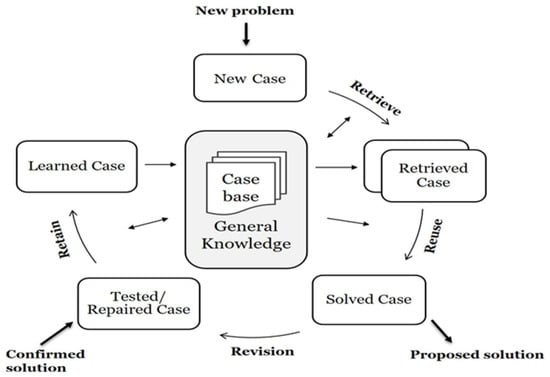
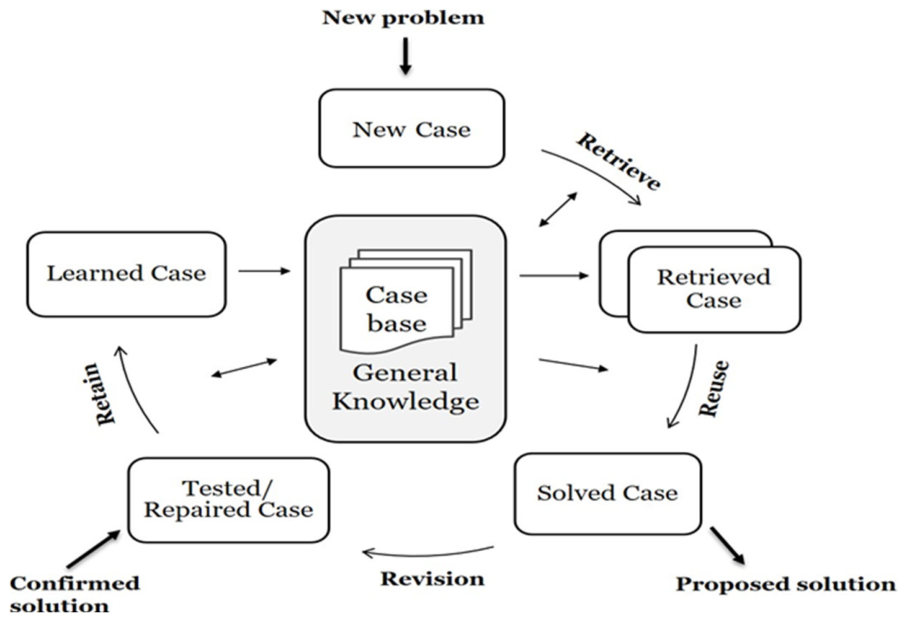
Effective indexing plays a pivotal role in CBR, as it enables the efficient retrieval and comparison of relevant cases. The CBR community has proposed several guidelines for designing robust indexes. First, indexes should be predictive, capturing the key attributes that determine case outcomes and the contexts in which cases may be applied. Second, they should be sufficiently abstract to ensure adaptability and reuse across a wide range of future scenarios. Third, they must remain concrete enough to be clearly identifiable in new problem situations [6,7]. To this end, different case representation and similarity-based retrieval approaches have been developed to facilitate the identification and reuse of relevant past experiences [8,9], each tailored to support the application of CBR in specific problem domains. A widely accepted model of CBR processing is the CBR cycle proposed by [7] which involves a reasoning cycle of four processes: Retrieve, Reuse, Revise, and Retain (Figure 1).
Figure 1.
The Case-Based Reasoning cycle [7].
CBR starts by representing the target problem as a new case to be solved. The reasoning process then follows the classical four-step cycle of Retrieve, Reuse, Revise, and Retain.
During the Retrieve phase, the system searches the case base to identify previously solved cases that are most similar to the target case. Various retrieval techniques have been proposed in the literature, including k-Nearest Neighbors (k-NN), decision trees, and similarity-based indexing methods [9]. Regardless of the retrieval strategy, an appropriate similarity model is essential for identifying the most relevant prior experiences [8].
In the Reuse phase, the solution associated with the retrieved case is transferred to the target problem. When differences exist between the retrieved and target cases, an adaptation mechanism is required. Common adaptation strategies include re-instantiation, substitution, and transformation [10].
The Revise phase evaluates the suitability of the proposed solution before it is accepted. This step may involve expert validation, user feedback, or consistency checking to determine whether the adapted solution adequately addresses the target problem [3].
Finally, the Retain phase determines whether the validated case should be incorporated into the case base for future reuse. Since retaining every solved case may introduce redundancy or noise, many CBR systems employ retention policies based on similarity thresholds, case quality, or utility criteria [8].
CBR has been successfully applied in numerous domains, including healthcare, engineering, manufacturing, education, and decision-support systems [11]. More recently, research has explored the integration of CBR with machine learning [12], semantic technologies, and large language models [13] to improve retrieval quality, case adaptation, and knowledge acquisition. These hybrid approaches further reinforce the role of CBR as an effective paradigm for knowledge reuse and intelligent decision support in modern data-driven environments.
2.2. CBR for Knowledge and Experience Reuse
The use of Case-Based Reasoning (CBR) for experience reuse has been extensively studied across a wide range of scientific disciplines. Leveraging prior experiences is widely recognized as a means to reduce redundant effort, prevent recurring issues, save time, accelerate development, and assist novices who may lack sufficient expertise. The literature on CBR-based experience reuse demonstrates a diverse array of approaches and methodologies aimed at achieving these benefits.
Table 1 summarizes and compares representative CBR-based approaches for experience reuse across different application domains, highlighting their support for experience reuse, metadata management, viewpoint consideration, and their main limitations.
Table 1.
Comparison of existing CBR-based approaches for experience reuse and the proposed CCReF framework.
As shown in Table 1, although numerous CBR-based approaches have been proposed for experience reuse across domains such as healthcare, education, project management, cloud computing, and industrial engineering, most existing works focus on reusing past cases to support decision-making within a specific application domain. Only a limited number of studies consider the management of user viewpoints, and even fewer address the reuse of metadata and annotations generated during decision processes. Furthermore, existing approaches rarely exploit the Common Warehouse Metamodel (CWM) as a foundation for structuring and sharing experiential knowledge. Therefore, a gap remains regarding the integration of viewpoint-based metadata management and case-based experience reuse in data warehouse environments. To address this gap, we propose the Common Case Reuse Framework (CCReF), which combines our viewpoint-based extension of CWM with a CBR mechanism to support structured, multi-perspective experience reuse and knowledge capitalization.
3. CCReF Architecture
In this section, we present the architecture of the Common Case Reuse Framework (CCReF) and describe its main components. Building on our previously introduced viewpoint metamodel within a decisional process, CCReF integrates this metamodel with Case-Based Reasoning (CBR) to enable systematic reuse of user experiences and metadata throughout CWM-based decision processes.
The three challenges identified in the Introduction directly motivate the design of the proposed CCReF framework. To make the alignment between the identified challenges and the proposed technical solutions explicit, Table 2 summarizes how each challenge is addressed by the corresponding components and mechanisms of CCReF.
Table 2.
Alignment between the identified challenges and the corresponding CCReF components.
As shown in Table 2, each challenge identified in the Introduction is addressed by a corresponding component of CCReF. The first challenge is addressed through the viewpoint-oriented case representation, which enables user viewpoints, annotations, and metadata to be captured as structured and reusable cases. The second challenge is addressed through the indexing and similarity-based retrieval mechanisms, which consider the analytical objective, context, and user role when identifying relevant prior experiences. Finally, the third challenge is addressed through the reuse, adaptation, and retention mechanisms, which allow retrieved experiences to be applied to new decision situations and incorporated into the case base. The following subsections describe these components and their interactions in detail.
3.1. Viewpoint-Based Extension of CWM
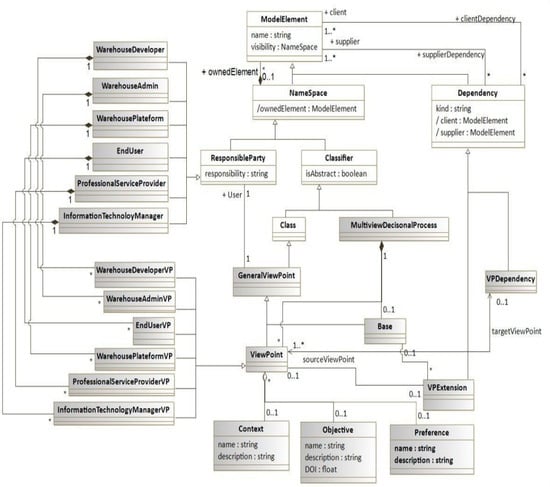
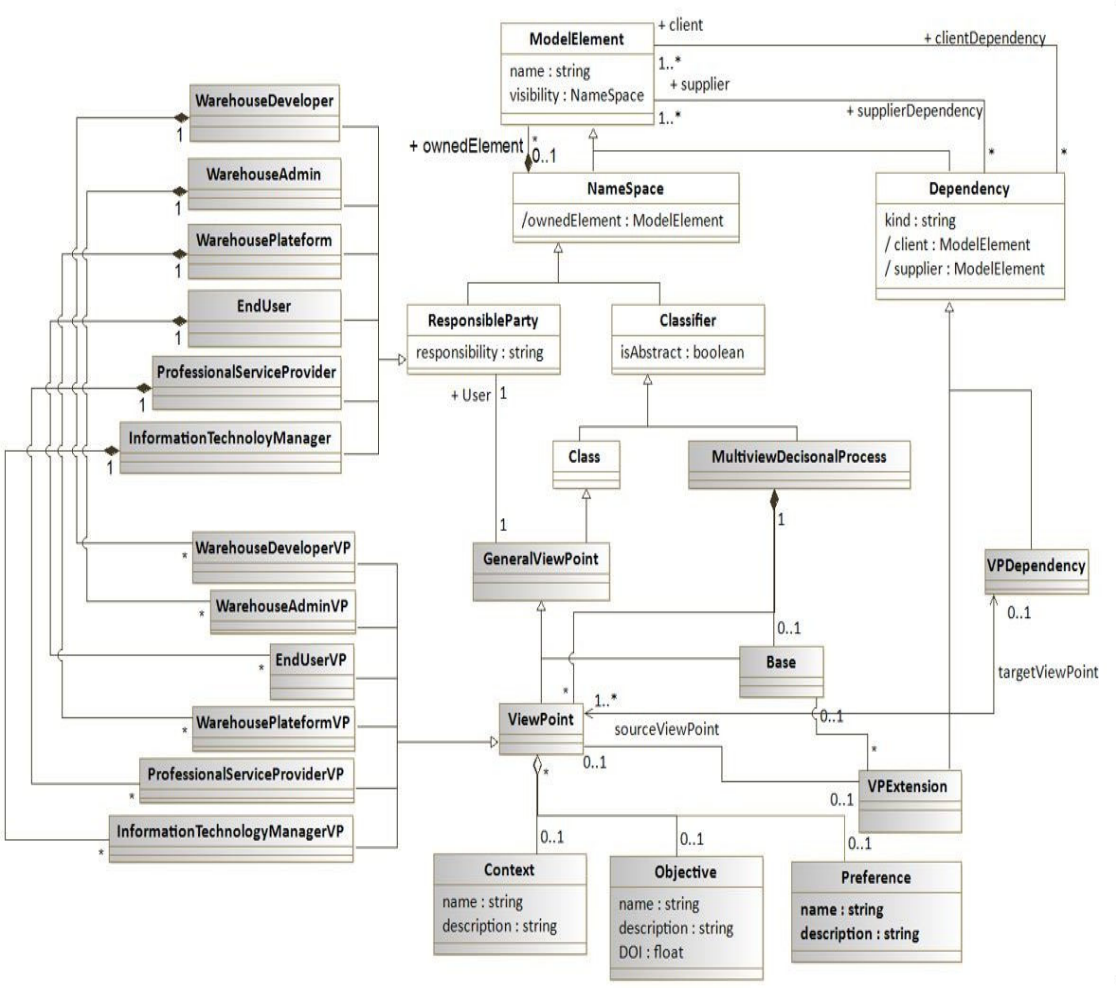
A decisional process based on the Common Warehouse Metamodel (CWM) can be accessed and utilized by users with different roles, profiles, objectives, and perspectives. To represent these user-dependent perspectives, our previous work introduced a viewpoint-oriented extension of the CWM-based modeling environment [2] (Figure 2). The detailed structure and modeling principles of this extension are presented in [2]; therefore, only its main concepts are recalled here as the basis for the proposed CCReF framework.
Figure 2.
Our viewpoint metamodel by extending CWM [2].
The extension introduces viewpoint-related concepts, including Viewpoint, Context, Objective, Preference, and User Role, which provide an additional layer for representing the perspective from which a user interacts with and exploits data warehouse information. These concepts enable user-specific analytical perspectives, preferences, and contextual information to be associated with the warehouse exploitation process.
In the present work, this viewpoint-oriented extension serves as the foundation for representing user experiences, annotations, and metadata as cases. CCReF subsequently integrates these viewpoint-based representations with a Case-Based Reasoning mechanism to support their capitalization, retrieval, adaptation, and reuse.
In this paper, the term “CWM extension” refers to the conceptual viewpoint-oriented extension introduced in our previous work [2,5]. No claim of formal OMG certification or compliance testing is made; the extension is used here as a conceptual modeling layer built upon the CWM-based environment.
3.2. CCReF: A Viewpoint-Based Case Reuse Framework
The proposed Common Case Reuse Framework (CCReF) extends the viewpoint metamodel with a Case-Based Reasoning mechanism that supports the capitalization and reuse of user experiences generated during CWM-based decision processes. The framework preserves analytical annotations together with the reasoning context in which they were produced, thereby facilitating knowledge sharing among users and assisting novice decision-makers.
As discussed in Section 2, CBR is based on the premise that similar problems have similar solutions. When a new problem arises, the system retrieves relevant experiences by searching for past cases with comparable characteristics.
In CCReF, the case base initially consists of a collection of cases capturing previous viewpoints and corresponding user annotations collected during data warehouse exploitation. Each case is represented as a (problem, solution) pair: the problem corresponds to a user’s viewpoint, while the solution comprises the associated annotation or metadata reflecting that user’s experience. For the preliminary evaluation presented in Section 4, the case base contains twelve viewpoint cases representing representative OLAP-oriented warehouse scenarios collected from the proposed application domain.
During a CWM-based decisional process, various types of user experiences can be captured, such as OLAP operations, ETL activities, or data mining tasks. A new case, denoted as VP (Viewpoint), represents the problem component for which a corresponding solution (user experience) must be identified.
The first step involves comparing the attributes of VP with those of all existing problem components in the case base, using a similarity function. This process identifies the most similar case—that is, the (viewpoint, experience) pair whose characteristics most closely match VP. The solution component of the retrieved case is then adapted and paired with VP to generate a proposed solution, forming a candidate case (VP, experience). This solution is subsequently submitted for expert review.
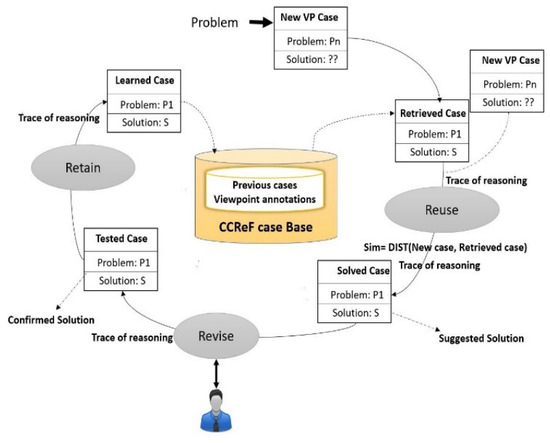
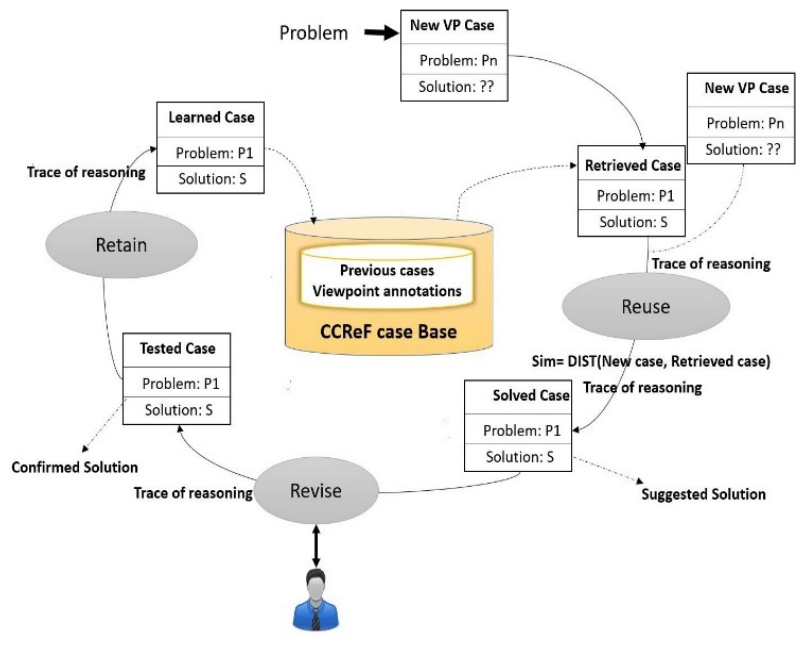
If the solution passes the revision phase, it becomes a validated case; otherwise, it is discarded. Finally, a decision is made regarding the incorporation of the tested case into the case base. The learning mechanism relies on a similarity threshold (th): if the similarity score exceeds this threshold, the case is retained and added to the repository. Figure 3 illustrates the CCReF process as described, solid arrows in the figure represent the main flow of the CBR cycle, whereas dashed arrows represent auxiliary relationships or information links, such as interactions with the case base and reasoning traces.
Figure 3.
The Common Case Reuse Framework process.
3.2.1. Case Representation
Although CCReF relies on a CBR approach, case representation remains a key element in any CBR system, as it strongly influences efficiency, accuracy, and overall performance. A well-designed representation scheme is therefore essential to ensure that reasoning and learning processes are both cost-effective and operationally reliable. In this regard, it is necessary to define an appropriate structure for our viewpoint-based cases.
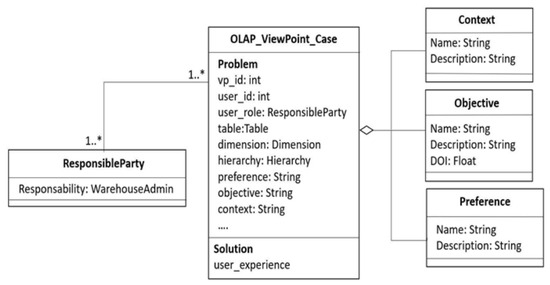
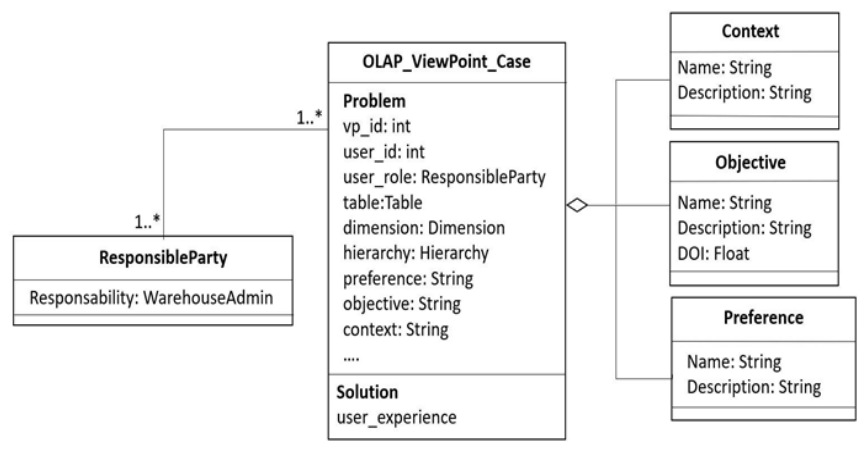
To address this requirement, we adopt an Object-Oriented (OO) case representation model, where each case is structured as a set of objects described by attribute–value pairs [25,28]. As illustrated in Figure 4, the OO case model in our framework is organized into two main components: Problem, which encapsulates the user’s viewpoint; Solution, which contains the corresponding user experience, expressed as annotations or metadata.
Figure 4.
The Object-Oriented representation for the viewpoint case.
The Problem description of the case captures the essential attributes of a viewpoint case, which must be fulfilled by a CWM user. These attributes vary according to the warehouse scenario being analyzed. In this paper, we illustrate this with the example of a viewpoint case in the context of an OLAP analysis. The key attributes of the viewpoint case are:
- vp_id: the identifier of the viewpoint (Integer),
- user_id: the identifier of the CWM user (Integer),
- user_role: the role of the CWM user expressing the viewpoint, which can be one of the following: WarehouseDeveloper, WarehouseAdmin, EndUser, InformationTechnologyManager, WarehousePlatform, and ProfessionalServiceProvider [2].
Additionally, the viewpoint case includes the following components:
- Context of analysis: characterized by name and description attributes,
- Preference class: defined by a name and description,
- Objective of analysis class: described by a name, a description, and a Degree of Interest (DOI).
The DOI attribute is a real number ranging from 0 to 1, indicating the user’s level of interest in achieving the objective. This value is determined by the CWM user and can be expressed qualitatively (e.g., very low, low, medium, high, very high) and quantitatively (e.g., 0.2 for low, 0.5 for medium, 0.8 for high).
The Solution description represents the user’s experience associated with the viewpoint. This experience is captured as a user_experience string attribute in the case representation. The user experience corresponds to the metadata and annotations collected during the user’s interaction with the decisional process based on the CWM viewpoint. This experience is stored in an XMI file [2] and maintained in the case base.
3.2.2. Case Indexing
A case index refers to a set of key descriptors that distinguish a case from others within the case base. When a new case is stored, specific indexes are assigned to facilitate efficient retrieval and comparison. The effectiveness of case retrieval depends heavily on the choice of these indexes, as they ensure that the most relevant case is identified at the appropriate time.
In the context of our viewpoint-based cases, which are consistently defined by a context of use, an objective to fulfill, and a user description, we adopt the following attributes as indexes:
- Context (C): the specific environment or domain in which the viewpoint is applied;
- Objective (O): the intended goal that the viewpoint seeks to achieve;
- User_role (R): the role of the user expressing the viewpoint.
These indexing attributes were selected because they encapsulate the essential distinguishing features of a viewpoint case. By capturing both the situational and user-driven dimensions of experience, they enable precise retrieval and comparison during the CBR process.
3.2.3. Case Retrieval
New cases are provided as input to the Case-based Reasoner (Figure 3) in the form of a problem part (Pn). To find a solution for the new case, the Retrieve phase computes the similarity function (DIST), which quantifies the distance between the new case and each case in the case base. Case retrieval involves identifying the case(s) in the case base that most closely resemble the current case. This search operation may result in finding a case that completely matches the new viewpoint’s characteristics, or it may return a set of cases with some similarities, such as sharing the same Objective or Context.
In our approach, we use the K-Nearest Neighbors (K-NN) strategy [7], where the similarity of each case to the target problem is expressed as a real number between [0, 1]. In nearest-neighbor retrieval, the case is chosen when the weighted sum of its matching features exceeds that of other cases in the case base. Put simply, a case that matches the current case across n features will be retrieved rather than one that matches only k features (where k < n). Features considered more significant in the problem-solving context can be weighted more heavily in the case-matching process [6,29]. Typically, the k most similar cases are retrieved. Alternatively, cases can be retrieved if their similarity to the target problem exceeds a predefined threshold (th). In our case, we set th to 0.5.
To measure similarity, various methods can be used, depending on the case representation [9]. We define a local similarity measure for each attribute of the viewpoint case, and a global similarity measure is computed as the weighted average of the local similarities. The weights assigned to the attributes allow for varying degrees of importance, and these weights can be adjusted manually by a user or domain expert.
- Case similarity
Case similarity is a fundamental component of the retrieval phase in Case-Based Reasoning, as it determines the extent to which a candidate case stored in the case base resembles a new case submitted to the system. The objective of similarity assessment is therefore to identify the most relevant past experience for reuse in the current decisional situation. Since similarity is not an absolute notion [9] but depends on the selected case descriptors and their relative importance, it is necessary to define both an appropriate weighting scheme and a local similarity function for each indexing attribute.
Let CN denote a new case and CC a candidate case stored in the case base. The global similarity between CN and CC is computed as a weighted aggregation of the local similarities associated with the case indexes:
where
- CN: is the new case to be evaluated,
- CC: is a candidate case from the case base,
- wi: is the weight associated with the ith indexing attribute,
- simi(, ): is the local similarity between the values of the ith attribute in the two cases.
To ensure comparability between similarity scores, the weights are normalized such that:
where wi denotes the weight assigned to the i-th indexing attribute.
The weights are normalized so that their sum equals 1, ensuring that the global similarity score remains within the interval [0, 1].
In CCReF, the weighting scheme reflects the relative importance of the three viewpoint indexes used during retrieval: Context (C), Objective (O), and User Role (R). The Objective index is assigned the highest weight (wO = 0.6) because it represents the main intention pursued by the user and therefore constitutes the most discriminative criterion for identifying relevant prior experiences. The User Role index is assigned an intermediate weight ((wR = 0.3)), since the role of the decision-maker influences the interpretation and usefulness of a retrieved experience. Finally, the Context index is given a lower weight (wC = 0.1), as it provides complementary situational information but does not by itself determine the relevance of a viewpoint case.
These weights were empirically assigned based on domain-informed considerations, assuming that the analytical objective is the primary criterion for viewpoint similarity, followed by the decision-maker’s role and then the contextual setting. Accordingly, Objective, User Role, and Context were assigned weights of 0.6, 0.3, and 0.1, respectively. These values constitute an initial weighting configuration used for the feasibility evaluation rather than empirically validated optimal weights.
The local similarity function (simi) depends on the type of the attribute being compared. In the proposed framework, three categories of attributes are considered: string attributes, nominal attributes, and numerical attributes.
- String-valued attributes: String-valued attributes are compared using the Jaccard coefficient, which measures the overlap between the sets of terms contained in two textual descriptions [30]. This measure is appropriate for the current case representation, which relies on short textual descriptors, such as the names and descriptions of analytical objectives and contexts. Let S(a) and S(b) denote the sets of terms extracted from two string values (a) and (b). Their similarity is defined as:
This coefficient ranges from 0 to 1. A value of 1 indicates that the two string descriptions are identical, whereas a value of 0 indicates that they do not share any common term. In CCReF, this measure is used to compare textual attributes such as the name and description of the Context and Objective components.
- Nominal attributes: Nominal attributes are compared using an exact-match function. The local similarity is equal to 1 when the two compared values are identical and 0 otherwise:
This measure is used for the User Role index, since user roles correspond to discrete categories such as Warehouse Administrator, Warehouse Developer, or End User.
- Numerical attributes: For numerical attributes, similarity is computed from a normalized distance. Let (a) and (b) be two numerical values belonging to the same attribute. Their local similarity is defined as:
In the proposed framework, this numerical similarity is used to compare the Degree of Interest (DOI) associated with the Objective component. Since DOI values range from 0 to 1, Equation (5) simplifies to:
simDOI(a,b) = 1 − |a − b|
Thus, two objectives with identical DOI values have a similarity of 1, whereas increasingly different DOI values lead to lower similarity scores.
- Similarity computation for viewpoint cases
The similarity between two viewpoint cases is computed by combining the local similarities of the three indexing dimensions:
- Context similarity is calculated by comparing the name and description of the context using the Jaccard coefficient. This index receives the weight (wC = 0.1).
- User Role similarity is computed using the nominal exact-match function. This index receives the weight (wR = 0.3).
- Objective similarity is computed by comparing the name and description of the objective using the Jaccard coefficient, and the DOI using the numerical similarity defined above. This index receives the highest weight (wO = 0.6).
The global similarity score between a new viewpoint case and a candidate case is then obtained by aggregating these weighted local similarities according to Equation (1). A candidate case is considered relevant if its similarity score exceeds a predefined threshold (th). In the current implementation, the threshold is set to (th = 0.5). This value was selected to ensure that only cases sharing at least a moderate level of similarity with the target viewpoint are retained as potential candidates for reuse.
The proposed similarity model enables CCReF to retrieve experiences that are not only related to the same analytical task but also consistent with the user’s objective, organizational role, and decisional context. By combining contextual, intentional, and user-centered dimensions within a weighted similarity framework, the system supports more relevant and personalized experience reuse in CWM-based decision-support environments.
3.2.4. Case Reuse/Adaptation
Once the retrieval phase has identified the most similar case in the case base, the next step consists of reusing its solution to support the current viewpoint. In Case-Based Reasoning, the reuse phase aims to determine how the solution associated with a previously solved case can be transferred to a new problem. This requires analyzing the extent to which the retrieved case matches the current viewpoint and identifying which elements of the stored experience remain relevant in the new decisional situation.
In CCReF, the solution part of a retrieved case corresponds to the user experience associated with the viewpoint, including annotations, metadata, observations, and decision traces produced during previous data warehouse exploitation activities. When a new case is submitted to the system, the solution of the most similar retrieved case is considered as a candidate experience for the new viewpoint. This candidate solution is then reused either directly or through an adaptation mechanism, depending on the degree of similarity between the source case and the target case.
When the new viewpoint is highly similar to the retrieved case, the reuse process can be performed directly by transferring the solution component of the retrieved case to the new case. However, when differences exist between the source and target viewpoints, an adaptation step is required in order to ensure that the proposed experience remains consistent with the new decisional context.
In the present version of CCReF, adaptation is carried out using a re-instantiation strategy. This strategy consists of copying the solution associated with the retrieved case and instantiating it within the context of the new viewpoint. More specifically, the reusable annotations, metadata, and experiential knowledge attached to the source case are transferred to the target case, while viewpoint-dependent elements are adjusted according to the characteristics of the target viewpoint. Thus, adaptation does not generate a new experience from scratch; rather, it preserves the reusable elements of the retrieved experience while modifying the elements that depend on the target viewpoint. This approach is suitable when the retrieved and target cases share the same analytical objective or a sufficiently similar decision context, so that the previously captured experience can be reused with limited transformation [31].
For example, consider the retrieval of case C1 for the target case T1 presented in Section 4. C1 concerns an academic research context in which the objective is to feed a data warehouse from collected data, and its stored experience consists of ETL configuration notes and data integration annotations. When C1 is reused for T1, the reusable elements of the experience, such as the ETL configuration knowledge and data integration annotations, are retained. The viewpoint-dependent elements are then re-instantiated according to the target case, particularly the specific data sources and analytical requirements associated with T1. The resulting adapted experience therefore preserves the relevant ETL and integration knowledge from C1 while being associated with the characteristics of the new target viewpoint. This example illustrates how CCReF transfers reusable experiential knowledge without simply copying the complete source case.
3.2.5. Case Revision
After the reuse/adaptation phase, the proposed solution is returned as a candidate solution for the new viewpoint. At this stage, the purpose of the revision phase is to verify whether the retrieved and adapted experience is appropriate for the target case and consistent with the current decisional context [32]. In CCReF, this validation may be carried out by expert users who assess the relevance, correctness, and usefulness of the proposed experience before it is accepted by the system.
More specifically, the expert examines whether the annotations, metadata, and experiential knowledge transferred from the retrieved case adequately address the objective of the new viewpoint and remain compatible with the user’s role and contextual setting. If the proposed solution is judged inappropriate, inconsistent, or irrelevant, it is rejected and is not considered for storage in the case base. Otherwise, it becomes a validated case that can proceed to the retention phase.
Although expert intervention is not mandatory in all situations, it plays an important role in improving the quality of the case base and the reliability of the reasoning process. Expert feedback contributes to filtering unsuitable experiences, validating useful ones, and progressively refining the retrieval mechanism. It can also support the adjustment of similarity parameters, such as the retrieval threshold, particularly when the case base evolves in size and diversity over time.
3.2.6. Case Retention
Once the proposed solution has been revised and validated, the final step of the Case-Based Reasoning cycle consists in deciding whether the solved case should be retained in the case base for future reuse. This phase is essential because it enables the system to learn incrementally from newly validated experiences and to progressively enrich its repository of viewpoint cases.
In CCReF, a retained case is composed of the new viewpoint together with its validated solution, including the associated annotations, metadata, and user experience generated during the decisional process. However, retaining all solved cases indiscriminately may gradually introduce redundancy or noise into the repository, which can negatively affect retrieval quality and overall system performance. Conversely, retaining too few cases would restrict the learning capability of the framework and reduce its ability to support future decisional situations.
To balance these two objectives, CCReF relies on a retention criterion based on both similarity assessment and expert validation. Let (CN) denote the new case and (CC) the most similar case retrieved from the case base. After revision, the new case is retained only if its similarity score with respect to the retrieved case exceeds a predefined threshold (th), and if the proposed solution has been judged relevant by the expert. Formally, the retention rule can be expressed as follows:
where (CB) denotes the case base, (Sim(CN, CC)) is the global similarity score defined in Equation (1), and (th) is the similarity threshold used to determine whether the new case is sufficiently close to previously stored experiences to be considered a meaningful addition to the repository.
CN ∊ CB if Sim (CN, CC) ≥ th and the solution is validated by the expert.
In the current implementation, the threshold is set to (th = 0.5). This value is intended to ensure that only cases exhibiting at least a moderate level of similarity with existing validated cases are retained. The threshold therefore acts as a filtering mechanism that limits the incorporation of irrelevant or weakly related experiences. At the same time, expert validation provides an additional safeguard by ensuring that retained cases are not only similar to prior ones, but also contextually relevant, coherent, and useful from a decisional perspective.
When both conditions are satisfied, the validated case is added to the case base and becomes available for future retrieval and reuse. Otherwise, the case is discarded and not stored in the repository. Through this retention mechanism, CCReF seeks to preserve a balance between incremental learning and case-base quality control, thereby supporting the long-term reliability of experience reuse in CWM-based decision-support environments.
It should be noted, however, that the present retention strategy remains relatively simple, as it relies primarily on a fixed similarity threshold combined with expert judgement. More advanced retention policies could be investigated in future work, for example by incorporating novelty detection, redundancy control, or adaptive threshold tuning based on the growth and diversity of the case base.
4. Case Study and Preliminary Evaluation
To illustrate the applicability of the proposed framework and provide an initial assessment of its retrieval mechanism, we conducted a case study in the context of a data warehouse exploitation process involving OLAP-based decision-support activities. The objective of this study is not to claim a full operational validation of CCReF, but rather to demonstrate the feasibility of representing analytical experiences as viewpoint cases and reusing them through the proposed Case-Based Reasoning process.
4.1. Case Study Context
The case study was conducted in a decision-support setting inspired by a company involved in the design, maintenance, and exploitation of analytical systems for data-intensive applications. In such environments, users with different responsibilities interact with the warehouse process from different perspectives. These users may include warehouse administrators, warehouse developers, end users, and IT-oriented actors, each of whom produces annotations, metadata, and experience traces while performing analytical tasks.
Within this context, the purpose of CCReF is to support the reuse of prior analytical experiences by capitalizing on user viewpoints expressed during warehouse exploitation scenarios. The study focuses on OLAP-related decision situations in which users need guidance based on previously solved cases sharing similar objectives, contexts, and user roles.
4.2. Case Base Construction
To support the case study, a case base of 12 viewpoint cases was constructed. Each case represents a previously encountered analytical situation and is modeled according to the Object-Oriented case representation introduced in Section 3.2.1. In CCReF, a case is represented as a pair (Problem, Solution):
- the Problem part corresponds to a user viewpoint and includes the indexing attributes Context, Objective, and User Role, together with their associated descriptive attributes;
- the Solution part stores the corresponding user experience in the form of annotations and metadata generated during the warehouse exploitation process.
The 12 cases in the case base were constructed as illustrative scenarios based on representative analytical situations in data warehouse and OLAP environments. They were designed to cover different combinations of Context, Objective, and User Role and to illustrate the types of experiences that can be captured and reused by CCReF. The case base includes scenarios such as feeding a data warehouse from collected data, improving OLAP query performance, validating data quality before analysis, preparing multidimensional views for reporting, monitoring ETL execution issues, and reusing previous analytical settings in similar contexts.
These cases were not extracted from longitudinal real-world user logs; rather, they were designed to provide a controlled and representative basis for demonstrating the proposed retrieval and reuse process. Table 3 summarizes the structure of the case base used in the study.
Table 3.
Summary of the viewpoint case base used in the preliminary evaluation.
The case base was intentionally kept limited in size because the objective of this study is to provide a controlled proof-of-feasibility rather than a large-scale benchmark. Nevertheless, the selected cases were designed to cover different combinations of contexts, objectives, and user roles in order to test the behavior of the similarity model under varied analytical situations.
5. Evaluation Protocol
To provide an initial assessment of the retrieval mechanism, we defined four new viewpoint cases representing unseen analytical situations. For each new case, CCReF computes its similarity to all cases stored in the case base using the similarity model described in Section 3.2.3. The system then retrieves the most similar case according to the weighted combination of the three indexing dimensions: Context, Objective, and User Role.
The weighting scheme used in this study follows the rationale presented earlier:
- Objective receives the highest weight because it represents the main analytical intention of the user;
- User Role captures the perspective from which the decision problem is expressed;
- Context provides complementary information about the decision environment.
- For each new case, the retrieved case was examined with respect to:
- the global similarity score returned by the retrieval process;
- the semantic coherence between the retrieved case and the target case;
- the relevance of the proposed solution, assessed qualitatively from the viewpoint of the analytical task.
At this stage, the evaluation remains preliminary and feasibility-oriented. It aims to verify that the framework retrieves viewpoint cases that are coherent with the target problem and that the proposed reuse process can support analytical guidance in similar warehouse situations.
5.1. Retrieval Results
Table 4 presents the four test cases used in the preliminary evaluation together with the most similar case retrieved by CCReF.
Table 4.
Preliminary retrieval results obtained with CCReF.
The results show that the retrieved cases share semantic similarity with the corresponding target cases. For example, T1 retrieves C1, which addresses the same academic context, a closely related objective of feeding a data warehouse, and the same user role. Similarly, T2 retrieves C5, which also concerns ETL monitoring from the perspective of a warehouse administrator. In the case of T3, the retrieved case C7 corresponds to a healthcare-oriented multidimensional analysis scenario and therefore provides a relevant prior experience for cube preparation. Finally, T4 retrieves C8, which reflects a similar retail OLAP analysis task involving comparative sales reporting for an end user.
These examples suggest that the similarity model is able to prioritize cases sharing the same analytical goal and user perspective, while using context as a complementary factor to refine retrieval.
For the four test cases, the proposed viewpoint-aware retrieval considers Objective, User Role, and Context jointly, whereas the objective-only configuration considers only the analytical objective. The comparison indicates that incorporating the additional viewpoint dimensions can influence case selection when several candidate cases share similar analytical objectives. In particular, User Role and Context provide additional information for distinguishing between otherwise similar cases. These observations provide an initial indication of the contribution of viewpoint-aware retrieval, while a more systematic quantitative comparison remains part of future work.
5.2. Discussion
The case study provides an initial illustration of how CCReF can support the reuse of prior analytical experiences in CWM-based warehouse processes. Several observations can be drawn from the preliminary evaluation.
First, the Objective index appears to play an important role in the retrieval process, as cases sharing similar analytical goals tend to be prioritized even when their contextual descriptions differ slightly. This behavior is consistent with the design of the similarity model, in which the Objective dimension captures the main problem-solving intention of the user and is therefore assigned the highest weight (0.6). However, this result should be interpreted with caution, as the current evaluation does not allow the independent contribution of Objective to be isolated from the effect of its predefined weight. Thus, the results do not provide sufficient evidence to conclude that Objective is intrinsically the most influential dimension. A dedicated sensitivity or ablation analysis would be required to assess the individual contribution of each viewpoint dimension and to validate the selected weighting scheme.
Second, the User Role contributes to distinguishing between viewpoints that may pursue related objectives but from different operational perspectives. For instance, a warehouse administrator and an end user may both interact with OLAP structures, yet the type of reusable experience associated with each profile is different. Incorporating the user role into the similarity computation therefore improves the semantic adequacy of the retrieved cases.
Third, the Context attribute provides useful complementary information but has a lower impact on retrieval than the objective and the role. This is consistent with the weighting strategy adopted in the framework, where context helps refine the search space without dominating the analytical intention expressed by the case.
Overall, the study supports the feasibility of representing prior analytical experiences as viewpoint cases and retrieving them through the CCReF similarity mechanism. At the same time, it also confirms that the current evaluation remains preliminary. The case base is limited in size, the relevance assessment is qualitative, and no comparative baseline has yet been introduced. For this reason, the present results should be interpreted as an initial proof of feasibility rather than as a full empirical validation of operational effectiveness.
6. Limitations and Future Work
The present study should be regarded as a proof of feasibility rather than a full empirical validation of CCReF. The case study illustrates how viewpoint-oriented experiences can be represented, retrieved, and reused in a CWM-based decisional context, but it does not yet provide a large-scale evaluation of the framework. In particular, the evaluation relies on four test cases, which limits the extent to which the results can be generalized to a broader range of decision-support scenarios.
A first limitation concerns the case base, which remains limited and domain-specific. Although sufficient to demonstrate the reasoning process, it does not allow a systematic assessment of retrieval performance or generalizability across different decision-support settings.
A second limitation relates to the similarity model. The weights assigned to the Context, Objective, and User Role indexes, as well as the similarity threshold, were defined empirically in the current version of the framework. Their impact on retrieval effectiveness has not yet been validated through sensitivity analysis or comparative experiments.
In addition, the current adaptation and retention mechanisms remain relatively simple. Reuse is mainly based on re-instantiation of the retrieved solution, while retention relies on expert validation combined with a similarity threshold. More advanced strategies could further improve the robustness and scalability of the framework.
Future work will therefore focus on a rigorous empirical evaluation of CCReF using a larger and better-documented case base. This evaluation should include quantitative retrieval metrics, such as Precision and Recall, as well as expert-based and user-based assessments of the relevance and usefulness of retrieved cases. Comparative experiments with alternative retrieval strategies will also be conducted in order to better assess the added value of viewpoint-aware experience reuse. A larger evaluation set will also enable a more systematic assessment of the framework’s robustness and stability.
7. Conclusions
This paper presented CCReF, a Case-Based Reasoning framework designed to support the reuse of user experiences, annotations, and metadata in CWM-based digital decision processes. The framework extends our previous viewpoint metamodel by integrating a CBR mechanism for case representation, indexing, retrieval, reuse, revision, and retention. In CCReF, each case captures a user viewpoint through the dimensions of context, objective, and user role, while the associated solution stores the corresponding analytical experience in the form of annotations and metadata. The preliminary case study illustrates the feasibility of the proposed approach for representing and retrieving viewpoint-dependent analytical experiences in OLAP-oriented warehouse scenarios. The results suggest that combining viewpoint modeling with case-based retrieval can support the reuse of semantically relevant prior cases and provide guidance in similar decision situations. However, the present work remains a feasibility-oriented study: the case base is limited, the evaluation is preliminary, and further validation is needed. Future work will focus on expanding the case base, refining the similarity model, and conducting a broader quantitative evaluation in real-world decision-support environments.
Author Contributions
Conceptualization, L.D.; methodology, L.D.; software, L.D.; validation, E.Z., H.B. and B.T.; formal analysis, L.D.; investigation, L.D.; resources, H.B. and B.T.; writing—original draft preparation, L.D.; writing—review and editing, L.D.; supervision, H.B. All authors have read and agreed to the published version of the manuscript.
Funding
This research received no external funding.
Institutional Review Board Statement
Not applicable.
Informed Consent Statement
Not applicable.
Data Availability Statement
No new datasets were generated or analyzed during the current study. The data supporting the findings are contained within the article.
Conflicts of Interest
The authors declare no conflicts of interest.
Abbreviations
The following abbreviations are used in this manuscript:
| BI | Business Intelligence |
| CBR | Case-Based Reasoning |
| CCReF | Common Case Reuse Framework |
| CWM | Common Warehouse Metamodel |
| KNN | K-Nearest Neighbors |
| KDD | Knowledge Discovery in Databases |
| LLMs | Large Language Models |
| DOI | Degree of Interest |
| OO | Object-Oriented |
| OLAP | Online Analytical Processing |
References
- Zhang, P.; Essaid, A.; Zanni-Merk, C.; Cavallucci, D.; Ghabri, S. Experience capitalization to support decision making in inventive problem solving. Comput. Ind. 2018, 101, 25–40. [Google Scholar] [CrossRef] [Scilit]
- Demraoui, L.; Behja, H.; Zemmouri, E.M.; Abbou, R.B. A viewpoint based extension of the common warehouse metamodel to support the user’s viewpoint approach. Int. J. Metadata Semant. Ontol. 2016, 11, 137–154. [Google Scholar] [CrossRef] [Scilit]
- Yan, A.; Cheng, Z. A review of the development and future challenges of case-based reasoning. Appl. Sci. 2024, 14, 7130. [Google Scholar] [CrossRef] [Scilit]
- Zemmouri, E.M.; Behja, H.; Marzak, A.; Trousse, B. Ontology-based knowledge model for multi-view KDD process. Int. J. Mob. Comput. Multimed. Commun. (IJMCMC) 2012, 4, 21–33. [Google Scholar] [CrossRef] [Scilit]
- Demraoui, L.; Behja, H.; Abbou, R.B. Towards integration of the users’ preferences into the common warehouse metamodel. In 2014 Third IEEE International Colloquium in Information Science and Technology (CIST); IEEE: New York, NY, USA, 2014; pp. 151–154. [Google Scholar] [CrossRef] [Scilit]
- Perner, P. Case-based reasoning–methods, techniques, and applications. In Iberoamerican Congress on Pattern Recognition; Springer International Publishing: Cham, Switzerland, 2019; pp. 16–30. [Google Scholar] [CrossRef] [Scilit]
- Kolodner, J.L. An introduction to case-based reasoning. Artif. Intell. Rev. 1992, 6, 3–34. [Google Scholar] [CrossRef] [Scilit]
- Omonijo, O.O.; Akinola, S.O.; Ugbogbo, M.J.; Orumgbe, C.; Yusuf, I.O. A Comprehensive Review of Case Representation and Similarity Measures in Case-Based Reasoning Systems. Univ. Ib. J. Sci. Log. ICT Res. 2025, 14. Available online: https://journals.ui.edu.ng/index.php/uijslictr/article/view/2032 (accessed on 9 August 2026).
- Bergmann, R.; Stahl, A. Similarity measures for object-oriented case representations. In European Workshop on Advances in Case-Based Reasoning; Springer: Berlin/Heidelberg, Germany, 1998; pp. 25–36. [Google Scholar] [CrossRef] [Scilit]
- Cordier, A.; Fuchs, B.; Mille, A. Engineering and learning of adaptation knowledge in case-based reasoning. In International Conference on Knowledge Engineering and Knowledge Management; Springer: Berlin/Heidelberg, Germany, 2006; pp. 303–317. [Google Scholar] [CrossRef] [Scilit]
- Zhang, J.; Jiang, S. Construction safety decision-making system based on improved integration of case-based reasoning and rule-based reasoning. J. Constr. Eng. Manag. 2025, 151, 04025130. [Google Scholar] [CrossRef] [Scilit]
- Habal, A.H.Y.; Medjnoun, A.; Djerbal, L.; Bahar, R. Comprehensive review on predicting CBR values using machine learning techniques. Asian J. Civ. Eng. 2025, 26, 3153–3165. [Google Scholar] [CrossRef] [Scilit]
- Hatalis, K.; Christou, D.; Kondapalli, V. Review of case-based reasoning for LLM agents: Theoretical foundations, architectural components, and cognitive integration. arXiv 2025, arXiv:2504.06943. [Google Scholar] [CrossRef] [Scilit]
- Houeland, T.G.H. Reuse of Past Games for Move Generation in Computer Go. Doctoral Dissertation, Master’s Thesis, NTNU, Trondheim, Norway, 2008. [Google Scholar]
- Egyed-Zsigmond, E.; Mille, A.; Prié, Y. Club♣(Trèfle): A use trace model. In International Conference on Case-Based Reasoning; Springer: Berlin/Heidelberg, Germany, 2003; pp. 146–160. [Google Scholar] [CrossRef] [Scilit] [PubMed]
- Behja, H.; Trousse, B.; Marzak, A. Plateforme objet d’évaluation orientée point de vue d’un système d’information. Ing. Syst. D’information 2005, 10, 107–134. [Google Scholar] [CrossRef] [Scilit]
- Bach, K.; Szczepanski, T.; Aamodt, A.; Gundersen, O.E.; Mork, P.J. Case representation and similarity assessment in the selfBACK decision support system. In International Conference on Case-Based Reasoning; Springer International Publishing: Cham, Switzerland, 2016; pp. 32–46. [Google Scholar] [CrossRef] [Scilit]
- Guessoum, S.; Laskri, M.T.; Lieber, J. RespiDiag: A case-based reasoning system for the diagnosis of chronic obstructive pulmonary disease. Expert Syst. Appl. 2014, 41, 267–273. [Google Scholar] [CrossRef] [Scilit]
- Ferrer Aran, X. Concept Discovery and Argument Bundles in the Web of Experiences. Doctoral Dissertation, Universitat Autònoma de Barcelona, Barcelona, Spain, 2017. Available online: http://hdl.handle.net/10261/197553 (accessed on 9 August 2026).
- Reuss, P.; Stram, R.; Juckenack, C.; Althoff, K.D.; Henkel, W.; Fischer, D.; Henning, F. FEATURE-TAK-framework for extraction, analysis, and transformation of unstructured textual aircraft knowledge. In International Conference on Case-Based Reasoning; Springer International Publishing: Cham, Switzerland, 2016; pp. 327–341. [Google Scholar] [CrossRef] [Scilit]
- Wienhofen, L.W.; Mathisen, B.M. Defining the Initial Case-Base for a CBR Operator Support System in Digital Finishing: A Methodological Knowledge Acquisition Approach. In International Conference on Case-Based Reasoning; Springer International Publishing: Cham, Switzerland, 2016; pp. 430–444. [Google Scholar] [CrossRef] [Scilit]
- Jonsson, C.J. Supporting Design Knowledge Reuse in Stamping Tool Design Using Case-Based Reasoning. Doctoral Dissertation, Jönköping University, Jönköping, Sweden, 2024. [Google Scholar]
- Kübler, E.; Minor, M. Experience Reuse in a Workflow-oriented Cloud Management Framework. In Proceedings of the WM1017: 9te Konferenz Professionelles Wissensmanagement, Karlsruhe, Deutschland, 5–7 April 2017; CEUR Workshop Proceedings. Volume 1821, pp. 78–91. Available online: https://ceur-ws.org/Vol-1821/W2_paper2.pdf (accessed on 9 August 2026).
- Tawfik, A.A.; Kolodner, J.L. Systematizing scaffolding for problem-based learning: A view from case-based reasoning. Interdiscip. J. Probl.-Based Learn. 2016, 10, 6. [Google Scholar] [CrossRef] [Scilit]
- Martin, A.; Emmenegger, S.; Hinkelmann, K.; Thönssen, B. A viewpoint-based case-based reasoning approach utilising an enterprise architecture ontology for experience management. Enterp. Inf. Syst. 2017, 11, 551–575. [Google Scholar] [CrossRef] [Scilit]
- Lawanna, T. An Adaptive CBR–Agentic AI Model for Detecting Fraudulent User Behavior in Digital Marketplace Platforms. J. Intell. Decis. Mak. Inf. Sci. 2026, 3, 1210–1236. [Google Scholar] [CrossRef] [Scilit]
- Wijekoon, A.; Wiratunga, N.; Corsar, D.; Martin, K.; Nkisi-Orji, I.; Palihawadana, C.; Caro-Martínez, M.; Díaz-Agudo, B.; Bridge, D.; Liret, A. iSee: Advancing multi-shot explainable AI using case-based recommendations. In ECAI 2024: 27th European Conference on Artificial Intelligence, 19–24 October 2024, Santiago de Compostela, Spain–Including 13th Conference on Prestigious Applications of Intelligent Systems (PAIS 2024); SAGE Publications Pvt. Ltd.: London, UK, 2024; pp. 4626–4633. [Google Scholar] [CrossRef] [Scilit]
- Jaczynski, M. Modèle et plate-forme à objets pour l’indexation des cas par situations comportementales: Application à l’assistance à la navigation sur le Web. Doctoral Dissertation, Université Nice, Nice, France, 1998; p. 288. Available online: https://www.sudoc.abes.fr/cbs/DB=2.1//SRCH?IKT=12&TRM=04958202X (accessed on 9 August 2026).
- Pal, S.K.; Dillon, T.S.; Yeung, D.S. (Eds.) Soft Computing in Case Based Reasoning; Springer Science & Business Media: London, UK, 2012. [Google Scholar] [CrossRef] [Scilit]
- Niwattanakul, S.; Singthongchai, J.; Naenudorn, E.; Wanapu, S. Using of Jaccard coefficient for keywords similarity. In Proceedings of the International Multiconference of Engineers and Computer Scientists, Hong Kong, 13–15 March 2013; Volume 1, pp. 380–384. [Google Scholar]
- François, N.; Lieber, J. A Knowledge Representation Approach for Reasoning with Adaptation Rules. In International Conference on Case-Based Reasoning; Springer Nature: Cham, Switzerland, 2025; pp. 204–219. [Google Scholar] [CrossRef] [Scilit]
- Solanki, S.; Verma, S.; Biswas, P.; Roy, P.; Singh, A.; Sharma, S. A comprehensive study of case-based reasoning in information retrieval: An artificial intelligence approach. In 2025 International Conference on Pervasive Computational Technologies (ICPCT); IEEE: New York, NY, USA, 2025; pp. 751–755. [Google Scholar] [CrossRef] [Scilit]

Disclaimer/Publisher’s Note: The statements, opinions and data contained in all publications are solely those of the individual author(s) and contributor(s) and not of MDPI and/or the editor(s). MDPI and/or the editor(s) disclaim responsibility for any injury to people or property resulting from any ideas, methods, instructions or products referred to in the content. |
© 2026 by the authors. Licensee MDPI, Basel, Switzerland. This article is an open access article distributed under the terms and conditions of the Creative Commons Attribution (CC BY) license.