


Abstract
Background/Objectives: Corticosteroids are the standard first-line treatment for immune thrombocytopenia (ITP), a disorder that itself carries an excess risk of thrombosis, yet the evidence on corticosteroid-associated thrombotic risk in ITP has not been systematically synthesized. We aimed to estimate the association between corticosteroid exposure and venous (VT) and arterial thrombosis (AT) in ITP. Methods: Following PRISMA 2020 (PROSPERO CRD420261504746), we searched PubMed/MEDLINE, Scopus, Cochrane CENTRAL, LILACS, ClinicalTrials.gov, and WHO ICTRP from 2000 to 28 September 2026. Adjusted hazard ratios (HRs) were synthesized by study and outcome; crude odds ratios (ORs) were pooled with random-effects (REML) models within two subgroups (European cohorts; Asian hospital-based series). Risk of bias was assessed with JBI tools (and ROBINS-E for the adjusted cohorts) and certainty of evidence with GRADE. Results: Twelve studies (18,059 participants) were included, ten in the meta-analysis. Adjusted evidence came almost entirely from a French nationwide cohort (10,039 adults), in which time-varying corticosteroid exposure was associated with VT (HR 3.55, 95% CI 2.74–4.58; approximately 11 additional hospitalizations per 1000 person-years of exposure) but not with AT (HR 1.15, 0.94–1.41); an Italian cohort with ever-use exposure gave imprecise estimates (VT 2.2, 0.5–10.4; AT 5.3, 0.9–40.6). Crude ORs were 3.48 (1.73–7.01) in two European cohorts and 0.82 (0.59–1.14) in seven Asian hospital-based series, none of which adjusted for corticosteroid exposure (P for subgroup difference < 0.001). Two randomized trials comparing corticosteroid regimens reported no thrombotic events (0/328; exact 95% CI 0–1.1%). Certainty was low for VT and very low for the other outcomes. Conclusions: Low-certainty evidence, dominated by a single nationwide cohort, suggests that current corticosteroid exposure is associated with an approximately 3.5-fold higher hazard of VT in adults with ITP, without a consistent arterial association. Retrospective series that compare prior use without a defined exposure window may be less informative about the risk associated with current exposure. Corticosteroid exposure may reasonably be considered in VT risk assessment in ITP.
1. Introduction
Immune thrombocytopenia (ITP) is defined as an autoimmune disorder characterized by isolated thrombocytopenia (a platelet count < 100 × 109/L) resulting from accelerated platelet destruction and impaired platelet production [1,2]. Its incidence in adults rises with age, so that a growing proportion of patients present with cardiovascular comorbidity [3,4]. Although bleeding dominates the clinical picture, ITP is paradoxically associated with an increased risk of venous and arterial thrombosis [5,6,7].
Population-based cohorts and meta-analyses of observational studies indicate that adults with ITP have an approximately two-fold higher risk of venous thromboembolism than the general population, with a lesser impact on arterial events [8,9,10,11,12,13]. Proposed mechanisms include the release of procoagulant platelet- and red-cell-derived microparticles, a circulating population of young, hemostatically active platelets, antiphospholipid antibodies, complement activation and a procoagulant plasma profile [6,14]. Platelet activation and the interactions of platelets with immune and endothelial cells provide a further link between immune dysregulation, inflammation and thrombosis [15]. Treatment-related factors, including splenectomy, intravenous immunoglobulin (IVIg) and thrombopoietin receptor agonists (TPO-RAs), contribute additionally [6,16].
Corticosteroids are the standard first-line treatment for adults with ITP, given either as prednisone or prednisolone over several weeks or as pulsed high-dose dexamethasone (HD-DXM), and current guidelines recommend avoiding courses longer than six weeks [2,17]. In practice, repeated and prolonged exposure remains common, and its cumulative toxicity is increasingly recognized [18,19,20]. In the general population, glucocorticoid use is associated with a higher risk of venous thromboembolism, which is greatest with current and new use [21]. A 2026 meta-analysis estimated a pooled relative risk of 2.60 (95% CI 1.89–3.58), highest with early, high-dose systemic corticosteroid therapy [22]. The effect is biologically plausible, since glucocorticoids increase factor VIII, von Willebrand factor, and fibrinogen and impair fibrinolysis through higher plasminogen activator inhibitor-1 levels [23].
Whether corticosteroids add to the baseline thrombotic risk of ITP is therefore a clinically relevant question, particularly for older patients and those with additional risk factors. In the ITP literature, however, corticosteroid exposure has usually been examined as one covariate among many, and existing meta-analyses have addressed the baseline risk of ITP or the risk associated with TPO-RAs and second-line treatments rather than corticosteroids [11,12,13,16]. Separating a drug effect from the prothrombotic activity of the disease that prompts treatment is a further difficulty [24].
We therefore conducted a systematic review and meta-analysis to estimate the association between corticosteroid exposure and venous and arterial thrombosis in patients with ITP, to examine how the definition of exposure influences the estimates, and to place the findings in the context of general-population evidence.
2. Materials and Methods
2.1. Protocol and Registration
The review was registered in PROSPERO (CRD420261504746; protocol version 1.0, 12 September 2026; amended as version 1.1 on 3 October 2026) and is reported according to the PRISMA 2020 statement [25] and its literature-search extension PRISMA-S [26]. Changes to the registered protocol are listed in Section 2.10 and in full in Table S5; the amendment was submitted to PROSPERO on 3 October 2026. Protocol version 1.0 was registered before the searches were run (28 September 2026); the amendment was made after the searches had been run and the eligible studies identified. Changes made subsequently (October 2026) are listed separately in Table S5, Part B.
2.2. Eligibility Criteria
We included studies of patients with ITP (primary or secondary, any disease phase, diagnosed by any recognized criteria) that reported thrombotic events according to systemic corticosteroid exposure (prednisone, prednisolone, methylprednisolone or dexamethasone, any dose, route or duration). Eligible designs were self-controlled case series, cohort studies (prospective or retrospective, with adjusted estimates or with exposure-stratified event counts), case–control studies with exposure counts for cases and controls, and randomized controlled trials (RCTs) reporting thrombosis in at least one corticosteroid-containing arm. The comparator was no corticosteroid exposure for observational comparisons; trials comparing two corticosteroid regimens were eligible for narrative synthesis. Outcomes were venous thrombosis (VT; deep vein thrombosis, pulmonary embolism, splanchnic or cerebral venous thrombosis), arterial thrombosis (AT; ischemic stroke, myocardial infarction, peripheral arterial thrombosis) and any thrombotic event. Time to thrombosis, dose–response, thrombosis-related mortality and thrombosis recurrence were secondary outcomes, to be described narratively where reported. Events had to be clinically diagnosed or imaging-confirmed, and the method of ascertainment was recorded; when a venous or arterial composite included superficial vein thrombosis or transient ischemic attack that could not be separated, the estimate was used as reported, and this was considered in the risk-of-bias and certainty assessments. Studies were restricted to those published from 2000 onwards, without language restriction. Two full texts were published in Chinese with English-language abstracts [27,28]; they were translated with machine translation. Because the data extracted from them were limited to tabulated counts and the results of regression analyses, the translations were checked by both reviewers against the English abstracts, table labels and numerical values; they were not verified by a native speaker.
The population of interest was adults. Cohorts that included some patients younger than 18 years were eligible when the population was predominantly adult and age-specific data could not be obtained; these studies were flagged and excluded in a sensitivity analysis. We excluded case reports, reviews, conference abstracts without extractable data, composite outcomes that included hemorrhagic events or non-thrombotic cardiovascular conditions, studies in which corticosteroid exposure could not be separated from other treatments, and studies that did not report thrombosis by corticosteroid exposure. Where several reports described the same population, the report with the corticosteroid-specific estimate was retained, and overlapping populations were never combined in the same pooled estimate.
2.3. Information Sources and Search Strategy
We searched PubMed/MEDLINE, Scopus, the Cochrane Central Register of Controlled Trials (CENTRAL) and LILACS from 1 January 2000 to 28 September 2026, and the ClinicalTrials.gov and WHO International Clinical Trials Registry Platform (ICTRP) registries. Scopus was searched in place of Embase, to which the review team had no access. Databases that were freely accessible or available through the authors’ institution were searched; databases requiring an additional subscription, including Chinese bibliographic databases, were not searched. The bibliographic strategies combined an ITP concept with a thrombosis concept (controlled vocabulary and free text) and, because studies of corticosteroid toxicity may not mention thrombosis in the title or abstract, a supplementary arm combined a corticosteroid term in the title with adverse-event or safety terms. Registry searches combined the ITP condition with corticosteroid and TPO-RA intervention terms. Searches were validated against seven studies identified before the search, all of which were retrieved. Reference lists of included studies and relevant reviews were screened. Full strategies are given in Table S1.
2.4. Study Selection
Records were de-duplicated and screened. Two reviewers (D.-C.P. and M.-A.G.) independently screened titles and abstracts and then full texts against the eligibility criteria; disagreements were resolved by discussion and, where needed, by a third reviewer (R.T.). Full-text reports that had first been appraised during protocol development were assessed again against the final eligibility criteria and are included in the flow diagram.
2.5. Data Extraction
Data were extracted independently and in duplicate by two reviewers (D.-C.P. and M.-A.G.) using a piloted form covering study identification, design, setting, period, population (sample size, age, ITP type), corticosteroid exposure definition and comparator, outcome definitions and ascertainment, follow-up, adjusted estimates with covariates, and event counts by exposure. Corresponding authors of studies with incomplete or non-stratified data were contacted on 27–28 September 2026 (21 requests; Table S3; one request could not be sent because no e-mail address was available, and two were not delivered). Requests unanswered by 29 September 2026 were treated as yielding no data for eligibility and analysis decisions; replies received after this date (up to 3 October 2026) were used only to confirm published data or to inform the narrative synthesis. The contact period was subsequently extended to 24 October 2026; no further replies or data were received. When a 2 × 2 table could be constructed, crude odds ratios (ORs) were calculated by the reviewers; these estimates are unadjusted and are labelled as such. For the Asian series, we also recorded whether corticosteroids were entered into a multivariable model and any adjusted corticosteroid estimate, and, for all studies, incidence rates per person-time and the proportion of patients receiving corticosteroids at the time of the thrombotic event, where reported. Corticosteroid estimates from excluded studies that reported composite outcomes were summarized descriptively.
2.6. Risk of Bias Assessment
Risk of bias was assessed independently by two reviewers using the Joanna Briggs Institute (JBI) critical appraisal checklists for cohort and case–control studies and the revised JBI tool for randomized controlled trials [29]. Judgements referred to the corticosteroid–thrombosis comparison used in this review rather than to the primary aim of each study, with particular attention to exposure definition and timing, confounding by indication, outcome ascertainment and, for the crude comparisons, the absence of adjustment. Each study was given an overall level of concern (low, low–moderate, moderate, moderate–high, high or very high); no summary score was calculated. An evidence hierarchy (pre-specified in protocol version 1.0 and revised in version 1.1) was applied to the interpretive strength of each analysis set, from strongest to weakest: self-controlled case series, adjusted observational estimates, and crude comparative estimates interpreted according to the exposure definition. Randomized comparisons of corticosteroid regimens were reported narratively because they contained no corticosteroid-free comparator. The adjusted estimates of the two cohorts were additionally assessed by two reviewers with the Risk of Bias in Non- Studies—of Exposures (ROBINS-E) tool [30], which is designed for cohort studies estimating the effect of an exposure. ROBINS-E was not applied to the crude comparisons, for which the confounding domain would have been rated at high or very high risk of bias in every study, or to the case–control studies and randomized trials, for which it is not designed; JBI therefore remained the primary tool for all included studies.
2.7. Effect Measures and Data Synthesis
Two analysis sets were defined because the studies differed fundamentally in exposure definition and in control of confounding. The primary analysis used adjusted hazard ratios (HRs) for corticosteroid exposure versus no exposure, separately for VT and AT. Because one cohort provided almost all the information and the two cohorts defined exposure differently, the adjusted estimates are presented by study; they were combined only in a sensitivity analysis for VT, for which log HRs and their standard errors were derived from the published 95% confidence intervals (CIs). Arterial estimates were not combined. The secondary analysis pooled crude ORs calculated from 2 × 2 counts, in two subgroups defined in protocol version 1.1: European cohorts, which compared ever-users with never-users, and Asian hospital-based series, in which prior corticosteroid use was compared between patients with and without thrombosis. Neither subgroup defined a time window of exposure relative to the event, and the subgroups also differed in region, setting, design, and outcome composition. The Haldane–Anscombe correction (0.5 added to each cell) was applied only to studies with a zero cell [31]. For a matched case–control study, an unmatched OR was used because the conditional OR could not be calculated from published data. A study contributed at most once to each pooled estimate. RCTs with no events in either arm carry no information on a ratio scale and were summarized narratively, with exact (Clopper–Pearson) 95% CIs for the risk of thrombosis [32]. Where incidence rates per person-time were reported, absolute rates and the excess rate during exposure (rate without exposure × [HR − 1]) were derived.
Random-effects models with the restricted maximum-likelihood (REML) estimator of between-study variance (τ2) were used throughout, with Wald-type 95% CIs [33]. Heterogeneity was described with Cochran’s Q, I2 and τ2 [34], and 95% prediction intervals were calculated with a t distribution on k − 2 degrees of freedom when at least three studies were pooled [35]. Differences between the crude subgroups were tested with a Q test on the random-effects subtotals; because the subgroups differed, no overall crude estimate was calculated. Analyses were performed in R version 4.3.3 with the metafor package version 4.4.0 [36]. The analysis data set and R scripts are provided as Supplementary Files S1 and S2.
2.8. Sensitivity Analyses, Reporting Bias and Triangulation
For the sensitivity combination of the adjusted VT estimates, we also used the Hartung–Knapp–Sidik–Jonkman (HKSJ) method [37], a common-effect model and the Fine–Gray sub-distribution HR (death as competing event) of the nationwide cohort in place of its cause-specific HR. The nationwide cohort included adults only, whereas the Italian cohort may have included patients younger than 18 years. For the Asian hospital-based series, sensitivity analyses excluded, in turn, the study at very high risk of bias and studies in which secondary or autoimmune ITP predominated (both pre-specified in protocol version 1.0), and mixed-age studies, case–control designs, the study with possible outcome misclassification and the zero-cell study (added in protocol version 1.1, after the evidence base had been examined); the leave-one-out analysis and HKSJ adjustment were also added in version 1.1. Funnel plots and regression tests were not used because no analysis included ten or more studies [38]. To assess the robustness of the adjusted VT estimate of the nationwide cohort to unmeasured confounding, we calculated E-values [39], extracted negative-control exposure estimates where reported [40], and compared the adjusted estimate with the general-population benchmark for glucocorticoid-associated venous thromboembolism [22]. Platelet recovery after corticosteroid treatment was regarded as a mediator rather than a confounder when interpreting the adjusted estimates.
2.9. Certainty of Evidence
Certainty of evidence was rated with the GRADE approach for each outcome and analysis set, starting at low certainty for observational evidence and at high certainty for randomized evidence, considering downgrading for risk of bias, inconsistency, indirectness, imprecision and publication bias, and upgrading for a large magnitude of effect [41]. Results are summarized in a Summary of Findings table (Table 4), and the full GRADE evidence profile is given in Table S6.
2.10. Deviations from the Registered Protocol
The following changes were made after the evidence base had been examined and are reported transparently. (i) Scopus replaced Embase, LILACS was added, the corticosteroid-safety search arm was added, and registry searches used intervention terms. (ii) Eligibility was extended to unadjusted cohorts and case–control designs with extractable exposure counts, with an explicit rule for mixed-age cohorts; uncontrolled case series were not used, and no self-controlled case series was identified. (iii) The registered primary analysis, a proportional meta-analysis of event rates in corticosteroid-treated patients, was replaced by pooling of comparative estimates, because follow-up and exposure definitions varied too widely for single-arm proportions to be interpretable. (iv) Dose–response meta-regression and the comparison with TPO-RA-treated cohorts were not feasible (fewer than ten studies; dose and duration not reported in poolable form) and are addressed narratively. (v) VT and AT were analyzed separately rather than as a single composite in the primary analysis. (vi) The HKSJ method was used as a sensitivity analysis because of its instability with two studies. (vii) Peer review of the search strategies by an information specialist was not performed within the review timeline. (viii) The comparator was defined as no corticosteroid exposure, with regimen comparisons and TPO-RA exposure described narratively, and studies with non-separable corticosteroid exposure or with composite outcomes including hemorrhagic or non-thrombotic events were excluded. (ix) Further sensitivity analyses (design- and population-based exclusions, leave-one-out analysis and Fine–Gray substitution) were added. (x) The JBI case-series checklist was replaced by the case–control checklist and the revised JBI tool for randomized trials (2023), and the evidence hierarchy was revised accordingly. (xi) Negative-control exposures replaced the planned negative-control outcomes, because a negative-control exposure was reported in an included cohort and no negative-control outcome was available. (xii) GRADE was specified explicitly, with an evidence profile and a Summary of Findings table. (xiii) Author requests unanswered by 29 September 2026 were treated as yielding no data. (xiv) Crude ORs were pooled as a secondary analysis by subgroup, with a test for subgroup differences. These 14 points group the 19 itemized changes of the amendment log (protocol version 1.1, 3 October 2026; Table S5, Part A); items 14 (reporting-bias rule, unchanged) and 19 (timeline) are administrative. Further changes made in October 2026 are listed in Table S5, Part B: the adjusted estimates are no longer pooled in the main analysis, and the arterial estimates are not combined; the crude subgroups were relabeled, and no overall crude estimate is reported; ROBINS-E was added for the adjusted cohorts; and multivariable estimates, incidence per person-time and exposure at the time of the event were extracted.
3. Results
3.1. Study Selection
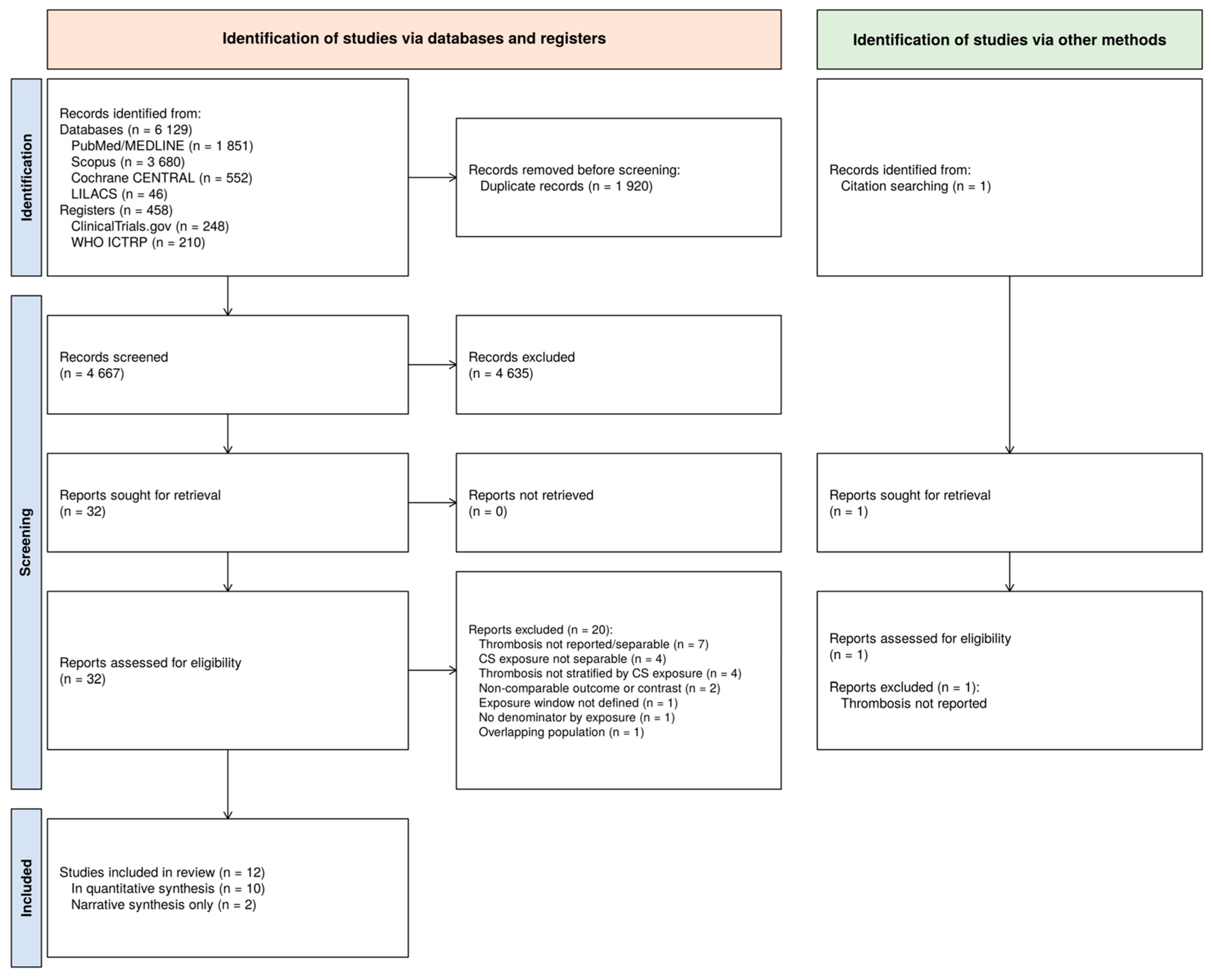
The searches identified 6587 records (6129 from bibliographic databases and 458 from trial registries). After removal of 1920 duplicates, 4667 records were screened, and 32 full-text reports were assessed for eligibility; 20 were excluded (Figure 1; reasons in Table S2). One further report identified through other sources was excluded because thrombosis was not reported. Twelve studies were included: ten contributed to the quantitative synthesis and two randomized trials were synthesized narratively.
Figure 1.
PRISMA 2020 flow diagram of study selection. Counts reconciled with the review records on 24 October 2026. CS, corticosteroid; ICTRP, International Clinical Trials Registry Platform.
3.2. Characteristics of the Included Studies
The 12 included studies, published between 2013 and 2026, comprised 18,059 participants (Table 1). They were conducted in China (n = 6), France (n = 2), Italy (n = 2), Korea (n = 1) and Egypt (n = 1). Two European cohorts reported adjusted HRs: A French nationwide cohort of 10,039 adults in which corticosteroid exposure was modelled as time-varying [42], and an Italian multicenter cohort of 986 patients with ever-use [43]. A French prospective registry provided crude VT counts by ever exposure [44]. Its recruitment period (2013–2022) probably overlaps that of the nationwide cohort for 2013–2017; the two were never combined in the same pooled estimate. Seven Asian single-center series compared prior corticosteroid use between patients with and without thrombosis [27,28,45,46,47,48,49]; together they included 5403 patients, 296 of whom had thrombosis. In these series, the proportion of patients without thrombosis who had received corticosteroids ranged from 46.5% to 95.4%, and the time window of exposure relative to the event was not defined. Three of the seven series were dominated by arterial events, one reported pulmonary embolism only, one included mainly secondary ITP, and three included some patients younger than 18 years. Two RCTs compared corticosteroid regimens without a corticosteroid-free arm [50,51].
Table 1.
Characteristics of the included studies.
3.3. Risk of Bias
Concern was low to moderate for the nationwide cohort, which modelled exposure as time-varying and adjusted for major risk factors, although residual confounding by disease activity cannot be excluded and only hospitalized events were captured (Table 2; item-level ratings in Table S4). Concern was moderate to high for the Italian cohort because ever-use exposure was not related in time to the event. All crude comparisons were at high or very high risk of bias, mainly because of the absence of adjustment and undefined exposure windows. For thrombosis, both RCTs were open-label and did not pre-specify thrombosis as an outcome. With ROBINS-E, the adjusted estimates of the nationwide cohort were at high risk of bias, driven by confounding (disease activity, bleeding, and hospitalization were not measured), with some concerns about exposure and outcome measurement and post-exposure interventions; the Italian cohort was at very high risk of bias because of confounding and the ever-use definition of exposure (Table S7).
Table 2.
Summary of risk-of-bias judgements.
3.4. Adjusted Estimates
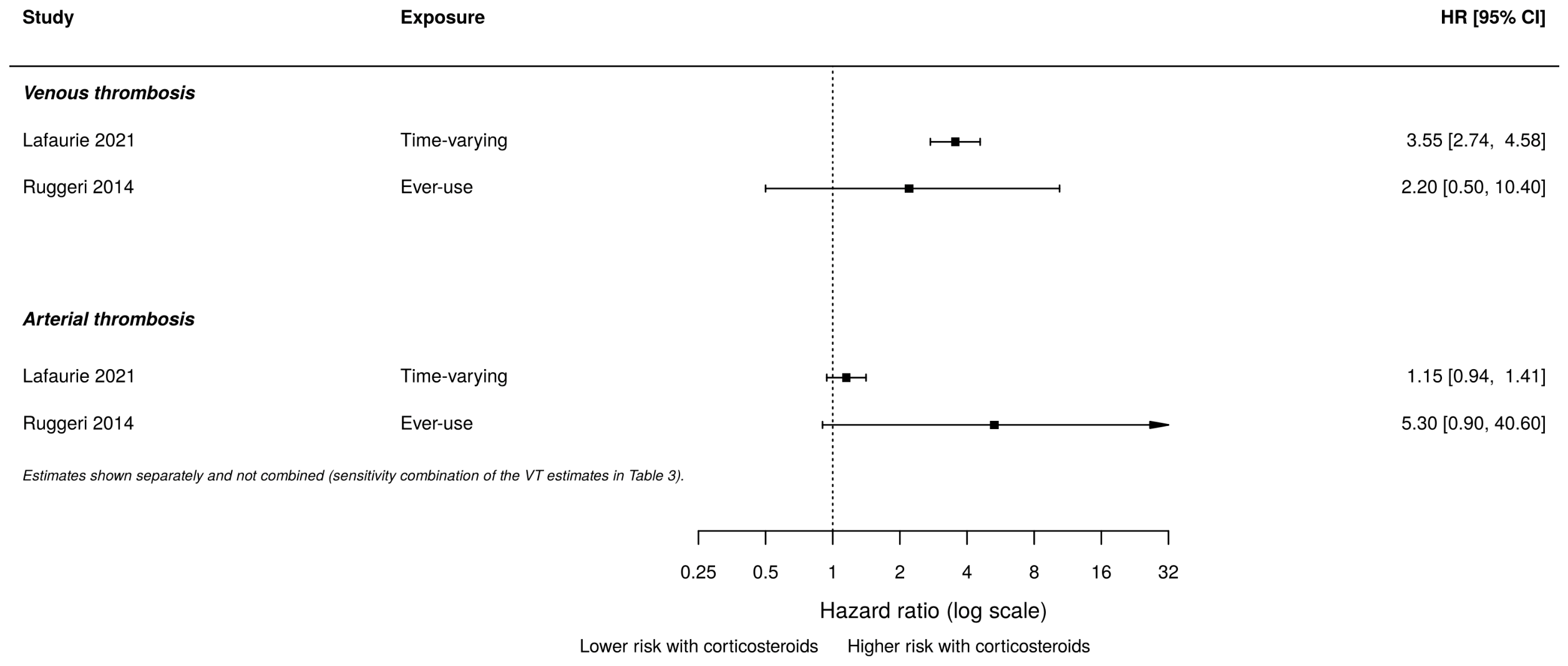
In the nationwide cohort (10,039 adults; 40,954 person-years), in which exposure was modelled as time-varying, corticosteroid exposure was associated with a higher hazard of hospitalization for VT (adjusted HR 3.55, 95% CI 2.74–4.58) but not for AT (adjusted HR 1.15, 0.94–1.41) (Figure 2, Table 3). In the Italian cohort (986 patients), in which ever-use was compared with never-use, the estimates were imprecise for both VT (HR 2.2, 0.5–10.4) and AT (HR 5.3, 0.9–40.6). Because the nationwide cohort would carry 97.2% of the weight of a combined VT estimate and the two cohorts defined exposure differently, the estimates are presented separately; their combination, reported as a sensitivity analysis, gave an HR of 3.50 (2.72–4.51), essentially that of the nationwide cohort. The arterial estimates, which conflicted, were not combined.
Figure 2.
Forest plot of adjusted hazard ratios for venous and arterial thrombosis with corticosteroid exposure versus no exposure. Study-level confidence intervals are shown as published; the estimates are presented by study and are not combined (exposure modelled as time-varying in Lafaurie 2021 [42] and as ever-use in Ruggeri 2014 [43]). CI, confidence interval; HR, hazard ratio.
Table 3.
Pooled estimates and sensitivity analyses.
In the nationwide cohort, the Fine–Gray sub-distribution HR (death as competing event) was 3.13 (2.43–4.03) for VT and 0.97 (0.79–1.19) for AT. In the sensitivity analysis of the VT estimates, substituting the Fine–Gray subdistribution HR gave 3.10 (2.42–3.98), and the HKSJ interval, although wider, excluded the null (1.29–9.53) (Table 3). Within the nationwide cohort, the VT association was similar in patients younger than 60 years (HR 2.99, 1.79–5.01) and in those aged 60 years or older (HR 3.76, 2.79–5.06), and in persistent or chronic ITP (HR 3.59, 2.74–4.69) [42]. For AT, the same cohort reported a modest association in patients younger than 60 years (HR 1.66, 1.06–2.60) but not in older patients (HR 1.08, 0.86–1.35).
In the nationwide cohort, the rate of hospitalization for VT was 7.3 (6.5–8.2) per 1000 person-years overall and 24.8 (21.0–29.4) per 1000 person-years during periods of corticosteroid exposure; the corresponding rates for AT were 16.8 (15.6–18.1) and 26.3 (22.3–31.0). From these published values, the rate of VT outside periods of exposure was approximately 4.4 (3.7–5.1) per 1000 person-years; applying the adjusted HR, corticosteroid exposure corresponded to approximately 11 (8–16) additional hospitalizations for VT per 1000 person-years of exposure, and to 2 (−1 to 6) additional hospitalizations for AT. Rates by exposure were not reported by the other studies: the Italian cohort reported overall rates of 3.9 (VT) and 7.1 (AT) per 1000 person-years, the French registry 53 VT events over 2352 person-years (22.5 per 1000 person-years) and the Korean series 15.2 thrombotic events per 1000 person-years; the six other Asian series did not report follow-up time (Table S9).
3.5. Crude Estimates by Subgroup
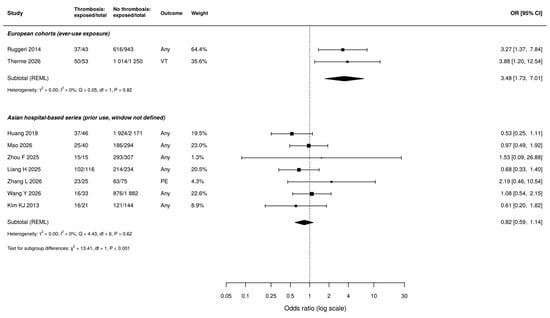
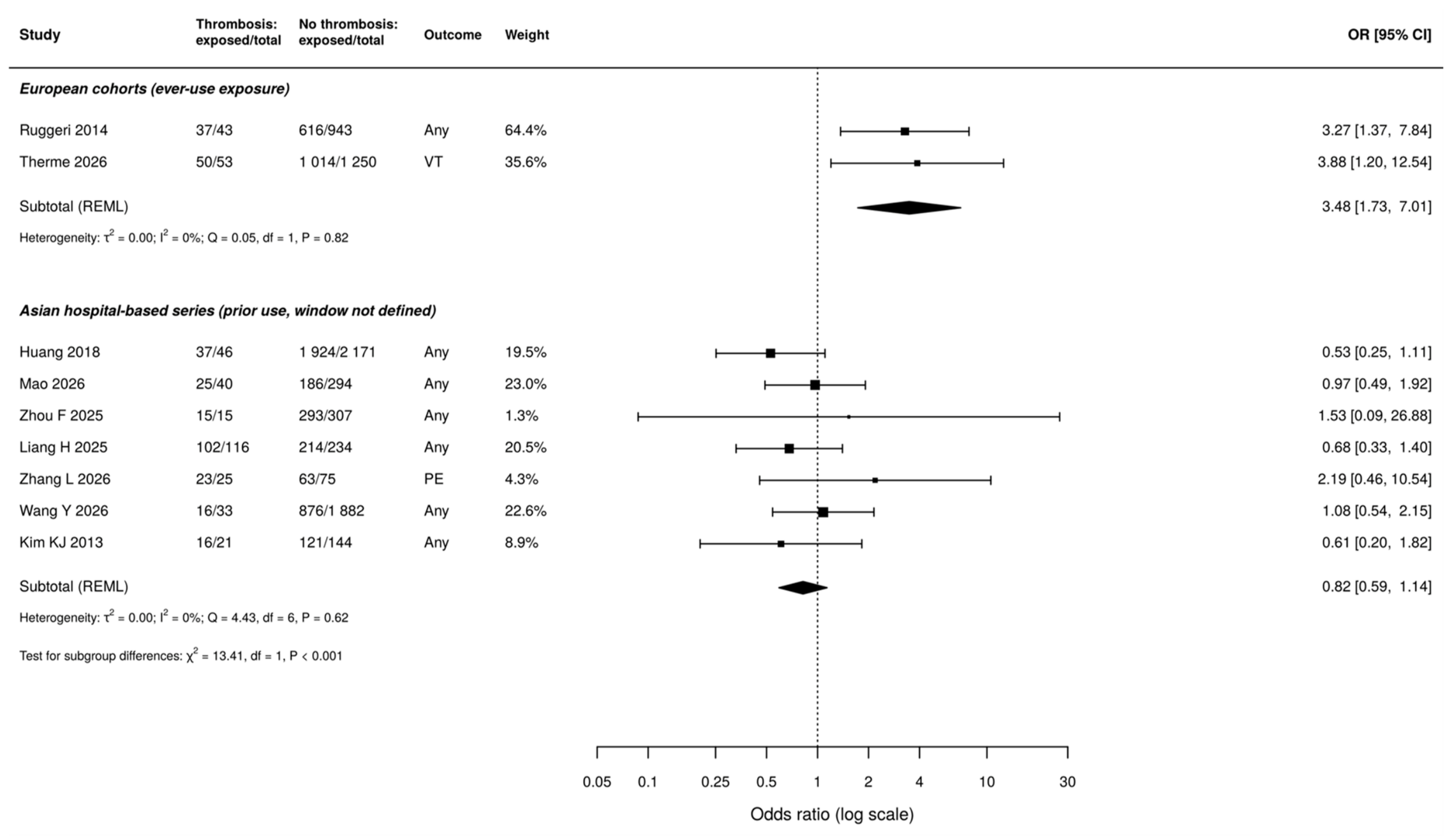
In the two European cohorts, which compared ever-users with never-users (2289 patients), the pooled crude OR was 3.48 (95% CI 1.73–7.01; I2 = 0%) (Figure 3). The corresponding author of the French registry confirmed the published counts and reported that 12 of the 39 patients with primary ITP and VT were receiving corticosteroids at the time of the event; person-time of exposure was not available. In the seven Asian hospital-based series, the pooled crude OR was 0.82 (0.59–1.14; p = 0.24), with no statistical heterogeneity (I2 = 0%) and a 95% prediction interval of 0.53–1.26. The two subgroups differed significantly (Q = 13.41, df = 1, p < 0.001). Because they differed in region, setting, design, outcome composition, and exposure ascertainment, and neither defined a time window of exposure, this difference cannot be attributed to any single factor, and no overall crude estimate was calculated.
Figure 3.
Forest plot of crude odds ratios for thrombosis according to corticosteroid exposure, by subgroup (European cohorts [43,44]; Asian hospital-based series [27,28,45,46,47,48,49]). Odds ratios were calculated by the reviewers from published counts and are unadjusted; the Haldane–Anscombe correction was applied to Zhou F 2025 [47]. Any, any thrombosis; PE, pulmonary embolism; VT, venous thrombosis.
None of the seven Asian series reported a corticosteroid estimate adjusted for other factors (Table S8). Five fitted multivariable models, but corticosteroids were not entered: in two the univariable comparison was not statistically significant, in one it could not be estimated because all patients with thrombosis were exposed, and in two corticosteroids were not a candidate variable; the remaining two series reported univariable comparisons only. Where published, the univariable ORs (0.97, 0.49–1.92, and 1.08, 0.54–2.15) agreed with the reviewer-calculated crude ORs. Information on exposure at the time of the event was limited: in one Asian series, 15 of 46 patients with thrombosis (32.6%) were receiving corticosteroids at the event, only three of them for more than one month; the corresponding proportions were 21 of 43 (49%) in the Italian cohort and 18 of 53 (34%) in the French registry, and, in the nationwide cohort, 136 of 292 hospitalizations for VT (46.6%) and 142 of 661 for AT (21.5%) occurred during periods of exposure (Table S8).
3.6. Sensitivity Analyses
The pooled estimate for the Asian hospital-based series was stable (Table 3; Figure S1). Across the six sensitivity analyses (two pre-specified in protocol version 1.0 and four added in version 1.1) and the leave-one-out analysis, pooled ORs ranged from 0.76 to 0.91; none was statistically significant, and I2 did not exceed 2%. The HKSJ interval was 0.58–1.17. Sensitivity analyses were not possible for the European crude set, which included two studies.
Two excluded studies reported corticosteroid estimates for composite outcomes that could not be combined with the outcomes of this review (Table S10). In a nested case–control study in a Japanese claims database [20], any corticosteroid prescription was associated with a composite of thromboembolic and cardiovascular events that included angina and cerebral hemorrhage (adjusted OR 2.16, 1.48–3.14), without a gradient across categories of duration (adjusted ORs 2.25, 2.71 and 1.72 for <15, 15–59 and ≥60 days) or cumulative dose. In a Taiwanese cohort in which all patients received corticosteroids [19], higher daily doses were associated with cardiovascular disorders (adjusted incidence rate ratio 2.61, 2.28–2.99) and with neuropsychiatric disorders including cerebrovascular disease (2.91, 2.29–3.69), but no thrombosis-specific outcome was reported.
3.7. Randomised Trials
Neither trial included a corticosteroid-free arm. Hamed et al. reported no thrombotic events with HD-DXM (0/105) or prednisolone plus azathioprine (0/110) over 12 months [50]. For the GIMEMA ITP0207 trial, which did not report thrombosis in the publication, the corresponding author confirmed that no thromboembolic events occurred with prednisone (0/59) or HD-DXM (0/54) [51]. No thrombotic events were reported or confirmed in these trial populations (0/328; exact 95% CI 0–1.1%; 0–2.3% with HD-DXM and 0–2.2% with prednisone-based regimens). Given the small sample size, the absence of a corticosteroid-free comparator, and the fact that thrombosis was not a pre-specified outcome, these data cannot inform the comparison with no exposure.
3.8. Triangulation
The E-value for the adjusted VT estimate of the nationwide cohort was 6.56, and 4.92 for its lower confidence limit: An unmeasured confounder would need to be associated with both corticosteroid exposure and VT by a risk ratio of at least 4.92, beyond the measured covariates, to move the lower limit to the null. The measured covariates did not include hospitalization, bleeding, or disease activity, which may be strongly associated with both corticosteroid use and VT, so confounding of this magnitude cannot be excluded. In the nationwide cohort, rituximab, used as a negative-control exposure given for active disease, was not associated with VT (HR 1.29, 0.83–2.02) or AT (HR 1.28, 0.89–1.83) [42]. Rituximab is, however, usually given later in the course of the disease and in different clinical circumstances, so it is an imperfect negative control for confounding by indication. The VT estimate of the nationwide cohort was of similar magnitude to the general-population benchmark for glucocorticoid-associated venous thromboembolism (pooled RR 2.60, 1.89–3.58), with overlapping confidence intervals [22].
3.9. Certainty of Evidence
Certainty was low for the association with VT and very low for AT, for both crude analyses and for the randomized comparisons of corticosteroid regimens (Table 4). For VT, inconsistency could not be assessed because one cohort provided almost all the information; for AT, the evidence was downgraded for risk of bias, inconsistency and imprecision.
Table 4.
Certainty of evidence (GRADE).
4. Discussion
In this systematic review and meta-analysis, corticosteroid exposure was associated with an approximately 3.5-fold higher hazard of VT in adults with ITP in the study with the strongest design, a nationwide cohort with time-varying exposure and multivariable adjustment, which provided almost all the adjusted evidence. The crude data from European cohorts gave a concordant estimate, whereas there was no consistent association with AT. Retrospective Asian series that compared prior corticosteroid use between patients with and without thrombosis showed no association, and the difference between the two crude subgroups was statistically significant.
The magnitude of the VT association is close to that reported for glucocorticoids in the general population, in which risk is highest with current and recent use and with high doses early in treatment [21,22]. The procoagulant effects of glucocorticoids, namely increased factor VIII, von Willebrand factor and fibrinogen and reduced fibrinolytic capacity [23], would be superimposed on the procoagulant state already described in ITP [6,14]. The time-varying analysis of the nationwide cohort, which compared periods of exposure with periods without exposure in the same population, is the design best suited to detect such a transient effect, and its estimate was consistent across age groups, in persistent and chronic disease, and with a competing-risk model [42]. In absolute terms, this corresponds to approximately 11 additional hospitalizations for VT per 1000 person-years of exposure, although this figure is derived from rounded published rates.
Confounding by indication is the main alternative explanation [24]. Corticosteroids are given during periods of active disease, bleeding and hospitalization, all of which may be prothrombotic, and are frequently combined with IVIg. Three observations argue, to a limited extent, against confounding as the sole explanation. First, the nationwide cohort adjusted for IVIg and other ITP treatments. Second, rituximab, also given for active disease, was not associated with VT in the same cohort, which suggests that disease activity alone does not account for the association [40,42]. This comparison is only partly informative, because rituximab and corticosteroids are usually given at different stages of the disease and in different circumstances (corticosteroids at diagnosis and during acute bleeding, rituximab later and electively). Third, the E-value indicates that only a strong unmeasured confounder, associated with both exposure and VT by a risk ratio of almost five, could fully explain the lower confidence limit. However, hospitalization, bleeding and disease activity were not measured and could plausibly be confounders of this strength. Residual confounding nevertheless remains possible, and observational data cannot establish causation.
The divergence between the European and Asian crude data is more plausibly methodological than biological. In the Asian series, corticosteroid exposure was close to universal among patients without thrombosis (up to 95%), the unexposed groups were small and probably unrepresentative, exposure was not related in time to the event, and exposure was not treated as time-varying. None of these series adjusted for confounders, and corticosteroids were not entered into any of their multivariable models. Treating any past exposure as current exposure misclassifies person-time and biases estimates towards the null, whereas the association in the nationwide cohort was driven by the period of exposure itself. Outcome composition is a second explanation: several Asian series were dominated by arterial events, for which no association was found in the adjusted analyses, so a composite outcome would dilute any venous effect. Geographic differences in the incidence of thrombosis in ITP [13], the inclusion of secondary ITP, systemic lupus erythematosus and adolescents, and the hospital-based selection of these series may also contribute. The European ever-use estimates, on the other hand, may be affected by immortal-time bias, which would tend to underestimate rather than overestimate harm [52], and by confounding by indication, which would act in the opposite direction. In the French registry, fewer than one-third of patients with primary ITP and thrombosis were receiving corticosteroids at the time of the event (author communication), so the ever-use contrast largely reflects past rather than concurrent exposure, and its agreement in magnitude with the adjusted estimate should not be read as independent confirmation of a concurrent-exposure effect. The French registry and the nationwide cohort also probably overlap in part. A Japanese claims-based study, excluded because its composite outcome included angina and cerebral hemorrhage, found a positive association with corticosteroid prescription [20], which argues against a simple population difference as the explanation. The Asian hospital-based series therefore do not refute the adjusted VT signal, but they limit its generalizability to Asian populations until time-varying analyses from these settings are available.
The absence of a consistent arterial association contrasts with the higher baseline arterial risk in ITP. The nationwide cohort found no overall association, and the Italian estimate was imprecise and included transient ischemic attacks. The modest association in younger patients in the nationwide cohort is hypothesis-generating only. Arterial events in ITP are driven largely by age and cardiovascular risk factors [42,43], and a short-term drug effect would be more difficult to detect against this background.
These findings have practical implications. Corticosteroid exposure can reasonably be considered a transient risk factor for VT in adults with ITP, particularly in patients with additional risk factors such as previous VT, active cancer, immobilization, antiphospholipid antibodies or older age. Because dose and duration could not be analyzed, these results neither confirm nor refute the benefit of current recommendations to avoid prolonged corticosteroid courses and to limit cumulative exposure [17,18]. In the Japanese claims-based study, the association with a composite outcome did not increase with duration or cumulative dose [20]. Whether shorter regimens, such as pulsed HD-DXM, carry a lower thrombotic risk than conventional prednisone cannot be determined from the available trials, which recorded no events [50,51,53]. The current data do not address thromboprophylaxis, which requires individual weighing of thrombotic and bleeding risk.
Strengths and Limitations
The strengths of this review include registration of the protocol before the searches were run, with all later amendments reported, a broad search of four bibliographic databases and two trial registries without language restriction, which allowed the inclusion of studies published in Chinese, explicit handling of overlapping populations, separation of analyses by exposure definition and degree of adjustment, and a triangulation strategy combining E-values, a negative-control exposure and an external benchmark.
Several limitations must be acknowledged. Only two studies provided adjusted estimates, one of which provided almost all the information, so the adjusted results were not pooled in the main analysis and essentially reflect a single cohort. The Italian cohort may have included adolescents, as the reported age range differs between its text and tables, and adult-only estimates could not be obtained. The crude ORs were calculated by the reviewers, are unadjusted, and combine different outcome definitions. The French registry probably overlaps the nationwide cohort in part, so the European crude and adjusted estimates are not fully independent. Dose–response and comparisons with TPO-RAs could not be analyzed quantitatively, and publication bias could not be assessed. Embase was not searched, and Scopus was used instead, and Chinese bibliographic databases requiring an additional subscription were not searched separately. Studies available only in these databases may have been missed, although they would most likely have been hospital-based series with crude prior-use comparisons, the weakest analysis set. The two Chinese articles were translated by machine translation and checked by the reviewers, but not by a native speaker. Most author data requests were unanswered, including after extension of the contact period to 24 October 2026. The JBI checklists do not address time-varying confounding and immortal-time bias in detail; this was addressed for the adjusted cohorts with ROBINS-E. Absolute rates by exposure were available from one cohort only and were derived from rounded published values. Finally, several protocol changes were made after the evidence had been examined; they are reported in full in the amended protocol (version 1.1; Table S5).
Future studies should analyze corticosteroid exposure as time-varying in other large databases, including Asian claims databases, report VT and AT separately with dose and duration, and use active-comparator designs such as HD-DXM versus prednisone or corticosteroids versus TPO-RAs as first-line treatment. Trials of ITP treatments should report thrombotic events systematically, including confirmed absence of events.
5. Conclusions
Low-certainty evidence, dominated by one nationwide cohort, suggests that current corticosteroid exposure is associated with an approximately 3.5-fold higher hazard of venous thrombosis in adults with ITP, corresponding to about 11 additional hospitalizations for VT per 1000 person-years of exposure, with no consistent association with arterial thrombosis. Retrospective hospital-based series that compare prior use without a defined exposure window may be less informative about the risk associated with current corticosteroid exposure. Corticosteroid exposure may reasonably be considered in VT risk assessment in ITP; whether the risk depends on dose or duration remains to be established.
Supplementary Materials
The following supporting information can be downloaded at: https://www.mdpi.com/article/10.3390/hemato7040040/s1, Table S1: Full search strategies; Table S2: Full-text reports excluded, with reasons; Table S3: Author data requests and replies (updated to 24 October 2026); Table S4: Item-level JBI critical appraisal; Figure S1: Sensitivity and leave-one-out analyses (Asian hospital-based series); Table S5: Protocol amendment log (version 1.0 to version 1.1, and subsequent changes); Table S6: GRADE evidence profile; Table S7: ROBINS-E assessment of the adjusted cohorts; Table S8: Multivariable analyses in the Asian series and corticosteroid exposure at the time of the event; Table S9: Incidence rates per person-time; Table S10: Corticosteroid estimates from excluded studies with composite outcomes; File S1: Extraction and analysis data set; File S2: R analysis scripts; PRISMA 2020 checklist. References [54,55,56,57,58,59,60,61,62,63,64,65,66,67,68,69,70,71] are cited in the Supplementary Materials.
Author Contributions
Conceptualization, D.-C.P.; methodology, D.-C.P. and M.-A.G.; software, D.-C.P.; formal analysis, D.-C.P.; investigation (screening and data extraction), D.-C.P., M.-A.G., C.O. and R.T.; data curation, D.-C.P., C.O.; writing—original draft preparation, D.-C.P., R.T.; writing—review and editing, M.-A.G., D.D., C.-M.C., R.M.I., H.B. and D.S.; supervision, H.B. All authors have read and agreed to the published version of the manuscript.
Funding
This research received no external funding.
Institutional Review Board Statement
Not applicable. This study is a systematic review of published data.
Informed Consent Statement
Not applicable.
Data Availability Statement
The data extracted for this review and the R scripts used for the analyses are provided in the Supplementary Materials (Files S1 and S2).
Acknowledgments
The authors thank Maria Gabriella Mazzucconi for providing unpublished data on thromboembolic events in the GIMEMA ITP0207 trial and Guillaume Moulis for confirming the published data of the CARMEN-France registry and providing additional information, and Francesco Rodeghiero for his reply to our data request. During the preparation of this manuscript, the authors used Claude Opus 5.5 (Anthropic) to assist with drafting results text, checking the R analysis code, and cross-checking extracted data against the source publications (including drafting revised text, re-running the R analyses, and extracting additional data from the source publications), and gpai (Figure Generator agent; https://gpai.app/, accessed on 7 October 2026) to generate the graphical abstract from the text of the abstract. The authors have contributed to, reviewed, and edited the output, verified all numerical values in the graphical abstract against the manuscript, and take full responsibility for the content of this publication.
Conflicts of Interest
The authors declare no conflicts of interest.
Abbreviations
The following abbreviations are used in this manuscript:
| aHR | Adjusted hazard ratio |
| AT | Arterial thrombosis |
| CI | Confidence interval |
| CS | Corticosteroid |
| GRADE | Grading of Recommendations Assessment, Development and Evaluation |
| HD-DXM | High-dose dexamethasone |
| HKSJ | Hartung–Knapp–Sidik–Jonkman |
| HR | Hazard ratio |
| ITP | Immune thrombocytopenia |
| IVIg | Intravenous immunoglobulin |
| JBI | Joanna Briggs Institute |
| OR | Odds ratio |
| PE | Pulmonary embolism |
| PI | Prediction interval |
| RCT | Randomized controlled trial |
| REML | Restricted maximum likelihood |
| ROBINS-E | Risk of Bias in Non-randomized Studies—of Exposures |
| TPO-RA | Thrombopoietin receptor agonist |
| VT | Venous thrombosis |
References
- Rodeghiero, F.; Stasi, R.; Gernsheimer, T.; Michel, M.; Provan, D.; Arnold, D.M.; Bussel, J.B.; Cines, D.B.; Chong, B.H.; Cooper, N.; et al. Standardization of Terminology, Definitions and Outcome Criteria in Immune Thrombocytopenic Purpura of Adults and Children: Report from an International Working Group. Blood 2009, 113, 2386–2393. [Google Scholar] [CrossRef] [Scilit] [PubMed]
- Provan, D.; Arnold, D.M.; Bussel, J.B.; Chong, B.H.; Cooper, N.; Gernsheimer, T.; Ghanima, W.; Godeau, B.; González-López, T.J.; Grainger, J.; et al. Updated International Consensus Report on the Investigation and Management of Primary Immune Thrombocytopenia. Blood Adv. 2019, 3, 3780–3817. [Google Scholar] [CrossRef] [Scilit] [PubMed]
- Frederiksen, H.; Schmidt, K. The Incidence of Idiopathic Thrombocytopenic Purpura in Adults Increases with Age. Blood 1999, 94, 909–913. [Google Scholar] [CrossRef] [Scilit]
- Moulis, G.; Palmaro, A.; Montastruc, J.-L.; Godeau, B.; Lapeyre-Mestre, M.; Sailler, L. Epidemiology of Incident Immune Thrombocytopenia: A Nationwide Population-Based Study in France. Blood 2014, 124, 3308–3315. [Google Scholar] [CrossRef] [Scilit] [PubMed]
- Rodeghiero, F. Is ITP a Thrombophilic Disorder? Am. J. Hematol. 2016, 91, 39–45. [Google Scholar] [CrossRef] [Scilit] [PubMed]
- Swan, D.; Newland, A.; Rodeghiero, F.; Thachil, J. Thrombosis in Immune Thrombocytopenia—Current Status and Future Perspectives. Br. J. Haematol. 2021, 194, 822–834. [Google Scholar] [CrossRef] [Scilit] [PubMed]
- Saldanha, A.; Colella, M.P.; Villaça, P.R.; Thachil, J.; Orsi, F.A. The Immune Thrombocytopenia Paradox: Should We Be Concerned about Thrombosis in ITP? Thromb. Res. 2024, 241, 109109. [Google Scholar] [CrossRef] [Scilit] [PubMed]
- Sarpatwari, A.; Bennett, D.; Logie, J.W.; Shukla, A.; Beach, K.J.; Newland, A.C.; Sanderson, S.; Provan, D. Thromboembolic Events among Adult Patients with Primary Immune Thrombocytopenia in the United Kingdom General Practice Research Database. Haematologica 2010, 95, 1167–1175. [Google Scholar] [CrossRef] [Scilit] [PubMed]
- Severinsen, M.T.; Engebjerg, M.C.; Farkas, D.K.; Jensen, A.Ø.; Nørgaard, M.; Zhao, S.; Sørensen, H.T. Risk of Venous Thromboembolism in Patients with Primary Chronic Immune Thrombocytopenia: A Danish Population-Based Cohort Study. Br. J. Haematol. 2011, 152, 360–362. [Google Scholar] [CrossRef] [Scilit] [PubMed]
- Nørgaard, M.; Severinsen, M.T.; Lund Maegbaek, M.; Jensen, A.Ø.; Cha, S.; Sørensen, H.T. Risk of Arterial Thrombosis in Patients with Primary Chronic Immune Thrombocytopenia: A Danish Population-Based Cohort Study. Br. J. Haematol. 2012, 159, 109–111. [Google Scholar] [CrossRef] [Scilit] [PubMed]
- Doobaree, I.U.; Nandigam, R.; Bennett, D.; Newland, A.; Provan, D. Thromboembolism in Adults with Primary Immune Thrombocytopenia: A Systematic Literature Review and Meta-Analysis. Eur. J. Haematol. 2016, 97, 321–330. [Google Scholar] [CrossRef] [Scilit] [PubMed]
- Langeberg, W.J.; Schoonen, W.M.; Eisen, M.; Gamelin, L.; Stryker, S. Thromboembolism in Patients with Immune Thrombocytopenia (ITP): A Meta-Analysis of Observational Studies. Int. J. Hematol. 2016, 103, 655–664. [Google Scholar] [CrossRef] [Scilit] [PubMed]
- Ma, Y.; Yao, W.; Lang, H.; Cheng, Y.; Ren, R.; Chen, Y.; Cheng, S.; Sun, S. Geographic and Diagnostic Variations in Thrombosis Risk among Patients with Immune Thrombocytopenia: A Systematic Review and Meta-Analysis. Thromb. Res. 2025, 254, 109450. [Google Scholar] [CrossRef] [Scilit] [PubMed]
- Álvarez-Román, M.T.; Fernández-Bello, I.; Jiménez-Yuste, V.; Martín-Salces, M.; Arias-Salgado, E.G.; Rivas Pollmar, M.I.; Justo Sanz, R.; Butta, N.V. Procoagulant Profile in Patients with Immune Thrombocytopenia. Br. J. Haematol. 2016, 175, 925–934. [Google Scholar] [CrossRef] [Scilit] [PubMed]
- Yan, M.; Wang, Z.; Qiu, Z.; Cui, Y.; Xiang, Q. Platelet Signaling in Immune Landscape: Comprehensive Mechanism and Clinical Therapy. Biomark. Res. 2024, 12, 164. [Google Scholar] [CrossRef] [Scilit] [PubMed]
- Tarasconi, E.; Clerici, B.; Marcucci, G.; Pontisso, E.; Mondini, C.; Pisetta, C.; Birocchi, S.; Schioppo, T.; Podda, G.M. The Thrombotic Burden of High-Risk Immune Thrombocytopenia Patients Receiving Second-Line Treatments: A Systematic Review. Rheumatology 2026, 65, keag461. [Google Scholar] [CrossRef] [Scilit] [PubMed]
- Neunert, C.; Terrell, D.R.; Arnold, D.M.; Buchanan, G.; Cines, D.B.; Cooper, N.; Cuker, A.; Despotovic, J.M.; George, J.N.; Grace, R.F.; et al. American Society of Hematology 2019 Guidelines for Immune Thrombocytopenia. Blood Adv. 2019, 3, 3829–3866. [Google Scholar] [CrossRef] [Scilit] [PubMed]
- Cuker, A.; Liebman, H.A. Corticosteroid Overuse in Adults with Immune Thrombocytopenia: Cause for Concern. Res. Pract. Thromb. Haemost. 2021, 5, e12592. [Google Scholar] [CrossRef] [Scilit] [PubMed]
- Wang, J.-D.; Ku, F.-C.; Chiang, I.-J.; Ku, M.-Y.; Chen, Y.-M.; Chien, L.-N. Longitudinal Evaluation of Adverse Events Due to Steroid Use in Primary Immune Thrombocytopenia: A Population-Based Study. Br. J. Haematol. 2024, 204, 1986–1993. [Google Scholar] [CrossRef] [Scilit] [PubMed]
- Kashiwagi, H.; Miura, I.; Terasawa, N.; Iwayama, K.-I.; Furukawa, Y.; Kanenishi, M. Treatment Trends and Risks of Corticosteroid Use in Adult Primary Immune Thrombocytopenia: A Claims Database Study in Japan. Int. J. Hematol. 2025, 121, 363–377. [Google Scholar] [CrossRef] [Scilit] [PubMed]
- Johannesdottir, S.A.; Horváth-Puhó, E.; Dekkers, O.M.; Cannegieter, S.C.; Jørgensen, J.O.L.; Ehrenstein, V.; Vandenbroucke, J.P.; Pedersen, L.; Sørensen, H.T. Use of Glucocorticoids and Risk of Venous Thromboembolism: A Nationwide Population-Based Case-Control Study. JAMA Intern. Med. 2013, 173, 743–752. [Google Scholar] [CrossRef] [Scilit] [PubMed]
- Srivali, N.; De Giacomi, F. Glucocorticoid Therapy and Risk of Venous Thromboembolism: A Systematic Review and Meta-Analysis with Exploration of Dose, Duration, and Route-Specific Effects. Expert Opin. Pharmacother. 2026, 27, 709–722. [Google Scholar] [CrossRef] [Scilit] [PubMed]
- van Zaane, B.; Nur, E.; Squizzato, A.; Gerdes, V.E.A.; Büller, H.R.; Dekkers, O.M.; Brandjes, D.P.M. Systematic Review on the Effect of Glucocorticoid Use on Procoagulant, Anti-Coagulant and Fibrinolytic Factors. J. Thromb. Haemost. JTH 2010, 8, 2483–2493. [Google Scholar] [CrossRef] [Scilit] [PubMed]
- Kyriacou, D.N.; Lewis, R.J. Confounding by Indication in Clinical Research. JAMA 2016, 316, 1818–1819. [Google Scholar] [CrossRef] [Scilit] [PubMed]
- Page, M.J.; McKenzie, J.E.; Bossuyt, P.M.; Boutron, I.; Hoffmann, T.C.; Mulrow, C.D.; Shamseer, L.; Tetzlaff, J.M.; Akl, E.A.; Brennan, S.E.; et al. The PRISMA 2020 Statement: An Updated Guideline for Reporting Systematic Reviews. BMJ 2021, 372, n71. [Google Scholar] [CrossRef] [Scilit] [PubMed]
- Rethlefsen, M.L.; Kirtley, S.; Waffenschmidt, S.; Ayala, A.P.; Moher, D.; Page, M.J.; Koffel, J.B.; PRISMA-S Group. PRISMA-S: An Extension to the PRISMA Statement for Reporting Literature Searches in Systematic Reviews. Syst. Rev. 2021, 10, 39. [Google Scholar] [CrossRef] [Scilit] [PubMed]
- Huang, Y.T.; Liu, X.F.; Chen, Y.F.; Fu, R.F.; Liu, W.; Xue, F.; Zhang, L.; Yang, R.C. The incidence and risk factors for thrombosis in primary immune thrombocytopenia. Zhonghua Xue YE Xue ZA Zhi Zhonghua Xueyexue Zazhi 2018, 39, 942–946. [Google Scholar] [CrossRef] [PubMed]
- Mao, J.H.; Wang, L.; Shi, Y.; Shao, L.L.; Hou, Y.; Hou, M. Construction and evaluation of a thrombosis risk prediction model in patients with primary immune thrombocytopenia. Zhonghua Xue YE Xue ZA Zhi Zhonghua Xueyexue Zazhi 2026, 47, 153–159. [Google Scholar] [CrossRef] [Scilit] [PubMed]
- Barker, T.H.; Stone, J.C.; Sears, K.; Klugar, M.; Tufanaru, C.; Leonardi-Bee, J.; Aromataris, E.; Munn, Z. The Revised JBI Critical Appraisal Tool for the Assessment of Risk of Bias for Randomized Controlled Trials. JBI Evid. Synth. 2023, 21, 494–506. [Google Scholar] [CrossRef] [Scilit] [PubMed]
- Higgins, J.P.T.; Morgan, R.L.; Rooney, A.A.; Taylor, K.W.; Thayer, K.A.; Silva, R.A.; Lemeris, C.; Akl, E.A.; Bateson, T.F.; Berkman, N.D.; et al. A Tool to Assess Risk of Bias in Non-Randomized Follow-up Studies of Exposure Effects (ROBINS-E). Environ. Int. 2024, 186, 108602. [Google Scholar] [CrossRef] [Scilit] [PubMed]
- Sweeting, M.J.; Sutton, A.J.; Lambert, P.C. What to Add to Nothing? Use and Avoidance of Continuity Corrections in Meta-Analysis of Sparse Data. Stat. Med. 2004, 23, 1351–1375. [Google Scholar] [CrossRef] [Scilit] [PubMed]
- Friedrich, J.O.; Adhikari, N.K.J.; Beyene, J. Inclusion of Zero Total Event Trials in Meta-Analyses Maintains Analytic Consistency and Incorporates All Available Data. BMC Med. Res. Methodol. 2007, 7, 5. [Google Scholar] [CrossRef] [Scilit] [PubMed]
- Veroniki, A.A.; Jackson, D.; Viechtbauer, W.; Bender, R.; Bowden, J.; Knapp, G.; Kuss, O.; Higgins, J.P.T.; Langan, D.; Salanti, G. Methods to Estimate the Between-Study Variance and Its Uncertainty in Meta-Analysis. Res. Synth. Methods 2016, 7, 55–79. [Google Scholar] [CrossRef] [Scilit] [PubMed]
- Higgins, J.P.T.; Thompson, S.G. Quantifying Heterogeneity in a Meta-Analysis. Stat. Med. 2002, 21, 1539–1558. [Google Scholar] [CrossRef] [Scilit] [PubMed]
- Riley, R.D.; Higgins, J.P.T.; Deeks, J.J. Interpretation of Random Effects Meta-Analyses. BMJ 2011, 342, d549. [Google Scholar] [CrossRef] [Scilit] [PubMed]
- Viechtbauer, W. Conducting Meta-Analyses in R with the Metafor Package. J. Stat. Softw. 2010, 36, 1–48. [Google Scholar] [CrossRef] [Scilit]
- IntHout, J.; Ioannidis, J.P.A.; Borm, G.F. The Hartung-Knapp-Sidik-Jonkman Method for Random Effects Meta-Analysis Is Straightforward and Considerably Outperforms the Standard DerSimonian-Laird Method. BMC Med. Res. Methodol. 2014, 14, 25. [Google Scholar] [CrossRef] [Scilit] [PubMed]
- Sterne, J.A.C.; Sutton, A.J.; Ioannidis, J.P.A.; Terrin, N.; Jones, D.R.; Lau, J.; Carpenter, J.; Rücker, G.; Harbord, R.M.; Schmid, C.H.; et al. Recommendations for Examining and Interpreting Funnel Plot Asymmetry in Meta-Analyses of Randomised Controlled Trials. BMJ 2011, 343, d4002. [Google Scholar] [CrossRef] [Scilit] [PubMed]
- VanderWeele, T.J.; Ding, P. Sensitivity Analysis in Observational Research: Introducing the E-Value. Ann. Intern. Med. 2017, 167, 268–274. [Google Scholar] [CrossRef] [Scilit] [PubMed]
- Lipsitch, M.; Tchetgen Tchetgen, E.; Cohen, T. Negative Controls: A Tool for Detecting Confounding and Bias in Observational Studies. Epidemiology 2010, 21, 383–388. [Google Scholar] [CrossRef] [Scilit] [PubMed]
- Guyatt, G.H.; Oxman, A.D.; Vist, G.E.; Kunz, R.; Falck-Ytter, Y.; Alonso-Coello, P.; Schünemann, H.J.; GRADE Working Group. GRADE: An Emerging Consensus on Rating Quality of Evidence and Strength of Recommendations. BMJ 2008, 336, 924–926. [Google Scholar] [CrossRef] [Scilit] [PubMed]
- Lafaurie, M.; Maquet, J.; Baricault, B.; Ekstrand, C.; Christiansen, C.F.; Linder, M.; Bahmanyar, S.; Nørgaard, M.; Sailler, L.; Lapeyre-Mestre, M.; et al. Risk Factors of Hospitalisation for Thrombosis in Adults with Primary Immune Thrombocytopenia, Including Disease-Specific Treatments: A French Nationwide Cohort Study. Br. J. Haematol. 2021, 195, 456–465. [Google Scholar] [CrossRef] [Scilit] [PubMed]
- Ruggeri, M.; Tosetto, A.; Palandri, F.; Polverelli, N.; Mazzucconi, M.G.; Santoro, C.; Gaidano, G.; Lunghi, M.; Zaja, F.; De Stefano, V.; et al. Thrombotic Risk in Patients with Primary Immune Thrombocytopenia Is Only Mildly Increased and Explained by Personal and Treatment-Related Risk Factors. J. Thromb. Haemost. JTH 2014, 12, 1266–1273. [Google Scholar] [CrossRef] [Scilit] [PubMed]
- Therme, F.; Viallard, J.F.; Rueter, M.; Comont, T.; Cheze, S.; Audia, S.; Ebbo, M.; Mahevas, M.; Terriou, L.; Reynaud, Q.; et al. Incidence, Characteristics, and Management of Venous Thrombosis in Adult Patients With Immune Thrombocytopenia: Results From the Multicenter, Prospective Registry CARMEN-France. Am. J. Hematol. 2026, 101, 456–466. [Google Scholar] [CrossRef] [Scilit] [PubMed]
- Kim, K.-J.; Baek, I.-W.; Yoon, C.-H.; Kim, W.-U.; Cho, C.-S. Thrombotic Risk in Patients with Immune Thrombocytopenia and Its Association with Antiphospholipid Antibodies. Br. J. Haematol. 2013, 161, 706–714. [Google Scholar] [CrossRef] [Scilit] [PubMed]
- Liang, H.; Duan, L.; Long, M.; Tie, S.; Sun, C.; Ma, S.; Wang, J.; Wang, S. Analysis of Risk Factors and the Establishment of a Predictive Model for Thrombosis in Patients with Immune Thrombocytopenia. Clin. Appl. Thromb. Off. J. Int. Acad. Clin. Appl. Thromb. 2025, 31, 10760296241301398. [Google Scholar] [CrossRef] [Scilit] [PubMed]
- Zhou, F.; Zhang, S.; Li, R.; Feng, Z.; Wang, D.; Wang, J.; Tan, Y.; Yang, W.; Zhang, W.; Ma, L.; et al. A Retrospective Study of Risk Factors for Thrombosis in Patients with ITP. Hematology 2025, 30, 2472461. [Google Scholar] [CrossRef] [Scilit] [PubMed]
- Wang, Y.; Li, H.; Chen, Y.; Liu, X.; Fu, R.; Liu, W.; Xue, F.; Zhang, L.; Yang, R. No Significant Increase in Thrombotic Risk Following the Widespread Adoption of TPO-RAs in ITP: A Comparative Study. Glob. Med. Genet. 2026, 13, 100107. [Google Scholar] [CrossRef] [Scilit] [PubMed]
- Zhang, L.; An, Z.; Zhao, P.; Huang, Q.; Wu, J.; He, Y.; Zhu, X.; Fu, H.; Zhang, Y.; Kong, Y.; et al. Unmasking the Link: Pulmonary Embolism Risk and Outcomes in Adults with Immune Thrombocytopenia. J. Thromb. Haemost. JTH 2026. [Google Scholar] [CrossRef] [Scilit] [PubMed]
- Hamed, E.M.; Ibrahim, A.R.N.; Meabed, M.H.; Khalaf, A.M.; El Demerdash, D.M.; Elgendy, M.O.; Saeed, H.; Salem, H.F.; Rabea, H. The Outcomes and Adverse Drug Patterns of Immunomodulators and Thrombopoietin Receptor Agonists in Primary Immune Thrombocytopenia Egyptian Patients with Hemorrhage Comorbidity. Pharmaceuticals 2023, 16, 868. [Google Scholar] [CrossRef] [Scilit] [PubMed]
- Mazzucconi, M.G.; Rodeghiero, F.; Avvisati, G.; De Stefano, V.; Gugliotta, L.; Ruggeri, M.; Vianelli, N.; Fazi, P.; Paoloni, F.; Sargentini, V.; et al. Prednisone vs High-Dose Dexamethasone in Newly Diagnosed Adult Primary Immune Thrombocytopenia: A Randomized Trial. Blood Adv. 2024, 8, 1529–1540. [Google Scholar] [CrossRef] [Scilit] [PubMed]
- Suissa, S. Immortal Time Bias in Pharmaco-Epidemiology. Am. J. Epidemiol. 2008, 167, 492–499. [Google Scholar] [CrossRef] [Scilit] [PubMed]
- Mithoowani, S.; Gregory-Miller, K.; Goy, J.; Miller, M.C.; Wang, G.; Noroozi, N.; Kelton, J.G.; Arnold, D.M. High-Dose Dexamethasone Compared with Prednisone for Previously Untreated Primary Immune Thrombocytopenia: A Systematic Review and Meta-Analysis. Lancet Haematol. 2016, 3, e489–e496. [Google Scholar] [CrossRef] [Scilit] [PubMed]
- Yang, S.; Wang, Y.; Chen, S.; Zhao, M. Factors associated with thrombosis in primary immune thrombocytopenia. Chin. Gen. Pract. 2022, 25, 603–607. [Google Scholar] [CrossRef]
- Lee, J.Y.; Jeong, E.-J.; Park, W.; Seo, J.; Kang, M.; Jung, E.H.; Kim, S.-A.; Suh, K.J.; Kim, J.-W.; Kim, S.H.; et al. Thrombosis in adult primary immune thrombocytopenia in Korea: Incidence and risk factors in a 20-year retrospective cohort. Ann. Hematol. 2026, 105. [Google Scholar] [CrossRef] [Scilit] [PubMed]
- Demirci, U.; Ümit, E.G.; Dumludağ, B.; Cömert, M.; Çiftçiler, R.; Özmen, D.; Ar, M.C.; Güven, S.; Soyer, Ö.; Güney, T.; et al. Arterial Thrombosis in Patients with Primary Immune Thrombocytopenia: A Nationwide Study. Turk. J. Hematol. 2025, 42, 290–298. [Google Scholar] [CrossRef] [Scilit] [PubMed]
- Ekstrand, C.; Linder, M.; Baricault, B.; Lafaurie, M.; Sailler, L.; Lapeyre-Mestre, M.; Kieler, H.; Moulis, G.; Bahmanyar, S. Impact of risk factors on the occurrence of arterial thrombosis and venous thromboembolism in adults with primary immune thrombocytopenia – Results from two nationwide cohorts. Thromb. Res. 2019, 178, 124–131. [Google Scholar] [CrossRef] [Scilit] [PubMed]
- Goncalves, I.; Lewis, C.; Grainger, B.; Dring, R.; Lee, N.; Pasricha, S.-R.; Szer, J.; Mason, K. Thrombosis in patients with immune thrombocytopenia: Incidence, risk, and clinical outcomes. Res. Pract. Thromb. Haemost. 2024, 8, 102342. [Google Scholar] [CrossRef] [Scilit] [PubMed]
- Palandri, F.; Catani, L.; Auteri, G.; Bartoletti, D.; Fatica, S.; Fusco, A.; Reggiani, M.L.B.; Cavo, M.; Vianelli, N. Understanding how older age drives decision-making and outcome in Immune Thrombocytopenia. A single centre study on 465 adult patients. Br. J. Haematol. 2018, 184, 424–430. [Google Scholar] [CrossRef] [Scilit] [PubMed]
- Wei, Y.; Ji, X.-B.; Wang, Y.-W.; Wang, J.-X.; Yang, E.-Q.; Wang, Z.-C.; Sang, Y.-Q.; Bi, Z.-M.; Ren, C.-A.; Zhou, F.; et al. High-dose dexamethasone vs prednisone for treatment of adult immune thrombocytopenia: A prospective multicenter randomized trial. Blood 2016, 127, 296–302. [Google Scholar] [CrossRef] [Scilit] [PubMed]
- An, Z.-Y.; Wu, Y.-J.; He, Y.; Zhu, X.-L.; Shi, H.-X.; Wang, C.-C.; Jiang, H.; Lu, J.; Jiang, Q.; Huang, Q.-S.; et al. Tacrolimus Plus High-Dose Dexamethasone Versus High-Dose Dexamethasone Alone As First-Line Treatment for Adult Immune Thrombocytopenia: The Phase 2, Open Label, Randomized Trial (TARGET 020). Blood 2021, 138, 13. [Google Scholar] [CrossRef] [Scilit]
- Zordan, J.; Zadro, Y.; Sommet, A.; Lapeyre-Mestre, M.; Moulis, G.; Lafaurie, M. Risk of thrombosis in adults with primary immune thrombocytopenia treated with eltrombopag vs romiplostim: A target trial emulation in the French Adult Immune Thrombocytopenia (FAITH) cohort. J. Thromb. Haemost. 2026, 24, 2567–2578. [Google Scholar] [CrossRef] [Scilit] [PubMed]
- Garabet, L.; Holme, P.P.A.; Darne, B.; Khelif, A.; Tvedt, T.H.A.; Michel, M.; Ghanima, W. The Risk of Thromboembolism Associated with Treatment of ITP with Rituximab: Adverse Event Reported in Two Randomized Controlled Trials. Blood 2019, 134, 4892. [Google Scholar] [CrossRef] [Scilit]
- Nørgaard, M.; Cetin, K.; Maegbaek, M.L.; Kristensen, N.R.; Ghanima, W.; Bahmanyar, S.; Stryker, S.; Christiansen, C.F. Risk of arterial thrombotic and venous thromboembolic events in patients with primary chronic immune thrombocytopenia: A Scandinavian population-based cohort study. Br. J. Haematol. 2015, 174, 639–642. [Google Scholar] [CrossRef] [Scilit] [PubMed]
- Moulis, G.; Baricault, B.; Ekstrand, C.; Lafaurie, M.; Christiansen, C.F.; Linder, M.; Bahmanyar, S.; Nørgaard, M.; Sailler, L.; Lapeyre-Mestre, M. Risk Factors of Thrombosis in Adults with Primary Immune Thrombocytopenia. a French Nationwide Cohort Study. Blood 2018, 132, 3745. [Google Scholar] [CrossRef] [Scilit]
- Moulis, G.; Germain, J.; Comont, T.; Brun, N.; Dingremont, C.; Castel, B.; Arista, S.; Sailler, L.; Lapeyre-Mestre, M.; Beyne-Rauzy, O.; et al. Newly diagnosed immune thrombocytopenia adults: Clinical epidemiology, exposure to treatments, and evolution. Results of the CARMEN multicenter prospective cohort. Am. J. Hematol. 2017, 92, 493–500. [Google Scholar] [CrossRef] [Scilit] [PubMed]
- Palandri, F.; Polverelli, N.; Sollazzo, D.; Romano, M.; Catani, L.; Cavo, M.; Vianelli, N. Have splenectomy rate and main outcomes of ITP changed after the introduction of new treatments? A monocentric study in the outpatient setting during 35 years. Am. J. Hematol. 2016, 91, E267–E272. [Google Scholar] [CrossRef] [Scilit] [PubMed]
- Beyene, D.A.; Sisay, E.A.; Fentie, A.M.; Gebremedhin, A. Health-related quality of life and complications of corticosteroid treatment in patients with immune thrombocytopenia in two teaching hospitals in Ethiopia: A cross-sectional study. Front. Med. 2024, 11, 1423161. [Google Scholar] [CrossRef] [Scilit] [PubMed]
- Valsecchi, D.; Carli, G.; Bini, R.; Salvini, T.; Palladino, S.; Perrone, V.; Leonetti, S.; Degli Esposti, L. Clinical and economic burden of steroids in primary immune thrombocytopenia: A real-world italian analysis. Blood 2025, 146, 4466. [Google Scholar] [CrossRef] [Scilit]
- Zhang, L.; Zhang, M.; Du, X.; Cheng, Y.; Cheng, G. Eltrombopag Plus Pulsed Dexamethasone As First Line Therapy for Subjects with Immune Thrombocytopenic Purpura (ITP). Blood 2018, 132, 733. [Google Scholar] [CrossRef] [Scilit]
- Wang, L.; Xu, L.; Hao, H.; Jansen, A.J.G.; Liu, G.; Li, H.; Liu, X.; Zhao, Y.; Peng, J.; Hou, M. First line treatment of adult patients with primary immune thrombocytopenia: A real-world study. Platelets 2019, 31, 55–61. [Google Scholar] [CrossRef] [Scilit] [PubMed]

Disclaimer/Publisher’s Note: The statements, opinions and data contained in all publications are solely those of the individual author(s) and contributor(s) and not of MDPI and/or the editor(s). MDPI and/or the editor(s) disclaim responsibility for any injury to people or property resulting from any ideas, methods, instructions or products referred to in the content. |
© 2026 by the authors. Licensee MDPI, Basel, Switzerland. This article is an open access article distributed under the terms and conditions of the Creative Commons Attribution (CC BY) license.