


Abstract
Background/Objectives: Patients receiving allogeneic hematopoietic stem cell transplantation (alloHCT) for acute myeloid leukemia (AML) and acute lymphoblastic leukemia (ALL) are at high risk for severe disease and treatment-related complications and toxicities. Pharmacogenetic studies suggest that genetic variants can alter the response to several drugs critical to alloHCT outcomes, including tacrolimus and cyclophosphamide, potentially impacting toxicity and treatment outcomes. Methods: To assess the frequency of pharmacogenetic variants in AML/ALL patients undergoing alloHCT, we used a validated 11-gene pharmacogenetic panel in an exploratory descriptive study. We retrospectively genotyped 142 AML/ALL patients including two atypical chronic myeloid leukemia (aCML) patients, ≥18 years, who underwent alloHCT at our center between January 2020 and June 2024. Results obtained from 470 individuals in the Lifelines NEXT population cohort were used as controls. Results: Almost all patients carried at least one pharmacogenetic variant (97.2%), with a mean of 3.2 (standard deviation = 1.5) variants per patient. Variants known to influence tacrolimus metabolism (CYP3A4 and CYP3A5) were present in 26.8% of patients. Variants known to influence cyclophosphamide metabolism (CYP2B6, CYP2C9, CYP2C19) were present in 81.7% of patients. Variant frequencies did not significantly differ from controls. Conclusions: Actionable pharmacogenetic variants are highly prevalent in alloHCT-recipients. Future studies should investigate whether genotype-guided drug selection and dosing could improve outcomes in alloHCT recipients.
1. Introduction
Patients with acute myeloid leukemia (AML) and acute lymphoblastic leukemia (ALL) face substantial morbidity and mortality associated with both their disease and the required treatment [1,2]. Most adult patients have high-risk disease, for whom allogeneic hematopoietic stem cell transplantation (alloHCT) is the only curative treatment option. AML/ALL patients receive intensive chemotherapy regimens that can be accompanied by severe toxicity [1,2]. Additionally, the combination of post-transplantation cyclophosphamide (PTCy) and tacrolimus is widely used to mitigate graft versus host disease (GVHD), graft rejection and risk of relapse [1,2,3,4,5,6,7]. However, this immunosuppressive strategy is complicated by the toxicity profile of cyclophosphamide (i.e., myelosuppression, hemorrhagic cystitis and sinusoidal obstruction syndrome) [8], and the narrow therapeutic range of tacrolimus [4]. Tacrolimus concentrations below and above target range are associated with a higher incidence of GVHD [9,10,11,12,13] and tacrolimus-related toxicities, respectively [4,9,14]. It therefore remains challenging to balance immunosuppression to prevent graft rejection and GVHD while maintaining graft-versus-leukemia effect [1,3,9,14], with patients being at high risk for drug-related complications and toxicities [1,2].
Findings from pharmacogenetic studies suggest that drug-response and toxicities can be influenced by a patient’s genotype [15]. Genetic variants (genotype) can influence drug metabolism and typically result in one of five predicted phenotypes: poor, intermediate, normal (extensive), rapid, or ultrarapid metabolism [16]. Some variants can result in subtherapeutic or toxic drug levels at regular doses, also known as drug–gene interactions [15,17]. These variants/genotypes are referred to as actionable if clinical guidelines recommend adjusting the standard dose of medications influenced by these genes [17,18]. A recent randomized clinical trial investigated screening for actionable variants in 6944 patients receiving a drug with pharmacogenetic guided dosing recommendations, and this study demonstrated that genotype-guided dose adjustments can reduce adverse drug reactions by 30% [17].
In the context of alloHCT, several actionable variants have been described. Clinical guidelines exist for drug–gene interactions between tacrolimus and CYP3A5, voriconazole and CYP2C19, as well as other CYP-enzymes and analgesics, antidepressants, antiemetics, and proton-pump inhibitors [19]. Moreover, evidence is emerging for more drug–gene interactions involving busulfan, tacrolimus, and cyclophosphamide [19]. For instance, variants in CYP3A4 can lead to toxic tacrolimus levels [4,9,10,19]. Variants in CYP2B6, CYP2C9, CYP2C19, and CYP3A4 can cause reduced activity of enzymes involved in the activation of cyclophosphamide [19,20,21]. Carriers of certain CYP2B6, CYP2C9, and CYP2C19 variants that received PTCy have been shown to have a higher risk of GVHD [8]. Thus, drug–gene interactions are particularly relevant to alloHCT recipients who are already at a high risk for drug-related complications and toxicities.
Genotype-guided dose adjustments have the potential to improve clinical outcomes in alloHCT recipients. However, to estimate clinical relevance, data on the prevalence of actionable variants are needed [22]. Studies investigating pharmacogenetic variant frequencies in alloHCT recipients are limited [19,23] and largely based on small cohorts [9,24,25]. While variant frequencies are available for the general population [22,26,27], frequencies can differ across populations [22] and genotyping method [28], potentially limiting applicability to AML/ALL patients. In the context of acute leukemia, pre-transplant samples should be used for genotyping to avoid contamination with donor DNA [19] but may contain leukemic blasts, potentially affecting genotyping results [29]. To date, no study has verified that variant frequencies of alloHCT recipients are comparable to the general population. To address these gaps, we analyzed the frequency of pharmacogenetic variants in AML/ALL patients undergoing alloHCT using a validated 11-gene pharmacogenetic panel and compared these frequencies to a demographically matched control cohort.
2. Materials and Methods
2.1. Study Design, Setting, and Patients
We performed a retrospective exploratory descriptive cohort study of patients undergoing alloHCT between 1 January 2020 and 13 June 2024 at the University Medical Center Groningen, Groningen, The Netherlands. Patients inclusion criteria were: age ≥ 18 years, received an alloHCT with PTCy and tacrolimus, diagnosed with AML, ALL or atypical chronic myeloid leukemia, and enrolled in OncoLifeS, a local data-biobank. Patients were identified in the electronic healthcare record (EHR) using the inclusion criteria as selection criteria. Samples and data from the OncoLifeS data-biobank for Oncology were retrieved (Dutch Trial Register: NL7839) [30]. In the OncoLifeS data-biobank, all patients are included after written informed consent, and the study protocol has been approved by the local Institutional Review Board (UMCG METc2010/109).
2.2. Data Acquisition and Pharmacogenetic Profiling
Patient data (demographics, disease and transplant characteristics) were manually collected from the EHR. Pharmacogenetic profiles were retrospectively produced with an automated pharmacogenetic passport pipeline using pre-transplant DNA-samples and the Infinium Global Screening Array multiethnic disease (GSA-MD) v.1.0 array (Illumina, Inc., San Diego, CA, USA). The panel includes 11 genes: ABCG2, CYP2B6, CYP2C9, CYP2C19, CYP2D6, CYP3A4, CYP3A5, MTHFR, NUDT15, SLCO1B1, VKORC1 [26]. The presence of pharmacogenetic variants was assessed by analyzing the diplotypes for each gene. The number of pharmacogenetic variants per patient was calculated for all genes combined and for genes relevant to tacrolimus and cyclophosphamide metabolism separate and combined (CYP2B6, CYP2C9, CYP2C19, CYP3A4, CYP3A5).
For technical validation, including a potential effect of leukemic blast cells in the DNA samples [29], variant frequencies were compared to a demographically matched control cohort. For this purpose, diplotypes of the same 11-gene panel obtained from 470 individuals in the Lifelines NEXT population cohort were used [26].
2.3. Sample Size and Statistical Analysis
CYP3A5 and tacrolimus was used as model gene–drug interaction for the sample size calculation. In our previous study, 15% of patients carried a CYP3A5 variant [26]. At least 20 patients with CYP3A5 variants were aimed for, requiring a sample size of 134. Achieving a 95% confidence level and 0.06 absolute precision at least 136 patients were needed. Continuous variables were assessed for normality using histograms, Q-Q plots, and the Shapiro–Wilk test. Normality violation was defined as a significant Shapiro–Wilk test. Based on distribution, continuous variables were described as mean with standard deviation (SD) or median with interquartile range (IQR). Categorical variables were described as frequencies (%). Missing data was reported as not available. Chi-square test of independence was used to compare the diplotypes/predicted phenotype frequencies of the two cohorts. When more than 20% of expected cell counts were <5, Fisher’s exact test was applied for 2 × 2 tables, and Monte Carlo simulation was used for ≥2 × 3 tables. Study data was stored in REDCap electronic data capture tool [31,32]. Data analysis was performed in IBM SPSS Statistics Version 28. A p < 0.05 was considered statistically significant. Given the retrospective and exploratory nature of this study, no correction for multiple testing was applied [33,34].
3. Results
3.1. Patients
Based on the study selection criteria, 144 patients were initially identified and genotyped. Two patients were excluded: one who received an autologous stem cell transplant and another who was diagnosed with lymphoma and underwent alloHCT for secondary leukemia outside the selection timeframe. This resulted in a sample of 142 patients entering the analysis. Patient characteristics can be found in Table 1.
Table 1.
Patient characteristics.
3.2. Pharmacogenetic Profiles
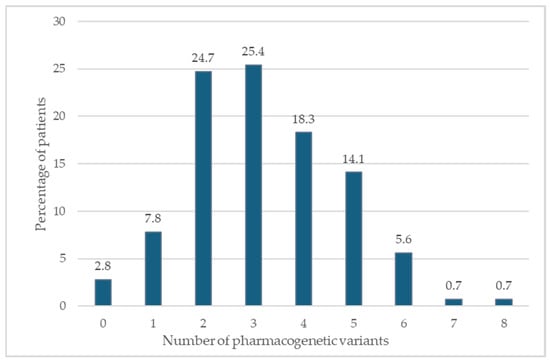
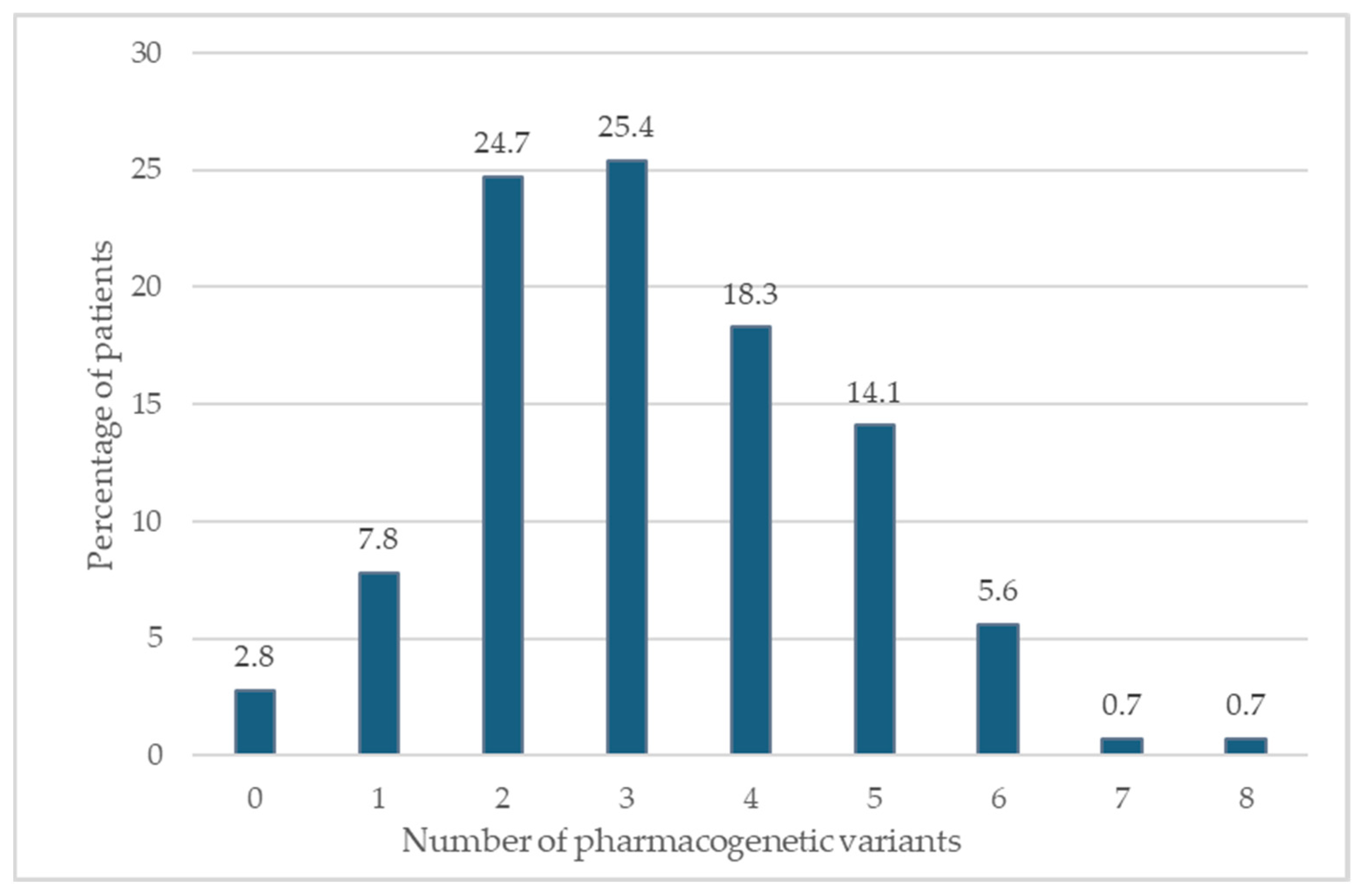
The number of pharmacogenetic variants per patient is displayed in Figure 1. There were a mean of 3.2 (SD = 1.5) variants per patient. Overall, 97.2% of patients had ≥1, 89.4% ≥ 2, 64.8% ≥ 3, 39.4% ≥ 4, and 21.1% had ≥5 pharmacogenetic variants. Genes most affected by variants resulting in predicted phenotypes other than normal metabolism were VKORC1 (84.5%), MTHFR (85.9%), and CYP2C9 (42.3%).
Figure 1.
Number of pharmacogenetic variants per patient.
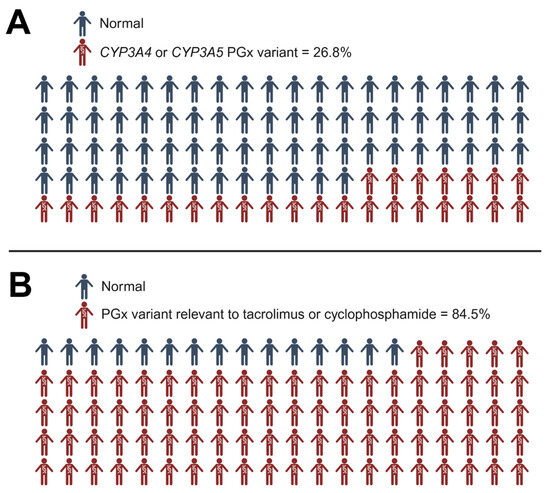
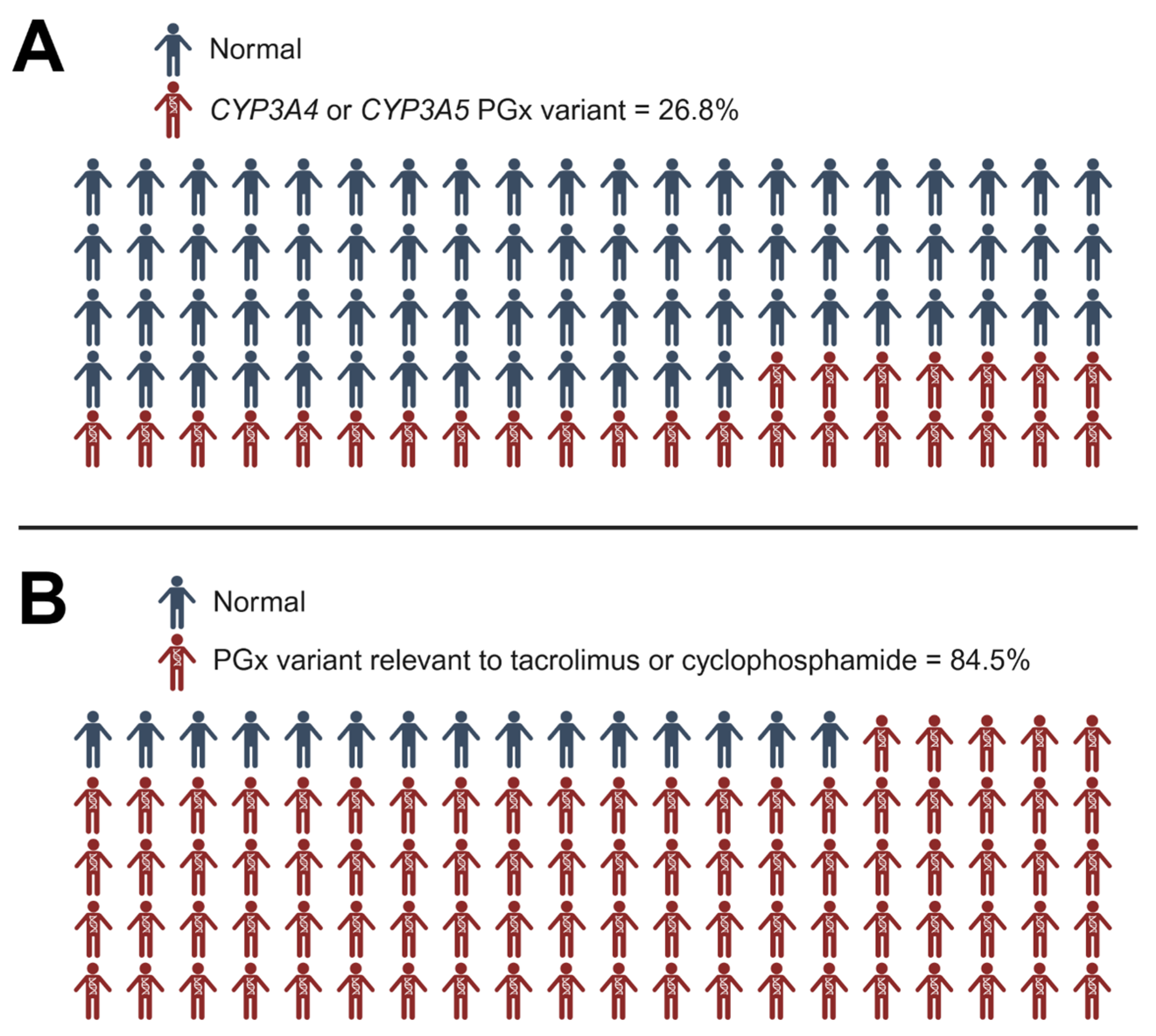
Analysis of genes relevant for tacrolimus metabolism showed that 21 (14.8%) were CYP3A5 expressers (an actionable genotype), and 38 (26.8%) patients had a pharmacogenetic variant in either CYP3A4 or CYP3A5, or both (Figure 2). For genes encoding CYP enzymes necessary for the activation of cyclophosphamide (CYP2B6, CYP2C9, CYP2C19 and CYP3A4), 116 (81.7%) patients had at least one pharmacogenetic variant resulting in a predicted phenotype other than normal (e.g., poor, intermediate, or ultrarapid metabolizers) (Table 2). Among these, the poor metabolizer phenotype, which is suggested to be the most clinically relevant, was present in 20 (14.1%) of patients. In total, 120 (84.5%) patients had an pharmacogenetic variant in genes relevant to either tacrolimus or cyclophosphamide metabolism (CYP2B6, CYP2C9, CYP2C19, CYP3A4, and CYP3A5).
Figure 2.
Frequency of pharmacogenetic (PGx) variants in alloHCT recipients: (A) shows the proportion of patients with at least one pharmacogenetic variant in CYP3A4 or CYP3A5, which are relevant to tacrolimus metabolism; (B) shows the proportion of patients with at least one pharmacogenetic variant relevant to tacrolimus and cyclophosphamide metabolism combined (CYP2B6, CYP2C9, CYP2C19, CYP3A4, and CYP3A5); PGx: pharmacogenetics.
Table 2.
Variant frequencies in cyclophosphamide and tacrolimus-related genes.
Table 3 shows the variant frequencies of the study and control cohort. There were no statistically significant differences in the frequencies between the two groups (p > 0.05). Although not statistically significant, notable numerical differences in genotype/predicted phenotype frequencies were observed for ABCG2 KK (strongly reduced activity), CYP2B6 (poor metabolizers), CYP2C9 (poor metabolizers), CYP2C19 (poor and ultrarapid metabolizers), CYP3A4 (poor metabolizers), and CYP3A5 (homozygous expressers) (Table 3).
Table 3.
Pharmacogenetic profiles of patients and control group.
4. Discussion
In this retrospective descriptive cohort study, we analyzed pharmacogenetic variant frequencies for 11 genes in 142 alloHCT recipients and compared the variant frequencies to a demographically matched control cohort. We found that almost every patient had at least one pharmacogenetic variant. Our results indicate that actionable variants are highly prevalent among patients with AML/ALL receiving alloHCT. This includes variants with drug–gene interactions involving tacrolimus and cyclophosphamide, both drugs which were administered to all patients in this cohort. Although some numeric differences were observed, the frequencies did not statistically differ between the patient and control cohorts.
Our findings correspond to previous studies reporting that up to 90–95% of individuals in the general population carry at least one actionable variant relevant to commonly used medications [18,26,35]. This means that many individuals, including alloHCT recipients, exhibit either slower or faster drug metabolism compared to what would be considered “normal”. For instance, only 1 out of 5 patients in this study was predicted to have normal cyclophosphamide metabolism, meaning that the other four patients were predicted to have poor, intermediate, or ultrarapid cyclophosphamide metabolism. Among these, poor metabolism is suggested to be most clinically relevant since it drastically reduces the formation of the active metabolite, leading to lower effective cyclophosphamide exposure [21]. This is relevant because adequate exposure to PTCy is a key determinant for alloHCT outcomes [7]. In fact, a higher risk of GVHD has been reported in patients receiving PTCy that carried certain CYP2B6, CYP2C9, and CYP2C19 variants [8]. It is currently unknown if, and how, cyclophosphamide dosing should be adjusted in patients with CYP2B6, CYP2C9, and CYP2C19 variants. Moreover, we found that 1 in 4 patients carried a variant in CYP3A4 or CYP3A5 known to cause altered tacrolimus metabolism [36]. A study in alloHCT recipients reported that CYP3A5 expressers required 11.8 days to reach therapeutic tacrolimus concentrations [9]. Tacrolimus dosing is guided by therapeutic drug monitoring [4] and is frequently administered as short as 28 days post-alloHCT [7,37]. Achieving adequate concentrations early during this short treatment course is considered to be important and genotype-guided dosing could help shorten the time to reach therapeutic blood levels. Accordingly, both international and Dutch guidelines recommend a 1.5–2.5× higher starting dose for CYP3A5 expressers compared to CYP3A5 non-expressers (most individuals) [36,38]. For the alloHCT population from this study, pre-emptive pharmacogenetic screening would have resulted in different tacrolimus starting dose in 14,8% of patients. When guideline recommendations for CYP3A4 variants and tacrolimus become available, it is expected that tacrolimus starting dose can be individually adjusted in about 27% of patients. Besides these tacrolimus drug–gene interactions, also the many drug–drug interactions of tacrolimus can highly influence tacrolimus exposure and should be taken into consideration at dose selection. There are currently no guidelines on how to combine drug–gene interactions and drug–drug interactions in clinical practice.
Even though our study indicates that pharmacogenetic variants are highly prevalent in the alloHCT setting, it remains controversial if and at what timepoint pharmacogenetic testing should be implemented [35]. Also, it is not clear if pharmacogenetic testing would be beneficial for all types of alloHCT, or that certain types of transplantation, donor, or disease would be of higher potential benefit. Pre-emptive panel-based screening is generally favored over a reactive single-gene approach, because it is more cost-effective, efficient, accounts for the combined effect of multiple pharmacogenetic variants, and avoids delays that are more likely with reactive and single-gene testing [26,35]. It currently remains unclear whether pharmacogenetic testing improves clinical outcomes in alloHCT recipients. Studies investigating whether pharmacogenetic testing reduces drug-related complications and toxicities are rare [19], often retrospective [8,23] and focused on specific drug–gene pairs [8,9,24,25,39]. Therefore, the results of a recently completed clinical trial investigating whether pharmacogenetic screening improves quality of life of patients receiving a hematopoietic cell transplantation (NCT04727827) are eagerly awaited. Nevertheless, clinically relevant and feasible pharmacogenetic screening programs have been described in various other health care settings [17,35], but evidence in the setting of alloHCT is still limited.
Future studies should investigate how known as well as novel drug–gene interactions influence clinical outcomes in alloHCT recipients, including those affecting tacrolimus [9,10,11,12,13,14,19], cyclophosphamide [8,19], antifungals and busulfan [19,25]. Since many patients carry multiple pharmacogenetic variants, future studies should consider the potential interplay between different drug–gene interactions. For example, combinations of CYP3A4 variants associated with poor tacrolimus metabolism and CYP3A5 variants that increase tacrolimus metabolism will result in distinct metabolic phenotypes compared to either variant alone [9,39]. Similarly, reduced activity of CYP2B6 but normal activity of the escape route enzymes (e.g., CYP2C9, CYP2C19 and CYP3A4) may only slightly reduce cyclophosphamide activation; whereas, reduced activity in both CYP2B6 and one of the escape route enzymes will result in much more pronounced reduction in cyclophosphamide activation [21]. This stresses the need to screen these genes combined, supporting the superiority of panel-based over single-gene testing. Future studies with panel-based testing in larger cohorts will create large datasets that allow for incorporation of pharmacogenetic variables in advanced predictive models for alloHCT outcomes [40]. Another relevant field for future pharmacogenetic studies in alloHCT patients, is to explore the genotyping of donors. In this setting, donor genetic profiling of metabolic liver enzyme is of less relevant; but, donor variation in, for example, aldehyde dehydrogenase is of interest since increased aldehyde dehydrogenase activity in donor T-cells is related to PTCy resistance [41] and reduced aldehyde dehydrogenase activity in donor stem cells can result in increased stem cell sensitivity to the cytotoxic effects of PTCy.
This study has several limitations, including its retrospective design and modest sample size. We did not investigate how many patients in our sample received drugs with other actionable drug–gene interactions such as voriconazole, analgesics, antidepressants, antiemetics, and proton-pump inhibitors [19]. Additionally, the genetic panel was not tailored to alloHCT recipients and therefore did not include all relevant genes, such as those encoding glutathione-S-transferase enzymes, involved in the hepatic inactivation of busulfan [19]. This potentially leads to underestimating the prevalence of pharmacogenetic variants in this population. Our findings may not generalize to individuals of other ancestry, because the genetic panel was designed for individuals of North-Western European ancestry [26] and variant frequencies can vary between populations [22]. Since race was not available in the dataset used for this retrospective analysis, this variable could not be included. Furthermore, the genotyping technique has some technical constraints: CYP2D6 often involves structural variation [35], some of which cannot be detected or distinguished by standard methods and instead rely on software predictions (computational phasing) to infer which variants occur together [26]. These limitations resulted in incomplete pharmacogenetic results for some individuals, indicated as not available [26]. Another limitation is that implementation of pharmacogenetic screening as a standard approach in alloHCT currently is not widely possible due to technical and financial limitations. However, the implementation of pharmacogenetic screening in the routine clinical workup of alloHCT patients in our center has demonstrated its feasibility. Unfortunately, detailed data on the intensity of the transplantation conditioning regimens were not available for the current study. Also, no clinical outcomes have been assessed yet, resulting in a descriptive analysis of variant frequencies. Correlative analyses with clinical data, including GVHD incidence and survival data, will be part of our future studies. In conclusion, retrospective pharmacogenetic testing revealed that almost all patients with AML/ALL undergoing alloHCT carry pharmacogenetic variants. We found no differences in variant frequencies between alloHCT recipients and the general population. Pharmacogenetic testing has the potential to improve individual drug selection and dosing, and future studies should investigate whether it improves clinical outcomes in alloHCT recipients.
Author Contributions
Conceptualization, M.N., G.A.H., D.J.T., T.H.O.M. and C.M.W.; Methodology, L.P.A.T., L.M.M., G.A.H., T.H.O.M. and C.M.W.; Formal Analysis, L.P.A.T., P.L. and T.H.O.M.; Investigation, L.P.A.T. and P.L.; Resources, P.L. and L.B.B.; Data Curation, P.L.; Writing—Original Draft Preparation, L.P.A.T.; Writing—Review and Editing, L.P.A.T., P.L., L.M.M., M.N., L.B.B., G.A.H., D.J.T., T.H.O.M. and C.M.W.; Visualization, L.P.A.T. and T.H.O.M.; Supervision, T.H.O.M. and C.M.W.; Project Administration, L.P.A.T., T.H.O.M. and C.M.W.; T.H.O.M. and C.M.W. contributed equally to this work. All authors have read and agreed to the published version of the manuscript.
Funding
This research received no external funding.
Institutional Review Board Statement
The study was conducted in accordance with the Declaration of Helsinki. For this study, we used data from the OncoLifeS data-biobank for Oncology (Dutch Trial Register: NL7839), which has been approved by the OncoLifeS Scientific committee (OLS079-202420880-pharm SCT, 21 January 2025). The OncoLifeS study protocol was approved by the medical research ethics committee of the University Medical Center Groningen (UMCG METc2010/109, 28 June 2019).
Informed Consent Statement
In the OncoLifeS data-biobank, all patients are included after written informed consent.
Data Availability Statement
The raw data supporting the conclusions of this article will be made available by the authors on request.
Acknowledgments
We thank Jelle Slager (Department of Genetics, University Medical Center Groningen, The Netherlands) and Jackie A. M. Dekens (Department of Genetics, Center for Development and Innovation, University Medical Center Groningen, The Netherlands) for their support in data curation (genotyping), software development and validation (providing the Lifelines NEXT data) as well as critically reading the manuscript.
Conflicts of Interest
The authors declare no conflicts of interest.
Abbreviations
The following abbreviations are used in this manuscript:
| AML | Acute myeloid leukemia |
| ALL | Acute lymphoblastic leukemia |
| alloHCT | Allogeneic hematopoietic stem cell transplantation |
| PTCy | Post-transplantation cyclophosphamide |
| GVHD | Graft versus host disease |
| EHR | Electronic health record |
| GSA-MD | Global Screening Array multiethnic disease |
| UMCG METc | University Medical Center Groningen Medisch Ethische Toetsingscommissie |
| SD | Standard deviation |
| IQR | Interquartile range |
| aCML | Atypical chronic myeloid leukemia |
| ELN | European leukemia network |
| NA | Not available |
| MRD | Minimal residual disease |
| HLA | Human leukocyte antigen |
| PGx | Pharmacogenetics |
| TAC | Tacrolimus |
| CP | cyclophosphamide |
| NM | Normal metabolizer |
| IM | Intermediate metabolizer |
| PM | Poor metabolizer |
| UM | Ultrarapid metabolizer |
References
- Gökbuget, N.; Boissel, N.; Chiaretti, S.; Dombret, H.; Doubek, M.; Fielding, A.; Foà, R.; Giebel, S.; Hoelzer, D.; Hunault, M.; et al. Management of ALL in Adults: 2024 ELN Recommendations from a European Expert Panel. Blood 2024, 143, 1903–1930. [Google Scholar] [CrossRef] [Scilit] [PubMed]
- Doehner, H.; We, A.H.; Appelbaum, F.R.; Craddock, C.; DiNardo, C.D.; Ebert, B.L.; Fenaux, P.; Godley, L.A.; Hasserjian, R.P.; Larson, R.A.; et al. Diagnosis and Management of AML in Adults: 2022 Recommendations from an International Expert Panel on Behalf of the ELN. Blood 2022, 140, 1345–1377. [Google Scholar] [CrossRef] [Scilit] [PubMed]
- Kubo, H.; Imataki, O.; Fukumoto, T.; Ishida, T.; Kubo, Y.H.; Yoshida, S.; Uemura, M.; Fujita, H.; Kadowaki, N. Clinical Effects of Tacrolimus Blood Concentrations Early after Allogeneic Hematopoietic Stem Cell Transplantation. Cytotherapy 2024, 26, 472–481. [Google Scholar] [CrossRef] [Scilit] [PubMed]
- Brunet, M.; Van Gelder, T.; Åsberg, A.; Haufroid, V.; Hesselink, D.A.; Langman, L.; Lemaitre, F.; Marquet, P.; Seger, C.; Shipkova, M.; et al. Therapeutic Drug Monitoring of Tacrolimus-Personalized Therapy: Second Consensus Report. Ther. Drug Monit. 2019, 41, 261–307. [Google Scholar] [CrossRef] [Scilit] [PubMed]
- Thol, F.; Döhner, H.; Ganser, A. How I Treat Refractory and Relapsed Acute Myeloid Leukemia. Blood 2024, 134, 11–20. [Google Scholar] [CrossRef] [Scilit] [PubMed]
- Mielcarek, M.; Furlong, T.; O’Donnell, P.V.; Storer, B.E.; McCune, J.S.; Storb, R.; Carpenter, P.A.; Flowers, M.E.D.; Appelbaum, F.R.; Martin, P.J. Posttransplantation Cyclophosphamide for Prevention of Graft-versus-Host Disease after HLA-Matched Mobilized Blood Cell Transplantation. Blood 2016, 127, 1502–1508. [Google Scholar] [CrossRef] [Scilit] [PubMed]
- Morsink, L.M.; Hazenberg, C.L.E.; Choi, G.; de Groot, M.R.; Biswana, A.; Bellido, M.; Kooistra, H.A.M.; Bungener, L.B.; Meijer, K.; Mulder, A.B.; et al. Improved Outcome of Allogeneic Transplantation in Older Patients Treated for Myeloid Malignancies Using Post-Transplantation Cyclophosphamide and Reduced Duration of Immune Suppression. Transpl. Cell Ther. 2024, 30, 794–807. [Google Scholar] [CrossRef] [Scilit] [PubMed]
- Muñiz, P.; Andrés-Zayas, C.; Carbonell, D.; Chicano, M.; Bailén, R.; Oarbeascoa, G.; Suárez-González, J.; Gómez Centurión, I.; Dorado, N.; Gallardo, D.; et al. Association between Gene Polymorphisms in the Cyclophosphamide Metabolism Pathway with Complications after Haploidentical Hematopoietic Stem Cell Transplantation. Front. Immunol. 2022, 13, 1002959. [Google Scholar] [CrossRef] [Scilit] [PubMed]
- Marco, D.N.; Molina, M.; Guio, A.M.; Julian, J.; Fortuna, V.; Fabregat-Zaragoza, V.L.; Salas, M.Q.; Monge-Escartín, I.; Riu-Viladoms, G.; Carcelero, E.; et al. Effects of CYP3A5 Genotype on Tacrolimus Pharmacokinetics and Graft-versus-Host Disease Incidence in Allogeneic Hematopoietic Stem Cell Transplantation. Pharmaceuticals 2024, 17, 553. [Google Scholar] [CrossRef] [Scilit] [PubMed]
- Patel, J.N.; Hamadeh, I.S. Pharmacogenetics and Tacrolimus Administration in Stem Cell Transplantation. Pharmacogenomics 2020, 21, 419–426. [Google Scholar] [CrossRef] [Scilit] [PubMed]
- Thervet, E.; Loriot, M.A.; Barbier, S.; Buchler, M.; Ficheux, M.; Choukroun, G.; Toupance, O.; Touchard, G.; Alberti, C.; Le Pogamp, P.; et al. Optimization of Initial Tacrolimus Dose Using Pharmacogenetic Testing. Clin. Pharmacol. Ther. 2010, 87, 721–726. [Google Scholar] [CrossRef] [Scilit] [PubMed]
- Hagen, P.A.; Kobrinski, D.; Al-Mansour, Z.; Tsai, S.B.; Parthasarathy, M.; Kliethermes, S.; Rodriguez, T.E.; Smith, S.E.; Stiff, P.J. Early Post-Transplantation Tacrolimus Levels Correlate with Acute Graft-Versus-Host Disease in Allogeneic Hematopoietic Stem Cell Transplantation from Related and Unrelated Donors. Blood 2016, 128, 3429. [Google Scholar] [CrossRef] [Scilit]
- Ganetsky, A.; Shah, A.; Miano, T.A.; Hwang, W.T.; He, J.; Loren, A.W.; Hexner, E.O.; Frey, N.V.; Porter, D.L.; Reshef, R. Higher Tacrolimus Concentrations Early after Transplant Reduce the Risk of Acute GvHD in Reduced-Intensity Allogeneic Stem Cell Transplantation. Bone Marrow Transpl. 2016, 51, 568–572. [Google Scholar] [CrossRef] [Scilit] [PubMed]
- Lee, J.J.; Norman, H.; Ziggas, J.E.; Bolaños-Meade, J.; Porter, T.J. Evaluation of Immunosuppression Levels and Risk of Graft-Versus-Host Disease in Allogeneic Blood or Marrow Transplantation With Post-Transplantation Cyclophosphamide. Transpl. Cell Ther. 2025, 31, 363.e1–363.e11. [Google Scholar] [CrossRef] [Scilit] [PubMed]
- Relling, M.V.; Klein, T.E.; Gammal, R.S.; Whirl-Carrillo, M.; Hoffman, J.M.; Caudle, K.E. The Clinical Pharmacogenetics Implementation Consortium: 10 Years Later. Clin. Pharmacol. Ther. 2020, 107, 171–175. [Google Scholar] [CrossRef] [Scilit] [PubMed]
- Caudle, K.E.; Dunnenberger, H.M.; Freimuth, R.R.; Peterson, J.F.; Burlison, J.D.; Whirl-Carrillo, M.; Scott, S.A.; Rehm, H.L.; Williams, M.S.; Klein, T.E.; et al. Standardizing Terms for Clinical Pharmacogenetic Test Results: Consensus Terms from the Clinical Pharmacogenetics Implementation Consortium (CPIC). Genet. Med. 2017, 19, 215–223. [Google Scholar] [CrossRef] [Scilit] [PubMed]
- Swen, J.J.; van der Wouden, C.H.; Manson, L.E.; Abdullah-Koolmees, H.; Blagec, K.; Blagus, T.; Böhringer, S.; Cambon-Thomsen, A.; Cecchin, E.; Cheung, K.C.; et al. A 12-Gene Pharmacogenetic Panel to Prevent Adverse Drug Reactions: An Open-Label, Multicentre, Controlled, Cluster-Randomised Crossover Implementation Study. Lancet 2023, 401, 347–356. [Google Scholar] [CrossRef] [Scilit] [PubMed]
- Bousman, C.A.; Narang, A.; Al Bkhetan, Z.; Woods, R.L.; Orchard, S.G.; Owen, A.J.; Fravel, M.A.; Gilmartin-Thomas, J.; Ryan, J.; Fransquet, P.D.; et al. Prevalence of Actionable Pharmacogenetic Genotype Frequencies, Cautionary Medication Use, and Polypharmacy in Community-Dwelling Older Adults. Clin. Pharmacol. Ther. 2025, 118, 337–342. [Google Scholar] [CrossRef] [Scilit] [PubMed]
- Morris, S.A.; Nguyen, D.G.; Patel, J.N. Pharmacogenomics in Allogeneic Hematopoietic Stem Cell Transplantation: Implications on Supportive Therapies and Conditioning Regimens. Best. Pract. Res. Clin. Haematol. 2023, 36, 101470. [Google Scholar] [CrossRef] [Scilit] [PubMed]
- Roy, P.; Yu, L.J.; Crespi, C.L.; Waxman, D.J. Development of a Substrate-Activity Based Approach to Identify the Major Human Liver P-450 Catalysts of Cyclophosphamide and Ifosfamide Activation Based on CDNA-Expressed Activities and Liver Microsomal P-450 Profiles. Drug Metab. Dispos. 1999, 27, 655–666. [Google Scholar] [CrossRef] [Scilit]
- El-Serafi, I.; Steele, S. Cyclophosphamide Pharmacogenomic Variation in Cancer Treatment and Its Effect on Bioactivation and Pharmacokinetics. Adv. Pharmacol. Pharm. Sci. 2024, 2024, 4862706. [Google Scholar] [CrossRef] [Scilit] [PubMed]
- Tremmel, R.; Zhou, Y.; Camara, M.D.; Laarif, S.; Eliasson, E.; Lauschke, V.M. PharmFreq: A Comprehensive Atlas of Ethnogeographic Allelic Variation in Clinically Important Pharmacogenes. Nucleic Acids Res. 2025, 53, D1498–D1509. [Google Scholar] [CrossRef] [Scilit] [PubMed]
- Rocha, V.; Porcher, R.; Fernandes, J.F.; Filion, A.; Bittencourt, H.; Silva, W.; Vilela, G.; Zanette, D.L.; Ferry, C.; Larghero, J.; et al. Association of Drug Metabolism Gene Polymorphisms with Toxicities, Graft-versus-Host Disease and Survival after HLA-Identical Sibling Hematopoietic Stem Cell Transplantation for Patients with Leukemia. Leukemia 2009, 23, 545–556. [Google Scholar] [CrossRef] [Scilit] [PubMed]
- Hamadeh, I.S.; Zhang, Q.; Steuerwald, N.; Hamilton, A.; Druhan, L.J.; McSwain, M.; Diez, Y.; Rusin, S.; Han, Y.; Symanowski, J.; et al. Effect of CYP3A4, CYP3A5, and ABCB1 Polymorphisms on Intravenous Tacrolimus Exposure and Adverse Events in Adult Allogeneic Stem Cell Transplant Patients. Biol. Blood Marrow Transplant. 2019, 25, 656–663. [Google Scholar] [CrossRef] [Scilit] [PubMed]
- Iwamoto, T.; Monma, F.; Fujieda, A.; Nakatani, K.; Gayle, A.A.; Nobori, T.; Katayama, N.; Okuda, M. Effect of Genetic Polymorphism of CYP3A5 and CYP2C19 and Concomitant Use of Voriconazole on Blood Tacrolimus Concentration in Patients Receiving Hematopoietic Stem Cell Transplantation. Ther. Drug Monit. 2015, 37, 581–588. [Google Scholar] [CrossRef] [Scilit] [PubMed]
- Lanting, P.; Warmerdam, R.; Slager, J.; Brugge, H.; Ochi, T.; Benjamins, M.; Lopera-Maya, E.; Jankipersadsing, S.; Gelderloos-Arends, J.; Teuben, D.; et al. Low-Cost Generation of Clinical-Grade Layperson-Friendly Pharmacogenetic Passports Using Oligonucleotide Arrays. Am. J. Hum. Genet. 2025, 112, 1015–1028. [Google Scholar] [CrossRef] [Scilit] [PubMed]
- Sayers, E.W.; Bolton, E.E.; Brister, J.R.; Canese, K.; Chan, J.; Comeau, D.C.; Connor, R.; Funk, K.; Kelly, C.; Kim, S.; et al. Database Resources of the National Center for Biotechnology Information. Nucleic Acids Res. 2022, 50, D20–D26. [Google Scholar] [CrossRef] [Scilit] [PubMed]
- Günther, T.; Goldberg, A.; Schraiber, J.G. Estimating Allele Frequencies, Ancestry Proportions and Genotype Likelihoods in the Presence of Mapping Bias. G3 2025, 15, jkaf172. [Google Scholar] [CrossRef] [Scilit] [PubMed]
- Mitchell, J.; Milite, S.; Bartram, J.; Walker, S.; Volkova, N.; Yavorska, O.; Zarowiecki, M.; Chalker, J.; Thomas, R.; Vago, L.; et al. Clinical Application of Tumour-in-Normal Contamination Assessment from Whole Genome Sequencing. Nat. Commun. 2024, 15, 323. [Google Scholar] [CrossRef] [Scilit] [PubMed]
- Sidorenkov, G.; Nagel, J.; Meijer, C.; Duker, J.J.; Groen, H.J.M.; Halmos, G.B.; Oonk, M.H.M.; Oostergo, R.J.; van der Vegt, B.; Witjes, M.J.H.; et al. The OncoLifeS Data-Biobank for Oncology: A Comprehensive Repository of Clinical Data, Biological Samples, and the Patient’s Perspective. J. Transl. Med. 2019, 17, 374. [Google Scholar] [CrossRef] [Scilit] [PubMed]
- Harris, P.A.; Taylor, R.; Thielke, R.; Payne, J.; Gonzalez, N.; Conde, J.G. Research Electronic Data Capture (REDCap)-A Metadata-Driven Methodology and Workflow Process for Providing Translational Research Informatics Support. J. Biomed. Inf. 2009, 42, 377–381. [Google Scholar] [CrossRef] [Scilit] [PubMed]
- Harris, P.A.; Taylor, R.; Minor, B.L.; Elliott, V.; Fernandez, M.; O’Neal, L.; McLeod, L.; Delacqua, G.; Delacqua, F.; Kirby, J.; et al. The REDCap Consortium: Building an International Community of Software Platform Partners. J. Biomed. Inform. 2019, 95, 103208. [Google Scholar] [CrossRef] [Scilit] [PubMed]
- Boulesteix, A.L.; Hoffmann, S. To Adjust or Not to Adjust: It Is Not the Tests Performed That Count, but How They Are Reported and Interpreted. BMJ Med. 2024, 3, e000783. [Google Scholar] [CrossRef] [Scilit] [PubMed]
- Bender, R.; Lange, S. Adjusting for Multiple Testing-When and How? J. Clin. Epidemiol. 2001, 54, 343–349. [Google Scholar] [CrossRef] [Scilit] [PubMed]
- Haidar, C.E.; Crews, K.R.; Hoffman, J.M.; Relling, M.V.; Caudle, K.E. Advancing Pharmacogenomics from Single-Gene to Preemptive Testing. Annu. Rev. Genom. Hum. Genet. 2022, 38, 449–473. [Google Scholar] [CrossRef] [Scilit] [PubMed]
- Birdwell, K.A.; Decker, B.; Barbarino, J.M.; Peterson, J.F.; Stein, C.M.; Sadee, W.; Wang, D.; Vinks, A.A.; He, Y.; Swen, J.J.; et al. Clinical Pharmacogenetics Implementation Consortium (CPIC) Guidelines for CYP3A5 Genotype and Tacrolimus Dosing. Clin. Pharmacol. Ther. 2015, 98, 19–24. [Google Scholar] [CrossRef] [Scilit] [PubMed]
- Morsink, L.M.; Keijzer, K.; Hazenberg, C.L.E.; Choi, G.; de Groot, M.R.; Ammatuna, E.; Klein, S.K.; Woolthuis, C.; Biswana, A.; Meppelink, J.F.S.; et al. Beneficial Effect of PTCy and a Short Duration of Immune Suppression on Relapse Risk in Acute Myeloid Leukemia Patients with Pretransplant MRD. Bone Marrow Transpl. 2025, 60, 1660–1662. [Google Scholar] [CrossRef] [Scilit] [PubMed]
- CYP3A5: Tacrolimus G-Standaard. Available online: https://www.g-standaard.nl/risicoanalyse/M0002762.pdf (accessed on 7 December 2025).
- Seligson, N.D.; Zhang, X.; Zemanek, M.C.; Johnson, J.A.; VanGundy, Z.; Wang, D.; Phelps, M.A.; Roddy, J.; Hofmeister, C.C.; Li, J.; et al. CYP3A5 Influences Oral Tacrolimus Pharmacokinetics and Timing of Acute Kidney Injury Following Allogeneic Hematopoietic Stem Cell Transplantation. Front. Pharmacol. 2024, 14, 1334440. [Google Scholar] [CrossRef] [Scilit] [PubMed]
- Asteris, P.G.; Armaghani, D.J.; Gandomi, A.H.; Mohammed, A.S.; Bousiou, Z.; Batsis, I.; Spyridis, N.; Karavalakis, G.; Vardi, A.; Tsoukals, M.Z.; et al. Survival Prediction in Allogeneic Haematopoietic Stem Cell Transplant Recipients Using Pre- and Post-Transplant Factors and Computational Intelligence. J. Cell Mol. Med. 2025, 29, e70672. [Google Scholar] [CrossRef] [Scilit] [PubMed]
- Luznik, L.; Kanakry, C.G. Efflux capacity and aldehyde dehydrogenase both contribute to CD8+ T-cell resistance to posttransplant cyclophosphamide. Blood Adv. 2022, 6, 4994–5008. [Google Scholar] [CrossRef] [Scilit] [PubMed]

Disclaimer/Publisher’s Note: The statements, opinions and data contained in all publications are solely those of the individual author(s) and contributor(s) and not of MDPI and/or the editor(s). MDPI and/or the editor(s) disclaim responsibility for any injury to people or property resulting from any ideas, methods, instructions or products referred to in the content. |
© 2026 by the authors. Licensee MDPI, Basel, Switzerland. This article is an open access article distributed under the terms and conditions of the Creative Commons Attribution (CC BY) license.