


Abstract
Bier anaemic spots, cyanosis, and urticaria-like eruption (BASCULE) syndrome is a vasomotor disorder predominantly reported in children and adolescents. We describe a 21-year-old woman with confirmed postural orthostatic tachycardia syndrome (POTS) and separately inducible urticaria factitia. A literature review identified a case-level dataset of 35 individual records, including the new patient and one historical report of postural cholinergic urticaria considered a possible clinical overlap. Three larger series were summarised separately; after subtraction of documented overlap, the combined evidence represented an upper estimate of 124 potentially unique individuals. The median age at presentation was 14 years; 30/35 patients were aged ≤18 years and 19/35 were female. Lower-extremity involvement was recorded in 33/35 patients, pruritus in 22/34, and pain, burning, stinging, or paraesthesia in 16/34. Orthostatic symptoms or diagnoses were recorded in 10/29 patients with relevant information, including four with confirmed POTS. Exploratory Fisher exact and Mann–Whitney comparisons were retained, but none remained significant after false discovery rate correction. Treatment descriptions were heterogeneous and frequently insufficient to distinguish symptomatic relief from clearance of the eruption. The findings support recognition of the characteristic cutaneous pattern and assessment of associated orthostatic complaints. The exploratory comparisons are hypothesis-generating, and the available reports do not establish a preferred treatment or reliable response rate.
1. Introduction
Bier anaemic spots, cyanosis, and urticaria-like eruption (BASCULE) syndrome is a rare vasomotor disorder predominantly affecting children and adolescents. The characteristic eruption comprises Bier anaemic spots and urticaria-like lesions on an erythrocyanotic background, usually on the lower extremities. Standing commonly provokes episodes in older patients, whereas handling or compression may be relevant in infants. Lesions improve after a change in position or removal of the provoking stimulus, but the reported time to resolution varies [1,2,3,4,5,6,7,8,9,10,11,12,13,14,15,16,17,18,19,20,21,22]. Pruritus and discomfort may accompany the eruption, and associated orthostatic symptoms warrant attention [2,3,4,5,7].
Since the initial description by Bessis et al. in 2016 [1], the evidence has expanded from individual reports to larger retrospective series [3,4,5,23,24,25,26,27,28,29,30,31]. We report a new patient with BASCULE syndrome and POTS and review the clinical phenotype, associated orthostatic findings, and treatment observations. Exploratory patient-level comparisons complement the descriptive summary without implying confirmatory evidence.
2. Materials and Methods
2.1. Literature Search and Study Selection
We conducted a literature review of published BASCULE cases. PubMed, Web of Science, and Scopus were searched from inception through 23 June 2026 using “Bier anaemic spots, cyanosis, and urticaria-like eruption,” “BASCULE syndrome,” and “postural urticaria,” combined with OR and adapted to each database. No publication-year or language restrictions were applied. Reference lists of eligible articles and relevant reviews were also examined. The review was not prospectively registered. Counts from the initial screening and exclusion stages were not retained, and a reliable retrospective PRISMA flow diagram could therefore not be produced.
Titles, abstracts, and full texts were assessed independently by two reviewers (T.G. and L.F.-P.), with disagreements resolved through discussion or consultation with L.S. Case reports and series describing BASCULE syndrome were eligible. Reports without new patients or with insufficient demographic or clinical information for case-level extraction were excluded. No paediatric age restriction was applied. One historical report by Hirohata et al., published as postural cholinergic urticaria [28], was included in the original case-level dataset because of its posture-dependent presentation. We explicitly distinguish this possible overlap case from author-diagnosed BASCULE: the original report does not document all components of the BASCULE triad and does not establish that diagnosis.
Possible duplicate publications were compared using authors, institutions, age, sex, clinical features, and chronology. A recognised longitudinal follow-up was linked to its original case and counted once. The 33-patient Bessis series explicitly included three previously published patients [4]. The 35-record individual dataset includes our new patient and is analysed separately from the three larger series. Combined counts are presented as an upper estimate of potentially unique individuals because complete patient-level linkage across publications was unavailable.
2.2. Data Extraction and Definitions
Data were extracted into a structured spreadsheet. Variables included age at presentation and onset, sex, reported triggers, episode characteristics, anatomical distribution, symptoms, orthostatic findings, comorbidities, investigations, treatment, and outcome. Multiple triggers, sites, symptoms, and treatments could be recorded for the same patient. During revision, source-verifiable discrepancies in the sex, anatomy, symptom, and treatment coding of individual reports were corrected before repeating the simple association tests.
Unreported information was not interpreted as a documented negative finding. Variable-specific denominators were used for symptoms, comorbidities, and other incompletely reported features; reported triggers and anatomical sites were summarised within the individual-case dataset. “Reported orthostatic symptoms or diagnoses” denotes a broad reporting category, including confirmed POTS, orthostatic hypotension, orthostatic intolerance, positive orthostatic testing, and explicitly documented orthostatic syncopal or presyncopal presentations. Confirmed POTS was recorded separately. The frequency of documented POTS diagnoses among patients with orthostatic information is not a prevalence estimate based on systematic POTS testing.
Treatment outcomes were described according to the original authors’ accounts. Relief of pruritus or pain, changes in visible lesions or episode frequency, and complete resolution were distinguished only when explicitly documented. General discussion statements about efficacy were not treated as individual treatment trials. Unreported treatment or outcome information was not classified as treatment failure. Because exposure, outcome definitions, and follow-up were heterogeneous, we did not interpret these observations as a standardised pooled response rate.
The three larger series were summarised separately using their reported numerators, denominators, and definitions [3,4,5]. Aggregate data were not used to reconstruct individual-level combinations of variables or added to patient-level association tests.
2.3. Statistical Analysis
Continuous variables are presented as medians, interquartile ranges (IQRs), and ranges; categorical variables as counts and percentages with their denominators. Exploratory categorical associations were assessed using two-sided Fisher exact tests, with conditional odds ratios and exact 95% confidence intervals. Continuous variables were compared using two-sided Mann–Whitney U tests with tie correction and continuity correction; rank-biserial correlations describe effect size. Wilson 95% confidence intervals were calculated for the proportions.
The existing family of 20 exploratory comparisons was retained: 12 categorical comparisons and eight continuous-variable comparisons. Benjamini–Hochberg adjustment was applied across all 20 tests, and both unadjusted and adjusted p-values are reported in Supplementary Table S1. Nominal p-values below 0.05 were not interpreted as confirmatory evidence when they did not remain below 0.05 after adjustment. Analyses used records with information on both variables. No multivariable regression models were retained.
No formal methodological quality assessment was performed; this is a limitation of the review. Findings are interpreted in the context of heterogeneous documentation, possible selection and publication bias, and the small case-level sample.
3. Results
3.1. Included Evidence
The case-level dataset contained 35 records: 34 from previously published reports and the newly reported patient. It also included the historical report of postural cholinergic urticaria [28], which was considered phenotypically consistent with BASCULE syndrome but was not presented as an independently confirmed BASCULE diagnosis. Three larger case series comprising 17, 33, and 42 patients were analysed separately [3,4,5]. Patient-level descriptive and analytical results refer exclusively to the 35 individually documented cases or their variable-specific subsets.
3.2. New Case
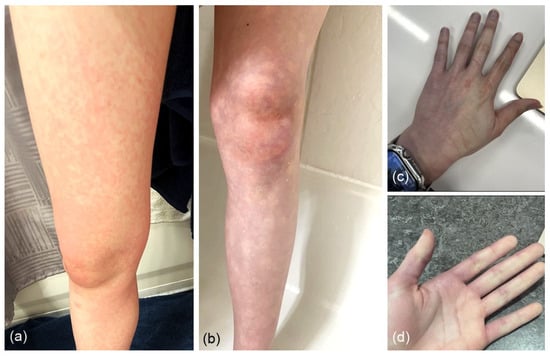
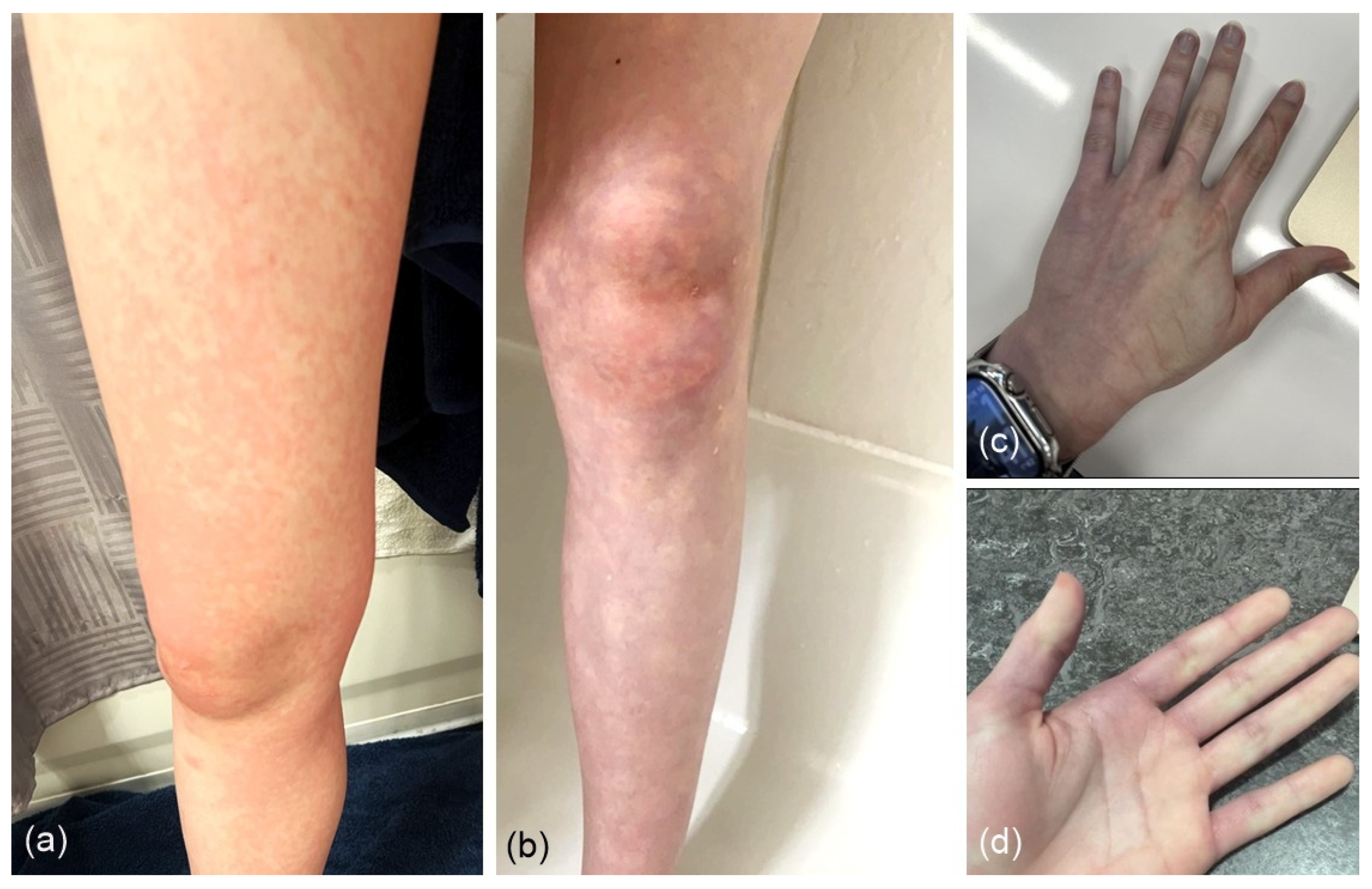
The patient was a 21-year-old woman whose symptoms had begun at age 13 years [Figure 1]. Pruritic episodes affecting the legs and hands were triggered by standing, heat, and showering and could last up to approximately 60 min (Figure 1). POTS was confirmed. Associated conditions included attention-deficit/hyperactivity disorder (ADHD), ectopic atrial tachycardia, joint hypermobility, fibromyalgia, migraine, and Raynaud phenomenon. Extensive laboratory testing, including autoimmune investigations, and imaging revealed no relevant abnormalities. Antihistamine treatment did not produce clinical improvement.
Figure 1.
Clinical manifestations of BASCULE syndrome in the 21-year-old woman. Mottled erythrocyanotic skin changes with Bier anaemic spots and superimposed urticaria-like lesions on the lower extremities during standing (a) and during standing after showering (b). Mottled vascular discolouration on the dorsal (c) and palmar (d) aspects of the left hand. The separately inducible urticaria factitia described in the case history is not illustrated in these photographs.
The patient also had urticaria factitia occurring independently of the BASCULE episodes. Mechanically induced wheals could be elicited at other sites, including the trunk, by more intense stimulation such as vigorous scratching. These reactions were clinically distinct from the posture-associated eruption on the legs and hands. Their coexistence does not establish a shared pathophysiological mechanism.
3.3. Characteristics of the Individual-Case Dataset
The median age at presentation was 14 years (IQR 12–16; range 0.25–58); 30/35 patients (85.7%) were aged ≤18 years and 19/35 (54.3%) were female. Exact onset age was available for 23 patients, with a median of 12 years (IQR 10.5–13). The median duration since onset was 2.0 years (IQR 0.9–3.0). The dataset included infants and a 58-year-old woman; age was not used to exclude otherwise eligible reports. Standing was the most frequently recorded trigger, but it was not a universal requirement. Infant reports also describe handling, positioning, or manual compression [1,22].
Lower-extremity involvement was recorded in 33/35 patients (94.3%), upper-extremity involvement in 12/35 (34.3%), and involvement of multiple regions in 12/35 (34.3%). Symptoms were described for 34 patients: pruritus in 22/34 (64.7%), pain, burning, stinging, or paraesthesia in 16/34 (47.1%), and oedema in 7/34 (20.6%). Three patients were explicitly described as asymptomatic, including the two siblings reported by Romero-Jiménez et al. [16]. These were a 12-year-old girl and her 15-year-old brother, not twins; both had hand involvement, and only the girl had additional lower-extremity lesions. Table 1 summarises the case-level characteristics.
Table 1.
Characteristics of the 35 individual case records.
3.4. Orthostatic Findings and Associated Conditions
Orthostatic information was available for 29 records. Ten (34.5%) had a reported orthostatic symptom or diagnosis, including four documented POTS diagnoses. The newly reported patient is included in these counts. The other recorded categories comprised orthostatic hypotension and orthostatic intolerance, abnormal screening, or syncopal/presyncopal presentations. These categories should not be equated with uniform testing or proof of generalised autonomic dysfunction. In particular, the Baurens case was a boy with tilt-test-confirmed POTS [7], so orthostatic findings were not confined to female patients. The broad category also includes the boy described by Cunningham et al., who had postural dizziness and light-headedness despite negative testing for POTS and orthostatic hypotension [23]. This is a symptom-positive record, not an additional confirmed POTS diagnosis.
Among 26 records with information on comorbidities, ADHD was reported in four, migraine in two, and joint hypermobility and hyperhidrosis in one each. These descriptive frequencies reflect the information recorded in the reports rather than systematic screening of all patients.
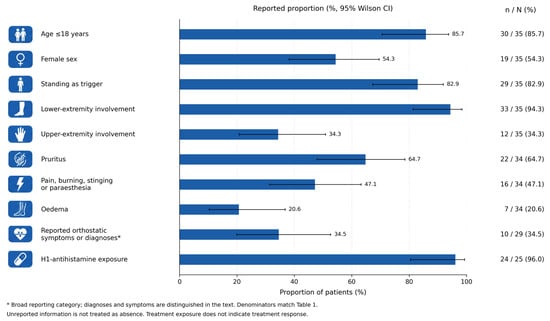
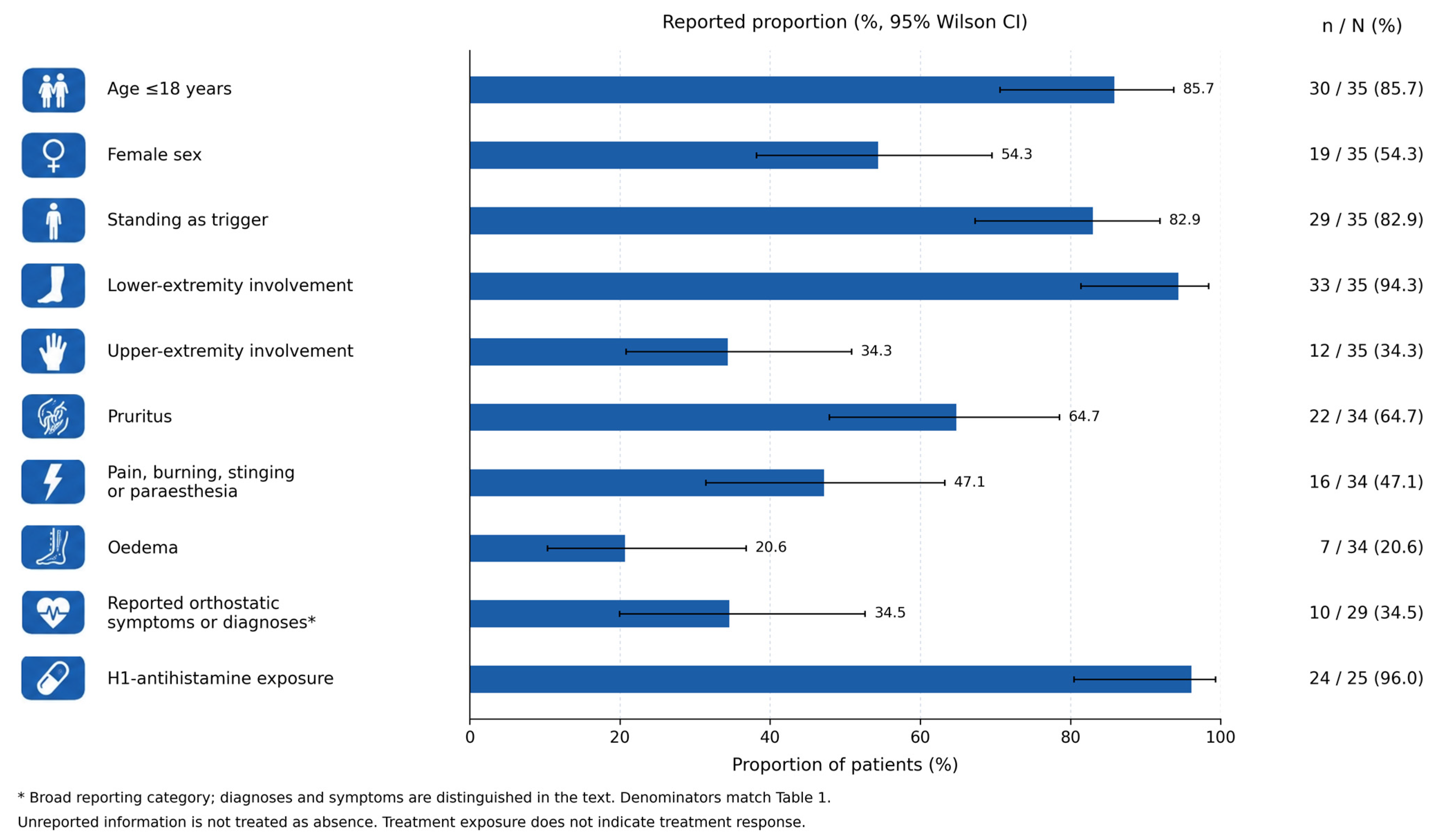
Selected demographic and clinical features are illustrated in Figure 2, using the same variable-specific denominators as Table 1.
Figure 2.
Graphical overview of selected characteristics in the 35 individual case records. Bars show reported proportions and whiskers show 95% Wilson confidence intervals; exact numerators and variable-specific denominators are displayed beside each estimate. The denominators match Table 1 and indicate available information, not the number systematically assessed. Reported orthostatic symptoms or diagnoses include confirmed POTS, orthostatic hypotension, orthostatic intolerance, positive orthostatic testing, and documented orthostatic syncopal or presyncopal presentations. H1-antihistamine exposure indicates documented treatment, not treatment response. The dataset includes the new patient and the historical diagnostic-overlap report described in the Methods.
3.5. Treatment Observations
Individual treatment information was available for 25 patients, 24 of whom had received an H1 antihistamine. Treatments also included compression measures, fludrocortisone, ivabradine, omalizumab, tranexamic acid, montelukast, and nonpharmacological measures. Some patients received several interventions, precluding attribution of improvement to a single agent.
Where the outcome was specified, improvements were not interchangeable. Bessis et al. described partial relief of pruritus without a change in cutaneous lesions [1]. Baurens et al. reported later improvement in itching during combined treatment, and Guillen-Climent et al. described relief of pruritus without clearance of the eruption [7,21]. Complete resolution or more substantial improvement was described in individual bilastine- or fexofenadine-treated cases [12,15,23]. Other accounts reported treatment failure, an unspecified improvement, or no evaluable individual outcome. These observations do not support a consistent symptom-specific response estimate. In particular, the general statements about antihistamines in the familial report were not counted as individual treatment failures [16].
3.6. Larger Case Series
The three series are compared in Table 2. Kearns-Turcotte et al. reported 42 patients, including ten aged 0–3 years and 32 aged 4–18 years [5]. Orthostatic intolerance (19/32), vasovagal episodes (11/32), and POTS (4/32) refer to the latter subgroup. Reported improvement with second-generation H1 antihistamines (7/23) or compression stockings (2/13) concerned symptom severity or episode frequency and should not be interpreted as complete clearance.
Table 2.
The three larger series: clinical characteristics.
The Bessis series included 33 patients, three of whom had been published previously, and reported POTS or orthostatic intolerance in 13% [4]. Reinhart et al. reported autonomic abnormalities in ten of 17 patients, including four with POTS, using their own clinical and autonomic-testing framework [3,29]. Improvement or resolution was documented in three of seven propranolol-treated patients and one of six cetirizine-treated patients; outcomes in the remaining treated patients were not reported as established failures. Differences in definitions and assessment prevent direct pooling of these series.
3.7. Exploratory Patient-Level Comparisons
In the corrected case-level dataset, orthostatic findings were recorded in 8/17 female patients and 2/12 male patients with available information (Fisher exact p = 0.126; Benjamini–Hochberg-adjusted p = 0.448). Pruritus was reported in 9/10 patients with orthostatic findings compared with 10/19 without such findings (p = 0.098; adjusted p = 0.448). These are exploratory associations, not evidence of a female-specific phenotype or a diagnostic relationship.
Patients with upper-extremity involvement were younger than those without it (median 11.5 versus 15 years; Mann–Whitney p = 0.026; adjusted p = 0.256). Patients with pruritus were older than those without reported pruritus (median 14.5 versus 11 years; p = 0.020; adjusted p = 0.256). None of the 20 comparisons remained statistically significant after adjustment. Supplementary Table S1 reports every comparison, including non-significant results and analysis-specific sample sizes. Further data are provided in the Supplementary Tables S1, S2A,B and S3A,B.
4. Discussion
The available reports describe a recognisable cutaneous pattern predominantly affecting young patients: Bier anaemic spots and urticaria-like lesions on an erythrocyanotic background, often on dependent limbs. Larger series broaden the evidence beyond isolated cases, but incomplete linkage and heterogeneous assessment preclude a definitive patient count or prevalence estimate [1,2,3,4,5]. Our individual-case summary and exploratory comparisons complement those series without substituting for a prospectively characterised cohort.
Posture dependence is diagnostically helpful but should not be reduced to an ability to stand independently. Barbé et al. described infant eruptions associated with being held, feeding, defaecation, or position-dependent compression [22]. Piroth et al. reproduced typical eruptions by proximal-limb compression in two infants; sex was not reported for those infants, so these reports are used here to illustrate the phenotype rather than added to the individual-level analysis [31]. Resolution times also varied, including episodes lasting 15 min to two hours in that report. We therefore describe improvement after removal of the trigger rather than impose a uniform definition of “rapid” resolution. Adult-onset disease, as reported in the 58-year-old patient, is compatible with a predominantly paediatric rather than exclusively paediatric condition [14].
The urticaria-like component must be distinguished from a separate inducible urticaria. Our patient’s independently elicitable urticaria factitia on the trunk supports the clinical coexistence of two phenomena, not their equivalence. Likewise, Hirohata et al. described posture-induced wheals with an acetylcholine-provocation response and a diagnosis of cholinergic urticaria, without explicitly documenting Bier spots or cyanosis [28]. That historical case illustrates diagnostic overlap but cannot be regarded as confirmed BASCULE on the available description. The familial occurrence reported in two siblings is also noteworthy, although it does not establish a mode of inheritance [16].
Orthostatic complaints are clinically relevant, but reported symptoms, positive screening, confirmed POTS, and objectively assessed autonomic dysfunction are not synonymous. The larger series used different definitions and assessment strategies [3,4,5,29]. In our case-level dataset, the corrected simple comparisons did not survive multiplicity adjustment. The data therefore do not establish an independent sex- or age-related risk profile. Symptom reporting may also depend on age and the ability to communicate itch, pain, or dizziness; absence of a reported infant symptom cannot automatically be interpreted as absence of the symptom.
A focused history should distinguish cutaneous discomfort from lightheadedness, palpitations, exercise intolerance, and syncope. Formal standing or tilt testing can be considered when the clinical history suggests an orthostatic disorder; the published evidence does not justify describing every typical cutaneous case as having dysautonomia [2,7,18,25,26]. Recognition of BASCULE may reduce unnecessary investigation for competing vascular or inflammatory diagnoses, while atypical, asymmetric, or persistent findings require individual assessment [3,4,5,30].
Therapeutic reporting is particularly heterogeneous. Reports vary in treatment exposure, concomitant interventions, follow-up, and whether improvement refers to itch, visible lesions, episode frequency, or complete resolution. General comments about antihistamines cannot replace patient-level outcome documentation. These limitations explain why a reliable symptom-specific or comparative response rate cannot be reconstructed. Individual reports of benefit from antihistamines coexist with incomplete responses and treatment failures [1,6,7,9,12,15,17,18,19,21,23]. The larger series likewise describe variable outcomes with antihistamines, compression, propranolol, and conservative measures [3,4,5]. Treatment response should not be used to infer a predominant histamine-mediated mechanism.
The clinical distribution and relationship to dependency or compression are compatible with a contribution from venous pooling and altered local vasomotor responses. Proposed roles for hypoxia, mast cells, eosinophils, acetylcholine, and histamine remain based largely on individual observations, nonspecific histology, and treatment responses [1,2,6,7,8,9,10,11,12,13,14,15,16,17,18,19,20,21,22,23,24,25,26,27,28,31]. The coexistence of other urticarial disorders does not resolve these mechanistic questions.
The review combines individual-level descriptions with separate summaries of the largest series, but it was not prospectively registered and the initial selection counts were not retained. No formal methodological quality assessment was performed. Reports under alternative terminology may have been missed, and exclusion of inadequately documented cases may have introduced selection bias. Publication and referral bias, incomplete ascertainment of symptoms, possible residual overlap, and the inclusion of a historical diagnostic-overlap case further limit interpretation. Fisher and Mann–Whitney tests remain exploratory; they do not overcome these limitations or establish causal associations. Consistent clinical definitions and prospectively documented outcomes are needed.
5. Conclusions
BASCULE syndrome is a recognisable vasomotor disorder with a characteristic combination of Bier anaemic spots, erythrocyanosis, and urticaria-like lesions. It predominantly affects young patients, but infants and adults have also been described. Associated orthostatic complaints warrant directed assessment, and coexisting inducible urticaria should be distinguished from the BASCULE. Treatment observations remain heterogeneous. The retained simple statistical comparisons are hypothesis-generating and require confirmation in consistently assessed cohorts.
Supplementary Materials
The following supporting information can be downloaded at: https://www.mdpi.com/article/10.3390/dermato6040044/s1.
Author Contributions
Conceptualization, T.G. and L.F.-P.; data extraction and selection, T.G. and L.F.-P.; data interpretation, T.G., L.F.-P., S.S.W.-F. and L.S.; writing—original draft, T.G.; writing—review and editing, all authors; visualisation, T.G. All authors have read and agreed to the published version of the manuscript.
Funding
This research received no external funding.
Institutional Review Board Statement
Not applicable.
Informed Consent Statement
Informed consent was obtained from the patient for publication of this case report and the accompanying clinical photographs.
Data Availability Statement
The clinical observations are described in this article. The reviewed source publications are cited, and the exploratory comparison results are provided in Supplementary Table S1.
Conflicts of Interest
The authors declare no conflicts of interest.
References
- Bessis, D.; Jeziorski, É.; Rigau, V.; Pralong, P.; Pallure, V. Bier anaemic spots, cyanosis with urticaria-like eruption (BASCULE) syndrome: A new entity? Br. J. Dermatol. 2016, 175, 218–220. [Google Scholar] [CrossRef] [Scilit]
- Bessis, D.; Pallure, V.; Jeziorski, É. BASCULE syndrome, orthostatic cyanosis and postural orthostatic tachycardia syndrome: Time for decanting old wine? Br. J. Dermatol. 2016, 175, 1110–1111. [Google Scholar] [CrossRef] [Scilit]
- Reinhart, J.P.; Kumar, A.B.; Casanegra, A.I.; Rooke, T.W.; Sartori-Valinotti, J.C.; Tollefson, M.M.; Klaas, K.M.; Davis, D.M. Bridging the gap in BASCULE syndrome: A retrospective case series of a recently described clinical entity. Pediatr. Dermatol. 2024, 41, 46–50. [Google Scholar] [CrossRef] [Scilit]
- Bessis, D.; Devoye, C.; Molinari, N.; Quéré, I.; de La Villéon, G.; Jeziorski, É. BASCULE syndrome: Additional evidence for the association with autonomic dysfunction. Pediatr. Dermatol. 2024, 41, 377–378. [Google Scholar] [CrossRef] [Scilit]
- Kearns-Turcotte, S.; McCuaig, C.; Powell, J.; Piram, M.; Marcoux, D.; Hatami, A.; Coulombe, J. Pediatric Bier anemic spots, cyanosis and urticaria-like eruption syndrome in 42 patients: A peek into dysautonomia. J. Am. Acad. Dermatol. 2025, 92, 159–161. [Google Scholar] [CrossRef] [Scilit]
- El Nemnom, P.; Lauwerys, B.; Marot, L.; Tennstedt, D.; Dekeuleneer, V. Bier anemic spots, cyanosis, and urticaria-like eruption (BASCULE) syndrome: Report of two new cases and literature review. Pediatr. Dermatol. 2020, 37, 864–867. [Google Scholar] [CrossRef] [Scilit]
- Baurens, N.; Briand, C.; Giovannini-Chami, L.; De Guillebon De Resnes, J.M.; Hubiche, T.; Chiaverini, C.; Giordana, P.; Leftheriotis, G.; Bernardor, J. Case Report, Practices Survey and Literature Review of an Under-Recognized Pediatric Vascular Disorder: The BASCULE Syndrome. Front. Pediatr. 2022, 10, 849914. [Google Scholar] [CrossRef] [Scilit]
- Gambichler, T.; Barras, M.; Stranzenbach, R.; Scheel, C.H.; Abu Rached, N. BASCULE Syndrome Associated with Autoantibodies. Dermato 2023, 3, 193–195. [Google Scholar] [CrossRef] [Scilit]
- Galindo-Gomez, A.; Martinez-Osorio, D. A 13-year-old boy with BASCULE syndrome and a literature review of the potential causative mechanisms. Eur. J. Dermatol. 2022, 32, 548–549. [Google Scholar] [CrossRef] [Scilit]
- Saratani, A.; Seo, T.; Watanabe, M.; Katayama, S.; Ito, T.; Ujiie, H. Bier Anemic Spots, Cyanosis, and Urticaria-Like Eruption (BASCULE) Syndrome in a 13-Year-Old Boy With Confirmed Venous Reflux. J. Dermatol. 2026, 53, e470–e471. [Google Scholar] [CrossRef] [Scilit]
- Yokamamoharan, A.; Lioger, B. Des macules orthostatiques des membres inférieurs [Orthostatic macules on the legs]. Rev. Med. Interne 2026, 47, 55–57. [Google Scholar] [CrossRef] [Scilit]
- Nakayama, S.; Shibuya, M.; Tazawa, K.; Kabashima, K. Bier anaemic spots, cyanosis with urticaria-like eruption (BASCULE) syndrome in a postoperative paediatric patient successfully treated with standard-dose fexofenadine. Eur. J. Dermatol. 2025, 35, 240–241. [Google Scholar] [CrossRef] [Scilit]
- Thielmann, C.M.; Krefting, F.; Sondermann, W. BASCULE-Syndrom bei einer 12-jährigen Patientin [BASCULE syndrome in a 12-year-old girl]. Die Dermatol. 2025, 76, 371. [Google Scholar] [CrossRef] [Scilit]
- Ceravalls, J.; Iglesias-Sancho, M.; Barrabés Torrella, C.; Fernández-Figueras, M.T. [Translated article] Adult-Onset BASCULE Syndrome. Actas Dermo-Sifiliogr. 2024, 115, T1008–T1009. [Google Scholar] [CrossRef] [Scilit]
- Keeling, E.; Cotter, C.; O’Mahony, S.; Andrawis, M.; Salim, A. Bier anemic spots, cyanosis, and urticaria-like eruption (BASCULE) syndrome in a 15-year-old male, responsive to high-dose fexofenadine. Pediatr. Dermatol. 2024, 41, 731–732. [Google Scholar] [CrossRef] [Scilit]
- Romero-Jiménez, B.; Axpe-Gil, C.; Román-Sainz, J.; Gruber-Velasco, F.; Martínez-Pérez, M.; Imbernón-Moya, A. Familial BASCULE Syndrome in Two Siblings. Dermatol. Pract. Concept. 2023, 13, e2023224. [Google Scholar] [CrossRef] [Scilit]
- Bortoluzzi, T.; Silver, S. BASCULE syndrome: A report of three new cases with various associations. SAGE Open Med. Case Rep. 2023, 11, 2050313X231152062. [Google Scholar] [CrossRef] [Scilit]
- Liu, C.; Wong, I.T.Y.; Au, S. BASCULE syndrome in a young woman with postural orthostatic tachycardia syndrome. CMAJ 2022, 194, E1382. [Google Scholar] [CrossRef] [Scilit]
- Bygum, A.; Rasmussen, L.P. BASCULE syndrom. Ugeskr. Laeger 2021, 183, V71083. [Google Scholar]
- Berrebi, D.; Farmer, W.; Zinn, Z. BASCULE syndrome in a child with prior asymptomatic COVID-19 infection. Pediatr. Dermatol. 2021, 38, 1342–1344. [Google Scholar] [CrossRef] [Scilit]
- Guillen-Climent, S.; Porcar Saura, S.; Pons Benavent, M.; García-Vázquez, A.; Martín, J.M. BASCULE syndrome associated with presyncopal episodes and first-degree atrioventricular block. Int. J. Dermatol. 2021, 60, e400–e402. [Google Scholar] [CrossRef] [Scilit]
- Barbé, J.; Escobar, G.; Bursztejn, A.C. Bier anemic spots, cyanosis with urticaria-like eruption (BASCULE) syndrome: A simple benign pathology, but probably underdiagnosed. Int. J. Dermatol. 2021, 60, 1163–1164. [Google Scholar] [CrossRef] [Scilit]
- Cunningham, L.; Dvorakova, V.; Browne, F.; Irvine, A.D. High-dose bilastine for the treatment of BASCULE syndrome. Clin. Exp. Dermatol. 2021, 46, 357–358. [Google Scholar] [CrossRef] [Scilit]
- Jiménez-Gallo, D.; Collantes-Rodríguez, C.; Ossorio-García, L.; Báez-Perea, J.M.; Linares-Barrios, M. Bier anaemic spots, cyanosis with urticaria-like eruption (BASCULE) syndrome on trunk and upper limbs. Pediatr. Dermatol. 2018, 35, e313–e315. [Google Scholar] [CrossRef] [Scilit]
- Danescu, S.; Baican, C.; Chiorean, R.; Filip, M.; Cismaru, G.; Baican, A. Orthostatic hypotension revealed by BASCULE syndrome. Eur. J. Dermatol. 2018, 28, 393–395. [Google Scholar] [CrossRef] [Scilit]
- Martín, J.M.; Torres, C.; Cordero, P.; Sánchez, S.; Terradez, L.; Ramón, D. Bascule syndrome associated with syncopal episodes. Pediatr. Dermatol. 2018, 35, e142–e143. [Google Scholar] [CrossRef] [Scilit]
- Gabrielli, S.; Le, M.; Netchiporouk, E.; Ben-Shoshan, M. Case of postural urticaria in a 14-year-old girl. BMJ Case Rep. 2021, 14, e246276. [Google Scholar] [CrossRef] [Scilit]
- Hirohata, A.; Yamaoka, T.; Hayashi, M.; Murota, H.; Tani, M.; Katayama, I. Unique case of postural cholinergic urticaria induced by a standing position. Clin. Exp. Dermatol. 2016, 41, 439–440. [Google Scholar] [CrossRef] [Scilit]
- Reinhart, J.P.; Kumar, A.B.; Casanegra, A.I.; Rooke, T.W.; Sartori-Valinotti, J.C.; Tollefson, M.M.; Klaas, K.M.; Davis, D.M. Reply to “BASCULE syndrome: Additional evidence for the association with autonomic dysfunction”. Pediatr. Dermatol. 2024, 41, 566. [Google Scholar] [CrossRef] [Scilit]
- Demircioğlu, D.; Öztürk Durmaz, E. Acrocyanosis: The Least Known Acrosyndrome Revisited With a Dermatologic Perspective. Dermatol. Res. Pract. 2025, 2025, 2904301. [Google Scholar] [CrossRef] [Scilit]
- Piroth, M.; Guenot, L.M.; Barbarot, S. Acute painful blue-white-red rash of the limbs: BASCULE syndrome. Int. J. Dermatol. 2020, 59, 749–750. [Google Scholar] [CrossRef] [Scilit]

Disclaimer/Publisher’s Note: The statements, opinions and data contained in all publications are solely those of the individual author(s) and contributor(s) and not of MDPI and/or the editor(s). MDPI and/or the editor(s) disclaim responsibility for any injury to people or property resulting from any ideas, methods, instructions or products referred to in the content. |
© 2026 by the authors. Licensee MDPI, Basel, Switzerland. This article is an open access article distributed under the terms and conditions of the Creative Commons Attribution (CC BY) license.