


Simple Summary
Little is known about bustards in the past, about their distribution, use and importance in Bulgaria. Today, both species of bustards (the Great Bustard and the Little Bustard) have disappeared as breeding species in the country. The research collects all known information about the fossil and subfossil bone remains of bustards from the studied archeological monuments (prehistoric, ancient and medieval settlements). In the Varshets locality, one of the most ancient bustards in Europe was found, the Khozatsky’s Houbara, which lived 2.4 million years ago in the Early Pleistocene, even before the appearance of modern humans. Most of the established localities of bustards are located in plains, lowlands or low hilly landscapes at 20 to 670 m. a.s.l., which are the preferred habitats of modern bustards. This study is the first of its kind in the countries of the Balkan Peninsula—a region through which, until recently, the southern border of the breeding range of the Otididae species in Europe passed.
Abstract
For the first time, an attempt has been made to comprehensively summarize data on the past distribution of bustards on the territory of Bulgaria based on their fossil and subfossil finds. The collected data refer to a total of 32 Quaternary localities (natural and of anthropogenic origin), of which three are Pleistocene and 29 of Holocene age. The earliest locality of an otidid identified to the species level dates back to 2.4 million years ago. A total of three species have been identified. Among them, one species, Khosatzki’s Houbara (Otis aff. khosatzkii), has disappeared from the modern fauna of the country. Great Bustard (Otis tarda) was found in 20 Quaternary localities, Little Bustard (Tetrax tetrax) in eight, Otis tarda/Tetrax tetrax in two, Khosatzki’s Houbara in one and Otididae gen. in one locality. Chronostratigraphically both Great Bustard and Little Bustard were spread from Greenlandian to Meghalayan (i.e., last ca. 117,000 ya), while the earliest Khosatzki’s Houbara is known only from Gelasian (2.23–2.40 Mya). All finds originated from localities at between 20 and 670 m. a.s.l. in plains, lowlands and low hills. The presence of extant species of bustards on the territory of Bulgaria is rather a post-Pleistocene (Holocene) phenomenon. Besides their primary use as a source of meat for food, bustards in Bulgaria were also used as a source of materials for tool making by ancient people.
1. Introduction
Bustards (Otididae Rafinesque, 1815) are among the largest flying birds. In the modern fauna, they are represented by 26 species. Their body height varies from 40 to 120 cm [1]. They are fast-running, omnivorous, ground-nesting, and nudifugous (chicks are precocial). Bustards are inhabitants of the steppes and semi-deserts of the Old World. Their numbers are not high everywhere [1]. They have a long history as valuable hunting quarry. Two species (Great Indian Bustard (Ardeotis nigriceps) and Bengal Florican (Houbaropsis bengalensis)) are critically endangered (CR), and two species (Ludwig’s Bustard (Neotis ludwigii) and Lesser Florican (Sypheotides indicus)) are endangered (EN) [2].
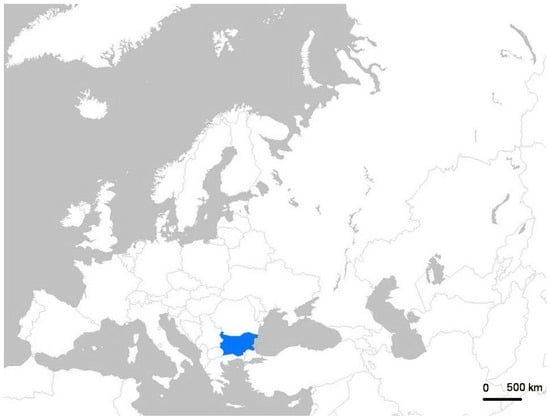
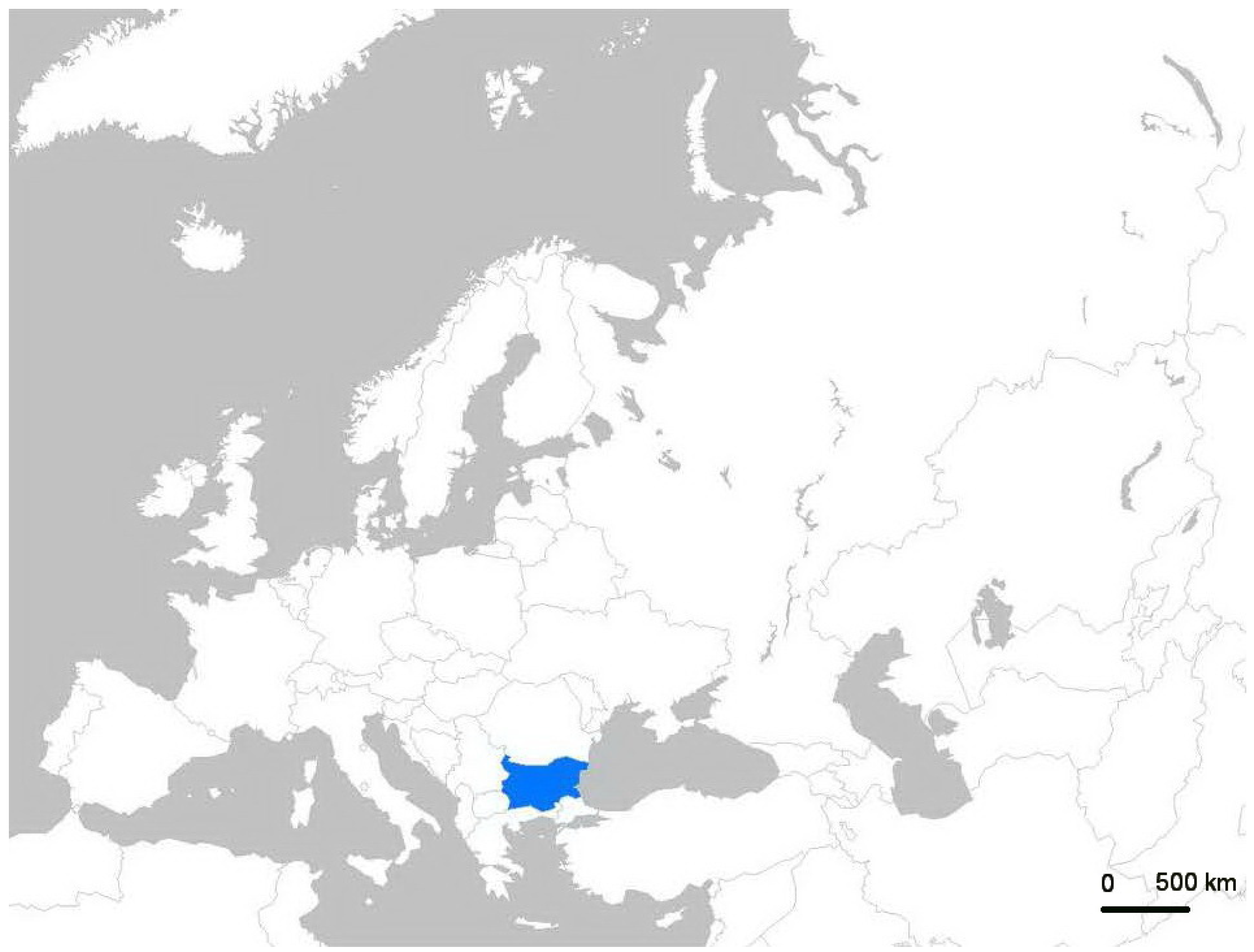
On the territory of Bulgaria (Figure 1), bustards have also always been of great interest to people. With their large body size, habitation in open landscapes and the taste of their meat, bustards have been among the most valuable hunting objects since ancient times. Great Bustard is the largest and heaviest bird of the recent Balkan and European avifauna. Until 1950, bustards were hunted in Bulgaria [3,4,5]. They were only placed under legal protection in 1962, when both Great Bustard and Little Bustard had already disappeared as breeding species in the country [6,7,8,9,10]. Since 1985 both species are included in the Red Book of Bulgaria [11,12,13,14].
Figure 1.
Map of Europe highlighting Bulgaria (after [15]).
It is not excluded that a third species—the Asian Houbara (Chlamydotis macqueenii) will be established in the country, as it has been recorded in neighboring countries (Serbia, Romania, Greece) on the Balkan Peninsula [16,17], albeit with isolated observations. The species is included as probable inclusion in the fauna of Bulgaria [17].
So far, the Quaternary data for the Great Bustard and the Little Bustard up to 2002 have been summarized by [18]. These data refer to three Little Bustard localities and ten Great Bustard localities. Over the last quarter century, many new remains of both species of bustards have been found in a number of archeological sites in Bulgaria. Most of them have been reported in a number of regional sources in Bulgarian, which are difficult to access in local publications, and some have not even been published. This fragmentary information cannot be used in its entirety for the needs of a general analysis. No targeted studies have been conducted in Bulgaria to date on the past distribution of bustards. The most complete data on the subject are contained only on their subrecent (19th–20th centuries) distribution [9,10,11,12,13,14].
This study aims to present and analyze the information available to date in its entiretyabout the representatives of the order Otidiformes from all localities in Bulgaria, based on the bone remains of both species. Due to the fact that the Great Bustard is critically endangered (CR) [13] and the Little Bustard is extinct (EX) [14] in Bulgaria, all information, including their past distribution, is of utmost importance for the development of a scientifically based conservation strategy to restore their former habitats with a view to the return of these species as breeders in the country. Therefore, it is important to know where (in which parts of the country) and when the bustards were found, at what altitude, in how many locations, etc.
2. Material and Methods
The presented data are extracted from published data in dozens of publications. Archaeozoology is a new scientific field in Bulgaria in which only a few people have worked so far. With the exception of a few single publications with data on domestic birds, in Bulgaria, all information on birds from archeological sites in the country comes from studies by the author of the present study. Coincidentally, he has all the scientific information on archaeornithology and is currently the only specialist in this field in the country. The finds of bustards in the studies cited here were identified through the comparative osteological collection in the Vertebrate Animals Department of the National Museum of Natural History at the Bulgarian Academy of Sciences.
The data used are from publications of the author’s scientific library, which is the only one in the country. Due to this specific feature of Bulgarian archaeornithology, the self-citation rate of this paper is exceptionally high.
For each species/taxon of the order Otidiformes, a complete list of all localities in which it has been found is provided. Data on archeological excavations (leader, years, sources) are presented. The age of the deposits is indicated according to the data of the paleontologists/archeologists who conducted the study of the relevant archeological sites. Two localities (Varshets and Shirokovo) are natural, i.e., they are not of anthropogenic origin. The their dating of Shirokovo locality is presented more generally/openly (early or late Holocene). All other studied sites represent prehistoric, ancient or medieval human settlements (Table 1). This proves the importance of bustards as hunting objects in the past.
Table 1.
Localities of fossil and subfossil bone remains of bustards in Bulgaria. (MNQ—Mammal Neogene Quaternary (zone); nr—near; P.—Province; SCT—Standard Chronostratigraphic Timescale; v.—village).
All localities with found bustard remains in Bulgaria are presented in Table 1. The chronostratigraphy follows [51] (Mya): Gelasian (GE) 2.588–1.800 (covering parts of the former Late Pliocene–Early Pleistocene); Calabrian (CA) 1.800–0.774 (Early Pleistocene); Chibanian (CH) 0.770–0.129 (Middle Pleistocene); Late Pleistocene (UP) 0.129–0.0117 (Late Pleistocene); Greenlandian (GR) 0.0117–0.0082 (Early Holocene); Northgrippian (NO) 0.0082–0.0042 (Middle Holocene); and Meghalayan (ME) 0.0042–0.0001 (Late Holocene).
3. Results and Discussion
The collected data show that three taxa of bustards have been identified within the borders of modern-day Bulgaria: Khosatzki’s Houbara (Otis aff. khosatzkii), Great Bustard and Little Bustard, the first of which is fossil taxon (Table 1). In general, bustards have been established in 32 localities/species, located in all parts of the country, both in northern and southern Bulgaria. Three of the sites (Varshets, Nanin Kamak and Devetashka Cave) are Pleistocene in age. All the others are Holocene. In five sites, both extant species—Great Bustard and Little Bustard—have been identified from subfossil remains. These sites are: Devetashka Cave, Nicopolis ad Istrum, Sarnevo, Serdica-Forum, and Slatina. The finding of remains of both species together at the same ancient settlement further strengthens the grounds for assuming that extensive grassy plain habitats were widespread in their vicinity in the past.
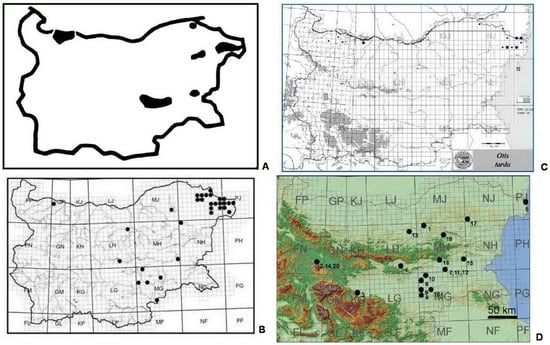
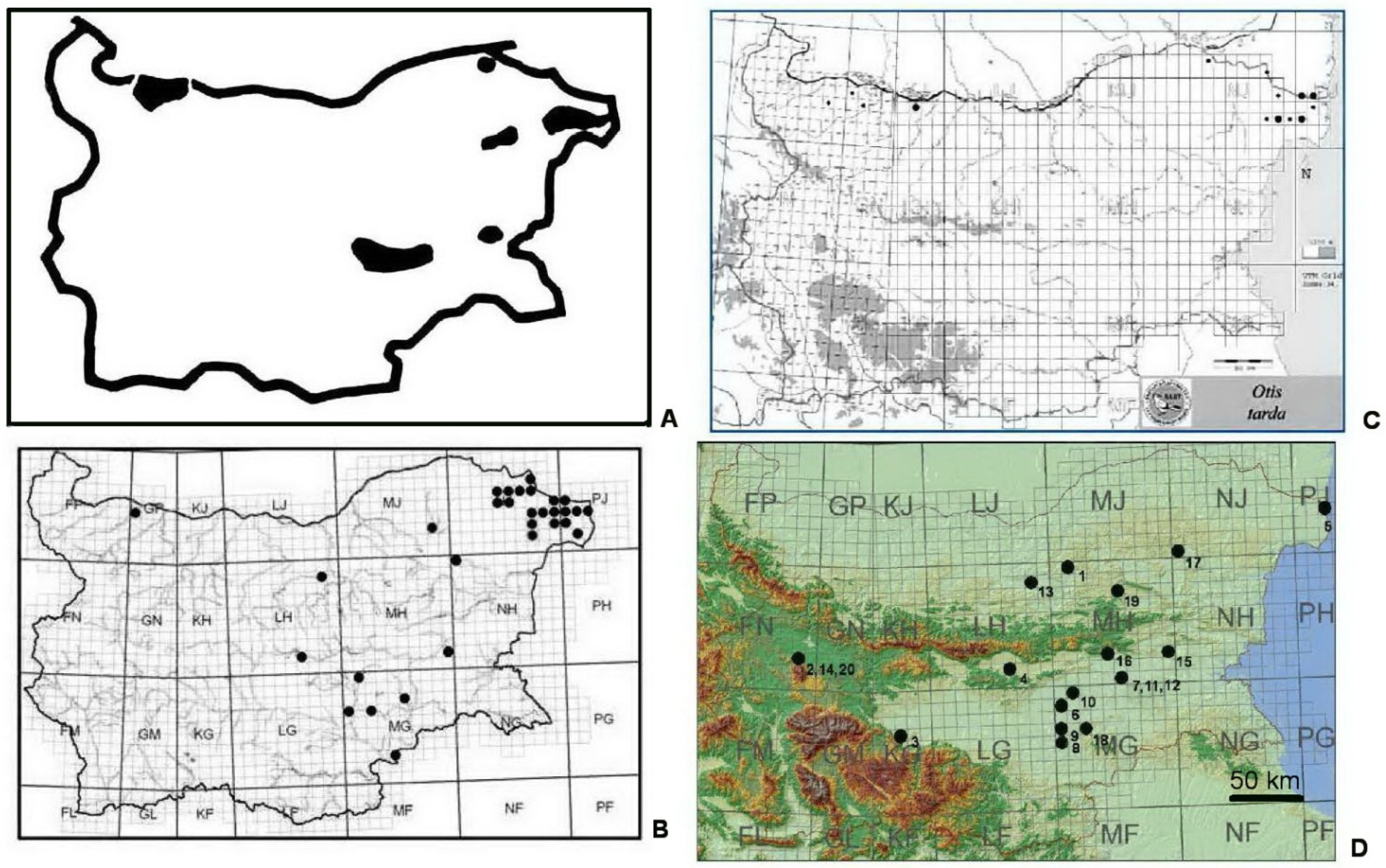
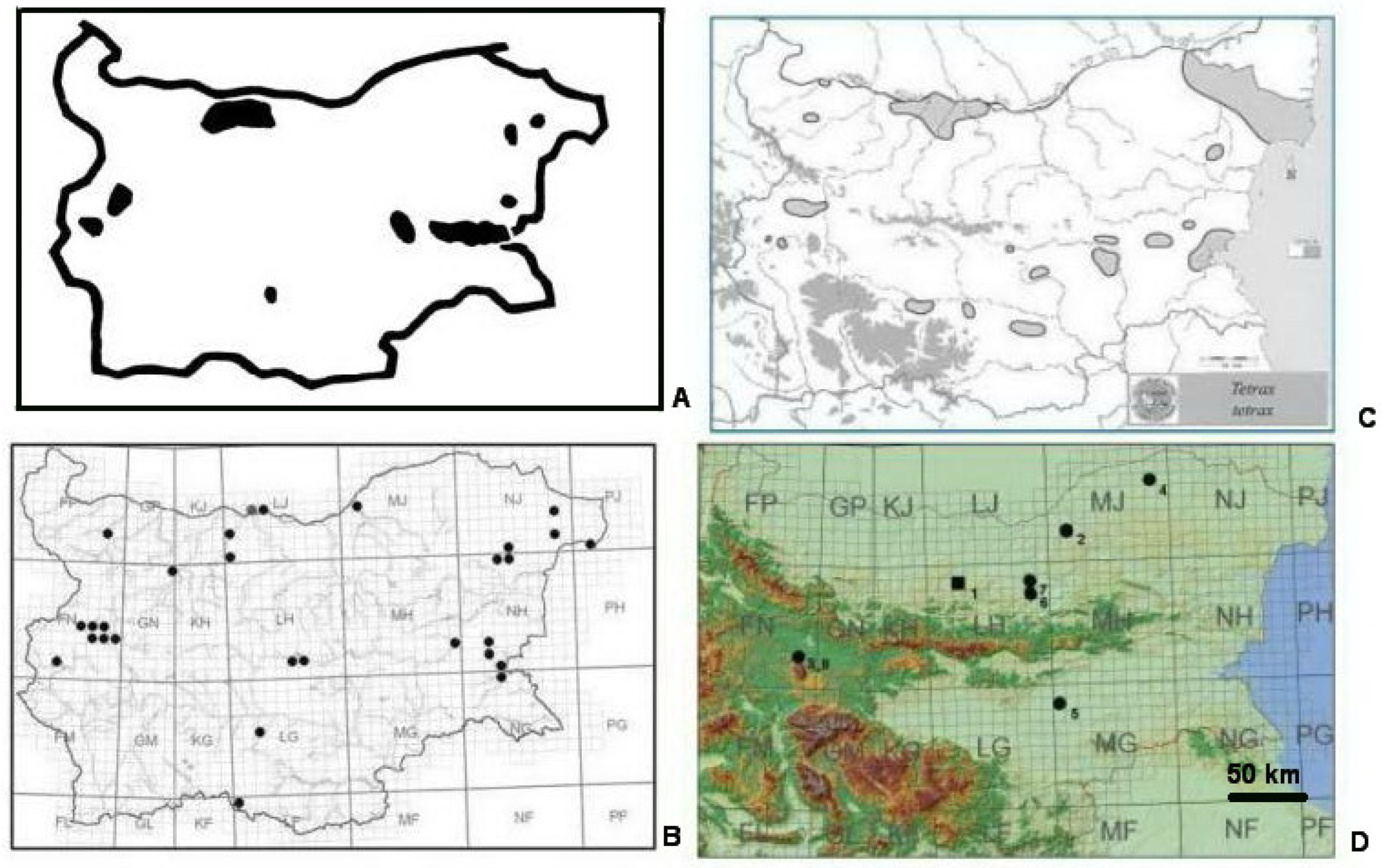
It is noteworthy that in Northwestern Bulgaria (mainly in the Zlatiyata region), where the Great Bustard was regularly recorded in the 19th and 20th centuries, the species has not been recorded there based on subfossil finds (Figure 2). In contrast, in Northeastern and Southeastern Bulgaria, modern and subfossil deposits almost completely coincide. In these regions the locations of modern (19th–20th centuries) and subfossil deposits overlap significantly.
Figure 2.
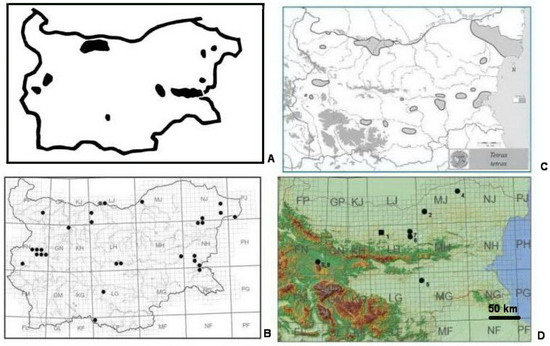
Distribution of the Great Bustard in Bulgaria: subrecent after [11] (A), subrecent after [13] (B), recent after [9] (C), and Quaternary (present study; (D)): Madara (1), Slatina (2), Kapitan-Dimitrievo (3), Kazanlak (4), Durankulak–1 (5), Sarnevo (6), Hadzhidimitrovo (7), Chavdarova Cheshma (8), Galabovo (9), Dyadovo (10), Yassa-Tepe (11), Kabile (12), Nicopolis-ad-Istrum (13), Serdica–Northern Wall (14), Karnobat (15), Hisarlaka (16), Pliska (17), Iskritsa (18), Omurtag (19), Serdica–Forum (20) (ref. to Table 1). Scale bar: 50 km (A–D). The locality numbers correspond to those in Table 1. Two Pleistocene sites (Nanin Kamak Cave and Devetashka Cave), in which remains identified as Great Bustard/Little Bustard have been found, are not marked on the map.
This suggests that the Tundzha Lowland and Dobrudzha (Dobrudzha Maritime steppe, westernmost part of the Pontic–Caspian steppe) are probably today among the most suitable areas for the reintroduction of the species. In these lowland and low hilly regions of the country, vast areas of natural grassy vegetation have been preserved to this day—typical habitats for the bustards. Furthermore, these parts of the country are relatively less populated and the anthropogenic impact is weaker. During the non-breeding period, single birds or small flocks have most often been observed in these two parts of the country over the past one or two decades. The Bulgarian ornithological community is increasingly discussing the issue of taking measures to reintroduce the Great Bustard in Bulgaria. Given the presence of preserved natural habitats, these two areas seem to be the most suitable for its reintroduction. For the Little Bustard, the 19th and 20th century localities in north-central and east-central Bulgaria appear to have greater continuity, but they strongly diverge from the localities of their subfossil remains (Figure 3). Sofia Valley is the only region in which the species seems to have resided most permanently. The Sofia Valley is a closed high plain (average altitude of 550 m) with a more continental climate. In the 20th century, most of it was converted into arable land and authentic grassland communities are almost non-existent.
Figure 3.
Distribution of the Little Bustard in Bulgaria: subrecent after [12] (A), subrecent after [14] (B), recent after [10] (C), and Quaternary (present study (D): Pleistocene—squares; Holocene—circles: Devetashka Cave (1), Shirokovo (2), Slatina (3), Malak Preslavets–1 (4), Sarnevo (5), Hotnitsa (6), Nicopolis-ad-Istrum (7), Serdica–Forum (8) (ref. to Table 1). Scale bar: 50 km (A–D). The locality numbers correspond to those in Table 1. Two Pleistocene sites (Nanin Kamak Cave and Devetashka Cave), in which remains identified as Great Bustard/Little Bustard have been found, are not marked on the map.
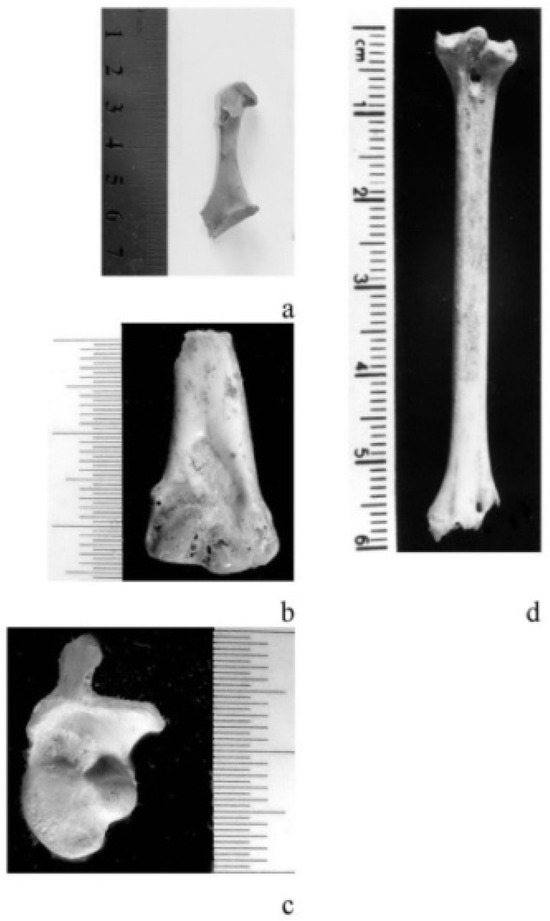
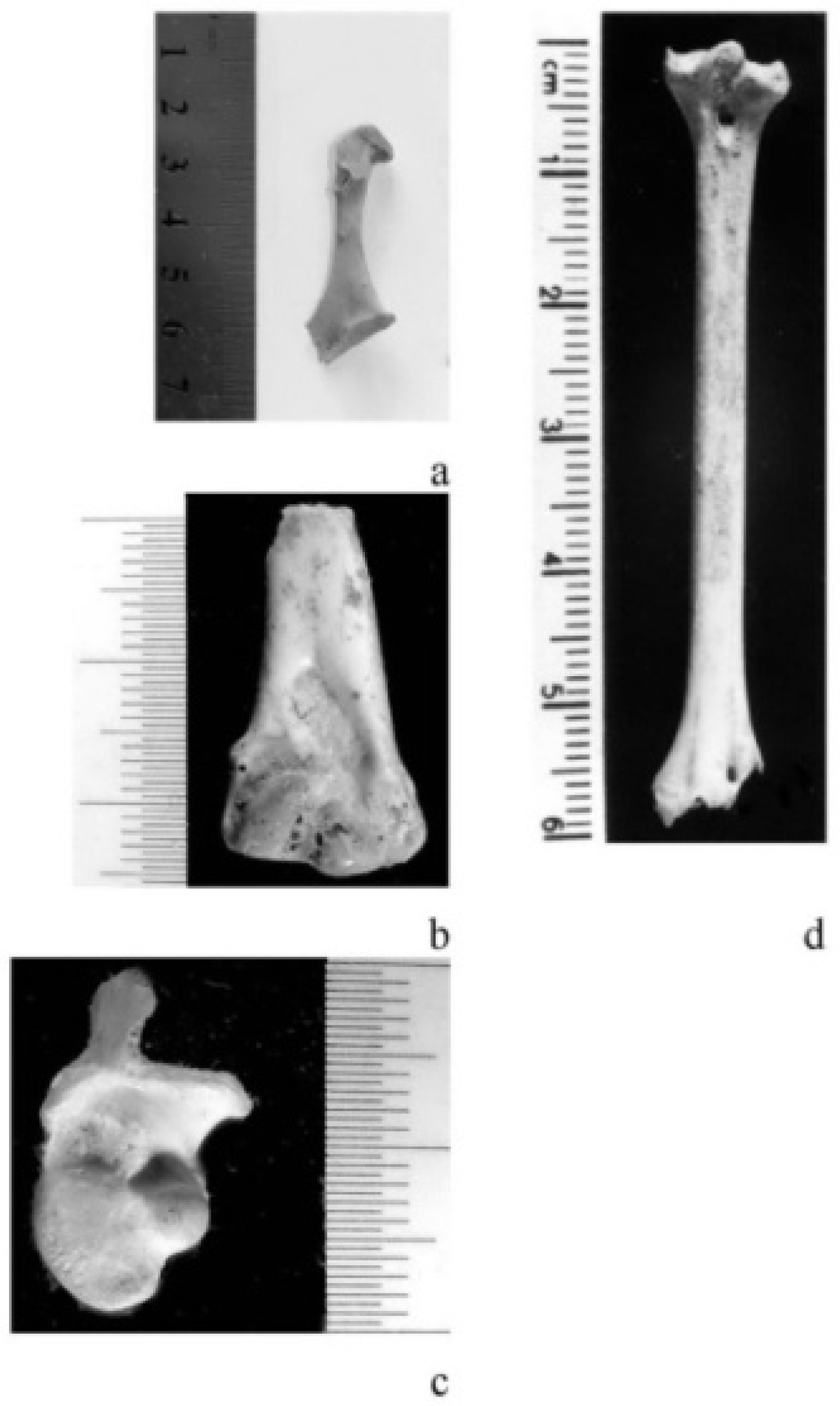
The most numerous are the localities (and remains) of the Great Bustard (Figure 4). The deposits of Little Bustard are more than twice as rare (Figure 5). However, in our opinion, this does not prove that it was twice as rare in the past. Most likely, this difference is due to the large differences in the sizes of the two species and, above all, to the macroscopic selective extraction of remains from the excavated soil without its sieving and washing. Fossil and subfossil remains of the two recent species prove their continuous distribution from the GE (or UP) to the present day.
Figure 4.
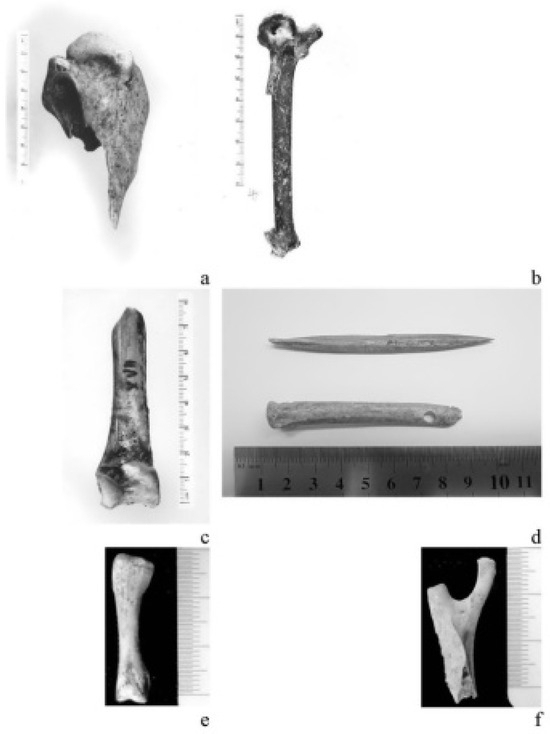
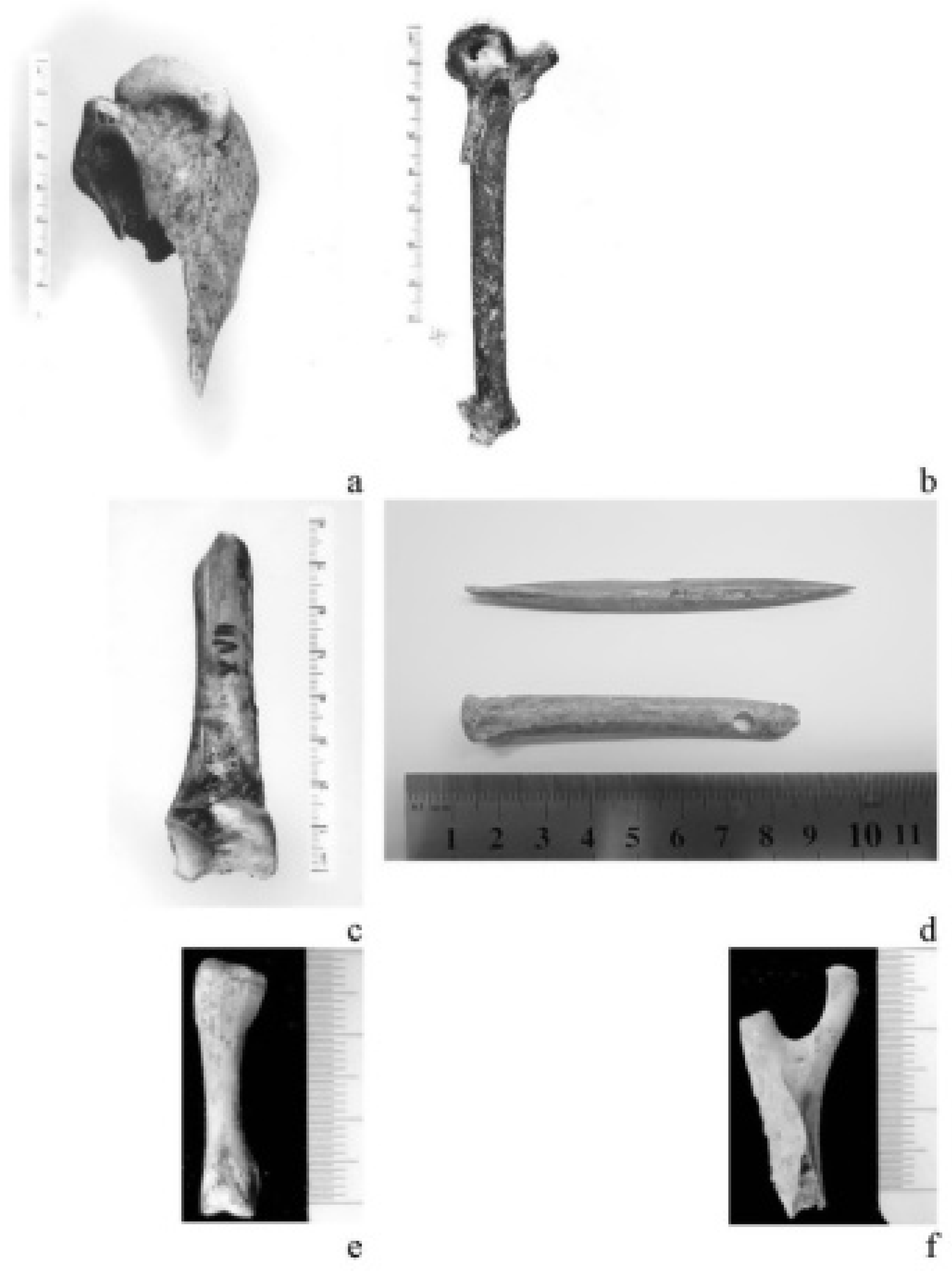
Bone remains of the Great Bustard from some localities in Bulgaria: proximal right humerus (a), left carpometacarpus (b), distal left tibiotarsus (c) from Kazanlak (after [25]); right ulna (worked, above) and distal left radius (worked, bellow) (d) from Hadzhidimitrovo (Photograph: Z. Boev); phalanx 1 dig. pedis (e) and vertebral part of left costa (f) from Madara (after [21]).
Figure 5.
Bone remains of Little Bustard from some localities in Bulgaria: left coracoid from Forum Serdica (a) (Photograph: Z. Boev); distal left humerus (b), and proximal left tibiotarsus (c) from Shirokovo (after [21]), left tarsometatarsus from Nicopolis ad Istrum. (d) (after [19]).
Some of the early Pleistocene (Middle Villafrancian) remains of bustards are attributed to Khosatzki’s Houbara [20]. Khozatsky’s Houbara is the most ancient and extinct species, established in only one locality (Varshets) from 2.4 Mya ago from the pre-glacial Quaternary events. It was intermediate in size between the modern Great Bustard and the Little Bustard, and slightly larger than the two modern Houbara species, Asian Houbara (Chlamydotis macqueenii) and African Houbara (Ch. undulata). The question of this species, which before its discovery in Bulgaria was thought to have had only a peri-Carpathian distribution [52], has not yet been finally resolved. There are completely opposing opinions among paleontologists, from its complete synonymization with African Houbara (Chlamydotis undulata) [53] to its recognition and assignment to houbaras (Chlamydotis) [54]. The species is fossil and it is known mainly from the Late Pliocene and Early Pleistocene. Metrically, it is closer to houbaras than to bustards (Otis). However, the authors of this species [55] initially described it in the genus Otis.
The paleoenvironment of this species is defined as forest-steppe savannah similar to modern African savannah forest [52]. Unlike this species, the Great and Little bustards are established in steppe landscapes, which retained their authentic natural appearance even until the mid-20th century. Then, as a result of collectivization in agriculture and the development of extensive socialist agriculture, many of them were destroyed, plowed up, and converted into arable fields after 1947.
The localities of both recent species are concentrated in the eastern plain and lowland half of the country. For Great Bustard they are mainly in southeastern Bulgaria (10 out of a total of 20 localities). These are areas whose relief and landscape (and probably also climate and vegetation cover) were similar to the modern ones, in which the species was still found during the last century (Figure 2).
For Little Bustard they are mainly in northern (central and eastern) Bulgaria, where the species is established in five out of a total of eight localities (Figure 3). The Great Bustard is found only in plains, lowlands and low hills at altitudes of 20–670 m above sea level. Although scarcer, data for Little Bustard are similar—62–555 m a.s.l. This is also the modern altitudinal range of the distribution of both species in Europe: Great Bustard—0–1000 m a.s.l. (0–646 m a.s.l. in China [56]), Little Bustard—0–600 m. a.s.l. in Europe [57]. All of their localities are located in the Danube Plain, the Upper Thracian Plane, and the Sofia Valley—the largest plain-lowland regions in the country.
As pointed out by [58], for Little Bustard a grass vegetation height of above 20 cm is a limiting factor for the distribution of the species. Taller vegetation may provide cover for the brooding female Great Bustard during nesting, but low vegetation allows the newly hatched chicks to move freely [59]. This increases the specificity of suitable nesting habitats for the species. Given that we are discussing archaeornithological material, it cannot be claimed that all 20 localities of Great Bustard originated from areas where the species once nested, i.e., they cannot be definitely attributed to breeding grounds. It is possible that bustards were also birds hunted in winter or during migration.
Nowadays, Great Bustard and Little Bustard continue to occasionally visit the country during winter or autumn migration. Rarely (not every year), single individuals or small flocks have been observed mainly in northeastern Bulgaria [9,10,13,14]. In this part of the country there are also two villages named Dropla (Bulgarian word for Bustard), which preserve the memory of the former traditional nesting habitats of the bustards. One village is in the Dobrich Province (northeastern Bulgaria) and the other in the Burgas Province (southeastern Bulgaria) [60]. Great Bustard is categorized as an umbrella species and its presence in a habitat is an indication of a healthy and well-functioning steppe ecosystem [61]. The identification of the species in 20 Holocene localities in Bulgaria is a kind of indication of the relatively wide distribution of open grassland landscapes in the past.
Ornithological studies are usually somewhat limited, as it is only possible in very rare cases to determine the season in which the bone remains were deposited. This is of key importance for determining whether the sites were occupied by nesting birds or by birds residing there in the non-nesting season (migratory or wintering individuals). Despite the relatively large size of the Great Bustard and the Little Bustard (and their bones), the fragmentation of the materials (Figure 4 and Figure 5) does not allow for a comment on this topic. All the bone remains found are from adult birds. No remains of young individuals have been found so far, and it is those that would prove the possible nesting of bustards in the area of their former habitats.
The material from Bulgaria, although relatively scarce, demonstrates that bustards had both primary and secondary uses [62] for humans in the past. Although they were important to humans as a source of meat for food, some of their by-products (their bones) were also used secondarily as raw materials for tool production. Figure 4d shows two bone tools made from the bones of a Great Bustard from a Late Neolithic settlement near the village of Hadzhidimitrovo in southeastern Bulgaria. Both tools are made from the wing bones. One tool (probably an awl) is made from an ulna bone, and the other (with a regular round hole drilled) is from a radius bone. Although their purpose is unknown to us, they prove another aspect of the use of these birds by people in the past. Such cases are very rare. A similar one is known from Morocco, also of Great Bustard bones, but from the Late Pleistocene, 14,700 years ago. [63]. It is obvious that these birds were hunted primarily for food. So far, no evidence has been found in Bulgaria for the secondary use of their by-products (bones) as raw materials for the production of tools. This is the first case in Bulgaria in which the use of bustard bones for the production of tools has been established. This is also the first case of processed bustard bones in the country. No cut marks on the surface of the bones from the dismemberment of the bodies of the captured birds were found. There are also no traces of burning from possible direct thermal processing of the meat.
The previous practice of conducting archeological excavations in Bulgaria in most cases did not include sieving and washing the excavated soil. For this reason, a huge part of the small-sized remains remain unnoticed and uncollected. Thus, invaluable information about the composition of paleofauna is lost through the failure to register many dozens of small vertebrate species such as fish, amphibians, reptiles, birds and small mammals (voles, mice, dormice, shrews, etc.). The justification for this situation is that the studies are usually conducted within the framework of rescue archeological excavations, for which the specified deadlines and financial resources are very limited. It is highly desirable that in the future the archaeozoological material is collected and studied in full.
4. Conclusions
Great Bustard was found in 20 Quaternary localities, Little Bustard in eight, Otis tarda/Tetrax tetrax in two, Khosatzki’s Houbara in one locality. Chronostratigraphically Great Bustard was spread in GR, NO, and ME. Its presence in the Pleistocene has not yet been proven. Conversely, Little Bustard, although only in one locality (Devetashka cave), has been found in the Late Paleolithic (Late Pleistocene); thus, its chronostratigraphic distribution is wider and covers UP, GR, NO, and ME. The earliest Khosatzki’s Houbara is known only from GE.
Therefore, although the Balkan Peninsula, at least south of the Stara Planina Mountains, is believed to have been a refugium during the stadials (glacials) in the Pleistocene [64], we must assume that the presence of recent species of bustards on the territory of Bulgaria is rather a post-Pleistocene (Holocene) phenomenon. Here we exclude Khosatzki’s Houbara, which we consider to be a Pliocene relict that survived into the Early Pleistocene. The disappearance of two extant species is due to habitat destruction and overhunting in the past, which continued until the mid-20th century. During the current century, both species have been observed extremely rarely, only in winter or during migration.
The Great Bustard’s habitats in northeastern and southeastern Bulgaria appear to be the most ancient for the species. This suggests that the Tundzha Lowland and Dobrudzha are now among the most suitable areas for reintroduction of the species. For the Little Bustard, only the habitats in the Sofia Valley match the former subfossil remains. These conjectures are based on the still-scarce ornithoarchaeological data that we have so far. They can only serve as a guideline, confirming that despite the changes in the paleoenvironment during the Holocene, there is a certain conditional conservatism in the distribution of both species in Bulgaria.
The present study is the first of its kind for the entire Balkan Peninsula. Only by obtaining data for other Balkan countries will it be possible to draw a more complete picture of the distribution of bustards in the region in the past. For bustards, the Balkans are of particular importance, because until recently the southern border of their breeding ranges in Southeastern Europe passed through them. It has been established that, in addition to their primary use, bustards in Bulgaria also had secondary use for ancient people.
Funding
This research received no external funding.
Institutional Review Board Statement
Ethical review and approval for this study were waived due to the lack of any ethical conflict issues in the content of the text.
Informed Consent Statement
Not applicable.
Data Availability Statement
The original contributions presented in this study are included in the article. Further inquiries can be directed to the corresponding author.
Acknowledgments
The author is very grateful to anonymous reviewers for their helpful remarks on a previous version of the manuscript.
Conflicts of Interest
The author declares no conflicts of interest.
References
- Collar, N.J. Family Otididae (Bustards). In Handbook of the Birds of the World; Hoatzin to Auks; del Hoyo, J., Elliott, A., Sargatal, J., Eds.; Lynx Edicions: Barcelona, Spain, 1996; Volume 3, pp. 240–273. [Google Scholar]
- IUCN. The IUCN Red List of Threatened Species; Version 2024-1; International Union for Conservation of Nature: Gland, Switzerland, 2024; Available online: https://www.iucnredlist.org (accessed on 12 March 2026).
- Boev, N. Bustards. Lov Ribolov 1950, 1–2, 6–7+11. (In Bulgarian) [Google Scholar]
- Boev, N. Bustards and their distribution in Bulgaria. Prir. Znanie 1963, 4, 17–19. (In Bulgarian) [Google Scholar]
- Petrov, A. Our Hunting Birds; Fizkultura Publishing House: Sofia, Bulgaria, 1950; 123p. (In Bulgarian) [Google Scholar]
- Boev, N. Bustard, forgive us! Nasha Rod. 1983, 2, 16–17. (In Bulgarian) [Google Scholar]
- Boev, N. Farewell or goodbye to the bustard? Zashtita Na Prir. 1982, 6, 33–34. (In Bulgarian) [Google Scholar]
- Boev, Z. The last bustards in Bulgaria. Lov I Ribolov 2022, 10, 64–69. (In Bulgarian) [Google Scholar]
- Georgiev, D.; Iankov, P.; Zehtindjiev, P.; Ilieva, M. Great Bustard Otis tarda. In Atlas of the Breeding Birds in Bulgaria; Bulgarian Society for the Protection of Birds, Conservation Series, Book 10; Iankov, P., Ed.; BSPB: Sofia, Bulgaria, 2007; pp. 230–231. [Google Scholar]
- Iankov, P.; Georgiev, D. Little Bustard Tetrax tetrax. In Atlas of the Breeding Birds in Bulgaria; Bulgarian Society for the Protection of Birds, Conservation Series, Book 10; Iankov, P., Ed.; BSPB: Sofia, Bulgaria, 2007; pp. 228–229. [Google Scholar]
- Boev, N. Great bustard Otis tarda L., 1758. In Red Data Book of the Republic of Bulgaria; Volume 2. Animals; Botev, B., Peshev, T., Eds.; BAS: Sofia, Bulgaria, 1985; pp. 101–102. (In Bulgarian) [Google Scholar]
- Boev, N. Little bustard Otis tetrax L., 1758. In Red Data Book of the Republic of Bulgaria; Volume 2. Animals; Botev, B., Peshev, T., Eds.; BAS: Sofia, Bulgaria, 1985; pp. 103–104. (In Bulgarian) [Google Scholar]
- Zehtindzhiev, P.; Boev, Z.; Georgiev, D.; Karaivanov, N. Great Bustard Otis tarda L., 1758. In Red Data Book of the Republic of Bulgaria; Volume 2. Animals; Golemanski, V., Ed.; IBER-BAS & MOEW: Sofia, Bulgaria, 2011; p. 86. [Google Scholar]
- Boev, Z. Little Bustard Tetax tetrax (Linnaeus, 1758). In Red Data Book of the Republic of Bulgaria; Volume 2. Animals; Golemanski, V., Ed.; IBER-BAS & MOEW: Sofia, Bulgaria, 2011; p. 45. [Google Scholar]
- Wikimedia Commons. Europe_Map_Bulgaria.Png (Public Domain). Available online: https://commons.wikimedia.org/wiki/File:Europe_map_bulgaria.png (accessed on 17 February 2026).
- Cramp, S.; Simmons, K.E.L. (Eds.) Handbook of the Birds of Europe the Middle East and North Africa: The Birds of Western Palearctic; Volume II. Hawks to Bustards; Oxford Univ. Press: Oxford, UK, 1990; 695p. [Google Scholar]
- Simeonov, S.; Michev, T.; Nankinov, D. The Fauna of Bulgaria; Volume 20. Aves. Part, I; Prof Marin Drinov Publishing House of British Antarctic Survey: Sofia, Bulgaria, 1990; 349p, (In Bulgarian with English Summary). [Google Scholar]
- Boev, Z. Distribution of the Little Bustard (Tetrax tetrax/Linnaeus, 1758/) and the Great Bustard (Otis tarda Linnaeus, 1758) (Aves: Otididae Gray, 1845) in Bulgaria during the Late Pleistocene and the Holocene. Annu. Sofia Univ. St. Kliment Ochridski 2003, 93–94, 41–47. [Google Scholar]
- Boev, Z. Neogene and Quaternary Birds (Aves) from Bulgaria. Ph.D. Thesis, Bulgarian Academy of Sciences, Sofia, Bulgaria, 1999. (In Bulgarian) [Google Scholar]
- Boev, Z. Late Pliocene Bustards (Aves: Otididae) from Western Bulgaria. Hist. Nat. Bulg. 1999, 10, 97–108. [Google Scholar]
- Mitev, I. (Ed.) Subfossil fauna of birds and mammals (Aves et Mammalia–Vertebrata) from localities in Northeastern Bulgaria. In Collected Works, Volume 1. Bulgarian Nature; Logis Publishing House: Sofia, Bulgaria, 2016; pp. 203–691. (In Bulgarian) [Google Scholar]
- Mitev, I.; Boev, Z. Food spectrum of the Eagle Owl (Bubo bubo (L., 1758)) (Aves: Strigiformes) from two Holocene localities in NE Bulgaria. Hist. Nat. Bulg. 2006, 17, 153–165, (In Bulgarian with English Summary). [Google Scholar]
- Boev, Z. Avian remains from the Early Neolithic settlement of Slatina (Present Sofia City, Bulgaria). Acta Zool. Bulg. 2009, 61, 151–156. [Google Scholar]
- Boev, Z. Avian finds from the Early Neolithic settlement near Kapitan-Dimitrievo village (Pazardzhik Region). ZooNotes 2017, 112, 1–3. [Google Scholar]
- Boev, Z. Neolithic birds from the prehistoric settlement at Kazanluk. Hist. Nat. Bulg. 1993, 4, 57–67, (In Bulgarian with English Summary). [Google Scholar]
- Manhart, H. Die vorgeschichtliche Tierwelt von Koprivec und Durankulak und anderen prähistorischen Fundplatzen in Bulgarien aufgrund von Knochcnfunden aus archao-logischen Ausgrabungen. Doc. Naturae 1998, 116, 1–341. [Google Scholar]
- Karastoyanova, N. Animals in Ritual Context: Archeozoological Study of Excavated Structure from the Late Neolithic Ritual Complex Near Sarnevo, Stara Zagora. Master’s Thesis, New Bulgarian University, Sofia, Bulgaria, 2011. (In Bulgarian) [Google Scholar]
- Boev, Z. Avian remains from the Late Neolithic settlement of Sarnevo (Stara Zagora Region, SC Bulgaria). Acta Zool. Bulg. 2013, 65, 259–262. [Google Scholar]
- Petrova, V.D.; Lyuncheva, M.; Iliev, I.; Yaneva, M.; Nikolov, V.; Vitezovic, S.; Zidarov, P.; Mitov, K.; Hadzhipetkov, I.; Taneva, S. Archaeological excavations at a Late Neolithic pit site near the village of Hadzhidimitrovo, Yambol region. In Archaeological Rescue Excavations Along the Trakia Motorway Route, LOT 1–4. Part, I. Prehistory; Alexandrov, S., Ed.; NAIM–BAS: Sofia, Bulgaria, 2024; pp. 7–94, (In Bulgarian with English Summary). [Google Scholar]
- Boev, Z. Late Neolithic and Late Antiquity avian finds of Chavdarova Cheshma (Simeonovgrad, Haskovo Region). ZooNotes 2017, 111, 1–3. [Google Scholar]
- Karastoyanova, N. Development of Hunting and Husbandry and Changes in Natural Environment from the Late Neolithic to the Late Chalcolithic Period in Eastern Bulgaria According to Data from Archaeological Sites. PhD Thesis, Bulgarian Academy of Sciences, Sofia, Bulgaria, 2018. (In Bulgarian) [Google Scholar]
- Boev, Z. Middle and Late Holocene birds from the Eastern Upper Thracian Plane (S Bulgaria). Hist. Nat. Bulg. 2004, 16, 23–132. [Google Scholar]
- Boev, Z. Avian remains from the Early Bronze Age settlement near Dyadovo village (vicinity of the town of Nova Zagora (Stara Zagora Region, SE Bulgaria). Hist. Nat. Bulg. 2006, 17, 133–135. [Google Scholar]
- Ribarov, G.; Boev, Z. Investigation of the animal remains from the Late Iron Age Yassa-Tepe near Yambol. In Interdiscipl. Res., Archaeological Institute and Museum; BAS: Sofia, Bulgaria, 1990; Volume 17, pp. 83–90, (In Bulgarian with English Summary). [Google Scholar]
- Ribarov, G. Données nouvelles pour la faune de la ville antique Kabilé. Bull. Musées Bulg. 1982, 6, 31–41, (In Bulgarian with French Summary). [Google Scholar]
- Ribarov, G. La faune de Cabyle (I-ère millénaire av. n. ère–VI s. de n. ère) d’après les restes d’animaux sauvages et domestiques. In Kabile; Velkov, V., Ed.; Bulgarian Bulgarian Academy of Sciences Academic Press: Sofia, Bulgaria, 1991; Volume 2, pp. 156–167, (In Bulgarian with Russian and French Summaries). [Google Scholar]
- Boev, Z.; Ribarov, G. Birds from the ancient town of Kabyle (1st millenium B. C.-6th century A. D.) near Kabyle (Burgas District). Hist. Nat. Bulg. 1993, 4, 68–77, (In Bulgarian with English Summary). [Google Scholar]
- Boev, Z. The birds of the Roman town of Nicopolis ad Istrum (2nd–6thc.) at Nikjup, Lovech Region. Hist. Nat. Bulg. 1991, 3, 92–102, (In Bulgarian with English Summary). [Google Scholar]
- Boev, Z.; Beech, M. The Bird Bones. In Nicopolis ad Istrum. A Late Roman and Early Byzantine City. The Finds and the Biological Remains; Poulter, A.G., Ed.; Oxbow Books: Oxford, UK; The Society of Antiquaries of London: London, UK, 2007; pp. 242–253+307–318. [Google Scholar]
- Boev, Z. New Data on the Fauna of the Late Antiquity Northern Fortification Walls of Serdica (3rd–6th century A.D.) from Building Excavations on Exarch Joseph Street (Sofia, Bulgaria). Bull. Nat. Hist. Mus.–Plovdiv 2020, 5, 15–23. [Google Scholar]
- Boev, Z.; Ribarov, G. Les oiseaux dans la vie de la localité moyenageuse de Hissarlik (Sliven) (X-XII s.). Bull. Musées Bulg. 1989, 12, 207–212, (In Bulgarian with French Summary). [Google Scholar]
- Boev, Z. New animal remains from Pliska, the medieval capital (10 c. AD) of Bulgaria, (Shumen Region, NE Bulgaria). ZooNotes 2016, 87, 1–3. [Google Scholar]
- Boev, Z. Subfossil Vertebrate Fauna from Forum Serdica (Sofia, Bulgaria), 16–18th century. Acta Zool. Bulg. 2016, 68, 415–424. [Google Scholar]
- Boev, Z. New data on the subfossil fauna from “Forum Serdica” (Sofia City, Bulgaria; 3–19th century A. D. Hist. Nat. Bulg. 2017, 24, 179–186. [Google Scholar]
- Boev, Z. Late Pleistocene avifauna of Nanin Kamak Cave (CN Bulgaria). Bull. Nat. Hist. Mus.–Plovdiv 2019, 4, 21–25. [Google Scholar]
- Boev, Z. Quaternary vertebrate fauna of Bulgaria—Composition, chronology and impoverishment. Geol. Balc. 2023, 52, 21–48. [Google Scholar] [CrossRef] [Scilit]
- Boev, Z. Birds over the mammoth’s head in Bulgaria. In The World of Elephants; Proceedings of the 1st International Congress; Cavaretta, G., Gioia, P., Mussi, M., Palombo, M.R., Eds.; Consiglio Nazionale delle Ricerche: Roma, Italy, 2001; pp. 180–186. [Google Scholar]
- Mitev, I. Subfossil finds of birds and mammals in accumulations of the food of Eagle Owl (Bubo bubo (L., 1758)) (Aves: Strigiformes) from the valley of Rusenski Lom river. Hist. Nat. Bulg. 2006, 17, 137–151, (In Bulgarian with English Summary). [Google Scholar]
- Boev, Z. Avian remains from the Late Chalcolithic settlement near Hotnitsa Village (Veliko Tarnovo Region, CN Bulgaria). Acta Zool. Bulg. 2009, 61, 49–54. [Google Scholar]
- Boev, Z. Subfossil fauna from “Forum Serdica” (Sofia City, Bulgaria) of Antiquity (2nd–4th century AD) and Ottoman Epoch (15th–18th century AD) (Excavations 2017). Bull. Nat. Hist. Mus.–Plovdiv 2018, 3, 7–13. [Google Scholar]
- Cohen, K.M.; Finney, S.C.; Gibbard, P.L.; Fan, J.-X. The ICS International Chronostratigraphic Chart. Episodes 2013, 36, 199–204. [Google Scholar] [CrossRef] [Scilit] [PubMed]
- Boev, Z. Paleobiodiversity of the Vrachanska Mountains in the Villafranchian: A case study of the Varshets (Dolno Ozirovo) Early Pleistocene locality of fossil fauna and flora. In Faunistic Diversity of Vrachanski Balkan Nature Park; ZooNotes, Suppl.3; Bechev, D., Georgiev, D., Eds.; Plovdiv University Press: Plovdiv, Bulgaria, 2016; pp. 299–323. [Google Scholar]
- Mlíkovský, J. Cenozoic Birds of the World. Part 1, Europe; Ninox Press: Praha, Czech Republic, 2002; 406p. [Google Scholar]
- Zelenkov, N.V. Bustards (Aves: Otididae) from the Middle Miocene of Mongolia. Paleontol. J. 2025, 59, 683–691. [Google Scholar] [CrossRef] [Scilit]
- Bocheński, Z.; Kurochkin, E. Pliocene bustards (Aves: Otitidae and Gryzaidae) of Moldavia and Southern Ukraine. Doc. Lyon 1987, 99, 173–185. [Google Scholar]
- Lu, Z.; Zhai, Y.; Meng, D.; Kou, G.; Li, H.; Liu, J. Predicting the potential distribution of wintering Asian Great Bustard (Otis tarda dybowskii) in China: Implications for conservation. Glob. Ecol. Conserv. 2021, 31, e01817. [Google Scholar] [CrossRef] [Scilit]
- Snow, D.W.; Perrins, C.M. The Birds of the Western Palearctic; Volume 1. Non-Passerines; Oxford University Press: Oxford, UK, 1998; 689p. [Google Scholar]
- Martínez, C. Habitat selection by the little bustard Tetrax tetrax in cultivated areas of central Spain. Biol. Conserv. 2021, 67, 125–128. [Google Scholar] [CrossRef] [Scilit]
- Fritzson, K. Suitability Analysis of a Reintroduction of the Great Bustard (Otis tarda) to Sweden. Master’s Thesis, Swedish University of Agricultural Sciences, Uppsala, Sweden, 2015. [Google Scholar]
- Michev, N. Dictionary of the Names and Status of Settlements in Bulgaria 1878–2004; Publ. House Petar Beron: Sofia, Bulgaria, 2005. (In Bulgarian) [Google Scholar]
- Casas, F.; Mougeot, F.; Arroyo, B.; Morales, M.B.; Hervás, I.; García de la Morena, E.L.; Fagan, W.F.; Viñuela, J. Opposing population trajectories in two Bustard species: A long-term study in a protected area in Central Spain. Bird Conserv. Internat. 2019, 29, 308–320. [Google Scholar] [CrossRef] [Scilit]
- Serjeantson, D. Birds. In Cambridge Manuals in Archaeology; Cambridge University Press: Cambridge, UK, 2009; 486p. [Google Scholar]
- Cooper, J.H.; Collar, N.J.; Bouzouggar, A.; Barton, N.; Humphrey, L. Late Pleistocene Great Bustards Otis tarda from the Maghreb, eastern Morocco. Ibis 2025, 167, 991–1001. [Google Scholar] [CrossRef] [Scilit]
- Blondel, J. Evolution and History of the European Bird Fauna. In The EBCC Atlas of European Breeding Birds. Their Distribution and Abundance; Hagemeijer, W.J.M., Blair, M.L., Eds.; T.&AD Poyser: London, UK, 1997. [Google Scholar]

Disclaimer/Publisher’s Note: The statements, opinions and data contained in all publications are solely those of the individual author(s) and contributor(s) and not of MDPI and/or the editor(s). MDPI and/or the editor(s) disclaim responsibility for any injury to people or property resulting from any ideas, methods, instructions or products referred to in the content. |
© 2026 by the author. Licensee MDPI, Basel, Switzerland. This article is an open access article distributed under the terms and conditions of the Creative Commons Attribution (CC BY) license.