Article

Wind Speed Influences Vigilance in Sentinels of a Cooperative Breeder

1
Independent Researcher, Montreal, QC, Canada
2
Archbold Research Station, 123 Main Dr., Venus, FL 33960, USA
*
Author to whom correspondence should be addressed.
Birds 2026, 7(2), 23; https://doi.org/10.3390/birds7020023
Submission received: 8 February 2026 / Revised: 18 March 2026 / Accepted: 27 March 2026 / Published: 1 April 2026

Simple Summary

Birds monitor their surroundings for threats using vigilance. How the physical environment of individuals influence vigilance is little-known. Wind speed, for instance, can affect vigilance by impairing the ability to escape, by increasing energy costs, and by decreasing the ability to communicate with companions and assess risk. We examined the association between wind speed and vigilance in sentinels of the Florida Scrub-Jay (Aphelocoma coerulescens). Sentinels in this species are not feeding and monitor their surroundings from vantage points. We found that sentinels increased their vigilance under windier conditions. We suggest that adjustments in vigilance likely reflect poorer visual assessment of risk, probably as a consequence of movements in the vegetation caused by wind. The study highlights behavioural adjustments to weather-related environmental variability.

Abstract

Vigilance is used to detect distant threats in many species of birds. Allocation of time to vigilance is shaped by the social and physical environment of individuals, but little research has focused on how weather variables affect vigilance. Wind speed, in particular, can influence vigilance by decreasing manoeuvrability during escape, increasing energy costs or by decreasing the ability to communicate and assess risk. We examined how wind speed influenced vigilance in sentinels of a cooperative breeder, the Florida Scrub-Jay (Aphelocoma coerulescens). Sentinels in this species occupy vantage points to monitor their surroundings and can devote all their time to vigilance during sentinel bouts. We found that head turns in sentinels, which allow individuals to monitor different areas, became more frequent under windier conditions. Wind speed is not likely to affect manoeuvrability in sentinels that are already close to cover. Energy costs during high wind likely are not as relevant to sentinels as they may be to other group members, since sentinels do not forage. We conclude that the ability to assess risk visually was probably compromised by movements in the vegetation caused by wind. The study highlights behavioural adjustments to weather-related environmental variability.

1. Introduction

Vigilance is deployed in many bird species to detect threats [1]. Individuals allocate time to vigilance across a range of activities, including foraging and resting, both of which entail predation risk. However, vigilance is costly because time devoted to threat detection is typically traded off against other essential activities [2]. Much research has examined how the social environment shapes vigilance behaviour in prey species [3,4]. When foraging in groups, for example, the presence of companions can increase predator detection and dilute individual risk, often resulting in reduced vigilance as group size increases [5]. Conversely, group members may themselves become targets of vigilance when competition for limited resources leads to aggressive interactions, thereby increasing vigilance directed at other group members [6,7,8,9].
By contrast, comparatively less research has examined how the physical environment influences vigilance. Environmental factors such as low temperature may raise energy costs and reduce the time available for vigilance [10]. Wind speed is another abiotic factor known to affect habitat use [11,12], activity patterns [13,14], and predator–prey dynamics [15] in a wide range of species. Despite this, the influence of wind speed on vigilance remains poorly understood and insufficiently investigated [16,17,18].
Wind speed can affect vigilance in birds through three different pathways [19]. First, high wind can affect manoeuvrability when flying to escape danger [20]. High wind may thus lead to increased vigilance to compensate for impaired mobility. However, as high wind can also affect flying predators, risk may actually decrease if predators are more affected by high wind than their prey. For instance, Eurasian Sparrowhawks (Accipiter nisus) were less likely to attack on windy days and less likely to capture prey as wind speed increased [21]. Wind speed may thus affect both predator hunting efficiency and prey detection processes in opposing directions, making its net effect on predation risk difficult to predict. Second, high wind can lead to substantial increases in metabolic expenditure through convective heat loss [22]. To offset higher energy costs, individuals may need to feed more, leading to a decrease in vigilance in high wind. While intuitive, this mechanism has not always received support, even using micro-meteorological data at the individual level [16,23]. One possibility to explain this counter-intuitive finding is that birds can maintain vigilance and still accumulate more resources by extending foraging time in high wind.
Lastly, wind speed can impair direct perception of risk across various sensory modalities. For instance, noise created by wind may decrease the ability to detect auditory cues associated with approaching danger [24,25,26]. Visual detection of predators in the distance may also be less effective in high wind due to movement in the vegetation that can be mistaken for predator movement or that may mask their approach [18,27]. Wind speed may also affect olfactory risk assessment [28], but this sensory channel is not very relevant to birds especially those facing non-mammalian predators [29]. Signal degradation may also impair social communication about risk forcing individuals to rely less on others to detect danger and increase their own vigilance [30].
Empirical evidence of an association between wind speed and vigilance is not extensive, and often contradictory, with many studies finding no support [16,23,31,32,33,34,35,36] while others have documented increases in vigilance as wind speed increases [14,18,37,38,39,40]. Partial support probably reflects the multifaceted impacts of wind speed on vigilance and the ability of birds to compensate for increased risk. Even in studies providing support, it remains difficult to determine whether observed responses are better explained by locomotion effects, thermoregulation constraints, or signal degradation.
Here, we examined the effect of wind speed on vigilance in sentinels of a cooperative breeder, the Florida Scrub-Jay (Aphelocoma coerulescens) during the non-breeding season. This species lives in groups in all-purpose territories vigorously defended year-round [41]. A typical group includes two adult breeders, a number of helpers, which are non-breeding adults that participate in brood rearing, territory defence against conspecific intruders, and vigilance, and any surviving juveniles from the previous breeding season. In their year-round territories, Scrub-Jay sentinels monitor their surroundings from vantage points above the scrubby vegetation [42]. During sentinel bouts, individuals turn their heads regularly from side to side to monitor different areas for possible intrusions in their territory [43]. Individuals in the group take turns as sentinels increasing the chances that at least one sentinel will be present at any given time. Sentinels raise the alarm when detecting a predator, allowing all group members to seek cover in the surrounding vegetation. Sentinels are not looking for food and are not competing with other group members for resources. Therefore, they are able to allocate all their time to vigilance against distant threats.
As sentinels are only a short distance away from cover, wind speed is not expected to have a large impact on manoeuvrability when escaping. As most alarm calls are produced by sentinels [42], call degradation due to noise is not expected to shape vigilance in sentinels, although it might affect foragers near the ground that rely on these alarm calls. Thermoregulation constraints associated with wind speed are not expected to affect vigilance in non-foraging sentinels although it may influence the length of sentinel bouts. Adjustments in vigilance in response to changes in wind speed are more likely associated with impaired assessment of risk.
During the non-breeding season, the main threats to Florida Scrub-Jays are avian predators like Cooper’s Hawks (Astur cooperii) [44] and neighbours challenging territorial boundaries [41], which try to sneak in by stealth and are detectable by sight rather than by sound or smell. We predicted that vigilance in sentinels increases with wind speed as visual assessment of risk is compromised. Our measure of vigilance is head-turning frequency. Under risk, individuals are expected to turn their heads more frequently from side to side to increase the chances of locating danger potentially originating from any direction [45,46]. Earlier studies with Scrub-Jay sentinels have shown that this measure is sensitive to predation risk. Indeed, sentinels turned their heads more frequently when part of smaller groups, when younger and more inexperienced, when perched lower, which reduces the field of view, and when no other sentinels were present simultaneously [43,47]. Predation risk also modulates head-turning frequency in other species [48,49,50,51], suggesting that this measure is generally sensitive to risk.

2. Materials and Methods

The study was conducted at Archbold Biological Station located in south-central Florida, USA (27.1° N, 81.2° W). Small scrub oaks (Quercus spp.) with scattered pine trees constitute the main vegetation in the area. Most Florida Scrub-Jays in the research tract of the station are banded with known sex, age, and social status. Group composition in each territory was established each month by conducting censuses of the population in the research tract over two consecutive days.
We made observations each year from 2022 to 2026 during about two weeks in the non-breeding season (January or February), typically in the morning when sentinel behaviour was more frequent. Walking along trails, one of us located foraging groups with sentinels. We recorded sentinel behaviour of focal birds with a video camera at close range (from 5 to 15 m), a distance that did not lead to observable changes in behaviour. Focal observations were scheduled to last a fixed amount of time unless the sentinel departed.
At the beginning of a focal observation, we noted the identity of the focal subject, using their unique combination of coloured bands, and the total number of Florida Scrub-Jays present. We visually evaluated sentinel perch height in increments of about 1 m. In addition, we noted whether other sentinels were present during the focal observation and whether visual obstructions like branches occurred within a 1 m radius around the focal subject. To determine wind speed, we relied on data retrieved from a weather station located in the research tract for 2022 to 2024. In 2025 and 2026, we relied on data from a weather station located in a nearby city as wind speed measurements were not available at the station at that time. Wind speed (km/h) as well as temperature were available every 5–10 min and the measurements closest in time to the beginning of a focal observation were used.
We played each video at low speed to extract the number of detectable head turns for each sentinel and divided the total number of head turns by focal observation duration to obtain head-turning frequency. We used a linear mixed model to analyse the association between wind speed and head-turning frequency while taking into account known correlates of sentinel vigilance in this species [43,47]. In the model, we used individual identification as a random effect (to account for several possible measurements for the same subjects over the years), and the following fixed effects: group size, status (breeder or non-breeder), presence of other sentinels (yes or no), presence of visual obstructions (yes or no), perch height, and wind speed. All the quantitative variables were right-skewed and were log10 transformed to meet model assumptions for the response variable. In addition, these variables were scaled to facilitate interpretation of the effect sizes.

3. Results

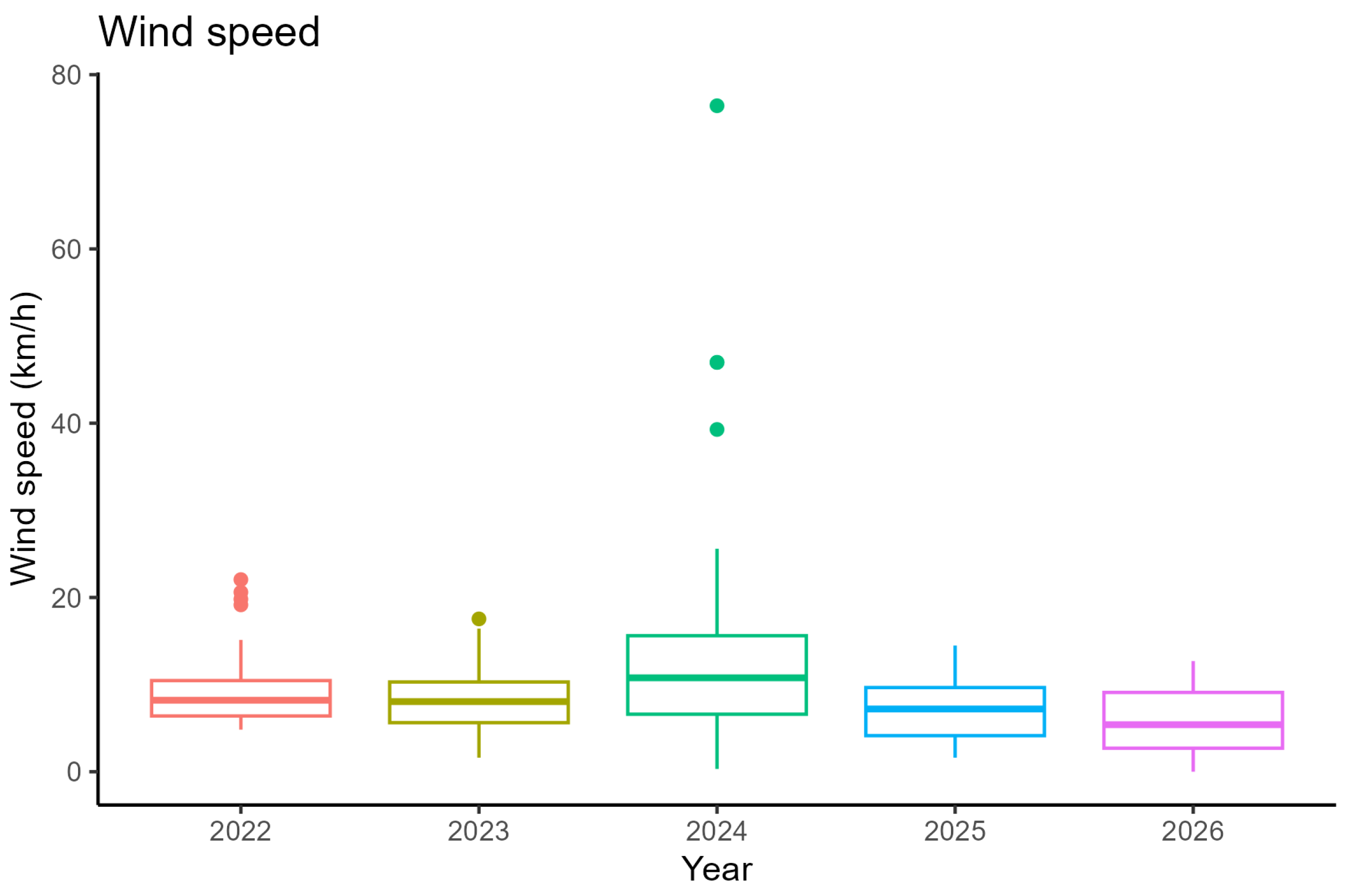
Over the five field seasons, we obtained 468 videos from 213 different individuals lasting on average 119 s. We analysed 339 videos of breeders and 129 of non-breeders. Group size ranged from 2 to 9 with a median of 4. The median perch height was 4 m and ranged from 0.1 to 25 m. Visual obstructions occurred in approximately 30% of the focal observations. Median wind speed was 8.0 km/h and ranged from 0 to 76 km/h over the years (Figure 1).
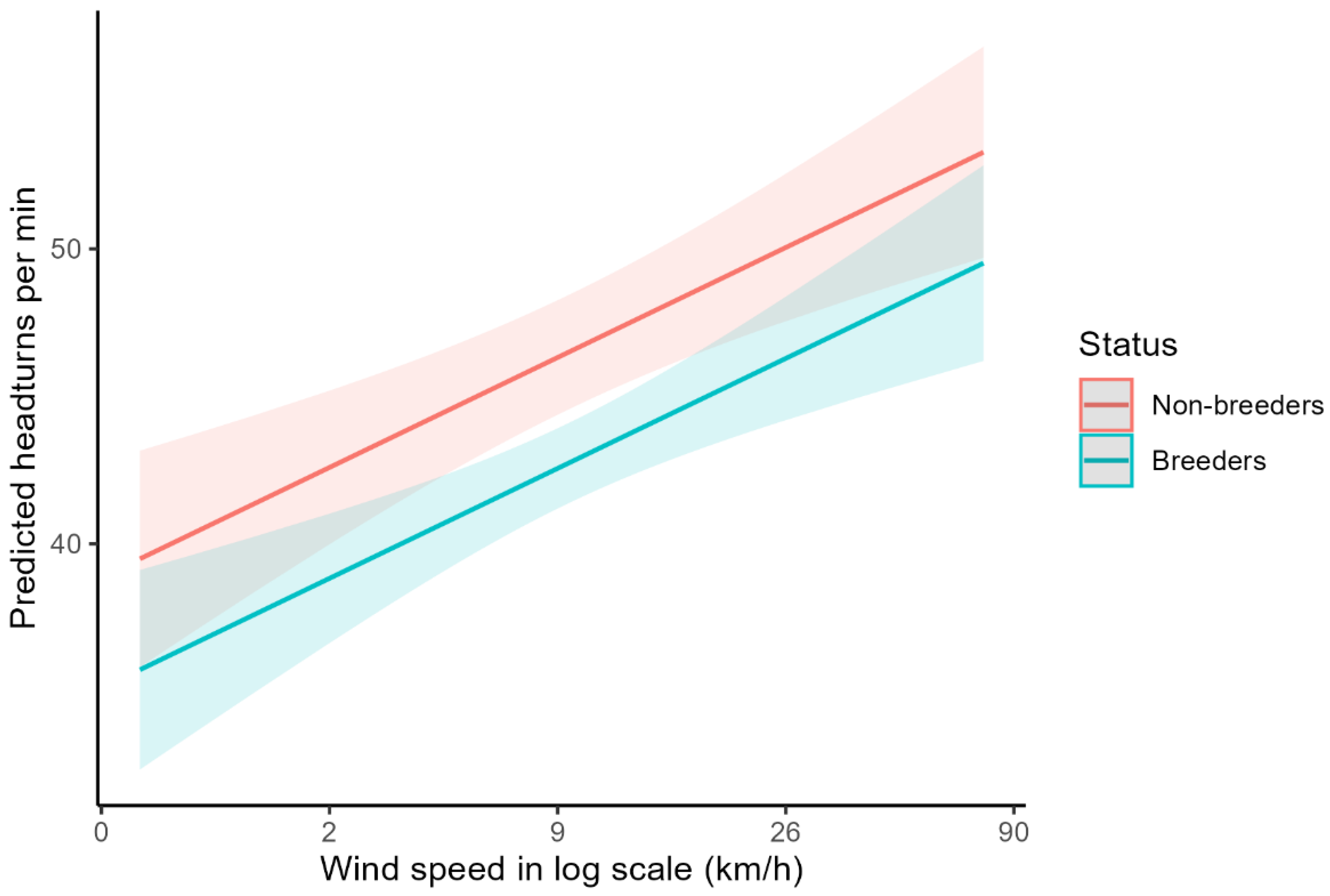
The linear mixed model including all fixed effects explained 17% of the variation in head-turning frequency (Table 1) and repeatability of measurements within individuals was moderate (ICC = 0.16). The number of head turns per min increased significantly with wind speed (Table 1; Figure 2). In terms of magnitude, an increase in wind speed from 0 to 76 km/h produced an approximately 34% increase in head-turning frequency. In addition to the wind speed effect, we found that breeder sentinels turned their heads less frequently than non-breeder sentinels (Table 1). Head-turning frequency in sentinels was also lower in larger groups and when multiple sentinels were present simultaneously. By contrast, sentinels that occupied higher perches turned their heads less frequently, whereas head-turning frequency increased in the presence of visual obstructions (Table 1).

4. Discussion

In this study, we found correlative evidence that variation in wind speed can influence vigilance. In the Florida Scrub-Jay, head-turning frequency in sentinels increased under windier conditions. As increases in head-turning frequency typically indicate an increase in the perception of risk [45], an increase in wind speed was thus probably perceived as riskier.
This study is correlative and we acknowledge the possibility that observed adjustments in sentinel behaviour may not necessarily be caused by wind speed. However, alternatives are not fully convincing. In particular, we note that temperature in this semi-tropical study site was typically mild in the winter (median = 17.3 °C) and rarely dropped below 10 °C suggesting little scope for changes in energy demands due to temperature even for individuals that are actively feeding. In addition, temperature and wind speed were weakly and positively correlated during the study period (r = 0.25).
We are confident that adjustments in vigilance were caused by wind speed and reflected changes in the ability to assess threats visually. Thermoregulation constraints are not relevant to non-foraging individuals that devote their full attention to vigilance during sentinel bouts. Decreased manoeuvrability when escaping due to high wind is not relevant for sentinels that are only metres away from cover and can drop directly down from their vantage points. The limited evidence suggests that flying predators may be adversely affected by high wind [21,52], suggesting that the risk of attack was not higher under windier conditions. Sentinels in this species rarely rely on the alarm calls of nearby companions to detect threats [42]. Therefore, call degradation caused by wind is not expected to be a factor shaping sentinel vigilance. The main threats to Florida Scrub-Jays at this time of year are avian predators [44] and conspecifics from nearby territories [41], which are detectable by sight and not by sound or smell. The results suggest that more windy conditions negatively affect the perception of risk probably through poorer visual detection of threats.
Possibilities to explain higher risk in high wind include increasing movement in the vegetation, which makes it harder to detect movements by predators and neighbours [18,27]. Blinking in one species was more frequent during high wind [53]. As blinking is known to limit visual processing, birds may respond by increasing head-turning frequency to compensate. Unfortunately, in our study, eye blinks were not easy to discern in the videos. Future studies are needed to determine which of these factors altered the perception of risk as wind speed increased.
Studies of other species with a sentinel system lend support to the idea that windier conditions are perceived as riskier. For example, Pied Babblers (Turdoides bicolor) initiated sentinel bouts sooner in high wind, and selected perches closer to the ground, possibly to maintain the effectiveness of their alarm calls in a noisy environment [17]. In Dwarf Mongooses (Helogale parvula), sentinels also chose lower perches on windy days [54]. In other species without a sentinel system, many studies have failed to document an association between wind speed and vigilance [16,23,31,32,33,34,35,36] while other studies have documented increases in vigilance in high wind [14,18,37,38,39,40], although it was not possible in most cases to determine whether behavioural adjustments reflected locomotion effects, thermoregulation constraints or signal degradation.
Beyond changes in vigilance, behavioural adjustments to wind can also include changes in micro-habitat use. For instance, small birds avoid foraging on the windier side of trees [12] and, as discussed earlier, sentinels in some species use perches closer to the ground in high wind. In our study, sentinels often perched in areas with nearby visual obstructions such as branches. These obstructions might provide shelter from the wind and indirectly from predators. However, we found that the presence of visual obstructions actually increased head-turning frequency, suggesting that obstructions probably made it more difficult to monitor the surroundings and increased the perception of risk. In social species, individuals can compete for better positions sheltered from the wind, which can lead to an increase in vigilance directed at competitors [12,27]. In our study, most sentinel bouts involved only one bird. When more than one sentinel was present, we found that head-turning frequency actually decreased, which suggests that other sentinels were not perceived as competitors but rather as allies in the detection of threats.
One limitation of our study is that wind speed was not measured at the exact time and location of sentinel bouts but was instead obtained from nearby weather stations with a small temporal lag. Wind speed is often viewed as a dynamic factor, varying rapidly from moment to moment and across small spatial scales. For example, gusts can occur unpredictably, and local physical features like vegetation may influence wind speed even over short distances. Weather measurements at a finer scale would more accurately reflect the conditions experienced by individuals during sentinel bouts. Nevertheless, our coarse-scale measurements were sufficient to detect a strong association between vigilance and wind speed. This is likely because sentinel bouts tended to occur in exposed locations with few physical barriers to wind and lasted for relatively long periods. Thus, although finer-scale wind measurements may provide additional detail, our results suggest that coarser-scale data can still be informative to elucidate the relationship between wind speed and vigilance.

5. Conclusions

This study shows that birds can adjust their vigilance in response to variability in their physical environment. In particular, sentinels of the Florida-Scrub-Jay increased their vigilance, as indicated by increases in head-turning frequency, as wind speed increased probably as a response to degradation in the visual information available to assess predation and intrusion risk.

Author Contributions

Conceptualization, G.B.; formal analysis, G.B.; investigation, G.B.; data curation, S.B.; writing—original draft preparation, G.B.; writing—review and editing, S.B.; project administration, S.B.; funding acquisition, S.B. All authors have read and agreed to the published version of the manuscript.

Funding

Funding for long-term research has been provided by Archbold Biological Station, National Science Foundation, and the U.S. Fish and Wildlife Service.

Institutional Review Board Statement

All research described here complied with the guidelines of Archbold’s Animal Care & Use Committee and Cornell University’s IACUC policies. All permits for trapping, banding, and observing Florida Scrub-Jays are held by S.B. (USFWS TE824723-10, USGS BBL 07732).

Informed Consent Statement

Not applicable.

Data Availability Statement

The data are available from the first author upon request.

Acknowledgments

We thank the Tori Bakley for directing the day-to-day work of the lab.

Conflicts of Interest

The authors declare no conflicts of interest.

References

  1. Beauchamp, G. Animal Vigilance: Monitoring Predators and Competitors; Academic Press: London, UK, 2015. [Google Scholar]
  2. Lima, S.L. Vigilance while feeding and its relation to the risk of predation. J. Theor. Biol. 1987, 124, 303–316. [Google Scholar] [CrossRef]
  3. Elgar, M.A. Predator vigilance and group size in mammals and birds: A critical review of the empirical evidence. Biol. Rev. 1989, 64, 13–33. [Google Scholar] [CrossRef]
  4. Roberts, G. Why individual vigilance declines as group size increases. Anim. Behav. 1996, 51, 1077–1086. [Google Scholar] [CrossRef]
  5. Pulliam, H.R. On the advantages of flocking. J. Theor. Biol. 1973, 38, 419–422. [Google Scholar] [CrossRef] [PubMed]
  6. Keverne, E.B.; Leonard, R.A.; Scruton, D.M.; Young, S.K. Visual monitoring in social groups of talapoin monkeys (Miopithecus talapoin). Anim. Behav. 1978, 26, 933–944. [Google Scholar] [CrossRef]
  7. Treves, A. Within-group vigilance in red colobus and redtail monkeys. Am. J. Primatol. 1999, 48, 113–126. [Google Scholar] [CrossRef]
  8. Favreau, F.-R.; Goldizen, A.W.; Pays, O. Interactions among social monitoring, anti-predator vigilance and group size in eastern grey kangaroos. Proc. R. Soc. B Biol. Sci. 2010, 277, 2089–2095. [Google Scholar] [CrossRef] [PubMed]
  9. Vahl, W.K.; van der Meer, J.; Weissing, F.J.; van Dullemen, D.; Piersma, T. The mechanisms of interference competition: Two experiments on foraging waders. Behav. Ecol. 2005, 16, 845–855. [Google Scholar] [CrossRef]
  10. Caraco, T. Time budgeting and group size: A theory. Ecology 1979, 60, 611–617. [Google Scholar] [CrossRef]
  11. Hilton, G.M.; Ruxton, G.D.; Cresswell, W. Choice of foraging area with respect to predation risk in redshanks: The effects of weather and predator activity. Oikos 1999, 87, 295–302. [Google Scholar] [CrossRef]
  12. Hogstad, O. Rank-related response in foraging site selection and vigilance behaviour of a small passerine to different winter weather conditions. Ornis Fenn. 2015, 92, 53–62. [Google Scholar] [CrossRef]
  13. Kogure, Y.; Sato, K.; Watanuki, Y.; Wanless, S.; Daunt, F. European shags optimize their flight behavior according to wind conditions. J. Exp. Biol. 2016, 219, 311–318. [Google Scholar] [CrossRef]
  14. Studd, E.K.; Peers, M.J.L.; Menzies, A.K.; Derbyshire, R.; Majchrzak, Y.N.; Seguin, J.L.; Murray, D.L.; Dantzer, B.; Lane, J.E.; McAdam, A.G.; et al. Behavioural adjustments of predators and prey to wind speed in the boreal forest. Oecologia 2022, 200, 349–358. [Google Scholar] [CrossRef]
  15. Barton, B.T. Reduced wind strengthens top-down control of an insect herbivore. Ecology 2014, 95, 2375–2381. [Google Scholar] [CrossRef]
  16. Boysen, A.F.; Lima, S.L.; Bakken, G.S. Does the thermal environment influence vigilance behavior in dark-eyed juncos (Junco hyemalis)? An approach using standard operative temperature. J. Therm. Biol. 2001, 26, 605–612. [Google Scholar] [CrossRef]
  17. Hollen, L.I.; Bell, M.B.V.; Wade, H.M.; Rose, R.; Russell, A.; Niven, F.; Ridley, A.R.; Radford, A.N. Ecological conditions influence sentinel decisions. Anim. Behav. 2011, 82, 1435–1441. [Google Scholar] [CrossRef]
  18. Blumstein, D.T.; Daniel, J.C. Foraging behavior of three Tasmanian macropodid marsupials in response to present and historical predation threat. Ecography 2003, 26, 585–594. [Google Scholar] [CrossRef]
  19. Cherry, M.J.; Barton, B.T. Effects of wind on predator-prey interactions. Food Webs 2017, 13, 92–97. [Google Scholar] [CrossRef]
  20. Shepard, E.L.C.; Ross, A.N.; Portugal, S.J. Moving in a moving medium: New perspectives on flight. Philos. Trans. R. Soc. B Biol. Sci. 2016, 371, 20150382. [Google Scholar] [CrossRef]
  21. Quinn, J.L.; Cresswell, W. Predator hunting behaviour and prey vulnerability. J. Anim. Ecol. 2004, 73, 143–154. [Google Scholar] [CrossRef]
  22. Wolf, B.O.; Walsberg, G.E. Thermal effects of radiation and wind on a small bird and implications for microsite selection. Ecology 1996, 77, 2228–2236. [Google Scholar] [CrossRef]
  23. Pravosudov, V.V.; Grubb, T.C. Vigilance in the tufted titmouse varies independently with air temperature and conspecific group size. Condor 1995, 97, 1064–1067. [Google Scholar] [CrossRef]
  24. Westover, L.; Morris-Drake, A.; Layton, M.; Kern, J.M.; Arbon, J.J.; Radford, A.N. The combined effects of elevated predation risk and anthropogenic noise on dwarf mongoose vigilance behaviour. Biol. Lett. 2025, 21, 20240645. [Google Scholar] [CrossRef]
  25. Quinn, J.L.; Whittingham, M.J.; Butler, S.J.; Cresswell, W. Noise, predation risk compensation and vigilance in the chaffinch Fringilla coelebs. J. Avian Biol. 2006, 37, 601–608. [Google Scholar] [CrossRef]
  26. Eastcott, E.; Kern, J.M.; Morris-Drake, A.; Radford, A.N. Intrapopulation variation in the behavioral responses of dwarf mongooses to anthropogenic noise. Behav. Ecol. 2020, 31, 680–691. [Google Scholar] [CrossRef]
  27. Carr, J.M.; Lima, S.L. High wind speeds decrease the responsiveness of birds to potentially threatening moving stimuli. Anim. Behav. 2010, 80, 215–220. [Google Scholar] [CrossRef]
  28. Fogarty, D.T.; Elmore, R.D.; Fuhlendorf, S.D.; Loss, S.R. Variation and drivers of airflow patterns associated with olfactory concealment and habitat selection. Ecology 2018, 99, 289–299. [Google Scholar] [CrossRef]
  29. Roth, T.C.; Cox, J.G.; Lima, S.L. Can foraging birds assess predation risk by scent? Anim. Behav. 2008, 76, 2021–2027. [Google Scholar] [CrossRef]
  30. Hayes, A.R.; Huntly, N.J. Effects of wind on the behavior and call transmission of pikas (Ochotona princeps). J. Mammal. 2005, 86, 974–981. [Google Scholar] [CrossRef]
  31. Welch, R.J.; le Roux, A.; Petelle, M.B.; Périquet, S. The influence of environmental and social factors on high- and low-cost vigilance in bat-eared foxes. Behav. Ecol. Sociobiol. 2018, 72, 29. [Google Scholar] [CrossRef]
  32. Fairbanks, B.; Dobson, F.S. Mechanisms of the group-size effect on vigilance in Columbian ground squirrels: Dilution versus detection. Anim. Behav. 2007, 73, 115–123. [Google Scholar] [CrossRef]
  33. van der Marel, A.; López-Darias, M.; Waterman, J.M. Group-enhanced predator detection and quality of vigilance in a social ground squirrel. Anim. Behav. 2019, 151, 43–52. [Google Scholar] [CrossRef]
  34. Edwards, A.M.; Best, E.C.; Blomberg, S.P.; Goldizen, A.W. Individual traits influence vigilance in wild female eastern grey kangaroos. Aust. J. Zool. 2013, 61, 332–341. [Google Scholar] [CrossRef]
  35. Ciuti, S.; Northrup, J.M.; Muhly, T.B.; Simi, S.; Musiani, M.; Pitt, J.A.; Boyce, M.S. Effects of humans on behaviour of wildlife exceed those of natural predators in a landscape of fear. PLoS ONE 2012, 7, e50611. [Google Scholar] [CrossRef] [PubMed]
  36. Fernández-Juricic, E.; Smith, R.; Kacelnik, A. Increasing the costs of conspecific scanning in socially foraging starlings affects vigilance and foraging behaviour. Anim. Behav. 2005, 69, 73–81. [Google Scholar] [CrossRef]
  37. Clermont, J.; Couchoux, C.; Garant, D.; Réale, D. Assessing anti-predator decisions of foraging eastern chipmunks under varying perceived risks: The effects of physical and social environments on vigilance. Behaviour 2017, 154, 131–148. [Google Scholar] [CrossRef]
  38. Carter, K.; Goldizen, A.W. Habitat choice and vigilance behaviour of brush-tailed rock-wallabies (Petrogale penicillata) within their nocturnal foraging ranges. Wildl. Res. 2003, 30, 355–364. [Google Scholar] [CrossRef]
  39. Novčić, I.; Vidović, Z. Nearest-neighbour distance, rather than group size, affects vigilance in urban flocks of preening Black-headed Gulls Chroicocephalus ridibundus. Bird Study 2021, 68, 174–182. [Google Scholar] [CrossRef]
  40. McBlain, M.; Jones, K.A.; Shannon, G. Sleeping Eurasian oystercatchers adjust their vigilance in response to the behaviour of neighbours, human disturbance and environmental conditions. J. Zool. 2020, 312, 75–84. [Google Scholar] [CrossRef]
  41. Woolfenden, G.E.; Fitzpatrick, J.W. The Florida Scrub-Jay: Demography of a Cooperative-Breeding Bird; May, R.M., Ed.; Monographs in Population Biology; Princeton University Press: Princeton, NJ, USA, 1984; Volume 20. [Google Scholar]
  42. McGowan, K.J.; Woolfenden, G.E. A sentinel system in the Florida scrub jay. Anim. Behav. 1989, 37, 1000–1006. [Google Scholar] [CrossRef]
  43. Beauchamp, G.; Bowman, R. Visual monitoring strategies of sentinels in a cooperative breeder. Biology 2022, 11, 1769. [Google Scholar] [CrossRef]
  44. Hailman, J.P.; McGowan, K.J.; Woolfenden, G.E. Role of helpers in the sentinel behaviour of the Florida scrub jay (Aphelocoma c. coerulescens). Ethology 1994, 97, 119–140. [Google Scholar] [CrossRef]
  45. Fernández-Juricic, E. Sensory basis of vigilance behavior in birds: Synthesis and future prospects. Behav. Process. 2012, 89, 143–152. [Google Scholar] [CrossRef]
  46. Linson, A.; Beauchamp, G.; Barve, S. Alerting and orienting attention in anti-predator vigilance: Neurocognitive modelling and behavioural evidence. J. R. Soc. Interface 2026, 23, 20250687. [Google Scholar] [CrossRef] [PubMed]
  47. Beauchamp, G.; Barve, S. Multiple sentinels in a cooperative breeder synchronize rather than coordinate gazing. Animals 2023, 13, 1524. [Google Scholar] [CrossRef]
  48. Fernández-Juricic, E.; Beauchamp, G.; Treminio, R.; Hoover, M. Making heads turn: Association between head movements during vigilance and perceived predation risk in brown-headed cowbird flocks. Anim. Behav. 2011, 82, 573–577. [Google Scholar] [CrossRef]
  49. Mettke-Hofmann, C. Is vigilance a personality trait? Plasticity is key alongside some contextual consistency. PLoS ONE 2022, 17, e0279066. [Google Scholar] [CrossRef]
  50. Hofmann, G.; Mettke-Hofmann, C. Watch out! High vigilance at small waterholes when alone in open trees. PLoS ONE 2024, 19, e0304257. [Google Scholar] [CrossRef]
  51. Lazarus, J. Flock size and behaviour in captive red-billed weaverbirds (Quelea quelea): Implications for social facilitation and the functions of flocking. Behaviour 1979, 71, 127–145. [Google Scholar] [CrossRef]
  52. Iasiello, L.; Colombelli-Négrel, D. Bright and early: Artificial light affects arrival time, but not group size or vigilance in Little Penguins (Eudyptula minor). Ibis 2025, 167, 248–262. [Google Scholar] [CrossRef]
  53. Yorzinski, J.L.; Argubright, S. Wind increases blinking behavior in Great-tailed Grackles (Quiscalus mexicanus). Front. Ecol. Evol. 2019, 7, 330. [Google Scholar] [CrossRef]
  54. Kern, J.M.; Radford, A.N. Sentinel dwarf mongooses, Helogale parvula, exhibit flexible decision making in relation to predation risk. Anim. Behav. 2014, 98, 185–192. [Google Scholar] [CrossRef]
Figure 1. Distribution of wind speed (km/h) during the study period over five consecutive years. Box show the interquartile range and include the median shown as a bolded line. Whiskers extend to 1.5 times the interquartile range and values beyond this range are shown with dots.
Birds 07 00023 g001
Figure 2. Head-turning frequency, a measure of vigilance behaviour, of Florida Scrub-Jay sentinels as a function of wind speed (in log10 scale). The predicted values were derived from a linear mixed model including breeders and non-breeders (juveniles and helpers). Ribbons show the 95% confidence limits.
Birds 07 00023 g002
Table 1. Beta estimates (95% confidence intervals) from a linear mixed model of head-turning frequency in the Florida Scrub-Jay. For the random effects section, the error variance is provided along with the variance explained by bird individual identification. ICC refers to the intra-class correlation coefficient association with the random effect.
Head Turns per min
pCIBeta EstimatesPredictors
<0.001 41.2–43.942.6(Intercept)
<0.001 −2.4–−0.63−1.5Group size (log scale)
<0.001 1.7–5.83.8Status [non-breeders vs. breeders]
<0.001 −7.1–−3.1−5.1Other sentinels [present vs. absent]
0.03 0.18–3.92.1Obstruction [present vs. absent]
<0.001 1.0–2.71.9Wind speed (log scale)
<0.001 −2.7–−0.9−1.8Perch height (log scale)
Random Effects
70.3σ2
13.4τ00 id
0.16ICC
213N id
468Observations
0.17/0.31Marginal R2/Conditional R2
Disclaimer/Publisher’s Note: The statements, opinions and data contained in all publications are solely those of the individual author(s) and contributor(s) and not of MDPI and/or the editor(s). MDPI and/or the editor(s) disclaim responsibility for any injury to people or property resulting from any ideas, methods, instructions or products referred to in the content.