


Highlights
What are the main findings?
- Vendor competency is a strong positive predictor of perceived sanitation and safety (β = 0.664) and high-value gastronomy experience (β = 0.501) in Bangkok’s street food tourism.
- Perceived sanitation and safety partially mediate the relationship between vendor competency and high-value gastronomy experience (β = 0.153).
- High-value gastronomy experience negatively influences behavioral intentions (β = −0.267), revealing a novelty-seeking paradox in which highly satisfying street food experiences fulfill tourists’ exploratory motivations.
What are the implications of the main findings?
- Investments in vendor training, operational competence, and hygiene infrastructure can enhance both tourists’ safety perceptions and overall gastronomic experiences.
- Destination managers should recognize that loyalty in gastronomy tourism may extend beyond revisit intentions to include recommendation behavior and positive word-of-mouth.
- Tourism marketers should adopt broader destination-level loyalty strategies, acknowledging that novelty-seeking is an inherent characteristic of high-quality gastronomy tourism experiences.
Abstract
This study examines the structural relationships among vendor competency, perceived sanitation and safety, high-value gastronomy experiences, and behavioral intentions in Bangkok’s street food tourism. Using survey data and PLS-SEM, the results indicate that vendor competency significantly enhances both perceived sanitation and safety and high-value gastronomy experiences. Perceived sanitation and safety further strengthens experiential value and partially mediates this relationship. However, contrary to conventional expectations, high-value gastronomy experiences exhibit a significant negative effect on behavioral intentions, suggesting a novelty-seeking paradox in exploratory tourism contexts. This study contributes in three ways: (1) by positioning vendor competency as a foundational driver of experiential value in informal food settings, (2) by integrating sanitation and safety into experiential value formation, and (3) by challenging the linear satisfaction–loyalty assumption through evidence of paradoxical tourist behavior. The findings offer theoretical and managerial implications for gastronomy tourism and destination management.
1. Introduction
Bangkok occupies a singular position in the global gastronomic imagination, with its street food culture widely celebrated by international media and culinary institutions as an expression of both everyday creativity and cultural resilience (Henderson, 2019). Beyond its economic contribution, street food in Bangkok functions as a vehicle for Thailand’s soft power, shaping the city’s global image and driving international arrivals (Okumus et al., 2018). Within the broader framework of urban tourism, Bangkok’s street food precincts operate as dynamic cultural landscapes where space, social interaction, and gastronomy intersect to produce distinctive place-based meaning (Ólafsdóttir & Dowling, 2014). These environments generate what Björk and Kauppinen-Räisänen (2019) conceptualize as “high-value gastronomy experiences”—encounters in which authenticity, sensory richness, and emotional engagement converge to transform food consumption into memorable tourism encounters.
Despite this global prestige, Bangkok’s street food ecosystem continues to face persistent challenges related to hygiene and food safety. These concerns have intensified in the post-COVID-19 era, as tourists demonstrate heightened sensitivity to health risks and sanitation conditions when selecting dining options (Rather, 2021; Ratasuk, 2023). Prior research consistently identifies sanitation and service quality as critical antecedents of tourist satisfaction and behavioral intentions (Chavarria & Phakdee-Auksorn, 2017; Ryu et al., 2012). However, the vendor side of this equation remains undertheorized. Studies from diverse contexts—including Ecuador, Vietnam, and South Africa—demonstrate that vendor characteristics such as formal training, hygiene knowledge, and managerial competency are the primary determinants of food safety compliance and consistent product quality (Huynh-Van et al., 2022; Nkosi & Tabit, 2021; Pilamala et al., 2023). Yet existing scholarship largely remains descriptive, mapping tourist preferences or cataloguing vendor deficiencies without modeling the structural mechanisms through which vendor-side capabilities translate into tourist perceptions and experiential outcomes.
This gap is theoretically significant. If vendor competency (VC) drives perceived sanitation and safety (PSS), and PSS in turn shapes high-value gastronomy experiences (HVGE), then the pathway from vendor capability to memorable tourist experience is both causal and mediated—a chain that conventional satisfaction models fail to capture. Moreover, the downstream relationship between HVGE and behavioral intentions (BI) remains contested. While traditional satisfaction-loyalty frameworks in hospitality research posit a positive, linear link between positive experiences and behavioral intentions (J.-H. Kim et al., 2012), an alternative stream of consumer behavior theory argues that novelty-seeking and variety-seeking motives—particularly salient in exploratory gastronomy tourism—may disrupt this assumed linearity (J. Kim & Fesenmaier, 2017). From this perspective, a peak culinary experience may paradoxically fulfill a tourist’s exploratory mission so completely that it reduces, rather than reinforces, the desire to return.
The present study addresses these gaps by developing and empirically testing a structural model that integrates vendor competency, perceived sanitation and safety, high-value gastronomy experience, and behavioral intentions within Bangkok’s street food culture. Using Partial Least Squares Structural Equation Modeling (PLS-SEM) with data from 800 domestic and international tourists, the study pursues three objectives: to examine the direct effect of vendor competency on both perceived sanitation and safety and high-value gastronomy experience; to test the mediating role of perceived sanitation and safety in the VC–HVGE relationship; and to investigate the effect of HVGE on behavioral intentions (BI). The principal findings confirm the foundational role of vendor competency in shaping tourist experiences, validate the partial mediation of perceived sanitation and safety, and reveal a statistically significant negative relationship between HVGE and behavioral intentions—a paradoxical outcome interpreted through the lens of novelty-seeking and variety-seeking behavior theories. These results advance gastronomy tourism theory and offer evidence-based implications for vendor development and destination management in Southeast Asian urban tourism contexts.
This study contributes in three ways. First, it positions vendor competency as a foundational driver of both perceived safety and experiential value in informal street food settings. Second, it integrates sanitation and safety into experiential value formation, extending gastronomy tourism research beyond sensory and cultural dimensions. Third, it challenges the conventional linear relationship between experience quality and loyalty by demonstrating a novelty-seeking paradox in which high-value experiences may reduce behavioral intentions.
Research Questions
RQ1: How does vendor competency influence perceived sanitation and safety and high-value gastronomy experience in Bangkok street food tourism?
RQ2: How does perceived sanitation and safety influence high-value gastronomy experience?
RQ3: How does high-value gastronomy experience influence tourists’ behavioral intentions?
RQ4: Does perceived sanitation and safety mediate the relationship between vendor competency and high-value gastronomy experience?
2. Literature Review
2.1. Vendor Competency (Vendor Competency—VC)
Vendor competency (VC) refers to the set of knowledge, skills, managerial capabilities, and personal attributes that enable vendors to perform effectively in service and operational settings. According to competency theory, competencies represent underlying characteristics—including knowledge, skills, motives, and personal traits—that contribute to superior performance outcomes (Boyatzis, 2008). This perspective provides a theoretical foundation for conceptualizing vendor competency as a multidimensional construct in tourism and hospitality contexts.
In street food tourism, vendor competency is particularly important because vendors simultaneously perform technical, managerial, and relational roles. Vendors are responsible not only for food preparation and hygiene management, but also for customer interaction, communication, and operational planning. Prior studies indicate that training, education, and operational capabilities significantly influence hygiene compliance, product consistency, and customer trust (Huynh-Van et al., 2022; Pilamala et al., 2023; Nkosi & Tabit, 2021). These findings suggest that vendor competency contributes not only to food quality but also to tourists’ perceptions of sanitation and safety.
Beyond safety-related outcomes, vendor competency may also enhance experiential value through authenticity, interpersonal interaction, and consistent service delivery. In gastronomy tourism, such competencies support value co-creation by shaping both functional and emotional dimensions of the tourist experience.
Accordingly, following the multidimensional competency perspective proposed by Boyatzis (2008), vendor competency is conceptualized in this study as a higher-order construct composed of knowledge and skills, marketing competence, planning competence, and personality.
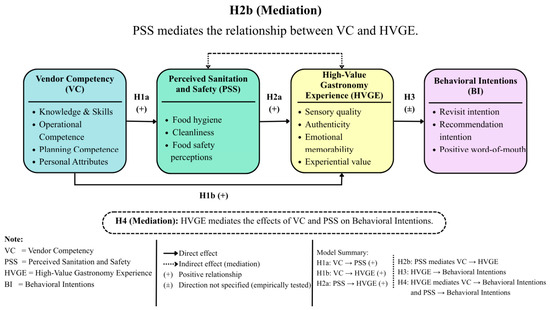
Hypothesis H1a.
Vendor competency (VC) positively affects perceived sanitation and safety (PSS).
Hypothesis H1b.
Vendor competency (VC) positively affects high-value gastronomy experience (HVGE).
In this study, vendor competency is operationalized through four dimensions: knowledge and skills, marketing competence, planning competence, and personality. These dimensions collectively reflect vendors’ ability to manage food operations, interact with tourists, and deliver consistent service quality.
2.2. Perceived Sanitation and Safety (Perceived Sanitation & Safety—PSS)
Perceived sanitation and safety (PSS) refers to tourists’ evaluations of hygiene, food safety, and risk conditions associated with street food consumption. In informal food environments, tourists often rely on visible cues—such as food handling practices, cleanliness, and waste management—to form trust judgments under uncertainty (Pilamala et al., 2023).
Previous studies suggest that sanitation perceptions influence tourist confidence, reduce perceived risk, and support more positive consumption experiences. Rather than functioning solely as hygiene factors, sanitation and safety may act as experiential enablers by allowing tourists to engage more fully with sensory and cultural dimensions of gastronomy experiences.
Because vendor competencies influence hygiene practices, PSS is modeled as a perceptual mediator linking vendor competency to experiential outcomes.
Hypothesis H2a.
Perceived sanitation and safety (PSS) positively affects high-value gastronomy experience (HVGE).
Hypothesis H2b.
PSS mediates the relationship between VC and HVGE.
2.3. High-Value Gastronomy Experience (HVGE)
High-value gastronomy experience (HVGE) is conceptualized as a multidimensional experiential construct encompassing sensory quality, authenticity, emotional memorability, and perceived experiential value. This conceptualization draws from memorable tourism experience research, which identifies novelty, meaningfulness, and local cultural immersion as important drivers of tourism outcomes (J.-H. Kim et al., 2012).
Unlike general tourist satisfaction, HVGE reflects a broader experiential state integrating both functional and emotional dimensions of gastronomy consumption. While memorable tourism experience (MTE) primarily emphasizes memorable and affective tourism experiences associated with novelty, meaningfulness, and local culture (J.-H. Kim et al., 2012), HVGE additionally incorporates perceived cultural authenticity, experiential worth, and symbolic value associated with local food experiences. In street food tourism contexts, these dimensions are particularly important because tourists often seek immersive and culturally distinctive encounters rather than purely utilitarian food consumption.
In gastronomy tourism, experiential value emerges through the interaction of food quality, social exchange, destination context, and perceived safety (Björk & Kauppinen-Räisänen, 2019). In street food settings, sensory stimulation, vendor interaction, authenticity, and visible sanitation cues jointly shape tourists’ overall experiences and influence their emotional engagement with the destination. Prior studies suggest that positive gastronomic experiences can strengthen post-consumption behavioral outcomes, including behavioral intentions, recommendation intention, and positive word-of-mouth communication.
However, in exploratory tourism contexts, behavioral responses may also be influenced by novelty-seeking and variety-seeking motivations (Lee, 2014; J. Kim & Fesenmaier, 2017). Tourists who highly value unique and memorable food experiences may subsequently seek different culinary experiences rather than repeatedly returning to the same vendor or destination. This perspective suggests that highly satisfying experiences do not always produce direct revisit behavior, particularly in destinations characterized by abundant culinary diversity and experiential variety.
Accordingly, HVGE is modeled in this study as both an outcome of vendor competency and perceived sanitation and safety, and as a predictor of post-visit behavioral intentions. The construct captures how tourists cognitively and emotionally evaluate gastronomy experiences within Bangkok’s street food environment.
Hypothesis H3.
High-value gastronomy experience (HVGE) has a significant effect on behavioral intentions (BI).
Hypothesis H4.
HVGE mediates the effects of VC and PSS on behavioral intentions (BI).
2.4. Novelty-Seeking and Behavioral Intention in Food Tourism
Novelty-seeking has long been recognized as a central motivational factor in tourism behavior, particularly in experiential forms of tourism such as gastronomy tourism. Tourists often travel not only to consume products or services, but also to pursue unfamiliar, distinctive, and memorable experiences that differ from everyday life (Fields, 2002). In food tourism contexts, local cuisine functions as both a cultural attraction and an experiential medium through which tourists engage with destination identity, authenticity, and sensory exploration (Cohen & Avieli, 2004).
Previous tourism research has generally suggested that positive travel experiences enhance satisfaction, loyalty, and behavioral intentions. However, revisit behavior in tourism may not always follow a linear satisfaction–loyalty relationship. Jang and Feng (2007) demonstrated that novelty-seeking can significantly influence behavioral intentions, as tourists with strong exploratory tendencies may prefer new destinations and experiences even after highly satisfying visits. This suggests that positive experiences do not necessarily guarantee repeated patronage, particularly in tourism environments characterized by diversity and abundance of alternatives.
The role of novelty is especially relevant in gastronomy tourism, where tourists actively seek sensory stimulation, cultural immersion, and unique culinary encounters. Quan and Wang (2004) argued that food experiences can function as “peak tourism experiences,” generating emotional engagement and memorable consumption beyond routine dining activities. Similarly, Mak et al. (2012) noted that tourists’ food consumption behavior is strongly associated with cultural curiosity and the desire to experience unfamiliar local practices. In highly diverse culinary destinations, tourists may therefore prioritize exploration of new food experiences over revisiting previously consumed offerings.
This perspective aligns with variety-seeking behavior theory, which proposes that consumers may intentionally switch among alternatives despite previous satisfaction because of an intrinsic desire for diversity, stimulation, and experiential change (Jang & Feng, 2007). Consequently, in street food tourism contexts such as Bangkok, highly positive gastronomy experiences may simultaneously encourage positive word-of-mouth communication while reducing direct behavioral intentions toward a specific vendor. Tourists may remain loyal to the destination experience as a whole while continuing to seek novel culinary experiences within the broader foodscape.
Accordingly, the present study incorporates novelty-seeking logic to provide a broader interpretation of the relationship between high-value gastronomy experience and post-visit behavioral intention in Bangkok’s street food tourism context.
Based on the literature review, a conceptual framework was developed to examine the relationships among vendor competency, perceived sanitation and safety, high-value gastronomy experience, and behavioral intentions. The proposed research framework is presented in Figure 1.
Figure 1.
Proposed Conceptual Framework.
3. Materials and Methods
This study employed a quantitative research design using Partial Least Squares Structural Equation Modeling (PLS-SEM) to examine the relationships among vendor competency, perceived sanitation and safety, high-value gastronomy experience, and behavioral intentions within the context of Bangkok’s street food tourism. The target population comprised both domestic and international tourists who had recently consumed street food in Bangkok.
A convenience sampling approach was employed due to the exploratory nature of the study and the absence of a comprehensive sampling frame for street food tourists. Data were collected between October and December 2024 at four well-known street food destinations in Bangkok: Yaowarat (Chinatown), Chatuchak, Pratunam, and Banthat Thong. These locations were selected because of their popularity among tourists, diversity of food offerings, and established reputations as gastronomic attractions.
A total of 950 questionnaires were distributed. After data screening and the removal of incomplete responses, 800 valid questionnaires were retained for analysis, consisting of 400 Thai tourists and 400 international tourists. The sample size exceeded the minimum requirements for PLS-SEM analysis and was considered sufficient to ensure adequate statistical power (Hair et al., 2019).
Data were collected using a structured self-administered questionnaire. Trained enumerators approached tourists after they had consumed street food and invited them to participate voluntarily in the survey. All respondents were informed of the purpose of the study and were assured that their responses would remain anonymous and confidential. Informed consent was obtained prior to participation.
Prior to hypothesis testing, data normality was assessed using skewness and kurtosis statistics. The results indicated that all values fell within the recommended ranges, suggesting no serious deviations from normality. Although PLS-SEM does not require normally distributed data, this assessment provides additional evidence regarding the suitability of the dataset for subsequent analysis.
3.1. Measurement Instrument
All constructs were measured using multiple-item scales adapted from established studies in the tourism, hospitality, and competency literature. Responses were recorded using a five-point Likert scale ranging from 1 (“strongly disagree”) to 5 (“strongly agree”).
The questionnaire consisted of four constructs: Vendor Competency (VC), Perceived Sanitation and Safety (PSS), High-Value Gastronomy Experience (HVGE), and Behavioral Intentions (BI). Behavioral Intentions were operationalized as a broader post-consumption construct consisting of revisit intention, recommendation intention, and positive word-of-mouth intention.
The wording of several items was slightly modified to reflect the characteristics of Bangkok’s street food tourism environment while maintaining the original conceptual meanings of the constructs. Table 1 summarizes the sources of the measurement scales used in this study.
Table 1.
Sources of Measurement Scales.
3.2. Data Analysis
Data were analyzed using SmartPLS 4 software following the two-step approach recommended by Hair et al. (2019). The measurement model was first assessed for internal consistency reliability using Cronbach’s alpha and composite reliability (CR), convergent validity using indicator loadings and Average Variance Extracted (AVE), and discriminant validity using the Heterotrait–Monotrait ratio (HTMT) and the Fornell–Larcker criterion.
Subsequently, the structural model was evaluated using bootstrapping procedures to estimate path coefficients (β), t-statistics, and p-values. Additional assessments included collinearity diagnostics using Variance Inflation Factors (VIF), explanatory power using coefficients of determination (R2), effect sizes using f2 statistics, and model fit using the Standardized Root Mean Square Residual (SRMR). Common method bias was assessed using Harman’s single-factor test.
3.3. Ethical Considerations
Ethical approval was obtained from the Ethics Committee in Human Research, National Institute of Development Administration (protocol code ECNIDA 2024/0140; date of approval: 11 September 2024). The study was conducted in accordance with the principles of the Declaration of Helsinki.
During the preparation of this manuscript, the authors used Gemini solely for English language and grammar checking purposes. All outputs were reviewed, verified, and edited by the authors, who take full responsibility for the content of this publication.
4. Results
A total of 800 valid responses were obtained from international tourists visiting street food destinations in Bangkok. The majority of respondents were female (58.3%), followed by male respondents (29.4%). Most participants were between 18 and 30 years old (44.3%), followed by those aged 31–40 years (32.3%). Regarding educational attainment, most respondents held a bachelor’s degree (66.0%). The largest proportion of respondents reported a monthly income exceeding THB 80,001 (25.8%). In terms of geographical origin, most tourists came from Asia (69.0%), followed by Europe (13.0%) and North America (11.0%).
The data were analyzed using Partial Least Squares Structural Equation Modeling (PLS-SEM) with SmartPLS 4. Following the recommended two-stage approach, the measurement model was first assessed for reliability and validity, followed by the assessment of the structural model and hypothesis testing.
4.1. Measurement Model Assessment
The measurement model was evaluated for internal consistency reliability, convergent validity, and discriminant validity. Internal consistency reliability was assessed using Cronbach’s alpha and composite reliability (rho_c), while convergent validity was evaluated using outer loadings and average variance extracted (AVE).
As shown in Table 2, composite reliability values ranged from 0.819 to 0.848, exceeding the recommended threshold of 0.70. Cronbach’s alpha values ranged from 0.677 to 0.786. Although the Cronbach’s alpha value for Perceived Sanitation and Safety (PSS) was slightly below 0.70, its composite reliability value of 0.819 confirmed acceptable reliability.
Table 2.
Measurement Model.
Most indicator loadings exceeded 0.70. Some indicators, including HVGE3 (0.664), HVGE4 (0.659), PSS2 (0.688), VC3 (0.672), and BI1 (0.569), were below the preferred threshold of 0.70 but were retained because they exceeded the minimum acceptable threshold and contributed to the theoretical content validity of the constructs. The AVE values ranged from 0.536 to 0.613, exceeding the minimum threshold of 0.50. Therefore, convergent validity was established.
4.2. Discriminant Validity
Discriminant validity was assessed using the Heterotrait–Monotrait ratio (HTMT) and the Fornell–Larcker criterion. As shown in Table 3, all HTMT values were below the threshold of 0.90. The highest HTMT value was between Vendor Competency (VC) and Perceived Sanitation and Safety (PSS) at 0.883, which remained within the acceptable range. These results indicate adequate discriminant validity.
Table 3.
HTMT Ratio.
The Fornell–Larcker criterion also confirmed discriminant validity. As presented in Table 4, the square root of AVE for each construct exceeded its correlations with other constructs.
Table 4.
Fornell–Larcker Criterion.
4.3. Common Method Bias Assessment
Because the data were collected through a single questionnaire, common method bias was assessed using Harman’s single-factor test. The first unrotated factor accounted for 30.93% of the total variance, which is below the recommended threshold of 50%. Therefore, common method bias was unlikely to pose a serious threat to the validity of the findings.
In addition, inner model collinearity was assessed using variance inflation factor (VIF) values. As shown in Table 5, all VIF values ranged from 1.000 to 1.787, below the conservative threshold of 3.3. This further suggests that multicollinearity and common method bias were not major concerns.
Table 5.
Inner VIF Values.
4.4. Structural Model Assessment
The structural model was assessed using path coefficients, t-statistics, p-values, R2, and f2 effect sizes. The bootstrapping results are presented in Table 6.
Table 6.
Hypothesis Testing Results.
Vendor Competency (VC) had a significant positive effect on Perceived Sanitation and Safety (PSS) (β = 0.664, t = 33.227, p < 0.001), supporting H1a. VC also had a significant positive effect on High-Value Gastronomy Experience (HVGE) (β = 0.501, t = 11.073, p < 0.001), supporting H1b. PSS significantly and positively affected HVGE (β = 0.231, t = 4.739, p < 0.001), supporting H2a.
The relationship between HVGE and Behavioral Intentions (BI) was statistically significant but negative (β = −0.267, t = 8.475, p < 0.001). The relationship between HVGE and BI was statistically significant but negative (β = −0.267, t = 8.475, p < 0.001). Thus, H3 was supported in terms of statistical significance, although the observed direction was negative. This result suggests a novelty-seeking pattern in which tourists with highly valuable gastronomy experiences may be less inclined to repeat the same experience. This result suggests a novelty-seeking pattern in which tourists with highly valuable gastronomy experiences may be less inclined to repeat the same experience.
4.5. Mediation Analysis
The mediating effects were examined using bootstrapping. As shown in Table 7, the indirect effect of VC on HVGE through PSS was positive and significant (β = 0.153, t = 4.698, p < 0.001), supporting H2b.
Table 7.
Mediation Analysis Results.
HVGE also significantly mediated the effects of VC and PSS on BI. The indirect effect of VC on BI through HVGE was negative and significant (β = −0.134, t = 6.322, p < 0.001). Similarly, the indirect effect of PSS on BI through HVGE was negative and significant (β = −0.062, t = 4.044, p < 0.001). These results support H4 and indicate that HVGE transmits a negative indirect effect on BI.
4.6. Predictive Power and Effect Size
The explanatory power of the model was assessed using R2 values. The model explained 44.0% of the variance in PSS (R2 = 0.440), 45.8% of the variance in HVGE (R2 = 0.458), and 7.1% of the variance in BI (R2 = 0.071). The explanatory power for PSS and HVGE can be considered moderate, while the explanatory power for BI is weak. This suggests that behavioral intentions may be influenced by additional factors beyond the constructs included in this model.
Effect sizes were assessed using f2 values. As shown in Table 8, VC had a large effect on PSS (f2 = 0.787) and a medium effect on HVGE (f2 = 0.259). PSS had a small effect on HVGE (f2 = 0.055), while HVGE had a small effect on BI (f2 = 0.077).
Table 8.
Effect Size (f2).
4.7. Assessment of Predictive Relevance
Predictive relevance was assessed using a cross-validated redundancy procedure following Hair et al. (2019). As shown in Table 9, all Q2 values were greater than zero, indicating that the model possesses predictive relevance for all endogenous constructs. Specifically, PSS (Q2 = 0.242) and HVGE (Q2 = 0.224) demonstrated moderate predictive relevance, while BI (Q2 = 0.013) exhibited limited predictive relevance. These findings are consistent with the R2 values, where PSS and HVGE showed moderate explanatory power, and BI showed weak explanatory power.
Table 9.
Predictive Relevance (Q2).
The SRMR values exceeded the commonly suggested threshold of 0.08. However, PLS-SEM model assessment was based on a comprehensive evaluation of reliability, validity, collinearity, predictive relevance, and structural relationships (Hair et al., 2019). Therefore, the model was retained for further analysis, while the SRMR results should be interpreted with caution.
5. Discussion
This study examined the relationships among vendor competency, perceived sanitation and safety, high-value gastronomy experience (HVGE), and behavioral intentions in the context of Bangkok’s street food tourism. The findings provide empirical evidence regarding the mechanisms through which vendor-related capabilities and safety perceptions contribute to gastronomic tourism experiences and subsequent behavioral outcomes.
The results indicate that vendor competency significantly influences both perceived sanitation and safety and high-value gastronomy experience. These findings support competency theory, which suggests that individuals’ knowledge, skills, managerial abilities, and personal characteristics contribute to effective performance and value creation (Boyatzis, 2008). In the context of street food tourism, vendors play multiple roles simultaneously as food preparers, service providers, marketers, and cultural representatives. Consequently, competent vendors are more capable of ensuring food quality, maintaining hygiene standards, communicating effectively with tourists, and creating memorable service encounters. The large effect size observed for the relationship between vendor competency and perceived sanitation and safety (f2 = 0.787) further highlights the central role of vendor capabilities in shaping tourists’ perceptions of food safety and service quality.
The findings also demonstrate that perceived sanitation and safety positively affect high-value gastronomy experience. This result suggests that sanitation and safety should not be viewed solely as risk-reduction mechanisms but also as important contributors to experiential value creation. When tourists perceive food environments as clean, hygienic, and trustworthy, they are more likely to engage fully in the sensory, emotional, and cultural dimensions of food consumption. This finding supports previous studies suggesting that perceptions of cleanliness and food safety contribute positively to tourism experiences, customer evaluations, and destination image (Björk & Kauppinen-Räisänen, 2019; Rather, 2021).
Furthermore, perceived sanitation and safety partially mediated the relationship between vendor competency and high-value gastronomy experience. This finding suggests that competent vendors enhance tourists’ experiences not only directly through service delivery and interaction quality but also indirectly by fostering confidence in food safety and hygiene conditions. The result reinforces the importance of integrating operational competence and sanitation management within gastronomy tourism development strategies.
Behavioral intentions in this study represent a broader post-consumption construct comprising revisit intention, recommendation intention, and positive word-of-mouth. Therefore, the negative relationship between HVGE and BI should not be interpreted as simple dissatisfaction. Rather, it may indicate that highly valuable street food experiences satisfy tourists’ exploratory motives, thereby reducing their intention to repeat the same experience while still allowing for recommendation behavior and destination-level loyalty.
Unlike general tourist satisfaction, HVGE reflects a multidimensional experiential construct encompassing sensory quality, authenticity, emotional memorability, and perceived experiential value. Consequently, a highly valuable gastronomic experience may not necessarily encourage tourists to repeat the same experience. Instead, tourists may perceive the experience as fulfilling and complete, motivating them to seek alternative culinary experiences in future travel decisions. This interpretation is consistent with novelty-seeking theory, which proposes that tourists often pursue unfamiliar and unique experiences rather than repeatedly consuming identical offerings (Lee & Crompton, 1992). Similarly, variety-seeking behavior suggests that consumers frequently switch among alternatives even when previous experiences were highly satisfying (McAlister & Pessemier, 1982).
In gastronomy tourism, particularly within destinations characterized by rich culinary diversity, such as Bangkok, highly memorable food experiences may encourage tourists to continue exploring different food offerings rather than returning to the same vendors or locations. Therefore, the negative relationship observed in this study should not be interpreted as dissatisfaction but rather as an indication of exploratory consumption behavior driven by novelty-seeking motivations.
The relatively low explanatory power of behavioral intentions (R2 = 0.071) further supports this interpretation. While vendor competency, sanitation perceptions, and experiential value contribute to explaining tourists’ behavioral tendencies, additional variables not included in the current model may play important roles. Factors such as novelty-seeking orientation, destination attachment, cultural background, travel frequency, prior experience, and personal motivations may further influence tourists’ future behavioral decisions.
The predictive relevance results further support this interpretation. While the model demonstrated predictive relevance for PSS and HVGE, the predictive relevance for BI was comparatively weak. This suggests that tourists’ future behavioral tendencies may be influenced by additional psychological, situational, and destination-related factors beyond vendor competency, sanitation perceptions, and gastronomy experiences.
From a theoretical perspective, this study contributes to the gastronomy tourism literature in three ways. First, it extends competency theory by demonstrating the critical role of vendor competency in shaping both safety perceptions and experiential outcomes within informal food tourism settings. Second, it positions sanitation and safety as experiential value enhancers rather than merely operational requirements. Third, it contributes to tourism behavior literature by providing evidence that highly valuable tourism experiences do not necessarily translate into stronger future behavioral intentions, particularly in exploratory tourism contexts where novelty-seeking motivations are prominent.
From a practical perspective, the findings suggest that tourism authorities and destination managers should prioritize vendor training programs that strengthen operational competence, food safety knowledge, communication skills, and customer service capabilities. Such initiatives can simultaneously improve sanitation perceptions and enhance tourists’ gastronomic experiences. Additionally, marketing strategies should not rely solely on repeat visitation as an indicator of success. Instead, greater emphasis should be placed on recommendation behavior, positive word-of-mouth, and destination-wide culinary diversity that encourages tourists to continue exploring gastronomic offerings within the destination.
6. Conclusions
This study investigated the relationships among vendor competency, perceived sanitation and safety, high-value gastronomy experience, and behavioral intentions within the context of Bangkok’s street food tourism. Using PLS-SEM analysis, the findings demonstrate that vendor competency significantly influences both perceived sanitation and safety and high-value gastronomy experience. Perceived sanitation and safety also positively contribute to experiential value and partially mediate the relationship between vendor competency and gastronomy experiences.
The study further reveals a significant but negative relationship between high-value gastronomy experience and behavioral intentions. This finding suggests that highly valuable gastronomic experiences do not necessarily encourage tourists to revisit the same vendor or consume the same experience again. Instead, tourists may be motivated to seek new and diverse culinary experiences, reflecting novelty-seeking and variety-seeking behaviors commonly observed in tourism consumption contexts.
These findings highlight the importance of vendor competency and sanitation management as foundational elements of gastronomy tourism development. Investments in vendor training, food safety practices, and service quality enhancement can generate substantial benefits for tourists’ experiential evaluations and destination competitiveness.
Despite its contributions, this study has several limitations. The research focused exclusively on street food tourists in Bangkok and employed a cross-sectional research design. Therefore, the findings may not be generalizable to other destinations or tourism contexts. Future research should examine the role of novelty-seeking tendencies, destination attachment, cultural differences, and other psychological factors that may influence behavioral intentions following memorable gastronomy experiences. Longitudinal studies may also provide deeper insights into how gastronomic experiences shape tourist behavior over time.
Overall, this study contributes to the growing body of gastronomy tourism research by demonstrating that vendor competency and sanitation perceptions play essential roles in creating valuable tourism experiences, while simultaneously highlighting the complex relationship between experiential value and tourists’ future behavioral intentions.
6.1. Contribution
This study contributes to the literature in three ways. First, it extends competency-based perspectives by demonstrating that vendor competency is a key driver of both perceived sanitation and safety and high-value gastronomy experiences in street food tourism. Second, it advances gastronomy tourism research by positioning sanitation and safety as experiential enablers rather than merely risk-reduction mechanisms. Third, the study identifies a novelty-seeking paradox, showing that highly valuable gastronomy experiences may not necessarily translate into stronger behavioral intentions, thereby challenging the conventional assumption that positive experiences always lead to loyalty-related outcomes. Practically, the findings suggest that investments in vendor training, hygiene management, and food safety standards can enhance tourists’ experiences and strengthen destination competitiveness.
6.2. Limitations
Several limitations should be acknowledged. First, the model explained a relatively small proportion of variance in Behavioral Intentions (R2 = 0.071), indicating that additional factors may influence tourists’ future behavioral tendencies. Second, the study employed convenience sampling in selected street food locations in Bangkok, which may limit the generalizability of the findings. Finally, the cross-sectional design prevents the observation of changes in tourists’ perceptions and behaviors over time.
6.3. Future Research Directions
Future studies should incorporate additional variables such as novelty-seeking orientation, destination attachment, cultural background, and travel motivations to improve the prediction of behavioral intentions. Further research is also needed to examine whether novelty-seeking acts as a mediating or moderating factor in the relationship between gastronomy experiences and post-consumption behavior. Finally, comparative studies across different gastronomic destinations would help determine whether the novelty-seeking paradox identified in this study can be generalized beyond the Bangkok street food context.
Author Contributions
Conceptualization, S.P. and N.C.; Methodology, N.C.; Software, N.C.; Validation, H.C. and K.M.; Formal analysis, N.C.; Investigation, H.C.; Resources, N.C.; Data curation, K.M. and S.P.; Writing—original draft preparation, N.C.; Writing—review and editing, S.P.; Visualization, H.C. and K.M.; Supervision, S.P.; Project administration, N.C.; Funding acquisition, H.C. All authors have read and agreed to the published version of the manuscript.
Funding
This research was funded by Thailand Science Research and Innovation (TSRI).
Institutional Review Board Statement
The study was conducted in accordance with the Declaration of Helsinki and approved by the Ethics Committee in Human Research, National Institute of Development Administration (protocol code ECNIDA 2024/0140; date of approval: 11 September 2024).
Informed Consent Statement
Informed consent was obtained from all subjects involved in the study.
Data Availability Statement
The data presented in this study are available from the corresponding author due to privacy.
Acknowledgments
The authors would like to thank the street food vendors and tourists who participated in this study, as well as colleagues who provided support during data collection. The authors also wish to acknowledge the valuable support provided by the National Institute of Development Administration (NIDA) throughout the research process. During the preparation of this manuscript, the authors used Gemini 3 Pro for language editing and manuscript refinement. The authors reviewed and edited all outputs and take full responsibility for the content.
Conflicts of Interest
The authors declare no conflicts of interest.
Abbreviations
The following abbreviations are used in this manuscript:
| VC | Vendor Competency |
| PSS | Perceived Sanitation and Safety |
| HVGE | High-Value Gastronomy Experience |
| BI | Behavioral Intentions |
| PLS-SEM | Partial Least Squares Structural Equation Modeling |
References
- Björk, P., & Kauppinen-Räisänen, H. (2019). Destination foodscape: A stage for travelers’ food experience. Tourism Management, 71, 466–475. [Google Scholar] [CrossRef] [Scilit]
- Boyatzis, R. E. (2008). Competencies in the 21st century. Journal of Management Development, 27(1), 5–12. [Google Scholar] [CrossRef] [Scilit]
- Chavarria, L. C. T., & Phakdee-Auksorn, P. (2017). Understanding international tourists’ attitudes towards street food in Phuket, Thailand. Tourism Management Perspectives, 21, 66–73. [Google Scholar] [CrossRef] [Scilit]
- Cohen, E., & Avieli, N. (2004). Food in tourism: Attraction and impediment. Annals of Tourism Research, 31(4), 755–778. [Google Scholar] [CrossRef] [Scilit]
- Fields, K. (2002). Demand for the gastronomy tourism product: Motivational factors. In A. M. Hjalager, & G. Richards (Eds.), Tourism and gastronomy (pp. 36–50). Routledge. [Google Scholar]
- Hair, J. F., Risher, J. J., Sarstedt, M., & Ringle, C. M. (2019). When to use and how to report the results of PLS-SEM. European Business Review, 31(1), 2–24. [Google Scholar] [CrossRef] [Scilit]
- Henderson, J. C. (2019). Street food and gastronomic tourism. In S. K. Dixit (Ed.), The Routledge handbook of gastronomic tourism (pp. 431–440). Routledge. [Google Scholar]
- Huynh-Van, B., Vuong-Thao, V., Huynh-Thi-Thanh, T., Dang-Xuan, S., Huynh-Van, T., Tran-To, L., Nguyen-Thi-Thao, N., Huynh-Bach, C., & Nguyen-Viet, H. (2022). Factors associated with food safety compliance among street food vendors in Can Tho city, Vietnam. BMC Public Health, 22, 94. [Google Scholar] [CrossRef] [Scilit] [PubMed]
- Jang, S., & Feng, R. (2007). Temporal destination revisit intentions: The effects of novelty seeking and satisfaction. Tourism Management, 28(2), 580–590. [Google Scholar] [CrossRef] [Scilit]
- Kim, J., & Fesenmaier, D. R. (2017). Tourism experience and tourism design. In D. R. Fesenmaier, & Z. Xiang (Eds.), Design science in tourism (pp. 25–42). Springer. [Google Scholar] [CrossRef] [Scilit]
- Kim, J.-H., Ritchie, J. R. B., & McCormick, B. (2012). Development of a scale to measure memorable tourism experiences. Journal of Travel Research, 51(1), 12–25. [Google Scholar] [CrossRef] [Scilit]
- Lee, T. H. (2014). The influence of novelty seeking on attitude and behavioral intentions in festival tourism. Journal of Travel & Tourism Marketing, 31(6), 726–741. [Google Scholar] [CrossRef] [Scilit]
- Lee, T. H., & Crompton, J. L. (1992). Measuring novelty seeking in tourism. Annals of Tourism Research, 19(4), 732–751. [Google Scholar] [CrossRef] [Scilit]
- Mak, A. H. N., Lumbers, M., & Eves, A. (2012). Globalisation and food consumption in tourism. Annals of Tourism Research, 39(1), 171–196. [Google Scholar] [CrossRef] [Scilit]
- McAlister, L., & Pessemier, E. (1982). Variety seeking behavior: An interdisciplinary review. Journal of Consumer Research, 9(3), 311–322. [Google Scholar] [CrossRef] [Scilit] [PubMed]
- Nkosi, N. V., & Tabit, F. T. (2021). The food safety knowledge of street food vendors and the sanitary conditions of their street food vending environment in the Zululand District, South Africa. Heliyon, 7, e07640. [Google Scholar] [CrossRef] [Scilit] [PubMed]
- Okumus, B., Köseoğlu, M. A., & Ma, F. (2018). Food and gastronomy research in tourism and hospitality: A bibliometric analysis. International Journal of Hospitality Management, 73, 64–74. [Google Scholar] [CrossRef] [Scilit]
- Ólafsdóttir, R., & Dowling, R. K. (2014). Geotourism and geoparks—A tool for geoconservation and rural development in vulnerable environments: A case study from Iceland. Geoheritage, 6(1), 71–87. [Google Scholar] [CrossRef] [Scilit]
- Pilamala, A., Linnemann, A. R., & Luning, P. A. (2023). Food safety knowledge, self-reported hygiene practices, and street food vendors’ perceptions of current hygiene facilities and services—An Ecuadorian case. Food Control, 144, 109377. [Google Scholar] [CrossRef] [Scilit]
- Quan, S., & Wang, N. (2004). Towards a structural model of the tourist experience: An illustration from food experiences in tourism. Tourism Management, 25(3), 297–305. [Google Scholar] [CrossRef] [Scilit]
- Ratasuk, A. (2023). Impact of food hygiene on purchase intentions and its mechanism in Bangkok street food under the influence of COVID-19. Medical Research Archives, 11(8), 1–11. [Google Scholar] [CrossRef] [Scilit]
- Rather, R. A. (2021). Demystifying the effects of perceived risk and fear on customer engagement, co-creation and behavioral intentions during COVID-19: A protection motivation theory approach. Journal of Destination Marketing & Management, 20, 100564. [Google Scholar] [CrossRef] [Scilit]
- Ryu, K., Lee, H. R., & Kim, W. G. (2012). The influence of the quality of the physical environment, food, and service on restaurant image, customer perceived value, customer satisfaction, and behavioral intentions. International Journal of Contemporary Hospitality Management, 24(2), 200–223. [Google Scholar] [CrossRef] [Scilit]
- Zeithaml, V. A., Berry, L. L., & Parasuraman, A. (1996). The behavioral consequences of service quality. Journal of Marketing, 60(2), 31–46. [Google Scholar] [CrossRef] [Scilit]

Disclaimer/Publisher’s Note: The statements, opinions and data contained in all publications are solely those of the individual author(s) and contributor(s) and not of MDPI and/or the editor(s). MDPI and/or the editor(s) disclaim responsibility for any injury to people or property resulting from any ideas, methods, instructions or products referred to in the content. |
© 2026 by the authors. Licensee MDPI, Basel, Switzerland. This article is an open access article distributed under the terms and conditions of the Creative Commons Attribution (CC BY) license.