Article

Reframing Sustainable Human Resource Management in Tourism: Education, Social Exchange, and Destination Governance

by
Ioannis Valachis
* and
Sofoklis Skoultsos
Department of Economics and Sustainable Development, Harokopio University of Athens, 17676 Athens, Greece
*
Author to whom correspondence should be addressed.
Tour. Hosp. 2026, 7(5), 118; https://doi.org/10.3390/tourhosp7050118
Submission received: 11 March 2026 / Revised: 18 April 2026 / Accepted: 21 April 2026 / Published: 23 April 2026

Abstract

Despite growing attention to social sustainability in tourism, employment relations remain predominantly studied at the firm level, overlooking the broader systemic contexts that shape how workforces function. This paper argues that Sustainable Human Resource Management (SHRM) in tourism cannot be fully understood without examining what workers expect from employment before they enter it, and how those expectations are formed. Drawing on Social Exchange Theory (SET) and revisiting the longstanding vocational–liberal debate in hospitality and tourism education, the paper reframes education as a formative mechanism shaping social exchange expectations prior to labour market entry. An integrative framework is developed, bringing together four literature streams—tourism labour markets and employment precarity, hospitality and tourism education, SET, and destination governance—to connect educational orientations, SHRM practices, and destination-level governance structures. Education conditions how workers read and respond to HR practices, while governance arrangements determine whether the relational foundations of employment are sustained or eroded across destination labour markets. Workforce sustainability thus emerges from coordinated social exchange relations embedded across tourism destination systems rather than from isolated HR initiatives. The framework’s main contribution lies in repositioning education as a relational mechanism central to SHRM theory, framing workforce sustainability as a system-level outcome, and offering practical directions for destination governance bodies, policymakers, and curriculum designers seeking to strengthen the institutional foundations of sustainable tourism employment.

1. Introduction

Workforce precarity, high turnover, and fragmented employment lie at the centre of tourism’s social sustainability problem, eroding employee well-being, weakening service quality and, over time, undermining destination competitiveness. Contemporary tourism labour markets depend heavily on seasonality, mobile workforces, and increasingly irregular employment arrangements, conditions that strain organisational continuity and normalise instability as a routine feature of work (Baum, 2018; Bianchi & de Man, 2021). Yet despite decades of debate on sustainable tourism, workforce sustainability is still largely treated as an internal human resource concern, addressed within organisational boundaries rather than as a systemic issue shaped by wider labour market and governance conditions (Bramwell & Lane, 2011; Hall, 2011).
This bias is especially visible in research on Sustainable Human Resource Management. Much of the literature concentrates on HR practices and employee outcomes, framing workforce sustainability as a question of organisational design, managerial intent, or policy alignment (Kramar, 2014; Ehnert et al., 2016; Ren et al., 2023). Education, by contrast, appears mainly as a background supply-side variable, useful for explaining skills availability but rarely considered as a formative influence on how employment relationships are later interpreted and enacted. As a result, SHRM research in tourism overlooks a critical issue: that by the time workers encounter HR practices, their sense of what work should involve, what managers owe them, and what counts as fair treatment is already largely in place.
Long before individuals engage with HR practices, they acquire values, assumptions, and relational orientations that influence how employment conditions are understood and evaluated. Earlier debates in hospitality and tourism education, most notably the vocational–liberal divide, have typically framed education as either technical preparation for work or a broader philosophical project (Airey & Tribe, 2000; Tribe, 2000; Kunwar, 2018; Zhang, 2024). Yet this framing overlooks a deeper conceptual issue. Educational orientations do more than transmit knowledge or skills. They shape how future managers and workers come to understand what employment is for, what employers owe their staff, and what constitutes a fair exchange. Under contemporary sustainability pressures, treating education as a self-contained pedagogical concern is no longer a viable position.
Previous SHRM research has paid limited attention to this formative role of education, even as it continues to emphasise employee attitudes, commitment, and engagement as outcomes of HR practices (Kramar, 2014; Ehnert et al., 2016; Ren et al., 2023). This omission is particularly consequential in tourism contexts, where employment relations rarely unfold within a single organisation but circulate across destinations through shared labour markets, repeated seasonal employment, and fragmented career paths, producing collective expectations about what constitutes normal work.
When these expectations remain unexamined, SHRM frameworks struggle to account for persistent patterns of precarity and turnover that individual organisations alone cannot resolve.
Despite growing recognition of SHRM’s importance in tourism, three interrelated gaps constrain existing research. First, education is treated as a peripheral supply-side variable rather than as a formative influence on how employment expectations are built. Second, SHRM frameworks remain anchored at the organisational level and overlook how employment relations circulate across destination labour markets through shared educational pathways, seasonal mobility, and fragmented career structures. Third, the role of governance structures in holding together or eroding the relational foundations of employment remains theoretically underexplored, leaving questions about destination-level coordination unresolved. Addressing these gaps requires repositioning education at the centre of the analysis and embedding SHRM within the governance systems that shape how destinations function as labour markets.
This paper argues that workforce sustainability in tourism cannot be understood without examining how social exchange expectations are shaped before individuals enter the workforce. Drawing on Social Exchange Theory (Blau, 1964; Cropanzano & Mitchell, 2005), it develops an integrative framework that connects educational orientations, SHRM practices, and destination-level governance structures. Rather than treating workforce engagement as a direct outcome of HR practices, the framework highlights reciprocal processes through which individuals interpret organisational actions in light of prior expectations, shaped through education and reinforced or undermined by destination labour conditions.
From this perspective, SHRM cannot be confined to individual organisations. Employment relations in tourism are embedded in destination governance systems that shape how labour markets function, how standards are enforced, and how responsibility for workforce sustainability is distributed (Hall, 2011; Bramwell & Lane, 2011). Workforce sustainability, then, is rarely the product of a well-designed HR policy alone. It takes shape through the relational exchanges that accumulate across a destination, between workers, organisations, and the governance structures that frame their interactions. What determines whether HR practices actually work is not so much their formal content but the expectations workers bring when they encounter them. Shifting SHRM in tourism in this direction means placing education at the centre of the analysis: as the earlier context in which understandings of work, fairness, and mutual obligation are first formed.
This paper makes three contributions to tourism and hospitality scholarship. First, theoretically, it moves education from the margins to the theoretical core of SHRM, repositioning it not as a background supply-side factor but as a relational mechanism shaping the normative and cognitive foundations of employment. By showing how educational orientations influence what workers expect from employment before they ever enter it, the paper redirects SHRM theorising away from a narrow focus on practices and outcomes and toward the earlier formation of exchange assumptions.
Second, analytically, the framework uses Social Exchange Theory as a cross-level explanatory lens connecting individual sensemaking, organisational HR systems, and destination-level labour dynamics. This helps explain how employment arrangements take shape, hold together, or unravel through cumulative reciprocal interactions across institutional contexts.
Third, in practical terms, the analysis situates SHRM within destination governance structures, highlighting how coordination, regulation, and shared standards determine whether relational exchanges can take root under conditions of structural labour fragmentation. Workforce sustainability, from this perspective, is a collective achievement rather than something any single organisation can manufacture on its own.
The next section revisits this debate through this relational lens.

Conceptual Approach and Method

This paper is a conceptual and theory-building contribution. It does not report primary empirical data but rather develops an integrative framework through structured engagement with existing scholarship. The approach can be described as a framework development paper, bringing together ideas from different but related strands of literature into a coherent explanatory model (Jaakkola, 2020). This type of contribution is well established in management and tourism research as a means of advancing theoretical understanding when the goal is to provide an organising structure for future empirical inquiry (Colquitt & Zapata-Phelan, 2007).
Literature was identified through systematic searches of Scopus, Web of Science, and Google Scholar, using keyword combinations such as ‘sustainable human resource management tourism’, ‘social exchange theory employment’, ‘hospitality tourism education vocational–liberal’, ‘destination governance labour markets’, and ‘workforce precarity gigification’. Inclusion was guided by theoretical relevance to the four core constructs of the framework—educational orientation, social exchange expectations, SHRM practices, and destination governance—and by the capacity of each source to illuminate the relational mechanisms linking these constructs. The four literature streams and their respective contributions to the integrative framework are outlined below (Table 1).
The framework draws on four interconnected literature streams, each contributing a distinct analytical layer. The first, centred on tourism labour markets and precarity, establishes the structural conditions—seasonality, gigification, workforce fragmentation, and employment insecurity—that constrain SHRM effectiveness and make relational exchange difficult to sustain (Baum, 2018; Bianchi & de Man, 2021; Robinson et al., 2019; Novitz, 2021). The second stream, covering hospitality and tourism education, provides the theoretical basis for treating educational orientation as a formative mechanism that shapes exchange expectations before labour market entry, drawing on the longstanding vocational–liberal debate (Airey & Tribe, 2000; Tribe, 2000; Morrison & O’Mahony, 2003; Zhang, 2024). The third stream, Social Exchange Theory, supplies the cross-level relational logic that connects individual dispositions, HR practices, and destination-level dynamics within a single explanatory account (Blau, 1964; Cropanzano & Mitchell, 2005; Cropanzano et al., 2017). The fourth stream, destination governance scholarship, situates SHRM within the multi-actor institutional systems that determine whether relational employment norms can take hold and be sustained over time (Hall, 2011; Bramwell & Lane, 2011; Beritelli et al., 2007).

2. Literature Review

This literature review develops the argument in a structured sequence. It begins by revisiting the vocational–liberal education debate, reframing it not as a curricular dilemma but as a relational question that shapes how employment expectations form. It then establishes Social Exchange Theory as the connecting mechanism across individual, organisational, and destination levels, explaining how reciprocal expectations translate into workforce outcomes. Subsequent sections examine the structural constraints imposed by precarity and gigification alongside the normative tensions between instrumental and normative sustainability approaches. The review then positions education as a moral and relational anchor within tourism systems before linking SHRM to destination governance and reflecting critically on issues of power and the risk of instrumentalisation.

2.1. From Educational Debate to SHRM Challenges

The longstanding vocational–liberal debate in tourism education is often presented as a curricular dilemma, yet its deeper significance lies elsewhere. At stake is not simply what students are taught, but how future tourism professionals come to understand work, responsibility, and exchange. Educational orientations preconfigure the interpretive lenses through which HR practices are later evaluated, influencing whether employment is approached as a transactional arrangement or as a relational commitment embedded in longer-term social obligations.
Within hospitality and tourism education, vocationally oriented curricula have traditionally emphasised operational competence, immediate employability, and technical efficiency (Airey & Tribe, 2000; Tribe, 2000). Such orientations align closely with labour markets characterised by seasonality and high turnover, normalising short-term engagement and instrumental views of work. By contrast, broader educational approaches often associated with liberal or critical traditions cultivate reflexivity, ethical awareness, and sensitivity to the social consequences of managerial decisions (Kunwar, 2018; Morrison & O’Mahony, 2003). These orientations do more than add soft skills; they shape how responsibility and reciprocity are understood, creating conditions under which relational forms of social exchange can plausibly emerge.
Tourism education has rarely been examined through this relational lens. Debates have tended to focus on curriculum content or pedagogical balance, leaving their implications for employment relations largely implicit. This mirrors a broader tendency within Sustainable Human Resource Management research to treat education as a background supply mechanism rather than as an influence on how HR practices are interpreted (Kramar, 2014; Ehnert et al., 2016; Ren et al., 2023). The result is a conceptual disconnect: SHRM frameworks emphasise trust, commitment, and mutual obligation while paying limited attention to how such expectations are formed.
This disconnect becomes especially visible in tourism labour markets marked by precarity, fragmented career paths, and recurring workforce mobility (Baum, 2018; Bianchi & de Man, 2021). Graduates move across organisations within the same destination and carry shared assumptions about what constitutes normal employment. Educational orientations therefore extend beyond individual careers and contribute to destination-level labour norms that shape how HR practices are received and evaluated. Where vocationally narrow frameworks dominate, HR initiatives are more likely to be interpreted instrumentally, valued for short-term benefits and easily abandoned when conditions change. Conversely, educational orientations that foreground responsibility and long-term engagement create space for more durable relational exchanges, even under structural constraints.
From a Sustainable Human Resource Management perspective, this challenges the assumption that workforce sustainability can be achieved primarily through organisational intervention. Contemporary SHRM models increasingly frame employees as relational actors rather than as passive recipients of HR policies (Ehnert, 2009; Kramar, 2014). Yet without recognising how educational systems shape the interpretive lenses through which HR practices are understood, these models risk overestimating what organisations can accomplish in isolation. Employees may perceive HR initiatives either as credible commitments or as symbolic gestures within unstable labour markets (Robinson et al., 2019). This interpretive variability becomes especially pronounced under conditions of precarity and labour fragmentation that are examined subsequently in this review.
Crucially, these dynamics extend beyond individual firms. Employment relations in tourism circulate across destinations, carried by shared labour pools, managerial cultures, and governance arrangements that either hold relational expectations in place or gradually wear them down over time (Hall, 2011). Educational systems are part of this institutional environment. They embed particular understandings of work, fairness, and professional identity that shape how destination labour markets function long after graduation (Baum & Szivas, 2008). Revisiting the vocational–liberal debate, therefore, is not simply an educational concern. It is a way of understanding how the conditions that make SHRM possible or difficult are produced and reproduced within destination systems.

2.2. Social Exchange Theory as the Relational Mechanism

As originally developed by Blau (1964) and subsequently elaborated by Cropanzano and Mitchell (2005), SET holds that social relationships are governed by norms of reciprocity: actors engage in exchanges in which resources—material or non-material—are provided in anticipation of comparable future returns, with trust and relational commitment building over time as exchanges are consistently honoured. SET differs from purely economic exchange in that obligations are unspecified, returns are not guaranteed by contract, and the quality of the relationship itself becomes a valued outcome. In the present framework, SET operates as the cross-level relational mechanism that connects educational orientations (individual level), SHRM practices (firm level), and governance structures (destination level), explaining how expectations formed prior to employment shape responses to HR practices and how these, in aggregate, produce destination-level workforce outcomes.
Social Exchange Theory frames social relationships as systems of reciprocal exchange in which actors provide resources in anticipation of future returns such as trust, recognition, or support (Blau, 1964). In tourism employment, socially responsible HR practices that signal long-term commitment, including fair treatment, development opportunities, and work–life balance, tend to elicit positive reciprocal responses such as loyalty and discretionary effort (Cropanzano & Mitchell, 2005). SET is particularly useful here because it explains not only how HR practices are received, but why the same practice can produce very different responses depending on what employees have been conditioned to expect from work. Short-term contracts and employment insecurity tend to cut these exchange relationships short, pushing workers toward transactional orientations that leave little room for the kind of sustained engagement that workforce sustainability requires (Baum, 2018; Bianchi & de Man, 2021).
Within the framework developed here, SET operates as a cross-level mechanism linking education, SHRM, and destination governance. What workers expect from employment is not formed on the job but carried into it, shaped by the educational experiences that precede labour market entry. Graduates formed through vocationally narrow frameworks are more likely to approach employment as transactional, whereas broader educational orientations cultivate a sense of fairness and longer-term mutual commitment (Airey & Tribe, 2000; Lopes, 2018). These orientations do not stay with the individual. They circulate across organisations within the same destination, gradually contributing to shared understandings of what work should look like and what employers owe their staff (Hall, 2011; McLeod, 2020).
Where educational orientations, SHRM practices, and governance arrangements pull in the same direction, reciprocal exchange tends to take hold, building collective trust and supporting workforce continuity at the destination level. Where they do not, labour dynamics fragment and destinations become less resilient over time (Bramwell & Lane, 2011).

2.3. Precarity, Gigification and the Relational Limits of SHRM

Sustainable Human Resource Management offers a compelling framework for aligning organisational performance with employee well-being (Karman, 2020). In tourism, however, its application is increasingly strained by precarity and what has come to be called gigification: the decomposition of employment into short-term, task-based arrangements that bypass stable contractual relationships (Novitz, 2021). The sector relies heavily on seasonality, short-term contracts, fragmented career paths, and limited employment security, conditions that undermine stable work arrangements and weaken long-term organisational commitment (Baum, 2018). These realities raise an important question: to what extent can socially responsible HR practices take root in labour markets dominated by temporary and transactional employment?
The gigification of tourism work breaks employment down into task-based, short-duration exchanges that leave little room for relationships to develop. Under these conditions, workers have neither the time nor the incentive to invest in an organisation, and organisations have limited means to build the kind of trust that sustained engagement requires (Cropanzano et al., 2017). Even well-designed SHRM initiatives struggle to gain traction when employment itself is fragmented into transient episodes, a structural constraint documented across precarious tourism labour markets (Bianchi & de Man, 2021). The implication is straightforward: SHRM models developed in contexts of stable employment cannot simply be transplanted into labour markets defined by flexibility and insecurity, with the expectation that they will function in the same way.
Social Exchange Theory helps explain why SHRM practices produce such uneven outcomes across the tourism workforce. Where employment is short-lived or unstable, workers focus on immediate economic returns because there is little else on offer and little reason to invest further (Rabenu, 2021; Baum, 2018; Bianchi & de Man, 2021). Where employment provides continuity, voice, and genuine development opportunities, more stable employment relations can emerge: workers begin to invest back, and relationships develop that neither side is in a hurry to abandon. What determines which of these dynamics takes hold is not managerial intent alone but the institutional arrangements that make sustained reciprocal exchange feasible or difficult in the first place (Heslinga et al., 2019).
Destination governance plays a decisive role in determining whether precarity becomes normalised or restrained. Public policy, labour regulation, training systems, and destination management strategies influence how insecurity is structured within tourism labour markets (Duncan et al., 2020). When governance systems invest in education, professional development, and coordinated labour standards, they strengthen the relational foundations on which SHRM depends. Addressing precarity and gigification therefore cannot be treated solely as an organisational issue but must be understood as a collective governance responsibility central to socially sustainable tourism development (Novitz, 2021). In short, precarity and the spread of gig work do not simply make SHRM more difficult. They reshape the conditions under which relational exchange can exist at all, meaning that structural intervention becomes a necessary condition rather than an optional complement to organisational HR efforts.

2.4. Normative Versus Instrumental Approaches to Sustainability in HRM

A growing body of research distinguishes between instrumental and normative approaches to sustainability in human resource management, a distinction that is particularly salient in tourism contexts marked by labour precarity (Macke & Genari, 2019; Bratton et al., 2021; Ren et al., 2023). Instrumental approaches frame sustainability primarily as a means to organisational ends and emphasise efficiency, productivity, and competitive advantage. Within this logic, sustainability-oriented HR practices are justified insofar as they contribute to measurable performance outcomes such as employee retention, service quality, or employer branding (Kramar, 2014; Bal & Brookes, 2022). Although such approaches may generate short-term organisational gains, they risk reducing sustainability to a managerial instrument rather than treating it as a substantive commitment to workforce well-being.
Normative approaches adopt a different stance. Rather than viewing human resources as instruments of performance, they foreground ethical responsibility, social justice, and the intrinsic value of work. Sustainability is grounded in principles of fairness, dignity, and long-term societal well-being that extend beyond organisational boundaries to include employees, communities, and future generations (Ehnert et al., 2016). In tourism destinations characterised by insecure employment and social vulnerability, this perspective challenges logics that may otherwise legitimise precarious work arrangements (Señoret et al., 2022).
The tension between these approaches is embedded in how sustainability is enacted across tourism labour systems. In destinations where competitiveness, cost control, or visitor growth dominate governance priorities, instrumental logics often coexist with sustainability rhetoric (Baum, 2018). HR practices labelled as sustainable may enhance organisational image while leaving underlying employment conditions unchanged. A normative orientation shifts the evaluative focus toward workers’ lived experiences rather than organisational performance indicators alone.
Education plays a significant role in shaping how these sustainability logics are interpreted and reproduced. Frameworks that emphasise technical efficiency and immediate employability tend to reinforce instrumental interpretations, training future managers to assess HR practices through cost–benefit reasoning (Morrison & O’Mahony, 2003). Broader educational orientations that incorporate ethical reflection and social responsibility cultivate normative sustainability mindsets, influencing how managerial responsibility and labour relations are later understood (Madanaguli et al., 2022).
Within destination governance systems, the balance between instrumental and normative sustainability becomes particularly visible. Governance arrangements that privilege short-term economic performance tend to steer HR practices toward instrumental logics even when sustainability language is adopted. Aligning educational orientations with normative principles can therefore influence how sustainability is enacted across destination labour markets rather than merely how it is articulated (Venturelli, 2024). Education does not simply support SHRM implementation; it shapes which understanding of sustainability becomes dominant within tourism destinations. This distinction is theoretically important because it shifts the question of workforce sustainability away from managerial choice and towards institutional formation, where educational systems and governance structures, rather than individual firms, define what is realistically possible.

2.5. Education as a Moral and Relational Anchor in Sustainable Tourism Systems

Education does more than prepare people for work. It shapes how they understand it (Baker, 2024). The values, assumptions, and relational sensibilities that graduates carry into employment are not formed on the job; they are already in place before the first contract is signed. Some approach work as a process built on trust and mutual obligation, others as a straightforward exchange of labour for pay (Finn, 2017). Where educational frameworks pay little attention to the relational dimensions of employment, the latter tends to become the default, not through conscious choice but because nothing has equipped graduates to think otherwise (Baker, 2024; Della Lucia et al., 2021).
At the destination level, education contributes to the reproduction of labour norms over time. As successive cohorts enter the tourism workforce, shared assumptions about management, responsibility, and employee relations shape organisational cultures and inform governance practices across destinations (Mooney & Baum, 2019). Education therefore becomes embedded within the institutional environment that structures tourism labour dynamics, aligning with governance perspectives that understand sustainability as the outcome of coordinated social practices rather than isolated organisational initiatives (Billi et al., 2021).
Educational investment that integrates vocational competence with social awareness strengthens the capacity of tourism systems to sustain stable work arrangements under conditions of mobility and precarity (International Labour Organization, 2022; Della Lucia et al., 2021; Robinson et al., 2019). In this way, education functions as a moral and relational anchor that influences how employment relations are interpreted and normalised across destination labour markets.

2.6. Destination Governance and Workforce Sustainability

Tourism destinations are not simply places where tourism happens. They are governance systems in which public authorities, destination management organisations, private firms, educational institutions, and local communities collectively shape how development unfolds (Beritelli et al., 2007; Hall, 2011). Within these systems, employment relations are not produced by organisational policies alone. They are structured through institutional arrangements, regulatory frameworks, and shared norms that accumulate over time and influence what work looks like and what it is worth (Hall, 2011; Bramwell & Lane, 2011). Workforce sustainability, in this light, is as much a governance achievement as it is a managerial one. It depends on the institutional conditions that a destination, as a whole, creates or fails to create for the relational exchanges that hold labour markets together (Beritelli et al., 2007).
From this perspective, Sustainable Human Resource Management extends beyond individual organisations and requires coordination among destination stakeholders. Governance mechanisms such as labour regulation, training standards, accreditation schemes, and public–private partnerships shape how HR practices are enacted and interpreted (Onyoin, 2020). They influence whether fairness, stability, and employee well-being are embedded within tourism labour markets or remain rhetorical commitments (Paulet, 2019). Where governance arrangements support long-term investment in human capital, they contribute to stabilising labour dynamics and moderating structural pressures associated with seasonality and workforce mobility.
Bringing Social Exchange Theory into this governance context helps explain why some destinations manage to build stable, committed workforces while others do not. Governance practices that signal commitment to workers through investment in education, professional development, and inclusive stakeholder engagement reinforce reciprocal dynamics at the destination level (Cropanzano et al., 2017). These dynamics foster trust and shared responsibility, strengthening the social infrastructure that underpins service quality and destination competitiveness. Conversely, governance environments that tolerate precarious employment or prioritise short-term cost efficiency weaken reciprocal relationships and undermine workforce stability (Bianchi & de Man, 2021).

Power, Alignment, and the Risk of Instrumentalisation

Aligning educational orientations with destination sustainability goals raises important political questions: what alignment entails, who defines its parameters, and whose interests it ultimately serves cannot be resolved through technical coordination alone. Governance systems reflect power asymmetries among tourism firms, destination management organisations (DMOs), public authorities, labour organisations, and educational institutions, and where short-term competitiveness dominates governance priorities, pressures to narrow curricula toward immediate employability risk reducing education to a workforce supply mechanism (Hall, 2011; Zhang, 2024).
Addressing this requires understanding alignment as a dialogical and negotiated process grounded in institutional autonomy, inclusive stakeholder representation, and public accountability—conditions under which education can counterbalance instrumental logics rather than simply reproduce them (Baum & Szivas, 2008). This integrative potential is what the framework in the following section seeks to make analytically explicit.

3. An Integrative Framework

This section draws the preceding analysis together into a single explanatory framework, showing how education, Social Exchange Theory, SHRM practices, and destination governance connect and interact over time. The aim is not to restate what has already been argued but to clarify how these elements reinforce or complicate one another in shaping employment patterns across tourism destinations. The framework has four interrelated components.
The first is education. How future tourism professionals come to understand work, responsibility, and fairness is not determined by their first job but by the educational experiences that precede it. Vocationally narrow programmes tend to normalise transactional employment relations, while broader educational approaches cultivate a sense of mutual obligation and longer-term commitment (Airey & Tribe, 2000; Morrison & O’Mahony, 2003). As graduates move across firms within the same destination, these dispositions accumulate into shared labour norms that no single organisation has created and no single organisation can easily change.
The second component is Social Exchange Theory, which provides the relational logic connecting educational orientations to employment outcomes. What workers expect from an employment relationship shapes how they respond to HR practices, whether they invest in them, engage with them, or dismiss them as symbolic gestures, and whether these practices are ultimately sustained or weakened at the system level (Blau, 1964; Cropanzano & Mitchell, 2005). These responses are not fixed. Over time, repeated interactions either deepen or erode reciprocal expectations, gradually feeding into the broader employment culture of a destination (Cropanzano et al., 2017).
The third component is SHRM practice itself. Development opportunities, participatory decision-making, and work–life balance initiatives do not produce the same effects everywhere. Their outcomes depend on what employees bring to them and on whether the institutional environment makes sustained relational exchange possible in the first place (Ehnert, 2009; Kramar, 2014). A well-designed HR programme can fall flat in a context where workers have been conditioned to expect little and trust less.
The fourth component is destination governance. Regulatory frameworks, labour standards, training systems, and coordination mechanisms determine whether the relational norms that education and HR practices work to build are reinforced or weakened at the system level (Hall, 2011; Bramwell & Lane, 2011). Governance is not simply a backdrop to these processes. It actively shapes which employment norms become normal and which remain aspirational. This is particularly visible in the context of gigification, where the fragmentation of work into short-term, task-based arrangements can render relational employment the exception rather than the rule. Where governance systems fail to regulate these tendencies, even well-aligned educational and HR efforts struggle to produce durable workforce outcomes.
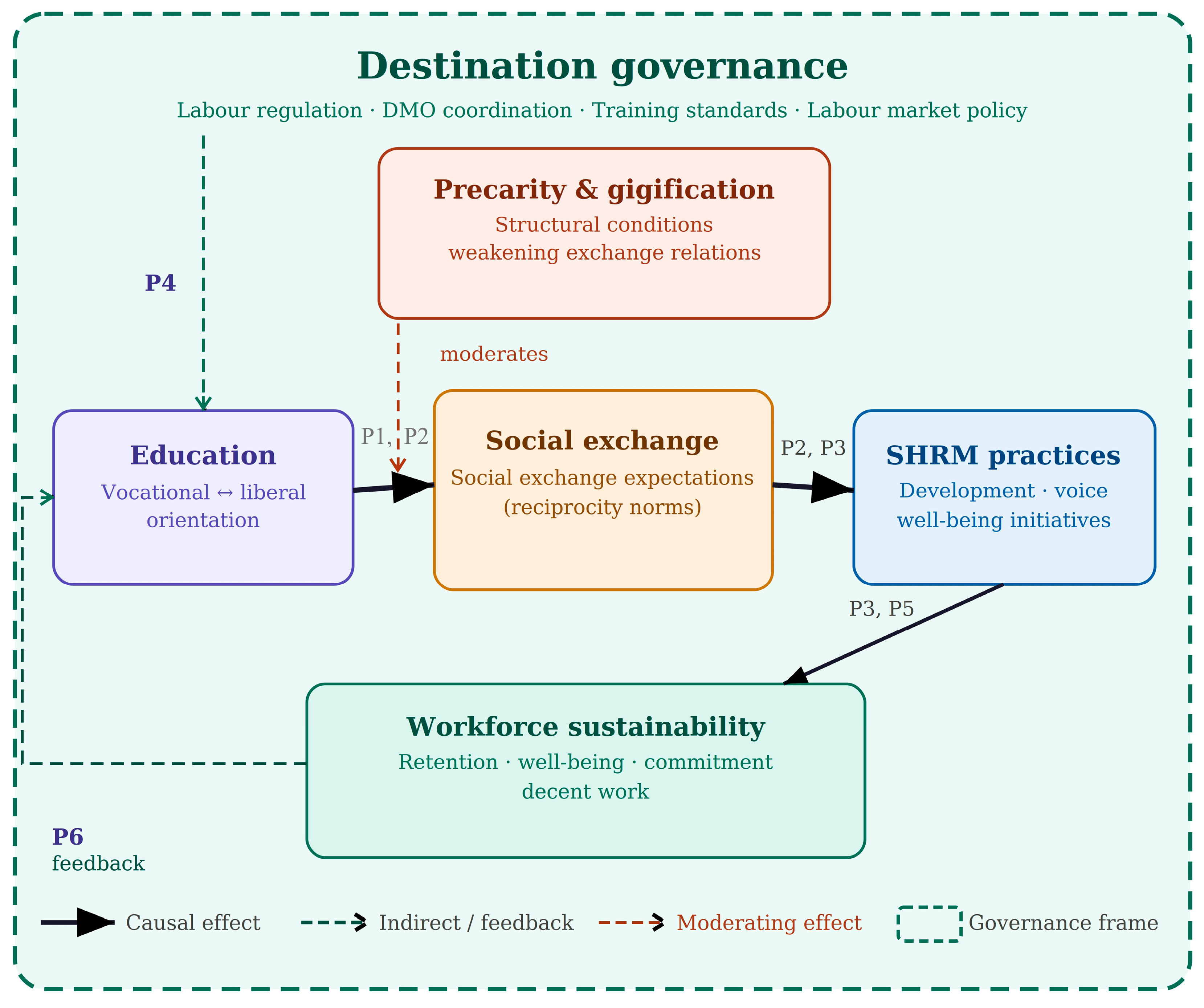
Figure 1 illustrates how these four components relate to one another. Education enters first, as the formative context in which understandings of work and reciprocity are shaped. Social exchange then operates as the mechanism linking how individuals interpret their employment conditions to how organisations function and how destinations develop over time. SHRM practices sit within individual firms, but their effects accumulate beyond them, gradually contributing to the employment culture of the destination as a whole. Governance structures frame all of this, determining whether the relational norms that education and HR practices work to build are given room to take hold or are worn down by structural pressures.
Crucially, governance does not operate merely as a background context: it actively shapes educational priorities, labour market conditions, and the feasibility of SHRM investment, functioning as an institutional driver whose influence runs through all other components of the framework. Taken together, these elements suggest that workforce sustainability in tourism is better understood as a system-level outcome than as the sum of individual HR decisions. It takes shape through the ongoing interaction of educational orientations, workplace practices, and the governance arrangements that hold destination labour markets together. No single level produces it alone.
Before presenting the propositions, the four core constructs require precise definition and boundary clarification. Educational orientation refers to the normative and relational dispositions cultivated through tourism and hospitality education. It encompasses curriculum emphasis, ethical and reflective content, internship structure, and the degree of employer engagement in programme design, all of which shape how future workers and managers understand work, fairness, and mutual obligation (Airey & Tribe, 2000; Morrison & O’Mahony, 2003; Zhang, 2024). It does not refer to specific skill outcomes or post-entry learning.
These mechanisms are closely linked to the type of social exchange expectations they shape. Curricula that prioritise operational efficiency and employer-defined competencies, especially when internships are structured around task execution with limited space for reflection or ethical engagement, tend to normalise transactional orientations. In such cases, work is approached as a bounded exchange of labour for wages, with limited expectations of reciprocity or longer-term commitment. By contrast, programmes that integrate ethics and labour rights, encourage reflection on employment relations, and promote critical engagement with managerial responsibility tend to foster more relational expectations, including stronger perceptions of fairness, mutual obligation, and a longer-term orientation to reciprocal commitment that individuals carry into the labour market.
The role of employers in curriculum design further shapes these orientations. Where employer influence is strong and remains largely uncritical, it can reinforce transactional logics even within programmes that are otherwise broader in scope. At the institutional level, accreditation and quality assurance systems function differently: when they mandate the inclusion of normative content across programmes, they extend relational orientations beyond individual educational settings and contribute to greater consistency at the destination level in how employment is understood and evaluated. Each mechanism leaves a distinct and predictable imprint on social exchange expectations prior to labour market entry.
Social exchange expectations denote the pre-formed normative assumptions about what constitutes a fair employment relationship that individuals carry into the labour market from their educational and socialisation experiences—including reciprocity norms, fairness perceptions, and relational versus transactional orientations toward work (Blau, 1964; Cropanzano & Mitchell, 2005; Lopes, 2018). This construct is distinct from post-entry attitudes such as job satisfaction or organisational commitment, which are formed through workplace experience rather than prior to it.
Workforce sustainability refers to the capacity of tourism destination labour markets to sustain stable, fairly treated, and committed workforces across organisational boundaries over time, encompassing employee well-being, retention, skill development, decent work standards, fairness, and employment continuity (Baum, 2018; International Labour Organization, 2022; Robinson et al., 2019). It is not reducible to short-term organisational performance metrics or productivity indicators.
Destination governance denotes the multi-actor institutional arrangements through which public authorities, destination management organisations (DMOs), private firms, educational institutions, and civil society collectively regulate tourism labour market conditions—including labour regulation, training standards, accreditation systems, and public–private coordination mechanisms (Hall, 2011; Bramwell & Lane, 2011; Beritelli et al., 2007). It is analytically distinct from firm-level HR policy and individual managerial decisions, which operate within the institutional environment that governance structures create.
Before presenting the formal propositions, a note on the levels of analysis is necessary. The framework operates across three interconnected levels that can be examined separately but in practice work together.
At the individual level, educational experiences shape the relational orientations and exchange expectations of workers and managers prior to labour market entry. At the firm level, SHRM practices translate those orientations into workplace interactions, either reinforcing or contradicting the relational norms workers carry with them. At the destination level, governance structures, shared labour market conditions, and collectively reproduced employment norms aggregate individual and firm-level dynamics into system-level workforce outcomes. Outcomes at each level feed back into conditions at others: destination-level precarity shapes individual expectations; firm-level SHRM informs governance norms; and educational systems are themselves shaped over time by the labour market conditions they help reproduce.
Drawing on the preceding analysis, six formal propositions are advanced:
  • Proposition 1 (P1): Workers who come through narrowly vocational programmes are more likely to approach employment in more transactional terms than those with broader, more critical educational backgrounds. This difference appears to be present from the outset, before organisational experience comes into play, with more narrowly trained graduates generally entering the labour market with weaker expectations of ongoing, reciprocal employment relationships.
  • Proposition 2 (P2): When employees’ educational background aligns with the relational logic of SHRM practices, those practices are more likely to generate sustained engagement and reciprocal commitment. When this alignment is absent, particularly in cases where vocationally narrow education meets relationally oriented HR practices, engagement tends to be lower, regardless of how well those practices are formally designed.
  • Proposition 3 (P3): In contexts marked by high employment precarity and the spread of gig work, SHRM practices are less able to sustain reciprocal exchange relationships, even when workers bring a more relational orientation from their educational background. Under these conditions, fragmented labour structures set clear limits on what individual organisations can achieve on their own.
  • Proposition 4 (P4): When destination governance actively enforces labour standards, supports professional development, and aligns employment norms across firms, it strengthens the relational conditions that SHRM depends on. As a result, destinations with more coherent and active governance tend to show stronger baseline conditions for sustained reciprocal exchange than those where governance is weak or fragmented.
  • Proposition 5 (P5): Destinations where educational orientations, SHRM practices, and governance structures are aligned tend to achieve stronger workforce sustainability outcomes. The contribution of any single component depends on how it fits with the other two, and misalignment across any pairing weakens workforce sustainability at the destination level, even when individual components are strong.
  • Proposition 6 (P6): Over time, workforce sustainability outcomes at the destination level feed back into educational institutions and governance systems, shaping the relational norms through which employment is understood and enacted. Destinations with strong sustainability outcomes tend to reinforce these conditions, while those facing persistent precarity are more likely to follow a path of gradual deterioration.

Illustrative Scenario: Weak Governance, Vocational Education, and Precarity

To illustrate the explanatory logic of the framework, consider the following worked example. A Mediterranean coastal destination relies heavily on seasonal labour and short-term employment contracts. Local tourism and hospitality education programmes historically emphasise operational efficiency, technical service skills, and immediate employability, with limited attention to employment rights, ethical dimensions of management, or the relational foundations of work. Graduates entering this destination’s labour market carry predominantly transactional exchange expectations: work is understood as a short-term exchange of labour for wages, with limited investment in employer relationships and low expectations of reciprocal organisational commitment.
Hotel and restaurant operators in the destination invest in formal SHRM initiatives, including structured training programmes, employee voice mechanisms, and work–life balance policies, motivated in part by employer branding and service quality concerns. These practices embody a relational logic, signalling organisational commitment and inviting reciprocal engagement. However, they encounter a workforce conditioned by educational formation and structural labour market experience to treat employment as temporary and to discount such signals as symbolic rather than substantive. This mismatch between organisational intent and transactional exchange orientation is compounded by weak destination governance: labour standards are unevenly enforced, DMO coordination of workforce development is limited, and seasonal employment cycles are structurally reproduced without institutional intervention.
The result illustrates the dynamics predicted by Propositions 3 and 5: despite formal HR investment, the destination exhibits persistent high turnover, low commitment, and weak workforce sustainability. The scenario demonstrates how the convergence of vocational education, structural precarity, and weak governance produces transactional exchange dynamics, undermining SHRM effectiveness even where individual HR practices are formally well designed. Under different conditions—curricula integrating reflective learning and labour rights, combined with destination-level coordination of seasonal employment continuity and active enforcement of labour standards—the framework predicts more durable reciprocal exchange and improved workforce sustainability outcomes, consistent with Propositions 1, 2, and 4.

4. Implications and Future Research

The framework developed here carries implications primarily for research and theory. At a theoretical level, it advances Sustainable Human Resource Management by integrating education, social exchange, and destination governance within a single systemic perspective. Rather than treating workforce sustainability as the outcome of organisational HR practices alone, the analysis highlights the formative and institutional conditions under which reciprocal employment relations emerge and stabilise.
The framework also contributes to destination governance scholarship by conceptualising employment relations as system-level phenomena shaped through institutional coordination and shared norms. Situating SHRM within destination governance structures shifts attention from individual organisations to the broader environments in which employment expectations are reproduced and contested over time (Hall, 2011; Bramwell & Lane, 2011; Baum, 2018; Bianchi & de Man, 2021).
By mobilising Social Exchange Theory as a cross-level explanatory lens, the framework connects individual interpretation, organisational practice, and governance arrangements within a unified analytical account. Reciprocal expectations shaped through education and conditioned by institutional environments accumulate over time and contribute to destination-level employment patterns (Blau, 1964; Cropanzano & Mitchell, 2005; Cropanzano et al., 2017; Järlström et al., 2018).
Several empirical questions follow from this perspective.
Future studies could explore how educational orientations shape engagement with SHRM practices, how these relationships develop across different career stages, and how varying governance contexts influence the durability of relational employment systems. Educational orientation may be captured through graduates’ self-reported views on the normative content of their programmes, for instance the extent to which curricula addressed employment rights, ethical aspects of management, or the relational nature of work.
Additional indicators could include internship quality, reflecting the balance between reflective learning and routine task execution, as well as employer involvement in curriculum design. Programme accreditation may also serve as a proxy for the presence of institutionalised normative content. At the destination level, governance strength can be approximated through composite measures that draw on labour standards enforcement, public investment in vocational training, and the degree of coordination among destination management actors. These suggestions are indicative rather than exhaustive, but they show that the framework’s core constructs can be measured using established survey and documentary approaches, and that comparative research across destinations is both realistic and methodologically viable.
Several limitations warrant consideration. The framework remains conceptual and requires empirical validation across diverse destination contexts. Longitudinal research designs would be particularly valuable, given that the reciprocal exchange processes the framework describes unfold over time and are unlikely to be adequately captured through cross-sectional approaches. How these dynamics operate outside Western settings also remains an open question, since norms around fairness, authority, and mutual obligation vary considerably across cultural contexts in ways this framework cannot fully anticipate.
A more fundamental limitation concerns the assumption of directional alignment between the framework’s components. The analysis proceeds as though education, SHRM practices, and governance arrangements can, under the right conditions, reinforce one another. In practice, however, these elements frequently pull in opposite directions. Educational institutions may cultivate normative sustainability orientations while governance systems simultaneously incentivise cost efficiency and labour flexibility. Organisations may invest in relational HR practices within destination environments that structurally reproduce precarity. The framework identifies these tensions but does not resolve them, and the conditions under which misalignment becomes self-reinforcing rather than correctable remain theoretically underspecified. This is perhaps the most significant boundary of the current analysis, and one that future theoretical and empirical work will need to address directly.
The framework points toward several directions for practice, spanning destination governance, public policy, and tourism education. At the destination level, the analysis reinforces that workforce sustainability cannot be delegated to individual firms operating in isolation. DMOs are well positioned to coordinate shared labour standards, facilitate cross-sector professional development programmes, and promote employment conditions that support relational rather than purely transactional forms of work (Hall, 2011; Bramwell & Lane, 2011). Where seasonal labour fragmentation is structural, destination-level initiatives that invest in career continuity mechanisms, such as inter-organisational mobility schemes or year-round training pathways, are more likely to produce durable workforce outcomes than firm-level HR initiatives alone.
This governance dimension connects directly to the policy environment. Labour market arrangements that normalise short-term employment and tolerate precarity effectively undermine the relational foundations that socially responsible HR practices require (Baum, 2018; Bianchi & de Man, 2021). Policy instruments that incentivise stable employment, enforce fair labour standards, and fund vocational education with a broader normative dimension represent investments in the systemic conditions of workforce sustainability, rather than responses to individual employer needs.
The implications for educational institutions follow from the same logic. Curricula that integrate operational competence with ethical reflection and an understanding of employment relations produce graduates better equipped to enact and sustain SHRM practices across the diverse and often precarious labour environments of contemporary tourism destinations (Morrison & O’Mahony, 2003; Della Lucia et al., 2021). Taken together, these directions suggest that meaningful progress on workforce sustainability requires coordinated action across governance, policy, and education, none of which can substitute for the others.
Beyond HRM scholarship, the framework contributes to broader sustainability debates by reframing labour conditions as systemic outcomes shaped through the interaction of education, governance, and labour market institutions (Bianchi & de Man, 2021; Duncan et al., 2020). Social sustainability in tourism therefore depends not only on managerial initiatives, but on how relational norms align with institutional arrangements across destination systems.

5. Conclusions

This paper began with the observation that the conditions shaping workforce sustainability in tourism are formed long before workers encounter HR policies. By repositioning education as a relational mechanism rather than a supply-side variable, and by embedding SHRM within destination governance structures, the framework developed here offers an alternative explanation for why workforce sustainability proves so difficult to achieve in practice.
The argument is not that HR practices are irrelevant. Rather, their effects depend on expectations, and expectations are formed through education, reinforced or eroded by governance, and accumulated across destination labour markets over time. Addressing workforce precarity in tourism therefore requires more than better-designed HR programmes. It requires coordinated investment in the educational and institutional conditions that make reciprocal employment relationships possible in the first place. Much remains to be tested. In particular, how these dynamics play out across different cultural settings, how they shift across career stages, and whether governance systems can actively reverse entrenched patterns of precarity are all questions that empirical research will need to address.
The framework proposed here reconceptualises workforce sustainability in tourism. It moves beyond viewing it as an issue of organisational HR design alone and instead understands it as an outcome shaped by the combined influence of education, governance, and labour market conditions across destinations. Sustainable tourism workforces are not built through better HR policies alone but are shaped by the alignment of educational formation, institutional governance, and organisational practice. This reframing provides a foundation for empirical inquiry that must be multi-level, longitudinal, and institutionally sensitive—qualities that the field’s existing research designs have rarely combined, and which future scholarship will need to embrace if the systemic determinants of workforce sustainability are to be fully understood.


Author Contributions

Conceptualization, I.V. and S.S.; Writing—Original Draft Preparation, I.V. and S.S.; Writing—Review & Editing, I.V. and S.S. All authors have read and agreed to the published version of the manuscript.

Funding

This research received no external funding.

Institutional Review Board Statement

Not applicable.

Informed Consent Statement

Not applicable.

Data Availability Statement

No new data were created or analyzed in this study. Data sharing is not applicable to this article.

Conflicts of Interest

The authors declare no conflict of interest.

References

  1. Airey, D., & Tribe, J. (2000). Education for hospitality. In C. Lashley, & A. Morrison (Eds.), In search of hospitality: Theoretical perspectives and debates (pp. 276–291). Butterworth-Heinemann. [Google Scholar]
  2. Baker, M. A. (2024). Sustainable tourism employment: A comprehensive overview of tourism employees’ experience from a tourist-employee interaction perspective. Journal of Hospitality and Tourism Management, 60, 228–238. [Google Scholar] [CrossRef] [Scilit]
  3. Bal, M., & Brookes, A. (2022). How sustainable is human resource management really? An argument for radical sustainability. Sustainability, 14(7), 4219. [Google Scholar] [CrossRef] [Scilit]
  4. Baum, T. (2018). Sustainable human resource management as a driver in tourism policy and planning: A serious sin of omission? Journal of Sustainable Tourism, 26(6), 873–889. [Google Scholar] [CrossRef] [Scilit]
  5. Baum, T., & Szivas, E. (2008). HRD in tourism: A role for government? Tourism Management, 29(4), 783–794. [Google Scholar] [CrossRef] [Scilit]
  6. Beritelli, P., Bieger, T., & Laesser, C. (2007). Destination governance: Using corporate governance theories as a foundation for effective destination management. Journal of Travel Research, 46(1), 96–107. [Google Scholar] [CrossRef] [Scilit]
  7. Bianchi, R. V., & de Man, F. (2021). Tourism, inclusive growth and decent work: A political economy critique. Journal of Sustainable Tourism, 29(2–3), 353–371. [Google Scholar] [CrossRef] [Scilit]
  8. Billi, M., Mascareño, A., & Edwards, J. (2021). Governing sustainability or sustainable governance? Semantic constellations on the sustainability-governance intersection in academic literature. Journal of Cleaner Production, 279, 123523. [Google Scholar] [CrossRef] [Scilit]
  9. Blau, P. M. (1964). Exchange and power in social life. Wiley. [Google Scholar]
  10. Bramwell, B., & Lane, B. (2011). Critical research on tourism and governance. Journal of Sustainable Tourism, 19(4–5), 411–421. [Google Scholar] [CrossRef] [Scilit]
  11. Bratton, J., Gold, J., Bratton, A., & Steele, L. (2021). Human resource management. Bloomsbury Publishing. [Google Scholar]
  12. Colquitt, J. A., & Zapata-Phelan, C. P. (2007). Trends in theory building and theory testing: A five-decade study of the Academy of Management Journal. Academy of Management Journal, 50(6), 1281–1303. [Google Scholar] [CrossRef] [Scilit]
  13. Cropanzano, R., Anthony, E. L., Daniels, S. R., & Hall, A. V. (2017). Social exchange theory: A critical review with theoretical remedies. Academy of Management Annals, 11(1), 479–516. [Google Scholar] [CrossRef] [Scilit]
  14. Cropanzano, R., & Mitchell, M. S. (2005). Social exchange theory: An interdisciplinary review. Journal of Management, 31(6), 874–900. [Google Scholar] [CrossRef] [Scilit]
  15. Della Lucia, M., Dimanche, F., Giudici, E., Camargo, B. A., & Winchenbach, A. (2021). Enhancing tourism education: The contribution of humanistic management. Humanistic Management Journal, 6(3), 429–449. [Google Scholar] [CrossRef] [Scilit]
  16. Duncan, T., Hillman, A. G., & Elbe, J. (2020). Sustainable tourism employment, the concept of decent work, and Sweden. In A. Walmsley, K. Åberg, P. Blinnikka, & G. Jóhannesson (Eds.), Tourism employment in Nordic countries (pp. 327–348). Palgrave Macmillan. [Google Scholar] [CrossRef] [Scilit]
  17. Ehnert, I. (2009). Sustainable human resource management: A conceptual and exploratory analysis from a paradox perspective. Physica-Verlag. [Google Scholar] [CrossRef] [Scilit]
  18. Ehnert, I., Parsa, S., Roper, I., Wagner, M., & Müller-Camen, M. (2016). Reporting on sustainability and HRM. International Journal of Human Resource Management, 27(1), 88–108. [Google Scholar] [CrossRef] [Scilit]
  19. Finn, K. (2017). Relational transitions, emotional decisions: New directions for theorising graduate employment. Journal of Education and Work, 30(4), 419–431. [Google Scholar] [CrossRef] [Scilit]
  20. Hall, C. M. (2011). A typology of governance and its implications for tourism policy analysis. Journal of Sustainable Tourism, 19(4–5), 437–457. [Google Scholar] [CrossRef] [Scilit]
  21. Heslinga, J., Groote, P., & Vanclay, F. (2019). Strengthening governance processes to improve benefit-sharing from tourism in protected areas by using stakeholder analysis. Journal of Sustainable Tourism, 27(6), 773–787. [Google Scholar] [CrossRef] [Scilit]
  22. International Labour Organization. (2022). The future of work in the tourism sector: Sustainable and safe recovery and decent work in the context of the COVID-19 pandemic. International Labour Organization. Available online: https://www.ilo.org/resource/conference-paper/future-work-tourism-sector-sustainable-and-safe-recovery-and-decent-work (accessed on 10 December 2025).
  23. Jaakkola, E. (2020). Designing conceptual articles: Four approaches. AMS Review, 10(1–2), 18–26. [Google Scholar] [CrossRef] [Scilit]
  24. Järlström, M., Saru, E., & Vanhala, S. (2018). Sustainable human resource management with salience of stakeholders: A top management perspective. Journal of Business Ethics, 152(3), 703–724. [Google Scholar] [CrossRef] [Scilit]
  25. Karman, A. (2020). Understanding sustainable human resource management–organizational value linkages: The strength of the SHRM system. Human Systems Management, 39(1), 51–68. [Google Scholar] [CrossRef] [Scilit]
  26. Kramar, R. (2014). Beyond strategic human resource management: Is sustainable HRM the next approach? International Journal of Human Resource Management, 25(8), 1069–1089. [Google Scholar] [CrossRef] [Scilit]
  27. Kunwar, R. R. (2018). Tourism education, curriculum spaces, knowledge production, and disciplinary pluralism. The Gaze: Journal of Tourism and Hospitality, 9, 83–155. [Google Scholar] [CrossRef] [Scilit]
  28. Lopes, H. (2018). The moral dimensions of the employment relationship: Institutional implications. Journal of Institutional Economics, 14(1), 103–125. [Google Scholar] [CrossRef] [Scilit]
  29. Macke, J., & Genari, D. (2019). Systematic literature review on sustainable human resource management. Journal of Cleaner Production, 208, 806–815. [Google Scholar] [CrossRef] [Scilit]
  30. Madanaguli, A., Srivastava, S., Ferraris, A., & Dhir, A. (2022). Corporate social responsibility and sustainability in the tourism sector: A systematic literature review and future outlook. Sustainable Development, 30(3), 447–461. [Google Scholar] [CrossRef] [Scilit]
  31. McLeod, M. (2020). Understanding knowledge flows within a tourism destination network. Journal of Hospitality and Tourism Insights, 3(5), 549–566. [Google Scholar] [CrossRef] [Scilit]
  32. Mooney, S., & Baum, T. (2019). A sustainable hospitality and tourism workforce research agenda: Exploring the past to create a vision for the future. In R. Sharpley, & D. Harrison (Eds.), A research agenda for tourism and development (pp. 189–205). Edward Elgar Publishing. [Google Scholar] [CrossRef] [Scilit]
  33. Morrison, A., & O’Mahony, B. (2003). The liberation of hospitality management education. International Journal of Contemporary Hospitality Management, 15(1), 38–44. [Google Scholar] [CrossRef] [Scilit]
  34. Novitz, T. (2021). Gig work as a manifestation of short-termism: Crafting a sustainable regulatory agenda. Industrial Law Journal, 50(4), 636–661. [Google Scholar] [CrossRef] [Scilit]
  35. Onyoin, M. (2020). Human resource management in public-private partnership organisations: A review. Corporate Governance and Organizational Behavior Review, 4(2), 18–29. [Google Scholar] [CrossRef] [Scilit]
  36. Paulet, R. (2019). Sustainable HRM: Rhetoric versus reality. In P. Holland (Ed.), Contemporary HRM issues in the 21st century (pp. 159–172). Emerald Publishing Limited. [Google Scholar] [CrossRef] [Scilit]
  37. Rabenu, E. (2021). Twenty-first century workplace challenges: Perspectives and implications for relationships in new era organizations. Lexington Books. [Google Scholar]
  38. Ren, S., Cooke, F. L., Stahl, G. K., Fan, D., & Timming, A. R. (2023). Advancing the sustainability agenda through strategic human resource management: Insights and suggestions for future research. Human Resource Management, 62(3), 251–265. [Google Scholar] [CrossRef] [Scilit]
  39. Robinson, R. N. S., Martins, A., Solnet, D., & Baum, T. (2019). Sustaining precarity: Critically examining tourism and employment. Journal of Sustainable Tourism, 27(7), 1008–1025. [Google Scholar] [CrossRef] [Scilit]
  40. Señoret, A., Ramirez, M. I., & Rehner, J. (2022). Employment and sustainability: The relation between precarious work and spatial inequality in the neoliberal city. World Development, 153, 105840. [Google Scholar] [CrossRef] [Scilit]
  41. Tribe, J. (2000). Balancing the vocational: The theory and practice of liberal education in tourism. Tourism and Hospitality Research, 2(1), 9–26. [Google Scholar] [CrossRef] [Scilit]
  42. Venturelli, A. (2024). Towards a sustainable future: Competencies, regulations, and paradigm shifts in education. In A. Venturelli, & C. Mio (Eds.), The Routledge handbook of accounting for the sustainable development goals (pp. 517–526). Routledge. [Google Scholar] [CrossRef] [Scilit]
  43. Zhang, K. (2024). Exploring the role and purpose of hospitality higher education under neo-liberalism: Perspectives from hospitality academics. Hospitality & Society, 14(1), 93–115. [Google Scholar] [CrossRef] [Scilit]
Figure 1. An Integrative Framework of Education, Social Exchange, Sustainable HRM, and Destination Governance. Destination governance operates as the overarching institutional driver shaping all framework components; dashed arrows indicate indirect cumulative pathways; Social Exchange Theory (SET) operates as the primary mediating mechanism; precarity and gigification moderate exchange outcomes.
Tourismhosp 07 00118 g001
Table 1. Core literature streams and their contributions to the integrative framework.
Key SourcesContribution to the Framework
Tourism labour markets and employment precarityBaum (2018); Bianchi and de Man (2021); Robinson et al. (2019); Novitz (2021)Establishes the structural conditions—seasonality, gigification, and employment insecurity—that constrain SHRM effectiveness and make sustained relational exchange difficult
Hospitality and tourism educationAirey and Tribe (2000); Tribe (2000); Morrison and O’Mahony (2003); Zhang (2024)Provides the theoretical basis for treating educational orientation as a formative mechanism that shapes social exchange expectations prior to labour market entry
Social Exchange TheoryBlau (1964); Cropanzano and Mitchell (2005); Cropanzano et al. (2017)Supplies the cross-level relational logic connecting individual dispositions, organisational HR practices, and destination-level workforce dynamics within a single explanatory account
Destination governanceHall (2011); Bramwell and Lane (2011); Beritelli et al. (2007)Situates SHRM within the multi-actor institutional systems that determine whether relational employment norms can take hold and be sustained across destination labour markets
Disclaimer/Publisher’s Note: The statements, opinions and data contained in all publications are solely those of the individual author(s) and contributor(s) and not of MDPI and/or the editor(s). MDPI and/or the editor(s) disclaim responsibility for any injury to people or property resulting from any ideas, methods, instructions or products referred to in the content.