


Abstract
This study aims to examine the mechanisms fostering users’ intention to follow generative artificial intelligence (GenAI)-assisted travel destination recommendations (ATDRs) in the context of digital transformation. A research framework was developed by integrating perceived value, trust, and perceived intrusiveness with the Self-Determination Theory (SDT). Data were collected from 469 respondents who expressed an intention to visit GenAI-ATDRs. This study utilizes structural equation modeling (SEM) to examine the research model. The findings indicate that perceived value and trust are affected by SDT-related dimensions, namely perceived competence, perceived relatedness, perceived autonomy, and perceived intrusiveness. However, trust does not influence perceived value. Furthermore, all three GenAI-related constructs, including perceived value, trust, and perceived intrusiveness, significantly affect users’ intention to follow GenAI-ATDRs. Finally, this work contributes to the body of knowledge on GenAI and user engagement by enlightening its necessity as a helpful virtual assistant and providing practical guidance for industry practitioners on how to enhance users’ willingness to adopt GenAI-ATDRs.
1. Introduction
Generative artificial intelligence (GenAI) has emerged as a transformative technology, profoundly reshaping user experiences across digital platforms. As a subfield of artificial intelligence (AI), GenAI is designed to generate new human-like content, including text, images, and videos, using datasets from different sources through machine learning and deep learning techniques (Y. Liu et al., 2025). Its ability to simulate human-like creativity and automate complex tasks has positioned GenAI at the forefront of technological innovation in various sectors. The global usage of GenAI is accelerating at a remarkable pace. Statista (2025) reported that the global GenAI market is anticipated to grow from USD 66.89 billion in 2025 to USD 442.07 billion by 2031. This upward trajectory is mirrored in Vietnam, where the GenAI market is estimated to reach USD 185.76 million in 2025, with a projected increase to USD 1.23 billion by 2031 (Statista, 2024). This development is fueled by increasing user acceptance and demand for digital services.
In the tourism sector, which is inherently reliant on information access, personalized services, and decision-making, GenAI plays an increasingly prominent role. It is being integrated into various stages of the travel journey, including travel planning, information delivery, booking, and on-site experiences (Hinton, 2025). A survey conducted in 2024 revealed that 80% of respondents were willing to use AI for organizing their vacations (Hinton, 2025). More specifically, GenAI is being applied in tasks, including generating travel ideas (65%), searching for flights (56%), comparing and choosing destinations (45%), researching accommodations (42%), creating itineraries (38%), and renting vehicles (36%) (Hinton, 2025). This development underscores GenAI’s potential not only to improve operational efficiency for businesses but also to enhance the quality and personalization of tourist experiences.
As digital transformation becomes an essential trajectory for the global tourism industry, the integration of advanced technologies, particularly GenAI, is increasingly viewed as a critical solution for enhancing customer experience and improving service delivery (Foroughi et al., 2025). In Vietnam, travel companies have actively embraced various digital solutions such as AI-powered platforms and virtual assistants to optimize operational efficiency, reduce labor dependency, and strengthen tourism marketing strategies (Xuan Hieu, 2025). For instance, travel companies have developed GenAI-assisted smart applications that deliver suggestions based on customers’ preferences, which considerably enhances their decision-making regarding destination choice (Xuan Hieu, 2025). The widespread adoption of AI-powered applications among Vietnamese users further highlights the relevance and urgency of this transformation (Le & Nguyen, 2025). According to a recent survey by Booking.com, 99% of Vietnamese users reported using AI-integrated search engines, 92% engaged with AI-assisted content recommendations on digital platforms, and 95% interacted with GenAI-driven tools (Cao Huong, 2025). These technologies are perceived to offer benefits such as rapid itinerary generation, available support (24/7), customized advice, and automated pricing, collectively contributing to cost effectiveness and time saving while enhancing personalization in travel planning. However, users remain reluctant to use GenAI. The same survey revealed that 91% of respondents expressed concerns about the potential consequences of GenAI applications; additionally, 6% opposed their utilization, 4% remained cautious, and 2% were skeptical (Cao Huong, 2025). These results hint that trust, emotional response, and perceived intrusiveness shape users’ engagement with GenAI in following travel destination recommendations. There is a critical need to investigate how users embrace GenAI in travel-related scenarios and to identify their expectations of GenAI’s utility. This work, therefore, aims to test the importance of GenAI within the tourism sector, with a specific focus on understanding user perceptions and behavioral intentions toward GenAI-powered travel services. The findings are expected to provide practical contributions, offering insights for technology developers and tourism businesses to diffuse GenAI in a rapidly evolving digital milieu.
Extant studies have found motivations for GenAI use in tourism. Foroughi et al. (2025) utilized the Unified Theory of Acceptance and Use of Technology 2 (UTAUT2) to explicate how performance expectancy, facilitating conditions, personal innovativeness, and perceived risk affect intentions to utilize GenAI for travel planning. Intention to utilize GenAI-ATDRs was examined through the lens of perceived barriers and personality traits (Seyfi et al., 2025). Akdim and Casaló (2023) illustrated the role of AI’s characteristics (convenience, compatibility, and personalization), costs, and perceived value in leveraging users’ intentions to recommend and continue using AI and to follow recommendations. Despite these empirical demonstrations regarding GenAI-assisted behavioral intentions in tourism, there is still a lack of an insightful explanation of how users’ psychological needs indirectly influence GenAI-ATDRs through trust and perceived value. Earlier studies on GenAI-ATDRs have been predominantly grounded in commonly acknowledged models such as the technology acceptance model (TAM) and UTAUT2, which highlight utilitarian and cognitively driven assessments of technology usage. Several essential factors, including perceived value, show conceptual overlap with TAM’s key antecedents (e.g., perceived usefulness), thereby offering limited theoretical advancement and explanatory power. Although recent studies have extended TAM by combining trust (e.g., Asif & Sarwar, 2025), these extensions consider trust as an auxiliary belief embedded in a rational-instrumental adoption framework, which remains inadequate for capturing the complex, relational, and psychologically driven nature of user engagement with GenAI. Hence, TAM and UTAUT2-based models are inappropriate for explicating how users’ psychological needs foster trust and value perceptions. Thus, research on GenAI-ATDRs must move beyond conventional technology adoption models and adopt a more psychologically grounded perspective to enrich a mechanism of user engagement. Furthermore, the application of Self-Determination Theory (SDT) in explicating user behavior toward GenAI remains limited, particularly in the context of emerging markets such as Vietnam. SDT provides a powerful explanation of how psychological needs shape intrinsic motivations and individual behaviors toward new technologies like GenAI (Cortez et al., 2024; Yang et al., 2025). Drawing on a relevant theoretical underpinning of SDT, our study seeks to clarify how GenAI fosters users’ trust and contributes to perceived value, thereby influencing their behavioral intentions to follow travel destination recommendations. Moreover, the impact of perceived intrusiveness on perceived value and trust will be examined within the proposed research model. To narrow the gap, this study aims to: (i) analyze the impact of psychological constructs and perceived intrusiveness on trust, perceived value, and (ii) clarify how trust, perceived value, and perceived intrusiveness drive users’ intention to adopt GenAI-ATDRs. This integrative approach not only advances the existing body of literature but also addresses a critical research gap by contextualizing users’ behavioral responses to GenAI within the tourism domain of an emerging market. To achieve these objectives, the following three research questions (RQs) are proposed:
RQ1. Do psychological constructs, specifically perceived competence, relatedness, and autonomy, as well as perceived intrusiveness, explain trust in GenAI?
RQ2. How do these psychological constructs and perceived intrusiveness affect perceived value?
RQ3. Which factors influence users’ intention to follow GenAI-ATDRs?
This study contributes to the field of GenAI from three primary perspectives. First, drawing on SDT, a research framework is developed to identify the factors influencing users’ intention to follow GenAI-ATDRs. Preliminary studies have demonstrated SDT’s predictive power in explaining user behavior toward GenAI across various domains (Chen et al., 2025; Cortez et al., 2024; Wu & Yu, 2025). Within the context of this study, SDT indicates that users are motivated to utilize GenAI for travel ideation and information search. This study further elucidates the influence of SDT antecedents and perceived intrusiveness on trust and perceived value in the context of GenAI. The psychological constructs of SDT, specifically perceived competence, relatedness, and autonomy, are found to enhance users’ trust and their perceptions of GenAI’s value. In contrast, perceived intrusiveness reduces trust and perceived value in the tourism sector. Ultimately, users’ intentions to follow GenAI-based automated travel decision recommendations (GenAI-ATDRs) are determined by trust, perceived value, and perceived intrusiveness. Second, we empirically test the framework using data collected from GenAI users in an emerging market, specifically Vietnam. Notwithstanding the growth of GenAI in travel planning, there remains a scarce understanding of how GenAI fosters users’ intention to follow travel destination recommendations in such a context. Third, the findings draw several practical implications for practitioners, emphasizing the importance of advancing GenAI attributes and abating concerns about perceived intrusiveness to facilitate more effective GenAI-assisted travel destination decision-making.
2. Literature Review
2.1. GenAI and Intention to Follow Travel Destination Recommendations
GenAI is increasingly integrated into the tourism sector as a versatile technological infrastructure that supports customers’ decision-making and service automation. It delivers personalized recommendations, advice, and ideas, helping customers develop travel plans tailored to their specific needs. By using cutting-edge computing technologies, including intelligent business systems, virtual interaction environments, advanced data analysis, and predictive modeling, GenAI enhances operational efficiency and decision-making for tourism firms (Y. Liu et al., 2025). Furthermore, GenAI boosts more interactive experiences by assisting the identification of key customer segments and providing in-depth insights into their preferences (Gupta et al., 2024). GenAI provides customer service automation, dynamic price adjustment, marketing optimization, and sentiment analysis. GenAI-ATDR refers to the application of GenAI systems for recommending destination information, travel suggestions, and itineraries tailored to users’ preferences and behavioral patterns, as identified through algorithmic analysis (Akdim & Casaló, 2023). GenAI enhances communication between customers and service providers, facilitates access to relevant services and promotional content, and resolves user issues through interactive and gamified approaches (Y. Liu et al., 2025). Platforms such as ChatGPT and Trip Planner provide personalized recommendations by integrating user preferences, destination data, and algorithmic personalization techniques (Pham et al., 2024). Microsoft Copilot delivers web-based travel information, including customized itineraries, accommodation options, and activity suggestions aligned with user-defined criteria (Shin et al., 2026). Google Gemini, a GenAI-powered assistant, enables personalized and context-aware travel planning by synthesizing search data, mapping services, and user-specific queries to generate trip feedback. By incorporating user feedback and adapting to evolving tasks, these systems lower interaction costs, promote creativity, and enhance communication between users and systems, thereby increasing overall interactivity (Hmoud et al., 2024; Annamalai et al., 2025).
Furthermore, GenAI has captured significant attention from tourism businesses due to its ability to deliver tailored advice on travel destinations, accommodations, and itinerary-building features (Akdim & Casaló, 2023). Beyond information provision, GenAI supports users in idea generation, feedback exchange, and trend prediction, which collectively facilitate the development of highly customized travel plans (Pham et al., 2024). GenAI not only provides personalized user experiences but also contributes to destination management, operational efficiency, and promotional effectiveness by leveraging advanced data analytics and process automation. Customers increasingly favor individualized travel experiences over conventional package tours, preferring in-depth exploration of a single destination rather than superficial visits to multiple locations (Cao Huong, 2025). Hence, GenAI emerges as a pivotal tool in facilitating efficient itinerary planning (Seyfi et al., 2025), offering contextually relevant recommendations, generating real-time responses, and saving temporal and financial costs (Foroughi et al., 2025). Consequently, the usage of GenAI in travel planning fosters a greater sense of autonomy and enjoyment, which, in turn, boosts user satisfaction and willingness to follow GenAI-ATDRs.
Previous research has examined behavioral intentions toward GenAI in tourism from both user and organizational perspectives. Seyfi et al. (2025) identified mechanisms of trust and intention to use GenAI-ATDRs among Korean and American users, emphasizing value and usage barriers as well as technology anxiety as primary challenges to trust and usage behavior. Pham et al. (2024), in a study of 606 ChatGPT users at crowded tourist destinations in Vietnam, found that perceptions of warmth, competence, and communication speed significantly influence attitudes and behavioral responses, including satisfaction and continued usage intentions. Conversely, studies from an organizational perspective have demonstrated that GenAI capabilities can enhance business effectiveness. Shin et al. (2026) investigated the impact of GenAI tools, such as ChatGPT and Copilot, on supply-demand interactions and tourism service ecosystems in Korea, showing that GenAI significantly affects value co-creation, managerial decision-making, and structural innovation. Ku and Chen (2024) analyzed data from tourism businesses in Beijing, Hangzhou, Taipei, and Singapore, demonstrating that GenAI-related features, including innovation and new product advantage, enhance functional benefits, thereby increasing tourist satisfaction and continued GenAI service usage intention. Although most existing studies address either individual behavioral intentions or organizational business performance in the context of GenAI, limited research clarifies how to foster users’ intention to follow GenAI-ATDRs.
Furthermore, several challenges persist, especially concerns regarding GenAI’s perceived intrusiveness and the quality of the information it generates, which may impede user engagement (Yang et al., 2025). Past studies indicated that perceived risks and fear of GenAI can significantly erode user trust (Y. Liu et al., 2025). Salih et al. (2025) further stated that heightened privacy risk perceptions associated with AI technologies undermine users’ confidence in the safety and reliability of AI-enabled services, thereby increasing hesitation to adopt and continue utilizing such services. As privacy concerns intensify, the perceived threat of data disclosure or misuse of individual information may outweigh the benefits offered by AI-enabled services, resulting in reduced sustained usage. Alagarsamy and Mehrolia (2023) affirmed that technology fear and perceived risk amplify the perceived difficulties of using AI chatbots and negatively influence users’ trust. Specifically, technology anxiety heightens uncertainty about AI systems, thereby eroding perceived reliability, attitude, behavioral intention, and overall satisfaction. To improve the adoption of GenAI-ATDRs, it is essential to comprehend users’ value perceptions, develop confidence, and translate these evaluations into behavioral responses toward GenAI (Cortez et al., 2024; Pham et al., 2024; Seyfi et al., 2025). Addressing this gap, the study aims to clarify the role of GenAI in boosting users’ intention to follow GenAI-ATDRs.
2.2. Self-Determination Theory (SDT)
Self-Determination Theory (SDT) is a widely recognized framework of human motivation that explicates how psychological needs facilitate or hinder individuals’ perceptions and behaviors (Quan, 2025). SDT posits that creating a supportive environment for users’ self-determined engagement is essential for fulfilling fundamental psychological needs that foster intrinsic motivation (Kang et al., 2025). SDT denotes that individuals possess three fundamental psychological needs, including competence, relatedness, and autonomy, which buttress their motivations to perform actions (Wu & Yu, 2025). Competence illustrates users’ possession of abilities to achieve goals (Pitafi & Xie, 2024). Relatedness delineates a sense of connection and being cared for within social groups or communities, whilst autonomy reflects freedom to make self-initiated choices (Kang et al., 2025). When these needs are satisfied, users will experience enhanced intrinsic motivation and perform appropriate behaviors (Cortez et al., 2024).
GenAI systems, by their interactive language models, can flexibly meet users’ psychological requirements. GenAI assists users by providing tailored suggestions, acquiring information about destinations and accommodation, and providing itinerary-building features for personalized travel planning (Seyfi et al., 2025), thereby leading to a sense of competence. Additionally, the interactive features of GenAI, such as virtual assistants that share travel experiences, recommend destinations, and create travel plans, may foster users’ sense of relatedness. However, the effectiveness of these societal cues in fulfilling users’ demands for affiliation needs to be deliberately considered in an empirical study (Quan, 2025; Wu & Yu, 2025). Moreover, GenAI helps users receive customized responses, adjust inquiries based on individualized demands, and actively foster autonomy (Quan, 2025).
SDT has been applied across multiple domains. For instance, Yang et al. (2025) documented that users whose autonomy, competence, and relatedness needs are fulfilled are willing to integrate GenAI into educational environments. Pitafi and Xie (2024) indicated that psychological standards (i.e., competence and relatedness) are significant predictors of individual creativity when using social media. Annamalai et al. (2025) revealed that the sense of autonomy and relatedness contribute to users’ perceptions of competence and continuous usage of ChatGPT for their learning. In the study, SDT depicts the necessity of psychological needs for competence, relatedness, and autonomy, offering a mechanism for enlightening how these needs alleviate the negative impacts of concerns about intrusiveness and nurture trust and perceived value, thereby boosting users’ intention to follow GenAI-ATDRs.
3. Hypothesis Development and Research Model
Perceived competence refers to the ability to manage and alter the environment whilst exploring probabilities to enhance skills and abilities (Pitafi & Xie, 2024). It is associated with users’ confidence in their abilities to perform actions efficiently and achieve desired outcomes (Ryan & Deci, 2017; Yang et al., 2025). In our context, users must be confident in their ability to create effective and well-structured travel plans using GenAI. Specifically, GenAI can enhance users’ sense of competence by allowing them to feel more capable of organizing itineraries, detailing travel activities, and making informed decisions based on GenAI-ATDRs. Users have the capacities and expertise due to GenAI usage to meet their requirements for competence (Cortez et al., 2024). The present literature shows that GenAI is a tool that facilitates competence (Pham et al., 2024). Users’ competence in utilizing GenAI encompasses their capabilities in creating GenAI-based travel plans and effectively detailing travel plans, which is critical for effective usage of ATDRs in travel planning (Annamalai et al., 2025; Yang et al., 2025). When users perceive themselves as competent and self-efficient in utilizing GenAI for travel planning, they are more likely to perceive greater value in GenAI-enabled services and, consequently, display stronger intentions to follow GenAI-ATDRs.
Furthermore, prior studies substantiated that perceived competence positively impacts trust in chatbots (Cheng et al., 2022), service robots (Park et al., 2025), and ChatGPT (Pham et al., 2024). Yang et al. (2025) elucidated how SDT-related dimensions can alleviate anxiety and discomfort toward GenAI, revealing a significant relationship between perceived competence and users’ willingness to integrate the technology. When users have the ability to filter necessary information, address travel destination problems, and formulate GenAI-assisted travel plans, they will develop trust in GenAI. In the current context, it is hypothesized that perceived competence significantly influences users’ perceived value and trust in GenAI. Hence:
Hypothesis 1 (H1).
Perceived competence positively drives perceived value.
Hypothesis 2 (H2).
Perceived competence positively drives trust.
Perceived relatedness denotes the sense of affiliation and alignment with an entity (Ryan & Deci, 2017). This study represents the extent to which users experience a feeling of connection through their use of GenAI to follow GenAI-ATDRs. This connection reflects users’ perceived relevance or affinity during interactions with GenAI while performing tasks, such as information searching and travel planning (Annamalai et al., 2025). GenAI fosters meaningful interactions that are compatible with the approach to following GenAI-ATDRs, and facilitates access to travel-related knowledge and experience, thereby enhancing users’ perceived connection with the system (Quan, 2025; Yang et al., 2025). Consistent with the SDT, fulfilling users’ psychological needs for relatedness fosters intrinsic motivations by reinforcing perceptions of value and confidence, which subsequently influence behavioral engagement (Pitafi & Xie, 2024). Kohnke (2022) showed that GenAI makes human-like conversations with users. Researchers affirmed that GenAI is an effective tool that fosters interactivity using natural language (Annamalai et al., 2025). When users perceive GenAI as relevant, supportive, and aligned with their personal preferences, they are more likely to view it as valuable, harbor more trust, and exhibit stronger engagement in this technology (Annamalai et al., 2025; Yang et al., 2025). Based on the discussion, the following hypotheses are postulated:
Hypothesis 3 (H3).
Perceived relatedness positively drives perceived value.
Hypothesis 4 (H4).
Perceived relatedness positively drives trust.
Perceived autonomy represents a psychological need for users to feel free and independent to take actions in the absence of environmental conditions that constrain experiences (Ryan & Deci, 2017). As GenAI becomes ubiquitous, there are no spatio-temporal limitations on information searching and plan ideation, so users can easily access it. GenAI enables users to access services in real time from any geographical location (Annamalai et al., 2025). Consequently, users possess the autonomy to adopt GenAI because they can utilize it freely across temporal and spatial settings (Lai et al., 2023). In the current context, autonomy refers to users’ ability to independently design travel itineraries, freely express their preferences, and retain control over decisions when engaging with GenAI-ATDRs (Yang et al., 2025). GenAI’s rapid responsiveness enables users to access destination information without reliance on service employees, thereby strengthening users’ sense of control and encouraging the active use of GenAI in travel planning (Annamalai et al., 2025). When users have greater autonomy due to GenAI, they consider this technology a valuable tool and put their trust in it. Prior studies documented the significant impact of perceived autonomy on perceived value (Annamalai et al., 2025), trust (Cantucci et al., 2026; Han & Ko, 2025), and behavioral intention (Cortez et al., 2024; Kang et al., 2025). Based on the empirical evidence, the following hypotheses are postulated:
Hypothesis 5 (H5).
Perceived autonomy positively drives perceived value.
Hypothesis 6 (H6).
Perceived autonomy positively drives trust.
Perceived intrusiveness delineates the degree to which a technology permits individuals or organizations to be reachable (Benlian et al., 2020). When the technology is perceived as intrusive, users’ perceptions of its value and their willingness to utilize it tend to diminish. GenAI is often perceived as intrusive because it requires access to user data, including personal profiles and conversational content, to generate outputs (Seyfi et al., 2025). Users acknowledge that the collection of such socio-preferential information reflects the practices of technology developers and service providers (Le & Nguyen, 2024). The accumulation of user data evokes feelings of intrusion and constant monitoring, as individuals feel the system is continuously listening, thereby heightening concerns about surveillance and the unauthorized use of their personal information (Akdim & Casaló, 2023). Prior studies emphasized that perceived intrusiveness negatively influences perceived value toward augmented reality (Lau et al., 2019) and voice assistants (Akdim & Casaló, 2023). The following hypothesis is inferred:
Hypothesis 7 (H7).
Perceived intrusiveness negatively drives perceived value.
Furthermore, the extant literature indicates that users who are uncertain about service providers’ ability to ensure service quality tend to exhibit lower levels of trust, thereby diminishing their intention to adopt digital technologies (Cortez et al., 2024). Extant studies found that perceived intrusiveness negatively influences trust and behavioral intentions in digital technologies. Cortez et al. (2024) indicated that higher perceived intrusiveness in AI-based social service robots can mitigate users’ trust. When GenAI poses excessively personal questions derived from users’ private data, it elicits a perceived sense of intrusion that causes discomfort, erodes trust, and impedes engagement in GenAI. Following the empirical evidence, the hypotheses are portrayed:
Hypothesis 8 (H8).
Perceived intrusiveness negatively drives trust.
Hypothesis 9 (H9).
Perceived intrusiveness negatively drives intention to follow GenAI-ATDRs.
Trust refers to the expectation that another party will act reliably (Wang et al., 2023). It is present when users are confident that their vulnerabilities will not be exploited in risky situations (Silva et al., 2023). Within the context of this study, trust is defined as users’ confidence in GenAI’s trustworthiness and honesty, as well as their intention to adhere to GenAI-ATDRs. Trust is closely related to GenAI-assisted online services (Liew et al., 2025; Silva et al., 2023). Trust captures a crucial role in individuals’ decision-making, particularly regarding GenAI-ATDRs (Seyfi et al., 2025). Present literature demonstrates that trust fosters positive perceptions and responses, such as perceived value and behavioral intentions (Cortez et al., 2024; Kakkar et al., 2025). The relationship between trust and usage intention has been empirically examined in travel recommendations (Kim et al., 2023), AI-based social robots (Cortez et al., 2024), AI-assisted purchase (Cu et al., 2025), and AI banking (Liew et al., 2025). Extant findings revealed that trust enhances emotional experiences, customer engagement, and usage intention toward GenAI (Kim et al., 2023; Pham et al., 2024). In line with the evidence, this study raises a question of how perceived value and intention to follow GenAI-ATDRs are inspired by trust. Therefore, the following hypotheses are postulated:
Hypothesis 10 (H10).
Trust positively drives perceived value.
Hypothesis 11 (H11).
Trust positively drives intention to follow GenAI-ATDRs.
Perceived value refers to users’ assessments of GenAI’s usefulness, determined by the balance between what is received and what is given (Akdim & Casaló, 2023). It is a multifaceted and context-dependent construct that encapsulates the trade-off between perceived benefits and perceived costs (Zeithaml, 1988). This study investigates the extent to which users perceive GenAI as advantageous, valuable, and beneficial for facilitating efficient tourism decision-making through GenAI-ATDRs. The extant literature highlights perceived value as a fundamental determinant shaping user behavior across various contexts. Empirical evidence highlights its critical role in user behavior and future intentions toward GenAI. For instance, user engagement with AI-powered voice assistants is primarily driven by perceived value (Akdim & Casaló, 2023). Furthermore, perceived value represents a significant facilitator of behavioral intention in mobile banking (Le, 2025) and social commerce (Kakkar et al., 2025). Drawing on valid arguments, the study assumes that a higher perceived value of GenAI motivates a greater inclination to follow GenAI-ATDRs. Thus:
Hypothesis 12 (H12).
Perceived value positively drives intention to follow GenAI-ATDRs.
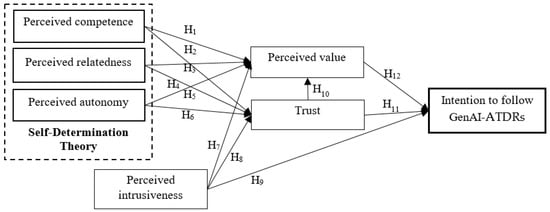
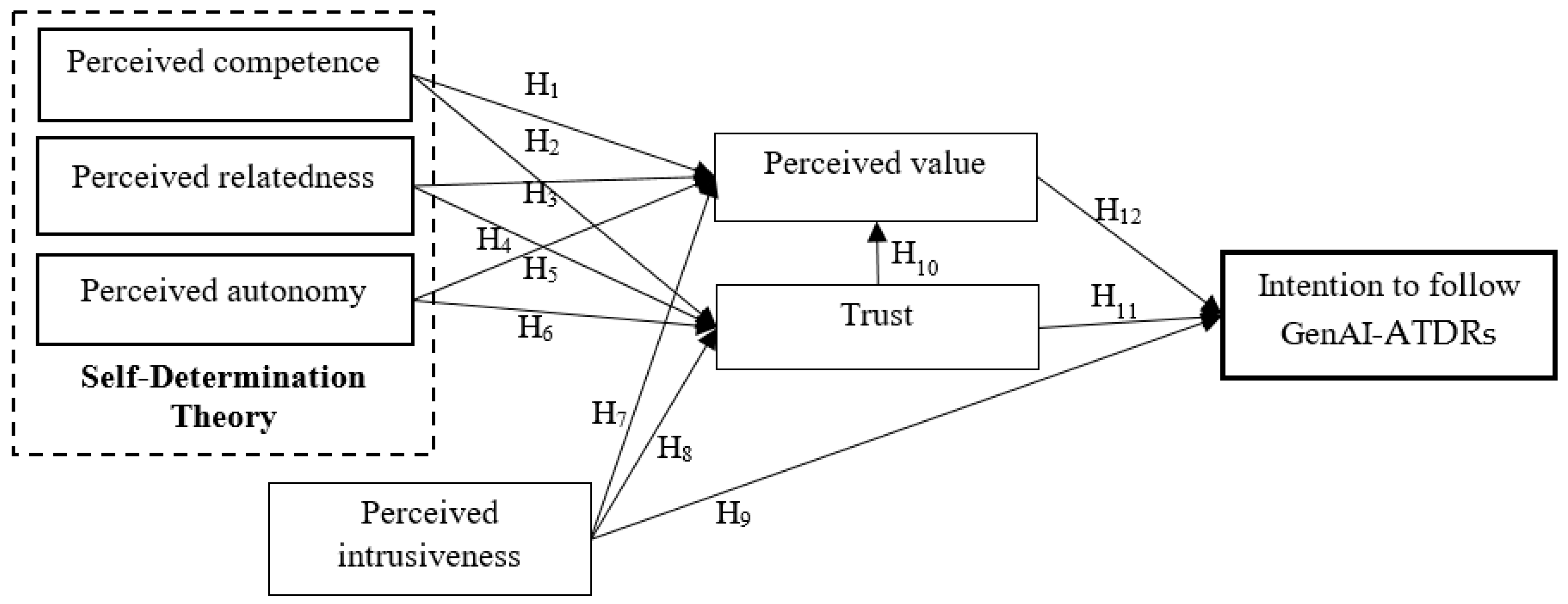
Based on the postulated hypotheses, the proposed research is framed in Figure 1.
Figure 1.
Proposed research model.
4. Methodology
4.1. Measurement
The study employed a structured questionnaire, with measurement items adapted from well-established prior research. To establish content validity, the questionnaire was assessed by two professors and nine academic scholars with extensive expertise and experience in AI-related research and applications. Their evaluations served as a foundation for validating the clarity, relevance, and appropriateness of the questionnaire items. Based on their feedback, revisions were made to the wording and phrasing of items to enhance precision and alignment with the research objectives. These modifications were deemed essential for ensuring the instrument’s validity and for improving the generalizability of the study’s findings. The finalized questionnaire utilized a 5-point Likert scale, ranging from 1 (strongly disagree) to 5 (strongly agree).
Perceived competence (three items), perceived relatedness (three items), and perceived autonomy (four items) were measured and adapted from Yang et al. (2025) and Ryan and Deci (2000). Regarding perceived intrusiveness, three items were derived from Lau et al. (2019) and Akdim and Casaló (2023). The measurement of perceived value comprised three items, which were drawn from Molinillo et al. (2021) and F. Liu et al. (2015). Trust was measured by using three items from Silva et al. (2023) and T. T. U. Nguyen et al. (2024). Intention to follow GenAI-ATDRs with three items was sourced from Toyib and Paramita (2024).
4.2. Data Collection
The sample population covered GenAI users in Vietnam. Prior to participation, participants were informed about their optional involvement and the study’s purpose. Those who provided consent were supplied with specific information about the study’s objectives and procedures. This information was shared before completing the questionnaire to ensure respondents’ full comprehension of the methodology and research context. The questionnaire was administered to the target population via Google Forms. The survey link was disseminated through popular social networking sites, comprising Zalo and Facebook. Data collection was conducted systematically over a defined period, from June to August 2025. To minimize potential language-related misunderstandings, a forward–backward translation procedure was employed to ensure consistency and equivalence between the English and Vietnamese versions of the questionnaire.
The questionnaire consisted of two main sections. The first section included close–ended questions designed to collect demographic and background information from respondents, such as gender, age, educational background, monthly income level, and frequency of GenAI usage. The second section comprised items related to the constructs of the proposed research model. In this part, respondents were asked to express their perceptions, evaluations, and behaviors toward GenAI usage in the tourism context. To assess the reliability, a pilot study was conducted with a sample of 45 participants (n = 45). Cronbach’s alpha (CA) was measured for each construct. The results indicated that all constructs achieved CA values exceeding the recommended threshold of 0.70, demonstrating satisfactory internal consistency and reliability of the measurement scales.
Data were collected using a convenience sampling method, which is cost-effective and widely adopted in prior information systems studies (Le & Nguyen, 2025). This method was deemed appropriate given the absence of a comprehensive and reliable sampling frame of GenAI users in Vietnam. A total of 507 questionnaires were returned. After excluding incomplete responses, questionnaires with missing data, and those containing uninformative or patterned answers, 469 valid responses were utilized for subsequent data analysis.
Table 1 presents the respondents’ demographic characteristics. Of the total sample, 51.17% were male. Respondents varied in age and educational background. Specifically, 39.87% were between 31 and 45 years old. In terms of education, the majority held a bachelor’s degree (69.72%), followed by those with a master’s degree (27.72%) and a doctoral degree (2.56%). Regarding monthly income (in thousand VND), 53.52% of respondents reported earnings between 10,000 and less than 30,000, while 29% earned between 30,000 and less than 50,000. Additionally, 10.66% reported earning less than 10,000, and 6.82% earned more than 50,000. In terms of GenAI usage frequency, the highest proportion (59.06%) used it more than 30 times per week. 33.48% reported using GenAI 15–30 times per week, while 7.46% used it fewer than 15 times per week.
Table 1.
Demographic characteristics.
5. Results
5.1. Common Method Bias
Several techniques were implemented to address the common method bias (CMB). First, respondents were advised that the survey contained no right or wrong answers and that their responses would be treated anonymously. No personally identifiable information was required, and questions regarding names or ID numbers were deliberately excluded from the questionnaire to minimize concerns about data privacy. To further enhance participants’ trust in the confidentiality of the study, it was explicitly stated that all collected information would be used exclusively for research purposes. Upon completion of the study, the data would be securely saved and managed in accordance with research ethics. In alignment with ethical requirements, all participants were required to read an online informed consent form before completing the questionnaire.
Harman (1976)’s single-factor test was employed to statistically measure the potential presence of common method bias (CMB) across the seven measurement constructs. If a single factor accounts for less than 50% of the total variance, CMB is unlikely to be a concern. The analysis revealed that the first factor accounted for 46.238% of the variance, which is below the 50% threshold, indicating that CMB was not a significant issue in this study. Additionally, multicollinearity was examined through the variance inflation factor (VIF). The results indicated that all the VIF values were below the recommended threshold of 5 (Diamantopoulos & Siguaw, 2006), further supporting the nonexistence of CMB and confirming the validity of the data (see Table 2).
Table 2.
Multi-collinearity Test (VIF).
5.2. Measurement Model Analysis
Structural equation modeling (SEM) is a comprehensive multivariate approach that facilitates the examination of complex relational structures among variables, particularly useful for exploring untested theoretical concepts and extending existing models by specifying all relationships. In this study, covariance-based SEM (CB-SEM) was employed as the primary analytical technique, given its suitability for large sample sizes and its widespread application in theory testing and confirmation (Hair et al., 2018). SEM comprises two key components: a measurement model and a structural model. The measurement model represents the theoretical relationships between observed indicators and their underlying constructs, while the structural model articulates the hypothesized interrelationships among the constructs.
In the measurement model, it is essential to ensure the reliability and validity of both measurement items and constructs. To assess the measurement model, the construct reliability and validity were examined. The composite reliability (CR) and average variance extracted (AVE) were used to evaluate the convergent validity. According to Hair et al. (2018), CR values should exceed 0.70 and AVE values should be greater than 0.50 to affirm acceptable levels of convergent validity. In this study, all the CR and AVE values met or exceeded these recommended thresholds.
Convergent validity was supported by the standardized loadings of the measurement items, which ranged from 0.786 to 0.918. These values surpassed the minimum benchmark of 0.70 (Hair et al., 2018), indicating a high degree of internal consistency among the indicators measuring the same construct.
Additionally, CA coefficients were calculated to assess construct reliability. As recommended by Hair et al. (2018), CA values should exceed 0.70. As shown in Table 3, all constructs exhibited CA values above this threshold, thereby asserting the reliability of the measurement model.
Table 3.
Standardized Loadings, CA, AVE and CR.
Furthermore, the discriminant validity was evaluated to determine the extent to which each construct illustrates empirical distinctiveness relative to the others. Following the Fornell and Larcker (1981) criterion, discriminant validity is established when the square root of the AVE for each construct exceeds the correlations between that construct and all other constructs in the model. In the correlation matrix, the diagonal constructs represent the square roots of the AVE values, while the off-diagonal constructs indicate the inter-construct correlations. As shown in Table 4, the square root of the AVE for each construct was greater than its corresponding correlations with other constructs, thereby confirming satisfactory discriminant validity.
Table 4.
Discriminant Validity.
Before evaluating the structural model, several fit indices were examined to assess the goodness-of-fit of the measurement model. These included the chi-square to degrees of freedom ratio (χ2/df), comparative fit index (CFI), relative fit index (RFI), Tucker–Lewis index (TLI), incremental fit index (IFI), normed fit index (NFI), and root mean square error of approximation (RMSEA). According to Hair et al. (2018), acceptable model fit is indicated by χ2/df values below 3 and RMSEA values below 0.08, while the CFI, RFI, TLI, IFI, and NFI values should exceed the threshold of 0.90. The results confirmed that all the fit indices met the recommended criteria, indicating a satisfactory model fit (see Table 5).
Table 5.
Goodness-of-fit.
5.3. Structural Model Analysis
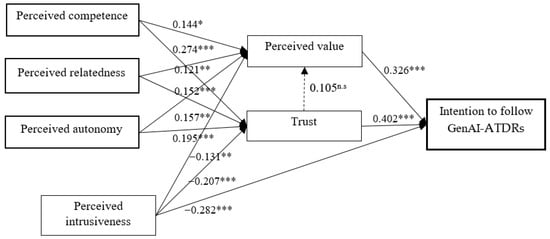
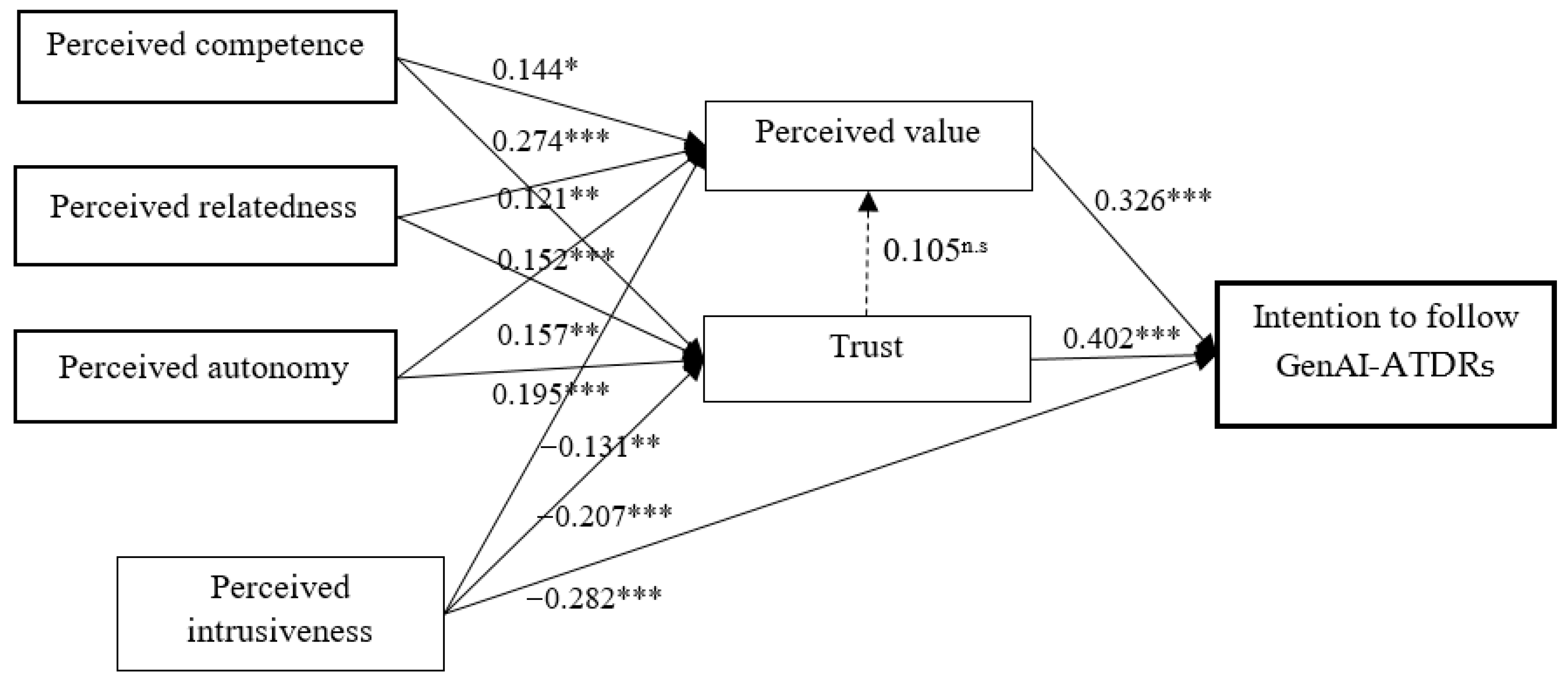
Table 6 outlines the estimated path coefficients along with their statistical significance. Of the 12 hypotheses, 11 are supported. The model accounted for 44.4% of the variance in trust (R2 = 0.444), 34.4% of the variance in perceived value (R2 = 0.344), and 61.3% of the variance in intention to follow GenAI-ATDRs (R2 = 0.613) (Figure 2).
Table 6.
Structural Model Results.
Figure 2.
Structural Model with Path Coefficients. Note: * p < 0.05, ** p < 0.01, *** p < 0.001, n.s: not significant.
First, perceived competence was found to positively influence perceived value (β = 0.144, p = 0.012) and trust (β = 0.274, p = 0.000). Therefore, H1–H2 were supported. Furthermore, perceived relatedness positively influenced perceived value (β = 0.121, p = 0.003) and trust (β = 0.152, p = 0.000); thereby supporting H3–H4. Moreover, H5–H6 were supported because perceived autonomy positively affected perceived value (β = 0.157, p = 0.002) and trust (β = 0.195, p = 0.000).
Second, perceived intrusiveness was found to negatively influence perceived value (β = −0.131, p = 0.003), trust (β = −0.207, p = 0.000), and intention to follow GenAI-ATDRs (β = −0.282, p = 0.000). Thus, H7–H9 were supported.
Third, H10 was not supported because trust (β = 0.105, p = 0.055) did not influence perceived value. Meanwhile, trust (β = 0.402, p = 0.000) inspired intention to follow GenAI-ATDRs. Thus, H11 was supported.
Lastly, perceived value (β = 0.326, p = 0.000) significantly influenced intention to follow GenAI-ATDRs; thus, H12 was supported.
6. Discussion and Implications
6.1. Discussion
The results indicate that perceived competence positively influences perceived value (H1), hinting that users with greater expectations for competence are more likely to seek opportunities to upgrade their skills and capacities when following GenAI-ATDRs. GenAI serves as an effective interactive medium that allows users to engage in individualized conversations and receive personalized advice, thereby fulfilling their competence needs (Hinton, 2025). Consequently, the greater the knowledge and expertise that users possess, the higher the value that they perceive in GenAI. This finding aligns with earlier studies, denoting that users who perceived themselves as more skilled tend to assess GenAI’s value more positively (Annamalai et al., 2025; Pham et al., 2024). Furthermore, consistent with the preliminary findings of Pham et al. (2024), perceived competence also nurtures trust (H2). Users who demonstrate higher levels of competence tend to exhibit greater trust. By empowering users to generate ideas, structure activities, and identify optimal travel solutions, GenAI substantially strengthens their confidence in its capability to deliver effective assistance.
The results for H3 indicate that perceived relatedness enhances perceived value. The finding hints that when individuals feel a sense of connection with GenAI through travel destination recommendations, they tend to perceive greater value in the system and show stronger interest in incorporating it into their travel planning process. The stronger the connection users perceive with GenAI, the greater the value they attribute to its role in their travel-related activities. The finding is congruent with Kohnke (2022), who asserted that perceived relatedness enhances value perceptions of GenAI. Furthermore, the findings for H4 demonstrate a strong association between perceived relatedness and trust. This implies that when users recognize opportunities to engage in collaborative interactions with GenAI aimed at achieving shared goals, their trust in GenAI tends to increase. This result concurs with previous findings, emphasizing the essential role of perceived relatedness in inspiring user confidence in human–GenAI affiliation. (Hou et al., 2023).
The findings for H5–H6 demonstrate that perceived autonomy positively influences both perceived value and trust. User autonomy, defined as the unrestricted access afforded to users when interacting with GenAI to plan their travels, enables users to experience a sense of freedom in system usage. Consequently, users are more likely to recognize its benefits, foster trust in human–AI interactions, and exhibit greater intention to follow GenAI-ATDRs. These results align with previous research indicating that higher levels of decision-making autonomy can elicit intrinsic motivation, enhance trust, and facilitate users’ utilization of AI-powered technologies (Annamalai et al., 2025; Cantucci et al., 2026; Han & Ko, 2025).
The findings for H7 indicate that the perceived intrusiveness negatively affects perceived value. Intrusiveness is alluded to as an essential dimension of perceived risk, as GenAI developers and service providers can overutilize users’ personal information and data for business activities. When GenAI is perceived as intrusive, its perceived value tends to decline. This outcome is consistent with earlier studies that documented how intrusiveness undermines users’ evaluations of GenAI’s utility (Akdim & Casaló, 2023; Benlian et al., 2020). Furthermore, the key results (H8–H9) demonstrate that perceived intrusiveness significantly mitigates both trust and intention to follow GenAI-ATDRs, advocating past evidence that users tend to diminish trust and hesitate to depend on these recommendations due to the constant surveillance and invasion of personal data (Akdim & Casaló, 2023). In the digital sphere, users have paid mounting attention to the potential risks of intruding data and security standards due to advanced technologies. Moreover, another reason lies in the profound impact of Vietnam’s oriental cultural characteristics on users’ cognitive awareness and belief systems (Le, 2025). High collectivism, power distance, and sensitivity to social norms may heighten users’ concerns about information disclosure and surveillance, amplifying perceptions of intrusiveness (Hofstede, 2011). Consequently, these cultural traits help explicate psychological resistance and negative engagement with GenAI’s recommendations. Incorporating this theoretical perspective provides a clearer regional interpretation and strengthens the study’s contextual relevance.
In contrast, the results for H10 confirm that trust does not influence perceived value in GenAI. This finding diverges from preceding studies illustrating the importance of trust in improving perceived value (Chen et al., 2025; Kakkar et al., 2025). A probable interpretation is that users tend to perceive GenAI as valuable based on its functional benefits, such as convenience, personalization, and compatibility (Akdim & Casaló, 2023), rather than affective responses like trust (Quan, 2025). In addition, with the solvent diffusion and accumulative familiarity of GenAI-assisted services, users may possess an innate degree of trust, which consequently diminishes their discerning power in nurturing perceived value. However, the significance of the impact is slim. The outcome does not mean that trust is not important. A possible explanation is that SDT-related psychological needs (e.g., competence and autonomy) and perceived intrusiveness are highly appreciated by users, having more impact than trust in driving value perceptions.
Furthermore, the results for H11 demonstrate that trust boosts users’ intention to follow GenAI-ATDRs, implying that trust constitutes a critical construct for assessing user confidence in GenAI and evaluating its subsequent impact on their willingness to rely on the system’s guidance. This finding fortifies previous studies indicating that trust leads to usage intentions (Cicek et al., 2025; Cortez et al., 2024; Kim et al., 2023; Liew et al., 2025).
Lastly, the findings for H12 show that perceived value serves as a key facilitator of user engagement. Extant studies consistently identified perceived value as a critical determinant of behavioral intentions toward innovative technologies (Akdim & Casaló, 2023; Kakkar et al., 2025). This study extends this body of knowledge by affirming that the strong association between perceived value and intention to follow GenAI-ATDRs should be considered when applying GenAI in tourism. Through its capacity to generate ideas, provide targeted advice and deliver individualized recommendations based on users’ personal data and requirements via advanced algorithms and data analytics (Huang, 2018), GenAI allows users to adopt more effective and cost-efficient travel plans (Akdim & Casaló, 2023). The convenience, ease of information retrieval, and upgraded understanding of customer wants collectively induce user behavior to adopt GenAI-ATDRs.
6.2. Theoretical Implications
First, the study provides further evidence and in-depth insights into the mechanisms underlying improvements in perceived value and trust in GenAI, drawing upon the SDT perspective and perceived intrusiveness. Three fundamental psychological needs—competence, autonomy, and relatedness—contribute substantially to users’ intrinsic motivation and evaluations of GenAI (Cortez et al., 2024; Han & Ko, 2025). Despite their theoretical importance, relatively few studies have shown how these psychological needs foster value perceptions and trust in adopting GenAI for following travel destination recommendations. Additionally, consistent with preliminary studies emphasizing the significant linkage between perceived intrusiveness and perceived value in emerging technologies (Akdim & Casaló, 2023), our research extends current knowledge by empirically affirming this relationship in the setting of GenAI-ATDR adoption. These findings raise the value of the literature on perceived value and trust in GenAI.
Second, building on the aforementioned findings, this study offers profound insights by illuminating the critical role of perceived value for promoting user engagement toward GenAI in tourism. The current literature has consistently argued that perceived value serves as a key motivator of behavioral intentions toward digital technologies across multiple domains, including services, healthcare, and e-retail (Chen et al., 2025; Kakkar et al., 2025). To our understanding, empirical studies examining the influence of perceived value on users’ willingness to follow GenAI-ATDRs remain notably limited (Cantucci et al., 2026).
Third, by incorporating two additional constructs, including perceived intrusiveness and trust alongside the SDT-related antecedents and testing their effects on users’ behavioral intention to follow GenAI-ATDRs, the existing study extends the SDT framework suggested by Ryan and Deci (2017). It enriches the studies on GenAI-assisted behaviors by delving into how to formulate behavioral intentions to follow GenAI-ATDRs in the tourism context, especially within an emerging-market setting. Consequently, our study stands among the pioneering endeavors to upgrade the SDT model toward digital technology (i.e., GenAI) within the service industry (i.e., tourism) and offers empirical validation in a salient spatial context (i.e., Vietnam).
6.3. Practical Implications
Beyond its theoretical contributions, this research provides practitioners with several practical guidelines and actionable insights for the effective application of GenAI in Vietnam’s tourism sector. First, based on the results, practitioners should recognize the importance of users’ psychological needs in enhancing perceived value and trust in GenAI. In particular, attention should be directed toward perceived competence, which exerts a strong influence on both perceived value and users’ confidence in following GenAI-ATDRs. Users with limited experience with GenAI often lack the knowledge and expertise necessary to effectively utilize the system’s recommendations. To address this, practitioners need to deliver demonstrations and guidelines through both offline channels (e.g., service employees) and online channels (e.g., frequently asked questions and instructional videos) (T. H. Nguyen & Le, 2025). Moreover, service providers need to target earlier adopters and innovators because their judgment and decisions to follow the recommendations are significantly shaped by personal innovativeness and prior experience.
To heighten relatedness support, technology developers should design GenAI systems to be more human-like by upgrading their capabilities to comprehend and disperse advice in a natural and contextually appropriate manner (Akdim & Casaló, 2023). Furthermore, practitioners can enhance users’ initial experiences with GenAI and facilitate its integration into personalized travel planning by boosting a collaborative human–GenAI milieu in which users feel supported by both human agents and advanced systems (Yang et al., 2025). Additionally, service providers may establish and cultivate online communities via social media platforms to respond to users’ inquiries and promote the sharing of travel planning knowledge and experiences assisted by GenAI-ATDRs.
Concerning perceived autonomy, the results of our research suggest that technological developers and service providers should facilitate users’ independent interactions with GenAI. User self-efficacy can be fostered by strengthening the role of GenAI in supporting users to make customized travel plans, evoke their strategy choices, and self-evaluate their progress (Quan, 2025). Additionally, designers could develop personalized recommendation styles that allow users to adjust language and help based on their personal needs (Cu, 2025).
Second, the strong association between perceived intrusiveness and perceived value suggests that designers and service providers should mitigate the invasion and surveillance of GenAI systems toward users’ personal data and activities. They can enhance transparency through policies and assurances about users’ information privacy or the removal of interaction history and data in various browsers (Akdim & Casaló, 2023). Practitioners should offer clear guidance on how GenAI protects user information and ensure the secure distribution of feedback (Seyfi et al., 2025). Additionally, allowing users to operate with an anonymous status may trigger greater readiness to share personal and sensitive data, given their assurance that user–GenAI conversations will not be stored and used for business purposes.
Third, in developing countries (e.g., Vietnam), users often do not consciously assess their initial trust in service providers and digital technologies, demonstrating the imperative for practitioners to strengthen trust among individuals. Practitioners should follow ethical principles and adopt robust security assurances before, during, and after GenAI usage to cement trust (Kim et al., 2023). Furthermore, improving user interfaces and transparency features that prioritize and integrate privacy protection mechanisms is an important strategy for sustaining trust (Kim et al., 2023). Additionally, service providers should design trial activities, for instance, the personalization of free trips or the usage of high-quality GenAI functions.
Fourth, the positive effect of perceived value on users’ intention to follow GenAI-ATDRs suggests that practitioners should implement proactive strategies to enhance the perceived value of GenAI’s recommendations, thereby promoting greater user engagement. Travel service providers make efforts to communicate the benefits (e.g., cost-effectiveness, dynamic pricing recommendations, unconstrained spatio-temporal accessibility) (Seyfi et al., 2025) and realistic evidence on how GenAI improves current users’ travel planning through multiple platforms, including websites, social media, and mobile apps. Additionally, practitioners should provide GenAI-assisted information and services that are consistent with users’ preferences and demands. When they may improve the perceived value of GenAI’s recommendations, users consider GenAI beneficial, thereby prevailing in their embrace of GenAI-assisted advice.
7. Conclusions and Future Research Directions
This study is theoretically buttressed by the SDT, which highlights the role of three fundamental psychological needs (i.e., perceived competence, perceived relatedness, and perceived autonomy) in facilitating users’ trust and perceived value of GenAI. Thus, from the lens of SDT, this study develops an integrated framework and ascertains how these psychological standards shape intrinsic motivation and foster perceived value and trust in GenAI. The two constructs, in turn, facilitate users’ intention to follow GenAI-ATDRs. This study complements the nascent literature on GenAI behavioral adoption by empirically examining a new construct, perceived intrusiveness, which plays an important role in driving trust, perceived value, and users’ behavioral intention. Therefore, our study offers significant theoretical contributions to the domain of GenAI adoption in an emerging market, particularly in Vietnam. Furthermore, this study provides valuable insights for practitioners aiming to fulfill users’ personalized needs and, in turn, foster behavioral intentions to follow GenAI-ATDRs through the development of high-quality GenAI.
Notwithstanding the significant investigations, some limitations remain, which open potential avenues for further research on GenAI-related behaviors. First, the data were collected from GenAI users in Vietnam, which may limit the generalizability of the results to other cultural and technological contexts. Further studies should validate the existing model across countries with different levels of GenAI maturity to enhance external validity. Second, to strengthen the practical significance of the study’s contribution, promising studies should employ larger and more diverse samples of GenAI users, as this technology is expected to diffuse widely in the future. Third, although this study adopted a quantitative SDT-based framework, the absence of qualitative inquiry constrains in-depth insights into users’ cognitive processes and interaction experiences. Mixed-method approaches, such as interviews, could offer a more holistic understanding of users’ perceptions, trust formation, and behavioral intentions. Fourth, the cross-sectional research design limits causal inference and fails to capture the dynamic nature of user–GenAI interactions. As trust, perceived value, and perceived intrusiveness are likely to evolve with behavioral adoption to follow GenAI-ATDRs, longitudinal or experimental designs are recommended to examine temporal and causal mechanisms more rigorously. Finally, whilst our research concentrated on SDT-related psychological needs and perceived intrusiveness as factors influencing perceived value and trust, additional factors should be integrated into the current model. For example, perceived explainability (Han & Ko, 2025) and extrinsic motivations (e.g., system quality and interactivity) (Wu & Yu, 2025) could be examined to broaden the understanding of the motivational mechanisms of inducing GenAI adoption in tourism.
Author Contributions
Conceptualization, X.C.L. and T.H.N.; methodology, H.T.B.T. and X.C.L.; validation, H.T.B.T.; formal analysis, H.T.B.T. and T.H.N.; investigation, X.C.L. and T.H.N.; resources, X.C.L., T.H.N., H.T.B.T.; writing—original draft preparation, X.C.L.; writing—review and editing, X.C.L., T.H.N., H.T.B.T.; data curation, X.C.L.; visualization, H.T.B.T.; supervision, T.H.N.; project administration, X.C.L. All authors have read and agreed to the published version of the manuscript.
Funding
This research received no external funding.
Institutional Review Board Statement
The study was conducted in accordance with the Declaration of Helsinki, and the protocol was approved by the CSTRAD Ethics Committee of Thuongmai University No. 2025/CSTRAD-11-050 on 1 September 2025.
Informed Consent Statement
Informed consent for participation was obtained from all participants involved in the study.
Data Availability Statement
The original contributions presented in this study are included in the article. Further inquiries can be directed to the corresponding author.
Acknowledgments
The authors would like to thank the anonymous reviewers for their insightful comments and remarks, which enabled the improvement of the article. The authors have used Grammarly to check grammar and sentence structures.
Conflicts of Interest
The authors declare no conflicts of interest.
Abbreviations
The following abbreviations are used in this manuscript:
| GenAI | Generative artificial intelligence |
| SDT | Self-Determination Theory |
| SEM | Structural Equation Modelling |
| UTAUT2 | Unified theory of acceptance and use of technology 2 |
| ATDRs | Assisted travel destination recommendations |
References
- Akdim, K., & Casaló, L. V. (2023). Perceived value of AI-based recommendations service: The case of voice assistants. Service Business, 17(1), 81–112. [Google Scholar] [CrossRef] [Scilit]
- Alagarsamy, S., & Mehrolia, S. (2023). Exploring chatbot trust: Antecedents and behavioural outcomes. Heliyon, 9(5), e16074. [Google Scholar] [CrossRef] [Scilit]
- Annamalai, N., Bervell, B., Mireku, D. O., & Andoh, R. P. K. (2025). Artificial intelligence in higher education: Modelling students’ motivation for continuous use of ChatGPT based on a modified self-determination theory. Computers and Education: Artificial Intelligence, 8, 100346. [Google Scholar] [CrossRef] [Scilit]
- Asif, M., & Sarwar, F. (2025). The essential position of trust in the technology acceptance model: A comprehensive review and bibliometric analysis in management studies. Journal of Modelling in Management, 20(5), 1635–1655. [Google Scholar] [CrossRef] [Scilit]
- Benlian, A., Klumpe, J., & Hinz, O. (2020). Mitigating the intrusive effects of smart home assistants by using anthropomorphic design features: A multimethod investigation. Information Systems Journal, 30(6), 1010–1042. [Google Scholar] [CrossRef] [Scilit]
- Cantucci, F., Marini, M., & Falcone, R. (2026). The role of robot competence, autonomy, and personality on trust formation in human-robot interaction. ACM Transactions on Human-Robot Interaction, 15(3), 1–27. [Google Scholar] [CrossRef] [Scilit]
- Cao Huong. (2025). Ung dung tri tue nhan tao trong du lich: Xu huong moi cua nguoi Viet. Available online: https://nhandan.vn/ung-dung-tri-tue-nhan-tao-trong-du-lich-xu-huong-moi-cua-nguoi-viet-post897479.html (accessed on 29 August 2025).
- Chen, Z., Wu, T., Wu, X., Wang, J., Ke, S., Li, H., & Lin, R. (2025). The mediating effects of technology trust and perceived value in the relationship between eHealth literacy and attitude toward the usage of artificial intelligence in nursing: A cross-sectional study. BMC Nursing, 24(1), 989. [Google Scholar] [CrossRef] [Scilit]
- Cheng, X., Zhang, X., Cohen, J., & Mou, J. (2022). Human vs. AI: Understanding the impact of anthropomorphism on consumer response to chatbots from the perspective of trust and relationship norms. Information Processing & Management, 59(3), 102940. [Google Scholar] [CrossRef] [Scilit]
- Cicek, M., Gursoy, D., & Lu, L. (2025). Adverse impacts of revealing the presence of “Artificial Intelligence (AI)” technology in product and service descriptions on purchase intentions: The mediating role of emotional trust and the moderating role of perceived risk. Journal of Hospitality Marketing & Management, 34(1), 1–23. [Google Scholar] [CrossRef] [Scilit]
- Cortez, P. M., Ong, A. K. S., Diaz, J. F. T., German, J. D., & Singh Jagdeep, S. J. S. (2024). Analyzing preceding factors affecting behavioral intention on communicational artificial intelligence as an educational tool. Heliyon, 10(3), e25896. [Google Scholar] [CrossRef] [Scilit]
- Cu, L. X. (2025). Determinants of customer willingness toward chatbot-based online banking services: Do perceived values and chatbot characteristics matter? Asia-Pacific Journal of Business Administration, 1–24, ahead-of-print. [Google Scholar] [CrossRef] [Scilit]
- Cu, L. X., Nguyen, T. H., & Vu, T. T. L. (2025). Understanding AI chatbot utilization in Vietnam: An extended elaboration likelihood model perspective. Thammasat Review, 28(1), 152–178. [Google Scholar] [CrossRef]
- Diamantopoulos, A., & Siguaw, J. A. (2006). Formative versus reflective indicators in organizational measure development: A comparison and empirical illustration. British Journal of Management, 17(4), 263–282. [Google Scholar] [CrossRef] [Scilit]
- Fornell, C., & Larcker, D. (1981). Evaluating structural equation models with unobservable variables and measurement error. Journal of Marketing Research, 18(1), 39–50. [Google Scholar] [CrossRef] [Scilit]
- Foroughi, B., Iranmanesh, M., Asadi, S., Al-Emran, M., Ghobakhloo, M., & Batouei, A. (2025). Extending UTAUT2 to explore intention to use ChatGPT for travel planning: A hybrid PLS-ANN approach. Journal of Tourism Futures, 1–23, ahead-of-print. [Google Scholar] [CrossRef] [Scilit]
- Gupta, R., Nair, K., Mishra, M., Ibrahim, B., & Bhardwaj, S. (2024). Adoption and impacts of generative artificial intelligence: Theoretical underpinnings and research agenda. International Journal of Information Management Data Insights, 4(1), 100232. [Google Scholar] [CrossRef] [Scilit]
- Hair, F., Babin, B., Black, W. J., & Anderson, R. E. (2018). Multivariate data analysis. Cengage. [Google Scholar]
- Han, J., & Ko, D. (2025). Consumer autonomy in generative ai services: The role of task difficulty and AI design elements in enhancing trust, satisfaction, and usage intention. Behavioral Sciences, 15(4), 534. [Google Scholar] [CrossRef] [Scilit] [PubMed]
- Harman, H. H. (1976). Modern factor analysis. University of Chicago Press. [Google Scholar]
- Hinton, T. (2025). How generative AI is changing travel planning. Available online: https://www.statista.com/chart/34168/travel-use-cases-for-generative-ai/ (accessed on 29 August 2025).
- Hmoud, M., Swaity, H., Hamad, N., Karram, O., & Daher, W. (2024). Higher education students’ task motivation in the generative artificial intelligence context: The case of ChatGPT. Information, 15(1), 33. [Google Scholar] [CrossRef] [Scilit]
- Hofstede, G. (2011). Dimensionalizing cultures: The Hofstede model in context. Online Readings in Psychology and Culture, 2(1), 1–26. [Google Scholar] [CrossRef] [Scilit]
- Hou, K., Hou, T., & Cai, L. (2023). Exploring trust in human–AI collaboration in the context of multiplayer online games. Systems, 11(5), 217. [Google Scholar] [CrossRef] [Scilit]
- Huang, T.-L. (2018). Creating a commercially compelling smart service encounter. Service Business, 12(2), 357–377. [Google Scholar] [CrossRef] [Scilit]
- Kakkar, A., Kalia, P., Panesar, A., & Sood, R. (2025). Investigating the impact of quality, technology and trust on customers’ purchase intention and word-of-mouth in S-commerce. Aslib Journal of Information Management, 1–26, ahead-of-print. [Google Scholar] [CrossRef] [Scilit]
- Kang, H., Yang, T., Banu, N., Ng, S. W. T., & Lee, J. K. (2025). Exploring smart health wearable adoption among singaporean older adults based on self-determination theory: Web-based survey study. JMIR Aging, 8, e69008. [Google Scholar] [CrossRef] [Scilit]
- Kim, J. H., Kim, J., Kim, C., & Kim, S. (2023). Do you trust ChatGPTs? Effects of the ethical and quality issues of generative AI on travel decisions. Journal of Travel & Tourism Marketing, 40(9), 779–801. [Google Scholar] [CrossRef] [Scilit]
- Kohnke, L. (2022). A qualitative exploration of student perspectives of chatbot use during emergency remote teaching. International Journal of Mobile Learning and Organisation, 16(4), 475–488. [Google Scholar] [CrossRef] [Scilit]
- Ku, E. C. S., & Chen, C.-D. (2024). Artificial intelligence innovation of tourism businesses: From satisfied tourists to continued service usage intention. International Journal of Information Management, 76, 102757. [Google Scholar] [CrossRef] [Scilit]
- Lai, C. Y., Cheung, K. Y., & Chan, C. S. (2023). Exploring the role of intrinsic motivation in ChatGPT adoption to support active learning: An extension of the technology acceptance model. Computers and Education: Artificial Intelligence, 5, 100178. [Google Scholar] [CrossRef] [Scilit]
- Lau, C. K. H., Chui, C. F. R., & Au, N. (2019). Examination of the adoption of augmented reality: A VAM approach. Asia Pacific Journal of Tourism Research, 24(10), 1005–1020. [Google Scholar] [CrossRef] [Scilit]
- Le, X. C. (2025). Older consumers’ positive word-of-mouth toward m-banking: Evidence from an emerging market. Journal of Science and Technology Policy Management. ahead-of-print. [Google Scholar] [CrossRef] [Scilit]
- Le, X. C., & Nguyen, T. H. (2024). The effects of chatbot characteristics and customer experience on satisfaction and continuance intention toward banking chatbots: Data from Vietnam. Data in Brief, 52, 110025. [Google Scholar] [CrossRef] [Scilit]
- Le, X. C., & Nguyen, T. H. (2025). Exploring customer stickiness toward banking chatbots: Focus on agility capability and emotional receptivity. Telematics and Informatics Reports, 19, 100247. [Google Scholar] [CrossRef] [Scilit]
- Liew, T. W., Lim, C. T. M., Khan, M. T. I., & Tan, S.-M. (2025). Banking on voice: AI attributes, technology perceptions, and trust in banking voicebot acceptance. Computers in Human Behavior Reports, 20, 100812. [Google Scholar] [CrossRef] [Scilit]
- Liu, F., Zhao, X., Chau, P. Y. K., & Tang, Q. (2015). Roles of perceived value and individual differences in the acceptance of mobile coupon applications. Internet Research, 25(3), 471–495. [Google Scholar] [CrossRef] [Scilit]
- Liu, Y., Zhang, Z., & Wu, Y. (2025). What drives Chinese university students’ long-term use of GenAI? Evidence from the heuristic-systematic model. Education and Information Technologies, 30(11), 14967–15000. [Google Scholar] [CrossRef] [Scilit]
- Molinillo, S., Aguilar-Illescas, R., Anaya-Sánchez, R., & Liébana-Cabanillas, F. (2021). Social commerce website design, perceived value and loyalty behavior intentions: The moderating roles of gender, age and frequency of use. Journal of Retailing and Consumer Services, 63, 102404. [Google Scholar] [CrossRef] [Scilit]
- Nguyen, T. H., & Le, X. C. (2025). Artificial intelligence-based chatbots—A motivation underlying sustainable development in banking: Standpoint of customer experience and behavioral outcomes. Cogent Business & Management, 12(1), 2443570. [Google Scholar] [CrossRef] [Scilit]
- Nguyen, T. T. U., Nguyen, P. V., Huynh, H. T. N., Vrontis, D., & Ahmed, Z. U. (2024). Identification of the determinants of public trust in e-government services and participation in social media based on good governance theory and the technology acceptance model. Journal of Asia Business Studies, 18(1), 44–61. [Google Scholar] [CrossRef] [Scilit]
- Park, M., Andress, D. A., Chang, J. H., Lee, A., & Lee, C. H. (2025). What drives hospitality employees’ trust in service robots? Tourism and Hospitality, 6(5), 231. [Google Scholar] [CrossRef] [Scilit]
- Pham, H. C., Duong, C. D., & Nguyen, G. K. H. (2024). What drives tourists’ continuance intention to use ChatGPT for travel services? A stimulus-organism-response perspective. Journal of Retailing and Consumer Services, 78, 103758. [Google Scholar] [CrossRef] [Scilit]
- Pitafi, A. H., & Xie, W. (2024). Exploring how enterprise social media usage affects employee creativity: Based on self-determination theory. Heliyon, 10(5), e27632. [Google Scholar] [CrossRef] [Scilit]
- Quan, Y. (2025). The role of AI-driven feedback in fostering growth mindset and engagement: A self-determination theory perspective. Learning and Motivation, 92, 102192. [Google Scholar] [CrossRef] [Scilit]
- Ryan, R. M., & Deci, E. L. (2000). Self-determination theory and the facilitation of intrinsic motivation, social development, and well-being. American Psychologist, 55(1), 68–78. [Google Scholar] [CrossRef]
- Ryan, R. M., & Deci, E. L. (2017). Self-determination theory: Basic psychological needs in motivation, development, and wellness. The Guilford Press. [Google Scholar]
- Salih, L., Tarhini, A., & Acikgoz, F. (2025). AI-enabled service continuance: Roles of trust and privacy risk. Journal of Computer Information Systems, 1–16, ahead-of-print. [Google Scholar] [CrossRef] [Scilit]
- Seyfi, S., Kim, M. J., Nazifi, A., Murdy, S., & Vo-Thanh, T. (2025). Understanding tourist barriers and personality influences in embracing generative AI for travel planning and decision-making. International Journal of Hospitality Management, 126, 104105. [Google Scholar] [CrossRef] [Scilit]
- Shin, H., Jo, Y., Kim, H., & Xu, J. (2026). Exploring service innovation archetypes of generative artificial intelligence in tourism: Integrating the views of tourists and tourism technology entrepreneurs. Tourism Management, 115, 105413. [Google Scholar] [CrossRef] [Scilit]
- Silva, F. A., Shojaei, A. S., & Barbosa, B. (2023). Chatbot-based services: A study on customers’ reuse intention. Journal of Theoretical and Applied Electronic Commerce Research, 18(1), 457–474. [Google Scholar] [CrossRef] [Scilit]
- Statista. (2024). Generative AI—Vietnam. Available online: https://www.statista.com/outlook/tmo/artificial-intelligence/generative-ai/vietnam (accessed on 8 January 2025).
- Statista. (2025). Generative AI—Worldwide. Available online: https://www.statista.com/outlook/tmo/artificial-intelligence/generative-ai/worldwide (accessed on 3 February 2025).
- Toyib, J. S., & Paramita, W. (2024). An authentic human-like figure: The success keys of AI fashion influencer. Cogent Business & Management, 11(1), 2380019. [Google Scholar] [CrossRef] [Scilit]
- Wang, C., Li, Y., Fu, W., & Jin, J. (2023). Whether to trust chatbots: Applying the event-related approach to understand consumers’ emotional experiences in interactions with chatbots in e-commerce. Journal of Retailing and Consumer Services, 73, 103325. [Google Scholar] [CrossRef] [Scilit]
- Wu, J., & Yu, Z. (2025). Research on adoption intention toward intelligent messaging service: From self-determination theory perspective. Journal of Theoretical and Applied Electronic Commerce Research, 20(2), 83. [Google Scholar] [CrossRef] [Scilit]
- Xuan Hieu. (2025). Ung dung AI trong du lich: Ca nhan hoa trai nghiem, toi uu hanh trinh. Available online: https://nhandan.vn/ung-dung-ai-trong-du-lich-ca-nhan-hoa-trai-nghiem-toi-uu-hanh-trinh-post883988.html (accessed on 30 August 2025).
- Yang, Y., Xia, Q., Liu, C., & Chiu, T. K. F. (2025). The impact of TPACK on teachers’ willingness to integrate generative artificial intelligence (GenAI): The moderating role of negative emotions and the buffering effects of need satisfaction. Teaching and Teacher Education, 154, 104877. [Google Scholar] [CrossRef] [Scilit]
- Zeithaml, V. A. (1988). Consumer perceptions of price, quality, and value: A means-end model and synthesis of evidence. Journal of Marketing, 52(3), 2–22. [Google Scholar] [CrossRef] [Scilit]

Disclaimer/Publisher’s Note: The statements, opinions and data contained in all publications are solely those of the individual author(s) and contributor(s) and not of MDPI and/or the editor(s). MDPI and/or the editor(s) disclaim responsibility for any injury to people or property resulting from any ideas, methods, instructions or products referred to in the content. |
© 2026 by the authors. Licensee MDPI, Basel, Switzerland. This article is an open access article distributed under the terms and conditions of the Creative Commons Attribution (CC BY) license.