


Abstract
Emerging technologies, such as artificial intelligence (AI), including chatbots, are now transforming the hospitality and tourism industry. Chatbot technology is an excellent tool for enhancing communication, boosting service delivery efficiency, reducing costs, and improving the tourist experience. Despite their potential benefits, the adoption of AI-powered chatbots in Goa’s hospitality and tourism industry remains low, underscoring the need to identify the determinants influencing tourists’ behavioural intention to adopt this technology and use behaviour. Therefore, this study examines the key determinants influencing tourists’ behavioural intentions to adopt AI-powered chatbots in the hospitality and tourism industry. In addition, the study also examines the impact of tourists’ behavioural intentions to adopt AI-powered chatbots on use behaviour. For this purpose, a revised UTAUT2 model is assessed by leveraging a quantitative research approach. Structured questionnaires were distributed to a total of 400 inbound and outbound tourists, of which 227 respondents who were aware of AI-powered chatbots were chosen as the respondents for this study based on purposive sampling. The collected data were analysed using Partial Least Squares–Structural Equation Modelling (PLS-SEM) in SmartPLS 4.0. The findings revealed that attitude, performance expectancy, effort expectancy, social influence, facilitating conditions, and perceived enjoyment significantly influence tourists’ behavioural intention to adopt AI-powered chatbots, whereas automation and habit do not significantly influence their behavioural intention to adopt AI-powered chatbots. This study has implications for tourism managers and policymakers in the tourism and hospitality industry, who can gain insights into the factors that can encourage tourists to adopt AI-based facilities.
1. Introduction
Technology is transforming the travel and tourism industry, acting as a key driver of innovation and efficiency (Pillai & Sivathanu, 2020). Advanced technologies, including chatbots, artificial intelligence (AI), and robotics, are reshaping operational practices within the travel and tourism sector (Tussyadiah, 2020). AI-based systems not only facilitate service and process automation but are also increasingly employed for direct customer interactions across various frontline services, thereby enhancing the overall guest experience (van Doorn et al., 2017). A chatbot is a computer software programme, often referred to as a bot, designed to engage in natural language conversations with users (Dhiman & Jamwal, 2023; Sumarjan et al., 2023). Chatbots have evolved into sophisticated systems with advanced written and voice dialogue capabilities through developments in natural language processing and artificial intelligence (Sumarjan et al., 2023).
Despite the numerous benefits that AI-powered chatbots offer in the hospitality and tourism industries, research on chatbots has primarily focused on the technical aspects of users’ attributions of human qualities to chatbots and their effects on communication (Hill et al., 2015). Nevertheless, there is limited research about tourists’ behavioural intentions to adopt these technologies, as well as their actual usage behaviour, which remains insufficiently understood, creating a critical knowledge gap for both researchers and industry practitioners (Ayyildiz et al., 2022; Tuomi et al., 2021; Wirtz et al., 2018). Research suggests that several factors may play a crucial role in shaping users’ intentions to adopt and interact with these technologies. These include attitude, performance expectancy, effort expectancy, social influence, facilitating condition, automation, habits and perceived enjoyment (Hakim et al., 2022; A. Huang et al., 2024; de Kervenoael et al., 2020; Melián-González et al., 2021; Sujood et al., 2024).
Moreover, previous researchers such as Pillai and Sivathanu (2020) and Sujood et al. (2024) have utilised the theory of planned behaviour (TPB) and the technology acceptance model (TAM) to provide valuable insights; however, these frameworks have limitations. The TPB focuses on attitudes, subjective norms, and perceived behavioural control, while the TAM emphasises perceived usefulness and ease of use, both of which overlook social, hedonic, and habitual influences. The unified theory of acceptance and use of technology (UTAUT) addressed some of these gaps by integrating performance expectancy, effort expectancy, social influence, and facilitating conditions (Marghany et al., 2025), yet it primarily targets organisational contexts.
The UTAUT proposed by Venkatesh et al. (2003) represents a comprehensive integration of the theory of reasoned action (TRA), TPB, and TAM. The UTAUT model identifies four core determinants of technology adoption: performance expectancy, effort expectancy, social influence, and facilitating conditions. Additionally, it incorporates four moderating factors: age, gender, experience, and the voluntariness of use. Among the core determinants, performance expectancy, effort expectancy, and social influence directly affect individuals’ behavioural intention to use technology and their actual usage behaviour. In contrast, facilitating conditions do not directly influence behavioural intention but instead directly affect actual usage behaviour. Notably, performance expectancy and effort expectancy align closely with the TAM’s concepts of perceived usefulness and perceived ease of use (Davis, 1989), while social influence and facilitating conditions correspond to the TPB’s subjective norms and perceived behavioural control (Ajzen, 1991).
Recognising the widespread application and significance of UTAUT, Venkatesh et al. (2012) extended the model to create UTAUT2, incorporating three additional determinants, namely hedonic motivation, price value, and habit, while removing the moderating factor of voluntariness of use. Wen et al. (2023) identified three main applications of the UTAUT2 model, i.e., testing it in new contexts such as emerging technologies, varied user groups, and cultural settings; incorporating additional constructs to strengthen its theoretical mechanisms; and extending the original framework to broaden its scope and enhance its explanatory power. Ali et al. (2024) modified the UTAUT by incorporating price value and residency as moderating variables to examine their influence on the proposed relationships, while Neves et al. (2025) extended the UTAUT2 model across five European countries, finding that habit, environmental knowledge, information provision, and innovativeness significantly drive sustainable technology adoption, while social influence and price value vary across countries.
Foroughi et al. (2025) also extended the UTAUT2 model and found that performance expectancy, hedonic motivation, facilitating conditions, personal innovativeness, and risk aversion significantly influence intention to use ChatGPT for travel planning. Low et al. (2025) combined UTAUT and protection motivation theory (PMT) to examine factors influencing employee pro-environmental and green behaviours. The findings show that pro-environmental behaviour is driven by social influence and perceived severity, while green behaviour is shaped by effort and performance expectancy. Despite its theoretical advancements, UTAUT2 does not fully capture the evolving dynamics of contemporary technology adoption, particularly in contexts characterised by rapid AI development and increasing user complexity in the hospitality and tourism industry.
Although UTAUT2 adds constructs such as hedonic motivation, price value, and habit (Çalışkan et al., 2025; Melián-González et al., 2021), its explanatory scope remains constrained in highly contextualised service settings in tourism and hospitality. Therefore, the following question arises: Do any determinants influence tourists’ intentions to adopt AI-powered chatbots in the hospitality and tourism industry in Goa? Specifically, UTAUT2 does not adequately capture users’ overall attitudes and intrinsic enjoyment, nor does it sufficiently address perceptions of automation, which are particularly important in tourists’ interactions with AI-powered chatbots. These dimensions are particularly important in tourists’ interactions with AI-powered chatbots, where adoption decisions are shaped not only by functional utility but also by emotional engagement and perceptions of system intelligence.
Furthermore, to better capture the technological and experiential characteristics of tourism and hospitality, and to fill the gaps in the literature, we propose the revised UTAUT2 model (see Figure 1) by incorporating additional constructs, such as attitude, perceived enjoyment, and automation, which are particularly relevant to tourists’ adoption of AI-powered chatbots. Therefore, the study examines the key determinants influencing tourists’ behavioural intentions to adopt AI-powered chatbots in the hospitality and tourism industry. In addition, the study also examines the impact of tourists’ behavioural intentions to adopt AI-powered chatbots on use behaviour.
Understanding these determinants provides valuable insights into tourist behaviour and contributes to a more nuanced understanding of technology adoption in tourism. This investigation is particularly relevant in Goa, where travel service providers are increasingly integrating AI-enabled tools, yet tourist adoption of chatbot technologies remains uneven. Goa’s diverse tourist population, with varying levels of digital literacy and technology readiness, offers a suitable and realistic setting to examine how such determinants influence the adoption of AI-powered chatbots. The findings therefore provide context-specific and actionable guidance for hospitality managers, service providers, and policymakers in Goa and similar emerging tourism destinations seeking to enhance AI implementation, improve service delivery, and increase user acceptance of AI-powered technologies within the tourism and hospitality sector.
The present study is structured as follows: Section 1 introduces the research background, problem, and objectives. Section 2 outline the literature review and hypothesis development. Section 3 presents the research methodology, which includes the study site, data collection, sampling design, constructs measurement and analysis techniques. Section 4 presents the analysis of the results, while Section 5 discusses the findings and their implications. Finally, Section 6 presents the conclusion, highlighting key insights, limitations, and directions for future research.
2. Literature Review
The revised UTAUT2 model, mainly applied in the hospitality and tourism industry, proposes that a tourist’s behavioural intention to adopt AI-powered chatbots is influenced by multiple factors, including performance expectancy, effort expectancy, social influence, facilitating conditions, attitude, automation, habit, and perceived enjoyment. In addition, the model posits that tourists’ behavioural intention to adopt AI-powered chatbots directly affects use behaviour. For this study, the model was adapted to fit the specific context of AI-powered chatbots in the hospitality and tourism industry. Each construct is hypothesised to have a direct and significant impact on user adoption and usage behaviour. The inter-relationships among these constructs are analysed and discussed in the following section, and specific hypotheses are developed to reflect the adaptation of UTAUT2 constructs to the study’s objectives and context.
2.1. Performance Expectancy
Performance expectancy, as conceptualised in the UTAUT, is closely related to the TAM’s ‘perceived usefulness’ construct. Davis (1989) defines perceived usefulness as “the degree to which individuals believe that using a particular technology will enhance their job performance or overall effectiveness”. Venkatesh et al. (2003) extend this idea in the UTAUT model by framing it as performance expectancy, which emphasises “the degree to which an individual believes that using the system will help him or her to attain gains in job performance”. This terminology is also used by Pillai and Sivathanu (2020) and Sujood et al. (2024), who emphasise that the two constructs are theoretically analogous and highlight the central role of perceived performance improvement in driving technology adoption decisions.
Performance expectancy, also known as perceived usefulness, has a significant influence on technology adoption intentions in the tourism sector. Studies have shown that users are more likely to adopt technologies in tourism and hospitality when they perceive them as beneficial and efficient. This has been observed across various contexts, including self-service hotel technologies (Hakim et al., 2022; Kaushik et al., 2015; J. J. Kim & Han, 2022; Lata, 2021; Lim et al., 2024), business-to-consumer (B2C) airline websites (H. Kim et al., 2009), and AI-powered chatbots and smart technology (Ali et al., 2024; Dhiman & Jamwal, 2023; Melián-González et al., 2021; Pillai & Sivathanu, 2020; Rafdinal et al., 2021; Sujood et al., 2024). Venkatesh et al. (2003) identified performance expectancy as one of the strongest predictors of behavioural intention to adopt technology. Based on this theoretical foundation, the following hypothesis is proposed:
H1:
Performance expectancy significantly influences tourists’ behavioural intention to adopt AI-powered chatbots.
2.2. Effort Expectancy
Effort expectancy is defined as “the degree of ease associated with the user’s use of technology” (Venkatesh et al., 2012) and has consistently been recognised as a key factor influencing technology adoption. In the TAM, a closely related construct to effort expectancy is referred to as ‘perceived ease of use’, which suggests that when consumers believe a system can be used with little effort, they are more likely to adopt it (Davis, 1989). A substantial body of literature supports this construct as a determinant of adoption behaviour. For instance, studies by Faqih (2022), Pillai and Sivathanu (2020), Rasheed et al. (2023b), Shen et al. (2022), and Yavuz et al. (2021) have demonstrated that perceived ease of use significantly predicts behavioural intention to use various digital technologies, including e-commerce platforms, mobile applications, and online services.
In parallel, other scholars have employed the terminology of ‘effort expectancy’, especially when applying the UTAUT model in the travel and tourism industry (Lata, 2021; Ma & Huo, 2023; Melián-González et al., 2021). Despite differences in terminology, both constructs, such as perceived ease of use and effort expectancy, converge on the notion that ease and simplicity of interacting with technology reduce barriers to adoption and encourage user acceptance. In service-oriented industries such as hospitality and tourism, this factor becomes particularly salient. Travellers and guests typically seek quick, seamless, and convenient interactions when booking hotels, accessing concierge services, or requesting travel information. It can be logically posited that if AI-powered chatbots are perceived as user-friendly, intuitive, and easy to learn, customers would be more inclined to adopt them as part of their service experience. Conversely, it is reasonable to assume that if such chatbots are perceived as complex or difficult to use, their likelihood of adoption would diminish, even if they offer substantial functional benefits. Given this theoretical and empirical grounding, effort expectancy is considered a vital antecedent of behavioural intention to adopt AI-powered chatbots within the revised UTAUT2 framework, particularly in contexts where user experience and service efficiency are central. Therefore, the following hypothesis is proposed:
H2:
Effort expectancy significantly influences tourists’ behavioural intention to adopt AI-powered chatbots.
2.3. Social Influence
The concept of social influence, also referred to as social norms or subjective norms, was first introduced in the TRA by Ajzen and Fishbein (1975), where it was defined as “the individual’s perception that most people who are important to him think he should or should not perform the behaviour in question”. Later, in the TPB, Ajzen (1991) emphasised that individuals are strongly influenced by peer groups in their decision to adopt or use a new technology, highlighting that social approval or disapproval can significantly shape behavioural intentions. Building on this, the UTAUT conceptualises social influence as “the degree to which an individual is influenced by family, friends, or other important referents to use a particular technology” (Venkatesh et al., 2003). Social influence has since been widely recognised as a core determinant of behavioural intention in technology adoption, consistently validated in the UTAUT and UTAUT2 models (Venkatesh et al., 2003, 2012).
Empirical research across various domains has further reinforced the importance of social influence. For instance, Ma and Huo (2023) confirmed its role in shaping the adoption of AI technologies, while Faqih (2022) highlighted its significance in the gaming industry. In the hospitality, travel, and tourism sector, multiple studies such as Lata (2021), Melián-González et al. (2021), Ronaghi and Ronaghi (2022), Sujood et al. (2024), and Tussyadiah and Miller (2019) demonstrated that individuals’ choices are frequently guided by the opinions and recommendations of peers, family members, and social networks. This influence is particularly evident in travel-related decisions, where travellers often rely on trusted sources to select hotels, plan itineraries, and evaluate service experiences. Within this context, the adoption of AI-powered chatbots in hospitality and tourism may also be shaped by social influence, as travellers are likely to form favourable intentions when family, friends, or peer groups recommend or endorse the technology. Therefore, grounded in both theoretical and empirical evidence, the present study proposes the following hypothesis:
H3:
Social influence significantly influences tourists’ behavioural intention to adopt AI-powered chatbots.
2.4. Facilitating Conditions
Facilitating conditions refer to “the degree to which an individual believes the organisational and technical infrastructure exists to support the use of the system” (Venkatesh et al., 2003). When individuals believe that adequate support structures, such as reliable technology, access to resources, and organisational assistance, are in place, they are more likely to engage with and adopt new technologies. Within the UTAUT, facilitating conditions are considered a critical determinant of technology adoption, as they capture the extent to which users feel empowered by supportive infrastructure, including hardware, software, training, and technical support services (Oye et al., 2014). This construct closely parallels the concept of perceived behavioural control in the TPB, which emphasises individuals’ perceptions of the ease or difficulty of performing a behaviour based on the availability of resources, knowledge, and capabilities (Ajzen, 1991). Both perspectives suggest that when individuals perceive fewer barriers and greater support, their likelihood of adopting and using technology increases. Therefore, in this study, facilitating conditions are recognised as a central factor influencing chatbot adoption.
Prior research provides empirical evidence supporting the significance of facilitating conditions in shaping behavioural intentions toward technology adoption. For instance, Palau-Saumell et al. (2019) found that facilitating conditions strongly influenced users’ intentions to adopt mobile applications in the restaurant sector. Similarly, Chiao et al. (2018) demonstrated that facilitating conditions played a primary role in driving the intention to use a virtual platform in cultural tourism education. Escobar-Rodríguez and Carvajal-Trujillo (2014) also identified facilitating conditions as a key predictor of online purchase intentions. However, it was found to be relatively less influential than other UTAUT constructs. In the tourism industry, Ronaghi and Ronaghi (2022) found that facilitating conditions positively affect the perceived value, indicating that internet infrastructure and knowledge-based capabilities positively influence its use. Collectively, these findings highlight that facilitating conditions, while varying in relative importance across contexts, consistently shape technology adoption and usage behaviours. Drawing on these insights, the present study posits that facilitating conditions will significantly influence the behavioural intention to adopt AI-powered chatbots. Accordingly, the following research hypothesis is proposed:
H4:
Facilitating conditions significantly influence tourists’ behavioural intention to adopt AI-powered chatbots.
2.5. Attitude
Attitude is referred to as “the positive and negative judgment of a consumer’s willingness to adopt a given behaviour” (Ajzen & Fishbein, 1975). It has been widely recognised as a critical determinant of behavioural intention to adopt AI technologies (Ajzen, 1991). Empirical studies indicate that individuals with positive attitudes toward AI are more likely to use it (Ayyildiz et al., 2022; Cha, 2020; Melián-González et al., 2021; Rasheed et al., 2023a; Sujood et al., 2024). Specifically, Ayyildiz et al. (2022) found that favourable perceptions of AI’s usefulness and ease of interaction enhance users’ willingness to engage with AI systems, while Cha (2020) highlighted that trust and perceived benefits strengthen the link between attitude and adoption intention.
In the hospitality and tourism industry, Melián-González et al. (2021) and Sujood et al. (2024) reported that tourists’ positive attitudes toward AI-powered services, such as chatbots for hotel bookings and itinerary planning, significantly shape their intention to use these technologies. Rasheed et al. (2023a) further emphasised that user perceptions of convenience, responsiveness, and personalisation contribute to favourable attitudes, which in turn encourage adoption. Collectively, these studies suggest that fostering positive attitudes through intuitive design, clear communication of benefits, and integration of AI-powered chatbots is key to enhancing tourists’ behavioural intention. In the revised UTAUT2 model, attitude plays a significant role alongside the other key determinants, underscoring the importance of favourable user perceptions for technology adoption in the hospitality and tourism industry. Therefore, the hypothesis is proposed as follows:
H5:
Attitude significantly influences tourists’ behavioural intention to adopt AI-powered chatbots.
2.6. Automation
As automation continues to reshape service industries, machines are increasingly performing tasks traditionally carried out by humans (Pol & Reveley, 2017). Public concerns persist that robots and AI technologies may replace human jobs (Wike & Stokes, 2018). Recent large-scale bibliometric research by Gavrila et al. (2025) demonstrates that AI automation has expanded rapidly across industries, becoming increasingly specialised in organisational tasks and decision-making processes. Their findings show that AI extends beyond routine automation to enable innovation, productivity enhancement, and strategic transformation. This evolution provides strong theoretical support for the adoption of AI-powered chatbots, as such systems represent specialised, task-oriented automation tools.
In hospitality and tourism, AI advances traditional automation by shifting from routine task efficiency to intelligent, data-driven personalisation and decision-making, thereby transforming workforce roles and performance (Jabeen et al., 2022). Similarly, Melián-González et al. (2021) proposed that consumers’ negative attitudes toward chatbots may stem from the perception that these technologies are replacing tasks and services that humans have traditionally performed. However, empirical findings demonstrate a direct, positive, and significant relationship between perceptions of automation and chatbot usage intention. These advancements highlight a positive and significant relationship between AI-driven automation and service outcomes. Within the revised UTAUT2 proposed by Venkatesh et al. (2012), positive perceptions of automation, such as efficiency, convenience, and innovativeness, align with performance expectancy, effort expectancy, and hedonic motivation. These favourable beliefs positively and significantly influence users’ behavioural intention to adopt AI-powered chatbots. Thus, automation acts as a key perceptual driver of chatbot acceptance. In the present study, automation is defined as “the application of machines to tasks once performed by human beings or, increasingly, to tasks that would otherwise be impossible”. Accordingly, it is hypothesised that favourable attitudes toward automation are positively and significantly related to tourists’ behavioural intention to use AI-powered chatbots. Therefore, the hypothesis is proposed:
H6:
Automation significantly influences tourists’ behavioural intention to adopt AI-powered chatbots.
2.7. Habit
Habit is referred to as “the extent/degree to which users/consumers use technology behaviours automatically because of learning” (Venkatesh et al., 2012). Users use technology, and when they realise that it is easy and comfortable, they become repeat customers (Lata, 2021). In the UTAUT2 proposed by Venkatesh et al. (2012), habit is introduced as a key construct that captures the extent to which individuals perform behaviours automatically as a result of learning. It reflects how repeated interactions with a technology shape users’ behaviour, making their use more automatic and less deliberate. When individuals develop stronger habits of using a technology, they are more likely to exhibit a higher intention to continue using it (Escobar-Rodríguez & Carvajal-Trujillo, 2014).
In the context of AI-powered chatbots in tourism, habit plays a particularly crucial role. Travellers who frequently use AI tools for booking, information, or assistance are likely to develop habitual patterns that make chatbot usage more automatic and appealing. Once the interaction becomes familiar and comfortable, travellers are less likely to resist using AI-driven interfaces, thereby reinforcing their behavioural intentions. Studies grounded in the UTAUT2 highlight habit as a key predictor of behavioural intention and technology use. For instance, Escobar-Rodríguez and Carvajal-Trujillo (2014) found that habitual online booking behaviour significantly strengthens consumers’ intention to purchase hotel rooms and flight tickets. Similarly, Lata (2021) found that prior repeated use reinforces intention in digital service contexts. Ali et al. (2024) and Melián-González et al. (2021) show that habitual interaction with digital tools increases continued usage intention. Likewise, Wen et al. (2023) demonstrated that habit significantly predicts visitors’ intention to use smart technologies at cultural heritage sites. Collectively, these findings suggest that repeated prior use fosters automaticity, thereby positively and significantly influencing behavioural intentions in tourism and hospitality settings. Therefore, it can be inferred that travellers’ technology use habits significantly influence their behavioural intention to adopt AI-powered chatbots. Based on this reasoning, the following hypothesis is proposed:
H7:
Habit has a significant influence on tourists’ behavioural intention to adopt AI-powered chatbots.
2.8. Perceived Enjoyment
Perceived enjoyment refers to “the intrinsic drive of an individual that relates to how users perceive something as enjoyable and pleasurable, regardless of the consequences” (Davis et al., 1992). It reflects the subjective pleasure or satisfaction a person experiences while performing a task or engaging in a particular behaviour (Moon & Kim, 2001). In the context of tourism, Do et al. (2020) described perceived enjoyment as a feeling arising from the interaction between an individual’s experiences and their surrounding environment. This highlights that enjoyment is not only a personal emotional state but also a response to situational factors. Within the UTAUT2 framework, perceived enjoyment is identified as a key hedonic motivator influencing users’ behavioural intentions. It represents a user’s internal satisfaction and pleasure derived from using a technology, rather than from achieving functional benefits (Venkatesh et al., 2012). Hence, perceived enjoyment embodies intrinsic motivation, as it stems from the inherent pleasure of performing the activity itself (Orden-Mejía & Huertas, 2022).
In technology-enabled service settings, perceived enjoyment often refers to the pleasure users experience when interacting with digital tools or systems. For instance, Melián-González et al. (2021) demonstrated that enjoyment has a significant impact on users’ intentions to engage with chatbots in travel-related contexts. It also enhances users’ engagement and willingness to use the technology in robot-serviced restaurants (Cha, 2020) and mobile augmented reality games (Faqih, 2022). Similarly, studies in hospitality and tourism (Do et al., 2020; A. Huang et al., 2024; Orden-Mejía & Huertas, 2022; Ronaghi & Ronaghi, 2022) show that hedonic experiences strengthen adoption intentions. In online purchasing environments, Goli et al. (2023) further confirm that enjoyment positively and significantly influences intention to use AI-powered chatbots. Thus, it is evident that perceived enjoyment predicts continuance intention in technological environments, particularly in chatbot applications. Therefore, the study proposes the following:
H8:
Perceived enjoyment significantly influences tourists’ behavioural intention to adopt AI-powered chatbots.
2.9. Tourists’ Behavioural Intention to Adopt AI-Powered Chatbots
Behavioural intention is defined as “the subjective probability of an individual’s engagement in a certain behaviour” (Fishbein & Ajzen, 1975) and explains and predicts users’ acceptance of new technology (Davis, 1989; Venkatesh et al., 2003). Actual use behaviour refers to “an individual’s eagerness to use technology and continue to utilise it further” (Venkatesh et al., 2012). Behavioural intention is the proximal predictor of actual usage. It reflects a person’s motivation to perform a specified behaviour, thereby influencing actual usage (Fishbein & Ajzen, 1975). The UTAUT2 model provides flexibility to incorporate additional constructs, offering a more comprehensive understanding of user behaviour in technology adoption (Chao, 2019). Although developed through a review of prior technology acceptance models, UTAUT is not exhaustive, and other factors may also impact technology acceptance (Venkatesh et al., 2016).
Empirical studies have consistently demonstrated a strong and positive relationship between behavioural intention and actual technology use across various contexts. For example, Davis (1989) showed that users’ intentions to adopt a system strongly predicted their actual use in workplace settings. Similarly, Venkatesh et al. (2003, 2012) confirmed this relationship in both organisational and consumer technology contexts, highlighting that intention is a reliable indicator of subsequent usage behaviour. More recent studies in tourism and service contexts further confirm that behavioural intention is a strong predictor of actual technology use. Research by Ali et al. (2024) found that positive attitudes, trust, and perceived usefulness significantly increase both intention and actual use of digital technologies in tourism. Lata (2021) showed that behavioural intention mediates the effect of perceived benefits on continued usage. Similarly, Pillai and Sivathanu (2020) demonstrated that performance expectancy and organisational support significantly predict intention, which in turn drives actual technology use. These studies collectively underscore the critical role of behavioural intention as a precursor to actual adoption and use of technology. Thus, travellers’ behavioural intentions significantly influence their use behaviour of AI-powered chatbots. Based on this rationale, the following hypothesis is proposed:
H9:
Tourists’ behavioural intention to adopt AI-powered chatbots significantly impacts the use behaviour.
Figure 1.
Theoretical framework of the revised UTAUT2 model.
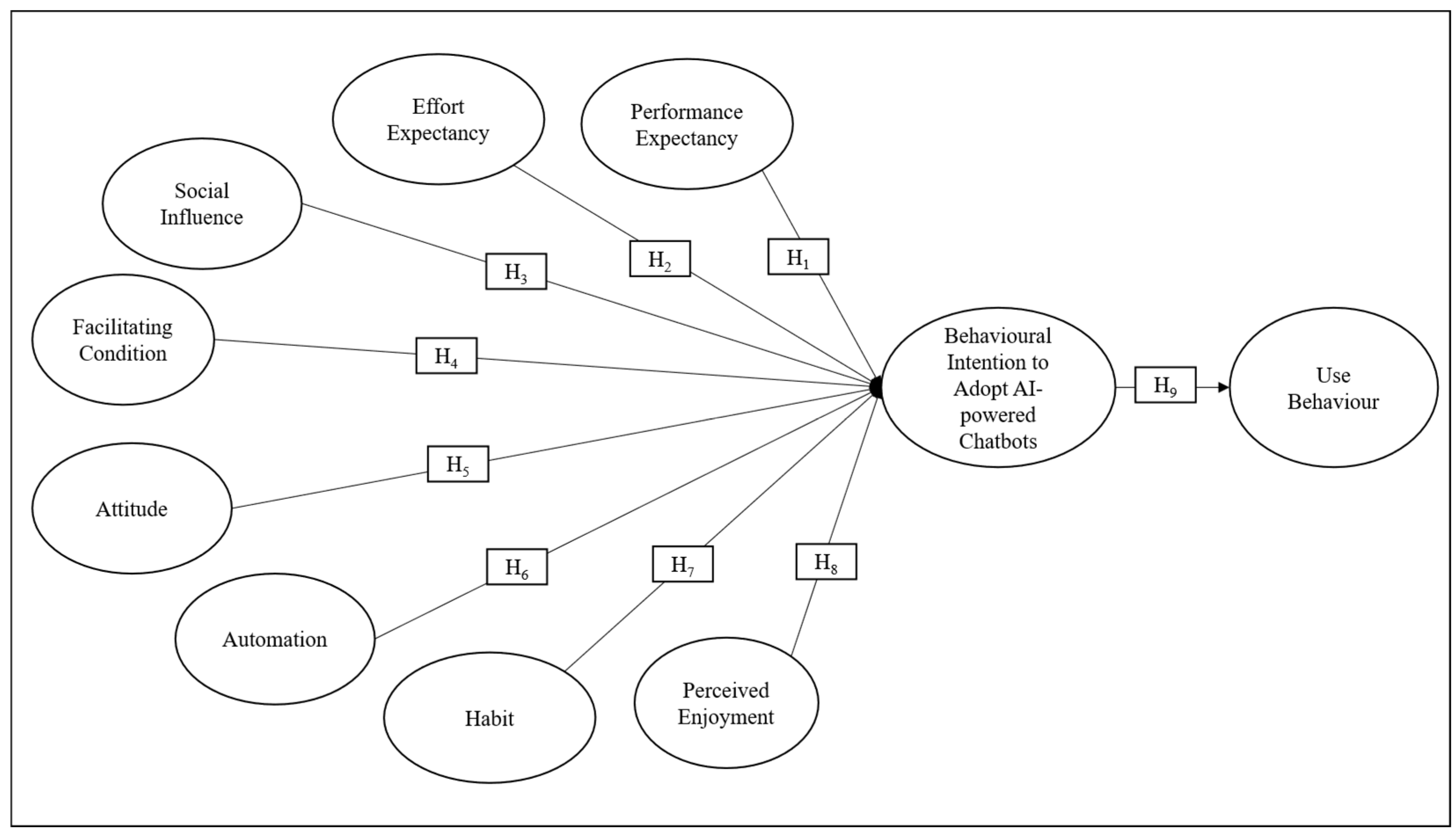
Figure 1 illustrates the conceptual framework that examines the factors influencing the adoption and use of AI-powered chatbots in the hospitality and tourism industries. At the core of the model is the “Behavioural Intention to Adopt AI-powered Chatbots”, which serves as the immediate predictor of actual “Use Behaviour”. This relationship suggests that the stronger the behavioural intention to adopt, the more likely a user is to utilise AI-powered chatbots. Furthermore, several antecedents, including performance expectancy, effort expectancy, social influence, facilitating conditions, attitude, automation, habits, and perceived enjoyment, are hypothesised to influence the behavioural intention to adopt AI-powered chatbots. Together, these constructs create a comprehensive model that integrates cognitive, social, and affective factors to explain both the behavioural intention to adopt AI-powered chatbots and their actual usage behaviour. The framework offers a multidimensional view, combining theories such as TPB, TAM, UTAUT, and UTAUT2, providing a robust explanation of AI-powered chatbot adoption.
3. Materials and Methods
3.1. Study Site
The present research was conducted by the researcher in Goa, situated on the western coast of India. Goa is one of the country’s most prominent tourist destinations, attracting both domestic and international visitors due to its stunning beaches, rich cultural heritage, vibrant festivals, and thriving hospitality industry (Directorate of Planning Statistics and Evaluation—DPSE, 2023a; Incredible India, n.d.). The state has also witnessed rapid technological innovation and digital transformation in the hospitality and tourism sector, with a highly competitive, service-intensive approach to cater to a diverse customer segment. The high volume of tourists and the need for efficient service delivery create a conducive environment for implementing technology-driven solutions such as chatbots (Narayan, 2024). These systems can assist with travel planning, virtual concierges, automated booking systems, and chatbot interfaces, providing an opportunity to study real-world usage and adoption patterns, as well as customer support, which is particularly valuable in destinations with seasonal tourist influxes and multilingual businesses (Sujood et al., 2024). The diverse tourist population, comprising domestic travellers, international visitors, and repeat tourists, enables a comprehensive assessment of different user expectations, preferences, and behavioural intentions toward AI-based technologies. In such a diverse and dynamic tourism environment, with varying levels of digital literacy and a wide range of hospitality services, tourists’ interactions with AI-powered chatbots in Goa make it particularly suitable for applying the revised UTAUT2 model. Therefore, this will allow the researcher to capture real-world insights into how AI-based service automation is perceived and utilised across different tourist segments, thereby providing actionable knowledge for service providers seeking to implement AI-driven solutions effectively.
3.2. Source of Data Collection
The primary data for this study were collected from inbound and outbound tourists aged 18 years and above who had undertaken at least one leisure or business trip within the past year. Participants were required to have prior experience using digital technologies for travel, such as booking services or interacting with AI-powered tools, such as chatbots. Only those who had engaged with tourism or hospitality providers that employed such technologies and had willingly participated in the survey were included in the sample. This study is based on quantitative data collected using structured questionnaires. The researcher used a self-administered questionnaire method to collect data from the targeted respondents. The targeted respondents here are the inbound and outbound tourists. Here, inbound tourists refer to those who travel to the state of Goa, India, from any other state in India or from another country. These tourists visit Goa for various reasons, including leisure, holidays, business, and other purposes. Outbound tourists are residents of Goa who travel to destinations outside the state or country for leisure, business, or other purposes. These individuals are departing from Goa and travelling to other regions, either within India or internationally. Inbound and outbound tourists were included to capture diverse travel experiences and technology usage patterns across different travel contexts. Inbound tourists may rely more heavily on AI-powered chatbots for destination information, local navigation, and service coordination in unfamiliar environments, whereas outbound tourists may use such technologies for trip planning, booking management, and pre-travel support. Including both groups enhances the generalisability of the findings, reduces contextual bias, and provides a more comprehensive understanding of AI-powered chatbot adoption behaviour within the tourism sector. The interaction with these tourists took place at various locations in Goa, spanning both North Goa and South Goa. Respondents were approached at key tourist locations, including airports, hotels, travel agencies, and popular tourist sites.
3.3. Sampling Design
The sampling design was implemented in two stages. At the first stage, the researcher drew a sample size based on the total number of inbound and outbound tourists in the state. It was noted that the population of inbound tourists is approximately 7,187,850, and the outbound tourists approximately 1,575,000 (Directorate of Planning Statistics and Evaluation—DPSE, 2023a, 2023b; Ministry of Home Affairs [MHA], 2011). Therefore, the total population identified for the study was 8,762,950. The identification of the total population informed the sample size selection for the present study. The required sample size for this study was determined using (Krejcie & Morgan, 1970). The sample size determination table indicated a sample size of 384 respondents, since the sample size determination method given by Krejcie and Morgan (1970) provided nearly identical results, which supports the adequacy of the estimated sample. However, to enhance the reliability of the findings, account for potential non-responses, and ensure a sufficiently representative dataset, the final sample size proposed for this study was 400 respondents.
Prior to the main data collection, the questionnaire underwent content validity assessment through expert review. The instrument was evaluated by academic and industry experts in the research community. Their feedback focused on clarity, relevance, wording, and contextual appropriateness of the items. Based on their suggestions, minor modifications were made to enhance the instrument’s content validity and comprehensibility. Subsequently, a pilot study was conducted among 38 inbound and outbound tourists across major tourist destinations in North and South Goa to assess the instrument’s reliability and practicality. The pilot study helped assess the clarity of items, response patterns, and preliminary reliability of the constructs. The results indicated satisfactory internal consistency, confirming the instrument’s suitability for the full-scale survey.
During the second stage of sampling, the researcher employed purposive sampling techniques to identify suitable participants. Purposive sampling was used to ensure that only respondents with prior experience using AI-powered chatbots for travel-related purposes who had used them at least once during their travel journey were included. Since chatbot adoption is experience-based and not all tourists have interacted with such technology, a screening question helped identify qualified participants while maintaining consistency in the sampling process. This dual approach enabled the researcher to access a more targeted, relevant pool of participants, ensuring that the collected data reflected meaningful insights into tourists’ experiences with AI-powered chatbot technologies.
The final data were initially collected from 400 respondents, consisting of 200 inbound and 200 outbound tourists, to ensure balanced representation of different tourist segments and enhance generalizability. However, after applying data screening procedures, including the removal of incomplete responses and inconsistent answer patterns, a total of 227 valid questionnaires were retained, comprising 118 inbound and 109 outbound tourists. Only fully completed and valid responses were included in the final analysis to ensure data quality and robustness of results. This reflects an effective response rate of approximately 53%, ensuring a reliable and representative dataset for analysis. The adequacy of the sample size was assessed using the 10-times rule commonly applied in PLS-SEM analysis. According to this rule, the minimum sample size should be at least ten times the maximum number of structural paths directed at any construct in the model (Hair et al., 2019, 2022). In the present study, the most complex construct receives fewer than ten direct paths, indicating that the required minimum sample size is substantially lower than 227. Therefore, the final sample of 227 valid responses exceeds the recommended threshold and is considered sufficient for reliable structural model estimation.
3.4. Constructs Measurement
The primary research instrument for this study was a structured questionnaire designed using a 5-point Likert scale, where 1 represented ‘strongly disagree’, 2 represented ‘disagree’, 3 represented ‘neutral’, 4 represented ‘agree’, and 5 represented ‘strongly agree’. The questionnaire was organised into two sections to comprehensively address the study’s objectives. Section A focused on recording respondents’ demographic profiles, including gender, type of tourist, age, education level, and occupation. Section B was developed to explore the factors influencing respondents’ adoption of AI-chatbots in the hospitality and tourism sector, covering aspects such as performance expectancy (4 items), adapted from T. L. Huang et al. (2023), Li and Jiang (2023), and Rasheed et al. (2023a); effort expectancy (3 items), adapted from T. L. Huang et al. (2023), Li and Jiang (2023), and Rasheed et al. (2023a); social influence (4 items), adapted from Melián-González et al. (2021) and Ronaghi and Ronaghi (2022); facilitating conditions (3 items), adapted from Gudowsky et al. (2023), Ronaghi and Ronaghi (2022), and Venkatesh et al. (2016); attitude (3 items), adapted from Ajzen (1991), Davis (1989), Li and Jiang (2023), and Rasheed et al. (2023a); automation (3 items), adapted from Melián-González et al. (2021); habit (3 items), adapted from Melián-González et al. (2021) and Venkatesh et al. (2012); perceived enjoyment (3 items), adapted from Li and Jiang (2023), Rasheed et al. (2023a), and Ronaghi and Ronaghi (2022); behavioural intention to adopt AI-powered chatbots (4 items), adapted from Li and Jiang (2023), Rasheed et al. (2023a), and Venkatesh et al. (2012); and use behaviour (3 items), adapted from Ronaghi and Ronaghi (2022) and Venkatesh et al. (2012).
3.5. Data Analysis Tools and Techniques
For the analysis and interpretation of the collected data, the Partial Least Squares–Structural Equation Modelling (PLS-SEM) technique was employed with SmartPLS 4.0. This technique was chosen as it is particularly effective for examining complex relationships among constructs, testing measurement models, and assessing both direct and indirect effects within the research framework. It is widely used in social science research, as it is suitable for non-normal data and supports both small and large sample sizes (Hair et al., 2013, 2017, 2014b). Melián-González et al. (2021) and Pillai and Sivathanu (2020) have used the PLS-SEM technique in the context of technology adoption, demonstrating its robustness in analysing complex models that involve multiple construct relationships. This methodological strength makes PLS-SEM particularly suitable for investigating the adoption of AI-powered chatbots within the hospitality and tourism industry. Given the sector’s dynamic nature and the interplay of technological, behavioural, and experiential factors influencing adoption decisions, PLS-SEM enables a comprehensive assessment of both direct and indirect relationships among variables. Therefore, applying PLS-SEM in this research context enables a nuanced understanding of how these factors collectively influence the adoption of AI-driven chatbot technologies in the hospitality and tourism sectors.
4. Results
4.1. Demographic Profile of the Respondents
Table 1 shows that most respondents were male (58%) compared to female (42%). In terms of tourist types, a significant portion of respondents (52%) were inbound tourists, while the rest (48%) were outbound tourists. The age distribution of respondents varied, with the largest group being those aged 18 to 30 (58%), followed by those aged 31 to 40 (23%), 41 to 50 (14%), 51 to 60 (4%), and those aged 61 and above (2%). In terms of education, the majority of respondents were graduates (53%), followed by postgraduates (31%), those with higher secondary education (11%), and others (5%). Finally, occupation-wise, the majority were private-sector employees (44%), followed by students (25%), self-employed individuals (12%), government-sector employees (11%), and others (8%).
Table 1.
Demographic profile of respondents (n = 227).
4.2. Determinants of Tourists’ Behavioural Intention to Adopt AI-Powered Chatbots for the Hospitality and Tourism Industry
Prior to hypotheses testing, the data were examined for normality and common method bias. Normality was assessed using skewness and kurtosis statistics for all measurement items, although this is not a prerequisite for PLS-SEM. The results indicated that the values fell within the acceptable range of ±2, suggesting that the data did not significantly deviate from normality and were appropriate for multivariate analysis. To evaluate common method bias, Harman’s single-factor test was conducted by entering all measurement items into an unrotated exploratory factor analysis. The findings showed that a single factor accounted for well below the commonly accepted threshold of 50%. Therefore, common method bias is unlikely to be a serious concern in this study. This indicates that common method bias is unlikely to pose a serious threat to the validity of the study’s results.
4.2.1. Measurement Model
The measurement model results presented in Table 2 provide strong evidence of reliability and validity for the constructs examined in the study on AI chatbot adoption. The variance inflation factor (VIF) values are all well below the critical cut-off of 5 (Hair et al., 2019), confirming that multicollinearity is not a concern. Across all constructs, the standardised factor loadings exceed the recommended threshold of 0.70, indicating that the individual items are strong indicators of their respective latent variables.
Table 2.
Showing multicollinearity, reliability and validity assessment.
In terms of reliability, the CA values consistently exceed the acceptable benchmark of 0.70, ranging from 0.728 to 0.911, which suggests strong internal consistency. Similarly, CR values range from 0.834 to 0.944, all of which surpass the minimum threshold of 0.70, thereby confirming the reliability of the constructs. Convergent validity is further established through the AVE, with all constructs exceeding the recommended 0.50 cut-off. Notably, constructs such as ‘habit’ (0.721) and ‘perceived enjoyment’ (0.778) show particularly high convergent validity, indicating that their items capture the construct exceptionally well. Thus, the measurement model demonstrates robust psychometric properties, thereby providing a solid foundation for subsequent structural model testing to examine the relationships among the constructs.
Table 3 presents the discriminant validity results, as determined by the Fornell–Larcker criterion, which compares the square roots of the AVEs with the inter-construct correlations. The diagonal elements are all higher than the corresponding correlations in their respective rows and columns, which establishes discriminant validity among the constructs. It is noted that the square root of AVE for ‘attitude’ (0.817) is greater than its correlations with ‘automation’ (0.187), ‘effort expectancy’ (0.606), and ‘use behaviour’ (0.731), confirming that attitude is a distinct construct. Similarly, ‘use behaviour’ (0.866) demonstrates particularly strong discriminant validity, with diagonal values substantially higher than the cross-loadings. Moreover, constructs such as ‘performance expectancy’ (0.853), ‘habit’ (0.849), and ‘perceived enjoyment’ (0.882) also meet this criterion, indicating conceptual distinctiveness. Although some correlations are moderately high, such as those between ‘behavioural intention to adopt’ and ‘performance expectancy’ (0.727) or ‘attitude’ and ‘use behaviour’ (0.731), the diagonal values remain higher, affirming that these constructs, while related, measure unique dimensions. Thus, the results confirm that the measurement model possesses sound discriminant validity, ensuring that the constructs are empirically distinct while still theoretically connected, thereby strengthening the robustness of the structural model assessment.
Table 3.
Discriminant validity—Fornell-Larcker criterion.
Table 4 presents the HTMT (Heterotrait–Monotrait Ratio) results for assessing discriminant validity. Following established guidelines, HTMT values below 0.85 or 0.90 indicate adequate discriminant validity. Several construct pairs demonstrate clear separation, such as ‘attitude–automation’ (0.233), ‘facilitating conditions–automation’ (0.057), and ‘use behaviour–social influence’ (0.365). However, certain relationships approach or exceed the recommended threshold, including ‘behavioural intention to adopt–performance expectancy’ (0.883), ‘behavioural intention to adopt–effort expectancy’ (0.837), ‘use behaviour–attitude’ (0.922), and ‘use behaviour–behavioural intention’ (0.832). The HTMT value between ‘attitude’ and ‘use behaviour’ slightly exceeds 0.90, as suggested by Henseler et al. (2015). To further evaluate discriminant validity, HTMT inference was conducted using bootstrapping. The 95% confidence interval did not include 1, supporting discriminant validity. Cross-loadings also confirmed that all indicators loaded higher on their respective constructs than on other constructs. Although attitude and use behaviour are found to be statistically closely related within the AI-powered chatbots adoption framework, they remain theoretically distinct constructs and were therefore retained.
Table 4.
Discriminant validity—HTMT ratio matrix.
4.2.2. Structural Path Model
Table 5 and Figure 2 present the structural model results, which provide valuable insights into the determinants of behavioural intention to adopt AI-powered chatbots and their subsequent effect on usage behaviour. The R2 and adjusted R2 for behavioural intention to adopt AI-powered chatbots are 0.687 and 0.675, respectively, indicating that 68.7% and 67.5% of the variance in behavioural intention is explained by the predictors, suggesting a moderate-to-strong relationship. Moreover, the R2 and adjusted R2 for use behaviour are 0.439 and 0.436, respectively, indicating that 43.9% and 43.6% of the variance in use behaviour is explained by behavioural intention to adopt AI-powered chatbots.
Table 5.
Path coefficients and testing of hypotheses.
Figure 2.
Graphical output of the path coefficient of the revised UTAUT2 model.
Further, out of the nine hypothesised relationships, seven are statistically significant, while two are not supported. First, significant influence on behavioural intention to adopt AI-powered chatbots was demonstrated for performance expectancy, H1 (β = 0.257, p < 0.001); effort expectancy, H2 (β = 0.148, p = 0.035); social influence, H3 (β = 0.133, p = 0.006); facilitating condition, H4 (β = 0.104, p = 0.031); attitude, H5 (β = 0.284, p < 0.001); and perceived enjoyment, H8 (β = 0.122, p = 0.032). These findings suggest that individuals are more likely to intend to adopt AI-powered chatbots when they have favourable attitudes toward AI, believe chatbots enhance performance, find them easy to use, feel social pressure from important others, have the necessary resources and knowledge, and experience enjoyment from using the technology. Among these, attitude emerges as the strongest predictor, highlighting the central role of personal evaluations and perceptions in shaping the adoption intention of AI-powered chatbots, while performance expectancy is a stronger determinant of tourists’ behavioural intentions to adopt AI-powered chatbots among the key determinants of the original UTAUT2 model.
Second, automation, H6 (β = 0.058, p = 0.166), and habits, H7 (β = 0.010, p = 0.860), do not significantly influence behavioural intention to adopt AI-powered chatbots. This implies that concerns about job replacement by chatbots, general fun-seeking tendencies, and existing usage habits may not significantly influence adoption intentions in this context. This could be due to the relatively novel stage of chatbot adoption, where practical usefulness and attitudes are more influential than habitual or hedonic motivations. Finally, behavioural intention to adopt AI-powered chatbots strongly influences use behaviour, H9 (β = 0.662, p < 0.001), confirming that individuals who intend to use chatbots are highly likely to engage with them in practice. This path shows the strongest effect in the model, underlining the robustness of behavioural intention as a direct driver of use behaviour.
Thus, the findings validate much of the revised UTAUT2 framework, emphasising the importance of attitude, performance expectancy, effort expectancy, facilitating conditions, social influence, and perceived enjoyment in driving AI-powered chatbot adoption in the hospitality and tourism industry. The results also indicate that habit and hedonic motivation are not yet central to adoption, suggesting that users may prioritise utility and ease of use over intrinsic fun or routine use when evaluating AI-powered chatbot technologies.
The effect size (f2) and predictive relevance (Q2) analyses were conducted, shown in Table 6, to assess the contribution of each exogenous construct to the endogenous variables. According to (Cohen, 1988; Hair et al., 2014a; Shmueli et al., 2019) guidelines, values of 0.02, 0.15, and 0.35 indicate small, medium, and large effects, respectively. The effect size indicates that behavioural intention to adopt AI-powered chatbots has a very large effect on use behaviour (f2 = 0.781), indicating that behavioural intention is the primary driver of use behaviour. Among the predictors of behavioural intention to adopt an AI-powered chatbot, attitude (f2 = 0.142) demonstrates the strongest contribution, approaching a medium effect size. Performance expectancy (f2 = 0.074), social influence (f2 = 0.033), effort expectancy (f2 = 0.026), perceived enjoyment (f2 = 0.026), and facilitating conditions (f2 = 0.022) exhibit small effect sizes, suggesting limited but meaningful practical contributions. In contrast, automation (f2 = 0.009) and habits (f2 = 0.000) show negligible effects, indicating that they contribute little to explaining behavioural intention to adopt an AI-powered chatbot within the current model.
Table 6.
Effect sizes (f2) and predictive relevance (Q2).
The predictive relevance analysis indicates that, for behavioural intention to adopt AI-powered chatbots (Q2 = 0.360; Q2predict = 0.648), the Q2 and Q2predict values exceed the commonly accepted large threshold (≥0.35), suggesting that the model predicts users’ behavioural intention quite well. For use behaviour (Q2 = 0.321; Q2predict = 0.499), the values are above the medium threshold (≥0.15) but below the large cut-off, indicating moderate predictive accuracy; the model is less precise at predicting actual usage than at predicting behavioural intention.
5. Discussion and Implications
5.1. Discussion
This research examines the key determinants influencing behavioural intention to adopt AI-powered chatbots in the hospitality and tourism industry. Travel planning chatbots are user-friendly tools that can be accessed through multiple devices, including mobile phones, laptops, and desktops. By offering instant recommendations and real-time solutions, these chatbots streamline travel automation and significantly enhance travellers’ efficiency (Pillai & Sivathanu, 2020). The findings validate the applicability of the revised UTAUT2 model in explaining technology adoption in the hospitality and tourism industry, while also emphasising the value of incorporating additional antecedents tailored to the unique characteristics of each technology.
Performance expectancy, effort expectancy, social influence, facilitating conditions, attitude, and perceived enjoyment significantly influence behavioural intention to adopt AI-powered chatbots. The statistically significant positive relationship between performance expectancy and the behavioural intention to adopt AI-powered chatbots results is also aligned with previous research, such as Dhiman and Jamwal (2023), Hakim et al. (2022), Kaushik et al. (2015), H. Kim et al. (2009), Melián-González et al. (2021), Pillai and Sivathanu (2020), and Sujood et al. (2024). From the core dimensions of UTAUT2, performance expectancy was found to be the strongest construct influencing behavioural intention to adopt AI-powered chatbots. Foroughi et al. (2025) also confirmed that performance expectancy was the strongest predictor, with innovativeness and risk aversion moderating several relationships. This suggests that users are more likely to adopt AI-powered chatbots when they perceive them as useful and performance-enhancing.
Regarding effort expectancy, the study found a significant influence of this factor on the behavioural intention to adopt AI-powered chatbots. This result aligns with the findings of Faqih (2022) and Pillai and Sivathanu (2020), who emphasised that perceived ease of use or effort expectancy positively shapes users’ behavioural intention to adopt new technologies. When travellers, hotel guests, or service seekers perceive chatbots as simple, intuitive, and easy to use, they are more likely to engage with them. However, the present findings contrast with those of Ali et al. (2024), Lata (2021), and Melián-González et al. (2021), who suggested that effort expectancy may not be a decisive factor, as chatbot use often involves only basic actions, such as opening the interface, typing a query, and engaging in a conversational exchange.
The present study also found that social influence positively affects the behavioural intention to adopt AI-powered chatbots. This suggests that individuals are guided by people they know or consider influential. This finding corroborates prior research in the hospitality and tourism domain. For instance, Lata (2021) emphasised that travellers’ technology adoption decisions are often shaped by peer recommendations and social cues. Similarly, Melián-González et al. (2021) highlighted that social influence plays a decisive role in tourists’ acceptance of digital tools within hotels, while Sujood et al. (2024) demonstrated that endorsements from family, friends, or trusted networks significantly strengthen travellers’ behavioural intention to adopt AI-driven services. Taken together, these studies reinforce the idea that social influence is a critical determinant of behavioural intention in the adoption of AI-powered chatbots.
The study further revealed a positive and significant influence of facilitating conditions on tourists’ behavioural intention to adopt AI-powered chatbots. This finding aligns with prior research highlighting the critical role of facilitating conditions in technology adoption. For instance, Palau-Saumell et al. (2019) found that facilitating conditions were a strong determinant of users’ adoption of mobile applications in the hospitality sector. Similarly, Chiao et al. (2018) emphasised that facilitating conditions drive the intention to use virtual platforms in cultural tourism education. Contrastingly, the present result does not fully align with Lata’s (2021) findings, which reported that facilitating conditions exerted only a relatively weak influence on users’ intentions to adopt hotel booking applications on smartphones. In the context of digital technology use for cultural heritage monuments, Wen et al. (2023) found that facilitating conditions had a weaker influence on technology adoption than other UTAUT constructs. These results align with foundational adoption theories such as the TAM (Davis, 1989) and UTAUT2 (Venkatesh et al., 2012), which emphasise the importance of core dimensions in shaping behavioural intentions.
Attitude was identified as the strongest predictor of behavioural intention, compared with other key determinants, supporting principles derived from the TPB, which emphasise the role of attitudinal evaluations in shaping behavioural intentions. Many previous researchers have used these constructs to explore their influence on behavioural intention across different areas, such as J. J. Kim and Han (2022), who found that attitude generates favourable behavioural intentions in the consumer decision-making process towards a smart hotel. Zhang and Liu (2022) revealed that attitude predicts consumers’ behavioural intention to adopt eco-friendly smart home services. In the hospitality and tourism industry, Rafdinal et al. (2021) and Sujood et al. (2024) highlighted that attitude have a significant influence on consumers’ behavioural intention to use of smart technologies. These findings reaffirm that attitude plays a pivotal role in shaping behavioural intention, consistent with the core assumptions of the TPB and revised UTAUT2 model. This underscores the importance of fostering positive attitudinal evaluations to enhance users’ intention to adopt AI-powered technologies in hospitality and tourism contexts.
Perceived enjoyment also showed a significant positive effect, highlighting the experiential and emotional dimension of AI chatbot adoption in tourism contexts. Cha (2020) demonstrated that perceived enjoyment strongly influences users’ behavioural intentions to adopt AI service robots in hospitality, as enjoyment enhances users’ emotional attachment and satisfaction with technology-based interactions. Similarly, Hoang et al. (2023) found that tourists’ enjoyment when interacting with virtual assistants significantly increases their intention to use AI-enabled services, showing that positive emotional experiences can outweigh concerns about privacy or reliability. A. Huang et al. (2024) further confirmed that perceived enjoyment is a central factor driving continued usage of AI-powered chatbots in the tourism and retail sectors, as enjoyable interactions contribute to both user engagement and long-term loyalty.
In addition, Orden-Mejía and Huertas (2022) revealed that tourists who perceive interactions with AI-powered chatbots as enjoyable are more inclined to rely on them for destination information and travel planning, suggesting that emotional satisfaction can play an equally, if not more, influential role than functional efficiency. However, the current study’s findings do not support the results of Goli et al. (2023), who reported an insignificant relationship between perceived enjoyment and the intention to use AI-powered chatbots in online purchasing contexts. This discrepancy may be explained by contextual differences; tourism interactions often involve more experiential, personalised, and emotionally engaging elements than transactional online purchases. Thus, the significant effect of perceived enjoyment reinforces the relevance of the revised UTAUT2 model, which extends the traditional UTAUT and UTAUT2 frameworks. This finding confirms that, in tourism contexts, both utilitarian and experiential factors jointly shape users’ intentions to adopt AI-powered chatbots.
Interestingly, the relationship between automation and tourists’ behavioural intention to adopt AI-powered chatbots was not supported in the current study. This suggests that while users recognise AI functionality, they may not yet perceive automation sophistication or routine usage as primary drivers of adoption. Furthermore, habit did not significantly influence behavioural intention, thereby contradicting the findings of Melián-González et al. (2021), who reported a direct, positive, and significant relationship between habit and behavioural intention. In addition, Wen et al. (2023) found that users’ habits of engaging with AR/VR technologies positively affect their intention to use AR/VR applications in heritage monuments. Collectively, these studies emphasise that when technology use becomes part of individuals’ routines, it enhances their willingness to adopt and rely on it consistently. However, the insignificant relationship observed in this study may be attributed to participants’ busy schedules, which limit the time available to engage with technology and AI-driven applications. As noted by Lata (2021), time constraints and competing commitments can hinder users from developing habitual patterns of use, thereby weakening the influence of habit on behavioural intention. This finding indicates that AI chatbot usage in tourism may still be at an early diffusion stage where habitual behaviour has not fully developed.
Finally, the analysis confirms the core relationship between behavioural intention to adopt AI-powered chatbots and subsequent use behaviour, as proposed by the UTAUT2 model. This indicates that travellers’ behavioural intentions strongly shape their actual usage in the hospitality and tourism industry. Previous studies corroborate this finding, such as Lata (2021), who observed that intention predicts usage in tourism technology adoption, while Venkatesh et al. (2012) highlighted the general applicability of this relationship across technologies. Pillai and Sivathanu (2020) specifically examined chatbots in tourism and reported that the model explained 63.2% of the variance in intention and 67.9% of the variance in actual usage, demonstrating robust predictive validity.
Similarly, Davis (1989) and Kaushik et al. (2015) confirmed that behavioural intentions are strong determinants of actual adoption and usage. The results indicate that tourists evaluate AI-powered chatbots through both performance-related and experience-related dimensions. While functional benefits such as performance expectancy, effort expectancy, social influence and facilitating conditions remain critical, emotional and experiential factors such as enjoyment and attitude also play decisive roles, ultimately translating into stronger behavioural intentions and actual use behaviour. These findings highlight the multidimensional nature of AI adoption in tourism settings. Thus, the revised UTAUT2 model can serve as a useful framework to better understand user acceptance, behavioural intentions, and continued usage of such chatbots in this sector.
5.2. Theoretical Contributions
This study makes several theoretical contributions to technology adoption research and tourism literature. First, a key theoretical contribution of this study is to enhance the UTAUT by extending and adapting its core constructs to better align with the specific context of this research. Rather than applying the original model unchanged, we refined its structure and incorporated context-relevant factors to develop a more comprehensive and theoretically grounded framework. This enhanced model provides a more precise explanation of behavioural intention and usage behaviour within the study setting, thereby strengthening the model’s contextual relevance, explanatory power, and theoretical robustness.
Second, it revised UTAUT2 by integrating automation, attitude, and perceived enjoyment into the framework to better capture AI-specific system characteristics. While UTAUT2 has been widely applied across consumer technologies (Venkatesh et al., 2012), its adaptation to AI-powered conversational systems in tourism has been limited. The inclusion of automation acknowledges that AI technologies embody intelligent system attributes, such as real-time data processing, adaptive conversational interaction, and contextual responsiveness, that extend beyond traditional expectancy-based constructs, such as performance expectancy and effort expectancy. Moreover, incorporating attitude introduces a comprehensive evaluative dimension that reflects users’ overall positive or negative assessment of AI chatbots, drawing conceptual support from the TPB. This addition recognises that adoption decisions in tourism are not solely utility-driven but are shaped by broader cognitive and affective judgments. Similarly, perceived enjoyment captures the hedonic and experiential aspects of interacting with AI chatbots, which are particularly salient in tourism environments characterised by emotional engagement and experiential consumption.
Third, the insignificant effects of automation and habit refine theoretical understanding by challenging assumptions that technological sophistication or routine behaviour automatically drives adoption. The findings, therefore, indicate that AI-specific constructs require careful conceptual differentiation rather than simple integration into existing expectancy dimensions. By empirically validating an extended UTAUT2 framework tailored to AI-powered chatbots in tourism, this study provides a more context-sensitive adoption model. It contributes to technology acceptance theory by demonstrating that AI-driven service technologies require hybrid evaluation dimensions. This refined framework offers a stronger theoretical lens for examining smart tourism ecosystems and digitally mediated service innovations.
5.3. Practical Implications
The findings provide several important implications for tourism managers and policymakers implementing AI-powered chatbots in the hospitality and tourism industry. First, since performance expectancy significantly influences adoption, organisations should clearly communicate the tangible benefits of chatbot usage, such as faster responses, personalised travel recommendations, 24/7 availability, and improved customer convenience. Moreover, demonstrating measurable value can strengthen tourists’ confidence and increase adoption rates. Second, the significant role of effort expectancy underscores the importance of a user-friendly design that provides seamless experiences for guests booking hotels, planning trips, or seeking real-time recommendations. Managers and policymakers should ensure that chatbots can handle queries efficiently, such as booking confirmations, itinerary suggestions, or concierge services, while offering guided prompts and a natural conversational flow to minimise user effort.
Third, social influence plays a meaningful role in shaping behavioural intention to adopt. Hospitality organisations can leverage testimonials, online reviews, influencer endorsements, and peer recommendations to build credibility and trust in chatbot services, thereby increasing travellers’ behavioural intention to use AI-powered chatbots. Fourth, facilitating conditions significantly affect adoption, emphasising the need for reliable technological infrastructure, strong internet connectivity, system compatibility, and accessible technical support. This suggests that tourism service providers and organisations seeking to implement chatbot solutions should prioritise ensuring reliable technological support and user-friendly systems. Such efforts can enhance tourists’ confidence and ultimately encourage greater adoption. Fifth, given the strong influence of attitudes, hospitality and tourism organisations should promote the benefits and ease of use of chatbots while enhancing user experience through responsiveness, reliability, and multilingual support. Training staff to assist customers and tailoring features for different segments can boost adoption and satisfaction.
Sixth, the significant and positive relationship between perceived enjoyment and tourists’ behavioural intention to adopt AI-powered chatbots suggests that when tourists perceive their interactions with chatbots as rewarding, enjoyable, and engaging, they are more likely to continue using such technologies and to re-engage with them in future travel experiences. Tourism managers and policymakers should focus on creating emotionally engaging, interactive experiences. Incorporating natural language, humour, personalisation, and responsive dialogue can make chatbot interactions more enjoyable and memorable. Enhancing human-like qualities, such as empathy and friendliness, can further strengthen users’ emotional connection and trust. Finally, because behavioural intention strongly predicts actual usage behaviour, hospitality and tourism organisations should focus on strategies that enhance positive behavioural intentions, such as awareness campaigns, trial opportunities, service guarantees, and continuous performance improvements, to convert favourable perceptions into sustained adoption.
6. Conclusions, Limitations and Future Scope
6.1. Conclusions
This study focuses on understanding tourists’ behavioural intention to adopt AI-powered chatbots in the hospitality and tourism industry, highlighting the importance of applying a revised UTAUT2 model to examine the relationships between key constructs. Therefore, this study concludes that attitude, performance expectancy, effort expectancy, social influence, facilitating conditions, and perceived enjoyment are the significant determinants influencing tourists’ behavioural intention to adopt AI-powered chatbots. Moreover, the study demonstrates that tourists’ behavioural intention significantly influences use behaviour, indicating that when chatbots perform effectively and meet users’ requirements, they encourage continued use. On the other hand, constructs such as automation and habit did not directly influence behavioural intentions to adopt AI-powered chatbots, as tourists may prioritise practical benefits, ease of use, and social factors over novelty, pleasure, or routine behaviours when deciding to use AI-powered chatbots.
Therefore, tourism businesses should provide 24/7 availability, enabling them to respond to tourists’ inquiries at any time, thereby enhancing service and satisfaction. Chatbots are also cost-effective, as they can handle a large volume of inquiries simultaneously, reducing reliance on human agents and lowering operational costs. Additionally, they improve operational efficiency by automating responses to frequently asked questions, allowing human staff to focus on more complex or personalised tasks. Thus, AI-powered chatbots can contribute to tourism businesses by improving traveller service, streamlining operations, and enhancing growth through personalised customer experiences. While AI-powered chatbots offer significant opportunities to enhance service quality, efficiency, and customer engagement in the tourism sector, businesses must carefully manage their implementation and strike a balance between automated and human interactions to ensure a seamless and satisfactory customer experience.
6.2. Limitations of the Study
Despite these insights, the study has several limitations. First, the findings are based on a specific group of tourists within a particular geographical context, which may limit the generalisability of the results across different cultural settings, tourism segments, or technological environments. Second, other potentially influential factors outside the UTAUT2 framework, such as trust, perceived risk, or technology anxiety, were not included. Finally, another limitation relates to potential measurement validity concerns. Although established scales were adapted and statistical tests confirmed reliability and discriminant validity, the adaptation of the items to the AI-powered chatbot context may not fully capture users’ nuanced perceptions. Subtle contextual differences could affect construct interpretation, thereby posing a potential threat to construct validity.
6.3. Future Scope of the Research
The study proposes several avenues for future research. First, future studies may extend the present framework by integrating additional contextual and psychological variables to further refine the explanatory power of the UTAUT and UTAUT2 models in AI-powered chatbots, specifically in the hospitality and tourism industry. Second, longitudinal research designs are recommended to examine changes in user attitudes and usage behaviour over time, thereby capturing post-adoption dynamics. Third, comparative studies across different cultural contexts, industries, or types of AI applications may enhance the generalizability of findings. Finally, future research could adopt mixed-method or experimental designs and incorporate mediation, moderation, or multi-group analyses to provide deeper insights into how users’ demographic characteristics, prior experience, and trust formation influence behavioural outcomes.
Author Contributions
Conceptualisation, S.S. and A.S.; methodology, R.F.; software, A.S.; validation, S.G. and R.F.; formal analysis, S.G.; resources, R.F. and A.S.; data curation, S.G.; writing—original draft preparation, A.S.; writing—review and editing, S.G., S.S. and R.F.; visualisation, S.G.; supervision, S.S.; project administration, S.S. All authors have read and agreed to the published version of the manuscript.
Funding
This research received no external funding.
Institutional Review Board Statement
The study was conducted in accordance with the Declaration of Helsinki, and approved by the Ethics Committee of Government College of Arts, Science, & Commerce, Khandola, Marcela, Goa (protocol code GCASCK/EST/SVS/SG/4539 dated 10 August 2025).
Informed Consent Statement
Informed consent was obtained from all subjects involved in the study.
Data Availability Statement
The data presented in this study are available on request from the corresponding author due to privacy.
Acknowledgments
The authors would like to thank all the respondents who answered our questionnaire.
Conflicts of Interest
The authors declare no conflicts of interest.
Abbreviations
The following abbreviations are used in this manuscript:
| AI | Artificial Intelligence |
| ATT | Attitude |
| AUT | Automation |
| AVE | Average Variance Extracted |
| B2C | Business-to-Consumer |
| CA | Cronbach’s Alpha |
| CR | Composite Reliability |
| DPSE | Directorate of Planning, Statistics and Evaluation |
| EFF | Effort Expectancy |
| FAC | Facilitating Condition |
| HAB | Habit |
| HTMT | Heterotrait–Monotrait |
| INT | Behavioural Intention to Adopt AI-powered Chatbots |
| PEE | Perceived Enjoyment |
| PER | Performance Expectancy |
| PLS-SEM | Partial Least Squares–Structural Equation Modelling |
| PMT | Protection Motivation Theory |
| SOC | Social Influence |
| TAM | Technology Acceptance Model |
| TPB | Theory of Planned Behaviour |
| TRA | Theory of Reasoned Action |
| UBEH | Use Behaviour |
| UTAUT | Unified Theory of Acceptance and Use of Technology |
| VIF | Variance Inflation Factor |
References
- Ajzen, I. (1991). The theory of planned behavior. Organizational Behavior and Human Decision Processes, 50(2), 179–211. [Google Scholar] [CrossRef] [Scilit]
- Ajzen, I., & Fishbein, M. (1975). A bayesian analysis of attribution processes. Psychological Bulletin, 82(2), 261–277. [Google Scholar] [CrossRef] [Scilit]
- Ali, M. B., Tuhin, R., Alim, M. A., Rokonuzzaman, M., Rahman, S. M., & Nuruzzaman, M. (2024). Acceptance and use of ICT in tourism: The modified UTAUT model. Journal of Tourism Futures, 10(2), 334–349. [Google Scholar] [CrossRef] [Scilit]
- Ayyildiz, A. Y., Baykal, M., & Koc, E. (2022). Attitudes of hotel customers towards the use of service robots in hospitality service encounters. Technology in Society, 70, 101995. [Google Scholar] [CrossRef] [Scilit]
- Cha, S. S. (2020). Customers’ intention to use robot-serviced restaurants in Korea: Relationship of coolness and MCI factors. International Journal of Contemporary Hospitality Management, 32(9), 2947–2968. [Google Scholar] [CrossRef] [Scilit]
- Chao, C. M. (2019). Factors determining the behavioral intention to use mobile learning: An application and extension of the UTAUT model. Frontiers in Psychology, 10, 1652. [Google Scholar] [CrossRef] [Scilit]
- Chiao, H. M., Chen, Y. L., & Huang, W. H. (2018). Examining the usability of an online virtual tour-guiding platform for cultural tourism education. Journal of Hospitality, Leisure, Sport and Tourism Education, 23, 29–38. [Google Scholar] [CrossRef] [Scilit]
- Cohen, J. (1988). Statistical power analysis for the behavioral sciences (2nd ed.). Lawrence Erlbaum Associates. Available online: https://www.utstat.toronto.edu/~brunner/oldclass/378f16/readings/CohenPower.pdf (accessed on 26 December 2025).
- Çalışkan, G., Yayla, İ., & Pamukçu, H. (2025). The use of augmented reality technologies in tourism businesses from the perspective of UTAUT2. European Journal of Innovation Management, 28(4), 1498–1526. [Google Scholar] [CrossRef] [Scilit]
- Davis, F. D. (1989). Perceived usefulness, perceived ease of use, and user acceptance of information technology. MIS Quarterly: Management Information Systems, 13(3), 319–339. [Google Scholar] [CrossRef] [Scilit]
- Davis, F. D., Bagozzi, R. P., & Warshaw, P. R. (1992). Extrinsic and intrinsic motivation to use computers in the workplace. Journal of Applied Social Psychology, 22(14), 1111–1132. [Google Scholar] [CrossRef] [Scilit]
- de Kervenoael, R., Hasan, R., Schwob, A., & Goh, E. (2020). Leveraging human-robot interaction in hospitality services: Incorporating the role of perceived value, empathy, and information sharing into visitors’ intentions to use social robots. Tourism Management, 78, 104042. [Google Scholar] [CrossRef] [Scilit]
- Dhiman, N., & Jamwal, M. (2023). Tourists’ post-adoption continuance intentions of chatbots: Integrating task–technology fit model and expectation–confirmation theory. Foresight, 25(2), 209–224. [Google Scholar] [CrossRef] [Scilit]
- Directorate of Planning Statistics and Evaluation—DPSE. (2023a). Goa At A Glance (GAAG). Available online: https://www.dpse.goa.gov.in/Goa-at-a-Glance-2023.pdf (accessed on 31 December 2025).
- Directorate of Planning Statistics and Evaluation—DPSE. (2023b). Statistical hand book of Goa. Available online: https://www.goa.gov.in/wp-content/uploads/2023/11/SHB-2021-22.pdf (accessed on 31 December 2025).
- Do, H. N., Shih, W., & Ha, Q. A. (2020). Effects of mobile augmented reality apps on impulse buying behavior: An investigation in the tourism field. Heliyon, 6(8), e04667. [Google Scholar] [CrossRef] [Scilit]
- Escobar-Rodríguez, T., & Carvajal-Trujillo, E. (2014). Online purchasing tickets for low cost carriers: An application of the unified theory of acceptance and use of technology (UTAUT) model. Tourism Management, 43, 70–88. [Google Scholar] [CrossRef] [Scilit]
- Faqih, K. M. S. (2022). Factors influencing the behavioral intention to adopt a technological innovation from a developing country context: The case of mobile augmented reality games. Technology in Society, 69, 101958. [Google Scholar] [CrossRef] [Scilit]
- Fishbein, M., & Ajzen, I. (1975). Belief, attitude, intention, and behavior: An introduction to theory and research. Volume 2089 of Addison-Wesley series in social psychology. Addison-Wesley Publishing Company. Available online: https://books.google.co.in/books?id=8o0QAQAAIAAJ (accessed on 12 January 2026).
- Foroughi, B., Iranmanesh, M., Asadi, S., Al-Emran, M., Ghobakhloo, M., & Batouei, A. (2025). Extending UTAUT2 to explore intention to use ChatGPT for travel planning: A hybrid PLS-ANN approach. Journal of Tourism Futures. [Google Scholar] [CrossRef] [Scilit]
- Gavrila, S. G., Lopez, A. P. de L., & Molano, C. V. (2025). AI automation at an unprecedented scale: Mapping its adoption and specialisation. Journal of Innovation & Knowledge, 10(6), 100819. [Google Scholar] [CrossRef] [Scilit]
- Goli, M., Sahu, A. K., Bag, S., & Dhamija, P. (2023). Users’ acceptance of artificial intelligence-based chatbots: An empirical study. International Journal of Technology and Human Interaction, 19(1), 1–18. [Google Scholar] [CrossRef] [Scilit]
- Gudowsky, N., Kowalski, J., & Bork-Hüffer, T. (2023). Augmented futures? Scenarios and implications of augmented reality use in public spaces. Futures, 151, 103193. [Google Scholar] [CrossRef] [Scilit]
- Hair, J. F., Hult, G. T. M., Ringle, C. M., & Sarstedt, M. (2017). A primer on partial least squares structural equation modeling (PLS-SEM) (2nd ed.). Sage Publications. Available online: https://books.google.co.in/books/about/A_Primer_on_Partial_Least_Squares_Struct.html?id=JDWmCwAAQBAJ&redir_esc=y#:~:text=A%20Primer%20on%20Partial%20Least%20Squares%20Structural%20Equation,statistical%20technique%2C%20to%20conduct%20research%20and%20obtain%20solutions (accessed on 12 January 2026).
- Hair, J. F., Hult, G. T. M., Ringle, C. M., & Sarstedt, M. (2022). A primer on partial least squares structural equation modeling (PLS-SEM) (3rd ed.). Sage. Available online: https://in.sagepub.com/en-in/sas/a-primer-on-partial-least-squares-structural-equation-modeling-pls-sem/book270548 (accessed on 12 January 2026).
- Hair, J. F., Ringle, C. M., & Sarstedt, M. (2013). Partial least squares structural equation modeling: Rigorous applications, better results and higher acceptance. Long Range Planning, 46(1–2), 1–12. [Google Scholar] [CrossRef] [Scilit]
- Hair, J. F., Ringle, C. M., & Sarstedt, M. (2014a). PLS-SEM: Indeed a silver bullet. Journal of Marketing Theory and Practice, 19(2), 139–152. [Google Scholar] [CrossRef] [Scilit]
- Hair, J. F., Risher, J. J., Sarstedt, M., & Ringle, C. M. (2019). When to use and how to report the results of PLS-SEM. European Business Review, 31(1), 2–24. [Google Scholar] [CrossRef] [Scilit]
- Hair, J. F., Sarstedt, M., Hopkins, L., & Kuppelwieser, V. G. (2014b). Partial least squares structural equation modeling (PLS-SEM): An emerging tool in business research. European Business Review, 26(2), 106–121. [Google Scholar] [CrossRef] [Scilit]
- Hakim, A. H. L., Ibrahim, H. M., & Pauline, T. P. L. (2022). Customer perception on the adoption of self-service technologies in Klang valley hotels. Journal of Tourism, Hospitality & Culinary Arts (JTHCA), 14(1), 200–216. [Google Scholar]
- Henseler, J., Ringle, C. M., & Sarstedt, M. (2015). A new criterion for assessing discriminant validity in variance-based structural equation modeling. Journal of the Academy of Marketing Science, 43(1), 115–135. [Google Scholar] [CrossRef] [Scilit]
- Hill, J., Randolph Ford, W., & Farreras, I. G. (2015). Real conversations with artificial intelligence: A comparison between human-human online conversations and human-chatbot conversations. Computers in Human Behavior, 49, 245–250. [Google Scholar] [CrossRef] [Scilit]
- Hoang, S. D., Dey, S. K., Tučková, Z., & Pham, T. P. (2023). Harnessing the power of virtual reality: Enhancing telepresence and inspiring sustainable travel intentions in the tourism industry. Technology in Society, 75, 102378. [Google Scholar] [CrossRef] [Scilit]
- Huang, A., Ozturk, A. B., Zhang, T., de la Mora Velasco, E., & Haney, A. (2024). Unpacking AI for hospitality and tourism services: Exploring the role of perceived enjoyment on future use intentions. International Journal of Hospitality Management, 119, 103693. [Google Scholar] [CrossRef] [Scilit]
- Huang, T. L., Tsiotsou, R. H., & Liu, B. S. (2023). Delineating the role of mood maintenance in augmenting reality (AR) service experiences: An application in tourism. Technological Forecasting and Social Change, 189, 122385. [Google Scholar] [CrossRef] [Scilit]
- Incredible India. (n.d.). Discover India’s coastal jewel Goa: Where the sun, sand, and susegad collide. Available online: https://www.incredibleindia.gov.in/en/goa (accessed on 25 October 2025).
- Jabeen, F., Al Zaidi, S., & Al Dhaheri, M. H. (2022). Automation and artificial intelligence in hospitality and tourism. Tourism Review, 77(4), 1043–1061. [Google Scholar] [CrossRef] [Scilit]
- Kaushik, A. K., Agrawal, A. K., & Rahman, Z. (2015). Tourist behaviour towards self-service hotel technology adoption: Trust and subjective norm as key antecedents. Tourism Management Perspectives, 16, 278–289. [Google Scholar] [CrossRef] [Scilit]
- Kim, H., Kim, T., & Shin, S. W. (2009). Modeling roles of subjective norms and eTrust in customers’ acceptance of airline B2C eCommerce websites. Tourism Management, 30(2), 266–277. [Google Scholar] [CrossRef] [Scilit]
- Kim, J. J., & Han, H. (2022). Hotel service innovation with smart technologies: Exploring consumers’ readiness and behaviors. Sustainability, 14(10), 5746. [Google Scholar] [CrossRef] [Scilit]
- Krejcie, R., & Morgan, D. (1970). Determining sample size for research activities. Educational and Psychological Measurement, 30(3), 607–610. [Google Scholar] [CrossRef] [Scilit]
- Lata, S. (2021). What determines consumers’ intention for hotel bookings through smartphone apps? ASEAN Journal on Hospitality and Tourism, 19(3), 167–184. [Google Scholar] [CrossRef] [Scilit]
- Li, S., & Jiang, S. (2023). The technology acceptance on AR memorable tourism experience—The empirical evidence from China. Sustainability, 15(18), 13349. [Google Scholar] [CrossRef] [Scilit]
- Lim, W. M., Mohamed Jasim, K., & Das, M. (2024). Augmented and virtual reality in hotels: Impact on tourist satisfaction and intention to stay and return. International Journal of Hospitality Management, 116, 103631. [Google Scholar] [CrossRef] [Scilit]
- Low, M. P., Rahim, F. A., & Wut, T. M. (2025). Leveraging artificial intelligence to foster pro-environmental and green behavior in organizations: Insights from PLS-SEM and necessary condition analysis. Sustainable Futures, 9, 100786. [Google Scholar] [CrossRef] [Scilit]
- Ma, X., & Huo, Y. (2023). Are users willing to embrace ChatGPT? Exploring the factors on the acceptance of chatbots from the perspective of AIDUA framework. Technology in Society, 75, 102362. [Google Scholar] [CrossRef] [Scilit]
- Marghany, M. N. M., Elmohandes, N. M. A. A., Mohamad, I., Elshawarbi, N. N. M. A., Saleh, M. I., Ghazy, K., & Helal, M. Y. I. (2025). Robots at your service: Understanding hotel guest acceptance with meta-UTAUT investigation. International Journal of Hospitality Management, 130, 104227. [Google Scholar] [CrossRef] [Scilit]
- Melián-González, S., Gutiérrez-Taño, D., & Bulchand-Gidumal, J. (2021). Predicting the intentions to use chatbots for travel and tourism. Current Issues in Tourism, 24(2), 192–210. [Google Scholar] [CrossRef] [Scilit]
- Ministry of Home Affairs [MHA]. (2011). Census India-Goa population. Available online: https://censusindia.gov.in/census.website/data/population-finder (accessed on 17 January 2026).
- Moon, J.-W., & Kim, Y.-G. (2001). Extending the TAM for a World-Wide-Web context. Information Management, 38, 217–230. [Google Scholar] [CrossRef] [Scilit]
- Narayan, N. (2024). Goa embarks on a digital and tourism transformation with bold new initiatives. Available online: https://hospitalitynews.in/news/goa-embarks-on-a-digital-and-tourism-transformation-with-bold-new-initiatives (accessed on 15 January 2026).
- Neves, C., Oliveira, T., Cruz-Jesus, F., & Venkatesh, V. (2025). Extending the unified theory of acceptance and use of technology for sustainable technologies context. International Journal of Information Management, 80, 102838. [Google Scholar] [CrossRef] [Scilit]
- Orden-Mejía, M., & Huertas, A. (2022). Analysis of the attributes of smart tourism technologies in destination chatbots that influence tourist satisfaction. Current Issues in Tourism, 25(17), 2854–2869. [Google Scholar] [CrossRef] [Scilit]
- Oye, N. D., A.Iahad, N., & Ab.Rahim, N. (2014). The history of UTAUT model and its impact on ICT acceptance and usage by academicians. Education and Information Technologies, 19(1), 251–270. [Google Scholar] [CrossRef] [Scilit]
- Palau-Saumell, R., Forgas-Coll, S., Sánchez-García, J., & Robres, E. (2019). User acceptance of mobile apps for restaurants: An expanded and extended UTAUT-2. Sustainability, 11(4), 1210. [Google Scholar] [CrossRef] [Scilit]
- Pillai, R., & Sivathanu, B. (2020). Adoption of AI-based chatbots for hospitality and tourism. International Journal of Contemporary Hospitality Management, 32(10), 3199–3226. [Google Scholar] [CrossRef] [Scilit]
- Pol, E., & Reveley, J. (2017). Robot induced technological unemployment: Towards a youth-focused coping strategy. Psychosociological Issues in Human Resource Management, 5(2), 169–186. [Google Scholar] [CrossRef] [Scilit]
- Rafdinal, W., Susanto, E., Novianti, S., & Juniarti, C. (2021). Is smart tourism technology important in predicting visiting tourism destination? Lessons from West Java, Indonesia. Journal of Tourism Sustainability, 1(2), 102–115. [Google Scholar] [CrossRef] [Scilit]
- Rasheed, H. M. W., Chen, Y., Khizar, H. M. U., & Safeer, A. A. (2023a). Understanding the factors affecting AI services adoption in hospitality: The role of behavioral reasons and emotional intelligence. Heliyon, 9(6), e16968. [Google Scholar] [CrossRef] [Scilit]
- Rasheed, H. M. W., He, Y., Khizar, H. M. U., & Abbas, H. S. M. (2023b). Exploring consumer-robot interaction in the hospitality sector: Unpacking the reasons for adoption (or resistance) to artificial intelligence. Technological Forecasting and Social Change, 192, 122555. [Google Scholar] [CrossRef] [Scilit]
- Ronaghi, M. H., & Ronaghi, M. (2022). A contextualized study of the usage of the augmented reality technology in the tourism industry. Decision Analytics Journal, 5, 100136. [Google Scholar] [CrossRef] [Scilit]
- Shen, S., Xu, K., Sotiriadis, M., & Wang, Y. (2022). Exploring the factors influencing the adoption and usage of augmented reality and virtual reality applications in tourism education within the context of COVID-19 pandemic. Journal of Hospitality, Leisure, Sport and Tourism Education, 30, 100373. [Google Scholar] [CrossRef] [Scilit]
- Shmueli, G., Sarstedt, M., Hair, J. F., Cheah, J.-H., Ting, H., Vaithilingam, S., & Ringle, C. M. (2019). Predictive model assessment in PLS-SEM: Guidelines for using PLSpredict. European Journal of Marketing, 53(11), 2322–2347. [Google Scholar] [CrossRef] [Scilit]
- Sujood, Bano, N., & Siddiqui, S. (2024). Consumers’ intention towards the use of smart technologies in tourism and hospitality (T&H) industry: A deeper insight into the integration of TAM, TPB and trust. Journal of Hospitality and Tourism Insights, 7(3), 1412–1434. [Google Scholar] [CrossRef] [Scilit]
- Sumarjan, N., Mazlan, N., Azmi, N. S. S., Kamaruddin, M. A., & Salleh, A. (2023). The usage intention of chatbot technology in hospitality and tourism industry: Customer’s perspective. Journal of Tourism, Hospitality & Culinary Arts, 15(1), 206–224. [Google Scholar]
- Tuomi, A., Tussyadiah, I. P., & Stienmetz, J. (2021). Applications and implications of service robots in hospitality. Cornell Hospitality Quarterly, 62(2), 232–247. [Google Scholar] [CrossRef] [Scilit]
- Tussyadiah, I. (2020). A review of research into automation in tourism: Launching the annals of tourism research curated collection on artificial intelligence and robotics in tourism. Annals of Tourism Research, 81, 102883. [Google Scholar] [CrossRef] [Scilit]
- Tussyadiah, I., & Miller, G. (2019). Nudged by a robot: Responses to agency and feedback. Annals of Tourism Research, 78, 102752. [Google Scholar] [CrossRef] [Scilit]
- van Doorn, J., Mende, M., Noble, S. M., Hulland, J., Ostrom, A. L., Grewal, D., & Petersen, J. A. (2017). Domo arigato mr. Roboto: Emergence of automated social presence in organizational frontlines and customers’ service experiences. Journal of Service Research, 20(1), 43–58. [Google Scholar] [CrossRef] [Scilit]
- Venkatesh, V., Morris, M. G., Davis, G. B., & Davis, F. D. (2003). User acceptance of information technology: Toward a unified view. MIS Quarterly: Management Information Systems, 27(3), 425–478. [Google Scholar] [CrossRef] [Scilit]
- Venkatesh, V., Thong, J. Y. L., & Xu, X. (2016). Unified theory of acceptance and use of technology: A synthesis and the road ahead. Journal of the Association for Information Systems, 17(5), 328–376. [Google Scholar] [CrossRef] [Scilit]
- Venkatesh, V., Walton, S. M., & Thong, J. Y. L. (2012). Consumer acceptance and use of information technology: Extending the unified theory of acceptance and use of technology. MIS Quarterly, 36(1), 157–178. [Google Scholar] [CrossRef] [Scilit]
- Wen, X., Sotiriadis, M., & Shen, S. (2023). Determining the key drivers for the acceptance and usage of AR and VR in cultural heritage monuments. Sustainability, 15(5), 4146. [Google Scholar] [CrossRef] [Scilit]
- Wike, R., & Stokes, B. (2018). In advanced and emerging economies alike, worries about job automation. Pew Research Center. Available online: https://www.pewresearch.org/global/2018/09/13/in-advanced-and-emerging-economies-alike-worries-about-job-automation/ (accessed on 21 January 2026).
- Wirtz, J., Patterson, P. G., Kunz, W. H., Gruber, T., Lu, V. N., Paluch, S., & Martins, A. (2018). Brave new world: Service robots in the frontline. Journal of Service Management, 29(5), 907–931. [Google Scholar] [CrossRef] [Scilit]
- Yavuz, M., Çorbacıoğlu, E., Başoğlu, A. N., Daim, T. U., & Shaygan, A. (2021). Augmented reality technology adoption: Case of a mobile application in Turkey. Technology in Society, 66, 101598. [Google Scholar] [CrossRef] [Scilit]
- Zhang, W., & Liu, L. (2022). Unearthing consumers’ intention to adopt eco-friendly smart home services: An extended version of the theory of planned behavior model. Journal of Environmental Planning and Management, 65(2), 216–239. [Google Scholar] [CrossRef] [Scilit]
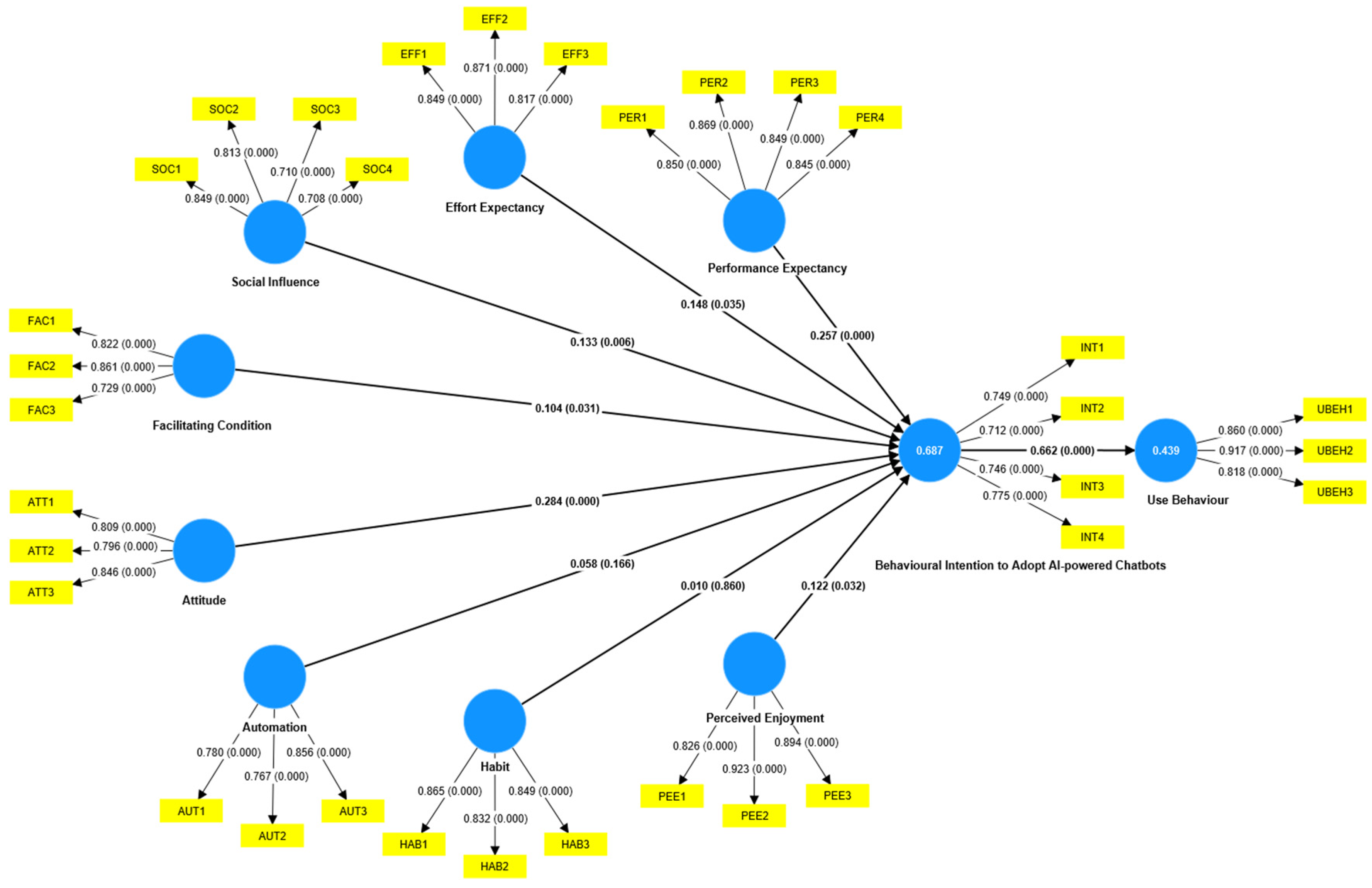

Disclaimer/Publisher’s Note: The statements, opinions and data contained in all publications are solely those of the individual author(s) and contributor(s) and not of MDPI and/or the editor(s). MDPI and/or the editor(s) disclaim responsibility for any injury to people or property resulting from any ideas, methods, instructions or products referred to in the content. |
© 2026 by the authors. Licensee MDPI, Basel, Switzerland. This article is an open access article distributed under the terms and conditions of the Creative Commons Attribution (CC BY) license.