


Highlights
What are the main findings?
- Tourism’s conceptual foundations and institutional arrangements position space as context, and the travelling subject as the starting point of inquiry. A survey of 353 degree programmes at the fifty highest-ranked universities on each continent finds 71% within faculties of business, management, economics, hospitality or events, and 1.4% within architecture or the built environment.
- The moral ranking of tourism developments derives from nomenclature, not from spatial evidence. A comparison of two properties operated by a single hotel group records the 24-tent safari lodge at approximately twelve times the carbon intensity per occupied room night of the 300-room urban tower.
What are the implications of the main findings?
- Tourism would establish space as the central point of inquiry, from which its different lines of research depart with their own questions. Research and teaching accordingly require a stronger presence within landscape planning, architecture and the built-environment disciplines.
- Spatialising tourism integrates landscape planning into tourism development. It reconsiders tourism’s categories on spatial grounds, with no label taken as given.
Abstract
Tourism studies have long centred the travelling subject, classifying practices and distinguishing sustainable from mass tourism to establish what counts as responsible development. Within this structure, space enters as context or impact, not as a condition shaping what tourism becomes in a given place. Geographical scholarship has examined tourism through place, mobility, land use, and environmental change, yet these contributions have not reshaped the practices through which tourism is developed and evaluated. Drawing on tourism’s definitional, disciplinary, moral and classificatory traditions, this paper examines how space has been subordinated to the priorities of the tourist and the industry. A survey of 353 degree programmes at the fifty highest-ranked universities per continent finds 71% within business, management, economics, hospitality or events faculties, and 1.4% within architecture or the built environment. A comparison of two properties operated by one hotel group records a 24-tent safari lodge at twelve times the carbon intensity per occupied room night of a 300-room urban tower. The paper calls for spatialising tourism: establishing space as a primary analytical lens in tourism research, education and planning, supported by a transferable approach that holds across contexts yet varies by site, and by sustained exchange between tourism and the spatial disciplines.
1. Introduction
Following the Industrial Revolution and the rise of environmentally conscious development, tourism increasingly shifted towards greener approaches. This transition introduced a range of concepts and definitions intended to address environmental concerns and promote more sustainable forms of tourism development. However, a closer examination of tourism planning and implementation reveals that these concepts are not always reflected in practice. The ideals the global tourism sector seeks to achieve are often undermined by conceptual frameworks that oversimplify the complexities of tourism development and fail to capture the realities of how tourism projects are planned, implemented, and managed.
Tourism has been caught in a race to classify its practices into the good and the harmful, wrapped in a moral rhetoric that positions certain forms of tourism as ethically superior and others as inherently damaging (Butcher, 2003). Call it ‘sustainable tourism’, and it is encouraged. Call it ‘mass tourism,’ and it is discouraged. These classifications judge tourism without considering the spaces in which it occurs. Without a spatial reading, the labels and the moral weight they carry remain abstract and detached from the specific territories, communities, and ecological conditions that would determine whether they would hold (Moscardo & Murphy, 2014). For example, is the construction of large-scale hotels to accommodate major events, such as the FIFA World Cup, compatible with the protection of sensitive landscapes? In an area of high landscape value, should accommodation for 600 rooms be provided through two 300-room hotels, or would a more dispersed model such as one 300-room hotel complemented by ten 30-room lodging facilities better balance visitor demand with environmental and landscape conservation objectives? Such questions remain relevant across all stages of tourism development, from policy formulation to implementation.
During the early transition towards greener forms of tourism development, tourism concepts and definitions were broadly aligned with the physical characteristics of tourism establishments and their spatial footprints. Over time, however, this relationship has weakened. As tourism has evolved, many typologies have retained their original labels despite substantial changes in their scale, density, and spatial configuration. This growing disconnect between tourism typologies and their spatial attributes has made many established concepts and definitions increasingly misaligned with the realities of contemporary tourism development.
Tourism studies have long sought to stabilise their object of study across a wide range of disciplinary, theoretical, and methodological trajectories (Airey & Tribe, 2005; Butler, 1980; Cohen, 1972; Jafari, 2001; Leiper, 1979; MacCannell, 1976; Smith, 1977; Tribe, 1997; Urry, 1990). This breadth reflects the nature of the subject itself: tourism ‘can be stretched to encompass a wide range of phenomena’ (Tribe, 1997). The field has built its knowledge around the travelling subject, the tourism system, the industry, and the category, and that work has been foundational. Space has its own tradition within this body of work, developed through destination development, carrying capacity, tourism planning, and the critical geography of tourism (Britton, 1991; Butler, 1980; Gunn & Var, 2003; O’Reilly, 1986; Pearce, 1989). That tradition remains active and has produced handbooks and research agendas of its own (Cheer & Mostafanezhad, 2025; Hall & Page, 2006; Lew, 1999; Müller, 2019). Its position within the field is the issue. Space enters tourism studies as context, resource, or impact, something tourism happens in or to, and it surfaces where consequences get assessed rather than where the object gets defined. What the field has not done is establish space as the primary lens through which tourism is theorised and evaluated.
This paper therefore makes the case for spatialising tourism. When research and practice overlook the space in which tourism occurs, the judgements that follow risk being incomplete, reductionist, or misleading. Despite tourism being fundamentally a spatial phenomenon, its dominant theories, classifications, and educational structures have largely privileged the tourist over the territory in which tourism unfolds. The argument proceeds through four interrelated lenses—the definitional, disciplinary, moral, and classificatory—developed in the sections that follow. Before turning to these, the paper examines the spatial literature tourism studies has already produced, to establish what that literature has achieved and why its achievements have not yet reshaped the field’s governing frameworks.
2. Tourism’s Spatial Scholarship and Its Containment
Spatial research on tourism goes back several decades, and the body of work it has produced is substantial. This tradition has examined how destinations form and change over time, and how the places tourism enters emerge through contested relations rather than arriving ready-made (Britton, 1991; Mullins, 1991; Saarinen, 2004). Since the late 1990s, the work has consolidated into a recognisable subfield with its own handbooks, research agendas and methodological debates (Hall & Page, 2006; Lew, 1999; Müller, 2019). It has also changed character, moving from an applied meeting of geography and tourism management toward a critical social science concerned with place, environment and the politics of spatial production (Cheer & Mostafanezhad, 2025).
The question is where that research sits in relation to the rest of the field. Spatial knowledge about tourism is produced largely within a subfield that describes its own position in borderland terms, as having long existed on the verge of disciplinary borders (Cheer & Mostafanezhad, 2025). Writing from inside it, Saarinen (2019) asks why tourism research is still treated as an unserious subject within geography, and warns that tourism geographies may remain peripheral to the discipline’s wider debates. The subfield is contained twice over. It has not been fully absorbed into geography, and its findings have not restructured the instruments through which tourism is defined, counted, classified, certified, and taught. Tourism studies assembled those instruments elsewhere, and has never rebuilt them around what tourism geography knows.
This situation has a long history, and the terms of the present argument were set out decades ago. Britton (1991) argued that geographers had failed to theorise tourism adequately, and that tourism deserved attention precisely because it reveals how the social meaning and physical form of places are produced and then drawn into processes of accumulation. His call was for a critical geography of tourism, not a descriptive one. That call was answered, and critical tourism geography developed much as he proposed.
Spatial scholarship on tourism has produced theory as well as evidence. Destinations appear in this work as historical formations whose identities emerge through competing discourses, read through the spatialisation of social theory (Saarinen, 2004). Other work develops a relational account, in which tourism space takes shape through power geometries and unfinished interrelations, and holds that the space of tourism has received too little rigorous theoretical attention given how urgently a more just tourism is needed (Tomassini & Lamond, 2023). Research on touristification, gentrification and overtourism gives these positions empirical weight, documenting what concentrated visitor presence does to housing markets and to the social fabric of historic centres (Cocola-Gant, 2018; Milano et al., 2019). Sarantakou (2023) argues that typologies built on geographical dimensions have historically offered the most appropriate basis for strategic planning, and proposes organising destinations as urban, island, coastal, and mountainous. The proposal matters because it accepts that territorial conditions should govern how tourism is planned. These contributions provide the conceptual basis for reading tourism spatially.
Spatial methods have also made significant contributions to tourism research. Studies mapping tourist flows, modelling capacities and analysing land-use change have provided increasingly detailed evidence of tourism’s spatial patterns and impacts (Córdoba Azcárate, 2025). The categories through which the field organises tourism do not change in response to what that spatial evidence shows. In practice, the spatial data guides siting, zoning and the mitigation of identified impacts. In practice, the evidence guides siting, zoning and the mitigation of identified impacts. Economic and commercial considerations largely settle the scale, built form and type of tourism a project delivers, and spatial evidence, in many cases, enters that process as a parallel input, not a determining one.
One strand of that literature comes closest to the position argued here. Mullins (1991) identified tourism urbanisation as a distinct form of city building organised around consumption rather than production, which established tourism as an agent of settlement rather than a visitor to it. Gohar (2021) extends this historically, tracing how destinations, mobility systems, and travellers have shaped one another across successive eras, and concluding that tourism’s development cannot be explained by demand alone, because the form of the destination and the mobility available in a given period are equally determining. He also identifies why the connection remains underdeveloped. Tourism is studied through specialised optics—anthropological, economic, cultural, and hospitality-based, and it is housed in departments that rarely share a platform on which the relationship between tourism and the built environment could be examined (Gohar, 2021).
3. Methods
The following four lenses unpack and examine the central hypothesis that, without spatialising tourism, our understanding and evaluation of tourism will remain fundamentally flawed. By investigating tourism through definitional, disciplinary, moral, and classificatory lenses, this paper demonstrates how the omission of spatial considerations leads to incomplete knowledge and misguided judgments. We selected these four lenses because each corresponds to a point at which the field produces and organises knowledge about tourism: how the field defines it, where it institutionalises it, how it morally evaluates it, and how it sorts its practices. Other lenses are possible, and these four are not claimed to exhaust the field’s knowledge practices.
Each lens draws on a distinct body of material and raises a distinct question about where space has been missing, and what a spatial reading would add that is not there now. Two decisions govern the application of these lenses. The first concerns what counts as spatial content. Space can be understood in absolute terms as a grid of positions, in relative terms through accessibility and connections between places, or in relational terms through the wider processes that constitute a place (Harvey, 2006). A framework may therefore refer to place and still treat it as a coordinate, fixing where tourism happens without letting the conditions of that place bear on how tourism is defined or judged. Spatial content is understood here in the relative and relational senses, with an emphasis on the latter. The second concerns what is examined. The lenses are applied to the instruments through which the field works, its definitions, curricula, typologies and standards, and not to the research literature, which has produced substantial spatial scholarship without reshaping those instruments.
Through the definitional lens, we first ask whether tourism is defined spatially or primarily through non-spatial attributes such as movement, duration, and visitor motivation. The definitions examined are those in active institutional and scholarly use: the formulations issued by international organisations, and the foundational definitions through which the field first established its object. What changes if tourism is instead understood from the characteristics of the place being entered: its landscape, communities, history, and governance?
Through the disciplinary lens, we examine whether tourism is taught and researched as a spatial discipline or remains predominantly embedded within business, management, and hospitality education, where spatial inquiry is often peripheral. Working down the Times Higher Education ranking on each continent, the survey took the fifty highest-ranked universities offering tourism degree programmes (Times Higher Education, 2026). Oceania yielded twenty-five, the only universities there found to offer such programmes, giving a sample of 275 institutions. The survey identified 353 programmes at bachelor’s and master’s level across them, each recorded alongside the faculty that houses it. Appendix A presents ten universities per continent as a sample; the full dataset is available as Supplementary Materials.
Through the moral lens, we reconsider tourism’s moral framework. The longstanding distinction between sustainable and mass tourism often assigns normative value to tourism types without adequately considering the spatial contexts in which they occur. We examine this through the sustainable and mass tourism literature, and through a comparison of two properties operated by a single hotel group. We argue that ethical evaluation should emerge from the interaction between tourism and place, rather than from predefined categories alone.
Finally, through the classificatory lens, we question whether existing tourism typologies adequately account for spatial conditions or merely classify tourism according to tourists’ motivations. The typologies examined are those in general circulation, as they appear in textbooks and in destination marketing material. Categories such as cultural, adventure, or religious tourism may occur in radically different territorial contexts, yet these spatial differences are rarely reflected in the classification itself.
3.1. The Definitional Lens
The first attempts to define tourism emerged at the turn of the twentieth century, when the phenomenon began to be recognised as an economic activity with measurable effects. Yet from the outset, definitions have struggled to keep pace with what tourism is. There are ‘as many definitions as the number of authors discussing the topic,’ a condition that reflects the complexity of a phenomenon connected to nearly all sectors of human social activity (Beni, 2001, cited in Cunha, 2012). Definitions of tourism have multiplied over decades, with most centring on the travelling subject, on defining who the tourist is, measuring their movement, duration, and motivation, while paying comparatively less attention to the supply side: the places, resources, and spatial conditions that make any tourism practice possible in the first place (Cunha, 2012). The definitions examined here are drawn from the two traditions through which the field has established its object: the operational formulations adopted by international bodies for the purpose of measurement, and the conceptual formulations that textbooks and review literature treat as foundational. This section traces how that tendency has shaped what tourism is understood to be, and where space has been left underdeveloped in the process.
The earliest formal definitions were operational, designed to enable statistical comparison rather than conceptual understanding. Bormann (1931) characterised tourism as journeys undertaken for pleasure, commercial purposes, or other reasons, during which the absence from home was temporary. The definition’s spatial content was minimal: tourism was defined by departure and return, with the destination registering only as the place of temporary presence. Hunziker and Krapf (1942) extended this into the field’s most influential early formulation, tourism as ‘the sum of the phenomena and relationships arising from the travel and stay of non-residents, insofar as they do not lead to permanent residence and are not connected with any earning activity,’ adopted by the International Association of Scientific Experts in Tourism and held as the standard for decades. The spatial logic was not much different from Bormann’s: the tourist is still defined by what they are not, a non-resident, and the destination appears only as the site where they temporarily stop.
International bodies continued to refine this operational tradition. Each revision attempted to keep pace with the expanding reality of tourism practice. The most significant refinement was the notion of the ‘usual environment,’ a threshold introduced to separate tourism from everyday mobility, marking the tourist as someone who has stepped outside the spatial boundaries of their routine life (United Nations World Tourism Organisation, 1994). It was, in essence, a tool for identifying who counts as a tourist, and it worked reasonably well for that purpose. But what counts as ‘usual’ is not a fixed geographical condition. It depends on individual experience, perception, and spatial habits, which makes the threshold at once formally precise and practically arbitrary (Govers et al., 2008). The threshold is spatial in form and locational in substance. It establishes where a person stands in relation to a boundary, and nothing about the place they have entered bears on what their presence there is taken to be.
The United Nations World Tourism Organisation (UNWTO) carries this notion forward, describing tourism on its website as ‘a social, cultural and economic phenomenon which entails the movement of people to countries or places outside their usual environment’ (United Nations World Tourism Organisation, n.d.), while its own glossary reduces this to four words: ‘Tourism refers to the activity of visitors’ (United Nations World Tourism Organisation, n.d., 2010). The gap is telling. One gestures toward tourism’s broader social and cultural dimensions; the other brings it back, without elaboration, to what a particular category of person does. In both cases, the space being visited remains the threshold crossed.
The conceptual tradition attempted something more ambitious: to characterise tourism as a system of phenomena and relationships. MacCannell (1976) offered one of the earliest and most spatially suggestive accounts, arguing that tourist sites are staged, organised into front and back regions arranged to produce the authenticity tourists seek. Space here is actively constructed rather than passively encountered, anticipating by decades the idea that destinations are produced rather than found. What remains in the background, however, is what drives that production: the staging is explained through the tourist’s search for authenticity, with the space functioning as the setting for that search. Leiper (1979) also gave tourism some of its most explicitly spatial vocabulary, proposing that tourism involves tourists, generating regions, transit routes, destination regions, and a tourist industry in functional and spatial connection. The vocabulary is spatial throughout, yet the regions it names are positions in a system of flows, distinguished by their function in the movement of tourists and not by any condition of their own.
Mathieson and Wall (1982) broadened this further, adding the activities tourists undertake during their stay and the facilities created to serve them, acknowledging that tourism is not only movement but a complex of practices that unfolds at the destination. Tribe (1997), building on McIntosh et al. (1995), pushed the frame wider still, understanding tourism as the sum of phenomena and relationships arising from the interaction, in generating and host regions, of tourists, business suppliers, governments, and communities, and environments. For the first time, the receiving community and its environment appeared as actors with a stake in what tourism produces, and not merely as a backdrop against which it unfolds.
Table 1 traces this pattern across the definitional tradition surveyed above, from Bormann’s earliest operational formulation to the UNWTO’s current definition. What emerges is a consistent asymmetry: the travelling subject is present in every definition examined, while communities, environments, and facilities appear only partially and inconsistently, and space as a prior condition is absent throughout. The usual environment, by contrast, is marked across nearly every tradition. It is a threshold defined from the traveller’s side, locating tourism in relation to where the visitor normally lives and not in relation to the place they enter. Even Tribe’s (1997) formulation, the most conceptually expansive of those reviewed, incorporates communities and environments without treating the space they inhabit as a condition that precedes and shapes tourism’s arrival. Yet this is precisely where the spatial dimension becomes most legible. People travel toward places that existed long before any tourism infrastructure was built around them and were never designed to serve visitors; the attractions that draw tourists are mostly natural and cultural resources whose value predates the industry now organising access to them (Cunha, 2012; Crompton, 1979; Lickorish & Jenkins, 1997).
Table 1.
Elements foregrounded across eight definitional traditions. Circles indicate the extent to which each element appears in the definition: ● explicit and central, ◕ substantially present, ◐ partially present, ◔ marginally present, ○ absent. Source: Authors.
3.2. The Disciplinary Lens
Whether tourism is a discipline, a field, or something else entirely has been debated for decades without resolution. The positions taken have ranged across indiscipline, multi-discipline, cross-disciplinary, interdisciplinary, and post-disciplinary, and the debate remains more or less inconclusive (Butowski, 2016; Coles et al., 2005). Tourism academic degrees are predominantly offered within business, management, and hospitality faculties, and less frequently within the social sciences and humanities. They are only rarely situated within geography, planning, or landscape architecture studies, despite tourism being inherently spatial in nature (Airey, 2008; Echtner & Jamal, 1997). This institutional positioning is far from neutral. This section demonstrates tourism’s longstanding location within business and management education, which has largely shaped the questions the field asks, privileging markets, consumers, and industry performance while marginalising spatial inquiry.
Tourism did not enter the university through the front door. Its origins were vocational, built around training people for an industry instead of building knowledge about a phenomenon (Airey, 2008). What eventually gave it an institutional and scholarly infrastructure was a gradual accumulation of specialised journals, conferences, research networks, university programs, textbooks and a cumulative body of knowledge, what Jafari (2001) called the ‘scientification’ of tourism. Without it, tourism would have remained on the margins of the academy, too close to industry training to be taken seriously as scholarship. But the institutional homes the field moved into were mainly business and management faculties, and that placement has pulled tourism knowledge toward economic and managerial concerns ever since. Cohen (1979) noticed early on that tourism research was fragmented across adjacent disciplines, each bringing its own frameworks without anything holding them together. What a business faculty is equipped to examine is the market, and the territory in which that market operates falls outside its questions.
As the field grew, the fragmentation did not resolve; it deepened. Tribe (1997) gave it its sharpest diagnosis: tourism has no distinctive conceptual network of its own, no shared criteria for what counts as valid knowledge, nothing connecting its parts beyond the object they all happen to study. He further argued that disciplinary frameworks do not only organise knowledge, but they can also constrain it, rewarding certain ways of seeing while quietly closing off others (Tribe, 1997). In tourism, that constraining force has been economics, directing the field’s attention toward growth, market performance, and industry efficiency, while spatial and humanistic orientations have had to work harder to find a footing. To address the fragmentation, Tribe proposed separating the business dimensions of tourism from its non-business ones, the social, humanistic, and environmental (Tribe, 1997). The distinction was useful, but naming business as one coherent half of tourism knowledge gave institutional legitimacy to an arrangement that was already prevailing on the ground. Tourism’s disciplinary condition cannot be understood apart from the institutional conditions under which its knowledge is produced (Echtner & Jamal, 1997). Over time, the field has tended to reward industry relevance and economic measurability, and those priorities get passed on through the academic communities that teach, publish, and hire within it (Tribe, 2006, 2010). Spatial inquiry enters such an arrangement only in the form those priorities can register, as an impact to be measured and managed.
To document this institutional pattern empirically, we recorded the faculty, school, or department administering each of the 353 programmes identified across the 275 institutions surveyed, and grouped these into six broad categories: Business, Management and Economics; Social Sciences, Humanities and Arts; Geography, Environment and Planning; Tourism, Hospitality and Events; Architecture and Built Environment; and Other or Interdisciplinary. These categories combine closely related units under a single heading to allow comparison across institutional systems that vary considerably in how they name and structure faculties.
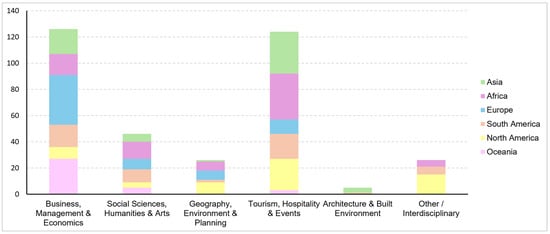
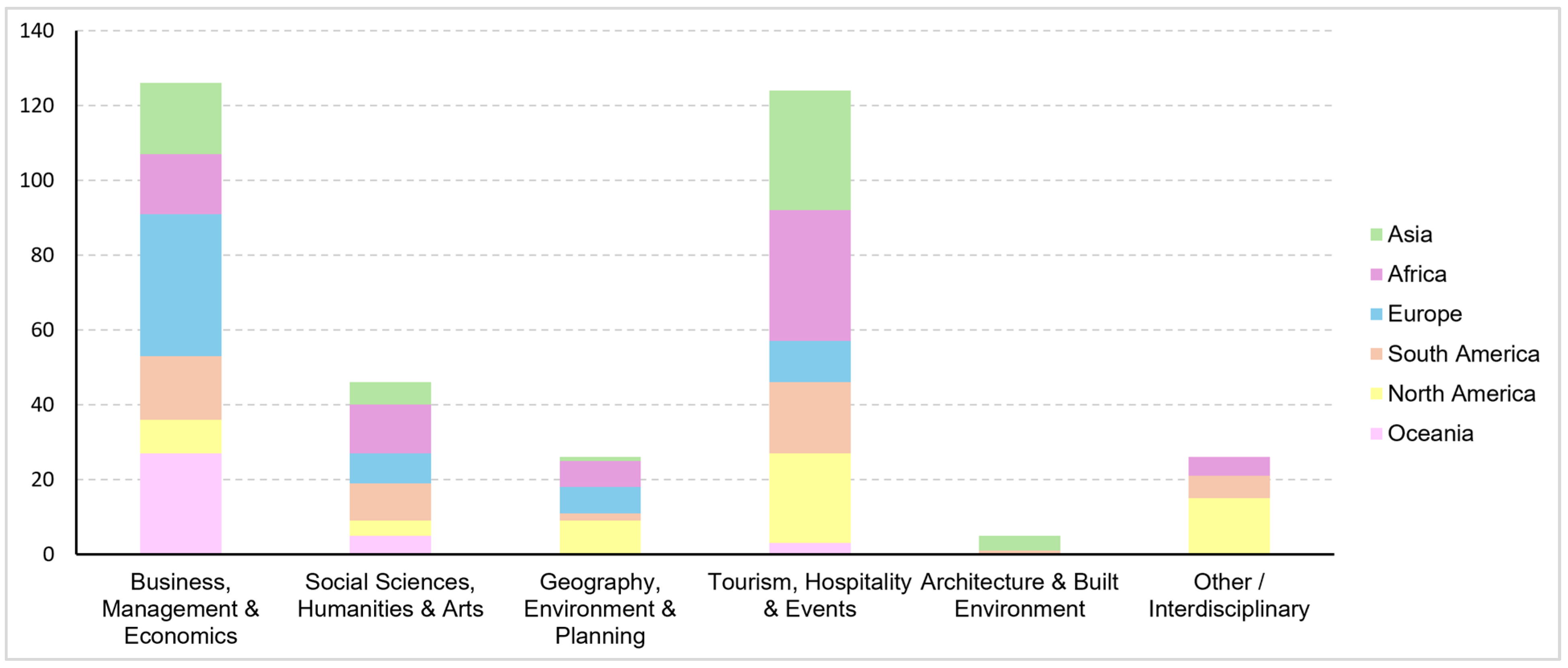
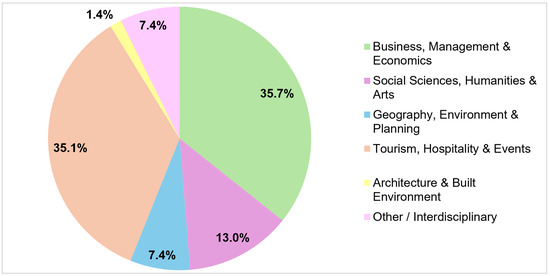
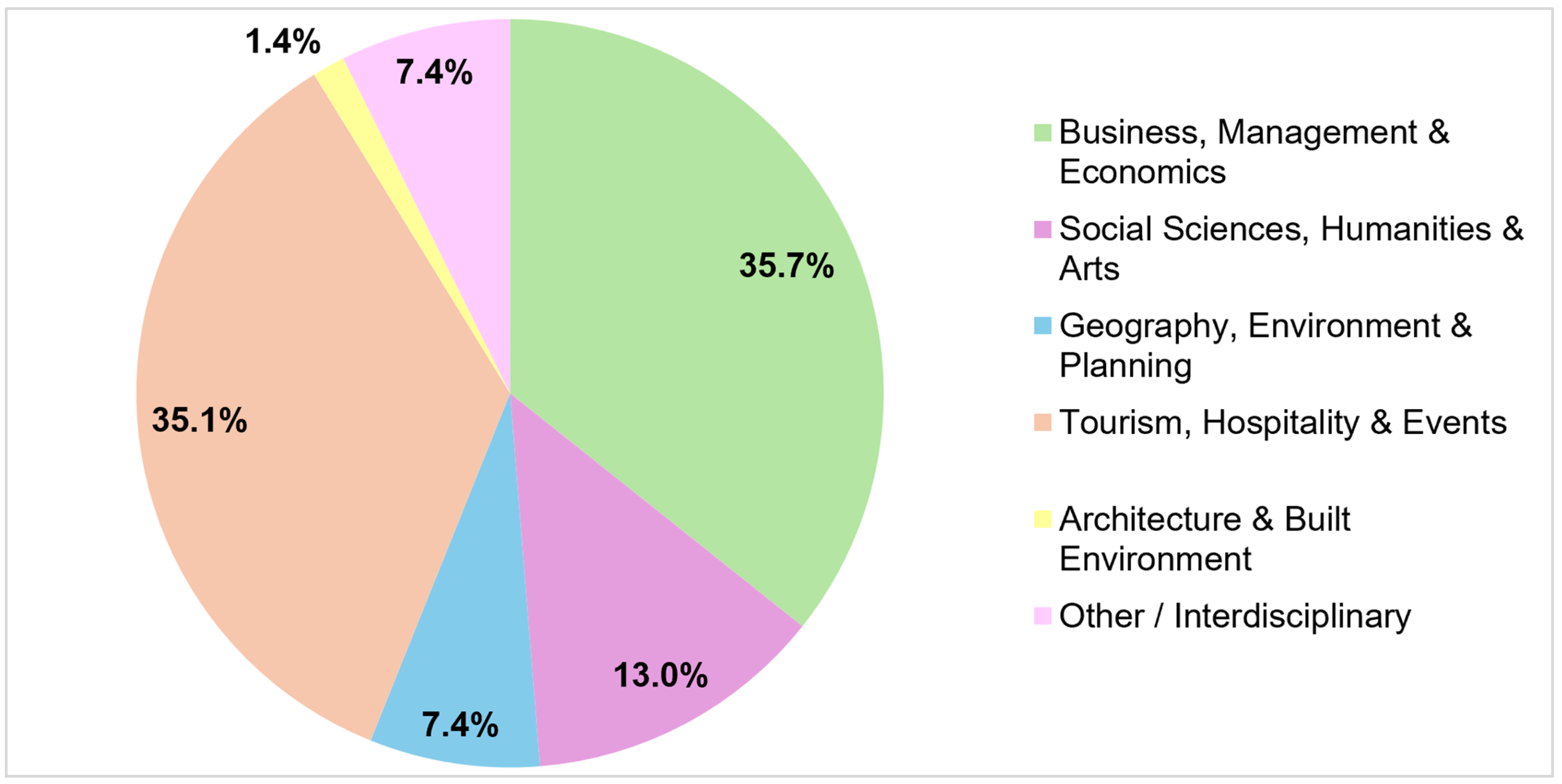
Table 2 presents the resulting distribution of tourism programmes by combined faculty category across the six continents surveyed. Figure 1 shows the distribution within each category, where Business, Management and Economics and Tourism, Hospitality and Events remain consistently large on every continent and are not driven by any single region. Figure 2 aggregates across continents: these two categories account for 70.8% of programmes surveyed, while Geography, Environment and Planning and Architecture and Built Environment together represent 8.8%, of which Architecture and Built Environment alone accounts for 1.4%.
Table 2.
Distribution of tourism degree programmes by combined faculty category across six continents, based on a survey of the top universities offering tourism degrees per continent (top 50, except Oceania, top 25), ranked by Times Higher Education (2026). Source: Authors.
Figure 1.
Distribution of tourism programmes by faculty category and continent, showing the continental composition within each category. Source: Authors.
Figure 2.
Overall distribution of tourism programmes across faculty categories, aggregated across all six continents surveyed. Source: Authors.
3.3. The Moral Lens
Alongside its typologies, tourism developed a moral vocabulary. From the 1980s onward, the field began ranking practices as well as naming them. Mass tourism sat at one end: high-volume, standardised, tied in the literature to environmental degradation, cultural erosion, and the flattening of places (Krippendorf, 1987; Turner & Ash, 1975). At the other end stood its correctives, sustainable tourism, ecotourism, alternative tourism, responsible tourism, presented as lower in volume, more sensitive to local cultures and ecosystems, and more ethically defensible (Butler, 1999; Wearing & Neil, 2009). This binary has shaped tourism policy, education, and research for four decades. Recent scholarship has begun to question whether it holds up, whether the distinction between sustainable and mass tourism, as it currently stands, is actually sufficient to guide policy or evaluation (Butcher, 2003; Jamal & Higham, 2021). This section examines why the opposition between mass and sustainable tourism is not enough for evaluating tourism practice, problematising the suggestion of a judgement before the practice is examined.
The elevation of mass tourism to the status of paradigmatic negative case was never a foregone conclusion. Mass tourism is not a self-evident category; it had to be built, assembled from assumptions about what tourism ought to look like, whose interests it should serve, and what kinds of relationships it should cultivate with the places it moves through (Butcher, 2020). Those assumptions were shaped by a broader cultural politics in which the package holidaymaker, the charter flight passenger, the all-inclusive resort guest came to stand as the mirror image of everything the responsible, culturally attuned traveller was supposed to be. The critique of mass tourism has never been purely environmental. Beneath the ecological concerns lies something else, a practice of social distinction, which is why the debate between mass and alternative tourism has been driven far more by ideological positioning than by rigorous comparative analysis. Sustainability, in this light, is not a neutral label. It can quietly function as a moral discourse, a way for tourists to distance themselves from the mass tourist and, in doing so, to claim a more virtuous relationship with the places they visit (Butcher, 2003; Mowforth & Munt, 2015; Munt, 1994; Theng et al., 2015).
Examined closely, this binary complicates considerably. Mass tourism, understood as high-volume, concentrated visitation, does not produce uniform outcomes. The same volume that overwhelms one destination’s infrastructure and displaces its residents can, in another, concentrate pressure within a defined area and spare the surrounding landscape from dispersal. Which of the two scenarios occurs cannot be determined without reading the space itself. The corrective logic of alternative tourism is equally vulnerable to spatial scrutiny.
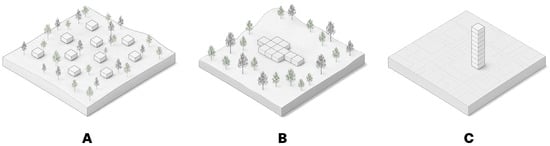
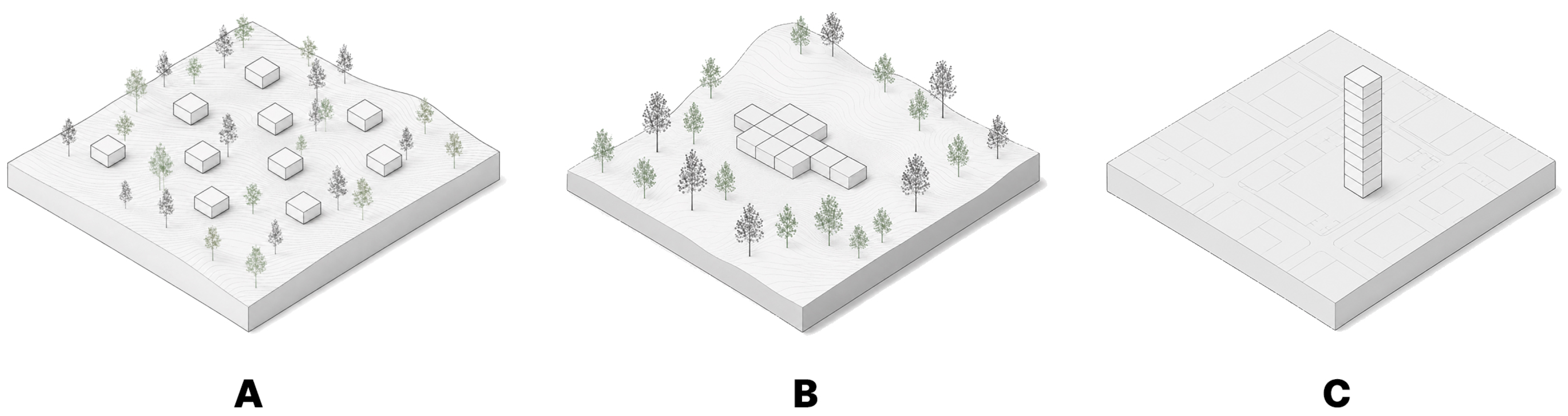
Consider the scenarios in Figure 3: a single three-hundred-room hotel, concentrated and vertical; ten thirty-room ecolodges scattered across the landscape; or three hundred rooms distributed horizontally in a single cluster. The total capacity is identical across all three. By the conventional logic of the ethical binary, the dispersed ecolodges are preferable: lower density, smaller scale, closer to nature, ticking all the ecotourism boxes. Yet the clustered horizontal option, which shares the same capacity and the same lodge typology, already begins to unsettle that verdict. What appears more sustainable at the level of the label may tell a different story on the ground. The dispersed option spreads across a wider territorial surface, reaching into areas that concentrated development would have left untouched, while the clustered option limits territorial penetration without sacrificing scale. Whether any configuration is better depends entirely on the spatial conditions of the specific site. Without that spatial assessment, any ethical verdict is premature.
Figure 3.
Three scenarios of equal accommodation capacity: (A) dispersed low-rise units extending across the landscape; (B) clustered low-rise units contained within a defined footprint; and (C) a vertical tower concentrating the same capacity within one plot. Source: Authors.
This is not an argument against small-scale or nature-based tourism, but against treating scale, format, and marketing label as adequate proxies for spatial impact. The ecotourism label illustrates the problem: its very success in attracting visitors to sensitive areas has in many cases produced the degradation it was designed to prevent, as certification itself increases visitor pressure (Buckley, 2004), leaving open whether ecotourism can deliver on its promise, a question that depends far more on the spatial conditions of the destination than on the label applied to it.
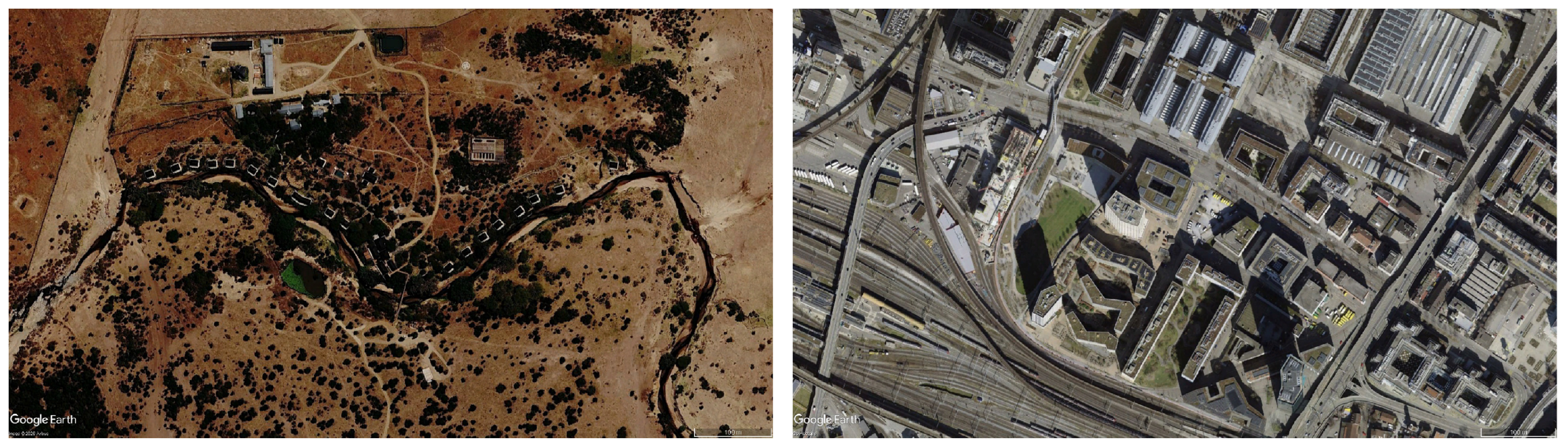
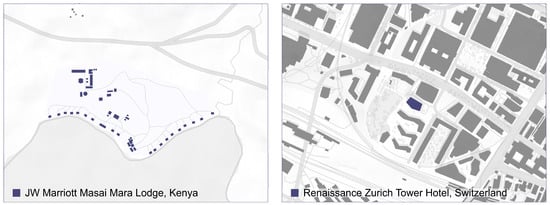
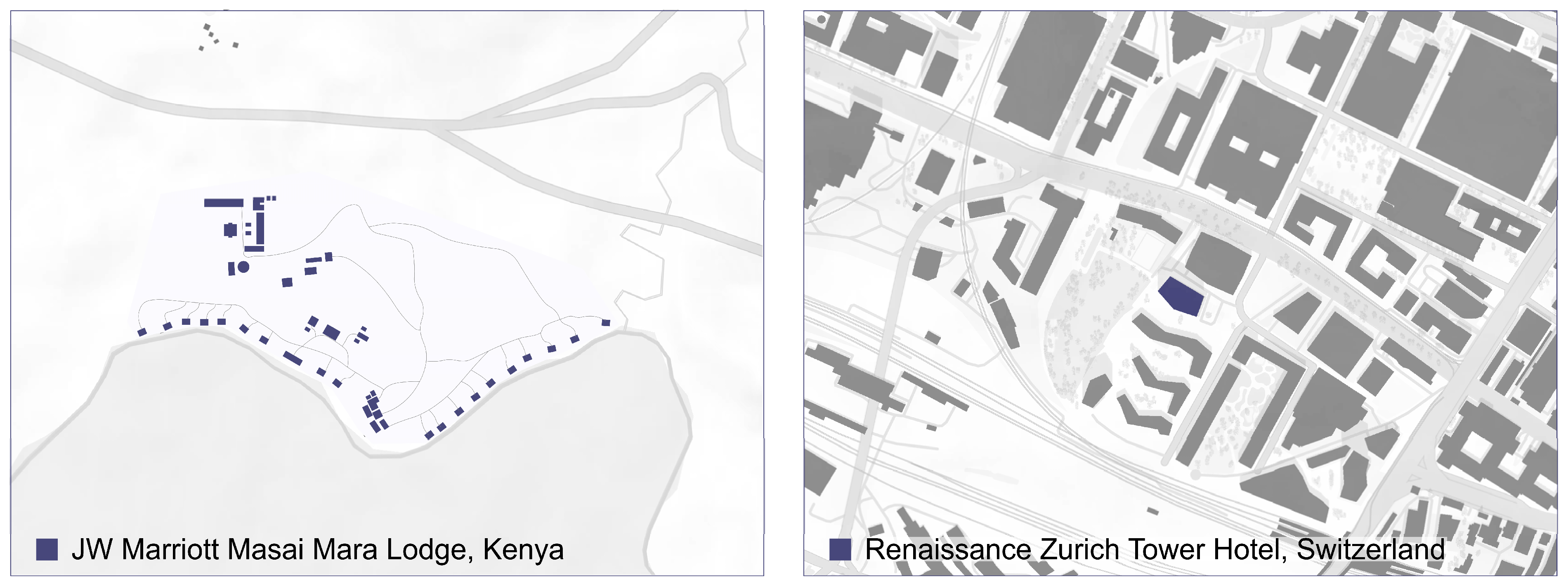
As an example, shown in Figure 4, the JW Marriott Masai Mara Lodge in Kenya, twenty-four private tents and associated amenities with a built footprint of approximately 7233 square metres, set within a far larger open wildlife conservancy, reports a carbon footprint of 49.52 kg CO2e per room night (Marriott, n.d.-a). The Renaissance Zurich Tower Hotel in Switzerland, a three-hundred-room, fifteen-storey urban tower sitting on a ground footprint of approximately 1400 square metres, reports 3.99 kg CO2e per room night from the same group’s published data (Marriott, n.d.-b). The lodge occupies more than five times the ground area of the tower (see Appendix B), is dispersed across a sensitive natural environment, and produces more than twelve times the carbon per room night. The type and the label all suggest the lodge is the more responsible option. The carbon and territorial footprints complicate that assumption. The point is not that urban towers belong in wildlife conservancies, but that spatial conditions, the nature of the land, the energy infrastructure available, the ecological sensitivity of the site, and many other spatial factors should inform assessment before a category is assigned.
Figure 4.
JW Marriott Masai Mara Lodge, Kenya (left): 24 tents and associated amenities, single-storey, ground footprint approximately 7233 m2. Renaissance Zurich Tower Hotel, Switzerland (right): 300 rooms across 15 storeys, ground footprint approximately 1400 m2. Source: Authors, drawings based on Google Earth (2026) and information from Marriott (n.d.-a, n.d.-b).
3.4. The Classificatory Lens
Over the past several decades, tourism has accumulated a remarkable number of labels. Cultural tourism, wellness tourism, medical tourism, religious tourism, dark tourism, adventure tourism, rural tourism, urban tourism, gastronomic tourism, volunteer tourism, and the list keeps growing. These terms come from different places and serve different purposes. Some emerge from academic research, others from marketing campaigns, development policy, or media coverage. Some name genuine distinctions in practice; others are market segments dressed as analytical or aspirational categories. New practices emerge as society changes and naming them is necessary. The problem is that classification has become a substitute for analysis, giving the field the appearance of specificity while obscuring something more fundamental: none of these categories tells us anything meaningful about the space in which the practice occurs. This section examines how tourism’s typological tradition, built around tourist motivation and activity, has produced categories that travel across contexts without reading them.
Tourism typologies have been built, almost without exception, around two organising principles: what tourists do, and why they do it. Activity-based classifications group practices by their primary content: cultural tourism involves cultural heritage, adventure tourism involves physical challenge, religious tourism involves sacred sites. Motivation-based classifications organise tourists by the psychological or social drivers of their travel, including Plog’s (2001) distinction between allocentric and psychocentric travellers, Cohen’s (1979) phenomenological spectrum from recreational to existential tourism and Smith’s (1977) typology from explorer to charter tourist. Both approaches have been productive in their own terms. They have generated a substantial body of research on tourist behaviour, destination marketing, and product development. What they share is a consistent starting point: the tourist. The place being visited enters these frameworks mainly as the mere setting for an experience.
The result is a classificatory system that says very little about where tourism happens. Tourism types do, to some extent, gesture toward the kind of attractions a place holds: cultural tourism implies heritage, wellness tourism implies natural or therapeutic resources, religious tourism implies sacred sites. But the label stops there. Cultural tourism is perhaps the clearest example. It covers the historic city centre struggling under the weight of visitor numbers, the remote indigenous community negotiating what it means to share its heritage with outsiders, the post-conflict city using culture to rebuild its image, and the rural landscape that has turned its agricultural character into a product.
These are not variations on the same thing. They involve different land, different communities, different histories, and different stakes. Yet they all carry the same label, as though the category itself were enough to tell us what is going on. But the real difficulty runs deeper than the definitional imprecision. The category was never built to register the spatial difference in the first place. The same pattern runs through the rest of the typological landscape. Wellness tourism brings together urban spa breaks, mountain retreats, and coastal thalassotherapy under one heading, practices that share a motivation toward health and restoration but take place in very different environments, with different consequences for land, communities, and ecology.
The epistemological project of tourism studies requires rigour in the use of concepts. Labels should carry analytically grounded content, not just descriptive or promotional currency (Butowski, 2016; Cunha, 2012). Tourism classification has grown without a spatial foundation, and without one, there is no basis for distinguishing between practices that are genuinely different in kind and those that differ only in motivation or market positioning. A classification built on motivation alone cannot explain why cultural tourism in Venice produces a crisis while cultural tourism in a smaller city sustains a functioning neighbourhood. Nor can it explain why rural tourism regenerates some landscapes and strips others of what made them worth visiting, or why two destinations carrying the same wellness label produce opposite outcomes for the people who live there. These differences are not random. They are spatial. Yet a typology organised around tourist motivation has little vocabulary for analysing how such spatial differences are produced or experienced.
4. Results
Reading the four lenses together points to a single condition, not four separate deficiencies. In each domain examined, space is neither absent nor unknown, but it is consistently subordinate to another organising concern, whether that concern is the travelling subject, institutional convenience, tourist motivation, or moral labelling, as shown in Table 3. Even where spatial considerations do surface, they rarely extend far enough to shape how tourism itself is defined, evaluated, or taught. This distinction, between space as location and space as constitutive context, underlies each of the findings presented below.
Table 3.
Summary of key findings across the definitional, disciplinary, moral and classificatory lenses. Source: Authors.
Tourism’s definitional tradition, from its earliest operational formulations to its most recent conceptual expansions, has been built around the travelling subject. Definitions measure movement, duration, and motivation; they name the destination as a threshold to be crossed or an environment to be entered, but rarely as a condition with its own prior history, ecology, and territorial character. Even the field’s most expansive definitions, which incorporate host communities, environments, and governments as actors, describe these elements in relation to the tourist’s arrival rather than as constitutive of what tourism becomes in each place. Space, across this tradition, functions as a backdrop, a coordinate, or a destination category, never as the starting point from which a definition is built.
The disciplinary lens produced the clearest quantitative evidence of the pattern. Across the 353 tourism programmes surveyed in the top universities of six continents, 35.7 percent are administratively located within Business, Management and Economics faculties, and a further 35.1 percent fall under Tourism, Hospitality and Events schools, whose curricula, as documented in Section 2, are themselves predominantly oriented toward management, marketing, and operational training. Combined, these two non-spatial categories account for more than seventy percent of all tourism programmes surveyed. By contrast, Geography, Environment and Planning and Architecture and Built Environment together, the two categories most directly equipped to engage tourism’s spatial dimensions, account for only 8.8 percent of programmes globally, of which Architecture and Built Environment alone accounts for 1.4%. These percentages represent a strikingly minor share given how central spatial questions are to what tourism does.
This pattern holds with notable consistency across regions, though its intensity varies. In Oceania, 77.1 percent of programmes sit within Business, Management and Economics faculties, the highest concentration of any continent surveyed. Europe follows closely, with 59.4 percent of programmes under business-oriented faculties. In Africa and Asia, the picture shifts toward Tourism, Hospitality and Events schools, which host 46.1 percent and 51.6 percent of programmes respectively, but these schools do not represent a spatial alternative to the business orientation, as their curricula remain substantially management-focused. North America presents the most institutionally diverse picture of any region surveyed, with programmes distributed relatively evenly across faculty categories, and with Tourism, Hospitality and Events schools, at 39.3 percent, forming the largest category. It also holds the highest share of programmes under Geography, Environment and Planning of any continent, at 14.8 percent, though this remains a minority position within the region’s overall distribution.
The moral lens demonstrates that the sustainable versus mass tourism binary assigns ethical value to tourism types independent of the spatial conditions in which they occur. What counts as appropriate ecotourism in one context is not necessarily appropriate in another; the same model of small-scale, dispersed, nature-based development can regenerate one landscape and degrade another, depending on conditions the label itself does not register. An ecolodge can, under certain spatial conditions, score a higher environmental impact than the very hotel model it is presented as an alternative to, and replicating that ecolodge as a successful template across a site does not resolve the problem; it can simply reproduce it at scale. This divergence illustrates a broader pattern: ethical frameworks in tourism have developed independently of the spatial analysis that would be required to substantiate their claims.
The classificatory lens found that tourism’s typological systems are built overwhelmingly around tourist motivation and activity. Cultural, religious, adventure, wellness, and other categories organise tourism by what the visitor seeks or does, not by the spatial conditions of where they do it. The same label routinely spans radically different territorial situations; a historic urban centre and a remote rural community can both be classified as cultural tourism, while the spatial consequences of each are entirely distinct. No classificatory framework identified in this review incorporates spatial context as a defining criterion, rather than as an incidental descriptor attached after the type has already been assigned.
5. Discussion
The reproduction of tourism knowledge across its major domains, and the consistent omission of space within that reproduction, is the pattern this paper’s findings converge on. It is not confined to any one domain. It reinforces itself as it moves from one part of the field’s structure to the next. A definitional tradition organised around the travelling subject renders tourism legible as a set of behaviours to be measured and a market to be served, which is precisely the kind of object a business faculty is equipped to study. Once housed there, tourism inherits a curriculum oriented toward performance, competitiveness, and consumer demand. A field that measures tourism by its performance then needs a way to separate the forms it can defend from the forms it cannot, and the sustainable and mass binary supplies it. Classification answers that moral demand instead of preceding it, producing categories built from what a tourist seeks rather than where a tourist goes.
This circularity accounts for something the findings do not explain on their own: why a spatial literature as substantial as tourism geography has not reshaped the field around it. The barrier is not scarcity of spatial research, nor its recency, since the call for a geography capable of theorising how tourism produces places is now more than three decades old (Britton, 1991). The barrier is that each domain examined here draws its legitimacy from the others, so spatial findings entering at any one point meet a structure already braced against them. Spatial justice frameworks, GIS-based destination modelling, geographical typologies for planning and carrying capacity studies therefore accumulate alongside the field’s defining instruments without governing them. This is the distinction the paper has maintained throughout: between space treated as one variable among many and space established as the condition from which every other variable derives its meaning.
The value of the existing definitions is not in question. They have given tourism studies a language through which to identify its object, compare cases, and distinguish tourism from other forms of mobility, consumption, and exchange. Yet they have largely been built around the demand side of tourism, around the tourist, their motivations, their movements, and the experiences they seek, while the supply side has remained conceptually underdeveloped. Destinations are not neutral receiving sites. They are places with prior lives, communities, and conditions that shape what tourism can and cannot become within them. A definition that accounts for the tourist’s motivation, the industry’s services, and the host community’s response, but says nothing about the spatial character of the place itself, has described the system without describing the ground it stands on.
The disciplinary findings suggest that this closure operates across every region, though its intensity varies. The concentration of tourism education within Business, Management, Economics, Hospitality and Events faculties is present on every continent surveyed, with Europe and Oceania among the highest. This pattern holds across the Global South as well. The question this raises applies regardless of region but is especially pressing for ecologically sensitive destinations: whether graduates taught predominantly within management-oriented curricula are equipped to read the territorial and ecological consequences of the destinations they will go on to plan, develop, and govern.
This pattern recurs on the ground, at the level of individual tourism developments, as the comparison between the Masai Mara property and the Zurich hotel demonstrates. It is not that lodges are inferior to city hotels, a claim this paper has been careful to avoid. It is that the field currently possesses no standing mechanism capable of identifying such a discrepancy before a label is applied. Sustainability certification, destination marketing, and academic classification proceed from the same assumption: that a category, once assigned, conveys reliable information about impact. If this fails for a single metric, carbon per room night, there is little basis for assuming it holds once land tenure, water use, waste management and community governance are considered. The example is illustrative rather than exhaustive. Its function is not to adjudicate which property is preferable, but to demonstrate that such adjudication cannot be made without spatial information current classifications are not designed to require. The binary that underwrites these judgements has absorbed considerable energy over where its line falls and how sustainability should be measured, and far less over the prior question of better and worse for whom, and under what conditions. A label cannot answer that question. The specific ecology, territorial history and absorptive capacity of a site can.
What the classificatory tradition is missing is not a better taxonomy. More categories or finer sub-typologies would not solve the problem, because the problem is not one of precision, but of direction. Classifications have been built outward from the tourist: what they do, what they seek, what experience they are after. They are far less equipped to work inward from the place: what conditions a practice enters, what those conditions can carry, and what tourism’s presence will mean for them. As long as spatial context is treated as background rather than as constitutive of what tourism is, classification will keep naming practices without evaluating them.
The absence of space from tourism’s core structures of knowledge does not constitute a series of discrete oversights amenable to piecemeal correction, a course revised here, a certification standard amended there. It requires a reorientation, one that asks the field to treat context, territory and geography as questions it must answer. These are not only questions for scholarship. The same definitions, categories and standards operate in tourism development, where they set the terms on which proposals are assessed and approved. Addressing any single domain in isolation, definitional, disciplinary, moral, or classificatory, would leave the underlying structure unchanged, since each draws its legitimacy from the others. What is needed is a broader movement across the field, one that alters the structure itself rather than amending any single part of it.
6. Conclusions and Recommendations
6.1. Conclusion
Tourism’s conceptual foundations were not built with space at their centre. This does not diminish the contributions of tourism studies, which are substantial. It indicates instead that the field is marked by a spatial blindness so foundational and so institutionally entrenched that it has largely remained invisible to the discipline itself. Bringing space to the centre of tourism inquiry is not a corrective appendix to existing frameworks. It is an ongoing critical practice: a commitment to keeping the question of space permanently open, resisting the discipline’s recurring impulse to close it through classification, certification, and management.
What is required is not more GIS studies, nor spatial analysis added as a module within tourism management programmes, nor a larger seat at the table for geographers and planners. These would be welcome, but they would leave the foundational structure of the discipline intact. The spatial question, how tourism produces, transforms, and is conditioned by the spaces in which it occurs, is the question from which all others derive their meaning. When we ask what sustainable tourism is, we ask a spatial question. When we ask why ecotourism certification does not prevent ecological degradation, we ask a spatial question. The discipline has been answering spatial questions with non-spatial methods.
The same reorientation applies to how the discipline educates. Tourism education is overwhelmingly housed within business and management faculties, oriented toward the reproduction of existing spatial arrangements rather than their critical interrogation. A spatially grounded education would ask students to read a destination as a produced, contested, and layered space before reading it as a market or a management challenge. Such reorientation would not leave tourism where it currently sits. It would find the field appearing, increasingly and necessarily, in urban planning schools, geography departments, and schools of architecture and environmental design.
It applies equally to the categories and metrics through which the field has built its legitimacy. Visitor arrivals, receipts, GDP contribution, competitiveness indices: these are the terms in which targets are set and development decisions justified, yet none registers whether the territory can absorb what those targets imply. Moral categories present the same problem in a different form. A label is assigned before the spatial conditions are read, even where assessment procedures exist. But whether a practice delivers what its label promises depends on where it happens. A spatial approach does not allow the label to determine the verdict. It asks, in every case: what are the spatial conditions in which this tourism occurs, what do those conditions do to the space and to those who inhabit it, and does the ethical claim correspond to the spatial reality on the ground?
The task is not to abandon what the field has built, but to spatialise it, to ask of every theory, definition, classification, and ethical framework: what spatial assumptions does this rest on, what spatial consequences does it produce, and whose spatial reality does it render invisible? Tourism has always been about space. It is time for the field to catch up.
6.2. Recommendations
The spatial reorientation of tourism requires deliberate intervention at the points where tourism knowledge is produced, taught, published, and applied. The following address each of these in turn.
Spatial thinking within existing curricula: Tourism programmes in business, management, and hospitality faculties should introduce spatial thinking as foundational to tourism studies, embedded within those programmes rather than delegated to geography departments.
Tourism within spatial disciplines: Tourism should equally be established as an object of study within landscape architecture, urban planning, and environmental design, where the tools for reading territory already exist. The reorientation proposed here requires movement in both directions.
Landscape planning in tourism development: Tourism development should draw on landscape planning, which reads terrain, hydrology, habitat and access, and sets densities, types and distribution on that basis.
A transferable method of inquiry: Spatial conditions differ across continents, regions, and individual sites, and no single set of criteria could accommodate that variation. What transfers is the method itself: the capacity to think about tourism spatially wherever it is planned or assessed. Graduates should be equipped to apply this reading in diverse contexts.
A dedicated journal section or special issues: Existing tourism journals could establish a standing section, or commission periodic special issues, devoted specifically to spatially grounded research, giving the topic a recognisable and recurring presence in the field’s publication landscape.
Annual workshops and a conference series: Recurring workshops bringing together researchers from spatial and non-spatial backgrounds would provide a venue for exchanging methods across disciplinary lines, with the potential to develop into a standing conference dedicated to spatial reorientation in tourism studies.
Spatial dialogues: A lecture series, held online or in person, would extend this exchange beyond those able to attend a single workshop or conference and build a cumulative, accessible record of the field’s development on this question.
Sustained collaboration: The authors intend to pursue partnerships with researchers and institutions interested in the spatial dimensions of tourism, to carry this argument from proposal toward coordinated practice.
Supplementary Materials
The following supporting information can be downloaded at: https://www.mdpi.com/article/10.3390/tourhosp7120400/s1, Table S1: Tourism degree programmes identified across 275 institutions, with faculty affiliation.
Author Contributions
Conceptualization, A.G. and H.M.; methodology, A.G.; data curation, A.G.; writing—original draft preparation, A.G.; writing—review and editing, A.G. and H.M; visualization, A.G. and H.M; supervision, A.G. All authors have read and agreed to the published version of the manuscript.
Funding
This research received no external funding.
Institutional Review Board Statement
Not applicable.
Informed Consent Statement
Not applicable.
Data Availability Statement
No new data were created or analyzed in this study. Data sharing is not applicable to this article.
Conflicts of Interest
The authors declare no conflicts of interest.
Appendix A
Table A1 presents a sample of the survey, listing ten universities from each continent together with the tourism degree programmes they offer and the faculty housing each one. The universities are ordered by their standing in the Times Higher Education World University Rankings (Times Higher Education, 2026). The full dataset, covering 275 institutions and 353 programmes, is available as Supplementary Material and produced the six institutional categories summarised in Table 2.
Table A1.
Sample of the programme survey: ten universities per continent, ordered by ranking, with the tourism degree programmes they offer and the faculty housing each. Source: Authors, compiled from Times Higher Education (2026).
Appendix B
Figure A1 presents satellite imagery of the two properties compared in Section 3.3, the JW Marriott Masai Mara Lodge in Kenya and the Renaissance Zurich Tower Hotel in Switzerland. The imagery shows how each property occupies its ground and what surrounds it.
Figure A1.
Satellite imagery of the JW Marriott Masai Mara Lodge, Kenya (left), and the Renaissance Zurich Tower Hotel, Switzerland (right), showing the ground footprint and immediate territorial context of each property. Source: Google Earth (2026). Masai Mara imagery © 2026 Airbus; Zurich imagery © 2026 swisstopo.
References
- Airey, D. (2008). Tourism education life begins at 40. Téoros, 27(1), 27–32. [Google Scholar]
- Airey, D., & Tribe, J. (2005). An international handbook of tourism education (1st ed.). Routledge. [Google Scholar] [CrossRef] [Scilit]
- Beni, M. C. (2001). Análise estrutural do turismo (5th ed.). Editora Senac São Paulo. [Google Scholar]
- Bormann, A. (1931). Die lehre vom fremdenverkehr. Verkehrswissenschaftliche Lehrmittelgesellschaft bei der Deutschen Reichsbahn. [Google Scholar]
- Britton, S. (1991). Tourism, capital, and place: Towards a critical geography of tourism. Environment and Planning D: Society and Space, 9(4), 451–478. [Google Scholar] [CrossRef] [Scilit]
- Buckley, R. (2004). The effects of world heritage listing on tourism to Australian national parks. Journal of Sustainable Tourism, 12(1), 70–84. [Google Scholar] [CrossRef] [Scilit]
- Butcher, J. (2003). The moralisation of tourism: Sun, sand… and saving the world? (1st ed.). Routledge. [Google Scholar] [CrossRef] [Scilit]
- Butcher, J. (2020). Constructing mass tourism. International Journal of Cultural Studies, 23(6), 898–915. [Google Scholar] [CrossRef] [Scilit]
- Butler, R. W. (1980). The concept of a tourist area cycle of evolution: Implications for management of resources. Canadian Geographer/Le Géographe Canadien, 24(1), 5–12. [Google Scholar] [CrossRef] [Scilit]
- Butler, R. W. (1999). Sustainable tourism: A state-of-the-art review. Tourism Geographies, 1(1), 7–25. [Google Scholar] [CrossRef] [Scilit]
- Butowski, L. (2016). The issue of disciplinarity and non-disciplinarity of tourism studies. Téoros, 35(1). [Google Scholar] [CrossRef] [Scilit]
- Cheer, J. M., & Mostafanezhad, M. (2025). On the verge: The state-of-the-art in tourism geographies. Tourism Geographies, 27(3–4), 419–437. [Google Scholar] [CrossRef] [Scilit]
- Cocola-Gant, A. (2018). Tourism gentrification. In L. Lees, & M. Phillips (Eds.), Handbook of gentrification studies (pp. 281–293). Edward Elgar Publishing Ltd. [Google Scholar] [CrossRef] [Scilit]
- Cohen, E. (1972). Toward a sociology of international tourism. Social Research, 39(1), 164–182. Available online: http://www.jstor.org/stable/40970087 (accessed on 28 October 2026).
- Cohen, E. (1979). A phenomenology of tourist experiences. Sociology, 13(2), 179–201. [Google Scholar] [CrossRef] [Scilit]
- Coles, T., Hall, C. M., & Duval, D. T. (2005). Mobilizing tourism: A post-disciplinary critique. Tourism Recreation Research, 30(2), 31–41. [Google Scholar] [CrossRef] [Scilit]
- Córdoba Azcárate, M. (2025). Tourism, space, and place: Bridging past, present and future research. Tourism Geographies, 27(3–4), 735–755. [Google Scholar] [CrossRef] [Scilit]
- Crompton, J. L. (1979). Motivations for pleasure vacation. Annals of Tourism Research, 6(4), 408–424. [Google Scholar] [CrossRef] [Scilit]
- Cunha, L. (2012). The definition and scope of tourism: A necessary inquiry. Cogitur, (5), 91–114. Available online: https://research.ulusofona.pt/en/publications/the-definition-and-scope-of-tourism-a-necessary-inquiry-7/ (accessed on 28 October 2026).
- Echtner, C. M., & Jamal, T. B. (1997). The disciplinary dilemma of tourism studies. Annals of Tourism Research, 24(4), 868–883. [Google Scholar] [CrossRef] [Scilit]
- Gohar, A. (2021). Tourism and urbanization, an interconnected evolution. Sustainability in Environment, 6(3), 96–135. [Google Scholar] [CrossRef] [Scilit]
- Govers, R., Van Hecke, E., & Cabus, P. (2008). Delineating tourism: Defining the usual environment. Annals of Tourism Research, 35(4), 1053–1073. [Google Scholar] [CrossRef] [Scilit]
- Gunn, C. A., & Var, T. (2003). Tourism planning: Basics, concepts, cases (4th ed.). Routledge. [Google Scholar] [CrossRef] [Scilit]
- Hall, C. M., & Page, S. J. (2006). The geography of tourism and recreation: Environment, place and space (3rd ed.). Routledge. [Google Scholar] [CrossRef] [Scilit]
- Harvey, D. (2006). Spaces of global capitalism: Towards a theory of uneven geographical development. Verso. [Google Scholar]
- Hunziker, W., & Krapf, K. (1942). Grundriss der Allgemeinen Fremdenverkehrslehre. Polygraphischer Verlag. [Google Scholar]
- Jafari, J. (2001). The scientification of tourism. In V. L. Smith, & M. Brent (Eds.), Hosts and guests revisited: Tourism issues of the 21st century (pp. 28–41). Cognizant Communication Corporation. [Google Scholar]
- Jamal, T., & Higham, J. (2021). Justice and ethics: Towards a new platform for tourism and sustainability. Journal of Sustainable Tourism, 29(2–3), 143–157. [Google Scholar] [CrossRef] [Scilit]
- Krippendorf, J. (1987). Ecological approach to tourism marketing. Tourism Management, 8(2), 174–176. [Google Scholar] [CrossRef] [Scilit]
- Leiper, N. (1979). The framework of tourism. Towards a definition of tourism, tourist, and the tourist industry. Annals of Tourism Research, 6(4), 390–407. [Google Scholar] [CrossRef] [Scilit]
- Lew, A. A. (1999). Editorial: A place called tourism geographies. Tourism Geographies, 1(1), 1–2. [Google Scholar] [CrossRef] [Scilit]
- Lickorish, L. J., & Jenkins, C. L. (1997). Introduction to tourism (1st ed.). Routledge. [Google Scholar] [CrossRef] [Scilit]
- MacCannell, D. (1976). The tourist: A new theory of the leisure class. Schocken Books. [Google Scholar]
- Marriott. (n.d.-a). JW Marriott Masai Mara Lodge sustainability information. Marriott International. Available online: https://www.marriott.com/en-us/hotels/nbomj-jw-marriott-masai-mara-lodge/overview/ (accessed on 19 July 2026).
- Marriott. (n.d.-b). Renaissance Zurich Tower Hotel sustainability information. Marriott International. Available online: https://www.marriott.com/en-us/hotels/zrhbr-renaissance-zurich-tower-hotel/overview/ (accessed on 19 July 2026).
- Mathieson, A., & Wall, G. (1982). Tourism: Economic, physical, and social impacts. Longman. [Google Scholar]
- McIntosh, R. W., Goeldner, C. R., & Ritchie, J. R. B. (1995). Tourism: Principles, practices, philosophies (7th ed.). John Wiley & Sons. [Google Scholar]
- Milano, C., Novelli, M., & Cheer, J. M. (2019). Overtourism and tourismphobia: A journey through four decades of tourism development, planning and local concerns. Tourism Planning and Development, 16(4), 353–357. [Google Scholar] [CrossRef] [Scilit]
- Moscardo, G., & Murphy, L. (2014). There is no such thing as sustainable tourism: Re-conceptualizing tourism as a tool for sustainability. Sustainability, 6(5), 2538–2561. [Google Scholar] [CrossRef] [Scilit]
- Mowforth, M., & Munt, I. (2015). Tourism and sustainability: Development, globalisation and new tourism in the Third World (4th ed.). Routledge. [Google Scholar] [CrossRef] [Scilit]
- Mullins, P. (1991). Tourism urbanization. International Journal of Urban and Regional Research, 15(3), 326–342. [Google Scholar] [CrossRef] [Scilit]
- Munt, I. (1994). Eco-tourism or ego-tourism? Race & Class, 36(1), 49–60. [Google Scholar] [CrossRef] [Scilit]
- Müller, D. K. (Ed.). (2019). A research agenda for tourism geographies. Edward Elgar Publishing Ltd. [Google Scholar]
- O’Reilly, A. M. (1986). Tourism carrying capacity: Concept and issues. Tourism Management, 7(4), 254–258. [Google Scholar] [CrossRef] [Scilit]
- Pearce, D. (1989). Tourist development. Wiley. [Google Scholar]
- Plog, S. (2001). Why destination areas rise and fall in popularity: An update of a Cornell quarterly classic. The Cornell Hotel and Restaurant Administration Quarterly, 42(3), 13–24. [Google Scholar] [CrossRef] [Scilit]
- Saarinen, J. (2004). ‘Destinations in change’: The transformation process of tourist destinations. Tourist Studies, 4(2), 161–179. [Google Scholar] [CrossRef] [Scilit]
- Saarinen, J. (2019). Not a serious subject?! Academic relevancy and critical tourism geographies. In D. K. Müller (Ed.), A research agenda for tourism geographies (pp. 33–41). Edward Elgar Publishing Ltd. [Google Scholar] [CrossRef] [Scilit]
- Sarantakou, E. (2023). Contemporary challenges in destination planning: A geographical typology approach. Geographies, 3(4), 687–708. [Google Scholar] [CrossRef] [Scilit]
- Smith, V. L. (1977). Hosts and guests: The anthropology of tourism. University of Pennsylvania Press. [Google Scholar]
- Theng, S., Qiong, X., & Tatar, C. (2015). Mass tourism vs alternative tourism? Challenges and new positionings. Études Caribéennes, 31–32. [Google Scholar] [CrossRef] [Scilit]
- Times Higher Education. (2026). World university rankings 2026. Available online: https://www.timeshighereducation.com/world-university-rankings/2026/world-ranking (accessed on 15 July 2026).
- Tomassini, L., & Lamond, I. (2023). Rethinking the space of tourism, its power-geometries, and spatial justice. Journal of Sustainable Tourism, 31(12), 2825–2838. [Google Scholar] [CrossRef] [Scilit]
- Tribe, J. (1997). The indiscipline of tourism. Annals of Tourism Research, 24(3), 638–657. [Google Scholar] [CrossRef] [Scilit]
- Tribe, J. (2006). The truth about tourism. Annals of Tourism Research, 33(2), 360–381. [Google Scholar] [CrossRef] [Scilit]
- Tribe, J. (2010). Tribes, territories and networks in the tourism academy. Annals of Tourism Research, 37(1), 7–33. [Google Scholar] [CrossRef] [Scilit]
- Turner, L., & Ash, J. (1975). The golden hordes: International tourism and the pleasure periphery. Constable. [Google Scholar]
- United Nations World Tourism Organisation. (n.d.). Glossary of tourism terms. United Nations World Tourism Organization. Available online: https://www.untourism.int/glossary-tourism-terms (accessed on 28 June 2026).
- United Nations World Tourism Organisation. (1994). Recommendations on tourism statistics (Statistical Papers, Series M No. 83). United Nations World Tourism Organisation. Available online: https://unstats.un.org/unsd/publication/seriesm/seriesm_83e.pdf (accessed on 10 October 2026).
- United Nations World Tourism Organisation. (2010). International recommendations for tourism statistics 2008 (Studies in Methods, Series M No. 83/Rev. 1). United Nations World Tourism Organisation. Available online: https://unstats.un.org/unsd/publication/seriesm/seriesm_83rev1e.pdf (accessed on 10 October 2026).
- Urry, J. (1990). The tourist gaze: Leisure and travel in contemporary societies. Sage. [Google Scholar]
- Wearing, S., & Neil, J. (2009). Ecotourism (2nd ed.). Routledge. [Google Scholar] [CrossRef] [Scilit]

Disclaimer/Publisher’s Note: The statements, opinions and data contained in all publications are solely those of the individual author(s) and contributor(s) and not of MDPI and/or the editor(s). MDPI and/or the editor(s) disclaim responsibility for any injury to people or property resulting from any ideas, methods, instructions or products referred to in the content. |
© 2026 by the authors. Licensee MDPI, Basel, Switzerland. This article is an open access article distributed under the terms and conditions of the Creative Commons Attribution (CC BY) license.