


Highlights
What are the main findings?
- Travel experience in Phuket was associated with significant but relatively small differences in perceptions of WISKET42.
- Convenience, safety and reliability, and uniqueness collectively accounted for 59.9% of the variance in usefulness, with uniqueness exhibiting the largest standardized coefficient.
What are the implications of the main findings?
- Mobile gamification in gastronomy tourism may be an interactive communication tool that can promote participation and local cultural transfer.
- Gamified culinary applications should combine unique cultural content with convenient, safe and reliable technology to enhance users’ perceptions of usefulness.
Abstract
Applying mobile gamification in the gastronomy tourism industry is an intriguing challenge. Phuket is a city with a culinary heritage. This study examined Thai domestic tourists’ perceptions of WISKET42, a mobile web-based gamification application designed to support the communication of Phuket’s local culinary culture and wisdom. The mobile web-based gamification application “WISKET42” was tested. Data collection was carried out using a questionnaire after the gamification application was tried out to study data that were collected from Thai tourists with and without tourism experience in Phuket (n = 428). This study indicated significant differences among travel-experience groups across all four dimensions: convenience, usefulness, safety and reliability, and uniqueness. However, the relatively small effect sizes (η2 = 0.019–0.041) indicated that prior travel experience was associated with only a modest proportion of the observed variation in participants’ perceptions. Comparisons further showed that the pairwise differences were selective rather than uniform across travel-experience groups. Multiple regression analysis showed that convenience, safety and reliability, and uniqueness were positively and significantly associated with usefulness, jointly accounting for 59.9% of its variance (R2 = 0.599). Uniqueness exhibited the largest standardized coefficient (β = 0.305), followed closely by safety and reliability (β = 0.279) and convenience (β = 0.277). These findings suggest that WISKET42 has potential as an interactive digital approach to communicating Phuket’s culinary heritage, while prior destination experience appears to represent a modest contextual factor in users’ perceptions. The study focuses only on Thai participants, possibly misrepresenting the behavior and technology acceptance of foreign tourists and limiting the generalizability of the results to universal contexts. Future research should include international tourists for more inclusiveness in comparing the differences in perception, technology acceptance, and culinary heritage learning behavior across cultural contexts.
1. Introduction
Phuket City Municipality was praised as a City of Gastronomy by UNESCO in 2015 (Phuket, 2026). This status reflects the attractions and highlights of Phuket as a multicultural society, particularly its culinary culture based on ethnic diversity. However, the gastronomy tourism industry in Phuket is still facing the primary challenge of communication. Culinary culture’s value has changed amidst tourist behavioral changes in the digital era, with tourists having a tendency to rely more on social media and digital platforms for information searches and decision-making.
Hjalager (2022) conducted the study “Digital Food and the Innovation of Gastronomic Tourism,” with an analysis of 17 cases of “digital food” in the tourism sector. He described the shifts brought by various digital innovations, e.g., AR and VR, smart cities/destinations, and digital platforms that promote community participation and sustainability. It was also found that gamification is an effective tool to promote sustainable urban tourism (Fraga et al., 2025). A study on the effectiveness of gamification in improving tourism experiences revealed that the elements of this technique (challenges, recommendations, rewards, and a table of rankings) could relieve fatigue through motivation and result in higher tourist satisfaction (Wei et al., 2023).
According to our literature review, although there are some studies on gastronomy tourism in Phuket that have been publicized in traditional media (leaflets, guides, and websites), they explore one-way communication and lack interactive experience. Therefore, despite Phuket being a UNESCO City of Gastronomy, local culinary wisdom transfer still lacks advanced innovation and user participation. Meanwhile, technology now plays a key role in the improvement of the tourism industry through support and promotion of local businesses for higher access to tourists and through maintaining cultural as well as natural resources (Chai-Arayalert et al., 2023). Moreover, so far there have been no research studies focusing on mobile gamification design or evaluation to promote Phuket’s local cultural and culinary wisdom transfer. This indicates a knowledge gap in the development of an effective tool that can encourage participatory learning and enhance gastronomy tourism experience.
Therefore, this study aims to examine Thai domestic tourists’ perceptions of the WISKET42 mobile web-based gamification application as a digital tool for communicating Phuket’s local culinary culture and knowledge, with particular attention given to cultural perception, travel experience, and usefulness. In this way, the study connects tourism gamification and digital heritage research with a user-centered technology perception perspective in the context of culinary heritage communication. To address this aim, the following research questions were formulated:
Q1: What are Thai domestic tourists’ perceptions of the WISKET42 mobile gamification application?
Q2: Do tourists with different levels of travel experience in Phuket differ in their perceptions of the WISKET42 application?
Q3: Which dimensions of users’ perceptions are associated with the usefulness of the WISKET42 application?
2. Literature Review
2.1. Cultural Heritage and Digital Technology
One of the prominent highlights of Phuket is its cultural diversity, particularly the culinary culture of the Baba-Peranakan Community. The literature defined local food as food that is produced, processed, and distributed within a specific geographical scope, or food associated with a particular geographical region (Duram, 2011). In addition, using cross-cultural materials also creates more interesting stories of local food. One study pointed out that local food is particularly associated with a specific place because it frequently refers to food from a certain tourist attraction or site (Ivanova et al., 2014). Materials and ingredients for cooking and drinks are produced in local areas. Presenting information about specific or unique ingredients is also interesting. Seasonal materials can only be found during certain periods of the year. Research studies conducted between 2021 and 2025 started to pay attention to using technology to promote Phuket’s local food more, with three key approaches identified, as follows. (1) Application development for gastronomy tourism: for example, Surapiyawong and Kasemsarn (2024) developed a mobile application prototype to promote gastronomy tourism in Phuket for Gen Y. (2) Technology and digital marketing strategies: for example, Prasitsupparote et al. (2024) developed an application named “UMARKET” to support food businesses and consumer behavior based on the 4P’s and 4C’s concepts. (3) Technology for cultural heritage communication: for example, Tovankasame (2023) developed an innovative media prototype to present the story of the culinary culture of the Baan Saan Community. Nevertheless, although these research studies reflected the role of technology in promoting tourism and culinary heritage, they still focused mainly on data/information, marketing, and media presentation. In contrast, there has been limited development of tools that concentrate on the use of participation and interactive experience, e.g., mobile gamification, for culinary heritage transfer and for creating cultural perception. This limitation implies a knowledge gap that should be explored further.
2.2. Gamification
Gamification, the integration of game design elements into non-game contexts, has gained significant traction in the development of mobile applications across various sectors, including health, education, commerce, and environmental sustainability (Oliveira et al., 2024). Gamification is different from the development of full games (serious games). Deterding et al. (2011) define gamification as “the use of game design elements in non-game contexts” and therefore as something different from games and learning games in full. According to this definition, gamification is the deliberate incorporation of game elements into other types of interaction, rather than just transforming basic activities into a complete game. They also differentiated between gamefulness, gameful interaction and gameful design. Gameful design was described as the use of game design elements to support game-like experiences. Xu et al. (2017) identify that the gamification of tourism can contribute to more rewarding interactions. This approach leads to a higher level of satisfaction, increased brand awareness, and greater loyalty to the destination. Tourism gamification can be applied before, during, and after travel. Before a trip, online and mobile gamified applications can provide destination information and stimulate interest; during travel, location-based games can encourage interaction with the destination; and after travel, gamified applications can facilitate the sharing or recalling of experiences. This broader view is particularly relevant to digital culinary heritage applications because users may engage with destination-related content even without prior physical experience of the destination. However, research on the gamification of tourism needs to be constantly revalidated, particularly regarding the design process of gamification in the tourism context, which should consider the nature of tourist experiences and the preferences of both tourists and service providers. This distinction is important because game design elements should not be assumed to produce particular user outcomes automatically. Hamari et al. (2014) conceptualize gamification through three analytically distinct components: motivational affordances implemented, psychological outcomes and behavioral outcomes. The review they conducted found a plethora of motivational affordances that have been used in empirical gamification studies, such as points, leaderboards, achievements, levels, story or theme, feedback, rewards, progress, and challenges. This view suggests a basic theoretical distinction between the components of a gamified system and the users’ subsequent reactions to it. One of the widely accepted gamification development concepts is “Octalysis.” This is a human-focused gamification framework developed by Chou (2015) that analyzes and builds engaging experiences through eight core drives of human motivation, which are (1) Epic Meaning and Calling, (2) Development and Accomplishment, (3) Empowerment of Creativity and Feedback, (4) Ownership and Possession, (5) Social Influence and Relatedness, (6) Scarcity and Impatience, (7) Unpredictability and Curiosity, and (8) Loss and Avoidance. Landers et al. (2015) studied how to apply gamification principles to operations using a ranking system. They found that a leaderboard or rankings can motivate competition because it shows the achievements of each individual player. According to an assessment of students’ driving force in e-learning during the COVID-19 outbreak, investigating gamification-based motivation using Octalysis (Marisa et al., 2020), it was found that gamification was required to increase learning motivation and to generate better achievement. Gamification can support e-learning systems appropriately if it is seriously applied. That is because society craves something fresh and new that can draw attention, with nonstop development. Likewise, the conceptual framework of Octalysis was used to analyze motivation and to combine it with self-confidence theory for designing a game to motivate and create employee commitment. These authors found that gamification could effectively create an enjoyable atmosphere at work as well as appropriately promote a balance between internal and external motivation (Haque et al., 2024). Users’ competition serves as a powerful motivator that can seamlessly integrate into gameplay (Genovese et al., 2024). Therefore, rankings will encourage attempts to reach the top ranks despite a lack of written commands. This study positions the Octalysis framework as the foundation for WISKET42. This framework guided the integration of game-oriented features that highlight Phuket’s culinary heritage. In WISKET42, these features include mechanisms such as ingredient collection, challenges, progression, storytelling, exploration of local dishes, feedback, rewards, and various forms of interactive participation. Many of these design elements align with the motivational affordances identified in prior gamification research, such as collecting, challenges, narrative themes, feedback, progress, and rewards.
2.3. Gamification in Tourism
Gamification has been studied in the tourism industry for it capacity to increase motivation and promote behavioral change (Xu et al., 2013). The results revealed the usefulness of gamification, i.e., higher participation, stronger loyalty, enlarged brand perception, and enhanced experience. The elements of a game regularly used as an external form of motivation include scores, coins, leaderboards, virtual items, ranks, etc. The elements which are more effective than external elements for internal motivation include interactions, sociability (the sense of connection), capabilities, and challenges. Nonetheless, there are few academic research studies that have been conducted on gamification, particularly in the context of the tourism industry. Issues that should be explored further in the future are gamification in different tourism sectors, organizational impacts (e.g., training), external impacts (e.g., customer engagement), and empirical outcomes of gamification effectiveness on tourist experience and loyalty.
Another study designed a digital game as a tool to motivate and increase interest as well as knowledge among youths about Thai culinary culture (Chaisriya et al., 2022). This game is played on mobile devices, and players must collect suitable food materials for famous dishes in four regions of Thailand while trying to overcome difficulties and challenges. The findings presented significantly higher interest in and knowledge about Thai culinary culture, although some participants reported that this learning program was not as attractive as other general games or not a good channel to draw attention to culture. There is a mobile game designed to publicize traditional Malaysian cuisine worldwide through WebGL (Norressan Helmee & Murli, 2025). The main menu contains three buttons: Start, Levels, and Shop. Users start by selecting “Start” and “Shop”. Then, they are taken to the first level to serve customers within a time limit, displayed by the patience bar. They will not get tips in case of a timeout, but good performance will be rewarded with coins. Players must collect coins to achieve the goal within 3 min to unlock the next level. There is a total of 16 levels as consecutive challenges. The players can use the coins for decoration/accessories, for higher customer satisfaction, and for tips. The game is in English, with the purpose of increasing recognition/perception of Malaysia cuisine. The game followed a systematic development life cycle. Considering the conceptual framework of player motivation in all 28 dimensions of digital games (McKechnie-Martin et al., 2024), it was found that the game could comprehensively and efficiently respond to player motivation in numerous dimensions, i.e., exploration (local menu finding and surveys) and storytelling (attractive stories). The integration of innovations, digital technology, and online platforms using short videos, virtual galleries, or theme-based games is a necessary strategy that can motivate attraction and cultural storytelling effectively (Cheng et al., 2025).
2.4. Technology Acceptance Model and Perception of New Technologies
The Technology Acceptance Model (TAM) is a widely accepted conceptual framework used to describe reactions to new technologies (Davis, 1989), including the examination of factors influencing users in terms of perceived usefulness (PU) and perceived ease of use (PEOU) that finally influence utilization, behavioral intention, and real use. According to a study on gamification in language learning through a mobile device, it was found that perceived usefulness and ease of use positively influenced behavioral intention and real behavior in terms of frequency and use durations in the context of learning English vocabulary through gamification (Chen & Zhao, 2022). Similarly, Kumar et al. (2026) used the TAM for testing acceptance of interactive learning through smartphones. Also, Balaman and Baş (2021) developed a scale to measure the perception of online learning platforms among university students. The TAM was also used in the context of a survey on acceptance of a mobile cultural application (Su et al., 2025). It was found that cultural identity (CI) significantly influenced perceived usefulness (PU) and behavioral intention (BI). The tourism industry has been advised to develop a user-friendly and dependable online travel platform. This platform would promote consistent utilization and improve the industry’s enduring competitiveness (Sureddy et al., 2026). For perceptions of new technologies, Pishnyak and Khalina (2021) included statements about perceived ease of use, perceived usefulness, safety and reliability, and the social dimension of technology use. Factor analysis identified four dimensions: ease of use, usefulness, safety and reliability, exclusivity. Their results show that perceptions of technological innovation are not limited to the two core TAM constructs but may also include evaluations of technological safety, reliability and social characteristics distinctiveness. The present study examines tourists’ perceptions of WISKET42 across four dimensions: convenience, usefulness, safety and reliability, and uniqueness. The conceptual framework is informed by the Technology Acceptance Model (TAM) and a broader perspective on users’ perceptions of new technologies, while the four dimensions are contextualized to the characteristics and purpose of WISKET42. Convenience is conceptually related to the TAM’s perceived ease of use (PEOU) but is broader in scope. PEOU primarily concerns the extent to which using technology is perceived as requiring little effort, whereas convenience in the present study encompasses ease of use and menu organization as well as system responsiveness and user support. Usefulness is conceptually related to TAM’s perceived usefulness (PU), but it is operationalized in the specific context of culinary heritage communication, including perceived benefits related to accessing culinary information, supporting food-related decision-making, and stimulating interest in Phuket’s local culinary heritage. Safety and reliability extends the evaluation beyond the core TAM constructs by addressing perceptions of information reliability and accuracy as well as personal data security. Uniqueness is treated as a context-specific dimension reflecting the distinctive and innovative characteristics of WISKET42, including its integration of gamification, local culinary culture, and interactive digital technology.
Accordingly, the TAM provides the principal theoretical lens for interpreting technology-related perceptions, particularly those associated with ease of use and usefulness, while safety and reliability and uniqueness broaden the evaluation to address additional characteristics relevant to users’ perceptions of WISKET42. This contextualized framework enables the study to evaluate the application beyond the core TAM constructs while maintaining a theoretically grounded connection to technology acceptance research.
The present study complements the literature in three respects. First, gamification is applied within the specific context of Phuket’s culinary heritage, thereby extending the discussion of digital heritage to a culinary heritage setting. Second, rather than focusing only on gamification mechanics or engagement outcomes, the study examines tourists’ post-use evaluations of WISKET42 across four technology-related and context-specific dimensions: convenience, usefulness, safety and reliability, and uniqueness. Third, it considers prior destination travel experience as a contextual factor in these evaluations and examines the associations of convenience, safety and reliability, and uniqueness with usefulness. In this way, the study connects tourism gamification and digital heritage research with a user-centered technology perception perspective in the context of culinary heritage communication.
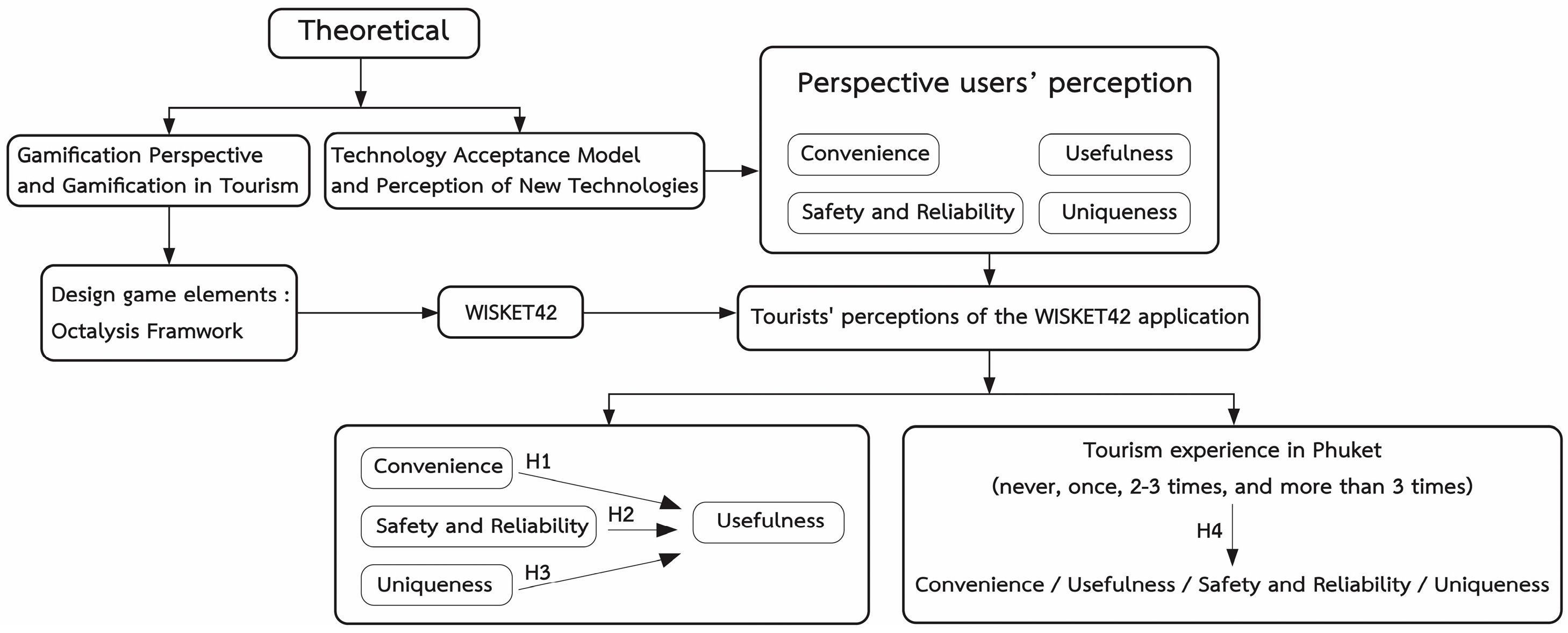
To ensure conceptual clarity, this study distinguishes between users’ perceptions of WISKET42 and culinary heritage communication. “Perceptions of WISKET42” refers to participants’ post-use evaluations of the system across the four predefined dimensions of convenience, usefulness, safety and reliability, and uniqueness. In contrast, “culinary heritage communication” refers to the application context and intended role of WISKET42 in presenting and communicating information related to Phuket’s local food, culinary culture, and associated local wisdom. The term “cultural perception” is not treated as a separate measured construct in this study. Accordingly, the study evaluates tourists’ perceptions of a gamified digital tool designed for culinary heritage communication rather than directly measuring changes in tourists’ cultural perceptions or knowledge. Based on these theoretical and conceptual foundations, an integrated conceptual framework for the design and evaluation of WISKET42 was developed, as shown in Figure 1.
Figure 1.
Integrated conceptual framework for the design and evaluation of WISKET42.
Therefore, the following hypotheses are proposed.
H1.
Perceived convenience is positively associated with the usefulness of WISKET42.
H2.
Perceived safety and reliability are positively associated with the usefulness of WISKET42.
H3.
Perceived uniqueness is positively associated with the usefulness of WISKET42.
H4.
Thai domestic tourists with different levels of travel experience in Phuket differ in their perceptions of WISKET42.
3. Materials and Methods
3.1. The Design of WISKET42
To create the prototype, local menu items in Phuket were selected first—a savory dish (Moo Hong: Southern-Style Braised Pork Belly), an appetizer (Hoo Chae: Southern-Style Mixed Vegetable Stew), a main dish (Hokkien Stir-Fried Noodles), a dessert (O-Aew: Southern-Style Shaved Iced with Grass Jelly/Clear Jelly), and a snack (A Pong: Southern-Style Coconut Pancake)—all of which are popular menu items. “WISKET42” is a game in which players collect ingredients for Phuket’s local food. WISKET42 was developed using Unity 6 and deployed through WebGL. Participants accessed the system through a web browser using a link or QR code; no installation of a dedicated native mobile application was required.
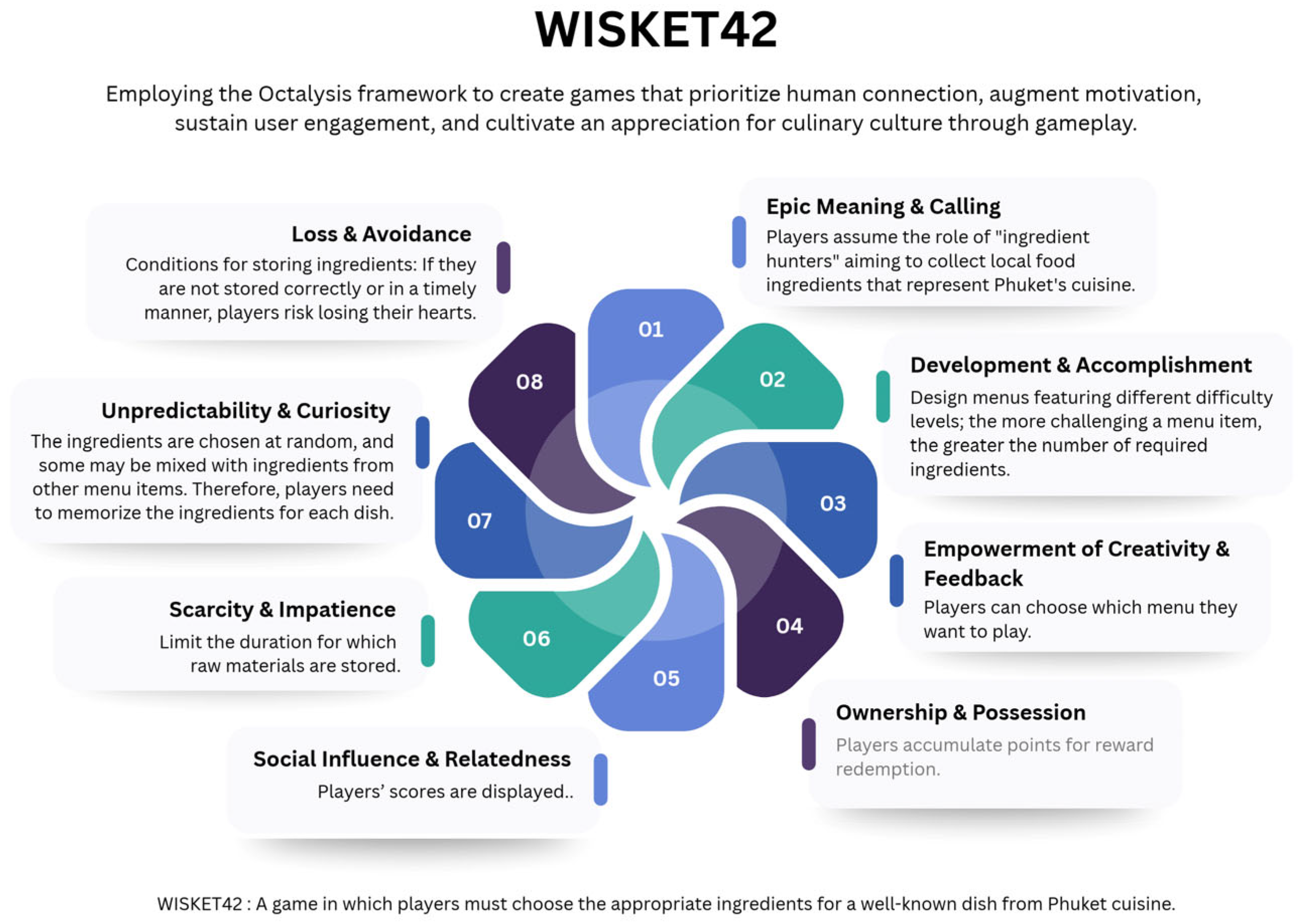
The game highlights the authenticity of recipes and cooking methods linked to specific places by showcasing the ingredients used in local food (Phrammanachot et al., 2026). Therefore, the materials and ingredients may be produced within specific local areas. In addition, the ingredients contain inherent nutritional value and have essential roles in social activities, cultural celebration events, and local beliefs. Therefore, players are expected to experience authentic culinary culture. In the present study, the Octalysis framework is used as a design framework to explain how motivational game elements were incorporated into WISKET42. It is not a measurement model for technology acceptance, as shown in Figure 2.
Figure 2.
Applying the Octalysis framework to create WISKET42.
3.2. How to Play
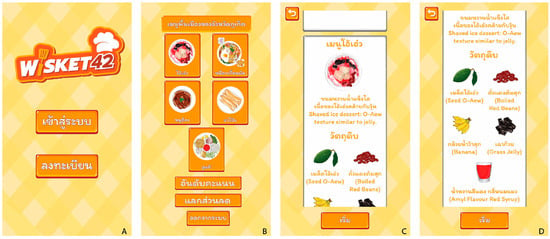
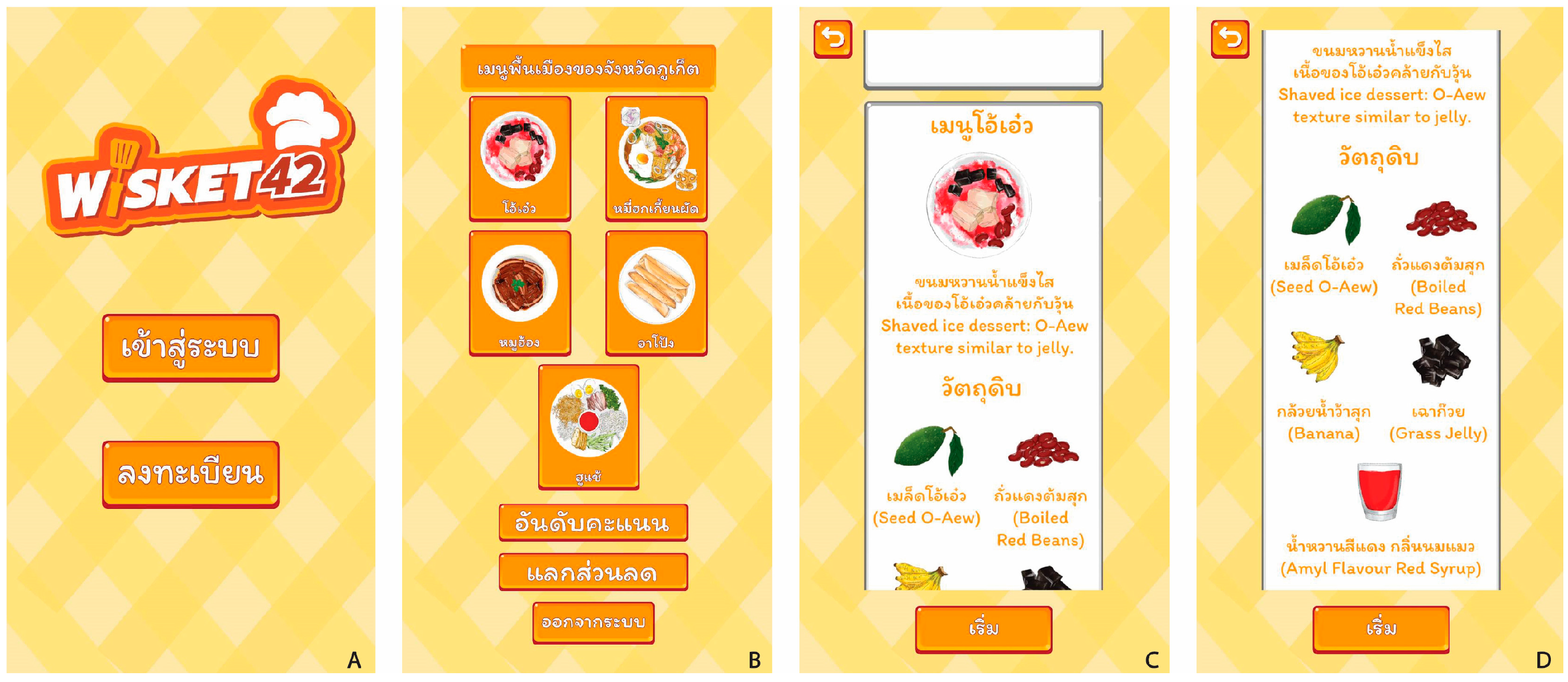
Regarding the elements of the game, the first one, as shown in Figure 3A, is the Main Page. Registration is required, followed by a login to play. Figure 3B shows the list of Phuket’s local food, score ranking, discount redemption, and logout button. Figure 3C,D demonstrate that players can click to read the rules, the details of each of the menu items, and the list of materials.
Figure 3.
Instructions for accessing the game “WISKET 42”. (A) Main Page; (B) List of Phuket’s local food; (C,D) Read the rules and the list of materials.
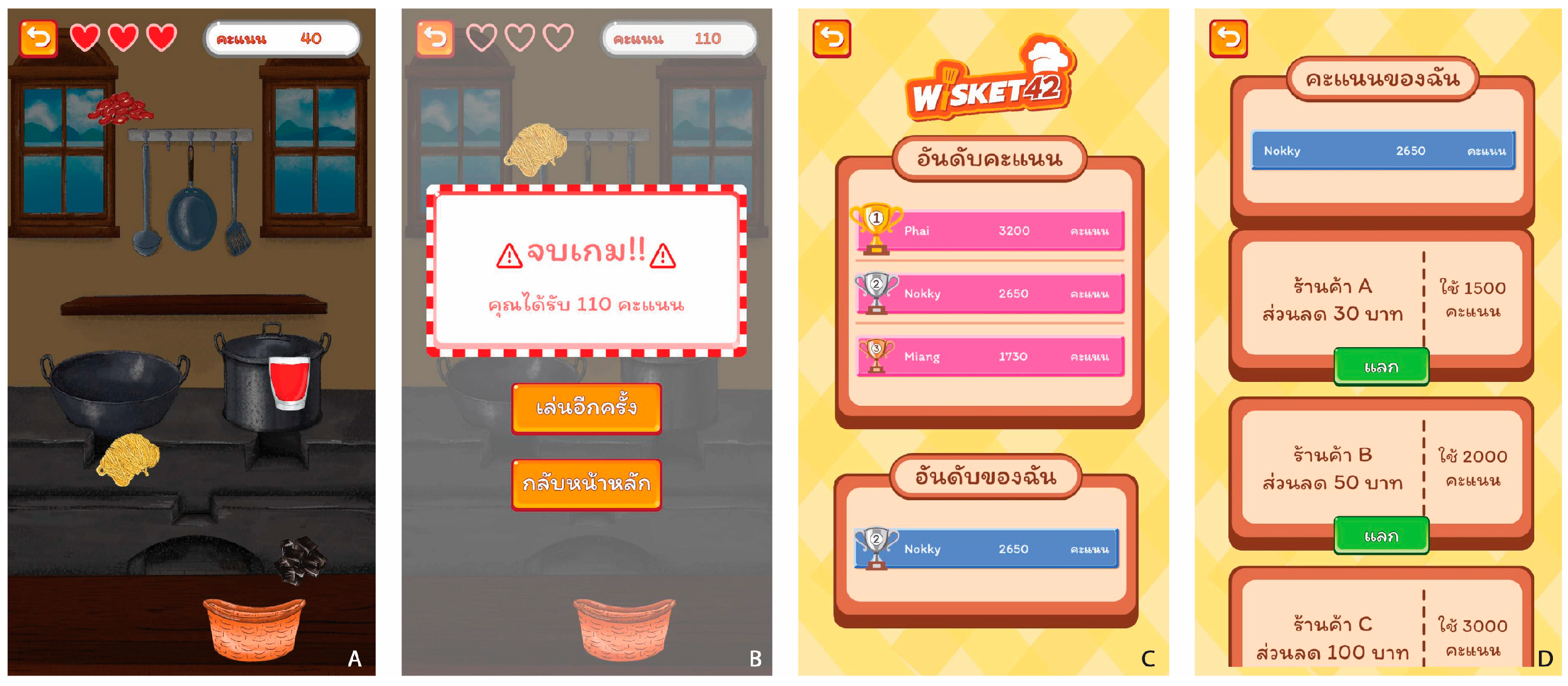
As shown in Figure 4A, after players memorize the materials, they can start playing. They are required to collect the correct falling materials for each particular menu item. As seen in Figure 4B, if the wrong materials are collected or players fail to collect the right ones in time, they will lose one heart each time. Losing three hearts results in “Game Over,” but players can restart the game and can select a new menu item. The difficulty depends on the list of materials in each menu item. Menu items with many materials require greater memorization. Figure 4C displays the table of rankings. Figure 4D presents the details for further extension. Scores can be used for food discounts or for reward redemption. Potentially, this game could be part of activities associated with Phuket’s local food in restaurants or at the annual food festival.
Figure 4.
How to play the game “WISKET 42”. (A) Start playing; (B) Game Over; (C) Displays the table of rankings; (D) Further extension.
3.3. Data Analysis Technique
The instrument used to evaluate participants’ perceptions of this innovation for promoting Phuket’s local cultural and culinary wisdom transfer was a questionnaire. Questionnaire development was guided by four dimensions: convenience, usefulness, safety and reliability, and uniqueness. The questionnaire items are presented in Appendix A (Table A1). Next, the IOC (Index of Item-Objective Congruence) was tested by three experts. The questions were revised as per their suggestions, and the questionnaire finally consisted of three sections: Part 1: General Data and Consumer Behavior; Part 2: Opinions, evaluated based on a 5-point rating scale; and Part 3: Recommendations. The questionnaire was pilot-tested with 30 participants. Table 1 displays the acceptable internal consistency for all the items according to reliability analysis.
Table 1.
Reliability statistics.
To elaborate, convenience (4 items) showed excellent reliability (α = 0.904). Usefulness (4 items) showed very high internal consistency (α = 0.965). Safety and reliability (4 items) showed good reliability (α = 0.874). Uniqueness (4 items) also showed good internal consistency (α = 0.875). For the overview, these results implied that the instrument was reliable and appropriate to evaluate perceived innovation in the context of cultural and knowledge transfer for Phuket’s local food.
Data were collected from Thai domestic tourists with varying levels of travel experience in Phuket using convenience sampling through both offline and online recruitment. Offline recruitment was conducted through university networks and at tourist areas, whereas online recruitment was conducted through LINE and university networks, which were used to distribute study information and invitations to potential participants. The inclusion criteria were: (1) being a Thai domestic tourist, (2) being 18 years of age or older, and (3) interacting with WISKET42 before completing the post-use questionnaire. Participants who did not complete the WISKET42 interaction or who submitted incomplete questionnaires were excluded from the final analysis. Before interacting with WISKET42, participants were provided with instructions regarding the purpose and main features of the system and the procedure for completing the questionnaire. They then accessed WISKET42 through a provided web link or QR code. No standardized interaction duration was imposed; participants were allowed to interact with WISKET42 at their own pace. Participants were not assigned standardized predefined tasks; instead, they were allowed to explore WISKET42 freely according to their interests. After participants finished their interaction with WISKET42, they completed the post-use questionnaire. Data collection was conducted between December 2025 and February 2026, resulting in a final sample of 428 Thai domestic tourists.
4. Results
4.1. General Data
The evaluated general data of 428 Thai tourists ≥ 18 years of age with and without tourism experience in Phuket are presented in Table 2.
Table 2.
General data of Thai tourists.
As shown in Table 2, of the 428 Thai tourists surveyed, 202 (47.20%) had never traveled to Phuket. A further 48 individuals had traveled there once (11.21%), while 113 had traveled 2–3 times (26.40%). Lastly, 65 tourists had traveled to Phuket more than three times (15.19%).
As shown in Table 3, participants who had visited Phuket more than three times reported the highest mean scores across all four dimensions, whereas those who had visited two to three times reported the lowest mean scores. However, these descriptive differences alone do not indicate statistical significance.
Table 3.
Descriptive statistics of WISKET42 perceptions by travel experience in Phuket.
4.2. Differences in Tourists’ Perceptions by Travel Experience
To examine tourists’ perceptions of WISKET42, which differed according to travel experience in Phuket, participants were classified into four groups (never, once, 2–3 times, and more than three times). In travel-experience comparison analyses, the homogeneity-of-variance assumption was assessed using Levene’s test. Given the unequal group sizes and heterogeneity of variances, Welch’s ANOVA was used for the test, as shown in Table 4.
Table 4.
Welch’s ANOVA.
As shown in Table 4, the results were statistically significant for convenience, F(3, 143.261) = 3.618, p = 0.015; usefulness, F(3, 140.828) = 6.199, p = 0.001; safety and reliability, F(3, 138.517) = 3.658, p = 0.014; and uniqueness, F(3, 141.553) = 3.973, p = 0.009. These findings indicate significant differences across travel-experience groups for all four perception constructs. The effect sizes were small for convenience (η2 = 0.028), usefulness (η2 = 0.041), safety and reliability (η2 = 0.019) and uniqueness (η2 = 0.029), indicating that travel experience accounted for a modest proportion of the observed variance in participants’ perceptions. Games–Howell post hoc comparisons were conducted to identify the specific group differences, as shown in Table 5.
Table 5.
Games–Howell post hoc comparisons of WISKET42 perceptions by travel experience in Phuket.
As shown in Table 5, the Games–Howell post hoc comparisons revealed several significant differences among the travel-experience groups.
Participants who had visited Phuket two to three times reported significantly different levels compared to the group that had visited more than three times when considering convenience (MD = −0.30415, p = 0.031, 95% CI [−0.5881, −0.0202]), usefulness (MD = −0.35334, p = 0.001, 95% CI [−0.5896, −0.1171]), and uniqueness (MD = −0.28948, p = 0.020, 95% CI [−0.5455, −0.0334]).
The safety and reliability perception of those who had never visited Phuket was significantly different to that of the group that visited two to three times (MD = 0.14901, p = 0.033, 95% CI [0.0084, 0.2897]).
Notably, first-time visitors did not exhibit any significant differences from any of the other travel-experience groups in all four dimensions of WISKET42 perceptions.
Overall, these results support H4, as significant differences among travel-experience groups were revealed for all four perception constructs. However, the Games–Howell results suggest that the specific pairwise differences were selective rather than representative of groups with different travel experience.
4.3. Analyzing the Relationships of Elements with Usefulness
According to multiple regression analysis (MRA), conducted to examine the associations of convenience (X1), safety and reliability (X2), and uniqueness (X3) with usefulness (Y), the relationship equation can be concluded as follows:
Usefulness = 0.753 + 0.247 (Convenience) + 0.274 (Safety and Reliabity) + 0.313 (Uniqueness)
It was found that all three elements, i.e., convenience, safety and reliability, and uniqueness, could significantly predict usefulness at 59.9%, as seen in Table 6.
Table 6.
Model summary.
The overall regression model was statistically significant—F(3, 424) = 210.812, p < 0.001—as shown in Table 7.
Table 7.
F test.
Multiple regression analysis was conducted to examine the associations of convenience (X1), safety and reliability (X2), and uniqueness (X3) with usefulness (Y) (p < 0.001). Uniqueness showed the largest standardized regression coefficient (β = 0.305, p < 0.001), followed closely by safety and reliability (β = 0.279, p < 0.001) and convenience (β = 0.277, p < 0.001), as shown in Table 8.
Table 8.
Multiple linear regression analysis.
Despite uniqueness displaying the highest standardized coefficient, the standardized coefficients of the three predictors were comparatively alike, indicating that all three dimensions significantly contributed to the prediction of usefulness.
Tolerance values ranged from 0.391 to 0.440, and VIF values ranged from 2.272 to 2.555. Since these values do not exceed the standard threshold of 5.0 according to the specified criteria, this result indicates that indicate that there was no serious multicollinearity among the predictor variables.
5. Discussion
5.1. The Differences in Opinion Levels on Perception of the Innovation Among the Tourists with Different Tourism Experiences in Phuket (Never, Once, 2–3 Times, and More than 3 Times)
The findings indicate that there are significant differences between groups across all four dimensions of WISKET42 perception. Nevertheless, the relatively small effect sizes indicate that travel experience accounted for only a modest proportion of the observed variation in users’ perceptions. Thus, travel experience appears to be a relevant contextual factor, but it should not be regarded as the sole explanation for how tourists evaluate the application and should not be interpreted as evidence of equivalent effectiveness across travel-experience groups.
Welch’s ANOVA showed significant differences in all four dimensions of WISKET42 perceptions across the groups of travel experience. However, the effect sizes were relatively small (η2 = 0.019–0.041), suggesting that travel experience accounted for only a small proportion of the variation observed in participants’ perceptions. Descriptive statistics indicated that participants who had visited Phuket more than three times had the highest mean scores on all four dimensions. However, Games–Howell post hoc comparisons of perceptions of the game showed that these descriptive differences were not significant across all pairwise comparisons. Specifically, the convenience, usefulness, and uniqueness assessments of participants who had visited Phuket more than three times were significantly higher than those who had visited two to three times. However, the results for safety and reliability were different, showing that participants who had never visited Phuket scored the game significantly higher than those who had visited two to three times. None of the other pairwise comparisons were statistically significant. Hence, travel experience was not found to be consistently associated with more favorable WISKET42 perceptions. Instead, previous travel experience seems to be a contextual factor related to small dimensions and issue-specific changes in perception. One perspective is that participants who have previous experience in a destination may have some contextual familiarity that shapes their perception of the culinary content provided by WISKET42. However, caution is advised when interpreting these findings, as this study did not directly measure place attachment, familiarity with Phuket’s culinary culture, or quality of previous destination experiences. In an expanded heritage-tourism context, Ma et al. (2026) showed that high-quality heritage experiences can contribute to emotional connections with place and subsequent culturally sustaining behavioral intentions. From this perspective, WISKET42 may function as a digital interface through which frequent visitors relate their previous experiences to representations of Phuket’s culinary culture. However, place attachment was not directly measured in the present study; therefore, this interpretation should be considered a theoretically informed explanation rather than an empirically tested mechanism.
Participants who had visited Phuket once reported generally favorable perceptions of WISKET42. However, the Games–Howell comparisons showed that this group did not differ significantly from any of the other travel-experience groups across the four perception dimensions. Moura et al. (2025), in their study of young gastronomic tourists in Portugal, suggested that participants valued both traditional and regional cuisine and opportunities to experience new and diverse variations, suggesting that tradition and innovation can coexist in gastronomic tourism motivations. This perspective may be relevant to WISKET42, which combines traditional Phuket culinary content with an interactive digital format. Such a combination may provide context for understanding the relative perceptions observed among first-time visitors. However, these findings should be interpreted cautiously rather than attributed to novelty-seeking behavior, as novelty seeking was not directly measured in the present study.
Participants who had visited Phuket two to three times reported the lowest mean scores across all four dimensions. The present data do not provide sufficient evidence to explain why this intermediate-experience group evaluated the application less favorably than frequent visitors. Further research should therefore examine whether intermediate familiarity, novelty reduction, or other unmeasured factors contribute to this pattern.
These findings complement existing gamification research by introducing a user-context perspective into the evaluation of digital culinary heritage communication.
5.2. Usefulness Gamification for Cultural Heritage Promotion
The regression findings showed that convenience, safety and reliability, and uniqueness were all positively and significantly associated with usefulness. Together, these three dimensions explained 59.9% of the variance in usefulness. This finding suggests that users’ perceptions of the usefulness of WISKET42 are associated with a combination of functional and innovation-related characteristics rather than with a single attribute. Among the three predictors, uniqueness exhibited the largest standardized regression coefficient, although its coefficient was only slightly larger than those of safety and reliability and convenience. Therefore, the findings should not be interpreted as indicating that uniqueness overwhelmingly determines usefulness. Rather, they suggest that the distinctive qualities of WISKET42 may make an important contribution alongside perceptions of convenience and technological dependability.
The relationship between convenience and usefulness is broadly consistent with the Technology Acceptance Model (TAM) (Davis, 1989), which proposes a relationship between perceived ease of use and perceived usefulness. A similar finding was reported by Kumar et al. (2026) in the context of interactive mobile learning; perceived ease of use was associated with perceived usefulness, while perceived usefulness was significantly related to attitudes toward using technology. Their findings show the importance of designing mobile learning platforms that are both user-friendly and perceived as beneficial by users. For WISKET42, convenient interaction may enable users to interact more easily with gamified culinary heritage rather than focusing on difficulties related to the operation of the application. However, convenience in the present study should be considered conceptually related to, rather than equivalent to, perceived ease of use in TAM.
Safety and reliability also showed a significant positive association with usefulness. This finding indicates that users’ evaluations of a digital cultural application may depend not only on its distinctive characteristics or ease of interaction but also on whether the technology is perceived as dependable. For tourism-oriented digital applications, technological reliability may reduce uncertainty during interaction and support users’ confidence in engaging with digital content. Safety and reliability may therefore represent an important complementary dimension for understanding usefulness beyond the core TAM constructs.
The positive association between uniqueness and usefulness may be related to how local culinary ingredients, dishes, cultural narratives, and game mechanisms are combined into an interactive digital experience in WISKET42. This interpretation is broadly consistent with Weking et al. (2020), who examined the use of augmented reality for promoting local Indonesian food, illustrating the potential of interactive technologies for presenting local culinary content in novel forms.
More broadly, the role of gamification in cultural heritage should not be understood solely in terms of efficient knowledge transmission. Marques et al. (2023) suggested that gamification can bring cultural objects closer to the public by providing a very significant focus on gamification being used for motivation/engagement and for creativity enhancement. They further emphasized the importance of examining how gamified media shape audiences’ experiences and perceptions of cultural heritage. From this perspective, WISKET42 can be viewed not merely as a tool for transmitting culinary information but as an interactive format through which users engage with representations of Phuket’s culinary heritage. This interpretation is particularly relevant to the present study, which examined users’ perceptions of the application rather than directly measuring knowledge acquisition or learning outcomes.
From a practical standpoint, the results provide two recommendations for tourism boards and app designers who want to preserve the uniqueness of digital culinary heritage apps over time. Tourism bodies should work with local communities, culinary experts and cultural stakeholders to regularly update and diversify culturally authentic content, including stories on local food, traditional ingredients, cooking methods and food-related traditions and cultural practices. This may help to maintain the unique cultural identity of the application.
Second, as digital interfaces develop, application designers face the challenge of balancing innovative features with usability and information reliability. Besides adding new interactive elements and updating the interface, usability testing should be conducted, culinary information should be verified, and data security practices should be regularly reviewed. These steps may help to preserve the distinctiveness of the application without affecting convenience or safety and reliability, which are also positively correlated to perceived usefulness.
6. Conclusions
6.1. Summary of Findings
This research studies the opinions of Thai tourists towards WISKET42, a mobile web-based gamification application and digital tool for communicating Phuket’s local culinary culture and wisdom. Overall, participants reported generally favorable perceptions of WISKET42. The relatively high scores in these dimensions indicate that participants had positive perceptions of the application after trying it. Significant differences in perceptions were observed across travel-experience groups for all four dimensions: convenience, usefulness, safety and reliability, and uniqueness. These findings indicate that participants evaluated the application favorably after interacting with it. However, the relatively small effect sizes (η2 = 0.019–0.041) indicate that travel experience accounted for only a modest proportion of the variation in participants’ perceptions. Participants who had visited Phuket more than three times consistently reported the highest mean scores across the four dimensions, whereas those who had visited two to three times reported the lowest. Rather than indicating that more destination experience necessarily leads to more positive perceptions, the results indicate travel experience as one of several contextual factors that can influence the way tourists evaluate a gamified culinary heritage application.
The analysis also showed that convenience, safety and reliability, and uniqueness were all positively and significantly correlated with usefulness, overall explaining 59.9% of the variance. Uniqueness showed the highest standardized regression coefficient, followed by safety, reliability, and convenience. The results suggest that the usefulness of WISKET42 is more strongly associated with reliability, convenience and uniqueness than with any single characteristic. The positive link between convenience and usefulness is consistent with the technology adoption perspective, while the research findings regarding safety, reliability and distinctiveness highlight the complementary dimensions that are important for users’ evaluation of digital cultural applications.
Overall, the research suggests that WISKET42 has potential as an interactive method for communicating Phuket’s food heritage. Positive ratings regarding usefulness and distinctiveness demonstrate users’ awareness of the application’s practical value and distinctiveness within the context of communicating Phuket’s local food culture and wisdom. However, because this research examines self-reported perceptions rather than objective learning outcomes, behavioral intentions, or actual continued use, the results should not be interpreted as direct evidence that the application enhances cultural knowledge, learning motivation, or long-term technology adoption. Future research using pre–post measures, behavioral data, and comparative or experimental designs is needed to evaluate these outcomes directly.
6.2. Limitations and Future Work
Regardless of the meaningful findings on users’ perceptions of mobile gamification to promote cultural perception of culinary wisdom, there are some limitations for further consideration. Future research should enlarge the scope in terms of samples, methods, and theoretical frameworks, as per the suggestions below, for greater inclusiveness and precision of the results.
However, this study only included Thai participants, which may not represent the behavior and acceptance of technology among foreign tourists. Thus, the results may be limited in generalizability in universal contexts. To increase inclusiveness, the participant group should be expanded to foreign tourists so that differences in perception (i.e., multilingual support), technology acceptance, and culinary culture learning behavior in cross-cultural contexts can be compared. This approach will enhance the capacity to describe the results at a universal level.
The study focused on travel experience as the principal participant-level grouping factor and did not systematically examine demographic or technology-related characteristics such as age, gender, education, digital literacy, smartphone-use patterns, gaming experience, or prior familiarity with Phuket’s culinary culture. Consequently, the study cannot determine whether these characteristics contributed to differences in participants’ perceptions. Future research should incorporate these variables to examine potential heterogeneity in responses to mobile gamification across user groups.
The data used in the analysis may have been influenced by participants’ biases; for example, their answers might have been shaped by social expectations or exaggerated self-evaluations, which could impact the precision of the measurements. There should be long-term research conducted by collecting data at different phases, e.g., before use, after use, and at the follow-up phase, to continuously study the changes in perceptions and usage behaviors. Data of actual behavior, e.g., game playing duration, frequency, reward-redemption rates and progress, should be collected to investigate whether gamification affects visitor satisfaction, destination attachment, and revisit intention.
The research design did not make comparisons with learning models or other types of media. Therefore, it could not reach clear conclusions as to whether this innovative gamification is more efficient than traditional communication approaches or other types of digital media. There should be experimental research designs applied to compare the effectiveness of gamification with other media, e.g., digital media, traditional learning or pre/post measures of culinary heritage knowledge. Such experimental designs would provide stronger evidence regarding the comparative effectiveness of gamification and help distinguish perceived usefulness from actual learning outcomes.
6.3. Practical Implications
Mobile gamification design should focus on three complementary qualities identified in this study: distinctive cultural experiences, technological dependability, and convenient interaction. These mechanisms may be considered as design strategies for encouraging engagement and continued use; however, their effects on continued use should be empirically examined in future studies.
There should be concerns about differences and identities in experience. Gamification innovation should be unique. For example, culinary content should be connected to cultural stories, or there should be local-cuisine cooking scenarios, with players as chefs who must select local materials for cooking based on original recipes. In addition, there could be opportunities to take part in cooking at festivals and engage with local culinary businesses for cultural value-added creation and memorable impressions.
Future design could integrate gamification with tourism activities, e.g., local street food, food trails, cooking classes, community markets, local-cuisine museums, annual food festivals, or Phuket’s cultural traditions, via methods such as QR codes, AR or GPS.
In the policy aspect, public agencies should support digital platform development that uses gamification as a tool to communicate local identities. They should also strengthen collaboration among innovation developers, communities, and entrepreneurs to create opportunities to extend digital culinary heritage communication.
Author Contributions
Conceptualization, M.P., C.L. and S.E.; methodology, M.P., C.L. and S.E.; software, M.P. and S.S.; validation, M.P., C.L. and S.E.; formal analysis, M.P., C.L. and S.E.; investigation, M.P.; resources, M.P.; data curation, M.P., C.L., S.E. and T.P.; writing—original draft preparation, M.P.; writing—review and editing, C.L., S.E. and T.P.; visualization, M.P. and S.S.; supervision, C.L. and S.E.; project administration, C.L. and S.E. All authors have read and agreed to the published version of the manuscript.
Funding
This research received no external funding.
Institutional Review Board Statement
The study was conducted in accordance with the Declaration of Helsinki, and approved by the Ethics Committee King Mongkut’s Institute of Technology Ladkrabang (protocol code: EC-KMITL_68_065; approval date: 14 May 2025).
Informed Consent Statement
Informed consent was obtained from all subjects involved in the study.
Data Availability Statement
The data presented in this study are available on request from the corresponding author.
Acknowledgments
The authors would like to thank all participants who provided help and encouragement.
Conflicts of Interest
The authors declare no conflicts of interest.
Appendix A. The Resulting Instrument Comprised 16 Items Organized into Four Predefined Dimensions: Convenience, Usefulness, Safety and Reliability, and Uniqueness
Table A1.
Questionnaire items used to evaluate WISKET42.
References
- Balaman, F., & Baş, M. (2021). Perception of using e-learning platforms in the scope of the technology acceptance model (TAM): A scale development study. Interactive Learning Environments, 31(8), 5395–5419. [Google Scholar] [CrossRef] [Scilit]
- Chai-Arayalert, S., Sansompron, N., Chodchuang, S., Chantanaphant, J., & Duangjan, C. (2023). Digital platform-mediated tourism system in small-town destination. International Journal of Interactive Mobile Technologies (iJIM), 17(05), 143–161. [Google Scholar] [CrossRef] [Scilit]
- Chaisriya, K., Gilbert, L., Suwangerd, R., & Rattanarungrot, S. (2022). A digital game for preserving food cultural heritage: Design and evaluation of Thai Food Adventure game. International Journal of Power Electronics and Drive Systems/International Journal of Electrical and Computer Engineering, 12(5), 5272–5278. [Google Scholar] [CrossRef] [Scilit]
- Chen, Y., & Zhao, S. (2022). Understanding Chinese EFL learners’ acceptance of gamified vocabulary learning apps: An integration of self-determination theory and technology acceptance model. Sustainability, 14(18), 11288. [Google Scholar] [CrossRef] [Scilit]
- Cheng, W., Niu, C., Huang, L., & Zhang, Y. (2025). Design strategies for culinary heritage restaurants from a cultural sustainability perspective: Focusing on Generation Z consumers. Sustainability, 17(8), 3401. [Google Scholar] [CrossRef] [Scilit]
- Chou, Y. (2015). Actionable gamification: Beyond points, badges and leaderboards. CreateSpace. [Google Scholar]
- Davis, F. D. (1989). Perceived usefulness, perceived ease of use, and user acceptance of information technology. MIS Quarterly, 13(3), 319–340. [Google Scholar] [CrossRef] [Scilit] [PubMed]
- Deterding, S., Dixon, D., Khaled, R., & Nacke, L. (2011). From game design elements to gamefulness: Defining “gamification”. In Proceedings of the 15th international academic MindTrek conference: Envisioning future media environments (MindTrek ‘11) (pp. 9–15). Association for Computing Machinery. [Google Scholar] [CrossRef] [Scilit]
- Duram, L. A. (2011). Encyclopedia of organic, sustainable, and local food. University of Nebraska Press. [Google Scholar]
- Fraga, C., Cardoso, L., De Stefano, E., Santos, L. L., & Motta, N. (2025). Mapping gamification for sustainable urban development: Generating new insights for tourism education. Tourism and Hospitality, 6(1), 17. [Google Scholar] [CrossRef] [Scilit]
- Genovese, F., Bolognesi, M. M., Di Iorio, A., & Vitali, F. (2024). The advantages of gamification for collecting linguistic data: A case study using Word Ladders. Online Journal of Communication and Media Technologies, 14(2), e202426. [Google Scholar] [CrossRef] [Scilit]
- Hamari, J., Koivisto, J., & Sarsa, H. (2014, January 6–9). Does gamification work?—A literature review of empirical studies on gamification. 2014 47th Hawaii International Conference on System Sciences (pp. 3025–3034), Waikoloa, HI, USA. [Google Scholar] [CrossRef] [Scilit]
- Haque, S., Panda, D., & Ghosh, A. (2024). Gamifying sustainability with self-efficacy: Motivating green behaviours in large industrial firms. International Journal of Organizational Analysis, 32(11), 74–93. [Google Scholar] [CrossRef] [Scilit]
- Hjalager, A. (2022). Digital food and the innovation of gastronomic tourism. Gastronomy and Tourism, 7(1), 35–49. [Google Scholar] [CrossRef] [Scilit]
- Ivanova, L., Terziyska, I., & Trifonova, J. (2014). Characteristics of traditional food—The viewpoint of the tourism business. Service Management, 14, 123–130. [Google Scholar]
- Kumar, A., Banerjee, S., Arokiasam, A. R. A., Gupta, K., & Bansal, S. (2026). Adoption of interactive mobile learning technologies through the lens of the technology acceptance model. International Journal of Interactive Mobile Technologies (iJIM), 20(07), 20–31. [Google Scholar] [CrossRef] [Scilit]
- Landers, R. N., Bauer, K. N., & Callan, R. C. (2015). Gamification of task performance with leaderboards: A goal setting experiment. Computers in Human Behavior, 71, 508–515. [Google Scholar] [CrossRef] [Scilit]
- Ma, C., Liu, G., & Wang, X. (2026). How perceived cultural authenticity shapes sustainable heritage tourism behavior: The serial mediating roles of visitor experience quality and sense of place. Sustainability, 18(8), 3677. [Google Scholar] [CrossRef] [Scilit]
- Marisa, F., Ahmad, S. S. S., Yusoh, Z. I. M., Maukar, A. L., Marcus, R. D., & Widodo, A. A. (2020). Evaluation of student core drives on e-learning during the COVID-19 with Octalysis gamification framework. International Journal of Advanced Computer Science and Applications, 11(11), 104–116. [Google Scholar] [CrossRef] [Scilit]
- Marques, C. G., Pedro, J. P., & Araújo, I. (2023). A systematic literature review of gamification in/for cultural heritage: Leveling up, going beyond. Heritage, 6(8), 5935–5951. [Google Scholar] [CrossRef] [Scilit]
- McKechnie-Martin, C. T., Cunningham, A., Baumeister, J., & Von Itzstein, G. S. (2024). A meta-ethnography of player motivation in digital games: The 28 dimensions of play. Games and Culture, 21(2), 167–191. [Google Scholar] [CrossRef] [Scilit]
- Moura, A. A., Mira, M. D. R., & Teixeira, A. R. (2025). The tourist gastronomic experience: Ties between young foodies’ motivation and destination development in Portugal. Tourism and Hospitality, 6(1), 7. [Google Scholar] [CrossRef] [Scilit]
- Norressan Helmee, S. Z., & Murli, N. (2025). The development of a mobile game while exploring traditional Malaysian cuisine. Applied Information Technology And Computer Science, 6(1), 1393–1410. Available online: https://periodical.uthm.edu.my/index.php/aitcs/article/view/16290 (accessed on 16 September 2026).
- Oliveira, M., Abelha, A., Sousa, R., & Peixoto, H. (2024). Gamification in mobile applications: Techniques, benefits and challenges. Procedia Computer Science, 251, 678–683. [Google Scholar] [CrossRef] [Scilit]
- Phrammanachot, M., Louhapensang, C., Piromgarn, T., Sompoangeon, S., & Egwutvongsa, S. (2026). Cultural tourism: Factors influencing the transmission of cultural and culinary heritage in Phuket, Thailand. GeoJournal of Tourism and Geosites, 64(1), 98–109. [Google Scholar] [CrossRef] [Scilit]
- Phuket. (2026). Creative cities network. Available online: https://www.unesco.org/en/creative-cities/phuket (accessed on 16 September 2026).
- Pishnyak, A., & Khalina, N. (2021). Perception of new technologies: Constructing an innovation openness index. Foresight-Russia, 15(1), 39–54. [Google Scholar] [CrossRef] [Scilit]
- Prasitsupparote, A., Pasitsuparoad, P., & Jungjit, S. (2024). Design and implementation of a local marketplace application for food and beverage businesses using 4P’s and 4C’s strategies. In Joint international conference on digital arts, media and technology with ECTI northern section conference on electrical, electronics (pp. 318–323). Computer and Telecommunications Engineering (ECTI DAMT & NCON). [Google Scholar] [CrossRef] [Scilit]
- Su, J., Wang, Y., & Li, Z. (2025). Investigating user acceptance of mobile cultural applications in China: An expanded technology acceptance model (TAM). International Journal of Human-Computer Interaction, 41(5), 2920–2935. [Google Scholar] [CrossRef] [Scilit]
- Surapiyawong, P., & Kasemsarn, K. (2024). Mobile application of local Baba-Peranakan food tourism for Generation Y: A case study of Phuket province, Thailand. Journal of Mekong Societies, 20(2), 101–130. [Google Scholar]
- Sureddy, A. D., Babu, G. N. P. V., Giribabu, P., & Sriramneni, C. (2026). Continuance usage in online travel platforms: The role of relationship quality. GeoJournal of Tourism and Geosites, 64(1), 156–164. [Google Scholar] [CrossRef] [Scilit]
- Tovankasame, J. C. A. N. (2023). Creating a food museum in Baan Saan, Phuket: A case study in material culture and media technology. NRCT Data Center. [Google Scholar] [CrossRef]
- Wei, Z., Zhang, J., Huang, X., & Qiu, H. (2023). Can gamification improve the virtual reality tourism experience? Analyzing the mediating role of tourism fatigue. Tourism Management, 96, 104715. [Google Scholar] [CrossRef] [Scilit]
- Weking, A. N., Suyoto, S., & Santoso, A. J. (2020). A development of augmented reality mobile application to promote the traditional Indonesian food. International Journal of Interactive Mobile Technologies (iJIM), 14(09), 248. [Google Scholar] [CrossRef] [Scilit]
- Xu, F., Buhalis, D., & Weber, J. (2017). Serious games and the gamification of tourism. Tourism Management, 60, 244–256. [Google Scholar] [CrossRef] [Scilit]
- Xu, F., Weber, J., & Buhalis, D. (2013). Gamification in tourism. In Information and communication technologies in tourism (pp. 525–537). Springer International Publishing. [Google Scholar] [CrossRef] [Scilit]

Disclaimer/Publisher’s Note: The statements, opinions and data contained in all publications are solely those of the individual author(s) and contributor(s) and not of MDPI and/or the editor(s). MDPI and/or the editor(s) disclaim responsibility for any injury to people or property resulting from any ideas, methods, instructions or products referred to in the content. |
© 2026 by the authors. Licensee MDPI, Basel, Switzerland. This article is an open access article distributed under the terms and conditions of the Creative Commons Attribution (CC BY) license.