


Abstract
Circular-economy research in hospitality has expanded from isolated waste-reduction practices to questions of procurement, digital measurement, stakeholder participation, and organizational change. Yet the available evidence remains difficult for hotel managers to convert into a governed investment portfolio: published reviews classify practices and barriers, while implementation decisions require owners, baselines, decision gates, auditable indicators, and feedback routines. An integrative review was therefore conducted to connect circular-hospitality evidence with management and governance mechanisms. The synthesis began from an established bibliometric map of 71 hospitality publications (2018–2024), audited its principal references and claims against publisher and DOI metadata, and incorporated peer-reviewed studies published through August 2026 that materially extended evidence on food systems, furniture and procurement, digital leadership, institutional pressures, and human participation. Sources were coded by operational domain, decision level, actor, information requirement, barrier, and outcome. Four mutually dependent governance functions emerged: strategic direction, knowledge mobilization, process control, and portfolio integration. On this basis, the article develops a five-stage 5D framework—Diagnose, Design, Deploy, Digitize, and Demonstrate—and specifies deliverables, decision gates, responsibilities, and denominator-aligned indicators for each stage. The resulting model shifts circularity from a catalogue of environmental initiatives to a repeatable management system. Its contribution is conceptual and translational rather than causal: it offers a testable architecture for hotel groups, independent properties, and destination partnerships, while identifying where longitudinal validation, common measurement rules, and evidence from emerging economies remain necessary.
1. Introduction
Hotels sit at a difficult point in the transition from linear consumption to circular value creation. They combine buildings, furniture, food services, laundry, mobility, water, energy, and a high-contact customer experience within the same operating system. Each resource stream has different suppliers, decision horizons, and performance measures. Consequently, a property may reduce food waste while continuing to purchase short-lived furniture, or install efficient equipment without creating routines that preserve savings after staff turnover. Circularity becomes fragmented when initiatives are treated as disconnected environmental projects instead of a managed portfolio.
The circular economy (CE) seeks to preserve the value of products, components, and materials while reducing virgin-resource use and avoidable waste (Geissdoerfer et al., 2017; Kirchherr et al., 2017; Murray et al., 2017). In tourism and hospitality, the literature has translated these principles into food-waste prevention, water recirculation, renewable energy, adaptive reuse, repair, local sourcing, and product–service arrangements (P. Jones & Wynn, 2019; Rodríguez-Antón & Alonso-Almeida, 2019; Rodríguez et al., 2020). Studies of hotels and hospitality small and medium-sized enterprises (SMEs) nevertheless show that adoption is shaped by capital constraints, supplier availability, regulation, managerial attention, and the capacity to reorganize daily work (Alharethi et al., 2024; Bittner et al., 2024; Bowen et al., 2024; Sorin & Sivarajah, 2021). Department-level evidence and recent pollution-control analysis further show that environmental performance depends on coordinated routines across housekeeping, food and beverage, engineering, purchasing, and management rather than on isolated technical measures (Menegaki, 2025; Ozdemir Akgul et al., 2025). The implementation problem is therefore managerial as much as technical.
Recent syntheses have strengthened the field’s descriptive base. A bibliometric analysis mapped 71 publications and identified an operational emphasis on resource efficiency and waste, together with weaker coverage of finance, emerging technologies, and developing-country contexts (Peñaherrera Veloz et al., 2025). A food-waste review consolidated sector-specific circular practices (Cardenas et al., 2024), research on green hotels clarified the field’s theoretical and methodological development (Acampora et al., 2022), and a broader systematic review of 159 studies organized the literature around strategies, drivers, and environmental, social, and economic impacts (Gohoungodji & Chembessi, 2026). These contributions clarify what the field studies. They do not, however, fully specify how a hotel should govern the transition: which decisions belong at corporate or property level, what evidence is sufficient to pass from a pilot to scale, how heterogeneous indicators should be normalized, and how learning should change procurement and capital-allocation rules.
Empirical work published after the principal bibliometric window reinforces this need. Research on hotel furniture shows the importance of leasing, refurbishment, take-back arrangements, and supplier coordination (Fonseca & Dias, 2025); Malaysian evidence links circular food-practice adoption to institutional pressures and environmental beliefs (Chang et al., 2025); and a process-tracing study demonstrates that sustainability innovations in a tourism SME develop through stepwise adoption, organizational learning, and techno-economic appraisal (Chatzifoti et al., 2025). Studies of digital leadership, smart technologies, and green efficacy place organizational and managerial capability between technology and sustainability performance (Abdou, 2025; Elshaer et al., 2025), while research in developing settings emphasizes staff, managers, guests, finance, infrastructure, and public support (Gaffar et al., 2026; Saydam et al., 2026). Taken together, the evidence suggests that circular hospitality works less as a single intervention than as a sequence of decisions supported by data, responsibilities, and adaptive control.
The present article addresses the following question:
How can the dispersed evidence on circular practices, barriers, and enabling conditions in hospitality be translated into a governance-ready management framework with explicit stages, metrics, responsibilities, and decision gates?
Three contributions follow. First, the review distinguishes four governance functions that are often implicit in CE research: strategic direction, knowledge mobilization, process control, and portfolio integration. Second, it develops a 5D implementation framework that connects diagnosis to design, controlled deployment, digital measurement, and demonstration of value. Third, it provides a compact measurement architecture that aligns environmental quantities with operational denominators and makes data completeness visible before performance claims are aggregated. The framework is intended as a testable design proposition, not as an empirically validated maturity standard. Table 1 locates this contribution alongside recent reviews. The earlier syntheses map the field, examine sustainable hotel practices, or focus on particular circular activities. The present review draws on that evidence to specify responsibilities, decision gates, and measures that can guide implementation, while leaving their effectiveness open to empirical testing.
Table 1.
Positioning of the present study relative to recent syntheses of circularity and sustainability in hospitality.
2. Review Design and Analytical Procedure
2.1. Why an Integrative Review Was Required
The research question concerns the configuration of an implementation system rather than the average effect of a single intervention. An integrative review was therefore more appropriate than meta-analysis. It allows empirical studies, systematic reviews, case evidence, and governance concepts to be compared through a common analytical frame while preserving differences in setting and unit of analysis. The procedure followed established expectations for transparent evidence synthesis and bibliometric interpretation (Donthu et al., 2021; Page et al., 2021; Zupic & Čater, 2015), but it did not present the targeted update as a new exhaustive database census.
The evidence was assembled in three layers. The first layer was the field map reported by Peñaherrera Veloz et al. (2025), which covered 71 publications retrieved from Scopus and Web of Science for 2018–2024. That study was used to delimit the knowledge base and identify candidate themes; its productivity and citation results were not republished as original findings. The second layer comprised direct hospitality studies and reviews that explained implementation mechanisms, including procurement, food systems, asset life extension, stakeholder behavior, digital capability, and barriers. The third layer drew selectively on management and sustainability-governance research to clarify how direction, learning, control, and coordination operate when responsibility is distributed across organizational levels (Meuleman, 2021; Rizos et al., 2016; Schroeder et al., 2019).
The unit of analysis in this review is the publication and the implementation mechanism it describes, rather than an individual hotel or a homogeneous sample of properties. Accordingly, the 71 publications in the initial field map should not be interpreted as 71 hotels, nor do the studies incorporated in the targeted update constitute a single comparable dataset. The reviewed evidence includes hotel operators, individual properties, hotel groups, hospitality SMEs, foodservice organizations, suppliers, and destination partnerships. Their size, location, operating model, and research design differ; these characteristics are considered when interpreting the transferability of each mechanism.
An update was performed through August 2026 to prevent the framework from resting on a corpus closed in 2024. The search expression combined “circular economy” with hotel* or hospitality and at least one implementation term (implement*, govern*, management, procurement, food waste, or digital*). Targeted publisher searches and backward/forward reference checks retained peer-reviewed contributions only when they added evidence about an implementation mechanism or challenged an emerging interpretation. Generic sustainability papers without a circular mechanism, non-peer-reviewed commentary, and records whose identifiers did not match their titles were excluded. The update included recent work on food practices and stakeholder networks (Ally et al., 2025; Chang et al., 2025), furniture and life-cycle management (Fonseca & Dias, 2025; Gungor & Moscarelli, 2025), green digital leadership and managerial capabilities (Abdou, 2025; Elshaer et al., 2025), implementation in tourism SMEs (Chatzifoti et al., 2025), human-centered participation (Gaffar et al., 2026; Seraj et al., 2025), managerial perceptions (Saydam et al., 2026), and the broader state of the field (Gohoungodji & Chembessi, 2026). Because this was a purposive sensitivity update, no frequency claim is based on the number of updated sources.
The targeted update was used to examine whether recent studies extended or challenged the implementation mechanisms identified in the earlier field map. It was not designed to estimate the prevalence of particular practices or barriers in the literature. Selected sources, their reported settings, the mechanisms they inform, and limits on transferring their findings are presented in Table 2. The complete coding of retained sources is provided in the supplementary evidence matrix. Because the update was purposive rather than an exhaustive database search, its findings should be interpreted as a test of the framework’s conceptual coverage, not as a systematic estimate of the field.
Table 2.
Selected evidence contexts and their contribution to the proposed framework.
2.2. Integrity Audit and Coding Frame
Every reference used to support the framework was checked against a publisher record, DOI landing page, or authoritative bibliographic record. Records whose DOI resolved to a different title or sector were removed rather than repaired by inference. Studies published after 2024 were treated as contextual updates and were not inserted retrospectively into the 2018–2024 bibliometric corpus. This distinction avoids two common errors in fast-growing review domains: presenting time-sensitive citation counts as stable findings and blending a later publication into an earlier search window.
Retained sources were coded using six fields: (i) operational domain, (ii) decision level, (iii) principal actor, (iv) information requirement, (v) barrier or enabling condition, and (vi) claimed outcome. Coding decisions were checked iteratively against the source text; ambiguous quantitative claims were excluded from the synthesis. A mechanism was considered transferable when it answered a recurrent managerial question—who decides, what evidence is needed, what routine sustains the practice, or what condition permits scaling—without assuming that an effect observed in one region would hold elsewhere.
Figure 1 summarizes the analytical sequence. The method deliberately separates evidence mapping from framework construction. The former establishes what is known; the latter makes explicit the authors’ synthesis and its testable assumptions.
Figure 1.
Traceability from the prior evidence map to the governance-ready framework. The targeted update is used for conceptual sensitivity, not for bibliometric frequency estimates.
2.3. Scope and Limits of the Synthesis
The unit of interest is the hotel property or hotel portfolio, although evidence from restaurants, foodservice, tourism destinations, and hospitality SMEs was retained when the mechanism was directly applicable. Table 2 presents selected sources that illustrate the range of settings informing the framework and the limits of transferring their findings. The studies differ in location, organizational unit, and research design; several do not report hotel size, ownership, or service mix in a comparable form. Consequently, the review cannot establish a uniform distribution of hotel categories or compare outcomes statistically across them. Contextual differences inform the proposed adaptations rather than demonstrating that the framework has been validated in every hotel segment.
Circularity was interpreted more strictly than general environmental sustainability: an initiative had to prevent waste, reduce throughput, extend useful life, circulate products or materials, regenerate a resource base, or create an enabling information or governance capability. Energy-efficiency measures were included when they formed part of a broader resource strategy, but efficiency alone was not treated as proof of circularity.
The review does not estimate pooled effect sizes. Methods, boundaries, denominators, and outcome periods vary too widely across the literature. The proposed stages and indicators consequently represent a design architecture to be validated, calibrated, and adapted. They should not be read as universal certification thresholds.
3. What the Evidence Implies for Hotel Management
3.1. Four Operational Domains, One Management Problem
The literature can be organized into four operational domains: resource-flow operations; circular assets and procurement; measurement and digital infrastructure; and people, markets, and institutional context. Table 3 shows why each domain creates a governance requirement.
Table 3.
Evidence domains and the managerial questions they create.
Food and material waste are the most visible starting points. Prevention, redistribution, valorization, composting, and industrial symbiosis can reduce losses, but outcomes depend on forecasting, kitchen routines, storage, portion design, separation quality, and reliable downstream partners (Camilleri, 2021; Cardenas et al., 2024; Filimonau & Ermolaev, 2022; Martin-Rios et al., 2018). Hotel and restaurant evidence shows that priorities can vary across the service cycle, that measurement must be paired with staff and managerial routines, and that practical toolkits can lower implementation barriers (Amicarelli et al., 2022; Chawla et al., 2021; A. Jones et al., 2025). Stakeholder-network analysis also indicates that reliable food-waste pathways extend beyond the property to collectors, public actors, educators, and destination partners (Ally et al., 2025). Treating food waste as a disposal problem places action too late in the process. A governed approach begins with menus, purchasing, production planning, and responsibility for avoidable loss.
Assets and procurement move circularity upstream. Furniture, textiles, equipment, and fit-outs lock properties into future material flows. Multi-case evidence and recent grounded-theory work point to durability, maintenance, refurbishment, leasing, take-back schemes, and supplier collaboration as alternatives to replacement-driven purchasing (Bittner et al., 2024; Fonseca & Dias, 2025; Rodríguez-Antón & Alonso-Almeida, 2019). Life-cycle assessment of reused furnishings in a public hostel illustrates why set-up decisions and embodied impacts should be examined before the operating phase begins (Gungor & Moscarelli, 2025). These arrangements require purchasing criteria, service-level agreements, residual-value assumptions, and coordination between operations, finance, design, and suppliers.
Digital tools make circularity observable but do not create it automatically. Smart meters, kitchen analytics, maintenance systems, procurement records, and reporting platforms can link operational data to managerial decisions (Elshaer et al., 2025; Pencarelli, 2020). Hotel evidence suggests that data-driven decision making and innovation capabilities mediate the value of smart technologies rather than emerging automatically from their installation (Abdou, 2025). Without data ownership, shared definitions, and exception routines, dashboards simply accelerate inconsistent reporting. Digitalization should therefore follow a defined decision model instead of preceding it.
Human and institutional factors connect the other domains. Managers and staff translate policy into routines; guests influence demand, participation, and service acceptance; suppliers determine which loops are technically and commercially feasible; and public institutions shape incentives and infrastructure. Departmental coordination, green knowledge sharing, employee voice, and sector-specific skills all influence whether formal objectives become ordinary work practices (Ozdemir Akgul et al., 2025; Seraj et al., 2025; Silva et al., 2025). Guest-review and experience studies likewise show that environmental practices must coexist with cleanliness, amenities, value, and service quality (Aliyah et al., 2025; Merli et al., 2019). Recent studies further underline the combined roles of financial constraints, government support, customer expectations, environmental beliefs, and human-centered design (Chang et al., 2025; Gaffar et al., 2026; Saydam et al., 2026). Isolated technical projects, on their own, cannot substitute for a governance system.
3.2. Why Project-by-Project Adoption Stalls
Three discontinuities recur across the evidence. First, operational savings are seldom connected to asset and procurement decisions. A property may save energy while refurbishing on a short replacement cycle, or divert waste without changing purchase specifications. Second, environmental measures are often detached from financial appraisal. Managers can report kilograms diverted but not the avoided purchase cost, labor requirement, residual value, or risk exposure. Third, successful pilots are rarely translated into standard operating procedures, contracts, budgets, and training. Benefits then depend on individual champions and fade when personnel or priorities change.
SME evidence makes these discontinuities especially visible. Limited slack can foster pragmatic experimentation, yet it also constrains access to technology, specialist advice, and long-term capital (Alharethi et al., 2024; Bowen et al., 2024; Rizos et al., 2016). Process-tracing evidence suggests that incremental adoption becomes more defensible when operational learning is joined to an explicit techno-economic assessment (Chatzifoti et al., 2025). Large hotel groups possess greater purchasing power and data infrastructure but may face slower coordination and heterogeneous property systems. Governance must therefore be proportional: smaller properties need fewer indicators and shared services, while portfolios need common definitions, local flexibility, and explicit aggregation rules.
4. Four Governance Functions for Circular Hospitality
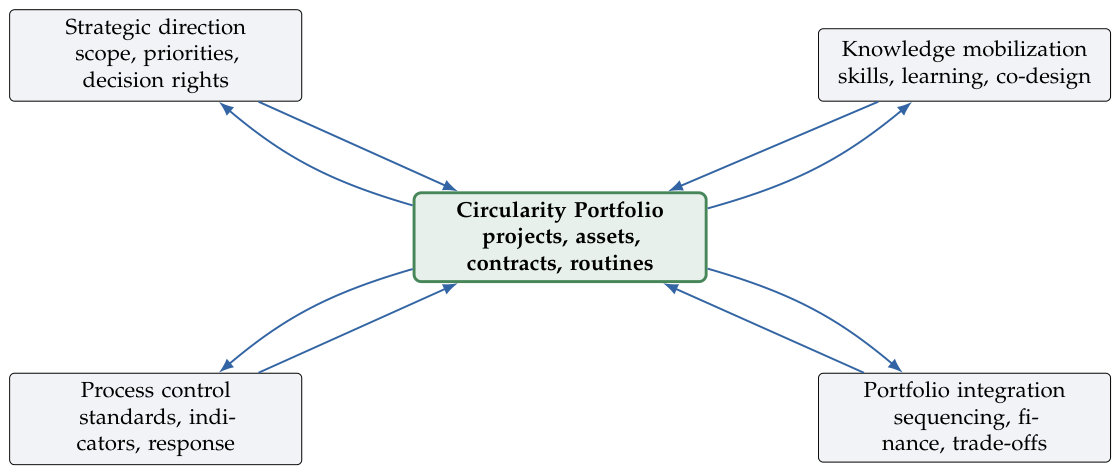
The synthesis identified four functions that transform a set of practices into a management system. They are not maturity levels; all four must operate throughout the transition.
4.1. Strategic Direction
Strategic direction defines the material issues, ambition, boundaries, and decision rights. It answers which resource flows matter, which risks justify action, and who can approve changes to specifications, contracts, and capital plans. Direction also prevents a long list of low-value initiatives from displacing fewer interventions with structural effects. In sustainability governance, coherent combinations of hierarchical, network, and market mechanisms are often more effective than reliance on a single mode (Meuleman, 2021). For hotels, this means joining corporate objectives with property knowledge and supplier capability.
4.2. Knowledge Mobilization
Circular transitions depend on practical knowledge distributed among chefs, housekeepers, engineers, purchasing teams, finance staff, guests, and suppliers. Knowledge mobilization converts local experience into reusable routines: training tied to real tasks, documented problem solving, peer comparison, and supplier co-design. It also creates a way to revise a practice when it damages guest experience or transfers a burden to another resource stream.
4.3. Process Control
Process control stabilizes performance through standard work, measurement boundaries, data-quality checks, and response rules. Control is not synonymous with bureaucracy. Its purpose is to make deviations visible and assign action. Food waste per cover, water per guest-night, and maintenance completion rates are useful only when the organization knows who reviews them, how often, and what happens outside the expected range.
4.4. Portfolio Integration
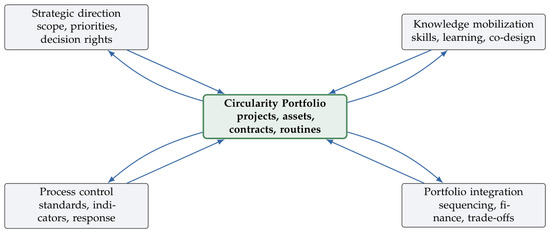
Portfolio integration connects initiatives that compete for capital, staff time, physical space, and supplier attention. A portfolio view supports sequencing, makes dependencies visible, and compares initiatives using environmental, financial, service, and risk criteria. It also allows a hotel group to distinguish measures that should be standardized from those that require local adaptation. Figure 2 depicts these four functions around the circularity portfolio.
Figure 2.
Four governance functions required to manage circular hospitality as a portfolio rather than as a collection of isolated projects.
Table 4 translates the four functions into accountable levels and recurring management routines. Its failure signals provide a practical way to identify where an initiative lacks authority, organizational learning, reliable process control, or a decision about whether to continue and scale.
Table 4.
Governance functions, principal owners, and minimum operating routines.
5. The 5D Management Framework
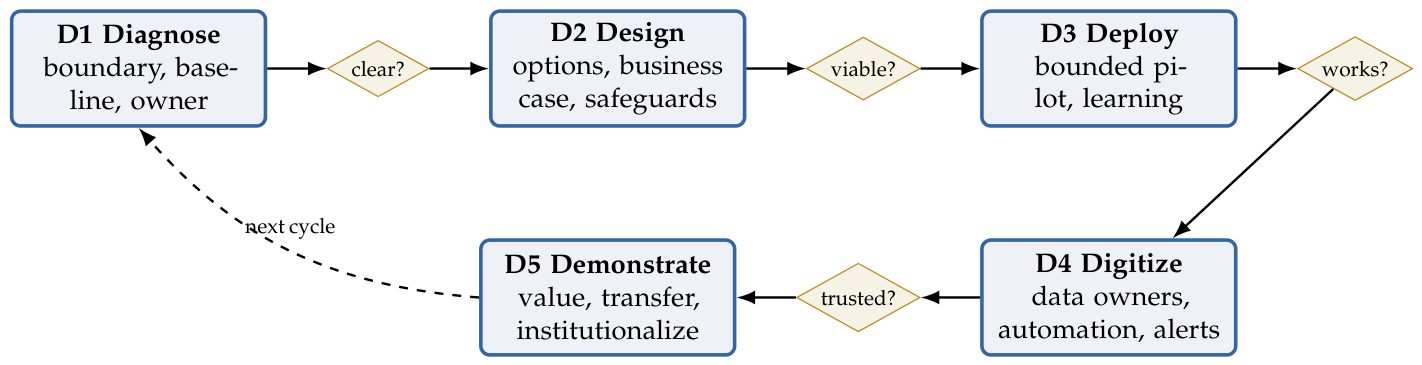
The 5D framework organizes the transition into five recurring stages: Diagnose, Design, Deploy, Digitize, and Demonstrate. The sequence is deliberately iterative. A demonstrated result changes the next diagnosis, and digital evidence may reveal that an intervention needs redesign rather than expansion. Each stage concludes with a decision gate so that activity is not mistaken for progress.
The framework does not claim that diagnosis, pilot testing, digital measurement, or performance review are individually new. Its contribution lies in specifying how these activities are connected in a hotel management cycle. Each stage produces an output for a defined decision gate, while the four governance functions assign direction, learning, operational control, and portfolio responsibility across the cycle. This combination makes it possible to ask not only whether a circular practice is desirable, but also who can authorize it, what evidence supports its continuation, and under which conditions it can be transferred to another property.
5.1. D1—Diagnose
Diagnosis establishes the operating boundary and baseline. Properties identify material flows, costs, contractual constraints, legal obligations, data availability, and the points at which waste or value loss occurs. Materiality is assessed across environmental magnitude, financial exposure, service relevance, implementation feasibility, and stakeholder concern. The output is a short portfolio of problems with named owners, not a generic sustainability checklist.
Baseline design requires denominator discipline. Food waste per cover, energy and water per guest-night, and purchases per occupied room convey different information from absolute totals. Occupancy, events, restaurant covers, climate, and renovation cycles must be recorded so that changes in activity are not misreported as efficiency gains. Departmental differences in resource use and control also require named local data owners rather than a single undifferentiated hotel baseline (Ozdemir Akgul et al., 2025). The first gate asks whether the problem, boundary, owner, and baseline are sufficiently clear to justify design work.
5.2. D2—Design
Design moves upstream from disposal to prevention and value retention. Alternatives should follow a hierarchy: avoid demand, reduce input, extend life, reuse, repair or refurbish, redistribute, remanufacture, recycle, recover, and only then dispose. For assets, the design stage examines durability, modularity, maintainability, aesthetics over time, take-back conditions, residual value, and embodied impacts (Bocken et al., 2016; Fonseca & Dias, 2025; Gungor & Moscarelli, 2025). For food, it links menu engineering, forecasting, purchasing, storage, preparation, portions, and destination pathways (Amicarelli et al., 2022; Cardenas et al., 2024; Chang et al., 2025).
Each alternative receives an owner, expected mechanism, affected stakeholders, resource requirements, service risks, measurement plan, and stop condition. A credible design states what would disconfirm the business case. The gate authorizes a bounded pilot only when operational, financial, environmental, and customer implications have been considered.
5.3. D3—Deploy
Deployment tests the mechanism under controlled conditions. A pilot should define site, duration, comparison period, training, responsibilities, data-capture method, and escalation route. Short pilots are useful for workflow defects, but seasonal operations and asset-life decisions require longer observation. Staff and supplier feedback is collected alongside numerical indicators because implementation burden often explains why technically sound practices do not persist.
The deployment gate distinguishes three outcomes: stop, redesign, or expand. Expansion requires evidence that the mechanism worked without unacceptable service degradation, burden shifting, or dependence on exceptional staff effort. Studies of green-hotel reviews, guest experience, and circular agritourism indicate that sustainability attributes are evaluated together with cleanliness, comfort, service quality, and perceived value, which makes service safeguards part of the intervention rather than a secondary outcome (Aliyah et al., 2025; Merli et al., 2019; Tavares de Carvalho et al., 2024). A positive environmental result is insufficient if the intervention creates food-safety risk, damages accessibility, or merely exports waste to an unverified contractor.
5.4. D4—Digitize
Digitization begins after the decision use is defined. The objective is to lower measurement cost, improve timeliness, and support exception management. Data may come from meters, point-of-sale systems, purchasing records, kitchen scales, maintenance platforms, supplier documents, or guest interfaces. Green digital leadership and data-driven managerial capability can help align technology with routines, learning, and organizational efficacy, but technological investment should not be treated as a proxy for performance (Abdou, 2025; Elshaer et al., 2025; Pencarelli, 2020).
Every automated indicator requires a data owner, definition, unit, denominator, refresh rate, completeness rule, and audit trail. Missing data should remain visible; interpolation and estimation must be labeled. The gate to institutionalization is passed when managers can trace a dashboard value to source data and to a defined operational response.
5.5. D5—Demonstrate
Demonstration connects operational change with environmental, financial, service, and risk outcomes. It asks whether savings persisted, whether avoided purchases or disposal costs were realized, whether working conditions and guest experience remained acceptable, and whether the intervention is transferable. Where a monetary business case is required, net present value should include installation, training, monitoring, maintenance, disposal, and residual-value effects rather than energy or material savings alone.
An illustrative food-service application shows how the gates would operate. A hotel first measures avoidable food waste per cover and identifies whether losses arise during purchasing, preparation, or service (Diagnose). The kitchen and purchasing teams then compare changes to forecasting, menus, storage, and portion sizes, recording expected costs and service risks (Design). One dining service tests the selected change over a defined period, with staff feedback and a comparable baseline (Deploy). If the pilot warrants continued monitoring, existing purchasing and point-of-sale records may be linked to kitchen measurements, with an assigned data owner and a rule for investigating deviations (Digitize). Management subsequently checks whether the reduction persists, whether costs are actually avoided, and whether guest experience and staff workload remain acceptable before standardizing, redesigning, or ending the practice (Demonstrate). The example illustrates the decision sequence; it is not an evaluated intervention or evidence of a quantified effect.
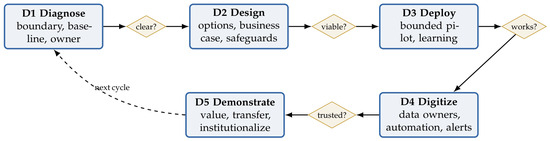
Demonstration produces one of four decisions: standardize, scale selectively, redesign, or retire. It also changes purchasing rules, budgets, contracts, operating procedures, and training. Without this institutional step, a successful pilot remains a temporary project. Figure 3 and Table 5 summarize the framework.
Figure 3.
The 5D stage-gate cycle. Gates prevent unclear baselines, weak business cases, untested pilots, or unreliable data from being carried forward as evidence of success.
Table 5.
Deliverables and decision gates in the 5D framework.
6. Measurement Architecture
6.1. Denominator-Aligned Indicators
Comparability begins with an operational denominator. Let denote the quantity of resource or waste stream k during period t, and let denote the service output most closely associated with that stream. The intensity indicator is
Suitable denominators include guest-nights for accommodation utilities, covers for food-service waste, occupied-room cleans for housekeeping consumables, and floor area adjusted for operating hours when building loads dominate. A percentage improvement relative to a declared baseline b is
The baseline period, inclusion boundary, and treatment of missing observations must accompany . Otherwise, the same percentage can describe a genuine process improvement, an occupancy shift, a menu change, or incomplete data. For example, a reduction in kilograms of food waste per cover can support a decision about forecasting or portion design, provided that edible and inedible waste are classified consistently and the services compared have similar boundaries. A decline in water use per guest-night requires a different interpretation if laundry has been outsourced or a pool has been closed. Indicators therefore describe change within a declared operating boundary; they should not be used to rank unlike properties without examining service mix, occupancy, climate, and outsourced activities.
Procurement requires value-retention indicators in addition to flow intensity. A circular procurement share can be defined as
where qualified expenditure must satisfy documented criteria such as durability, repairability, verified recycled content, leasing, refurbishment, or supplier take-back. The definition should not allow a purchase to qualify solely because a supplier uses broad environmental language.
6.2. Data Completeness and Portfolio Aggregation
Portfolio reporting should disclose how much of the relevant activity is represented. For indicator k, coverage is
An indicator with low coverage may still support local learning, but it should not be presented as portfolio performance. Aggregation should use service-weighted quantities instead of the arithmetic mean of property percentages. This prevents a small property from receiving the same portfolio weight as a large resort. Coverage should be assessed separately for each indicator. A property may have complete guest-night records but incomplete kitchen measurements; high coverage for the former does not validate the latter. Managers should document missing periods and withhold portfolio-level claims when the observed activity is unrepresentative of the eligible activity.
A composite maturity index may be useful for internal prioritization, but it can conceal weak dimensions. If is a score for dimension d and is an agreed weight, an internal index can be expressed as
The score should be reported with its five components and data coverage. No universal weights or thresholds are claimed here; validation must precede external benchmarking or certification use.
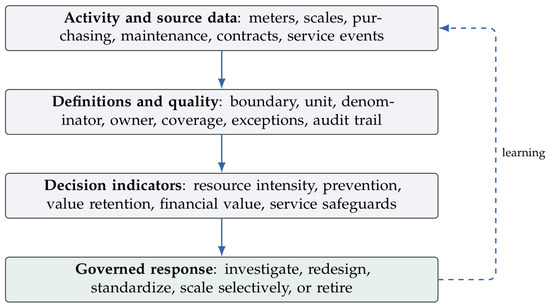
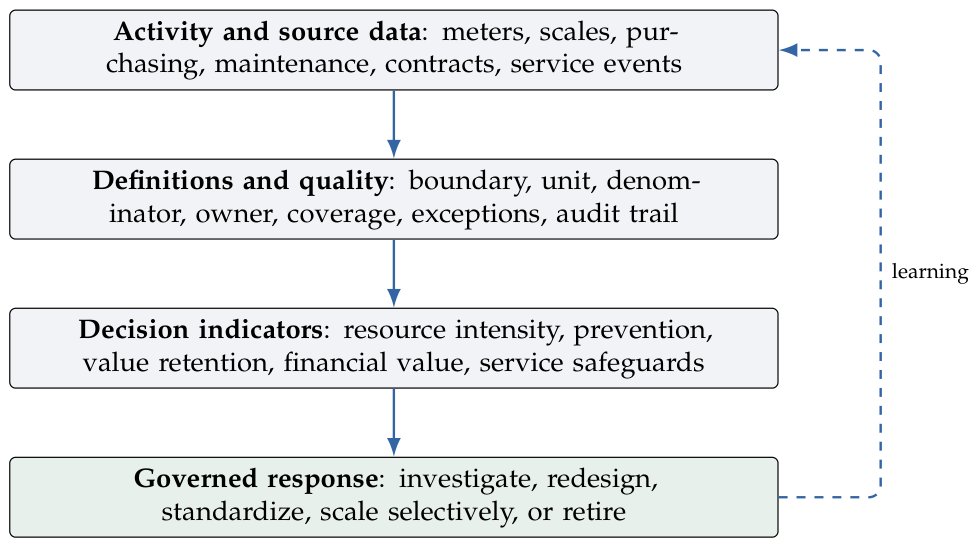
Figure 4 shows the data-to-decision chain. It places action after interpretation and governance review, rather than treating a dashboard as the endpoint.
Figure 4.
Data-to-decision architecture. Digital tools add value when source data and quality rules are explicitly connected to an accountable response.
Table 6 brings the proposed measures into a minimum indicator set. It pairs each operational definition with a suitable denominator, the decision it can inform, and a caution about interpretation. Properties should select indicators that correspond to their material flows and service mix; the full set is not a universal reporting requirement.
Table 6.
Minimum indicator set for a circular-hospitality management system.
7. Application Across Hotel Contexts
The applications below are context-sensitive adaptations of the mechanisms identified in the reviewed literature, not subgroup results from a stratified hotel sample. The evidence contexts summarized in Table 2 inform these adaptations: SME studies clarify resource constraints and incremental adoption; research on hotel operations and suppliers informs property and portfolio coordination; and destination-level studies identify shared infrastructure and stakeholder responsibilities. Where the evidence comes from a single setting or an adjacent hospitality activity, the proposed adaptation is presented as a managerial inference that requires local testing. Table 7 summarizes these adaptations and their principal transfer risks.
Table 7.
Context-sensitive adaptations of the 5D framework.
7.1. Independent and Small Properties
Independent hotels should begin with one or two material flows and a minimal indicator set. Shared destination services can reduce the cost of weighing equipment, staff training, specialist audits, and verified downstream partners. Procurement cooperatives may improve access to repair, refill, take-back, and local sourcing. A lightweight 5D cycle can operate with a monthly review and a simple data register; sophistication should follow decision need.
The main risk for small properties is overdesign. A complex dashboard can consume the same scarce attention required for operational change. The framework therefore prioritizes boundary, owner, denominator, and response rule before automation. SME studies support an incremental approach but also show that experimentation should be connected to longer-term capability, practical implementation tools, and finance (Bowen et al., 2024; Chatzifoti et al., 2025; A. Jones et al., 2025; Rizos et al., 2016).
Feasibility also differs across the five stages. Diagnosis requires staff time and access to basic purchasing or waste records; Design may require supplier information and a modest financial appraisal; and Deploy requires training and a period of observation alongside ordinary service. Digitize need not begin with new software: a maintained register may be sufficient until the volume and frequency of decisions justify automation. Demonstration requires management time to verify whether an operational improvement produced a realizable benefit. Where staff capacity, finance, or downstream infrastructure is limited, a property may narrow the initial scope, share specialist services with other businesses, or defer an intervention whose circular pathway cannot yet be verified.
7.2. Hotel Groups and Portfolios
Groups require a common dictionary and portfolio-weighted aggregation. Corporate standards should define non-negotiable principles—for example, verified waste destinations, minimum procurement clauses, and data-quality rules—while properties adapt interventions to climate, building type, brand promise, supplier market, and guest segment. Central purchasing can enable take-back and service contracts that individual properties cannot negotiate. Conversely, local pilots can reveal operational constraints before group-wide rollout.
Portfolio governance should also prevent favorable-property bias. Pilots conducted only in new, large, well-staffed hotels may not transfer to leased, heritage, seasonal, or remote properties. Scale decisions need explicit transfer conditions, including infrastructure, skills, capital, and supplier capacity.
7.3. Emerging Economies and Destination Partnerships
Geographic imbalance remains a recurrent concern in hospitality CE research (Gohoungodji & Chembessi, 2026; Peñaherrera Veloz et al., 2025). Evidence from developing contexts points to infrastructure, finance, training, public support, and supply-chain coordination as determinants of adoption (Bittner et al., 2024; Gaffar et al., 2026; Saydam et al., 2026). These are not peripheral conditions; they determine which loops are feasible.
An unavailable collection route, repair service, or take-back provider cannot be remedied by property-level measurement alone. Before adopting a target, managers and destination partners need to establish who bears the cost of the required infrastructure and whether the proposed material destination can be verified.
Destination partnerships can pool organic-waste collection, repair services, reverse logistics, training, and data standards. Network evidence from tourist hotels shows why municipal bodies, waste actors, educational institutions, communities, and hotel departments must be treated as an interdependent implementation system (Ally et al., 2025). Public policy can combine minimum requirements with technical assistance, procurement incentives, and infrastructure investment. Uniform targets without capacity building may encourage symbolic compliance, while incentives without verification may subsidize activity rather than outcomes. The 5D gates offer public–private programs a shared language for judging readiness and evidence.
8. Discussion
8.1. Theoretical Contribution
The framework reframes circular hospitality as a governed capability, not simply a bundle of practices. The existing studies describe interventions, drivers, and barriers with increasing breadth (Gohoungodji & Chembessi, 2026; Rodríguez et al., 2020). The 5D model adds a temporal and organizational explanation: an intervention becomes durable when strategic direction selects a material problem, knowledge mobilization shapes a workable design, process control stabilizes deployment, and portfolio integration connects evidence to capital and institutional rules. The proposed distinction is thus one of integration and decision specification, rather than the introduction of five previously unknown management activities.
The relationship between digitalization and circularity is conditional rather than automatic. Studies of green digital leadership and data-driven managerial capabilities suggest that technology can strengthen coordination and decision-making, while the evidence on food waste, procurement, and supplier networks shows that circular outcomes still depend on changes in routines and material flows (Abdou, 2025; Ally et al., 2025; Elshaer et al., 2025; Fonseca & Dias, 2025). In the 5D model, digital tools become useful when a manager has already specified the resource flow, the decision to be made, the responsible actor, and the response to an observed deviation. Purchasing records, kitchen scales, or maintenance systems can then reveal avoidable losses and document whether corrective action persists. A dashboard alone cannot verify that waste was prevented, an asset remained in use for longer, or a supplier completed a take-back commitment. This distinction helps explain why greater data availability need not produce greater circularity. The Demonstrate stage therefore evaluates material outcomes alongside financial realization, service safeguards, and transfer conditions.
8.2. Managerial Implications
Managers can use the framework as a portfolio review template. The most immediate improvement is to require four items for every initiative: an accountable owner, an operational denominator, a decision gate, and a documented response to poor performance. These requirements expose projects that have attractive narratives but no measurable mechanism. They also support stopping or redesigning initiatives without treating termination as failure.
Procurement deserves particular attention because it determines future waste, maintenance, and flexibility. Supplier evaluation should move beyond environmental declarations to contractable properties: expected life, repair response, replaceable components, refurbishment, take-back evidence, material disclosure, and end-of-use responsibility. Finance teams should participate at design stage so that avoided purchases, residual value, training, and monitoring costs are incorporated before a pilot is approved.
The framework is intended to be adaptable, but its full set of tools need not be deployed at once or in the same form in every property. A small independent hotel with limited records can begin with one material flow, a simple baseline, a named owner, and a monthly decision about whether to continue or modify the intervention. A hotel with established measurement systems may instead focus on data quality, supplier verification, and the comparison of initiatives across departments. Hotel groups require common definitions and aggregation rules, while allowing properties to adjust interventions to their service mix, building, supplier market, and local infrastructure. In each setting, the appropriate entry point depends on current capability and the material problem being addressed. Managers should revisit the diagnosis as operations, suppliers, or data quality change; progression through the five stages is therefore iterative rather than a one-time certification of maturity.
8.3. Policy Implications
Policy should enable loops rather than merely demand isolated indicators. Waste segregation rules have limited effect where collection, processing, or market outlets are absent. Destination-level infrastructure, shared definitions, workforce development, and credible verification can make hotel action feasible. Public procurement, tax instruments, and concessional finance can reward value retention, but they require safeguards against relabeling ordinary efficiency or waste transfer as circularity.
Alignment with the Sustainable Development Goals is strongest when the causal pathway is specified. Resource prevention and responsible procurement contribute directly to SDG 12; infrastructure and circular innovation connect to SDG 9; emissions and resilience connect to SDG 13; decent local value chains relate to SDG 8; and partnerships support SDG 17 (Schroeder et al., 2019). Mapping every initiative to several SDGs without an evidence pathway adds little managerial value.
8.4. Research Agenda and Propositions
Empirical validation should test the framework’s sequence and boundary conditions. Five propositions follow from the synthesis:
- P1.
- Circular initiatives with an explicit operational denominator and response rule will show greater persistence than initiatives monitored only through absolute quantities.
- P2.
- Early participation by procurement and finance will increase the proportion of pilots that alter upstream specifications or contracts.
- P3.
- Digital measurement will improve outcomes only when data ownership and decision routines mediate the relationship between technology adoption and performance.
- P4.
- Portfolio-level stage gates will reduce indefinite pilots and improve the transfer of successful practices across heterogeneous properties.
- P5.
- The effect of the 5D framework will be moderated by local infrastructure, supplier capability, property scale, and institutional support.
Table 8 translates these propositions into research designs. Longitudinal and comparative work is especially important because many CE benefits depend on maintenance, repeated behavior, asset life, and learning. Cross-sectional self-reports cannot establish whether savings persist or whether an intervention shifts impacts outside the measured boundary.
Table 8.
Priority empirical tests for the governance-ready 5D framework.
8.5. Limitations
Several limitations bound the contribution. The framework integrates heterogeneous evidence and does not estimate causal effects. The initial field map ends in 2024, and the 2025–2026 update was purposive rather than an exhaustive rerun of Scopus and Web of Science. Reference auditing improves bibliographic integrity but cannot recover unreported methodological details. The governance mechanisms are drawn partly from adjacent management research; their transfer to hospitality is theoretically reasoned and supported by recent hotel studies, yet still requires direct testing. The sources also do not form a balanced sample by hotel size, category, ownership, or region. Consequently, the context adaptations in Section 7 are reasoned applications of the synthesized mechanisms, not evidence of equivalent effectiveness across property types. Comparative and longitudinal studies are needed to establish which stages, measures, and governance arrangements work best under different operating conditions. Finally, the KPI set favors measures that can be implemented across diverse properties. Specialized resorts, heritage hotels, cruise hospitality, and all-inclusive operations may need additional boundaries and indicators.
9. Conclusions
Circular hospitality has moved beyond a narrow concern with recycling, but its management systems have not always kept pace with its expanding ambition. Evidence now covers food systems, assets, procurement, digital capability, staff and guest participation, institutional pressures, and cross-sector partnerships. The unresolved question is how these elements are governed as a coherent transition.
The proposed 5D framework answers that question with a repeatable cycle. Diagnose makes the problem measurable and owned; Design moves action upstream and makes assumptions explicit; Deploy tests the mechanism under ordinary conditions; Digitize creates reliable, decision-linked information; and Demonstrate connects operational change to environmental, financial, service, and risk outcomes. Four governance functions—strategic direction, knowledge mobilization, process control, and portfolio integration—operate across the cycle.
The framework does not promise a universal score or a guaranteed business case. Its value lies in making assumptions, boundaries, responsibilities, and evidence visible. For managers, it offers a disciplined route from pilot to institutional practice. For policymakers, it identifies the capabilities and infrastructure that make circular loops feasible. For researchers, it provides propositions, measures, and boundary conditions that can be tested across property types and regions. The next step is longitudinal application in hotel portfolios and destination partnerships, with particular attention to emerging economies and to the service consequences of circular redesign.
Supplementary Materials
The following supporting information can be downloaded at https://www.mdpi.com/article/10.3390/tourhosp7100337/s1, Table S1: an audited evidence matrix and mechanism-coding summary provided as a CSV file.
Author Contributions
Conceptualization, H.P.-V., D.M.-C., J.P.-S. and C.V.-S.; methodology, H.P.-V., D.M.-C., J.P.-S. and C.V.-S.; investigation, H.P.-V., D.M.-C., J.P.-S. and C.V.-S.; writing—original draft preparation, H.P.-V., D.M.-C., J.P.-S. and C.V.-S.; writing—review and editing, H.P.-V., D.M.-C., J.P.-S. and C.V.-S.; visualization, C.V.-S.; supervision, C.V.-S. All authors have read and agreed to the published version of the manuscript.
Funding
This research received no external funding.
Institutional Review Board Statement
Not applicable. The study synthesizes published literature and did not involve human participants or identifiable personal data.
Informed Consent Statement
Not applicable.
Data Availability Statement
The original contributions presented in this study are included in the article and Supplementary Materials. The structured evidence matrix supporting the integrative synthesis is provided in Supplementary Table S1. Further inquiries can be directed to the corresponding author.
Acknowledgments
The authors acknowledge the scholars and hospitality practitioners whose published work made the integrative synthesis possible.
Conflicts of Interest
The authors declare no conflicts of interest.
References
- Abdou, A. H. (2025). Smarter technologies, innovation, and managerial capabilities driving hotel sustainability: The integration of resource-based view and dynamic capabilities perspective. Tourism and Hospitality, 6(5), 252. [Google Scholar] [CrossRef] [Scilit]
- Acampora, A., Lucchetti, M. C., Merli, R., & Ali, F. (2022). The theoretical development and research methodology in green hotels research: A systematic literature review. Journal of Hospitality and Tourism Management, 51, 512–528. [Google Scholar] [CrossRef] [Scilit]
- Alharethi, T., Abdelhakim, A., & Mohammed, A. (2024). Drivers and barriers towards circular economy in rural tourism destinations: A case study of Tunis village, Egypt. Tourism and Hospitality, 5(3), 639–656. [Google Scholar] [CrossRef] [Scilit]
- Aliyah, U., Williady, A., & Kim, H.-S. (2025). An evaluation of green hotels in Singapore, Sentosa Island: A big data study through online review. Tourism and Hospitality, 6(1), 24. [Google Scholar] [CrossRef] [Scilit]
- Ally, B., Abdulkadir, A., Mwevura, H., Furu, P., Salukele, F., Hirsbak, S., & Remmen, A. (2025). Stakeholder engagement and social networks: Enhancing sustainable food waste management in Zanzibar’s tourist hotels. Tourism and Hospitality, 6(5), 255. [Google Scholar] [CrossRef] [Scilit]
- Amicarelli, V., Aluculesei, A.-C., Lagioia, G., Pamfilie, R., & Bux, C. (2022). How to manage and minimize food waste in the hotel industry: An exploratory research. International Journal of Culture, Tourism and Hospitality Research, 16(1), 152–167. [Google Scholar] [CrossRef] [Scilit]
- Bittner, N., Bakker, N., & Long, T. B. (2024). Circular economy and the hospitality industry: A comparison of the Netherlands and Indonesia. Journal of Cleaner Production, 444, 141253. [Google Scholar] [CrossRef] [Scilit]
- Bocken, N. M. P., de Pauw, I., Bakker, C., & van der Grinten, B. (2016). Product design and business model strategies for a circular economy. Journal of Industrial and Production Engineering, 33(5), 308–320. [Google Scholar] [CrossRef] [Scilit]
- Bowen, R., Dowell, D., & Morris, W. (2024). Hospitality SMEs and the circular economy: Strategies and practice post-COVID. British Food Journal, 126(1), 80–97. [Google Scholar] [CrossRef] [Scilit]
- Camilleri, M. A. (2021). Sustainable production and consumption of food: Mise-en-place circular economy policies and waste management practices in tourism cities. Sustainability, 13(17), 9986. [Google Scholar] [CrossRef] [Scilit]
- Cardenas, M., Schivinski, B., & Brennan, L. (2024). Circular practices in the hospitality sector regarding food waste. Journal of Cleaner Production, 472, 143452. [Google Scholar] [CrossRef] [Scilit]
- Chang, K. A., Norazlin, A. A., Lim, J. P. S., & Zaidi, M. Z. M. (2025). Adopting circular food practices in Malaysian hotels: The influence of isomorphic pressures and environmental beliefs. International Journal of Hospitality Management, 127, 104113. [Google Scholar] [CrossRef] [Scilit]
- Chatzifoti, N., Alexandropoulou, A., Fousteris, A. E., Karvounidi, M. D., & Chountalas, P. T. (2025). Techno-economic evaluation of sustainability innovations in a tourism SME: A process-tracing study. Tourism and Hospitality, 6(4), 209. [Google Scholar] [CrossRef] [Scilit]
- Chawla, G., Lugosi, P., & Hawkins, R. (2021). Food waste drivers in corporate luxury hotels: Competing perceptions and priorities across the service cycle. Tourism and Hospitality, 2(3), 302–318. [Google Scholar] [CrossRef] [Scilit]
- Donthu, N., Kumar, S., Mukherjee, D., Pandey, N., & Lim, W. M. (2021). How to conduct a bibliometric analysis: An overview and guidelines. Journal of Business Research, 133, 285–296. [Google Scholar] [CrossRef] [Scilit]
- Elshaer, I. A., Azazz, A. M. S., Alyahya, M., Fayyad, S., Aboutaleb, M., & Mohammad, A. A. A. (2025). Driving sustainability performance in hotels through green digital leadership and circular economy: The moderating role of hotel green efficacy. Systems, 13(6), 415. [Google Scholar] [CrossRef] [Scilit]
- Filimonau, V., & Ermolaev, V. A. (2022). Exploring the potential of industrial symbiosis to recover food waste from the foodservice sector in Russia. Sustainable Production and Consumption, 29, 467–478. [Google Scholar] [CrossRef] [Scilit]
- Fonseca, D. B., & Dias, Á. (2025). Adopting circular economy in hospitality: A grounded theory approach. Circular Economy and Sustainability, 5, 2653–2677. [Google Scholar] [CrossRef] [Scilit]
- Gaffar, V., Tjahjono, B., Koeswandi, T., Tjahjono, M., Rofaida, R., & Sari, M. (2026). Transformative hospitality: Leveraging a human-centric circular economy framework for the hotel industry. International Journal of Contemporary Hospitality Management, 38(4), 1296–1319. [Google Scholar] [CrossRef] [Scilit]
- Geissdoerfer, M., Savaget, P., Bocken, N. M. P., & Hultink, E. J. (2017). The circular economy—A new sustainability paradigm? Journal of Cleaner Production, 143, 757–768. [Google Scholar] [CrossRef] [Scilit]
- Gohoungodji, P., & Chembessi, C. (2026). The circular turn in hospitality: Strategies, drivers, and impacts of circular practices in the hotel industry—A systematic review. Sustainability, 18(14), 7123. [Google Scholar] [CrossRef] [Scilit]
- Gungor, A., & Moscarelli, R. (2025). Experimenting with sustainable hospitality: A life cycle assessment analysis of the set-up phase of a public hostel in Italy. Tourism and Hospitality, 6(1), 40. [Google Scholar] [CrossRef] [Scilit]
- Jones, A., Laing, T., Majik, I., Farache Aureliano Da Silva, F., & Riano, J. (2025). Creating a sustainability toolkit for restaurants. Tourism and Hospitality, 6(2), 70. [Google Scholar] [CrossRef] [Scilit]
- Jones, P., & Wynn, M. G. (2019). The circular economy, natural capital and resilience in tourism and hospitality. International Journal of Contemporary Hospitality Management, 31(6), 2544–2563. [Google Scholar] [CrossRef] [Scilit]
- Khan, I. S., Najar, A. H., Shafi, I., & Singh, R. (2024). Bibliometric analysis of sustainable practices in the hotel industry: Current trends and future research directions. Atna Journal of Tourism Studies, 19(1), 113–132. [Google Scholar] [CrossRef] [Scilit]
- Kirchherr, J., Reike, D., & Hekkert, M. (2017). Conceptualizing the circular economy: An analysis of 114 definitions. Resources, Conservation and Recycling, 127, 221–232. [Google Scholar] [CrossRef] [Scilit]
- Martin-Rios, C., Demen-Meier, C., Gössling, S., & Cornuz, C. (2018). Food waste management innovations in the foodservice industry. Waste Management, 79, 196–206. [Google Scholar] [CrossRef] [Scilit] [PubMed]
- Menegaki, A. N. (2025). Optimizing pollution control in the hospitality sector: A theoretical framework for sustainable hotel operations. Tourism and Hospitality, 6(2), 85. [Google Scholar] [CrossRef] [Scilit]
- Merli, R., Preziosi, M., Acampora, A., & Ali, F. (2019). Why should hotels go green? Insights FROM guests experience in green hotels. International Journal of Hospitality Management, 81, 169–179. [Google Scholar] [CrossRef] [Scilit]
- Meuleman, L. (2021). Public administration and governance for the SDGs: Navigating between change and stability. Sustainability, 13(11), 5914. [Google Scholar] [CrossRef] [Scilit]
- Murray, A., Skene, K., & Haynes, K. (2017). The circular economy: An interdisciplinary exploration of the concept and application in a global context. Journal of Business Ethics, 140(3), 369–380. [Google Scholar] [CrossRef] [Scilit]
- Ozdemir Akgul, S., Cabi Bilge, A., & Cicekdagi, M. (2025). Evaluating the role of hotel departments in sustainability practices. Tourism and Hospitality, 6(5), 279. [Google Scholar] [CrossRef] [Scilit]
- Page, M. J., McKenzie, J. E., Bossuyt, P. M., Boutron, I., Hoffmann, T. C., Mulrow, C. D., Shamseer, L., Tetzlaff, J. M., Akl, E. A., Brennan, S. E., Chou, R., Glanville, J., Grimshaw, J. M., Hróbjartsson, A., Lalu, M. M., Li, T., Loder, E. W., Mayo-Wilson, E., McDonald, S., … Moher, D. (2021). The PRISMA 2020 statement: An updated guideline for reporting systematic reviews. BMJ, 372, n71. [Google Scholar] [CrossRef] [Scilit] [PubMed]
- Pencarelli, T. (2020). The digital revolution in the travel Furthermore, tourism industry. Information Technology & Tourism, 22(3), 455–476. [Google Scholar] [CrossRef] [Scilit]
- Peñaherrera Veloz, H. L., Pacheco Olea, F. E., & Lopez Novilo, O. E. (2025). Circular economy in the hotel industry: A general mapping through bibliometric analysis. Journal of Posthumanism, 5(5), 750–769. [Google Scholar] [CrossRef] [Scilit]
- Rizos, V., Behrens, A., van der Gaast, W., Hofman, E., Ioannou, A., Kafyeke, T., Flamos, A., Rinaldi, R., Papadelis, S., Hirschnitz-Garbers, M., & Topi, C. (2016). Implementation of circular economy business models by small and medium-sized enterprises (SMEs): Barriers and enablers. Sustainability, 8(11), 1212. [Google Scholar] [CrossRef] [Scilit]
- Rodríguez, C., Florido, C., & Jacob, M. (2020). Circular economy contributions to the tourism sector: A critical literature review. Sustainability, 12(11), 4338. [Google Scholar] [CrossRef] [Scilit]
- Rodríguez-Antón, J. M., & Alonso-Almeida, M. d. M. (2019). The circular economy strategy in hospitality: A multicase approach. Sustainability, 11(20), 5665. [Google Scholar] [CrossRef] [Scilit]
- Saydam, M. B., Nagy, A., & Schneider, A. (2026). Hotel managers’ voices on circular economy: Unveiling barriers, enablers and strategic solutions. Journal of Hospitality and Tourism Insights. [Google Scholar] [CrossRef] [Scilit]
- Schroeder, P., Anggraeni, K., & Weber, U. (2019). The relevance of circular economy practices to the sustainable development goals. Journal of Industrial Ecology, 23(1), 77–95. [Google Scholar] [CrossRef] [Scilit]
- Seraj, A. H., Hasanein, A. M., Al-Romeedy, B. S., & Taha, E. H. (2025). How talent management drives sustainability in hospitality enterprises: The mediating role of green knowledge sharing and employee voice. Tourism and Hospitality, 6(4), 176. [Google Scholar] [CrossRef] [Scilit]
- Silva, S., Silva, C., & Oliveira, M. (2025). The value of skills for a sustainable tourism and hospitality industry. Tourism and Hospitality, 6(1), 14. [Google Scholar] [CrossRef] [Scilit]
- Sorin, F., & Sivarajah, U. (2021). Exploring circular economy in the hospitality industry: Empirical evidence from scandinavian hotel operators. Scandinavian Journal of Hospitality and Tourism, 21(3), 265–285. [Google Scholar] [CrossRef] [Scilit]
- Tavares de Carvalho, P., Raimundo, R. J., & Dias Lopes, J. (2024). Improving guest and owner satisfaction through a circular economy: An agritourism case study. Tourism and Hospitality, 5(4), 887–905. [Google Scholar] [CrossRef] [Scilit]
- Zupic, I., & Čater, T. (2015). Bibliometric methods in management and organization. Organizational Research Methods, 18(3), 429–472. [Google Scholar] [CrossRef] [Scilit]



Disclaimer/Publisher’s Note: The statements, opinions and data contained in all publications are solely those of the individual author(s) and contributor(s) and not of MDPI and/or the editor(s). MDPI and/or the editor(s) disclaim responsibility for any injury to people or property resulting from any ideas, methods, instructions or products referred to in the content. |
© 2026 by the authors. Licensee MDPI, Basel, Switzerland. This article is an open access article distributed under the terms and conditions of the Creative Commons Attribution (CC BY) license.