


Abstract
The methanation of pyrolysis gas was investigated using the open access software DWSIM v9.0.5 to assess its potential for producing methane-rich gas. The pyrolysis gas composition was derived from known experimental tests of anthropogenic residues, namely sewage sludge and digestate. Four gas compositions were considered; they were obtained by the pyrolysis of residues with and without a sorbent for CO2 capture. The methanation process was simulated by a non-stoichiometric thermodynamic approach to calculate the chemical equilibrium composition of the gas. A parametric investigation was carried out under a temperature range of 300–500 °C and a pressure range of 10–40 bar. Carbon oxide conversion, methane selectivity and methane yield were calculated. CO almost underwent quantitative conversion, while CO2 showed significantly lower or negative conversion. Synthetic biogas was obtained from the pyrolysis gas of the residues, showing a methane content of about 50 mol%. Synthetic natural gas was obtained from the pyrolysis gas residues plus sorbent, showing a methane content of about 90 mol%.
1. Introduction
1.1. Feedstocks
Digestate is the residual material left after anaerobic digestion (AD), a biological process in which microorganisms degrade organic substances in the absence of oxygen, producing biogas [1]. In Europe, about 25 Mton of dry digestate is produced. Digestate contains water, organic matter, residual microbial biomass, and nutrients such as nitrogen, phosphorus, and potassium. In May 2026, the EU launched the Commission’s Fertiliser Action Plan, which recognizes digestate as a strategic resource for the European agro-industrial sector [2]. It certainly offers several advantages as a fertilizer, but it also presents challenging environmental, agronomic and management criticalities [3,4,5]. Environmental issues include excess nitrogen and phosphorus, which contribute to the contamination of surface and groundwater, and ammonia emissions during storage and spreading. If poorly managed, it can generate methane and nitrous oxide, contributing to greenhouse gas emissions [6,7]. Agronomic challenges include nutritional imbalances—the ratio of nitrogen, phosphorus, and potassium does not always match crop needs—salinity and soil compaction, and the presence of contaminants such as traces of heavy metals or microplastics. Furthermore, logistical and economic challenges include long-distance transportation, limited land availability, the need for dedicated storage tanks and infrastructure, and, finally, farmers’ reluctance to use digestate as a soil amendment and fertilizer. Therefore, digestate management is the main challenge in AD [8,9,10]. Alongside digestate, sewage sludge constitutes the other major organic residual matrix that Europe must manage.
Sewage sludge is the solid or semi-solid material that remains after the treatment of urban wastewater (from sewers, domestic wastewater, and sometimes industrial wastewater) in wastewater treatment plants. It contains water, organic substances, microorganisms, and various contaminants that are separated from the water during the purification process [11]. In the European Union (EU), there are different approaches to the disposal or reuse of sewage sludge: landfilling, agricultural use, composting and other applications, and incineration. In 2018, landfilling accounted for 6% of sludge disposal in the EU, agricultural use accounted for 35%, composting and other applications accounted for 12%, and incineration accounted for 37% [12,13].
1.2. Thermochemical Processes for Methane Rich Gas
Both digestate and sewage sludge have a significant organic fraction that can be exploited via thermochemical processes such as pyrolysis to produce fuel gas and reduce the volume of waste to be disposed of. In particular, our research group is studying the pyrolysis of digestate and sewage sludge in rotary kilns, tailored to the production of methane-rich gas [14,15].
Methane is the main component of natural gas (about 90 vol%), followed by light C2–C4 hydrocarbons. Natural gas is among the primary energy sources extensively employed worldwide. It is utilized for heating, power generation, transportation, and chemical production [16]. However, as a fossil fuel, its global distribution and price are related to geopolitical scenarios that, in recent years, have undergone rapid and uncontrolled developments. Therefore, there is a fundamental need to develop a synthetic natural gas (SNG) supply chain as a substitute for natural gas. With the global focus on environmental concerns and carbon footprint neutrality, producing methane from environmentally friendly biomass has become a highly attractive method.
The methanation of gases from thermochemical processes has been investigated at different technological readiness levels. Several research projects have intensively dealt with the production of SNG. For example, in Güssing (Austria), a biomass steam gasification plant for CHP was installed and successfully demonstrated with a 1 MW unit for the production of BioSNG [17]. Biomass hydrothermal gasification, as well as supercritical water gasification, has been investigated for methane production at the laboratory and bench scales. Even though these wet technologies are conceptually similar and are often overlapping, hydrothermal gasification operates at pressures and temperatures near the critical point of water, while supercritical water gasification occurs at pressures and temperatures above the critical point of water. Usually, low temperatures in the range of 300–400 °C and pressures of about 30–40 MPa, in the presence of catalysts, are employed to drive biomass conversion towards methane production [18,19,20,21].
Pyrolysis was also investigated for methane production. Similarly to gasification, a secondary unit for catalytic methanation of pyrolysis gas was proposed. Jaffar et al. developed a two-stage biomass pyrolysis–catalytic hydrogenation reactor for methane production. They investigated different catalysts and process parameters. The highest methane yield of 7.4 mmol g−1biomass was obtained at a pyrolysis temperature of 800 °C, a catalyst temperature of 500 °C, and an H2 gas hourly space velocity of 3600 mL h−1 g−1catayst. The resulting gaseous mixture contained 75.5 vol% methane [22]. Yue et al. produced tar-free methane-rich gases from reed biomass pyrolysis volatiles using corresponding biochar-supported Ni catalysts in a two-stage catalytic conversion process. CH4 yields ranged from 102.04 to 162.28 L kgreed−1. They assessed that the tar compounds in the pyrolysis volatiles were completely converted into gaseous products at relatively low catalytic temperatures of 400–500 °C. Effective catalyst preparation should account for the pyrolysis temperature used for biochar production and the Ni loading [23].
1.3. Goal of the Work
With the goal of setting up experimental methanation tests of pyrolysis gas from these anthropogenic residues, pyrolysis gas methanation was investigated using the open access software DWSIM v9.0.5. Sensitivity analyses were conducted using a thermodynamic approach based on Gibbs free energy minimization. The thermodynamic conditions that maximize methane production were identified together with the corresponding thermodynamic limits. The thermodynamic equilibrium model is a useful tool for calculating the maximum methanation performance that can be attained in a methanation reactor. The model calculations are independent of methanation reactor design; it is also referred to as a zero-dimensional model and is independent of the reactant residence times and hydrodynamics. Therefore, it is extremely helpful for studying the influence of process parameters, such as methanation temperature, pressure, and pyrolysis gas composition [24]. However, the thermodynamic model has some drawbacks: it does not take into account the kinetic limitations of the process and cannot predict how fast the gases are converted into methane. In a real reactor, if the pyrolysis gas residence time is too short, the gas will leave the reactor before reaching the predicted methane yield. Consequently, the use of a thermodynamic model can lead to an overestimation of pyrolysis gas conversion. The methanation of gases from thermochemical processes occurs through the catalytic reduction of carbon dioxide and carbon monoxide by hydrogen according to exothermic chemical reactions (1) and (2):
Reduction reactions occur in the temperature range of 300–400 °C, over a nickel catalyst to reduce kinetic limitation and to approach thermodynamic equilibrium as closely as possible [25]. In addition to H2, CO, CH4, CO2 and H2O, raw gas from pyrolysis contains impurities (e.g., tars, particulate, NH3, and H2S) that must be removed before methanation to avoid catalyst deactivation and poisoning [26]. From the stoichiometry of reactions (1) and (2), the H2/CO2 and H2/CO molar ratios should be 4 and 3 for a binary mixture (H2/COx), respectively. For a syngas where both CO2 and CO are present, it is advised that is used as a function of the concentration of the carbon oxides [27]. Unfortunately, gas from the biomass thermochemical process shows . Regarding gasification, this ratio shows values near 0.5, as determined by several authors [28,29,30]. Biomass pyrolysis at a temperature in the range of 800–900 °C yields gas with a slightly higher . It is very probable that the cracking of volatile molecules that occurs at these temperatures gives rise to higher H2 and CO concentrations, and the absence of oxidant reduces CO2 production [31,32]. The addition of a sorbent (CaO) for CO2 chemisorption during biomass pyrolysis at 800 °C yields a gas with [14,15]. Regarding pressure, reactions (1) and (2) occur with a reduction in the number of moles, , for both reactions. According to Le Chatelier’s principle, high pressure (10–30 bar) shifts the thermodynamic equilibrium towards methane production [33,34]. Moreover, from a kinetic point of view, increasing the total pressure in the gas phase compresses the gaseous molecules into a smaller volume. This increases the collision frequency and local reactant concentration at the catalyst surface, thereby accelerating the overall reaction rate with beneficial effects on process performance [34]. As stated above, the authors of this work are investigating a novel pyrolysis-based technology for the production of methane-rich gas. Compared to the state of the art, it was assessed that the addition of a sorbent (CaO) for CO2 chemisorption to a bench-scale rotary kiln pyrolyzer fed with digestate/sewage sludge yields a gas with a methane content of up to 42 mol% and increases to 1.8. With the goal of further increasing the methane content in the gas, reduction tests of gaseous carbon oxides were planned. To understand the thermodynamic principles governing methanation and to establish the optimal experimental conditions for the methanation tests, a thermodynamic analysis was carried out.
2. Materials and Methods
Four gas compositions were considered inputs for the thermodynamic analyses. The four gases were derived from experimental pyrolysis tests of sewage sludge and digestate carried out at 600, 700, and 800 °C, with and without a sorbent for CO2 capture. These pyrolysis tests were described in detail in previous works [14,15]. For both feedstocks, the pyrolysis temperature of 700 °C was selected because, together with sorbent addition, it yielded the highest methane and hydrocarbon concentrations in the pyrolysis gas. The gases obtained at a pyrolysis temperature of 700 °C without sorbent were also considered for both feedstocks. The four gas compositions are listed in Table 1.
Table 1.
Investigated pyrolysis gas for the thermodynamic analysis.
The chemical species considered for the calculation are H2O, C, H2, CO, CO2, CH4, and O2. Light hydrocarbons C2 and C3 were assumed to be CH4 because they accounted for about 1–3 vol% and because they are saturated hydrocarbons with similar chemical reactivity to methane. For the calculation of K-values (vapour/liquid equilibrium of the chemical species) and stream enthalpy, the Soave–Redlich–Kwong (SRK) Equation of State was used. The thermodynamic non-stoichiometric approach was applied to calculate the chemical equilibrium composition of the system. The Gibbs free energy of the chemical species involved in the process was minimized, and the chemical equilibrium criterion is applied, expressed as
The Gibbs free energy was calculated using Equation (4):
The minimization of this function is performed under the constraints imposed by the atomic mass balances of the three chemical elements (C, H, and O) in the system and by the method of Lagrangian undetermined multipliers. A system of seven linear equations is obtained, corresponding to the seven unknown chemical species involved in the methanation process. An iterative solution method provided by the open access software DWSIM v9.0.05 was used to determine the composition corresponding to the minimum Gibbs free energy. Sensitivity analyses were performed for each gas composition listed in Table 1 by varying the temperature from 300 to 500 °C in ten steps and varying the pressure from 10 to 40 bar in six steps. The temperature and pressure ranges were selected based on a literature survey [22,23,35,36]. The carbon oxide conversion was calculated using Equation (5):
The methane selectivity was calculated using Equation (6):
The methane yield was calculated using Equation (7):
The carbon yield was calculated using Equation (8):
3. Results and Discussion
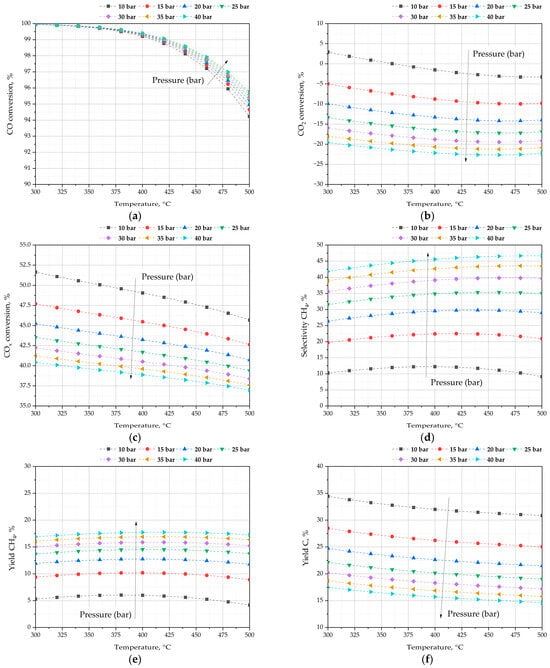
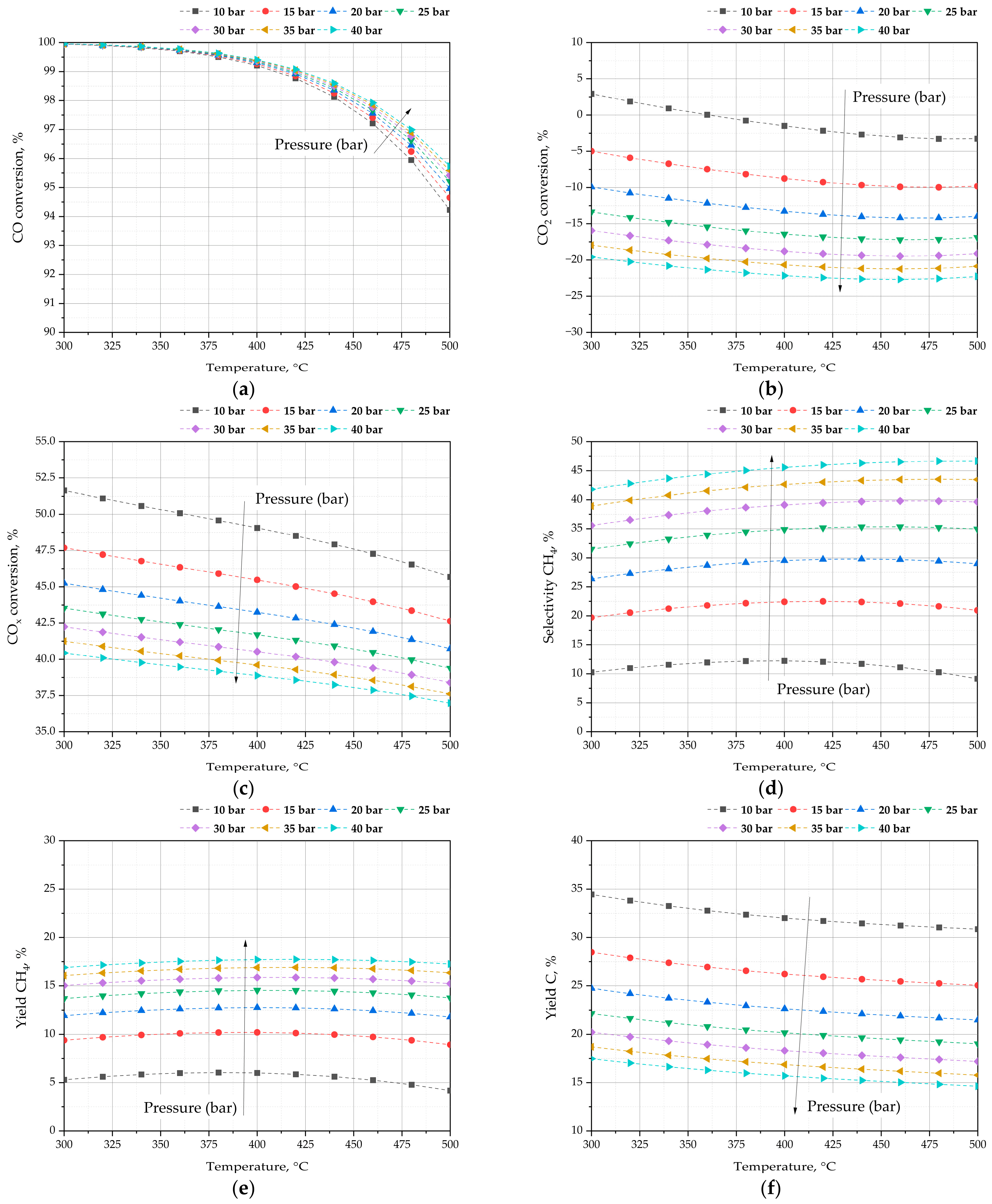
Figure 1 highlights the key process indicators for the methanation of pyrolysis gas derived from digestate, the composition of which is shown in Table 1. Carbon monoxide is quantitatively converted at the lowest temperatures (300–350 °C). At higher temperatures, the amount of converted CO slightly decreases; however, even at the highest temperature of 500 °C, its conversion rate remains around 95%. The effect of pressure is observed at higher temperatures; that is, increasing pressure favours CO conversion (Figure 1a). Carbon dioxide conversion always exhibits a negative value, except at 10 bar and between 300 and 360 °C (Figure 1b). This negative carbon dioxide conversion indicates that CO2 is produced during methanation, likely due to the water–gas shift reaction occurring alongside the shift in the Boudouard equilibrium (reactions (9) and (10)).
Figure 1.
Key process indicators for the methanation of pyrolysis gas from digestate: conversion of CO (a), CO2 (b) and COx (c); selectivity to CH4 (d); yields of CH4 (e) and of C (f) as functions of the process temperature.
Overall, the carbon oxide (CO + CO2) conversion rate ranges between 37% and 52%; it steadily decreases with increasing temperature and pressure (Figure 1c). Methane selectivity ranges between 9% and 47%. It is evident that pressure strongly influences selectivity; for example, at 400 °C, selectivity increases from 12% to 46% when the pressure increases from 10 to 40 bar. Temperature has a moderate effect on selectivity. For instance, the 25-bar isobar exhibits a concave-down trend, ranging from 26% to 29% (Figure 1d). The methane yield isobars show values that increase with pressure. Each isobar is a concave-down curve showing a maximum methane yield value, which varies as a function of temperature. Specifically, at 10 bar, the maximum yield occurs at 380 °C; increasing the pressure to 40 bar shifts the maximum to 420 °C. Finally, methane yields vary from 4 to 18% (Figure 1e). The carbon yield of the process was also calculated (Figure 1f). It varies within the range of 15–34%. It significantly decreases with increasing pressure and slightly decreases with temperature. Carbon is produced through side reactions (10)–(13) [37].
Carbon formation has several disadvantages for process performance; namely, it is associated with coke formation, which can deactivate the catalyst by blocking active sites and pores (reactions (9)–(12)), and with soot formation, which can restrict gas flow and increase pressure drops in the methanation plant (reaction (13)) [36,38,39]. It is also interesting to compare the inlet and outlet gases to evaluate the gas volume ratio, gas composition, and heating value. For each isobar, the temperature yielding the highest methane production rate was selected to analyze the main gas characteristics (Table 2).
Table 2.
Gas features from the methanation of pyrolytic gas from digestate.
Table 1 and Table 2 show that a net increase in methane and carbon dioxide content occurs during methanation. In fact, the methane content rises from 17.2 mol% to 43–45 mol%, while the carbon dioxide content increases from 25 to about 53 mol%. The carbon monoxide content is below 1%, and the hydrogen content is 2–3 mol%. The heating value of the output gas is higher than that of the input gas (16 vs. 13 MJ/Nm3), as is the density (1.37 vs. 0.96 kg/Nm3). The output gas from methanation is similar to biogas in terms of composition and heating value [40,41]. The gas ratio of the methanation process is in the range of 47–58%. The by-products of the process are water produced by methanation reactions (1) and (2) and carbonaceous residue produced by side reactions (10)–(13). All of these thermodynamic results confirm interesting considerations regarding the suitability of digestate pyrolysis coupled with methanation for the production of synthetic biogas.
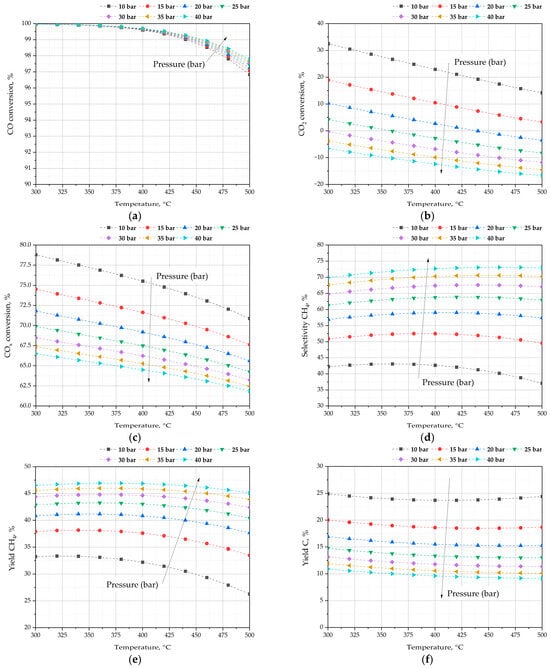
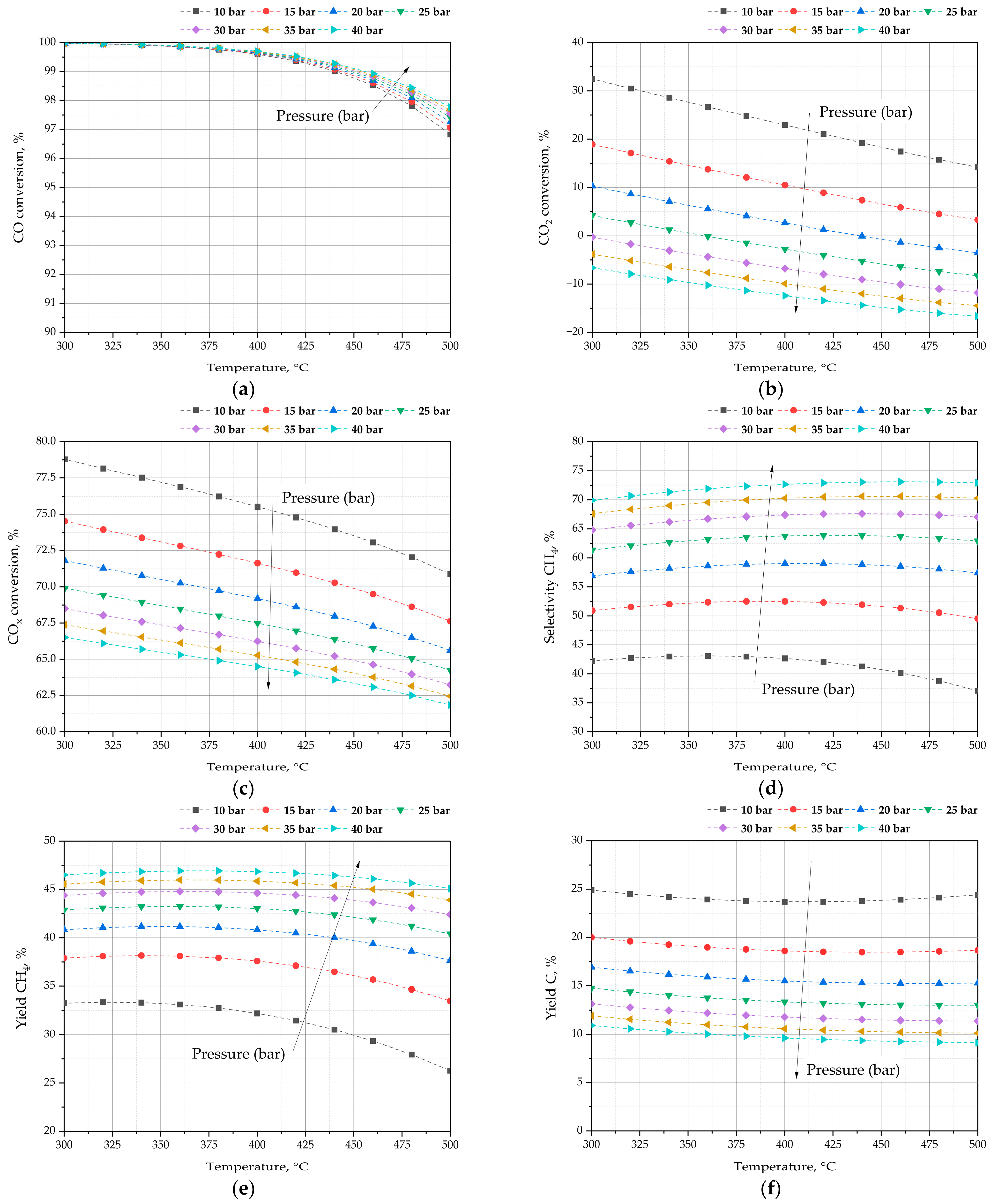
From this first analysis, a poor CO2 conversion was observed. Therefore, with the goal of increasing COx conversion and methane yield, a second analysis was carried out using a pyrolytic gas obtained from digestate pyrolysis performed at 700 °C with a sorbent for CO2 capture. The composition of this gas, shown in Table 1, highlights a lower CO2 content (9.21 mol%). Figure 2a again shows that CO conversion is quantitative at the lowest temperatures and remains very high, at about 97–98%, even at higher temperatures. It is very interesting to observe that this gas provided positive CO2 conversion at 10 and 15 bar over the entire temperature range and at 20 and 25 bar at lower temperatures (Figure 2b).
Figure 2.
Key process indicators for the methanation of pyrolysis gas from digestate with sorbent: conversion of CO (a), CO2 (b) and COx (c); selectivity to CH4 (d); and yields of CH4 (e) and of C (f) as functions of the process temperature.
Figure 2c highlights a carbon oxide conversion in the range of 62–79%. The carbon oxide conversion exhibits a steadily decreasing trend with increasing temperature and pressure.
Selectivity is markedly improved with increasing pressure, whereas temperature has a less pronounced effect (Figure 2d). The higher carbon oxide conversion rate and selectivity result in higher methane yields, ranging from 26 to 47% (Figure 2e). The methane yield increases with pressure and exhibits a concave-down trend with respect to temperature. The maximum methane yield at 10 bar was observed at 320 °C; after increasing the pressure to 40 bar, the maximum methane yield was observed at 360 °C. The carbon yield varies in the range of 9–24% (Figure 2f). This value is lower than that obtained in the first analysis and exhibits similar dependencies on pressure and temperature.
For each isobar, the temperature yielding the highest methane production rate was selected. The corresponding results in terms of gas composition, heating value, and gas ratio (gasout/gasin) are reported in Table 3. Methanation increased the methane content in the gas from 24 mol% to 82 mol% (see Table 1 and Table 3), while the carbon dioxide content increased from 9 to 21 mol%. Carbon monoxide was quantitatively converted and was therefore almost absent in the output gas. The hydrogen content was in the range of 2–3 mol%. A reduction in gas volume occurred; in fact, the gas ratio was in the range of 42–49%. Finally, digestate pyrolysis with sorbent addition followed by pyrolysis gas methanation shows promising thermodynamic potential for the production of bio-synthetic natural gas [42].
Table 3.
Gas features from the methanation of pyrolytic gas from digestate with sorbent.
Figure A1 and Figure A2 highlight the key process indicators for the methanation of pyrolysis gas from sewage sludge without and with sorbent addition, respectively. The compositions of the pyrolysis gases obtained from sewage sludge pyrolysis without and with sorbent addition are shown in Table 1. For each isobar, the temperature yielding the highest methane production rate was selected, and the characteristics of the gas after methanation are reported in Table A1 and Table A2. In the methanation of pyrolysis gases derived from sewage sludge with and without sorbent addition, trends similar to those observed for the digestate were obtained. However, from a quantitative point of view, some differences were observed, such as lower CO2 conversion and methane yields (<12%) in the case of gases derived from sewage sludge pyrolysis. At the 10-bar isobar, a negative methane yield was observed for the gas derived from sewage sludge pyrolysis.
4. Conclusions
In this paper, a theoretical study was carried out to evaluate, from a thermodynamic point of view, the upper performance limit of the methanation of pyrolysis gases derived from two anthropogenic residues, namely digestate and sewage sludge. The pyrolysis gas compositions were derived from experimental pyrolysis tests carried out in a bench-scale rotary kiln at 700 °C, both without and with the addition of a sorbent (CaO) for CO2 chemisorption. Therefore, four gas compositions were considered overall. The goal of the thermodynamic study was to obtain useful information for the design and analysis of future experimental methanation tests of these pyrolysis gases. For the pyrolysis gases derived from both residues, carbon monoxide conversion was almost quantitative within the investigated temperature and pressure ranges, increasing with pressure and decreasing with temperature. Carbon dioxide conversion exhibited very low or even negative values. This indicates that CO2 is produced during the process and that CO is the main carbon oxide involved in methanation reactions.
The pyrolysis gas derived from digestate pyrolysis reached a methane yield of 18% at 40 bar and 420 °C. The pyrolysis gas derived from sewage sludge reached a methane yield of 12% at 40 bar and 420 °C. The output gas exhibited a composition similar to that of biogas; for example, for digestate, the methane content was about 45 mol%, while the CO2 content was about 50 mol%.
To reduce the amount of inactive CO2 fed to the methanation reactor, both residues were pyrolysed with the addition of a sorbent for CO2 capture. These pyrolysis gases had a CO2 content below 10 mol%. Quantitative carbon monoxide conversion was again observed. For the pyrolysis gas derived from digestate with sorbent addition, appreciable CO2 conversions (up to 33%) were observed at 10 and 15 bar over the entire temperature range and at 20 and 25 bar at lower temperatures. For the pyrolysis gas derived from sewage sludge with sorbent addition, appreciable CO2 conversions were observed only at 10 and 15 bar and at lower temperatures. The output gas exhibited a composition similar to that of natural gas; in fact, the methane content was in the range of 92–95 mol% for sewage sludge gas and 78–82 mol% for digestate gas.
The simulations conducted in the present study indicate that pyrolysis gases derived from anthropogenic residues such as digestate and sewage sludge are thermodynamically favourable for the production of synthetic biogas, and that pyrolysis gases obtained from these residues with the addition of a sorbent for CO2 capture can be used to produce synthetic natural gas.
The collection of future experimental results on pyrolysis gas methanation, together with their integration with data from sewage sludge and digestate pyrolysis, will be required for energy assessment and evaluation of the economic feasibility of the overall process. Furthermore, plant optimization and energy recovery strategies should be investigated to reduce the heat demand of the pyrolysis process. For example, char and pyrolysis oil could be combusted to sustain the pyrolysis process, while the heat recovered from methanation could be used for feedstock drying. Char combustion would also provide regenerated sorbent in the form of CaO mixed with metal oxides derived from the feedstock, which could be reused in subsequent pyrolysis cycles.
Author Contributions
Conceptualization, C.F. and E.F.; methodology, C.F.; validation, C.F. and E.F.; investigation, C.F., E.F. and O.T.; resources, C.F.; data curation, C.F., E.F. and O.T.; writing—original draft preparation, C.F. and E.F.; writing—review and editing, C.F. and E.F.; visualization, C.F., E.F. and O.T.; supervision, G.C. and G.B.; project administration, E.F.; funding acquisition, E.F. and G.B. All authors have read and agreed to the published version of the manuscript.
Funding
This research was realized within the project “WWGF” funded by the Italian Ministry for University and Research, PON “R&I” 2014–2020, grant number ARS01_00868, area “Energy”.
Data Availability Statement
The original contributions presented in this study are included in the article. Further inquiries can be directed to the corresponding authors.
Conflicts of Interest
The authors declare no conflicts of interest.
Abbreviations
The following abbreviations are used in this manuscript:
| Gibbs free energy of formation at standard conditions of pure compound i [kJ/mol] | |
| Total Gibbs free energy of the entire mixture [kJ/mol] | |
| Standard enthalpy of formation [kJ/mol] | |
| LHV | Low heating value [MJ/Nm3] |
| Total moles of pure compound i | |
| Pressure [Pa] | |
| Universal gas constant 8.314 [J/mol K] | |
| Temperature [K] | |
| Molar fraction of pure compound i | |
| Non-ideality correction factor |
Appendix A
Figure A1 and Figure A2 provide the key process indicators for the methanation of pyrolysis gas from sewage sludge without and with the addition of a sorbent, respectively.
Figure A1.
Key process indicators for the methanation of pyrolysis gas from sewage sludge: conversion of CO (a), CO2 (b) and COx (c); selectivity to CH4 (d); and yields of CH4 (e) and of C (f) as functions of the process temperature.
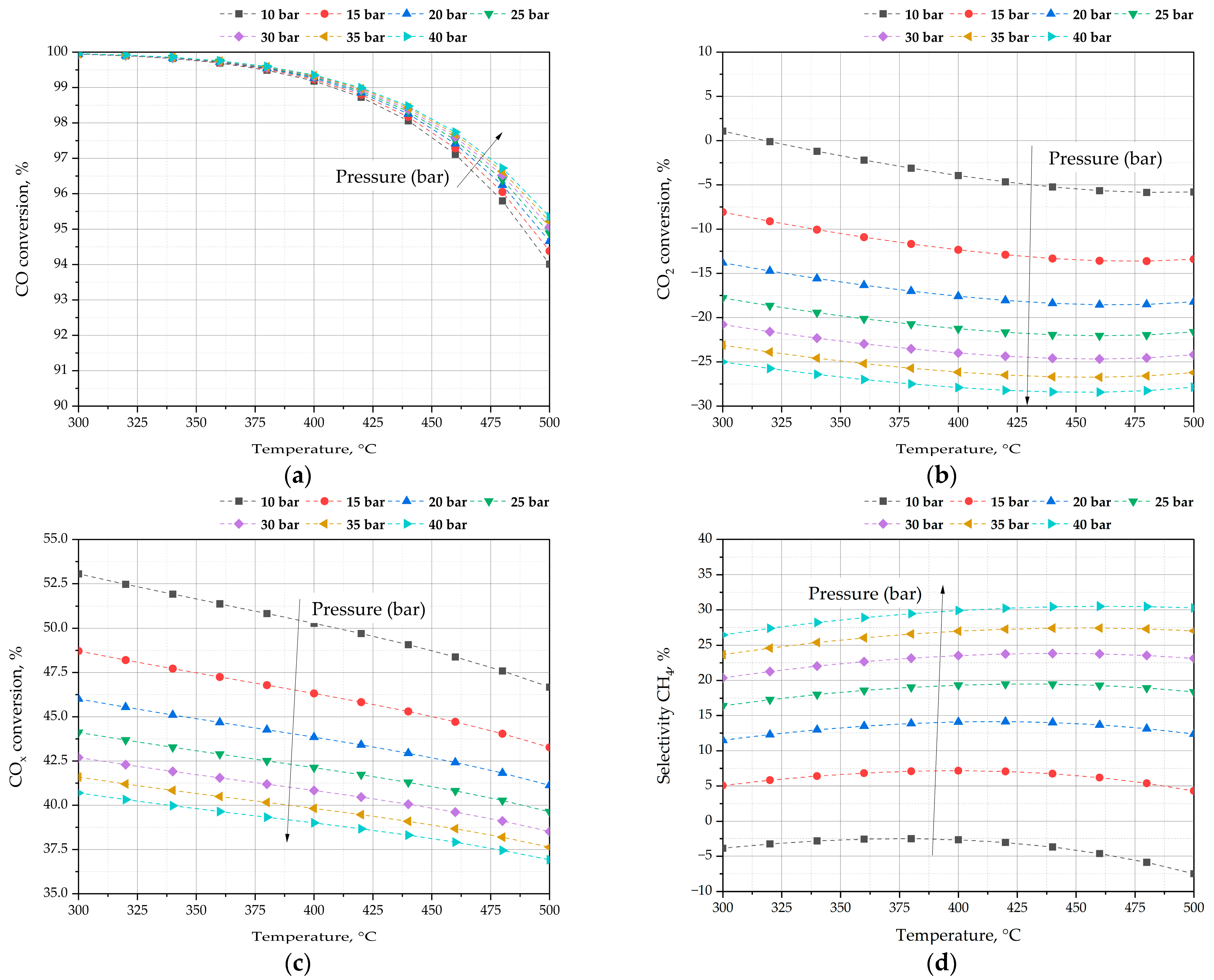
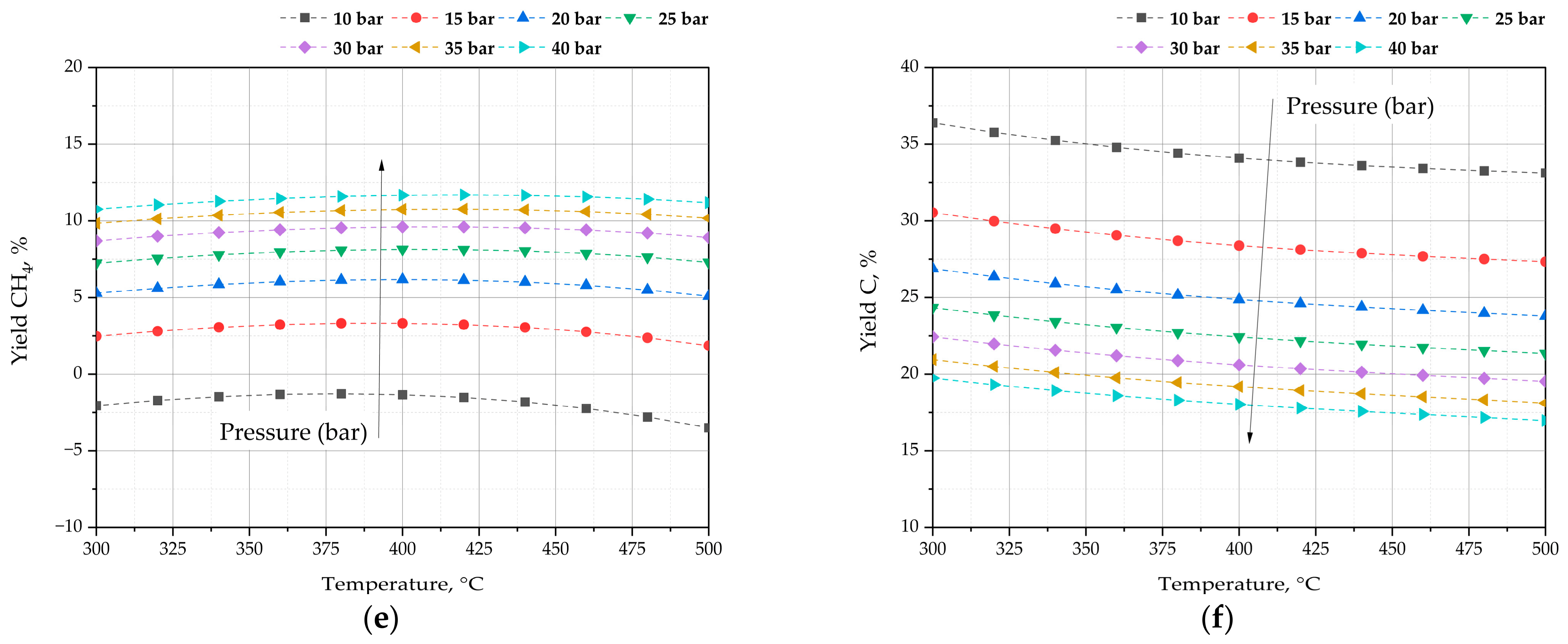
Figure A2.
Key process indicators for the methanation of pyrolysis gas from sewage sludge with sorbent: conversion of CO (a), CO2 (b) and COx (c); selectivity to CH4 (d); and yields of CH4 (e) and of C (f) as functions of the process temperature.
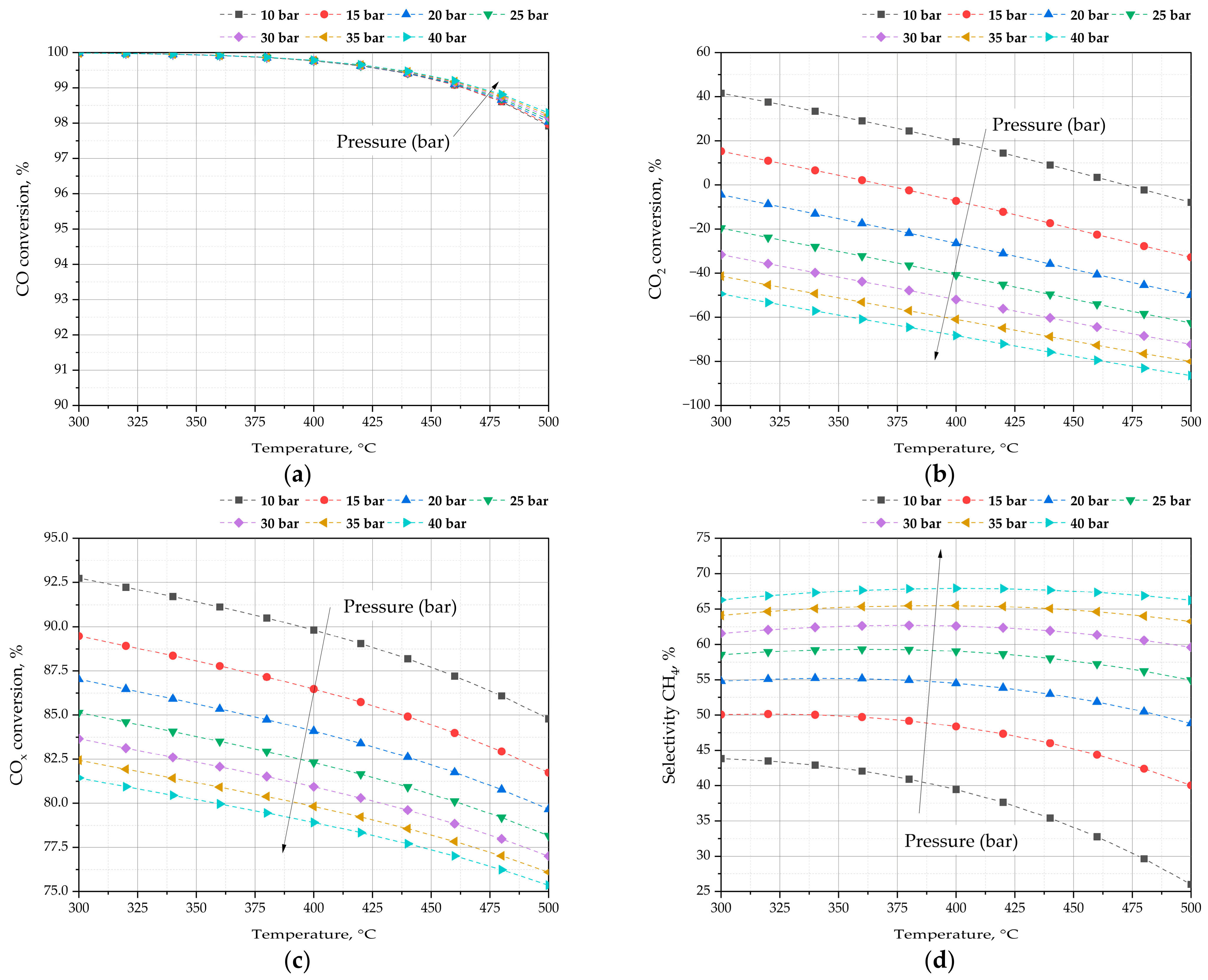
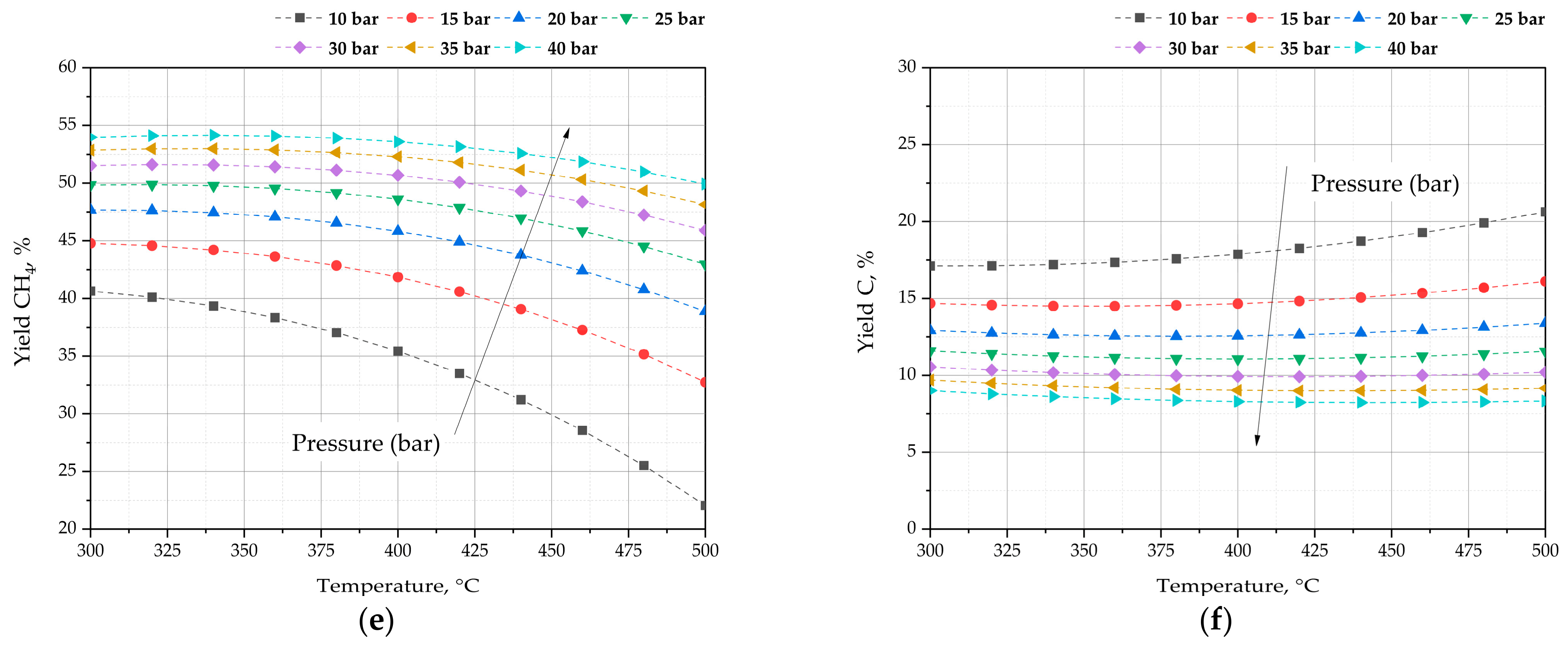
Table A1 and Table A2 present gas features from the methanation of pyrolytic gas from sewage sludge without and with the addition of a sorbent, respectively.
Table A1.
Gas features from the methanation of pyrolytic gas from sewage sludge.
Table A2.
Gas features from the methanation of pyrolytic gas from sewage sludge with a sorbent.
References
- Chojnacka, K.; Moustakas, K. Anaerobic Digestate Management for Carbon Neutrality and Fertilizer Use: A Review of Current Practices and Future Opportunities. Biomass Bioenergy 2024, 180, 106991. [Google Scholar] [CrossRef] [Scilit]
- European Commision. Commission’s Fertiliser Action Plan; European Commision: Strasbourg, France, 2026. [Google Scholar]
- Peng, W.; Lü, F.; Hao, L.; Zhang, H.; Shao, L.; He, P. Digestate Management for High-Solid Anaerobic Digestion of Organic Wastes: A Review. Bioresour. Technol. 2020, 297, 122485. [Google Scholar] [CrossRef] [Scilit] [PubMed]
- Martín-Sanz-Garrido, C.; Revuelta-Aramburu, M.; Santos-Montes, A.M.; Morales-Polo, C. A Review on Anaerobic Digestate as a Biofertilizer: Characteristics, Production, and Environmental Impacts from a Life Cycle Assessment Perspective. Appl. Sci. 2025, 15, 8635. [Google Scholar] [CrossRef] [Scilit]
- Logan, M.; Visvanathan, C. Management Strategies for Anaerobic Digestate of Organic Fraction of Municipal Solid Waste: Current Status and Future Prospects. Waste Manag. Res. J. Sustain. Circ. Econ. 2019, 37, 27–39. [Google Scholar] [CrossRef] [Scilit] [PubMed]
- Baldé, H.; VanderZaag, A.C.; Burtt, S.D.; Wagner-Riddle, C.; Crolla, A.; Desjardins, R.L.; MacDonald, D.J. Methane Emissions from Digestate at an Agricultural Biogas Plant. Bioresour. Technol. 2016, 216, 914–922. [Google Scholar] [CrossRef] [Scilit] [PubMed]
- Grobelak, A.; Bień, B.; Sławczyk, D.; Bień, J. Conditioning Biomass for Biogas Plants: Innovative Pre-Treatment and Digestate Valorization Techniques to Enhance Soil Health and Fertility. Sustainability 2025, 17, 3289. [Google Scholar] [CrossRef] [Scilit]
- Kataki, S.; Hazarika, S.; Baruah, D.C. Assessment of By-Products of Bioenergy Systems (Anaerobic Digestion and Gasification) as Potential Crop Nutrient. Waste Manag. 2017, 59, 102–117. [Google Scholar] [CrossRef] [Scilit] [PubMed]
- Weber, C.J.; Kundel, D.; Fliessbach, A.; Bünemann, E.K.; Bigalke, M. Baseline Levels of Microplastics in Agricultural Soils Obscure the Effects of Additional Microplastics from Recycled Fertilizers. Microplastics Nanoplastics 2025, 5, 30. [Google Scholar] [CrossRef] [Scilit]
- Cucina, M.; Castro, L.; Escalante, H.; Ferrer, I.; Garfí, M. Benefits and Risks of Agricultural Reuse of Digestates from Plastic Tubular Digesters in Colombia. Waste Manag. 2021, 135, 220–228. [Google Scholar] [CrossRef] [Scilit] [PubMed]
- Roychoudhury, A.; Das, N. Sewage Sludge Treatment and Involvement of Microbes. In Sustainable Management and Utilization of Sewage Sludge; Springer International Publishing: Cham, Switzerland, 2022; pp. 165–181. [Google Scholar]
- Salva, J.; Sečkár, M.; Schwarz, M.; Samešová, D.; Mordáčová, M.; Poništ, J.; Veverková, D. Analysis of the Current State of Sewage Sludge Treatment from the Perspective of Current European Directives. Environ. Sci. Eur. 2025, 37, 59. [Google Scholar] [CrossRef] [Scilit]
- Hušek, M.; Moško, J.; Pohořelý, M. Sewage Sludge Treatment Methods and P-Recovery Possibilities: Current State-of-the-Art. J. Environ. Manag. 2022, 315, 115090. [Google Scholar] [CrossRef] [Scilit] [PubMed]
- Fanelli, E.; Freda, C.; Romanelli, A.; Valerio, V.; Le Pera, A.; Sellaro, M.; Cornacchia, G.; Braccio, G. Thermochemical Conversion of Digestate Derived from OFMSW Anaerobic Digestion to Produce Methane-Rich Syngas with CO2 Sorption. Processes 2025, 13, 2451. [Google Scholar] [CrossRef] [Scilit]
- Freda, C.; Fanelli, E.; Romanelli, A.; Valerio, V.; Le Pera, A.; Sellaro, M.; Cornacchia, G.; Braccio, G. Methane-Rich Syngas from Pyrolysis of Sewage Sludge with Sorbent/Catalyst. Biomass 2026, 6, 7. [Google Scholar] [CrossRef] [Scilit]
- Ghasem, N. Introduction to High-Value Chemicals and Energy Production from Natural Gas. In Advances in Natural Gas: Formation, Processing, and Applications. Volume 7: Natural Gas Products and Uses; Elsevier: Amsterdam, The Netherlands, 2024; pp. 3–20. [Google Scholar]
- Hofbauer, H. Biomass Gasification for Electricity and Fuels, Large Scale. In Encyclopedia of Sustainability Science and Technology; Springer: New York, NY, USA, 2012; pp. 1426–1445. [Google Scholar]
- Wu, Y.; Ye, X.; Wang, Y.; Wang, L. Methane Production from Biomass by Thermochemical Conversion: A Review. Catalysts 2023, 13, 771. [Google Scholar] [CrossRef] [Scilit]
- Cengiz, N.Ü.; Yildirir, E.; Sağlam, M.; Yüksel, M.; Ballice, L. Hydrogen and Methane Production from Tomato Processing Plant Waste by Hydrothermal Gasification. J. Supercrit. Fluids 2022, 190, 105751. [Google Scholar] [CrossRef] [Scilit]
- Waldner, M.H.; Krumeich, F.; Vogel, F. Synthetic Natural Gas by Hydrothermal Gasification of Biomass. J. Supercrit. Fluids 2007, 43, 91–105. [Google Scholar] [CrossRef] [Scilit]
- Frusteri, F.; Frusteri, L.; Costa, F.; Mezzapica, A.; Cannilla, C.; Bonura, G. Methane Production by Sequential Supercritical Gasification of Aqueous Organic Compounds and Selective CO2 Methanation. Appl. Catal. Gen. 2017, 545, 24–32. [Google Scholar] [CrossRef] [Scilit]
- Jaffar, M.M.; Nahil, M.A.; Williams, P.T. Methane Production from the Pyrolysis–Catalytic Hydrogenation of Waste Biomass: Influence of Process Conditions and Catalyst Type. Energy Fuels 2019, 33, 7443–7457. [Google Scholar] [CrossRef] [Scilit]
- Yue, X.; Chen, D.; Luo, J.; Huang, Z.; Hong, L.; Hu, Y. Direct Synthesis of Methane-Rich Gas from Reed Biomass Pyrolysis Volatiles over Its Biochar-Supported Ni Catalysts. Biomass Bioenergy 2021, 154, 106250. [Google Scholar] [CrossRef] [Scilit]
- Freda, C.; Vittoria, U.; Fanelli, E.; Cornacchia, G.; Braccio, G. Thermodynamic Analysis of Biomass Gasification by Different Agents. Tec. Ital.-Ital. J. Eng. Sci. 2020, 62, 129–134. [Google Scholar] [CrossRef] [Scilit]
- Yeo, C.-E.; Seo, M.; Kim, D.; Jeong, C.; Shin, H.-S.; Kim, S. Optimization of Operating Conditions for CO2 Methanation Process Using Design of Experiments. Energies 2021, 14, 8414. [Google Scholar] [CrossRef] [Scilit]
- Kohl, A.L.; Richard, N. Gas Purification; Gulf Pub.: Houston, TX, USA, 1997. [Google Scholar]
- Styring, P.; McCord, S.; Rackley, S. Carbon Dioxide Utilization. In Negative Emissions Technologies for Climate Change Mitigation; Elsevier: Amsterdam, The Netherlands, 2023; pp. 391–413. [Google Scholar]
- Catizzone, E.; Freda, C.; Villone, A.; Romanelli, A.; Cornacchia, G. Gasification of Olive Tree Pruning in a Rotary Kiln Reactor Integrated with Radio Frequency Plasma Torch. Fuel 2025, 381, 133480. [Google Scholar] [CrossRef] [Scilit]
- Narváez, I.; Orío, A.; Aznar, M.P.; Corella, J. Biomass Gasification with Air in an Atmospheric Bubbling Fluidized Bed. Effect of Six Operational Variables on the Quality of the Produced Raw Gas. Ind. Eng. Chem. Res. 1996, 35, 2110–2120. [Google Scholar] [CrossRef] [Scilit]
- Jankes, G.; Trninic, M.; Stamenic, M.; Simonovic, T.; Tanasic, N.; Labus, J. Biomass Gasification with CHP Production: A Review of State of the Art Technology and near Future Perspectives. Therm. Sci. 2012, 16, 115–130. [Google Scholar] [CrossRef] [Scilit]
- Scicchitano, C.; Licastro, P.; Freda, C.; Muraca, E.; Catizzone, E.; Macri’, D.; Migliori, M. Pyro-Gasification of Olive Pomace Pellets for Renewable Hydrogen Production: Experimental Data-Driven Techno-Economic Analysis. J. Clean. Prod. 2026, 561, 148415. [Google Scholar] [CrossRef] [Scilit]
- Dufour, A.; Girods, P.; Masson, E.; Rogaume, Y.; Zoulalian, A. Synthesis Gas Production by Biomass Pyrolysis: Effect of Reactor Temperature on Product Distribution. Int. J. Hydrogen Energy 2009, 34, 1726–1734. [Google Scholar] [CrossRef] [Scilit]
- Esa, Y.A.M.; Sapawe, N. A Short Review on Carbon Dioxide (CO2) Methanation Process. Mater. Today Proc. 2020, 31, 394–397. [Google Scholar] [CrossRef] [Scilit]
- Chen, B.; Feng, M.; Chen, Y.; Yang, J.; Liu, Y. Performing Electrocatalytic CO2 Reduction Reactions at a High Pressure. Carbon Neutrality 2024, 3, 31. [Google Scholar] [CrossRef] [Scilit]
- Ciccone, B.; Murena, F.; Ruoppolo, G.; Urciuolo, M.; Brachi, P. Methanation of Syngas from Biomass Gasification: Small-Scale Plant Design in Aspen Plus. Appl. Therm. Eng. 2024, 246, 122901. [Google Scholar] [CrossRef] [Scilit]
- Ding, M.-Y.; Tu, J.-Y.; Wang, T.-J.; Ma, L.-L.; Wang, C.-G.; Chen, L.-G. Bio-Syngas Methanation towards Synthetic Natural Gas (SNG) over Highly Active Al2O3–CeO2 Supported Ni Catalyst. Fuel Process. Technol. 2015, 134, 480–486. [Google Scholar] [CrossRef] [Scilit]
- Ren, J.; Liu, Y.-L.; Zhao, X.-Y.; Cao, J.-P. Methanation of Syngas from Biomass Gasification: An Overview. Int. J. Hydrogen Energy 2020, 45, 4223–4243. [Google Scholar] [CrossRef] [Scilit]
- Wang, Y.; Gu, M.; Wu, J.; Cao, L.; Lin, Y.; Huang, X. Formation of Soot Particles in Methane and Ethylene Combustion: A Reactive Molecular Dynamics Study. Int. J. Hydrogen Energy 2021, 46, 36557–36568. [Google Scholar] [CrossRef] [Scilit]
- Gardner, D.C.; Bartholomew, C.H. CATALYST SECTION Kinetics of Carbon Deposition During Methanation of CO; ACS Publications: Washington, DC, USA, 1981; Volume 20. [Google Scholar]
- Chen, X.Y.; Vinh-Thang, H.; Ramirez, A.A.; Rodrigue, D.; Kaliaguine, S. Membrane Gas Separation Technologies for Biogas Upgrading. RSC Adv. 2015, 5, 24399–24448. [Google Scholar] [CrossRef] [Scilit]
- Gupta, R.; Bhardwaj, K.N.; Choudhary, C.; Chandna, P.; Jain, K.K.; Kaur, A.; Kumar, S.; Shrivastava, B.; Ninawe, S.; Singh, A.; et al. Biofuels: The Environment-Friendly Energy Carriers. In Biotechnology for Environmental Management and Resource Recovery; Springer: New Delhi, India, 2013; pp. 125–148. [Google Scholar]
- Baudouin, D.; Salionov, D.; Vogel, F.; Bjelić, S. Advanced Analytical Study of Process Streams for a Rational Optimization of Hydrothermal Gasification. ACS Eng. Au 2021, 1, 134–147. [Google Scholar] [CrossRef] [Scilit]

Disclaimer/Publisher’s Note: The statements, opinions and data contained in all publications are solely those of the individual author(s) and contributor(s) and not of MDPI and/or the editor(s). MDPI and/or the editor(s) disclaim responsibility for any injury to people or property resulting from any ideas, methods, instructions or products referred to in the content. |
© 2026 by the authors. Licensee MDPI, Basel, Switzerland. This article is an open access article distributed under the terms and conditions of the Creative Commons Attribution (CC BY) license.