


Abstract
Background: Dedicator of cytokinesis 8 (DOCK8) deficiency is an autosomal-recessive combined immunodeficiency marked by severe cutaneous viral infections, atopy with elevated IgE, malignancy, and early mortality without hematopoietic stem-cell transplantation (HSCT). Foundational syntheses predate the current transplant era and biologic therapy. Objective: It aims to provide an updated individual-patient-data (IPD) synthesis of DOCK8 deficiency cases reported from 2017 to 2026. Methods: Following PRISMA 2020 and PRISMA-IPD guidance, we searched PubMed/MEDLINE (with full Boolean strings provided for Embase, Scopus, Web of Science and Cochrane CENTRAL) for reports with extractable individual data on confirmed DOCK8 deficiency. Two-stage screening, Murad-2018 risk-of-bias assessment, random-effects Freeman–Tukey pooled proportions (with a random-intercept logistic model as a sensitivity analysis), and reconstructed Kaplan–Meier analyses were performed. Results: Of 360 records, 56 full texts were assessed, and 41 studies were included; 29 provided individual data for 64 patients from 22 countries, and 12 contributed aggregate data. Sixty-three potentially eligible reports were paywalled and could not be retrieved, and non-English reports were excluded, introducing possible retrieval and language bias. Consanguinity was reported in 40/43 (93%); the genotype spectrum was dominated by large deletions and splice/intronic variants. Eczema (72%), cutaneous viral infection (80%) and bacterial infection (64%) predominated. The pooled proportion alive at last reported follow-up was 87.3% (95% CI 81.1–92.6); this is a cross-sectional proportion over variable follow-up and is not a long-term survival estimate, as reconstructed age-specific Kaplan–Meier survival fell to approximately 53% by age 20 (exploratory analysis). Pooled malignancy prevalence was 10.6% (95% CI 3.4–20.7; I2 = 66%), and pooled post-HSCT survival was 86.3% (95% CI 79.0–92.5). Conclusions: Contemporary reports reaffirm the severe infectious and malignant burden of DOCK8 deficiency and support HSCT as definitive therapy, alongside emerging biologic (dupilumab, siltuximab) and gene-directed strategies. Findings are constrained by reporting, retrieval and language bias and by reconstructed IPD; completion of the planned multi-database searches and independent second-reviewer verification are ongoing to finalise the evidence base.
1. Introduction
Dedicator of cytokinesis 8 (DOCK8) is a guanine-nucleotide exchange factor for the Rho-family GTPase CDC42 that regulates actin cytoskeletal dynamics, immunological synapse formation, and lymphocyte survival during migration through dense tissues. Biallelic loss-of-function variants in DOCK8 cause an autosomal-recessive combined immunodeficiency, first identified as a molecular entity in 2009 [1], now classified among combined immunodeficiencies with associated or syndromic features by the International Union of Immunological Societies. The clinical syndrome—historically termed autosomal-recessive hyper-IgE syndrome (AR-HIES)—combines early-onset atopic dermatitis and markedly elevated serum IgE with distinctive susceptibility to cutaneous viral infection (herpes simplex virus, human papillomavirus, molluscum contagiosum and varicella-zoster virus), recurrent sinopulmonary bacterial infection, mucocutaneous candidiasis, food and environmental allergy, and elevated lifetime malignancy risk, particularly from virally driven epithelial and lymphoid tumours.
The reference description of the phenotype derives from a survey of 136 patients published in 2015 [2] and a narrative synthesis of pathophysiology and management in 2017 [3]. Both predate two developments that have reshaped the field: the maturation of allogeneic hematopoietic stem-cell transplantation (HSCT) as a curative intervention—culminating in the first prospective clinical trial of transplantation for DOCK8 deficiency, reported in 2025 [4]—and the multi-institutional characterisation of transplant outcomes [5]. In parallel, the malignancy burden of the hyper-IgE syndromes has been quantified only at the level of the syndrome group rather than DOCK8 specifically [6], and biologic agents such as dupilumab have begun to appear in the DOCK8 literature as bridging or adjunctive therapy. No individual-patient-data (IPD) systematic review has consolidated the DOCK8 case literature of the current era.
We therefore undertook an updated IPD systematic review of DOCK8 deficiency cases reported between 2017 and 2026. Our objectives were to (i) assemble a de-duplicated, individual-level dataset of contemporary cases; (ii) describe the genotype spectrum, immunophenotype, infection spectrum, malignancy and treatment; (iii) estimate pooled proportions for key binary outcomes; and (iv) reconstruct survival, including transplant-stratified estimates, while being explicit about the limitations of case-based evidence.
2. Materials and Methods
2.1. Protocol, Registration and Reporting
This review was conducted and is reported in accordance with the PRISMA 2020 statement (Supplementary Materials) [7] and the PRISMA-IPD extension [8]. The protocol was registered in the Open Science Framework (OSF) database after study selection had commenced, and therefore was not prospective (Registration: https://osf.io/9ucms, accessed on 5 July 2026). A search of the PROSPERO register identified no published or ongoing DOCK8-specific IPD synthesis for the 2017–2026 window.
2.2. Eligibility Criteria (PECO)
Population: patients with genetically confirmed (biallelic DOCK8 variants) or functionally confirmed (absent/markedly reduced DOCK8 protein) DOCK8 deficiency, of any age. Inclusion: case reports, case series and cohort studies published 2017–2026 reporting extractable individual-level data. Foundational cohorts synthesised in the 2015 [2] and 2017 [3] reviews were used only to build cumulative pooled estimates, with rigorous de-duplication (Section 2.5). Exclusion: reviews without primary patient data; non-DOCK8 hyper-IgE or HIES-like disorders (e.g., STAT3, PGM3, ZNF341, IL6ST); monoallelic or heterozygous variants of uncertain significance not meeting a biallelic/functional definition; animal or purely mechanistic studies with no individual-level clinical data. Languages: English; non-English reports were recorded and excluded at screening.
2.3. Information Sources and Search
PubMed/MEDLINE was searched on 1 July 2026 using the string:
‘(“DOCK8” [Title/Abstract] OR “dedicator of cytokinesis 8” [Title/Abstract] OR “DOCK8” [MeSH Terms] OR “DOCK8 deficiency” [Supplementary Concept] OR “autosomal recessive hyper-IgE” [Title/Abstract] OR “AR-HIES” [Title/Abstract]) AND (“1 January 2017” [Date—Publication]: “31 December 2026” [Date—Publication])’.
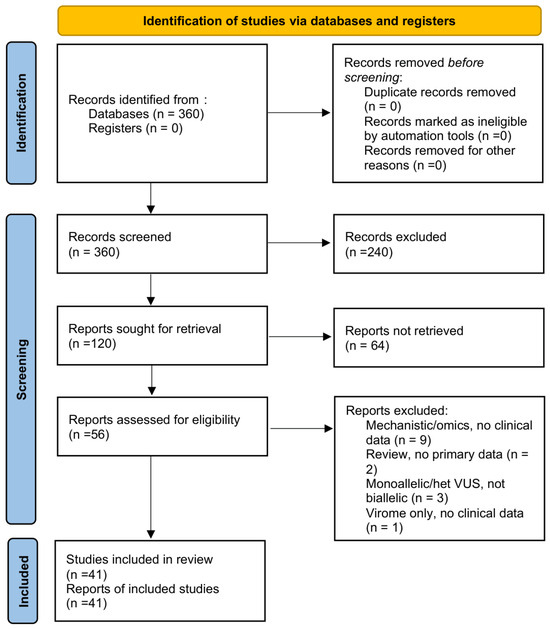
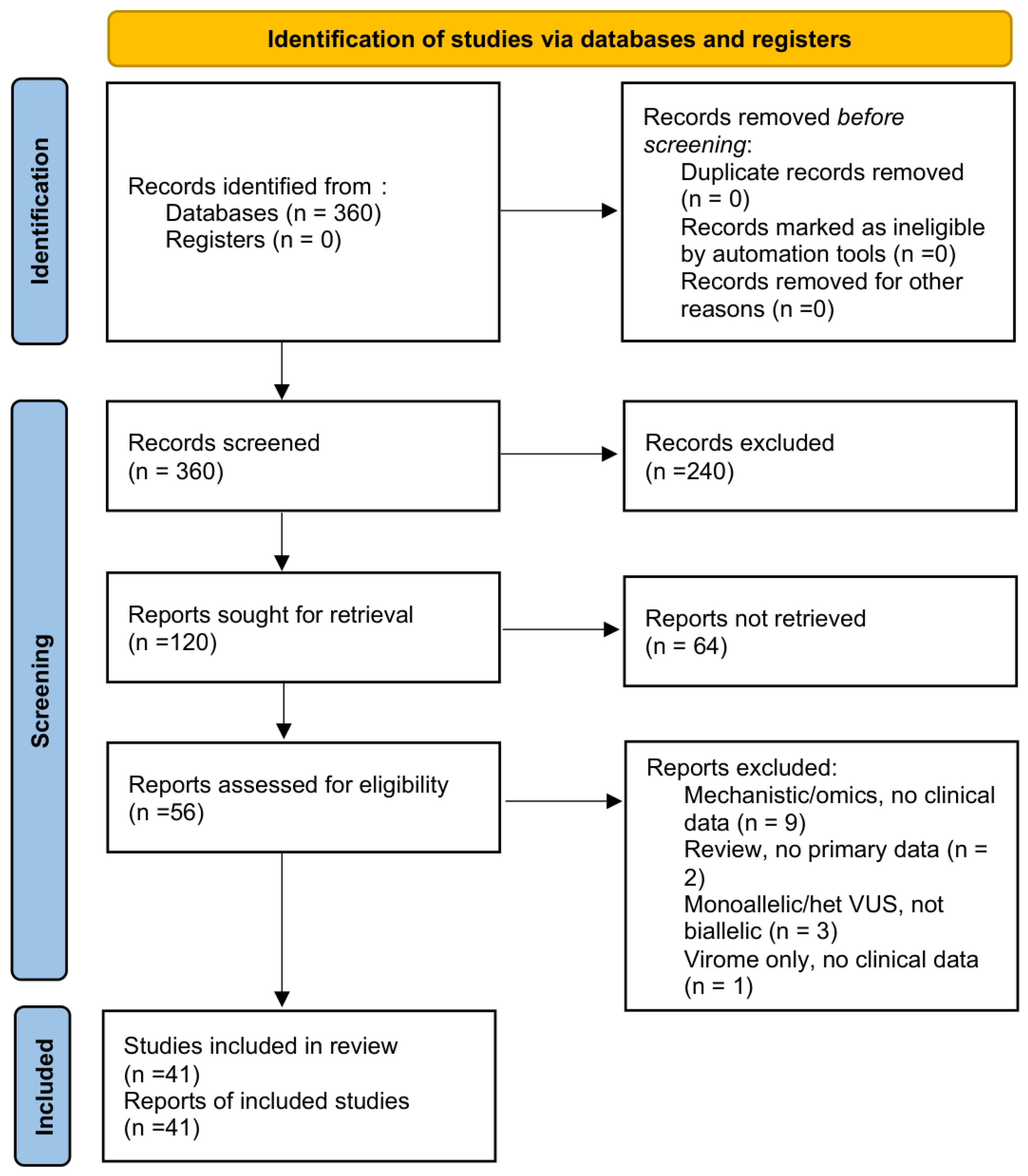
This yielded 360 records. Complete Boolean translations for Embase, Scopus, Web of Science and Cochrane CENTRAL are provided in full in Appendix A; searches of these databases are being executed to complement the primary PubMed/MEDLINE search, and the PRISMA flow diagram (Figure 1) will be updated to incorporate their yield in the completed review. Reference lists of the 2015 and 2017 reviews and of large series were hand-searched.
Figure 1.
PRISMA 2020 flow diagram of study identification, screening and inclusion for this DOCK8 deficiency individual-patient-data (IPD) systematic review. Records were identified from PubMed/MEDLINE (n = 360; searched 1 July 2026); title/abstract screening excluded 240, full text was sought for 120 and not retrieved for 64 (63 paywalled, 1 abstract-only), 56 were assessed for eligibility, and 41 studies were included (29 with extractable IPD for 64 patients; 12 aggregate cohorts). The Embase, Scopus, Web of Science and Cochrane CENTRAL searches (strategies in Appendix A) are pending and will update the diagram.
2.4. Study Selection and Data Extraction
Records underwent two-stage screening (title/abstract, then full text). For every eligible patient we extracted, where reported: demographics (country, sex, age at onset and diagnosis, consanguinity, family history); genetics (DOCK8 variant(s), zygosity, mutation class, confirmation method); immunophenotype (serum immunoglobulins, eosinophils, lymphocyte subsets, DOCK8 protein expression); clinical phenotype (eczema, allergy, asthma; bacterial, cutaneous-viral, fungal and Pneumocystis infection; bronchiectasis; autoimmunity; vasculopathy/CNS events); malignancy (presence, type, age); treatment (immunoglobulin replacement, antimicrobial prophylaxis, biologics, other); transplant (HSCT, age, donor, conditioning, GvHD, engraftment, chimerism, resolution, complications); and outcome (status, age at last follow-up or death, cause of death, follow-up duration). One row was created per patient. Fields not reported in the source were recorded as “not reported” (NR) and never imputed. Studies reporting only pooled statistics without extractable individual data were retained as aggregate cohorts and analysed separately.
2.5. Data Integrity and De-Duplication
Because several groups report overlapping populations, de-duplication was performed by matching on country, centre, sex, variant, and age. The National Institutes of Health (NIH) transplant programme (ClinicalTrials.gov NCT01176006) is reported across multiple papers; the prospective trial cohort [4] was used as the single anchor for NIH aggregate transplant counts, and overlapping subset reports were flagged and excluded from pooled denominators. The Aydin 2015 [2] and 2019 [5] cohorts share patients, and a lineage-chimerism series [9] reported patients previously published in those cohorts; the latter was excluded from survival pools. Recurrent Middle-Eastern/North-African founder alleles create potential overlap between the Egyptian subsets of two genetic cohorts [10,11]; these were flagged for manual reconciliation. All merge decisions are itemised in Appendix B.
2.6. Risk of Bias
Each included primary report was assessed with the Murad et al. (2018) tool for case reports and case series [12], covering selection, ascertainment (exposure and outcome), causality, and reporting. The challenge/re-challenge and dose–response items are not applicable to a monogenic disorder and were marked as such.
2.7. Synthesis
Descriptive statistics are reported as medians with interquartile range (IQR) for continuous variables and as counts with the explicit denominator (number of patients for whom the variable was reported) for categorical variables. Pooled proportions with 95% confidence intervals for overall survival, malignancy and post-HSCT survival were estimated using random-effects models (DerSimonian–Laird) with the Freeman–Tukey double-arcsine transformation, computed across multi-patient cohorts with genuine denominators; single case reports were excluded from pooling to avoid selection bias. Because each pooled outcome comprised only four to six cohorts, the robustness of every pooled estimate was tested in a sensitivity analysis using a random-intercept logistic (generalised linear mixed) model on the logit scale, and the two estimates were compared. Heterogeneity was quantified with I2 and the between-study variance τ2, and 95% prediction intervals were reported. Survival was reconstructed from published age-at-event data using the Kaplan–Meier method on an age timescale, with transplanted versus non-transplanted groups compared by the log-rank test, and post-HSCT survival computed on a time-since-transplant scale. Because per-patient entry (delayed-entry) times could not be reconstructed from the published reports, all patients entered the risk set at birth; the resulting age-timescale curve is therefore reported as exploratory, and its left-truncation/immortal-time limitation is stated explicitly (Section 3.7 and Section 4 (Limitations)). Analyses used R 4.5 with the meta, metafor, survival and survminer packages.
3. Results
3.1. Study Selection
The PubMed search returned 360 records (Figure 1). After title/abstract screening, 240 (66.7%) were excluded: 234/240 (97.5%) on content—non-DOCK8 disease, absence of extractable individual data, animal or basic-science studies, or reviews without primary data—and 6/240 (2.5%) as non-English reports. Of the 120 reports sought for retrieval, 64 (53.3%) could not be obtained in full text (63 paywalled and one abstract-only) and were not extracted; the potential for retrieval bias this introduces is addressed in Section 4 (Limitations). The remaining 56 full texts were assessed, and 15 were excluded (nine mechanistic/omics reports without clinical individual data, two reviews without primary data, three monoallelic/heterozygous variants of uncertain significance, and one virome-only study). Forty-one studies were included: 29 provided extractable individual data for 64 patients, and 12 contributed aggregate DOCK8 cohort data. Because paywalled and non-English reports could not be assessed, we cannot exclude that the included case set over- or under-represents particular phenotypes or outcomes; the likely direction of this bias is considered in Section 4 (Limitations).
3.2. Cohort Characteristics
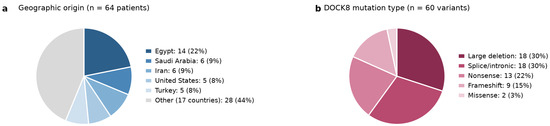
The 64 individually reported patients originated from 22 countries, with the largest contributions from Egypt (n = 14), Saudi Arabia (n = 6), Iran (n = 6), the United States (n = 5) and Turkey (n = 5) (Figure 2a; Table 1). Sex was reported for 35 patients (20 female, 15 male). Median age at symptom onset was 2.0 years (IQR 0.5–4.0; n = 31) and median age at diagnosis was 7.0 years (IQR 5.0–11.0; n = 61), reflecting a diagnostic delay of several years. Consanguinity was reported in 40/43 (93%) of patients for whom it was stated, consistent with the predominance of reports from populations with high background consanguinity.
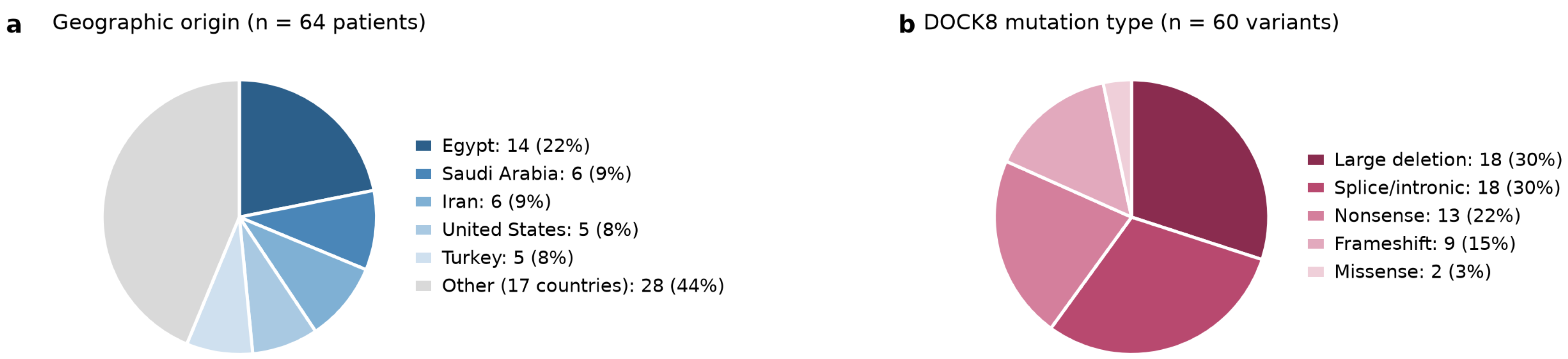
Figure 2.
Distribution of the individually reported DOCK8-deficiency patients, shown as pie charts. (a) Geographic origin of the 64 patients; each slice is labelled with country, n and percentage of 64, and the 17 countries contributing one to three patients each are grouped as “Other”. (b) DOCK8 mutation-type distribution among the 60 patients with a classifiable variant (large deletion, splice/intronic, nonsense, frameshift, missense), each slice labelled with n and percentage of 60. Source: individual-patient data extracted for this review (Table 1).
Table 1.
Characteristics of the 29 studies contributing individual-patient data to this review. Patients (n) is the number of DOCK8 patients with extractable individual data contributed by each study. NR, not reported; PMID, PubMed identifier; HIES, hyper-IgE syndrome; CMC, chronic mucocutaneous candidiasis.
3.3. Genotype
Among 60 patients with a classifiable DOCK8 variant, the mutation spectrum comprised large deletions (n = 18), splice/intronic variants (n = 18), nonsense (n = 13), frameshift (n = 9) and missense (n = 2) alleles (Figure 2b). Deep-intronic and splice-region variants were increasingly recognised in recent years, including a recurrent homozygous deep-intronic allele (c.4626 + 76A > G) reported independently in two studies [22,27]. Recurrent founder alleles were prominent in Middle-Eastern/North-African cohorts, notably the frameshift allele p.(Phe1045Leufs*2) and a recurrent variant affecting residue Ser1711 among Egyptian patients [10,11]; the latter was reported in the source as “p.Ser1711” without specification of the resulting residue or a termination codon, and a complete HGVS descriptor could not be assigned from the published data. Somatic reversion of DOCK8 variants—restoring protein expression in a subset of lymphocytes—was documented in individual reports and was present in 17 of 36 subjects in the prospective trial [4].
3.4. Immunophenotype and Clinical Phenotype
Elevated serum IgE and eosinophilia were near-universal where reported, although atypical low-IgE presentations were described, particularly in infancy and in patients with large deletions. The dominant clinical features (Table 2) were eczema/atopic dermatitis (41/57 (72%)), allergy (22/24 (92%)), cutaneous viral infection (28/35 (80%)), bacterial infection (37/58 (64%)) and fungal infection (14/19 (74%)). Bronchiectasis was reported in 10/10 (100%) of patients in whom it was assessed. Autoimmune and immune-dysregulatory manifestations (5/20 (25%)) included autoimmune cytopenias, an IPEX-like disorder with early-onset autoimmune enteropathy [15], and systemic lupus erythematosus [31]; vasculopathy and central nervous system (CNS) events (4/10 (40%)) comprised cerebral vasculopathy, cerebellar atrophy and recurrent facial palsy. The denominators for these features are the number of patients for whom the feature was explicitly reported; because case reports selectively describe salient findings, these proportions should be read as ascertainment-conditioned rather than true prevalences. These individually reported features are complemented by cohort-level immunological studies: innate lymphoid cell deficiency and broader lymphocyte abnormalities have been characterised in DOCK8-deficient patients [41], autoimmune manifestations have been examined across inborn errors affecting B-cell development [42], and gastrointestinal involvement has been identified through exome-based screening of paediatric inflammatory bowel disease cohorts [43].
Table 2.
Clinical and laboratory features among the individually reported patients. Each feature is shown as the number of patients with the feature over the number for whom it was reported, with the percentage in parentheses (n/N (%)); denominators differ because features were not reported for every patient, so proportions are ascertainment-conditioned rather than population prevalences. HSV, herpes simplex virus; HPV, human papillomavirus; VZV, varicella-zoster virus; CNS, central nervous system.
3.5. Infection Spectrum
The cutaneous viral phenotype—herpes simplex virus (including eczema herpeticum and HSV keratitis), human papillomavirus/verrucosis, molluscum contagiosum and varicella-zoster—was the signature manifestation. Bacterial infections were predominantly sinopulmonary (recurrent otitis media, sinusitis and pneumonia, in some patients progressing to bronchiectasis) together with cutaneous and soft-tissue infection including recurrent skin abscesses, with the organisms characteristic of the syndrome (e.g., Staphylococcus aureus, Streptococcus pneumoniae and Haemophilus influenzae) where speciated. Fungal infection comprised chronic mucocutaneous candidiasis and, in individual patients, invasive or deep fungal disease; a subset also had chronic Cryptosporidium infection with sclerosing cholangitis [44]. Among the deaths captured in the reconstructed dataset, causes documented in the source reports included overwhelming or opportunistic infection—for example, a fatal paediatric case with sclerosing cholangitis and bronchiectasis [26] and fatal post-treatment complications of BK-virus haemorrhagic cystitis with cytokine-release syndrome [23]—and infection was, in individual reports, the stated precipitant of the decision to transplant.
3.6. Malignancy, Treatment and Pooled Outcomes
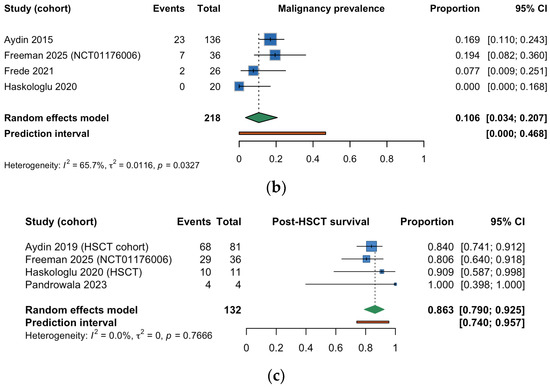
Malignancy in the individually reported cases was predominantly virally associated and lymphoid or epithelial. The types documented comprised EBV-positive lymphoma and lymphoproliferation (including EBV-associated lymphomatoid granulomatosis), EBV-associated smooth-muscle tumour [14], B-lymphoblastic leukaemia with EBV-associated diffuse large B-cell lymphoma [19], and squamous-cell and other cutaneous carcinomas. Because only a small number of malignancies were individually reported, stable type-specific percentages cannot be derived; the quantitative summary is the pooled prevalence of any malignancy across multi-patient cohorts, 10.6% (95% CI 3.4–20.7; I2 = 66%, k = 4) (Figure 3b). The substantial heterogeneity arises because malignancy risk accrues with age and ascertainment differed markedly between cohorts: cohort-level estimates ranged from 0% (0/20; Haskologlu 2020 [45], a predominantly paediatric cohort) to 16.9% (23/136; Aydin 2015 [2]) and 19.4% (7/36; Freeman 2025 [4], a transplant-referral trial enriched for advanced disease), so differences in cohort age structure and referral pattern, rather than sampling error alone, drive the dispersion. A random-intercept logistic (GLMM) sensitivity model gave a concordant estimate of 14.7% (95% CI 10.6–20.0).
Figure 3.
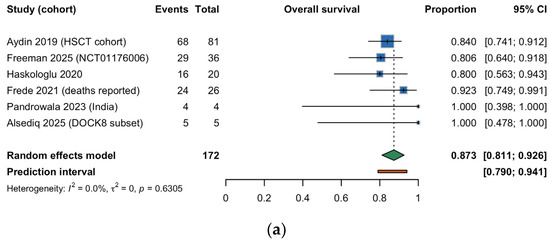
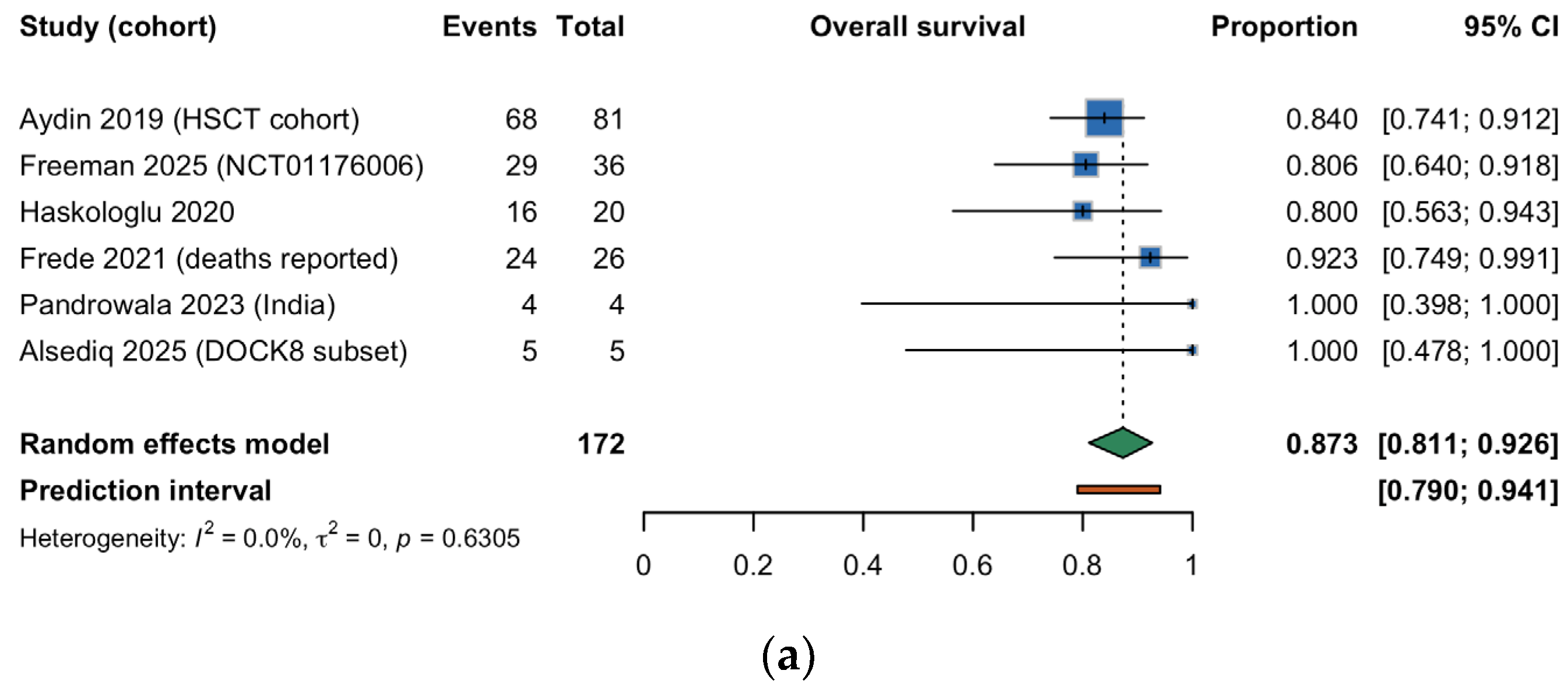
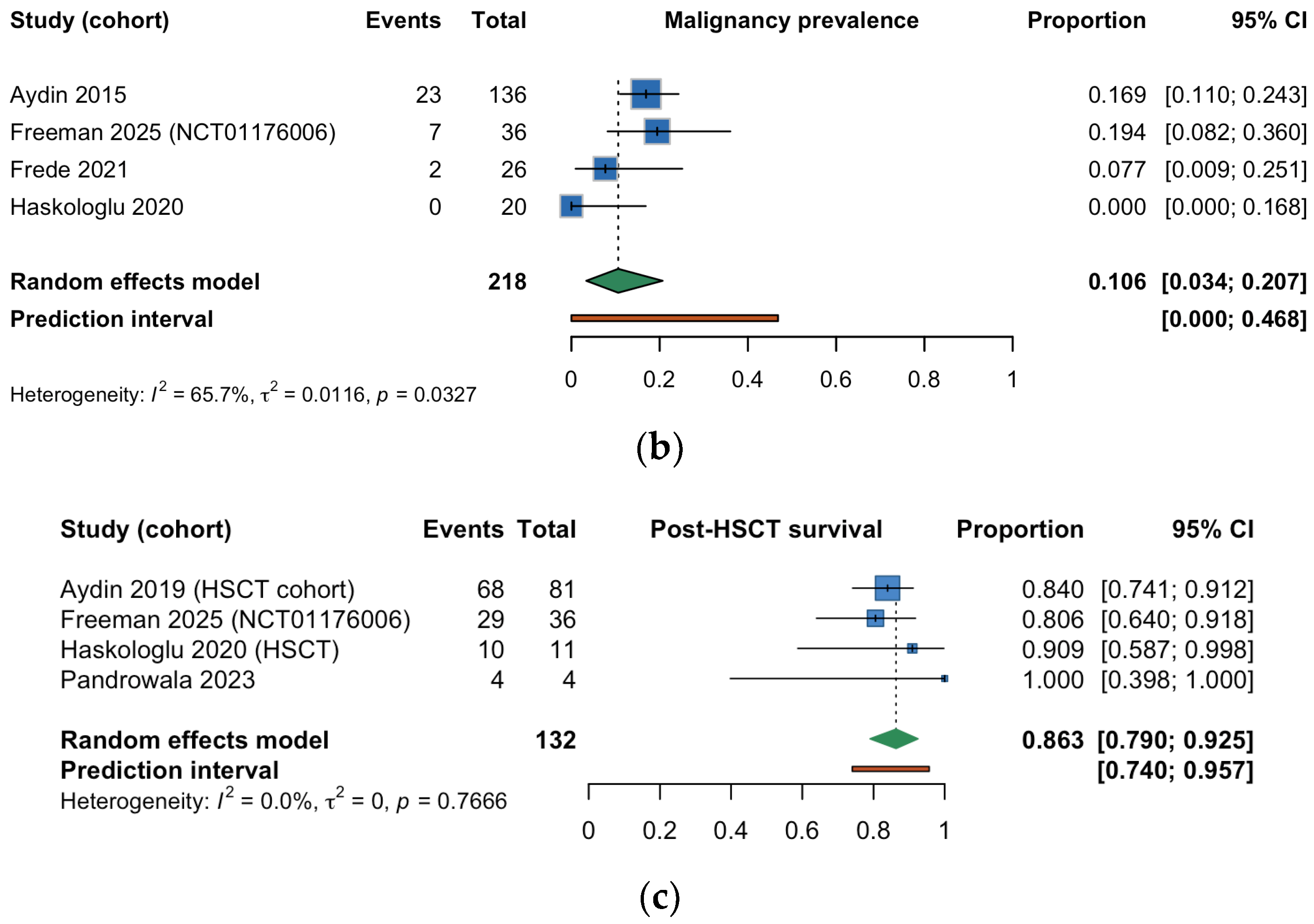
Random-effects meta-analysis of pooled proportions across multi-patient DOCK8 cohorts with genuine denominators, shown as forest plots ([2,4,5,10,16,29,45]). (a) Overall survival, defined as the proportion of patients alive at last reported follow-up (k = 6 cohorts; 172 patients). (b) Malignancy prevalence (k = 4 cohorts; 218 patients). (c) Post-HSCT survival, defined as the proportion alive after transplantation (k = 4 cohorts; 132 patients; the Raedler 2021 [9] series was excluded to avoid overlap with the Aydin cohorts, Section 2.5). In each panel, the blue square is the cohort point estimate (area proportional to study weight) with its 95% confidence interval (CI); the green diamond is the random-effects pooled proportion and the orange bar the 95% prediction interval. Proportions were pooled on the Freeman–Tukey double-arcsine scale with the DerSimonian–Laird τ2 estimator; heterogeneity is summarised by I2 and τ2 with the heterogeneity-test p value. Single case reports were excluded from pooling. HSCT, haematopoietic stem-cell transplantation.
Beyond supportive care (immunoglobulin replacement, antimicrobial prophylaxis), the current era introduced biologic and targeted therapy: dupilumab produced marked improvement in eczema in a DOCK8 subset of an inborn-errors-of-immunity cohort [16], and siltuximab induced remission of a refractory Castleman-like/granulomatous phenotype [32]. Across the multi-patient clinical cohorts, the pooled proportion of patients alive at last reported follow-up was 87.3% (95% CI 81.1–92.6; I2 = 0%, k = 6) (Figure 3a); a GLMM sensitivity model gave a concordant 84.9% (95% CI 78.7–89.5). This pooled figure is a cross-sectional proportion alive over heterogeneous and often short follow-up and must not be read as a long-term or lifetime survival estimate; the age-resolved reconstruction in Section 3.7 shows survival declining substantially with age.
3.7. Transplant Outcomes and Survival
HSCT was reported in 22/34 (65%) of individually reported patients for whom transplant status was stated (Table 3), performed at a median age of 7.8 years (IQR 3.0–11.0). Donors were haploidentical, matched unrelated, or matched related, and conditioning was predominantly reduced-toxicity/reduced-intensity regimens, frequently busulfan- or treosulfan-based with post-transplant cyclophosphamide (PT-Cy) [46]. Reduced-toxicity conditioning with high CD34 doses showed success in a paediatric Indian cohort [29], and αβ-T/CD19-depleted grafts were used in adults [40]. Pooled post-HSCT survival across four multi-patient cohorts with genuine denominators (Aydin 2019 [5], Freeman 2025 [4] [NCT01176006], Haskologlu 2020 [45] and Pandrowala 2023 [29]) was 86.3% (95% CI 79.0–92.5; I2 = 0%, k = 4) (Figure 3c); a random-intercept logistic sensitivity model gave a concordant 84.1% (95% CI 76.8–89.4). The Raedler 2021 lineage-chimerism series [9] was excluded from this pool because its patients were previously reported in the Aydin cohorts (Section 2.5); its inclusion would raise the estimate to 87.8% (k = 5). The prospective trial reported 80.6% survival at a median of 7.4 years [4]. Additional transplant-related considerations reported in this population include fertility preservation before conditioning in affected women [47] and tandem hematopoietic stem-cell transplantation in families with multiple affected siblings [48].
Table 3.
Transplant outcomes among the individually reported patients. Denominators are the number of HSCT recipients with the relevant field reported. HSCT, haematopoietic stem-cell transplantation; IQR, interquartile range; MUD, matched unrelated donor; MMUD, mismatched unrelated donor; NR, not reported. “Related” denotes matched related (family) donors and “Haploidentical” denotes related haploidentical donors.
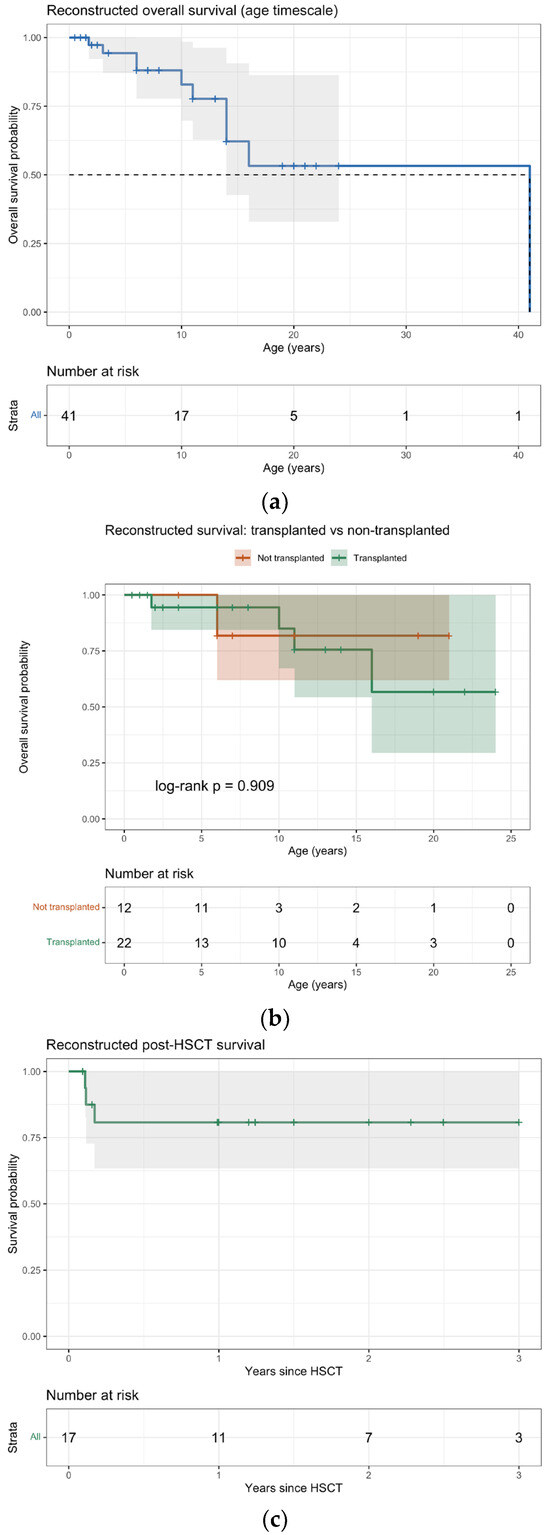
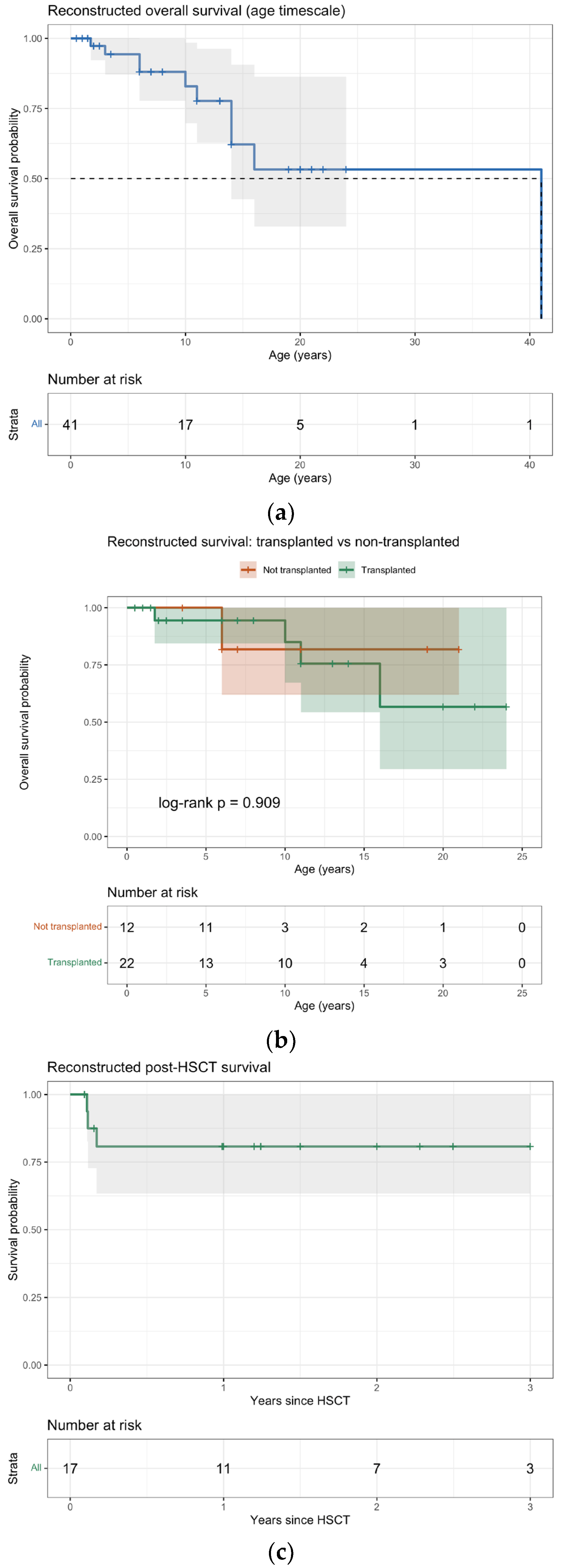
Reconstructed Kaplan–Meier analysis of the 41 individually reported patients with age-at-event data (10 deaths) showed overall survival declining from 94% at age 5 to 83% at age 10 and approximately 53% by age 20 (Figure 4a). This age-timescale analysis is exploratory: because patients were ascertained at varying ages and per-patient entry (delayed-entry) times could not be reconstructed from the published data, all patients are placed in the risk set from birth, so survival before case ascertainment is treated as observed follow-up. This structure (immortal-time/left-truncation) tends to overestimate early survival and renders the age-specific estimates, including the approximately 53% at age 20, provisional rather than lifetable-valid; the curve should be interpreted accordingly (Section 4 (Limitations)). A comparison of transplanted versus non-transplanted patients showed no significant difference on this reconstructed, confounded timescale (log-rank p = 0.91; Figure 4b); this null result reflects survivorship and indication bias—patients surviving to transplant are conditioned on survival, and the sickest patients may die before transplant or be reported without transplant—and must not be interpreted as evidence against transplantation. Post-HSCT survival, computed on a time-since-transplant scale and therefore not subject to the same entry-time problem, was approximately 81% and stable across the first three years (Figure 4c).
Figure 4.
Reconstructed Kaplan–Meier survival from published age- and time-at-event data (individually reported patients). (a) Overall survival on an age timescale for the 41 patients with age-at-event data (10 deaths); this analysis is exploratory because per-patient delayed-entry times were unavailable and all patients enter the risk set at birth (left-truncation/immortal-time bias), which tends to overestimate early survival. The dashed line marks 50% survival and the number-at-risk table is shown below the plot. (b) Overall survival stratified by transplant status (transplanted vs. not transplanted) on the same age timescale; the log-rank comparison is non-significant (p = 0.91) but is confounded by indication and survivorship and must not be read as evidence against transplantation. (c) Post-HSCT survival on a time-since-transplant scale, which is not subject to the entry-time problem in panel (a). Shaded bands are 95% confidence intervals, and tick marks are censored observations. HSCT, haematopoietic stem-cell transplantation.
3.8. Risk-of-Bias Findings
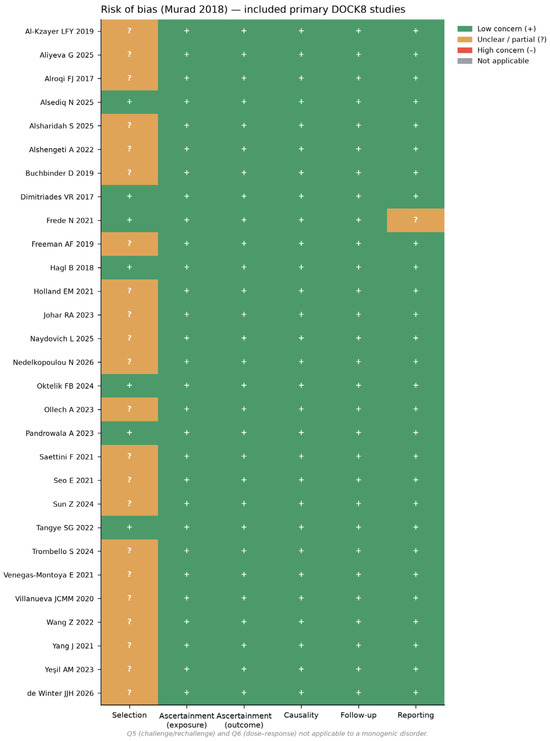
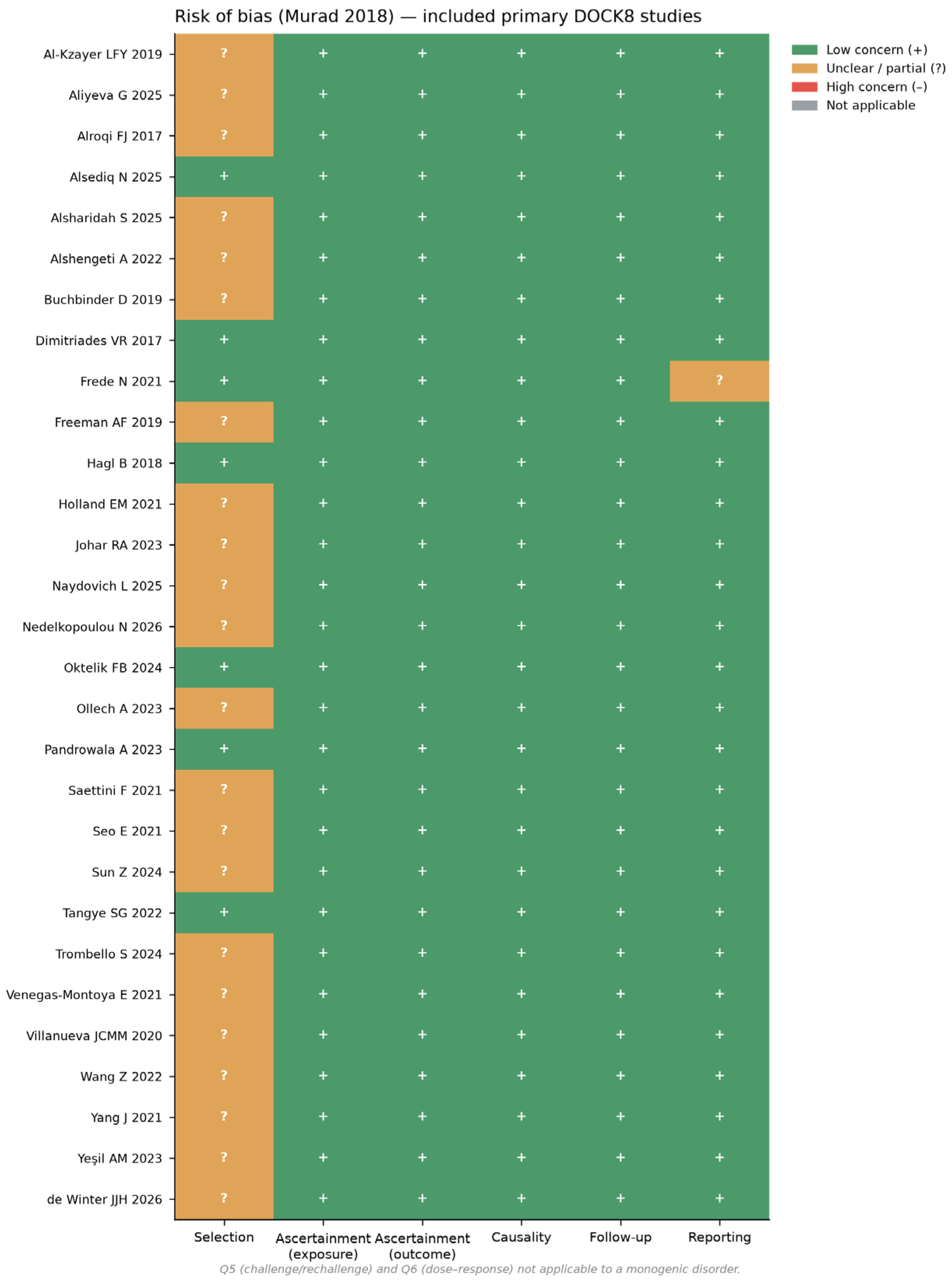
All 29 primary reports were judged at low concern for the exposure- and outcome-ascertainment and causality domains, because DOCK8 status was molecularly or functionally confirmed and the phenotype is causally attributable to the biallelic defect. The selection domain, by contrast, was rated unclear/partial (“?”) for most single case reports (Figure 5), because individual cases are typically selected for salient or unusual features and do not represent a consecutive or unselected series; this is the principal risk-of-bias concern in this evidence base and underlies the ascertainment-conditioned nature of the reported proportions. Six multi-patient series were rated low overall risk of bias; the remaining 23 reports were rated moderate overall, driven by this selection concern (for the single case reports) and, for one large genotype-focused cohort (Frede 2021 [10]), by sparse per-patient clinical reporting. The per-study, per-domain assessment is shown in full in Figure 5. The challenge/re-challenge and dose–response items of the Murad tool are not applicable to a monogenic disorder and were marked as such.
Figure 5.
Risk-of-bias assessment of the included primary DOCK8 studies using the A et al. (2018) tool for case reports and case series [12]. Rows are studies (first author, year); columns are the tool’s domains: Selection, Ascertainment (exposure), Ascertainment (outcome), Causality, Follow-up and Reporting. Cells are colour-coded green “+” (low concern), amber “?” (unclear/partial concern), red “–” (high concern) and grey (not applicable). The challenge/re-challenge and dose–response items are not applicable to a monogenic disorder. The Selection domain is unclear/partial for most single case reports because individual cases are selected for salient features rather than drawn from consecutive series. This figure is the complete per-study assessment [10,13,14,15,16,17,18,19,20,21,22,23,24,25,26,27,28,29,30,31,32,33,34,35,36,37,38,39].
3.9. Data Integrity
De-duplication removed overlapping NIH (NCT01176006) subset reports and the Aydin/Raedler cohort overlaps from pooled denominators (Section 2.5; Appendix B). Residual uncertainty regarding overlap of Middle-Eastern/North-African founder-variant patients across genetic cohorts is flagged for manual verification and itemised in Appendix B.
4. Discussion
This individual-patient-data synthesis of DOCK8 deficiency reported between 2017 and 2026 assembles 64 individually reported patients from 29 studies across 22 countries, together with 12 aggregate cohorts, and situates them against the foundational descriptions of the disorder. Three principal findings emerge.
First, the contemporary genotype and phenotype reaffirm the classical picture from the 136-patient survey of 2015 [2] and the 2017 synthesis [3]—early-onset eczema, markedly elevated IgE, a distinctive cutaneous viral diathesis, sinopulmonary bacterial infection, and substantial malignancy risk—while providing resolution in two respects. The mutation spectrum is increasingly populated by large deletions and splice/deep-intronic variants detectable only with copy-number and RNA-level methods, including a recurrent deep-intronic allele reported independently in two cohorts [22,27]; and recurrent founder alleles anchor the disease in Middle-Eastern/North-African populations [10,11], where consanguinity was reported in the large majority of patients. Somatic reversion, present in a substantial fraction of prospective-trial subjects [4], is now recognised as a common modifier that can attenuate or complicate the phenotype.
Second, our pooled estimates place malignancy prevalence at 10.6% (95% CI 3.4–20.7) across cohorts. This is DOCK8-specific and complements the syndrome-level estimate for the hyper-IgE syndromes as a group [6]; the substantial heterogeneity (I2 = 66%) is expected, since malignancy accrues with age and ascertainment differs between transplant cohorts and clinical series. The malignancy phenotype—EBV-driven lymphoproliferation and smooth-muscle tumour [14], and epithelial skin cancer—reflects the oncogenic consequences of impaired antiviral immunosurveillance.
Third, our transplant findings are concordant with, and now framed by, the first prospective HSCT trial for DOCK8 deficiency [4] and the multi-institutional retrospective experience [5]. Pooled post-HSCT survival was 86.3% (95% CI 79.0–92.5), and reduced-toxicity conditioning strategies—including treosulfan- and busulfan-based regimens with post-transplant cyclophosphamide, and αβ-T/CD19-depleted grafts in adults [40]—are being applied across a widening age range and donor spectrum, including in resource-constrained settings [29]. Biologic therapy represents a distinct development in the current era: dupilumab for the atopic component [16] and siltuximab for refractory inflammatory phenotype [32] exemplify a shift toward pathway-directed adjuncts, although transplantation remains the only established cure.
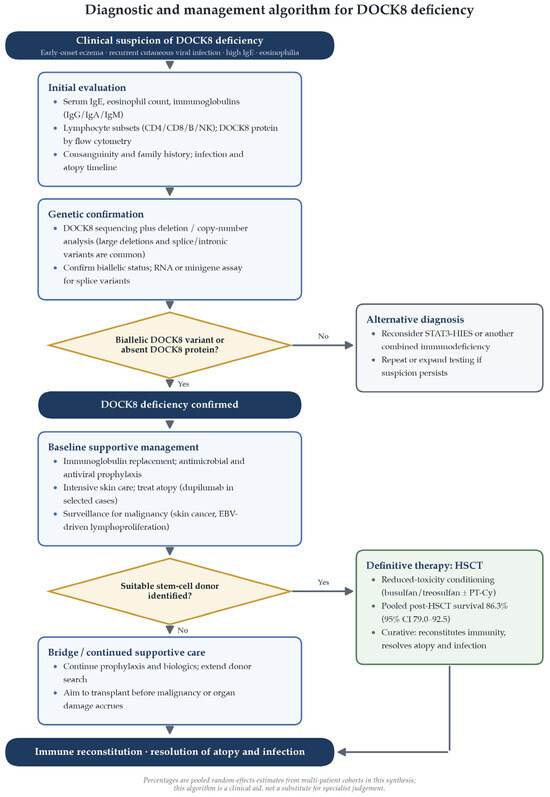
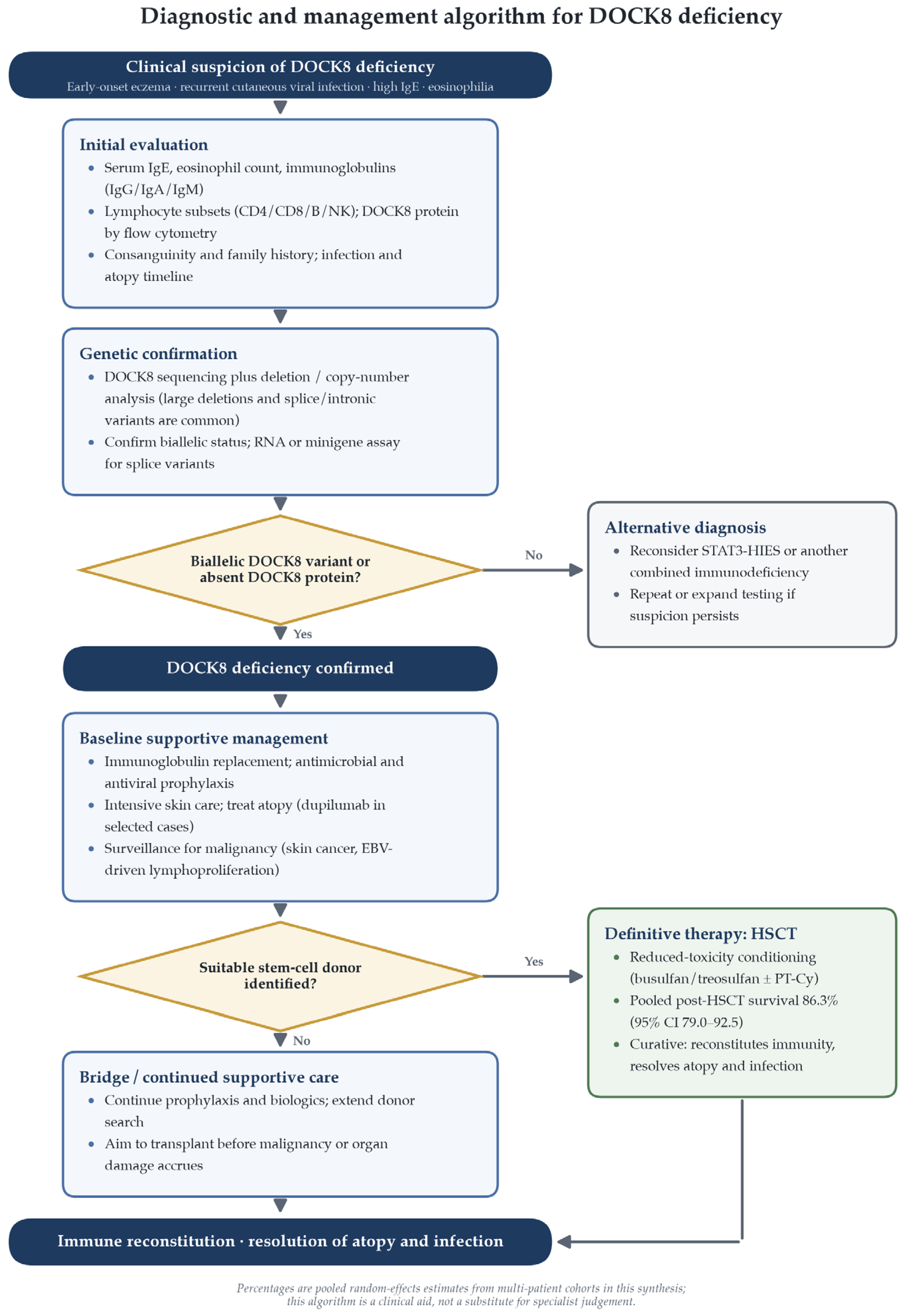
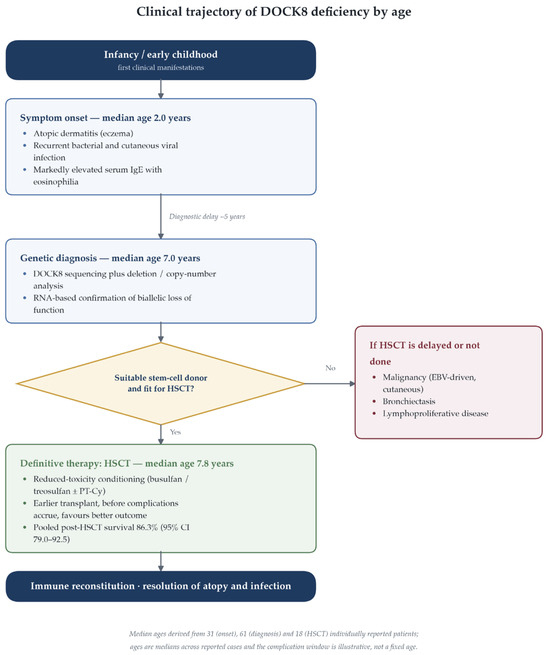
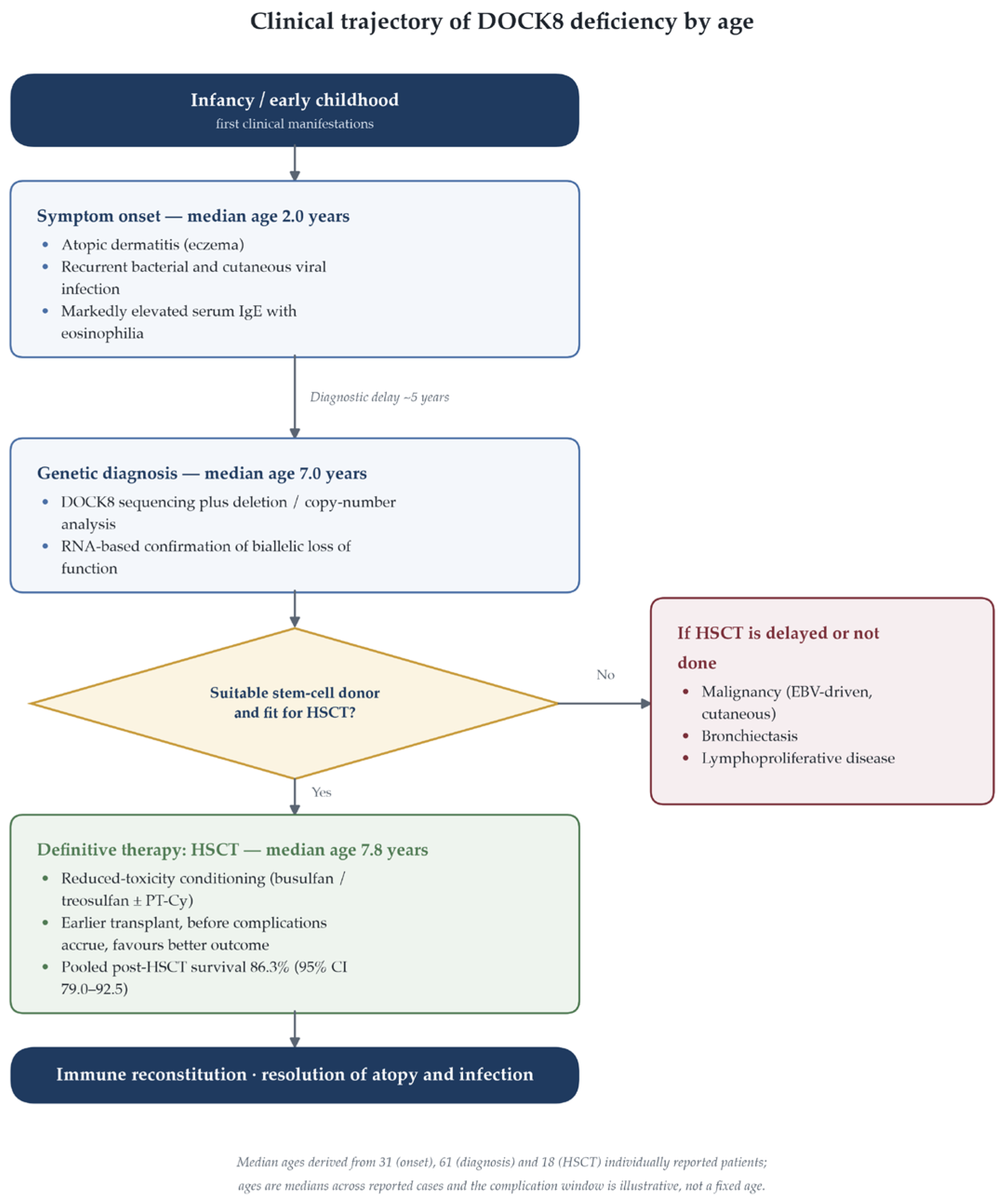
The clinical implication is that early molecular diagnosis—now requiring deletion/CNV and RNA-level testing to capture the full variant spectrum—should prompt timely referral for HSCT before the accrual of malignancy, chronic organ damage (bronchiectasis, sclerosing cholangitis) and treatment-refractory infection. The regional concentration of reports and the strong consanguinity signal argue for targeted genetic counselling and newborn or cascade screening in high-prevalence populations. These diagnostic and management steps are summarised in the proposed algorithm (Figure 6), and the age-related evolution from symptom onset through diagnosis to definitive treatment is depicted in the clinical-trajectory schematic (Figure 7).
Figure 6.
Proposed diagnostic and management algorithm for DOCK8 deficiency, integrating the diagnostic, supportive and transplant findings of this synthesis. Boxes denote clinical states or actions and diamonds denote decision points; pooled estimates shown (e.g., post-HSCT survival 86.3%, 95% CI 79.0–92.5) are the random-effects proportions from this review. PT-Cy, post-transplant cyclophosphamide; HSCT, haematopoietic stem-cell transplantation; IgE, immunoglobulin E; EBV, Epstein–Barr virus; STAT3-HIES, STAT3 hyper-IgE syndrome. The algorithm is a clinical aid, not a substitute for specialist judgement.
Figure 7.
Clinical trajectory and management of DOCK8 deficiency across age, from early symptom onset (median age 2.0 years) through the diagnostic delay to genetic confirmation (median 7.0 years) to definitive treatment. The decision point reflects donor availability and fitness for transplantation, contrasting hematopoietic stem-cell transplantation (median age 7.8 years; pooled post-HSCT survival 86.3%, 95% CI 79.0–92.5) with the complications—malignancy, bronchiectasis and lymphoproliferative disease—that accrue when transplantation is delayed or not performed. Ages are medians across individually reported cases (n = 31 for onset, 61 for diagnosis, 18 for HSCT). HSCT, haematopoietic stem-cell transplantation.
Limitations
Several limitations constrain these findings and are intrinsic to the evidence base. The synthesis rests on case reports and case series, which are subject to selection and reporting bias: salient features are preferentially described, mild or atypical cases are under-reported, and fatal cases may be over- or under-represented depending on journal and era. Denominators therefore vary by variable and are stated explicitly throughout; the feature proportions are ascertainment-conditioned rather than population prevalences. Two pooled survival measures must be distinguished: the cross-sectional pooled proportion alive at last follow-up (87.3%) reflects variable and often short follow-up, whereas the reconstructed age-specific Kaplan–Meier estimate (approximately 53% by age 20) describes cumulative survival with age; neither is a definitive lifetime estimate. The age-timescale survival reconstruction uses published age-at-event data without per-patient delayed-entry times, so all patients enter the risk set at birth; this left-truncation/immortal-time structure likely overestimates early survival, and the age-specific curve is therefore labelled exploratory. Where primary time-to-event or entry-age data can be obtained, the analysis should be repeated with delayed entry. The transplanted-versus-non-transplanted comparison is confounded by indication and survivorship and cannot be interpreted causally. Pooled proportions were restricted to multi-patient cohorts to avoid the extreme selection bias of single-patient denominators; robustness was supported by concordant random-intercept logistic sensitivity models, though residual between-cohort heterogeneity and overlap remain. Despite structured de-duplication—anchoring the NIH NCT01176006 counts to the prospective trial and removing the Aydin/Raedler overlaps (Appendix B)—residual double-counting of founder-variant patients across Middle-Eastern/North-African cohorts cannot be fully excluded. Importantly, the primary search to date has been PubMed/MEDLINE; the Embase, Scopus, Web of Science and Cochrane CENTRAL strategies are provided in Appendix A and are being executed to complete the search, with the PRISMA flow to be updated accordingly. Sixty-three potentially eligible full texts were paywalled, and one was abstract-only, and non-English reports were excluded; these retrieval and language restrictions may bias the included set in an uncertain direction—paywalled specialist reports may include both severe transplant cases and detailed genetic series, while non-English reports may capture regions under-represented here—and this cannot be quantified without the missing reports. Finally, screening, extraction and de-duplication are undergoing independent second-reviewer verification; the pooled estimates and clinical conclusions should be considered provisional until that verification is complete.
5. Conclusions
Contemporary reports of DOCK8 deficiency reaffirm a severe combined immunodeficiency defined by cutaneous viral infection, atopy, recurrent bacterial infection and a high malignancy burden, and they consolidate hematopoietic stem-cell transplantation—now supported by prospective trial data—as the definitive therapy, with pooled post-HSCT survival of 86.3% (95% CI 79.0–92.5). The current era adds a broader, deletion- and splice-weighted genotype spectrum with recognisable founder alleles, an appreciation of somatic reversion, and the first use of biologic adjuncts. These conclusions are drawn from case-based, reconstructed evidence and, pending completion of the multi-database search and independent second-reviewer verification, should be considered provisional; nonetheless, they support early molecular diagnosis and timely transplant referral, particularly in consanguineous, high-prevalence populations.
Supplementary Materials
The following supporting information can be downloaded at: https://www.mdpi.com/article/10.3390/immuno6030052/s1, PRISMA 2020 Checklist.
Author Contributions
Conceptualization, K.A.A. and R.S.A.; methodology, K.A.A.; validation, N.A.-J., F.A. and R.A.A.; formal analysis, K.A.A.; investigation (study screening and data extraction), R.S.A., N.A.-J., R.A.A. and A.S.A.; data curation, R.S.A. and A.S.A.; writing—original draft preparation, R.S.A. and K.A.A.; writing—review and editing, F.A., N.A.-J., R.A.A. and A.S.A.; visualisation, K.A.A.; supervision, K.A.A. All authors have read and agreed to the published version of the manuscript.
Funding
This research received no external funding.
Institutional Review Board Statement
Not applicable.
Informed Consent Statement
Not applicable.
Data Availability Statement
All data analysed in this review were extracted from the published sources cited in the References; no new primary data were generated. The search strategies (Appendix A), the de-duplication and cohort-merge log (Appendix B) and the per-study risk-of-bias assessment (Figure 5) are provided within the article, and study-level characteristics with the patient-to-publication mapping are given in Table 1. The list of reports that could not be retrieved at full text and the per-patient clinical extraction are held in the review team’s records and are available from the corresponding author on reasonable request.
Acknowledgments
During the preparation of this manuscript, the authors used AI-assisted tools for English-language editing and for the preparation and labelling of figures; the authors reviewed and edited all content and take full responsibility for the published article.
Conflicts of Interest
The authors declare no conflicts of interest.
Abbreviations
The following abbreviations are used in this manuscript:
| AR-HIES | Autosomal-recessive hyper-IgE syndrome |
| CDC42 | Cell division control protein 42 homologue |
| CI | Confidence interval |
| CMC | Chronic mucocutaneous candidiasis |
| CNS | Central nervous system |
| CNV | Copy-number variation |
| DLBCL | Diffuse large B-cell lymphoma |
| DOCK8 | Dedicator of cytokinesis 8 |
| EBV | Epstein–Barr virus |
| GLMM | Generalised linear mixed model |
| GvHD | Graft-versus-host disease |
| HIES | Hyper-IgE syndrome |
| HPV | Human papillomavirus |
| HSCT | Haematopoietic stem-cell transplantation |
| HSV | Herpes simplex virus |
| IgE | Immunoglobulin E |
| IgG/IgA/IgM | Immunoglobulin G/A/M |
| IPD | Individual patient data |
| IPEX | Immune dysregulation, polyendocrinopathy, enteropathy, X-linked |
| IQR | Interquartile range |
| MENA | Middle East and North Africa |
| MMUD | Mismatched unrelated donor |
| MUD | Matched unrelated donor |
| NIH | National Institutes of Health |
| NK | Natural killer (cell) |
| NR | Not reported |
| OS | Overall survival |
| OSF | Open Science Framework |
| PECO | Population, Exposure, Comparator, Outcome |
| PFT | Freeman–Tukey double-arcsine transformation |
| PI | Prediction interval |
| PMID | PubMed identifier |
| PRISMA | Preferred Reporting Items for Systematic Reviews and Meta-Analyses |
| PT-Cy | Post-transplant cyclophosphamide |
| RoB | Risk of bias |
| SCC | Squamous-cell carcinoma |
| SLE | Systemic lupus erythematosus |
| VZV | Varicella-zoster virus |
Appendix A. Database Search Strategies
The PubMed/MEDLINE search was executed on 1 July 2026. The Boolean translations for the four remaining databases are given below; these searches are being executed to complete the review, and the PRISMA flow diagram (Figure 1) will be updated with their yield. All strategies use the same three concept blocks (DOCK8/AR-HIES terminology) combined with the 2017–2026 publication-date limit.
Appendix A.1. PubMed/MEDLINE (Executed; 360 Records)
(“DOCK8” [Title/Abstract] OR “dedicator of cytokinesis 8” [Title/Abstract] OR “DOCK8” [MeSH Terms] OR “DOCK8 deficiency” [Supplementary Concept] OR “autosomal recessive hyper-IgE” [Title/Abstract] OR “AR-HIES” [Title/Abstract]) AND (“1 January 2017” [Date—Publication]: “31 December 2026” [Date—Publication]).
Appendix A.2. Embase (Elsevier; Emtree + Free Text)
(‘DOCK8 protein’/exp OR ‘dedicator of cytokinesis 8’:ti,ab OR ‘DOCK8’:ti,ab OR ‘autosomal recessive hyper IgE’:ti,ab OR ‘AR-HIES’:ti,ab) AND [2017–2026]/py.
Appendix A.3. Scopus (TITLE-ABS-KEY)
TITLE-ABS-KEY (“DOCK8” OR “dedicator of cytokinesis 8” OR “DOCK8 deficiency” OR “autosomal recessive hyper-IgE” OR “AR-HIES”) AND PUBYEAR > 2016 AND PUBYEAR < 2027.
Appendix A.4. Web of Science Core Collection (Topic)
TS = (“DOCK8” OR “dedicator of cytokinesis 8” OR “DOCK8 deficiency” OR “autosomal recessive hyper-IgE” OR “AR-HIES”) AND PY = (2017–2026).
Appendix A.5. Cochrane CENTRAL (CENTRAL; Title/Abstract/Keyword)
(“DOCK8” OR “dedicator of cytokinesis 8” OR “DOCK8 deficiency” OR “autosomal recessive hyper-IgE” OR “AR-HIES”):ti,ab,kw, with Publication Year from 2017 to 2026.
Appendix B. De-Duplication and Cohort-Merge Log
Because several groups report overlapping DOCK8 populations, the following merge decisions were applied before pooling. Matching was on country, centre, sex, DOCK8 variant and age. These decisions implement the rules stated in Section 2.5; residual founder-allele overlap remains flagged for manual verification.
- NIH transplant programme (ClinicalTrials.gov NCT01176006) is reported across multiple papers. The prospective trial cohort [4] was used as the single anchor for NIH aggregate transplant counts; overlapping subset reports of the same programme were excluded from pooled denominators to prevent double-counting.
- Aydin 2015 [2] and Aydin 2019 [5] share patients. The 2019 HSCT cohort was used for post-HSCT survival pooling, and the 2015 survey for malignancy pooling, and patients common to both were not counted twice within a single pooled analysis.
- Raedler 2021 [9] is a lineage-chimerism series whose patients were previously published in the Aydin cohorts; it was therefore excluded from all survival pools. Its inclusion in post-HSCT survival would have added a 9/9 cohort and raised the pooled estimate from 86.3% (k = 4) to 87.8% (k = 5).
- Recurrent Middle-Eastern/North-African founder alleles create potential overlap between the Egyptian subsets of two genetic cohorts, El Hawary 2022 [11] and Frede 2021 [10]. Because per-patient identifiers are not resolvable from the published data, these were flagged for manual reconciliation rather than merged, and the residual possibility of double-counting is acknowledged in Section 4 (Limitations).
References
- Zhang, Q.; Davis, J.C.; Lamborn, I.T.; Freeman, A.F.; Jing, H.; Favreau, A.J.; Matthews, H.F.; Davis, J.; Turner, M.L.; Uzel, G.; et al. Combined immunodeficiency associated with DOCK8 mutations. N. Engl. J. Med. 2009, 361, 2046–2055. [Google Scholar] [CrossRef] [Scilit]
- Aydin, S.E.; Kilic, S.S.; Aytekin, C.; Kumar, A.; Porras, O.; Kainulainen, L.; Kostyuchenko, L.; Genel, F.; Kütükcüler, N.; Karaca, N.; et al. DOCK8 deficiency: Clinical and immunological phenotype and treatment options—A review of 136 patients. J. Clin. Immunol. 2015, 35, 189–198. [Google Scholar] [CrossRef] [Scilit] [PubMed]
- Biggs, C.M.; Keles, S.; Chatila, T.A. DOCK8 deficiency: Insights into pathophysiology, clinical features and management. Clin. Immunol. 2017, 181, 75–82. [Google Scholar] [CrossRef] [Scilit] [PubMed]
- Freeman, A.F.; Gonzalez, C.E.; Yates, B.; Cole, K.; Little, L.; Flannelly, E.; Steinberg, S.M.; Mo, G.; Piette, N.; Hughes, T.E.; et al. Hematopoietic cell transplantation for DOCK8 deficiency: Results from a prospective clinical trial. J. Allergy Clin. Immunol. 2025, 155, 176–187. [Google Scholar] [CrossRef] [Scilit] [PubMed]
- Aydin, S.E.; Freeman, A.F.; Al-Herz, W.; Al-Mousa, H.A.; Arnaout, R.K.; Aydin, R.C.; Barlogis, V.; Belohradsky, B.H.; Bonfim, C.; Bredius, R.G.; et al. Hematopoietic Stem Cell Transplantation as Treatment for Patients with DOCK8 Deficiency. J. Allergy Clin. Immunol. Pract. 2019, 7, 848–855. [Google Scholar] [CrossRef] [Scilit] [PubMed]
- Mohammadi, T.; Azizi, G.; Rafiemanesh, H.; Farahani, P.; Nirouei, M.; Tavakol, M. A systematic review regarding the prevalence of malignancy in patients with the hyper-IgE syndrome. Clin. Exp. Med. 2023, 23, 4835–4859. [Google Scholar] [CrossRef] [Scilit] [PubMed]
- Page, M.J.; McKenzie, J.E.; Bossuyt, P.M.; Boutron, I.; Hoffmann, T.C.; Mulrow, C.D.; Shamseer, L.; Tetzlaff, J.M.; Akl, E.A.; Brennan, S.E.; et al. The PRISMA 2020 statement: An updated guideline for reporting systematic reviews. BMJ 2021, 372, n71. [Google Scholar] [CrossRef] [Scilit] [PubMed]
- Stewart, L.A.; Clarke, M.; Rovers, M.; Riley, R.D.; Simmonds, M.; Stewart, G.; Tierney, J.F.; PRISMA-IPD Development, G.r.o.u.p. Preferred Reporting Items for Systematic Review and Meta-Analyses of individual participant data: The PRISMA-IPD Statement. JAMA 2015, 313, 1657–1665. [Google Scholar] [CrossRef] [Scilit] [PubMed]
- Raedler, J.; Magg, T.; Rohlfs, M.; Klein, C.; Vallée, T.; Hauck, F.; Albert, M.H. Lineage-Specific Chimerism and Outcome After Hematopoietic Stem Cell Transplantation for DOCK8 Deficiency. J. Clin. Immunol. 2021, 41, 1536–1548. [Google Scholar] [CrossRef] [Scilit] [PubMed]
- Frede, N.; Rojas-Restrepo, J.; Caballero Garcia de Oteyza, A.; Buchta, M.; Hübscher, K.; Gámez-Díaz, L.; Proietti, M.; Saghafi, S.; Chavoshzadeh, Z.; Soler-Palacin, P.; et al. Genetic Analysis of a Cohort of 275 Patients with Hyper-IgE Syndromes and/or Chronic Mucocutaneous Candidiasis. J. Clin. Immunol. 2021, 41, 1804–1838. [Google Scholar] [CrossRef] [Scilit] [PubMed]
- El Hawary, R.E.; Meshaal, S.S.; Abd Elaziz, D.S.; Alkady, R.; Lotfy, S.; Eldash, A.; Erfan, A.; Chohayeb, E.A.; Saad, M.M.; Darwish, R.K.; et al. Genetic Testing in Egyptian Patients with Inborn Errors of Immunity: A Single-Center Experience. J. Clin. Immunol. 2022, 42, 1051–1070. [Google Scholar] [CrossRef] [Scilit] [PubMed]
- Murad, M.H.; Sultan, S.; Haffar, S.; Bazerbachi, F. Methodological quality and synthesis of case series and case reports. BMJ Evid. Based Med. 2018, 23, 60–63. [Google Scholar] [CrossRef] [Scilit] [PubMed]
- Al-Kzayer, L.F.Y.; Al-Aradi, H.M.H.; Shigemura, T.; Sano, K.; Tanaka, M.; Hamada, M.; Ali, K.H.; Aldaghir, O.M.; Nakazawa, Y.; Okuno, Y. DOCK8 mutation diagnosed using whole-exome sequencing of the dried blood spot-derived DNA: A case report of an Iraqi girl diagnosed in Japan. BMC Med. Genet. 2019, 20, 114. [Google Scholar] [CrossRef] [Scilit] [PubMed]
- Aliyeva, G.; Bajin, I.Y.; Orhan, D.; Kutluk, T.; Kösemehmetoğlu, K.; Cagdas, D. Epstein-Barr Virus-Associated Smooth Muscle Tumors in inborn Errors of Immunity: A single-center Case Series and Literature Overview. J. Clin. Immunol. 2025, 45, 144. [Google Scholar] [CrossRef] [Scilit] [PubMed]
- Alroqi, F.J.; Charbonnier, L.M.; Keles, S.; Ghandour, F.; Mouawad, P.; Sabouneh, R.; Mohammed, R.; Almutairi, A.; Chou, J.; Massaad, M.J.; et al. DOCK8 Deficiency Presenting as an IPEX-Like Disorder. J. Clin. Immunol. 2017, 37, 811–819. [Google Scholar] [CrossRef] [Scilit] [PubMed]
- Alsediq, N.; Algholaiqa, T.; Alnami, G.; AlJaber, A.N. Dupilumab for atopic manifestations in pediatric patients with inborn errors of immunity: Efficacy and safety in a genetically diverse cohort. Front. Immunol. 2025, 16, 1715919. [Google Scholar] [CrossRef] [Scilit] [PubMed]
- Alsharidah, S.; Elhussein, A.; Al-Herz, W. Haploidentical stem cell transplantation in DOCK8 deficiency: A case report of successful outcomes. Blood Coagul. Fibrinolysis 2025, 36, 199–203. [Google Scholar] [CrossRef] [Scilit] [PubMed]
- Alshengeti, A. Eczema herpeticum vs dermatitis herpetiformis as a clue of dedicator of cytokinesis 8 deficiency diagnosis: A case report. World J. Clin. Cases 2022, 10, 10735–10741. [Google Scholar] [CrossRef] [Scilit] [PubMed]
- Buchbinder, D.; Kirov, I.; Danielson, J.; Shah, N.N.; Freeman, A.F.; Chavan, R.S.; Su, H.C. Compound Heterozygous DOCK8 Mutations in a Patient with B Lymphoblastic Leukemia and EBV-Associated Diffuse Large B Cell Lymphoma. J. Clin. Immunol. 2019, 39, 592–595. [Google Scholar] [CrossRef] [Scilit] [PubMed]
- Dimitriades, V.R.; Devlin, V.; Pittaluga, S.; Su, H.C.; Holland, S.M.; Wilson, W.; Dunleavy, K.; Shah, N.N.; Freeman, A.F. DOCK 8 Deficiency, EBV+ Lymphomatoid Granulomatosis, and Intrafamilial Variation in Presentation. Front. Pediatr. 2017, 5, 38. [Google Scholar] [CrossRef] [Scilit] [PubMed]
- Freeman, A.F.; Yazigi, N.; Shah, N.N.; Kleiner, D.E.; Parta, M.; Atkinson, P.; Heller, T.; Holland, S.M.; Kaufman, S.S.; Khan, K.M.; et al. Tandem Orthotopic Living Donor Liver Transplantation Followed by Same Donor Haploidentical Hematopoietic Stem Cell Transplantation for DOCK8 Deficiency. Transplantation 2019, 103, 2144–2149. [Google Scholar] [CrossRef] [Scilit] [PubMed]
- Hagl, B.; Spielberger, B.D.; Thoene, S.; Bonnal, S.; Mertes, C.; Winter, C.; Nijman, I.J.; Verduin, S.; Eberherr, A.C.; Puel, A.; et al. Somatic alterations compromised molecular diagnosis of DOCK8 hyper-IgE syndrome caused by a novel intronic splice site mutation. Sci. Rep. 2018, 8, 16719. [Google Scholar] [CrossRef] [Scilit] [PubMed]
- Holland, E.M.; Gonzalez, C.; Levy, E.; Valera, V.A.; Chalfin, H.; Klicka-Skeels, J.; Yates, B.; Kleiner, D.E.; Hadigan, C.; Dave, H.; et al. Case Report: Fatal Complications of BK Virus-Hemorrhagic Cystitis and Severe Cytokine Release Syndrome Following BK Virus-Specific T-Cells. Front. Immunol. 2021, 12, 801281. [Google Scholar] [CrossRef] [Scilit] [PubMed]
- Johar, R.A.; Hasanain, A.; Khouqeer, Y. Efficacy of Dupilumab in Treating Atopic Dermatitis with Recurrent Eczema Herpeticum in a Patient with DOCK8-Deficiency Hyper-IgE Syndrome: A Case Report. Cureus 2023, 15, e43360. [Google Scholar] [CrossRef] [Scilit] [PubMed]
- Naydovich, L.; Berger, J.R.; Milutinovic, P.S. Progressive multifocal leukoencephalopathy in a young adult with DOCK8 deficiency: A case of JC virus reactivation in primary immunodeficiency. J. Neurovirol 2025, 31, 585–587. [Google Scholar] [CrossRef] [Scilit] [PubMed]
- Nedelkopoulou, N.; Ugonna, K.; Hughes, S.; Rajwal, S.; Mtegha, M. DOCK8 deficiency presenting with sclerosing cholangitis, raised immunoglobulin E, and bronchiectasis: A fatal pediatric case report. JPGN Rep. 2026, 7, 11–13. [Google Scholar] [CrossRef] [Scilit] [PubMed]
- Oktelik, F.B.; Wang, M.; Keles, S.; Eke Gungor, H.; Cansever, M.; Can, S.; Karakoc-Aydiner, E.; Baris, S.; Schmitz-Abe, K.; Benamar, M.; et al. DOCK8 deficiency due to a deep intronic variant in two kindreds with hyper-IgE syndrome. Clin. Immunol. 2024, 268, 110384. [Google Scholar] [CrossRef] [Scilit] [PubMed]
- Ollech, A.; Simon, A.J.; Lev, A.; Stauber, T.; Sherman, G.; Solomon, M.; Barzilai, A.; Somech, R.; Greenberger, S. A horse or a zebra? Unusual manifestations of common cutaneous infections in primary immunodeficiency pediatric patients. Front. Pediatr. 2023, 11, 1103726. [Google Scholar] [CrossRef] [Scilit] [PubMed]
- Pandrowala, A.; Sharma, A.N.; Kakunje, M.; Bodhanwala, M.; Hiwarkar, P. Reduced toxicity conditioning and a high CD34(+) cell dose can achieve full donor chimerism in DOCK8 deficiency. J. Allergy Clin. Immunol. Glob. 2023, 2, 100106. [Google Scholar] [CrossRef] [Scilit] [PubMed]
- Saettini, F.; Fazio, G.; Moratto, D.; Galbiati, M.; Zucchini, N.; Ippolito, D.; Dinelli, M.E.; Imberti, L.; Mauri, M.; Melzi, M.L.; et al. Case Report: Hypomorphic Function and Somatic Reversion in DOCK8 Deficiency in One Patient with Two Novel Variants and Sclerosing Cholangitis. Front. Immunol. 2021, 12, 673487. [Google Scholar] [CrossRef] [Scilit] [PubMed]
- Seo, E.; Lee, B.H.; Lee, J.H.; Park, Y.S.; Im, H.J.; Lee, J. Hematopoietic stem cell transplantation in an infant with dedicator of cytokinesis 8 (DOCK8) deficiency associated with systemic lupus erythematosus: A case report. Medicine 2021, 100, e20866. [Google Scholar] [CrossRef] [Scilit] [PubMed]
- Sun, Z.; Wei, R.; Pan, C.; Ni, C.; Zhang, X.; Guan, W.; Cheng, R.; Gu, Y.; Yu, H.; He, K.; et al. Successfully treated with siltuximab and prednisone in a 7-year-old girl with DOCK8-deficiency presenting as recurrent wart-like lesions: A case report. Front. Immunol. 2024, 15, 1414573. [Google Scholar] [CrossRef] [Scilit] [PubMed]
- Tangye, S.G.; Gray, P.E.; Pillay, B.A.; Yap, J.Y.; Figgett, W.A.; Reeves, J.; Kummerfeld, S.K.; Stoddard, J.; Uzel, G.; Jing, H.; et al. Hyper-IgE Syndrome due to an Elusive Novel Intronic Homozygous Variant in DOCK8. J. Clin. Immunol. 2022, 42, 119–129. [Google Scholar] [CrossRef] [Scilit] [PubMed]
- Trombello, S.; Jarisch, A.; Willasch, A.; Rettinger, E.; Fekadu-Siebald, J.; Holzinger, D.; Adelmann, R.; Bader, P.; Bakhtiar, S. Case report: Advanced age at transplantation and pre-emptive treatment with dupilumab in DOCK8 deficiency. Front. Immunol. 2024, 15, 1507494. [Google Scholar] [CrossRef] [Scilit] [PubMed]
- Venegas-Montoya, E.; Staines-Boone, A.T.; Sánchez-Sánchez, L.M.; García-Campos, J.A.; Córdova-Gurrola, R.A.; Salazar-Galvez, Y.; Múzquiz-Zermeño, D.; González-Serrano, M.E.; Lugo Reyes, S.O. Case Report: DOCK8 Deficiency Without Hyper-IgE in a Child with a Large Deletion. Front. Pediatr. 2021, 12, 635322. [Google Scholar] [CrossRef] [Scilit] [PubMed]
- Villanueva, J.C.M.M.; Chan, K.W.; Ong, R.C.; Andaya, A.G.; Lau, Y.L.; van Zelm, M.C.; Kanegane, H. Hyper IgE Syndrome Associated with Warts: A First Case of Dedicator of Cytokinesis 8 Deficiency in the Philippines. Front. Pediatr. 2020, 8, 604725. [Google Scholar] [CrossRef] [Scilit] [PubMed]
- Wang, Z.; Zhang, Y.; Li, G.; Huang, L.; Chen, J. Dedicator of cytokinesis 8 deficiency and hyperimmunoglobulin E syndrome: A case report. Medicine 2022, 101, e28807. [Google Scholar] [CrossRef] [Scilit] [PubMed]
- Yang, J.; Liu, Y. Autosomal recessive hyper-IgE syndrome caused by DOCK8 gene mutation with new clinical features: A case report. BMC Neurol. 2021, 21, 288. [Google Scholar] [CrossRef] [Scilit] [PubMed]
- Yeşil, A.M.; Kayaoğlu, B.; Gül, E.; Gönç, N.; Özön, A.; Tezcan, İ.; Gürsel, M.; Çağdaş, D. DOCK8 deficiency with hypereosinophilia and the syndrome of inappropriate antidiuretic hormone secretion during herpes infection. Turk. J. Pediatr. 2023, 65, 536–541. [Google Scholar] [CrossRef] [Scilit] [PubMed]
- de Winter, J.J.H.; Ibrahimov, B.M.; Verheij, F.A.; Brinkman, I.D.; Stuut, A.H.G.; Schonewille, P.; Heijstek, M.W.; van Rhenen, A.; van der Wagen, L.E.; Daenen, L.G.M.; et al. αβT/CD19-depleted Allogeneic Stem Cell Transplantation in Adults with Inborn Errors of Immunity. J. Clin. Immunol. 2026, 46, 21. [Google Scholar] [CrossRef] [Scilit] [PubMed]
- Eken, A.; Cansever, M.; Okus, F.Z.; Erdem, S.; Nain, E.; Azizoglu, Z.B.; Haliloglu, Y.; Karakukcu, M.; Ozcan, A.; Devecioglu, O.; et al. ILC3 deficiency and generalized ILC abnormalities in DOCK8-deficient patients. Allergy 2020, 75, 921–932. [Google Scholar] [CrossRef] [Scilit] [PubMed]
- Azizi, G.; Hesari, M.F.; Sharifinejad, N.; Fayyaz, F.; Chavoshzadeh, Z.; Mahdaviani, S.A.; Alan, M.S.; Jamee, M.; Tavakol, M.; Sadri, H.; et al. The Autoimmune Manifestations in Patients with Genetic Defects in the B Cell Development and Differentiation Stages. J. Clin. Immunol. 2023, 43, 819–834. [Google Scholar] [CrossRef] [Scilit] [PubMed]
- Crowley, E.; Warner, N.; Pan, J.; Khalouei, S.; Elkadri, A.; Fiedler, K.; Foong, J.; Turinsky, A.L.; Bronte-Tinkew, D.; Zhang, S.; et al. Prevalence and Clinical Features of Inflammatory Bowel Diseases Associated With Monogenic Variants, Identified by Whole-Exome Sequencing in 1000 Children at a Single Center. Gastroenterology 2020, 158, 2208–2220. [Google Scholar] [CrossRef] [Scilit] [PubMed]
- Wang, C.; Filippov, E.; Seyedmousavi, A.; Kleiner, D.E.; Rai, A.; Heller, T.; Dias, A.L.; Gonzalez, C.E.; Arnold, D.E.; Dimitrova, D.; et al. Cryptosporidiosis in inborn errors of immunity: A single center cohort and review of the literature. J. Infect. Dis. 2026, jiag262. [Google Scholar] [CrossRef] [Scilit] [PubMed]
- Haskologlu, S.; Kostel Bal, S.; Islamoglu, C.; Aytekin, C.; Guner, S.; Sevinc, S.; Keles, S.; Kendirli, T.; Ceylaner, S.; Dogu, F.; et al. Clinical, immunological features and follow up of 20 patients with dedicator of cytokinesis 8 (DOCK8) deficiency. Pediatr. Allergy Immunol. 2020, 31, 515–527. [Google Scholar] [CrossRef] [Scilit] [PubMed]
- Shah, N.N.; Freeman, A.F.; Su, H.; Cole, K.; Parta, M.; Moutsopoulos, N.M.; Baris, S.; Karakoc-Aydiner, E.; Hughes, T.E.; Kong, H.H.; et al. Haploidentical Related Donor Hematopoietic Stem Cell Transplantation for Dedicator-of-Cytokinesis 8 Deficiency Using Post-Transplantation Cyclophosphamide. Biol. Blood Marrow Transplant. 2017, 23, 980–990. [Google Scholar] [CrossRef] [Scilit] [PubMed]
- Aserlind, A.; Martini, A.; Dong, J.; Zolton, J.; Carpinello, O.; DeCherney, A. Fertility preservation before hematopoetic stem cell transplantation: A case series of women with GATA binding protein 2 deficiency, dedicator of cytokinesis 8 deficiency, and sickle cell disease. F&S Rep. 2020, 1, 287–293. [Google Scholar] [CrossRef] [Scilit] [PubMed]
- Silbert, S.; Cole, K.; Bedoya, S.Z.; Freeman, A.F.; Whangbo, J.S.; Avila, D.N.; Su, H.C.; Yates, B.; Epstein, M.; Wendler, D.S.; et al. Tandem hematopoietic stem cell transplant considerations in families with multiple siblings affected by DOCK8 deficiency. Bone Marrow Transplant. 2022, 57, 1721–1723. [Google Scholar] [CrossRef] [Scilit] [PubMed]

Disclaimer/Publisher’s Note: The statements, opinions and data contained in all publications are solely those of the individual author(s) and contributor(s) and not of MDPI and/or the editor(s). MDPI and/or the editor(s) disclaim responsibility for any injury to people or property resulting from any ideas, methods, instructions or products referred to in the content. |
© 2026 by the authors. Licensee MDPI, Basel, Switzerland. This article is an open access article distributed under the terms and conditions of the Creative Commons Attribution (CC BY) license.