


Abstract
Severe aplastic anemia (SAA) in pregnancy represents a rare but life-threatening clinical challenge. Standard therapies such as hematopoietic stem cell transplantation (HSCT) and immunosuppressive therapy are limited during pregnancy due to safety concerns, leaving supportive care as the mainstay. Thrombopoietin receptor agonists (TPO-RAs) such as eltrombopag have emerged as promising agents in refractory SAA, though evidence of their safety in pregnancy remains scarce. We present the case of a 27-year-old woman with SAA post-allogeneic bone marrow transplant who relapsed during subsequent pregnancies. Her disease course was characterized by recurrent pancytopenia, mixed chimerism, and repeated need for stem cell boosts. During pregnancy in 2023, discontinuation of cyclosporine led to worsening cytopenias, prompting reintroduction of cyclosporine and the continuation of eltrombopag. This combined approach, alongside G-CSF and stem cell boosts, contributed to favorable hematologic stabilization. She successfully delivered a healthy infant and achieved hematologic recovery following a third stem cell boost postpartum. This report highlights the potential utility of TPO-RAs during pregnancy when conventional therapy is limited, while emphasizing the need for vigilant monitoring of maternal–fetal outcomes. A review of the literature suggests that although routine use of eltrombopag in pregnancy is not recommended, it may be considered in refractory SAA cases with careful risk–benefit assessment. The case underscores the role of multidisciplinary care, individualized therapeutic planning, and the need for further studies on TPO-RAs in pregnancy-associated bone marrow failure syndromes.
1. Introduction
Severe aplastic anemia (SAA) is a rare, life-threatening bone marrow failure disorder characterized by pancytopenia and hypocellular bone marrow. Standard management in nonpregnant adults relies on allogeneic hematopoietic stem cell transplantation (HSCT) or immunosuppressive therapy (IST) with antithymocyte globulin and cyclosporine. However, during pregnancy, treatment options are profoundly restricted because of teratogenic risks and maternal toxicity associated with standard therapies. Consequently, supportive transfusions and infection prophylaxis remain the cornerstone of management, but these alone may be insufficient to prevent life-threatening complications [1].
Pregnancy in women with SAA poses dual challenges for maternal and fetal health. Maternal risks include hemorrhage, severe infections, preeclampsia, and heart failure, while fetal outcomes are jeopardized by growth restriction, prematurity, and stillbirth. Several retrospective studies have highlighted that maternal hemoglobin and platelet levels are critical predictors of outcomes, with severe cytopenias correlating with poor prognosis. Relapse of SAA during pregnancy has also been observed even in women previously in remission, underscoring the unpredictable nature of the disease [1]. Given the extreme rarity of SAA in pregnancy, there is a notable lack of disease-specific data and guidelines. Consequently, the management of these patients often relies on limited case reports and extrapolation from more common conditions like immune thrombocytopenia (ITP), highlighting the urgent need for further SAA-specific research in this population.
Recent years have witnessed growing interest in thrombopoietin receptor agonists (TPO-RAs) as potential therapeutic tools for bone marrow failure syndromes [2,3]. Eltrombopag has demonstrated multilineage hematologic responses in refractory SAA and is now approved in this setting outside of pregnancy [2]. Its use in immune thrombocytopenia (ITP) during pregnancy has been increasingly reported, generally without teratogenic effects, though neonatal complications such as thrombocytopenia, thrombocytosis, and low birth weight have occasionally been observed [4]. Romiplostim has also been used as a rescue agent in refractory ITP pregnancies [5], but both agents remain investigational in aplastic anemia during gestation.
Despite these emerging reports, data on the safety and efficacy of TPO-RAs in SAA during pregnancy are extremely limited. Published experiences are largely confined to isolated case reports, with variable maternal and neonatal outcomes. The paucity of evidence highlights a major gap in clinical guidance, leaving physicians reliant on individualized, multidisciplinary decision-making. In this report, we describe a complex case of SAA relapse during pregnancy managed with cyclosporine, eltrombopag, and repeated stem cell boosts. These repeated boosts were possible because cryopreserved aliquots of the allogeneic HSCs obtained from the initial donor were available. We also review the current literature on TPO-RA use in pregnancy-associated SAA.
2. Case Description
A 27-year-old woman, mother of two, with no significant prior medical history, presented in November 2015 with intermittent vaginal bleeding, skin bruising, and gum bleeding. She had recently taken herbal medication before symptom onset. Initial investigations revealed pancytopenia, and bone marrow biopsy confirmed the diagnosis of severe aplastic anemia. She was transfused with red cells and platelets and admitted to King Faisal Specialist Hospital & Research Centre for further management.
She underwent allogeneic bone marrow transplantation in December 2015 and achieved hematologic recovery. However, during a subsequent pregnancy in 2017, she developed mixed whole blood chimerism with loss of lymphoid engraftment and recurrent pancytopenia. Treatment with cyclosporine and eltrombopag (up to 150 mg daily) led to hematologic improvement and stabilization of split chimerism, with preserved myeloid engraftment.
Her disease course was complicated by multiple relapses. In July 2019, she again developed pancytopenia with whole blood chimerism of 69%. With cyclosporine and eltrombopag, her counts improved, but mixed chimerism persisted. She later received multiple CD34+ stem cell boosts in 2020 and 2022, which improved counts but did not fully normalize chimerism. Despite this, she remained clinically stable without graft-versus-host disease.
In May 2023, she became pregnant again. Cyclosporine was discontinued early in pregnancy, due to concerns regarding potential fetal toxicity and renal impairment, and she was maintained on eltrombopag with initially stable counts. However, cytopenia recurred, prompting reintroduction of cyclosporine, daily G-CSF, and two stem cell boosts in July and August 2023. During this period, her transfusion requirements were significant, receiving multiple units of packed red blood cells to maintain a safe hemoglobin level for fetal development. Despite these measures, marrow biopsy showed only 20% cellularity with worsening mixed chimerism.
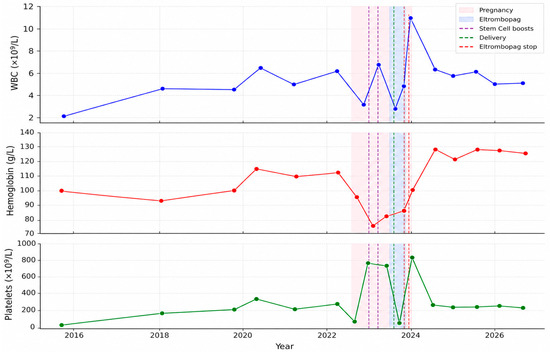
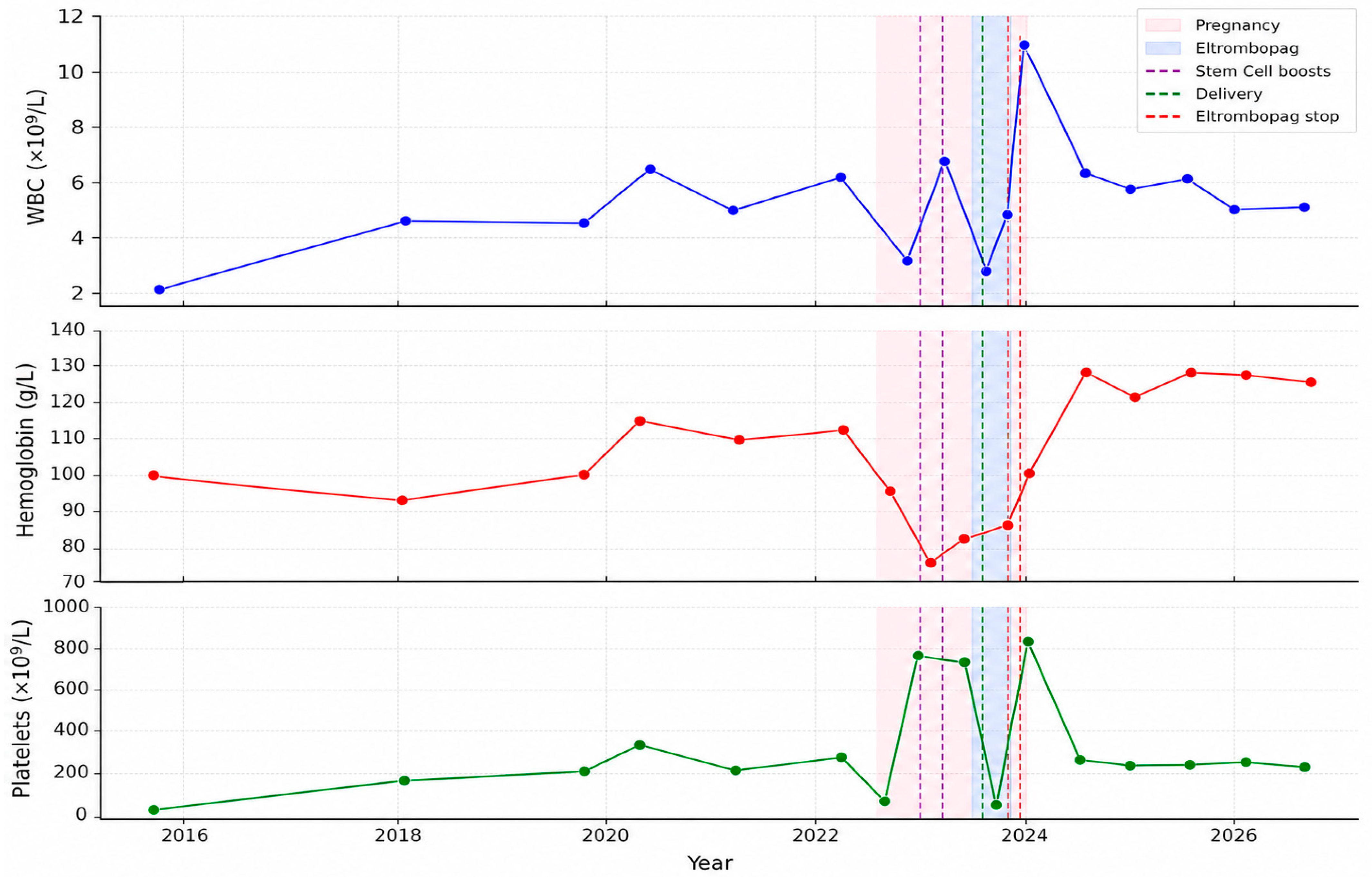
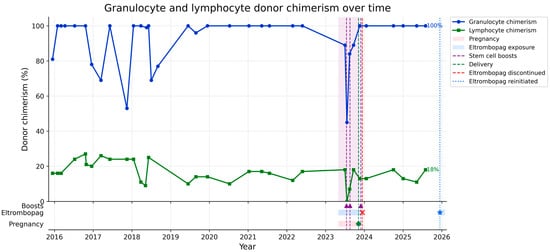
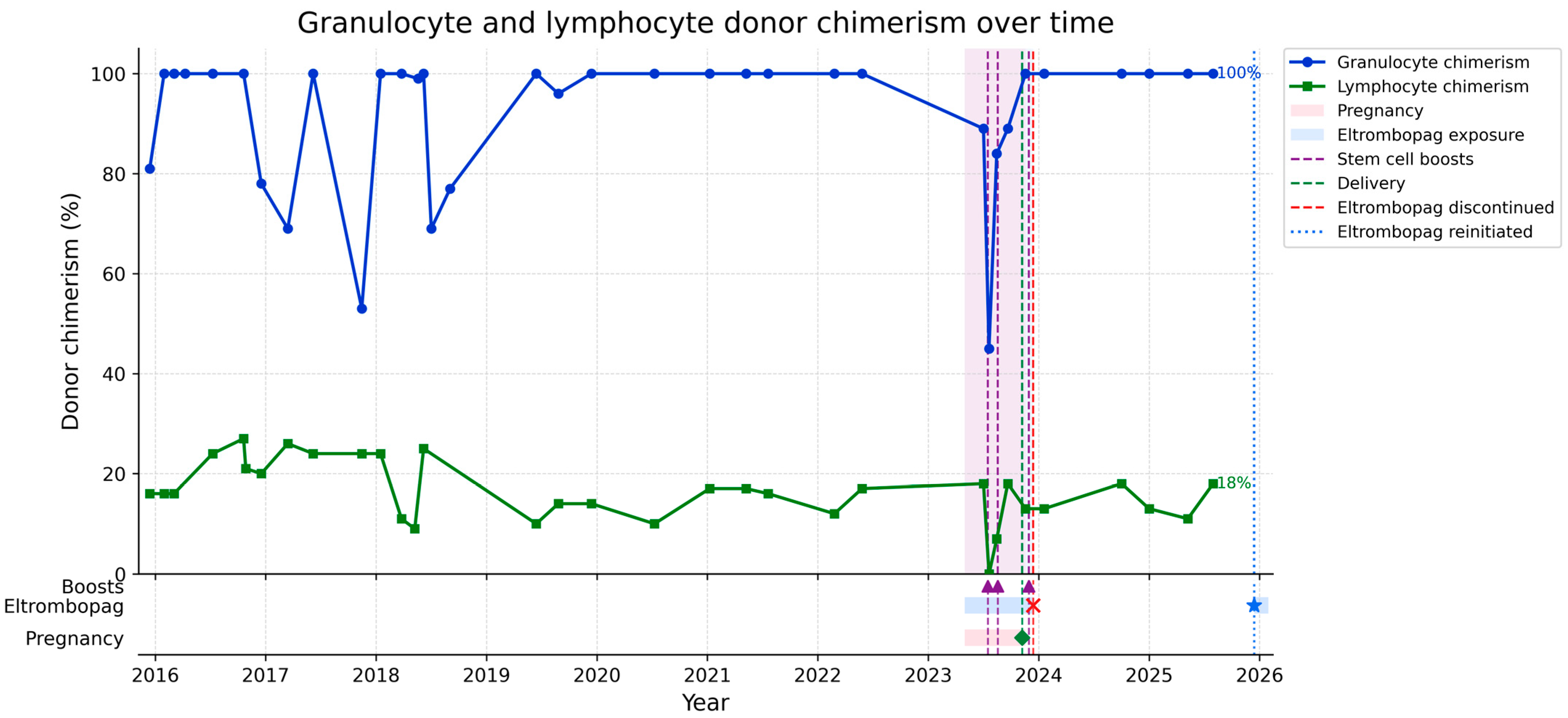
She delivered a healthy baby in November 2023, via Cesarean section due to obstetric indications. Her platelet count at the time of delivery was maintained above 50 × 109/L following platelet transfusions to minimize bleeding risk. After this, a third CD34+ boost was administered at the end of that month. The hematologic course and dynamic changes in chimerism during this period are illustrated in Figure 1 and Figure 2, respectively.
Figure 1.
Hematologic trends in a patient with severe aplastic anemia treated with eltrombopag during pregnancy.
Figure 2.
Granulocyte and lymphocyte chimerism over time with pregnancy, stem cell boosts, and EPAG discontinuation.
Her postpartum course was complicated by severe hemorrhage with hemoglobin dropping to 46 g/L, necessitating transfusions. Following the third boost, counts gradually recovered, and by December 2023 her chimerism improved. Eltrombopag was discontinued when her platelets overshot above 700 × 109/L, and iron chelation was stopped by June 2024 after ferritin normalized. She remained on cyclosporine with gradual dose tapering under close monitoring.
At follow-up in August 2025, aged 37 years, she was clinically well with stable blood counts, preserved myeloid chimerism (100%) and low-level lymphoid chimerism (18%), without graft-versus-host disease or infection, while continuing cyclosporine with gradual tapering. Prior disease control during pregnancy and earlier relapses had been achieved with a combination of therapies, including cyclosporine, G-CSF, and stem cell boosts, alongside eltrombopag. While eltrombopag likely contributed to hematologic stabilization, the multifactorial nature of her treatment makes it difficult to isolate its independent effect.
However, in December 2025, she relapsed with cytopenia and heavy menstrual bleeding requiring transfusion support, and bone marrow biopsy showed marked hypocellularity with reduced trilineage hematopoiesis. Given the prior success and subsequent discontinuation of eltrombopag, it was reinitiated alongside immunosuppression, including antithymocyte globulin, and additional stem cell support, leading to clinical stabilization. Importantly, the infant exposed to eltrombopag in utero has shown normal developmental milestones and no hematologic abnormalities at the two-year follow-up. This course highlights the relapsing nature of post-transplant severe aplastic anemia and the role of eltrombopag and combined therapeutic strategies in maintaining hematologic recovery.
The recurrent worsening of her hematologic parameters during both the 2017 and 2023 pregnancies strongly underscores the urgency to further study the management of SAA during gestation, as pregnancy itself appears to act as a significant stressor or trigger for disease exacerbation in susceptible individuals.
3. Discussion
Pregnancy-associated severe aplastic anemia (SAA) remains one of the most difficult scenarios in hematology, combining risks of maternal morbidity and mortality with significant obstetric challenges. Supportive transfusions, infection prophylaxis, and careful monitoring continue to form the backbone of therapy. However, standard curative options such as allogeneic hematopoietic stem cell transplantation and immunosuppressive therapy with antithymocyte globulin are generally avoided during pregnancy due to safety concerns. Thus, management decisions must balance maternal stabilization against fetal safety in a setting where robust evidence is lacking.
The role of thrombopoietin receptor agonists (TPO-RAs) has gained interest in this context. Originally approved for immune thrombocytopenia (ITP), eltrombopag and romiplostim have demonstrated multilineage responses in refractory SAA. Their off-label use in pregnancy has been cautiously reported, primarily in ITP. A systematic review by Howaidi et al. identified 10 case reports and one cohort study, with eltrombopag used at doses ranging from 12.5–75 mg/day and romiplostim at 2–10 µg/kg/week. No congenital malformations were reported, though cases of low birth weight, preterm delivery, neonatal thrombocytopenia, and rare thrombocytosis were observed, emphasizing the need for close monitoring [6].
In SAA specifically, published experiences remain extremely limited. Pajor et al. demonstrated that pregnancy during remission can be tolerated, though unpredictable relapses occur in up to one-third of cases, often resolving postpartum [7]. Similarly, Bo et al. showed that adverse outcomes were strongly associated with low hemoglobin and platelet counts, with preeclampsia, preterm birth, and hemorrhage as leading complications [8]. These data underscore the need for strategies that stabilize counts during gestation, where TPO-RAs could theoretically play a role.
It is important to note that SAA patients typically require higher doses of eltrombopag (up to 150 mg daily, as used in this case) compared to ITP patients. This dosing rationale is based on phase I/II studies demonstrating that 150 mg is required to reliably restore trilineage hematopoiesis in refractory SAA [9]. However, this higher dose theoretically increases the risk of fetal exposure and potential toxicity. In our case, the decision to maintain the 150 mg dose during pregnancy was made after carefully weighing the severe risk of maternal hemorrhage and mortality against the unknown fetal risks, accompanied by intensive maternal–fetal monitoring.
Our case aligns with other isolated reports describing TPO-RA use in SAA pregnancies (Table 1). Suminaga et al. reported a primigravida with refractory SAA who continued eltrombopag after stopping cyclosporine. Her course was stable, and she delivered a healthy infant at 38 weeks despite placental findings consistent with vascular malperfusion [10]. Similarly, Kawabata et al. described a woman with severe AA treated with eltrombopag and transfusions who later developed preeclampsia and fetal growth restriction, delivering a low-birth-weight infant, though causality with eltrombopag was uncertain [11]. Both cases, together with our patient, suggest that eltrombopag may be a feasible option in highly selected, refractory cases when used as part of a broader supportive strategy.
Table 1.
Reported Cases of Thrombopoietin Receptor Agonist (TPO-RA) Use in Pregnancy with Severe Aplastic Anemia.
Conversely, evidence from the retrospective cohort study by Bortolotti et al. highlights the uncertainty of eltrombopag’s role. Among women with acquired bone marrow failure syndromes, only one patient was on eltrombopag at conception, which was promptly discontinued in favor of cyclosporine. Despite this discontinuation, her disease remained stable, though she required increased transfusion support [12]. The authors emphasized that while eltrombopag is commonly used in ITP pregnancies at lower doses, the higher doses required in SAA may carry greater risks, reinforcing that routine use should be avoided unless no alternatives exist.
Rottenstreich and Bussel (2023) reviewed 45 ITP pregnancies treated with TPO-RAs, showing high response rates (87% with eltrombopag, 83% with romiplostim) and a favorable maternal safety profile [13]. However, neonatal thrombocytopenia, thrombocytosis, intracranial hemorrhage, and low birth weight were reported [13]. Similarly, Bussel et al. (2022) reported on 186 women with ITP exposed to romiplostim, with 92 evaluable birth outcomes: 65% were normal, 17% had complications, and 14% ended in miscarriage or stillbirth [5]. Neonatal adverse events included trisomy 8, single umbilical artery, inguinal hernia, and autism in one child, while neonatal thrombocytopenia occurred in 12 infants, all resolving before discharge. No maternal thrombotic events were observed. Collectively, these findings suggest no overt teratogenicity but highlight potential subtle hematologic and vascular effects, necessitating cautious dosing, close obstetric surveillance (including serial ultrasounds for fetal growth and middle cerebral artery Doppler to assess for fetal anemia), and extended neonatal follow-up.
Beyond pharmacologic therapy, obstetric complications are frequent in SAA pregnancies. Li et al. observed preterm labor, preeclampsia, hemorrhage, and sepsis as major contributors to morbidity [8]. Kawabata et al. specifically linked severe early anemia to the development of preeclampsia, possibly through hypoxia-driven angiogenic imbalance [11]. Our patient similarly developed postpartum hemorrhage despite hematologic stabilization, illustrating that even with TPO-RA support, obstetric vigilance remains critical.
Alternative management strategies remain relevant. Abdel-Azim et al. described a 17-year-old who developed SAA at 26 weeks with intrauterine fetal demise; she underwent successful sibling donor transplantation postpartum, remaining in remission at one year [14]. Smolinsky et al. reported multidisciplinary management of a woman with transfusion-refractory thrombocytopenia using large-volume platelet transfusion and uterine artery embolization, preventing maternal mortality [15]. These cases reinforce that proactive planning and individualized interventions are essential in high-risk pregnancies complicated by SAA.
The uncertainty surrounding a causal link between pregnancy and SAA further complicates decision-making. Oosterkamp et al. found that pregnancy rates in women with newly diagnosed SAA did not differ from the general population, suggesting coincidence rather than causality [16]. Nevertheless, relapses during pregnancy, as in our case and those reported by Pajor et al., highlight the potential for pregnancy-related immune changes to unmask or exacerbate marrow failure [7].
Taken together, the available literature suggests that while TPO-RAs are not first-line therapy for SAA in pregnancy, they and other supportive measures may represent a valuable adjunct in refractory cases where conventional approaches are not feasible. Their use should remain restricted to specialized centers with expertise in both hematology and maternal–fetal medicine, guided by multidisciplinary decision-making and supported by close maternal–fetal monitoring. Larger prospective studies and registry data are urgently needed to clarify the safety profile, optimize dosing, and define the long-term outcomes of children exposed in utero to these agents.
Author Contributions
Conceptualization was performed by M.F.M.S. and A.K.A.; methodology, data curation, and writing of the original draft were conducted by M.F.M.S.; validation was carried out by M.F.M.S., A.K.A. and M.A.; resources were provided by M.A.; writing—review and editing were undertaken by M.F.M.S., A.K.A., A.N., A.H. and M.A.; supervision was provided by M.A.; and project administration was managed by M.F.M.S. All authors contributed to the conception and design of the work, data interpretation, drafting and critical revision of the manuscript, and approved the final version for publication. All authors have read and agreed to the published version of the manuscript.
Funding
This research received no external funding.
Institutional Review Board Statement
This case report was derived from the approved project titled “Establishing a Database of Patients Undergoing Hematopoietic Stem Cell Transplantation at KFSH&RC as Part of the Centre for International Blood and Marrow Transplant Research, European Society for Blood and Marrow Transplantation and Eastern Mediterranean.” The project was approved by the Research Ethics Committee, King Faisal Specialist Hospital & Research Centre, Riyadh, Saudi Arabia (Study Number: 2141054; approval date: 25 June 2025). The study was conducted in accordance with the Declaration of Helsinki.
Informed Consent Statement
Informed consent was obtained from the patient involved in the study. Written informed consent has been obtained from the patient to publish this paper.
Data Availability Statement
No new data were created or analyzed in this study.
Conflicts of Interest
The authors declare no conflicts of interest.
Abbreviations
The following abbreviations are used in this manuscript:
| SAA | Severe aplastic anemia |
| AA | Aplastic anemia |
| HSCT | Hematopoietic stem cell transplantation |
| IST | Immunosuppressive therapy |
| ATG | Antithymocyte globulin |
| TPO-RAs | Thrombopoietin receptor agonists |
| EPAG | Eltrombopag |
| G-CSF | Granulocyte colony-stimulating factor |
| ITP | Immune thrombocytopenia |
| BMB | Bone marrow biopsy |
| GVHD | Graft-versus-host disease |
References
- Perolla, A.; Cela, B.; Semanaj, V.; Dedej-Kurti, T.; Caja, T. Aplastic Anaemia in Pregnancy: A Case-Based Comprehensive Review of the Literature. Cureus 2024, 16, e58365. [Google Scholar] [CrossRef] [Scilit] [PubMed]
- Peffault de Latour, R.; Kulasekararaj, A.; Iacobelli, S.; Terwel, S.R.; Cook, R.; Griffin, M.; Halkes, C.J.M.; Recher, C.; Barraco, F.; Forcade, E.; et al. Eltrombopag Added to Immunosuppression in Severe Aplastic Anemia. N. Engl. J. Med. 2022, 386, 11–23. [Google Scholar] [CrossRef] [Scilit] [PubMed]
- Lin, X.; Yang, C.; Liu, Z.; Zhuang, J.; Chen, M.; Han, B. Effective treatment of refractory aplastic anemia with romiplostim after failure of multiple thrombopoietin receptor agonists: A single-center retrospective study. Ann. Med. 2025, 57, 2514791. [Google Scholar] [CrossRef] [Scilit] [PubMed]
- Agarwal, N.; Mangla, A. Thrombopoietin receptor agonist for treatment of immune thrombocytopenia in pregnancy: A narrative review. Ther. Adv. Hematol. 2021, 12, 20406207211001139. [Google Scholar] [CrossRef] [Scilit] [PubMed]
- Bussel, J.B.; Cooper, N.; Lawrence, T.; Michel, M.; Vander Haar, E.; Wang, K.; Wang, H.; Saad, H. Romiplostim use in pregnant women with immune thrombocytopenia. Am. J. Hematol. 2023, 98, 31–40. [Google Scholar] [CrossRef] [Scilit] [PubMed]
- Howaidi, J.; AlRajhi, A.M.; Howaidi, A.; AlNajjar, F.H.; Tailor, I.K. Use of thrombopoietin receptor agonists in pregnancy: A review of the literature. Hematol./Oncol. Stem Cell Ther. 2021, 15, 1–16. [Google Scholar] [CrossRef] [Scilit] [PubMed]
- Pajor, A.; Kelemen, E.; Szakács, Z.; Lehoczky, D. Pregnancy in idiopathic aplastic anemia (report of 10 patients). Eur. J. Obstet. Gynecol. Reprod. Biol. 1992, 45, 19–25. [Google Scholar] [CrossRef] [Scilit] [PubMed]
- Li, B.; Liang, M.-Y.; Zhang, Y.; Wang, S.-M.; Zhang, X.-H. Aplastic anemia associated with pregnancy: Maternal and fetal complications. J. Matern.-Fetal Neonatal Med. 2016, 29, 1120–1124. [Google Scholar] [CrossRef] [Scilit]
- Desmond, R.; Townsley, D.M.; Dumitriu, B.; Olnes, M.J.; Scheinberg, P.; Bevans, M.; Parikh, A.R.; Broder, K.; Calvo, K.R.; Wu, C.O.; et al. Eltrombopag restores trilineage hematopoiesis in refractory severe aplastic anemia that can be sustained on discontinuation of drug. Blood 2014, 123, 1818–1825. [Google Scholar] [CrossRef] [Scilit] [PubMed]
- Suminaga, Y.; Chigusa, Y.; Kondo, T.; Okamoto, H.; Kawamura, Y.; Taki, M.; Mandai, M.; Mogami, H. Aplastic Anemia Treated with Eltrombopag during Pregnancy. Case Rep. Obstet. Gynecol. 2022, 2022, 5889427. [Google Scholar] [CrossRef] [Scilit] [PubMed]
- Kawabata, I.; Yokote, R.; Kasano, S.; Ogawa, J.; Kato, M.; Ichikawa, T.; Yonezawa, M.; Kuwabara, Y.; Yamaguchi, H.; Suzuki, S. Preeclampsia in a pregnant woman with severe aplastic anemia: A case report. Clin. Case Rep. 2022, 10, e6789. [Google Scholar] [CrossRef] [Scilit] [PubMed]
- Bortolotti, M.; Trikha, R.; Salter, S.; Large, J.; Vlachodimitropoulou, E.; Gandhi, S.; Barcellini, W.; Johns, J.; Fattizzo, B.; Kulasekararaj, A. Pregnancy in acquired bone marrow failure syndromes: Antenatal management and maternal and fetal outcomes. Am. J. Hematol. 2024, 99, 1647–1650. [Google Scholar] [CrossRef] [Scilit] [PubMed]
- Rottenstreich, A.; Bussel, J.B. Treatment of immune thrombocytopenia during pregnancy with thrombopoietin receptor agonists. Br. J. Haematol. 2023, 203, 872–885. [Google Scholar] [CrossRef] [Scilit] [PubMed]
- Abdel-Azim, H.; Jovi-Usude, B.; Balian, C.; Shah, A.J.; Tang, S.; Sinha, A.; Kapoor, N.; Mahadeo, K.M. Successful bone marrow transplantation of an adolescent young adult female with pregnancy-associated aplastic anemia. J. Pediatr. Hematol./Oncol. 2015, 37, 319–321. [Google Scholar] [CrossRef] [Scilit] [PubMed]
- Smolinsky, A.; Carson, M.P.; Guzman, E.R.; Ranzini, A.; Toscano, J.; Bukhari, A. Aplastic anaemia in pregnancy with severe thrombocytopenia refractory to platelet transfusion: A case and management plan. Obstet. Med. 2009, 2, 26–29. [Google Scholar] [CrossRef] [Scilit] [PubMed]
- Oosterkamp, H.M.; Brand, A.; Kluin-Nelemans, J.C.; Vandenbroucke, J.P. Pregnancy and severe aplastic anaemia: Causal relation or coincidence? Br. J. Haematol. 1998, 103, 315–316. [Google Scholar] [CrossRef] [Scilit] [PubMed]

Disclaimer/Publisher’s Note: The statements, opinions and data contained in all publications are solely those of the individual author(s) and contributor(s) and not of MDPI and/or the editor(s). MDPI and/or the editor(s) disclaim responsibility for any injury to people or property resulting from any ideas, methods, instructions or products referred to in the content. |
© 2026 by the authors. Licensee MDPI, Basel, Switzerland. This article is an open access article distributed under the terms and conditions of the Creative Commons Attribution (CC BY) license.