


Abstract
Background: This study aimed to estimate the prevalence and associated demographic factors of autism spectrum disorder (ASD) in children aged 3 to 6 years in Bahrain, as well as to identify co-occurring developmental disorders. Methodology: The study sample comprised 500 children who attended eight health centers across four governorates (Group A) in Bahrain. A second group (Group B) consisted of all children who completed their diagnosis at the Child and Adolescent Psychiatric Unit for ASD from June 2023 to May 2024 to identify associated developmental disorders (n = 232). Group A mothers were interviewed using the M-CHAT-R. For Group B, we used children’s files, the General Intelligence Scale (Stanford-Binet), the M-CHAT-R, the CARS, Conners’ Form, and the Zarit Burden Interview to assess family burden. Additionally, a file review was conducted to determine the presence of intellectual disability (ID) in Group B cases. The Conner-3 Short Forms Test was administered to all cases aged 6 years or older (n = 64), and family burden was assessed using the Zarit Burden Interview Scale for reachable cases (n = 176). Results: Group A findings indicated an overall screen-based/at risk prevalence of ASD of 2.6%, with a higher prevalence in males (1.6%) compared to females (1%). In Group B, there was a78% prevalence of ID and a 17.2% prevalence of attention-deficit/hyperactivity disorder (ADHD). The study also found that the impact of having a child with ASD on the family varied based on the nature and severity of the disorder or disability, with moderate to severe burden reported at approximately 38%. Conclusions: The prevalence of ASD among young children was notably high, particularly among males. The most common comorbidities were ID followed by ADHD. The family burden associated with ASD was significant, with more than one third reporting moderate to severe burden. These data are essential for informing health education and social service planning.
1. Background
Autism spectrum disorder (ASD) is a neurodevelopmental condition characterized by enduring deficits in social communication and interaction, alongside restricted and repetitive patterns of behavior, interests, or activities [1]. ASD can significantly impact an individual’s daily functioning, educational performance, and overall quality of life [2,3]. Additionally, individuals with ASD often experience a high prevalence of comorbidities, including attention-deficit/hyperactivity disorder (ADHD), anxiety disorders, depressive disorders, and sleep-related disorders, which further affect their daily functioning and quality of life [4,5].
The prevalence of ASD varies considerably across different regions of the world, influenced by factors such as sampling methods and diagnostic practices [6]. A recent meta-analysis conducted in 2023 estimated the global prevalence of ASD at 0.72% [7]. Specifically, prevalence rates in North America, Europe, and Asia were reported as 1.01%, 0.73%, and 0.41%, respectively [7]. These findings align with a systematic review and meta-analysis from the previous year, which indicated a global prevalence of 0.60%, with subgroup analyses revealing rates of 0.40%, 1.00%, 0.50%, 1.00%, and 1.70% for Asia, America, Europe, Africa, and Australia, respectively [6]. To strengthen the contextualization of ASD prevalence, we consulted the most recent reports from the Centers for Disease Control and Prevention (CDC) Autism and Developmental Disabilities Monitoring (ADDM) Network, which estimated ASD prevalence among 8-year-old children in the United States at approximately 1 in 31 (3.2%) in 2022, with wide site-specific variability reflecting differences in identification practices and service access [8].
In the Gulf Cooperation Council (GCC) countries, the prevalence of ASD is generally lower than in developed countries, primarily due to methodological issues [9]. For instance, the prevalence in Iran is reported at 0.10% [10], while Oman and the United Arab Emirates have prevalence rates of 0.20% and 0.29%, respectively [11,12]. However, Qatar exhibits a significantly higher prevalence (1.14%) compared to its neighbors, potentially attributable to the point prevalence methodology [13]. While comprehensive efforts to ascertain the prevalence of ASD in Saudi Arabia are lacking, a recent study estimated that the prevalence among children in Jeddah and Makkah is approximately 0.28% [14].
Regarding comorbid conditions, a recent study utilizing the SPARK database—comprising data from families with a child or more diagnosed with ASD across 21 clinical sites in the United States—found that the most common comorbidity was ADHD (35.3%) [15], followed by learning disabilities (23.5%) and intellectual disabilities (21.7%). Other prevalent comorbidities included motor delays, anxiety disorders, and sleep disorders [15].
Despite the growing global awareness of ASD, national prevalence data for Bahrain remain limited and outdated. To the authors’ knowledge, no prior study has quantified the national prevalence of ASD among children aged 3–6 years or comprehensively assessed associated psychiatric comorbidities and family burden. Two previous Bahraini studies are notable: the first, conducted in 2013, examined all government-registered diagnosed cases of ASD, yielding a prevalence of 0.04% [16]; the second assessed ASD among 2-year-old children in primary care periodic health assessments, reporting a prevalence of 1.2% [17]. However, these studies were constrained by reliance on administrative records, narrow age groups, or targeted screening without broad community-based assessment across preschool ages or detailed comorbidity evaluation. The present study addresses these gaps by estimating ASD risk in a community sample of 3–6-year-old children and characterizing psychiatric comorbidities and caregiver burden in clinically diagnosed cases, providing essential evidence to inform national health and rehabilitation planning in Bahrain [17].
Given that this study focuses on estimating the prevalence of ASD risk in young children and characterizing associated comorbidities, early diagnosis remains paramount. Timely identification of ASD during the preschool years enables prompt access to evidence-based interventions, which have been shown to significantly improve developmental outcomes, social communication skills, adaptive functioning, and long-term quality of life, while reducing the severity of associated challenges such as intellectual disability and behavioral comorbidities [18].
While the primary objectives of this study were to estimate the prevalence of ASD risk in young Bahraini children and characterize associated psychiatric comorbidities such as intellectual disability and ADHD, assessing caregiving burden is essential to capture the broader family impact. Caregivers of children with ASD frequently experience elevated emotional, physical, social, financial, and psychological strain, often intensified by comorbidities that increase caregiving demands and complexity [19,20]. This burden can lead to reduced parental mental health, quality of life, and family functioning, with studies showing higher levels in families of children with ASD compared to other neurodevelopmental conditions, particularly when intellectual disability or ADHD co-occur [19,21]. Understanding caregiver burden provides critical insights for developing family-centered interventions, psychosocial support programs, and policy recommendations that address not only child outcomes but also parental well-being and long-term sustainability of care.
2. Materials and Methods
The study employed a cross-sectional study design, with the sample divided into two distinct groups. Group A composed of Bahraini children aged 3–6 years who underwent screening for ASD using the Modified Checklist for Autism in Toddlers—Revised Arabic Version (M-CHAT-R) [22] from July 2024 to August 2024 (n = 500). A convenience sample with a balanced gender distribution was recruited from eight primary health care centers (PHCs), two from each governorate. Group B included all children diagnosed with ASD at the Child and Adolescent Psychiatric Unit (CAPU), Psychiatric Hospital, and Government Hospitals (n = 232) over a one-calendar-year period, from May 2023 to June 2024.
Sample size calculation for Group A was conducted using a prevalence rate of 1.5%, a z-score of 1.96, and a precision of 1%, resulting in a sample size of n = 438.
For Group B, no sample size calculation was performed as all diagnosed cases of ASD during the specified year were included.
2.1. Group A Procedures
All Bahraini children (3–6 years) who attended during the study period (July–August 2024) were eligible and were consecutively referred to a member of the research team by clinic staff. A convenience sampling approach was employed due to logistical constraints in primary care settings, aiming to achieve a balanced gender distribution and geographic representation across the four governorates.
The data collection sheet included baseline characteristics of the children, such as sex and age, as well as the educational level and employment status of fathers, recognizing that fathers are typically the primary financial supporters of families.
The Arabic version of the Modified Checklist for ASD (M-CHAT-R) was distributed to the parents of participating children, primarily mothers [22]. The Arabic version of the M-CHAT was developed to support early identification of ASD in Arab countries. It demonstrated good psychometric properties, with high sensitivity (0.86), specificity (0.80), and Positive Predictive Value (PPV) (0.88), comparable to the original M-CHAT, supporting its reliability and validity as a screening tool [22].
Children who scored positive (a score of 3 or above) on the M-CHAT-R underwent a comprehensive diagnostic evaluation based on the Diagnostic and Statistical Manual of Mental Disorders, Fifth Edition, Text Revision (DSM-5-TR) [23].
The M-CHAT-R was chosen as a brief, parent-report screening tool for early detection of ASD risk in toddlers and preschoolers. The Arabic version shows good sensitivity and specificity in Arab populations [22]. Its ease of use in routine well-child visits, low cost, and international endorsement for primary care screening make it suitable for estimating ASD risk prevalence in this Bahraini cohort.
2.2. Group B Procedures
All children in Group B who attended CAPU and received an ASD diagnosis through the M-CHAT-R and DSM-5-TR (n = 232) were also assessed using the Childhood Autism Rating Scale (CARS), the Autism Diagnostic Observation Schedule (ADOS-2), and the Autism Diagnostic Interview Revised (ADI-R). To evaluate comorbid conditions, clinical notes were reviewed for the presence of intellectual disability (ID), assessed using the Stanford-Binet General Intelligence Test. The Conners Brief Test was utilized to assess the presence of ADHD in children aged 6 years and older (n = 64). Mothers in Group B were interviewed by an experienced psychologist via telephone. The burden of raising a child with ASD was evaluated using the Zarit Burden Interview Scale. A total of 176 cases were contacted for interviews. Outcome measures included mean age, sex, father’s education, father’s employment, presence of ASD risk factors, presence of ID, presence of ADHD, and family burden.
2.2.1. Selection Criteria for Group B
Inclusion Criteria
All Bahraini children aged 3–6 years who underwent the M-CHAT-R at the PHCs during the specified period were included in the study, along with a group of children diagnosed with ASD from the CAPU.
Exclusion Criteria
Patients with incomplete assessments.
Group B was specifically included to enhance the community screening data from Group A by providing a detailed characterization of psychiatric comorbidities and the impact on families of children already diagnosed with ASD. This clinical sample (n = 232), consisting of all Bahraini children diagnosed with ASD at the CAPU over a one-year period (May 2023 to June 2024), facilitated an in-depth assessment of co-occurring conditions such as ID and ADHD, as well as the burden experienced by caregivers, utilizing validated tools.
2.3. Instruments
The following instruments were utilized for data collection in this study.
A data collection tool that included patients’ baseline characteristics, such as sex, age, nationality, and information about their fathers. The M-CHAT-R was distributed to the parents of participating children.
Children who screened positive on the M-CHAT-R were referred for a comprehensive diagnostic evaluation utilizing the DSM-5-TR [24], CARS [25], ADOS-2 [26], and ADI-R [27].
The M-CHAT-R, a validated 20-item parent-report screening questionnaire demonstrating high sensitivity and specificity in Arab populations, was administered to parents to identify children at increased risk for ASD (positive screening ≥3). Positive M-CHAT-R screens prompted comprehensive diagnostic evaluations in accordance with DSM-5-TR criteria. These evaluations included the CARS—a 15-item clinician-rated behavioral observation scale assessing autism severity—the ADOS-2—a semi-structured, standardized observation tool evaluating social communication, interaction, and repetitive behaviors—and the ADI-R—a detailed caregiver interview covering developmental history and ASD symptoms.
For comorbidity assessment, the Stanford-Binet General Intelligence Test [28] was employed to evaluate ID. The Conners Brief Test [29] was used to assess the presence of ADHD.
The Stanford-Binet Intelligence Scales were utilized to evaluate intellectual functioning and identify ID. Conner-3 Short Forms Test —a concise parent/teacher questionnaire assessing ADHD symptoms, with elevated scores indicating a likely diagnosis of ADHD—was administered to children aged 6 years and older.
The burden of raising a child with ASD was measured using the Zarit Burden Interview (ZBI) scale [30]. ZBI is a 22-item self-report measure evaluating the subjective emotional, physical, social, and financial strain experienced by families raising a child with ASD.
2.4. Ethical Considerations
The study was conducted in accordance with the ethical principles outlined in the Declaration of Helsinki. Ethical approval was obtained from the Primary Care Health Research Committee for the community screening component (Approval ID: 18072024, dated 18 July 2024) and from the Government Hospitals Research Committee for the diagnostic review component (Approval ID: 67-060624, dated 6 June 2024). Written informed consent was secured from the parents or legal guardians of all participating children prior to data collection or medical file review. Participation was entirely voluntary, and participants were clearly informed of their right to withdraw at any time without any penalty or impact on the care provided to their child.
2.5. Data Analysis
Data were analyzed separately for Group A (community screening sample, n = 500) and Group B (children who received an ASD diagnosis at the CAPU, n = 232) using descriptive statistical methods. Prevalence estimates in Group A were calculated as the proportion of children identified as high risk for ASD based on the M-CHAT-R screening results, reported overall and stratified by gender. In Group B, prevalence rates of comorbidities were determined through file reviews and standardized assessments. All findings were reported in accordance with the study objectives to provide insights into prevalence, comorbidity patterns, and family impact in the Bahraini context. Differences between age categories and sexes were analyzed using chi-square or Fisher’s exact tests. All tests were two-tailed, with significance set at p < 0.05, utilizing SPSS version 26.0.
3. Results
Among the 500 children assessed, 13 scored 3 or above on the M-CHAT-R, indicating that 2.6% were identified as being at an increased risk for ASD. The cohort consisted of 8 males and 5 females, resulting in a male to female ratio of 1.6:1.
Group A: The distribution of children across each governorate was equal, with 125 children in each. The age distributions were as follows: 3 years (153), 4 years (129), 5 years (104), and 6 years (114), with a statistically significant difference (p = 0.01). The most frequently reported fathers’ educational backgrounds were secondary-level education (50.8% n = 254) followed by university-level education (undergraduate or postgraduate, 33.6%, n = 168). On the other hand, the employment status of the fathers showed that 86.4% were employed, 9% retired, while 4% were unemployed (Table 1).
Table 1.
Group A participants by father’s education and employment.
Group B: Data on ID was available for 232 participants. Assessment of burden on families using ZBI could only be performed on 176 children due to the inability to contact 56 families (24%). The Conner-3 Short Forms Test, used to screen for ADHD, was only administered on children who reached 6 years of age (n = 64).
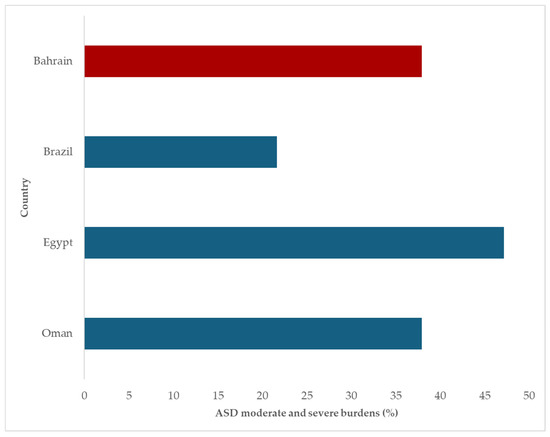
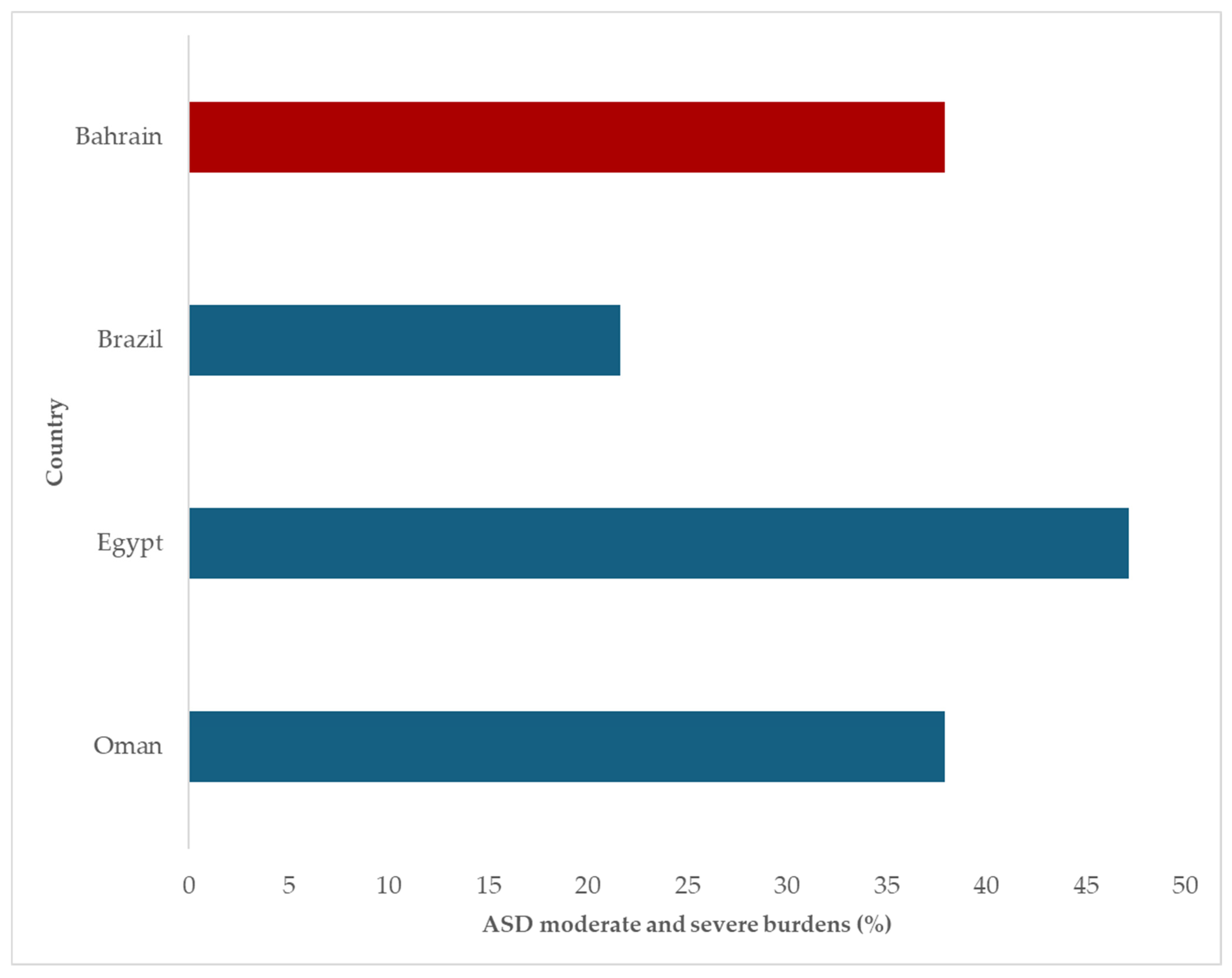
The findings of this report indicated that 181 (78.0%) children with ASD also possessed an ID. Among the 64 children assessed with the Conner-3 Short Forms Test, 11 (17.2%) scored positively (≥15 out of 30), as detailed in Table 2. The burden on families of children with ASD, indicated moderate to severe burden levels in 38% of cases, while 37 participants (21%) reported no burden. Figure 1 illustrates the moderate and severe burden levels in Bahrain compared with those in selected countries (mild burden levels are not shown). Further analysis revealed that the burden was greater in ASD patients with comorbid ID and ADHD than in those with ASD alone.
Table 2.
Group B participants by comorbidity.
Figure 1.
ASD moderate and severe burdens in Bahrain and among selected countries. Note: Approximate/proxy burden data for other countries were extracted from the following sources: Brazil [31]; Egypt [32]; Oman [33].
4. Discussion
The prevalence of risk for ASD among children aged 3 to 6 years was notably high and aligned with rates reported by the CDC and other high- or middle- income countries [13,34,35]. In contrast, the risk was found to be higher in low- income countries or developing countries [10,36]. It is important to note that the study’s response rate was nearly 100%, with only one family declining to participate. The number of children examined varied by age across PHCs (p = 0.01). The proportion of educated and employed fathers in the sample was high, reflecting a higher compliance rate among this demographic for periodic routine health development examinations. The male-to-female (M/F) ratio observed was not consistent with that reported in the literature [1,37]. This discrepancy may be attributed to the small number of positive cases scoring 3 or higher on the M-CHAT-R [16]; thus, adding a single case from one gender could significantly impact the ratio. Additionally, it is essential to clarify that the authors are discussing the risk of ASD rather than the final comprehensive diagnostic assessment, which may yield different results.
The prevalence of ID among children in the CAPUs was reported at 78%. This prevalence was considerably higher than that observed in other studies (31.4%) [37]. The elevated rates of ID as a comorbidity may be explained by the inherent challenges associated with assessing individuals with both ASD and ID in terms of behavioral evaluation.
The prevalence of ADHD was found to be 17.2%, significantly higher than the rate of 5% reported in children of the same age [38]. While the comorbidity rate of ADHD was lower than the approximately 39% reported in a US study [39], it remained comparable to findings of other studies elsewhere in the world [40,41].
The study employed strategies to reduce sampling errors within practical constraints. Group A’s sample size exceeded the calculated requirement for 1% precision at 95% confidence around a 1.5% prevalence estimate. Recruitment from two centers per governorate ensured geographic coverage, and consecutive referral of routine attendees with active gender balancing aimed to limit selection bias, though convenience sampling was used due to primary care logistics. Group B encompassed all diagnosed cases over one year, avoiding sampling error in the clinical cohort.
The prevalence of ID and ADHD among individuals with ASD has critical implications for two primary reasons. First, the rehabilitation needs of these individuals should be considered differently when they are referred to specialized centers. Second, addressing these comorbidities prior to referral is essential. The presence of comorbidities should be clearly documented in the final diagnostic report intended for rehabilitation kindergartens or centers [15].
The burden of raising a child with ASD on families was reported at 79%, with only 21% of families indicating no burden. The burden experienced by families with moderate-to-severe challenges was 38%. This burden was less than Egypt [32], comparable to those reported in Oman [33], yet greater than those reported in Brazil [31]. Unsurprisingly, the burden was exacerbated among patients with comorbid ID and ADHD [38]. These cases warrant immediate attention from the treatment team to provide counseling aimed at alleviating the level of burden experienced by families [16,38].
This study offers valuable data for professionals in higher-level planning service departments (health, education, social development, and legal affairs) to monitor the status of existing services and to inform future development plans. Enhanced collaboration between primary and secondary health care providers is crucial for effective feedback exchange, facilitating accurate diagnoses and addressing study-related issues. Furthermore, determining the specificity of screening and diagnostic tools, as well as studying the risk factors associated with ASD, is essential for monitoring the disorder’s prevalence at the national level over time.
Limitations: This study has several limitations. Group A utilized convenience sampling from PHCs, which may introduce bias toward families with higher paternal education and employment who are keen to attend routine visits. The M-CHAT-R, while validated in Arab populations, is a screening tool with variable performance (pooled sensitivity of 0.83 and specificity of 0.94 according to a recent meta-analysis [42]. It is susceptible to false positives in low-likelihood community settings, particularly in the absence of systematic follow-up interviews. The reported 2.6% reflects high-risk status rather than confirmed ASD diagnoses, as not all screen-positive children underwent a comprehensive diagnostic evaluation. Group B, comprising an exhaustive one-year clinical cohort from a specialized psychiatric unit, may over-represent severe cases or those with high comorbidity of intellectual disabilities (78%), thus limiting generalizability to community or milder presentations. The ADHD assessment was restricted to children aged ≥6 years (n = 64), thereby reducing statistical power for younger participants. Caregiver burden data (using Zarit scale) were collected from only 76% of reachable mothers via telephone, potentially introducing non-response and social desirability bias. The cross-sectional study design hinders causal inferences regarding comorbidities or the progression of burden, and additional risk factors or long-term outcomes were not examined. Future population-based, longitudinal studies with universal diagnostic follow-up are necessary to enhance these findings.
5. Conclusions
The rate of developing ASD among children aged 3 to 6 years attending community PHCs was 2.6%. This was notably higher in males, consistent with findings reported in numerous studies. A significant proportion of fathers (33.6%) had a university education, and many were employed. ID was highly prevalent at 78%, while the prevalence of ADHD was moderate at 17.2%. Compared with data from other countries, the burden of moderate and severe cases was comparable to that of Oman. The recently implemented periodic assessments of young children for ASD are advantageous in identifying future cases. These findings will enable stakeholders to utilize the data as indicators for establishing new rehabilitative services and for national planning concerning all facets of life for this increasingly prevalent population.
Author Contributions
Conceptualization, A.M.S.A.A., H.A.J., M.A.A. (Muna Ahmed Almohri), N.A.S., R.H., M.A.A. (Mahmoud A. Alfaqih), M.K.A. and R.R.H.; methodology, A.M.S.A.A., H.A.J., M.A.A. (Muna Ahmed Almohri), N.A.S., R.H., M.A.A. (Mahmoud A. Alfaqih), M.K.A. and R.R.H.; software, H.A.J.; validation, A.M.S.A.A., M.A.A. (Muna Ahmed Almohri), N.A.S. and R.H.; formal analysis, A.M.S.A.A., H.A.J. and R.R.H.; investigation, A.M.S.A.A., H.A.J., M.A.A. (Muna Ahmed Almohri), N.A.S., R.H., M.A.A. (Mahmoud A. Alfaqih), M.K.A. and R.R.H.; resources, H.A.J.; data curation, A.M.S.A.A., M.A.A. (Muna Ahmed Almohri), N.A.S., R.H., M.A.A. (Mahmoud A. Alfaqih) and M.K.A.; writing—original draft preparation, A.M.S.A.A., H.A.J., M.A.A. (Muna Ahmed Almohri), N.A.S., R.H., M.A.A. (Mahmoud A. Alfaqih), M.K.A. and R.R.H.; writing—review and editing, A.M.S.A.A., H.A.J., M.A.A. (Muna Ahmed Almohri), N.A.S., R.H., M.A.A. (Mahmoud A. Alfaqih), M.K.A. and R.R.H.; visualization, H.A.J. and R.R.H.; supervision, A.M.S.A.A.; project administration, A.M.S.A.A. All authors have read and agreed to the published version of the manuscript.
Funding
This research received no external fundings.
Institutional Review Board Statement
All procedures performed in this study were in accordance with the Declaration of Helsinki, and the Ethical approval was obtained from the Primary Care Health Research Committee (Approval Code: 18072024; Approval Date: 18 July 2024) for Group A, and from the Government Hospitals Research Committee (Approval Code: 67-060624; Approval Date: 6 June 2024) for Group B.
Informed Consent Statement
Written informed consent was obtained from the parents/legal caregivers of all the children.
Data Availability Statement
The data presented in this study are available on request from the corresponding author. The data are not publicly available due to ethical issues.
Conflicts of Interest
The authors declare that they have no conflicts of interest.
References
- Hirota, T.; King, B.H. Autism spectrum disorder: A review. JAMA 2023, 329, 157–168. [Google Scholar] [CrossRef] [Scilit] [PubMed]
- Torabi, S.Y.; Akbarfahimi, N.; Mirzaie, H. The Relationship Between Executive Function and Various Aspects of Life in Children with Autism Spectrum Disorder: A Scoping Review. Rev. J. Autism Dev. Disord. 2025, 1–24. [Google Scholar] [CrossRef] [Scilit]
- Katsiana, A.; Strimpakos, N.; Ioannis, V.; Kapreli, E.; Sofologi, M.; Bonti, E.; Stiliani, K.; Stalikas, A. Health-related quality of life in children with autism spectrum disorder and children with down syndrome. Mater. Socio-Medica 2020, 32, 93. [Google Scholar] [CrossRef] [Scilit]
- Petti, T.; Gupta, M.; Fradkin, Y.; Gupta, N. Management of sleep disorders in autism spectrum disorder with co-occurring attention-deficit hyperactivity disorder: Update for clinicians. BJPsych Open 2024, 10, e11. [Google Scholar] [CrossRef] [Scilit] [PubMed]
- Mutluer, T.; Aslan Genç, H.; Özcan Morey, A.; Yapici Eser, H.; Ertinmaz, B.; Can, M.; Munir, K. Population-based psychiatric comorbidity in children and adolescents with autism spectrum disorder: A meta-analysis. Front. Psychiatry 2022, 13, 856208. [Google Scholar] [CrossRef] [Scilit] [PubMed]
- Salari, N.; Rasoulpoor, S.; Rasoulpoor, S.; Shohaimi, S.; Jafarpour, S.; Abdoli, N.; Khaledi-Paveh, B.; Mohammadi, M. The global prevalence of autism spectrum disorder: A comprehensive systematic review and meta-analysis. Ital. J. Pediatr. 2022, 48, 112. [Google Scholar] [CrossRef] [Scilit]
- Talantseva, O.I.; Romanova, R.S.; Shurdova, E.M.; Dolgorukova, T.A.; Sologub, P.S.; Titova, O.S.; Kleeva, D.F.; Grigorenko, E.L. The global prevalence of autism spectrum disorder: A three-level meta-analysis. Front. Psychiatry 2023, 14, 1071181. [Google Scholar] [CrossRef] [Scilit]
- Shaw, K.A. Prevalence and early identification of autism spectrum disorder among children aged 4 and 8 years—Autism and Developmental Disabilities Monitoring Network, 16 Sites, United States, 2022. MMWR. Surveill. Summ. 2025, 74, 1–22. [Google Scholar] [CrossRef] [Scilit]
- Chiarotti, F.; Venerosi, A. Epidemiology of autism spectrum disorders: A review of worldwide prevalence estimates since 2014. Brain Sci. 2020, 10, 274. [Google Scholar] [CrossRef] [Scilit]
- Mohammadi, M.R.; Ahmadi, N.; Khaleghi, A.; Zarafshan, H.; Mostafavi, S.-A.; Kamali, K.; Rahgozar, M.; Ahmadi, A.; Hooshyari, Z.; Alavi, S.S. Prevalence of autism and its comorbidities and the relationship with maternal psychopathology: A national population-based study. Arch. Iran. Med. 2019, 22, 546–553. [Google Scholar]
- Al-Mamri, W.; Idris, A.B.; Dakak, S.; Al-Shekaili, M.; Al-Harthi, Z.; Alnaamani, A.M.; Alhinai, F.I.; Jalees, S.; Al Hatmi, M.; El-Naggari, M.A. Revisiting the prevalence of autism spectrum disorder among Omani children: A multicentre study. Sultan Qaboos Univ. Med. J. 2019, 19, e305. [Google Scholar] [CrossRef] [Scilit]
- Eapen, V.; Mabrouk, A.A.; Zoubeidi, T.; Yunis, F. Prevalence of pervasive developmental disorders in preschool children in the UAE. J. Trop. Pediatr. 2007, 53, 202–205. [Google Scholar] [CrossRef] [Scilit]
- Alshaban, F.; Aldosari, M.; Al-Shammari, H.; El-Hag, S.; Ghazal, I.; Tolefat, M.; Ali, M.; Kamal, M.; Abdel Aati, N.; Abeidah, M. Prevalence and correlates of autism spectrum disorder in Qatar: A national study. J. Child Psychol. Psychiatry 2019, 60, 1254–1268. [Google Scholar] [CrossRef] [Scilit] [PubMed]
- Sabbagh, H.J.; Al-Jabri, B.A.; Alsulami, M.A.; Hashem, L.A.; Aljubour, A.A.; Alamoudi, R.A. Prevalence and characteristics of autistic children attending autism centres in 2 major cities in Saudi Arabia: A cross-sectional study. Saudi Med. J. 2021, 42, 419. [Google Scholar] [CrossRef] [Scilit]
- Khachadourian, V.; Mahjani, B.; Sandin, S.; Kolevzon, A.; Buxbaum, J.D.; Reichenberg, A.; Janecka, M. Comorbidities in autism spectrum disorder and their etiologies. Transl. Psychiatry 2023, 13, 71. [Google Scholar] [CrossRef] [Scilit] [PubMed]
- Al-Ansari, A.; Ahmed, M. Epidemiology of autistic disorder in Bahrain: Prevalence and obstetric and familial characteristics. East. Mediterr. Health J. 2013, 19, 769–774. [Google Scholar] [CrossRef] [Scilit] [PubMed]
- Almohri, M.A.; Alawainati, M.A.; Ayoob, Z.A.; Nasser, N.A.; Abdulaal, N.A.; Aldailami, A.A.; Aldailami, D.A. Characteristics and outcomes of the screening program of autism spectrum disorder in Primary Healthcare Centers in Bahrain. J. Fam. Community Med. 2025, 32, 44–50. [Google Scholar] [CrossRef] [Scilit]
- Hyman, S.L.; Levy, S.E.; Myers, S.M. Executive Summary: Identification, Evaluation, and Management of Children With Autism Spectrum Disorder. Pediatrics 2020, 145, e20193448. [Google Scholar] [CrossRef] [Scilit]
- Cadman, T.; Eklund, H.; Howley, D.; Hayward, H.; Clarke, H.; Findon, J.; Xenitidis, K.; Murphy, D.; Asherson, P.; Glaser, K. Caregiver burden as people with autism spectrum disorder and attention-deficit/hyperactivity disorder transition into adolescence and adulthood in the United Kingdom. J. Am. Acad. Child Adolesc. Psychiatry 2012, 51, 879–888. [Google Scholar] [CrossRef] [Scilit]
- Dückert, S.; Gewohn, P.; König, H.; Schöttle, D.; Konnopka, A.; Rahlff, P.; Vogeley, K.; Schulz, H.; David, N.; Peth, J. Multidimensional Burden on Family Caregivers of Adults with Autism Spectrum Disorder: A Scoping Review. Rev. J. Autism Dev. Disord. 2025, 12, 723–740. [Google Scholar] [CrossRef] [Scilit]
- van Niekerk, K.; Stancheva, V.; Smith, C. Caregiver burden among caregivers of children with autism spectrum disorder. S. Afr. J. Psychiatry 2023, 29, 2079. [Google Scholar] [CrossRef] [Scilit]
- Seif Eldin, A.; Habib, D.; Noufal, A.; Farrag, S.; Bazaid, K.; Al-Sharbati, M.; Badr, H.; Moussa, S.; Essali, A.; Gaddour, N. Use of M-CHAT for a multinational screening of young children with autism in the Arab countries. Int. Rev. Psychiatry 2008, 20, 281–289. [Google Scholar] [CrossRef] [Scilit]
- First, M.B.; Yousif, L.H.; Clarke, D.E.; Wang, P.S.; Gogtay, N.; Appelbaum, P.S. DSM-5-TR: Overview of what’s new and what’s changed. World Psychiatry 2022, 21, 218. [Google Scholar] [CrossRef] [Scilit] [PubMed]
- American Psychiatric Association. Diagnostic and Statistical Manual of Mental Disorders: DSM-5-TR, 5th ed.; text revision; American Psychiatric Association Publishing: Washington, DC, USA, 2022. [Google Scholar]
- Schopler, E.; Reichler, R.J.; DeVellis, R.F.; Daly, K. Toward objective classification of childhood autism: Childhood Autism Rating Scale (CARS). J. Autism Dev. Disord. 1980, 10, 91–103. [Google Scholar] [CrossRef] [Scilit] [PubMed]
- Maddox, B.B.; Brodkin, E.S.; Calkins, M.E.; Shea, K.; Mullan, K.; Hostager, J.; Mandell, D.S.; Miller, J.S. The Accuracy of the ADOS-2 in Identifying Autism among Adults with Complex Psychiatric Conditions. J. Autism Dev. Disord. 2017, 47, 2703–2709. [Google Scholar] [CrossRef] [Scilit]
- Lord, C.; Rutter, M.; Le Couteur, A. Autism Diagnostic Interview—Revised: A revised version of a diagnostic interview for caregivers of individuals with possible pervasive developmental disorders. J. Autism Dev. Disord. 1994, 24, 659–685. [Google Scholar] [CrossRef] [Scilit]
- Roid, G.H.; Pomplun, M. The Stanford-Binet Intelligence Scales; The Guilford Press: New York, NY, USA, 2012. [Google Scholar]
- Izzo, V.A.; Donati, M.A.; Novello, F.; Maschietto, D.; Primi, C. The Conners 3-short forms: Evaluating the adequacy of brief versions to assess ADHD symptoms and related problems. Clin. Child Psychol. Psychiatry 2019, 24, 791–808. [Google Scholar] [CrossRef] [Scilit]
- Yiengprugsawan, V. Caregiver Burden Scale: Zarit interview. In Encyclopedia of Quality of Life and Well-Being Research; Michalos, A.C., Ed.; Springer: Dordrecht, The Netherlands, 2014; pp. 566–567. [Google Scholar]
- Cardoso, A.L.; Silva-Junior, G.O.; Bastos, L.F.; Cesar, A.L.M.; Serrano, L.G.; Dziedzic, A.; Picciani, B.L.S. Preliminary Assessment of the Quality of Life and Daily Burden of Caregivers of Persons with Special Needs: A Questionnaire-Based, Cross-Sectional Survey. Int. J. Environ. Res. Public Health 2023, 20, 12. [Google Scholar] [CrossRef] [Scilit]
- Omaima, E.; Magda, B.; Osama, A.S. Quality of Life and Subjective Burden on Family Caregiver of Children with Autism. Am. J. Nurs. Sci. 2017, 6, 33–39. [Google Scholar] [CrossRef] [Scilit]
- Al-Farsi, Y.; Al-Said, M.; Al-Khaduri, M.; Al-Sharbati, M.; Waly, M.; Al Shafaee, M.; Ouhtit, A.; AlAdawi, S. Challenges Facing Educators of Children with Autism in Oman from Educators’ Perspective: A Qualitative Study. In Proceedings of the 2013 International Meeting for Autism Research, San Sebastián, Spain, 2–4 May 2013. [Google Scholar]
- Metwally, A.M.; Salah El-Din, E.M.; Sami, S.M.; Abdelraouf, E.R.; Sallam, S.F.; Elsaeid, A.; El-Saied, M.M.; Ashaat, E.A.; Fathy, A.M.; El-Hariri, H.M. Mapping autism in Egypt: Population-based insights into prevalence, risk determinants, and severity among children aged 1–12 years. Mol. Autism 2025, 16, 32. [Google Scholar] [CrossRef] [Scilit]
- Maenner, M.J. Prevalence and characteristics of autism spectrum disorder among children aged 8 years—Autism and Developmental Disabilities Monitoring Network, 11 sites, United States, 2020. MMWR. Surveill. Summ. 2023, 72, 1–14. [Google Scholar] [CrossRef] [Scilit]
- Al-Farsi, Y.M.; Al-Sharbati, M.M.; Al-Farsi, O.A.; Al-Shafaee, M.S.; Brooks, D.R.; Waly, M.I. Brief report: Prevalence of autistic spectrum disorders in the Sultanate of Oman. J. Autism Dev. Disord. 2011, 41, 821–825. [Google Scholar] [CrossRef] [Scilit]
- Christensen, D.L.; Maenner, M.J.; Bilder, D.; Constantino, J.N.; Daniels, J.; Durkin, M.S.; Fitzgerald, R.T.; Kurzius-Spencer, M.; Pettygrove, S.D.; Robinson, C.; et al. Prevalence and Characteristics of Autism Spectrum Disorder Among Children Aged 4 Years—Early Autism and Developmental Disabilities Monitoring Network, Seven Sites, United States, 2010, 2012, and 2014. MMWR Surveill Summ 2019, 68, 1–19. [Google Scholar] [CrossRef] [Scilit] [PubMed]
- Al-Ansari, A.M.; Al-Medfa, M.K.; Al-Roomi, K.A.; Al-Sharbati, W.E.; Almarabheh, A.; Haji, E.; Almohri, M.A.; Sulaiman, N.A.; Jahrami, H. The National Prevalence of Attention Deficit Hyperactivity Disorder (ADHD) Symptoms and its Comorbidities Among Children in Bahrain. Bahrain Med. Bull. 2024, 46, 2425–2428. [Google Scholar]
- Fombonne, E.; Green Snyder, L.; Daniels, A.; Feliciano, P.; Chung, W. Psychiatric and Medical Profiles of Autistic Adults in the SPARK Cohort. J. Autism Dev. Disord. 2020, 50, 3679–3698. [Google Scholar] [CrossRef] [Scilit]
- Fucà, E.; Guerrera, S.; Valeri, G.; Casula, L.; Novello, R.L.; Menghini, D.; Vicari, S. Psychiatric comorbidities in children and adolescents with high-functioning autism spectrum disorder: A study on prevalence, distribution and clinical features in an Italian sample. J. Clin. Med. 2023, 12, 677. [Google Scholar] [CrossRef] [Scilit] [PubMed]
- Lugo-Marín, J.; Magán-Maganto, M.; Rivero-Santana, A.; Cuellar-Pompa, L.; Alviani, M.; Jenaro-Rio, C.; Díez, E.; Canal-Bedia, R. Prevalence of psychiatric disorders in adults with autism spectrum disorder: A systematic review and meta-analysis. Res. Autism Spectr. Disord. 2019, 59, 22–33. [Google Scholar] [CrossRef] [Scilit]
- Wieckowski, A.T.; Williams, L.N.; Rando, J.; Lyall, K.; Robins, D.L. Sensitivity and Specificity of the Modified Checklist for Autism in Toddlers (Original and Revised): A Systematic Review and Meta-analysis. JAMA Pediatr. 2023, 177, 373–383. [Google Scholar] [CrossRef] [Scilit] [PubMed]

Disclaimer/Publisher’s Note: The statements, opinions and data contained in all publications are solely those of the individual author(s) and contributor(s) and not of MDPI and/or the editor(s). MDPI and/or the editor(s) disclaim responsibility for any injury to people or property resulting from any ideas, methods, instructions or products referred to in the content. |
© 2026 by the authors. Licensee MDPI, Basel, Switzerland. This article is an open access article distributed under the terms and conditions of the Creative Commons Attribution (CC BY) license.