

Virtual Reality-Assisted Cognitive Behavioural Interventions for Alcohol Use Disorder: A Scoping Review of Therapeutic Mechanisms with Potential Implications for Anxiety, Depression, and Precision Digital Mental Health
 , ,
, ,  , ,
, ,  ,
,
Abstract
1. Introduction
2. Materials and Methods
2.1. Study Design
2.2. Eligibility Criteria
2.3. Information Sources and Search Strategy
2.4. Screening and Eligibility Assessment
2.5. Data Extraction
2.6. Data Synthesis
3. Results
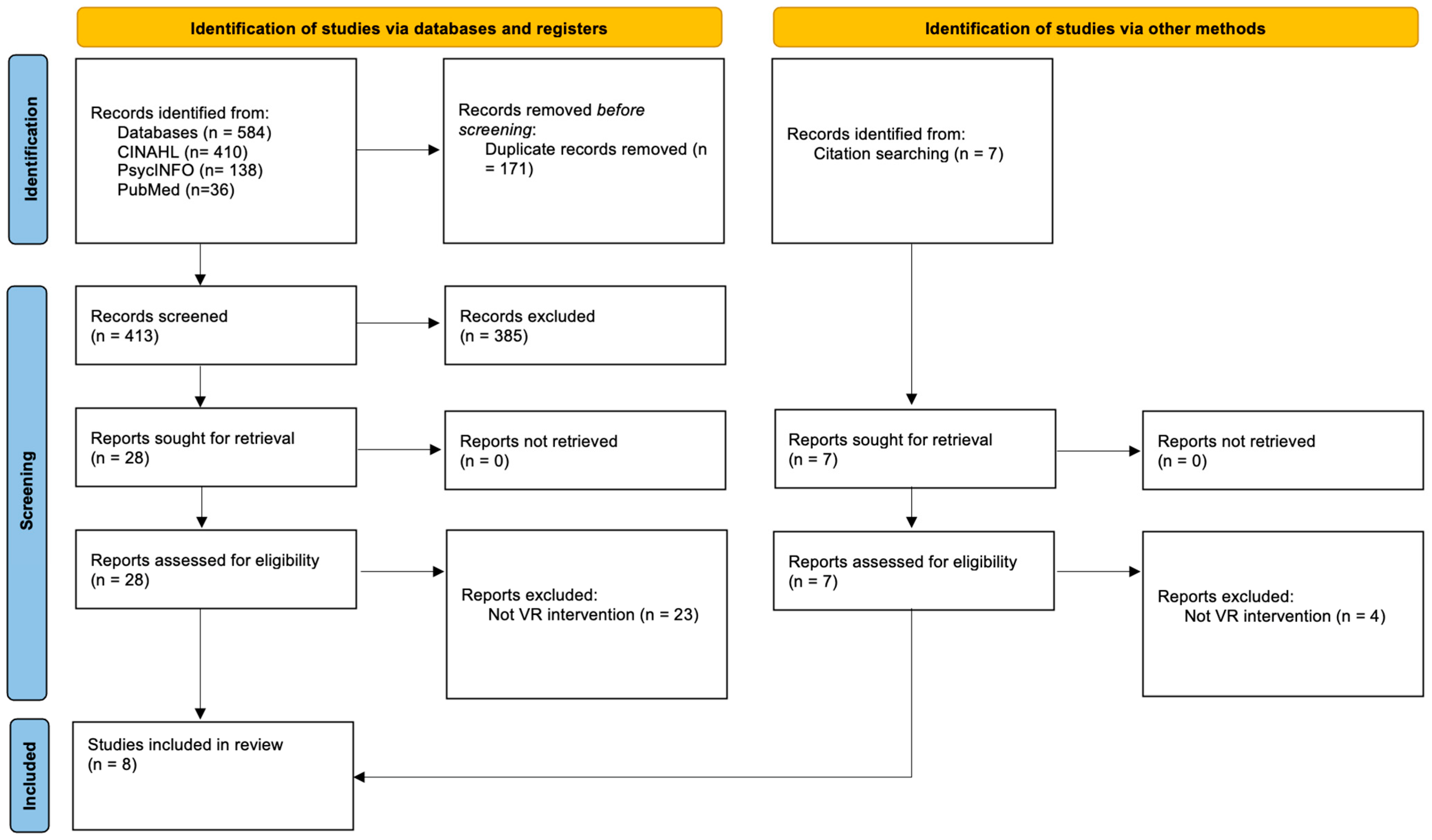
3.1. Results of the Study Selection Process
3.2. Characteristics of Included Studies
3.3. Study Design Classification
3.4. Targeted Therapeutic Mechanisms
3.5. Patterns of VR Use Within CBT Frameworks
3.6. Heterogeneity of Interventions and Outcomes
3.7. Summary of Main Findings
4. Discussion
5. Future Directions
6. Conclusions
Supplementary Materials
Author Contributions
Funding
Institutional Review Board Statement
Informed Consent Statement
Data Availability Statement
Conflicts of Interest
Abbreviations
| AUD | Alcohol Use Disorder |
| CBT | Cognitive Behavioural Therapy |
| VR | Virtual Reality |
| VR-CBT | Virtual Reality–Assisted Cognitive Behavioural Therapy |
| JBI | Joanna Briggs Institute |
| PRISMA-ScR | Preferred Reporting Items for Systematic Reviews and Meta-Analyses Extension for Scoping Reviews |
| OSF | Open Science Framework |
References
- World Health Organization. Global Status Report on Alcohol and Health 2024; WHO: Geneva, Switzerland, 2024. [Google Scholar]
- Craske, M.G.; Stein, M.B. Anxiety. Lancet 2016, 388, 3048–3059. [Google Scholar] [CrossRef] [Scilit] [PubMed]
- Disner, S.G.; Beevers, C.G.; Haigh, E.A.P.; Beck, A.T. Neural mechanisms of the cognitive model of depression. Nat. Rev. Neurosci. 2011, 12, 467–477. [Google Scholar] [CrossRef] [Scilit] [PubMed]
- Fernandes, B.S.; Williams, L.M.; Steiner, J.; Leboyer, M.; Carvalho, A.F.; Berk, M. The new field of precision psychiatry. BMC Med. 2017, 15, 80. [Google Scholar] [CrossRef] [Scilit] [PubMed]
- National Institute on Alcohol Abuse and Alcoholism. Alcohol Use Disorder: A Comparison Between DSM-IV and DSM-5; NIAAA: Bethesda, MD, USA, 2023.
- Nakao, M.; Shirotsuki, K.; Sugaya, N. Cognitive behavioral therapy for management of mental health and stress-related disorders. Biopsychosoc. Med. 2021, 15, 16. [Google Scholar] [CrossRef] [Scilit] [PubMed]
- Dobson, K.S.; Dozois, D.J.A. Handbook of Cognitive-Behavioral Therapies, 4th ed.; Guilford Press: New York, NY, USA, 2019. [Google Scholar]
- Beck, J.S. Cognitive Behavior Therapy: Basics and Beyond, 2nd ed.; Guilford Press: New York, NY, USA, 2011. [Google Scholar]
- Bohil, C.J.; Alicea, B.; Biocca, F.A. Virtual reality in neuroscience research and therapy. Nat. Rev. Neurosci. 2011, 12, 752–762. [Google Scholar] [CrossRef] [Scilit] [PubMed]
- Wen, Y.; Shen, X.; Shen, Y. Improving immersive experiences in virtual natural settings for public health: A systematic review and meta-analysis. PLoS ONE 2024, 19, e0297986. [Google Scholar] [CrossRef] [Scilit] [PubMed]
- Gregory, V.L.; Wall, D.A.; White-Traut, S.N.; McBride, B.L.; Lipsey, A.D. Digital cognitive-behavioral therapy for substance use: Systematic review and meta-analysis. Am. J. Drug Alcohol Abus. 2024, 50, 771–785. [Google Scholar] [CrossRef] [Scilit] [PubMed]
- Aromataris, E.; Lockwood, C.; Porritt, K.; Pilla, B.; Jordan, Z. JBI Manual for Evidence Synthesis; Joanna Briggs Institute: Adelaide, Australia, 2024. [Google Scholar] [CrossRef] [Scilit]
- Tricco, A.C.; Lillie, E.; Zarin, W.; O’Brien, K.K.; Colquhoun, H.; Levac, D.; Moher, D.; Peters, M.D.J.; Horsley, T.; Weeks, L.; et al. PRISMA Extension for Scoping Reviews (PRISMA-ScR): Checklist and explanation. Ann. Intern. Med. 2018, 169, 467–473. [Google Scholar] [CrossRef] [Scilit] [PubMed]
- Ghiţă, A.; Hernández-Serrano, O.; Fernández-Ruiz, Y.; Monras, M.; Ortega, L.; Mondon, S.; Teixidor, L.; Gual, A.; Porras-García, B.; Ferrer-García, M.; et al. Cue-elicited anxiety and alcohol craving as indicators of the validity of ALCO-VR software: A virtual reality study. J. Clin. Med. 2019, 8, 1153. [Google Scholar] [CrossRef] [Scilit] [PubMed]
- Choi, Y.J.; Lee, J.H. The effect of virtual covert sensitization on reducing alcohol craving in heavy social drinkers. Virtual Real. 2015, 19, 111–117. [Google Scholar] [CrossRef] [Scilit]
- Hernández-Serrano, O.; Ghiţă, A.; Fernández-Ruiz, J.; Monràs, M.; Gual, A.; Gacto, M.; Porras-García, B.; Ferrer-García, M.; Gutiérrez-Maldonado, J. Determinants of cue-elicited alcohol craving and perceived realism in virtual reality among patients with alcohol use disorder. J. Clin. Med. 2021, 10, 2241. [Google Scholar] [CrossRef] [Scilit] [PubMed]
- Ryu, C.-H. The Crime Prevention Policy and Virtual Reality Therapy (VRT): Focused on Virtual Reality Cognitive Behavior Therapy (VR-CBT) for Alcohol-Dependent Patients in the National Probation Service. Korean Assoc. Addict. Crime Rev. 2017, 7, 65–92. [Google Scholar]
- Simon, J.; Etienne, A.M.; Bouchard, S.; Quertemont, E. Alcohol craving in drinkers after cue exposure in a virtual environment: The role of sense of presence. Front. Hum. Neurosci. 2020, 14, 124. [Google Scholar] [CrossRef] [Scilit] [PubMed]
- Son, J.H.; Lee, S.H.; Seok, J.W.; Kee, B.S.; Lee, H.W.; Kim, H.J.; Lee, T.K.; Han, D.H. Virtual reality therapy for the treatment of alcohol dependence: A PET/CT study. J. Stud. Alcohol Drugs 2015, 76, 620–627. [Google Scholar] [CrossRef] [Scilit] [PubMed]
- Zhang, J.; Chen, M.; Yan, J.; Wang, C.; Deng, H.; Wang, J.; Gu, J.; Wang, D.; Li, W.; Wang, C. Effects of virtual reality-based cue exposure therapy on craving and physiological responses in alcohol-dependent patients: A randomised controlled trial. BMC Psychiatry 2023, 23, 951. [Google Scholar] [CrossRef] [Scilit] [PubMed]
- Thaysen-Petersen, D.; Hammerum, S.K.; Vissing, A.C.; Oestrich, I.H.; Nordentoft, M.; Düring, S.W.; Fink-Jensen, A. Virtual reality-assisted cognitive behavioral therapy for alcohol use disorder: A randomized feasibility study. Front. Psychiatry 2024, 15, 1337898. [Google Scholar] [CrossRef] [Scilit] [PubMed]
- Ghiţă, A.; Gutiérrez-Maldonado, J. Applications of virtual reality in individuals with alcohol misuse: A systematic review. Addict. Behav. 2018, 81, 1–11. [Google Scholar] [CrossRef] [Scilit] [PubMed]


| Database: CINAHL Complete (via EBSCO) Filters: last 10 years, English, Portuguese, Spanish, Results: 410 Search strategy (22 January de 2025) Boolean string: (TI alcohol OR AB alcohol OR SU alcohol OR TI “alcohol use disorder” OR AB “alcohol use disorder” OR SU “alcohol use disorder” OR TI alcoholism OR AB alcoholism OR SU alcoholism OR TI “alcohol drinking” OR AB “alcohol drinking” OR SU “alcohol drinking” OR TI “substance-related disorders” OR AB “substance-related disorders” OR SU “substance-related disorders”) AND (TI “cognitive behavioral therapy” OR AB “cognitive behavioral therapy” OR SU “cognitive behavioral therapy” OR TI “virtual reality exposure therapy” OR AB “virtual reality exposure therapy” OR SU “virtual reality exposure therapy” OR TI “virtual reality” OR AB “virtual reality” OR SU “virtual reality” OR TI psychotherapy OR AB psychotherapy OR SU psychotherapy OR TI “behavior therapy” OR AB “behavior therapy” OR SU “behavior therapy”) |
| Database: Psychology and Behavioral Sciences Collection Filters: last 10 years, English, Portuguese, Spanish Results: 138 Search strategy (22 January 2025) Boolean string:: (TI alcohol OR AB alcohol OR SU alcohol OR TI “alcohol use disorder” OR AB “alcohol use disorder” OR SU “alcohol use disorder” OR TI alcoholism OR AB alcoholism OR SU alcoholism OR TI “alcohol drinking” OR AB “alcohol drinking” OR SU “alcohol drinking” OR TI “substance-related disorders” OR AB “substance-related disorders” OR SU “substance-related disorders”) AND (TI “cognitive behavioral therapy” OR AB “cognitive behavioral therapy” OR SU “cognitive behavioral therapy” OR TI “virtual reality exposure therapy” OR AB “virtual reality exposure therapy” OR SU “virtual reality exposure therapy” OR TI “virtual reality” OR AB “virtual reality” OR SU “virtual reality” OR TI psychotherapy OR AB psychotherapy OR SU psychotherapy OR TI “behavior therapy” OR AB “behavior therapy” OR SU “behavior therapy”) |
| Database: PubMed Filters: last 10 years, English, Portuguese, Spanish Results: 36 Search strategy (22 January 2025) Boolean string: (alcohol [Title/Abstract] OR “alcohol use disorder” [Title/Abstract] OR “alcohol use disorder” [MeSH Terms] OR alcoholism [Title/Abstract] OR alcoholism [MeSH Terms] OR “alcohol drinking” [Title/Abstract] OR “substance-related disorders” [Title/Abstract]) AND (“cognitive behavioral therapy” [Title/Abstract] OR “virtual reality exposure therapy” [Title/Abstract] OR “virtual reality” [Title/Abstract] OR psychotherapy [Title/Abstract] OR “behavior therapy” [Title/Abstract]) AND (“clinical setting” [Title/Abstract] OR “outpatient clinics” [Title/Abstract] OR “inpatient care” [Title/Abstract] OR “health services” [Title/Abstract] OR “treatment outcome” [Title/Abstract]) |
| Author (Year, Country) | Study Objective | Study Design | Sample (N) | Population | VR Intervention | CBT Components/Mechanisms | Key Findings |
|---|---|---|---|---|---|---|---|
| Ghiţă et al. (2019, Spain) [14]. | To validate the ALCO-VR system in eliciting craving and anxiety | Experimental study | 27 | AUD and social drinkers (mixed sample) | Exposure to virtual alcohol-related environments | Cue reactivity and trigger identification | VR environments successfully induced craving and anxiety responses |
| Choi & Lee (2015, South Korea) [15]. | To evaluate the effect of virtual covert sensitisation on alcohol craving | Randomised controlled trial | 40 | Social and light drinkers (non-clinical) | Virtual exposure with covert sensitisation vs. control | Craving induction and aversive conditioning | Significant reduction in craving, particularly among heavy drinkers |
| Hernández-Serrano et al. (2021, Spain) [16]. | To assess predictors of change in craving during VR-CET | Longitudinal comparative study | 42 | Individuals with AUD | VR cue exposure therapy + treatment as usual vs. treatment as usual | Craving regulation and exposure | Greater reduction in craving in the VR group compared to standard treatment |
| Ryu et al. (2017, South Korea) [17]. | To evaluate neurocognitive and behavioural effects of VR-CBT | Quantitative study with EEG | 11 | Individuals with AUD | VR-CBT intervention (anger control focus) | Impulse control and emotional regulation | No significant differences observed; results limited by small sample size |
| Simon et al. (2020, Brazil) [18]. | To compare craving responses following VR exposure | Cross-sectional study | 39 | Occasional and heavy drinkers (non-clinical) | Exposure to virtual alcohol-related cues | Craving and sense of presence | Higher craving in heavy drinkers; sense of presence influenced responses |
| Son et al. (2015, South Korea) [19]. | To assess neural effects of VR therapy in alcohol dependence | Neuroimaging study (PET/CT) | 12 | Individuals with alcohol dependence (AUD) | VR therapy with aversive conditioning | Craving modulation | Brain metabolic changes consistent with reduced craving |
| Zhang et al. (2023, China) [20]. | To evaluate the effects of virtual reality-based cue exposure therapy on craving and physiological responses in alcohol-dependent patients. | RCT | 44 | Individuals with AUD | VR-based cue exposure therapy combined with conventional treatment | Cue exposure, craving regulation, physiological reactivity | VR cue exposure therapy reduced psychological craving and some physiological responses associated with alcohol-related cues, suggesting potential therapeutic benefits in alcohol dependence treatment. |
| Thaysen-Petersen et al. (2024, Denmark) [21]. | To assess feasibility of VR-CBT in AUD | Randomised feasibility study | Not specified | Individuals with AUD | VR-supported CBT with high-risk scenario simulation | Trigger identification and exposure | VR enhanced identification of triggers; feasibility supported |
Disclaimer/Publisher’s Note: The statements, opinions and data contained in all publications are solely those of the individual author(s) and contributor(s) and not of MDPI and/or the editor(s). MDPI and/or the editor(s) disclaim responsibility for any injury to people or property resulting from any ideas, methods, instructions or products referred to in the content. |
© 2026 by the authors. Licensee MDPI, Basel, Switzerland. This article is an open access article distributed under the terms and conditions of the Creative Commons Attribution (CC BY) license.
Share and Cite
Moreira, M.T.; Lima, A.; Martins, D.R.; Guimarães, M.I.; Lopes Cardoso, I.; Fernandes, C.S.; Lima da Costa, T.; Ferreira, S. Virtual Reality-Assisted Cognitive Behavioural Interventions for Alcohol Use Disorder: A Scoping Review of Therapeutic Mechanisms with Potential Implications for Anxiety, Depression, and Precision Digital Mental Health. Psychiatry Int. 2026, 7, 129. https://doi.org/10.3390/psychiatryint7030129
Moreira MT, Lima A, Martins DR, Guimarães MI, Lopes Cardoso I, Fernandes CS, Lima da Costa T, Ferreira S. Virtual Reality-Assisted Cognitive Behavioural Interventions for Alcohol Use Disorder: A Scoping Review of Therapeutic Mechanisms with Potential Implications for Anxiety, Depression, and Precision Digital Mental Health. Psychiatry International. 2026; 7(3):129. https://doi.org/10.3390/psychiatryint7030129
Chicago/Turabian StyleMoreira, Maria Teresa, Andreia Lima, Diana Ribeiro Martins, Maria Inês Guimarães, Inês Lopes Cardoso, Carla Sílvia Fernandes, Telmo Lima da Costa, and Salomé Ferreira. 2026. "Virtual Reality-Assisted Cognitive Behavioural Interventions for Alcohol Use Disorder: A Scoping Review of Therapeutic Mechanisms with Potential Implications for Anxiety, Depression, and Precision Digital Mental Health" Psychiatry International 7, no. 3: 129. https://doi.org/10.3390/psychiatryint7030129
APA StyleMoreira, M. T., Lima, A., Martins, D. R., Guimarães, M. I., Lopes Cardoso, I., Fernandes, C. S., Lima da Costa, T., & Ferreira, S. (2026). Virtual Reality-Assisted Cognitive Behavioural Interventions for Alcohol Use Disorder: A Scoping Review of Therapeutic Mechanisms with Potential Implications for Anxiety, Depression, and Precision Digital Mental Health. Psychiatry International, 7(3), 129. https://doi.org/10.3390/psychiatryint7030129