


Abstract
Press releases and wire-agency copy are information subsidies: material supplied to newsrooms so that it can be turned into news at low cost. The question is therefore less whether such material is used than how much of it reaches readers unchanged and whether readers are told where it came from. This study examines that question in the short economic news brief. Fifty-two Economics briefs published by El Mundo and La Vanguardia (January–July 2014) were compared with the press releases and agency dispatches from which they derived, using a lexical-similarity measure adjusted for the large difference in length between a brief and its source. Forty-four briefs (84.6%) substantially reproduce the wording of at least one source. Reuse of press releases is similar in both newspapers, whereas reuse of agency copy is markedly higher in El Mundo (mean index 0.69 vs. 0.46; ). In La Vanguardia, 14 of the 19 staff-signed briefs reproduce the originating press release, so that the byline does not disclose the corporate origin of the text. Read through information-subsidy, framing, and market-driven-journalism perspectives, the findings show how a format with little room for reframing turns corporate communication into news with minimal journalistic transformation.
1. Introduction
Newsrooms have long relied on material that others prepare for them. Gandy (1982) called this material information subsidies: press releases, briefings, and other ready-made content through which sources lower the cost to journalists of producing news, in exchange for influence over what is reported and how. A press release is written to be reproduced; when a journalist turns it into a news item, the subsidy is being put to its intended use (Franklin et al., 2005; Turk, 1986a). Wire-agency copy belongs to a different category: it is a journalistic product that newspapers purchase through a subscription and may reproduce, edit, and shorten under the terms of that license, normally preserving the agency’s credit. Both kinds of material are cheap, ready-made inputs for a newsroom, and both have been the object of renewed attention since Davies (2008) popularized the term churnalism for news assembled largely from pre-packaged copy (Brück et al., 2025), a label that in many respects renames the older concept of the information subsidy.
The study of content reuse in journalism is best framed by information-subsidy theory (Gandy, 1982; Turk, 1986a, 1986b; for recent applications, see Comfort et al., 2024; Rendon & Johnson, 2026). The communication offices of companies and institutions design press releases with the explicit purpose of lowering newsrooms’ production costs and making it easy for their messages to be adopted in full. The incorporation of this material is therefore neither plagiarism in the legal sense nor an unauthorized appropriation, but the practice of what we call a consented information subsidy. Even so, when newspapers publish such texts without indicating where they come from, an informational opacity arises that bears on journalistic independence, particularly in a sensitive area such as economic journalism (Curtin, 1999; Franklin et al., 2005; Rendon & Johnson, 2026). Maple’s EssayTools library is used here as an automated methodological tool to quantify the degree of dependence on these subsidies.
Economic journalism is a particularly consequential site for this practice. Business and economic news shapes how citizens, investors, and policy-makers understand companies, markets, and the economy, yet it is also a beat in which corporate sources are dominant (Davis, 2000; Strauß, 2019): much of its raw material (results, appointments, product launches, financing operations) is released on the company’s own terms and cannot easily be verified independently before publication. When economic news reproduces that material largely unchanged, readers receive a company’s self-presentation in the form, and with the authority, of journalism. The concern is not that subsidies are used (that is what they are for) but that their reuse may substitute for, rather than feed into, independent reporting, narrowing the range of voices and framings that reach the public (Lewis et al., 2008; Welbers et al., 2018; Brück et al., 2025). These concerns have sharpened as newsroom staff have shrunk and workloads have grown (in the United States, for instance, newspapers acquired by investment firms have lost a substantial share of their reporting staff; Peterson & Dunaway, 2023), conditions that the editors and union representatives interviewed for the doctoral research behind this study described at both newspapers (Martínez, 2017) and that recent conceptual work on journalistic precarity seeks to theorize (Rick & Hanitzsch, 2024).
Previous research has documented the influence of information subsidies on news content at the level of topics, sources, and framing (Boumans, 2018; Curtin, 1999; Turk, 1986a; Comfort et al., 2024), and has estimated the share of news that relies wholly or mainly on press releases and agency copy (Lewis et al., 2008). Studies that compare press releases with the resulting news reports sentence by sentence show that journalists do transform subsidies, adding context and removing promotional evaluations, but that the frame of the release often survives (Pander Maat & de Jong, 2013). Much less is known about how much of a subsidy’s actual wording reaches readers in the shortest and most routine news formats, about whether that reuse occurs directly or through the wire agencies that redistribute press releases, and about whether the byline tells readers which of these has happened. In the Spanish press, where the share of agency copy in native digital outlets has been documented through content counts (López del Castillo Wilderbeek, 2023), text-level evidence of the reuse of press releases and agency dispatches remains scarce.
From the standpoint of the sociology of news production, dependence on information subsidies is tied to a loss of the newsroom’s capacity for reframing. Pander Maat and de Jong (2013) show that the extent to which a journalist modifies or reinterprets a product press release can be taken as an indicator of professional independence from the corporate source. Where time pressure and thin staffing make this reframing work impossible, the press release is carried over mimetically into the newspaper, which thereby takes on the source’s agenda as its own.
This article addresses that gap through a content analysis of 52 Economics briefs published in 2014 by two leading newspapers in Catalonia (Spain), El Mundo and La Vanguardia. Each brief is compared with the press release and/or wire-agency dispatch from which it derived, using a lexical-similarity measure adapted to the large difference in length between a brief and its source. The computational tool used to calculate the measure (the EssayTools package of the Maple software, version 17; Maplesoft, Waterloo, ON, Canada) is a means to this end rather than the object of the study; its technical details are reported in Appendix A for readers who wish to replicate the procedure. This study addresses three research questions:
- RQ1: To what extent do the Economics briefs of El Mundo and La Vanguardia reproduce the wording of the press releases and wire-agency dispatches from which they derive?
- RQ2: Does the degree of reuse differ between newspapers and between types of source (press release vs. agency copy), and do the briefs’ bylines disclose the origin of the reused text?
- RQ3: Can a length-adjusted lexical-similarity procedure measure reuse reliably when the compared texts differ greatly in length?
A note on terminology is necessary. The doctoral research from which this study derives (Martínez, 2017) used the metaphor of “copy and paste” and, at times, the word “plagiarism” to describe the practices analyzed here. We do not use that framing in this article. Reproducing a press release is not plagiarism: it is the use for which the release was produced, and newspapers are entitled to reproduce the agency copy they pay for. We therefore speak of textual reuse or coincidence between a brief and its source. The questions that reuse raises for journalism concern originality, the framing of corporate information as news, and transparency toward readers about the origin of what they read, and these questions, rather than legal or academic-integrity ones, are the focus of the analysis.
During two years of fieldwork (2014–2015), we collected cases, facts, and examples relating to the state of the print press in Spain, and particularly in Catalonia. Interviews with editors and union representatives at the two newspapers studied here helped to construct a coherent account of the causes of professional discontent in the trade (longer hours, heavier workloads, and higher productivity demands) which was understood, in turn, to erode the quality of the final product.
The remainder of this article is organized as follows. Section 2 presents the theoretical framework. Section 3 describes the corpus, the rationale for the choice of newspapers, and the measurement of textual reuse. Section 4 reports the results. Section 5 compares them with previous studies and discusses their theoretical and professional implications, and Section 6 concludes. Appendix A contains the technical details of the similarity measure.
2. Theoretical Framework
2.1. Information Subsidies and Agenda Building
Gandy (1982) conceived of the information subsidy as an exchange: sources reduce the cost to journalists of obtaining information, and in return gain influence over the news agenda and, through it, over public policy. In an influential empirical test of the idea, Turk (1986a, 1986b) followed the information that the public information officers of six state government agencies supplied to daily newspapers and found that about half of it appeared in published stories and that the agencies’ priority topics matched the topics the newspapers emphasized, but also that fewer than half of the stories about these agencies contained such material, so that it was not the journalists’ main source. Recent computational work that traces press-release text into news coverage shows that, in some cases, most of a science story’s sentences closely mirror the release, whereas outlets with specialist expertise rely on such material far less (Comfort et al., 2024). Curtin (1999) located subsidy use within the economics of news production. Drawing on interviews and a national survey of editors, the study found that economic pressure had led newsrooms to use public-relations material more often, though only in specific cases, and that such use often did not advance the agenda-building goals of the organizations that supplied it. More recently, journalists surveyed in Germany estimated that, on average, more than a third of their output was shaped by public relations, and this perceived influence was greater among those who pay attention to the interests of publishers and advertisers (Obermaier et al., 2018). Lewis et al. (2008) framed their analysis of UK national news explicitly in these terms and concluded that the conditions producing reliance on information subsidies were likely to persist or intensify. Recent work shows that the mechanism is not confined to corporate or government sources, nor to Anglo-American journalism: nonprofit organizations build agendas through information subsidies in newspaper coverage of immigration in Mexican and U.S. border states alike (Rendon & Johnson, 2026).
Wire-agency copy should be distinguished from press releases within this framework. A press release is a free, unsolicited subsidy whose issuer wants it reproduced; an agency dispatch is a product that the newspaper buys and that is itself the result of journalistic work, which may or may not include an independent treatment of the original release. A recent systematic review of the churnalism literature draws the same distinction between the recycling of non-journalistic material (chiefly public relations) and the recycling of journalistic material (chiefly agency copy), and finds the evidence for the latter more consistent (Brück et al., 2025). The distinction matters for the interpretation of reuse. Reproducing agency copy under the agency’s byline is a transparent and contractually legitimate practice; reproducing it, or the press release behind it, under the newspaper’s own byline is not, because readers are led to attribute the text to the newspaper’s reporters.
2.2. Framing, Genre, and the News Brief
Using a subsidy does not imply adopting its perspective. In a sentence-by-sentence comparison of 49 Dutch product press releases with the newspaper reports based on them, Pander Maat and de Jong (2013) showed that journalists reduce product and company information, add context, remove positive evaluations, add negative ones, and attribute claims to their sources, so that less than half of the information in a report comes from the release. Yet major transformations were rare, and the advertising frame of the release often remained in place; most reframing occurred late in the report. How a release is treated also depends on the release itself. In a study of 84 press releases on ocean-plastic research and the 495 newspaper articles from 24 countries that drew on them, releases with more news factors attracted more coverage, although the number of news factors was not associated with greater textual reuse, and more than half of the traceable articles contained copied or lightly edited release text (Vonk et al., 2024). For corporate press releases, likewise, whether a release is merely recycled or substantially reworked depends on its newsworthiness, and less newsworthy releases receive little journalistic investment (Schafraad & van Zoonen, 2020).
These findings suggest that the genre of the resulting news item is a key condition. A full report offers space for context, additional sources, and evaluation; a brief of about ten printed lines offers almost none. If reframing is concentrated toward the end of a news text, as Pander Maat and de Jong (2013) found, a format that consists only of a lead and one or two further sentences leaves little room in which it can occur. In such a format, the extent to which the wording of the source survives is a reasonable indicator of how much of the source’s framing survives as well, although lexical continuity and framing are not the same thing, a point to which we return in the Discussion.
2.3. Market-Driven Journalism and the Commodification of News
A third perspective links subsidy use to the commodification of news. In market-driven journalism, news is produced under the logic of cost minimization and audience maximization, and editorial space must be filled at the lowest possible cost (McManus, 1994). Such pressures persist: in the United States, newspapers acquired by hedge funds or private-equity firms lost, on average, about one in seven of their reporters and editors (Peterson & Dunaway, 2023). Subsidized material is among the cheapest inputs available, and economic pressure has led newsrooms to use it more often (Curtin, 1999). Business news adds a further dimension: corporate public relations is directed mainly at other business leaders, with the business press as a main channel (Davis, 2000). Recent studies confirm the pattern: financial journalists describe news production as largely self-referential within the financial system, with little room for alternative voices (Strauß, 2019), and business trade associations have been shown to place the messages of their press releases directly in national newspaper coverage (Strauß & Njagojevic, 2025). From this perspective, the recurring brief slot in an Economics section can be understood as a standardized, low-cost commodity: a fixed space that must be filled every day and that ready-made corporate and agency text fills most efficiently.
Taken together, these perspectives lead to three expectations that guide the analysis. First, reuse in Economics briefs should be extensive, given the format’s limited room for reframing and the cost pressures on the desks that produce it. Second, reuse should be higher for agency copy than for press releases, since agency copy is already written as news and is licensed for reproduction. Third, if reuse is driven by cost rather than by editorial choice, it should also appear in briefs signed by the newspaper’s own staff, where it is not disclosed to readers.
3. Materials and Methods
3.1. Corpus and Data Collection
The corpus analyzed in this study consists of the Economics briefs published by two Spanish newspapers, La Vanguardia and El Mundo de Catalunya, together with the press releases and/or news agency dispatches (e.g., Efe, Europa Press) from which each brief was plausibly derived. La Vanguardia was monitored from Wednesday, 1 January 2014, to Thursday, 24 July 2014, yielding a total of 30 briefs; El Mundo de Catalunya was monitored over the same period, yielding 22 briefs, for a combined sample of 52 items. Coverage was limited to the first seven months of 2014.
The sample covers two newspapers of the Spanish media landscape with different models: El Mundo (Catalonia edition), a daily of national circulation, and La Vanguardia, the reference daily in Catalonia. This selection makes it possible to compare how the routine of information subsidy operates in two different newsroom structures. The analysis distinguishes two types of source: the press releases of corporate communication offices, which are free information subsidies, and the dispatches of news agencies (Efe, Europa Press), which are paid-for content supplied under a subscription held by the publishing company.
The two newspapers were chosen for three reasons. First, both publish a daily Economics brief feature for readers in Catalonia, so that the same genre could be compared under the same market conditions, in the same period, and with access to the same supply of corporate press releases and agency copy. Second, they represent two different models of newspaper: La Vanguardia is a Barcelona-based legacy daily and the leading general-interest newspaper in Catalonia, whereas El Mundo de Catalunya is the regional edition of a Madrid-based national daily. Comparing them allows the analysis to distinguish practices common to the genre from practices specific to one newsroom. Third, the doctoral fieldwork included interviews with editors and union representatives at both newspapers, which provide context for interpreting the textual evidence. The sample is purposive rather than statistically representative of the Spanish press, and the findings should be read as a case study of the economic brief in two newsrooms; Section 5.2 compares them with studies conducted in other countries and periods.
Briefs were selected at random following a rotating weekly schedule: the brief published on Monday was selected in the first week, the one published on Tuesday in the second week, the one published on Wednesday in the third week, and so on, cycling through the days of the week across the monitoring period. Monitoring for both newspapers began on Wednesday, 1 January 2014, and, because the two newspapers do not publish their Economics-brief feature on exactly the same days of the week, the rotating schedule was applied independently to each title, restricted to the days on which that title actually carries the feature; as a result, the n-th selected day of the rotation can fall on a different calendar date in each newspaper (for instance, the second selected brief fell on Sunday, 2 February 2014, in La Vanguardia, and on Tuesday, 11 February 2014, in El Mundo de Catalunya) (Martínez, 2017).
For each selected brief, a search was conducted to identify its most plausible source text: either a news agency dispatch or a press release issued by the company’s own communications department. When a wire-agency dispatch was identified, an additional check was made for whether the agency itself appeared to have relied on a prior press release, issued either directly by the company or by a public-relations or advertising agency working on its behalf. The byline of each brief (wire agency or the newspaper’s own staff) was also recorded. Once identified, each pair (brief, source text) was compared using the procedure described in Section 3.2, so that the degree of textual coincidence could be established for three types of comparison: brief–press release, brief–wire-agency dispatch, and, where both existed, press release–wire-agency dispatch.
3.2. Measuring Textual Reuse
EssayTools evaluates the lexical-frequency vectors of two texts with standard similarity coefficients (cosine, Jaccard, and Dice) and their binary equivalents; the Jaccard and cosine coefficients are among the measures described in surveys of plagiarism-detection algorithms (Amirzhanov et al., 2025). In a journalistic setting, binary coefficients are well suited because they assess the presence or absence of terms regardless of how often each is repeated. The package’s default routine for flagging similar texts applies the binary Jaccard coefficient with a match threshold of 0.35, which we adopt as a conventional cut-off for identifying significant textual overlap.
The unit of analysis is the pair formed by a brief and one of its candidate sources. For each pair, textual reuse was measured with the binary Jaccard coefficient, a standard measure of lexical overlap: the number of distinct words that the two texts share, divided by the number of distinct words that appear in either of them. The coefficient ranges from 0 (no words in common) to 1 (identical vocabulary). Because it counts shared words rather than shared sequences, it does not depend on word order and does not detect paraphrase; it is therefore a conservative measure of reuse, which captures the reproduction of wording but not the rewriting of a source in different words. The coefficient was computed with the EssayTools package of the Maple software (Maplesoft, 2013a, 2013b), which allows the comparison to be programmed flexibly for pairs of texts.
A brief is typically much shorter than its source, and a direct comparison of a short text with a long one yields low scores even when the short text is copied word for word from the long one, because the long text contributes many words that the short one lacks. To correct for this, each brief was compared with progressively longer opening segments of its source (starting with a segment of the same length as the brief and adding one word at a time) and the highest score obtained was retained, together with the length of the segment at which it occurred. This length-adjusted index measures how closely the brief reproduces the part of the source on which it draws. Appendix A gives the formal definition, an illustration, and the code.
A pair was classified as coincident when its length-adjusted index was 0.35 or higher. This is the package’s default cut-off, mentioned above. The package names the corresponding command DetectPlagiarism; as explained in Section 1, we interpret a score above the threshold as evidence of textual reuse, not of plagiarism. Because any threshold is a convention, the results also report the full distribution of indices and their means, so that the main conclusions do not depend on the cut-off alone.
The approach is related to computational studies of text reuse in the news: Nicholls (2019) compared a month of U.S. and UK online news with wire and press-release corpora and found less reuse than earlier studies had suggested, and Kuntur et al. (2026) traced sentence-level reuse across news agencies. It is also related to the broader field of automatic plagiarism and text-reuse detection (Amirzhanov et al., 2025; Barrón-Cedeño et al., 2013). Unlike those studies, which must search for the sources of a text among thousands of candidates, the present analysis compares each brief with a small number of manually identified sources, which allows a fine-grained, item-by-item examination of a curated corpus.
Differences between newspapers in mean similarity were tested with Welch’s unequal-variance t-test (Welch, 1947; Delacre et al., 2017), with a two-sided significance level of (all the conclusions reported below are the same at ); a Mann–Whitney U test (Divine et al., 2018; Mann & Whitney, 1947) was used as a non-parametric check, and the effect size is reported as Hedges’ g (Goulet-Pelletier & Cousineau, 2018; Hedges, 1981) with the 90% confidence interval of the mean difference, which corresponds to the chosen significance level.
4. Results
4.1. Worked Example
Consider brief B01 and press release NP01. Compared directly, the two texts obtain a similarity index of 0.14, which would suggest that the brief has little in common with the release. The length-adjusted procedure, however, yields an index of 0.58, reached when the brief (45 words) is compared with the first 75 words of the release. The brief and the first 75 words of the press release read as follows.
Brief (B01): “La firma internacional Osborne Clarke ha creado un startup desk para ofrecer asesoramiento legal multidisciplinar de bajo coste a proyectos e ideas de emprendedores. El equipo, dirigido por Tomás Dega, está formado por los abogados Xavier Frías, Roger Segarra, José Ramón Mallol y Anna Iborra.”
(“The international firm Osborne Clarke has created a startup desk to offer low-cost, multidisciplinary legal advice to entrepreneurial projects and ideas. The team, led by Tomás Dega, is made up of the lawyers Xavier Frías, Roger Segarra, José Ramón Mallol, and Anna Iborra.”)
Press release (NP01, first 75 words): “La firma internacional Osborne Clarke ha creado un startup desk para ofrecer asesoramiento legal multidisciplinar de bajo coste a proyectos e ideas de emprendedores. Esta nueva línea de negocio se enmarca en el objetivo del despacho de cubrir las necesidades de jóvenes emprendedores que desean recibir asesoramiento legal de calidad durante la fase inicial de su negocio. El startup desk está compuesto por los abogados Xavier Frías, Roger Segarra, José Ramón Mallol y Anna Iborra.”
(“The international firm Osborne Clarke has created a startup desk to offer low-cost, multidisciplinary legal advice to entrepreneurial projects and ideas. This new line of business is part of the firm’s aim of meeting the needs of young entrepreneurs who wish to receive quality legal advice during the initial stage of their business. The startup desk is made up of the lawyers Xavier Frías, Roger Segarra, José Ramón Mallol, and Anna Iborra.”)
The first sentence of the brief (itself nearly half of its total length) is reproduced almost verbatim from the press release, illustrating precisely the kind of coincidence that a naive, non-length-adjusted similarity score (0.14) fails to detect, and that the length-adjusted procedure (0.58) reveals clearly. The example also shows what the brief leaves out: the release’s promotional sentence on the firm’s commitment to “quality legal advice” for young entrepreneurs is dropped, but no context, independent source, or evaluation is added, and the release’s framing of the launch as a service to entrepreneurs is the only one the reader receives.
4.2. Aggregate Results Across the Corpus
The length-adjustment procedure illustrated in Section 4.1 was applied to every relevant pair of texts in the corpus described in Section 3.1: 52 briefs (30 from La Vanguardia, 22 from El Mundo de Catalunya), together with the press releases (NP) and/or wire-agency dispatches (NA) from which each was plausibly derived. Following the three-way comparison scheme introduced in Section 3.1, results are reported separately, for each newspaper, for (i) brief–press release pairs, (ii) brief–wire-agency pairs, and, for the subset of briefs for which both source texts could be retrieved, (iii) press release–wire-agency pairs. In every table, the reported index is the length-adjusted similarity index described in Section 3.2 (i.e., the maximum similarity value, not the naive, non-length-adjusted score), the “Words” column gives the number of words of the second (longer) text at which that maximum is attained, and “Coincidence?” records whether the index reaches the threshold of 0.35.
4.2.1. La Vanguardia: Brief–Press Release Coincidence
Of the 30 briefs in La Vanguardia for which a press release could be identified, 19 (63.33%) reach the 0.35 similarity threshold; the mean index across all 30 pairs is 0.41 (Table 1).
Table 1.
La Vanguardia: length-adjusted similarity index between each brief and the corresponding press release (NP).
The brief showing the highest coincidence with its press release is B09 (0.74; published 2 February 2014, on the law firm Rousaud Costas Duran’s appointment of a new partner), whose opening sentence is reproduced from the press release essentially unchanged. Twelve of the 19 briefs classified as coincident lie above the arithmetic mean of the similarity indices.
4.2.2. La Vanguardia: Brief–Wire-Agency Coincidence
For the 14 La Vanguardia briefs for which a wire-agency dispatch (rather than, or in addition to, a press release) could be identified, 10 (71.43%) reach the threshold, with a mean index of 0.46 (Table 2) (somewhat higher than for the brief–press-release comparison).
Table 2.
La Vanguardia: length-adjusted similarity index between each brief and the corresponding wire-agency dispatch (NA).
The single highest coincidence in this comparison is B25 (0.79; 24 March 2014, Acciona’s water-infrastructure project in Australia, sourced from a Europa Press dispatch of the previous day). Five of the ten coincident briefs (numbers 11, 15, 25, 27, and 29) lie above the arithmetic mean.
4.2.3. La Vanguardia: Press Release–Wire-Agency Coincidence
Where both a press release and a wire-agency dispatch could be retrieved for the same brief, it is also possible to ask how closely the wire-agency dispatch itself coincides with the originating press release (that is, whether the news agency, rather than the newspaper, is the one reproducing the company’s own text). For La Vanguardia, 9 of these 14 pairs (64.29%) reach the threshold, with a mean index of 0.41 (Table 3).
Table 3.
La Vanguardia: length-adjusted similarity index between each wire-agency dispatch and the corresponding original press release.
The dispatch most closely aligned with its source press release is NA46 (0.74; Prosegur’s EUR 400 million syndicated loan, 12 June 2014), which reproduces the press release’s content almost in full. Overall, in only 7 of the 30 La Vanguardia briefs in the sample (numbers 7, 17, 19, 33, 39, 43, and 50) does no source text considered here (press release or wire-agency dispatch) show significant coincidence with the published brief.
4.2.4. El Mundo: Brief–Press Release Coincidence
Applying the same procedure to El Mundo, 12 of the 20 briefs for which a press release could be identified (60.00%) reach the threshold, with a mean index of 0.41 (Table 4) (closely matching La Vanguardia’s figures for this comparison type).
Table 4.
El Mundo: length-adjusted similarity index between each brief and the corresponding press release (NP).
The highest coincidence is B26 (0.77; Mutua Madrileña’s new investment fund, 25 April 2014), the only brief in the El Mundo sub-sample not signed by a wire agency but by the newspaper’s own staff (“E.M.”), and nonetheless the one most closely reproducing its source press release almost verbatim.
4.2.5. El Mundo: Brief–Wire-Agency Coincidence
The picture changes markedly for the brief–wire-agency comparison: of the 21 El Mundo briefs for which a wire-agency dispatch could be identified, 20 (95.24%) reach the threshold, with a mean index of 0.69 (Table 5) (the highest coincidence rate and mean index of any of the six comparisons reported here).
Table 5.
El Mundo: length-adjusted similarity index between each brief and the corresponding wire-agency dispatch (NA).
The highest index in the entire corpus is recorded here: B02 (0.87; a brief on Swiss banks’ U.S. tax-regularization program, 1 January 2014), whose 52 words are drawn almost word for word from a 52-word Efe dispatch. Only B44 falls below the threshold, meaning it is the single El Mundo brief, out of 21 compared against a wire-agency dispatch, showing no significant coincidence with that dispatch. Since all but one of the El Mundo briefs carry an agency byline, this extensive reuse of agency copy is, for the most part, disclosed to readers.
4.2.6. El Mundo: Press Release–Wire-Agency Coincidence
Finally, for the 19 El Mundo pairs for which both a press release and a wire-agency dispatch could be retrieved, 13 (68.42%) reach the threshold, with a mean index of 0.47 (Table 6).
Table 6.
El Mundo: length-adjusted similarity index between each wire-agency dispatch and the corresponding original press release.
The closest wire-agency–press-release match is NA32 (0.83; Bankinter, a Spanish bank), described in the source material as “almost a tracing” of the bank’s own press release. With one exception (B40), the brief–wire-agency index is higher than the brief–press-release index for every El Mundo case in which both comparisons are available, indicating that, when both sources are on hand, the El Mundo brief tracks the wire-agency wording rather than the original press release.
4.3. Cross-Newspaper Comparison: Summary Statistics and Hypothesis Test
Table 7 summarizes the mean and standard deviation of the length-adjusted similarity index for each newspaper and each of the two source types for which a direct brief-level comparison is available (press release and wire-agency dispatch). The brief–press-release means are close for the two newspapers (0.41 in both cases), although El Mundo shows somewhat greater dispersion (SD = 0.18 vs. 0.15). The brief–wire-agency means, by contrast, differ considerably: 0.46 for La Vanguardia versus 0.69 for El Mundo.
Table 7.
Mean and standard deviation of the length-adjusted similarity index between brief and press release (NP) and between brief and wire-agency dispatch (NA), by newspaper.
The difference in brief–wire-agency similarity between the two newspapers is statistically significant. A Welch t-test on the two independent samples of indices (, ) gives , , with a mean difference of 0.23 (90% CI [0.13, 0.33]) and a large effect size (Hedges’ ; Goulet-Pelletier & Cousineau, 2018, Hedges, 1981). The non-parametric Mann–Whitney U test (Divine et al., 2018; Mann & Whitney, 1947) leads to the same conclusion (, ). By contrast, the brief–press-release means do not differ between the newspapers (Welch , ). The difference in coincidence rates against agency copy (95.24% vs. 71.43%) points in the same direction but, with these sample sizes, is not significant on its own at (Fisher’s exact test, ; Fagerland et al., 2017; Fisher, 1922). The detailed computations behind these results, together with Python (version 3.13, with NumPy 2.5 and SciPy 1.18; Python Software Foundation, Wilmington, DE, USA) and R (version 4.3.3; R Foundation for Statistical Computing, Vienna, Austria) code that reproduces them, are given in Appendix B.
4.4. Corpus-Wide Summary and Bylines
Pooling all comparisons, 44 of the 52 briefs in the corpus (84.6%) show a length-adjusted similarity index at or above the 0.35 threshold with at least one of their candidate source texts (press release and/or wire-agency dispatch); only 8 do not (La Vanguardia briefs 7, 17, 19, 33, 39, 43, and 50, and El Mundo brief 44). For 35 of the 52 briefs, a wire-agency dispatch could be identified as a candidate source and compared (14 in La Vanguardia, 21 in El Mundo; Table 2 and Table 5); 30 of these 35 (85.7%) reach the coincidence threshold. Only 32 of the 52 briefs overall carry a wire-agency byline, however; the remaining briefs are signed by the newspapers’ own staff (“Redacción”), yet, in 15 of these staff-signed cases (14 in La Vanguardia, 1 in El Mundo), the brief nonetheless shows significant coincidence with a press release. Two La Vanguardia briefs signed by staff (numbers 11 and 45) show significant coincidence with a wire-agency dispatch that is, in turn, itself significantly coincident with the originating press release, so that the press release reaches the reader through a two-step chain (company, agency, newspaper) without either step being disclosed. A third staff-signed brief (B41), identified as such a chain in the original submission, coincides with its agency dispatch (index 0.35) but the dispatch falls just below the threshold against the press release (0.32), so it does not meet the criterion.
As a secondary methodological result, the length of the briefs themselves was characterized using four descriptive statistics (mean, median, mode, and standard deviation) computed on the number of printed lines occupied by each brief (Table 8). The three measures of central tendency converge closely around 10 lines for both newspapers (and for the pooled sample), suggesting a de facto editorial convention for the length of this format, while El Mundo shows markedly greater dispersion (SD = 4.1 vs. 2.5 lines), indicating a less standardized allocation of space to the genre than in La Vanguardia.
Table 8.
Descriptive statistics for the length, in printed lines, of the briefs sampled from La Vanguardia and El Mundo.
5. Discussion
The results reported in Section 4 confirm, with corpus-wide quantitative evidence rather than only the single worked example of Section 4.1, that Economics briefs in both newspapers studied coincide substantially with the press releases and/or wire-agency dispatches from which they plausibly derive: 44 of the 52 briefs (84.6%) reach the 0.35 coincidence threshold against at least one candidate source. In answer to RQ1, the wording of the information subsidy, and not merely its topic, is what reaches the reader in most Economics briefs. The three expectations derived in Section 2 are borne out: reuse is extensive; it is higher for agency copy than for press releases, especially in El Mundo; and it also occurs, undisclosed, in briefs signed by the newspapers’ own staff (RQ2).
5.1. Information Subsidies Used as Intended
These patterns should first be read for what they are: information subsidies being used for the purpose for which they were produced. Press releases are drafted by corporate communication departments precisely so that they will be reproduced with as little alteration as possible (Gandy, 1982; Turk, 1986a). The doctoral research on which this article is based described this arrangement as “consented plagiarism” (Martínez, 2017); in the terms of information-subsidy theory, it is simply a successful subsidy. Interviews conducted during the fieldwork (2014–2015) illustrate both sides of the exchange: economics-desk reporters describe reproducing a press release when it is already “as journalistic as possible” and reworking it would add nothing, while communication-agency directors describe studying a target newspaper’s routines in detail so that a release will be adopted with minimal editing (Martínez, 2017). Recent research on science press releases likewise finds copied or lightly edited release text in more than half of the newspaper articles traced to them (Vonk et al., 2024). Agency copy is also used as intended: newspapers subscribe to agency services in order to publish their dispatches, and El Mundo’s high reuse of agency copy (mean 0.69, 95.24% coincidence) occurs in briefs that, with one exception, carry the agency’s byline.
What the findings show, then, is not a breach of rules but the outcome of an exchange in which both parties obtain what they seek: the company, wide and low-cost diffusion of its message in the form of news; the newspaper, copy that fills the recurring brief slot at minimal cost. This is the logic of market-driven journalism (Curtin, 1999; McManus, 1994; Obermaier et al., 2018; Peterson & Dunaway, 2023), and it is reinforced by the conditions under which economic desks operate. Recent conceptual work on journalistic precarity proposes a model of how insecure working conditions shape journalists’ perceptions of their work (Rick & Hanitzsch, 2024), and interview research with U.S. journalists shows that rapid technological change adds to an already high-pressure job and demands continual coping (Hayes, 2026); the interviews conducted for this study describe rising workloads and thinner editorial oversight at both newspapers. In this setting, the economic brief behaves like a standardized commodity: of the 52 briefs sampled, 49 concern corporate matters (product launches, financing operations, appointments, sales campaigns) rather than issues of manifest public interest (Martínez, 2017), and most of them reproduce the corporate account of those matters with little transformation.
5.2. Comparison with Other Times and Contexts
How do these findings compare with those of other studies? In the United States in the 1980s, Turk (1986a) found that about half of the information supplied by state agencies’ public information officers was used by newspapers, but that such information was not the journalists’ main source. In the United Kingdom in 2006, Lewis et al. (2008) found that a majority of the domestic news items in each of five national newspapers relied wholly or mainly on agency copy or public-relations material. More recent studies point in the same direction: in the Netherlands, online newspapers relied heavily on national news-agency copy, which made their content highly similar to one another (Welbers et al., 2018), and in U.S. science news, in some cases up to 65% of an article’s sentences were highly similar to the originating press release (Comfort et al., 2024). In the Netherlands, Boumans (2018) found that about one in ten newspaper articles was triggered by an organizational press release and that verbatim copying was not routine, while Pander Maat and de Jong (2013) found that, in reports based on product press releases, less than half of the information came from the release, because journalists added context and attributions and removed promotional evaluations. More recently, Rendon and Johnson (2026) documented the agenda-building role of nonprofit information subsidies in newspaper coverage of immigration in Mexican and U.S. border states, and Vonk et al. (2024) traced 84 science press releases on ocean-plastic research into English-language newspaper articles from 24 countries.
Although the measures used in these studies are not identical, and direct numerical comparison should be avoided, the Spanish Economics brief appears at the high end of the range they describe. In this corpus, 84.6% of the briefs substantially reproduce the wording of at least one source, and the brevity of the format (about ten printed lines; Table 8) leaves little room for the context, additional sources, and attributions that Pander Maat and de Jong (2013) observed journalists adding in full reports. Two features of the case, rather than national peculiarity, plausibly explain this position: the genre, whose length leaves little room for the reframing that occurs in longer reports, and the beat, in which corporate sources are dominant (Davis, 2000; Strauß, 2019). The wider evidence is compatible with this reading: a systematic review of 46 studies finds churnalism more common in online than in print news, though with mixed evidence on whether it is growing or declining over time (Brück et al., 2025), and a study of four Spanish digital-native outlets found a fairly stable share of Europa Press content in each (López del Castillo Wilderbeek, 2023).
5.3. Theoretical Contributions
The study contributes to the literature on information subsidies in three ways. First, it identifies the news genre as a condition of subsidy reuse. Research on agenda building has mostly asked whether subsidized topics and sources reach the news (Curtin, 1999; Turk, 1986a; Strauß & Njagojevic, 2025); research on reframing has shown that journalists transform subsidies when the format allows it (Pander Maat & de Jong, 2013). The economic brief is a format in which the subsidy’s wording, and therefore much of its framing, passes into the news almost intact. Short, routine formats deserve specific attention in studies of subsidy influence, since they may concentrate the least transformed share of subsidized content.
Second, the study shows that the distinction between non-journalistic and journalistic recycling (Brück et al., 2025) is blurred in practice by the role of wire agencies. Agencies themselves frequently reproduce press releases (9 of 14 pairs in La Vanguardia and 13 of 19 in El Mundo reach the threshold), so that a brief based on licensed agency copy may still be, at one remove, largely the company’s own text. When such a brief is then signed by the newspaper’s staff, as in La Vanguardia briefs B11 and B45, neither the agency’s mediation nor the corporate origin of the text is visible to the reader. We propose the term attribution gap for this distance between the origin of a news text and the origin that its byline suggests; in this corpus, the gap appears in 15 of the 20 staff-signed briefs.
Third, the study provides a text-level, item-by-item measure of subsidy reuse that complements the topic- and source-level measures common in agenda-building research. A length-adjusted similarity index makes it possible to establish not only that a subsidy was used but how much of its wording reached the reader, and it can be applied to other beats, outlets, and periods.
5.4. Professional Implications: Transparency Rather than Legality
The question that these practices raise for economic journalism is not a legal one. The use of press releases is the use for which they are issued, and the use of agency copy is governed by the subscription contract and by the professional convention of preserving the agency’s credit. The relevant question is one of transparency toward readers. Where a brief carries an agency byline, readers are told that the text originates outside the newsroom, as is largely the case in El Mundo. Where a brief signed by the newspaper’s own staff reproduces a press release, or an agency dispatch that itself reproduces one, readers have no means of knowing that its wording and framing originate in a corporate communication department. A simple attribution formula (for example, “according to a statement by the company” or “with information from” the agency) would close much of this gap at almost no cost to the newsroom, and would allow readers to weigh the information accordingly.
5.5. Limitations and Future Research
Several limitations should be acknowledged. First, the corpus is limited to the first seven months of 2014 and to two Spanish newspapers, which restricts the generalizability of any conclusions to other outlets, beats, time periods, or languages. The dated, single-market corpus should accordingly be read as establishing a documented baseline for a specific production routine rather than as a claim retested against the current media landscape. That said, the underlying mechanism (understaffed, deadline-pressured economics desks substituting ready-made institutional text for independent reporting) is not obviously specific to 2014, and the studies reviewed in Section 5.2 suggest that it is neither recent nor confined to Spain. Second, the similarity coefficients used here operate at the lexical level and do not capture paraphrasing or semantic-level reuse that preserves meaning while altering wording; a brief that closely paraphrases, rather than copies, its source would receive a lower score under this method even though it might still be considered derivative in substance. For the same reason, lexical continuity is an indicator, not a direct measure, of framing: a brief could reproduce much of a release’s wording while altering its evaluative frame, although the brevity of the genre makes this unlikely, and a qualitative frame analysis of the same pairs would be a valuable complement. Recent work benchmarking transformer-based sentence-embedding models for paraphrase detection shows that their performance depends on the model, the similarity measure, and the decision threshold, which must therefore be calibrated to the task (Ortiz Martes et al., 2025); such models offer a concrete path toward addressing the paraphrase limitation. Third, the identification of the source text (press release vs. wire-agency dispatch) for each brief relied on manual retrieval and, in a small number of cases, no candidate press release could be located at all, so the true immediate source of the corresponding wire-agency dispatch could not be verified. Fourth, because the sample is purposive and small, the comparison between the two newspapers should be read as indicative of differences in newsroom practice rather than as an estimate for the Spanish press as a whole. Future work could extend the corpus in time, outlets, and languages, compare briefs with longer news formats to test the role of genre directly, and incorporate semantic-similarity measures alongside the lexical coefficients used here. A further, complementary direction concerns automated journalism: a recent systematized review of 185 studies describes a fast-growing but theoretically fragmented field, concentrated on credibility, newsroom adoption, and ethics (Bartleman et al., 2026). As generative-AI tools become embedded in newsroom workflows, length-adjusted coincidence measures of the kind proposed here could help establish how far automated text reproduces the institutional material it draws on, and would be useful in future replications of this study.
6. Conclusions
This study asked how much of the wording of press releases and wire-agency copy reaches readers in the Economics briefs of El Mundo and La Vanguardia, whether this differs between newspapers and types of source, and whether readers are told. Overall, 44 of the 52 briefs (84.6%) substantially reproduce at least one source. Reuse of press releases is similar in both newspapers (mean index 0.41), whereas reuse of agency copy is significantly higher in El Mundo (0.69) than in La Vanguardia (0.46); in El Mundo, this reuse is almost always disclosed through the agency byline. In La Vanguardia, by contrast, 14 of the 19 staff-signed briefs reproduce the originating press release, two of them through an agency dispatch that itself reproduces the release, so that the byline conceals the corporate origin of the text.
Read through the lens of information-subsidy theory, these results do not document a misuse of press releases but their successful use, made possible by a format that leaves almost no room for reframing and by newsrooms in which filling the daily brief slot at minimal cost takes precedence over transforming its content. This study thus identifies the short, routine news genre as a condition under which subsidies pass into the news least transformed, shows how wire agencies blur the distinction between journalistic and non-journalistic recycling, and points to an attribution gap between where economic news comes from and where readers are led to believe it comes from.
The reproduction of press releases does not raise an intellectual-property conflict, since these documents are created by communication offices for the express purpose of being disseminated and reproduced by the media. The relevant question is not a legal one but strictly one of ethics and journalistic transparency: the lack of any explicit indication to the reader that the content and framing of the text come from a corporate communication office. Closing that gap requires no legal change, only the professional habit of telling readers when what they read was written by the company it concerns.
Methodologically, this study shows that a length-adjusted lexical-similarity measure, implemented here with Maple’s EssayTools package (Appendix A), can measure subsidy reuse reliably even when a brief is much shorter than its source (RQ3): in the worked example, a naive score of 0.14 rises to 0.58 once length is taken into account. The same procedure could be applied to other beats, outlets, and periods, and combined with semantic-similarity measures and qualitative frame analysis to establish how far the patterns documented here extend beyond the Spanish economic brief.
Author Contributions
Conceptualization, J.M.-F. and F.P.; methodology, J.M.-F.; software, J.M.-F.; validation, J.M.-F.; formal analysis, J.M.-F.; investigation, J.M.-F.; resources, J.M.-F.; data curation, J.M.-F.; writing—original draft preparation, J.M.-F.; writing—review and editing, F.P.; visualization, J.M.-F.; supervision, F.P.; project administration, F.P. All authors have read and agreed to the published version of the manuscript.
Funding
This research received no external funding.
Institutional Review Board Statement
Informed Consent Statement
Not applicable.
Data Availability Statement
The briefs, press releases, and wire-agency dispatches analyzed in this study, together with the Maple worksheet implementing the procedure described in Appendix A, are available from the corresponding author upon reasonable request.
Acknowledgments
The authors are grateful to the editors and union representatives at La Vanguardia and El Mundo de Catalunya who were interviewed during the broader doctoral research from which this study originates, and to the three anonymous reviewers whose comments substantially improved the manuscript. During the preparation of this manuscript, the authors used LanguageTool (online version, https://languagetool.org, accessed on 25 September 2026; LanguageTooler GmbH, Potsdam, Germany) and Claude (Claude Opus 5.5 and Claude Sonnet 5.5; Anthropic, San Francisco, CA, USA) to check and correct the grammar, spelling, and style of the English text. The authors have reviewed and edited all output as necessary and take full responsibility for the content of this publication.
Conflicts of Interest
The authors declare no conflicts of interest.
Abbreviations
The following abbreviations are used in this manuscript:
| NP | Nota de Prensa (press release) |
| NA | Nota de Agencia (wire-agency dispatch) |
| B | Brief (short news item) |
| SD | Standard deviation |
| CI | Confidence interval |
| EM | El Mundo |
| LV | La Vanguardia |
| RQ | Research question |
Appendix A. Technical Details of the Similarity Measure
Appendix A.1. The SimilarityScore Command
The SimilarityScore command compares word usage in two or more texts and returns a matrix of scores for each pair of texts. A score of 0 indicates that there is no overlap whatsoever between the two texts, whereas a score of 1 indicates complete overlap between them; however, a score of 1 does not necessarily imply that the two texts are identical, as the following examples illustrate.
- > with(EssayTools):
- > textA := "Sobre la bella lluvia cayó":
- > textB := "Sobre la lluvia bella cayó":
- > SimilarityScore(textA, textB)
- [1]
(word for word, “Upon the beautiful rain fell” and “Upon the rain beautiful fell”: the same words in a different order.)
While:
- > with(EssayTools):
- > textC := "Paris Rome":
- > textD := "London Barcelona":
- > SimilarityScore(textC, textD)
- [0]
In addition, several methods are available for comparing the level of similarity between two texts, namely the methods called CosineCoefficient, JaccardCoefficient, DiceCoefficient, and their binary equivalents.
Consider, for example, the phrases “El día alto” and “El perro alto” (literally, “The tall day” and “The tall dog”). A list is first built of all the distinct words that appear in either text; in this case, the list is [el, día, alto, perro] (the, day, tall, dog). Two vectors are then generated indicating how many times each of these words appears in each text. The vector for the first text is , since el (the) appears once, as do día (day) and alto (tall), while perro (dog) does not appear at all. The vector for the second text is . These two vectors must then be combined through a mathematical operation that differs depending on the coefficient used.
Appendix A.1.1. Cosine Coefficient
Given two vectors and , the cosine coefficient is computed as the dot product of the two vectors divided by the product of their norms:
where and . For the vectors above, and , so the coefficient is .
Appendix A.1.2. Jaccard Coefficient
The Jaccard coefficient is the dot product of the two vectors divided by the sum of the squares of their norms minus their dot product:
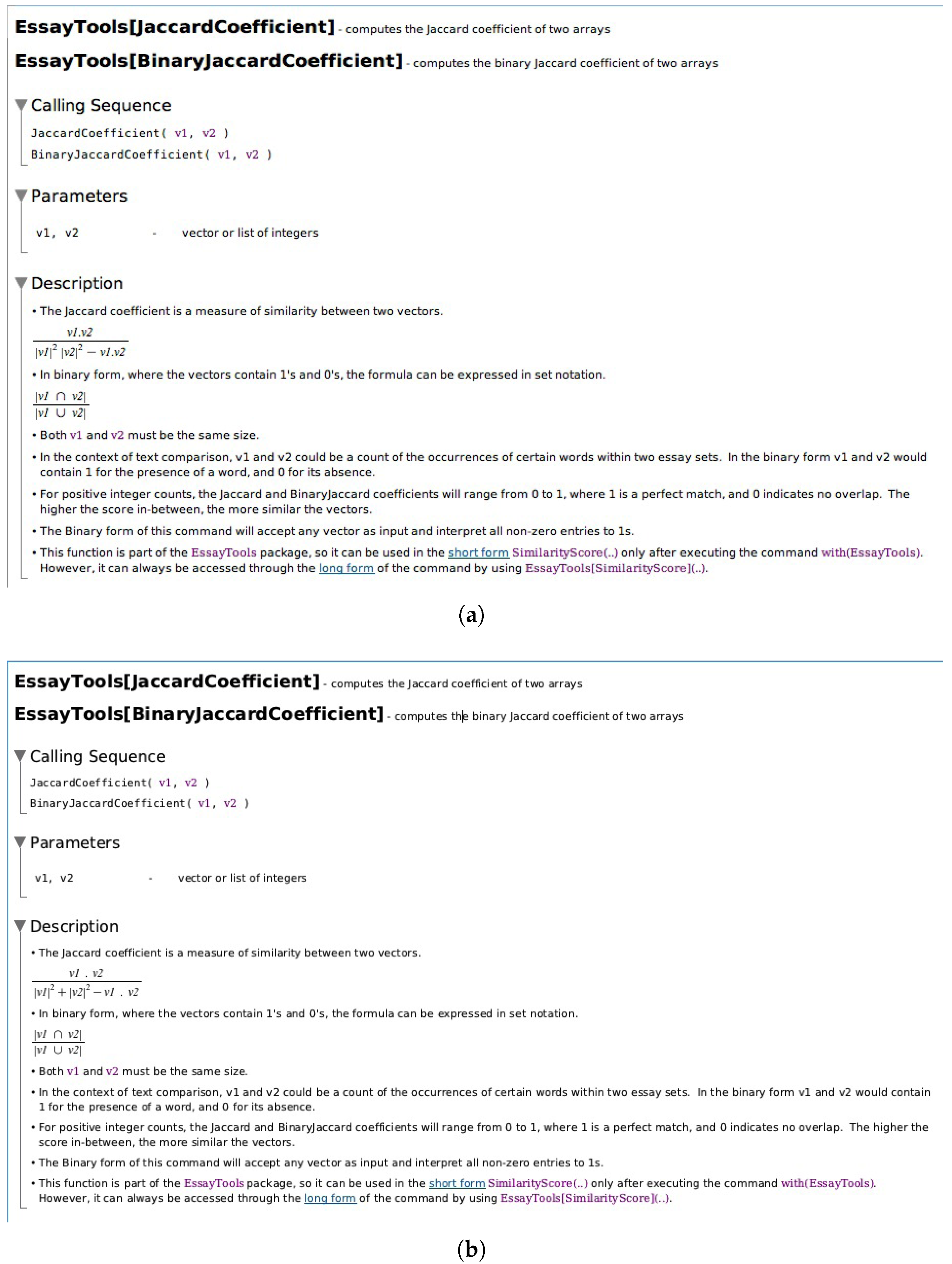
For the vectors above, it equals . Although Maple’s implementation of the JaccardCoefficient command is correct, the explanation of this command given in Maple’s own Help documentation contained an error, as shown in Figure A1a. We reported this error to Maplesoft; the corrected version, shown in Figure A1b, has since been adopted by Maplesoft (see the current Maple Help page for this command: https://www.maplesoft.com/support/help/Maple/view.aspx?path=EssayTools/JaccardCoefficient, accessed on 18 November 2026).
Figure A1.
Maple Help documentation for the JaccardCoefficient and BinaryJaccardCoefficient commands. (a) Original version, containing an error in the denominator of the Jaccard-coefficient formula (a product of squared norms, , instead of a sum). (b) Corrected version, showing the sum of squared norms, , following the error report submitted to Maplesoft.
Appendix A.1.3. Dice Coefficient
The Dice coefficient is twice the dot product divided by the sum of the squares of the norms:
which equals for the vectors above.
Appendix A.1.4. Binary Coefficients
Each of these three coefficients has a binary counterpart, in which what matters is not how many times a word appears but merely whether it appears at all: every count greater than one is treated as one. For the phrases “la hija de la casa” and “la hija se casa” (“the daughter of the house” and “the daughter is getting married”), with word list [la, hija, de, casa, se], the vectors are and ; the cosine coefficient is , whereas the binary cosine coefficient, computed on and , is . For binary vectors, the Jaccard coefficient reduces to the number of distinct words shared by the two texts divided by the number of distinct words appearing in either, which is the measure used in this study.
Appendix A.2. The DetectPlagiarism Command and the Threshold
The DetectPlagiarism command compares texts using the SimilarityScore command and returns those pairs that exceed a given similarity threshold. By default, it uses a threshold of 0.35 and the BinaryJaccardCoefficient similarity metric; the threshold can be modified to any value between 0 and 1, and the metric can be any of the six coefficients described above. Despite the command’s name, a score above the threshold indicates lexical overlap, not plagiarism; see Section 1. It should be borne in mind that this is a probabilistic measure: a high score does not necessarily imply that two texts are copies of one another, or that they were copied from the same source.
Appendix A.3. The Length-Adjustment Procedure
When comparing two texts, their relative length matters. Consider a short first text: “La crisis española ha supuesto una larga travesía del desierto para las ventas de Carrefour en España” (“The Spanish crisis has meant a long desert crossing for Carrefour’s sales in Spain”), and a longer text that contains the first one exactly: “La crisis española ha supuesto una larga travesía del desierto para las ventas de Carrefour en España. Los ingresos de la filial española del grupo francés de distribución cayeron en 2014 por sexto año consecutivo, según los datos de resultados anuales que hoy ha presentado la empresa. Pese a ello, la compañía ve signos de recuperación y señala que los resultados operativos en España están mejorando notablemente” (“…The revenues of the Spanish subsidiary of the French distribution group fell in 2014 for the sixth consecutive year, according to the annual results data the company presented today. Despite this, the company sees signs of recovery and notes that operating results in Spain are improving markedly”). The similarity index between the two texts is 0.33, below the 0.35 threshold, even though the first sentence of both texts is identical.
To address this problem (and starting from the premise that the shorter text is always the brief) a recurrent comparison is made between the brief and an increasingly larger portion of the press release or wire-agency dispatch. The procedure returns the maximum value of the similarity index and the number of words of the source text that maximizes it, and is initialized with a number of words of the source equal to the number of words in the brief. The Maple code is given in Listing A1.
In the code above, the first line declares that the arguments of the procedure are of type string; the second line declares local variables, and the following three lines initialize several of them. The Words command converts a text into a list of words, and WordCount counts the number of words in a text. The procedure consists of two loops. In the first, the reduced text to be compared with the brief is built up word by word. In the second, the comparison between the two texts is carried out, storing the similarity index whenever it exceeds the previously computed value, together with the corresponding number of words of the source text. To reduce execution time, after 50 iterations without improvement in the similarity index, the program breaks out of the loop and returns the similarity index together with the word count. For brief B01 and press release NP01 (Section 4.1), the direct score is SimilarityScore(textB01, textNP01) , whereas similarity(textB01, textNP01).
| Listing A1. Maple procedure implementing the length-adjustment routine. |
| similarity := proc(textA::string, textB::string) |
| local text, aux, A, i, j, SS, idx, desc; |
| text := ""; |
| aux := 0; |
| desc := 0; |
| A := Words(textB); |
| for j from WordCount(textA) to WordCount(textB) do |
| for i to j do |
| text := cat(text, " ", A[i]) |
| end do; |
| SS := SimilarityScore(textA, text, |
| methods = [EssayTools:-BinaryJaccardCoefficient], |
| filter = StringTools:-LowerCase)[1, 1]; |
| if aux < SS then aux := SS; idx := j else desc := desc+1 end if; |
| if 50 < desc then break end if |
| end do; |
| [aux, idx] |
| end proc |
Appendix B. Statistical Computations for Section 4.3
This appendix details the computations behind the results reported in Section 4.3. All of them use the length-adjusted similarity indices of Table 1, Table 2, Table 4 and Table 5, rounded to two decimals as printed there. Listings A2 and A3 give Python and R code that reproduces every figure; both programs return identical results.
Appendix B.1. Data
The main comparison concerns the brief–wire-agency indices of the two newspapers: values for El Mundo (Table 5) and values for La Vanguardia (Table 2). Their sample means and standard deviations are
so that the observed mean difference is . The brief–press-release comparison uses the and indices of Table 1 and Table 4.
Appendix B.2. Welch’s t-Test and Confidence Interval
Because the two samples have different sizes and, possibly, different variances, the means were compared with Welch’s unequal-variance t-test (Welch, 1947), which is recommended as the default for two independent samples, particularly when their sizes differ (Delacre et al., 2017). The standard error of the difference and the test statistic are
and the approximate degrees of freedom are given by the Welch–Satterthwaite formula,
The two-sided p-value is , so the null hypothesis of equal means is rejected at the chosen significance level (and would also be rejected at or ). With the critical value , the 90% confidence interval for the difference in means, which corresponds to , is
For the brief–press-release indices, the same procedure gives (, ) and (, ), so that , , , and , with a 90% confidence interval for the difference of ; the null hypothesis of equal means is not rejected.
Appendix B.3. Effect Size
The standardized mean difference uses the pooled standard deviation,
and Hedges’ correction for small-sample bias (Hedges, 1981),
which is a large effect by conventional standards. Because g standardizes the difference by the pooled standard deviation, it is reported here as a conventional descriptive measure of the size of the difference; see Goulet-Pelletier and Cousineau (2018) for this definition, its small-sample correction, and alternative estimators.
Appendix B.4. Mann–Whitney U Test
As a check that does not assume normality, the two samples were compared with the Mann–Whitney U test (Mann & Whitney, 1947). The 35 indices are pooled and ranked from smallest to largest, tied values receiving the average of the ranks they occupy. The sum of the ranks of the El Mundo indices is , and
counts the pairs (one brief from each newspaper) in which the El Mundo index is the higher of the two, ties counting one half; it is the statistic reported in Section 4.3 (R reports it as W). Accordingly, estimates the probability that a randomly chosen El Mundo index exceeds a randomly chosen La Vanguardia index (ties counting one half); the test compares this probability with 0.5 and is not a test of medians (Divine et al., 2018). Under the null hypothesis, U has mean . Because the data contain ties, the p-value was obtained from the normal approximation with the tie-corrected variance,
where and is the number of observations sharing the k-th tied value, and with a continuity correction of :
Appendix B.5. Fisher’s Exact Test on Coincidence Rates
Classifying each brief–wire-agency pair as coincident (index ) or not gives the contingency table shown in Table A1.
Table A1.
Brief–wire-agency pairs classified as coincident (index ) or not, by newspaper.
With these sample sizes, an asymptotic chi-squared test is not appropriate (two expected counts are below 5), so Fisher’s exact test was used (Fisher, 1922). The test is known to be conservative in small samples (Fagerland et al., 2017), so this p-value, if anything, understates the evidence for a difference. Conditional on the margins, the number X of non-coincident El Mundo briefs follows a hypergeometric distribution, , which gives , , , , , and . The observed value is . The two-sided p-value is the sum of the probabilities of all tables no more likely than the observed one,
so the difference in coincidence rates (95.24% vs. 71.43%; sample odds ratio 20 × 4/ (1 × 10) = 8.0) is not significant at (nor, a fortiori, at ).
Appendix B.6. Code
Listing A2 uses NumPy and SciPy (SciPy version 1.11 or later is required); Listing A3 uses base R only. Both were run, with Python 3.13 (NumPy 2.5, SciPy 1.18) and R 4.3.3, on the data above and return the values reported in this appendix. (R’s fisher.test also reports a conditional maximum-likelihood estimate of the odds ratio, 7.52, which differs from the sample odds ratio of 8.0 given above; the p-value is the same).
| Listing A2. Python code reproducing the computations of Section 4.3. |
| import numpy as np |
| from scipy import stats |
| lv_na = np.array([0.70, 0.71, 0.26, 0.79, 0.68, 0.54, 0.37, 0.35, 0.29, |
| 0.39, 0.30, 0.43, 0.27, 0.37]) # Table 2 |
| em_na = np.array([0.87, 0.69, 0.75, 0.69, 0.78, 0.69, 0.52, 0.76, 0.78, |
| 0.71, 0.76, 0.81, 0.76, 0.59, 0.75, 0.76, 0.83, 0.75, |
| 0.45, 0.54, 0.28]) # Table 5 |
| lv_np = np.array([0.58, 0.38, 0.46, 0.31, 0.74, 0.51, 0.47, 0.37, 0.25, |
| 0.20, 0.36, 0.58, 0.24, 0.43, 0.37, 0.49, 0.30, 0.27, |
| 0.56, 0.22, 0.26, 0.29, 0.38, 0.36, 0.40, 0.61, 0.63, |
| 0.20, 0.27, 0.66]) # Table 1 |
| em_np = np.array([0.25, 0.43, 0.55, 0.49, 0.41, 0.32, 0.23, 0.26, 0.16, |
| 0.46, 0.35, 0.77, 0.23, 0.46, 0.72, 0.75, 0.21, 0.53, |
| 0.36, 0.23]) # Table 4 |
| def welch(y, x): |
| se = np.sqrt(y.var(ddof=1)/len(y) + x.var(ddof=1)/len(x)) |
| res = stats.ttest_ind(y, x, equal_var=False) |
| ci = res.confidence_interval(0.90) |
| return [round(float(v), 4) for v in |
| (res.statistic, res.df, res.pvalue, ci.low, ci.high, se)] |
| print("Welch NA:", welch(em_na, lv_na)) |
| n1, n2 = len(em_na), len(lv_na) |
| sp = np.sqrt(((n1-1)*em_na.var(ddof=1) + (n2-1)*lv_na.var(ddof=1))/(n1+n2-2)) |
| d = (em_na.mean() - lv_na.mean())/sp |
| print("Hedges g:", round((1 - 3/(4*(n1+n2) - 9))*d, 4)) |
| mw = stats.mannwhitneyu(em_na, lv_na, alternative="two-sided", |
| method="asymptotic", use_continuity=True) |
| print("Mann-Whitney U, p:", mw.statistic, round(mw.pvalue, 4)) |
| print("Welch NP:", welch(em_np, lv_np)) |
| table = [[int((em_na >= 0.35).sum()), int((em_na < 0.35).sum())], |
| [int((lv_na >= 0.35).sum()), int((lv_na < 0.35).sum())]] |
| print("Fisher table, p:", table, round(stats.fisher_exact(table).pvalue, 4)) |
| Listing A3. R code reproducing the computations of Section 4.3. |
| # Statistical computations for Section 4.3 (base R only) |
| lv_na <- c(0.70, 0.71, 0.26, 0.79, 0.68, 0.54, 0.37, 0.35, 0.29, 0.39, |
| 0.30, 0.43, 0.27, 0.37) |
| em_na <- c(0.87, 0.69, 0.75, 0.69, 0.78, 0.69, 0.52, 0.76, 0.78, 0.71, |
| 0.76, 0.81, 0.76, 0.59, 0.75, 0.76, 0.83, 0.75, 0.45, 0.54, 0.28) |
| lv_np <- c(0.58, 0.38, 0.46, 0.31, 0.74, 0.51, 0.47, 0.37, 0.25, 0.20, |
| 0.36, 0.58, 0.24, 0.43, 0.37, 0.49, 0.30, 0.27, 0.56, 0.22, |
| 0.26, 0.29, 0.38, 0.36, 0.40, 0.61, 0.63, 0.20, 0.27, 0.66) |
| em_np <- c(0.25, 0.43, 0.55, 0.49, 0.41, 0.32, 0.23, 0.26, 0.16, 0.46, |
| 0.35, 0.77, 0.23, 0.46, 0.72, 0.75, 0.21, 0.53, 0.36, 0.23) |
| # 1. Welch t-test and 90% CI (brief--wire-agency), alpha = 0.10 |
| t.test(em_na, lv_na, var.equal = FALSE, conf.level = 0.90) |
| # 2. Hedges’ g |
| n1 <- length(em_na); n2 <- length(lv_na) |
| sp <- sqrt(((n1 - 1) * var(em_na) + (n2 - 1) * var(lv_na)) / (n1 + n2 - 2)) |
| d <- (mean(em_na) - mean(lv_na)) / sp |
| g <- (1 - 3 / (4 * (n1 + n2) - 9)) * d |
| cat("pooled SD =", sp, " d =", d, " Hedges’ g =", g, "\n") |
| # 3. Mann-Whitney U test (normal approximation with tie and continuity corrections) |
| wilcox.test(em_na, lv_na, exact = FALSE, correct = TRUE) |
| # 4. Welch t-test (brief--press-release) |
| t.test(em_np, lv_np, var.equal = FALSE, conf.level = 0.90) |
| # 5. Fisher’s exact test on coincidence rates against agency copy |
| tab <- rbind(EM = c(sum(em_na >= 0.35), sum(em_na < 0.35)), |
| LV = c(sum(lv_na >= 0.35), sum(lv_na < 0.35))) |
| tab |
| fisher.test(tab, conf.level = 0.90) |
References
- Amirzhanov, A., Turan, C., & Makhmutova, A. (2025). Plagiarism types and detection methods: A systematic survey of algorithms in text analysis. Frontiers in Computer Science, 7, 1504725. [Google Scholar] [CrossRef] [Scilit]
- Barrón-Cedeño, A., Vila, M., Martí, M. A., & Rosso, P. (2013). Plagiarism meets paraphrasing: Insights for the next generation in automatic plagiarism detection. Computational Linguistics, 39(4), 917–947. [Google Scholar] [CrossRef] [Scilit]
- Bartleman, M., Schapals, A. K., & Dubois, E. (2026). Generative AI and the new landscape of automated journalism: A systematized review of 185 studies (2012–2024). Journalism and Media, 7(1), 39. [Google Scholar] [CrossRef] [Scilit]
- Boumans, J. (2018). Subsidizing the news? Organizational press releases’ influence on news media’s agenda and content. Journalism Studies, 19(15), 2264–2282. [Google Scholar] [CrossRef] [Scilit]
- Brück, J., Knorr, C., & Guenther, L. (2025). Copy, paste, and publish: A systematic review of churnalism as a journalistic practice. Annals of the International Communication Association, 49(4), 257–270. [Google Scholar] [CrossRef] [Scilit]
- Comfort, S. E., Gruszczynski, M., & Browning, N. (2024). Building the science news agenda: The permeability of science journalism to public relations. Journalism & Mass Communication Quarterly, 101(3), 637–656. [Google Scholar] [CrossRef] [Scilit]
- Curtin, P. A. (1999). Reevaluating public relations information subsidies: Market-driven journalism and agenda-building theory and practice. Journal of Public Relations Research, 11(1), 53–90. [Google Scholar] [CrossRef] [Scilit]
- Davies, N. (2008). Flat earth news: An award-winning reporter exposes falsehood, distortion and propaganda in the global media. Chatto & Windus. [Google Scholar]
- Davis, A. (2000). Public relations, business news and the reproduction of corporate elite power. Journalism, 1(3), 282–304. [Google Scholar] [CrossRef] [Scilit]
- Delacre, M., Lakens, D., & Leys, C. (2017). Why psychologists should by default use Welch’s t-test instead of Student’s t-test. International Review of Social Psychology, 30(1), 92–101. [Google Scholar] [CrossRef] [Scilit]
- Divine, G. W., Norton, H. J., Barón, A. E., & Juarez-Colunga, E. (2018). The Wilcoxon–Mann–Whitney procedure fails as a test of medians. The American Statistician, 72(3), 278–286. [Google Scholar] [CrossRef] [Scilit]
- Fagerland, M. W., Lydersen, S., & Laake, P. (2017). Statistical analysis of contingency tables. Chapman & Hall/CRC. [Google Scholar] [CrossRef] [Scilit]
- Fisher, R. A. (1922). On the interpretation of χ2 from contingency tables, and the calculation of P. Journal of the Royal Statistical Society, 85(1), 87–94. [Google Scholar] [CrossRef] [Scilit]
- Franklin, B., Hamer, M., Hanna, M., Kinsey, M., & Richardson, J. E. (2005). Key concepts in journalism studies. Sage. [Google Scholar] [CrossRef] [Scilit]
- Gandy, O. H., Jr. (1982). Beyond agenda setting: Information subsidies and public policy. Ablex. [Google Scholar]
- Goulet-Pelletier, J.-C., & Cousineau, D. (2018). A review of effect sizes and their confidence intervals, Part I: The Cohen’s d family. The Quantitative Methods for Psychology, 14(4), 242–265. [Google Scholar] [CrossRef] [Scilit]
- Hayes, C. (2026). Technostress is the (re)new(ed) normal: How journalists manage technological innovation. Journalism and Media, 7(1), 44. [Google Scholar] [CrossRef] [Scilit]
- Hedges, L. V. (1981). Distribution theory for Glass’s estimator of effect size and related estimators. Journal of Educational Statistics, 6(2), 107–128. [Google Scholar] [CrossRef] [Scilit]
- Kuntur, S., Smirnova, N., Wroblewska, A., Mayr, P., & Maček, S. R. (2026). Rewrite the news: Tracing editorial reuse across news agencies. In Proceedings of the 1st Workshop on Social Context (SoCon) and the 2nd Workshop on Integrating NLP and Psychology to Study Social Interactions (NLPSI) @ LREC 2026, Palma, Mallorca, Spain, 11–16 May (pp. 76–84). European Language Resources Association (ELRA). [Google Scholar] [CrossRef] [Scilit]
- Lewis, J., Williams, A., & Franklin, B. (2008). A compromised fourth estate? UK news journalism, public relations and news sources. Journalism Studies, 9(1), 1–20. [Google Scholar] [CrossRef] [Scilit]
- López del Castillo Wilderbeek, F. L. (2023). Cibermedios nativos y dependencia de las agencias de noticias en España [Native digital media and dependence on news agencies in Spain]. Vivat Academia, 156, 89–106. [Google Scholar] [CrossRef] [Scilit]
- Mann, H. B., & Whitney, D. R. (1947). On a test of whether one of two random variables is stochastically larger than the other. The Annals of Mathematical Statistics, 18(1), 50–60. [Google Scholar] [CrossRef] [Scilit]
- Maplesoft. (2013a). EssayTools package documentation. Maplesoft. [Google Scholar]
- Maplesoft. (2013b). Maple 17: User manual. Maplesoft. [Google Scholar]
- Martínez, J. (2017). Copia y pega: Cómo las multinacionales construyen las noticias. Los breves de empresa en los diarios La Vanguardia y El Mundo de Catalunya. Estudio de similitud entre los breves y las notas de prensa [Ph.D. thesis, Universitat Ramon Llull]. [Google Scholar]
- McManus, J. H. (1994). Market-driven journalism: Let the citizen beware? Sage. [Google Scholar]
- Nicholls, T. (2019). Detecting textual reuse in news stories, at scale. International Journal of Communication, 13, 4173–4197. [Google Scholar]
- Obermaier, M., Koch, T., & Riesmeyer, C. (2018). Deep impact? How journalists perceive the influence of public relations on their news coverage and which variables determine this impact. Communication Research, 45(7), 1031–1053. [Google Scholar] [CrossRef] [Scilit]
- Ortiz Martes, D., Gunderson, E., Neuman, C., & Kachouie, N. N. (2025). Transformer models for paraphrase detection: A comprehensive semantic similarity study. Computers, 14(9), 385. [Google Scholar] [CrossRef] [Scilit]
- Pander Maat, H., & de Jong, C. (2013). How newspaper journalists reframe product press release information. Journalism, 14(3), 348–371. [Google Scholar] [CrossRef] [Scilit]
- Peterson, E., & Dunaway, J. (2023). The new news barons: Investment ownership reduces newspaper reporting capacity. The Annals of the American Academy of Political and Social Science, 707(1), 74–89. [Google Scholar] [CrossRef] [Scilit]
- Rendon, H., & Johnson, M. A. (2026). Information subsidies in Mexican and U.S. border-state journalism: Nonprofit organizations’ agenda-building. News Research Journal, 47(1), 49–66. [Google Scholar] [CrossRef] [Scilit]
- Rick, J., & Hanitzsch, T. (2024). Journalists’ perceptions of precarity: Toward a theoretical model. Journalism Studies, 25(2), 199–217. [Google Scholar] [CrossRef] [Scilit]
- Schafraad, P., & van Zoonen, W. (2020). Reconsidering churnalism: How news factors in corporate press releases influence how journalists treat these press releases after initial selection. Communications, 45(s1), 718–743. [Google Scholar] [CrossRef] [Scilit]
- Strauß, N. (2019). Financial journalism in today’s high-frequency news and information era. Journalism, 20(2), 274–291. [Google Scholar] [CrossRef] [Scilit]
- Strauß, N., & Njagojevic, M. (2025). Building the media and political agenda during COVID-19: How trade associations used strategic communication to stir public discussions in Switzerland. Corporate Communications: An International Journal, 30(7), 44–61. [Google Scholar] [CrossRef] [Scilit]
- Turk, J. V. (1986a). Information subsidies and media content: A study of public relations influence on the news. Journalism Monographs, 100, 1–29. [Google Scholar]
- Turk, J. V. (1986b). Public relations’ influence on the news. Newspaper Research Journal, 7(4), 15–27. [Google Scholar] [CrossRef] [Scilit]
- Vonk, A. N., Bos, M., & van Sebille, E. (2024). Journalism versus churnalism: How news factors in press releases affect journalistic processing of ocean plastic research in newspapers globally. Journalism Studies, 25(16), 2031–2050. [Google Scholar] [CrossRef] [Scilit]
- Welbers, K., van Atteveldt, W., Kleinnijenhuis, J., & Ruigrok, N. (2018). A gatekeeper among gatekeepers: News agency influence in print and online newspapers in the Netherlands. Journalism Studies, 19(3), 315–333. [Google Scholar] [CrossRef] [Scilit]
- Welch, B. L. (1947). The generalization of ‘Student’s’ problem when several different population variances are involved. Biometrika, 34(1–2), 28–35. [Google Scholar] [CrossRef] [Scilit]

Disclaimer/Publisher’s Note: The statements, opinions and data contained in all publications are solely those of the individual author(s) and contributor(s) and not of MDPI and/or the editor(s). MDPI and/or the editor(s) disclaim responsibility for any injury to people or property resulting from any ideas, methods, instructions or products referred to in the content. |
© 2026 by the authors. Licensee MDPI, Basel, Switzerland. This article is an open access article distributed under the terms and conditions of the Creative Commons Attribution (CC BY) license.