


Abstract
News headlines help define how disputes over generative images are named, but longitudinal changes in legal and labour cues remain unclear. We analysed 11,436 GDELT headline records, deduplicated by URL and observation timestamp, from 54 monthly ArtList windows between January 2022 and 28 June 2026. TimelineVolRaw supplied query-matching news-volume counts, multi-label dictionaries identified frame cues, and OpenAlex and arXiv enabled title-only comparisons. Forty-four ArtList windows reached the 250-record limit, restricting frame estimates to the retrieved sample. Between 2022 and 2025, Legal/Policy prevalence rose overall from 2.0% to 21.5%, whereas Livelihood/Labour prevalence remained similar at 4.0% and 3.5%. Two blinded coders independently assessed 600 stratified records; Cohen’s κ was 0.947 for Legal/Policy and 0.920 for Livelihood/Labour. Mean weighted coder estimates changed from 5.0% to 44.9% and from 8.2% to 7.5%, respectively. Coding coverage rose from 9.9% to 36.3%, so Labour’s smaller share of frame mentions reflects faster growth in other frames, while record-level labour cues stayed near their earlier rate. Title-only comparisons showed similar labour-theme prevalence in news, OpenAlex, and arXiv, with stronger consent and provenance cues in arXiv titles. Legal-policy language expanded in the retrieved headline records. The ArtList return limit and the headline-only field keep that result inside the retrieved sample.
1. Introduction
Public releases of diffusion models broadened access to the production and circulation of synthetic images (Ho et al., 2020; Rombach et al., 2022; Yang et al., 2023). The resulting disputes extend beyond model performance. Artists, studios, platforms, and regulators have argued over training data, consent, style imitation, employment, disclosure, and liability (Jiang et al., 2023; Samuelson, 2023; Vincent, 2023). News coverage is one place where these disputes acquire a public vocabulary. A headline can foreground a threatened livelihood, an alleged theft, a novel creative tool, or a matter for courts and policymakers (de Vreese, 2005; Entman, 1993; Scheufele, 1999).
How headlines select among these competing concerns is central to journalism research. Agenda-setting scholarship examines how media attention ranks issues for public consideration (McCombs & Shaw, 1972; Napoli, 2019). Framing scholarship examines how news selects and connects particular aspects of those issues (de Vreese, 2005; Entman, 1993; Goffman, 1974). Headlines warrant separate study because search results, aggregators, notifications, and social feeds often display them without the full article (Couldry & Hepp, 2017; Diakopoulos, 2019; Gillespie, 2010). They are also the only consistently available news text in the database used here. We therefore examine frame cues in headlines, not the full framing of the underlying articles.
Recent work in Journalism and Media demonstrates the value of longitudinal computational research on artificial-intelligence coverage. Jain and Ranganathan (2025) show that technology-media coverage expanded after the November 2022 release of ChatGPT (GPT-3.5) and increasingly addressed governance and regulation. Singh et al. (2025) combine newspaper frames with topic modelling to examine how one infrastructure controversy was packaged for readers. These studies establish that large news collections can trace agenda change. They do not isolate generative-image disputes or separate record-level frame prevalence from the composition of all frame mentions.
Several adjacent literatures motivate that distinction. Research on training data documents questions of consent, representation, and value extraction (Bender et al., 2021; Birhane & Prabhu, 2021; Crawford, 2021; Luccioni et al., 2023; Schuhmann et al., 2022). Legal scholarship examines authorship, fair use, and responsibility across the generative-AI supply chain (Lee et al., 2023; Lessig, 2008; Murray, 2023; Pasquale, 2023; Tyagi, 2024). Platform research treats licences, rankings, and metadata fields as organising choices rather than neutral labels (Plantin et al., 2018; Star & Ruhleder, 1996; Wolf et al., 2020). Computational communication research cautions that dictionary matches are observable textual cues, not direct measures of intention (boyd & Crawford, 2012; Grimmer & Stewart, 2013; Krippendorff, 2004; Van Atteveldt & Peng, 2018).
The study uses four open information services, each with a different institutional role. GDELT is an open global news-monitoring database maintained by the GDELT Project, and its DOC 2.0 ArtList endpoint returns ranked article metadata (Leetaru & Schrodt, 2013). OpenAlex is an open index of scholarly works maintained by OurResearch (Priem et al., 2022). arXiv is an open preprint repository (Ginsparg, 2011). Hugging Face Hub is a public repository for model and dataset metadata (Wolf et al., 2020). These services record different kinds of public text, so they are analysed separately and are not pooled into one sample. We ask whether query-matching news volume remained elevated after 2022, how the record-level prevalence and composition of six headline frames changed across complete calendar years, and which of those patterns remained under alternative screens, a high-precision lexicon, retrieval-window checks, and a title-only comparison. Across 2022–2025, Legal/Policy cues rose overall, whereas Livelihood/Labour prevalence remained broadly stable.
2. Materials and Methods
2.1. Study Object and Units of Analysis
The primary unit is a GDELT record deduplicated by URL and observation timestamp, and the coded field is its headline. This procedure keeps syndicated or repeated title strings when they are attached to different record keys. The corpus contained 8707 distinct exact title strings, and 3455 records belonged to 726 title strings that occurred more than once. Headlines are the short texts that circulate in search, aggregation, notifications, and social distribution, and they are the news text ArtList returns consistently. We estimate the prevalence of dictionary-defined cues among retrieved records. Query-matching news volume is the number of records returned by TimelineVolRaw. Record-level frame prevalence is the proportion of retrieved headline records matching a frame, and frame mention share is a frame’s proportion of all frame matches in a year. Because coding is multi-label, a frame can lose mention share while its record-level prevalence stays stable. The estimates describe retrieved headline records. They leave unique title strings, complete articles, outlets, and audience exposure outside the claim.
2.2. News Retrieval and Comparison Sources
The primary GDELT corpus uses 54 one-month DOC 2.0 ArtList windows from 1 January 2022 through 28 June 2026. Each query combined generative-image terms with copyright, artist, labour, lawsuit, governance, and provenance terms. ArtList returned no more than 250 ranked records per window, and deduplication by URL and observation timestamp yielded 11,436 headline records. GDELT’s separate TimelineVolRaw endpoint supplied uncapped daily query counts for the volume analysis. The source archive also contained 18 earlier three-month retrieval windows. Those 4112 deduplicated records stay out of the primary corpus and serve only as a check on whether the broad Legal/Policy trajectory changes when the ranking window is three months rather than one. Both designs are ranked ArtList retrievals (Supplementary Section S1; Supplementary Figure S10).
OpenAlex supplied 10,291 scholarly records from thirteen searches, and arXiv supplied 515 preprints from ten searches (Table 1). The title-only comparison uses complete-year records from 2022–2025: 9956 GDELT records, 6742 OpenAlex records, and 403 arXiv records (Supplementary Table S3). Holding the coded field to the title reduces the extra chance of a match that an abstract would add, while title length and archive coverage still differ. A separate description of 2441 Hugging Face model and dataset records is reported in Supplementary Figure S6. January–June 2026 is a partial year. We show it with open symbols or hatching in descriptive figures, and formal complete-year comparisons, permutation tests, and cross-source trends use 2022–2025. Geographic and language composition of the retrieved records is in Supplementary Figure S3.
Table 1.
Source coverage and complete-year analysis bases.
2.3. Screening and Frame Coding
Three nested screening tiers bound query noise. The full tier contains all 11,436 monthly window records. The moderate tier retains headlines matching either an AI/generative lexicon or a governance lexicon, and the strict tier requires both lexicons in the same headline, retaining 2166 records (18.9%). Screening changes which headlines enter a display. It does not change the frame definitions (Supplementary Figure S1). Six non-exclusive frames were fixed before analysis: Theft/Exploitation, Fair Use/Transformation, Innovation/Progress, Livelihood/Labour, Disclosure/Provenance, and Legal/Policy. Six stakeholder lexicons identify Platforms/Model Developers, Artists/Creators, Publishers/Industry, Courts/Regulators, Audiences/Public, and Museums/Institutions. Named organisations are actor cues, and topic matches are kept separate from the six frames (Supplementary Figure S2). For every year and tier we report record-level frame prevalence, coding coverage, defined as the proportion of records receiving at least one of the six frame codes, and mention share as a secondary description of composition among coded matches (Supplementary Table S1). The regular-expression dictionaries accompany the Supplementary Materials.
2.4. Retrieval-Cap Sensitivity
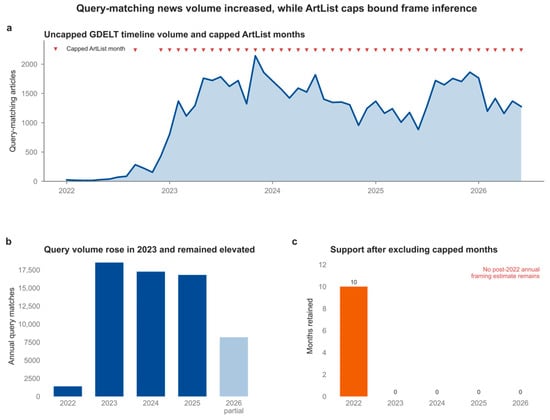
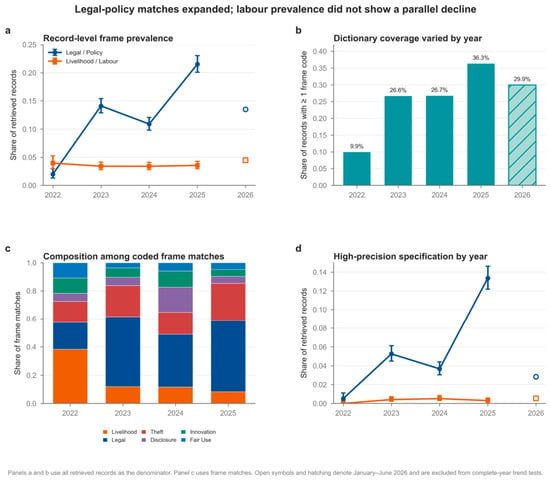
We counted the records returned by every monthly ArtList request. Forty-four of 54 windows reached 250 records. The capped months were September and December 2022, every month of 2023–2025, and January–June 2026. These months are marked in Figure 1 and listed in Supplementary Section S1 and Supplementary Figure S10. Removing the capped calendar months leaves ten months in 2022 and no month after 2022, so later frame rates describe the retrieved monthly sample. Query-matching volume is taken from the uncapped TimelineVolRaw series, and the monthly and three-month retrievals are compared only as a check on window length.
Figure 1.
Query-matching news volume increased, while ArtList caps bound frame inference. (a) Monthly GDELT TimelineVolRaw query matches. Red markers at the top identify monthly ArtList windows that returned 250 records. (b) Annual uncapped query volume; the lighter 2026 bar covers January–June. (c) Number of months retained by year after capped calendar months are excluded.
2.5. Independent Human Validation
A disproportionate stratified sample contained 600 headline records, with 120 from each study year. Within each year, strata distinguished machine-coded Legal only, Labour only, both, and neither, and inverse-probability weights restored each year’s stratum distribution. Two coders independently received shuffled workbooks containing only record identifiers and headlines. Using a shared codebook, they coded all six frames as present, absent, or unclear, without years, URLs, dictionary labels, or one another’s decisions. Both completed every item without using the unclear category. Raw agreement and both unweighted and design-weighted Cohen’s κ were calculated before any discussion between coders. Disagreements remained two independent judgements. Prevalence was estimated for each coder and reported as the mean and range of the two weighted estimates (Supplementary Tables S4 and S5; Supplementary Figure S11).
2.6. News Volume and Event Context
Monthly and annual TimelineVolRaw counts describe query-matching news volume. After the cap audit, ArtList counts describe the size of the retrieved record sample. Ten public milestones were specified before the event-window analysis. Event-month volume and frame composition are compared with the preceding three months, and interrupted time-series models use local ±12-month windows, ordinary least squares, and HC1 robust standard errors. Twenty non-event months receive the same specification. A one-sided Mann–Whitney test compares the absolute estimated level shifts. Because the windows overlap an already changing series, the comparison describes local shifts and is reported in Supplementary Figure S7.
2.7. Cross-Layer Title Comparison
The same six theme dictionaries are applied to GDELT, OpenAlex, and arXiv titles from 2022–2025. The themes are Copyright & IP Law, Artist Labour & Economics, Training Data & Consent, Provenance & Attribution, Governance & Policy, and Technology & Methods. Source-level prevalence is the proportion of titles matching a theme. Yearly cosine similarity summarises the alignment of the six-theme vectors. These comparisons describe differences among archives with distinct collection rules.
2.8. Automated Robustness Checks
A high-precision lexicon requires narrower or denser cues within each frame family, and we report its yearly prevalence with all retrieved records as the denominator (Supplementary Table S2; Supplementary Figure S4). Agreement between the standard and high-precision specifications is lexicon agreement. Human inter-coder reliability is reserved for the two coders. We also test whether ordinary textual features recover the dictionary labels. Term-frequency inverse-document-frequency features from headline unigrams and bigrams enter one-versus-rest logistic regressions. Five-fold cross-validation reports precision, recall, and F1, and a temporal-transfer test trains on 2022–2023 and evaluates 2024–2025 (Supplementary Figure S5). This check asks whether dictionary-labelled vocabulary is stable over time. For the Legal/Policy and Livelihood/Labour mention-share changes, 2000 Monte Carlo permutations exchanged 2022 and 2025 year labels while holding headline codes fixed. One-sided alternatives specified an increase in Legal/Policy and a decrease in Livelihood/Labour, and Monte Carlo p values use the add-one correction, (b + 1)/(2000 + 1) (Supplementary Figure S8).
2.9. Stakeholder and Frame Co-Occurrence
Stakeholder and frame dictionaries are jointly applied to strict-tier headline records. Odds ratios compare frame prevalence in records that name a stakeholder with the remaining strict-tier records. Fisher’s exact test is used when any cell contains fewer than five records, and chi-square tests are used otherwise. These odds ratios describe lexical co-naming (Supplementary Figure S8). Frame co-membership is summarised with intersection counts and pairwise Jaccard overlap, which show whether two labels occur in the same headline record.
2.10. Software
Analyses used Python 3.12 with pandas 2.3.3, NumPy 2.2.1, SciPy 1.15.2, scikit-learn 1.9.0, statsmodels 0.14.6, ruptures 1.1.10, and NetworkX 3.6.1. Figures used matplotlib 3.10.8, upsetplot 0.9.0, and pyCirclize 1.10.1. Random operations use fixed seeds.
3. Results
3.1. Query-Matching News Volume Increased, While ArtList Coverage Was Incomplete
The uncapped GDELT timeline contained 1395 query matches in 2022 and 18,517 in 2023. Annual volume stayed high at 17,253 in 2024 and 16,802 in 2025, and the partial 2026 period contained 8182 matches through 28 June (Figure 1a,b). These counts come from TimelineVolRaw. Forty-four monthly ArtList windows reached the 250-record maximum. Excluding those months retains ten months in 2022 and none thereafter, so the later frame rates describe the retrieved monthly sample of 11,436 records (Figure 1c; Supplementary Figure S10). The three-month retrieval shows the same broad Legal/Policy rise and remains a check on window length.
3.2. Legal-Policy Prevalence Increased, While Labour Prevalence Remained Comparatively Stable
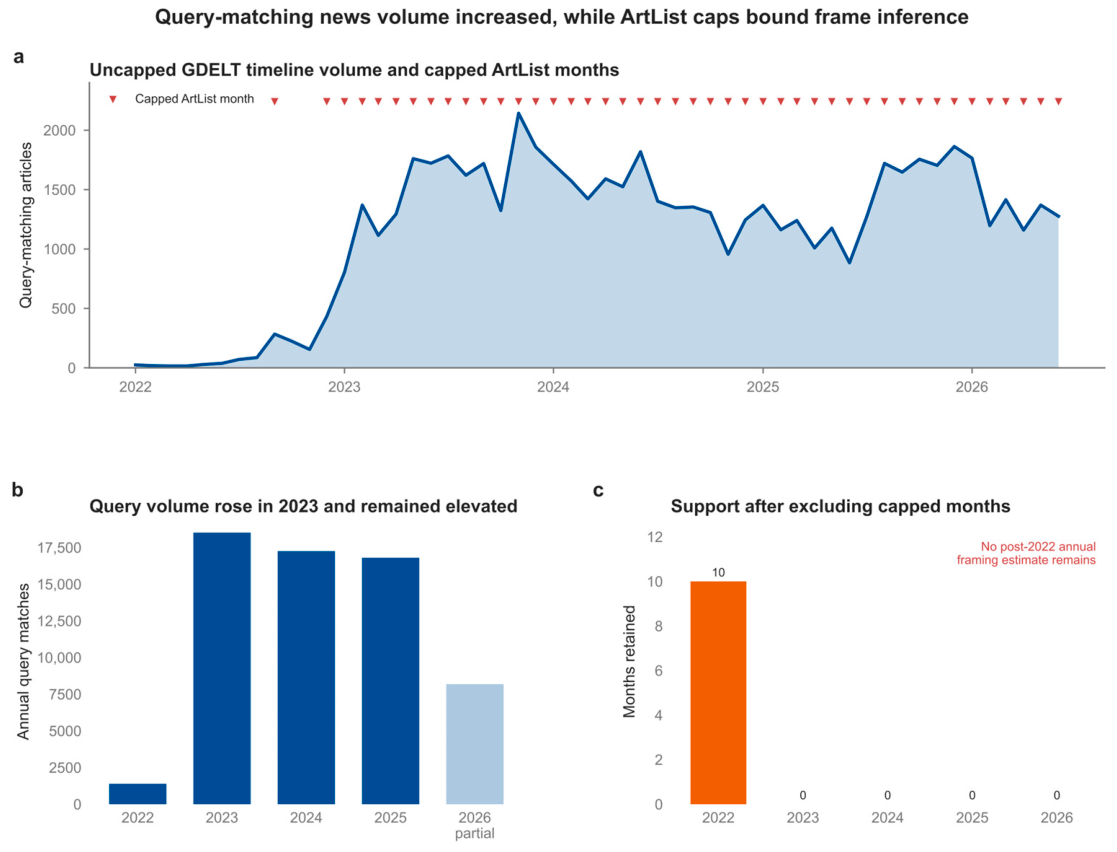
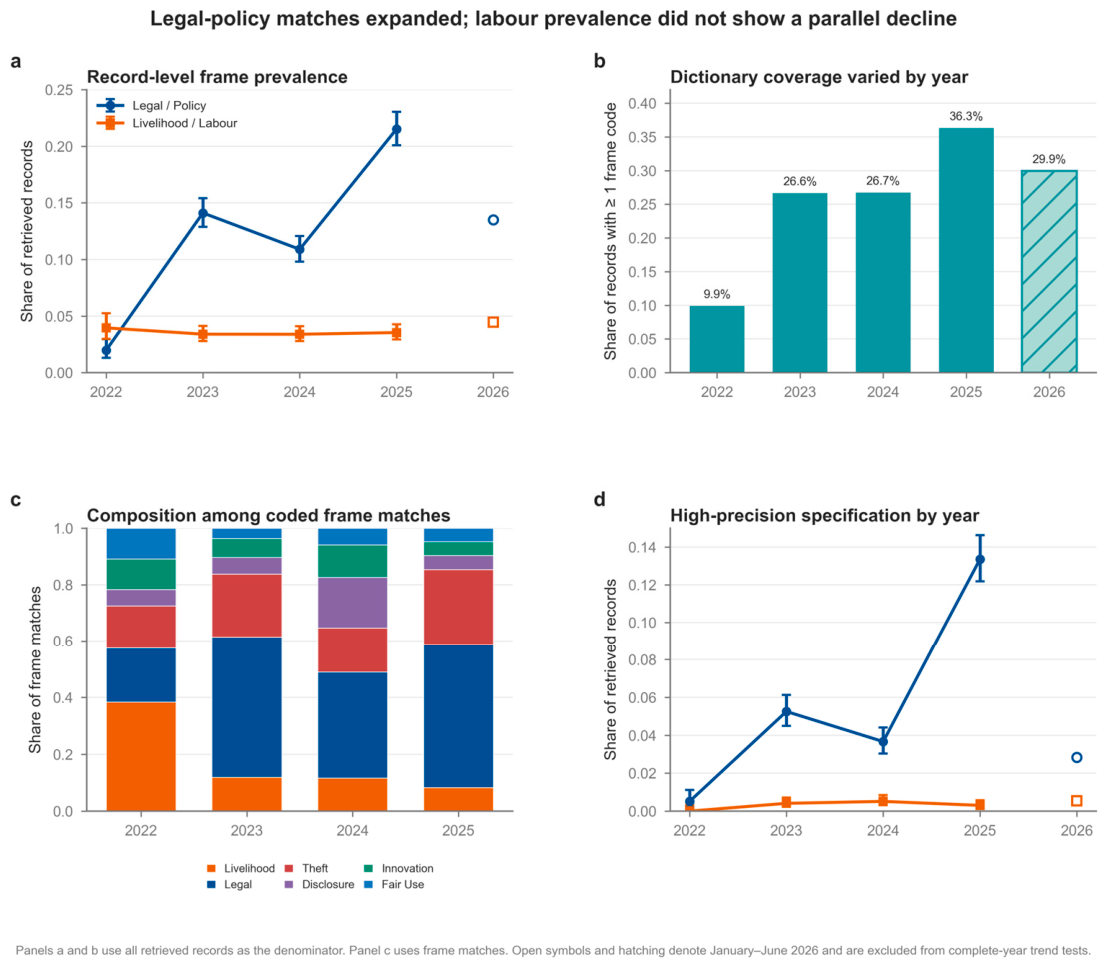
Record-level rates and mention shares answer different questions. Legal/Policy matched 2.0% of retrieved headline records in 2022, 14.1% in 2023, 10.9% in 2024, and 21.5% in 2025, while Livelihood/Labour matched 4.0%, 3.4%, 3.4%, and 3.5% (Figure 2a; Table 2; Supplementary Table S1). The record-level series shows a large expansion of Legal/Policy wording, with Labour prevalence staying near 4%. Coding coverage rose from 9.9% in 2022 to 36.3% in 2025 (Figure 2b). Among all frame matches, Livelihood/Labour’s share fell from 38.3% to 8.3% and Legal/Policy’s share rose from 19.2% to 50.5% (Figure 2c). Mention share divides by every frame match, so the growing Legal/Policy code lowers the other shares while record-level Labour prevalence stays stable.
Figure 2.
Legal-policy matches expanded, while labour prevalence did not show a parallel decline. (a) Record-level Legal/Policy and Livelihood/Labour prevalence with 95% Wilson intervals. (b) Share of records receiving at least one frame code. (c) Composition among all frame matches. (d) Record-level prevalence under the high-precision specification. Open symbols and hatching denote January–June 2026.
Table 2.
Record-level prevalence of Legal/Policy and Livelihood/Labour, with yearly coding coverage. The 2026 values are partial-year and excluded from complete-year tests.
The high-precision lexicon retained 44.3% of standard Legal/Policy matches and 10.6% of Labour matches. Yearly Legal/Policy prevalence under that lexicon rose from 0.5% in 2022 to 13.4% in 2025, and Labour prevalence was 0% and 0.3% (Figure 2d; Supplementary Table S2). The stricter series supports the Legal/Policy rise, with Labour remaining near zero. Monthly and three-month windows show the same broad direction (Supplementary Figure S10). In January–June 2026, Legal/Policy prevalence was 13.5%, Labour prevalence was 4.5%, and coding coverage was 29.9%. These partial-year values are shown with open symbols and stay outside the complete-year tests.
3.3. Independent Coders Recovered the Legal/Policy Increase
Both coders completed all 600 sampled records. Raw agreement was 97.7% for Legal/Policy and 97.3% for Livelihood/Labour, with unweighted Cohen’s κ = 0.947 and 0.920. Design-weighted κ was 0.958 and 0.803 (Supplementary Figure S11a; Supplementary Table S4). Across the other frames, unweighted κ ran from 0.570 for Innovation/Progress to 1.000 for Fair Use/Transformation. The mean weighted coder estimate for Legal/Policy rose from 5.0% in 2022 to 44.9% in 2025, with coder-specific values of 4.0–6.0% and 44.2–45.6%. Mean Livelihood/Labour prevalence moved from 8.2% to 7.5%, with ranges of 5.3–11.1% and 7.3–7.7% (Supplementary Figure S11b,c; Supplementary Table S5). Both coders placed the absolute rates above the dictionaries, and both recovered a sharp Legal/Policy rise with Labour staying near its earlier rate.
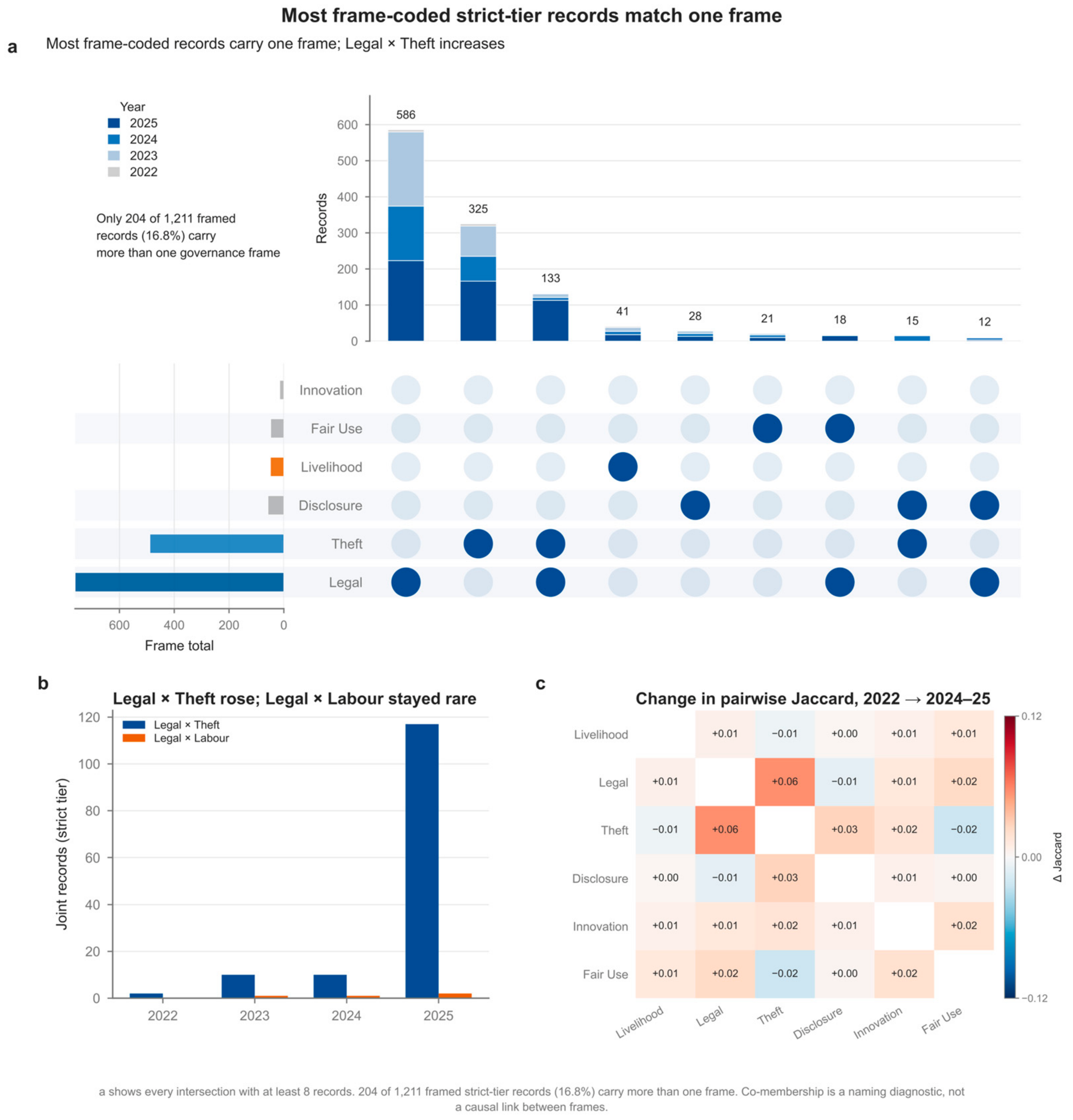
3.4. Most Frame-Coded Strict-Tier Records Matched One Frame
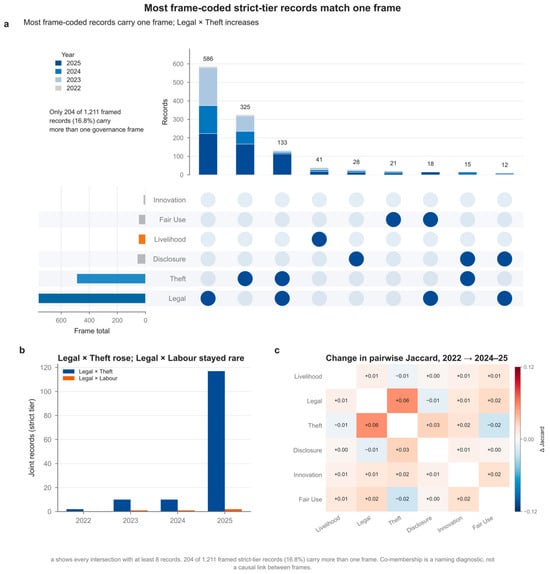
Among 1211 frame-coded strict-tier records in complete years 2022–2025, 204 (16.8%) received more than one frame (Figure 3a). The Legal × Theft intersection increased from 2 records in 2022 to 117 in 2025 (Figure 3b). Legal × Labour remained rare, with no more than two joint records in a year. The Jaccard increase was largest for Legal × Theft (Figure 3c). These results describe co-naming among coded records and do not establish substitution between frames.
Figure 3.
Most frame-coded strict-tier records match one frame. (a) Frame-code intersections with at least eight records in complete years 2022–2025. (b) Joint Legal × Theft and Legal × Labour records by year. (c) Change in pairwise Jaccard overlap between 2022 and 2024–2025. Co-membership is a lexical description, not evidence of causal dependence or direct substitution.
3.5. Actor Naming Was Concentrated, While Event Evidence Remained Descriptive
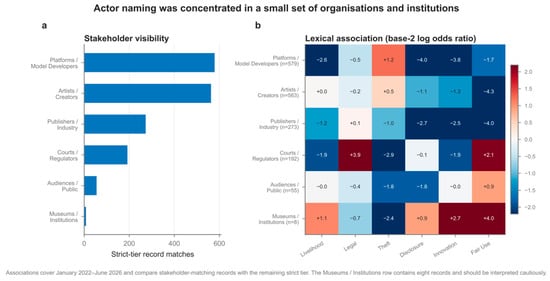
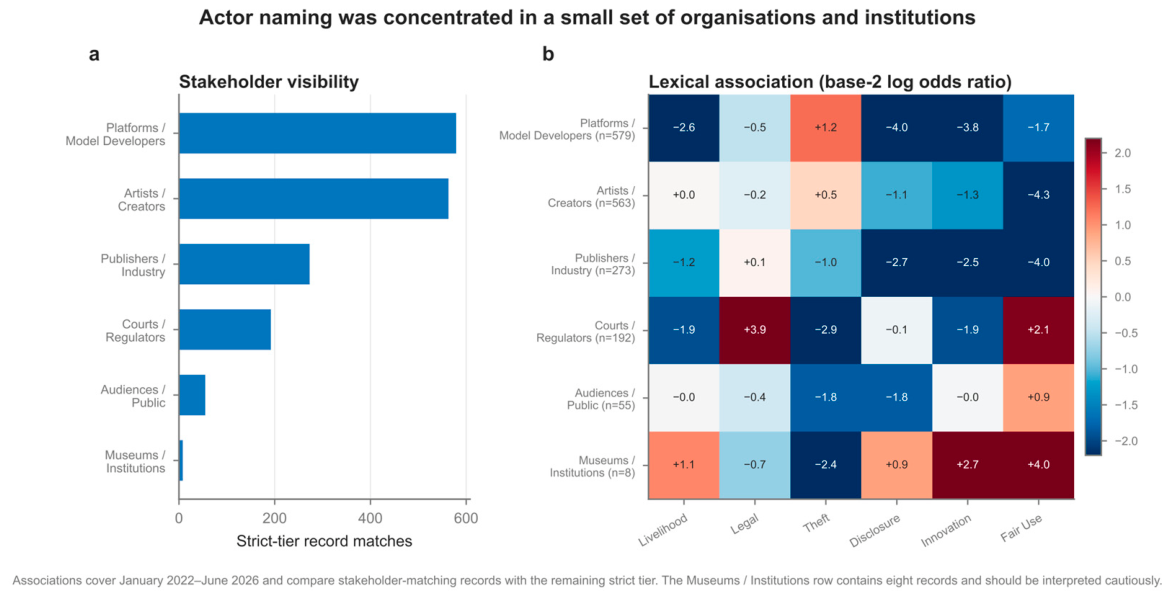
Within 2166 strict-tier records, Platforms/Model Developers appeared 579 times and Artists/Creators 563 times. Publishers/Industry appeared 273 times and Courts/Regulators 192 times, while Audiences/Public (55) and Museums/Institutions (8) were uncommon (Figure 4a). Courts and regulators were the actors most often named with Legal/Policy language (odds ratio 14.68; Figure 4b; Supplementary Figure S8). These counts describe who is named in the headline. The event-window comparison uses the same local model for ten specified months and twenty placebo months. The median absolute level shift was 121.4 query matches for specified months and 20.5 for placebo months (one-sided Mann–Whitney U = 145, p = 0.025; Supplementary Figure S7). The windows overlap a series that was already changing, so the comparison describes the size of local shifts.
Figure 4.
Actor naming was concentrated in a small set of organisations and institutions. (a) Stakeholder matches in strict-tier records from January 2022 through June 2026. (b) Base-2 log odds ratios comparing stakeholder-matching records with the remaining strict tier. The Museums/Institutions row contains eight records. Associations describe lexical co-occurrence and do not estimate actor influence.
3.6. Title-Only Comparison Preserves Consent and Provenance Contrasts, Not a Labour Gap
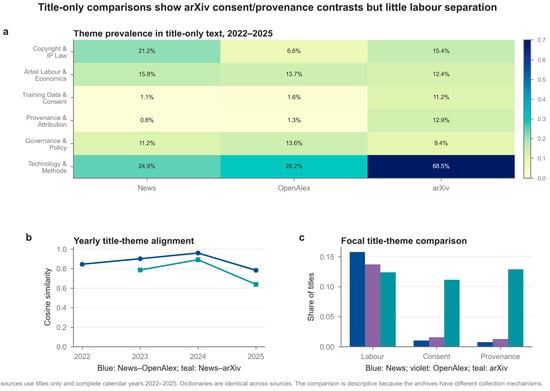
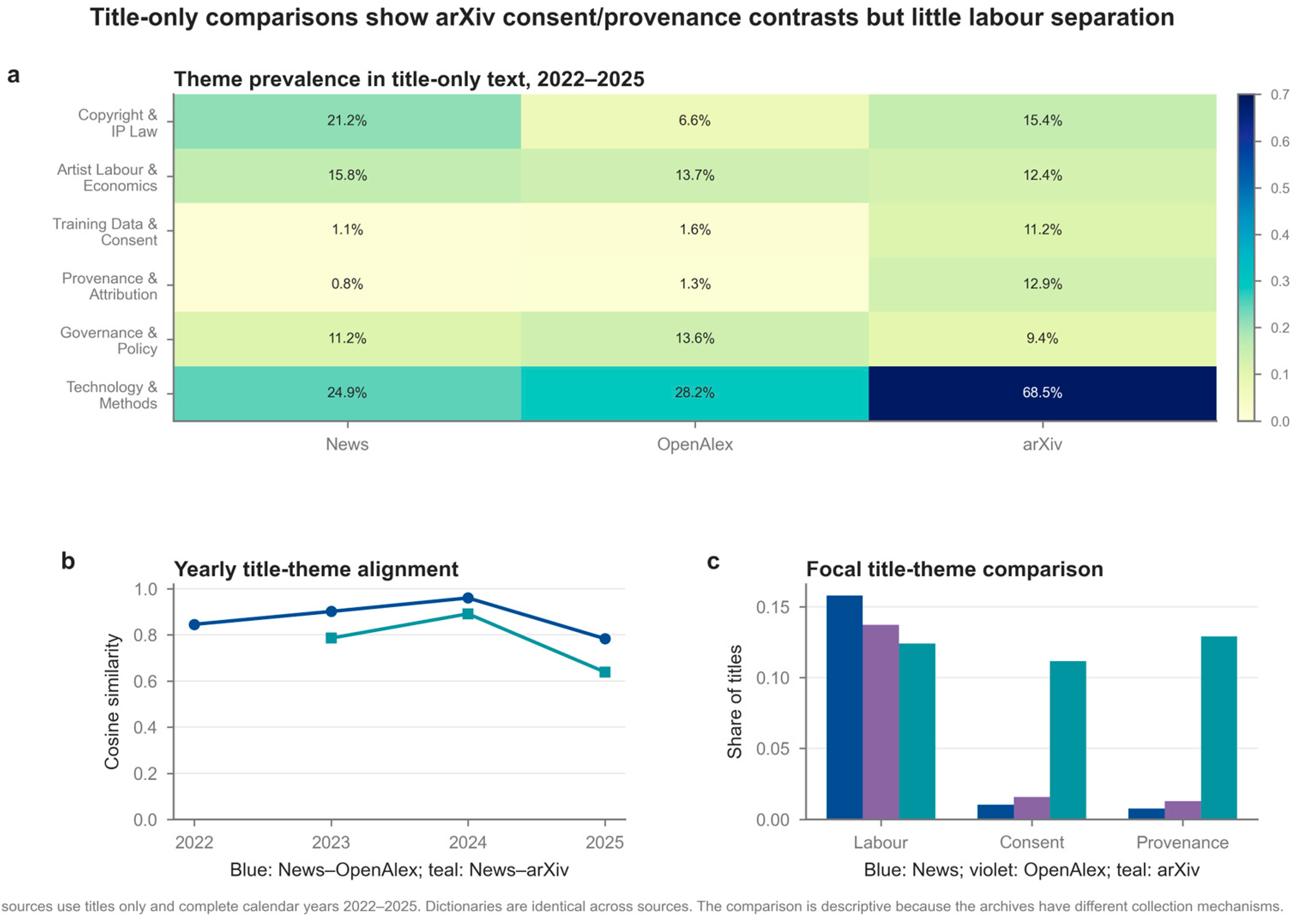
Under title-only coding for 2022–2025, Artist Labour & Economics matched 15.8% of news titles, 13.7% of OpenAlex titles, and 12.4% of arXiv titles (Figure 5a; Supplementary Table S3). Labour-theme prevalence is similar across the three collections, and the earlier labour-gap reading is withdrawn. Training Data & Consent matched 1.1%, 1.6%, and 11.2% of those titles, and Provenance & Attribution matched 0.8%, 1.3%, and 12.9% (Figure 5c). Consent and provenance are the contrasts that remain, and both are higher in arXiv. No arXiv record met the search in 2022, so yearly news–arXiv similarity begins in 2023 (Figure 5b).
Figure 5.
Title-only comparisons show arXiv consent and provenance contrasts but little labour-theme separation. (a) Theme prevalence in titles from complete years 2022–2025. (b) Yearly cosine similarity between source-level theme vectors; no arXiv record met the search criteria in 2022. (c) Title-only comparison of labour, consent, and provenance themes. The same dictionaries are used across sources.
3.7. Automated Checks Show Within-Period Recovery and Later Drift
Five-fold recovery of dictionary labels reached macro-F1 = 0.848 and micro-F1 = 0.888. When the same features were trained on 2022–2023 and applied to 2024–2025, macro-F1 fell to 0.600, so later headline vocabulary is only partly recoverable from the earlier period (Supplementary Figure S5; Table 3). The standard and high-precision lexicons agreed on 79.1% of records (κ = 0.369). Among the 952 records matched by the high-precision lexicon, agreement was 84.7% (κ = 0.716; Supplementary Figure S4). These values compare two coding rules. Human reliability is reported separately above.
Table 3.
Validation and robustness diagnostics. Automated recovery and lexicon agreement are not substitutes for independent human reliability.
Under the standard lexicon, Disclosure/Provenance prevalence in the full tier rose from 1.7% in 2023 to 5.2% in 2024 and fell to 2.1% in 2025. The 2024 rate was 5.6% on the moderate screen and 8.0% on the strict screen (Supplementary Table S6). The high-precision lexicon gave 0.4%, 0.2%, and 0.1% for 2023–2025 (Supplementary Figure S9). The 2024 rise holds across screens and drops out under the narrower rules.
4. Discussion and Conclusions
Legal/Policy cues became markedly more prevalent in retrieved headline records between 2022 and 2025, whereas Livelihood/Labour prevalence remained broadly stable. Both independent coders recovered this contrast, at higher absolute rates than the dictionaries. Labour’s falling share of all frame mentions reflects the growth of legal cues and of coding coverage. Record-level prevalence describes how often a cue occurs among retrieved headlines, and mention share describes the mix of detected cues. Legal and policy language became a much more common headline cue, while livelihood and labour language stayed at a similar rate. Neither measure estimates how often readers encountered these headlines.
Query-matching news volume rose in 2023 and remained elevated through 2025. Frame rates are less generalisable because 44 of 54 ArtList windows reached the return limit, and both the monthly and three-month retrievals are ranked returns. They agree that Legal/Policy prevalence was higher in 2025 than in 2022. Title-only coding holds the textual field constant across GDELT, OpenAlex, and arXiv, and under that specification labour-theme prevalence is similar in the three collections. The Legal/Policy increase remains under high-precision coding, the alternative retrieval window, and independent human coding. Labour prevalence stays near its earlier rate, and the 2024 Disclosure/Provenance rise depends on the coding rules. Lower temporal-transfer performance indicates a change in vocabulary. The event comparison describes local shifts in an overlapping series.
Headlines omit the explanation, quotation, and context of the full article. URL-and-time deduplication also retains repeated title strings, and the English-language dictionaries may under-detect cues in the small non-English subset (Supplementary Figure S3). The human sample contained 558 distinct exact title strings, with 69 sampled records in 27 repeated-title groups. The early strict-tier baseline is small, the human estimates are a two-coder range, and actor associations remain descriptive. Legal-policy cues expanded in retrieved GDELT headline records, and Livelihood/Labour cues remained at a similar record-level prevalence through 2025. Population-wide news trends, audience exposure, frame replacement, and effects of particular events lie outside this evidence.
Supplementary Materials
The following supporting information can be downloaded at: https://www.mdpi.com/article/10.3390/journalmedia7040238/s1. The supporting information includes Sections S1–S6. Tables S1–S6 report yearly frame prevalence, high-precision coding, title-only themes, human reliability, coder trends, and Disclosure/Provenance by screening tier. Figures S1–S11 report screening, topics, geography, lexicon agreement, automated recovery, platform metadata, event diagnostics, associations, frame robustness, the ArtList cap, and human validation.
Author Contributions
Conceptualization, C.Q. and Z.Z.; methodology, C.Q. and Z.Z.; software, Z.Z.; formal analysis, C.Q. and Z.Z.; investigation, C.Q. and Z.Z.; data curation, Z.Z.; writing—original draft preparation, C.Q.; writing—review and editing, C.Q. and Z.Z.; visualization, C.Q. and Z.Z.; supervision, Z.Z. All authors have read and agreed to the published version of the manuscript.
Funding
OmicLab Limited provided no financial or material support for this research and did not fund the article processing charge. The company had no role in the study design; data collection, analysis, or interpretation; manuscript preparation; or the decision to submit the manuscript for publication.
Institutional Review Board Statement
Not applicable. Only public metadata were analysed. No human participants were involved.
Informed Consent Statement
Not applicable.
Data Availability Statement
The original records are publicly available from GDELT, OpenAlex, arXiv, and Hugging Face Hub. Processed tables, dictionaries, figure data, and analysis scripts are provided as Supplementary Materials. No new primary data were collected from human participants.
Acknowledgments
The authors have no additional acknowledgments. During the preparation of this manuscript, the authors used a large-language-model writing assistant for language editing. The authors have reviewed and edited the output and take full responsibility for the content of this publication.
Conflicts of Interest
Author Zicheng Zhao was employed by the OmicLab Limited. The remaining authors declare that the research was conducted in the absence of any commercial or financial relationships that could be construed as a potential conflict of interest.
References
- Bender, E. M., Gebru, T., McMillan-Major, A., & Shmitchell, S. (2021, March 3–10). On the dangers of stochastic parrots: Can language models be too big? The 2021 ACM Conference on Fairness, Accountability, and Transparency (pp. 610–623), Virtual. [Google Scholar] [CrossRef] [Scilit]
- Birhane, A., & Prabhu, V. U. (2021, January 5–9). Large image datasets: A pyrrhic win for computer vision? The 2021 IEEE Winter Conference on Applications of Computer Vision (pp. 1536–1546), Virtual. [Google Scholar] [CrossRef] [Scilit]
- boyd, d., & Crawford, K. (2012). Critical questions for big data. Information, Communication & Society, 15(5), 662–679. [Google Scholar] [CrossRef] [Scilit]
- Couldry, N., & Hepp, A. (2017). The mediated construction of reality. Polity. [Google Scholar]
- Crawford, K. (2021). Atlas of AI: Power, politics, and the planetary costs of artificial intelligence. Yale University Press. [Google Scholar]
- de Vreese, C. H. (2005). News framing: Theory and typology. Information Design Journal + Document Design, 13(1), 51–62. [Google Scholar] [CrossRef] [Scilit]
- Diakopoulos, N. (2019). Automating the news: How algorithms are rewriting the media. Harvard University Press. [Google Scholar]
- Entman, R. M. (1993). Framing: Toward clarification of a fractured paradigm. Journal of Communication, 43(4), 51–58. [Google Scholar] [CrossRef] [Scilit]
- Gillespie, T. (2010). The politics of “platforms”. New Media & Society, 12(3), 347–364. [Google Scholar] [CrossRef] [Scilit]
- Ginsparg, P. (2011). arXiv at 20. Nature, 476(7359), 145–147. [Google Scholar] [CrossRef] [Scilit] [PubMed]
- Goffman, E. (1974). Frame analysis: An essay on the organization of experience. Harvard University Press. [Google Scholar]
- Grimmer, J., & Stewart, B. M. (2013). Text as data: The promise and pitfalls of automatic content analysis methods for political texts. Political Analysis, 21(3), 267–297. [Google Scholar] [CrossRef] [Scilit]
- Ho, J., Jain, A., & Abbeel, P. (2020). Denoising diffusion probabilistic models. In Advances in neural information processing systems (pp. 6840–6851). Curran Associates, Inc. [Google Scholar]
- Jain, A., & Ranganathan, S. (2025). A longitudinal analysis of artificial intelligence coverage in technology-focused news media using latent dirichlet allocation and sentiment analysis. Journalism and Media, 6(4), 176. [Google Scholar] [CrossRef] [Scilit]
- Jiang, H. H., Brown, L., Cheng, J., Khan, M., Gupta, A., Workman, D., Hanna, A., Flowers, J., & Gebru, T. (2023, August 8–10). AI art and its impact on artists. The AAAI/ACM Conference on AI, Ethics, and Society (pp. 363–374), Montréal, QC, Canada. [Google Scholar] [CrossRef] [Scilit]
- Krippendorff, K. (2004). Reliability in content analysis. Human Communication Research, 30(3), 411–433. [Google Scholar] [CrossRef] [Scilit]
- Lee, K., Cooper, A. F., & Grimmelmann, J. (2023). Talkin’ ’bout AI generation: Copyright and the generative-AI supply chain. arXiv. [Google Scholar] [CrossRef] [Scilit]
- Leetaru, K., & Schrodt, P. A. (2013, April 3–6). GDELT: Global data on events, location, and tone. International Studies Association Annual Convention, San Francisco, CA, USA. [Google Scholar]
- Lessig, L. (2008). Remix: Making art and commerce thrive in the hybrid economy. Penguin Press. [Google Scholar]
- Luccioni, S., Akiki, C., Mitchell, M., & Jernite, Y. (2023). Stable bias: Evaluating societal representations in diffusion models. In Advances in Neural Information Processing Systems (Vol. 36). Curran Associates, Inc. [Google Scholar] [CrossRef] [Scilit]
- McCombs, M. E., & Shaw, D. L. (1972). The agenda-setting function of mass media. Public Opinion Quarterly, 36(2), 176–187. [Google Scholar] [CrossRef] [Scilit]
- Murray, M. D. (2023). Generative and AI-authored artworks and copyright law. Hastings Communications and Entertainment Law Journal, 45, 27–45. [Google Scholar]
- Napoli, P. M. (2019). Social media and the public interest. Columbia University Press. [Google Scholar]
- Pasquale, F. (2023). Generative AI and the future of creative labor. AI & Society. [Google Scholar]
- Plantin, J.-C., Lagoze, C., Edwards, P. N., & Sandvig, C. (2018). Infrastructure studies meet platform studies in the age of Google and Facebook. New Media & Society, 20(1), 293–310. [Google Scholar] [CrossRef] [Scilit]
- Priem, J., Piwowar, H., & Orr, R. (2022). OpenAlex: A fully-open index of scholarly works, authors, venues, institutions, and concepts. arXiv. [Google Scholar] [CrossRef] [Scilit]
- Rombach, R., Blattmann, A., Lorenz, D., Esser, P., & Ommer, B. (2022, June 18–24). High-resolution image synthesis with latent diffusion models. The IEEE/CVF Conference on Computer Vision and Pattern Recognition (pp. 10684–10695), New Orleans, LA, USA. [Google Scholar] [CrossRef] [Scilit]
- Samuelson, P. (2023). Generative AI meets copyright. Science, 381(6654), 158–161. [Google Scholar] [CrossRef] [Scilit] [PubMed]
- Scheufele, D. A. (1999). Framing as a theory of media effects. Journal of Communication, 49(1), 103–122. [Google Scholar] [CrossRef]
- Schuhmann, C., Beaumont, R., Vencu, R., Gordon, C., Wightman, R., Cherti, M., Coombes, T., Katta, A., Mullis, C., Wortsman, M., Schramowski, P., Kundurthy, S., Crowson, K., Schmidt, L., Kaczmarczyk, R., & Jitsev, J. (2022). LAION-5B: An open large-scale dataset for training next generation image-text models. Advances in Neural Information Processing Systems, 35, 25278–25294. [Google Scholar] [CrossRef] [Scilit]
- Singh, H., Hansen, M., & Birkenholtz, T. (2025). The politics of framing water infrastructure: A topic model analysis of media coverage of India’s ken-betwa river link. Journalism and Media, 6(3), 114. [Google Scholar] [CrossRef] [Scilit]
- Star, S. L., & Ruhleder, K. (1996). Steps toward an ecology of infrastructure: Design and access for large information spaces. Information Systems Research, 7(1), 111–134. [Google Scholar] [CrossRef] [Scilit]
- Tyagi, K. (2024). Copyright, text & data mining and the innovation dimension of generative AI. Journal of Intellectual Property Law & Practice, 19(7), 557–570. [Google Scholar] [CrossRef] [Scilit]
- Van Atteveldt, W., & Peng, T.-Q. (2018). When communication meets computation: Opportunities, challenges, and pitfalls in computational communication science. Communication Methods and Measures, 12(2–3), 81–92. [Google Scholar] [CrossRef] [Scilit]
- Vincent, J. (2023). Getty images sues AI image generator maker stability AI. The Verge. Available online: https://www.theverge.com/2023/1/17/23558516/generative-ai-art-copyright-stable-diffusion-getty-images-lawsuit (accessed on 20 August 2026).
- Wolf, T., Debut, L., Sanh, V., Chaumond, J., Delangue, C., Moi, A., Cistac, P., Rault, T., Louf, R., Funtowicz, M., Davison, J., Shleifer, S., von Platen, P., Ma, C., Jernite, Y., Plu, J., Xu, C., Le Scao, T., Gugger, S., … Rush, A. (2020, November 16–20). Transformers: State-of-the-art natural language processing. The 2020 Conference on Empirical Methods in Natural Language Processing: System Demonstrations (pp. 38–45), Online. [Google Scholar] [CrossRef] [Scilit]
- Yang, L., Zhang, Z., Song, Y., Hong, S., Xu, R., Zhao, Y., Zhang, W., Cui, B., & Yang, M.-H. (2023). Diffusion models: A comprehensive survey of methods and applications. ACM Computing Surveys, 56(4), 1–39. [Google Scholar] [CrossRef] [Scilit]

Disclaimer/Publisher’s Note: The statements, opinions and data contained in all publications are solely those of the individual author(s) and contributor(s) and not of MDPI and/or the editor(s). MDPI and/or the editor(s) disclaim responsibility for any injury to people or property resulting from any ideas, methods, instructions or products referred to in the content. |
© 2026 by the authors. Licensee MDPI, Basel, Switzerland. This article is an open access article distributed under the terms and conditions of the Creative Commons Attribution (CC BY) license.