


Abstract
In the context of studies on the curation of journalistic content, this research analyzes how media outlets curate digital content for live-blogging features covering major, unexpected, or highly anticipated events. In this study, we examined live blogging of six U.S. media outlets (three newspapers and three television networks) to analyze how they curated digital content during their live coverage of the 2024 U.S. presidential election. Using the CAS (Curation Analysis System) method, a framework for evaluating news curation quality, we analyzed the content published over a 24-h period. Our main conclusions are as follows: the stories provide a large amount of informative content with a high publication frequency; the majority of posts (52%) feature curated content; according to the CAS ranking, the quality is high, with no notable differences between newspapers and television networks; most of the curated content comes from websites and originates from the media outlet itself, confirming a trend observed in previous studies; large media outlets tend to provide higher-quality coverage than smaller outlets, as well as outlets that are considered populist or sensationalist. This study confirms that curation improves digital journalism quality in an increasingly saturated information environment fed by myriad highly varied sources.
1. Introduction
This study examines content curation of a specific type of journalistic product offered by digital media outlets when they cover a remarkable instance as it unfolds. This practice is known in journalistic jargon as “live” or “in-real-time” coverage, or, more commonly in the digital context, “live blogging.” This type of coverage is used for extraordinary events that generate a large volume of information in a relatively short period of time. This study examines how six mainstream American media outlets—three newspapers and three television networks—curated live content on their websites over a 24-h period on Election Day. Specifically, the research focuses on coverage of the 5 November 2024, U.S. presidential election won by Republican Donald Trump. We conducted the analysis using the CAS (Curation Analysis System) technique (Guallar et al., 2021), which has been employed in previous studies on curation, particularly those focusing on newsletters, news, and social media.
2. Theoretical Framework/Literature Review
2.1. News Curation
The concept of content curation emerged in the digital environment to combat an overwhelming influx of fragmented, unverified, biased, or false online information. Faced with this information overload, Bhargava (2009) emphasized the importance of a professional practice that focuses on selecting, reworking, and contextualizing relevant digital content for specific audiences.
Since then, content curation has become a well-established discipline and fundamental activity within the digital communication ecosystem. Curation is broadly understood as the systematic process of producing information by selecting and contextualizing pre-existing digital content. This process aims to provide valuable, organized information tailored to specific audiences (Thorson & Wells, 2015, 2016; Bruns, 2018; Good, 2023; Mayerhöffer et al., 2024). In a saturated media environment, curators and curation aim to organize information chaos and provide readers with a clearer, more structured view of current events (Lopezosa et al., 2023).
In today’s media landscape, journalists have evolved to serve not only as reporters but also as information managers and facilitators of public discourse. This fosters a form of journalism that is more explanatory, contextual, and interconnected with the digital environment. Accordingly, content curation has become an essential skill for practicing quality 21st-century journalism (Guerrini, 2013; Díaz-Arias, 2015; Cui & Liu, 2017; Guallar & Codina, 2018; Osório & Vieira, 2021; Upmanyu, 2024; Guallar et al., 2025, 2026).
2.2. Live Blogging Curation
Live broadcasts were a mainstay of television and radio journalism. However, with the advent of digital technology, most media outlets have incorporated this type of content into their websites. This practice is used for major events, whether planned—such as sporting, political, or electoral events—or unexpected—such as major natural disasters, terrorist attacks, or serious accidents.
The origins of this practice in digital journalism are inextricably linked to the rise of Twitter (now X) at the end of the first decade of the 21st century and the phenomenon known as citizen journalism. Bruns and Highfield (2012) trace the origins of live coverage in digital journalism back to the emergency landing of a U.S. Airways Airbus on the Hudson River in January 2009.1 The authors attribute this phenomenon to the proliferation of social media and the coverage provided by many citizens via their mobile phones (Hu et al., 2012). This marked the beginning of a practice that established Twitter as a suitable platform for journalism (Hermida, 2010) and gave rise to citizen journalism, consolidating the social network as an alternative media outlet to mainstream media.
Since then, many conventional media outlets have adopted live coverage on their websites. The term most widely used in the scientific literature to refer to live broadcasts offered by digital media is “live blogging.”
Synthesising definitions from various authors, live blogging is characterized as a web-native, real-time format covering extraordinary scheduled or unexpected events, providing up-to-date information in generally brief posts, presented in reverse chronological order; live blog authors offer diverse content from multiple sources in a multimedia format with hyperlinks that allow for easy navigation (Thurman & Walters, 2013; Thorsen & Jackson, 2018; Pantic, 2020; Matheson & Wahl-Jorgensen, 2020; J. Cascón-Katchadourian et al., 2025). Thorsen and Jackson (2018) and Pantic (2020) add that live blogs allow for user participation. Other studies note that live blogs are relatively transparent in their correction practices and are often authored by more than one journalist in different locations (Thurman & Rodgers, 2014). Some research emphasizes that a key feature of live blogging is the use of social media content, which requires that journalists strike a balance between the need for immediacy and the need to thoroughly verify information (Thurman & Walters, 2013; Thorsen, 2013; Thorsen & Jackson, 2018). Few scholars use the term “curation” to describe the activity of live blog authors. In addition to Matheson and Wahl-Jorgensen (2020), this is done by Thurman and Walters (2013, p. 18), who state that live blogging “combines conventional reporting with curation, where journalists sift through and prioritize information from secondary sources and present it to the audience (…) often incorporating their feedback.” According to these authors, readers perceive the journalist’s role as a curator as the main attraction of the format. Curation is therefore an essential element of live blogging, as it is in all digital journalism. It can facilitate access to information that is selected, verified, and tailored to users’ needs in the data-saturated universe that is the web.
In order to establish a theoretical basis for comparing live blogs originating in print journalism with those originating in television, it is important to analyze whether their organizational structures and professional routines influence curation processes, as these structures and routines affect their standard products (Jay, 1973; Patterson, 2000; Gans, 2004). Television-based organizations are historically tied to the demands of broadcast speed, audiovisual immediacy, and a continuous flow of breaking news. This translates into dynamic strategies and attention-grabbing headlines. In contrast, print-based organizations focus on narrative contextualization, analytical depth, and structured reporting. For this research, it is of interest to determine whether, when converging in a common format—live blogs—these organizations employ similar content curation practices or, conversely, whether their curation processes remain rooted in their digital organizational legacies.
Whether they originate in print media or on television, live blogs are innovative digital journalism products whose authors act as content curators. This research aims to delve deeper into how live blog authors—live bloggers—curate content. It falls within a line of research already explored by the authors, although we have mainly focused on newsletters and social media thus far. Extending this research to the field of live blogs can expand our knowledge of how technological advances in the digital realm are transforming the practice of journalism.
3. Objectives, Materials and Methodology
3.1. Objectives
The main objective of the study is to analyze the characteristics of content curation in live blogging in the digital media, especially in the context of large informative events such as election days. To achieve this objective, three research goals (RGs) are proposed:
- RG1: Analyze the characteristics of content curation in live blogging in the digital media during an election day in the United States. In the authorship parameter, examine the gender variable.
- RG2: Establish a ranking of digital media based on the quality of the curation of their live blogging.
- RG3: Compare the live blogging content curation of newspapers and television websites.
3.2. Materials
Six U.S. media outlets were selected for analysis: three newspapers and three television stations, all of which are considered mainstream media. The outlets were chosen based on data from the Reuters 2024 Digital News Report and the 2024 Media Web Reputation Ranking, which was published by the Scimago Media Ranking.2
If we exclude non-U.S. media outlets, radio stations, news agencies, local media, and aggregators, both news research institutions agree on the list of media outlets leading in audience reach, public trust, and reputation. They are: FOX News, CNN, ABC, CBS, NBC/MSNBC News, The New York Times, USA Today, The Washington Post, The Wall Street Journal, The New York Post, PBS, and Forbes. We decided to limit the sample to three television networks and three newspapers representative of different types of journalism and coverage, such as more popular or elite and more general or specialized. The final sample comprises the three newspapers, The New York Times, The Washington Post, and The New York Post, as well as the three television channels, NBC, Fox News, and CNN.
Therefore, the material analyzed is the live news published by the six selected media outlets on their websites during the 2024 U.S. presidential election. Specifically, all publications from 6:00 a.m. EST on 5 November 2024, to 6:00 a.m. EST on 6 November 2024, were studied. Most election-related activity had already taken place during this 24-h period. By 6 a.m. EST on 6 November, the vote count was practically over, and the Associated Press declared Donald Trump the winner at 5:34 a.m. EST. He delivered his victory speech and received congratulations from several international leaders. Election Day could be considered over.
Since the website was updated periodically, all content published in the 24-h period was copied into a separate document for each media outlet. The curated content in each of the six documents was then analyzed. A total of 1651 posts were studied (see the “Section 4” below).
3.3. Methods
The Curation Analysis System (CAS) method (Guallar et al., 2021) is used to analyze the content of the texts. This method is based on an analysis system organized into two dimensions: Content and Curation (see Table 1).
Table 1.
CAS method. Dimensions, parameters and indicators.
The Content dimension includes parameters such as:
- Number of curated items.
- Time range of the curated content.
- Origin of the content (own or external).
- Type of source according to the organization (official, corporate, media, citizens).
- Type of source according to morphology (websites, blogs, social networks, secondary sources).
The Curation dimension analyzes:
- Authorship.
- Sense-making techniques used (summarizing, commenting, quoting, storyboarding).
- Functions of links (unmodified, describe, contextualize, interpret, cite source, cite author, call to action).
Following the original CAS design, this study operationalizes variety across curation parameters (such as time range, source types, and techniques) as a key indicator of quality. This is based on the principle that greater variety reflects higher curation performance and analytical depth. To establish the media rankings, the CAS framework applies a cumulative scoring system across the parameters for a theoretical maximum of 30 points. Most parameters use binary scoring (0–1 point), rewarding curatorial variety and diversity across sources, timeframes, sense-making techniques, or link functions as indicators of quality. The only exception is “Number of curated items” (A1), scored from 1–3. When we refer to curated items, we always mean links—links that connect to hypertext content. Outlets are ranked in descending order based on their total accumulated score, where higher aggregate points indicate superior curation quality and diversity. More details are available in Guallar et al. (2021).
In the authorship section, we also recorded the gender of the author or authors, as well as cases in which the media outlet itself was attributed as the author. Although authorship gender was not originally part of the CAS method, it is worth incorporating into the study given its growing importance. Including this dimension not only enriches the qualitative analysis but also aligns this study with the current literature on diversity in media production practices. Indeed, current research in media sociology and digital journalism concurs that breaking down authorship by gender is essential for identifying biases in news production (Jane, 2017; Ozer, 2023).
The three authors of this research coded the curated content from the six selected documents, completing an Excel spreadsheet for each document with the assessed variables. Prior to this, a double-coding analysis was conducted on a representative sample of the total 1651 posts to ensure the reliability of the results recorded by the three coders, applying Krippendorf’s alpha coefficient method (Krippendorf, 2004). Preliminary testing was conducted to ensure the highest possible reliability when analyzing the sample. First, each analyst independently coded a small number of posts, and then the analysts discussed issues and uncertainties encountered during a team meeting. During the same meeting, the analysts collectively analyzed additional posts in real time to further refine a set of guidelines and standardization criteria. This process led to a coding consensus to address the most ambiguous cases.
Once the preliminary tests were complete, several posts were randomly selected from four media outlets, proportionate to the total number of posts ultimately examined from each outlet. The sample included 65 posts from NBC, 50 from the Washington Post, 45 from the New York Post, and 31 from the New York Times. The three coders independently analyzed these 191 posts, which represent 11.5% of the total sample (the standard percentage commonly used in studies of this type), and subjected them to Krippendorf’s alpha reliability analysis. The results are presented in Table A1 of Appendix A.
Across the 27 analyzed variables, the results indicate a high level of inter-coder reliability. Except for the “summarize” variable—which nevertheless achieved a coefficient of 0.793—all variables obtained values above 0.80. Consequently, none fell below 0.667, the threshold generally considered to indicate unacceptable agreement. Therefore, the level of agreement among coders was high for all variables analyzed.
An example of coded posts is included in the Supplementary Materials.
4. Results
The following section presents the results achieved through the application of the CAS method and quantitative analysis to live blogging coverage of the 2024 U.S. presidential election across six digital media outlets. The full dataset is available at https://tinyurl.com/yc5fvkmc (accessed on 7 July 2026).
4.1. General Characteristics
Live news reports are unique among news stories published by digital media outlets. They can be considered documentary units consisting of a sequence of posts arranged in reverse chronological order. The unit of analysis is twofold: the entire document and each post published. In this study, the primary unit of analysis is the entire document. However, some of the parameters under study will also be analyzed for each post as an independent unit.
The media ranking is the same in terms of the number of posts as it is for the number of curated items or links, except the New York Post and the New York Times, which swap third and fourth place. This suggests that a higher number of posts published on a live news story generally leads to a higher number of curated items (Table 2). NBC stands out with 480 posts, 110 more than the Washington Post, which ranks second. Fox News and CNN are in last place with 143 and 135 posts, respectively—a much smaller difference than in the number of curated posts, which means that Fox News publishes a proportionally higher number of curated posts, as we will see below.
Table 2.
Number of posts, curated posts, and curated content by each media outlet.
Of the 1651 posts analyzed, 853 are curated,3 representing a curation rate of 52%. In other words, one out of every two posts is curated. Fox News has the highest proportion of curated posts at 86%, nearly 30 points above NBC, which ranks second with 59% curated posts. The New York Post has the lowest average, at 27%, while the Washington Post and CNN are tied at 47%.
The 1651 analyzed posts contain a total of 2622 curated items, resulting in an average of 1.58 curated items per post. The New York Times (2.09) and the Washington Post (1.80) exceed this average. CNN (1.04) and the New York Post (1.36) have the lowest scores.
Comparing the number of curated items with the number of curated posts reveals that the New York Post provides the most links proportionally, with more than five links per curated post. Fox News, however, which has the highest proportion of curated posts, provides the fewest links per post, with a ratio of only 1.77 curated items of content per curated post.
4.1.1. Authorship
Live documents have a header containing a title and a short description, as well as three or four headlines or lead-ins. They are either attributed to an organization, such as NBC, or they are not attributed. Published posts, on the other hand, may be signed by the author(s) or unsigned. In this study, we deemed it important for posts to be signed. Thus, if more than 50% of the posts are signed by one or more authors, the entire live document receives one point for authorship. Since most posts across all media outlets have identified authors, all media outlets received a score of one.
In terms of the type of authorship (Table 3), 72% of the posts—1190—are individually authored. Of these, 655 were written by men (39.67% of the total posts), and 535 were written by women (32.4%). The next highest percentage is 15.63% (258) with unidentified authorship, followed by 8.9% (147) that are co-authored and 3.39% (56) with corporate authorship by the media outlet. Some posts were also signed by agencies such as Reuters in the New York Post. Regarding co-authorship, posts may be signed by two women, two men, a man and a woman, two women and a man, and so on, up to a CNN post signed by seven authors (five women and two men).
Table 3.
Post authorship.
The first conclusion drawn from this comparison is that posts are attributed in a variety of ways, which enriches the content. For instance, Fox News, the New York Times, and the New York Post strongly favor individual authorship, with percentages exceeding 90%. Notably, 99% of Fox News’s posts are individually authored. In contrast, less than 50% of NBC’s content is authored by a single individual, though this remains the most common type of authorship for the outlet. NBC and the Washington Post stand out for their high percentages of unsigned posts: 31.67% and 25.41%, respectively. We consider this practice problematic since authorship is human, not automated, a fact not reflected in these figures. NBC also stands out in terms of corporate authorship, with 9.58% of posts signed this way, which likely involves many editors or sections of the newspaper. Finally, CNN stands out in terms of co-authorship with 31.11% of posts being co-authored, while NBC has a more modest 10%.
4.1.2. Authorship Gender
This study examined the gender of post authors to evaluate how each media outlet promotes gender equality within its staff (Table 4). In addition to counting the number of posts signed by men or women, we also considered those published as co-authored pieces. Co-authorship with a corporate author is possible, as is the case with NBC. To this end, a score was assigned to male and female authors based on their representation in the posts. If a post is written solely by a female author, the female gender receives one point. The same applies to male authors. If a post is co-authored by one female and one male author, each receives 0.5 points. If a post is co-authored by three authors—two women and one man—the female authors receive 0.66 points and the male author 0.33 points, and so on.
Table 4.
Authorship gender.
A total of 1370 posts were found that featured authors of either gender. Of these posts, 53% (726.9) were written by male authors, while 47% (642.9) were written by female authors. Overall, there is a fairly even balance of posts authored by each gender. However, when we analyze each media outlet separately, we find that women publish more frequently in three outlets: CNN, NBC, and the Washington Post. Men publish more frequently in three other outlets: Fox News, the New York Times, and the New York Post. The New York Post is the most unbalanced outlet in this regard, with the highest percentage of posts authored by men at 73.5% (208 out of 283). At the other extreme is CNN, with a percentage 10 points lower—63.7%—but skewed in favor of women.
4.2. Analysis of the Content Dimension
4.2.1. Quantity of Curated Content
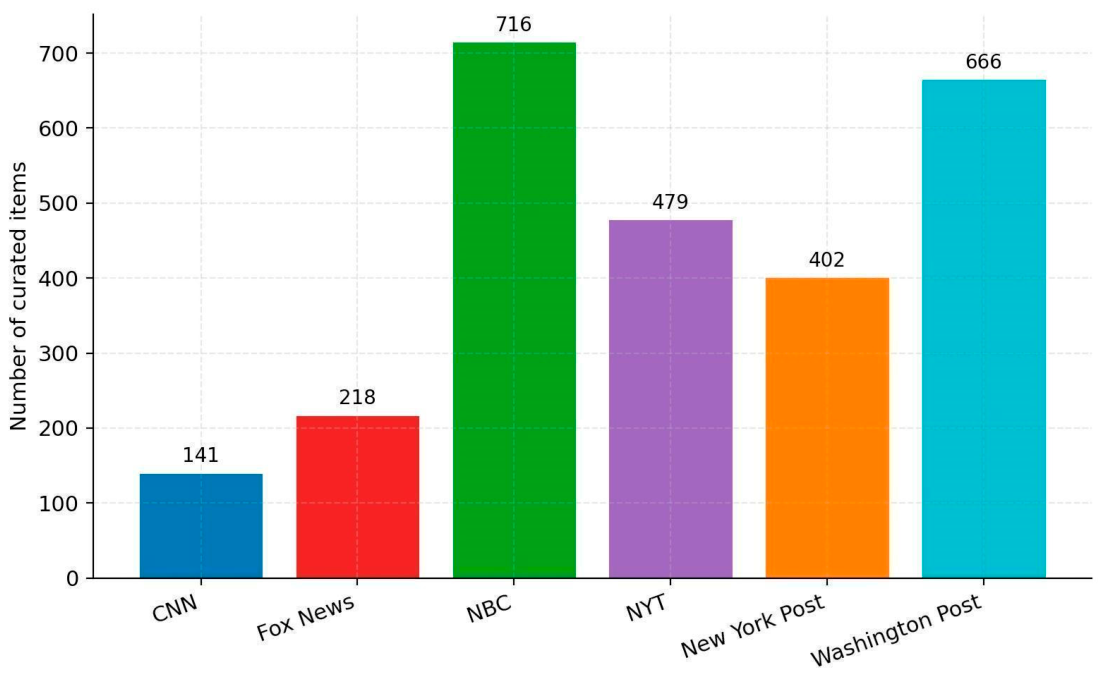
The quantity of curated content was assessed using a scoring system specific to this study, which is as follows: one point for between 1 and 309 pieces of curated content; two points for between 310 and 572 pieces; and three points for 573 or more links. Given the number of media outlets analyzed and the number of pieces of curated content from each outlet (see Table 2), it is most appropriate to divide the outlets into tertiles. This results in three distinct groups of media outlets based on the natural differences in the number of curated items observed. For example, there is a difference of 184 pieces between Fox News (218) and the New York Post (402), and a difference of 187 pieces between the New York Times (479) and the Washington Post (666). To determine the cutoffs between media outlets that receive one score or another, we calculated the midpoint between each group of media outlets: The midpoint between the low level, which receives one point, and the medium level, which receives two points, is 310. The midpoint between the medium level, which earns two points, and the high level, which earns three points, is 572.
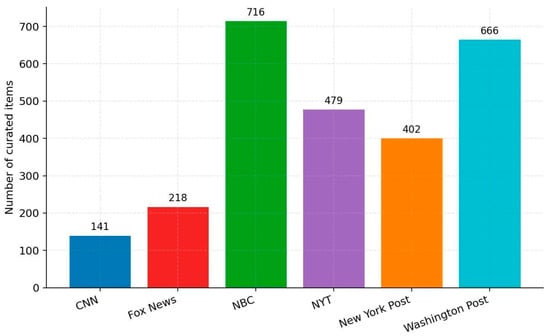
The media outlets with the most curated content are NBC (716) and the Washington Post (666), which both scored three points. Following them are the New York Times (479) and the New York Post (402), which received two points each. Fox News and CNN received one point each for having 218 and 141 pieces of curated content, respectively (Figure 1). With the exception of NBC, newspapers cover more content than television networks and rank second, third, and fourth. The New York Post deserves special mention. It published 294 posts; however, in 215 of them, the only curated content is a link to the author’s name. Therefore, these 215 posts are not considered curated posts; however, the published link is included in the total count of curated content. This explains why the outlet has only 79 curated posts but a total of 402 pieces of curated content: 215 of these are authors’ bylines, a phenomenon unique to this outlet.
Figure 1.
Total Volume of Curated Content by Media Outlet.
The average score per curated item is two points, ranging from 309 to 572 per news story. Quantitative analysis shows that the six documents analyzed contain a total of 2622 curated items, with an average of 436.66 per news story.
4.2.2. Time Range
There are five possible time ranges, for a maximum score of 5.
- Timeless content: The curated content contains multiple publication dates, such as tags linking to the article’s author, a news figure, or an entity, as well as social media profiles.
- Retrospective: The curated content is more than one month old relative to the analyzed news story.
- Recent: When the content is more than one day old but less than one month old.
- Current: Content published within the last 24 h.
- Real-time: Content published within the last hour relative to the publication time of the analyzed news story.
According to the qualitative analysis, all media outlets in this section perform excellently and achieve the maximum score because all time ranges are present.
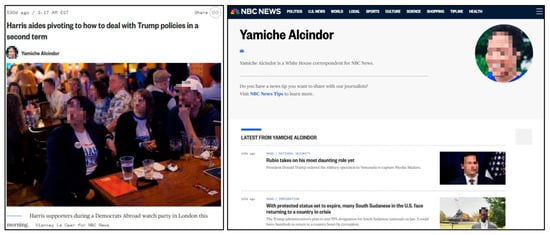
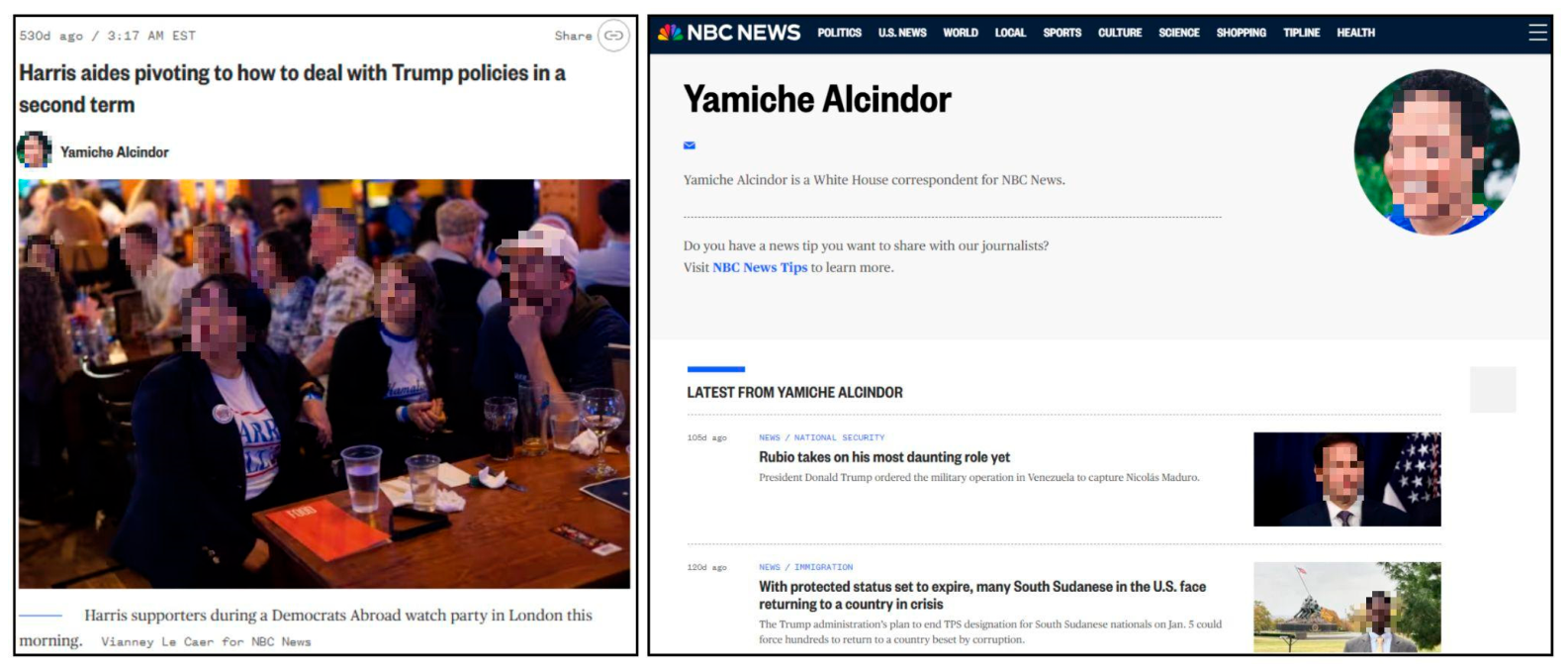
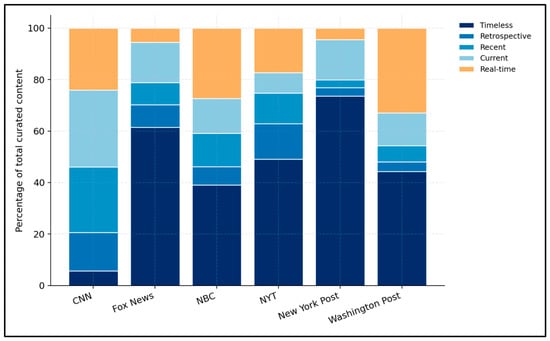
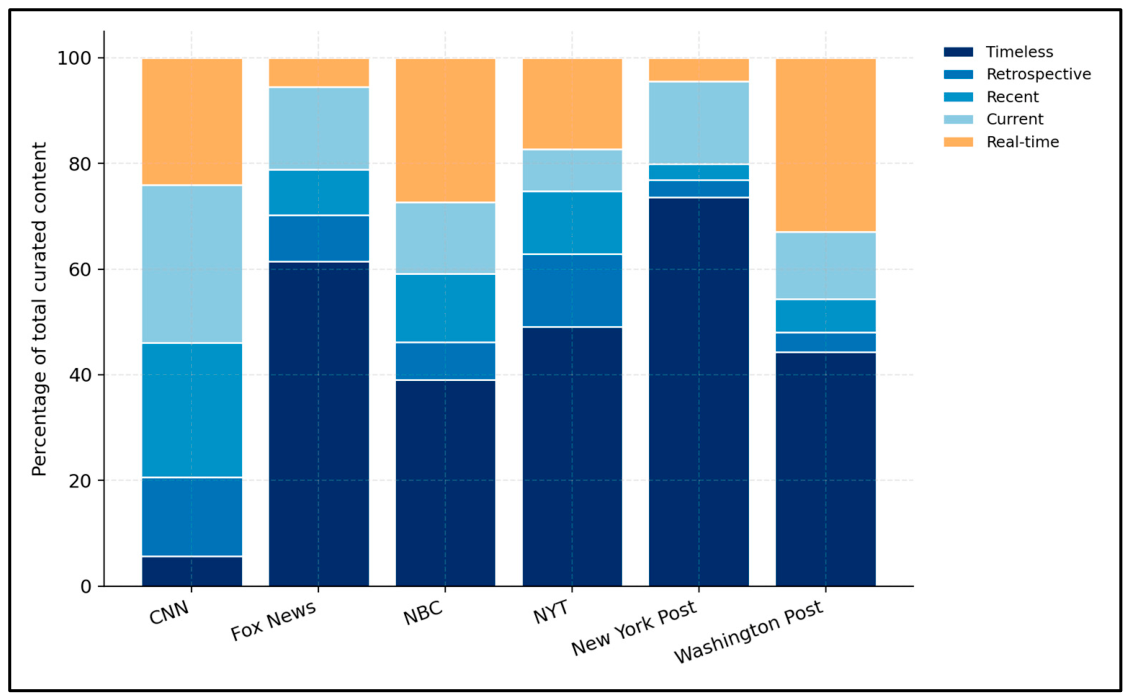
The quantitative analysis reveals important details about the temporal variables most frequently used by these media outlets. Notably, the timeless range accounts for nearly half of the content curated by all media outlets (1248 out of 2622, or 47.6%). This is because live blogging consists of a series of posts or entries by journalists from the outlet. Typically, the journalist’s name is a link to their profile page on the outlet’s website. This profile page contains all the news stories published by the journalist (Figure 2). Second, consistent with the nature of live news, real-time content stands out (562 entries, or 21.4%). Current content (13.6%), recent content (9.8%), and retrospective content (7.4%) have lower percentages that are close to one another (Figure 3).
Figure 2.
Post with the author’s name presented as curated content.
Figure 3.
Temporal Distribution of Curated Content by Media Outlet.
Notably, timeless content was the most prevalent category across all media outlets except CNN. There is significant variation: The New York Post and Fox News lead the way with 74% and 61.4%, respectively, while CNN barely reaches 5.6%. This difference is due to CNN never linking to the author’s name in the post, whereas the New York Post always does.
In the second most common time category, referred to as real-time which gives this type of news its name, the presence of curated content is minimal in two outlets: Fox News, with 5.5% of its content curated, and the New York Post, with 4.5%. CNN stands out with balanced use of current (29.7%), recent (25.5%), and real-time (24%) content.
4.2.3. Origin
We examined whether the curated content came from the outlet itself or external sources. A maximum score of two points was given per news item if both types of content were included. All six of the analyzed outlets received the maximum score of two in the qualitative analysis, which is not surprising given that these are extensive documents with a large amount of curated content.
However, the quantitative data indicate that the majority of the curated content—2343 out of 2622 items (89%)—is from the outlet itself, while only 277 items (10.5%) are from external sources. The New York Times (16%) and the New York Post (16.25%) lead the pack, while Fox News has only 1.8% of external content.
4.2.4. Sources by Type of Organization
Live blogging performs strongly in this category, earning an average score of 3.83 out of 4 across the four groups considered: media, official, corporate, and citizens. All media outlets scored 4 points except for Fox News, which scored 3 points because it does not curate any official content. The high proportion of official and corporate sources is different from other curated journalistic content. This may be because these election-monitoring documents often contain information about court rulings on the electoral process, official voter turnout figures, polls, announcements by electoral authorities regarding disruptions to voting schedules, and reports from law enforcement agencies on minor public order incidents.
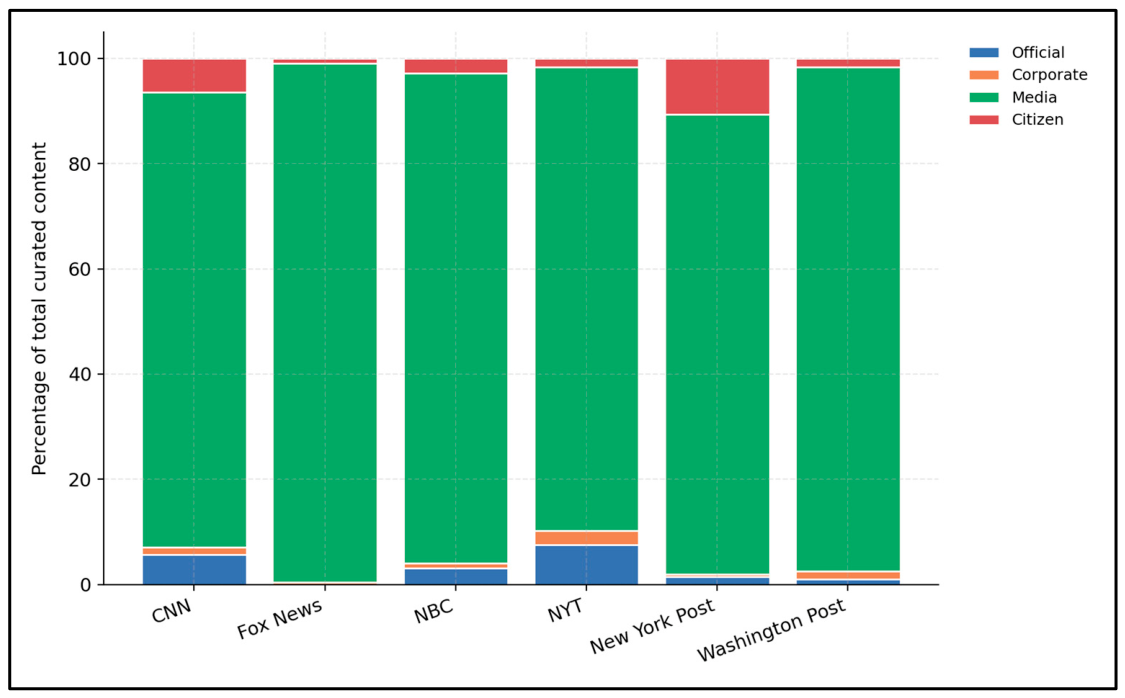
The quantitative analysis shows that media outlets are the most common source type, accounting for 92% (2413 out of 2622) of the curated content. Far behind are content from citizens and official sources, at 3.5% and 3%, respectively (Figure 4). Corporate sources rank last at 1.33%. Fox News stands out negatively as 98.6% of its content comes from media sources. It has no official content, and only a very small proportion comes from corporate and citizen sources. This indicates little variability in this parameter. In contrast, other media outlets are notable because despite having more than 85% of their content be from media sources, they have significant amounts of content from other source types. These include The New York Post, with 10.75% of its content coming from citizen sources (mostly links to the social media platform X); The New York Times, with 7.52% of its content coming from official sources; and CNN, with 6.38% from citizen sources and 5.67% from official sources.
Figure 4.
Source Origin by Type of Organization (%).
4.2.5. Sources by Morphology
The CAS method considers four types of sources in this parameter, with a maximum score of 4 points: websites, social networks, blogs, and secondary sources. The last two do not appear in the live blogging documents. Web and social media content, on the other hand, are present in all media outlets, which is why all of them receive a score of 2 in this section. This reflects a profound homogenization of content curation in this area.
Quantitative data confirms this, reflecting the absolute dominance of web content, which accounts for 95.5% of the total (2502 out of 2622), compared to 4.5% for social media. Fox News exhibits the least variety in types of sources, which reflects a lower degree of curation richness according to the principles of the CAS framework. Fox News has also the highest percentage of web content, at 98.6%. Conversely, The New York Post features a notable 11.5% social media content and consequently a lower percentage of web content (88.5%).
4.3. Analysis of the Curation Dimension
4.3.1. Techniques
This section analyzes techniques that add value to the curating process, known in the literature as “sense-making” (Deshpande, 2013; Guallar et al., 2022): summarizing (a primarily informative technique), commenting (opinion-based or interpretive), quoting (based on direct quotations from the original content), and storyboarding (linking pieces of different formats through narration). The maximum score in this section is 4 points.
In this section, we analyzed the full news article and each of its individual posts. It should be noted in the qualitative analysis of the full news story that live blogging news stories received medium-to-high scores, averaging 2.83 overall. All media outlets received one point for summarizing and quoting, two techniques consistently present across all outlets. Fox News and CNN did not use any other techniques, earning them a score of 2. The rest employed storyboarding, integrating different formats (text, photos, videos, graphics, and embedded posts). The Washington Post leads this category with a maximum score of 4 because it adds the commenting technique to the aforementioned methods.
Of the 853 curated posts analyzed, 93.1% (794) use the summarizing technique, 21.2% (181) “quote”, and only 0.9% (8) “comment”.4 Interestingly, at CNN, NBC, and the Washington Post, quoting never appears alone but always alongside summarizing. At the Washington Post, commenting appears on its own in six out of eight instances. Finally, summarizing appears frequently on its own across all media outlets and, on some occasions, is accompanied by quoting and, on two occasions, by commenting.
Except for the New York Times, which has 61% of its curated posts using “summarize”, the rest of the outlets have percentages very close to 100% (96.5–100%), with three of them using “summarize” for all their posts: CNN, Fox News, and NBC. The quoting technique shows more moderate numbers, with differences among outlets. The New York Times and the New York Post have around 40% of their posts using the summarizing technique, while Fox News and CNN have around a quarter of their posts using it. NBC (12.7%) and the Washington Post (6.8%) have lower figures. Commenting plays a minor role, with only 5% of posts in the Washington Post using this technique.
4.3.2. Function of Links
This section examines the informative function of each hyperlink to curated content within the live news story. It distinguishes the following options, based primarily on Cui and Liu (2017) and Guallar et al. (2021): “unmodified”, “describe” (sourcing curation), “contextualize” (contextualizing curation), “interpret” (interpreting curation), “cite source”, “cite author”, and “call to action”. One point is awarded for each category, for a maximum score of seven.
The functions used by all media outlets—and thus scoring one point in each category—are citing the content source and the author (by naming writers whose profiles are linked to personal pages) and describing curation. These are followed by “unmodified”, “call to action”, and contextualizing curation, all of which received a score of 0.83, meaning they were used by all media outlets except one. “Call to action” is particularly important in live news, as links frequently include phrases such as: “Continue reading” (The Washington Post), “Read the full/our story here” (NBC and CNN), and “Read more” (The New York Post). Interestingly, Fox News does not have a single call to action, and the New York Times uses it in only four instances with the phrase “learn more.”
On Election Day, contextualization is helpful. Explanations on how to cast a blank vote, how to check the voter rolls, and how to review results from previous elections provide context for the current elections. In other cases, links are provided to background information on Trump and his legal cases or to each candidate’s proposals. Finally, the most personal or opinion-based function, “interpret”, appears in three outlets with an average usage rate of 0.50: The Washington Post, NBC, and CNN. In any case, this function is practically negligible, with only a minimal amount of content. This leads us to conclude that live blogging, a format providing real-time information on voting or vote counting, is not the most appropriate space for content delving into in-depth analysis and interpretation, as the focus is on urgent, immediate information.
Quantitative data somewhat deepens the qualitative analysis: it shows that the top categories in terms of the number of curated items are citing the author (1074 curated items, 40.9% of the total) and sourcing curation (910 pieces, 34% of the total). However, citing the source, which also earned a point for appearing in all media outlets, lags far behind and ranks fourth in terms of the percentage of curated content (187 pieces, 7.1%). Therefore, it is worth noting that the top two variables (citing the author and sourcing curation) account for three-quarters of the curated content. Call to action ranks third quantitatively (229 pieces, or 8.7%), and unmodified ranks fifth (167 pieces, or 6.36%). Contextualizing (112, or 4.27%) and interpreting (7, or 0.2%) are very rare.
The average score for the six media outlets is 6 out of a possible 7, which indicates a high average. CNN, NBC, and the Washington Post stand out among the outlets with a perfect score of seven, demonstrating a wide variety of link uses. Close behind are the New York Times with 6 points (falling short only in interpreting curation) and the Washington Post with 5 points. The New York Post received a medium–high score of 5 points (it did not engage in contextualizing or interpreting curation), and Fox News received a medium score of 4 points (it fell short in unmodified, calls to action, and interpreting curation). Surprisingly, live news stories lack unmodified and call-to-action curated content. In the first case, since these articles are produced quickly, it would be easy to include the exact title of the curated content in the link. In the latter case, it is common to publish an excerpt or summary of a news story and provide access to the full story to drive traffic to the news outlet. Nevertheless, neither technique is used much.
The quantitative analysis explains why the qualitative scores for the outlets are as stated above. While outlets that score higher qualitatively (CNN, NBC, and the Washington Post) make balanced and diverse use of the functions, the other three outlets engage in more specialized and intensive curation of some functions. For example, 97% of Fox News’s curated content consists of sourcing curation. For the New York Times, sourcing curation and calls to action together account for 87% of its curated content. Finally, 71.64% of the New York Post’s curated content focuses on citing the author.
4.4. Media Ranking
As detailed in the Section 3, the overall curation quality score for each media outlet was calculated by adding the points earned across the two CAS dimensions (Content and Curation). Table 5 presents the final media ranking based on these aggregate scores. With a theoretical maximum score of 30 points, the Washington Post achieves the highest overall score of 28, because it curates a large amount of content, excels across all time frames of curation, sources (external and internal), and sources by type of organization, maintains great diversity in the use of links, and effectively manages sense-making. There are only two areas in which it falls short: secondary sources and blogs in the Sources by Morphology parameter.
Table 5.
Media ranking based on curation in live blogging coverage.
NBC has the same strengths as the Washington Post except in the sense-making parameter, which it does not address, causing it to trail by one point. The difference between the top two and the next three is that the latter have fewer curated items (especially CNN), and the New York Times and New York Post do not achieve the maximum score in the link function parameter. Fox News lags behind the other media outlets due to its lower number of curated items, failure to curate official content, and lowest score in the journalistic/informative treatment of links.
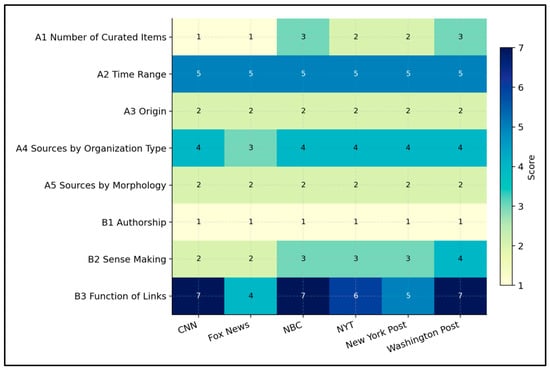
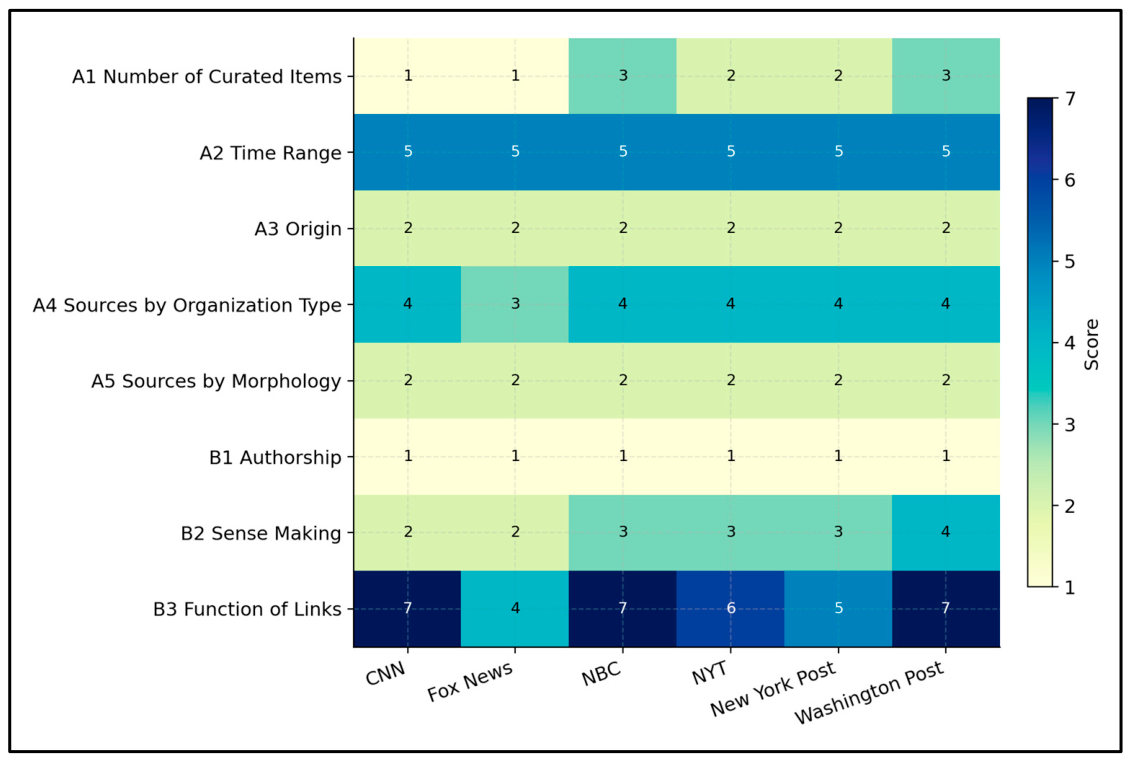
The final scores (Table 5) make it clear that the live blogging reports on the presidential election maintain a very high level of curation across the board because of their very nature as lengthy documents covering a major news event (Figure 5).
Figure 5.
Heatmap: Qualitative Scores by Category and Media Outlet.
Newspapers win by a narrow margin when compared to television networks; although they are interspersed in the rankings, newspapers take first, third, and fourth/fifth place, while television networks take second, fourth/fifth, and sixth place. Newspapers’ total score is 77, while television networks’ total score is 71.
It is also worth noting that CNN achieves a commendable third-place tie with The New York Times despite having the least curated content of all media outlets. It is particularly significant that CNN obtains the highest score in terms of time range, origin, sources by type of organization, and journalistic/news treatment, despite having little curated content.
5. Discussion and Conclusions
5.1. Large Documents with Curated Posts
In response to RG1, we can identify the characteristics of both the typical live blogging story and the typical live blogging post in the analyzed media.
A typical live blogging story covering the U.S. presidential election is a fairly extensive document with a high number of posts and pieces of curated content, with an average of 275 posts and 437 pieces of curated content. The document also exhibits excellent diversity in the time ranges of the curated content, its origins, and the sources of the content by type of organization. In contrast, sources are used with little variety by format, as web content predominates with limited social media presence, while blogs and secondary sources are nonexistent. A similar pattern emerges in sense-making techniques: most posts summarize curated content, and one-fifth cite it as well. Commenting is rare, and storyboarding is absent at the post level. However, it is present throughout the full live news story. Thus, four of the six analyzed media outlets include a variety of content formats. Finally, the journalistic treatment of links exhibits a wide variety of functions, with interpretive curation being the least used.
The typical live blogging post is a curated post (52%), with an average of 1.58 curated items per post. The time frame of curated content is typically timeless or real-time, and it is sourced from media organizations, mainly their own content, in web format, and attributed to an identified individual author; the curation technique most used is “summarizing”, and links frequently include author attribution and sourcing curation.
As was also observed in other studies, such as those on The New York Times newsletters (Guallar et al., 2026), gender parity in authorship is fairly balanced in live blogging stories. The New York Post is the exception among the analyzed media outlets, with only one in four authors being women.
5.2. High Level of Curation
In response to RG2, it can be stated that live news blogging of the U.S. presidential election maintained a high level of curation due to its inherent characteristics as extensive documents covering a major news event. All media outlets fall into curation quality levels considered high or medium–high.
The CAS ranking shows that the list is topped by prestigious media outlets, while the bottom is occupied by outlets that can be considered representative of populist or sensationalist journalism, such as Fox News and the New York Post. In this regard, we observe that media outlets with greater resources, a larger presence, and higher prestige among American audiences generally demonstrate greater gender parity and higher-quality curation in most of the aspects studied. In contrast, populist, sensationalist media outlets with a more limited sphere of influence, such as Fox News and the New York Post, generally receive lower CAS ratings. The New York Post is a prime example. It shows a lack of gender parity in authorship and relies much more heavily on photographs and content from the social media platform X than other outlets do. This could be due to its teams’ more limited capacity to cover Election Day. Fox News publishes very little content—only CNN publishes less—and offers little variety. For example, it does not publish official content, which would be consistent with its populist nature.
It is worth noting that the journalistic format of live blogging surpasses the average curatorial quality of newspaper articles (Guallar et al., 2025) and media newsletters (Guallar et al., 2026). Until now, newsletters had been considered the clearest example of journalistic curation (Silva-Rodríguez, 2021; Rojas Torrijos & González-Alba, 2018; Newman, 2020).
5.3. Little Difference Between Newspapers and TV Stations
Addressing the initial question of whether differing organizational structures and routines would lead to distinct curation strategies, our study’s comparison of television networks and digital newspapers (as for RG3) shows hardly any significant differences in how live news content is curated. This suggests that the live blog product standardizes journalistic routines regardless of the media outlet’s format.
This uniformity aligns with much of the literature addressing these formats, which does not distinguish between different types of media (Thurman & Walters, 2013; Matheson & Wahl-Jorgensen, 2020; Pantic, 2020). The only notable exception in our study is The New York Post, which, in keeping with its tradition as a tabloid newspaper, gives much greater prominence to photographs in its live news coverage.
5.4. A Growing Trend in Digital Journalism
When comparing our findings with recent research on media curation beyond live blogging, we observe that more sophisticated curation processes—characterized by greater source diversity and parameter variability—are increasingly present across the media landscape.
It could also be argued that there is a pattern of limited use of external sources. As the analysis of The New York Times’ newsletters showed (Guallar et al., 2026), the main goal of prioritizing links to in-house content seems to be retaining the audience, generating internal traffic, and increasing visits to the outlet’s website. This trend is more prevalent in legacy media than in native digital media (Guallar et al., 2022). The results of this study would confirm that this trend of prioritizing their own content is maintained by media outlets in live blogging.
When links to external content are shared on social media, X (formerly Twitter) is the clear favorite. Based on this study, it can even be concluded that the use of this social media platform appears to be inversely proportional to the size of the media outlet: news organizations with smaller teams use X more frequently than major publications, which use it less. In our case, this can be illustrated by the difference in X usage between The New York Post (high) and The New York Times (lower).
Furthermore, in the curation of most products, genres, and media formats analyzed thus far using the CAS method, X has the greatest presence when externally curated content from social media is included. This has been evident on newspaper front pages (Guallar et al., 2025), in library publications (Guallar, 2016), and in various types of newsletters, including independent ones (J. D. Cascón-Katchadourian et al., 2022), those specializing in the Coronavirus (Guallar et al., 2022), and those from a single media outlet, such as The New York Times (Guallar et al., 2026).
5.5. Election Day Live Blogging Scores Higher in U.S. Than in Spain
Specifically focusing on live blogging coverage of Election Day, our findings can be set against those of J. Cascón-Katchadourian et al. (2025), the only study we identified that analyzes the curation of live coverage in digital media during election periods. The two studies were not designed for cross-national comparison, so any parallels are suggestive only. Even so, the results differ in several respects, most clearly in the volume of curated content. This study focused on live news coverage of the 2023 Spanish elections in eight digital outlets. U.S. media outlets have a much higher average number of curated items per news story than Spanish media outlets do (437 versus 69.6).
Live news coverage by U.S. media outlets receives higher overall CAS scores (24.67 versus 20.63) and stands out in various analyzed curation characteristics, such as the variety of time frames of the curated content, its origin, and the sources by organization. Some differing priorities are also evident in both cases. U.S. outlets primarily link to timeless (47%) and real-time (21%) content, while Spanish outlets rely heavily on current (63%) and, to a lesser extent, timeless (16%) content. Regarding links, U.S. outlets prioritize citing authors and the descriptive function of sourcing, while Spanish outlets use the various functions more evenly.
Despite these contextual and methodological differences, both studies point to a common pattern: curation in live blogging relies almost exclusively on the web format and on original content produced by media outlets.
5.6. Implications for Contemporary Digital Journalism Practice
The findings of this study offer significant insights for contemporary journalistic practice. First, when compared to the Spanish electoral context, the quantitative differences in curated content suggest that U.S. media outlets allocate greater staff resources to live blogging, driven by the critical importance of U.S. presidential elections.
For newsrooms, this format demonstrates a capacity to deliver a level of depth and richness that is comparable to, or even exceeds, that of newsletters. However, a greater volume of publications or posts does not necessarily equate to higher quality; in fact, it can become counterproductive by causing information overload, which underscores the need for structural balance.
Furthermore, this analysis reveals a clear tension between commercial considerations and product quality; while U.S. media outlets prioritize internal traffic to retain users and build audience loyalty—at the expense of source diversity—Spanish media incorporate more external links but experience reduced engagement. Consequently, these dynamics present clear practical implications for media management: journalistic quality depends not only on volume, but on strategic curation, which can be enhanced by integrating external sources to increase credibility and informational value, even if it compromises short-term traffic.
5.7. Recommendations
While the descriptive analysis demonstrates that live election blogging achieves high overall curation scores within the CAS method, the findings also highlight specific areas where curatorial practices remain relatively homogeneous, such as a heavy reliance on in-house content, web formats, media-centric sources, and descriptive summarization techniques. Although our empirical data do not support prescriptive conclusions, these descriptive patterns suggest several potential avenues that newsrooms might consider to enrich live coverage, subject to further empirical validation.
To reduce informational inbreeding and expose readers to content from outside the outlet, newsrooms might consider gradually incorporating a broader variety of external sources, such as official institutions, corporate entities, or secondary sources, as well as exploring social media curation beyond X.
Additionally, incorporating a greater variety of visual and interactive formats, such as data visualizations and embedded social media posts, would enhance the live blogging format. These formats would allow for a greater presence of both the public (via social media, as noted earlier) and data journalists who provide real-time visualizations.
Considering the almost exclusive use of summarization, which is descriptive of news coverage, newsrooms could experiment with commentary curation to integrate expert analysis. Similarly, increasing the use of contextualizing and interpreting link functions could add explanatory depth to fast-paced breaking coverage.
Given the exploratory nature of these suggestions, further empirical validation, as outlined in the following section, would be necessary to determine their actual impact on news quality.
5.8. Limitations and Future Research Directions
Finally, we highlight some of this study’s limitations and suggest possible future research directions to further consolidate academic knowledge of journalistic curation in general and the live blogging format in particular.
One limitation of this study is its small sample size. Future research on live blogging should expand the sample size by analyzing a larger number of media outlets. In particular, studies should be conducted on radio station websites, as they have not yet been analyzed. Additionally, it would be interesting to extend these studies to media outlets from other countries.
Another limitation of this study is the analysis method used, CAS, which does not capture the full complexity and challenges of curation in media outlets’ journalistic products. It would be appropriate to use other methods to complement CAS studies, such as surveys of media readers or interviews with editorial journalists.
This study offers insight into how journalists curate and structure content on live blogs. However, it does not assess how readers receive or are impacted by these practices. Future research should examine the audience’s perspective by exploring how variability in curation and diversification of content sources influence users’ perceptions, engagement, knowledge acquisition, and perceived quality. Such studies would aid in decision-making on the production side based on audience-side findings.
Additionally, our comparison with prior research on Spanish digital media (J. Cascón-Katchadourian et al., 2025) is exploratory: the two studies differ in sample design and national context, so cross-national generalizations should be made with caution.
Lastly, this study’s characterization of live blogs is limited because they were examined exclusively in the context of election coverage. Therefore, its conclusions cannot be extrapolated—or should be extrapolated with great caution—to other news events. It is essential to investigate how curatorial practices are applied in live news coverage of other relevant events, such as major sporting or cultural events, emergency situations, and unexpected news stories.
Supplementary Materials
The following supporting information can be downloaded at: https://www.mdpi.com/article/10.3390/journalmedia7040235/s1.
Author Contributions
Conceptualization, J.G. and J.C.-K.; Methodology, J.G. and J.C.-K.; Validation, J.C.-K., P.F. and J.G.; Formal Analysis, J.C.-K.; Investigation, J.C.-K., J.G., and P.F.; Data Curation J.C.-K.; Writing—Original Draft, J.C.-K., P.F. and J.G.; Writing—Review & Editing, J.G. and P.F.; Supervision, J.G., J.C.-K. and P.F. All authors have read and agreed to the published version of the manuscript.
Funding
This research was supported by the project “Quality and effective dissemination of digital information in media outlets and cultural institutions to promote more inclusive societies (CADEMIC)” funded by MICIU/AEI PID2025-172242OB-I00.
Institutional Review Board Statement
Due to the nature of the study, which focuses solely on textual material published online by six US media outlets during the 2024 US election and therefore encompasses the total absence of personal data utilisation, the study was deemed exempt from Ethics Committee approval in accordance with Spain’s scientific research regulations, which limit this approval to biomedical research (Act 14/2007 of 3 July on Biomedical Research, art. 2.1 e).
Informed Consent Statement
Informed consent was not required because this study did not involve human participants. The research was based on the analysis of publicly available media content published by news organizations.
Data Availability Statement
The data presented in the study are openly available at https://tinyurl.com/yc5fvkmc (accessed on 7 July 2026).
Acknowledgments
The authors would like to acknowledge the contributions of our colleagues, Carlos Lopezosa and Francisco José Segado Boj, to this research project. Lopezosa is a member of the Center for Research in Information, Communication, and Culture (CRICC) at the Faculty of Information and Audiovisual Media at the University of Barcelona in Barcelona, Spain. Francisco José Segado is a researcher in Communication at the Universidad Complutense in Madrid, Spain.
Conflicts of Interest
The authors declare no conflicts of interest.
Appendix A
Table A1.
Krippendorf’s Alpha analysis.
Notes
| 1 | However, The Guardian humorously suggests that it published its first live blog as early as 1923—a piece that provided “hour-by-hour” coverage of that year’s general election (Owen, 2012). |
| 2 | Scimagolab, a Spanish media research group composed of experts such as Ramón Salaverría, Lluís Codina, Félix de Moya Aragón, and Magdalena Trillo-Domínguez, compiles the Scimago ranking. The group conducts studies on the reputation of more than 6600 media outlets from 200 countries and in 90 languages. For its Media Web Reputation Ranking, Scimagolab uses data from the metrics tools Semrush and Majestic. The research group says, “Using four metrics—Authority Score, Referring Domains, Citation Flow, and Trust Flow—each weighted equally at 25%, we construct an overall indicator that reflects media websites’ digital reputation.” Scimago Media Rankings (2024). Accessed on 16 May 2026. |
| 3 | A post is considered curated when it contains curated content within the body of the post. A post is not considered curated if the only curated content is the author’s profile. This occurs when the post is signed by a writer for the publication and the writer’s name includes a link to their personal website within the publication (see Figure 1). Therefore, when analyzing the total number of curated items, links from the post authors are taken into account; however, when analyzing curated posts, they are not. This is because the author link is considered automated. Consequently, if there are no other links, the post in question is considered uncurated, given that there is no journalistic curation of any kind. |
| 4 | Note that a single post may use two techniques, which explains why the sum of the percentages exceeds 100 and the number of posts exceeds 853. |
References
- Bhargava, R. (2009). Manifesto for the content curator: The next big social media job of the future? Available online: https://rohitbhargava.com/manifesto-for-the-content-curator-the-next-big-social-media-job-of-the-future/ (accessed on 28 June 2026).
- Bruns, A. (2018). Gatewatching and news curation: Journalism social media and the public sphere. Peter Lang. [Google Scholar] [CrossRef] [Scilit]
- Bruns, A., & Highfield, T. (2012). Blogs, Twitter, and breaking news: The produsage of citizen journalism. In R. A. Lind (Ed.), Producing theory in a digital world: The intersection of audiences and production in contemporary theory (pp. 15–32). Volume 80: Digital Formations. Peter Lang Publishing. Available online: https://snurb.info/files/2012/Blogs,%20Twitter,%20and%20Breaking%20News.pdf (accessed on 26 June 2026).
- Cascón-Katchadourian, J., Guallar, J., Lopezosa, C., & Boté-Vericad, J. J. (2025). Content curation in live news. The case of the 2023 election days in Spain. Estudios Sobre el Mensaje Periodístico, 31(1), 15–26. [Google Scholar] [CrossRef] [Scilit]
- Cascón-Katchadourian, J. D., Boté-Vericad, J. J., & Guallar, J. (2022). Curación de información con marca de autor: Análisis de newsletters independientes. Revista Española de Documentación Científica, 45(4), e339. [Google Scholar]
- Cui, X., & Liu, Y. (2017). How does online news curate linked sources? A content analysis of three online news media. Journalism, 18(7), 852–870. [Google Scholar] [CrossRef] [Scilit]
- Deshpande, P. (2013). Six content curation templates for content annotation. The Curata Blog. Available online: https://curata.com/blog/6-content-curation-templates-for-content-annotation/ (accessed on 28 June 2026).
- Díaz-Arias, R. (2015). Curaduría periodística, una forma de reconstruir el espacio público. Estudios Sobre el Mensaje Periodístico, 21, 61–80. [Google Scholar] [CrossRef] [Scilit]
- Gans, H. J. (2004). Deciding what’s news: A study of CBS evening news, NBC nightly news, newsweek, and time. Northwestern University Press. [Google Scholar]
- Good, R. (2023). Real-time news curation—The complete guide. Part, 4: Process, key, tasks, workflow. Available online: https://bit.ly/4bjwPzW (accessed on 28 June 2026).
- Guallar, J. (2016). Curación de contenidos en bibliotecas mediante plataformas social media. ThinkEPI Yearbook, 10, 142–151. [Google Scholar] [CrossRef] [Scilit][Green Version]
- Guallar, J., Cascón-Katchadourian, J., Lopezosa, C., & Boté-Vericad, J. J. (2025). News curation in digital media: Analysis of four newspapers’ front pages. Journalism and Media, 6(3), 97. [Google Scholar] [CrossRef] [Scilit]
- Guallar, J., & Codina, L. (2018). Journalistic content curation and news librarianship: Differential characteristics and necessary convergence. El Profesional de la Información, 27(4), 778–791. [Google Scholar] [CrossRef] [Scilit]
- Guallar, J., Franch, P., Boté-Vericad, J.-J., & Anton, L. (2022). How do legacy and digital media curate coronavirus content. An assessment of newsletters from the USA and four European countries. Profesional de La Información, 31(3), 310318. [Google Scholar] [CrossRef] [Scilit]
- Guallar, J., Franch, P., Cascón-Katchadourian, J., & Boté-Vericad, J. J. (2026). The Rise of Curated Newsletters in Media: A Case Study of the New York Times. Journalism Practice, 20(8), 2536–2557. [Google Scholar] [CrossRef] [Scilit]
- Guallar, J., Pedraza-Jiménez, R., Pérez-Montoro, M., & Antón, L. (2021). Curación de contenidos en periodismo. Indicadores y buenas prácticas. Revista Española de Documentación Científica, 44, 2. [Google Scholar] [CrossRef] [Scilit]
- Guerrini, F. (2013). Newsroom curators & independent storytellers: Content curation as a new form of journalism. Reuters Institute. Available online: https://bit.ly/3MMOrIO (accessed on 28 June 2026).
- Hermida, A. (2010). TWITTERING THE NEWS: The emergence of ambient journalism. Journalism Practice, 4(3), 297–308. [Google Scholar] [CrossRef] [Scilit]
- Hu, M., Liu, S., Wei, F., Wu, Y., Stasko, J., & Ma, K.-L. (2012, May 5–10). Breaking news on twitter. Proceedings of the SIGCHI Conference on Human Factors in Computing Systems (pp. 2751–2754), Austin, TX, USA. [Google Scholar]
- Jane, E. A. (2017). Misogyny online: A short (and brutish) history. SAGE Publications. [Google Scholar]
- Jay, E. E. (1973). News from Nowhere: Television and the News. Random House. [Google Scholar]
- Krippendorf, K. (2004). Content Analysis: An Introduction to its Methodology. Sage. [Google Scholar]
- Lopezosa, C., Guallar, J., Codina, L., & Pérez-Montoro, M. (2023). Content curation and journalism: Scoping review and expert opinion. Revista Mediterránea de Comunicación/Mediterranean Journal of Communication, 14(1), 205–223. [Google Scholar] [CrossRef] [Scilit]
- Matheson, D., & Wahl-Jorgensen, K. (2020). The epistemology of live blogging. New Media & Society, 2(22), 300–316. [Google Scholar] [CrossRef] [Scilit]
- Mayerhöffer, E., Kristensen, J. B., & Ramsland, T. (2024). Curators of digital counterpublics: Mapping alternative news environments in Sweden and Denmark. Nordicom Review, 45(S1), 92–119. [Google Scholar] [CrossRef] [Scilit]
- Newman, N. (2020). The resurgence and importance of email newsletters. In N. Newman, R. Fletcher, A. Schulz, A. Simge, & R. K. Nielsen (Eds.), Reuters institute digital report 2020. Reuters Institute for the Study of Journalism. Available online: https://reutersinstitute.politics.ox.ac.uk/digital-news-report/archive/survey/2020/the-resurgence-and-importance-of-email-newsletters/index.html (accessed on 28 June 2026).
- Osório, M., & Vieira, L. (2021). Uma reflexão sobre o método da curadoria a partirda newsletter Farol Jornalismo. In Anais 19° Encontro nacional de pesquisadores em jornalismo. Galoá. SBPJor. Available online: https://proceedings.science/encontros-sbpjor/sbpjor-2021/trabalhos/uma-reflexao-sobre-o-metodo-da-curadoria-a-partir-da-newsletter-farol-jornalismo?lang=pt-br (accessed on 28 June 2026).
- Owen, P. (2012, October 28). When was the first blog? 1923, it seems. The Guardian. Available online: https://www.theguardian.com/media/shortcuts/2012/oct/28/when-first-live-blog-1923 (accessed on 12 May 2026).
- Ozer, A. L. (2023). Women experts and gender bias in political media. Public Opinion Quarterly, 87(2), 293–315. [Google Scholar] [CrossRef] [Scilit] [PubMed]
- Pantic, M. (2020). Engagement with live blogs: When passive consumption overpowers participation. Electronic News, 14(1), 22–36. [Google Scholar] [CrossRef] [Scilit]
- Patterson, T. E. (2000). Doing well and doing good: How soft news and critical journalism are shrinking the news audience and weakening democracy–and what news outlets can do about it. Shorenstein Center on Media, Politics and Public Policy. [Google Scholar]
- Rojas Torrijos, J. L., & González-Alba, J. A. (2018). La newsletter como producto periodístico en la búsqueda de nuevos lectores. Estudio de boletines de noticias de El País, El Español y El Independiente. AdComunica, 165–195. [Google Scholar] [CrossRef] [Scilit]
- Scimago Media Rankings. (2024). Media web reputation ranking. 2024 winter edition. Available online: https://www.scimagomedia.com/rankings.php?country=United%20States&edition=2024_03 (accessed on 16 May 2026).
- Silva-Rodríguez, A. (2021). Emergencia de newsletters especializadas en COVID-19: Información curada y actualizada en el email. Profesional de la Información, 30(4). [Google Scholar] [CrossRef] [Scilit]
- Thorsen, E. (2013). Live blogging and social media curation: Challenges and opportunities for journalism. In K. Fowler-Watt, & S. Allan (Eds.), Journalism: New challenges (pp. 123–145). Centre for Journalism & Communication Research (CJCR), Bournemouth University. [Google Scholar]
- Thorsen, E., & Jackson, D. (2018). Seven characteristics defining online news formats: Towards a typology of online news and live blogs. Digital Journalism, 6(7), 847–868. [Google Scholar] [CrossRef] [Scilit]
- Thorson, K., & Wells, C. (2015). How gatekeeping still matters: Understanding media effects in an era of curated flows. In T. P. Vos, & F. Heinderyckx (Eds.), Gatekeeping in transition (pp. 25–44). Routledge. [Google Scholar]
- Thorson, K., & Wells, C. (2016). Curated flows: A framework for mapping media exposure in the digital age. Communication Theory, 26(3), 309–328. [Google Scholar] [CrossRef] [Scilit]
- Thurman, N., & Rodgers, J. (2014). Citizen journalism in real time: Live blogging and crisis events. In E. Thorsen, & S. Alla (Eds.), Citizen journalism: Global perspectives, volume 2 (pp. 81–95). Peter Lang. Available online: https://openaccess.city.ac.uk/id/eprint/3633/1/live-blogging-and-crisis-events.pdf (accessed on 28 June 2026).
- Thurman, N., & Walters, A. (2013). Live blogging–digital journalism’s pivotal platform? A case study of the production, consumption, and form of Live Blogs at Guardian.co.uk. Digital Journalism, 1(1), 82–101. [Google Scholar] [CrossRef] [Scilit]
- Upmanyu, K. (2024). Re-humanising news: Delineating the trends and research scope for curatorial journalism. Studies in Media and Communication, 12(1), 33–41. Available online: https://redfame.com/journal/index.php/smc/article/view/6255 (accessed on 26 June 2026). [CrossRef] [Scilit]

Disclaimer/Publisher’s Note: The statements, opinions and data contained in all publications are solely those of the individual author(s) and contributor(s) and not of MDPI and/or the editor(s). MDPI and/or the editor(s) disclaim responsibility for any injury to people or property resulting from any ideas, methods, instructions or products referred to in the content. |
© 2026 by the authors. Licensee MDPI, Basel, Switzerland. This article is an open access article distributed under the terms and conditions of the Creative Commons Attribution (CC BY) license.