


Abstract
This study examines hashtagging practices among six selected Arab influencers on Instagram and Twitter/X, focusing on hashtag function, placement, length, and language choice. Drawing on an exploratory content-analytic design, it analyses 3208 hashtag-level observations from 733 posts produced between 2016 and 2021. The study treats hashtags as platformed multilingual resources rather than as simple indexing devices. The findings show that functional hashtags dominate the dataset, but entertaining, inspirational, spiritual, and advertisement-related hashtags also reveal how influencers use hashtags to signal stance, create audience proximity, mark cultural and religious affiliation, and support commercial or lifestyle visibility. Platform differences are also evident: Instagram hashtags are mostly appended, short, and frequently in English, while Twitter/X hashtags are more often embedded, longer, and predominantly Arabic. Language choice further shows how Arabic, English, dialectal Arabic, and transliterated forms perform different identity and visibility functions. Overall, the study shows that Arab influencers’ hashtag usage is not merely a search tool but a reflection of digital identity and cultural discourse.
1. Introduction
Hashtags are a central element of social media communication (Rauschnabel et al., 2019). They are motivated by the need to organise content, support searchability, connect posts to wider conversations, and contribute to meaning-making. Although hashtags were initially associated with indexing and content retrieval, research has shown that they also function as discursive resources through which users express stance, affiliation, humour, affect, identity, and visibility. These functions are especially relevant in influencer discourse, where communication depends on audience engagement, platform visibility, self-presentation, and branding.
This article treats influencers as platformed communicative actors rather than as a unified social group. Influencers use language, images, captions, hashtags, and platform conventions to construct public personae and maintain visibility within competitive social media environments. However, while hashtag research has examined communicative and identity-related uses of hashtags, much of this work remains weighted toward English-language and Western social media contexts. Similarly, influencer studies often focus on commercial visibility, authenticity, branding, and audience engagement, with less attention to hashtagging as multilingual discourse. Arab influencers remain underexamined in this respect, despite operating across Arabic, English, dialectal Arabic, transliterated forms, religious and cultural references, and platform-specific visibility norms.
This article presents an exploratory comparative case study of hashtagging practices among six selected Arab influencers on Instagram and Twitter/X. It does not attempt to generalise about Arab influencers as a whole. Instead, it examines how hashtags operate in selected cases as platformed multilingual resources. The article argues that hashtagging among these influencers is not simply a mechanism of content indexing. Across the dataset, hashtags organise posts, support visibility, signal stance, mark cultural and religious affiliation, enable branding, and mediate between local, regional, and transnational audiences. These practices vary by platform and by individual influencer style, which makes a case-study approach appropriate for the aims of the study. More specifically, the paper addresses these research questions:
- RQ1:
- What communicative functions do hashtags perform in the posts of the selected Arab influencers?
- RQ2:
- What platform-specific and case-specific patterns emerge in the hashtagging practices of the selected influencers, including hashtag placement and length?
- RQ3:
- What do language choices in hashtags, including Arabic, English, dialect, and mixed forms, suggest about multilingual digital identity in the selected accounts?
The article makes three contributions. First, it extends research on hashtags beyond predominantly English-language and Western social media contexts by examining selected Arab influencers whose hashtagging practices draw on multiple language varieties and various functions. Second, it reframes influencer hashtagging as a platformed communicative practice through which visibility, stance, branding, and identity are negotiated. Third, it develops a transparent coding framework for analyzing hashtag function, language, placement, and form in multilingual influencer discourse. Because the study is based on a purposive sample of six influencers, its contribution is analytical rather than statistically generalisable: it identifies patterns and interpretive possibilities that can inform larger-scale future research on Arabic and multilingual digital discourse.
2. Literature Review
2.1. Hashtags as Searchable and Platformed Discourse
Since their inception in 2006 (Bruns & Burgess, 2011), hashtags were first associated with the technical organisation of social media content, allowing users to mark posts with searchable labels that connect them to wider streams of discussion. Early work on Twitter/X showed that hashtags could gather otherwise dispersed users around shared events, topics, or issues, producing what Bruns and Burgess (2011) describe as “ad hoc publics.” Related studies have examined hashtags as mechanisms for topic aggregation, information retrieval, event tracking, and public participation (Bruns & Burgess, 2015; Caleffi, 2015; Shapp, 2014; Yang et al., 2012). This indexing function remains central to hashtag use, since hashtags make posts retrievable and allow users to enter platform-specific systems of visibility. However, subsequent linguistic and discourse-oriented research has shown that hashtags should not be understood only as metadata. They are also meaning-making resources that shape how posts are interpreted (Scott, 2015; Wikström, 2014; Zappavigna, 2015, 2018).
Zappavigna’s work on “searchable talk” and “ambient affiliation” is especially useful for understanding this broader function. For Zappavigna (2015, 2018), hashtags make discourse searchable while also allowing users to affiliate with values, topics, identities, emotions, or publics without necessarily entering direct interaction. A hashtag can therefore identify the topic of a post, but it can also signal stance, belonging, humour, evaluation, affect, or cultural affiliation. This is relevant to influencer discourse because influencers often address large and partly imagined audiences, and hashtags allow them to position their posts within searchable and socially meaningful spaces. Scott (2015) similarly argues that hashtags can operate pragmatically by guiding inference, adding evaluative meaning, or reframing the relation between the post and its audience. Wikström (2014) shows that hashtags perform several communicative functions beyond categorization, including metacommentary, parenthetical explanation, humour, and interpersonal positioning. Laucuka (2018) also identifies multiple hashtag functions, including attitude expression, irony, commentary, metadata, and broader worldview marking.
This body of research provides the basis for treating hashtag function as a central analytical variable, which is often context-dependent. Platform context, for example, shapes how hashtags are used. Twitter/X has historically been associated with real-time public conversation, trending topics, news events, political debate, and live commentary (Bruns & Burgess, 2015; Rambukkana, 2015; Zappavigna, 2018). Hashtags on this platform often enter the syntactic structure of posts or function as part of public-facing commentary. Instagram, by contrast, is more strongly associated with visual content, lifestyle display, discoverability, and influencer branding (Cotter, 2019; Ting et al., 2015; Veszelszki, 2017). On Instagram, hashtags are often appended to captions as clusters that support search, visibility, and content categorization. Veszelszki (2017) identifies different Instagram hashtag types, including thematizing tags, like-hunter tags, and contextualizing tags, which point to the way Instagram hashtags move between categorization, visibility-seeking, and personal expression. Research on platform affordances also suggests that communicative practices cannot be separated from the technical and social architecture of platforms (Boyd, 2010; Bucher, 2018; Gillespie, 2018).
The distinction between embedded and appended hashtags has been studied both from the linguistic and the computational perspectives. Embedded hashtags participate more directly in the syntax and interpretation of a post, while appended hashtags often function as post-caption metadata, search markers, or visibility devices, as Caleffi (2015) explains. From a computational point of view, hashtag placement is seen as an indicator of users’ sentiments and personality traits. Celli and Zaga (2013), for example, used a Twitter/X corpus to map user behavior against automated sentiment tagging. Hashtag length is also significant. Short hashtags tend to work as broad and reusable labels, while longer multiword hashtags often operate as slogans, campaign labels, jokes, compressed evaluations, or identity statements. Length can therefore indicate a difference between general discoverability and more specific expressive or affiliative work. Wang and Zheng (2014), for example, studied hashtag diffusion on Twitter/X and broke down the exact character and word lengths of popular vs. rare hashtags, establishing that shorter tags enjoy sustained, multi-year lifecycles while longer, multi-word tags experience immediate, single-spike decay. Caleffi (2015), on the other hand, analysed the morpho-syntactic features of hashtags, specifically looking at how multi-word phrases are compressed grammatically into single orthographic units. She argued that when users create long hashtags, they are intentionally trading away standard reading mechanics to bake complex commentary, irony, or precise metadata directly into a single compressed token.
Within digital communication studies, the placement and textual length of hashtags in influencer accounts have been studied as critical signifiers of user categorisation and algorithmic performance. When considering structural placement, research indicates a strategic division in user behavior: while novice or lower-tier influencers often embed highly contextualized hashtags within the body of their text to alter sentence syntax, established influencers systematically favour appending hashtags cleanly at the end of a thought or isolating them within subsequent comment fields to minimize caption clutter and preserve an aesthetic of organic authenticity (Omena et al., 2020; Kay et al., 2020). Concurrently, the composition and length of the hashtag string heavily dictate visibility across platform indices. Quantitative analysis of smaller-scale, highly targeted accounts reveals that the utilisation of short, concise, and informative keyword indices significantly maximizes digital reach and discoverability; while the usage of excessively long, multi-word, and self-presenting phrase combinations complicates computational processing and reduces overall audience transmission (Sun et al., 2022).
2.2. Influencer Hashtagging and Multilingual Digital Identity
The relevance of hashtags becomes more pronounced in influencer discourse, where visibility, recognition, audience engagement, and persona construction are central to communication. Influencers are not treated here as a homogeneous social group, but as platformed communicative actors whose public presence depends on repeated practices of self-presentation. Research on micro-celebrity and self-branding has shown that influencers cultivate recognizable personae through recurring forms of address, lifestyle display, intimacy, expertise, aspiration, and commercial association (Abidin, 2018; Khamis et al., 2017; Marwick, 2015; Page, 2012). Hashtags are part of this work because they help influencers make themselves, their content categories, their values, and their brand partnerships more visible and recognisable.
Page’s (2012) work on self-branding and micro-celebrity is particularly relevant because it links hashtagging to the linguistic construction of an online persona. Hashtags can mark the themes through which an influencer wishes to be found, the communities with which they affiliate, and the commercial or lifestyle fields in which they operate. Abidin’s (2016, 2018) work on visibility labour similarly shows that influencer communication involves sustained effort to remain visible to audiences and platforms. Cotter’s (2019) concept of the “visibility game” adds an important platform dimension, showing that influencers often adapt their practices to perceived algorithmic and platform norms. In this context, hashtagging becomes a visibility practice, a branding device, and an audience-orientation strategy. Studies of influencer marketing also show that social media influence depends on credibility, trust, expertise, audience relations, and commercial association (De Veirman et al., 2017; Rauschnabel et al., 2019).
Research on Arab influencers is growing, particularly in Gulf contexts where influencers have been studied in relation to consumer behaviour, national branding, gendered self-presentation, authenticity, modest fashion, religion, and platform governance. Hurley’s (2019) study of female Gulf-Arab Instagram influencers, for example, connects influencer authenticity to Instagram affordances, sociocultural norms, and globalized commercial practices. Recent studies have also examined Arab and Gulf influencers through consumer behaviour and purchase intention (Alharthi et al., 2026; Alsalloum & Gainous, 2025), national image and digital diplomacy (Salim & Salamah, 2025), religious authority and Islamic practice (Zaid et al., 2022), and self-branding in Arab influencer profiles (Alangari & Olwi, 2026). However, less attention has been paid to Arab influencers as producers of analysable multilingual discourse, and even less to hashtags as a specific linguistic resource within that discourse.
This gap is significant because Arab influencer communication is shaped by multilingual and multidialectal repertoires. Arabic, English, dialectal Arabic, transliterated Arabic, and mixed forms can all appear within the same platform environment, but they do not necessarily perform the same tasks. Sociolinguistic approaches to audience design, indexicality, and networked multilingualism help explain why language choice matters. Bell’s (1984) audience design model suggests that speakers adjust linguistic choices in relation to actual or imagined audiences. Silverstein’s (2003) account of indexicality further shows that language forms point to social meanings beyond their referential content. In digital settings, Androutsopoulos (2015) argues that multilingual practices are shaped by networked audiences, platform norms, and the affordances of mediated interaction. More specifically, studies of Arabic-English code-switching and Arabic digital communication show that online language choice can index identity, audience orientation, informality, education, modernity, and local or transnational belonging (El Nahal, 2023; Hamed et al., 2025; Lee, 2017; Versteegh, 2014).
Overall, existing hashtag research has established that hashtags are multifunctional, searchable, affiliative, and platform-dependent. Influencer studies have examined self-branding, authenticity, commercial visibility, and audience engagement. However, these two bodies of work have rarely been brought together through a focused analysis of Arab influencer hashtagging style. In particular, there is limited research that examines how hashtag function, placement, length, and language choice interact in multilingual Arab influencer discourse. This study addresses that gap through an exploratory case study of six selected Arab influencers on Instagram and Twitter/X.
3. Data and Methodology
This study adopts an exploratory content-analytic design supported by descriptive statistics. It examines hashtagging practices across a purposive sample of selected Arab influencers in order to identify patterns in hashtag function, language choice, placement, and form. The quantitative analysis here aims to describe patterns within the dataset, without any claim to statistical representativeness or generalisation to Arab influencer culture as a whole.
3.1. Sample Selection, Collection and Preparation
This study is based on a sample of six Arab influencers from Egypt, Iraq, and the United Arab Emirates, and posts selected from their Twitter/X and Instagram accounts. These accounts were chosen because they offered analytically relevant variation across national context, platform, follower scale, content orientation, and public visibility. The aim was not to construct a statistically representative sample of Arab influencers, but to examine selected cases that allow close analysis of hashtagging practices in relation to language, communicative function, platform use, and influencer self-presentation. The sample includes three Twitter/X accounts and three Instagram accounts.
The selected accounts vary in their content orientation, including social commentary, lifestyle, travel, comedy, health-related content, entertainment, and promotional communication. They also vary considerably in follower size, which allows the study to examine hashtagging across different scales of influencer visibility. This heterogeneity is treated as part of the case-study design rather than as the basis for population-level comparison. It should also be noted that gender overlaps with platform in the sample: the Twitter/X accounts are female, while the Instagram accounts are male. For this reason, gender is not treated as an independent analytical variable in this study. The analysis focuses instead on hashtag function, language choice, placement, length, platformed practice, and case-specific variation. Table 1 summarises the six selected influencer accounts:
Table 1.
The selected influencer accounts.
Data were collected from publicly available posts using the Twitter/X and Instagram APIs. The dataset covers the period 2016–2021, allowing the study to examine hashtagging practices across a multi-year period. Only original posts and tweets produced by the selected influencers were included. Retweets, replies, comments, reposts, and audience-generated responses were excluded in order to maintain the focus on hashtags produced by the influencers themselves rather than by their followers or the wider public. However, Exact duplicate post texts were removed before hashtag-level analysis. This step was taken to prevent identical repeated posts from artificially inflating the frequency of particular hashtags, functions, or language patterns. The deduplication process applied only to posts with identical wording; repeated hashtags were retained and counted when they appeared in different posts. After extraction, the dataset was cleaned and organised for analysis, resulting in a final dataset of 3208 hashtags.
Hashtags were retained as they appeared in the posts, while obvious formatting inconsistencies were standardised for analytical purposes. Duplicate hashtags were counted each time they appeared, since repeated use was treated as part of each influencer’s hashtagging practice. Arabic and English hashtags were identified and coded separately, and Arabic hashtags were further examined for register, including Modern Standard Arabic, dialectal Arabic, and mixed or transliterated forms where relevant. Where spelling variation occurred, the original form was preserved, but analytically similar forms were noted during interpretation when they referred to the same topic, place, brand, or expression.
Hashtags were analysed in relation to the post in which they appeared, rather than as isolated lexical items. This was necessary because the communicative function of a hashtag often depends on its textual, visual, commercial, or cultural context. For example, a hashtag referring to a hotel, product, or destination may function as a general topical marker in one context but as advertisement-related in another if it appears in a clearly promotional post. Brand-related and sponsored hashtags were therefore identified through their relationship to the surrounding post.
3.2. Coding Procedure
The analysis followed a manual content-analytic coding procedure supported by descriptive statistical summaries. Hashtags were first extracted and organized by influencer, platform, language, placement, and post context. The coding was conducted manually because the study required interpretation of multilingual, culturally embedded, and context-dependent hashtag functions. Software-assisted organisation using OpenRefine (Version 3.7.0), Google Sheets and Python scripts was used for data cleaning, sorting, frequency counting, and visualization, but functional classification was carried out through close reading of the hashtags in context.
A formal codebook was developed to guide the classification of hashtag functions. The five communicative categories were derived through a combination of existing literature on hashtag functions and iterative examination of recurrent patterns in the dataset. Previous studies have shown that hashtags may operate as topic markers, pragmatic comments, affiliation markers, visibility tools, branding devices, and expressions of stance. Building on this work, the coding framework used in this study classified hashtags into five primary communicative functions: functional, entertaining, inspirational, spiritual, and advertisement-related. As shown in Table 2, the codebook defined the categories.
Table 2.
The analytical categories as defined in the codebook.
Each hashtag received one primary functional code based on its most salient role in the post context. A secondary code was recorded only when the hashtag clearly performed an additional function. Where a hashtag indexed a product or brand within a commercial post, advertisement-related function was prioritised. Where a religious expression also conveyed emotional uplift, spiritual function was prioritised if the religious reference was explicit. In general, coding rules prioritised contextual interpretation, and ambiguous cases were resolved by examining the hashtag in relation to the full post rather than relying on the hashtag alone.
After the codebook was revised, both authors independently coded a random sample of 15–20% of the hashtags for primary function. Agreement was then calculated, disagreements were discussed, and the codebook was refined before final coding decisions were confirmed. This reliability check was used to improve the transparency and consistency of the coding procedure. Following discussion of disagreements, the final version of the codebook was applied to the full dataset, and descriptive statistics were generated to summarise the distribution of hashtag functions across platforms and individual accounts.
In addition to communicative function, hashtags were coded for language, placement, and length. Language coding distinguished between Arabic, English, dialectal Arabic (based on the authors’ knowledge of their native dialects and of the Emirati dialect where they currently live), and mixed or transliterated forms. Placement coding identified whether the hashtag was embedded within the main text of the post or appended at the end. Length was coded according to the number of words contained within the hashtag, with attention to language-specific conventions such as underscores in Arabic multiword hashtags and capitalization or compressed forms in English hashtags. These additional coding dimensions allowed the analysis to examine not only what hashtags communicated, but also how their linguistic form and placement shaped their role in influencer discourse.
3.3. Methodological Scope and Limitations
The methodological scope of this study should be understood in relation to its exploratory case-study design and goals. The study mainly aims to identify patterns within a purposive sample and to examine how hashtag function, language choice, placement, and length operate across selected influencer accounts.
Several limitations follow from this design. First, the sample is small and heterogeneous. The selected influencers differ in country, platform, content orientation, follower scale, and public visibility. This heterogeneity is analytically useful because it allows the study to examine case-specific variation, but it also limits the extent to which direct comparisons can be made across accounts. The uneven follower counts also mean that the accounts occupy different positions within influencer culture and platform visibility structures. For this reason, the results are interpreted as patterns within selected cases rather than as evidence of general tendencies across Arab influencer communication, which are still valuable given the scarcity of studies specifically on Arab influencers.
Second, although the sample includes both male and female influencers, gender is not treated as an independent analytical variable because it overlaps with platform in the dataset. This design makes it impossible to separate platform-based variation from possible gendered patterns of communication. The analysis therefore focuses on platformed hashtag practices, language choice, communicative function, placement, length, and case-specific variation, without making claims about gender differences.
Third, the dataset covers the period 2016–2021, a time during which social media platforms, influencer practices, and hashtag conventions underwent significant change. The multi-year scope allows the study to observe hashtagging across an extended period, but it does not provide a year-by-year longitudinal analysis of platform change. The findings should therefore be read as a study of hashtagging practices within this historical period rather than as evidence of current platform behaviour.
Finally, the study focuses on hashtag production rather than reception. It examines how influencers used hashtags in their own posts, but it does not analyse audience interpretation, follower interaction, engagement metrics, algorithmic reach, or the measurable performance of specific hashtags. Likes, comments, reposts, shares, impressions, and other engagement indicators are therefore outside the scope of the present analysis.
4. Results
Before addressing the results pertaining to the research questions, it is useful to provide an overview of the final analytical dataset. After data cleaning and the removal of exact duplicate post texts, the dataset consists of 733 posts and 3208 hashtag-level observations across six selected Arab influencer accounts. Since the study uses a purposive case-study sample rather than a statistically representative sample, the distribution of hashtags across accounts is important for interpreting the results. Table 3 summarizes the number of posts and hashtags analyzed for each influencer, grouped by platform.
Table 3.
Distribution of posts and hashtags across influencer accounts.
The distribution shows a clear imbalance in hashtag density across the selected accounts. Although Instagram accounts account for 305 of the 733 posts analyzed, they produce 2653 hashtags, or 82.7% of the total hashtag observations. This pattern is largely driven by Sayf Aldeen (SA), whose 156 Instagram posts contain 2440 hashtags, representing 76.1% of all hashtags in the dataset and an average of 15.64 hashtags per post. By contrast, the three Twitter/X accounts together account for 428 posts but only 555 hashtags, with an average of 1.30 hashtags per post.
This uneven distribution confirms the need to interpret the results at both platform and case levels. Platform-level patterns are useful, particularly when comparing Instagram and Twitter/X hashtagging practices, but they must be read alongside individual account styles. In particular, SA’s high-density hashtagging practice strongly shapes the Instagram totals. For this reason, the analysis below reports both aggregate patterns and case-specific variation, rather than treating the selected influencers as a uniform group.
4.1. Communicative Functions of Hashtags
This section addresses the first research question: What communicative functions do hashtags perform in the posts of the selected Arab influencers? As explained in the methodology, each hashtag was assigned one primary function based on its most salient role in the post context. The five primary functions were functional, entertaining, inspirational, spiritual, and advertisement-related. Table 4 presents the distribution of these functions across the full dataset.
Table 4.
Distribution of primary hashtag functions across the dataset.
Functional hashtags form the largest category in the dataset, which confirms that hashtags continue to perform an indexing function, i.e., they identify people, places, events, campaigns, activities, objects, or content categories. Examples include #كورونا_الجديد (“new coronavirus”), #بغداد (“Baghdad”), #Maldives, #زينب_العقابي (“Zainab Al-Eqabi”), and #egyptology. These hashtags make posts searchable and organize content thematically, but they may also support account identity when used repeatedly as personal, place-based, or activity-based markers. At the same time, the distribution shows that hashtagging in the dataset is not limited to topical indexing. Inspirational hashtags represent the second largest category, with 456 hashtags, or 14.2% of all observations. These hashtags communicate encouragement, pride, aspiration, self-development, positive affect, or personal values. Examples include #صعيدية_وافتخر (“Upper Egyptian woman and proud”), #سافروا_تصحوا (“Travel and you will heal/recover”), #كلنا_محمد_بن_زايد (“We are all Mohammed bin Zayed”), and # اسعد_نفسك(“Make yourself happy”). These hashtags do more than label the topic of a post; they position the influencer affectively or evaluatively in relation to the content.
Entertaining hashtags account for 7.8% of the dataset. These hashtags create humour, playfulness, pop-cultural reference, comic exaggeration, or audience amusement. Examples include #شوماخر (“Schumacher”), used humorously in relation to reckless driving, #حبيبة_خالتها (“her aunt’s beloved”), #laughm3Tarek (“laugh with Tarek”), #Bollywood, and #chill. This category is especially relevant to influencer discourse because it shows how hashtags contribute to the tone of a post and establish a playful or culturally familiar relationship with followers. On the other hand, spiritual hashtags account for only 4.4% of the dataset. These include devotional expressions, prayers, blessings, and religious occasions, such as  (“Praise be to God”), #يارب (“O Lord”), #عيدكم_مبارك (“Blessed Eid”), #رمضان (“Ramadan”), and #HappyEaster. In this dataset, spiritual hashtags show how religious and devotional language may enter everyday influencer communication. Their function is not only referential; they often add an affective or evaluative layer to the post. Finally, advertisement-related hashtags are the least frequent category overall, at 2.7% of the dataset. However, they are concentrated mainly on Instagram, where they account for 83 hashtags, compared with only 3 hashtags on Twitter/X. Examples include #Ad, #OSN, #timberlanddxb, #Beeah, #PuckArabia, #طلبات_كل_يوم_في_الإنجاز (“Talabat every day in achievement/delivery”), and #ما_تلاقيش_فريش_الا_فريش (“You won’t find Fresh except Fresh”). These hashtags indicate the role of hashtagging in commercial visibility and influencer-brand communication.
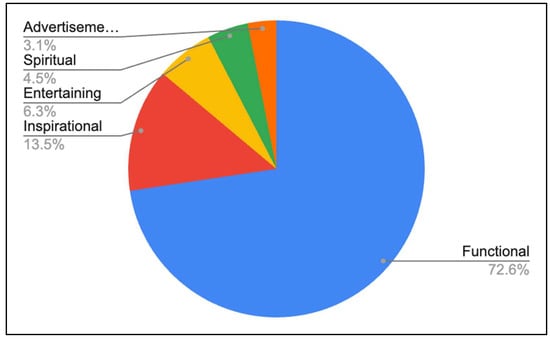
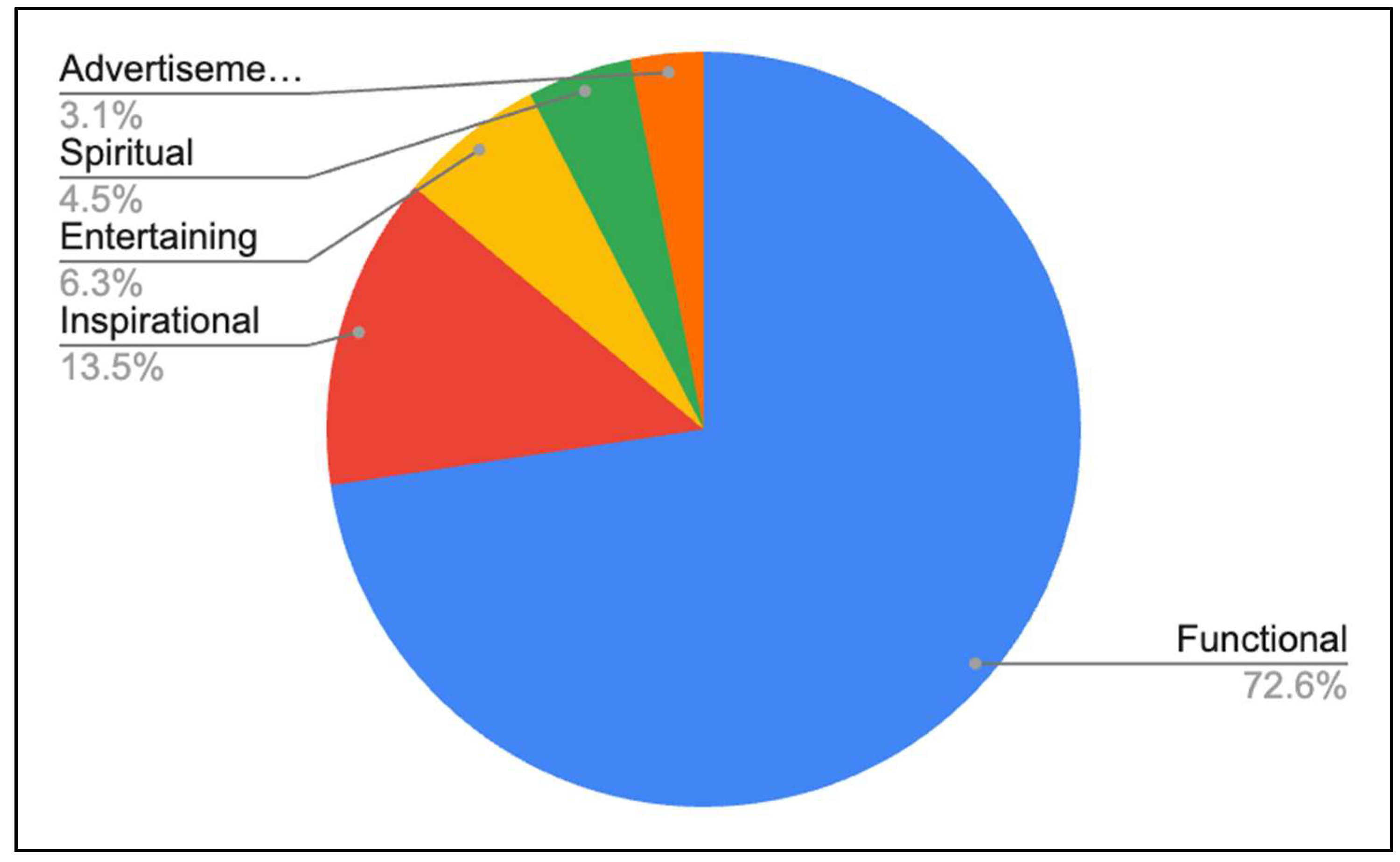
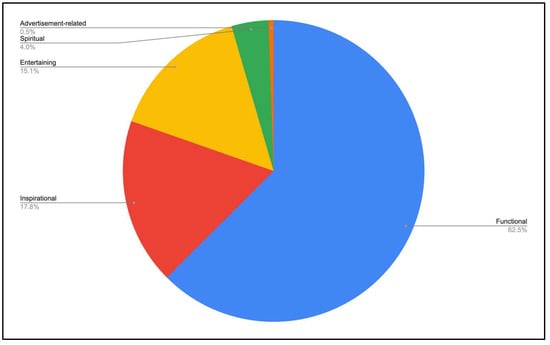
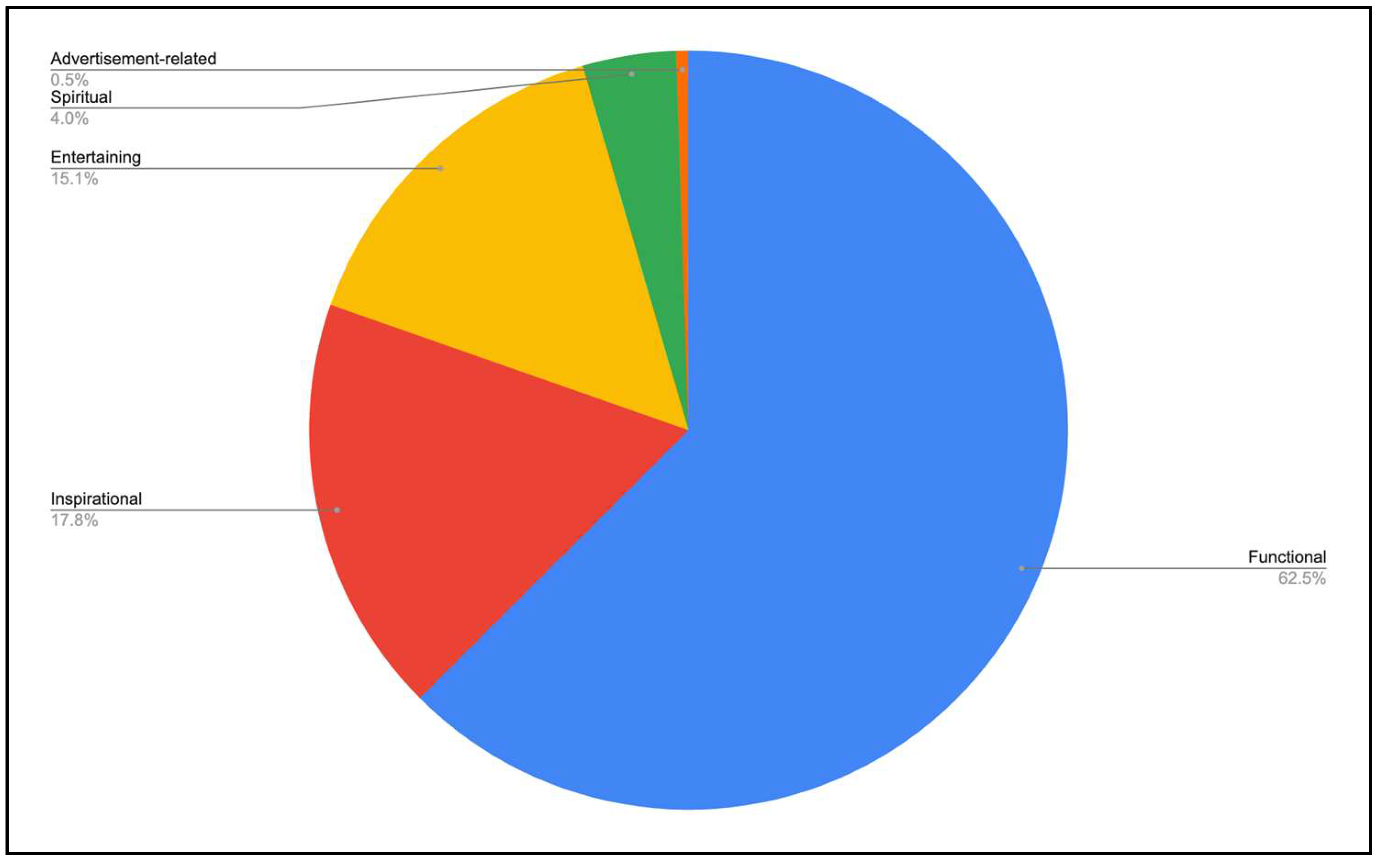
Comparing hashtag functions per platform, as shown in Figure 1 and Figure 2, there is both similarity and variation. Functional hashtags are the largest category on both platforms, but they are proportionally higher on Instagram (72.6%) than on Twitter/X (62.5%). Inspirational hashtags are proportionally higher on Twitter/X (17.8%) than on Instagram (13.5%), and entertaining hashtags are also higher on Twitter/X (15.1%) than on Instagram (6.3%). Spiritual hashtags are relatively similar across the two platforms, while advertisement-related hashtags are more visible in the Instagram data, although this pattern is shaped by the specific accounts included in the sample.
Figure 1.
Distribution of hashtag function on Instagram.
Figure 2.
Distribution of hashtag function on Twitter/X.
Since the dataset is case-based and unevenly distributed across influencers, platform-level percentages need to be read alongside account-level variation. Table 5 presents the distribution of primary functions by individual influencer.
Table 5.
Distribution of primary hashtag functions by influencer.
As the table shows, the two most extreme cases in the dataset are Sayf Aldeen (SA) and Mohamed Tarek (MT), who represent the highest and lowest hashtag volumes respectively. SA accounts for 2440 hashtags, or 76.1% of all hashtag observations in the dataset, making his account the main driver of the aggregate results, especially for Instagram. His hashtagging practice is characterized by dense clusters of mostly functional tags. These include place, identity, activity, and visual-theme markers such as #baghdad, #iraq, #iraqi, #home, #تصويري (“my photography”), and #كريم_العراقي (“Karim the Iraqi”). At the same time, SA’s account also contains a large number of inspirational hashtags, including #hope, #love, #beautiful, and #smile, as well as spiritual hashtags such as #eid, #faith, #islam, and #العيد (“Eid”). His case therefore shows a high-density hashtagging style in which hashtags operate simultaneously as searchability markers, affective cues, and identity signals. By contrast, MT contributes only 16 hashtags, or 0.5% of the dataset, making his account too small to shape the aggregate distribution. Nevertheless, his limited hashtag use is functionally concentrated: advertisement-related tags such as #طلبات_كل_يوم_في_الإنجاز (“Talabat every day in achievement/delivery”) appear alongside entertainment-oriented hashtags such as #laughm3Tarek and #nurhanzafashionistagotnothingonme. Overall, SA and MT demonstrate the range of hashtagging intensity within the Instagram sample: one account uses hashtags extensively as a dense visibility and identity-building system, while the other uses them sparingly and more selectively, mainly for promotional or comedic purposes.
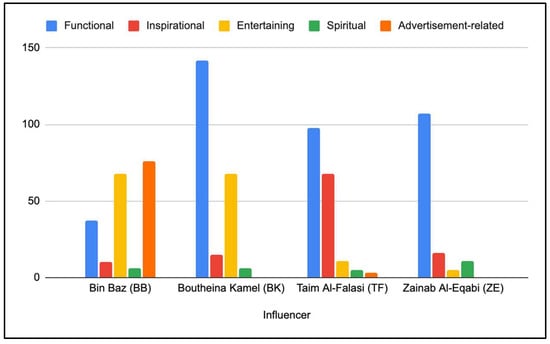
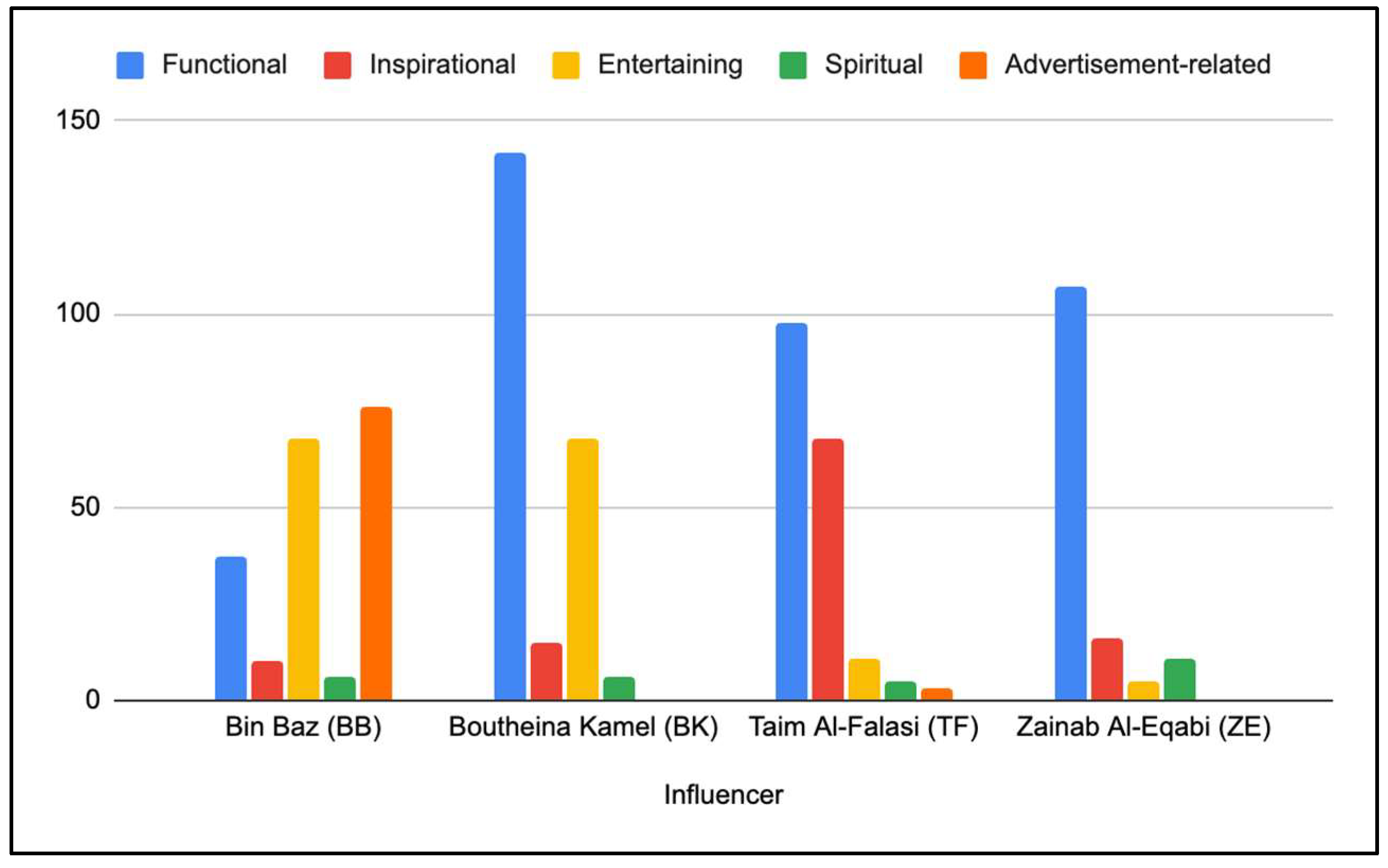
Excluding those two outliers, the remaining four accounts could be seen as an example of the average hashtagging distribution style. Figure 3 presents this distribution style, allowing the more typical case-level patterns to be seen.
Figure 3.
Distribution of primary hashtag functions across four accounts.
Bin Baz (BB) has a much stronger concentration of advertisement-related and entertaining hashtags. Advertisement-related tags such as #huaweip40pro, #timberlanddxb, and #breitling point to promotional visibility and brand association, while entertaining hashtags such as #صاحبة_الغمزة (“the girl with the wink”), #DontTrythisAtHome, #TipsAndTricks, and #LostControl reflect the account’s comic and entertainment-oriented style. Boutheina Kamel (BK) combines a large number of functional hashtags with a relatively high number of entertaining tags. Functional examples include #nubia, #اسوان (“Aswan”), #النوبة (“Nubia”), and #كينيا (“Kenya”), which index places, travel, and cultural topics. Entertaining or cultural-consumption tags include #SoundCloud, #محمد_صلاح (“Mohamed Salah”), and #الستات_مايعرفوش_يكدبوا (“Women do not know how to lie”). BK’s smaller set of inspirational and spiritual hashtags includes #صعيدية_وافتخر (“Upper Egyptian woman and proud”), #سافروا_تصحوا (“Travel and you will heal/recover”), حد_السعف (“Palm Sunday”), and #مولد_العدرا (“Festival of the Virgin Mary”).
On the other hand, Taim Al-Falasi (TF) shows the strongest inspirational profile among the Twitter/X accounts, with 68 inspirational hashtags out of 185. These include hashtags associated with national pride, public support, and collective affect, such as #الامارات_تفخر_بكم (“The UAE is proud of you”), #UAE_Martyrs_Day, #We_Celebrate_UAE, and #آمر_يا_سيدي (“At your command, my master/sir”). Functional hashtags in TF’s account include #محمد_بن_زايد (“Mohammed bin Zayed”), #UAE, #ADSW, and #45شهيد_إماراتي (“45 Emirati martyrs”), while entertaining hashtags include sports-related tags such as #العين_ريال_مدريد, #العين_ريفربليت, and #الكأس_اصفر (“the cup is yellow”). The presence of only three advertisement-related hashtags shows that promotional tagging is not a dominant function. Finally, Zainab Al-Eqabi’s (ZE) account is dominated by functional hashtags, with 107 out of 139 hashtags in this category. Examples include #Beirut, #Mosul, #LabourDay, #RefugeeDay, #WithRefugees, and #HorseRiding. These hashtags mainly index places, campaigns, events, or activities. ZE also uses inspirational hashtags such as #SaudiWomen, #اصحاب_الهمم (“people of determination”), and #ALegend, and spiritual hashtags such as (“Praise be to God”), #رمضان (“Ramadan”), #HappyEaster, and #عيد_سعيد (“Happy Eid”). Entertaining hashtags are less frequent in this account but include examples such as #حبيبة_خالتها (“her aunt’s beloved”), #فيروز (“Fairuz”), and #كرة_القدم (“football”).
(“Praise be to God”), #رمضان (“Ramadan”), #HappyEaster, and #عيد_سعيد (“Happy Eid”). Entertaining hashtags are less frequent in this account but include examples such as #حبيبة_خالتها (“her aunt’s beloved”), #فيروز (“Fairuz”), and #كرة_القدم (“football”).4.2. Platform and Case Patterns: Placement and Length
This section addresses the second research question: What platform-specific and case-specific patterns emerge in the hashtagging practices of the selected influencers, particularly in relation to hashtag placement and length? The analysis considers two formal features of hashtag use: whether hashtags are embedded within the textual flow of a post or appended after the main text or image, and whether they are short single-word tags or longer multi-word constructions.
Starting with placement, Table 6 illustrates the results for the data by platform and indicates a clear platform-level difference. Instagram hashtags are overwhelmingly appended rather than embedded: with 98.9% of them appearing after the main caption text or image. By contrast, Twitter/X shows a more mixed pattern. Although appended hashtags remain slightly more common on Twitter/X, accounting for 55.1%, embedded hashtags are also frequent, accounting for 44.9%. This suggests that hashtags in the Twitter/X accounts are more often incorporated into the syntax or flow of the post, whereas Instagram hashtags in this dataset are more commonly used as appended visibility markers. This difference should be read cautiously because it is mainly driven by SA’s account who follows an appended-only multiple hashtagging style. In this way, hashtags function less as part of the sentence structure and more as accumulated visibility and indexing markers.
Table 6.
Hashtag placement by platform.
Other accounts on Instagram, BB and MT also rely mainly on appended hashtags, but with some embedded use. For example, BB includes embedded promotional or entertainment-oriented tags such as “Want to experience the latest in prepaid packages? Then you need #WaselGo, the all new weekly” and “
 When your parents just don’t understand…” (“download Amazon app #whiteFriday they misunderstand”).
The Twitter/X accounts show more frequent embedding within the post text. ZE has the highest proportion of embedded hashtags, with 69.8% of her hashtags integrated into the tweet text. A recurring example is #زينب_العقابي (“Zainab Al-Eqabi”), which often functions as a personal identifier within the post although it is frequently sandwiched between two parts of the post (usually in English and Arabic) rather than being syntactically integrated in the text. However, other examples show true lexical embedding, including “#Music can fill your soul with brilliant wonderful energy” and “
 ” (“On the occasion of refugee day, I hope one day this word will cease to exist”). BK shows a more balanced pattern, with 55.0% appended and 45.0% embedded. She even often uses double embedded hashtags such as “

 ” (“Turkiye using refugees as a pressure card on Europe is despicable”). TF, by contrast, relies more on appended hashtags, with 74.1% appended, including public-affective and national tags such as #كلنا_محمد_بن_زايد (“We are all Mohammed bin Zayed”), #الامارات_تفخر_بكم (“The UAE is proud of you”), and #UAE_Martyrs_Day. Her embedded hashtags can also double up while being fully integrated in the sentence such as “

 ” (“Sheikh Mohamed bin Zayed and President Sisi walk around in one of the shopping malls in AbuDhabi”). Overall, these case-level differences suggest that placement is shaped not only by platform affordances but also by individual hashtagging style and account orientation.
” (“On the occasion of refugee day, I hope one day this word will cease to exist”). BK shows a more balanced pattern, with 55.0% appended and 45.0% embedded. She even often uses double embedded hashtags such as “ ” (“Turkiye using refugees as a pressure card on Europe is despicable”). TF, by contrast, relies more on appended hashtags, with 74.1% appended, including public-affective and national tags such as #كلنا_محمد_بن_زايد (“We are all Mohammed bin Zayed”), #الامارات_تفخر_بكم (“The UAE is proud of you”), and #UAE_Martyrs_Day. Her embedded hashtags can also double up while being fully integrated in the sentence such as “ ” (“Sheikh Mohamed bin Zayed and President Sisi walk around in one of the shopping malls in AbuDhabi”). Overall, these case-level differences suggest that placement is shaped not only by platform affordances but also by individual hashtagging style and account orientation.Turning to hashtag length, Table 7 shows the distribution of one-word, two-word, and longer hashtags across the two platforms. Length is important because it indicates whether hashtags are used mainly as compact searchable labels or as longer phrases that compress slogans, evaluations, or promotional messages into hashtag form. Length was measured by the number of words contained within each hashtag. Across the full dataset, hashtags range from one to seven words.
Table 7.
Hashtag length across the dataset.
The platform-level results show a clear difference between Instagram and Twitter/X. Instagram is dominated by one-word hashtags, with 94.3% falling into this category. By contrast, Twitter/X contains a much higher proportion of two-word and longer hashtags: two-word hashtags account for 52.1%, while three-word hashtags account for 13.9%. The mean hashtag length is therefore higher on Twitter/X. Moreover, the case-level results show that these platform differences are strongly shaped by individual account style. SA is the most distinctive, as almost all of his hashtags are one-worded since he depends on the accumulation of short searchable markers, usually duplicated in both Arabic and English. By contrast, MT has the highest mean hashtag length in the dataset, at 3.56 words, although his total number of hashtags is very small. His account includes only one one-word hashtag and is instead marked by longer promotional and more creative and humorous constructions, such as #أوفر_وجبة_في_مصر (“the most affordable meal in Egypt”), and #nurhanzafashionistagotnothingonme.
Among the Twitter/X accounts, BK and ZE rely mainly on one- and two-word hashtags. In BK’s account, 93.9% of her hashtags are between one and two words long. ZE shows an even stronger preference for two-word hashtags, with 79.1% falling into this category. Examples include #صناع_الامل (“Makers of Hope”), #WithRefugees and #HorseRiding. TF differs from the other Twitter/X accounts because of her frequent use of longer multi-word hashtags. Only 18 of TF’s hashtags are one-word tags, while 63 are three-word hashtags, 34 are four-word hashtags, eight are five-word hashtags, three are six-word hashtags, and two are seven-word hashtags. This gives TF the highest mean length among the Twitter/X accounts, at 2.86 words. Many of these longer hashtags function as compact public slogans or collective identity statements, such as #كلنا_محمد_بن_زايد (“We are all Mohammed bin Zayed”), #ميلاد_اسد_الامارات (“Birth of the lion of the Emirates”), and #السعودية_الامارات_بلد_واحد (“Saudi Arabia and the UAE are one country”).
4.3. Language Choice and Multilingual Identity
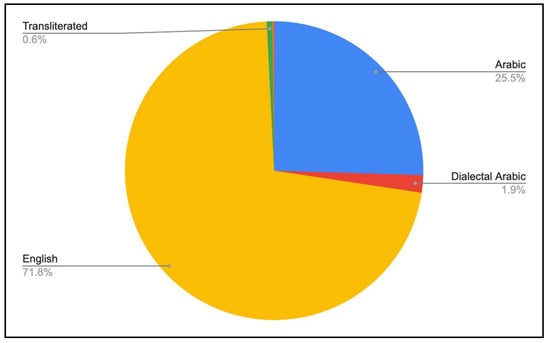
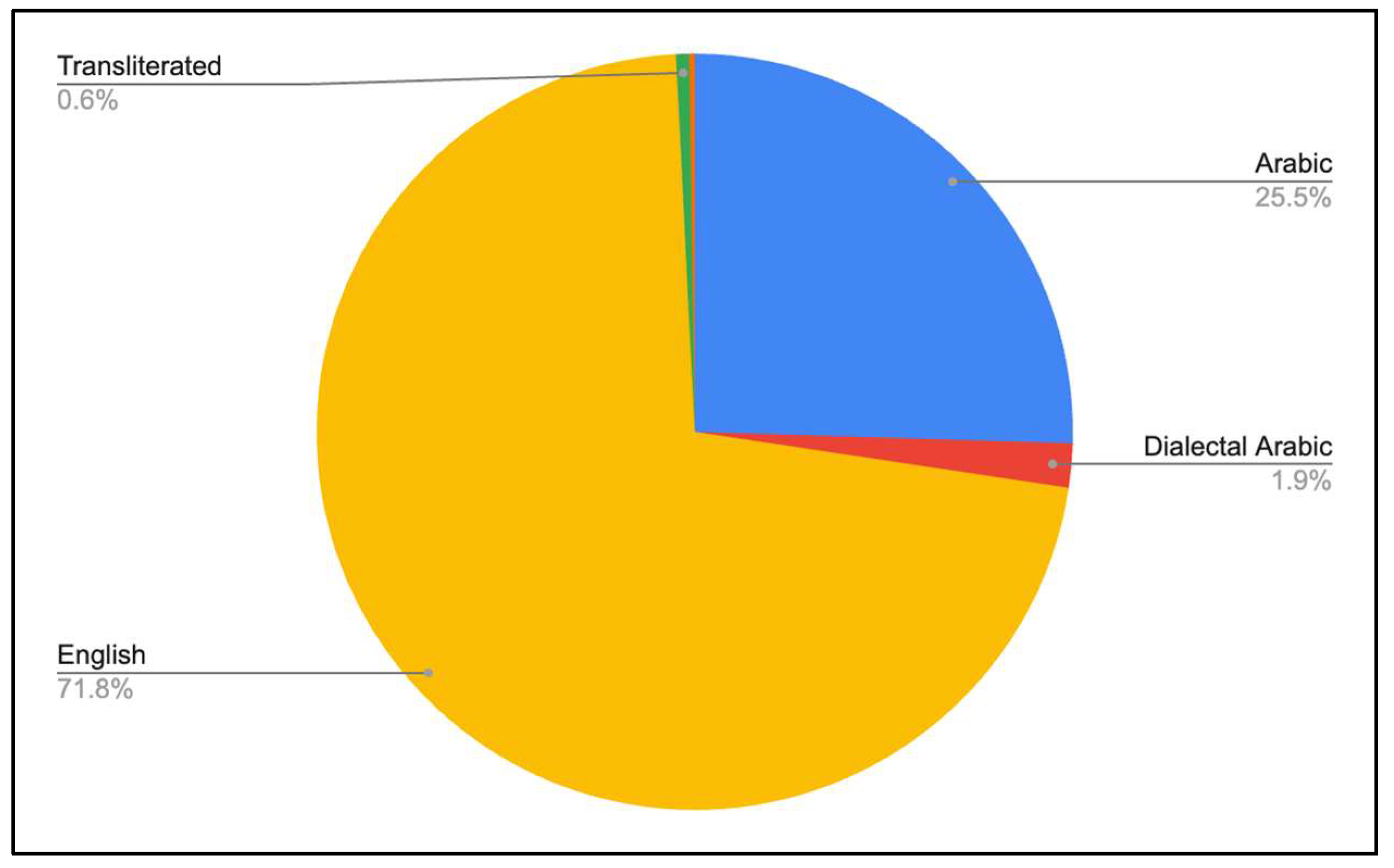
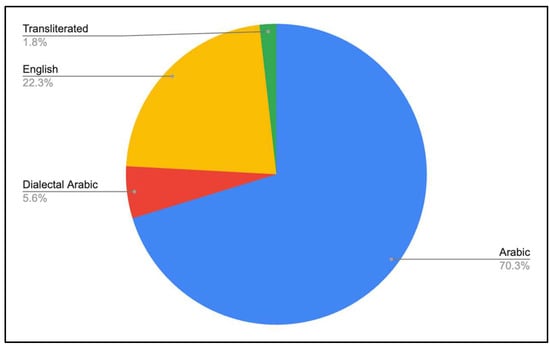
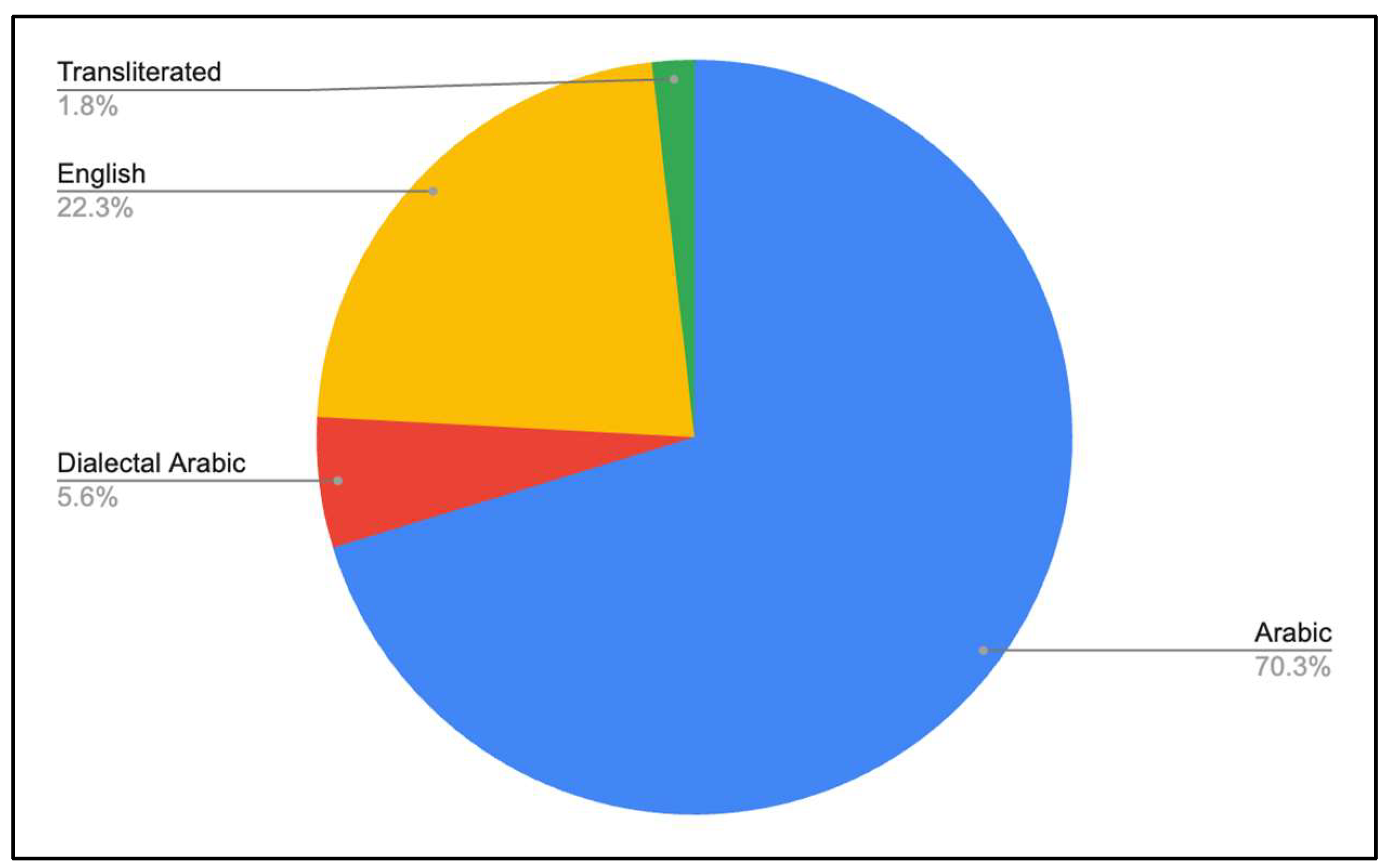
This section addresses the third research question: What do language choices in hashtags, including Arabic, English, dialectal Arabic, and mixed forms, suggest about multilingual digital identity in the selected accounts? For the purpose of this analysis, all transliterated forms were grouped under one category, labelled ‘Transliterated’. This category includes hashtags combining Arabic with transliterated words, English with transliterated words, and hashtags written entirely in transliterated Arabic. The remaining categories are Arabic, dialectal Arabic, English, and Other (numerical hashtags, e.g., #2020). The results of overall distrbution show that English is the most frequent language category for hashtags in the dataset, accounting 63.3%, Arabic hashtags account for 33.2%, while dialectal Arabic is much less frequent with only 2.5% and transliterated hashtags are limited in number. However, looking at the distribution by platform reveals a lot of variations as Figure 4 and Figure 5 illustrate:
Figure 4.
Language distribution on Instagram.
Figure 5.
Language distribution on Twitter/X.
As the figures reveal, Instagram is predominantly English, with 1906 English hashtags, or 71.8% of Instagram hashtags. By contrast, Twitter/X is predominantly Arabic, with 390 Arabic hashtags, or 70.3% of Twitter/X hashtags. Dialectal Arabic is also proportionally more visible on Twitter/X, where it accounts for 5.6% of hashtags, compared with 1.9% on Instagram. These results suggest that English hashtags in the Instagram accounts are often used as searchable and platform-recognizable tags, while Arabic hashtags in the Twitter/X accounts are more closely connected to public discourse, local address, national events, and collective commentary.
At the account level, again the effect of individual hashtagging style is visible. Table 8 illustrates the hashtag language distribution by individual influencers, where it can be seen that SA is the main driver of the English dominance in the dataset, as his account alone contains 73.3% of the total English hashtags.
Table 8.
Language distribution by influencer.
The other Instagram accounts show more mixed linguistic profiles. BB uses English frequently, with 56.9%, including #blessed, #LostControl and #russia2018. However, he also has the second highest number of dialectal Arabic hashtags in the dataset, with 41 instances, including #بنولع_الجو (“We set the mood on fire”) and ##قدام_يالأبيض (“Go Whites”). MT’s data is much smaller, but it is very linguistically mixed: English, Arabic, dialectal Arabic, and transliterated forms all appear.
The Twitter/X accounts, on the other hand, show a stronger Arabic orientation. TF has 82.7% of her hashtags in Arabic, including #حريق_جدة (“Jeddah Fire”) and #يوم_المرأة_الإمارتية (“Emirati Woman Day”). ZE shows a similar pattern, with 84.9% of hashtags in Arabic, including #رمضان (“Ramadan”) and #صناع_الامل (“Makers of Hope”). In both accounts, English hashtags are present but more limited, appearing mainly in relation to global campaigns, events, places, or activities, such as #LouvreAbuDhabi, #WeAreCommitted and #HappyEaster. BK is the most balanced Twitter/X case, with 51.5% Arabic hashtags and 40.3% English hashtags. This pattern reflects an account style that moves between Arabic and English references, particularly in posts related to travel, music, place, and cultural affiliation.
Finally, comparing hashtag language with their functions reveals that Arabic hashtags are more functionally concentrated, as 83.0% of them are functional, compared with 67.3% of English hashtags. English hashtags though are more functionally diversified. English has a higher proportion of inspirational hashtags, at 17.5%, compared with 7.6% for Arabic, and it also has a higher share of entertaining hashtags, at 8.1%, compared with 3.1% for Arabic. Interestingly, more than half of the hashtags in dialectal Arabic perform an entertaining function (54%), while 21% belong to the inspirational category. So there is noticeable pattern that standard Arabic is more strongly associated with functional/public indexing, English with visibility and affective/lifestyle tagging, while dialectal Arabic is the most socially intimate category. It tends to signal humour, familiarity, local identity, conversational address, and closeness to the audience. Transliterated hashtags are few, but they cluster mainly around advertisement-related and entertaining uses, suggesting that transliteration is used less for neutral indexing and more for playful, promotional, or locally inflected audience address.
5. Discussion
This study set out to examine how selected Arab influencers use hashtags as communicative, platformed, and multilingual resources. The results show that hashtagging in this dataset cannot be reduced to content indexing, although indexing remains the dominant function. Instead, hashtags operate across several overlapping forms of work: they make posts searchable, position the influencer affectively or socially, support platform visibility, mark commercial association, and signal cultural or linguistic affiliation. This supports Zappavigna’s (2015, 2018) account of hashtags as “searchable talk” and as resources for ambient affiliation, while also extending this perspective to a multilingual Arab influencer context.
The dominance of functional hashtags, which account for 70.9% of all hashtags in the dataset, confirms that hashtags continue to perform a basic indexing role. They identify places, people, events, campaigns, activities, or content categories and make posts retrievable within platform search systems. However, the distribution of the remaining categories shows that indexing is only one part of hashtag meaning. Inspirational, entertaining, spiritual, and advertisement-related hashtags show how influencers use hashtags to frame posts affectively, culturally, commercially, or interpersonally. This supports previous research that treats hashtags as pragmatic and discursive resources rather than neutral labels (Scott, 2015; Wikström, 2014; Laucuka, 2018). In this study, the five-category coding scheme is therefore useful because it separates the informational function of hashtags from other forms of meaning-making that are especially relevant to Arab influencer discourse. The distinction between inspirational and spiritual hashtags is particularly important in this regard. Inspirational hashtags in the dataset communicate motivation, pride, aspiration, positive affect, or public support. Spiritual hashtags, by contrast, contain explicit religious or devotional references, including prayers, blessings, religious occasions, or divine references. This distinction matters in Arab influencer discourse because religious language may overlap with emotional or motivational expression, but it also carries a different cultural and devotional meaning. The coding therefore treats spiritual hashtags as a specific affiliative category when religious reference is explicit. This avoids collapsing all positive or affective hashtags into one broad emotional category and makes religious and devotional expression visible in everyday influencer communication.
The platform comparison further shows that hashtagging is shaped by platform affordances as well as individual account style. Instagram hashtags are overwhelmingly appended and predominantly short, with 98.9% appearing after the main caption text and 94.3% consisting of one word. This pattern suggests that, in Instagram accounts, hashtags are often used as accumulated visibility markers attached to visual posts rather than as integrated parts of sentence structure. This is consistent with research describing Instagram as a platform where hashtags support discoverability, categorization, lifestyle display, and influencer visibility (Veszelszki, 2017; Cotter, 2019). Twitter/X, by contrast, shows a more mixed placement pattern, with 44.9% of hashtags embedded in the post text. This suggests a more discursive use of hashtags, where they can participate in the syntax and argument of the post, especially in public commentary, campaign discourse, or event-based communication.
Length adds a further layer to this platformed distinction. Instagram is dominated by short, one-word hashtags, especially in Sayf Aldeen’s account, where repeated one-word Arabic and English tags form dense searchable clusters. Twitter/X contains a higher proportion of two-word and longer hashtags, and Taim Al-Falasi’s account in particular uses longer hashtags as compact public slogans or collective identity statements. This pattern supports the interpretation of hashtag length as a formal indicator of communicative orientation. Short hashtags tend to support broad discoverability and repeated content categorization, while longer hashtags often carry more specific stance, slogan-like meaning, humour, campaign identity, or public affect. The study therefore shows that hashtag form is not merely a technical matter; placement and length help indicate whether hashtags are functioning primarily as searchable metadata, discursive elements, or expressive statements.
The language results are also important because they show a clear platform contrast: Instagram is dominated by English hashtags, while Twitter/X is dominated by Arabic hashtags. This contrast suggests that English in the Instagram accounts often supports global searchability, lifestyle discourse, visual-content categories, and platform-recognisable tags. Arabic hashtags on Twitter/X, by contrast, are more closely associated with public commentary, national events, local address, and collective discourse. This finding connects with audience design and indexicality: language choice in hashtags orients posts toward different imagined audiences and attaches different social meanings to influencer communication (Bell, 1984; Silverstein, 2003). It also supports Androutsopoulos’s (2015) argument that digital multilingualism is shaped by networked audiences and platform contexts.
The relationship between language and function adds further evidence for this interpretation. Arabic hashtags are more functionally concentrated, with 83% coded as functional, suggesting a stronger role in public, topical, national, religious, or event-based indexing. English hashtags are more functionally diversified, with higher proportions of inspirational and entertaining uses, suggesting their association with lifestyle, affect, visibility, and transnational influencer genres. Dialectal Arabic is the most socially intimate category: more than half of dialectal Arabic hashtags perform an entertaining function, indicating its role in humour, familiarity, local address, and audience closeness. These patterns show that language choice is not a neutral technical feature; rather, it reflects how Arab influencer discourse negotiates public identity across local cultural affiliation, regional recognition, global platform visibility, and commercial branding.
At the same time, results in this study show that platform-level patterns must be interpreted cautiously because individual influencer style strongly shapes the dataset. Sayf Aldeen accounts for 76.1% of all hashtag observations and therefore strongly affects the Instagram totals. His practice is characterized by high-density appended hashtagging, mainly through short searchable tags connected to place, identity, activity, travel, photography, and affect. Bin Baz and Mohamed Tarek, by contrast, use fewer hashtags but with stronger entertainment and promotional functions. On Twitter/X, Boutheina Kamel, Taim Al-Falasi, and Zainab Al-Eqabi show different balances between functional, inspirational, embedded, and appended hashtags. These case differences support the article’s exploratory case-study design: the aim is not to generalize about Arab influencers as a whole, but to show how platform norms and individual communicative styles interact in shaping hashtag practice.
6. Conclusions and Directions for Future Research
The main contribution of this study is analytical. It brings together hashtag studies, influencer research, and multilingual digital discourse by showing how hashtag function, placement, length, and language choice can be examined together as interrelated dimensions of digital identity construction in Arab influencer discourse. The results show that hashtags are not simply attached to posts after meaning has been produced; they participate in the production of meaning itself. For the selected Arab influencers, hashtags help organize visibility, signal stance, mark cultural and religious affiliation, construct audience proximity, and make commercial or lifestyle personae more searchable. In this sense, hashtagging operates as a platformed multilingual practice through which influencers negotiate public identity across local, regional, and transnational audiences. The study also shows that function, placement, length, and language choice of hashtags each capture a distinct aspect of this public identity. Overall, these variables provide a coding framework for analysing how multilingual influencer hashtags operate as communicative, searchable, and identity-building resources.
The study is limited by its exploratory case-study design, small and heterogeneous sample, platform-gender overlap, and focus on hashtag production rather than audience reception or engagement metrics. These limitations mean that the findings should not be read as representative of Arab influencer culture as a whole. Rather, they identify patterns within selected cases and offer an analytical framework that can be tested, refined, or expanded in future research. Such future research could also expand the sample across more Arab countries, platforms, genres, and influencer types; compare male and female influencers within the same platform; examine hashtag change over time; and include audience responses, comments, or engagement data. Larger corpus-assisted and multimodal studies would also be valuable for examining how hashtags interact with captions, images, video, emojis, and platform metrics in Arab influencer communication.
Author Contributions
Conceptualization, M.Z. and M.A.-K.; methodology, M.Z. and M.A.-K.; software, M.Z.; validation, M.Z., and M.A.-K.; formal analysis, M.Z. and M.A.-K.; investigation, M.A.-K.; resources, M.Z.; data curation, M.Z.; writing—original draft preparation, M.Z. and M.A.-K.; writing—review and editing, M.Z. and M.A.-K.; visualization, M.Z.; project administration, M.A.-K.; funding acquisition, M.Z. All authors have read and agreed to the published version of the manuscript.
Funding
The work in this paper was supported, in part, by the Open Access Program at the American University of Sharjah. This paper represents the opinions of the author(s) and does not mean to represent the position or opinions of the American University of Sharjah.
Institutional Review Board Statement
Not applicable.
Informed Consent Statement
Not applicable.
Data Availability Statement
The original contributions presented in this study are included in the article. Further inquiries can be directed to the corresponding author.
Conflicts of Interest
The authors declare no conflict of interest.
References
- Abidin, C. (2016). Visibility labour: Engaging with influencers’ fashion brands and #OOTD advertorial campaigns on Instagram. Media International Australia, 161(1), 86–100. [Google Scholar] [CrossRef] [Scilit]
- Abidin, C. (2018). Internet celebrity: Understanding fame online. Emerald Publishing. [Google Scholar]
- Alangari, M., & Olwi, A. (2026). Emoji use as a self-branding strategy in male and female Arab influencers’ Instagram bios: A corpus linguistic study. Frontiers in Communication, 11, 1799861. [Google Scholar] [CrossRef] [Scilit]
- Alharthi, B., Farsi, M., & Helmy, A. M. (2026). Social media influencer marketing and e-commerce in Saudi Arabia: A social media analysis from consumer and industry perspectives. Frontiers in Communication, 11, 1723356. [Google Scholar] [CrossRef] [Scilit]
- Alsalloum, A. A., & Gainous, J. (2025). Female social media influencers in the Arab Gulf: Examining the effect of source credibility, brand image and parasocial relationships on purchase intention. Frontiers in Communication, 10, 1518386. [Google Scholar] [CrossRef] [Scilit]
- Androutsopoulos, J. (2015). Networked multilingualism: Some language practices on Facebook and their implications. International Journal of Bilingualism, 19(2), 185–205. [Google Scholar] [CrossRef] [Scilit]
- Bell, A. (1984). Language style as audience design. Language in Society, 13(2), 145–204. [Google Scholar] [CrossRef] [Scilit]
- Boyd, D. (2010). Social network sites as networked publics: Affordances, dynamics, and implications. In Z. Papacharissi (Ed.), A networked self: Identity, community, and culture on social network sites (pp. 39–58). Routledge. [Google Scholar]
- Bruns, A., & Burgess, J. (2011). The use of Twitter hashtags in the formation of ad hoc publics. In Proceedings of the 6th European consortium for political research (ECPR) general conference 2011 (pp. 1–9). The European Consortium for Political Research (ECPR). [Google Scholar]
- Bruns, A., & Burgess, J. (2015). Twitter hashtags from ad hoc to calculated publics. In Hashtag publics: The power and politics of discursive networks (Vol. 103, pp. 13–28). Peter Lang. [Google Scholar]
- Bucher, T. (2018). If…then: Algorithmic power and politics. Oxford University Press. [Google Scholar]
- Caleffi, P. (2015). The “hashtag”: A new word or a new rule? SKASE Journal of Theoretical Linguistics, 12(2), 46–69. [Google Scholar]
- Celli, F., & Zaga, C. (2013). Be conscientious, express your sentiment! In 1st international workshop on emotion and sentiment in social and expressive media (ESSEM 2013) (pp. 140–147). CEUR. [Google Scholar]
- Cotter, K. M. (2019). Playing the visibility game: How digital influencers and algorithms negotiate influence on Instagram. New Media & Society, 21(4), 895–913. [Google Scholar] [CrossRef] [Scilit]
- De Veirman, M., Cauberghe, V., & Hudders, L. (2017). Marketing through Instagram influencers: The impact of number of followers and product divergence on brand attitude. International Journal of Advertising, 36(5), 798–828. [Google Scholar] [CrossRef] [Scilit]
- El Nahal, S. (2023). Motivation of code-switching by Arabic-English bilinguals in social media influencers’ short videos. Textual Turnings: An International Peer-Reviewed Journal in English Studies, 5(1), 150–165. [Google Scholar] [CrossRef] [Scilit]
- Gillespie, T. (2018). Custodians of the Internet: Platforms, content moderation, and the hidden decisions that shape social media. Yale University Press. [Google Scholar]
- Hamed, I., Sabty, C., Abdennadher, S., Vu, N. T., Solorio, T., & Habash, N. (2025). A survey of code-switched Arabic NLP: Progress, challenges, and future directions. In Proceedings of the 31st international conference on computational linguistics (pp. 4561–4585). Association for Computational Linguistics. [Google Scholar]
- Hurley, Z. (2019). Imagined affordances of Instagram and the fantastical authenticity of female Gulf-Arab social media influencers. Social Media + Society, 5(1), 2056305118819241. [Google Scholar] [CrossRef] [Scilit]
- Kay, S., Mulcahy, R., & Parkinson, J. (2020). When less is more: The impact of macro and micro social media influencers’ disclosure. Journal of Marketing Management, 36(3–4), 248–278. [Google Scholar] [CrossRef] [Scilit]
- Khamis, S., Ang, L., & Welling, R. (2017). Self-branding, “micro-celebrity” and the rise of social media influencers. Celebrity Studies, 8(2), 191–208. [Google Scholar] [CrossRef] [Scilit]
- Laucuka, A. (2018). Communicative functions of hashtags. Economics and Culture, 15(1), 56–62. [Google Scholar] [CrossRef] [Scilit]
- Lee, C. (2017). Multilingual resources and practices in digital communication. In A. Georgakopoulou, & T. Spilioti (Eds.), The Routledge handbook of language and digital communication (pp. 118–132). Routledge. [Google Scholar]
- Marwick, A. E. (2015). Instafame: Luxury selfies in the attention economy. Public Culture, 27(1), 137–160. [Google Scholar] [CrossRef] [Scilit]
- Omena, J. J., Rabello, E. T., & Mintz, A. G. (2020). Digital methods for hashtag engagement research. Social Media + Society, 6(3), 2056305120940697. [Google Scholar] [CrossRef] [Scilit]
- Page, R. (2012). The linguistics of self-branding and micro-celebrity in Twitter: The role of hashtags. Discourse & Communication, 6(2), 181–201. [Google Scholar] [CrossRef] [Scilit]
- Rambukkana, N. (Ed.). (2015). Hashtag publics: The power and politics of discursive networks (digital formations). Peter Lang. [Google Scholar]
- Rauschnabel, P. A., Sheldon, P., & Herzfeldt, E. (2019). What motivates users to hashtag on social media? Psychology & Marketing, 36(5), 473–488. [Google Scholar] [CrossRef] [Scilit]
- Salim, D. F., & Salamah, M. W. (2025). Social media influencers and their role in enhancing Saudi Arabia’s national brand image in global media. Online Media and Global Communication, 4(4), 647–675. [Google Scholar] [CrossRef] [Scilit]
- Scott, K. (2015). The pragmatics of hashtags: Inference and conversational style on Twitter. Journal of Pragmatics, 81, 8–20. [Google Scholar] [CrossRef] [Scilit]
- Shapp, A. (2014). Variation in the use of Twitter hashtags [Master’s thesis, New York University]. [Google Scholar]
- Silverstein, M. (2003). Indexical order and the dialectics of sociolinguistic life. Language & Communication, 23(3–4), 193–229. [Google Scholar] [CrossRef] [Scilit]
- Sun, S., Kim, M., Nan, D., & Kim, J. H. (2022). Relationship between hashtags usage and reach rate in Instagram. In 2022 16th international conference on ubiquitous information management and communication (IMCOM) (pp. 1–4). IEEE. [Google Scholar]
- Ting, H., Ming, W. W. P., de Run, E. C., & Choo, S. L. Y. (2015). Beliefs about the use of Instagram: An exploratory study. International Journal of Business and Innovation, 2(2), 15–31. [Google Scholar]
- Versteegh, K. (2014). The Arabic language. Edinburgh University Press. [Google Scholar]
- Veszelszki, Á. (2017). Digilect: The impact of infocommunication technology on language. Walter de Gruyter GmbH & Co KG. [Google Scholar]
- Wang, Y., & Zheng, B. (2014, August). On macro and micro exploration of hashtag diffusion in Twitter. In 2014 IEEE/ACM international conference on advances in social networks analysis and mining (ASONAM 2014) (pp. 285–288). IEEE. [Google Scholar]
- Wikström, P. (2014). #srynotfunny: Communicative functions of hashtags on Twitter. Finnish Journal of Linguistics, 27, 127–152. [Google Scholar]
- Yang, L., Sun, T., Zhang, M., & Mei, Q. (2012, April). We know what @ you # tag: Does the dual role affect hashtag adoption? In Proceedings of the 21st international world wide web conference (pp. 261–270). [Google Scholar]
- Zaid, B., Fedtke, J., Shin, D. D., El Kadoussi, A., & Ibahrine, M. (2022). Digital Islam and Muslim millennials: How social media influencers reimagine religious authority and Islamic practices. Religions, 13(4), 335. [Google Scholar] [CrossRef] [Scilit]
- Zappavigna, M. (2015). Searchable talk: The linguistic function of hashtags. Social Semiotics, 25(3), 274–291. [Google Scholar] [CrossRef] [Scilit]
- Zappavigna, M. (2018). Searchable talk: Hashtags and social media metadiscourse. Bloomsbury Publishing. [Google Scholar]



Disclaimer/Publisher’s Note: The statements, opinions and data contained in all publications are solely those of the individual author(s) and contributor(s) and not of MDPI and/or the editor(s). MDPI and/or the editor(s) disclaim responsibility for any injury to people or property resulting from any ideas, methods, instructions or products referred to in the content. |
© 2026 by the authors. Licensee MDPI, Basel, Switzerland. This article is an open access article distributed under the terms and conditions of the Creative Commons Attribution (CC BY) license.