


Abstract
Generative artificial intelligence (GenAI) is rapidly reshaping the audience’s relationship with journalism, particularly through AI-generated summaries. Building on the observed patterns of limited visibility of sources, condensed summary presentation, and reduced contextual depth, we introduce the idea of news sufficiency, in which people encounter summarised content that feels enough to satisfy their immediate informational needs, thereby reducing the incentive to access full news articles. Empirically, this study examines differences between ChatGPT, Gemini, and Google Search when queried in European Portuguese, using three prompts: (a) asking for the main news of the day, (b) the latest on a specific news event, and (c) using only a basic keyword for that event. Drawing on a content analysis, we analysed 72 queries submitted by eight independent users. The results showed that platforms differ markedly in source attribution, summary structure, and contextual awareness. ChatGPT consistently provided hyperlinks and often clickable news images, while Gemini offered summaries only in text without citations. Both chatbots generated diverse and coherent news headlines capable of satisfying curiosity yet frequently failed to infer news intent from the basic keyword prompt, providing outdated or irrelevant information. The absence of Google’s AI Overview results during the observation window produced a contrast with a classic Google Search, which preserves user agency by requiring clicks on links. These findings have significant implications for journalistic authorship, editorial gatekeeping, and the economic sustainability of media, highlighting the need for AI literacy and platform governance that safeguards information pluralism.
1. Introduction
Generative artificial intelligence (GenAI) has introduced Large Language Models (LLMs) that not only classify or recommend content but can be used to produce apparently original text, images, audio, and video (Dwivedi et al., 2023; Diakopoulos et al., 2024).
As LLMs become embedded within digital platforms, features such as Google’s AI Overview and AI Mode, along with AI chatbots like ChatGPT and Gemini, can now generate instant summaries for almost any topic in response to a user query.
The potential impact of GenAI on news consumption has been compared to earlier disruptions introduced by search engines and social media, which lowered barriers to accessing information and transformed audience pathways to news (Reiss et al., 2026). In particular, GenAI is reshaping how audiences engage with journalism by creating alternative routes to news consumption that do not require users to click on an article or access the original news source.
One immediate consequence is the rise in zero-click searches, where users find answers directly on the search page and no longer visit the original source. Surveys show that even individuals who are sceptical toward GenAI acknowledge that roughly half of their queries are now answered without clicking through to external sites (Sommerfeld et al., 2025).
This shift suggests that search behaviour is moving away from audience exploration centred on the ranking of links to interaction with AI-generated responses, with profound implications for the public visibility of professional media.
A growing body of empirical evidence indicates that AI-generated summaries are associated with declines in publisher traffic, thereby posing challenges to news organisations reliant on page views for advertising revenue. Data from April 2025, submitted as part of a legal complaint to the UK Competition and Markets Authority, show that when AI Overview appears at the top of Google Search results, publishers experience a 47.5% drop in desktop clicks and a 37.7% drop on mobile ones (Brooker, 2025). Chartbeat data further reveal that Google Search referrals to news outlets have fallen 33% globally in 2025, based on metrics from more than 2500 news organisations (Newman, 2026). In this context, many media executives anticipate losses of up to 43% in the next three years, raising pressing concerns over the sustainability of journalism (Newman, 2026).
A Pew Research Center analysis of almost 69,000 Google searches over March 2025 similarly found that users clicked a link beneath an AI Overview in only 1 out of 100 searches (Chapekis & Lieb, 2025). However, Google argues that AI Overview improves click quality by reducing clickbait and ensuring that users who do click are genuinely interested in the content (L. Reid, 2025).
Interestingly, some SEO analyses suggest that news is not uniformly the most affected sector (Garanko, 2025), possibly reflecting Google’s strategic limitation of AI Overview in “hard news” categories (E. Reid, 2024). Yet the thresholds governing the appearance of AI Overview vary substantially across query types, keywords, languages, and time periods (Shehata, 2024; Garanko, 2025). Therefore, the loss of traffic on news outlets might be an effect that is unevenly distributed.
For media organisations whose business models rely heavily on digital advertising and monetisation based on referral traffic, reductions in access through links represent a major sustainability risk (Murschetz, 2024; Dodds et al., 2026).
With this study, we address a critical research gap concerning how GenAI systems mediate access to news in Portugal, an example of a small and concentrated media market highly dependent on referral traffic that is struggling to maintain online visibility and revenue amid strong competition from global technology actors (Cardoso et al., 2021).
Despite rapid global deployment of multiple GenAI tools, there is still no empirical and multi-platform evidence on how these systems present daily news in European Portuguese, how accurately they handle context in moments of national relevance, or how the specific design features of those platforms’ interfaces might influence pathways to journalistic content.
Guided by the following questions, we applied content analysis to content produced by three major platforms: ChatGPT, Gemini, and Google Search.
RQ1: How do generative AI systems mediate access to daily news in Portugal?
- ○
- RQ1a: How do ChatGPT, Gemini, and Google Search differ in source attribution, summary structure, and contextual awareness?
- ○
- RQ1b: To what extent do AI-generated summaries encourage a more passive news-seeking behaviour?
Our conclusions reveal that an emerging consequence of GenAI summaries on major platforms is the phenomenon that we describe as news sufficiency, in which people encounter summarised content that feels enough to satisfy their immediate informational needs, thereby reducing the incentive to access full news articles.
2. GenAI in Journalism
Automated Journalism (Diakopoulos, 2019), understood as the algorithmic generation of news articles, initially only from structured data such as sports scores or financial reports, has long been evaluated against human-written news. Even before the public release of ChatGPT in 2022, studies showed that AI-generated texts could be perceived as equal or, in some cases, better than those written by humans in clarity, conciseness, and objectivity (Wölker & Powell, 2021; Jung et al., 2017; Haim & Graefe, 2017; B. Liu & Wei, 2019).
Given the recent advancements in LLMs, recent studies demonstrate that both general publics and future journalists tend to rate GenAI-generated headlines or articles as credible, readable, and stylistically journalistic (Baptista et al., 2025; Gherheș et al., 2025; Moravec et al., 2024); however, when audiences are told that headlines are AI-generated, perceived accuracy and willingness to share decline (Altay & Gilardi, 2024).
Existing research, while recognising the potential for newsroom efficiency and audience participation, particularly through personalisation, accessibility, and interactive storytelling (Chalikiopoulou et al., 2025), highlights several shortcomings of GenAI in journalism, including bias, hallucinations, inconsistent source attribution, and risks to editorial transparency (Bartleman et al., 2026; Ioscote et al., 2024; Forja-Pena et al., 2024; Pavlik, 2023). For example, a study by Fang et al. (2024) revealed that, when using real headlines as prompts, LLMs produced content with substantial gender and racial bias compared to the original news articles. There is also evidence of strong geographic imbalance in the training data of these models, which affects output quality, particularly in underrepresented non-English contexts (Radcliffe, 2025). In response, many news organisations have begun adopting responsible guidelines for the professional use of GenAI tools (Sánchez-García et al., 2025).
Moreover, the integration of AI into journalistic workflows remains uneven. Limited financial and technical capacity makes it difficult for smaller media markets to compete with global platforms or to build AI infrastructures internally. Research in Portugal shows that while individual journalists increasingly experiment with AI tools, structural integration across the newsroom is limited by resource constraints, gaps in AI literacy, and concerns over accuracy and editorial control (Vicente et al., 2025; Couraceiro et al., 2025a). This reality strengthens the argument that supportive public policies are needed to ensure that news organisations can innovate responsibly, maintain autonomy, and promote information pluralism.
As AI-generated news summaries increasingly mediate public understanding of unfolding events, concerns have emerged regarding the absence of the editorial and accountability mechanisms that characterise journalism. This has resulted in sustained criticism from news organisations, which argue that AI-generated content facilitated by big tech platforms can undermine public trust in news. Such concerns are particularly salient given that many AI news features remain experimental and are therefore subject to substantial changes or discontinuation. For example, Apple suspended its AI-generated news alert service after major news organisations, including the BBC and The New York Times, raised concerns about factual inaccuracies in the summaries it produced (Milmo, 2025).
While a more streamlined information path may benefit straightforward questions, it raises concerns in complex or sensitive contexts. Google’s introduction of Guided Learning in Gemini reflects a broader recognition that overreliance on a single response may limit deeper learning and critical thinking. These concerns are further reflected in disclaimers warning that AI-generated responses may contain errors.
These deficiencies contribute to public scepticism toward AI-generated news. Survey research consistently finds that audiences across countries trust news articles written by journalists more than those produced exclusively by AI (R. Fletcher & Nielsen, 2024; Armstrong et al., 2024). A similar pattern emerges in Portugal, where twice as many people are comfortable with news produced primarily by journalists as with news generated by AI (Couraceiro et al., 2025b). Experimental evidence presented by Nanz et al. (2025) further suggests that audiences place less trust in news outlets that rely on AI-generated content than in otherwise similar outlets staffed by journalists, particularly when reporting on political issues. Such AI outlets are also associated with lower acceptance of advertising, although willingness to pay was not affected, indicating implications for the business model of news organisations. In this context, some groups actively resist the integration of AI into journalism, avoiding using AI tools for news searches and expressing normative opposition to automated news production (Morosoli et al., 2026).
As one of the first studies to examine the use of GenAI for political information and news, Reiss et al. (2026) found that in Germany before the 2024 European Parliament elections, GenAI played only a marginal role in news consumption. Rather than attracting traditionally disengaged audiences, GenAI use for news was more common among individuals with higher political interest, greater trust in news, and richer news media diets, suggesting that established patterns of information consumption largely remained unchanged during this initial phase of adoption. More recent data from the Digital News Report 2026 points in a similar direction (Ross Arguedas, 2026). Although the proportion of people using AI chatbots for news has increased globally (from 7% to 10% in one year), adoption remains concentrated among younger and highly engaged news users, with use being substantially higher among people with a strong interest in news and intensive news consumption habits.
Despite persistent scepticism toward AI-generated news, the measurable differences from authentic journalism narrow as LLMs and their AI summaries improve (J. Fletcher & Verckist, 2025). In fact, even the computational evaluation of ChatGPT’s performance in generating news summaries showed results equivalent to those produced by journalists (Kim et al., 2025). Therefore, the growing capacity of GenAI to summarise, synthesise, personalise, and reformat news content may profoundly reshape news consumption, potentially reducing dependence on traditional news outlets while increasing the importance of journalism’s distinctive contributions, such as verification, original reporting, and trusted relationships with audiences (Rydenfelt et al., 2026).
Meanwhile, social media platforms accelerate this blurring effect by circulating multimodal AI-generated content at scale, making people more familiar with synthetic media and increasing their difficulty in distinguishing authentic from fabricated material (Drolsbach & Pröllochs, 2025; Moravec et al., 2024; Sahebi & Formosa, 2025). In this sense, GenAI is not simply entering the media ecosystem; it is reshaping how audiences search for, interact with, and interpret information (Guzman & Lewis, 2024).
The present challenges do not emerge in a vacuum. AI has long influenced the news environment through algorithmic curation, recommendation systems, and ranking models (Túñez-López et al., 2020). What distinguishes the current moment is the scale and speed at which GenAI disrupts news access.
For this study, two key theoretical concepts—algorithmic gatekeeping and framing—are mobilised to bridge the above discussion on the automation of news production with its consequences when big tech platforms deliver AI summaries.
Algorithmic gatekeeping refers to the process through which the selection and visibility of online information, such as news, are increasingly governed by algorithmic systems rather than by human editors and journalists (Gillespie, 2018; Garajamirli, 2025). While early work on algorithmic gatekeeping focused primarily on social media platforms (Van Dalen, 2023), more recent scholarship has extended this perspective to GenAI. In this context, particular attention has been given to how LLMs automatically generate news content, thereby assuming gatekeeping functions (Voinea, 2025).
Framing theory complements this discussion by emphasising the role of news producers in constructing social reality through the selection and representation of information (Tuchman, 1978). Beyond determining which issues receive attention, framing concerns how events and actors are represented through visual and discursive elements that privilege certain interpretations while marginalising others. As Entman (1993) argues, frames function by defining problems, attributing causal responsibility, making moral evaluations, and promoting particular solutions, thereby influencing how audiences understand and evaluate public issues.
Voinea (2025), in theorising the place of mass communication theories in the AI era, argues that both framing and gatekeeping have traditionally presupposed human editorial judgement, grounded in social and deontological values that help define what constitutes legitimate information. However, these processes are reshaped by opaque algorithmic logics behind the production of GenAI content. Consequently, power asymmetries and structural dependencies on big tech platforms are intensified (Simon, 2024), contributing to the erosion of journalistic authority and the reconfiguration of normative news values into quantitative engagement metrics and processes of search or generative engine optimisation (SEO/GEO) that shape what is recognised and circulated as news.
3. Materials and Methods
This study applies content analysis to material produced and presented through three major AI platforms: ChatGPT (OpenAI, San Francisco, CA, USA), Gemini (Google LLC, Mountain View, CA, USA), and Google Search (Google LLC, Mountain View, CA, USA), based on three different prompts and 72 queries by 8 independent users on 10 September 2025, complemented by an exploratory assessment of the Google AI Mode on 14 October 2025.
The use of content analysis as a method is justified by its capacity for systematic description and annotation of data, which allows for the drawing of replicable inferences from content while taking into account the contexts in which it is used and produced (Krippendorff, 2019). In this sense, content coding, whether more or less complex, depending on the data and the research objectives, facilitates the identification and subsequent annotation of characteristics deemed relevant, which may interact with the broader societal context and are embedded within the analysed content (Coe & Scacco, 2017). As Schneijderberg et al. (2026) note, particularly in digital contexts such as the GenAI and search platforms analysed here, communication is framed differently and contains less contextual information than in face-to-face interactions. At the same time, the structuring of language and shared meaning within communicational flow, through forms of expression that follow regular patterns, enables the extraction of meanings from large volumes of text.
In this study, context was incorporated through consideration of both the prompts submitted by users and the responses generated by the AI platforms. The platform outputs were generated in response to predefined prompts by real users, allowing the resulting content to be interpreted in relation to the communicative scenarios established by the researchers, situated within specific temporal and geographical contexts, namely Portugal on 10 September 2025. In addition, the responses were analysed using a common coding framework based on analytical constructs derived from theory and previous research (Krippendorff, 2019; White & Marsh, 2006). This approach enabled a systematic comparison across platforms while accounting for the contextual influence of the prompts, the characteristics of real users, and the temporal and geographical constraints. Consequently, the analysis supported the development of inferences regarding specific platform features and variations across the analytical dimensions, while also facilitating replication in other contexts.
Moreover, as a method with a broad analytical scope (Titscher et al., 2000), content analysis is not limited to textual data but can be multimodal, extending to visual or auditory material, as well as to the interplay between different media (Coe & Scacco, 2017). Although the present study focuses on textual outputs, visual elements such as images and pictographic resources (e.g., newspaper logos) were occasionally observed across the analysed platforms, and, as such, formed part of the broader communicative environment in which the content was presented. While these elements were not systematically coded or incorporated into the analytical framework, they are reported in the results where relevant, as they contribute to understanding how information was communicated and presented across platforms.
The unit of analysis for this study consisted of screenshots that feature the texts, embedded links, and interface visual elements produced in response to predefined queries/prompts across three platforms: ChatGPT, Gemini, and Google Search. These screenshots were stored in a Word document, and the corresponding text was transcribed and recorded in a structured database (see Supplementary Materials).
Data collection occurred on 10 September 2025. Eight participants from Lisbon were recruited for the study (see Appendix A). These participants, each using independent accounts on their own laptop, executed a structured set of prompts across the three platforms, totalling 8 participants × 3 prompts × 3 platforms = 72 outputs.
Participants interacted with the publicly accessible consumer versions of ChatGPT, Gemini, and Google Search, available on 10 September 2025. ChatGPT responses were obtained using GPT-4o, and Gemini responses were obtained using the Gemini 2.5 flash.
All participants used their personal accounts, thereby maintaining natural conditions shaped by each user’s pre-existing search histories and account preferences, which produces an inherent real-world variability. For ChatGPT and Gemini, each query was submitted in a fresh conversation, preventing short-term memory effects and ensuring a greater degree of independence of responses.
Each participant entered the following three prompts/queries on ChatGPT, Gemini, and Google Search:
- Prompt 1. “Quais as principais notícias do dia?” [What is the main news of the day?]
- Prompt 2. “Quais as últimas notícias sobre o Elevador da Glória?” [What is the latest news on Glória Funicular.]
- Prompt 3. “Elevador da Glória.” [Glória Funicular.]
These prompts were selected to provide complementary levels of analysis. With prompt 1, the goal was to receive the most important news headlines, enabling a comparison of different systems’ outputs after surfacing top news topics without thematic constraints. With prompt 2, the focus was to identify how each platform presented news information about a specific topic, centred on the highly salient Glória Funicular accident in Lisbon. Finally, prompt 3 looked for contextual inference in the absence of explicit news framing, allowing assessment of whether platforms would autonomously prioritise updated information about the recent tragedy over generic responses based on historical tourist information.
The Glória Funicular accident in Lisbon was chosen as the focal thematic case due to its national and international salience. The accident, occurring on 3 September 2025, resulted in 16 fatalities and more than 20 injuries, affecting both Portuguese citizens and foreign tourists. The event generated extensive media coverage, political repercussions due to its proximity to the 2025 municipal elections, and ongoing news updates in Portugal and abroad throughout the following weeks.
It is worth noting that data collection took place on 10 September 2025, a week after the accident, at a moment when information about the potential causes and political responsibilities surrounding the event was still developing. This evolving context makes the case particularly useful for evaluating how responsive each system is to unfolding news.
The outputs from the search and conversational platforms were analysed according to three analytical dimensions: source attribution, summary structure, and contextual awareness.
The decision to adopt a model with three dimensions is grounded in both theoretical and methodological considerations. Existing research on audience responses to AI-generated content frequently focuses on evaluative constructs such as readability, informativeness, style, credibility, trust, and acceptance (Baptista et al., 2025; Gondwe, 2025; Moravec et al., 2024). While valuable, these dimensions primarily capture users’ perceptions and are therefore better suited to audience-centred research designs than to content analyses of platform outputs. Given that our research question examines how GenAI systems mediate access to news, we adopted a parsimonious framework centred on dimensions that are directly observable in AI-generated responses, representing a balance between theoretical comprehensiveness and empirical operationalisation. However, the boundaries between dimensions are not rigid, and connections with dimensions not explicitly incorporated into the model are understood as an inherent feature of complex social phenomena (Jabareen, 2009).
Aligned with the assumptions of the content analysis, our three dimensions are derived primarily from relevant literature.
The first dimension of source attribution captures the role of GenAI systems as algorithmic gatekeepers (Voinea, 2025). By selecting, prioritising, and presenting information from particular news sources, these systems influence not only the content users encounter but also the visibility of original news producers. Source attribution is therefore a key dimension of AI-mediated news access, as it captures the extent to which platforms make the origins of information transparent and traceable. Previous research has highlighted concerns regarding inaccurate, incomplete, or distorted source attribution in AI chatbots (J. Fletcher & Verckist, 2025) and emphasised the importance of source attribution for verifying the authenticity, origin, and authorship of AI-generated news content as a means of combating misinformation and disinformation (Luttrell et al., 2025). Source attribution is thus a central dimension of journalistic transparency and credibility, as the visibility and traceability of sources fundamentally shape how users assess reliability and authority in GenAI environments (Luttrell et al., 2025).
The second dimension, regarding the structure of the summary, builds on Zhang et al. (2024)’s application of framing theory to the analysis of news text summarisation. Their approach highlights how the presentation of information (e.g., what is selected and how text and images are organised) influences the audience’s perception and interpretation of the content. The summary structure is therefore particularly relevant to the study of AI-mediated news access, as GenAI systems do not merely retrieve information but actively condense and reorganise news events into hierarchies of relevance and salience (Liscio et al., 2025). In doing so, they participate in the construction of meaning and newsworthiness, while potentially preserving, reinforcing, or altering elements of the original news framing (Zhang et al., 2024). The summary structure is therefore a central dimension of AI-mediated news access, as it shapes the organisation, salience, meaning, and diversity of information presented on AI platforms.
Finally, the contextual awareness dimension reflects the premise that meaning in communication between humans and AI systems is co-constructed through contextual cues, encompassing linguistic, interactional, and situational factors (Geroimenko, 2026). In applied domains such as personalised learning, context-aware AI is increasingly defined through the integration of real-time environmental and behavioural data that enable adaptive outputs (Z. Liu et al., 2026). Regarding news, contextual awareness is particularly important because audience trust and expectations around AI-generated content depend not only on the provision of accurate information but also on the system’s ability to interpret user intent and situate responses within the current news environment (Gondwe, 2025; Simon et al., 2025). This includes providing relevant and updated content that follows established journalistic conventions (Zhang et al., 2024). Contextual awareness is therefore a central dimension of AI-mediated news access, as it shapes the contextualisation, relevance, and interpretability of news information presented on AI platforms.
These analytical dimensions and specific indicators presented in Table 1 follow a deductive–inductive approach (Schneijderberg et al., 2026), combining theoretical and empirical work. While existing theory guided the definition of the analytical dimensions a priori, the final set of indicators was defined and refined through exploration of the data.
Table 1.
Analytical dimensions and indicators.
Content analysis followed a sequential coding procedure. An initial coder analysed the full dataset and, for the qualitative components of the analysis, developed categories iteratively from the data. A second coder independently reviewed all coded material, with discrepancies identified and resolved through discussion and consensus.
After the core data collection for the three platforms had been completed, Google introduced a new experimental feature in Portugal called AI Mode. Because this functionality emerged only later, it was not integrated into the primary comparative analysis. Instead, it was examined exploratorily to further discuss its implications.
Given the preceding discussion, the following analytical framework (Figure 1) is designed to operationalise the core concepts and relate them to the research questions. Within this study, news searching is divided into two main categories: (i) a traditional search via Google Search, and (ii) a search within AI chatbots. Positioned between these are hybrid features such as Google AI Overview and AI Mode, which, despite relying on generative AI, remain integrated in the traditional search engine. Accordingly, the analysis of our three analytical dimensions seeks to identify the specific characteristics of each platform and situate them within broader discussions of audience behaviour. Ultimately, this framework aims to address the concept of “news sufficiency”, which is developed in the discussion and conclusions of this article..
Figure 1.
Analytical framework.
4. Results
We now present the results of the analysis of source attribution, summary structure, and contextual awareness for ChatGPT, Gemini, and Google Search from three different prompts and eight users conducted on 10 September. In the case of Google Search, these results are shaped by the absence of AI Overview across the three prompts, and the emergence of Google AI Mode, with those two points being further examined at the end of this section.
4.1. Source Attribution
Within the analysed corpus, ChatGPT, Gemini, and Google Search reveal sharply divergent approaches to source attribution (as summarised in Table 2). Across all prompts and users, ChatGPT consistently includes active hyperlinks to original news sources, offering at least one verifiable source per summarised item and thereby enabling traceability to news outlets. The hyperlinks generated by ChatGPT are typically concentrated at the end of each summarised item or paragraph, occupying a peripheral position but maintaining a uniform and visually distinct formatting structure with an explicit reference to news outlets’ names. Although the link format itself remains consistent across outputs, and a final sources option is available for consultation, there is notable variation in the specific sources attributed to different users. Additionally, explicit direct or indirect citations of identifiable news outlets within the body of the text does not occur.
Table 2.
Indicators of source attribution.
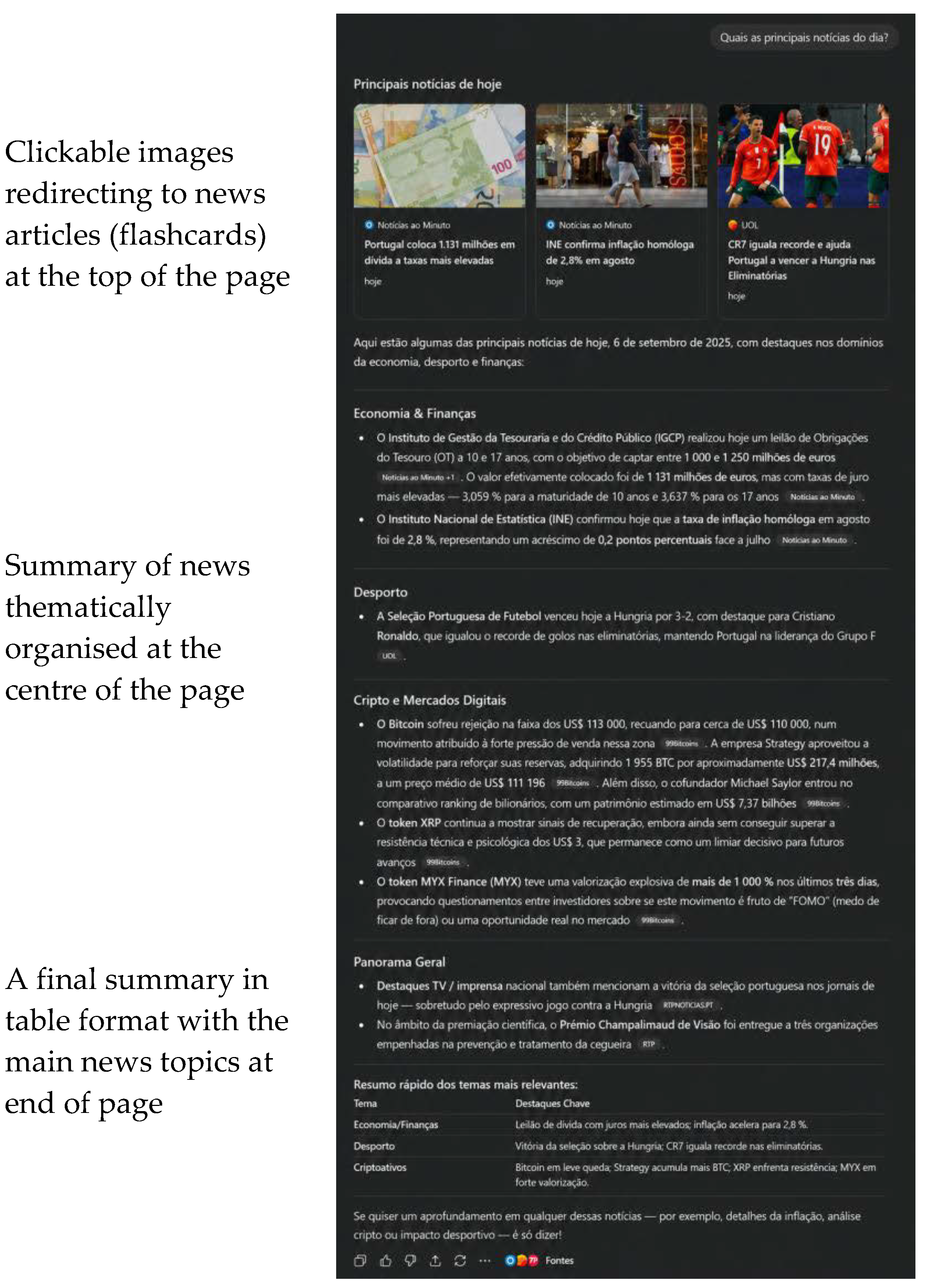
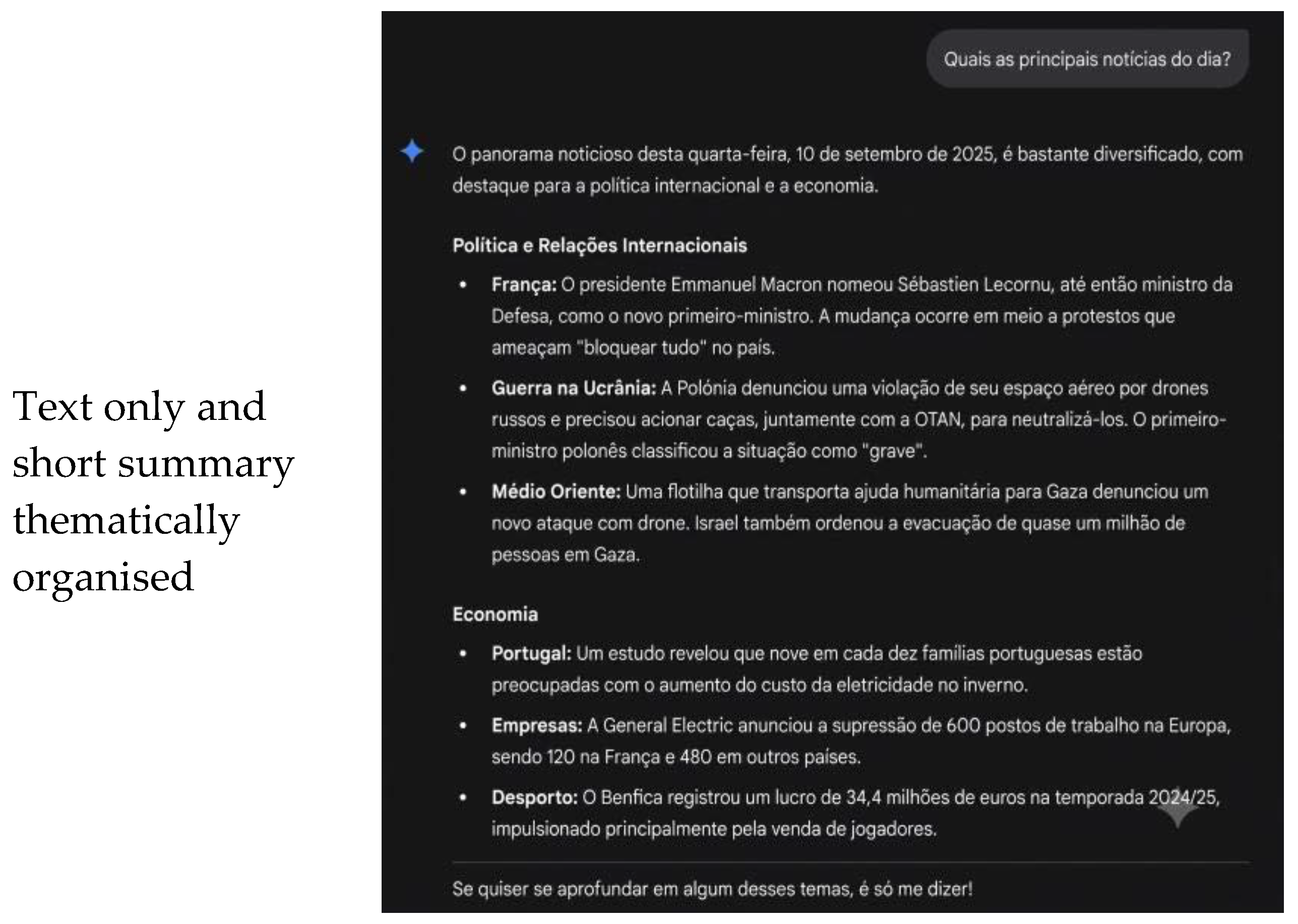
A distinctive pattern emerged in responses generated to most users across prompts, in which, before delivering the usual text summary, ChatGPT displayed highlighted news items in a flashcard format, each featuring a clickable image linked to the corresponding article. Gemini, by contrast, systematically omits hyperlinks and any other mechanism for identifying the provenance of information, such as explicit mentions of sources, visual markers, or a references list, providing summaries only in text that are opaque, leaving users unable to identify the origin of the information. Google Search largely maintains its conventional structure, in which hyperlinks and outlet names associated with the headlines function as the primary visual anchors of the results page. However, the sporadic appearance of the “Top stories” box for some users in prompts 2 and 3 introduces a notable degree of variability in the Google Search display. Importantly, it does not compromise source attribution itself as the “Top stories” box continues to present identifiable outlets and the associated images correspond to the original articles.
The profile and distribution of sources resulting from prompt 1 (What are the main news of the day?) further underscores differences between platforms, particularly ChatGPT and Google Search (see Appendix B.1). ChatGPT surfaces a broad range of news outlets, although the distribution is uneven, with a small number of sources disproportionately represented. Notícias ao Minuto appears most frequently (24 mentions), followed by 99Bitcoins (12), RTP (11), and Reuters (8). Together, these four sites account for approximately three-quarters of all citations generated across users. A notable aspect of ChatGPT’s sourcing behaviour is the absence of paywalled outlets such as Público, Expresso, or Observador. This might be a result of accessibility constraints because it cannot access up-to-date paywalled content; it gravitates toward news outlets or sites openly available, which is reflected in the use of Notícias ao Minuto, RTP, and Reuters as main sources. Similarly, in our dataset, the model did not cite specialist sports newspapers such as A Bola or Record that are paywalled. Instead, it privileges generalist outlets (e.g., Notícias ao Minuto) or non-journalistic sports sites such as Transfermarkt (three mentions). The appearance of 99Bitcoins for half of the users also suggests that, beyond editorial quality, the mere availability and accessibility of content, alongside previous users’ interactions, plays a decisive role in ChatGPT’s source selection.
In contrast, Google Search produces a markedly different sourcing landscape. The variety of sources is wider and less constrained by paywall limitations, with Correio da Manhã appearing among the top five results eight times each across the dataset, and Lusa news agency and Dirário de Notícias seven times. A further notable distinction is the visibility of Google News (seven occurrences) in the search results, with its appearance suggesting that Google Search promotes its own news aggregator site as an intermediary for news consumption.
4.2. Summary Structure
When evaluated through the analytical dimension of summary structure, the three platforms exhibit clear differences in how they organise and prioritise information (Table 3), which can be substantially different between users. ChatGPT stands out for adopting a comparatively elaborate and multi-layered structure (see Appendix B.2), particularly given that most users received an initial set of clickable images redirecting to news articles (flashcards) functioning as a visual entry point into the main news stories. This introductory layer is followed by the model’s standard structure, a categorised textual summary organised by thematic domains, which remain stable across prompts and users. In some cases, the summary concludes with a table synthesising the main points. Gemini, in contrast, maintains a markedly minimalist and uniform format, producing continuous text blocks segmented by themes, with a sequential ordering prioritising simplicity and brevity (see Appendix B.3). It is worth noticing that the table presented by ChatGPT may be considered redundant, as it summarises content that has already been summarised before. Nevertheless, it does offer the user another structured visual representation of the information requested, a feature not found in Gemini, which displays only text, without diagrams or tables.
Table 3.
Indicators of summary structure.
Google Search preserves its long-established layout of ranked hyperlinks, with the results reflecting typical SEO ranking and news indexing patterns, rather than any summarising mechanism. However, in prompts 2 and 3, the system occasionally activated the “Top Stories” feature, which restructures the hierarchy of results by elevating selected news articles to a visually prominent position in a box at the top of the page, adding images to the headlines and altering the order of sources relative to standard search results.
The platforms also differ meaningfully in the identification of main themes associated with prompt 1 “What are the main news of the day?” (see Appendix C). ChatGPT’s outputs display a marked emphasis on sports, with soccer emerging as the most frequently mentioned theme (15 occurrences). This is followed by economics and finance (10) and cryptocurrency-related topics (5). Gemini presents a markedly different thematic landscape, with international politics appearing most frequently (16 mentions), followed by news related to the Israel–Hamas conflict (8), the Ukraine war (7) and issues related to housing and the cost of living (6). This pattern aligns more closely with Google’s broader news ranking logic, privileging geopolitical developments and macro-level public affairs. Google Search, meanwhile, exposes users to a more heterogeneous and professionally curated set of topics, with the Ukraine war being the most recurrent theme (nine appearances in the top five results), followed by international politics (five occurrences) and soccer (four occurrences). Compared with ChatGPT, Gemini, and Google Search show less news related to sports and none about cryptocurrencies, signalling a different interpretation of what constituted the news salience of 10 September.
When examining the responses generated for prompt 2 (“what are the latest news of Glória Funicular?”), the differences in the identification of main themes across ChatGPT, Gemini, and Google Search become more subtle than in prompt 1, yet they remain analytically significant. All three platforms identify the same core set of sub-topics: (i) preliminary accident causes, (ii) victim information, (iii) maintenance problems, and (iv) governmental/municipal responses, indicating a shared baseline understanding of the event’s key news dimensions. However, the frequency and relative prominence of each sub-topic vary across platforms (Appendix C), revealing distinct patterns in how each system structures and prioritises event-specific information, with ChatGPT more aligned with Gemini. It is worth noticing that Google Search most prominently presents information that is more about victims, and also places strong emphasis on the responsibility of the maintenance company, a theme largely absent from GenAI outputs that give more attention to the preliminary causes of the accident.
4.3. Contextual Awareness
The analysis of contextual awareness across ChatGPT, Gemini, and Google Search highlights some points of convergence as well as substantial variations in the systems’ ability to produce coherent, contextually appropriate, and journalistically aligned responses (Table 4).
Table 4.
Indicators of contextual awareness.
Both ChatGPT and Gemini exhibit a structured approach when responding to prompt 1 (What are the main news of the day?”) and prompt 2 (“What are the latest news about the Glória Funicular?”). Both extract and condense the dominant issues circulating in the news ecosystem, offering the user an accessible overview of key developments, although raising doubts regarding their reliability, as both AI chatbots present warnings about possible errors. Their summaries present clear thematic segmentation and adequate informational depth, generally capturing the essential elements of each news item. The clarity with which top stories are summarised indicates that both AI chatbots can recognise the informational expectations associated with a request for “main news of the day” and respond with summaries that demonstrate internal consistency. ChatGPT often integrates supplementary contextualisation, for example, identifying main actors or causal factors, whereas Gemini tends to prioritise concision, providing core facts but fewer interpretive cues. Both conversational platforms end their summary with an incentive for users who wish to explore a topic in greater depth by doing so through a follow-up question. Google Search, while not operating as a summarisation tool, reflects the informational priorities of the broader news environment through the outlets it ranks most visibly.
For prompt 1, both ChatGPT and Gemini tend to adopt a style that approximates journalistic conventions, characterised by conciseness and an emphasis on factual reporting. However, deviations occur in prompt 2 (“What are the latest news about the Glória Funicular?”), where both systems occasionally introduce affective or empathetic language, such as the inclusion of evaluative terms like “unfortunately”, in an apparent attempt to adjust the tone given the sensitive nature of the event. While such phrasing may signal a contextualisation effort, it departs from conventional norms of journalistic neutrality and objectivity. These stylistic shifts suggest that, despite otherwise coherent summaries, GenAI systems may dynamically balance factual reporting with empathetic framing when confronted with socially delicate or tragic topics.
Moreover, some inconsistencies were also observed both in ChatGPT and Gemini in the Portuguese used in the output, sometimes alternating between European and Brazilian variants and at least once incorporating Spanish terms (e.g., “destaques clave”), which detracts from the clarity and linguistic uniformity expected from news produced by journalists.
The most pronounced limitations arise in determining whether the chatbots interpret prompt 3 (“Glória Funicular”) as a news-oriented query rather than a tourism-related request. Both ChatGPT and Gemini displayed systematic misinterpretation of user intent when the query was reduced to the name alone. Instead of recognising the prompt as a news-oriented task, considering the aftermath of a major media event, both platforms reverted to generic or outdated descriptions of the Glória Funicular as a tourist attraction. This included providing historical background, ticket prices, and operating schedules, even though the funicular had been out of service following the tragedy. In some cases, the responses were produced in English, presumably due to the globally recognisable nature of the attraction, which further illustrates the systems’ reliance on generic search or touristic information rather than situational awareness of recent events or the linguistic expectations set by the prompt. In contrast, Google Search demonstrated far stronger contextual awareness for the same minimal query (“Glória Funicular”); the system consistently surfaced up-to-date news links, completed with “Top stories” at the top of the page, thus correctly interpreting user intent as news-related rather than touristic information.
4.4. The Absence of Google’s AI Overview
The analysis revealed an unexpected absence of Google’s AI Overview during the formal data collection of 10 September 2025 despite being available since March 2025 and its earlier appearance in an exploratory test conducted on 22 August 2025 regarding the topic of fire season in Portugal.
According to Google’s Help Center, AI Overviews only appear when the system determines that generative summaries would be “especially helpful—for example, when you want to quickly understand information from a range of sources.” (Google, n.d.). Moreover, following the USA release in May 2024, Google stated in its blog that it aims “to not show AI Overviews for hard news topics, where freshness and factuality are important” (E. Reid, 2024). Independent SEO analyses further indicate that AI Overviews remained limited, with their visibility fluctuating as Google continually adjusts triggering thresholds and refines when the feature should be displayed, resulting in noticeable swings identified during 2024 and 2025 (Shehata, 2024; Garanko, 2025).
These factors provide plausible explanations for why prompt 1 (regarding the news of the day), which might include hard news, did not trigger an AI Overview and for why it also does not appear with the specific queries referring to the Glória Funicular tragedy (prompts 2 and 3), particularly given the initial circulation of incorrect official information regarding the number and identity of victims.
4.5. Exploratory Assessment of Google AI Mode
On 5 March 2025, Google announced on its blog a new AI Mode, Google AI Mode, justified by “power users” that “want AI responses for even more of their searches” (Stein, 2025). This feature was only introduced in Portugal on 7 October (Cattaruzzi, 2025).
Google AI Mode operates through a dedicated interface within Google Search, in contrast to AI Overview, which appears embedded directly within the primary results page. Accessing it requires users to select the “AI Mode” within the Google Search results page, after which the system automatically re-runs the user’s initial query within a conversational environment. Functionally, AI Mode resembles ChatGPT or Gemini, as it enables follow-up questions and sustained interaction. It therefore occupies a hybrid position, as it is triggered from the search engine but transitions the user into a separate dialogic space that blends GenAI content with an input initiated by a traditional Google search.
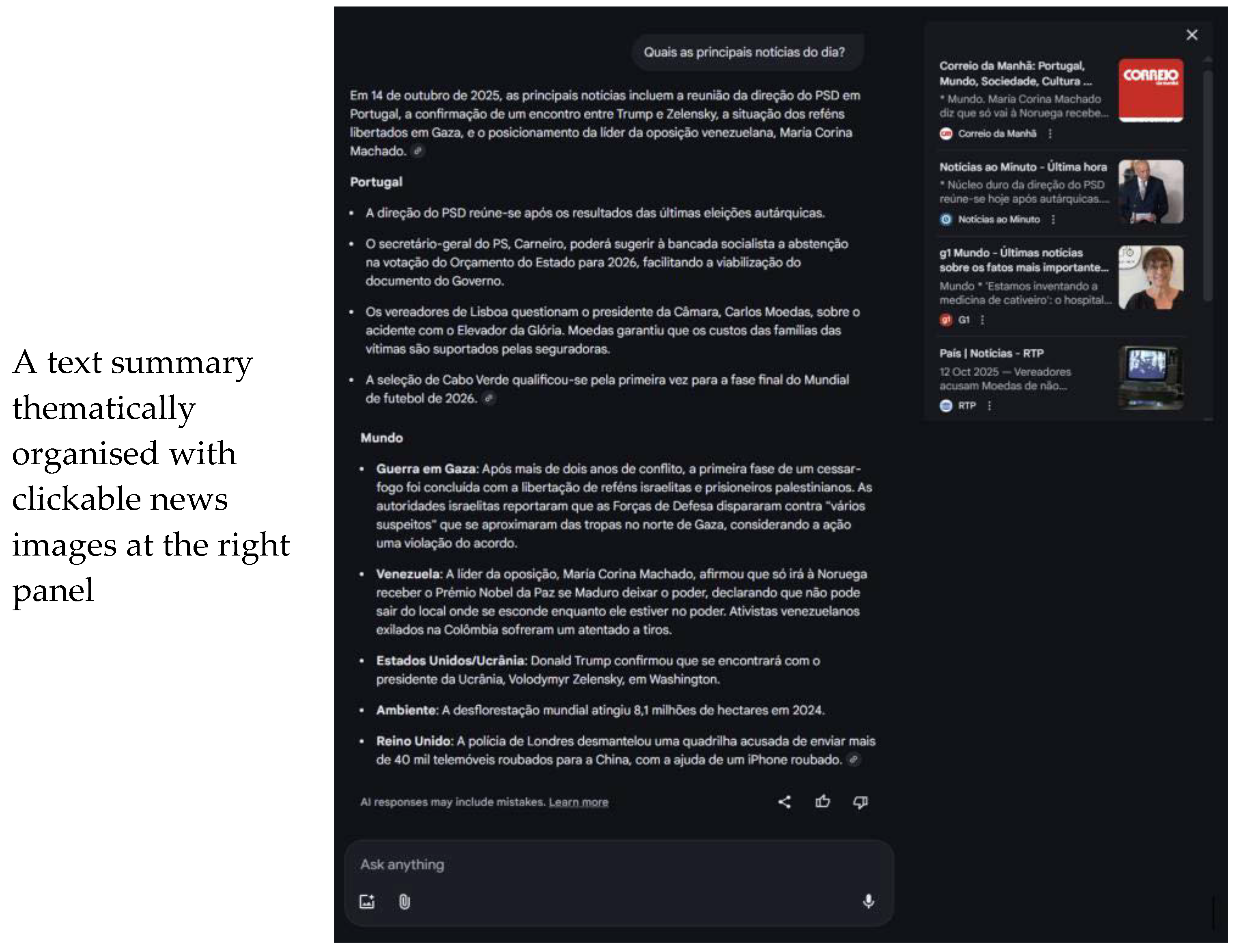
For the exploratory assessment conducted on 14 October 2025, only prompt 1 (“What are the main news of the day?”) was used (see Appendix D). Several preliminary tendencies emerged in relation to our analytical framework. First, AI Mode does not provide source attribution within the text, aligning it more closely with Gemini than with ChatGPT’s explicit linking practices. The absence of citation or reference within the body of the summary limits users’ capacity to verify the provenance of the information. However, unlike Gemini, AI Mode places a set of image cards linking to news (like ChatGPT flashcards) on the right-hand side of the interface, corresponding to the topics included in the summary. These links offer additional visual salience and serve as an external verification pathway, partially compensating for the lack of explicit source citation in the text.
Second, the structure of AI Mode’s text summaries is notably simple and resembles Gemini’s linear textual format, with the system presenting a concise overview of the main developments of the day across different paragraphs thematically grouped. Third, the writing style conforms to a journalistic style, marked by clarity and objectivity, as in this prompt 1, the tone remained factual and balanced. Given the scope of the exploratory exercise, it was not possible to determine whether AI Mode would exhibit the empathetic nuances observed in ChatGPT and Gemini when responding to sensitive prompts such as the Glória Funicular accident (prompt 2).
Overall, although preliminary, these observations suggest that AI Mode reflects Google’s attempt to integrate generative capabilities while preserving continuity with its established search paradigm.
5. Discussion
The comparison between ChatGPT and Gemini reveals differences in how information is presented that have implications for the credibility and perceived trustworthiness of their news outputs. ChatGPT generally provides summaries accompanied by explicit source attribution, offering hyperlinks that allow users to trace the provenance of the information. Gemini, by contrast, produces only summaries in text without any reference to original sources.
These findings are consistent with studies that show substantial variations in accuracy and sourcing quality across GenAI systems. An investigation by BBC involving journalists evaluating news summaries found that all major AI chatbots produced distorted or factually incorrect summaries (BBC, 2025). A broader European study with 22 public service media organisations similarly showed systemic sourcing failures, identifying significant problems in 72% of Gemini’s responses, more than triple the rate observed in other chatbots (J. Fletcher & Verckist, 2025). These attributional weaknesses mean that while the GenAI systems generate linguistically coherent outputs, their reliability diverges substantially.
Google Search stands somewhat apart in this GenAI ecosystem. Its conventional presentation of ranked links ensures accurate source identification by design, a pattern at least partially supported by Google’s commitment to suppress AI Overview for queries related to hard news in order to avoid misrepresentation (E. Reid, 2024). However, in early 2026, Google began testing AI-generated headline replacements, even in traditional search results, effectively rewriting journalistic headlines with AI alternatives that may distort tone or meaning without publisher consent (Hollister, 2026). As Memon and West (2024) argue, the incorporation of GenAI into search engines carries an “unwarranted sense of credibility” while simultaneously eroding transparency and source traceability, a dynamic clearly reflected in Google’s recent experiments.
These issues intersect with a wider body of research on hallucination risks in LLM outputs, especially when summarising dynamic and evolving events (Sun et al., 2024; Cao et al., 2024), as is the case with the Glória Funicular.
Across the content analysis, it became evident that the persuasive fluency of GenAI outputs can obscure factual errors, leading users to interpret AI-generated summaries as journalistic in tone and therefore inherently trustworthy (Moravec et al., 2024).
The journalistic style was clear in the response to the first prompt, where both ChatGPT and Gemini consistently produced outputs that resembled professional news writing, being concise and apparently neutral and objective. The structural organisation of the summaries, including systematic segmented thematic paragraphs and ChatGPT’s occasional use of tables, further reinforced the impression of an orderly and “journalistic” mode of presentation based on facts. This interplay between linguistic clarity and structured formatting constructs a discourse of epistemic authority despite the underlying quality or accuracy of the content.
The neutrality of the first two prompts (“main news of the day” and “latest news about the Glória Funicular”) also contributed to this effect. Their direct, unambiguous phrasing, combined with their formulation in Portuguese, led the AI models to adopt an expected journalistic register and to anchor their responses in national news frames. However, notable differences emerged as Gemini tended to give more prominence to international news, whereas ChatGPT placed greater emphasis on soccer.
The analysis also revealed that stylistic consistency is only superficial, and it breaks down in contexts involving sensitive events. In prompt 2, both ChatGPT and Gemini occasionally introduced affective expressions such as “unfortunately”, deviating from the objectivity traditionally associated with news reporting. This shift aligns with the broader tendency of LLMs to optimise for empathic engagement, adjusting tone in response to perceived emotional salience as a way of fostering user affinity (Chen et al., 2025). As a result, the “persona” projected by these GenAI systems oscillates between journalistic detachment and conversational empathy, with variations observed not only across prompts but also across users, likely reflecting differences in prior interactions.
A more pronounced limitation emerged in prompt 3 (“Glória Funicular”), where both ChatGPT and Gemini consistently failed to recognise the news intent of the query. Instead of contextualising the prompt within the ongoing accident coverage, as would be expected from a system with robust contextual reasoning, they reverted to generic tourist descriptions of the funicular, including outdated operational schedules and ticket prices despite the fact that the attraction had been closed following the tragedy. This inconsistency in how GenAI systems mobilise contextual cues suggests that LLMs possess limited contextual awareness, particularly when user intent must be inferred rather than explicitly stated. By contrast, Google Search’s architecture appears better suited to maintaining contextual relevance across queries, at least in highly salient news events.
This fundamental limitation of LLMs can be explained because they generate text by predicting statistically likely sequences, and so they cannot inherently distinguish accurate from false information, revealing vulnerabilities in contextual reasoning, safety mechanisms, and training data (Akpan, 2025). The result is a form of contextual myopia in which the system defaults to the most statistically common interpretation of a noun phrase (“Glória Funicular”) rather than integrating contextual awareness based on recent news events.
In our analysis, ChatGPT consistently emerges as visually more effective than Gemini. Its presentation of news “flashcards” at the top of the response, combined with explicit source links embedded at the end of each summary item, enhances informational transparency and strengthens perceived epistemic legitimacy. Gemini, by contrast, offers an interface centred exclusively on text. While such minimalism may align with dialogic interaction norms present in traditional chatbots, it limits opportunities for clicking on the underlying sources, raising questions about whether users perceive the information presented as sufficiently supported or authoritative.
Differences in thematic emphasis across platforms further reinforce these divergences. Gemini’s outputs appear broadly aligned with the thematic weighting observed in Google Search, which is unsurprising given their shared Google infrastructure.
ChatGPT, by contrast, does not reflect the top sources surfaced by Google Search and tends to rely more on international news such as Reuters. This pattern may reflect its English bias and the need for public access sources. Additionally, soccer and cryptocurrency were also more prominent in ChatGPT, which may be the result of particular users’ preferences regarding sports and cryptocurrencies rather than their relative newsworthiness. A noteworthy distinction is that ChatGPT does not cite paywalled outlets, whereas Google Search regularly features such sources prominently in its top results. This discrepancy may influence users’ perceptions of the value of paid journalism and could further marginalise outlets whose content requires subscription access. Such divergences matter as they may subtly reshape users’ perceptions of what counts as “important” news, thereby influencing media diets and agenda-setting effects across platforms.
Overall, the observed variations across platforms and prompts suggest that source attribution, summary structure, and contextual awareness can be understood as more than technical or stylistic features. They may also be interpreted as communicative affordances, reflecting the relationship between the technology itself and the social contexts in which it is used (Majchrzak et al., 2013), particularly given that AI outputs are shaped by training data produced by humans and patterns of user interaction. Differences in these dimensions, therefore, may shape how users read, navigate, and ultimately evaluate news content.
These contrasts also highlight important behavioural implications, pointing towards an increasing passivity in news consumption. Traditional search engines, such as conventional Google Search, encourage more active audiences, as individuals must compare multiple links, exercise editorial judgement, and select preferred sources, which maintains a degree of agency and exposes them to a wider range of news outlets. GenAI systems invert this process by delivering a single and authoritative answer, with no choice needed beyond the initial user query/prompt, reducing deliberation time and potentially diminishing exposure to diverse viewpoints. While this may benefit users seeking quick factual answers, scholars warn that it may erode critical thinking, increase vulnerability to errors and disinformation, and weaken the relationship between audiences and primary journalistic sources (R. Fletcher & Nielsen, 2024; Guzman & Lewis, 2024).
Whether these AI-generated summaries meet audiences’ expectations for their news diet might depend on individual informational needs and preferences. However, the findings suggest that, at a headline level, to know “what happened in the news”, the thematic range and information details offered by GenAI systems may be perceived as sufficient.
It is in this empirical context that we introduce the idea of news sufficiency. Building on the observed patterns of limited visibility of sources, condensed summary presentation, and reduced contextual depth, this concept refers to situations in which AI-generated summaries provide a level of information that users perceive as “enough”, thereby diminishing the incentive to access full news articles.
Evidence from the Digital News Report 2026 offers additional support for this theoretical proposition. While AI chatbots are still used for news by a relatively small share of the population, current users—who tend to be younger, highly interested in news, and intensive news consumers—already display behavioural patterns consistent with the logic of news sufficiency. Compared with users of search engines and social media, AI chatbot users are less likely to report clicking through to original news sources because they want additional detail. Ross Arguedas (2026) suggests that this difference may indicate that users are “more satisfied with the amount of information provided within chatbot environments”. In other words, AI-generated responses may increasingly fulfil informational needs without requiring them to consult the original news article, illustrating the mechanism that the concept of news sufficiency seeks to capture.
In our conceptualisation, news sufficiency occurs when audiences encounter a succinct and seemingly complete synthetic response whether in a search engine, IA chatbot, or other AI interface, and the perceived need to consult the original sources is reduced or eliminated.
This concept extends existing debates on zero-click searches, which describe situations in which users do not access external links. However, zero-click searches are primarily focused on traffic outcomes at the platform level. By contrast, news sufficiency shifts attention to the communicative effects underlying this behaviour. Rather than merely describing the absence of clicks, it captures the conditions under which AI-generated summaries are perceived as sufficiently complete to satisfy audiences’ immediate informational needs.
News sufficiency shares similarities with both news avoidance and the news-finds-me perception, yet it remains conceptually distinct from each. On the one hand, news avoidance is typically understood as the intentional or habitual reduction in news consumption driven by factors such as information overload, distrust, or lack of interest (Ksiazek et al., 2010; Skovsgaard & Andersen, 2020). By contrast, news sufficiency does not presuppose disengagement from news, as individuals may actively seek information and still perceive an AI-generated summary as sufficient. On the other hand, the news-finds-me perception captures the belief that active news seeking is unnecessary because news will reach individuals through social media, interpersonal networks, or incidental exposure (Gil de Zúñiga et al., 2017; Strauß et al., 2021). By contrast, news sufficiency captures the perception that further news seeking is unnecessary. Thus, whereas news avoidance reflects a motivation to disengage from news and the news-finds-me perception reflects a belief about how news is acquired, news sufficiency reflects a judgement that the information already obtained (through an AI-generated summary) is sufficient, reducing the perceived value of consulting original journalistic sources.
The growing AI integration in search engines is particularly visible, allowing it to provide results more quickly, with greater precision, and in ways that are adapted to the individual user (Alalaq, 2025). However, compared to AI chatbots such as ChatGPT or Gemini, the integration of GenAI into Google Search introduces a distinctive challenge because it operates involuntarily from an audience perspective. AI Overview cannot be disabled by users, and its presence is triggered automatically for many queries. This raises ethical questions regarding autonomy (Catena, 2026) and echoes longer debates concerning privacy, transparency, consent for data usage (Akakpo et al., 2025), and environmental sustainability (Pachot & Patissier, 2023), as users may not intend to engage with AI-generated content but encounter it regardless.
The distinction between conversational AI platforms such as ChatGPT and Gemini, which users access deliberately, and Google AI Overview, which may be automatically displayed during information searches, suggests that news sufficiency may be unintentional in certain circumstances. Some individuals may consciously regard AI-generated summaries as sufficient to meet their informational needs, whereas others may arrive at the same outcome without having previously considered whether further engagement with original news sources is necessary. In the latter case, the perceived sufficiency of the summary emerges as an unintended consequence of the interaction itself, reducing or eliminating the perceived need to consult the original source.
Consequently, unintentional forms of news sufficiency may contribute to inequalities in news consumption by disproportionately affecting users with lower levels of media literacy, trust, or interest (Reiss et al., 2026).
6. Conclusions
The present study contributes by showing how source attribution, summary structure, and contextual awareness may produce news sufficiency that reduces the need for access to news outlets.
Although the present study does not directly measure audiences’ behaviour, its findings provide empirical indications of the conditions under which news sufficiency may emerge, particularly as LLMs continue to improve and familiarity with these technologies increase. In this respect, news sufficiency should be understood as a communicative effect, arising from the interaction between audiences’ perceptions and the design characteristics of AI-generated summaries rather than solely from individual preferences.
This news sufficiency, in which people encounter summarised content that feels enough to satisfy their immediate informational needs, thereby reducing the incentive to access full news articles, threatens not only audience engagement but also the economic model of news organisations that depend on traffic for revenue. More broadly, it risks normalising a more superficial relationship with news that is less anchored in detail, context, or critical thinking.
As demonstrated in our content analysis, both ChatGPT and Gemini exhibit strong capacities for generating coherent summaries and organising complex information into accessible formats. These affordances help explain the growing adoption of AI tools in everyday news practices and suggest their potential as assistance tools to professional journalism rather than outright replacements.
At the same time, our study reveals clear limits in GenAI contextual reasoning. When prompts carry ambiguity, GenAI systems can misinterpret user intent, as seen in the repeated failure to recognise “Glória funicular” as a news prompt during a period of intense media coverage of the accident. Such errors undermine trust and illustrate why, at least for now, human oversight remains indispensable in news contexts.
This study also highlights a stylistic dimension that deserves further attention. For prompt 2 asking for the latest news on the Glória Funicular accident, AI chatbots shifted between apparent objective and empathetic tones. While such discourse adjustments may reflect attempts to meet perceived user expectations, they blur the boundary between journalistic detachment and conversational empathy. Therefore, future research could explore how these hybrid “personas” influence user trust, preferences for news tone, and perceptions of journalistic authority.
The variability observed across platforms, along with the absence of Google’s AI Overview in our analysis and the appearance of AI Mode, illustrates just how quickly search infrastructures and GenAI systems are evolving. Consequently, our findings are necessarily time-bounded, as the same experiment conducted today would likely produce different results. Real-world interactions are also more complex than the results that our set of prompts capture, with users interacting with LLMs in highly diverse ways, often including news-related requests within broader exploratory dialogues about politics, science, or local events (Hagar, 2024). In this sense, GenAI is not merely an information retriever but a medium for conversational news consumption, involving multi-step interactions beyond directly asking for news, such as article summarisation, clarification, verification, or comparison between sources (Hagar, 2024; Ross Arguedas, 2026).
As GenAI becomes increasingly embedded in both search infrastructures and conversational platforms, future research should extend beyond the present analysis to examine how users interpret, negotiate, and experience AI-mediated news environments. In this regard, interviews and focus groups could help explore questions related to trust and user agency, while semiotic and discursive analyses may provide additional insights into the meanings and power dynamics that shape these interactions.
Finally, it is also important to consider the limitations of this study. First, the results are sensitive to prompt design, as even small variations in wording may lead to different system outputs. This is particularly relevant to the interpretation of findings related to summary structure and contextual awareness. However, as Fang et al. (2024, p. 2) note, “it is necessary to analyse the bias of AI-generated content under biased prompts.” In this sense, variability induced by the chosen prompts should be considered a central methodological constraint in studies of generative AI systems. Second, analysing outputs from accounts with prior platform activity and a predominantly male sample may introduce bias, even though the aim was to capture real users, as both previous interactions and sociodemographic factors could influence the generated outputs. Third, while the three analytical dimensions capture key aspects of AI-mediated news access, they do not exhaust the range of potentially relevant dimensions that could reveal other facets of the phenomenon. For example, although source attribution was included as a central analytical dimension because of its established relevance in previous research, our analysis focuses on whether and how attribution is provided across AI systems rather than on its effects on audiences. Investigating these effects therefore remains an important avenue for future research and could further advance understanding of how GenAI mediates access to news.
Taken together, these limitations suggest that the findings should be interpreted as dependent on the characteristics and context of this study, especially given the rapid evolution of AI platforms.
Supplementary Materials
The following supporting information can be downloaded at: https://www.mdpi.com/article/10.3390/journalmedia7030152/s1. Text transcriptions of responses generated by ChatGPT, Gemini, and Google Search for each of the three predefined prompts used in the study.
Author Contributions
Conceptualization, P.C. and P.C.P.; methodology, P.C. and P.C.P.; software, P.C. and P.C.P.; validation, P.C. and P.C.P.; formal analysis, P.C. and P.C.P.; investigation, P.C. and P.C.P.; resources, P.C. and P.C.P.; data curation, P.C. and P.C.P.; writing—original draft preparation, P.C. and P.C.P.; writing—review and editing and visualisation, P.C. and P.C.P. All authors have read and agreed to the published version of the manuscript.
Funding
This research was supported by OberCom—Observatório da Comunicação and by FCT—Fundação para a Ciência e a Tecnologia, I.P., under project reference 2024.03241.BDANA (https://doi.org/10.54499/2024.03241.BDANA).
Institutional Review Board Statement
This study was conducted in accordance with the Declaration of Helsinki (1975, revised in 2013). Under applicable Portuguese national regulations, including Law no. 58/2019 implementing Regulation (EU) 2016/679, and in accordance with the Code of Ethics and Conduct of the University of Minho and the Code of Ethical Conduct in Research of Iscte—University Institute of Lisbon, ethical approval was not required for this observational non-interventionist study involving adult participants and posing minimal risk. Participants were adult volunteers recruited through open invitations to complete a set of predefined tasks autonomously and using their own personal computers in a natural environment (e.g., at home), without supervision on a date defined by the researchers. These tasks consisted exclusively of introducing predefined queries/prompts into publicly accessible platforms (ChatGPT, Gemini, and Google Search) and sending screenshots by email that displayed only the resulting outputs produced by those systems. Participation was entirely voluntary, and written informed consent was obtained from all participants prior to participation. No sensitive personal data were collected, and all data were anonymised before analysis.
Informed Consent Statement
Informed consent was obtained from all subjects involved in the study.
Data Availability Statement
The full text transcriptions derived from the original source material are openly available in the Supplementary Materials.
Acknowledgments
The authors express their gratitude to all participants who provided the source material that made this study possible.
Conflicts of Interest
The authors declare no conflicts of interest.
Appendix A
Table A1.
Participants’ sociodemographic characteristics.
Appendix B
Appendix B.1
Table A2.
Distribution of sources between ChatGPT and Google Search resulting from query/prompt 1 (What is the main news of the day?).
Appendix B.2
Figure A1.
Screenshot of user 5 from ChatGPT response to prompt 1 (What is the main news of the day?) on 10 September 2025. The figure reproduces the original output in Portuguese. The purpose is to illustrate the organisation and presentation of information, rather than the specific textual content.
Appendix B.3
Figure A2.
Screenshot of user 8 from Gemini response to prompt 1 (What is the main news of the day?) on 10 September 2025. The figure reproduces the original output in Portuguese. The purpose is to illustrate the organisation and presentation of information, rather than the specific textual content.
Appendix C
Table A3.
Distribution of themes between ChatGPT, Gemini, and Google Search resulting from query/prompt 1 (What is the main news of the day?).
Table A4.
Distribution of themes between ChatGPT, Gemini, and Google Search resulting from query/prompt 2 (What is the latest news on Glória Funicular?).
Appendix D
Figure A3.
Screenshot from Google AI Mode response to prompt 1 (What is the main news of the day?) on 14 October 2025. The figure reproduces the original output in Portuguese. The purpose is to illustrate the organisation and presentation of information, rather than the specific textual content.
References
- Akakpo, A., Gyasi, E. A., Oduro, B., & Akpabot, S. (2025). Artificial intelligence (AI) and the future of information privacy. Journal of Global Information Management, 33(1), 1–25. [Google Scholar] [CrossRef] [Scilit]
- Akpan, M. (2025). Have we reached artificial general intelligence? Comparison of ChatGPT, Claude, and Gemini to human literacy and education benchmarks. Corporate Ownership and Control, 22(1), 103–110. [Google Scholar] [CrossRef] [Scilit]
- Alalaq, A. S. (2025). AI-powered search engines. ShodhAI: Journal of Artificial Intelligence, 2(1), 49–62. [Google Scholar] [CrossRef] [Scilit]
- Altay, S., & Gilardi, F. (2024). People are skeptical of headlines labeled as AI-generated, even if true or human-made, because they assume full AI automation. PNAS Nexus, 3(10), pgae403. [Google Scholar] [CrossRef] [Scilit] [PubMed]
- Armstrong, J. K., Nugent, S., Gupta, R., & Parker, A. (2024). Embedding the audience: Putting audiences at the heart of generative AI. Ipsos & BBC. Available online: https://www.ipsos.com/en-uk/embedding-audience-putting-audiences-heart-generative-ai (accessed on 9 April 2026).
- Baptista, J. P., Rivas-de-Roca, R., Gradim, A., & Pérez-Curiel, C. (2025). Human-made news vs AI-generated news: A comparison of Portuguese and Spanish journalism students’ evaluations. Humanities and Social Sciences Communications, 12(1), 567. [Google Scholar] [CrossRef] [Scilit]
- Bartleman, M., Schapals, A. K., & Dubois, E. (2026). Generative AI and the new landscape of automated journalism: A systematized review of 185 studies (2012–2024). Journalism and Media, 7(1), 39. [Google Scholar] [CrossRef] [Scilit]
- BBC. (2025). Representation of BBC news content in AI assistants. Available online: https://www.bbc.co.uk/aboutthebbc/documents/bbc-research-into-ai-assistants.pdf (accessed on 9 April 2026).
- Brooker, A. (2025, July 30). AI Overviews cutting publisher clickthrough rates by 50%, new report finds. Press Gazette. Available online: https://pressgazette.co.uk/media-audience-and-business-data/google-ai-overviews-publishers-report-clickthroughs-authoritas-report/ (accessed on 9 April 2026).
- Cao, B., Li, Z., & Jiang, L. C. (2024). When chatbots make errors: Cognitive and affective pathways to understanding forgiveness of chatbot errors. Telematics and Informatics, 94, 102189. [Google Scholar] [CrossRef] [Scilit]
- Cardoso, G., Baldi, V., Couraceiro, P., Paisana, M., & Quintanilha, T. L. (2021). Salvar os media? O papel das plataformas na sustentabilidade do jornalismo e comunicação social. OberCom—Observatório da Comunicação. Available online: https://obercom.pt/salvar-os-media-o-papel-das-plataformas-na-sustentabilidade-do-jornalismo-e-comunicacao-social/ (accessed on 9 April 2026).
- Catena, E. (2026). AI and human autonomy: A literature review. AI and Ethics, 6, 126. [Google Scholar] [CrossRef] [Scilit]
- Cattaruzzi, L. (2025, October 7). Modo IA chega a Portugal. Google Blog. Available online: https://blog.google/intl/pt-pt/produtos/modo-ia-chega-a-portugal/ (accessed on 9 April 2026).
- Chalikiopoulou, E., Saridou, T., & Veglis, A. (2025). The role of generative AI in enhancing audience participation in journalism: A scoping review. Societies, 15(12), 358. [Google Scholar] [CrossRef] [Scilit]
- Chapekis, A., & Lieb, A. (2025). Google users are less likely to click on links when an AI summary appears in the results. Pew Research Center. Available online: https://www.pewresearch.org/short-reads/2025/07/22/google-users-are-less-likely-to-click-on-links-when-an-ai-summary-appears-in-the-results/ (accessed on 9 April 2026).
- Chen, Q., Jing, Y., Gong, Y., & Tan, J. (2025). Will users fall in love with ChatGPT? A perspective from the triangular theory of love. Journal of Business Research, 186, 114982. [Google Scholar] [CrossRef] [Scilit]
- Coe, K., & Scacco, J. M. (2017). Content analysis, quantitative. In J. Matthes, C. S. Davis, & R. F. Potter (Eds.), The international encyclopedia of communication research methods (1st ed., pp. 1–11). Wiley. [Google Scholar] [CrossRef] [Scilit]
- Couraceiro, P., Foà, C., & Pinto-Martinho, A. (2025a). Challenges and needs in algorithmic literacy for journalists: Uncovering the reality of portuguese newsrooms. Journalism Practice, 19(10), 2465–2496. [Google Scholar] [CrossRef] [Scilit]
- Couraceiro, P., Paisana, M., & Vasconcelos, A. (2025b). Scrolling with (dis)comfort on AI-generated news: Exploring group differences and the role of social media use in Portugal. Revista de Comunicación, 24(2), 83–107. [Google Scholar] [CrossRef] [Scilit]
- Diakopoulos, N. (2019). Automating the news: How algorithms are rewriting the media. Harvard University Press. [Google Scholar]
- Diakopoulos, N., Cools, H., Li, C., Helberger, N., Kung, E., Rinehart, A., & Gibbs, L. (2024). Generative AI in journalism: The evolution of newswork and ethics in a generative information ecosystem. Associated Press. [Google Scholar] [CrossRef]
- Dodds, T., Zamith, R., & Lewis, S. C. (2026). The AI turn in journalism: Disruption, adaptation, and democratic futures. Journalism, 27(3), 530–544. [Google Scholar] [CrossRef] [Scilit]
- Drolsbach, C., & Pröllochs, N. (2025). Characterizing AI-generated misinformation on social media. arXiv. [Google Scholar] [CrossRef] [Scilit]
- Dwivedi, Y. K., Kshetri, N., Hughes, L., Slade, E. L., Jeyaraj, A., Kar, A. K., Baabdullah, A. M., Koohang, A., Raghavan, V., Ahuja, M., Albanna, H., Albashrawi, M. A., Al-Busaidi, A. S., Balakrishnan, J., Barlette, Y., Basu, S., Bose, I., Brooks, L., Buhalis, D., … Wright, R. (2023). Opinion paper: “So what if ChatGPT wrote it?” Multidisciplinary perspectives on opportunities, challenges and implications of generative conversational AI for research, practice and policy. International Journal of Information Management, 71, 102642. [Google Scholar] [CrossRef] [Scilit]
- Entman, R. M. (1993). Framing: Toward clarification of a fractured paradigm. Journal of Communication, 43(4), 51–58. [Google Scholar] [CrossRef] [Scilit]
- Fang, X., Che, S., Mao, M., Zhang, H., Zhao, M., & Zhao, X. (2024). Bias of AI-generated content: An examination of news produced by large language models. Scientific Reports, 14, 5224. [Google Scholar] [CrossRef] [Scilit] [PubMed]
- Fletcher, J., & Verckist, D. (2025). News integrity in AI Assistants—An international PSM study. European Broadcasting Union (EBU). Available online: https://www.ebu.ch/research/open/report/news-integrity-in-ai-assistants (accessed on 9 April 2026).
- Fletcher, R., & Nielsen, R. K. (2024). What does the public in six countries think of generative AI in news? Reuters Institute for the Study of Journalism. [Google Scholar] [CrossRef]
- Forja-Pena, T., García-Orosa, B., & López-García, X. (2024). The ethical revolution: Challenges and reflections in the face of the integration of artificial intelligence in digital journalism. Communication & Society, 37(3), 237–254. [Google Scholar] [CrossRef] [Scilit]
- Garajamirli, N. (2025). Algorithmic gatekeeping and democratic communication: Who decides what the public sees? European Journal of Communication and Media Studies, 4(3), 1–10. [Google Scholar] [CrossRef] [Scilit]
- Garanko, J. (2025, December 15). Semrush AI overviews study: What 2025 SEO data tells us about Google’s search shift. Semrush Blog. Available online: https://www.semrush.com/blog/semrush-ai-overviews-study (accessed on 9 April 2026).
- Geroimenko, V. (2026). The future is contextual. In V. Geroimenko (Ed.), Beyond and after prompt engineering: The future of AI communication (pp. 57–70). Springer. [Google Scholar] [CrossRef] [Scilit]
- Gherheș, V., Fărcașiu, M. A., Cernicova-Buca, M., & Coman, C. (2025). AI vs. human-authored headlines: Evaluating the effectiveness, trust, and linguistic features of ChatGPT-generated clickbait and informative headlines in digital news. Information, 16(2), 150. [Google Scholar] [CrossRef] [Scilit]
- Gil de Zúñiga, H., Weeks, B., & Ardèvol-Abreu, A. (2017). Effects of the News-Finds-Me Perception in Communication: Social Media Use Implications for News Seeking and Learning About Politics. Journal of Computer-Mediated Communication, 22(3), 105–123. [Google Scholar] [CrossRef] [Scilit]
- Gillespie, T. (2018). Custodians of the internet: Platforms, content moderation, and the hidden decisions that shape social media. Yale University Press. [Google Scholar]
- Gondwe, G. (2025). Perceptions of AI-driven news among contemporary audiences: A study of trust, engagement, and impact. AI & Society, 40, 5637–5648. [Google Scholar] [CrossRef] [Scilit]
- Google. (n.d.). Find information in faster & easier ways with AI overviews in Google search. Google Search Help. Available online: https://support.google.com/websearch/answer/14901683 (accessed on 9 April 2026).
- Guzman, A. L., & Lewis, S. C. (2024). What generative AI means for the media industries, and why it matters to study the collective consequences for advertising, journalism, and public relations. Emerging Media, 2(3), 347–355. [Google Scholar] [CrossRef] [Scilit]
- Hagar, N. (2024, September 12). Do people want to get their news from chatbots? What data from real-world llm interactions tells us. Medium. Available online: https://generative-ai-newsroom.com/do-people-want-to-get-their-news-from-chatbots8a806495b65d (accessed on 9 April 2026).
- Haim, M., & Graefe, A. (2017). Automated News: Better than expected? Digital Journalism, 5(8), 1044–1059. [Google Scholar] [CrossRef] [Scilit]
- Hollister, S. (2026, March 20). Google search is now using AI to replace headlines. The Verge. Available online: https://www.theverge.com/tech/896490/google-replace-news-headlines-in-search-canary-coal-mine-experiment (accessed on 9 April 2026).
- Ioscote, F., Gonçalves, A., & Quadros, C. (2024). Artificial intelligence in journalism: A ten-year retrospective of scientific articles (2014–2023). Journalism and Media, 5(3), 873–891. [Google Scholar] [CrossRef] [Scilit]
- Jabareen, Y. (2009). Building a conceptual framework: Philosophy, definitions, and procedure. International Journal of Qualitative Methods, 8(4), 49–62. [Google Scholar] [CrossRef] [Scilit]
- Jung, J., Song, H., Kim, Y., Im, H., & Oh, S. (2017). Intrusion of software robots into journalism: The public’s and journalists’ perceptions of news written by algorithms and human journalists. Computers in Human Behavior, 71, 291–298. [Google Scholar] [CrossRef] [Scilit] [PubMed]
- Kim, H.-S., Kang, J.-W., & Choi, S.-Y. (2025). ChatGPT vs. human journalists: Analyzing news summaries through BERTScore and moderation standards. Electronics, 14(11), 2115. [Google Scholar] [CrossRef] [Scilit]
- Krippendorff, K. (2019). Content analysis: An introduction to its methodology (4th ed.). SAGE Publications, Inc. [Google Scholar] [CrossRef] [Scilit]
- Ksiazek, T. B., Malthouse, E. C., & Webster, J. G. (2010). News-seekers and avoiders: Exploring patterns of total news consumption across media and the relationship to civic participation. Journal of Broadcasting & Electronic Media, 54(4), 551–568. [Google Scholar] [CrossRef] [Scilit]
- Liscio, E., Lorandi, M., & Murukannaiah, P. K. (2025). News is more than a collection of facts: Moral frame preserving news summarization. arXiv. [Google Scholar] [CrossRef] [Scilit]
- Liu, B., & Wei, L. (2019). Machine Authorship In Situ: Effect of news organization and news genre on news credibility. Digital Journalism, 7(5), 635–657. [Google Scholar] [CrossRef] [Scilit]
- Liu, Z., Cheon, S., Stanbury, A., Jiao, X., Xing, W., & Kang, H. (2026). Towards contextual-based AI: A scoping review of artificial intelligence in X reality for personalized learning. Computers and Education: Artificial Intelligence, 10, 100523. [Google Scholar] [CrossRef] [Scilit]
- Luttrell, R., Davis, J., & Welch, C. (2025). Source attribution and detection strategies for AI-era journalism. Telecommunications Policy, 49(10), 103053. [Google Scholar] [CrossRef] [Scilit]
- Majchrzak, A., Faraj, S., Kane, G. C., & Azad, B. (2013). The Contradictory influence of social media affordances on online communal knowledge sharing. Journal of Computer-Mediated Communication, 19(1), 38–55. [Google Scholar] [CrossRef] [Scilit]
- Memon, S. A., & West, J. D. (2024). Search engines post-ChatGPT: How generative artificial intelligence could make search less reliable. arXiv. [Google Scholar] [CrossRef] [Scilit]
- Milmo, D. (2025, January 17). Apple suspends AI-generated news alert service after BBC complaint. The Guardian. Available online: https://www.theguardian.com/technology/2025/jan/17/apple-suspends-ai-generated-news-alert-service-after-bbc-complaintReturn (accessed on 9 April 2026).
- Moravec, V., Hynek, N., Skare, M., Gavurova, B., & Kubak, M. (2024). Human or machine? The perception of artificial intelligence in journalism, its socio-economic conditions, and technological developments toward the digital future. Technological Forecasting and Social Change, 200, 123162. [Google Scholar] [CrossRef] [Scilit]
- Morosoli, S., Resendez, V., Naudts, L., Helberger, N., & de Vreese, C. (2026). “I resist”. A study of individual attitudes towards generative AI in journalism and acts of resistance, risk perceptions, trust and credibility. Digital Journalism, 14, 771–790. [Google Scholar] [CrossRef] [Scilit]
- Murschetz, P. C. (2024). Business models in the media industry: A synoptic overview. In J. Krone, & T. Pellegrini (Eds.), Handbook of media and communication economics (pp. 425–445). Springer Fachmedien Wiesbaden. [Google Scholar] [CrossRef] [Scilit]
- Nanz, A., Binder, A., & Matthes, J. (2025). AI in the newsroom: Does the public trust automated journalism and will they pay for it? Journalism Studies, 26(14), 1745–1764. [Google Scholar] [CrossRef] [Scilit]
- Newman, N. (2026). Journalism, media, and technology trends and predictions 2026. Reuters Institute for the Study of Journalism. [Google Scholar] [CrossRef]
- Pachot, A., & Patissier, C. (2023). Toward sustainable artificial intelligence: An overview of environmental protection uses and issues. Green and Low-Carbon Economy, 3(2), 105–112. [Google Scholar] [CrossRef] [Scilit]
- Pavlik, J. V. (2023). Collaborating with ChatGPT: Considering the Implications of generative artificial intelligence for journalism and media education. Journalism & Mass Communication Educator, 78(1), 84–93. [Google Scholar] [CrossRef] [Scilit]
- Radcliffe, D. (2025). Journalism in the AI era: Opportunities and challenges in the global south and emerging economies. Thomson Reuters Foundation. Available online: https://www.trust.org/resource/ai-revolution-journalists-global-south/ (accessed on 9 April 2026).
- Reid, E. (2024, May 30). AI Overviews: About last week. Google Blog. Available online: https://blog.google/products-and-platforms/products/search/ai-overviews-update-may-2024 (accessed on 9 April 2026).
- Reid, L. (2025, August 6). AI in Search is driving more queries and higher quality clicks. Google Blog. Available online: https://blog.google/products-and-platforms/products/search/ai-search-driving-more-queries-higher-quality-clicks/ (accessed on 9 April 2026).
- Reiss, M. V., Knor, E. L., Merten, L., & Möller, J. (2026). Will news find them with generative AI? Exploring the affordances and potential of GenAI for news consumption. Weizenbaum Journal of the Digital Society, 6(1), 135472. [Google Scholar] [CrossRef] [PubMed]
- Ross Arguedas, A. (2026). Emerging uses of AI chatbots for news and what it means for journalism. In J. Egan, C. T. Robertson, A. Ross Arguedas, N. Newman, R. K. Nielsen, M. Mukherjee, & R. Fletcher (Eds.), Reuters Institute Digital News Report 2026 (pp. 36–40). Reuters Institute for the Study of Journalism. [Google Scholar] [CrossRef]
- Rydenfelt, H., Kiskola, J., & Olsson, T. (2026). AI in media consumption: Charting the futures of journalism. Journalism Studies, 27(8), 1151–1174. [Google Scholar] [CrossRef] [Scilit]
- Sahebi, S., & Formosa, P. (2025). The AI-mediated communication dilemma: Epistemic trust, social media, and the challenge of generative artificial intelligence. Synthese, 205, 128. [Google Scholar] [CrossRef] [Scilit]
- Sánchez-García, P., Diez-Gracia, A., Mayorga, I. R., & Jerónimo, P. (2025). Media self-regulation in the use of AI: Limitation of multimodal generative content and ethical commitments to transparency and verification. Journalism and Media, 6(1), 29. [Google Scholar] [CrossRef] [Scilit]
- Schneijderberg, C., Wieczorek, O., & Steinhardt, I. (2026). Definitions of qualitative and quantitative content analysis, and inductive and deductive research approaches. In C. Schneijderberg, O. Wieczorek, & I. Steinhardt (Eds.), The Handbook of Qualitative and Quantitative Content Analysis (pp. 21–40). Routledge. [Google Scholar] [CrossRef] [Scilit]
- Shehata, J. (2024, July 25). An analysis of AI Overview visibility in Google Search for trending news. NewzDash. Available online: https://www.newzdash.com/guide/analysis-ai-overview-visibility-google-search-trending-news (accessed on 9 April 2026).
- Simon, F. M. (2024). Escape me if you can: How AI reshapes news organisations’ dependency on platform companies. Digital Journalism, 12(2), 149–170. [Google Scholar] [CrossRef] [Scilit]
- Simon, F. M., Nielsen, R. K., & Fletcher, R. (2025). Generative AI and news report 2025: How people think about AI’s role in journalism and society. Reuters Institute for the Study of Journalism. Available online: https://reutersinstitute.politics.ox.ac.uk/generative-ai-and-news-report-2025-how-people-think-about-ais-role-journalism-and-society (accessed on 9 April 2026).
- Skovsgaard, M., & Andersen, K. (2020). Conceptualizing news avoidance: Towards a shared understanding of different causes and potential solutions. Journalism Studies, 21(4), 459–476. [Google Scholar] [CrossRef] [Scilit]
- Sommerfeld, N., McCurry, M., & Harrington, D. (2025). Goodbye clicks, hello AI: Zero-click search redefines marketing. Bain & Company. Available online: https://www.bain.com/insights/goodbye-clicks-hello-ai-zero-click-search-redefines-marketing/ (accessed on 9 April 2026).
- Stein, R. (2025, March 5). Expanding AI Overviews and introducing AI Mode. Google Blog. Available online: https://blog.google/products-and-platforms/products/search/ai-mode-search/ (accessed on 9 April 2026).
- Strauß, N., Huber, B., & Gil de Zúñiga, H. (2021). Structural influences on the news finds me perception: Why people believe they don’t have to actively seek news anymore. Social Media + Society, 7(2), 20563051211024966. [Google Scholar] [CrossRef] [Scilit]
- Sun, Y., Sheng, D., Zhou, Z., & Wu, Y. (2024). AI hallucination: Towards a comprehensive classification of distorted information in artificial intelligence-generated content. Humanities and Social Sciences Communications, 11(1), 1278. [Google Scholar] [CrossRef] [Scilit]
- Titscher, S., Meyer, M., Wodak, R., & Vetter, E. (2000). Methods of text and discourse analysis. Sage. [Google Scholar]
- Tuchman, G. (1978). Making news: A study in the construction of reality. Free Press. [Google Scholar]
- Túñez-López, J. M., Toural-Bran, C., & Frazão-Nogueira, A. G. (2020). From data journalism to robotic journalism: The automation of news processing. Studies in Big Data, 70, 17–28. [Google Scholar] [CrossRef] [Scilit]
- Van Dalen, A. (2023). Algorithmic gatekeeping for professional communicators: Power, trust, and legitimacy (1st ed.). Routledge. [Google Scholar] [CrossRef] [Scilit]
- Vicente, P. N., Sotero, J. M., Flores, A. M. M., Nunes, A. C., Granado, A., Camponez, C., Burnay, C. D., Silva, D. S., Ribeiro, F., Lopes, F., Ramalho, J., Miranda, J., Jerónimo, P., & Dourado, T. (2025). Livro branco sobre a inteligência artificial no jornalismo em Portugal. European Media and Information Fund & Fundação Calouste Gulbenkian. [Google Scholar] [CrossRef]
- Voinea, D. V. (2025). Reconceptualizing gatekeeping in the age of artificial intelligence: A theoretical exploration of artificial intelligence-driven news curation and automated journalism. Journalism and Media, 6(2), 68. [Google Scholar] [CrossRef] [Scilit]
- White, M. D., & Marsh, E. E. (2006). Content analysis: A flexible methodology. Library Trends, 55(1), 22–45. [Google Scholar] [CrossRef] [Scilit]
- Wölker, A., & Powell, T. E. (2021). Algorithms in the newsroom? News readers’ perceived credibility and selection of automated journalism. Journalism, 22(1), 86–103. [Google Scholar] [CrossRef] [Scilit]
- Zhang, X., Wei, Q., Zheng, B., Liu, J., & Zhang, P. (2024). FrameSum: Leveraging framing theory and deep learning for enhanced news text summarization. Applied Sciences, 14(17), 7548. [Google Scholar] [CrossRef] [Scilit]
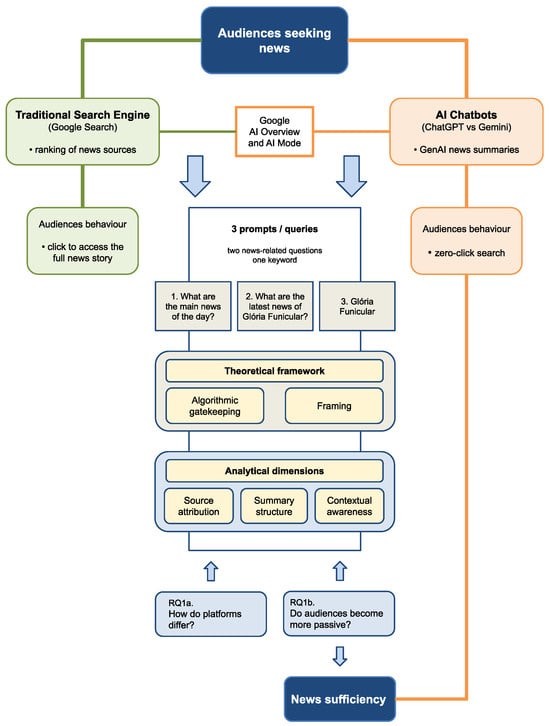
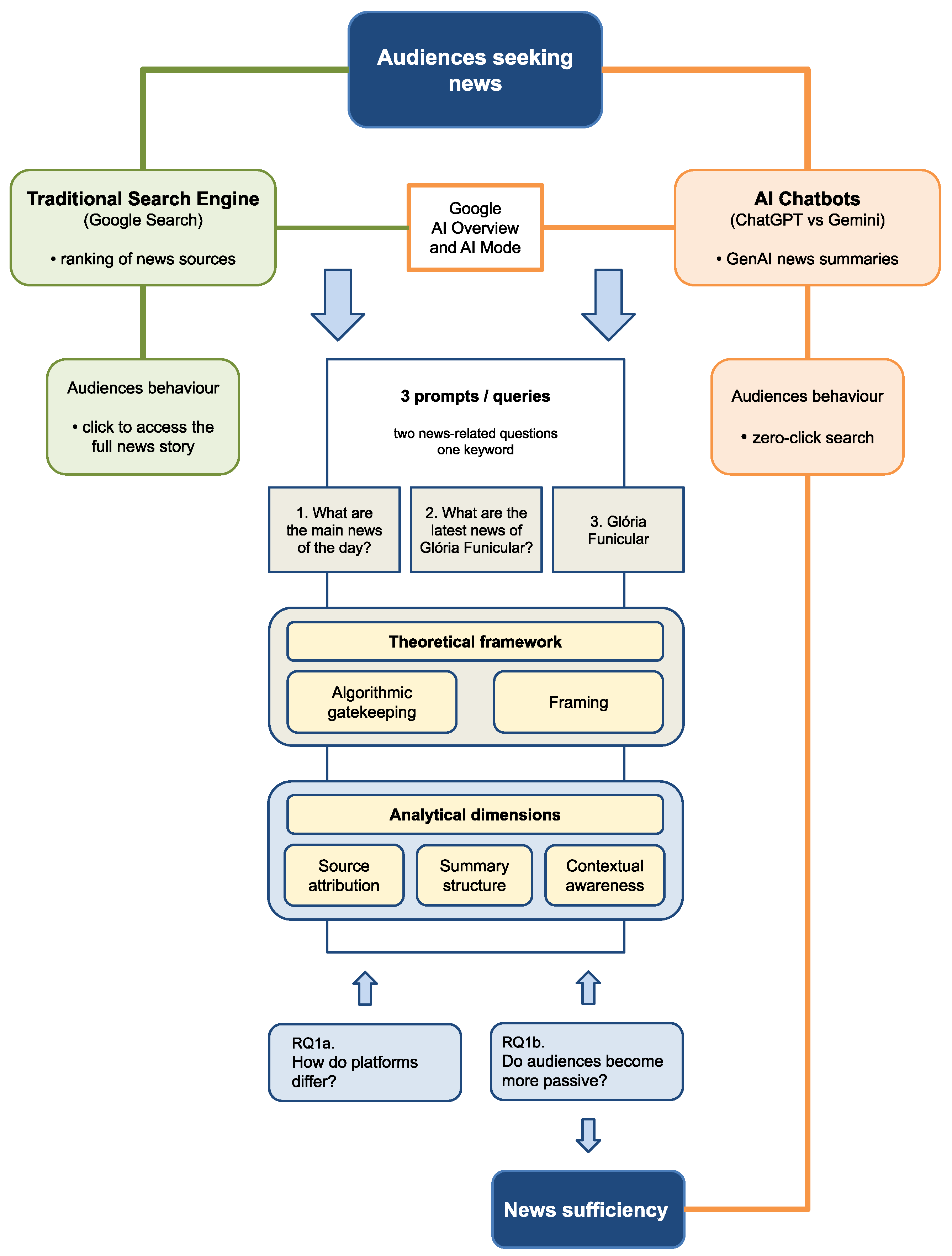

Disclaimer/Publisher’s Note: The statements, opinions and data contained in all publications are solely those of the individual author(s) and contributor(s) and not of MDPI and/or the editor(s). MDPI and/or the editor(s) disclaim responsibility for any injury to people or property resulting from any ideas, methods, instructions or products referred to in the content. |
© 2026 by the authors. Licensee MDPI, Basel, Switzerland. This article is an open access article distributed under the terms and conditions of the Creative Commons Attribution (CC BY) license.