


Abstract
This article analyses how Spanish newspapers and news agencies are embracing audio journalism and to what extent podcasts are establishing themselves as a tool for narrative, strategic, and commercial innovation. Based on the original production of 138 titles released by 15 news organizations, a mixed design (documentary collection, systematic listening and a 25-variable matrix on production, content, and distribution) is applied to describe formats, genres, themes and launch models, as well as the weight of co-productions and audio–video hybridisation. The results show, on the one hand, a clear expansion of informative podcasts, in the form of dailies, narrative series and conversational spaces, as well as a dominant focus on current affairs content; and, on the other hand, an asymmetrical development between groups, with Vocento’s audio division standing out in contrast to publications that barely exploit the expressive resources of the audio medium. It is concluded that podcasts are establishing themselves as vectors of transformation for the daily press by reinforcing editorial identity, diversifying offerings, and opening avenues for monetisation, but there is uneven experimentation with the potential of podcasts to deeply renew the ways of narrating and relating to audiences.
1. Introduction
Although the term podcasting was first formulated in 2004 (The Guardian), the files containing its attributes—spoken digital audio designed for distribution and consumption on demand on the internet—had already begun to take shape in 2000. In early 2001, Dave Winer published what would later be known as podcasting (Nuzum, 2019). The invention worked and found its best ally for distribution in the iPod. This democratisation of sound took hold in 2003, when Winer and Chrys Lydon developed the first episode of Open Source, an audio blog—as they defined it—of interviews with internet experts that began to be distributed using RSS technology (Nuzum, 2019; McHugh, 2022). Those interviews should be considered the first journalistic podcasts.
The combination of MP3 and RSS, i.e., the possibility of compressing digital audio and subscribing to a source that automates its download, was the technological foundation on which podcasting was understood and developed (Gallego-Pérez, 2010). Shortly after its birth, the platforms that would drive its development emerged: YouTube (2005), iTunes (2005), Spotify (2006), Amazon (2007) and iVoox (2010). Although podcasting was then considered a digital evolution of radio because its content was based on the spoken word (Berry, 2006, 2016; García-Marín, 2019), today it is recognised as an independent medium with its own distinctive features (Spinelli & Dann, 2019; Bonini, 2022; Sullivan, 2024): its transparency, the intimacy it creates with the audience and the redefinition of the listening experience that has built a culture of its own. In addition to these features, the on-demand and personalized nature of podcast consumption constitutes a defining characteristic of the medium, clearly distinguishing it from linear radio programming and contributing to a reconfiguration of the listening experience around flexibility, autonomy, and temporal control by the audience.
Although Spotify and Apple Podcast have historically been the audience’s favourite audio platforms for listening to podcasts, technological developments have allowed video-based products to be distributed under this label, which have been termed video podcasts (Palazón Herrera, 2012; Kay, 2012). This variant, which emerged as a way of disseminating audio content on video platforms (Cavia Fraile, 2016), implies a change in language that directly affects its consumption (Terol Bolinches et al., 2024). YouTube has driven a reconfiguration of podcasting—including video—because of its potential for discovering new content.
Although Spotify introduced the possibility of integrating video into podcasts in 2020, this functionality was not made available to the Spanish market until 2022 (López-Villafranca, 2024). Most conversational genre titles are now also distributed with images, which has blurred the boundaries between podcasts and video (Newman, 2024). Since 2023, the audience that consumes podcasts with video is larger than those who only listen to them (Webster, 2023); this phenomenon conditions the development of other audio projects, especially narrative fiction and non-fiction stories, whose essentially audio nature makes it difficult for them to circulate through audiovisual content channels and platforms. It is the news media that are most concerned about the effects of this crossroads.
2. Literature Review
Audio has taken the media and news agencies by storm as a strategic format and innovation tool that has brought about a gradual transformation in the Spanish media ecosystem. Emerging audio departments, with uneven development, are allowing these media outlets, originally linked to graphics and writing, to experiment with new ways of storytelling, expand the reach of their brands, and build audience loyalty through more intimate and emotional narratives (Pedrero-Esteban et al., 2025b).
As suggested by recent scholarship, podcasts produced by news organizations do not merely extend radio practices into digital environments, but rather remediate both radio and print journalism by adapting their narrative conventions, temporalities, and modes of address to the affordances of on-demand audio platforms. Drawing on the theory of remediation (Bolter & Grusin, 2000), podcasting combines elements of immediacy with hypermediacy, as podcasts circulate across platforms and are increasingly hybridized with video and visual branding.
2.1. Digital Transformation of the Journalism Industry
The contemporary model of print media production, which is increasingly digital, emerged as an evolution motivated by the 2008 financial crisis, following the decline in advertising investment and the drop in print circulation. After a phase of adjustments and cost control, journalistic innovation was adopted as a fundamental strategy to adapt to the new competitive context. Various studies on journalistic innovation (García-Avilés et al., 2018; García-Avilés, 2021) have analysed the factors and dimensions of this transformation that have led to the current convergence of information and technology, as well as the development of the professional environment. This has affected organisational structural elements and business models, which require solutions to add value to audiences and organisations.
The need to address innovation beyond technology involves putting in place strategies for a culture of experimentation (Doyle, 2014). In this new approach, media convergence has led to changes in both the production and consumption of journalistic content. One of these aspects has an impact on the production of various formats, from video to audio, including text, interactive graphics, and augmented reality, with the aim of creating richer and more attractive informative experiences (Scolari, 2013). Another of these elements, following Jenkins (2006) and transmedia narratives, points to the spread of content across multiple platforms to reach increasingly fragmented audiences and promote participation and expansion of stories. It should be added that the ownership of these global content platforms is, in most cases, unrelated to the media that produce the content, which causes a change in distribution dynamics.
Within this scenario marked by the multiplication of channels, the rise of social networks and the predominance of environments connected to global audiences, news continues to be a daily attraction. According to data from the General Media Framework in Spain 2025 (AIMC), 32% of Spaniards over the age of 14 consult a digital newspaper daily, and 40% access a newspaper in print or digital format. In this environment, podcasts have established themselves as an effective resource for revitalising the link with traditional media, especially print media—particularly local media—which are focused on digital reinvention to attract new audiences. The Digital News Report 2025 warns that ‘declining interest in news affects all sources, with consumption at its lowest level since 2015. Meanwhile, 4% use AI chatbots or podcasts to receive news’ (Newman et al., 2025).
The value of audio journalism lies not only in its portability and ease of integration into digital routines but also in its ability to generate an intimate experience and formats related to expressive innovation (Dowling, 2026). Therefore, with a business and structural approach, audio has begun to become institutionalised within newsrooms through specific areas of audio journalism (Katzenberger et al., 2023). These departments respond to new production logics and represent a strategic commitment to diversifying the information offering and expanding points of contact with the audience, allowing the editorial identity of the media outlet to be reinforced through narrative style, journalistic authorship and sound design, key elements in an ecosystem marked by fragmentation and excess content (Martínez-Costa et al., 2022).
2.2. Evolution and Normalization of Journalistic Podcast Genres
The expansion of audio journalism has transformed the dynamics of newsrooms with the incorporation of professionals from the audiovisual field, who have promoted the adoption and even renewal of original radio sound narratives. The genre that best exemplifies this dynamic is the daily news podcast, which originated in 2006 with the launch of Newsdesk by the British newspaper The Guardian (Martínez-Costa & Lus Gárate, 2019). This formula inspired what would years later become the global reference: The Daily, launched by The New York Times on 1 February 2017 and hosted by Michael Barbaro.
In Spain, the first experiment in audio production in the press was carried out by the newspaper El País in May 2018, when it began producing El País Noticias. These were daily or regular news summaries, in which a selection of the most important news items was presented by a journalist. However, proposals that emulated The Daily model would not be implemented until 2021, when El Mundo al día was launched in the daily newspaper El Mundo, and Un Tema Al Día in the digital newspaper elDiario.es (Leoz Aizpuru & Pedrero-Esteban, 2022).
The daily news podcast is innovative not so much for its content as for its approach (Orrantia, 2019): a presenter who gives a unique narrative treatment to the facts, trying to emulate the personality of the media outlet that produces it. Its average duration has settled at around 20 min. As for the narrative genres used, ‘they do not correspond to those commonly used in radio, but are halfway between chronicle, interview and reportage, although without fully conforming to any of them’ (Martínez Otón et al., 2022; Legorburu et al., 2026).
A similar parallel—radio origin and transformation in production for on-demand distribution—can be seen in documentaries, the most prominent example of non-fiction narrative podcast formats. In essence, they are based on a commitment to reality and facts, but they move away from urgency and the ephemeral. Their purpose is not to link themselves to immediate current events, but rather to be permanent (Gutiérrez-García et al., 2019). In terms of the construction of the narrative, there is a notable presence of a narrator who is part of the story, who gets involved and moves away from objectivity, and who has greater scope as the story is told over several episodes. The variety of topics is very wide and includes a notable presence of narrative resources. These spaces take advantage of sound narrative and the expressive possibilities of audio, seeking to explain the multiple dimensions of a news event.
With a similar feel, but without such depth, newspapers have also opted for reports and video reports because of journalistic investigations based on interviews, audio archives and settings. Their aim is to offer an in-depth and contextualised view of a topic, and, on occasion, they may incorporate sound recreations based on archive material and testimonies (Legorburu et al., 2021). They combine journalistic rigour and narrative creativity, thus constructing immersive stories that are highly appealing to the listener.
Another podcast genre that newspapers and agencies have turned to is the conversational format, based on dialogue between journalists, experts or guests at a discussion or colloquium; this format allows topics to be analysed from the diverse perspectives and areas of expertise of the guests. In addition to being relatively simple to produce, this format encourages in-depth analysis of sometimes complex topics. Some of these podcasts are led by prominent journalists whose experience or recognition adds a greater sense of trust and/or emotional connection with the audience. As already noted, the popularisation of video in podcasts of this genre is redefining the narrative, expressive and commercial foundations of these projects.
A very common format within this genre is the narrative interview, which incorporates audio and music during the conversation with the guest, thus creating a more intimate and emotional conversation. Finally, linked to current affairs and inspired by the press, spoken columns and video columns have been developed with the participation of renowned journalists or experts who express their views on current issues. They tend to be imbued with a reflective, personal, and argumentative tone; those with video provide visual resources to reinforce the power of the spoken word and emphasise its content.
3. Materials and Methods
This paper presents the findings of a study on podcast production in Spain in 2024, carried out within the framework of the national R&D&I project ESCUCHAD.es, funded by the Ministry of Science, Innovation and Universities through the State Research Agency (2024–2027), whose main objective is the comprehensive study of the digital audio industry in Spain.
The research was developed using a mixed design: on the one hand, qualitative and documentary in nature, involving the collection, selection and categorization of the data that made up the final sample for the study; on the other hand, quantitative, with a descriptive analysis of that sample using a coding tool that allowed for the systematic study of each title. For the qualitative phase, a complete list of titles released between 1 January and 31 December 2024 by all professional entities in the sector was compiled. The titles provided were categorized by the research team for analysis in the second phase.
After collecting this sample, a framework was constructed based on one previously validated by similar studies (Pedrero-Esteban et al., 2025a) and structured around 25 variables and 99 sub-variables on three types of indicators: (a) production, (b) content, and (c) distribution and marketing. Along with the time frame—2024 releases—it was established that the titles should be original productions, i.e., not broadcast on linear distribution channels.
This article analyses the audio production of the main Spanish newspapers and news agencies at national and regional levels, both legacy and digital, with a stable track record in the production of journalistic podcasts (Pedrero-Esteban et al., 2025b); There are 15 organisations that released a total of 138 titles throughout 2024 (Table 1). Each of these organisations has a department or resources dedicated specifically to audio production, except in the case of the Vocento group, which manages this task in all its regional publications through a single audio and podcast division created in 2021. The overall objective of the research is to identify the technical, narrative, commercial and strategic dimensions of this catalogue based on three specific objectives:
Table 1.
Media organizations and titles analysed in 2024.
- SO1: To identify podcast production in Spanish newspapers and establish categories and relationships that allow for in-depth analysis.
- SO2: To study how these categories are reflected in total production, to identify patterns and trends that help identify production strategies in the Spanish media.
- SO3: Analyse how newspapers and news agencies respond to the challenges of transformation in this medium in their digital audio production strategies.
The research combines quantitative and qualitative methods. Based on the information provided by the entities analysed, their lists were collected and studied to correct inaccuracies and standardise the cataloguing of their content. Once specific errors and imprecisions had been corrected, a table of variables and categories was used that had previously been applied with satisfactory results in the 2024 study on audio production in Spain and Argentina. The data was collected and processed using Excel for cleaning and subsequent quantitative analysis.
The table of variables proposes a categorisation into three sections. The first section, on production, breaks down quantitative variables such as the number of episodes of each title and their duration, the number of co-productions, the names of the participating entities and the type of release (new release, new season, or ongoing publication). The second section, dedicated to content, reflects the dominant genres and subgenres in the sample, while the third, which deals with distribution and marketing, focuses on the seriality, frequency, and periodicity of the podcasts, the presence or absence—and in what form—of video as part of the production, as well as the financing and inclusion of visual and/or audio credits (Table 2). This analysis model has already been applied in several previous studies (Pedrero-Esteban et al., 2023, 2024, 2025a).
Table 2.
Analysis categories and variables.
To make sure the data collected was reliable and scientifically relevant, we listened carefully to all 138 productions in the sample, as this qualitative method is the only way to accurately assess the content and characteristics of each podcast. Although this study identifies the presence of audio–video hybrid formats, the analysis prioritizes audio production due to the still-limited and uneven development of video podcasts within the sample. A systematic comparative analysis between audio-only and video-based podcasts is therefore proposed as a line of future research to be addressed once a more consolidated corpus of video podcasts is available.
4. Results
A detailed analysis of the sample reveals that audio is becoming an expanding format for Spain’s leading print media and news agencies, where traditional information dynamics coexist with the new narrative, technological, production and distribution strategies already described in this article.
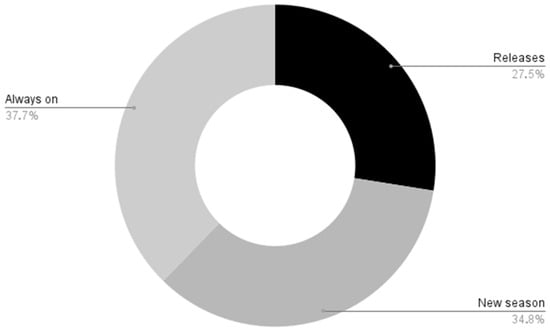
Most audio journalism projects are already well established, with around three-quarters (72.5%) of new seasons and continuously published programmes (always-on formats) being launched, while the remaining 27.5% are new productions. This data suggests that podcasts are reaching a certain degree of consolidation and maturity in their production by newspapers and news agencies (Figure 1).
Figure 1.
Podcasts published by news media in Spain by type of release.
However, there is an asymmetrical development among media groups. In absolute terms, Vocento’s regional newspapers are the most dynamic producers, accounting for almost a quarter of the podcasts launched in 2024. This figure doubles the output of the second and third largest players (ABC and Europa Press). In addition, Vocento is the group with the highest number of titles released in 2024, with a total of 13 new releases, and is also the only media outlet committed to paid content (2.9%).
This is a formula that is not widely used in audio journalism, where most podcasts are available on all platforms with the aim of maximising the reach and visibility of audio products. Another distribution model detected is linked to restricted or exclusive consumption on the producer’s own platform (9.4%), with Vocento and ABC standing out as a strategy to enrich the offering available to paying subscribers and thus attract more users under this financing formula.
In relation to production models, audio content represents a clear commitment by the media themselves and is configured as editorial products integrated into newsrooms or as an extension of organisational structures: 82.6% of podcasts are exclusive media launches, without alliances with other entities, which suggests a commitment to autonomy in this area.
However, there are also shared production formulas, which accounted for 13.8% in 2024, through agreements with public and private institutions or agreements with other production companies; the most striking case is that of the Europa Press news agency, which developed 8 of the 14 podcasts published (57%) together with the production company EOVE. This trend reflects a more collaborative and cross-cutting model in which alliances seek to achieve higher quality, scale, and cost reduction.
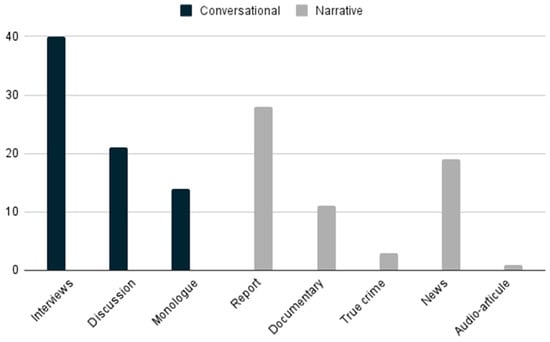
In genre terms, there is a relative balance between conversational and non-fiction narrative podcasts (53.4% and 44.9%, respectively), a combination of immediate editorial commentary and more elaborate documentary proposals. The slight predominance of conversational genres suggests a clear commitment to interpretation and analysis, with episodes structured around interviews, discussions, debates, and specialised commentary. Among the non-fiction narrative programmes, reports, documentaries, and news programmes stand out. In comparison, audio fiction appears marginally, with only one title: Palabra con futuro 2024, produced by Vocento from Diario La Rioja; it is an audio story, that is, a story narrated by a single voice (Figure 2).
Figure 2.
Conversational and narrative podcasts produced by news media in Spain in 2024.
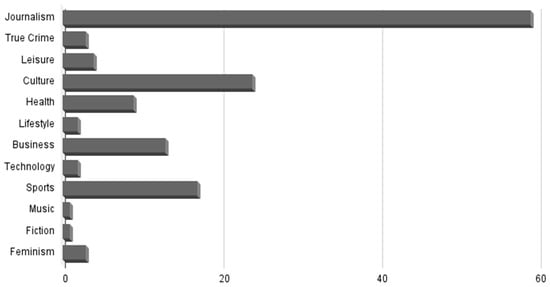
In terms of topics, a review of podcasts from print media and news agencies reveals a focus on content related to news and current affairs journalism (48.2%), especially in the daily format, with up to 17 titles in this category. The other two topics with the most content are culture, education, and society (17.4%) and sports (12.3%). The remaining nine categorised topics account for a quarter of the total and correspond to programmes on economics and business (13 podcasts), health and well-being (9 podcasts), leisure and entertainment (4), feminism (3), true crime (3), lifestyles (2), technology (2), and fiction and music, each with one title (Figure 3).
Figure 3.
Podcasts published by news media in Spain by topic.
Overall, the thematic distribution reveals a model focused on the journalistic function, where the podcast acts as a tool for reinforcing information rather than as a space for narrative experimentation towards more diverse content. In addition, half of the productions are published frequently, with daily, weekly and two or three times a week being the most common. It can also be seen that a third of the podcasts are published at irregular intervals. Fortnightly and monthly frequency is the least prevalent and is associated with cultural and economic content.
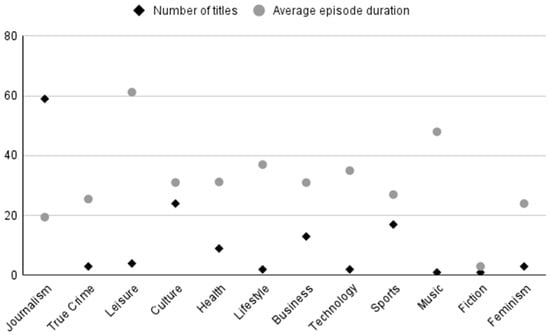
When examining the duration of episodes, the study reveals a clear disparity: almost two-thirds of the production (64.5%) ranges from up to 30 min, mainly episodes of dailies, documentary series and journalistic programmes. This content is updated more frequently and has an average duration of 19 min. The remaining third exceeds one hour in length and corresponds to talk shows and debates that allow for more detailed analysis and dialogue (Figure 4).
Figure 4.
Number of podcasts and average episode length by topic.
Most topics, ranging from mystery and crime to culture, sports, health, economics, lifestyle, and feminism, are between 20 and 50 min long, with an average duration of 48 min. Fiction podcasts are significantly shorter, while entertainment podcasts, on the other hand, exceed one hour in length. It should be noted that the costs and production time for narrative fiction and non-fiction podcasts—particularly investigative documentary series—are much higher than for interviews and talk shows, which also tend to have a longer duration and higher publication frequency.
The study also includes an analysis of the gender variable in the voices of those who host podcasts to check whether there is a significant distribution in the audio production of the media; the instrument measured whether the titles were presented by a male voice, a female voice or both. The predominance of male presence (44.2%) was found, especially in news and political-economic analysis podcasts. This overrepresentation is evident both in programs hosted by a single presenter and in those based on talk shows or debates, spaces in which the male voice remains more prominent.
Women account for almost a third, standing out in areas such as culture, well-being, and lifestyles, where there is greater openness to female participation. Interview formats show the most diverse distribution, with mixed teams in a high percentage of cases.
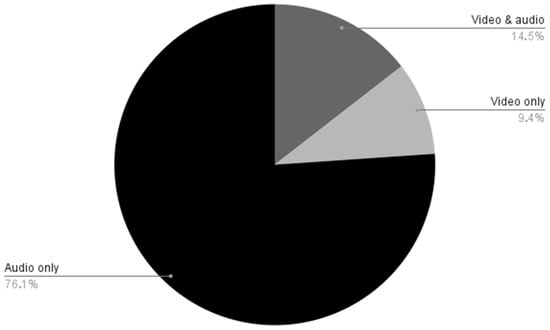
Finally, we examined whether podcast projects by print media and news agencies are incorporating video, one of the most notable trends in the industry in recent years and which, as indicated in the introduction, tends to increasingly influence the planning and development of productions.
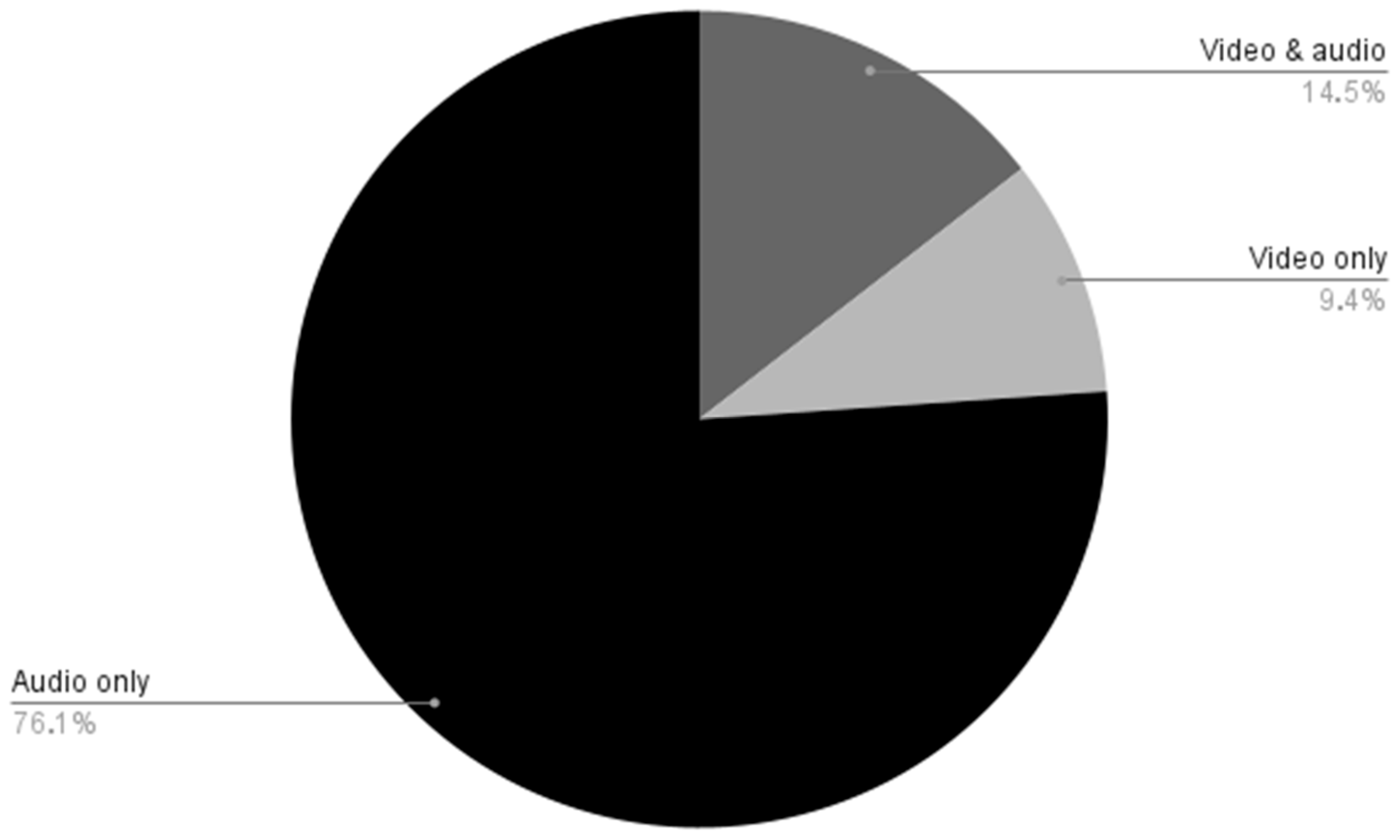
The analysis concludes that the adoption of video in Spanish news media is still limited: for three-quarters of podcasts, audio remains the only language. However, a transition towards video in hybrid formats has been detected: audio and video for platforms such as YouTube and Spotify, and video-only projects for conversational content such as interviews and columns published on YouTube and on the media outlet’s own website, specifically in the case of La Razón. This data can be interpreted as indicative of the degree of experimentation and digital adaptation of each media outlet, consolidating itself as an upward trend, but still far from widespread implementation (Figure 5).
Figure 5.
Presence of video in Spanish news media podcasts.
Beyond figures and percentages, a qualitative analysis of the 138 podcasts produced by newspapers and news agencies in Spain during 2024 reveals significant differences, both in terms of narrative and editorial content, and in terms of distribution and marketing strategies. As already noted, the entity that is most committed to audio as a tool for expanding information is the Vocento group, which published 31 podcasts from nine of its regional newspapers under the coordination of its audio division in Madrid.
Its titles are an example of variety in topics, adaptation to local markets and audience interests, and demands on production capacity: 20 of these releases, or almost two out of three (64%), are non-fiction narrative podcasts (reports and documentaries); including two seasons of the series Fuera del Radar, which premiered in 2022 and reached its seventh season in 2025 with a total of 68 episodes. Vocento’s podcasts, with their own narrative approach that highlights local stories, generate a sense of geographical belonging that becomes a value proposition to differentiate themselves and compete with other regional publications. This differentiation, in turn, justifies the fact that many of these products can only be listened to by subscription on the media platform (Table 3).
Table 3.
Podcasts produced by Vocento newspapers in 2024.
The ABC newspaper, also belonging to the Vocento group, but with a national presence and its own audio department, has also positioned itself as a leading producer with 15 releases in 2024, mainly in the non-fiction genre (11), with only 4 conversational productions (26%). It is worth noting its ability to keep up with current events with a daily news bulletin produced during the Olympic Games and in the daily Las noticias de ABC, published every weekday; both are examples of the news roundups typified by the authors of the Digital News Report.
This focus on narrative podcasts has been less exploited by the other publications analysed, where the conversational genre has carried more weight, even for current affairs topics. This is the case with El Español, El Confidencial, La Razón, La Vanguardia and El Debate, where the importance of audio in disseminating the opinions of their main columnists is evident. In these cases, the journalistic value of the voices contrasts with limited attention to sound design and narrative construction in audio format, aspects that remain in the background compared to the content.
Something similar occurs with El Confidencial, whose interview programmes Pausa and Punto ciego stand out for the relevance of their guests and their focus on current affairs, but with less use of the expressive resources specific to the medium. In some respects, these productions resemble political discussion programmes or specialised analysis programmes that are broadcast daily on generalist radio stations.
Special mention should be made of the podcasts produced by Agencia EFE, which, from various fields of specialised journalism—international news, agriculture, the environment, sport, and technology—effectively adapt traditional news content and language to audio from dailies and interview programmes, prioritising the value of the expert and journalistic clarity over basic audio creativity.
Finally, it should be noted that the flexibility of the narrative and technique of podcasting is compromised in some newspapers that use this label for content that is too far removed from the essentially audio nature and distribution adapted to any audio channel associated with this medium. This is the case with some titles in the Público newspaper and with most of the repertoire analysed in La Razón. In the first case, these are audio visual reports based on edited images that are not comprehensible through listening: Informe Público or Los reportajes de Livia Drusila exemplify this variant.
There are also other contents called ‘podcasts’ in Público and La Razón which, in reality, are video columns recorded in very low quality (sometimes by the protagonists themselves with a smartphone) that are only accessible through the websites of both newspapers; La opinión de Ana Bernal, La opinión de Cristina Fallarás, Las claves de Chema Molina, La opinión de Ana Pardo de Vera in Público and Alta Voz con Vicente Vallés, con Carlos Rodríguez Braun o con José Ramón Zallo in La Razón illustrate these newspapers’ efforts to expand their repertoire of digital offerings by combining and hybridising narrative and expressive formulas under taxonomies that, far from innovating, end up confusing the user’s expectations and understanding.
5. Discussion
Podcasts have become one of the essential tools in the profound change that the news industries are undergoing in the digital ecosystem. In a context in which audio content has gained prominence in leisure and entertainment, supported by connected devices, streaming services, and the rise of headphones (Piñeiro-Otero & Pedrero-Esteban, 2022), on-demand audio has proven its effectiveness in connecting with audiences who are saturated and even disenchanted with traditional news, especially younger audiences. As highlighted in the Reuters Institute’s Digital News Report, podcasts are presented as a ‘bright spot’ that attracts young, educated audiences and allows for experimentation with digital products that are less dependent on platform algorithms.
Journalistic podcasts such as Serial and The Daily have given way to deeper narratives, more diverse voices, and new distribution models, consolidating this format as an essential vector of innovation in contemporary journalism (Perrota, 2025). It is not just a matter of conceiving audio as an appropriate language for newspapers, but of understanding that its production requires rewriting, adjusting narratives and styles, and choosing the right voices and hosts for each topic, genre, and audience type. In this sense, and in the face of the limitations imposed by news radio, podcasts have opened space for long narratives or the exploration of the ‘behind the scenes’ of investigations and conversations between journalists. As Perdomo and Lindgren (2025) point out, this medium has allowed for the testing of new ways of producing and presenting news, reviving genres such as confessional journalism, investigative series and true crime, and challenging classic norms such as objectivity and distance.
Heirs to their informative nature, podcasts produced by newspapers tend to reflect the principles inherent in the construction of the printed narrative, here enriched with the nuances of sound language: data, context and explanation of events take on greater prominence with the tone and rhythm of voices and the setting and sound design. This is true of purely narrative works, but also of those based on dialogue: conversation in these podcasts is not a cheap stylistic device, but an intrinsic element of audio journalism that helps combat information fatigue and loss of relevance. In addition, podcasts reinforce the editorial identity of the media through style and values by selecting voices, journalistic authorship, topics covered, and sound design, being spaces that contribute to editorial positioning with the audience.
The uneven development observed among media groups can also be explained by structural and cultural barriers that affect the implementation of audio journalism. Limited financial and human resources, small and multi-skilled teams, and the persistence of production routines inherited from print journalism constrain experimentation with sound narratives. In some cases, audio remains subordinate to opinion or audiovisual content, rather than being conceived as a medium with its own expressive logic.
In this sense, the conversational structure humanises journalists, who are shown as people who hesitate, joke, make mistakes and correct themselves, rather than impersonal voices that “declaim” news. In addition, they transform listening to the news into an experience of sonic intimacy, as the listener feels that they are attending a conversation in which current affairs are thought out loud. Finally, journalistic podcasts structured around dialogue facilitate leisurely explanations, comparisons, and contextualisations that allow the listener to better understand the importance of events.
6. Conclusions
The conclusions of this study show that the main newspapers and news agencies in Spain have consolidated the news podcast as a central product for rethinking journalism in a hybrid way, halfway between the routines of the press, radio culture and the logic of digital platforms. An analysis of the 138 titles released in 2024 reveals an expanding but still uneven ecosystem, where highly institutionalised projects coexist with more experimental initiatives, and where the informative function remains the focus, although there is room for long-form storytelling and the exploration of conversational formats.
The results confirm that audio departments have become factors of strategic, narrative, and commercial transformation for newspapers (Pedrero-Esteban et al., 2025b). Podcasts contribute to diversifying the offering, strengthening brand identity, and opening new revenue streams, even though teams remain small and work with limited resources. This consolidation of audio journalism coexists with structural tensions: most productions are distributed openly and seek to maximise reach, while some groups, such as Vocento, are experimenting with payment models or exclusive access linked to subscriptions, which shows that the commercial possibilities of audio are still being explored cautiously.
From the perspective of journalistic practices, the study corroborates that audio forces us to rewrite and reconfigure the ways we tell stories: podcasts shift the centre of gravity from data to experience, emotion, and intimacy, taking advantage of silences and soundscapes to generate closeness and credibility. In this sense, documentaries, reports, and major investigations show how the Spanish press demonstrates the potential of audio to construct complex stories, place the listener ‘on the scene’ and prolong the informative life of topics beyond the immediate news, one of its most obvious differences from radio.
At the same time, the presence of titles linked to interviews or talk shows indicates that much of the innovation is articulated through conversation as a form of journalism, in line with international literature on news podcasts (Newman & Gallo, 2020; Perrota, 2025). These spaces transfer the logic of columns and analysis to on-demand listening and reinforce the role of the journalist’s voice as a mediator who explains, interprets, and accompanies the audience, although in many publications, sound experimentation remains limited, and the emphasis is more on the voice than on sound design.
In terms of possibilities and limitations, the findings point to a hybrid production model in which newspapers mostly take ownership of their podcasts but are beginning to share projects with external production companies and explore co-productions that provide scale, specialisation, and cost reduction. However, clear structural challenges remain small, multi-skilled teams, difficulties in consolidating specific revenues, the still minority adoption of video as a complementary layer, and the risk of taxonomic confusion when audiovisual products that do not work solely as audio are labelled as podcasts.
Finally, the study suggests that Spanish audio journalism already occupies a relevant place in the debate on ‘rethinking journalism in the age of podcasts,’ but it remains a field under construction that requires further research on its real impact on loyalty, audience profiles, the sustainability of business models, and the effects of audio–video hybridisation. In this future agenda, it will be key to continue observing how audio departments evolve, what margin narrative stories gain over more economical and scalable podcasts, and to what extent the commitment to emotion, intimacy, and the journalist’s voice manages to translate into an effective response to information disaffection and new forms of digital consumption.
Author Contributions
Conceptualization, L.M.P.E. and L.M.C.; Literature review, M.A.B., M.d.l.C.D. and L.M.C.; Methodology, L.M.P.E. and L.M.C.; Formal analysis: L.M.C., M.A.B. and M.d.l.C.D.; Investigation: L.M.P.E., L.M.C., M.A.B. and M.d.l.C.D.; Findings interpretation: L.M.C., M.A.B. and M.d.l.C.D.; Discussion: L.M.P.E.; Conclusion: L.M.P.E. and L.M.C.; Visualization: L.M.C.; Supervision & project administration: L.M.P.E.; Writing—review and editing, L.M.P.E.; Formatting, L.M.C. All authors have read and agreed to the published version of the manuscript.
Funding
This article is part of the research project: ESCUCHAD.es. Estudio integral de la industria cultural del audio digital en España: agentes, contenidos, hábitos de consumo, perfiles profesionales y estrategias de alfabetización (Comprehensive study of the digital audio culture industry in Spain: agents, content, consumption habits, professional profiles, and literacy strategies). Code: PID2023-149124OB-I00, financed by MICIU/AEI/10.13039/501100011033 and FEDER, UE.
Institutional Review Board Statement
Not applicable.
Informed Consent Statement
Not applicable.
Data Availability Statement
The data presented in this study are available upon request from the corresponding author. The data are not publicly available due to restriction of the funder.
Acknowledgments
We would like to thank the organizations analysed in this study for providing us with a list of podcasts released by each of them during 2024, as well as, in some cases, links to listen to them when they were restricted to paying users.
Conflicts of Interest
The authors declare no conflicts of interest.
References
- Berry, R. (2006). Will the iPod kill the radio star? Profiling podcasting as radio. Convergence: The International Journal of Research into New Media Technologies, 12(2), 143–162. [Google Scholar] [CrossRef] [Scilit]
- Berry, R. (2016). Podcasting: Considering the evolution of the medium and its association with the word ‘radio’. Radio Journal, 14(1), 7–22. [Google Scholar] [CrossRef] [Scilit]
- Bolter, D., & Grusin, R. (2000). Remediation understanding new media. The MIT Press. [Google Scholar]
- Bonini, T. (2022). Podcasting as a hybrid cultural form between old and new media. In M. Lindgren, & J. Loviglio (Eds.), Routledge companion to radio and podcast studies (pp. 19–29). Routledge. [Google Scholar]
- Cavia Fraile, S. (2016). Nuevo modelo de radio a través de la cuarta pantalla: Radiovisión, la radio que se ve. Fonseca, Journal of Communication, 13(13), 65–84. [Google Scholar] [CrossRef] [Scilit]
- Dowling, D. O. (2026). Theorizing podcast journalism: Toward a medium-specific framework for audio reporting. Journalism and Media, 7, 2. [Google Scholar] [CrossRef] [Scilit]
- Doyle, G. (2014). Re-invention and survival: Newspapers in the era of digital multiplatform delivery. Journal of Media Business Studies, 10(4), 1–20. [Google Scholar] [CrossRef] [Scilit]
- Gallego-Pérez, J. I. (2010). Podcasting: Distribución de contenidos sonoros y nuevas formas de negocio en la empresa radiofónica española [Doctoral thesis, Universidad Complutense de Madrid]. [Google Scholar]
- García-Avilés, J. A. (2021). Review article: Journalism innovation research, a diverse and flourishing field (2000–2020). Profesional de la Información, 30(1), e300110. [Google Scholar] [CrossRef] [Scilit]
- García-Avilés, J. A., Carvajal Prieto, M., & Arias Robles, F. (2018). Implantación de la innovación en los cibermedios españoles: Análisis de las percepciones de los periodistas. Revista Latina de Comunicación Social, 73, 369–384. [Google Scholar] [CrossRef] [Scilit]
- García-Marín, D. (2019). La radio en pijama. Origen, evolución y ecosistema del podcasting español. Estudios Sobre el Mensaje Periodístico, 25(1), 181–196. [Google Scholar] [CrossRef] [Scilit]
- Gutiérrez-García, M., Sellas-Güell, T., & Esteban, J. A. (2019). Periodismo radiofónico en el entorno online: El podcast narrativo. In L. M. Pedrero-Esteban, & J. M. García-Lastra (Eds.), La transformación digital de la radio. Diez claves para su comprensión profesional y académica (pp. 131–150). Tirant lo Blanch. [Google Scholar]
- Jenkins, H. (2006). Convergence culture: Where old and new media collide. New York University Press. [Google Scholar]
- Katzenberger, V., Schützeneder, J., Grassl, M., & Keil, J. (2023). Infotainers, mediators, or watchdogs? Mapping the field of news podcasters and their role conceptions in Germany, Austria, And Switzerland. Journalism and Media, 4(3), 820–834. [Google Scholar] [CrossRef] [Scilit]
- Kay, R. (2012). Exploring the use of video podcasts in education: A comprehensive review of the literature. Computers in Human Behavior, 28(3), 820–831. [Google Scholar] [CrossRef] [Scilit]
- Legorburu, J. M., Edo, C., & García-González, A. (2021). Podcasting as an opportunity to recover and renew the audio feature genre in Spanish: A case study of Cuonda and Podium Podcast. The Radio Journal: International Studies in Broadcast & Audio Media, 19(2), 311–326. [Google Scholar] [CrossRef] [Scilit]
- Legorburu, J. M., García de Torres, E., Parra Valcarce, D., & Edo, C. (2026). Between immediacy and depth: Evolving journalism practices in Spanish newspapers’ daily news podcasts. Journalism and Media, 7, 28. [Google Scholar] [CrossRef] [Scilit]
- Leoz Aizpuru, A., & Pedrero-Esteban, L. M. (2022). Audio storytelling innovation in a digital age: The case of daily news podcasts in Spain. Information, 13(4), 204. [Google Scholar] [CrossRef] [Scilit]
- López-Villafranca, P. (2024). El vídeo podcast en Spotify España. Un formato dirigido a la generación Z que marca tendencia en la industria del audio digital. Revista Mediterránea de Comunicación, 15(1), 235–249. [Google Scholar] [CrossRef] [Scilit]
- Martínez-Costa, M. P., Amoedo-Casais, A., & Moreno-Moreno, E. (2022). The value of podcasts to journalism: Analysis of digital native media brands’ offerings, production, and publishing in Spain. Profesional de la Información, 31(5), e310503. [Google Scholar] [CrossRef] [Scilit]
- Martínez-Costa, M. P., & Lus Gárate, E. (2019). El éxito de los podcasts de noticias y su impacto en los medios de comunicación digital. Miguel Hernández Communication Journal, 10(2), 323–340. [Google Scholar] [CrossRef] [Scilit]
- Martínez Otón, L., Leoz Aizpuru, A., & Pedrero-Esteban, L. M. (2022). Los podcasts informativos diarios en España: Evolución de la oferta y aportaciones narrativas del formato. Austral Comunicación, 11(2), 1–27. [Google Scholar] [CrossRef] [Scilit]
- McHugh, S. (2022). The power of podcasting. Telling stories with sound. Columbia University Press. [Google Scholar]
- Newman, N. (2024). Overview and key findings of the 2024 digital news report. Reuters Institute. Available online: https://reutersinstitute.politics.ox.ac.uk/digital-news-report/2024/dnr-executive-summary (accessed on 24 October 2025).
- Newman, N., Arguedas, R., Robertson, C. T., Nielsen, R. K., & Fletcher, R. (2025). Reuters institute digital news report 2025. Available online: https://reutersinstitute.politics.ox.ac.uk/sites/default/files/2025-06/Digital_News-Report_2025.pdf (accessed on 26 November 2025).
- Newman, N., & Gallo, N. (2020). News podcasts: Building new habits in the shadow of coronavirus. Reuters Institute for the Study of Journalism. [Google Scholar]
- Nuzum, E. (2019). Make Noise. In A creator’s guide to podcasting and great audio storytelling. Workman Publishing. [Google Scholar]
- Orrantia, A. (2019). Diez claves para contar buenas historias en podcast. O cómo producir contenidos en un entorno digital cambiante. UOC. [Google Scholar]
- Palazón Herrera, J. (2012). El vídeo podcast: Una tecnología de la web 2.0 al servicio de la interpretación instrumental. Eufonía: Didáctica de la Música, 55, 72–83. [Google Scholar]
- Pedrero-Esteban, L. M., Espada, A., Martínez-Otón, L., Martín-Nieto, R., Pérez Escoda, A., Castillo, E., Fisher, P., & Vaccaro, M. (2024). Cómo suenan los podcasts en España y Argentina. Radiografía de la producción original en plataformas y productoras de audio en 2023. Observatorio Nebrija del Español, Fundación Nebrija. Available online: https://acortar.link/dSf9VK (accessed on 18 October 2025).
- Pedrero-Esteban, L. M., Espada, A., Pérez-Escoda, A., & Martín-Nieto, R. (2025a). Hacia el afianzamiento de la industria cultural del podcast en español. Análisis de la producción en España y Argentina. Revista de Comunicación, 24(1), 409–429. [Google Scholar] [CrossRef] [Scilit]
- Pedrero-Esteban, L. M., Martínez-Otón, L., Martín-Nieto, R., & Castillo, E. (2023). Cómo suenan los podcasts en España. Radiografía de la producción original en las plataformas de audio en 2022. Observatorio Nebrija del Español, Fundación Nebrija. Available online: https://acortar.link/XSI4jX (accessed on 12 November 2025).
- Pedrero-Esteban, L. M., Moreno-Cazalla, L., & Fernández-Sande, M. (2025b). Audio journalism as a vector of strategic, narrative, and commercial transformation for Spanish print media. Communication & Society, 38(2), 199–217. [Google Scholar] [CrossRef] [Scilit]
- Perdomo, G., & Lindgren, M. (2025). Elements of podcast journalism, an emerging framework. In M. Perrota (Ed.), Podcast in the future of journalism. Exploring forms and formats of audio storytelling in digital news media (pp. 27–44). Roma Tre-Press. [Google Scholar]
- Perrota, M. (2025). Journalism in listening mode. Models’ co-production, and the new podcast economy. In M. Perrota (Ed.), Podcast in the future of journalism. Exploring forms and formats of audio storytelling in digital news media (pp. 15–26). Roma Tre-Press. [Google Scholar]
- Piñeiro-Otero, T., & Pedrero-Esteban, L. M. (2022). Audio communication in the face of the renaissance of digital audio. Profesional de la Información, 31(5), e310507. [Google Scholar] [CrossRef] [Scilit]
- Scolari, C. A. (2013). Narrativas transmedia, cuando todos los medios cuentan. Deusto. [Google Scholar]
- Spinelli, M., & Dann, L. (2019). Podcasting: The audio media revolution. Bloomsbury Academic. [Google Scholar]
- Sullivan, J. L. (2024). Podcasting in a platform age: From an amateur to a professional medium. Bloomsbury Podcast Studies. [Google Scholar]
- Terol Bolinches, R., Arense, A., Pérez-Alaejos, M. P. M., & Pedrero-Esteban, L. M. (2024). Journalism in the age of audification: Features of narrative nonfiction podcasting in Spain. Radio Journal: International Studies in Broadcast & Audio Media, 22(2), 163–185. [Google Scholar] [CrossRef] [Scilit]
- Webster, T. (2023, December 13). Sound you can see: Podcasting’s video dilemma. Available online: https://soundsprofitable.com/research/sound-you-can-see/ (accessed on 22 October 2025).

Disclaimer/Publisher’s Note: The statements, opinions and data contained in all publications are solely those of the individual author(s) and contributor(s) and not of MDPI and/or the editor(s). MDPI and/or the editor(s) disclaim responsibility for any injury to people or property resulting from any ideas, methods, instructions or products referred to in the content. |
© 2026 by the authors. Licensee MDPI, Basel, Switzerland. This article is an open access article distributed under the terms and conditions of the Creative Commons Attribution (CC BY) license.