


Abstract
In this paper, we describe and analyse the characteristics of news articles published in Spanish media which were written with assistance, of different types and to varying extents, from generative AI. We pursue three objectives: to identify how AI is being used, to examine the formal and textual characteristics of articles produced in this way, and to determine the degree of transparency with which the use of generative AI is communicated to readers. Using content analysis techniques, 120 articles published in different newspapers were studied, including articles written entirely by AI, written with the help of AI, and resulting from other uses of AI. Our analysis shows different results depending on the use of AI. The first group exhibits standardised writing, repetitive structures, and fewer sources. The second group shows less standardisation, more contextual information, and more journalistic errors. Despite relying on a repetitive structure, the third group does not display standardised writing. Regarding transparency, this study reveals that not all texts disclose AI use, and when they do, it appears separately from the byline or within the text. This study is pioneering due to the breadth of the analysed sample and our examination of different uses of AI in the Spanish news media.
1. Introduction
Technological advances have transformed journalism, affecting work routines, traditional roles, the production and presentation of information, and the relationship between the press and the public. So far, and especially in recent years, the field of journalism has quickly assimilated to these changes (Parratt-Fernández et al., 2021) and addressed the challenges that it has faced (Carlson, 2014; Clerwall, 2014).
In the “second machine age” (Diakopoulos, 2019), computers are performing intellectual tasks, just as machines took over manual labour in the 19th and 20th centuries. Following the emergence of the first online media, and with the digitalisation of journalism now well and truly established, the most disruptive change to the status quo has come with artificial intelligence (hereinafter AI)—a “rational agent” that achieves efficiency by imitating—with varying levels of success—human cognition (Canavilhas, 2022). The rapid pace at which AI has evolved has forced the media and professionals in the field to adapt quickly to the drastic changes that it brings. The way in which news is produced and transmitted has changed over the last four decades, moving on from the times of manual layout and laborious typesetting to the current environment in which computers can sometimes replace journalists completely (Túñez-López et al., 2019). The integration of AI into newsrooms presents both significant opportunities and challenges in four key areas that are intrinsically linked: workflow, news content, newsroom structure, and the relationships between media outlets, journalists, and the public (Pavlik, 2010).
In Spain, the use of AI in journalism has become “a phenomenon in full development” (Mayoral-Sánchez et al., 2023, p. 829). Generative artificial intelligence (hereinafter GenAI)—“a type of artificial intelligence technology that can create new content, such as text, images, audio, video, or other media, based on the data it has been trained on and according to written prompts provided by users” (Diakopoulos et al., 2024, p. 4)—has reached media newsrooms, promising to “revolutionise the way they produce content” (Cano-Orón & López-Meri, 2024, p. 66).
At a time of such rapid and decisive change, it is particularly relevant to examine how Gen AI is transforming news production. While AI applications across the journalistic process have been widely studied in Spain (Sanahuja & Rabadán, 2021; Mondría Terol, 2023; Sánchez-García et al., 2023), research focusing specifically on content remains limited, and most studies are partial or case-based (Segarra-Saavedra et al., 2019; Bazán-Gil et al., 2021; Tejedor, 2022; Aramburú-Moncada et al., 2023; Modrón-Lecue & Sánchez-García, 2026). This exploratory study is pioneering within the field, as we analyse and compare, for the first time, different degrees of use and applications of AI in the Spanish media (articles generated entirely by AI, those created with the help of AI, and those making innovative use of this technology). We aim to provide a broader and more descriptive perspective on such content, identify how AI is employed, analyse the formal and textual features of AI-assisted news articles, and assess the transparency with which AI use is communicated to readers.
2. Literature Review
The literature review is organised into three sections, aligned with the research objectives. The first—focused on the challenges and opportunities of GenAI in journalism—provides a general overview, highlighting tensions between automation and information quality, ethical dilemmas, and technological opportunities. The second—on generative AI applications in journalism—synthesises previous research to offer a comparative framework situating our study within the current academic literature. The third—focused on the Spanish context—is essential for contextualising the object of study, allowing us to examine previous experiences, strategies adopted by the media, and debates surrounding transparency and human oversight.
2.1. Challenges and Opportunities Related to GenAI in Journalism
GenAI can generate text, images, sounds, or any other type of information autonomously (Foy, 2022; Cano-Orón & López-Meri, 2024). Such a disruptive technology raises numerous questions regarding the advantages and challenges that could arise from its application. Among the former, the possibility of generating a large number of articles quickly and cheaply stands out, representing, as it does, improved efficiency for media companies (van Dalen, 2012; Graefe, 2016; Caswell & Dörr, 2017; Wölker & Powell, 2018; Beckett & Yaseen, 2023; Thäsler-Kordonouri & Barling, 2023); the opportunity for journalists to devote more time to research and in-depth journalism, without having to deal with routine tasks (van Dalen, 2012; Wölker & Powell, 2018; Cano-Orón & López-Meri, 2024); the ability to cover news stories that are not usually considered; and, finally, a way to create more complex digital narratives (Caswell & Dörr, 2017; Melin et al., 2018; Aramburú-Moncada et al., 2023).
In terms of challenges, experts have focused on issues such as authorship, responsibility, transparency, and the risk of engendering polarisation while at the same time limiting pluralism and critical thinking (Graefe et al., 2016; Peña-Fernández et al., 2023; Cano-Orón & López-Meri, 2024). Some authors have also highlighted concerns regarding how this new scenario could affect the journalistic field’s social responsibility, its role as a watchdog (Wölker & Powell, 2018), its function in democratic societies (Lin & Lewis, 2022), and its very nature (Thäsler-Kordonouri & Barling, 2023). As the Center for News, Technology & Innovation (2025) points out, “these changes mean rethinking the role journalism plays in society and the services it provides” (p. 14). Beckett and Yaseen (2023) take a similar view, arguing that GenAI threatens the mediating role of the profession, as does Caswell (2023), who states that editorial judgement will continue to represent the foundation of journalism.
Academic research on the application of GenAI in journalism frequently cites the word “quality”. Oh and Jung (2025) predict that the adoption of this technology will result in a significant improvement in the quality of news, while, conversely, Okonkwo et al. (2024) point out that its use may undermine the quality of content. Thäsler-Kordonouri (2026) explains that low-quality news articles generated by GenAI are post-edited by journalists before publication. Furthermore, Ding (2024) warns that human review is essential to check the quality of texts; in a study by Beckett and Yaseen (2023), respondents say they fear that GenAI will lead to the mass production of low-quality journalism; and van Dalen (2012) asserts that there are certain skills that journalists possess that cannot be imitated by algorithms and that are characteristic of quality journalism.
However, the quality of news is difficult to measure, as it is a complex and subjective concept (Graefe et al., 2016; Meier, 2019; Picard, 2004). This difficulty is compounded when assessing AI-generated news, as unprecedented technical, ethical, and editorial issues come into play (Ramírez-de-la-Piscina, 2015; La-Rosa-Barrolleta & Sandoval-Martín, 2024).
2.2. Applications of GenAI in Journalism
As Sandoval-Martín and La-Rosa-Barrolleta (2023) point out, the first automatically generated news articles were weather forecast summaries published in the 1970s. However, it was not until the mid-2000s that a substantial number of media outlets began integrating AI into their news production processes, enabling the automation or semi-automation of tasks ranging from data collection to dissemination (Diakopoulos, 2019). In 2014, the Associated Press became the first organisation to publish over 3000 robot-generated articles. Soon after, the Los Angeles Times, The New York Times, Forbes, and ProPublica also incorporated automated production systems into their newsrooms (Graefe, 2016). Meanwhile, Reuters started producing automated reports for sporting events and generating data visualisations (Rojas-Torrijos & de-Santis, 2024).
The emergence of GenAI tools has brought about a new and profound revolution in the automation of newsmaking, especially since the popularisation of natural language models, which have made it easier to generate journalistic content. The most striking example of GenAI is ChatGPT, which was launched by OpenAI at the end of November 2022, reached one million users in just five days (Foy, 2022), and had more than 100 million users by June 2023 (Fieiras-Ceide et al., 2024). The rapid expansion of these tools and the drastic changes that they represent for journalism have led many scholars to suggest that we are at a milestone or a radical turning point in the transformation of the profession (Beckett & Yaseen, 2023; Aramburú-Moncada et al., 2023; Peña-Fernández et al., 2023; Newman et al., 2024; Cristòfol et al., 2025). Caswell (2023) even equates the significance of the emergence of AI with that of the birth of the internet or the advent of the printing press.
Initially, automated news covered topics such as sports, finance, weather forecasts, and election results, which require only the processing of data and subsequent structured and predictable writing (Caswell & Dörr, 2017; Vállez & Codina, 2018; Graefe & Bohlken, 2020). Applying this technology to the writing of more complex texts was not possible, as the technology could only generate simple, data-based descriptions (Caswell & Dörr, 2017, p. 478).
As a result, the texts produced were “little more than a simple recitation of facts that neither requires flowery narration nor storytelling” (Graefe & Bohlken, 2020, p. 58), “routinely descriptive” (Caswell & Dörr, 2017, p. 478), “boring” and “full of clichés” (van Dalen, 2012, p. 653), due to having “a similar and repetitive structure” (Cano-Orón & López-Meri, 2024, p. 14) while not differing too much from “the brief, concise, sober and limited texts that are often hastily requested from writers” (Murcia-Verdú & Ufarte-Ruiz, 2019, p. 53).
Today, the main applications of GenAI in journalism (Shi & Sun, 2024) are in information gathering, which “serves as the cornerstone of news production, where journalists assess the relevance and significance of various topics based on available information” (p. 585); in two main aspects of content production, namely, generating content and diversifying writing styles; and in customization and dissemination, through assigning journalists to topics in which they have greater expertise and tailoring content to specific audiences.
2.3. GenAI in Spain
The application of GenAI in the media varies significantly between countries in terms of both its uses and its level of development. In Spain, where the media has traditionally been more reluctant to incorporate this technology (Parratt-Fernández et al., 2024), its use has increased significantly in recent years (Sánchez-García et al., 2023; Fieiras-Ceide et al., 2024). Some have even stated that it is already playing an important role in newsrooms (Cristòfol et al., 2025).
According to the Digital News Report 2025 (Newman et al., 2025), 57% of Spanish media outlets have already incorporated AI tools into their editorial processes, with the most common application being content generation (68%), followed by data analysis and the automation of editorial and production processes (both at 63%). This contrasts with some recent research (Fieiras-Ceide et al., 2024; Sánchez-García et al., 2023; Mayoral-Sánchez et al., 2024) reporting that, although most newspapers have conducted internal tests using AI, they are not publishing articles that have been generated entirely by AI, as these are not considered to be of sufficient quality and it is feared that they could damage a publication’s image. Automated text production is therefore still scarce in Spain, as is the technology available for news automation (Sánchez-García et al., 2023).
Among the first media outlets to experiment with automated texts, the Vocento group stands out, as, in 2016, they generated service information on the status of beaches and ski resorts (Ufarte-Ruiz & Manfredi-Sánchez, 2019; Túñez-López et al., 2019), as well as the newspaper El Confidencial, which was the first to publish automated sports reports (Rojas-Torrijos & Toural-Bran, 2019), and three publicly owned media outlets: Agencia EFE, TV3, and Radio Televisión Española (RTVE). During the COVID-19 pandemic, TV3 reported data on hospital admissions, infections, etc., with news stories written by GenAI and also used it to cover the results of the 2021 Catalan elections in small towns (Cano-Orón & López-Meri, 2024). RTVE used the same techniques to report on lower-division football matches and the results of the 2023 municipal and general elections in municipalities with fewer than 1000 inhabitants (Aramburú-Moncada et al., 2023; Danzon-Chambaud, 2023).
Other media outlets, such as the newspapers Sport, Mundo Deportivo, 20 Minutos, El Español, and Heraldo de Aragón, published their first automated news stories thanks to the services provided by the technology company Narrativa (Cano-Orón & López-Meri, 2024), the only provider of automated news with clients in Spain (Ufarte-Ruiz & Manfredi-Sánchez, 2019; Parratt-Fernández et al., 2024). It is noteworthy that within the list of 25 companies or centres offering AI in Spain compiled by Sánchez-García et al. (2023), only three of them—Dail Software, Knowledge Reuse, and Narrativa itself—offer text automation services for news stories. Currently, according to Fieiras-Ceide et al. (2024), most Spanish newspapers are in the early stages of AI implementation and show neither “a defined strategy or sophisticated uses” (p. 28).
So far, automation has been incorporated into some sections (Quian & Sixto-García, 2024) and certain tasks, such as summarising or generating headlines, and has been used to provide highly structured local information, including weather, sports, finance, and politics, especially election results (Cano-Orón & López-Meri, 2024; Calvo-Rubio & Rojas-Torrijos, 2024). The topics reported on are simple ones that had not been covered by the media before the advent of GenAI (Fieiras-Ceide et al., 2024).
Regarding the quality of automated news pieces published by Spanish media outlets, early research (Túñez-López et al., 2019; Ufarte-Ruiz & Manfredi-Sánchez, 2019; Rojas-Torrijos & Toural-Bran, 2019) has described them as texts with repetitive narrative structures, which lack style, quality sources, diversity of viewpoints, and context. However, their accuracy and neutrality have been highlighted.
As research progresses, the need for these GenAI-produced news articles to be checked by journalists before publication is becoming apparent (Tejedor-Calvo et al., 2021), and warnings are being issued about the implicit lack of transparency in not indicating that the text has been generated by AI (Túñez-López et al., 2021).
The most recent research shows continued scepticism towards the ability of technology to meet journalistic quality standards, pointing to limitations such as the inability to interpret, analyse, or add context, resulting in dull, flat texts (Calvo-Rubio & Rojas-Torrijos, 2024; Fieiras-Ceide et al., 2024). Conversely, other researchers have asserted that AI-produced articles are as well written as those produced by journalists (La-Rosa-Barrolleta & Sandoval-Martín, 2024) and that, in general, the perceived quality of AI-generated news is excellent (Calvo-Rubio et al., 2024). Currently, in Spanish journalism, AI is seen more as a tool serving journalists than as a threat to their professional performance.
In this work, we aim to delve deeper into the study of AI-generated content published in Spanish media. The following research questions are posed:
RQ1. How are Spanish media outlets using AI to write news articles?
RQ2. What formal and textual characteristics do AI-generated news published in the Spanish press have?
RQ3. How transparent are media organisations in disclosing their use of AI for content creation to their readers?
3. Method
In this study, we employ a mixed-methods approach, integrating both quantitative and qualitative techniques. It is grounded in content analysis, which is primarily quantitative; although no standalone qualitative techniques are employed, the results are interpreted qualitatively. Given the exploratory and descriptive nature of the research, content analysis represents a pertinent methodological approach. Not only is it a well-established technique within the social sciences, particularly in mass communication studies (Berger, 2016; Lombard et al., 2002), but it also enables the systematic examination of the formal and textual features of news articles (Piñeiro-Naval, 2020). Intentional sampling (Krippendorff, 1990) was used in order to collect a heterogeneous sample (Mason, 1997) that would enable the analysis of articles, written via differing uses of GenAI, published by various Spanish media outlets that currently use AI for content writing. The sample includes public and private media outlets, wide geographical coverage, and different degrees of AI incorporation into textual production in order to offer a fully comprehensive view of the reality examined. After discussions with the heads of 10 media outlets and two media groups, we selected 12 media outlets (Table 1), who use this technology in the following ways: 10 to generate content automatically, although always with human review before publication, as their managers assured the authors of this research; one as an editorial assistant to verify and enrich content; and one as part of an adaptive approach to creating a new section in the newspaper.
Table 1.
Media outlets and articles studied.
The total number of units for analysis was set at 120 news items, all published, for general consumption and not only for subscribers, between June 2024 and January 2025, distributed as follows: 40 from RTVE, 20 with weather information and another 20 with political information; 20 from Mundo Deportivo; 20 from Heraldo de Aragón; 20 from La Vanguardia; and 20 more from eight newspapers belonging to the Prensa Ibérica group. To ensure that all the pieces had been generated or assisted by AI, decision-makers from different media outlets were contacted prior to selection. The texts were then checked to verify the accuracy of the information provided.
The RTVE articles were generated entirely using AI and, as indicated, are divided into two groups: those reporting on weather forecasts in small municipalities in Lleida, and those reporting on the results of the 2024 Catalan elections in the 822 municipalities with fewer than 10,000 inhabitants. To sample the first group, we took articles on weather information from five different locations published in November 2024. To sample the second group, since the information is presented in alphabetical order by name of municipality, articles from the first towns corresponding to each letter of the alphabet were picked until the required number (20) had been selected.
The Mundo Deportivo articles, which relay information about Second Division football matches, were also written entirely by AI and were selected from those published in December 2024 and January 2025. Since the Prensa Ibérica group has an AI tool that writes weather reports for their publications, eight newspapers that publish such reports were selected, and then two or three pieces from each newspaper were chosen at random, all published in November 2024.
The sample from Heraldo de Aragón, however, is composed of texts that were not entirely generated by AI. These are hybrid articles, the result of collaborations between journalists and AI, which was used here as a writing assistant to verify and enrich the content. These articles deal with diverse topics and appeared in different sections of the newspaper between November and December 2024.
The case of La Vanguardia is special because of its innovative approach to the use of AI. In October 2024, the newspaper launched a new section called Flash, exclusively for the mobile web version and the newspaper’s app, which uses AI to offer readers a selection of the most important news stories of the day (15 or 16). For each news item, a summary and key information are provided, both generated by AI. If readers want more information, they can then access the full article, written by a journalist. Only articles that are available to the general public were taken into account for sample selection; while all the summaries and key information are freely available, this is not the case for all full articles. Of these, the first two published in January 2025 were selected.
To answer the research questions, achieve the proposed objectives, and provide a coherent framework for the study (Macnamara, 2005), an analysis sheet—based on the one created by Sabaté-Gauxachs et al. (2018)—was created, consisting of three dimensions and 20 variables (Table 2). In the variable regarding writing, ‘journalistic errors’ refer to flaws in journalistic writing, specifically in news writing. These flaws can be in the prioritisation of information, clarity, adherence to the news style, or the proper use of sources and data. Conversely, ‘other types of errors’ refer to normative aspects of language, such as spelling, punctuation, and grammar, which are not specific to journalistic discourse but are required in any type of text.
Table 2.
Description and analysis sheet.
The contents of this table were applied to articles generated either entirely by AI or using hybrid techniques. For texts published in La Vanguardia, due to their special characteristics, a simplified version was used. In the “Formal aspects” component, the variables sidebars, summaries, headlines, subheadings and interactivity were removed, and in the “Textual aspects” component, sources, data, structure, and context were removed.
To verify the reliability of the coding system (Krippendorff, 1990), a pretest was conducted. Discrepancies were resolved through collaboration between the three coders until a consensus was reached. Cohen’s Kappa was used to assess inter-coder agreement on a random 10 percent sample of the corpus, yielding values of at least 0.80 across all variables. This confirms the objectivity of the study by minimising individual biases (Piñeiro-Naval, 2020).
4. Results
The sample studied here (120 pieces) includes texts generated entirely by AI (Prensa Ibérica, RTVE and Mundo Deportivo); hybrid texts (Heraldo de Aragón); and pieces created using AI in different ways than these (La Vanguardia).
4.1. Newspaper Articles Written Entirely with AI
None of the articles written entirely by AI have a byline, but half of them (40) do let the reader know that the texts were generated by an AI system. However, these disclosures do not appear within the texts themselves but rather in separate sections. This is the case with the articles published by RTVE on weather information (hereinafter, RTVE El Tiempo) and on the 2024 elections in Catalonia (hereinafter, RTVE Elecciones), which include a notice in the upper right-hand corner of the screen that reads, “The content provided is the result of a technological test”. For greater transparency, there are also links to detailed information about each project: https://bit.ly/43ysEQh, https://bit.ly/3Ir5lPH (accessed on 20 August 2025). RTVE Elecciones also includes a brief text, as a footer at the bottom of each article, indicating that the content was generated by AI from official data “to guarantee its veracity and accuracy” and that “the entire process has been and is supervised by RTVE professionals to certify the quality of the information, editorial content and visuals”.
Unlike RTVE, none of the articles published by Mundo Deportivo and Prensa Ibérica (40) indicate that the content was generated by AI or with the help of AI. The most common topics covered are the weather (40), politics (20), and sports (20). The genres used correspond to those of the news item in all cases (Table 3).
Table 3.
Identifying information for pieces written entirely with AI.
The results vary between different publications in terms of the formal characteristics of the texts (Table 4). The presence of sidebars is practically equal (40 texts include them, all published by RTVE), while subheadings are present in 60 pieces (in all except those by RTVE El Tiempo) and headlines are present in 40, all published by RTVE. None of the texts analysed use summaries or highlights. The only paralinguistic resource used—in 40 of the pieces—is bold type, while the rest do not use any such resources at all (RTVE El Tiempo and Mundo Deportivo).
Table 4.
Formal aspects of pieces written entirely with AI.
All of the articles use some form of audiovisual resource, specifically, photographs (61), graphs or infographics (40), audio (20), or illustrations (19). Practically all of them include at least one photograph, except for those in the Prensa Ibérica group’s newspapers, where the texts are accompanied instead by a generic illustration. The presence of graphs and infographics is particularly notable in the RTVE pieces. In the case of RTVE El Tiempo, each piece is accompanied by a moving infographic showing a map of the geographical area in question with informative icons with regard to the weather situation: cloud cover and precipitation, wind, warnings, and minimum and maximum temperatures. In RTVE Elecciones, infographics take on a considerable role and show the distribution of votes throughout the locality in question, the results, and the distribution of seats won at a provincial level.
Audio clips (20) appear only on RTVE El Tiempo, in the form of narrated news items or text transcripts, which facilitates accessibility for people with visual impairments or reading difficulties. Textual supporting elements have a lesser presence (20). Specifically, 20 texts use hyperlinks and boxes or breakdowns, all of which are from RTVE Elecciones. They give a summary of the vote count in the town or electoral area being reported on.
The variable “Interactivity” is present in only half of the texts (40), specifically, in all the pieces from Prensa Ibérica, in the form of buttons to share content on WhatsApp, Facebook, or X, email it, copy the URL, or write a comment on the website, and from Mundo Deportivo, where there is a link to add comments.
In terms of textual aspects, it is worth noting the low number of sources used—an average of 0.80 per text—and that only half of the articles (44) cite specific sources: 24 within the same text, all from Prensa Ibérica; 4 from RTVE El Tiempo; and 20 from elsewhere (Table 5). Specifically, the articles from RTVE Elecciones name their source in the breakdown of the vote count summary, which is always the National Institute of Statistics. All the articles that detail their use of sources make use of primary sources (44).
Table 5.
Textual aspects of pieces written entirely with AI.
None of the articles analysed from Mundo Deportivo (20) cite sources. There is a similar situation in texts from RTVE El Tiempo; only four refer to the official forecast from the State Meteorological Agency (AEMET), which raises the question as to whether there was a change in criteria at some point when programming the automation tool or whether this aspect was simply overlooked. Among the articles that cite their sources within the text, the case of Prensa Ibérica is paradigmatic; references are made to the AEMET as the source in both the subheading and footer of all the pieces. Additionally, all the articles analysed are informative in nature (80), avoid giving opinions, and offer specific data on the topic addressed.
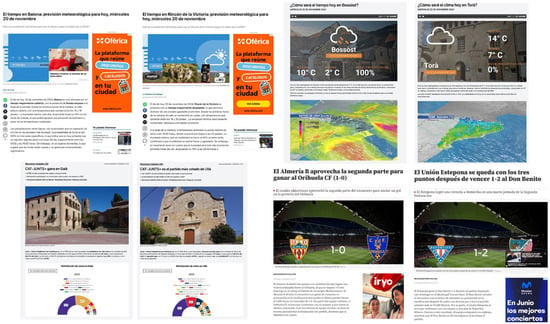
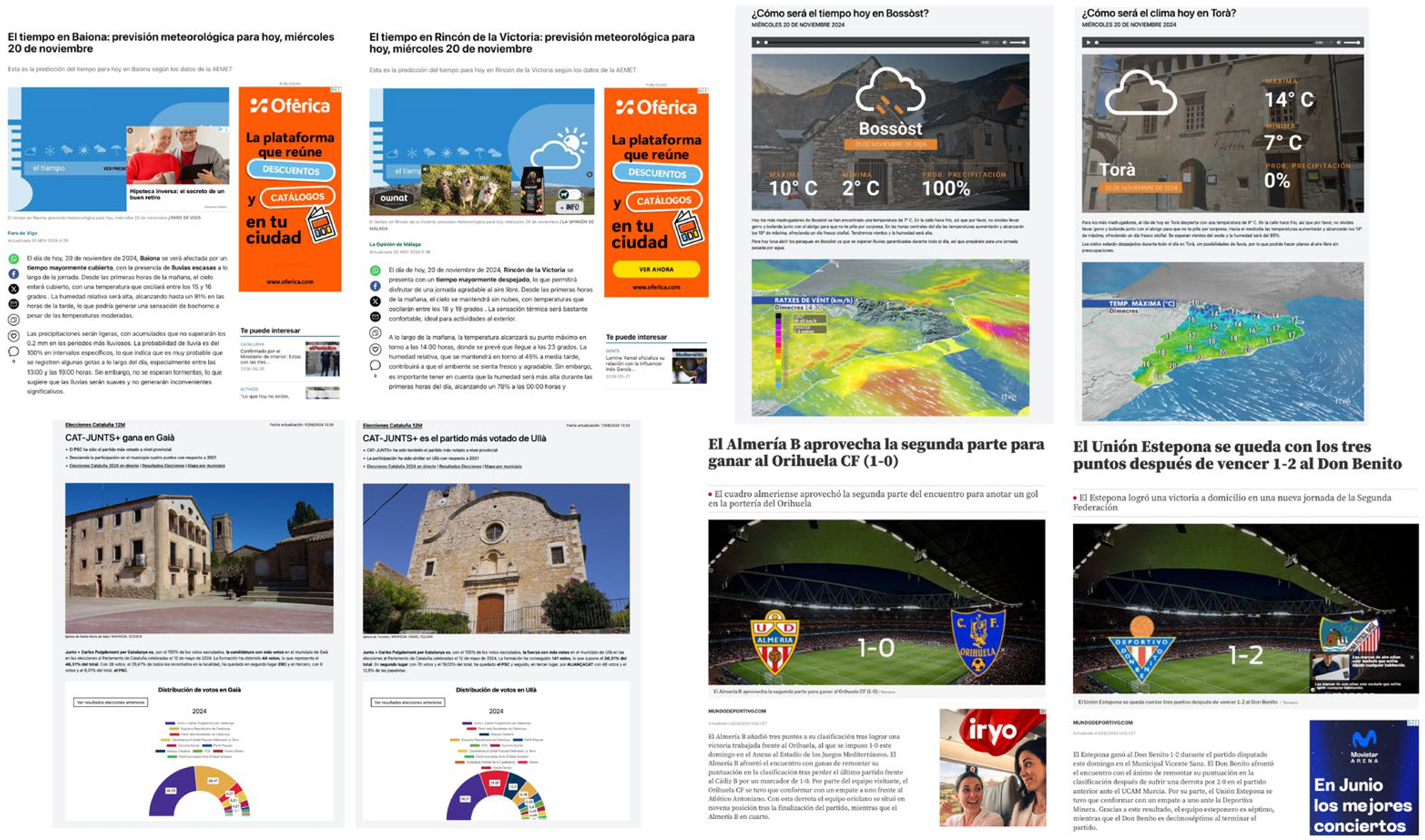
Two aspects reveal the use of AI systems in the preparation of the information. Firstly, the structure of the text is repetitive across all the articles, i.e., the format, division into thematic blocks, length of paragraphs, etc. Secondly, the wording of the texts is standardised across the 80 pieces, which results in the repetition of formulaic or even virtually identical phrases (Figure 1).
Figure 1.
Articles from Prensa Ibérica, RTVE, and Mundo Deportivo with a similar structure and standardised wording.
The texts from RTVE Elecciones include contextual information on the background and consequences of the elections, which facilitates a greater understanding of the text and adds value.
More than half of the articles contain errors (50), nearly all of which are journalistic in nature, with only one differing. In all of the Prensa Ibérica texts (20), the word “weather” is repeated in the headline and subheader, and the same phrase from the headline is used as the caption for the image. The latter also occurs in all of the Mundo Deportivo texts. Additionally, one of the articles in this newspaper contains errors based on the repetition of information, with almost identical expressions in consecutive sentences or paragraphs. Spelling and grammatical errors were also found. In RTVE Elecciones, the errors are mainly journalistic and in most cases are due to the fact that the information provided is sometimes obvious—e.g., when explaining how electoral processes work—or an incongruous narrative is employed in which the elections are referred to in the future tense when the final results are already being reported. In this sense, it is important to note that AI tools have limitations in representing temporality, particularly with respect to recent events, which may lead to errors in verb tense usage. Such errors should therefore not be interpreted solely as stylistic flaws. This is a critical consideration when applying this technology to journalism, where chronological accuracy is essential.
Finally, half of the pieces (40), specifically those about the weather, address their readers with varying levels of directness. The formulas used generally demonstrate repetitive patterns. In Prensa Ibérica, readers are addressed as “residents”, “citizens”, or “visitors” and are “advised”, “recommended”, or “reminded” to “take precautions”, “make the most” of the day, “carry an umbrella”, “dress warmly”, or “plan their activities” according to the weather forecast. RTVE El Tiempo uses direct address (“It’s cold outside, so please don’t forget to wear a hat and scarf with your coat so you’re not caught off guard”, “Caution is advised for those going out”).
4.2. Newspaper Articles Written with the Help of AI
In Heraldo de Aragón, the articles studied were generated with the help of a proprietary GenAI tool that assists in the writing, verification, and enrichment of content. According to the newspaper’s Digital Strategy Department, this process is subject to human checking prior to publication.
For all content, it is announced that it has been generated with the help of AI by means of a separate text incorporated at the end of the piece (Table 6) that states: “Information generated with the help of Artificial Intelligence. Learn more” (https://bit.ly/3FTobxP (accessed on 16 July 2025)). This message includes a hyperlink that provides further information on the use of this technology, and the headline and subheader of this text read, “The commitment of Heraldo.es to innovation and accurate reporting. In order to improve quality and adapt to new technologies, Heraldo.es has incorporated Artificial Intelligence (AI) tools to assist in the generation of some information,” which indicates some concern that the use of AI is related to quality or lack thereof in news content. It is striking that the content of this clarification is generated with the help of AI, as indicated at the end of the text.
Table 6.
Data identifying pieces written with the help of AI.
Most of the articles (16) are anonymous or unsigned, while the remaining four are all signed by the same writer. The topics covered in the texts are varied, with half corresponding to categories established in the analysis sheet—culture (four), economy (three), society (one), politics (one), and sports (one)—and the other half covering other topics. A similar situation occurs with genres: 13 texts are considered news articles, while the remaining seven do not correspond to traditional journalistic genres and are closer to entertainment than news.
Among the formal aspects, the use of boxes in more than half of the texts (12) and subheaders and bold type in all of them (Table 7) is noteworthy. Photographs are used in almost all of the content (19), and videos are used in three texts. Similarly, hyperlinks are included in 15 of the articles, and, in all of these, readers can interact through buttons to share content on Facebook, X, or WhatsApp.
Table 7.
Formal and textual aspects of pieces written with the help of AI.
In terms of textual aspects, more than half of the articles do not include sources. However, when they are cited, they appear in the text and are primary sources (Table 7). In addition, all the content studied provides data. Half of the pieces also include opinions alongside the news, but the informative intent prevails in almost all of them.
None of the articles utilise standardised structure or wording, which could be because an AI assistant offering various content formats was used to create the texts (Figure 2). In addition, 15 of the 20 texts include contextual information.
Figure 2.
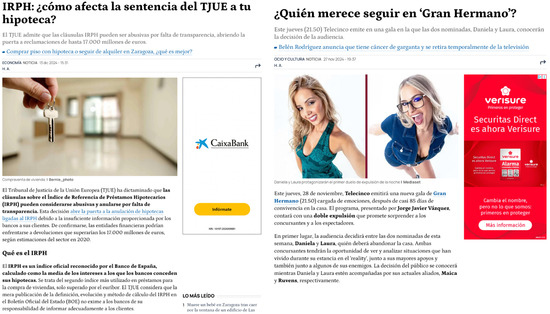
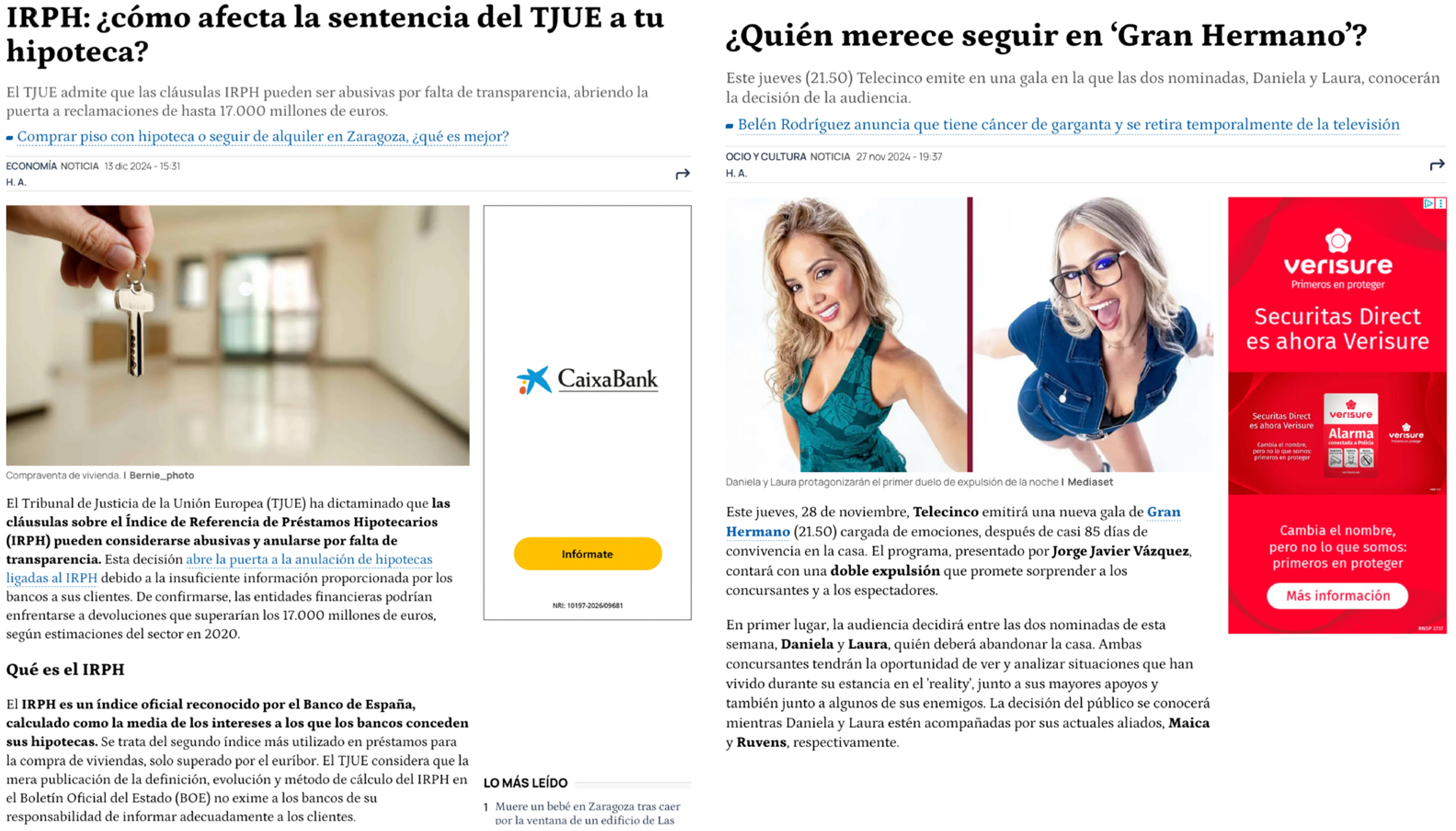
Screen grab of parts of two pieces on different topics published in Heraldo de Aragón.
Another relevant fact is that most of the pieces (17) contain errors, mainly journalistic, while eight of them include writing errors. Among the journalistic errors, those based on lack of clarity or inaccuracy in information stand out, such as the omission of fundamental data relating to the news, for example, a lack of knowledge around the scheduling of events announced in the text. The writing errors consist of spelling mistakes and grammatical issues. This fact is particularly striking considering that these pieces were not created entirely by AI but by humans assisted by it.
This shows that, paradoxically, human intervention in the editing and review of AI-generated texts does not necessarily prevent errors in published content, which may suggest that journalists place a high degree of trust in such tools, potentially reducing their level of scrutiny and ability to spot errors.
4.3. Innovative Uses of GenAI: The Case of La Vanguardia
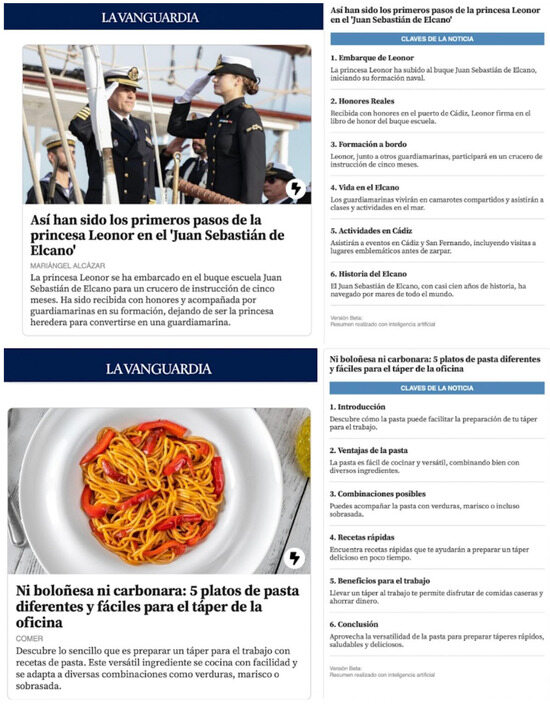
La Vanguardia’s use of GenAI is very different from those analysed so far. The newspaper itself explains that an “adaptive approach that allows every reader to decide the level of depth with which they wish to consume the news” is employed (González, 2024). With this goal in mind, the Flash section, designed to offer an updated selection of the day’s top news stories, was published for the first time at the end of October 2024. Each of these articles is presented with a photograph, a headline, and a summary generated by AI. Clicking on the headline takes you to the full article written by the journalist. Clicking on the icon at the bottom right of the photograph—a lightning bolt, the symbol of the section—leads to the key points of the news story being displayed (five or six for each article), which are all generated by AI (Figure 3).
Figure 3.
Two stories published in the “Flash” section of La Vanguardia.
Therefore, in La Vanguardia, AI summarises the main news stories and extracts their key points so that readers can quickly get the gist of the piece written by the journalist. Content generated by AI is always published for and available to the general public, whereas the journalistic text is sometimes only available to subscribers. All articles include a reminder that the free content has been provided by AI, with the message “Summary generated by artificial intelligence” at the end of the text. This demonstrates the publication’s intention towards transparency of authorship: as the articles are hosted in the Flash section, where all texts are generated by AI, such a message could have been considered unnecessary.
The articles cover a variety of topics and belong to different sections of the newspaper. Of the 20 pieces analysed, eight correspond to the society section, three to politics, and one to sports. The remaining eight have been included in the ‘other’ category. In terms of genre, news articles predominate (9), followed by features (6) and interviews (1). The other four pieces are closer to entertainment news than to journalistic reporting.
In terms of formal aspects, as might be expected given that this is a standardised section with a fixed length and structure, the pieces are very homogeneous: they are all illustrated with the same photograph that appears in the full article written by the journalist, and the headline—also the same as that of the full article—is highlighted in bold, as are the “titles” of each of the key points in the news item.
In terms of textual aspects, the absence of standardised writing is worth noting, as well as the fact that there is only one error, which is in itself only a very minor grammatical mistake: a missing accent mark. Furthermore, this error had already appeared in the full article written by the journalist. Additionally, the majority of the texts do not contain opinions (16), and in three of the four where opinions do appear, they do not compromise the principles of the journalistic genre to which the texts belong: a report on a football match, an announcement of the premiere of the new season of a television series in entertainment, and recipes in the lifestyle section.
Although the intention of most of the texts is to inform (13), a significant number (7) are more focused on entertainment, either because of the subject matter that they deal with—gossip, for example—or because of the way they do so, without following the rules of journalistic genres. Only two pieces directly address the reader, and in both cases, this is justified by the purpose and tone of the articles being summarised. The first piece, on changes to traffic regulations, only addresses the reader in the headline, and the second, in the context of cookery, addresses the reader in an instructional manner throughout the text.
5. Discussion and Conclusions
The results of this research contribute to strengthening our understanding of how Spanish media outlets are using GenAI in their writing, based on a study of its formal and textual characteristics. This study is pioneering in its approach to the different uses of internal GenAI tools by media outlets, as well as in the breadth of its sample, which includes mainstream media as well as regional and specialised press.
Depending on how it is used, AI appears to affect journalistic texts in different ways: in fully automated production, the main challenges relate to quality and the need for subsequent human review; in hybrid formats, the primary risk lies in overreliance, which may hinder the detection of errors; and, finally, in more innovative applications, for example, the creation of new sections, as in the case of La Vanguardia, the impact may be more strategic, offering audiences new features tailored to their needs. These patterns suggest that challenges related to quality, transparency, and oversight vary according to the type of AI application.
Significant results have been obtained regarding media transparency when disclosing the use of AI for text writing (RQ3). It is striking that half of the fully automated articles do not inform the readers about this at all, while the other half do so in an independent text, rather than in the byline or within the text. This second tendency is also found in articles produced by journalists with the help of AI. In all cases, a hyperlink is included that provides further information, speaking to the quality of information, transparency, and human supervision of content, as noted by Oh and Jung (2025); Thäsler-Kordonouri (2026); Beckett and Yaseen (2023); and Caswell and Dörr (2017). The fact that the reader has to go right to the end or even outside of the piece to find these statements suggests that there is still some reluctance within the industry to acknowledge the use of AI in the content byline. In the case of La Vanguardia, conversely, all articles include the message, “Summary produced using artificial intelligence” at the end, which shows an intention towards transparency of authorship. This is particularly relevant, as all the texts considered here are published in a section where the use of AI generation is already known about, so this statement and extra transparency are not strictly necessary.
Among the journalistic topics considered here, weather, politics, and sports stand out among those produced entirely with AI, these being simple topics that were not being covered before the emergence of GenAI (Fieiras-Ceide et al., 2024). The hybrid articles, however, are more heterogeneous, which could be due to the particular functionalities of the AI writing assistant used (RQ1).
La Vanguardia also offers a variety of content, although the majority of articles are related to social issues (8). While all fully automated GenAI-produced texts can be considered news, in the case of those written only with the help of AI, a third correspond to other untraditional genres and, in some cases, do not even have a strictly journalistic approach. This indicates that, although AI tools can be trained to write and to structure the information they are provided with into certain patterns, certain human skills characteristic of quality journalism cannot be imitated by algorithms (van Dalen, 2012). In the case of La Vanguardia, 80% of articles conform to conventional journalistic genres, while the remaining 20% are closer in style to entertainment than to journalism (RQ2).
Half of the fully automated texts do not allow for any kind of interactivity, which is striking in the case of RTVE, given that in its use of AI, it claims that transparency, quality, and accessibility are values inherent to its public service mission (RQ2).
The use of sources is lower among fully automated pieces than in those written with the help of AI, although primary sources are cited by all the articles considered here. Likewise, all of the texts are dominated by opinion and entertainment formats. Texts written entirely with AI have a repetitive structure and standardised wording, as observed by Cano-Orón and López-Meri (2024), which results in simple, predictable, unoriginal narration with hackneyed expressions, as pointed out by van Dalen (2012). The inclusion of contextual information in RTVE Elecciones is significant, representing an attempt to move beyond the simple narration of facts and/or data that characterises AI-generated news articles (Caswell & Dörr, 2017; Vállez & Codina, 2018; Graefe & Bohlken, 2020) and has also been described in the first studies to emerge on the subject in Spain (Túñez-López et al., 2019; Ufarte-Ruiz & Manfredi-Sánchez, 2019; Rojas-Torrijos & Toural-Bran, 2019). None of the hybrid articles have a repetitive structure or standardised wording, and most provide contextual information, which makes them more similar to traditional journalistic pieces written without the aid of AI. In the case of La Vanguardia, although the structure of the pieces is repetitive in order to fit the format of their intended section, the wording does not have a standard format (RQ2).
Journalistic errors are evident in all the articles, although the proportion is higher in those written with the help of AI, both of which could indicate that this technology still has limitations and that human supervision is necessary. Most of the errors are journalistic, although the number of spelling mistakes and grammatical errors is higher in the hybrid texts, raising concerns that journalists may overly rely on AI tools, reducing their scrutiny and ability to identify errors. Conversely, in the articles from La Vanguardia, there is only one very minor spelling mistake, which also appears in the text written by the journalist that the AI used in order to create the summary and extract the key news points (RQ2).
In what appears to be an attempt to engage with the reader as a journalist would, the weather texts generated entirely by AI address the readers and make direct recommendations to them based on the weather forecast for the day.
This study highlights significant differences in the use of AI by the Spanish press. In addition to traditional uses, such as automated writing and data analysis, there is a noticeable effort to adapt the technology to other purposes, as is the case with La Vanguardia’s Flash section. Evidence suggests that AI is beginning to be integrated into newsrooms with a defined strategy and more advanced uses (RQ1).
Finally, the results show the growing role of GenAI as a tool for processing and organising large volumes of complex information, thereby enhancing reader comprehension. This potential is particularly evident in areas such as weather reporting and election results, where AI can work with extensive datasets and present them in a synthetic and accessible manner, in both textual and visual forms.
Nevertheless, the study has some limitations due to the experimental nature of the use of GenAI in the media, the different ways in which it is employed, and the difficulties in establishing a homogeneous sample. However, rather than undermining the analysis, we believe that this heterogeneity has helped enrich and broaden the study’s perspective.
This work opens the door for future research on the changing uses and evolving levels of GenAI application in both the Spanish and international press, the use of this technology across other media, and the perception of AI by journalists and readers, as well as the current and future challenges it brings and practical recommendations for its implementation and ethical use.
Author Contributions
Conceptualization, M.M.-F., V.M.-G. and M.M.-S.; Methodology, M.M.-F., V.M.-G. and M.M.-S.; Validation, M.M.-F., V.M.-G. and M.M.-S.; Formal Analysis, M.M.-F., V.M.-G. and M.M.-S.; Investigation, M.M.-F., V.M.-G. and M.M.-S.; Resources, M.M.-F., V.M.-G. and M.M.-S.; Data Curation, M.M.-F., V.M.-G. and M.M.-S.; Writing—Original Draft Preparation, M.M.-F., V.M.-G. and M.M.-S.; Writing—Review & Editing, M.M.-F., V.M.-G. and M.M.-S.; Visualization, M.M.-F. and V.M.-G.; Supervision, M.M.-F.; Project Administration, M.M.-F. All authors have read and agreed to the published version of the manuscript.
Funding
This study was funded by the Spanish Ministry of Innovation, Science and Universities as part of project entitled “Implications of GenAI for journalistic content: professional practice, audience perceptions and teaching challenges” (PID2023-146913NB-I00).
Institutional Review Board Statement
Our study does not constitute human subjects research as defined by major international ethical guidelines. Therefore, it should not require approval from an ethics committee. The individuals contacted for the study did not participate as research subjects, and no personal, sensitive, or identifiable data was collected. Their involvement was strictly limited to confirming (by answering only yes or no), in their institutional and professional capacity, whether their respective media organizations used artificial intelligence tools. No interventions were conducted, no behaviours, attitudes, or personal characteristics were assessed, and no private information was collected. According to the International Ethical Guidelines for Health-related Research Involving Humans (CIOMS/WHO), certain studies may be exempt from ethical review. This includes studies based on publicly available data or interviews with public officials or institutional representatives in their official capacity regarding matters in the public domain. We believe our study meets these exemption criteria because the interviews were conducted in a professional and public context with no implications for the privacy or well-being of those consulted. Moreover, their confirmation of AI use in their media organizations ratified information already in the public domain since all published articles in those outlets disclosed the use of AI to readers. Furthermore, the study was conducted in accordance with principles of scientific integrity, transparency, and confidentiality, although no identifiable personal data were processed. For these reasons, we did not seek approval from an institutional ethics committee.
Informed Consent Statement
Informed consent for publication was obtained from the participants in the study.
Data Availability Statement
The original contributions presented in this study are included in the article. Further inquiries can be directed to the corresponding authors.
Acknowledgments
The authors would like to thank the Spanish Ministry of Innovation, Science and Universities for funding the research for this article. We also want to thank the anonymous reviewers and the editors of Journalism and Media and all the researchers whose previous studies have contributed to the development of this work.
Conflicts of Interest
The authors declare no conflicts of interest.
References
- Aramburú-Moncada, L. G., López-Redondo, I., & López-Hidalgo, A. (2023). Inteligencia artificial en RTVE al servicio de la España vacía. Proyecto de cobertura informativa con redacción automatizada para las elecciones municipales de 2023. Revista Latina de Comunicación Social, (81), 1–16. [Google Scholar] [CrossRef] [Scilit]
- Bazán-Gil, V., Pérez-Cernuda, C., Marroyo-Núñez, N., Sampedro-Canet, P., & De-Ignacio-Ledesma, D. (2021). Inteligencia artificial aplicada a programas informativos de radio. Estudio de caso de segmentación automática de noticias en RNE. Profesional de la información, 30(3), e300320. Available online: https://www.scipedia.com/wd/images/f/f0/Draft_Content_224950710-86312-5906-document.pdf (accessed on 23 May 2026). [CrossRef] [Scilit]
- Beckett, C., & Yaseen, M. (2023). Generating change. A global survey of what news organisations are doing with artificial AI. Available online: https://acortar.link/gofdOq (accessed on 15 July 2025).
- Berger, A. A. (2016). Media and research methods. An introduction to qualitative and quantitative approaches. Sage. [Google Scholar]
- Calvo-Rubio, L. M., & Rojas-Torrijos, J. L. (2024). Criteria for journalistic quality in the use of artificial intelligence. Communication & Society, 37(2), 247–259. [Google Scholar] [CrossRef] [Scilit]
- Calvo-Rubio, L. M., Ufarte-Ruiz, M. J., & Murcia-Verdú, F. J. (2024). A methodological proposal to evaluate journalism texts created for depopulated areas using AI. Journalism and Media, 5(2), 671–687. [Google Scholar] [CrossRef] [Scilit]
- Canavilhas, J. (2022). Inteligencia artificial aplicada al periodismo: Estudio de caso del proyecto “A European Perspective” (UER). Revista Latina de Comunicación Social, (80), 1–13. [Google Scholar] [CrossRef] [Scilit]
- Cano-Orón, L., & López-Meri, A. (2024). Introducción al uso de la IA en periodismo. Guía de referencias y modos de uso. Universitat de València. [Google Scholar]
- Carlson, M. (2014). The robotic reporter: Automated journalism and the redefinition of labor, compositional forms, and journalistic authority. Digital Journalism, 3(3), 416–431. [Google Scholar] [CrossRef] [Scilit]
- Caswell, D. (2023). AI and journalism: What’s next? Reuters Institute for the Study of Journalism. [Google Scholar]
- Caswell, D., & Dörr, K. (2017). Automated journalism 2.0: Event-driven narratives: From simple descriptions to real stories. Journalism Practice, 12(4), 477–496. [Google Scholar] [CrossRef] [Scilit]
- Center for News, Technology & Innovation. (2025, January). If, when and how to communicate journalistic uses of AI to the public. Available online: https://innovating.news/article/if-when-and-how-to-communicate-journalistic-uses-of-ai-to-the-public-considerations-and-next-steps (accessed on 15 July 2025).
- Clerwall, C. (2014). Enter the robot journalist: Users’ perceptions of automated content. Journalism Practice, 8(5), 519–531. [Google Scholar] [CrossRef] [Scilit]
- Cristòfol, F. J., Romera-Fadón, J.-A., & Peláez-Agudo, D. (2025). La IA como herramienta periodística: Perspectivas desde El Español y El Confidencial. Espejo de Monografías de Comunicación Social, (36), 221–233. [Google Scholar] [CrossRef] [Scilit]
- Danzon-Chambaud, S. (2023). Automated news in practice: A cross-national exploratory study. Open Research Europe, 3, 95. [Google Scholar] [CrossRef] [Scilit] [PubMed]
- Diakopoulos, N. (2019). Automating the news. How algorithms are rewriting the media. Harvard University Press. [Google Scholar] [CrossRef] [Scilit]
- Diakopoulos, N., Cools, H., Li, C., Helberger, N., Kung, E., Rinehart, A., & Gibbs, L. (2024). Generative AI in journalism: The evolution of newswork and ethics in a generative information ecosystem. Available online: https://cdn.theconversation.com/static_files/files/3273/AP_Generative_AI_Report_April_2024.pdf?1715867443 (accessed on 16 July 2025).
- Ding, Z. (2024). Advancing GUI for generative AI: Charting the design space of human-AI interactions through task creativity and complexity. In Companion proceedings of the 29th international conference on intelligent user interfaces (pp. 140–143). Association for Computing Machinery. [Google Scholar] [CrossRef] [Scilit]
- Fieiras-Ceide, C., Vaz-Álvarez, M., & Maroto-González, I. (2024). AI implementation strategies in the Spanish press media: Organizational dynamics, application flows, uses and future trends. Tripodos, (55), 10–32. [Google Scholar] [CrossRef] [Scilit]
- Foy, P. (2022, December 5). What is generative AI? Key concepts & use cases. MLQ.ai. Available online: https://www.mlq.ai/what-is-generative-ai (accessed on 15 July 2025).
- González, C. (2024, October 20). Infórmate en un minuto en el móvil con Flash La Vanguardia. La Vanguardia. Available online: https://www.lavanguardia.com/vida/20241020/10031707/vanguardia-lanza-flash-informarse-minuto-movil.html (accessed on 10 August 2025).
- Graefe, A. (2016). Guide to automated journalism. Columbia Journalism School, Tow Center for Digital Journalism. Available online: https://bit.ly/3FW1Uua (accessed on 7 July 2025).
- Graefe, A., & Bohlken, N. (2020). Automated journalism: A meta-analysis of readers’ perceptions of human-written in comparison to automated news. Media and Communication, 8(3), 50–59. [Google Scholar] [CrossRef] [Scilit]
- Graefe, A., Haim, M., Haarmann, B., & Brosius, H. B. (2016). Readers’ perception of computer-generated news: Credibility, expertise, and readability. Journalism, 19(5), 595–610. [Google Scholar] [CrossRef] [Scilit]
- Krippendorff, K. (1990). Metodología de análisis de contenido. Teoría y Práctica. Paidós Comunicación. [Google Scholar]
- La-Rosa-Barrolleta, L. A., & Sandoval-Martín, T. (2024). Artificial intelligence versus journalists: The quality of automated news and bias by authorship using a Turing test. Anàlisi: Quaderns de Comunicació i Cultura, 70, 15–36. [Google Scholar] [CrossRef] [Scilit]
- Lin, B., & Lewis, S. C. (2022). The one thing journalistic AI just might do for democracy. Digital Journalism, 10(10), 1627–1649. [Google Scholar] [CrossRef] [Scilit]
- Lombard, M., Snyder-Duch, J., & Bracken, C. C. (2002). Content analysis in mass communication. Assessment and reporting of intercoder reliability. Human Communication Research, 28(4), 587–604. [Google Scholar] [CrossRef]
- Macnamara, J. (2005). Media content analysis: Its uses, benefits and best practice methodology. Asia Pacific Public Relations Journal, 6, 1–34. [Google Scholar]
- Mason, J. (1997). Qualitative researching. Sage. [Google Scholar]
- Mayoral-Sánchez, J., Mera-Fernández, M., & Morata-Santos, M. (2024). Integración de la inteligencia artificial en las redacciones: La experiencia de los medios de comunicación en España. Espejo de Monografías de Comunicación Social, (25), 187–209. [Google Scholar] [CrossRef] [Scilit]
- Mayoral-Sánchez, J., Parratt-Fernández, S., & Mera-Fernández, M. (2023). Uso periodístico de la IA en medios de comunicación españoles: Mapa actual y perspectivas para un futuro inmediato. Estudios Sobre el Mensaje Periodístico, 29(4), 821–832. [Google Scholar] [CrossRef] [Scilit]
- Meier, K. (2019). Quality in journalism. In T. P. Vos, & F. Hanusch (Eds.), The international encyclopedia of journalism studies (pp. 1–8). John Wiley & Sons. [Google Scholar] [CrossRef] [Scilit]
- Melin, M., Bäck, A., Södergård, C., Munezero, M., & Leppänen, L. (2018). No landslide for the human journalist: An empirical study of computer-generated election news in Finland. IEEE Access, 6, 43356–43367. [Google Scholar] [CrossRef] [Scilit]
- Modrón-Lecue, I., & Sánchez-García, P. (2026). Inteligencia artificial aplicada al periodismo de servicio público: Innovación multimodal de RTVE. Revista Latina de Comunicación Social, (84), 1–24. [Google Scholar] [CrossRef] [Scilit]
- Mondría Terol, T. (2023). Innovación MedIÁtica: Aplicaciones de la inteligencia artificial en el periodismo en España. Textual & Visual Media, 17(1), 41–60. [Google Scholar] [CrossRef] [Scilit]
- Murcia-Verdú, F. J., & Ufarte-Ruiz, M. J. (2019). Mapa de riesgos del periodismo de alta tecnología. Hipertexto.net, 18, 47–55. [Google Scholar] [CrossRef] [Scilit]
- Newman, N., Arguedas, A. R., Robertson, C. T., Nielsen, R. K., & Fletcher, R. (2025). Reuters Institute digital news report 2025. Reuters Institute for the Study of Journalism. [Google Scholar] [CrossRef]
- Newman, N., Fletcher, R., Robertson, C., Ross-Arguedas, A., & Nielsen, R. (2024). Reuters Institute digital news report 2024. Reuters Institute for the Study of Journalism. [Google Scholar] [CrossRef]
- Oh, S., & Jung, J. (2025). Harmonizing traditional journalistic values with emerging AI technologies: A systematic review of journalists’ perception. Media and Communication, 13, 9495. [Google Scholar] [CrossRef] [Scilit]
- Okonkwo, P., Njoku, I. A., & Okonkwo, R. N. (2024). Digital media ethics in generative AI journalism: A framework for accountability. Preprints. [Google Scholar] [CrossRef] [Scilit]
- Parratt-Fernández, S., Mayoral-Sánchez, J., & Mera-Fernández, M. (2021). The application of artificial intelligence to journalism: An analysis of academic production. Profesional de la Información, 30(3), e300317. [Google Scholar] [CrossRef] [Scilit]
- Parratt-Fernández, S., Rodríguez-Pallares, M., & Pérez-Serrano, M. J. (2024). Artificial intelligence in journalism: An automated news provider. index.Comunicación, 14(1), 183–205. [Google Scholar] [CrossRef] [Scilit]
- Pavlik, J. (2010). The impact of technology on journalism. Journalism Studies, 1(2), 229–237. [Google Scholar] [CrossRef] [Scilit]
- Peña-Fernández, S., Meso-Ayerdi, K., Larrondo-Ureta, A., & Díaz-Noci, J. (2023). Without journalists, there is no journalism: The social dimension of generative artificial intelligence in the media. Profesional de la Información, 32(2). [Google Scholar] [CrossRef] [Scilit]
- Picard, R. G. (2004). Commercialism and newspaper quality. Newspaper Research Journal, 25(1), 54–65. [Google Scholar] [CrossRef] [Scilit]
- Piñeiro-Naval, V. (2020). La metodología de análisis de contenido. Usos y aplicaciones en la investigación comunicativa del ámbito hispánico. Communication & Society, 33(3), 1–16. [Google Scholar]
- Quian, A., & Sixto-García, J. (2024). Inteligencia artificial en la prensa: Estudio comparativo y exploración de noticias con ChatGPT en un medio tradicional y otro nativo digital. Revista de Comunicación, 23(1), 457–483. [Google Scholar] [CrossRef] [Scilit]
- Ramírez-de-la-Piscina, T. (2015). Quality Journalism: A theoretical approach. In A. Larrondo-Ureta, I. Agirreazkuenaga Onaindia, & K. Meso Ayerdi (Eds.), Active audiences and journalism: Analysis of the quality and regulation of the user generated contents (pp. 41–47). Universidad del País Vasco/Euskal Herriko Unibertsitatea. [Google Scholar]
- Rojas-Torrijos, J. L., & de-Santis, A. (2024). El periodismo deportivo, terreno de van-guardia para la aplicación de la Inteligencia Artificial. In ComunicAI. La revolución de la inteligencia artificial en la comunicación. Á. Torres-Toukoumidis, & T. León-Alberca (Coords.). Comunicación Social Ed. [Google Scholar]
- Rojas-Torrijos, J. L., & Toural-Bran, C. (2019). Periodismo deportivo automatizado. Estudio de caso de AnaFut, el bot desarrollado por El Confidencial para la escritura de crónicas de fútbol. Doxa Comunicación. Revista Interdisciplinar de Estudios de Comunicación y Ciencias Sociales, 29, 235–254. [Google Scholar] [CrossRef] [Scilit]
- Sabaté-Gauxachs, A., Micó-Sanz, J. L., & Díez-Bosch, M. (2018). El periodismo slow digital de Jot Down y Gatopardo. Transinformação, 30(3), 299–313. [Google Scholar] [CrossRef] [Scilit]
- Sanahuja, R. S., & Rabadán, P. L. (2021). Ámbitos de aplicación periodística de la inteligencia artificial. Mapa conceptual, funciones profesionales y tendencias en desarrollo en el contexto de la pandemia global de la COVID-19. Razón y Palabra, 25(112), 432–449. [Google Scholar] [CrossRef] [Scilit]
- Sandoval-Martín, T., & La-Rosa-Barrolleta, L. (2023). Investigación sobre la calidad de las noticias automatizadas en la producción científica internacional: Metodologías y resultados. Cuadernos.info, (55), 114–136. [Google Scholar] [CrossRef] [Scilit]
- Sánchez-García, P., Merayo-Álvarez, N., Calvo-Barbero, C., & Diez-Gracia, A. (2023). Spanish technological development of artificial intelligence applied to journalism: Companies and tools for documentation, production and distribution of information. Profesional de la información, 32(2). [Google Scholar] [CrossRef] [Scilit]
- Segarra-Saavedra, J., Cristófol, F. J., & Martínez-Sala, A. M. (2019). Inteligencia artificial (IA) aplicada a la documentación informativa y redacción periodística deportiva. El caso de BeSoccer. Doxa Comunicación. Revista Interdisciplinar de Estudios de Comunicación y Ciencias Sociales, 29, 275–286. [Google Scholar] [CrossRef] [Scilit]
- Shi, Y., & Sun, L. (2024). How generative AI Is transforming journalism: Development, application and ethics. Journalism and Media, 5(2), 582–594. [Google Scholar] [CrossRef] [Scilit]
- Tejedor, S. (2022). Artificial intelligence and newsgames in journalism: Proposals and ideas from the case study of three projects. VISUAL REVIEW. International Visual Culture Review Revista Internacional de Cultura Visual, 12(3), 1–8. [Google Scholar] [CrossRef] [Scilit]
- Tejedor-Calvo, S., Cervi, L., Pulido, C. M., & Pérez-Tornero, J. M. (2021). Análisis de la integración de sistemas inteligentes de alertas y automatización de contenidos en cuatro cibermedios. Estudios Sobre el Mensaje Periodístico, 27(3), 973–983. [Google Scholar] [CrossRef] [Scilit]
- Thäsler-Kordonouri, S. (2026). What comes after the algorithm? An investigation of journalists’ post-editing of automated news text. Journalism Practice, 20(4), 1369–1388. [Google Scholar] [CrossRef] [Scilit]
- Thäsler-Kordonouri, S., & Barling, K. (2023). Automated journalism in UK local newsrooms: Attitudes, integration, impact. Journalism Practice, 19(1), 58–75. [Google Scholar] [CrossRef] [Scilit]
- Túñez-López, J.-M., Fieiras-Ceide, C., & Vaz-Álvarez, M. (2021). Impact of artificial intelligence on journalism: Transformations in the company, products, contents and professional profile. Communication & Society, 34(1), 177–193. [Google Scholar] [CrossRef] [Scilit]
- Túñez-López, J.-M., Toural-Bran, C., & Valdiviezo-Abad, C. (2019). Automatización, bots y algoritmos en la redacción de noticias. Impacto y calidad del periodismo artificial. Revista Latina de Comunicación Social, (74), 1411–1433. [Google Scholar] [CrossRef] [Scilit]
- Ufarte-Ruiz, M. J., & Manfredi-Sánchez, J. L. (2019). Algoritmos y bots aplicados al periodismo. El caso de Narrativa Inteligencia Artificial: Estructura, producción y calidad informativa. Doxa Comunicación. Revista Interdisciplinar de Estudios de Comunicación y Ciencias Sociales, 29, 213–233. [Google Scholar] [CrossRef] [Scilit]
- van Dalen, A. (2012). The algorithms behind the headlines: How machine-written news redefines the core skills of human journalists. Journalism Practice, 6(5–6), 648–658. [Google Scholar] [CrossRef] [Scilit]
- Vállez, M., & Codina, L. (2018). Periodismo computacional: Evolución, casos y herramientas. Profesional de la Información, 27(4), 759–768. [Google Scholar] [CrossRef] [Scilit]
- Wölker, A., & Powell, T. E. (2018). Algorithms in the newsroom? News readers’ perceived credibility and selection of automated journalism. Journalism, 22(1), 86–103. [Google Scholar] [CrossRef] [Scilit]

Disclaimer/Publisher’s Note: The statements, opinions and data contained in all publications are solely those of the individual author(s) and contributor(s) and not of MDPI and/or the editor(s). MDPI and/or the editor(s) disclaim responsibility for any injury to people or property resulting from any ideas, methods, instructions or products referred to in the content. |
© 2026 by the authors. Licensee MDPI, Basel, Switzerland. This article is an open access article distributed under the terms and conditions of the Creative Commons Attribution (CC BY) license.