


Abstract
Much research on misinformation has focused on claims that challenge mainstream views. This study instead examines misinformation that is aligned with dominant narratives in mainstream news media. It uses an epistemically grounded definition of misinformation and a measurement approach that accounts for the complexity of politically relevant misinformation. The analysis centers on 20 false or misleading claims about major international issues, evaluated by a sample of 1590 survey respondents in German-speaking Switzerland. Across these claims, the population-weighted share of “fully agree” responses ranged from 6% to 50%. The probability of acceptance of misinformation was significantly associated (p < 0.05) with several factors: male gender (+0.04); medium or higher education (−0.06 and −0.05, respectively); more than 30 min of daily news consumption, compared with less (+0.06); identification with Green (+0.09) and Liberal party (+0.07, relative to Center party); medium trust in government (−0.04), relative to high trust; and a non-mainstream primary news source (−0.28), relative to public television. A similar pattern emerges for the subset of the claims that had been publicly corrected. Notable differences from patterns reported for non-mainstream misinformation highlight the importance of the type of misinformation under study. Taken together—and in light of evidence that news consumers expect truthful and impartial information—these findings suggest that misinformation in mainstream news media warrants greater attention in both research and regulatory policy.
1. Introduction
Research on the influence of media on beliefs and behavior has a long tradition, dating back to early studies of government propaganda (Lasswell, 1927). Contemporary scholarship shows that media shape what and how people think by selecting and framing content. Through these processes, media outlets can identify presumed causes of problems, suggest moral evaluations, and promote particular policy solutions (Entman, 2007). The impact of media arises from the interaction between media content and individual characteristics—including demographic traits, social-psychological factors, ideological orientations, trust in media, and patterns of media use (McLeod et al., 2009; Valkenburg et al., 2016).
While basic beliefs are often resistant to media influence (Lazarsfeld et al., 1948; Klapper, 1960), many news stories concern issues about which audiences have limited prior knowledge or firmly held beliefs. These include reports on novel national security threats, emerging pathogens, or proposed interventions to address new societal problems. Moreover, such stories frequently rely on uncertain, incomplete, or confidential information that cannot be independently verified. In these contexts, media selection and framing can exert a substantial influence on public belief and, by extension, on political responses and outcomes.
A very active line of research within this broader field examines the extent to which news consumers accept false or misleading stories, often described as “misinformation,” “disinformation,” or “fake news” (Aïmeur et al., 2023). This line of research also has important applied implications and relevance. From a democratic perspective, it is critical to assess whether evolving news media fulfill expectations of providing unbiased information that supports informed decision-making. At the same time, governments and political actors have a practical interest in understanding how beliefs and behavior can be actively influenced through media channels.
Research on misinformation, defined broadly as false or misleading information, whether intentional or not, has grown rapidly over the past decade. However, studies have almost exclusively focused on misinformation that runs counter to mainstream liberal perspectives. As a result, misinformation has mainly been examined in the context non-mainstream news sources and “populist” or authoritarian governments (Broda & Strömbäck, 2024), as well as in cases where mainstream media inadvertently amplified information from such sources (Tsfati et al., 2020). The possibility that liberal Western governments and mainstream media may themselves be a source of misinformation has received little attention (Altay et al., 2023). Accordingly, some scholars have recently called for broader research on misinformation across different types of media data from mainstream and alternative media (Altay et al., 2023; Broda & Strömbäck, 2024).
Conceptual approaches have also been limited. First, truth standards based on mainstream opinion may be sufficient for some purposes, but they overlook the possibility of institutional bias (Chaufan et al., 2024). A broader examination of misinformation—including false or misleading claims that align with dominant narratives in mainstream media—would require more epistemically grounded approaches. Second, measures of misinformation beliefs or acceptance often fail to capture the phenomenon’s complexity (Soprano et al., 2021). Claims that omit important information can be more misleading than claims that are outright false. Approaches that rely on a simple dichotomy between true and false are unlikely to be well suited for studying politically relevant misinformation.
The objective of this paper is to examine the acceptance of false or misleading claims that align with dominant narratives in mainstream news media using an empirical approach that addresses the conceptual issues outlined above. Empirically, the study proceeds by identifying international news stories in mainstream media that are false or misleading and summarizing their core claims in concise statements. A panel survey, conducted among the German-speaking population of Switzerland, is then used to assess respondents’ agreement with these claims, with “fully agree” responses interpreted as a lower bound measure of misinformation acceptance.
This study makes three main contributions. First, it extends empirical research on misinformation acceptance to the important domain of claims that aligned with dominant narratives. Second, it shows that misinformation consistent with mainstream views on key international issues is widely accepted by substantial segments of the population. Third, it finds that the individual-level correlates of misinformation acceptance differ markedly from those identified in studies on non-mainstream misinformation, suggesting that the types of misinformation examined play a decisive role in shaping observed pattens. These findings indicate that misinformation in mainstream media may distort opinion formation on international issues. Taken together with evidence on consumers’ expectations of truthful reporting, they point to a need for greater regulatory attention to misinformation in mainstream news media.
The next section provides the literature background and develops the research questions. Section 3 outlines the methods, including conceptualization and measurement of misinformation, the selection of statements, the survey design and implementation, and the statistical analysis. The remaining sections present the results, followed by the discussion and conclusions.
2. Background and Research Questions
2.1. Identification of Misinformation
Research on misinformation has exploded in recent years in several fields including psychology (Ecker et al., 2022), political science (Jerit & Zhao, 2020) and communication (Broda & Strömbäck, 2024). Researchers have focused on political and health beliefs, on prevalence, detection, and correction of misinformation, and on the determinants of misinformation beliefs or detection. Regarding types of misinformation and sources, this research has focused almost entirely on misinformation that contradicts mainstream narratives and often on social media and blatant fake news or conspiracy beliefs from fringe sources (Broda & Strömbäck, 2024).
While the current attention to such misinformation among researchers, authorities, and funding agencies is certainly justified, less obvious misinformation that is aligned with dominant narratives in mainstream news media has been largely overlooked. Misinformation is thus often entirely associated with obscure conspiracy beliefs, “state-sponsored disinformation” in Russia or China or “populist discourse” in Western countries where politicians and governments sometimes “bypass mainstream media and its journalistic scrutiny” (Broda & Strömbäck, 2024) or where “traditional news media are increasingly scapegoated for misleading the people” (Hameleers et al., 2022). Accordingly, very little is known about misinformation that conforms with mainstream views.
Related to this research focus, researchers have often relied on pragmatic assumptions that statements from official authorities and institutions in power are true and non-misleading (Altay et al., 2023). This approach is sufficient for the analysis of many types of misinformation. More generally, however, government-financed fact-checks (Pennycook & Rand, 2019) or even a scientific consensus (Lewandowsky et al., 2013) cannot be blindly trusted. Where important interests are involved, government sources and even scientific institutions can be compromised. A well-known example is the US government’s claim in 2003 about weapons of mass destruction in Iraq. Unfortunately, research on misinformation has made little effort to better understand where additional epistemological diligence may be warranted (Hayward, 2025). Accordingly, the literature may be contaminated with “misinformation about misinformation” (Altay et al., 2023). Problematic practices are increasingly recognized (e.g., Chaufan et al., 2024).
One strategy has been to sideline the issue by looking at examples of true and false information that are uncontentious, as in a recent study of knowledge about the Ukraine war (Beattie & Sherstoboeva, 2025). Unfortunately, this choice heavily restricts the domain of examined misinformation—to the point where the most important instances of misinformation are excluded. An alternative strategy is to turn to epistemically deeper definitions of misinformation, as suggested by Hayward (2023). This would entail a critical analysis of official stories based on evaluations by topic experts with a record of independence and impartiality. For instance, in the question about the natural (zoonotic) or laboratory origin of the COVID-19 virus, one might choose to discount the opinions of experts who are highly involved in the issue (Ackerman et al., 2024) and instead rely on independent experts (e.g., Harrison & Sachs, 2022).
Deeper definitions of misinformation are particularly important when mainstream media may be aligned with governments or other interested parties that ‘weaponize’ misinformation against inconvenient truths (Hayward, 2025). The issue extends beyond intentional disinformation. Identities, values and motivations may influence perceptions and reasoning in ways that actors do not even realize (Kunda, 1990). Where international political issues are concerned, Western government and mainstream media representatives are naturally influenced by Western education, culture, and values which may affect their reasoning and beliefs (Herman & Chomsky, 1988). Their evaluation of political issues, historical events, and scientific consensus should be interpreted with caution, even under assumptions that actors are honest.
2.2. Acceptance of Misinformation
To measure misinformation beliefs or acceptance, many studies have used direct belief rating with true/false options (e.g., Lewandowsky et al., 2005; Rathje et al., 2023). However, when statements are not simply false but cherrypicked, imprecise, incomplete, etc., simple true/false questions may not account for the complexity of misinformation (Soprano et al., 2021). Some studies have therefore used other approaches such as Likert-type accuracy scales (Roozenbeek et al., 2022) or agreement scales (Pennycook et al., 2021). While the simple true/false questions may miss important aspects of the respondents’ understanding of information, the agreement scales provide the opportunity to express perceived issues such as incompleteness of the claim (Rodrigo-Ginés et al., 2024).
Regarding the prevalence of misinformation acceptance across important political issues, there is only limited evidence available, as most existing studies have focused on single topics such as misinformation about COVID-19. An exception is Flynn (2016), who measured misperceptions and associated confidence levels about a range of topics. Across 11 facts about taxes, debt and deficit, welfare, gun control, unemployment, environment and foreign aid, an average of 20 percent held “very” or “extremely” confident misperceptions. Regarding the occurrence of misinformation in mainstream news sources, there are some studies about inaccuracies in selected news outlets (e.g., Maier, 2005; Porlezza et al., 2012). However, there does not appear to be any systematic work about the prevalence of misinformation in dominant narratives about major political issues despite many examples where mainstream media initially dismissed true information—from the CIA’s Mind Control Program (1953–1973) to the Hunter Biden laptop content (2020) and the Epstein files (2025).
Exposure to misinformation can shape a persons’ attitudes even if they recognize the information is false (Thorson, 2015). Research has therefore examined if false news that has been corrected or retracted is discounted by the recipients of the information. In a classic study on misinformation about the Iraq war, the authors find that participants in Australia and Germany were sensitive to correction, whereas participants in the United States, where most of the population supported the war, were not (Lewandowsky et al., 2005). A meta-analysis study on the continued influence of misinformation found that corrective messages do not entirely eliminate the effect of misinformation. Corrected messages were less effective if the misinformation was attributed to a credible source, had been repeated multiple times prior to correction, or when there was a time lag between the delivery and the correction of misinformation (Walter & Tukachinsky, 2020).
Against this background, the first research question (RQ1) is: based on examples of false or misleading claims that are aligned with dominant views in Western mainstream media, how frequent is the acceptance of misinformation (a) overall and (b) among cases where the misinformation was later corrected by public authorities and among cases where the misinformation was not corrected?
2.3. Factors Associated with Misinformation Acceptance
The individual-level factors associated with misinformation beliefs or acceptance have been an important topic in misinformation research. Studies have examined various correlates including socioeconomic characteristics, media consumption behavior, and variables related to prior beliefs or political identity. Among these sets of correlates of misinformation acceptance, the last have turned out to be particularly important. Due to the large amount of recent work, the following brief review is limited to findings reported in recent reviews.
Starting with socioeconomic correlates of misinformation, a recent meta-analysis of 31 U.S. studies on true vs. false online headlines found that older participants were better able to distinguish true and false information, while no significant effect was found for either gender or education (Sultan et al., 2024). A review of 61 studies on health misinformation found belief in misinformation to be associated with lower subject knowledge, lower literacy/numeracy, older age, lower education, and racial minority status (Nan et al., 2022).
Regarding media behavior, higher mainstream news consumption has been found to be associated with lower acceptance of misinformation (Jamieson & Albarracín, 2020), although mainstream media has also been found to sometimes help spread misinformation (Tsfati et al., 2020).
A primary finding of research in psychology and political science has been that people are more likely to accept misinformation that fits their prior beliefs or identity, i.e., when it aligns with their attitudes and when it supports their group or ideology. Partisanship bias has been found to be more important than analytical thinking, and even highly educated individuals have been found to believe misinformation when it aligned with their identity or ideology (Roozenbeek et al., 2022). Accordingly, misinformation that challenges liberal views—which is the type of misinformation examined in most studies—should be easier to identify for liberals than for conservatives. Recent meta-analyses indeed find that misinformation acceptance is higher among those with a conservative ideology (Nan et al., 2022) or in the U.S. context among Republicans and among those who distrust experts and authorities (Sultan et al., 2024).
Regarding mechanisms, a frequent psychological explanation for partisanship bias is motivated reasoning: individuals think analytically but interpret information based on motivations (Flynn et al., 2017; Kunda, 1990). Other authors find that susceptibility to partisan misinformation is mainly associated with low attention and superficial headline focus (Simko et al., 2021) or heuristic processing (Pennycook & Rand, 2019), while deliberation reduces belief in false headlines (Pennycook & Rand, 2020) and sharing of low-credibility news in social media (Pennycook et al., 2021). Related to these effects of processing style are effects of repeated exposure or familiarity with the claim (Sultan et al., 2024). Furthermore, emotional content has been found to boost acceptance via reduced reasoning and superficial emotional processing (Martel et al., 2020).
Given that most research has focused on social media and on information that contradicts liberal mainstream views, it is interesting to examine misinformation that is aligned with these views. An obvious hypothesis would be that some of the correlates like ideology, media behavior, and trust in authorities remain important, but the sign of correlations may be the opposite. Following this hypothesis, acceptance of the misinformation would be associated with trust in authorities, liberal ideology, and consumption of mainstream news. On the other hand, conservatives, those who mistrust the government, or consumers of non-mainstream news sources would be less likely to accept the misinformation.
The second research question is (RQ2): how is acceptance of mainstream misinformation associated with socioeconomic characteristics, media consumption behavior and political identification (a) overall and (b) among cases where the misinformation was later corrected by public authorities and cases where the misinformation was not corrected?
2.4. News Consumers’ Expectations of News Media
Any observation of misinformation in mainstream news media and its acceptance by news consumers in the study region would also raise additional questions: What do the news consumers expect from their news media? Do they expect the news organizations to report truthfully and impartially? And how do the findings on misinformation relate to the news consumers’ perceptions and expectations of the media? While several studies have examined news consumers’ trust in Swiss news media (Newman et al., 2025; RPS, 2025, 2026), there does not appear to be any study that directly asked news consumers about expectations.
These questions are important because research has found that Western mainstream news media, including those in Switzerland, obtain much of their international news content from a limited number of international news agencies and other sources (Vogler et al., 2024). News about armed conflicts is often obtained from official military sources (Udris et al., 2023), or comes from industry-sponsored think tanks (Freeman, 2023), and often from only one side of the conflict (Udris et al., 2023). Other research finds that the sources of mainstream news media often align with economic and strategic interests of the United States (e.g., Herman & Chomsky, 1988; Krüger, 2013; Ewaida, 2025). Misinformation could therefore be systematically biased towards foreign economic or strategic perspectives and interests. Such findings would not only be problematic from a democratic perspective but also from the perspective of national sovereignty and strategic autonomy.
The third research question (RQ3) is therefore: what do the news consumers in the study region expect of their news media, and how is the acceptance of misinformation associated with these expectations?
3. Methods
3.1. Definition of Misinformation
Existing research on misinformation recognizes partisan media as an important source of misinformation on policy issues at the national level (Altay et al., 2023). Scaling up to the global level and international policy issues as examined in this present study, the Western mainstream media can be similarly understood as partisan media. Hence, pragmatic but shallow standard definitions of misinformation, which essentially equate truth with (Western) consensus or authority, are not useful for the analysis of misinformation on contentious international issues. The purpose of the present study requires an epistemologically deeper approach (Altay et al., 2023; Hayward, 2023, 2025). The simplified assumptions used in much misinformation research are therefore replaced by the following definition:
Misinformation is content that lacks proper justification but is presented as having a degree of evidential support it does not actually possess, where “evidential support” is defined independently of institutional authority and instead grounded in transparency, reproducibility, and methodological soundness accessible to competent reviewers.
This definition focuses on justification, accounts for evolving knowledge, recognizes the role of interpretation, distinguishes interpretive errors from factual ones, and avoids the conflation of authority and truth. The definition includes cases in which information is not fully false but misleading, for instance due to omission of relevant information. It accounts for the fact that incomplete information can be as misleading as, or even more misleading than, fully false information (Altay et al., 2023; Rodrigo-Ginés et al., 2024).
In definitions of misinformation, some authors also consider the issues of intentionality and harmfulness, sometimes using disinformation to refer to information that is false or misleading and intentional and harmful (Hayward, 2025). The present study does not make these additional distinctions but uses misinformation as an umbrella term (cf. Rodrigo-Ginés et al., 2024). This choice seems useful as the additional distinctions are empirically challenging and unnecessary for the purpose of the present study.
3.2. Identification of Misinformation and Selection of False or Misleading Claims
The examined claims were developed in the following five steps, as explained in more detail in the paragraphs below.
- Identify examples of false or misleading stories in mainstream news.
- Select 20 examples from 2 issue domains, half of them officially corrected.
- Summarize misinformation in single-sentence statement.
- Review claims and adjust where appropriate.
- Document the claims.
Online search tools including duckduckgo.com, chatgpt.com, and grok.com were used to identify examples of misinformation in mainstream news stories about internationally relevant political issues, following the definition of misinformation (Section 3.1). The search distinguished two issues domains, the war in Ukraine and other topics. Furthermore, the search included both examples of misinformation that had later been partly or fully corrected by authorities of the party that had a potential interest in the misinformation, and examples for which this was not the case.
In line with the definition, misinformation was identified based on the assessments of knowledgeable (Western) academics and journalists with a proven track record of independent and honest judgment. Such actors often question and openly discuss the credibility of sources, including the authorities of their own country. The identification thus also considered diverse types of circumstantial evidence, including actors’ potential interests, institutional dependencies, transparency, and track record of integrity, or the dynamics of official authorities’ claims, and the dynamics of explanation backing these claims. News stories were only selected when they were identified as clearly false or clearly misleading, as opposed to slightly or somewhat false or misleading.
To illustrate such considerations, the claim that “Russia’s invasion of Ukraine is an unprovoked war of aggression” was identified as false or misleading. The issue is that the claim omits important contrary evidence. The statement also omits the relevant information that many of the most respectable independent Western academics and important political figures do not agree. A second example is “The origin of the COVID-19 pandemic (coronavirus) is probably a transmission of the virus from an animal to a human.” According to many mainstream sources, the claim is correct. The freely available version of the language model Chat-GPT, for instance, estimated the probability of a laboratory origin at 21 percent (in November 2025). The number is based on a survey of virologists and epidemiologists (Ackerman et al., 2024). Following the definition of misinformation, the claim is nevertheless false or misleading. Many scientists and health professionals have been prejudiced in this debate (e.g., Calisher et al., 2020). The surveyed virologists and epidemiologists may not have been sufficiently independent. Researchers and authorities who initially claimed a natural origin had not been fully transparent. Many independent analysts and even national security services in the U.S. and Germany have reached the conclusion that the virus is “more likely” to have leaked from a lab than to have come from animals. At the very least, the claim omits important information that there exist substantive uncertainty and contrary evidence and opinion. The claim also fails to mention the relevant circumstantial information that authorities of responsible parties had obstructed transparency. In both examples, the claim is false or misleading in the sense of the definition of misinformation. The claims lack proper justification but are presented as having a degree of evidential support they do not actually have (cf. Section 3.1).
From a larger number of identified examples of misinformation, twenty examples were then selected. Half of the chosen stories had been partly or fully corrected by authorities, and the other half of the stories had not. Furthermore, within each of these sets of examples, five were concerned with the war in Ukraine and the other five with other issues. From each of these examples of misinformation, a concise one-sentence statement was derived, which summarized the main claim. This set of twenty statements was given to two colleagues for review and slightly adapted on the basis of their comments.
The final statements and their classification as either corrected or not corrected are shown in the Appendix A (Table A1). The table further characterizes the misinformation using the three labels: “missing, weak or inconclusive evidence”, “important information missing”, and “important information about relevant authority’s lack of transparency is missing” (or combinations thereof). For each statement, the Supplementary Materials (S1) provides sources attesting to inadequate support of the claim including, where appropriate, official corrections. In addition, some examples of the claims in Swiss and international mass media outlets are provided, with priority given to the Swiss newspapers Neue Zürcher Zeitung and Tagesanzeiger, and the New York Times.
3.3. Measure of Misinformation Acceptance
Agreement with claims was measured on a 5-point scale from “fully agree” to “do not agree at all”, offering an explicit “do not know” option. Acceptance of misinformation was measured as a binary variable that was coded 1 when the response was “fully agree” and 0 otherwise. The rationale is that only “fully agree” responses imply acceptance of misinformation. Lacking quantitative scales for both the “falsity” of claims and respondents’ agreement, even “rather agree” responses may not imply acceptance of misinformation. Unless respondents “fully agree”, we do not have a clear basis to judge whether they accepted any false or misleading parts or aspects of the claim.
The proposed binary measure underestimates “misinformation acceptance”. For instance, the measure cannot detect the misinformation acceptance when respondents partly agree with a statement that is completely false (That detection would require a finer distinction between partly and fully false claims). A second type of underestimation may occur when participants evaluate a statement as true but choose “rather agree” only to indicate uncertainty of the response (and not partial agreement).
Probabilities and rates of “misinformation acceptance” should therefore be interpreted as a conservative lower-bound of the actual values. For the main purpose of this study, which is the analysis of the factors associated with misinformation acceptance, this is not a major concern, as the interest is not in absolute acceptance rates but in differences in acceptance rates. Where absolute rates are concerned, it seems more useful to simply report the percentage of “fully agree” responses to false or misleading claims rather than the conservative binary measure of misinformation belief or acceptance.
3.4. Survey
3.4.1. Survey Questionnaire
The survey was conducted in collaboration with the opinion research institute gfs.bern. The questionnaire included the following parts: (1) a welcome message; (2) questions about gender and age (used for quota-based sampling); (3) introduction; (4) questions about the extent of agreement with 20 statements; (5) questions about interest in politics and political values; (6) questions about media use, primary news sources, and perceptions and expectations of the media; and (7) questions about trust in government, left-right orientation, party identification, right to vote, and place of residence). The questions about agreement with the statements were introduced with the wording: “Please indicate to what extent you agree with the following statements.” For easier response, the questions were presented in three blocks—on the war in Ukraine, on other recent topics and on events further back in time, including three on Ukraine. Within the three blocks, the questions were presented in random order. The second block also contained a question to test the attention of the respondents.
The introduction to the main questions (part 4) was played out in two versions to experimentally examine whether the responses depended on details of wording. Treatment A introduced the questions with the sentence: “As part of a research project, we are interested in your perception of current issues and events.” Treatment B instead asked: “As part of a research project, we are interested in your perception of widely held views on current issues and events.” In each of the six quota-based groups based on age and gender, half of the participants were assigned to questionnaire treatment A and the other half to treatment B.
The questions about agreement with the statements, amount of time spent with the news sources, primary and second news sources, and expectations of the media were originally prepared for this survey. The menu of major media organizations offered in the questions about primary and secondary news sources was taken from the Swiss yearbook on media quality (RPS, 2024, p. 113) (One large news organization, Ringier, is missing due to a mistake in the preparation and review of the questionnaire. These respective responses are therefore subsumed in the category ‘Others’). The remaining questions are standard questions of the survey institute gfs.bern which conducted the survey. The complete questionnaire text is available in the Supplementary Materials (S3).
3.4.2. Survey Panel and Implementation
The survey was conducted as an online panel survey. The following description is based on the technical report (gfs.bern, 2025). The survey was conducted with gfs.bern’s in-house panel “Polittrends”, which consists of around 41,000 subjects aged between 16 and 100 years from all over Switzerland. The panel had been recruited by telephone as well as in the context of ongoing survey work using various channels. In addition, interested persons can register on the panel’s website (opt in). The email addresses of those registered are verified. In contrast to almost all other panels in Switzerland, the participants of the panel are more interested in socio-political and less interested in consumer issues. The participants in surveys are rewarded through a scoring system. A score of 20 points is assigned per minute of questionnaire length, and each minute is then compensated with 0.2 francs. In the present survey with a duration of about 10 min, the participants therefore received 2 Swiss francs.
The survey population was defined as (German speaking) individuals over 18 years in German-speaking Switzerland. Data collection was carried out using the online survey system (NEBU) of the gfs survey service. Invitations, reminders and incentives were also handled by this service. From 19 June to 23 June, a pretest was conducted, which yielded a sample of 118 completed questionnaires. Based on the pretest, one section in the questionnaire was slightly adjusted; after the question about the primary news source, an additional question was included about the second most frequently used source.
The main survey was conducted between 25 June and 2 July 2025. It was stopped on 2 July when it became clear that the quota of 18–39-year-old women would not be achievable for the original target of 2000 respondents. Based on the obtained 261 valid questionnaires from women aged 18–39, and the quotas for the other groups being adjusted, there was a total sample of 1590 valid questionnaires. The surplus responses—i.e., valid questionnaires that arrived after the group-specific quota had been met—were excluded from the analysis.
3.5. Statistical Analysis
A weighting variable for the 1590 observations was estimated by gfs.bern. The weighting variable corrects for distortions in survey participation and approximates the correct ratio of individuals according to the actual distribution in the population aged 18 and over in German-speaking Switzerland. For this weighting variable, age and gender were initially weighted interlocked. Afterwards, the distribution of settlement type (urban, intermediate, rural) was weighted according to language (German-speaking Switzerland only), education (11 levels), and party (People’s Party, Liberals, Center, Green Liberals, Social Democrats, Greens, Other parties). The sources for the weighting bases are the population and household statistics STATPOP of the Federal Statistical Office (age, gender, language, and type of settlement). The type of settlement is based on a municipality typology from the Federal Statistical Office (FSO, 2024, p. 21). Party affiliation was weighted according to the results of the 2023 National Council elections, and education based on gfs.bern’s own calculations using the 2018 census from the Federal Statistical Office.
The weighting was performed iteratively using a raking ratio algorithm. In the order specified above, one dimension was weighted (for example, the distribution of age by language and gender by language interlocked) so that the weighted distribution exactly matched the real distribution. When weighting the second dimension, the previous weight was taken and adjusted so that the weighted distribution of the second dimension exactly matched the real distribution. This was continued for all further dimensions. Since each weighting of the next dimension distorts the weight of the previous dimension again, this process was repeated iteratively until all weighted distributions were close enough to the actual distribution (±0.5 percentage points). Further details on the methodology are available in gfs.bern (2025).
Descriptive analysis included percentage agreement with the 20 statements in the population-weighted sample and statistics of the explanatory variables in the unweighted and population-weighted sample. The effect of the experimental treatment and the association of responses with individual variables were then analyzed using logistic regression. In the analysis of beliefs about single statements, the dependent variable is binary (coded 1 for “fully agree” and 0 otherwise). In analysis for sets of (20 or 10) statements, the dependent variable is a proportion (number of responses “fully agree” divided by number of statements). All explanatory variables were specified as indicator variables. In some cases, multiple levels in the original data were lumped for simplicity (cf. survey questionnaire in Supplementary Materials, S3). Party and news sources with less than 15 observations were included with the indicator variable “Other”. When there were 15 or more responses of “Do not know/no response” to a question, these responses were coded as an additional indicator variable.
4. Results
4.1. Sample Description
Table 1 describes the sample in terms of variable means and standard deviation in the unweighted sample, and variable means of the population-weighted sample.
Table 1.
Descriptive statistics.
The descriptive statistics include two variables that were not used in the further empirical analysis—Interest in politics and Left-right orientation—as these are informative for judgments about representativeness. The income variable is based on Household income and Household size, which were used to calculate income per adult in the household. Additional descriptive statistics including proportions of the weighted responses for each level of each variable are available in Schläpfer (2025).
4.2. Acceptance of the Statements
4.2.1. Population-Weighted Acceptance
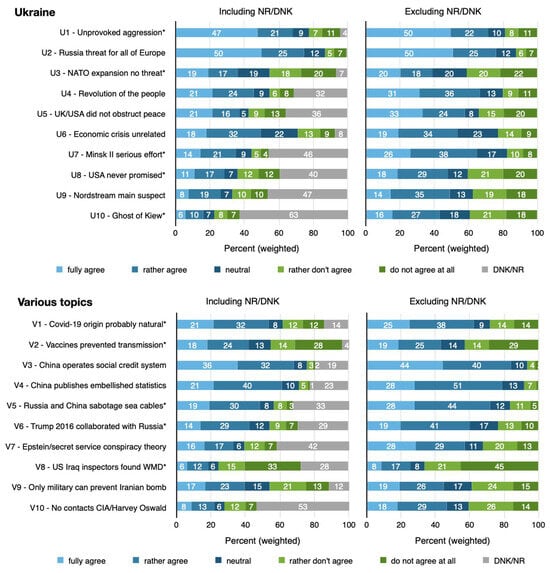
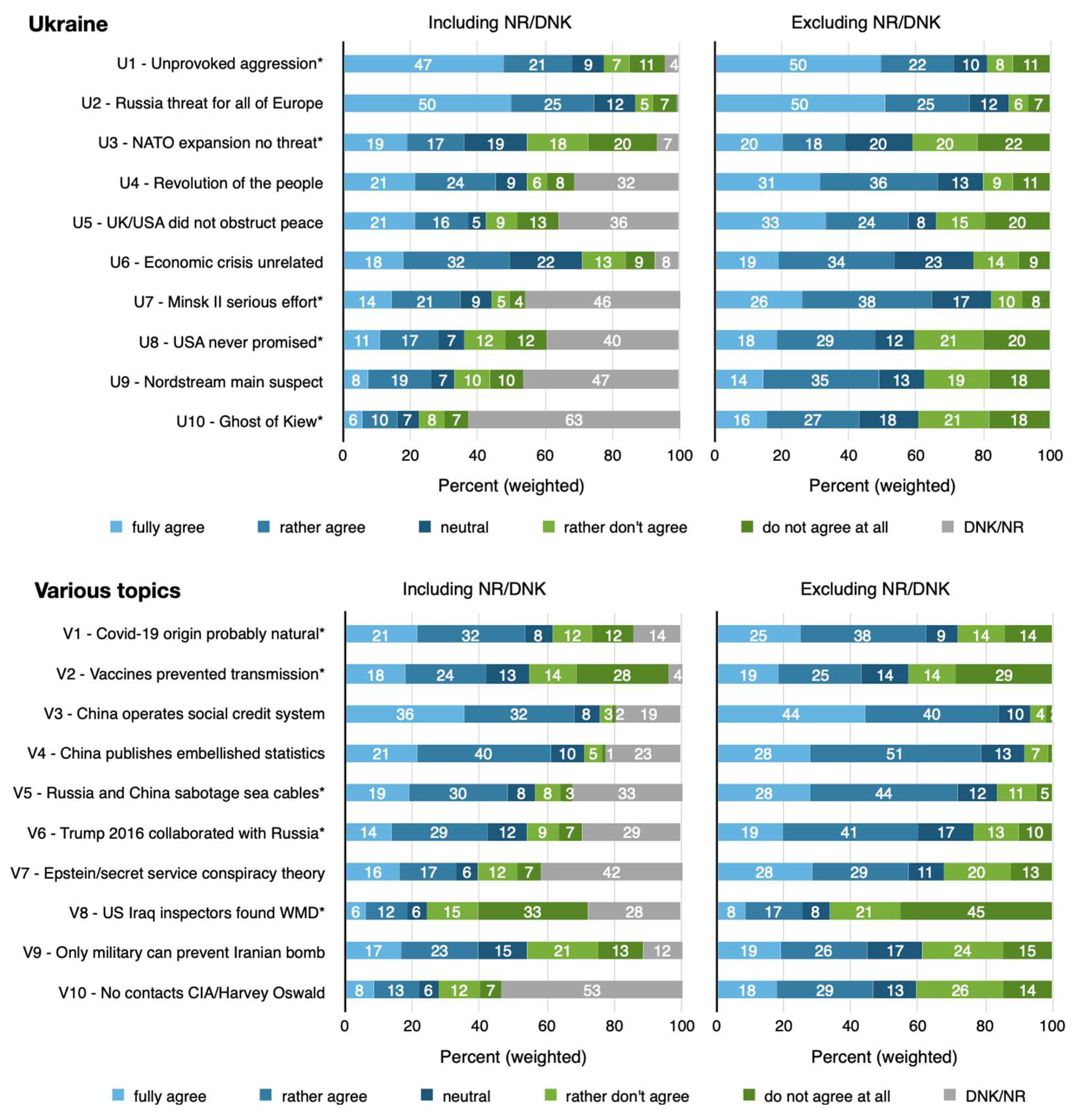
Figure 1 provides an overview of the weighted responses to the questions about the 20 statements. Notable results include the high proportion of unreserved agreement (“fully agree”) for two statements regarding the war in Ukraine (statements U1 and U2) and the statement about the Chinese social credit score system (V3). The former two (or similar statements) have been central claims made by authorities in the United States (mainly U1) and Europe (see sources in Supplementary Materials S1). They have been repeated and rarely questioned in Western mainstream media including those in Switzerland since the beginning of the war. Claims similar to V3 have frequently been made in the Western media (including Swiss media) since Chinese authorities experimented with social credit scores at the local level in the 2010s.
Figure 1.
Agreement with statements about the war in Ukraine (top) and other issues (bottom). Asterisks (*) indicate statements that have been partly or fully corrected by public authorities of interested parties (See Appendix A Table A1 for full statements).
Visual inspection shows that significant unreserved agreement is also found for statements that have been corrected by government authorities of the interested parties—marked with an asterisk (*) in Figure 1. An example is U1, which has been implicitly corrected by the Secretary General of the NATO, Jens Stoltenberg, and more directly by U. S. president Donald Trump and his envoy Steve Witkoff, among other sources (see Supplementary Materials S1). One claim (V2) had also been openly corrected by the media long ago but still obtained some support. However, the numbers also show that many respondents did not fully believe the false or misleading statements.
4.2.2. Unreserved Acceptance by Corrected/Uncorrected Status
Table 2 shows the mean percentage of respondents who “fully agreed” for statements that have and statements that have not been corrected by authorities of the interested party. The numbers show that misinformation beliefs are fairly common for both uncorrected and officially corrected statements.
Table 2.
Percentage acceptance of statements (“fully agree”).
4.2.3. Range of Unreserved Acceptance Rates of Individual Statements
There is a wide range of the acceptance rates across the individual misinformation statements (see Figure 1 and Appendix A Table A2). The percentage of the population-weighted sample that fully endorsed the statements ranged from 5.8% (U10) to 49.8% (U2). The percentage of “Don’t know” or non-response ranged from 1.2% (U2) to 62.8% (U10). These two response variables are highly correlated (Pearson r = 0.658; p = 0.0016). The variation may reflect the varying prominence of the topics in the news media. While some statements on the war in Ukraine (like U1 and U2) had featured prominently in daily news for years, others including the claims about a “ghost of Kyew” (U10) or potential connections of Jeffrey Epstein with the Israeli secret service (V7) obtained only little coverage in mainstream media. As the selected statements are not in any ways representative of any wider universe of possible statements (however defined), the following analysis concentrates on the determinants rather than the prevalence of acceptance.
4.3. Association of Misinformation Acceptance with Individual-Level Variables
Table 3 describes the variables used in the following regression analysis. All variables were entered as sets of indicator variables. The last column shows the relative frequency of each level of the examined variables.
Table 3.
Regression models: examined variables and levels.
Table 4 shows the logit regression models for the summed responses to all 20 statements (Model 1), for the 10 corrected and 10 uncorrected statements (Models 2 and 3), and for two selected single statements (Models 4 and 5) (The signs of significant coefficient estimates for each of the 20 models of single statements are available in Appendix A Table A2, and the estimates are in Supplementary Materials S2). The analysis begins with the political variables, since previous research shows that acceptance of misinformation is most consistently associated with prior beliefs.
Table 4.
Association of the acceptance (“fully agree”) of false or misleading claims with individual characteristics: marginal effects from logistic regression models.
Party identification across all 20 statements shows a fairly consistent pattern. Those who identify with left-wing and liberal parties were more likely to accept the misinformation than the Center party which was the reference group. The same pattern can be observed for the corrected statements alone (Model 2). Looking at these statements, those who favor the right-wing People’s Party were about ten percentage points less likely to accept the statements than those of the Center party (−0.104). The same liberal/conservative pattern is also found for the single statements, and the effect is even stronger (with differences in the probability of acceptance up to about 0.4 between left-wing and right-wing parties in the acceptance of the statement on Ukraine (U1)). An additional notable result is that those who chose “no party” were less likely to accept the misinformation than the Center party reference group (models for all statements and uncorrected statements).
Regarding Trust in government, the acceptance of the statements was lower among those with a medium trust level (−0.041) than among those with high trust, while those with low trust were not significantly different from the other categories. The same pattern is also observed for the single statement on the origin of COVID-19 (V1). In the model for the corrected statements only, those with either medium or low trust in government were less likely to accept the misinformation than those with high trust. The same is found for the single statement about the war in Ukraine being unprovoked (U1).
Turning to news consumption behavior (News time), the respondents who spent 30 min per day or more with news were more likely to “fully agree” with the statements. Across the 20 statements, the probability was increased by about 0.06 (estimates between +0.053 to +0.072; Table 4, Model 1). Coding those who spend 30 min or more with a single indicator variable, the estimate is +0.059 (p < 0.05). The significant association with news consumption is observed for both corrected statements (Model 2) and uncorrected statements (Model 3). With statement U1, those who spent more than 30 min with news were also more likely to fully accept the statement (+0.147 to +0.202).
Regarding Primary news source, across all 20 statements, the beliefs of the audience of the major private sources (TX Group, CH Media and NZZ Group) did not differ significantly from the audience of public-law TV, which was the reference category. However, those who reported the non-mainstream weekly Weltwoche as their primary news source were much more skeptical about the statements (−0.282) than those who mainly consume the news of the public-law TV. The results of the models for corrected and uncorrected statements are similar, although the audience of the (conservative) NZZ Group was more skeptical about the uncorrected statements (Model 3) and the statement regarding the origin of COVID-19 (Model 5).
While two thirds of the respondents rely on public-law TV as their the primary news source, the respondents’ Secondary news sources are more diverse (see Table 3). The audiences of the other large news organizations were again similar to the public-law TV, except for the NZZ Group’s audience, which was more skeptical about the statements that had been corrected and about the statement about the natural origin of COVID-19.
Regarding socioeconomic characteristics, across all 20 statements, those with higher Age (65+) were more likely to accept the statements than those in the medium and lower age groups. The same is found for the single statements presented in Models 4 and 5. For the uncorrected statements alone, the estimates show a linear increase in acceptance with age relative to those under 40 years of age (40–64: +0.040; 65+: +0.084). Regarding Gender, women were consistently more skeptical about the statements than men (+0.044). Those with medium or higher Education were more skeptical about the statements than those with low education. Income and urban or rural Residence were not consistently associated with acceptance.
Finally, the question Wording (treatments A and B) did not consistently affect the responses, indicating that the responses and results are not driven by accidental details of how the survey questions about agreement to the statements were introduced.
An overview of significant marginal effects for each single statement is available in the Appendix A (Table A2). The table shows fairly consistent associations of acceptance with age, gender, news behavior and party identification. Overall, the pattern suggests that the relationships (coefficient signs) are fairly stable across statements and policy domains.
4.4. Media Trust, Media Expectations, and General Values
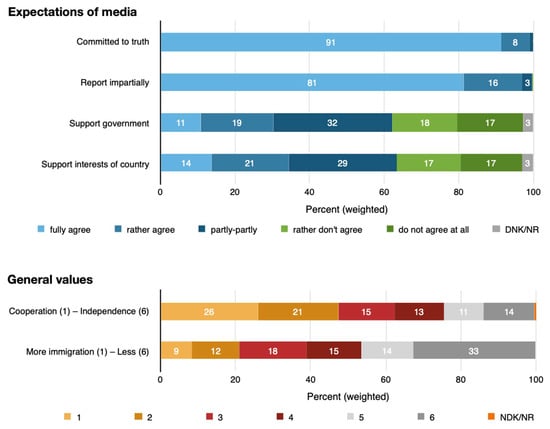
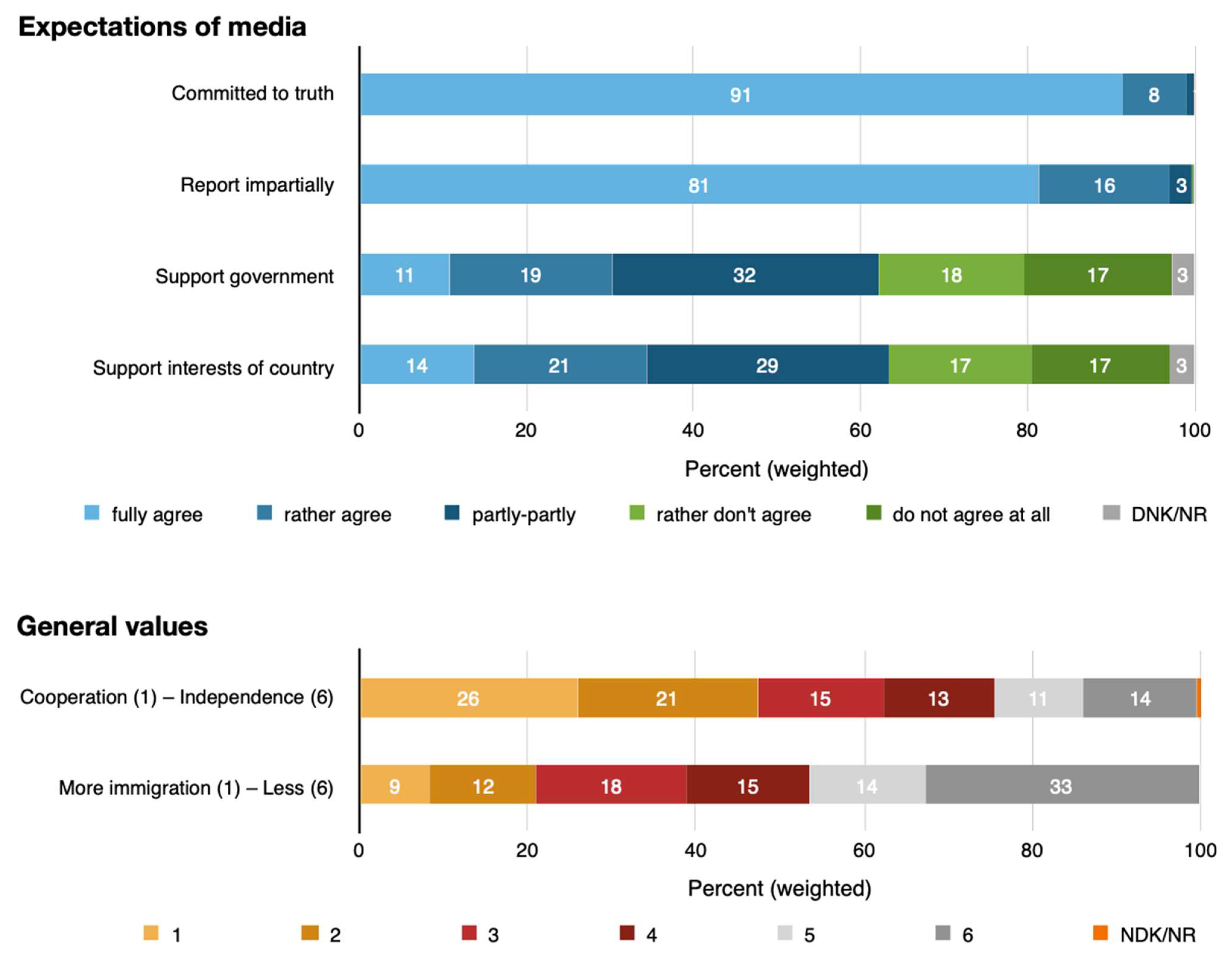
Figure 2 shows the distribution of respondents’ expectations of the news media (upper diagram) and responses about more general values (bottom diagram) in the weighted sample. A large majority of the respondents “fully” or “rather” agreed with the first two statements “The media should be committed above all to the truth” and “In crises and conflicts the media should report impartially”. At the same time, many also agreed on the statement “In crises the media should support the government” and “In international conflicts the media should represent the interests of their country.” Regarding general societal values, the distribution of responses shows preferences for cooperation over independence and for less over more immigration.
Figure 2.
Responses to questions about expectations of the media and general societal values (see text for full statements).
Table 5 examines how the proportion of acceptance (“fully agree” responses across all twenty statements) is associated with these expectations and values, along with the variable for trust in the traditional media. The first model includes only Trust in media and the variables for expectations. The second model adds the variables for general values. Acceptance of misinformation increased with trust in the traditional media. A one-category increase on the 5-point scale was associated with an increase in the proportion of fully accepted statements of about 0.05 (Model 1). Regarding expectations, acceptance of misinformation was higher among those who expected the media to be “committed above all to the truth” (+0.075), to “report impartially” (+0.027) and to “support the government in crises” (+0.020). Regarding general values, acceptance of misinformation was somewhat lower among those who valued national independence above international cooperation. The values regarding immigration were not significantly associated with the acceptance of misinformation.
Table 5.
Association of acceptance of misinformation (“fully agree”) across all 20 statements with media trust, media expectations, and values: marginal effects from logistic regression models.
5. Discussion
This study yields three main findings. First, misinformation that aligns with dominant narratives in mainstream media can be examined empirically. Second, based on “fully agree” responses to false or misleading claims, up to 50% of the population in the study region accepted such misinformation. Third, acceptance of misinformation was consistently associated with individual-level characteristics, but the pattern of these associations differs substantially from those reported in research on non-mainstream misinformation. In addition, responses to supplementary questions show that a large majority of consumers expect news media to report truthfully and impartially, underscoring the need for measures to address misinformation in mainstream media. The following paragraphs discuss these findings in turn, followed by a consideration on limitations and directions for future research.
The present analysis demonstrates that empirical work on this topic is feasible. Extending misinformation research to dominant narratives in mainstream media was made possible by combining an epistemically grounded definition of misinformation with a measure of misinformation acceptance that captures the complexity of politically relevant claims including those that mislead by omitting important information. While this feasibility is not unexpected, it is notable given the substantial gap in the literature (see Section 2). A likely explanation for this gap is that much of the existing research has been funded in response to unexpected election outcomes and the COVID-19 pandemic, contexts in which public authorities and other funders were primarily concerned with misinformation that contradicted mainstream views (Chaufan et al., 2024).
Regarding the prevalence of misinformation beliefs, this study provides some of the first empirical evidence for mainstream news. The claims examined cover a range of important recent issues in international reporting. Based on the study’s definition of misinformation and a conservative measure of acceptance, the findings indicate that dominant narratives in Western mainstream media have misled substantial portions of the population on several key issues. While earlier research has typically focused on individual cases—such as reporting on the war in Iraq (Lewandowsky et al., 2005)—the present results suggest that misinformation in Western mainstream media warrants more systematic investigation.
The individual-level variables associated with misinformation acceptance, including political ideology, news behavior, and trust in government, are similar to those identified in the large literature on misinformation that challenges dominant views in mainstream media. However, the direction of the correlation is often the opposite. Acceptance of misinformation was higher among older people, among men, among those who consume more news, and among those identifying with left-wing or liberal parties. The opposite explanatory pattern in the present study is interesting but not surprising. It is consistent with the literature showing that prior beliefs, identity, and motivations are important correlates of misinformation acceptance (see Section 2.3). The association of misinformation acceptance with trust in mainstream media (see Table 5) underlines this interpretation.
Several details of the explanatory pattern deserve additional attention. First, the effect of education was not reversed relative to studies on non-mainstream misinformation. Those with medium and higher education were less susceptible to the misinformation. Second, those with medium trust in government were less likely to accept misinformation than those with high trust but—remarkably—not less likely than those with low trust (see Table 4). Furthermore, those who identified with “no party” were less likely to accept misinformation—not only compared with those who identified with left-wing parties but also with those who identified with the Center party. While many studies have shown that those with contrary prior beliefs are more resistant to misinformation (Roozenbeek et al., 2022), the present findings indicate that those without any strong prior beliefs, ideology, or grounds for motivated reasoning are also more resistant. In other words, the less “prejudiced” were less likely to accept misinformation.
Respondents expressed near-unanimously expectations that the media should be “committed mainly to the truth” and “report impartially”. These expectations stand in clear tension with the observed presence of misinformation in mainstream coverage across a range of important international issues. While focused studies on the issue are not available, recent research suggests that the sources of such misinformation in international reporting in the study region and in Europe more broadly are fairly evident. Mainstream media rely heavily on only a limited set of international sources that tend to align ideologically with U.S. economic and strategic interests (Udris et al., 2023; Vogler et al., 2024, cf. Section 2.4). It is therefore unsurprising that the false or misleading news stories identified in this study (Section 3.3) largely reflect U.S. perspectives, even in cases where European interests differ substantially. Illustrative examples in which misinformation and a lack of transparency may have favored U.S. interests over European ones include reporting on the causes of the war in Ukraine, the investigation into Nord Stream sabotage, and the origins of the COVID-19 pandemic.
From a democratic or citizen-focused perspective, several aspects of the results are concerning: the high prevalence of misinformation acceptance, the contradiction with consumers’ expectations of truthful and impartial news, and the indications that misinformation tends to align with foreign interests. Together, these findings suggest that regulatory measures may be warranted to prevent news media from undermining informed political decision-making and a “free formation of political will and unbiased voting” as stipulated in the Swiss constitution. A relatively straightforward first step would be to introduce declaration requirements for news organizations, increasing transparency around major news sources, as well as their political alignment and funding. While such declaration requirements exist in many other product categories (e.g., Sunstein, 2011), they have not yet been applied to the news sector.
A limitation of this study—and any work on misinformation about contested issues—concerns the lack of an absolute truth standard. The credibility of the analysis ultimately relies on the acceptance of the underlying methodology. The present study supports the reader’s decision to accept or dismiss the labeling of misinformation by providing information on the grounds on which the claims were assessed (cf. Table A1 and Supplement S1). However, knowledge is preliminary, and new information may require updates on assessments. A second limitation is that the study did not examine the discernment of misinformation, which would require questions about both false or misleading and true and non-misleading claims (cf. Beattie & Sherstoboeva, 2025). A third limitation concerns the respondent sample, which is not based on probability sampling but drawn from a respondent panel. The sample is biased towards higher incomes, left-liberal ideology, high education, high media consumption and above-average interest in politics. The estimates at the population level (cf. Figure 1), which where weighted for important factors including political orientation, should therefore be interpreted with caution. The analysis of the associations of acceptance with individual characteristics should be less affected by the bias, as the biased sample is sufficiently heterogeneous in all relevant variables to identify the relationships.
This study raises several questions for future research. One important question concerns theoretical foundations, definitions, and procedures that enable researchers to usefully identify important misinformation that is aligned with dominant mainstream views. Furthermore, work on misinformation in mainstream media could look at other issue domains than those examined here. One example would be policy issues at the national level, where dominant narratives can be driven by corporate interests of industries such as the agricultural, banking, energy, military pharmaceutical, or real-estate industry. Another topic for future research is regulatory measures to discourage misinformation in mainstream news media, for instance through declaration requirements that increase source transparency.
6. Conclusions
This study used a panel survey to examine how news consumers in German-speaking Switzerland accept misinformation in mainstream news media. The analysis combined an epistemically grounded definition of misinformation with a measure of misinformation acceptance that captures the complexity of politically relevant misinformation, which often misleads through the omission of important information.
Based on population-weighted responses to twenty examined claims, up to 50% of the population fully agreed with misinformation on major international issues. For claims that had been fully or partly corrected by public authorities, the acceptance still reached up to 47% of the population. At the individual level, higher acceptance of misinformation was significantly associated with older age, male gender, low education, and longer daily news consumption. It was also linked to high trust in government (compared to medium trust), left-wing or liberal party identification (relative to Center affiliation, “several parties equally”, or “no party”), and reliance on mainstream news sources (as opposed to a non-mainstream source). Overall, the factors associated with accepting misinformation resemble those identified in studies of non-mainstream misinformation. However, the direction of these associations often differed, suggesting that patterns reported in the existing literature may reflect its focus on misinformation that contradicts dominant narratives of mainstream news organizations.
In terms of content, the misinformation examined was often aligned with U.S or broader Western economic and strategic interests. This systematic ideological bias was not part of the study design but appears to reflect Swiss news media’s reliance on U.S.-aligned international sources. At the same time, responses to supplementary survey questions indicate that media consumers expect information to be both truthful and impartial. The findings raise concerns about the potential influence of misinformation on political opinion formation and on voting behavior in referenda related to international affairs. They point to a need for regulatory measures that enhance source transparency in order to safeguard media quality and support well-informed public judgment on international issues.
Supplementary Materials
The following supporting information can be downloaded at: https://www.mdpi.com/article/10.3390/journalmedia7020103/s1, S1: Sources: evidence and media examples; S2: Additional model estimates; S3: Survey questionnaire.
Funding
This research did not receive any external funding.
Institutional Review Board Statement
Ethical review and approval was not required for the study on human participants in accordance with the local legislation and institutional requirements.
Informed Consent Statement
Written informed consent for participation was not required for this study in accordance with the national legislation and the institutional requirements.
Data Availability Statement
The original data presented in the study is available in Zenodo at https://doi.org/10.5281/zenodo.20021866.
Acknowledgments
I am grateful to two anonymous reviewers for very helpful comments and to Tobias Keller of gfs.bern for advice regarding the survey questionnaire and the implementation of the survey. The weighting of the responses and the related documentation by Jonas Kocher (also gfs.bern) are gratefully acknowledged.
Conflicts of Interest
The author declares no conflicts of interest.
Appendix A
Table A1.
Statements and classification as corrected/not uncorrected by authorities of the interested party).
Table A2.
Association of the acceptance of each statement with individual-level variables. Significant coefficients from logistic regression models.
References
- Ackerman, G., Behlendorf, B., Baum, S., Peterson, H., Wetzel, A., & Halstead, J. (2024). The origin and implications of the COVID-19 pandemic: An expert survey (global catastrophic risk institute technical report 24-1). Global Catastrophic Risk Institute. Available online: https://gcrinstitute.org/papers/069_covid-origin.pdf (accessed on 8 May 2026).
- Aïmeur, E., Amri, S., & Brassard, G. (2023). Fake news, disinformation and misinformation in social media: A review. Social Network Analysis and Mining, 13, 30. [Google Scholar] [CrossRef] [Scilit] [PubMed]
- Altay, S., Berriche, M., & Acerbi, A. (2023). Misinformation on misinformation: Conceptual and methodological challenges. Social Media + Society, 9(1), 20563051221150412. [Google Scholar] [CrossRef] [Scilit]
- Beattie, P., & Sherstoboeva, E. (2025). Understanding the war in Ukraine: Comparing knowledge and bias in Russia and the U.S. Political Psychology, 46, 1168–1185. [Google Scholar] [CrossRef] [Scilit]
- Broda, E., & Strömbäck, J. (2024). Misinformation, disinformation, and fake news: Lessons from an interdisciplinary, systematic literature review. Annals of the International Communication Association, 48(2), 139–166. [Google Scholar] [CrossRef] [Scilit]
- Calisher, C., Carroll, D., Colwell, R. R., Corley, R. B., Daszak, P., Drosteng, C., Enjuanesh, L., Farrari, J., Fieldj, H., Goldingi, J., Gorbalenyak, A., Haagmansl, B., Hughesm, J. M., Kareshn, W. B., Keusche, G. T., Lamo, S. K., Lubrothp, J., Mackenzieq, J. S., Madoffr, L., … Turneri, M. (2020). Statement in support of the scientists, public health professionals, and medical professionals of China combatting COVID-19. Lancet, 395, e42–e43. [Google Scholar] [CrossRef] [Scilit] [PubMed]
- Chaufan, C., Hemsing, N., Heredia, C., & McDonald, J. (2024). Trust us—We are the (COVID-19 misinformation) experts: A critical scoping review of expert meanings of “misinformation” in the COVID era. COVID, 4(9), 1413–1439. [Google Scholar] [CrossRef] [Scilit]
- Ecker, U. K. H., Lewandowsky, S., Cook, J., Schmid, P., Fazio, L. K., Brashier, N., Kendeou, P., Vraga, E. K., & Amazeen, M. A. (2022). The psychological drivers of misinformation belief and its resistance to correction. Nature Reviews Psychology, 1, 13–29. [Google Scholar] [CrossRef] [Scilit]
- Entman, R. M. (2007). Framing bias: Media in the distribution of power. Journal of Communication, 57(1), 163–173. [Google Scholar] [CrossRef] [Scilit]
- Ewaida, S. (2025). The role of unofficial American think tanks in shaping the strategy for controlling the trajectory of the international system (the Ukraine war as a model). Journal of Political Science and International Relations, 8, 169–178. [Google Scholar] [CrossRef] [Scilit]
- Flynn, D. J. (2016). The scope and correlates of political misperceptions in the mass public [Unpublished working paper]. Available online: https://paperzz.com/download/8502734 (accessed on 8 May 2026).
- Flynn, D. J., Nyhan, B., & Reifler, J. (2017). The nature and origins of misperceptions: Understanding false and unsupported beliefs about politics. Political Psychology, 38(S1), 127–150. [Google Scholar] [CrossRef] [Scilit]
- Freeman, B. (2023). Defense contractor funded think tanks dominate Ukraine debate. Quincy Institute for Responsible Statecraft. Available online: https://quincyinst-2.s3.amazonaws.com/wp-content/uploads/2023/05/17213007/QUINCY-BRIEF-NO.-41-MAY-2023-FREEMAN.pdf (accessed on 8 May 2026).
- FSO. (2024). Aktualisierung 2020 der nichtinstitutionellen Raumgliederungen. Federal Statistical Office. [Google Scholar]
- gfs.bern. (2025). Mediennarrative: Technischer Bericht. gfs.bern. [Google Scholar] [CrossRef]
- Hameleers, M., Brosius, A., & de Vreese, C. H. (2022). Whom to trust? Media exposure patterns of citizens with perceptions of misinformation and disinformation related to the news media. European Journal of Communication, 37(3), 237–268. [Google Scholar] [CrossRef] [Scilit]
- Harrison, N. L., & Sachs, J. D. (2022). A call for an independent inquiry into the origin of the SARS-CoV-2 virus. Proceedings of the National Academy of Sciences of the United States of America, 119(21), e2202769119. [Google Scholar] [CrossRef] [Scilit]
- Hayward, T. (2023). The applied epistemology of official stories. Social Epistemology, 38(4), 425–445. [Google Scholar] [CrossRef] [Scilit]
- Hayward, T. (2025). The problem of disinformation: A critical approach. Social Epistemology, 39(1), 1–23. [Google Scholar] [CrossRef] [Scilit]
- Herman, E. S., & Chomsky, N. (1988). Manufacturing consent: The political economy of the mass media. Pantheon Books. [Google Scholar]
- Jamieson, K. H., & Albarracín, D. (2020). The relation between media consumption and misinformation at the outset of the SARS-CoV-2 pandemic in the U.S. Harvard Kennedy School Misinformation Review, 1(2), 10-37016. [Google Scholar] [CrossRef] [Scilit]
- Jerit, J., & Zhao, Y. (2020). Political misinformation. Annual Review of Political Science, 23, 77–94. [Google Scholar] [CrossRef] [Scilit]
- Klapper, J. T. (1960). The effects of mass communication. Free Press. [Google Scholar]
- Krüger, U. (2013). Meinungsmacht. Der Einfluss von Eliten auf Leitmedien und Alpha-Journalisten—Eine kritische Netzwerkanalyse. Herbert von Halem Verlag. [Google Scholar]
- Kunda, Z. (1990). The case for motivated reasoning. Psychological Bulletin, 108(3), 480–498. [Google Scholar] [CrossRef] [Scilit]
- Lasswell, H. D. (1927). The theory of political propaganda. The American Political Science Review, 21(3), 627–631. [Google Scholar] [CrossRef] [Scilit]
- Lazarsfeld, P. F., Berelson, B., & Gaudet, H. (1948). The People’s choice: How the voter makes up his mind in a presidential campaign. Columbia University Press. [Google Scholar]
- Lewandowsky, S., Gignac, G., & Vaughan, S. (2013). The pivotal role of perceived scientific consensus in acceptance of science. Nature Climate Change, 3, 399–404. [Google Scholar] [CrossRef] [Scilit]
- Lewandowsky, S., Stritzke, W. G. K., Oberauer, K., & Morales, M. (2005). Memory for fact, fiction, and misinformation: The Iraq War 2003. Psychological Science, 16(3), 190–195. [Google Scholar] [CrossRef] [Scilit] [PubMed]
- Maier, S. (2005). Accuracy matters: A cross-market assessment of newspaper error and credibility. Journalism & Mass Communication Quarterly, 82, 533–551. [Google Scholar] [CrossRef] [Scilit]
- Martel, C., Pennycook, G., & Rand, D. G. (2020). Reliance on emotion promotes belief in fake news. Cognitive Research: Principles and Implications, 5, 47. [Google Scholar] [CrossRef] [Scilit]
- McLeod, D. M., Kosicki, G. M., & McLeod, G. M. (2009). Political communication effects. In J. Bryant, & M. B. Oliver (Eds.), Media effects: Advances in theory and research (3rd ed., pp. 228–251). Routledge. [Google Scholar]
- Nan, X., Wang, Y., & Thier, K. (2022). Why do people believe health misinformation and who is at risk? A systematic review of individual differences in susceptibility to health misinformation. Social Science & Medicine, 314, 115398. [Google Scholar] [CrossRef] [Scilit]
- Newman, N., Arguedas, A. R., Robertson, C. T., Nielsen, R. K., & Fletcher, R. (2025). Digital news report 2025. Reuters Institute for the Study of Journalism. [Google Scholar] [CrossRef]
- Pennycook, G., Epstein, Z., Mosleh, M., Arechar, A., Eckles, D., & Rand, D. G. (2021). Shifting attention to accuracy can reduce misinformation online. Nature, 592, 590–595. [Google Scholar] [CrossRef] [Scilit]
- Pennycook, G., & Rand, D. G. (2019). Fighting misinformation on social media using crowdsourced judgments of news source quality. Proceedings of the National Academy of Sciences of the United States of America, 116(7), 2521–2526. [Google Scholar] [CrossRef] [Scilit] [PubMed]
- Pennycook, G., & Rand, D. G. (2020). Who falls for fake news? The roles of bullshit receptivity, overclaiming, familiarity, and analytic thinking. Journal of Personality, 88(2), 185–200. [Google Scholar] [CrossRef] [Scilit] [PubMed]
- Porlezza, C., Maier, S., & Russ-Mohl, S. (2012). News accuracy in Switzerland and Italy. Journalism Practice, 6, 530–546. [Google Scholar] [CrossRef] [Scilit]
- Rathje, S., Roozenbeek, J., Van Bavel, J. J., & Van Der Linden, S. (2023). Accuracy and social motivations shape judgements of (mis)information. Nature Human Behaviour, 7, 892–903. [Google Scholar] [CrossRef] [Scilit]
- Rodrigo-Ginés, F. J., Carrillo-de-Albornoz, J., & Plaza, L. (2024). A systematic review on media bias detection: What is media bias, how it is expressed, and how to detect it. Expert Systems with Applications, 237(Part C), 121641. [Google Scholar] [CrossRef] [Scilit]
- Roozenbeek, J., Maertens, R., Herzog, S. M., Geers, M., Kurvers, R., Sultan, M., & Van Der Linden, S. (2022). Susceptibility to misinformation is consistent across question framings and response modes and better explained by myside bias and partisanship than analytical thinking. Judgment and Decision Making, 17(3), 547–573. [Google Scholar] [CrossRef] [Scilit]
- RPS (Ed.). (2024). Jahrbuch qualität der medien 2024. Research Center for the Public Sphere and Society. [Google Scholar] [CrossRef] [Scilit]
- RPS (Ed.). (2025). Jahrbuch qualität der medien 2025. Research Center for the Public Sphere and Society. [Google Scholar] [CrossRef] [Scilit]
- RPS (Ed.). (2026). Mediennutzung 2035. Studie zur Zukunft der informationsmedien. Research Center for the Public Sphere and Society. Available online: https://www.foeg.uzh.ch/dam/jcr:df34e922-ed51-49ea-a60a-496a2cc00748/foeg_Mediennutzung_2035_fin.pdf (accessed on 8 May 2026).
- Schläpfer, F. (2025). Einseitigkeit in nachrichtenmedien. Eine analyse von zeitungsberichten und meinungen in der Deutschsprachigen Schweiz (Media bias: An analysis of newspaper reports and opinions in German-speaking Switzerland). FS Economic Research. [Google Scholar] [CrossRef]
- Simko, J., Racsko, P., Tomlein, M., Hanakova, M., Moro, R., & Bielikova, M. (2021). A study of fake news reading and annotating in social media context. New Review of Hypermedia and Multimedia, 27(1–2), 97–127. [Google Scholar] [CrossRef] [Scilit]
- Soprano, M., Roitero, K., Barbera, D. L., Ceolin, D., Spina, D., Mizzaro, S., & Demartini, G. (2021). The many dimensions of truthfulness: Crowdsourcing misinformation assessments on a multidimensional scale. arXiv, arXiv:2108.01222. [Google Scholar] [CrossRef] [Scilit]
- Sultan, M., Tump, A. N., Ehmann, N., Lorenz-Spreen, P., Hertwig, R., Gollwitzer, A., & Kurvers, R. H. J. M. (2024). Susceptibility to online misinformation: A systematic meta-analysis of demographic and psychological factors. Proceedings of the National Academy of Sciences of the United States of America, 121(47), e2409329121. [Google Scholar] [CrossRef] [Scilit]
- Sunstein, C. R. (2011). Empirically informed regulation. University of Chicago Law Review, 78, 349–1429. [Google Scholar]
- Thorson, E. (2015). Belief echoes: The persistent effects of corrected misinformation. Political Communication, 33(3), 460–480. [Google Scholar] [CrossRef] [Scilit]
- Tsfati, Y., Boomgaarden, H. G., Strömbäck, J., Vliegenthart, R., Damstra, A., & Lindgren, E. (2020). Causes and consequences of mainstream media dissemination of fake news: Literature review and synthesis. Annals of the International Communication Association, 44(2), 157–173. [Google Scholar] [CrossRef] [Scilit]
- Udris, L., Vogler, D., Weston, M., & Eisenegger, M. (2023). Sourcing practices of online news media in Switzerland during the war in Ukraine. Frontiers in Political Science, 5, 1089994. [Google Scholar] [CrossRef] [Scilit]
- Valkenburg, P. M., Peter, J., & Walther, J. B. (2016). Media effects: Theory and research. Annual Review of Psychology, 67(1), 315–338. [Google Scholar] [CrossRef] [Scilit] [PubMed]
- Vogler, D., Udris, L., Meissner, F., & Sievert, H. (2024). The elephant(s) in the newsroom: A mixed methods study on the use of news agency material. Journalism Practice, 20(4), 1456–1476. [Google Scholar] [CrossRef] [Scilit]
- Walter, N., & Tukachinsky, R. (2020). A meta-analytic examination of the continued influence of misinformation in the face of correction: How powerful is it, why does it happen, and how to stop it? Communication Research, 47(2), 155–177. [Google Scholar] [CrossRef] [Scilit]

Disclaimer/Publisher’s Note: The statements, opinions and data contained in all publications are solely those of the individual author(s) and contributor(s) and not of MDPI and/or the editor(s). MDPI and/or the editor(s) disclaim responsibility for any injury to people or property resulting from any ideas, methods, instructions or products referred to in the content. |
© 2026 by the author. Licensee MDPI, Basel, Switzerland. This article is an open access article distributed under the terms and conditions of the Creative Commons Attribution (CC BY) license.