
Digital Communication Strategies of Start-Ups in the Agri-Food Sector in Spain

 ,
,  ,
,  and
and 
Abstract
1. Introduction
1.1. The Importance of Communication in the Entrepreneurial Ecosystem
1.2. Corporate Communication and Strategic Communication in Start-Ups
1.3. Own Media and Digital Communication in the Sector
1.3.1. The Corporate Website as the Hub of Digital Presence
1.3.2. Social Media
2. Materials and Methods
2.1. Analysis of Social Media
2.2. Methodological Design
- Data collection and organisation: Compilation of all publications from the study period using FanpageKarma and organisation of the corpus into databases differentiated by social network and company.
- Coding: Application of an analysis sheet (Piñuel, 2002) that will allow each publication to be classified according to the established categories.
- Statistical processing: Descriptive analysis of quantitative variables (frequencies, means, and standard deviations) to identify performance patterns.
- Qualitative interpretation: Analysis of communication strategies based on the coding of the messages examined.
2.3. Sample
3. Results
3.1. Agrotech and Foodtech Start-Ups
3.2. Analysis of the Website
Legal Compliance
3.3. Analysis of Social Media
3.3.1. Instagram
- The best times and days to post
- Top 10 images and videos
- Top 50 words and hashtags
3.3.2. TikTok
- The best times and days to post
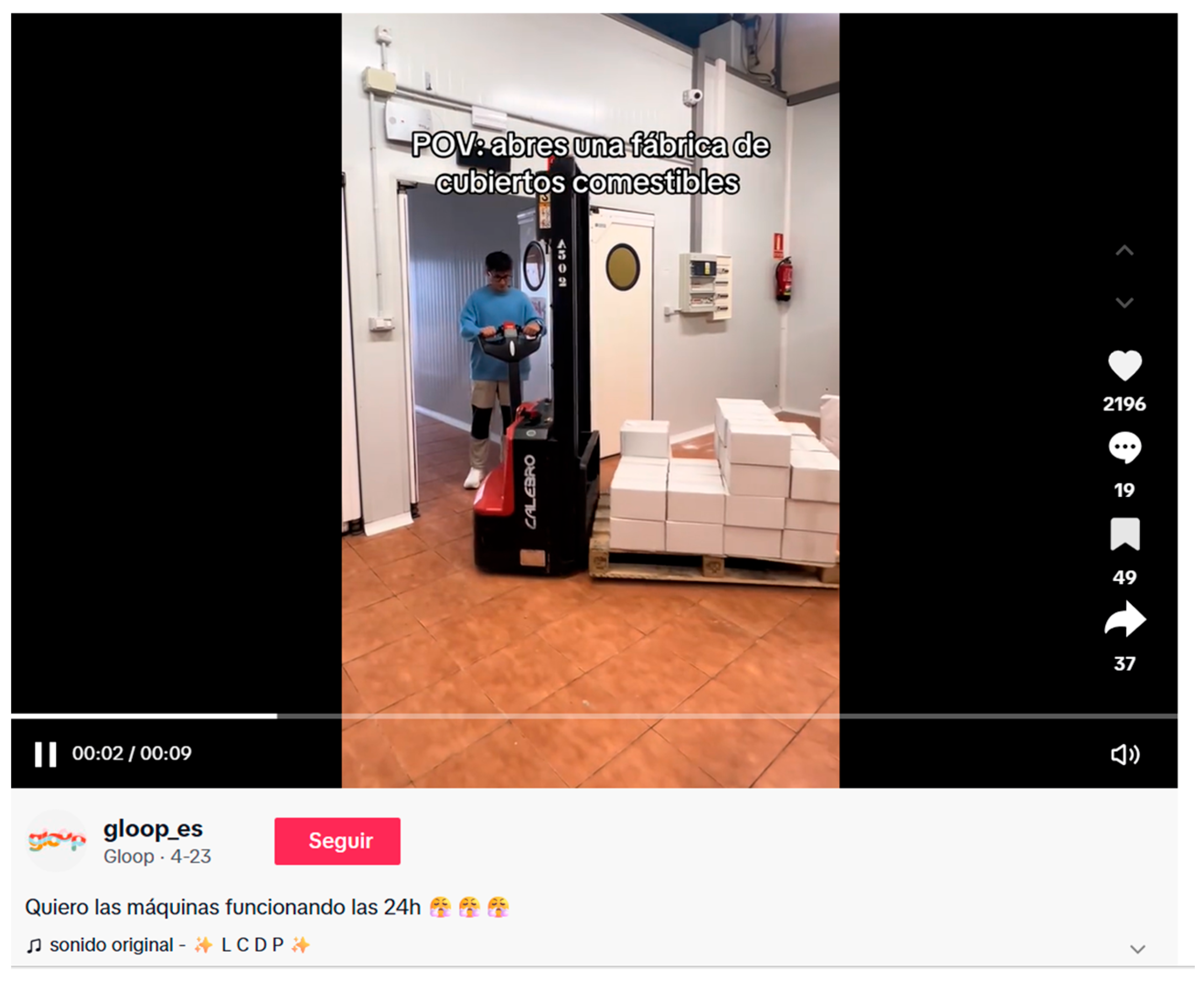
- Top 10 images and videos
- Top 50 words and hashtags
3.3.3. X
- The best times and days to post
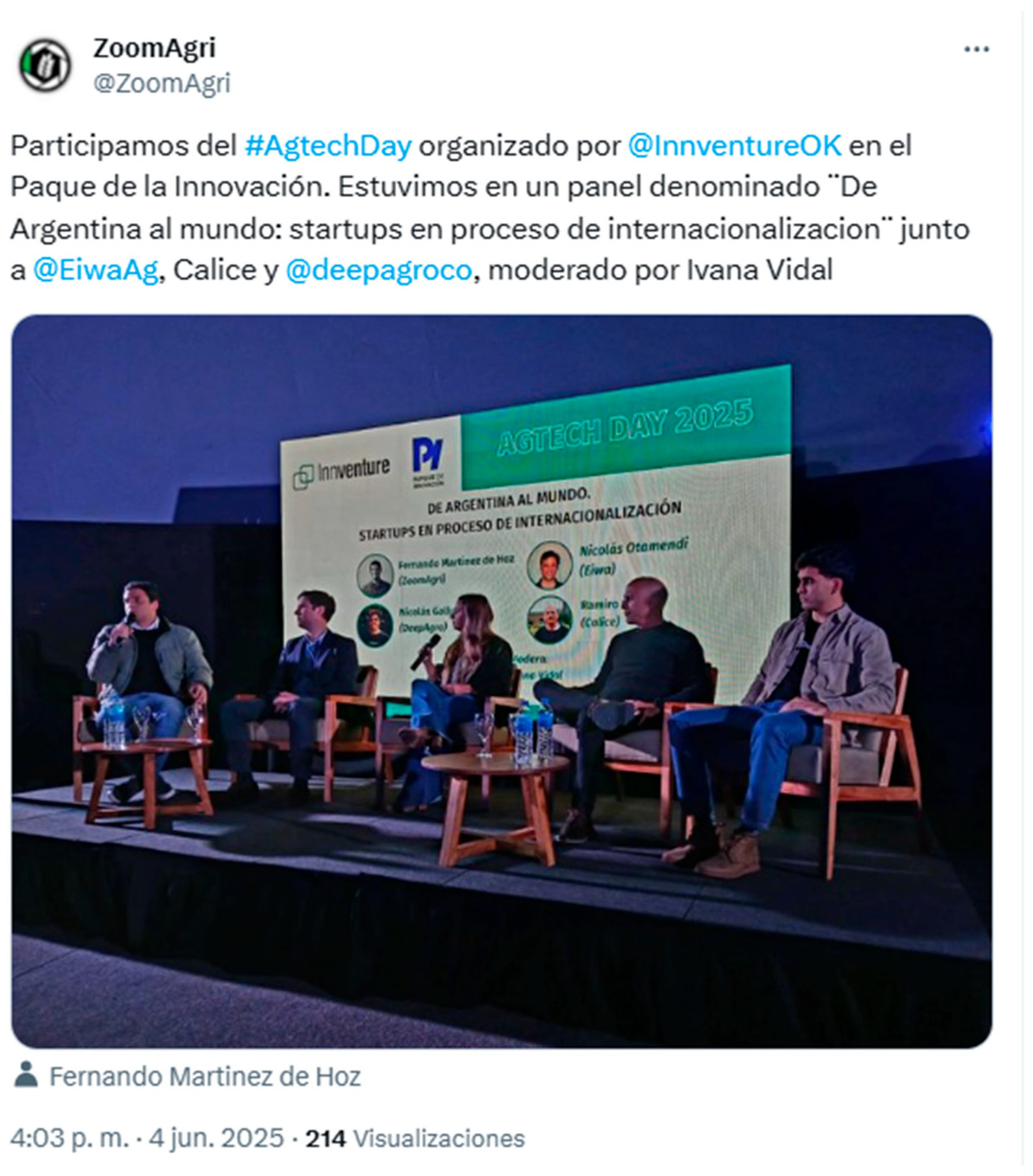
- Top 10 images and videos
- Top 50 words and hashtags
- Feelings generated
3.3.4. YouTube
- The best times and days to post
- Top 10 images and videos
- Top 50 words and hashtags
- Feelings generated
3.3.5. Facebook
- The best times and days to post
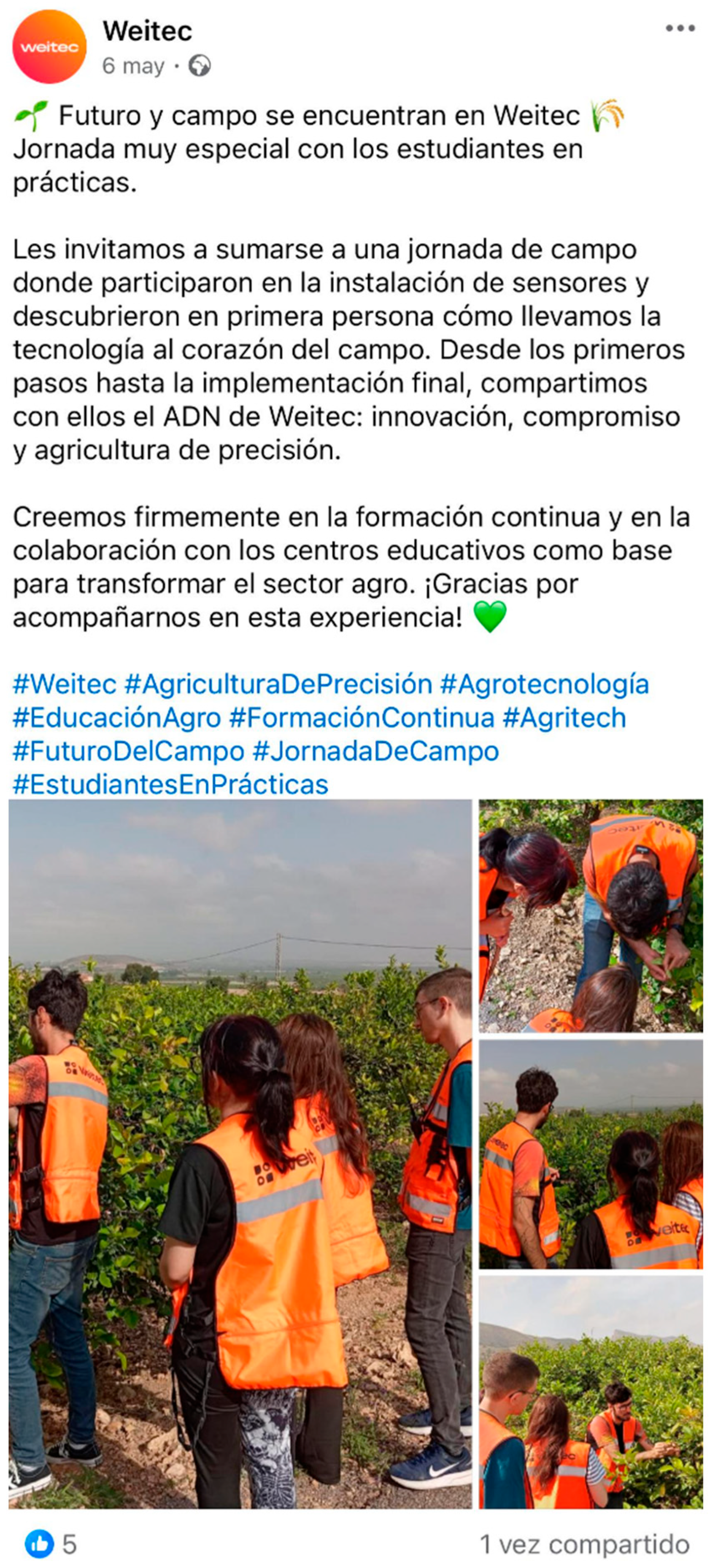
- Top 10 images and videos
- Top 50 words and hashtags
- Feelings generated
3.3.6. LinkedIn
4. Discussion
5. Conclusions
Author Contributions
Funding
Institutional Review Board Statement
Informed Consent Statement
Data Availability Statement
Conflicts of Interest
Appendix A


References
- Abu-Ayyash, S. (2025). Digital transformation’s effect on PR and strategic communication in Palestinian startups. In Strategic public relations in emerging economies: Public and private sector perspectives. Springer. [Google Scholar] [CrossRef] [Scilit]
- Aladwani, A. M., & Palvia, P. C. (2002). Developing and validating an instrument for measuring user-perceived web quality. Information & Management, 39(6), 467–476. [Google Scholar] [CrossRef] [Scilit]
- Ala-Kortesmaa, S., Laapotti, T., & Mikkola, L. (2022). Narrative start-up identity construction as strategic communication. International Journal of Strategic Communication, 16(2), 222–238. [Google Scholar] [CrossRef] [Scilit]
- Aldrich, H., & Fiol, C. M. (1994). Fools rush in? The institutional context of industry creation. Academy of Management Review, 19(4), 645–670. [Google Scholar] [CrossRef] [Scilit]
- Baidya, R., Kumar, D., & Livvarcin, D. O. (2024). Gamified communication in social media for brand advocacy of start-ups. In Marketing and gamification: Applications, challenges, and ethics. Routledge. [Google Scholar] [CrossRef] [Scilit]
- Berelson, B. (1952). Content analysis in communication research. The Free Press. [Google Scholar]
- Blank, S., & Dorf, B. (2012). The startup owner’s manual: The step-by-step guide for building a great company. K&S Ranch Press. [Google Scholar]
- Bruce, S. (2021). The impact of external communication strategy on blockchain startups: Analysing the case of credits blockchain platform. International Journal of Applied Research in Management and Economics, 4(2), 67–77. [Google Scholar] [CrossRef] [Scilit]
- Capriotti, P., Zeler, I., & Camilleri, M. A. (2021). Corporate communication through social networks: The identification of the key dimensions for dialogic communication. In Strategic corporate communication in the digital age (pp. 33–51). Emerald Group Publishing Ltd. [Google Scholar] [CrossRef] [Scilit]
- Chaudhri, V., Pridmore, J., & Mauck, C. (2022). Assembling the start-up brand: A process framework for understanding strategic communication challenges. International Journal of Strategic Communication, 16(2), 206–221. [Google Scholar] [CrossRef] [Scilit]
- Chen, Q., & Yen, D. C. (2004). Improving the quality of online presence through interactivity. Information & Management, 42(1), 217–226. [Google Scholar] [CrossRef] [Scilit]
- Chen, Z. F., Ji, Y. G., & Men, L. R. (2023). Effective social media communication for startups in China: Antecedents and outcomes of organization–public dialogic communication. New Media and Society, 25(12), 3613–3640. [Google Scholar] [CrossRef] [Scilit]
- Cornelissen, J. (2017). Corporate communication: A guide to theory and practice (5th ed.). SAGE. [Google Scholar]
- Díaz, E., Martín, M., & Esteban, Á. (2008). Evaluating the web quality of corporate tourism sites. International Journal of Tourism Research, 10(5), 459–477. [Google Scholar] [CrossRef] [Scilit]
- Dorfleitner, G., Hornuf, L., & Weber, M. (2018). Dynamics of investor communication in equity crowdfunding. Electronic Markets, 28(4), 523–540. [Google Scholar] [CrossRef] [Scilit]
- Egorycheva, E. A., Tamas, B., & Kiselev, D. D. (2022). Management and communication challenges in biotech startups. Scientific Journal Economic Systems, 15(4), 144–153. [Google Scholar] [CrossRef] [Scilit]
- Fernández Torres, M. J., Rando-Cueto, D., & del Pino Rodríguez-Vera, A. (2025a). Startups’ discursive and communication strategies on social media. VISUAL Review. International Visual Culture Review/Revista Internacional de Cultura, 17(2), 259. [Google Scholar] [CrossRef] [Scilit]
- Fombrun, C. (1996). Reputation: Realizing value from the corporate image. Harvard Business School Press. [Google Scholar]
- García García, M., Carrillo-Durán, M. V., & Tato Jiménez, J. L. (2017). Online corporate communications: Website usability and content. Journal of Communication Management, 21(2), 140–154. [Google Scholar] [CrossRef] [Scilit]
- Gil García, A., & Presol Herrero, Á. (2025). IMPACT transforming communication and sales strategies in SMEs and startups. VISUAL Review. International Visual Culture Review/Revista Internacional de Cultura, 17(1), 165–178. [Google Scholar] [CrossRef] [Scilit]
- Godulla, A., & Men, L. R. (2022). Start-up and entrepreneurial communication. International Journal of Strategic Communication, 16(2), 127–133. [Google Scholar] [CrossRef] [Scilit]
- Hallahan, K., Holtzhausen, D., van Ruler, B., Verčič, D., & Sriramesh, K. (2007). Defining strategic communication. International Journal of Strategic Communication, 1(1), 3–35. [Google Scholar] [CrossRef] [Scilit]
- Hassan Montero, Y. (2006). Factors in web design aimed at user satisfaction and the prevention of frustration. Revista Española De Documentación Científica, 29(2), 239–257. [Google Scholar] [CrossRef] [Scilit]
- Hatch, M. J., & Schultz, M. (2008). Taking brand initiative: How companies can align strategy, culture, and identity through corporate branding. Jossey-Bass. [Google Scholar]
- Herrero, J. V. (2021). Interactive non-fiction digital storytelling: An analysis of the user experience|Narrativas digitales de no ficción interactiva: Análisis de la experiencia del usuario. Doxa Comunicación. Revista Interdisciplinar de Estudios de Comunicación y Ciencias Sociales, 32(2021), 498–498. [Google Scholar]
- Hoang, K. M., & Böckel, A. (2024). Cradle-to-cradle business model tool: Innovating circular business models for startups. Journal of Cleaner Production, 467, 142949. [Google Scholar] [CrossRef] [Scilit]
- Hoffmann, C. P., Knabben, L., & Krueper, T. (2025). The emergence of the financial communication function: Exploring investor relations in start-ups. Journal of Communication Management, 1–15. [Google Scholar] [CrossRef] [Scilit]
- Igartua, J. J. (2006). Métodos cuantitativos de investigación en comunicación. Bosch. [Google Scholar]
- Ji, Y. G., Chen, Z. F., & Men, L. R. (2022). Carving start-up character: Effects of symmetrical communication on start-up corporate character, customer-start-up identification, and customer advocacy. International Journal of Strategic Communication, 16(2), 239–254. [Google Scholar] [CrossRef] [Scilit]
- Kasem, M. S. E., Hamada, M., & Taj-Eddin, I. (2024). Customer profiling, segmentation, and sales prediction using AI in direct marketing. Neural Computing and Applications, 36(9), 4995–5005. [Google Scholar] [CrossRef] [Scilit]
- Kent, M., & Taylor, M. (2002). Toward a dialogic theory of public relations. Public Relations Review, 28(1), 21–37. [Google Scholar] [CrossRef] [Scilit]
- Kim, Y. (2024). Personality of organizational social media accounts and its relationship with characteristics of their photos: Analyses of startups’ Instagram photos. BMC Psychology, 12(1), 233. [Google Scholar] [CrossRef] [Scilit]
- Konya-Baumbach, E., Schuhmacher, M. C., Kuester, S., & Kuharev, V. (2019). Making a first impression as a start-up: Strategies to overcome low initial trust perceptions in digital innovation adoption. International Journal of Research in Marketing, 36(3), 385–399. [Google Scholar] [CrossRef] [Scilit]
- Kopplin, C. S. (2021). Communication tools in new product development: Startup companies’ preferences over time. Journal of Small Business Strategy, 31(5), 75–91. [Google Scholar] [CrossRef] [Scilit]
- Kottani, A. K., & K.N, A. K. (2021). A study on the role of WhatsApp as an emerging business communication tool among Startups and MSMEs in India. International Journal of Management and Development Studies, 10(11), 9–12. [Google Scholar] [CrossRef] [Scilit]
- Krippendorff, K. (1990). Metodología de análisis de contenido: Teoría y práctica. Paidós. [Google Scholar]
- Krug, S. (2006). A common sense approach to web usability (2nd ed.). New Riders. [Google Scholar]
- Kulkov, I. (2023). Next-generation business models for artificial intelligence start-ups in the healthcare industry. International Journal of Entrepreneurial Behaviour and Research, 29(4), 860–885. [Google Scholar] [CrossRef] [Scilit]
- Lakeman, F. A., Walter, N., & Cleff, T. (2021). The impact of payment methods and payment-related marketing communications on e-commerce retailer trust—An empirical consumer analysis of Indonesian e-commerce start-ups. International Journal of Electronic Business, 16(4), 352–376. [Google Scholar] [CrossRef] [Scilit]
- Latorre, A., Del Rincón, D., & Arnal, J. (2003). Bases metodológicas de la investigación educativa. Editorial Experiencia. [Google Scholar]
- Lobillo-Mora, G., & Paniagua-Rojano, F. J. (2025). Estudio de la estrategia comunicativa en Instagram de las startups deportivas en España. Universitas, (38), 85–109. [Google Scholar] [CrossRef] [Scilit]
- Marín Dueñas, P. P., & Lasso de la Vega González, C. (2017). La comunicación corporativa en la web: Análisis de contenidos y estrategias. Revista Latina de Comunicación Social, 72, 1461–1478. [Google Scholar] [CrossRef] [Scilit]
- Men, L. R. (2021). The impact of startup CEO communication on employee relational and behavioral outcomes: Responsiveness, assertiveness, and authenticity. Public Relations Review, 47(4), 102078. [Google Scholar] [CrossRef] [Scilit]
- Men, L. R., Chen, Z. F., & Ji, Y. G. (2021). Cultivating relationships with startup employees: The role of entrepreneurs’ leadership communication. Management Communication Quarterly, 35(4), 518–545. [Google Scholar] [CrossRef] [Scilit]
- Men, L. R., Ji, Y. G., & Chen, Z. F. (2019). Strategic communication for startups and entrepreneurs in China. Routledge. [Google Scholar] [CrossRef] [Scilit]
- Miller, I. S., & Gereykhanova, I. A. (2022). Specifics of PR activities in startups. In Education in the Asia-Pacific region (Vol. 65). Springer. [Google Scholar] [CrossRef] [Scilit]
- Morales-Vargas, A., Pedraza-Jiménez, R., & Codina, L. (2020). Website quality: A systematic review of the literature. Profesional de la Información, 29(5), e290508. [Google Scholar] [CrossRef] [Scilit]
- Navis, C., & Glynn, M. A. (2010). How new market categories emerge: Temporal dynamics of legitimacy, identity, and entrepreneurship in satellite radio, 1990–2005. Administrative Science Quarterly, 55(3), 439–471. [Google Scholar] [CrossRef] [Scilit]
- Nielsen, J. (1993). Usability engineering. Academic Press. [Google Scholar]
- Nithyasree, S. R., & Sowmmiya, M. (2022). Case study on visual communication in contemporary graphic design with special emphasis on start-ups. International Journal of Engineering Technology Research & Management (IJETRM), 6, 125–130. [Google Scholar]
- Oliveira, P., Arriscado, P., Victor, J. A. M., Carreira, R., & Gaspar, P. M. (2024). Brand communication management of startups in Portugal. In Á. Rocha, C. Montenegro, E. T. Pereira, J. A. M. Victor, & W. Ibarra (Eds.), Management, tourism and smart technologies. ICMTT 2024 (Lecture Notes in Networks and Systems, Vol. 1190). Springer. [Google Scholar] [CrossRef] [Scilit]
- Palmer, J. W. (2002). Web site usability, design, and performance metrics. Information Systems Research, 13(2), 151–167. [Google Scholar] [CrossRef] [Scilit]
- Park, S. Y., & Loo, B. T. (2022). The use of crowdfunding and social media platforms in strategic start-up communication: A big-data analysis. International Journal of Strategic Communication, 16(2), 313–331. [Google Scholar] [CrossRef] [Scilit]
- Piazza, M., Mazzola, E., Perrone, G., & Vanhaverbeke, W. (2023). How does disruptive innovation influence the funding decisions of different venture capital investors? An empirical analysis on the role of startups’ communication. Long Range Planning, 56(2), 102293. [Google Scholar] [CrossRef] [Scilit]
- Piñeiro-Naval, V., Igartua, J. J., & Marañón, F. (2017). El diseño de las sedes web municipales de España. Una propuesta metodológica para su análisis. Revista Española de Documentación Científica, 40(1), 1–19. [Google Scholar] [CrossRef] [Scilit]
- Piñuel, J. L. (2002). Epistemología, metodología y técnicas del análisis de contenido. Estudios de Sociolingüística, 3(1), 1–42. [Google Scholar]
- Pollach, I. (2005). Corporate self-presentation on the WWW: Strategies for enhancing usability, credibility and utility. Corporate Communications: An International Journal, 10(4), 285–301. [Google Scholar] [CrossRef] [Scilit]
- Polowczyk, J., Zaks, O., & Trąpczyński, P. (2021). On the role of communication and management engagement for acquisition success: A study of Israeli startups. International Entrepreneurship Review, 7(4), 7–22. [Google Scholar] [CrossRef] [Scilit]
- Ries, E. (2011). The lean startup: How today’s entrepreneurs use continuous innovation to create radically successful businesses. Crown Business. [Google Scholar]
- Rode, V., & Vallaster, C. (2005). Corporate branding for start-ups: The crucial role of entrepreneurs. Corporate Reputation Review, 8(2), 121–135. [Google Scholar] [CrossRef] [Scilit]
- Rudeloff, C., Bekmeier-Feuerhahn, S., Sikkenga, J., & Barth, A. (2022a). Conditions of one-way and two-way approaches in strategic start-up communication: A qualitative comparative analysis (QCA). International Journal of Strategic Communication, 16(2), 157–181. [Google Scholar] [CrossRef] [Scilit]
- Rudeloff, C., Pakura, S., Eggers, F., & Niemand, T. (2022b). It takes two to tango: The interplay between decision logics, communication strategies and social media engagement in start-ups. Review of Managerial Science, 16(3), 681–712. [Google Scholar] [CrossRef] [Scilit]
- Ruiz Olabuénaga, J. I. (2012). Metodología de la investigación cualitativa (5th ed.). Universidad de Deusto. [Google Scholar]
- Sang, Y., Lee, J. Y., Park, S., Fisher, C., & Fuller, G. (2020). Signalling and expressive interaction: Online news users’ different modes of interaction on digital platforms. Digital Journalism, 8(4), 467–485. [Google Scholar] [CrossRef] [Scilit]
- Sary, K. A., Achmad, G. N., Yuni, Y., Leilani, A., & Warohma, S. S. (2024). Marketing communications strategy in the process of commercialization of innovative products start-up company “Mobilmantan.id”. International Journal of Humanities Education and Social Sciences (IJHESS), 4(2), 1031–1039. [Google Scholar] [CrossRef] [Scilit]
- Sánchez-Aranda, J. J. (2005). Análisis de contenido cuantitativo de medios. In Investigar en comunicación: Guía práctica de métodos y técnicas de investigación social en comunicación (pp. 207–228). MaGraw Hill. [Google Scholar]
- Segura-Mariño, A. G., Piñeiro-Naval, V., & Moreira-Cedeño, C. M. (2020). Metodología para evaluar la comunicación institucional en sitios web universitarios. Estudios Sobre el Mensaje Periodístico, 26(3), 1217–1228. [Google Scholar] [CrossRef] [Scilit]
- Shah, M. U., & Guild, P. D. (2022). Stakeholder engagement strategy of technology firms: A review and applied view of stakeholder theory. Technovation, 114, 102460. [Google Scholar] [CrossRef] [Scilit]
- Shao, J., Chen, T., & Su, L. Y. F. (2025). Cultivating engagement: A social media analysis of vertical farming brands’ communication strategies. Journal of Marketing Analytics. [Google Scholar] [CrossRef] [Scilit]
- Simon, H., & Leker, J. (2016). Using startup communication for opportunity recognition—An approach to identify future product trends. International Journal of Innovation Management, 20(8), 1640016. [Google Scholar] [CrossRef] [Scilit]
- Singhal, N., & Kapur, D. (2024). Mind your own business and communicate the same!—Signaling content that makes investors interested. Journal of Entrepreneurship in Emerging Economies, 16(4), 1023–1042. [Google Scholar] [CrossRef] [Scilit]
- Sonni, A. F. (2026). A critical review of AI-enhanced communication strategies in Southeast Asian startup ecosystems. Frontiers in Human Dynamics, 7, 1697293. [Google Scholar] [CrossRef] [Scilit]
- Stinchcombe, A. L. (1965). Social structure and organizations. In J. G. March (Ed.), Handbook of organizations (pp. 142–193). Rand McNally. [Google Scholar]
- Suchman, M. C. (1995). Managing legitimacy: Strategic and institutional approaches. Academy of Management Review, 20(3), 571–610. [Google Scholar] [CrossRef] [Scilit]
- Sutcliffe, A. G. (2002, January 7–10). Assessing the reliability of heuristic evaluation for Web site attractiveness and usability. 35th Annual Hawaii International Conference on System Sciences (pp. 1838–1847), Big Island, Hawaii. [Google Scholar]
- Teadi, C. (2023). The role of websites as marketing communication media for digital startup businesses in companies brainly. Interkoneksi: Journal of Computer Science and Digital Business, 1(1), 1–8. [Google Scholar] [CrossRef] [Scilit]
- Tetyana, T. (2023). Startup marketing: Features, digital tools, and promotion channels. Marketing and Digital Technologies, 7(1), 107–119. [Google Scholar] [CrossRef] [Scilit]
- Timóteo, T. R., Cazeri, G. T., Moraes, G. H. S. M. D., Sigahi, T. F. A. C., Zanon, L. G., Rampasso, I. S., & Anholon, R. (2024). Use of AHP and grey fixed weight clustering to assess the maturity level of strategic communication management in Brazilian startups. Grey Systems, 14(1), 69–90. [Google Scholar] [CrossRef] [Scilit]
- Tomita, K. (2022). Open innovation and drug discovery startups in Japan: The importance of communication in licensing. Asia Pacific Management Review, 27(4), 282–291. [Google Scholar] [CrossRef] [Scilit]
- van Balen, T., & Tarakci, M. (2024). Recruiting talent through entrepreneurs’ social vision communication. Organization Science, 35(1), 326–345. [Google Scholar] [CrossRef] [Scilit]
- Wiesenberg, M., Godulla, A., Tengler, K., Noelle, I. M., Kloss, J., Klein, N., & Eeckhout, D. (2020). Key challenges in strategic start-up communication: A systematic literature review and an explorative study. Journal of Communication Management, 24(1), 49–64. [Google Scholar] [CrossRef] [Scilit]
- Yan, R. (2015). The rise of multimedia for online communication startups. IEEE Multimedia, 22(4), 100–104. [Google Scholar] [CrossRef] [Scilit]
- Yang, J., Xiao, X., & Jin, J. (2025). Follow the metrics? How does social media affect the journalistic practices of digital science communication start-ups? Public Understanding of Science, 34(7), 884–900. [Google Scholar] [CrossRef] [Scilit] [PubMed]
- Yue, C. A., Thelen, P., Robinson, K., & Men, L. R. (2019). How do CEOs communicate on Twitter? A comparative study between Fortune 200 companies and top startup companies. Corporate Communications: An International Journal, 24(3), 532–552. [Google Scholar] [CrossRef] [Scilit]
- Zimmerman, M. A., & Zeitz, G. J. (2002). Beyond survival: Achieving new venture growth by building legitimacy. Academy of Management Review, 27(3), 414–431. [Google Scholar] [CrossRef] [Scilit]




Disclaimer/Publisher’s Note: The statements, opinions and data contained in all publications are solely those of the individual author(s) and contributor(s) and not of MDPI and/or the editor(s). MDPI and/or the editor(s) disclaim responsibility for any injury to people or property resulting from any ideas, methods, instructions or products referred to in the content. |
© 2026 by the authors. Licensee MDPI, Basel, Switzerland. This article is an open access article distributed under the terms and conditions of the Creative Commons Attribution (CC BY) license.
Share and Cite
García, L.V.; León, G.A.C.; Rojano, F.J.P.; Chávez, R.M. Digital Communication Strategies of Start-Ups in the Agri-Food Sector in Spain. Journal. Media 2026, 7, 104. https://doi.org/10.3390/journalmedia7020104
García LV, León GAC, Rojano FJP, Chávez RM. Digital Communication Strategies of Start-Ups in the Agri-Food Sector in Spain. Journalism and Media. 2026; 7(2):104. https://doi.org/10.3390/journalmedia7020104
Chicago/Turabian StyleGarcía, Lorena Vegas, Gladys Arlette Corona León, Francisco Javier Paniagua Rojano, and Rosalba Mancinas Chávez. 2026. "Digital Communication Strategies of Start-Ups in the Agri-Food Sector in Spain" Journalism and Media 7, no. 2: 104. https://doi.org/10.3390/journalmedia7020104
APA StyleGarcía, L. V., León, G. A. C., Rojano, F. J. P., & Chávez, R. M. (2026). Digital Communication Strategies of Start-Ups in the Agri-Food Sector in Spain. Journalism and Media, 7(2), 104. https://doi.org/10.3390/journalmedia7020104