


Abstract
This study focused on the mitigation of the negative impact of salinity stress over time on the growth and development of Phoenix dactylifera plants using compost and/or arbuscular mycorrhizal fungi (AMF). The experiment had eight treatments in a randomized design. The treatments consisted of a control, AMF (native consortium) and compost (produced from green waste). The treatments were applied separately or in combination in the presence of 240 mM NaCl (saline condition) or 0 mM NaCl (non-saline condition) after 10 and 14 months of cultivation. Our results show that saline stress increased toxic ion (sodium and chlorine), proline, soluble sugars and stress marker (H2O2 and MDA) contents. At the same time, it lowered growth traits, mycorrhizal colonization, leaf water potential and nutrients (nitrogen (N), potassium (K), phosphorus (P), calcium (Ca)) and photosynthetic pigment concentrations. The application of compost and AMF individually or in combination alleviated salt-induced effects through mechanisms such as an increase in nutrient absorption (P, N, K and Ca), photosynthetic pigment content, relative water content, stomatal opening, leaf water potential, photosystem II efficiency, organic osmolyte content (proline and soluble sugars) and antioxidant enzyme activities (SOD, APX, CAT and POD) and reduction in lipid peroxidation and H2O2 content. Our results also show that the tolerance strategies of date palm to salinity were progressively improved over time in treated plants and especially in date palms grown in the presence of the two biofertilizers. Between 10 and 14 months of cultivation, growth parameters increased with a significant improvement in nutrient contents, a reduction in the concentrations of toxic ions and stress markers, and regulation of the antioxidant system (antioxidant enzyme activity and osmolyte content) in both leaves and roots. In conclusion, this investigation highlights the effectiveness of dual application of compost and native AMF in mitigating the deleterious effects of salinity on date palm with an improvement in the tolerance over time.
1. Introduction
Soil salinization is one of the most critical environmental issues that damages agricultural land and leads to more than 20% decline in agricultural yield [1]. Increased soil salt concentrations induce osmotic, ionic and oxidative stress that generate deleterious effects on plants.
Arbuscular mycorrhizal fungi (AMF) figure among the most promising alternatives to enhance plant tolerance to salinity. AMF are telluric fungi that establish symbiotic associations with the roots of terrestrial plants. This symbiosis is known to mitigate the adverse effects of saline stress on plants, although it is itself affected by salinity [2]. Furthermore, the application of organic fertilizers to soils in arid and semi-arid areas is a key environmental strategy for soil restoration [3,4]. It has been reported that the use of compost was effective in the restoration of soils affected by salinity [5].
Heretofore, several scientific studies have investigated the responses of date palm to saline stress [6,7,8] and a few research studies have been conducted on the effect of AMF or compost application on mitigating the effects of saline stress in date palm. The present study was carried out to investigate the effects of the application of these two biofertilizers alone or combined on the growth, nutrient content, photosynthesis, water status and biochemical characteristics of date palm seedlings under saline conditions and the regulation of tolerance strategies between 10 and 14 months of cultivation.
2. Methods
2.1. Plant Material and Biological Treatments
Seeds of Boufeggous date palm cultivar were germinated and the seedlings were transplanted to black plastic bags containing sterile sandy substrate. AMF inoculum consists of the native Aoufous mycorrhizal consortium which was applied at a rate of 10 g of multiplication soil per bag. The organic amendment was obtained from the composting of quack grass waste and was applied to the corresponding bags at a rate of 5% (w/w).
2.2. Experimental Design and Growth Conditions
After germination, date palm transplants were regularly irrigated with distilled water for 5 months under a water regime of 75% of field capacity, then two different salinity concentrations were applied (0 and 240 mM NaCl) during the experiment period (14 months). The experiment design consisted of eight treatments crossing two levels of compost (−compost and +compost) and two levels of AMF inoculation (−AMF and +AMF) with two levels of salinity (0 and 240 mM NaCl). The bags were randomly arranged, and each treatment consisted of ten biological replicates for a total of 80 pots. The plants were grown for 14 months in the greenhouse.
2.3. Measured Parameters and Statistical Analyses
Plants of date palm at the stage of 10 and 14 months of cultivation were harvested. Growth, mycorrhization, physiological and water status parameters, mineral content, stress markers, organic osmolytes and antioxidant enzyme activity were assessed.
3. Results and Discussion
3.1. Growth, Nutritional and Physiological Parameters
In the presence of salinity, the largest increase in the growth parameters between the first and second harvest was recorded after the application of compost alone with a 76% increase compared to the values recorded at the first harvest (Table 1). Under salt stress, N levels showed the most important increase between 10 and 14 months of cultivation in the plants grown in the presence of compost + AMF, while Na and Cl levels significantly decreased in the treated plants (Table S1). The largest decline (17%) was recorded for Na uptake in plants treated with AMF alone. Considering the values of physiological traits in stressed plants between the two harvests, the chlorophyll b content recorded the greatest improvement (56%) in compost + AMF-treated plants (Table S2 and Figure S1). Our results show that the tolerance mechanism of date palm to salt stress was progressively improved over time in treated plants as reported by our previous studies [6,8,9] and particularly in compost + AMF-treated plants. Between 10 and 14 months of cultivation, growth parameters increased which could be explained by a significant improvement in nutrient contents (P, N and K+) and a reduction in toxic ion concentrations (Na+ and Cl−) [5,10].
Table 1.
Growth traits of date palm in the absence and presence of salinity with the application of compost and AMF after 10 and 14 months of cultivation.
3.2. Stress Markers and Organic Osmolytes Content, and Activity of Antioxidant Enzymes
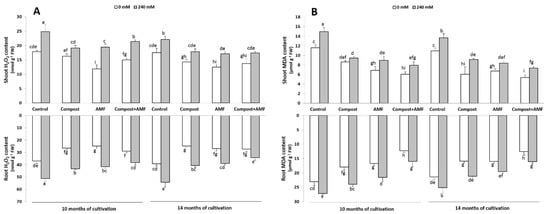
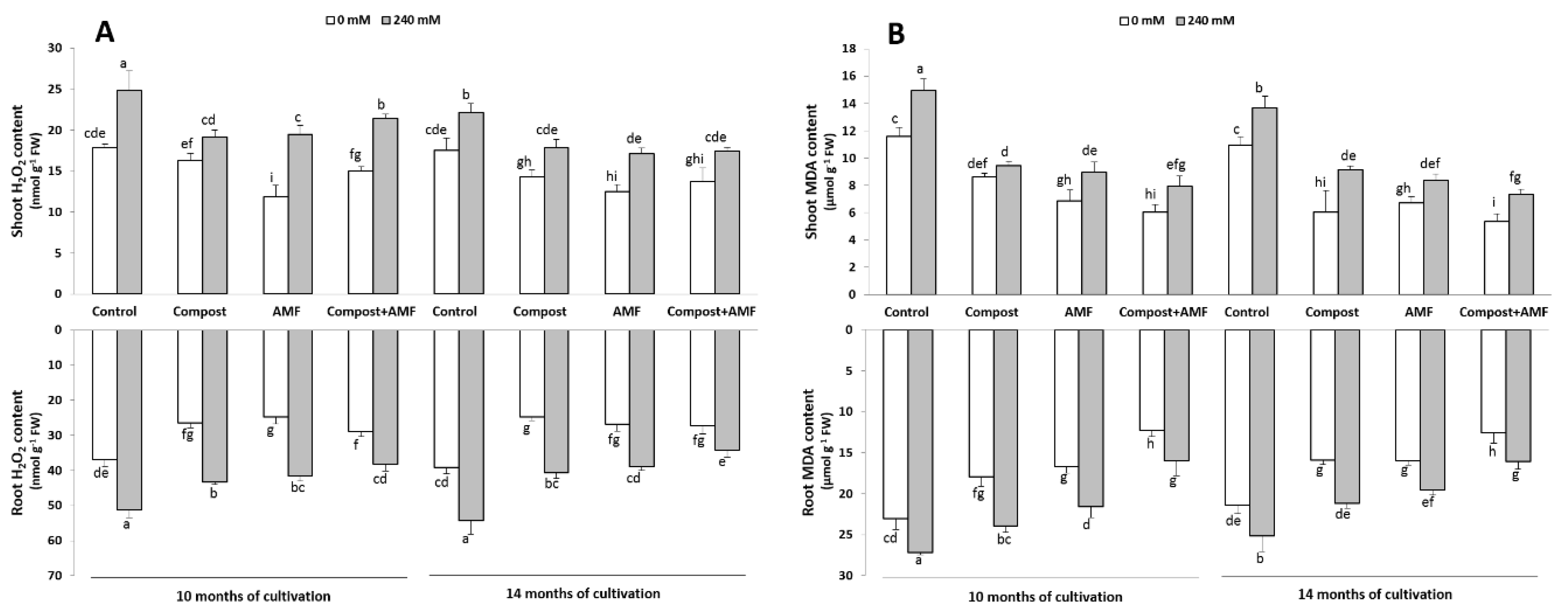
Under salinity, the stress markers showed a significant reduction between 10 and 14 months of cultivation for most of the treated plants while the concentrations of proline and soluble sugars showed significant differences in most treatments (Figure 1 and Table S3). The root soluble sugar content showed the greatest evolution with an increase of 28% in plants treated with compost alone. The activity of the antioxidant enzymes mainly decreased between 10 and 14 months of cultivation, in the presence of saline stress, where the shoot SOD activity showed the greatest decline (25%) between the two harvests in compost-treated plants (Figures S2 and S3). The significant increase in antioxidant enzyme activity in treated plants in the presence of saline stress after 10 months of cultivation probably led to a significant decrease in stress markers [11,12]. This decrease was more significant after 14 months of cultivation. The low values obtained for the stress markers could have a negative feedback effect on the activity of antioxidant enzymes by reducing them after 14 months of cultivation and could also be the cause of the reduction in organic osmolyte content.
Figure 1.
Hydrogen peroxide (A) and MDA (B) content in the shoot and the root of date palm in the absence and presence of salt stress with the application of compost and AMF after 10 and 14 months of cultivation. The bars labeled by different letters indicate significant differences assessed by Duncan’s test after performing three-way ANOVA (p < 0.05).
4. Conclusions
The tolerance of date palm to salinity evolves over time with a decrease in organic osmolytes and antioxidant enzyme activity between 10 and 14 months of cultivation as a response to the decrease in H2O2 and MDA concentrations, which means an improvement in the plant’s adaptation to salt stress. The present study strongly suggests the use of compost + AMF to mitigate the adverse impact of salt stress and to boost plant fitness in a saline environment in arid and semi-arid zones, particularly in Moroccan oasis ecosystems.
Supplementary Materials
The following supporting information can be downloaded at: https://www.mdpi.com/article/10.3390/environsciproc2022016015/s1, Figure S1. Photosynthetic pigment content (chlorophyll a (A), chlorophyll b (B), carotenoids (C) and total chlorophyll (D)) of mycorrhization of date palm plants grown in the absence (0 mM NaCl) and presence (240 mM NaCl) of salt stress with the application of compost and AMF alone or in combination after 10 and 14 months of cultivation, Figure S2. SOD (A) and CAT (B) antioxidant enzyme activity in the shoot and the root of mycorrhization of date palm plants grown in the absence (0 mM NaCl) and presence (240 mM NaCl) of salt stress with the application of compost and AMF alone or in combination after 10 and 14 months of cultivation, Figure S3 APX (A) and POD (B) antioxidant enzyme activity in the shoot and the root of mycorrhization of date palm plants grown in the absence (0 mM NaCl) and presence (240 mM NaCl) of salt stress with the application of compost and AMF alone or in combination after 10 and 14 months of cultivation, Table S1. Phosphorus (P), nitrogen (N), potassium (K), calcium (Ca), sodium (Na) and chlorine (Cl) uptake of date palm plants grown in the absence (0 mM NaCl) and presence (240 mM NaCl) of salt stress with the application of compost and AMF alone or in combination after 10 and 14 months of cultivation, Table S2. Physiological and water status of date palm plants grown in the absence (0 mM NaCl) and presence (240 mM NaCl) of salt stress with the application of compost and AMF alone or in combination after 10 and 14 months of cultivation, Table S3. Proline and soluble sugars content in shoot and root of date palm plants grown in the absence and presence of salt stress with the application of compost and AMF alone or in combination after 10 and 14 months of cultivation.
Author Contributions
Conceptualization, A.M., S.W. and M.B.; methodology, M.A.-E.-M., A.M., S.W. and M.B.; formal analysis, M.A.-E.-M., R.B.-L., M.A., A.F., Y.A.-R. and A.B.; writing—original draft preparation, M.A.-E.-M.; writing—review and editing, A.M., S.W., M.B. and T.M.; supervision and project administration, A.M., S.W. and M.B.; funding acquisition, M.B. and T.M. All authors have read and agreed to the published version of the manuscript.
Funding
This research received no external funding.
Conflicts of Interest
The authors declare no conflict of interest.
References
- Muchate, N.S.; Nikalje, G.C.; Rajurkar, N.S.; Suprasanna, P.; Nikam, T.D. Plant salt stress: Adaptive responses, tolerance mechanism and bioengineering for salt tolerance. Bot. Rev. 2016, 82, 371–406. [Google Scholar] [CrossRef] [Scilit]
- Ait-El-Mokhtar, M.; Fakhech, A.; Anli, M.; Ben-Laouane, R.; Boutasknit, A.; Wahbi, S.; Meddich, A. Infectivity of the palm groves arbuscular mycorrhizal fungi under arid and semi-arid climate and its edaphic determinants towards efficient ecological restoration. Rhizosphere 2020, 15, 100220. [Google Scholar] [CrossRef] [Scilit]
- Anli, M.; Baslam, M.; Tahiri, A.; Raklami, A.; Symanczik, S.; Boutasknit, A.; Ait-El-Mokhtar, M.; Ben-Laouane, R.; Toubali, S.; Ait Rahou, Y.; et al. Biofertilizers as strategies to improve photosynthetic apparatus, growth, and drought stress tolerance in the date palm. Front. Plant Sci. 2020, 1560. [Google Scholar] [CrossRef] [Scilit] [PubMed]
- Boutasknit, A.; Anli, M.; Tahiri, A.; Raklami, A.; Ait-El-Mokhtar, M.; Ben-Laouane, R.; Ait Rahou, Y.; Boutaj, H.; Oufdou, K.; Wahbi, S.; et al. Potential effect of horse manure-green waste and olive pomace-green waste composts on physiology and yield of garlic (Allium sativum L.) and soil fertility. Gesunde Pflanz. 2020, 72, 285–295. [Google Scholar] [CrossRef] [Scilit]
- Mbarki, S.; Skalicky, M.; Talbi, O.; Chakraborty, A.; Hnilicka, F.; Hejnak, V.; Zivcak, M.; Brestic, M.; Cerda, A.; Abdelly, C. Performance of Medicago sativa grown in clay soil favored by compost or farmyard manure to mitigate salt stress. Agronomy 2020, 10, 94. [Google Scholar] [CrossRef] [Scilit]
- Ait-El-Mokhtar, M.; Ben Laouane, R.; Anli, M.; Boutasknit, A.; Wahbi, S.; Meddich, A. Use of mycorrhizal fungi in improving tolerance of the date palm (Phoenix dactylifera L.) seedlings to salt stress. Sci. Hortic. 2019, 253, 429–438. [Google Scholar] [CrossRef] [Scilit]
- Al Kharusi, L.; Al Yahyai, R.; Yaish, M.W. Antioxidant response to salinity in salt-tolerant and salt-susceptible cultivars of date palm. Agriculture 2019, 9, 8. [Google Scholar] [CrossRef] [Scilit]
- Ait-El-Mokhtar, M.; Baslam, M.; Ben-Laouane, R.; Anli, M.; Boutasknit, A.; Mitsui, T.; Wahbi, S.; Meddich, A. Alleviation of detrimental effects of salt stress on date palm (Phoenix dactylifera L.) by the application of arbuscular mycorrhizal fungi and/or compost. Front. Sustain. Food Syst. 2020, 131. [Google Scholar] [CrossRef] [Scilit]
- Ait-El-Mokhtar, M.; Fakhech, A.; Ben-Laouane, R.; Anli, M.; Boutasknit, A.; Ait-Rahou, Y.; Wahbi, S.; Meddich, A. Compost as an eco-friendly alternative to mitigate salt-induced effects on growth, nutritional, physiological and biochemical responses of date palm. Int. J. Recycl. Org. Waste Agric. 2022, 11, 85–100. [Google Scholar]
- Chaichi, M.R.; Keshavarz-Afshar, R.; Lu, B.; Rostamza, M. Growth and nutrient uptake of tomato in response to application of saline water, biological fertilizer, and surfactant. J. Plant Nutr. 2017, 40, 457–466. [Google Scholar] [CrossRef] [Scilit]
- Ramzani, P.M.A.; Shan, L.; Anjum, S.; Ronggui, H.; Iqbal, M.; Virk, Z.A.; Kausar, S. Improved quinoa growth, physiological response, and seed nutritional quality in three soils having different stresses by the application of acidified biochar and compost. Plant Physiol. Biochem. 2017, 116, 127–138. [Google Scholar] [CrossRef] [Scilit]
- Toubali, S.; Tahiri, A.; Anli, M.; Symanczik, S.; Boutasknit, A.; Ait-El-Mokhtar, M.; Ben-Laouane, R.; Oufdou, K.; Ait-Rahou, Y.; Ben-Ahmed, H.; et al. Physiological and biochemical behaviors of date palm vitroplants treated with microbial consortia and compost in response to salt stress. Appl. Sci. 2020, 10, 8665. [Google Scholar] [CrossRef] [Scilit]

Publisher’s Note: MDPI stays neutral with regard to jurisdictional claims in published maps and institutional affiliations. |
© 2022 by the authors. Licensee MDPI, Basel, Switzerland. This article is an open access article distributed under the terms and conditions of the Creative Commons Attribution (CC BY) license (https://creativecommons.org/licenses/by/4.0/).