


Abstract
This study develops a reduced IEC 60287-based thermal model and an IEC-informed neural-network approximation for ampacity prediction in a 132 kV directly buried aluminium cable reference system. The analytical implementation is calibrated at a single CYMCAP baseline condition for a 132 kV, 1000 mm2 aluminium, XLPE-insulated and HDPE-sheathed cable, for which CYMCAP gives 799.486 A. The numerical design is a deterministic full-factorial Cartesian grid over five variables: soil thermal resistivity, burial depth, ambient soil temperature, allowable conductor temperature, and a bounded screen-loss scenario factor. This design yields 221,760 parameter combinations spanning the prescribed installation and thermal ranges. The model-development run underlying the reported accuracy metrics used 16,000 fitting cases and a 4000-case hold-out interpolation set. Against the reduced IEC 60287 targets, the neural model achieved a mean absolute percentage error of 0.141%, a root-mean-square error of 1.008 A, and R2 = 0.9999. The CYMCAP comparison is explicitly limited to the single calibration point and is not presented as independent multi-point CYMCAP validation. Sensitivity results for soil thermal resistivity and burial depth reproduce the expected monotonic trends, but burial-depth results are interpreted as sensitivities of the calibrated reduced model because the empirical mutual-heating factor is held fixed. The study therefore demonstrates high-fidelity approximation of the stated reduced IEC 60287 function within the sampled domain, rather than universal cable-system verification. The historical subset-selection seed was not retained, so exact reproduction of the neural-network run is not possible.
1. Introduction
High-voltage underground cable systems form a critical component of modern power transmission and distribution infrastructure. As electricity demand grows and grid operators pursue greater asset utilisation, accurate determination of the current-carrying capacity, commonly referred to as ampacity, of directly buried cable systems becomes increasingly important for safe, reliable, and economical network operation. The allowable continuous current of a buried cable is governed by the balance between heat generated through conductor, dielectric, and sheath losses and heat dissipated through the insulation, outer covering, surrounding backfill, and native soil [1]. For directly buried installations, this thermal balance is strongly influenced by soil thermal resistivity, burial depth, ambient soil temperature, conductor-temperature limits, cable geometry, and sheath bonding conditions [2,3,4]. Foundational cable-rating work predates the present IEC formulation [5], while conductor requirements and extruded high-voltage cable construction are addressed by IEC 60228 and IEC 60840, respectively [6,7]. Long-term thermal and electrical stresses on XLPE insulation and cable defects further reinforce the need to respect cable-temperature limits in rating studies [8,9]. The steady-state rating framework is standardised through IEC 60287-1-1, with external thermal resistance addressed in IEC 60287-2-1 and cyclic and emergency ratings addressed in IEC 60853 [1,4,10]. Recent machine-learning approaches can approximate nonlinear rating functions efficiently after training, but numerical accuracy against a standard-derived target should be distinguished from independent physical validation. This distinction is central to the scope adopted here.
Despite the growing application of physics-informed learning to engineering thermal problems [11,12,13], its use in cable-rating studies must be interpreted carefully when the reference target and the consistency term originate from the same analytical model. This study therefore addresses a deliberately bounded numerical question: whether a compact IEC-informed neural approximation can reproduce a calibrated reduced IEC 60287 ampacity function accurately within the sampled parameter domain [14,15]. The reference case is anchored to one CYMCAP baseline for a 132 kV, 1000 mm2 aluminium, XLPE-insulated and HDPE-sheathed cable. No claim is made of experimental validation or multi-point CYMCAP verification.
1.1. Novelty of the Proposed Work
The novelty of this work lies in linking a calibrated reduced IEC 60287 ampacity formulation with an IEC-informed neural approximation for one clearly defined 132 kV directly buried aluminium cable reference system. The work separates three levels of evidence that are often conflated: calibration at one commercial-solver reference point, numerical approximation of the reduced IEC function, and physical validation of a complete installation. Only the first two are undertaken here. The study is positioned against the applicable analytical, machine-learning, and physics-informed literature, while the numerical library is generated deterministically over five parameter axes and the neural model is evaluated on a held-out interpolation set. The resulting differentiable approximation is potentially useful for repeated numerical studies, while its applicability remains bounded by the assumptions of the calibrated reduced model.
1.2. Research Contributions
The main contributions of this paper are summarised as follows:
- An IEC-informed neural-network approximation is developed for reduced IEC 60287-based ampacity prediction in the stated 132 kV directly buried aluminium cable reference system. The training objective includes an IEC-consistency regularisation term, which is interpreted as numerical regularisation toward the analytical response rather than independent physical validation.
- A deterministic full-factorial numerical library of 221,760 parameter combinations is defined from soil thermal resistivity, burial depth, ambient soil temperature, allowable conductor temperature, and a bounded screen-loss scenario factor. The grid construction is reported explicitly and reproduced in Appendix A.
- The neural approximation is evaluated against reduced IEC 60287 targets using a 16,000-case fitting set and a 4000-case hold-out interpolation set. CYMCAP is used only for the single baseline calibration condition, and no multi-point CYMCAP verification is claimed.
- The study reports numerical approximation accuracy and calibrated-model sensitivity without asserting an unverified CYMCAP speed advantage or break-even workload. The limitations associated with the fixed mutual-heating calibration factor and the absence of a reproducible archived subsampling seed are stated explicitly.
The remainder of this paper is organised as follows. Section 2 presents the theoretical background and reduced IEC 60287 thermal formulation. Section 3 describes the neural architecture, deterministic parameter-grid construction, model-development split, and calibration methodology. Section 4 presents hold-out interpolation accuracy, parametric sensitivity, and the scope of the CYMCAP calibration. Section 5 discusses the implications and limitations of the reduced-model approximation. Section 6 concludes the paper.
2. Theoretical Background
2.1. Cable Ampacity and IEC-Informed Neural Approximation
Ampacity prediction in 132 kV directly buried aluminium cable systems is governed by coupled electrical-loss and heat-transfer mechanisms. Under steady-state conditions, the allowable current is determined by the maximum permissible conductor temperature and the ability of the cable and surrounding medium to dissipate generated heat. In the IEC 60287 framework, conductor, dielectric, and sheath losses are combined with thermal resistances to determine the continuous current rating [16]. For directly buried systems, the main influences include soil thermal resistivity, burial depth, ambient temperature, conductor-temperature limits, cable geometry, insulation properties, and sheath bonding conditions. Physics-informed learning offers one route to embedding engineering knowledge in data-driven models [17,18,19]. In the present study, however, the numerical target and IEC-consistency response are both derived from the same reduced IEC implementation. The neural model is therefore treated as an IEC-informed approximation with an analytical consistency regulariser, not as an independently physics-validated cable model.
2.2. Mathematical Formulation of IEC 60287 Ampacity
For a single-core cable without armour, the steady-state ampacity, , as derived from the IEC 60287-1-1 thermal balance, is expressed as:
where is the permissible temperature rise between the conductor and ambient soil; is the AC resistance of the conductor at operating temperature; is the dielectric loss per unit length; is the screen or sheath loss factor arising from circulating currents; and , , and are the thermal resistances of the insulation, outer covering, and external environment, respectively [20]. Equation (1) shows that the allowable current increases with a permissible conductor-temperature rise and decreases with increasing conductor resistance, dielectric loss, sheath loss factor, or thermal resistance.
2.2.1. AC Conductor Resistance
The AC conductor resistance incorporates the DC resistance at the operating temperature together with the skin-effect and proximity-effect correction factors. According to the IEC 60287-1-1 formulation, the AC resistance is given by:
where RDC(θ) is the DC resistance at conductor temperature θ; R0 is the DC resistance at 20 °C; α20 is the temperature coefficient at 20 °C; Ys is the skin-effect factor; and Yp is the proximity-effect factor. The conductor representation is consistent with the IEC 60228 framework [6]. For the 1000 mm2 aluminium conductor, R0 = 0.0291 Ω/km and α20 = 0.00403 K−1. At the 90 °C reference condition, the adopted calculation gives Ys = 0.05642 and Yp = 0.01455, matching the CYMCAP record to within 0.1%. The cable information available for this study does not include the complete stranding description, full layer geometry, screen resistance, or bonding and earthing details. Consequently, the calculation is treated as a calibrated reduced IEC representation rather than a fully reproducible detailed cable-design calculation.
2.2.2. Dielectric Losses
The dielectric loss per unit length is calculated from the cable capacitance, operating frequency, phase-to-earth voltage, and dielectric loss tangent as follows:
where is the operating frequency; is the cable capacitance per unit length; is the phase-to-earth voltage; and is the loss tangent of the insulation material [1]. For the reference cable used in this study, the dielectric loss is . Although this value is small relative to conductor loss, it remains part of the total thermal balance and is therefore retained in the ampacity formulation.
2.2.3. External Thermal Resistance
The external thermal resistance, , represents the heat-transfer path from the cable’s external surface to the surrounding soil. For a directly buried single cable, IEC 60287-2-1 expresses as:
where u = 2L/De, ρ is the soil thermal resistivity, L is burial depth, and De is the external cable diameter [4,21]. The reference system consists of three single-core cables in flat formation, directly buried in homogeneous soil. Sheath and screen behaviour can materially affect cable thermal performance [22]. For the reference condition, ρ = 1.2 K·m/W, L = 1.0 m, and T4 = 1.621 K·m/W. The reduced model uses the calibrated geometric factor g = T4, CYMCAP/T4, single = 1.831 at this reference condition to represent mutual heating. This factor is an empirical calibration for the fixed reference arrangement and is not a universal geometry constant. Because it is held fixed when burial depth is varied, the burial-depth results in Section 4.3 are sensitivities of the calibrated reduced model, not complete IEC recalculations of changing three-cable geometry. A full installation study must recompute mutual-heating terms when burial depth, spacing, or cable geometry changes. Installation practice can also affect cable condition [23].
2.3. State of the Art
Ampacity prediction for underground power cables has traditionally relied on analytical thermal models, with IEC 60287 providing the principal steady-state rating framework for directly buried cable systems. Therefore, its strength is physical interpretability and standardisation, while repeated evaluation can become burdensome in large parametric or optimisation studies. Machine-learning approximations can reduce the cost of repeated evaluations after training, but their engineering value depends on a clear account of the reference model and validation scope [24,25]. Physics-informed methods incorporate governing equations, residuals, or constraints in the training process. In this study, the embedded IEC term is not independent of the IEC-generated target, so the model is interpreted conservatively as an IEC-informed neural approximation rather than evidence of independent physical verification.
Recent cable-rating studies have explored machine-learning methods for conductor-temperature prediction, dynamic thermal rating, soil-condition modelling, and operational ampacity estimation [26,27,28]. Recent reviews also emphasise the need to distinguish genuinely physics-constrained learning from numerical emulation of a known governing model [29]. The present study is deliberately narrower: it evaluates one calibrated reduced IEC 60287 reference case using an IEC-informed neural model. Table 1 positions the study against the relevant analytical, machine-learning, and physics-informed literature.
Table 1.
Positioning of existing work and the proposed study.
Although significant progress has been made in applying machine-learning techniques to cable ampacity prediction, most existing approaches remain data-driven and do not explicitly preserve the electrical and thermal relationships used in standard rating calculations. The present study addresses a narrower numerical question: whether a compact neural model can reproduce a calibrated reduced IEC 60287 ampacity function accurately within the sampled domain. It does not use the single CYMCAP calibration point as evidence of multi-condition CYMCAP verification.
3. Methodology
3.1. IEC-Informed Neural Architecture and Consistency-Regularised Training Procedure
The neural model uses a fully connected feed-forward architecture. The input vector comprises soil thermal resistivity, burial depth, ambient soil temperature, maximum allowable conductor temperature, and a screen-loss scenario factor. The first four variables are direct thermal or installation inputs. The screen-loss factor is treated only as a bounded scenario variable because the complete screen geometry, resistance, and bonding data required for an independently derived physical sheath-loss calculation are not available for the reference case.
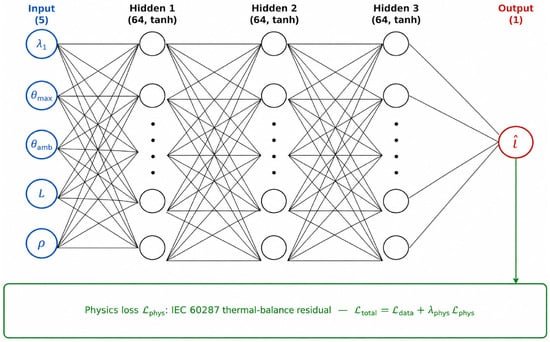
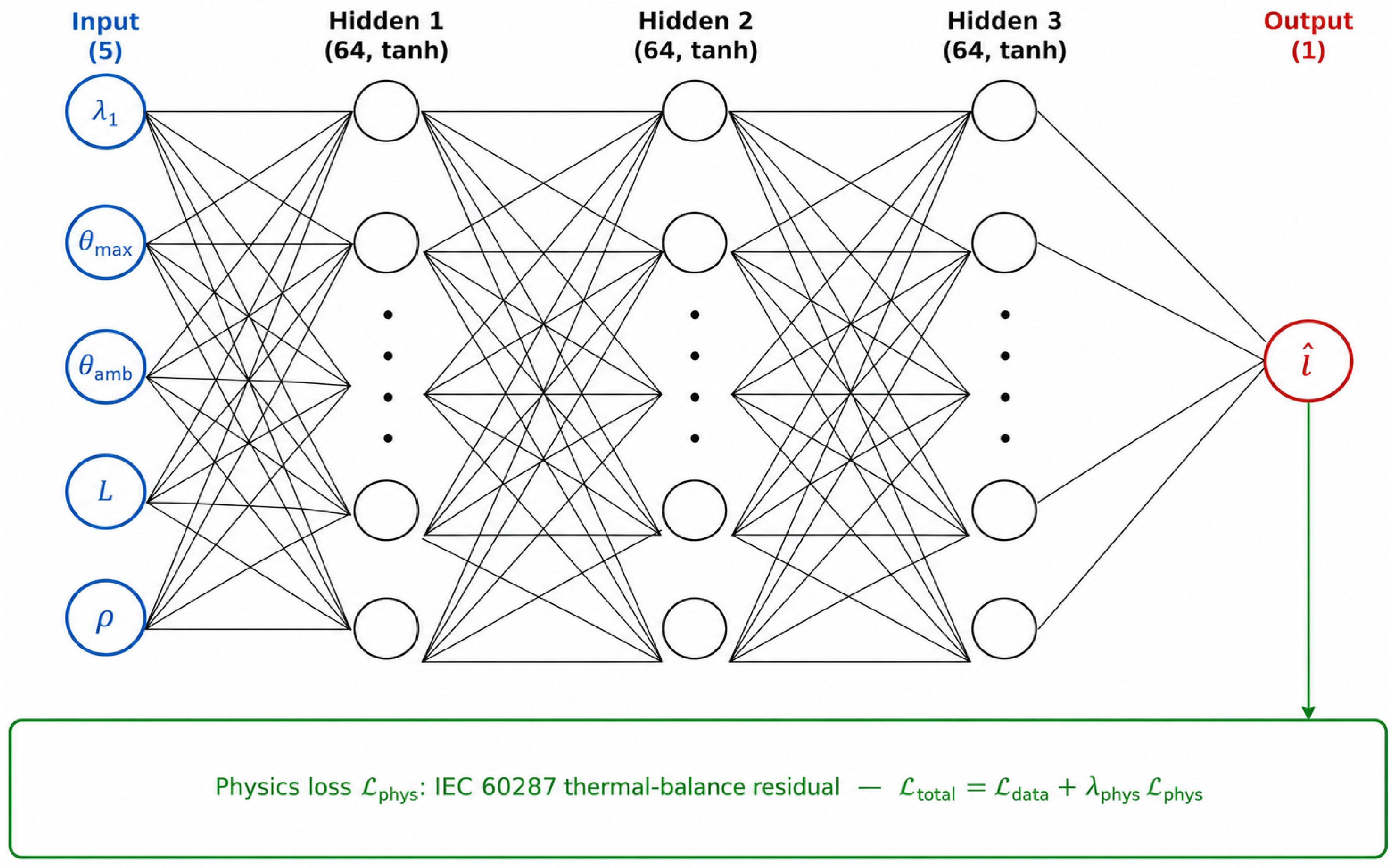
where is the soil thermal resistivity, is the burial depth, is the ambient soil temperature, is the allowable conductor temperature, and is the screen-loss factor. The output of the network is the predicted cable ampacity, . The network consists of five input neurons, three hidden layers with 64 neurons per layer, and one output neuron. A hyperbolic tangent activation function is used in the hidden layers because it provides smooth nonlinear mapping and is suitable for representing continuous thermal relationships. The resulting model maps the operating and installation variables to a scalar ampacity estimate while retaining compatibility with the governing IEC 60287 thermal-balance formulation. The architecture is shown in Figure 1.
Figure 1.
IEC-informed neural architecture with reduced IEC 60287 consistency regularisation. The five input variables are mapped through three hidden layers to the predicted ampacity; the reduced IEC response is used as a consistency term in the training objective.
The reduced IEC 60287 ampacity formulation is used to generate the numerical targets and is also evaluated within the consistency term of the training objective. Because the consistency response is derived from the same reduced IEC function as the target, it is not an independent experimental physics residual. The model is therefore interpreted as an IEC-informed neural approximation with an IEC-consistency regulariser. The total loss is given by:
The data-fitting term minimises the normalised mean-square difference between the network output and the IEC-generated target ampacity:
The IEC-consistency term penalises relative deviation between the neural prediction and the reduced IEC 60287 response evaluated for the same input vector. Its role is regularisation toward the analytical response used in this study; it does not constitute independent physical validation.
where N is the number of training samples, the network prediction is compared with the IEC-generated target for sample i, and Iphys (xi) is the corresponding reduced IEC response. The standard deviation σI is used for output normalisation. The parameter λphys was set to 0.3, and training used Adam with a learning rate of 10−3, mini-batches of 512, and 500 epochs. Training stability and gradient-balance considerations are recognised issues in physics-informed learning [30], building on earlier neural approaches to differential-equation modelling [31]. The Adam optimiser follows Kingma and Ba [32].
3.2. Dataset Construction and Validation
The numerical library was generated using a deterministic full-factorial Cartesian grid, not Latin Hypercube Sampling. Five variables were discretised at the levels shown in Table 2: 20 soil thermal-resistivity values, 16 burial depths, 11 ambient soil temperatures, 9 allowable conductor temperatures, and 7 screen-loss scenario factors. Their Cartesian product therefore contains 20 × 16 × 11 × 9 × 7 = 221,760 parameter combinations. No random seed is required to construct this grid. The first four variables were varied directly; λ1 was treated as a bounded scenario parameter because the cable and bonding inputs required to derive a physical sheath-loss factor are not available. The corresponding reduced IEC 60287 ampacity was evaluated for each parameter combination. Appendix A provides the exact Python 3.10.7 construction of the five-dimensional parameter grid.
Table 2.
Deterministic full-factorial parameter grid used for the reduced IEC 60287 numerical library.
The numerical model was calibrated against one CYMCAP baseline representing the 132 kV, 1000 mm2 aluminium, XLPE-insulated and HDPE-sheathed directly buried cable system. CYMCAP is used only for this stated reference condition. The reduced IEC implementation was adjusted to reproduce the reference thermal behaviour before the parameter grid was evaluated. This single-point comparison is a calibration cross-check, consistent with the role of reference rating examples in calculation-tool verification [33], and is not an independent multi-point validation of the reduced model.
Table 3 shows close numerical agreement at the single calibration condition: the reduced IEC model differs from the CYMCAP baseline by −0.091%, and the neural prediction differs by +0.061%. This agreement demonstrates consistency at the calibration point only. It does not establish CYMCAP equivalence elsewhere in the parameter domain.
Table 3.
Single-point baseline calibration comparison for the stated 132 kV, 1000 mm2 aluminium cable reference condition.
The 221,760 combinations constitute the full deterministic numerical library. The model-development run underlying the reported accuracy metrics used a 20,000-point subset of that library, divided into 16,000 fitting cases and 4000 held-out cases. The exact historical subsampling order and random seed for this 20,000-point subset were not preserved in the archived computational record; accordingly, no seed is asserted in this revision. Z-score normalisation was fitted using the training subset only. The 4000-point hold-out results are therefore interpreted strictly as an interpolation assessment within the structured IEC-generated domain, not as evidence of extrapolation or a fully reproducible benchmark split. Accordingly, exact bit-for-bit reproduction of the reported neural-network metrics is not possible from the presently archived materials.
3.3. Reproducibility Record and Archived Computational Information
The reproducibility record is separated into deterministic components and historically unavailable components. The full 221,760-point input grid is exactly reproducible from Appendix A, and the neural architecture and training settings are retained. In contrast, the exact historical procedure used to select the 20,000-point subset, the random seed, the precise membership of the 16,000 fitting and 4000 hold-out sets, the standalone target-generation source file, the software-library versions, and the trained weights were not preserved. These items are therefore not reconstructed retrospectively.
Table 3 preserves the numerical calibration, and Table 4 reports the reproducibility record for the IEC-informed neural-model experiment. The quantitative hold-out performance is summarised in Table 5. The IEC target calculation is documented analytically by Equations (1)–(5), the retained parameter-grid code is given in Appendix A, and the model configuration and training settings are specified in Section 3.1. The reported neural metrics should therefore be treated as archived results from the original model-development run rather than as exactly reconstructible benchmark values.
Table 4.
Reproducibility record for the reported IEC-informed neural-model experiment.
Table 4 explicitly distinguishes the fully reproducible deterministic grid and retained training configuration from the historical items that are no longer available. No random seed, sample-selection rule, trained weights, or target-generation source file is inferred or invented in this revision.
4. Results
4.1. Hold-Out Interpolation Accuracy
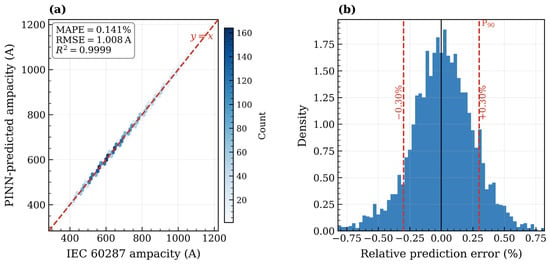
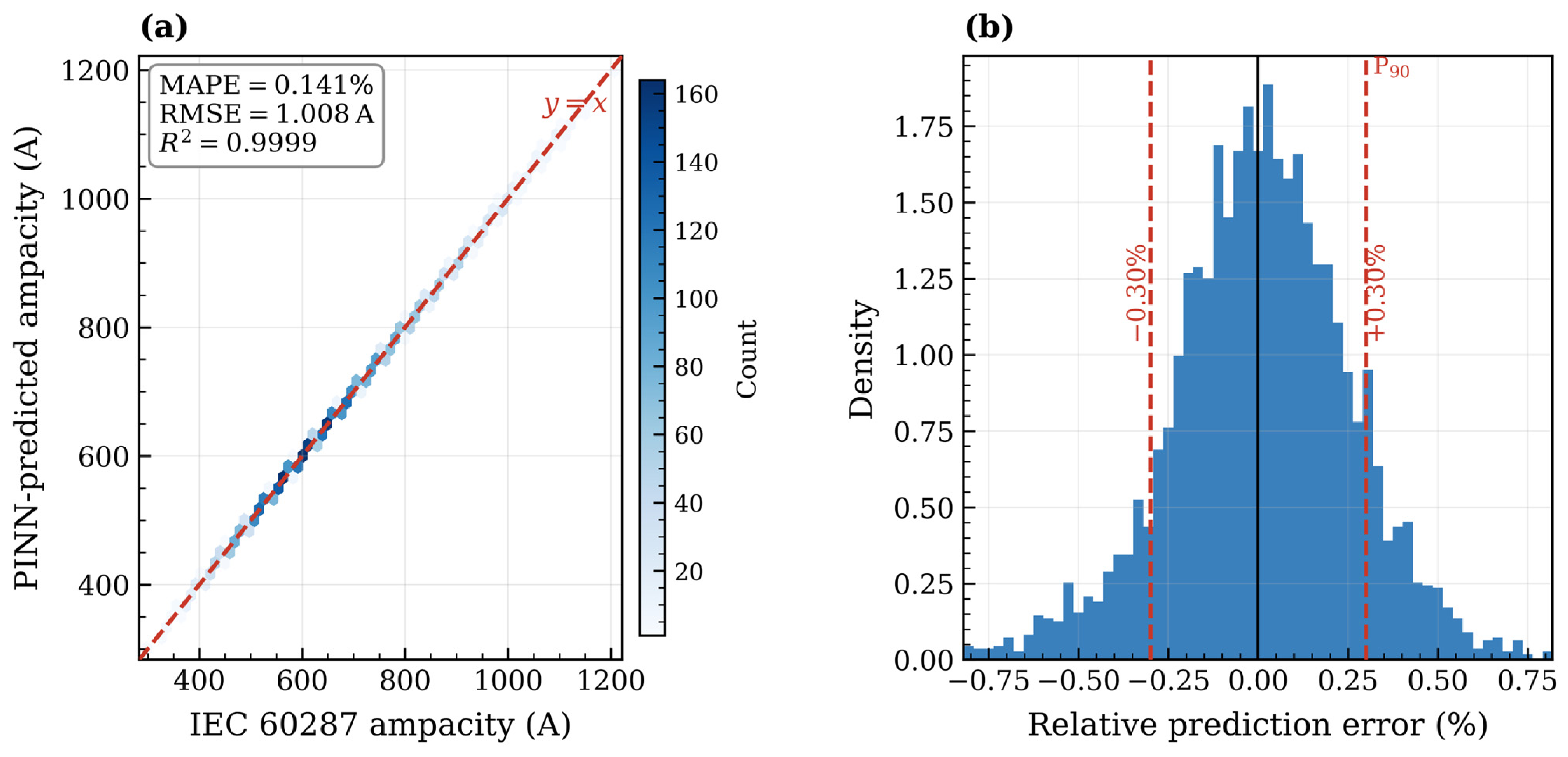
Predictive accuracy was assessed on the 4000 held-out cases from the reported model-development subset. Because these cases originate from the same structured parameter domain as the fitting cases, the evaluation is an interpolation test. Figure 2 compares neural predictions with the reduced IEC 60287 targets. The parity plot shows close agreement across the tested current range, but the result should not be interpreted as field validation, multi-point CYMCAP validation, or extrapolation to unseen cable configurations.
Figure 2.
Hold-out interpolation accuracy of the IEC-informed neural model: (a) predicted ampacity versus reduced IEC 60287 target; and (b) relative prediction-error distribution.
The relative-error distribution in Figure 2b is centred close to zero, with 90% of the held-out cases within ±0.30% of the reduced IEC target. Table 5 reports the quantitative interpolation metrics.
Table 5.
IEC-informed neural-model performance on the 4000-case hold-out interpolation set.
The model achieved MAPE = 0.141%, RMSE = 1.008 A, and R2 = 0.9999 on the 4000-case hold-out interpolation set. These values quantify numerical approximation of the reduced IEC 60287 function within the sampled domain. They do not by themselves validate the complete physical cable installation or establish transfer to unsampled cable geometries.
4.2. Parametric Sensitivity of Ampacity to Installation Conditions
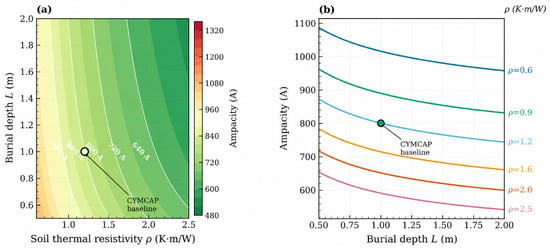
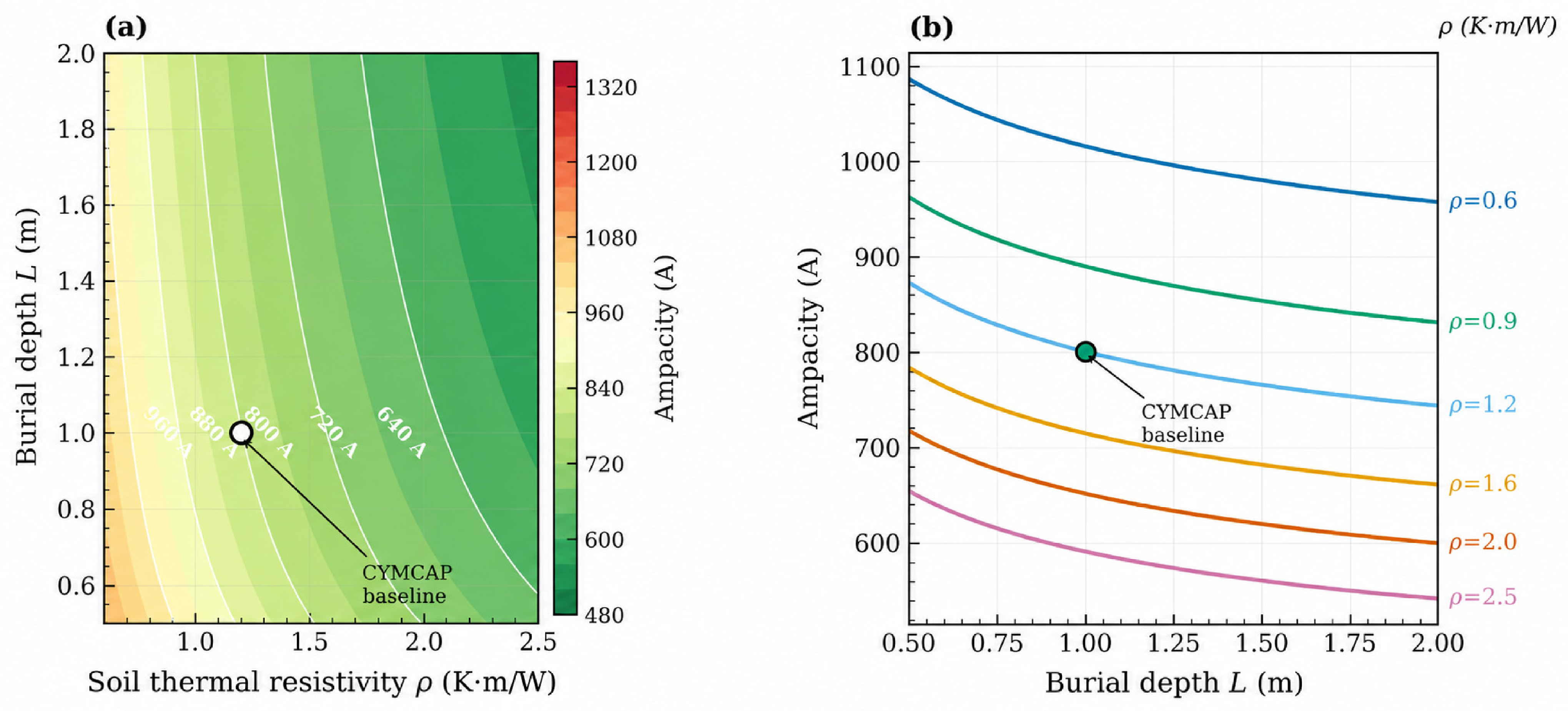
The model was used to examine sensitivity to soil thermal resistivity and burial depth over the ranges in Table 2, with the remaining inputs fixed at θamb = 25 °C, θmax = 90 °C, and λ1 = 0.162. Figure 3 shows the resulting response surface. Ampacity decreases as soil thermal resistivity increases, consistent with reduced heat dissipation through the surrounding soil. Ampacity also decreases with increasing burial depth in the calibrated reduced formulation. Because the empirical mutual-heating factor g = 1.831 is held fixed, the burial-depth trend is a sensitivity of this reduced calibrated model and should not be interpreted as a complete IEC recalculation of changing three-cable geometry [34].
Figure 3.
Reduced-model ampacity sensitivity to soil thermal resistivity and burial depth: (a) contour map; and (b) cross-sections at selected soil thermal-resistivity values.
The cross-sections in Figure 3b confirm a monotonic reduction in ampacity with increasing soil thermal resistivity over the reported domain. The CYMCAP baseline is recovered only at the calibration condition. No CYMCAP sensitivity-module or automated multi-point CYMCAP benchmark is claimed.
4.3. Scope of CYMCAP Calibration and Reduced-Model Interpretation
CYMCAP contributes one baseline calibration point only. The parameter-grid targets, hold-out metrics, and sensitivity surfaces are all based on the calibrated reduced IEC 60287 implementation. Accordingly, the study is best interpreted as an IEC-function approximation exercise anchored by a single CYMCAP reference condition, not as CYMCAP verification across the operating domain. A fair computational comparison with CYMCAP would require an automated or sensitivity-module workflow executing equivalent tasks under documented hardware and solver settings; such a benchmark was not available and is therefore not reported.
The fixed geometric factor g = 1.831 is a second important scope limitation. It reproduces the reference mutual-heating effect at the calibration geometry but is held constant in the reduced sensitivity model. When burial depth or phase spacing changes, a complete IEC installation calculation should recompute the geometric and mutual-heating terms. The present burial-depth results therefore support qualitative sensitivity of the calibrated reduced model only.
5. Discussion
The principal result is that the compact neural model reproduces the reduced IEC 60287 ampacity function with small interpolation error over the reported sampled domain. The 4000-case hold-out set yielded MAPE = 0.141%, RMSE = 1.008 A, and R2 = 0.9999. These statistics describe agreement with IEC-generated numerical targets and should not be conflated with independent physical validation. CYMCAP contributes one calibration point only, so the manuscript does not claim multi-point CYMCAP verification. The fixed mutual-heating factor g = 1.831 further limits the burial-depth study to sensitivity of the calibrated reduced formulation [34]. These qualifications narrow the claims but make the engineering interpretation reproducible and consistent with the evidence.
The IEC-consistency term provides numerical regularisation toward the governing reduced analytical response, but the consistency response and data target originate from the same IEC implementation. The present evidence therefore supports the term IEC-informed neural approximation more strongly than a claim of independent physics validation. Broader validation would require independently generated high-fidelity calculations, multiple automated CYMCAP operating points, or laboratory and field measurements. The deterministic full-factorial grid is fully specified, while the original 20,000-point model-development subsampling order was not preserved; this is retained as a reproducibility limitation rather than replaced with an invented seed. Future uncertainty studies may also consider Bayesian uncertainty analysis, Gaussian-process emulation, or formal computer-model calibration to quantify parameter and model-form uncertainty [35,36].
6. Conclusions and Future Work
This study developed a calibrated reduced IEC 60287 thermal model and an IEC-informed neural approximation for ampacity prediction in a 132 kV directly buried aluminium cable reference system. The deterministic full-factorial parameter grid contains 221,760 combinations defined by the five sets of levels in Table 2. The reported neural-network experiment used 16,000 fitting cases and a 4000-case hold-out interpolation set. On that hold-out set, the model achieved MAPE = 0.141%, RMSE = 1.008 A, and R2 = 0.9999 against the reduced IEC targets. The single CYMCAP value of 799.486 A is used only to calibrate the reference condition; it is not an independent multi-point validation dataset.
The sensitivity analysis confirms the expected reduction in ampacity with increasing soil thermal resistivity. The burial-depth trend is also monotonic within the reduced model, but the empirical mutual-heating factor g = 1.831 is held fixed; consequently, those burial-depth results are not equivalent to recomputing full IEC geometry at every depth. The findings are therefore limited to numerical approximation and local sensitivity of the stated calibrated reference formulation.
No CYMCAP timing benchmark, numerical speedup factor, or break-even workload is claimed in the revised manuscript because the available timing records do not support an equivalent, reproducible computational comparison between the batched neural calculation, scalar IEC code, and the manual CYMCAP graphical workflow.
The deterministic parameter grid and retained neural-model configuration are reproducible, but the exact 16,000/4000 sample membership and resulting neural-network run cannot be recreated exactly because the historical subset-selection procedure and random seed were not preserved. This limitation is documented in Section 3.3, Table 4, the Data Availability Statement, and Appendix A.
Future work should provide a fully archived computational package containing the reduced IEC implementation, the exact model-development subset and split definition, trained weights, and automated benchmarking scripts. Independent validation should then be expanded to multiple CYMCAP operating points or field/laboratory measurements, and the mutual-heating geometry should be recomputed for each burial-depth and spacing condition.
Author Contributions
Conceptualization, R.M. and B.T.; methodology, R.M. and B.T.; software, R.M. and B.T.; validation, B.T.; formal analysis, R.M. and B.T.; investigation, R.M. and B.T.; data curation, R.M.; writing—original draft preparation, R.M.; writing—review and editing, R.M. and B.T.; visualisation, R.M.; supervision, B.T. All authors have read and agreed to the published version of the manuscript.
Funding
This research received no external funding.
Data Availability Statement
No confidential equipment-owner raw dataset was used to generate the numerical results reported in this study. The numerical library is defined by the reduced IEC 60287 formulation and the deterministic Cartesian parameter grid specified in Table 2. Appendix A provides the retained grid construction code, which reproduces all 221,760 input combinations and requires no random seed. The exact historical standalone target-generation source file, the rule and random seed used to select the 20,000-point model-development subset, the precise 16,000/4000 sample membership, the software-library versions, and the trained-model weights were not preserved. Consequently, exact bit-for-bit reproduction of the reported neural-network metrics is not possible from the current archive. The analytical formulation, retained grid code, model configuration and training settings, and supporting aggregate numerical outputs are documented in Section 2.2 and Section 2.3, Table 3, Table 4 and Table 5, and Appendix A. The CYMCAP result reported in Table 3 is a single output from proprietary software and is used only as the baseline calibration value.
Conflicts of Interest
The authors declare no conflicts of interest.
Appendix A. Available Deterministic Parameter-Grid Construction Code
The archived code retained for this revision constructs exactly the Cartesian input grid reported in Table 2. It generates 221,760 combinations and requires no random seed. The exact historical standalone source file used to evaluate the reduced IEC 60287 target for every row was not preserved; therefore, no reconstructed script is presented as if it were the original code. Equations (1)–(5), the calibrated quantities reported in Section 2.2 and Section 3.2, and Table 3 document the target-generation formulation and retained computational settings at the level supported by the archived study record.
- from itertools import product
- import numpy as np
- rho = np.linspace(0.6, 2.5, 20)
- burial_depth = np.linspace(0.5, 2.0, 16)
- theta_amb = np.linspace(15.0, 40.0, 11)
- theta_max = np.linspace(75.0, 95.0, 9)
- lambda_1 = np.linspace(0.00, 0.30, 7)
- grid = np.asarray(
- list(product(rho, burial_depth, theta_amb, theta_max, lambda_1)),
- dtype = float
- )
- assert grid.shape == (221,760, 5)
This listing reproduces the input grid only. The exact historical rule used to select the 20,000-point neural-model subset, its random seed, the precise 16,000/4000 sample membership, the exact standalone target-generation source file, and the trained-model weights were not preserved. Accordingly, no unverified seed, subsampling rule, source code, or trained parameters are introduced in this revision, and exact bit-for-bit recreation of the reported neural-network metrics is not claimed.
References
- IEC 60287-1-1:2006/AMD1:2014; Electric Cables-Calculation of the Current Rating-Part 1-1: Current Rating Equations (100% Load Factor) and Calculation of Losses-General. International Electrotechnical Commission: Geneva, Switzerland, 2014.
- Anders, G.J. Rating of Electric Power Cables in Unfavourable Thermal Environment; IEEE Press/Wiley-Interscience: Hoboken, NJ, USA, 2005. [Google Scholar]
- CIGRÉ. A Guide for Rating Calculations of Insulated Cables; Technical Brochure No. 640; CIGRÉ: Paris, France, 2015. [Google Scholar]
- IEC 60287-2-1:2015; Electric Cables-Calculation of the Current Rating-Part 2-1: Thermal Resistance-Calculation of Thermal Resistance. International Electrotechnical Commission: Geneva, Switzerland, 2015.
- Neher, J.H.; McGrath, M.H. The calculation of the temperature rise and load capability of cable systems. Trans. Am. Inst. Electr. Eng. Part III Power Appar. Syst. 1957, 76, 752–772. [Google Scholar] [CrossRef] [Scilit]
- IEC 60228:2004; Conductors of Insulated Cables. International Electrotechnical Commission: Geneva, Switzerland, 2004.
- IEC 60840:2020; Power Cables with Extruded Insulation and Their Accessories for Rated Voltages above 30 kV (Um = 36 kV) up to 150 kV (Um = 170 kV)—Test Methods and Requirements. International Electrotechnical Commission: Geneva, Switzerland, 2020.
- Zhu, X.; Yin, Y.; Wu, J.; Wang, X. Study on aging characteristics of XLPE cable insulation based on quantum chemical calculation. IEEE Trans. Dielectr. Electr. Insul. 2020, 27, 1942–1950. [Google Scholar] [CrossRef] [Scilit]
- Zhao, X.; Pu, L.; Ju, Z.; Ren, S.; Duan, W.; Wang, J. Partial discharge characteristics and development of typical XLPE power cable insulation defects. In Proceedings of the 2016 International Conference on Condition Monitoring and Diagnosis (CMD), Xi’an, China, 25–28 September 2016; pp. 623–626. [Google Scholar]
- IEC 60853-2:1989/AMD1:2008; Calculation of the Cyclic and Emergency Current Rating of Cables—Part 2: Cyclic Rating of Cables Greater than 18/30 (36) kV and Emergency Ratings for Cables of All Voltages. International Electrotechnical Commission: Geneva, Switzerland, 2008.
- Raissi, M.; Perdikaris, P.; Karniadakis, G.E. Physics-informed neural networks: A deep learning framework for solving forward and inverse problems involving nonlinear partial differential equations. J. Comput. Phys. 2019, 378, 686–707. [Google Scholar] [CrossRef] [Scilit]
- Faroughi, S.A.; Pawar, N.M.; Fernandes, C.; Raissi, M.; Das, S.; Kalantari, N.K.; Mahjour, S.K. Physics-guided, physics-informed, and physics-encoded neural networks and operators in scientific computing: Fluid and solid mechanics. J. Comput. Inf. Sci. Eng. 2024, 24, 040802. [Google Scholar] [CrossRef] [Scilit]
- Nellikkath, R.; Chatzivasileiadis, S. Physics-informed neural networks for AC optimal power flow. Electr. Power Syst. Res. 2022, 212, 108412. [Google Scholar] [CrossRef] [Scilit]
- Tartakovsky, A.M.; Marrero, C.O.; Perdikaris, P.; Tartakovsky, G.D.; Barajas-Solano, D. Physics-informed deep neural networks for learning parameters and constitutive relationships in subsurface flow problems. Water Resour. Res. 2020, 56, e2019WR026731. [Google Scholar] [CrossRef] [Scilit]
- Willard, J.; Jia, X.; Xu, S.; Steinbach, M.; Kumar, V. Integrating scientific knowledge with machine learning for engineering and environmental systems. ACM Comput. Surv. 2023, 55, 66. [Google Scholar] [CrossRef] [Scilit]
- Aras, F.; Oysu, C.; Yilmaz, G. An assessment of the methods for calculating ampacity of underground power cables. Electr. Power Compon. Syst. 2005, 33, 1385–1402. [Google Scholar] [CrossRef] [Scilit]
- Karniadakis, G.E.; Kevrekidis, I.G.; Lu, L.; Perdikaris, P.; Wang, S.; Yang, L. Physics-informed machine learning. Nat. Rev. Phys. 2021, 3, 422–440. [Google Scholar] [CrossRef] [Scilit]
- Cuomo, S.; Di Cola, V.S.; Giampaolo, F.; Rozza, G.; Raissi, M.; Piccialli, F. Scientific machine learning through physics-informed neural networks: Where we are and what’s next. J. Sci. Comput. 2022, 92, 88. [Google Scholar] [CrossRef] [Scilit]
- Misyris, G.S.; Venzke, A.; Chatzivasileiadis, S. Physics-informed neural networks for power systems. In Proceedings of the 2019 IEEE Power & Energy Society General Meeting (PESGM), Atlanta, GA, USA, 4–8 August 2019; pp. 1–5. [Google Scholar] [CrossRef] [Scilit]
- Dubitsky, S.; Greshnyakov, G.; Korovkin, N. Comparison of finite element analysis to IEC-60287 for predicting underground cable ampacity. In Proceedings of the 2016 IEEE International Energy Conference (ENERGYCON), Leuven, Belgium, 4–8 April 2016; pp. 1–6. [Google Scholar] [CrossRef] [Scilit]
- Dubitsky, S.; Greshnyakov, G.; Korovkin, N. Refinement of underground power cable ampacity by multiphysics FEA simulation. Int. J. Energy 2015, 9, 12–19. [Google Scholar]
- Xin, Y.; Jiang, L.; Zhao, X.; Li, W.; Gao, J.; Xi, B.; Zhong, L.; Xia, L. Cause analysis of aging ablation on sheath of 110 kV single core high voltage cable. In Proceedings of the 2019 IEEE Conference on Electrical Insulation and Dielectric Phenomena (CEIDP), Richland, WA, USA, 20–23 October 2019; pp. 162–165. [Google Scholar] [CrossRef] [Scilit]
- Rybarz, J.; Borucki, S.; Kunicki, M.; Kucińska-Landwójtowicz, A.; Wajnert, D. Influence of the cable accessories installing method on the partial discharge activity in medium voltage cables. Energies 2022, 15, 4216. [Google Scholar] [CrossRef] [Scilit]
- Psichogios, D.C.; Ungar, L.H. A hybrid neural network-first principles approach to process modeling. AIChE J. 1992, 38, 1499–1511. [Google Scholar] [CrossRef] [Scilit]
- Ongsakul, W.; Dieu, V.N. Artificial Intelligence in Power System Optimization; CRC Press: Boca Raton, FL, USA, 2013. [Google Scholar] [CrossRef] [Scilit]
- Enescu, D.; Colella, P.; Russo, A. Thermal assessment of power cables and impacts on cable current rating: An overview. Energies 2020, 13, 5319. [Google Scholar] [CrossRef] [Scilit]
- Enescu, D.; Colella, P.; Russo, A.; Porumb, R.F.; Seritan, G.C. Concepts and methods to assess the dynamic thermal rating of underground power cables. Energies 2021, 14, 2591. [Google Scholar] [CrossRef] [Scilit]
- Zhang, W.; Ma, Z. A novel dynamic ampacity assessment method for direct burial cables based on an electro-thermal-fluid multiphysics coupling model. Energies 2025, 18, 6271. [Google Scholar] [CrossRef] [Scilit]
- Ren, Z.; Zhou, S.; Liu, D.; Liu, Q. Physics-informed neural networks: A review of methodological evolution, theoretical foundations, and interdisciplinary frontiers toward next-generation scientific computing. Appl. Sci. 2025, 15, 8092. [Google Scholar] [CrossRef] [Scilit]
- Wang, S.; Teng, Y.; Perdikaris, P. Understanding and mitigating gradient flow pathologies in physics-informed neural networks. SIAM J. Sci. Comput. 2021, 43, A3055–A3081. [Google Scholar] [CrossRef] [Scilit]
- Lagaris, I.E.; Likas, A.; Fotiadis, D.I. Artificial neural networks for solving ordinary and partial differential equations. IEEE Trans. Neural Netw. 1998, 9, 987–1000. [Google Scholar] [CrossRef] [Scilit] [PubMed]
- Kingma, D.P.; Ba, J. Adam: A method for stochastic optimization. arXiv 2014, arXiv:1412.6980. [Google Scholar] [CrossRef] [Scilit]
- CIGRÉ. Power Cable Rating Examples for Calculation Tool Verification; Technical Brochure No. 880; CIGRÉ: Paris, France, 2022. [Google Scholar]
- Soveral, M.A.C.; Nunes, H.S.; Lemos, F.A.B. Influence of installation characteristics and environment on the ampacity of submarine cables based on IEC 60287 standard. In Proceedings of the Congresso Brasileiro de Automática-CBA 2024, Rio de Janeiro, Brazil, 15–18 October 2024. [Google Scholar] [CrossRef] [Scilit] [PubMed]
- Gelman, A.; Carlin, J.B.; Stern, H.S.; Dunson, D.B.; Vehtari, A.; Rubin, D.B. Bayesian Data Analysis, 3rd ed.; CRC Press: Boca Raton, FL, USA, 2013. [Google Scholar]
- Kennedy, M.C.; O’Hagan, A. Bayesian calibration of computer models. J. R. Stat. Soc. Ser. B Stat. Methodol. 2001, 63, 425–464. [Google Scholar] [CrossRef] [Scilit]

Disclaimer/Publisher’s Note: The statements, opinions and data contained in all publications are solely those of the individual author(s) and contributor(s) and not of MDPI and/or the editor(s). MDPI and/or the editor(s) disclaim responsibility for any injury to people or property resulting from any ideas, methods, instructions or products referred to in the content. |
© 2026 by the authors. Licensee MDPI, Basel, Switzerland. This article is an open access article distributed under the terms and conditions of the Creative Commons Attribution (CC BY) license.