1. Introduction
The continuous growth of renewable energy generation has intensified the demand for efficient and reliable PV systems capable of delivering higher energy yield under variable environmental conditions. While significant progress has been achieved in PV cell efficiency and power-electronic conversion technologies, the effective utilization of the available solar resource remains strongly influenced by system configuration and operational strategy.
In practical deployments, PV installations must operate within technical, economic, and grid-related constraints. Land availability, grid-connection capacity, auxiliary consumption, and compliance with evolving grid codes increasingly shape system design choices. Consequently, improving the electrical performance of PV systems is no longer limited to module efficiency enhancements but also involves optimizing irradiance capture and dynamic system behavior.
STSs have emerged as a solution for increasing plane-of-array irradiance without expanding installed capacity. However, their implementation introduces additional electromechanical subsystems, control layers, and interactions with power-electronic converters. These aspects extend beyond geometric alignment and require evaluation using electrically meaningful performance indicators. Accordingly, this review examines STSs from an electrical engineering perspective, emphasizing performance assessment, control strategies, and integration within modern power systems.
1.1. Role of Solar Energy in Modern Electrical Power Systems
The accelerated transition toward low-carbon energy systems has positioned solar PV technology as a core component of modern electrical power systems. The continued reduction in PV generation costs and the maturation of utility-scale deployment practices have supported rapid expansion across transmission-connected plants and distribution-connected installations [
1,
2]. As PV penetration increases, solar generation shifts from a supplementary resource to a structurally relevant contributor to electricity supply, with direct implications for network planning, operation, and flexibility requirements [
3,
4,
5].
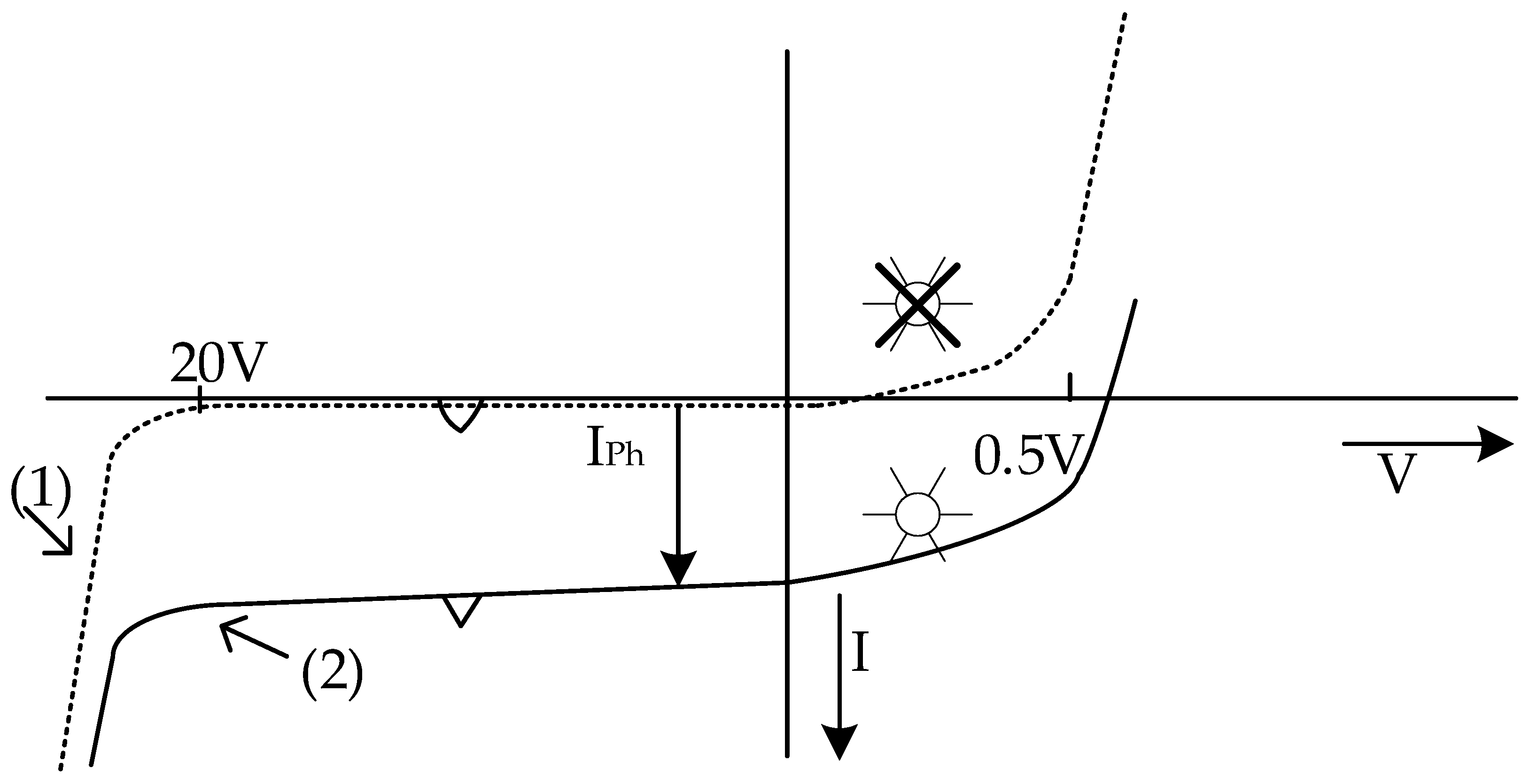
From an electrical engineering standpoint, PV plants interface with the grid through power-electronic converters, which shape the dynamic behavior of the power system. Each panel produces an I(V) characteristic depending on solar radiation, as presented in
Figure 1 [
6], where I is the current and V is the voltage.
Each photovoltaic cell has two terminals: a positive terminal and a negative terminal. Cells are connected in series, meaning the negative terminal of one cell is connected to the positive terminal of the next cell, increasing the total voltage of the panel.
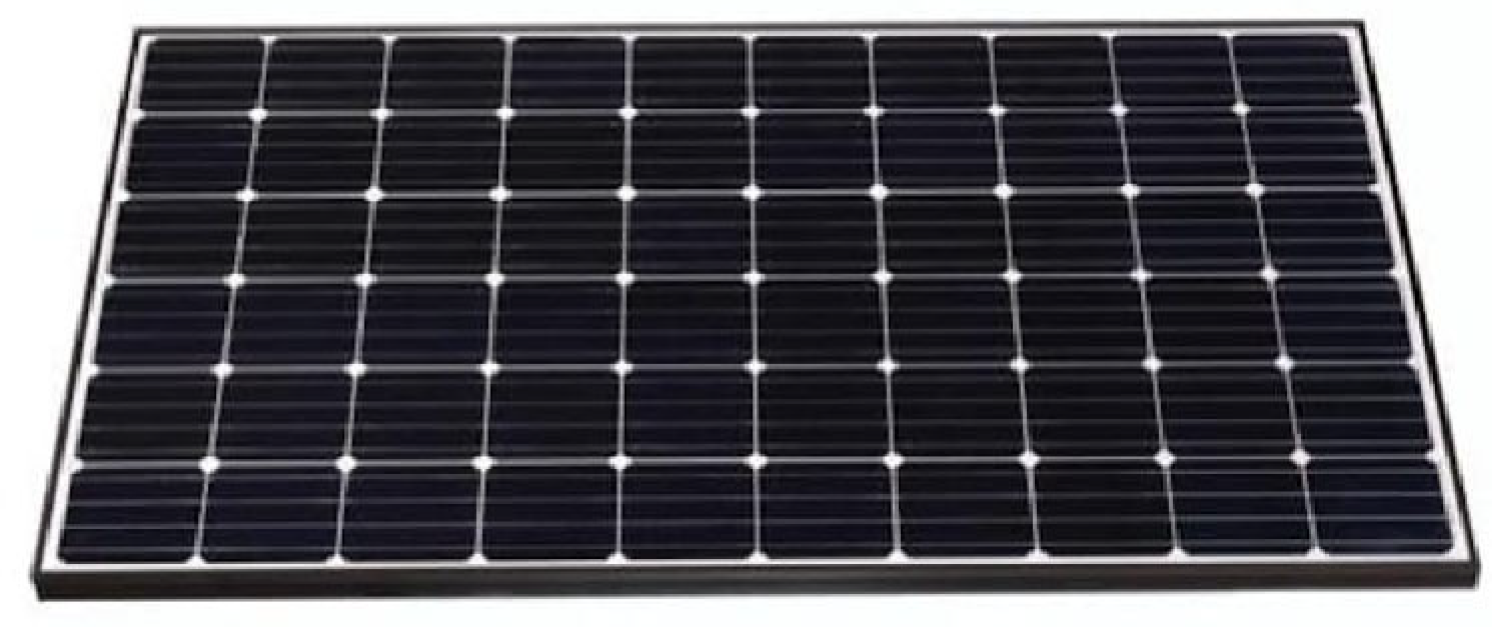
PV panels are constructed from PV cells that convert sunlight into electricity. These cells are typically made from silicon-based semiconductor materials. The manufacturing process begins by slicing silicon ingots into thin wafers, which then undergo chemical treatments and doping to form a p–n junction responsible for the photovoltaic effect. Cells are subsequently interconnected in series and parallel on a substrate to form a PV module, and the modules are framed (typically with aluminum) to produce the complete solar panel illustrated in
Figure 2.
High shares of inverter-based resources (IBRs) introduce system dynamics that differ from those of synchronous-generator-dominated grids, affecting the established notions of angle, frequency, and voltage stability [
7,
8,
9]. These effects become more pronounced under high instantaneous IBR penetration, where stability and control mechanisms must accommodate fast converter dynamics and reduced inherent inertial response [
10,
11]. As a result, improving PV energy capture and controllability supports not only higher energy production but also more predictable operational behavior at the power-system level [
12].
Solar generation remains strongly dependent on irradiance conditions, module orientation, and environmental variability. Fixed-tilt PV systems offer structural simplicity and reduced maintenance, yet they operate under non-ideal incidence angles for substantial portions of the day and year, limiting the attainable electrical power and reducing utilization of installed capacity. In modern power systems, where land use, grid-connection capacity, and energy yield per installed kilowatt are key design constraints, this motivates approaches that increase delivered energy without increasing nameplate PV capacity [
13,
14].
STSs address this limitation by maintaining favorable orientation throughout daily and seasonal solar trajectories, increasing the effective irradiance on the PV surface and raising instantaneous power output as well as cumulative energy injection to the grid. These gains can translate into higher specific yield and improved capacity factor, provided that auxiliary consumption and operational constraints are properly accounted for in net-energy evaluation.
In parallel, grid codes and interconnection standards increasingly require distributed energy resources, including PV, to provide grid-support capabilities such as voltage regulation functions and ride-through behavior during disturbances [
15,
16]. This requirement reinforces the need to assess PV systems—particularly those integrating solar tracking—using electrically meaningful metrics that include converter behavior, control architecture, and system-level integration constraints, rather than relying solely on mechanical descriptions or gross energy-gain values.
1.2. Limitations of Fixed-Tilt Photovoltaic Systems from an Electrical Perspective
Fixed-tilt PV systems remain widely deployed due to their mechanical simplicity, structural robustness, and low operational complexity. From an electrical perspective, these systems provide predictable behavior and minimal auxiliary power consumption, which simplifies grid integration and long-term operation. Despite these advantages, fixed-tilt configurations impose intrinsic electrical limitations related to irradiance utilization, power variability, and capacity factor, which become increasingly relevant as PV penetration rises within modern power systems.
The electrical output of a PV module is strongly governed by the angle of incidence between incoming solar radiation and the module surface. In fixed-tilt installations, this angle deviates from the optimal condition during most hours of the day and across seasonal cycles, leading to cosine losses that directly reduce the effective irradiance on the active surface [
17]. These losses translate into reduced short-circuit current and lower maximum power point (MPP) values, limiting instantaneous output power and cumulative energy production. Analytical and experimental studies demonstrate that fixed-tilt systems capture only a fraction of the available solar resource compared with dynamically oriented surfaces, particularly during morning and late-afternoon periods [
18].
From a system-level electrical standpoint, the reduced energy capture of fixed-tilt PV arrays impacts the utilization of installed capacity and grid-connection infrastructure. Lower capacity factors result in decreased annual energy yield per installed kilowatt, which affects economic performance and land-use efficiency in utility-scale installations. In networks with constrained connection capacity, this limitation reduces the effective return on grid assets, even when the PV plant operates within nominal electrical ratings.
Fixed orientation also influences the temporal distribution of power generation. Fixed-tilt systems tend to produce peak power around solar noon, while generation drops significantly during early and late daylight hours. This concentrated production profile increases the likelihood of power clipping at the inverter level in systems designed with high DC-to-AC ratios, especially under clear-sky conditions [
19]. In addition, midday power concentration may exacerbate local voltage rise issues in distribution networks with high PV penetration, increasing the need for active voltage regulation or curtailment strategies [
20,
21].
Environmental and site-specific factors further amplify these electrical limitations. Seasonal variations in solar altitude lead to extended periods of suboptimal irradiance incidence, particularly at higher latitudes. Soiling, partial shading, and non-uniform irradiance across the array introduce electrical mismatch losses that are not mitigated by fixed-tilt geometry [
22]. These effects alter the I–V and P–V characteristics of PV strings, reducing the effectiveness of MPPT algorithms and increasing resistive and mismatch-related losses at the system level.
Within the context of evolving grid requirements, fixed-tilt PV systems also face constraints related to flexibility and controllability. As grid codes increasingly require PV installations to provide voltage support and fault ride-through capability, the limited energy capture and rigid generation profile of fixed-tilt systems reduce the available operational margin for grid-support functions [
23]. These considerations highlight the need for alternative configurations that enhance energy capture while maintaining electrically efficient and controllable operation, motivating the integration of solar tracking solutions in modern PV power systems.
1.3. Solar Tracking Systems as an Electrical and Control-Oriented Solution
STSs are introduced in PV installations to mitigate the electrical limitations associated with fixed-tilt configurations by actively adapting the orientation of PV modules to the sun’s apparent motion. From an electrical perspective, the primary objective of solar tracking is not mechanical alignment itself but the maximization of plane-of-array (POA) irradiance and, consequently, the enhancement of electrical power output and annual energy yield under varying environmental conditions.
By maintaining a reduced angle of incidence throughout the day, tracking systems increase the effective irradiance received by the PV surface, which directly affects the generated current and the location of the maximum power point (MPP). Under simplified assumptions, the electrical output power of a PV array can be expressed as Equation (1).
where
represents the conversion efficiency, A is the active module area, and
denotes the irradiance incident on the module plane. STSs aim to maximize
over time, increasing both instantaneous power and cumulative energy production without altering the nominal PV capacity [
24].
Beyond energy capture, the adoption of tracking systems introduces a control layer that links mechanical motion with electrical performance. Tracking controllers determine actuator movement based on astronomical models, sensor feedback, or hybrid approaches, directly influencing the temporal profile of generated power. The control strategy affects not only tracking accuracy but also auxiliary power consumption, actuator duty cycles, and system reliability. As a result, the net electrical benefit of tracking systems must be evaluated by accounting for both energy gains and energy consumed by motors, sensors, and control electronics.
The electrical effectiveness of solar tracking can be quantified through the net energy balance given in Equation (2).
where
and
denote the annual energy production of tracked and fixed-tilt systems, respectively, and
represents the auxiliary energy required for actuation and control. This formulation highlights that tracking systems function as an energy-amplifying solution only when the incremental energy gain exceeds the associated parasitic consumption [
25].
From a power-system integration standpoint, solar tracking also influences the interaction between PV generation and power-electronic conversion stages. Changes in module orientation modify the operating point of the PV array, leading to continuous variations in the MPP that must be effectively handled by MPPT algorithms. Coordinated operation between mechanical tracking and electrical MPPT is therefore essential to avoid transient power losses, oscillations, or suboptimal inverter utilization [
26].
In grid-connected installations, tracking systems can contribute to a more distributed generation profile throughout the day by extending higher power output into morning and late-afternoon periods. This temporal redistribution of power production may reduce midday congestion and improve the utilization of grid-connection capacity, particularly in large-scale PV plants [
27]. At the same time, rapid or frequent tracking movements may introduce power fluctuations that interact with inverter controls and grid-support functions, reinforcing the importance of electrically informed tracking strategies.
In this context, STSs should be regarded as integrated electromechanical–electrical subsystems rather than purely mechanical add-ons. Their design and evaluation require a combined assessment of irradiance optimization, control architecture, auxiliary consumption, power-electronic interaction, and grid compatibility. This electrical and control-oriented viewpoint forms the basis for the systematic analysis presented in the subsequent sections of this review.
1.4. Scope, Objectives, and Main Contributions of the Review
This review focuses on STSs applied to PV installations from an electrical engineering perspective, addressing aspects that extend beyond mechanical design considerations. The scope of the paper is limited to PV-based STSs, while tracking applications dedicated exclusively to concentrated solar power are considered only when relevant for comparative or contextual purposes.
The primary objective of this work is to provide a systematic and electrically oriented assessment of STSs, with particular emphasis on their impact on output power, annual energy yield, auxiliary power consumption, and interaction with power-electronic conversion stages. Special attention is given to tracking control strategies and their influence on electrical performance, system reliability, and grid-connected operation.
A further objective is to examine the integration of STSs with MPPT algorithms, inverters, and grid-support functions required by modern interconnection standards. By analyzing the coordination between mechanical motion and electrical control, the review highlights operational constraints and design trade-offs that affect the net benefit of tracking-based PV systems [
6,
28].
In addition to the qualitative technical review, this paper incorporates a bibliographic and scientometric analysis of the scientific literature to identify research trends, leading publication venues, geographical contributions, and emerging topics related to solar tracking in PV applications. This analysis supports an evidence-based synthesis of existing knowledge and facilitates the identification of underexplored research directions.
The main contributions of this review can be summarized as follows:
- (i)
a structured taxonomy of STSs emphasizing electrically relevant characteristics;
- (ii)
a comparative assessment of tracking configurations and control strategies based on electrical performance and net energy gain;
- (iii)
an analysis of the interaction between solar tracking, MPPT algorithms, and grid-connected inverter operation;
- (iv)
the identification of current limitations and future research needs related to electrically optimized and grid-aware STSs.
Through this combined technical and bibliographic approach, the paper aims to support researchers, system designers, and grid engineers in the informed selection and development of solar tracking solutions suitable for modern PV power systems.
2. Materials and Methods (PRISMA-Compliant Framework)
A rigorous and transparent review methodology is essential for ensuring the reliability, reproducibility, and scientific relevance of survey-based research in engineering domains. In the context of STSs for PV applications, a structured methodological framework supports the objective synthesis of diverse studies addressing electrical performance, control strategies, and system-level integration aspects [
29].
Systematic review approaches and bibliographic analyses are increasingly adopted in energy and power engineering research to identify dominant research trends, assess the maturity of technological solutions, and highlight underexplored topics. When combined with scientometric techniques, these methods enable quantitative mapping of the literature, revealing publication dynamics, influential sources, and thematic evolution over time [
30].
This section presents the review protocol adopted in this work, including database selection, search strategy, screening criteria, and data processing steps. In addition, a bibliographic and scientometric analysis is employed to characterize the research landscape related to STSs in PV installations. This methodology supports the technical analyses presented in the following sections and ensures that the conclusions drawn are grounded in a comprehensive and systematically curated body of scientific literature [
31].
2.1. Review Protocol and PRISMA Framework
This study was conducted following the principles of systematic literature reviews to ensure transparency, reproducibility, and methodological rigor. The review process was structured in accordance with the Preferred Reporting Items for Systematic Reviews and Meta-Analyses (PRISMA 2020) guidelines, which provide a standardized framework for identifying, screening, and synthesizing scientific literature [
29,
30].
The PRISMA methodology was adopted to systematically organize the review process, including study identification, eligibility assessment, data extraction, and synthesis. Although the present work does not include a quantitative meta-analysis, the PRISMA framework supports a structured qualitative and bibliometric evaluation of solar tracking systems (STSs) in photovoltaic (PV) applications. This review was retrospectively registered in the Open Science Framework (OSF) following manuscript submission. The registration record is publicly available at
https://doi.org/10.17605/OSF.IO/8BJSR.
2.2. Eligibility Criteria
The eligibility criteria were defined to ensure that the selected studies are relevant to the electrical and control-oriented analysis of STSs.
Inclusion criteria:
Peer-reviewed journal articles and review papers;
Studies focused on photovoltaic systems incorporating solar tracking;
Research addressing at least one of the following aspects: electrical performance, control strategies, MPPT interaction, power electronics integration, grid-related behavior;
Publications written in English;
Studies published between 2016 and 2025.
Exclusion criteria:
Conference papers, patents, and non-peer-reviewed reports;
Studies focused exclusively on solar thermal or concentrated solar power systems;
Articles lacking technical relevance to electrical performance or control;
Duplicate records or incomplete publications.
These criteria ensured consistency in the dataset and alignment with the objectives of the review.
2.3. Information Sources
The literature search was conducted using the Web of Science Core Collection, a widely recognized database in engineering and energy research due to its high-quality indexing and citation tracking capabilities [
31,
32].
The database was selected to ensure comprehensive journal coverage, reliable bibliographic metadata, and consistency in citation analysis.
The final search was performed on 10 February 2026, and all records available up to this date were considered for inclusion.
2.4. Search Strategy
The search strategy was designed to capture relevant publications related to solar tracking systems in photovoltaic applications, with emphasis on electrical performance and control aspects.
The primary search query was based on the combination of the following keywords: (“solar tracking” AND “photovoltaic” AND “control” AND “energy” AND “grid”).
Filters were applied to include only journal articles and review papers, restrict results to English-language publications, and limit the publication period to 2016–2025.
The initial search returned 3232 records, which were subsequently refined through filtering and screening stages.
2.5. Selection Process
The study selection process was conducted in several structured stages, following the PRISMA framework to ensure transparency and reproducibility of the review methodology [
29].
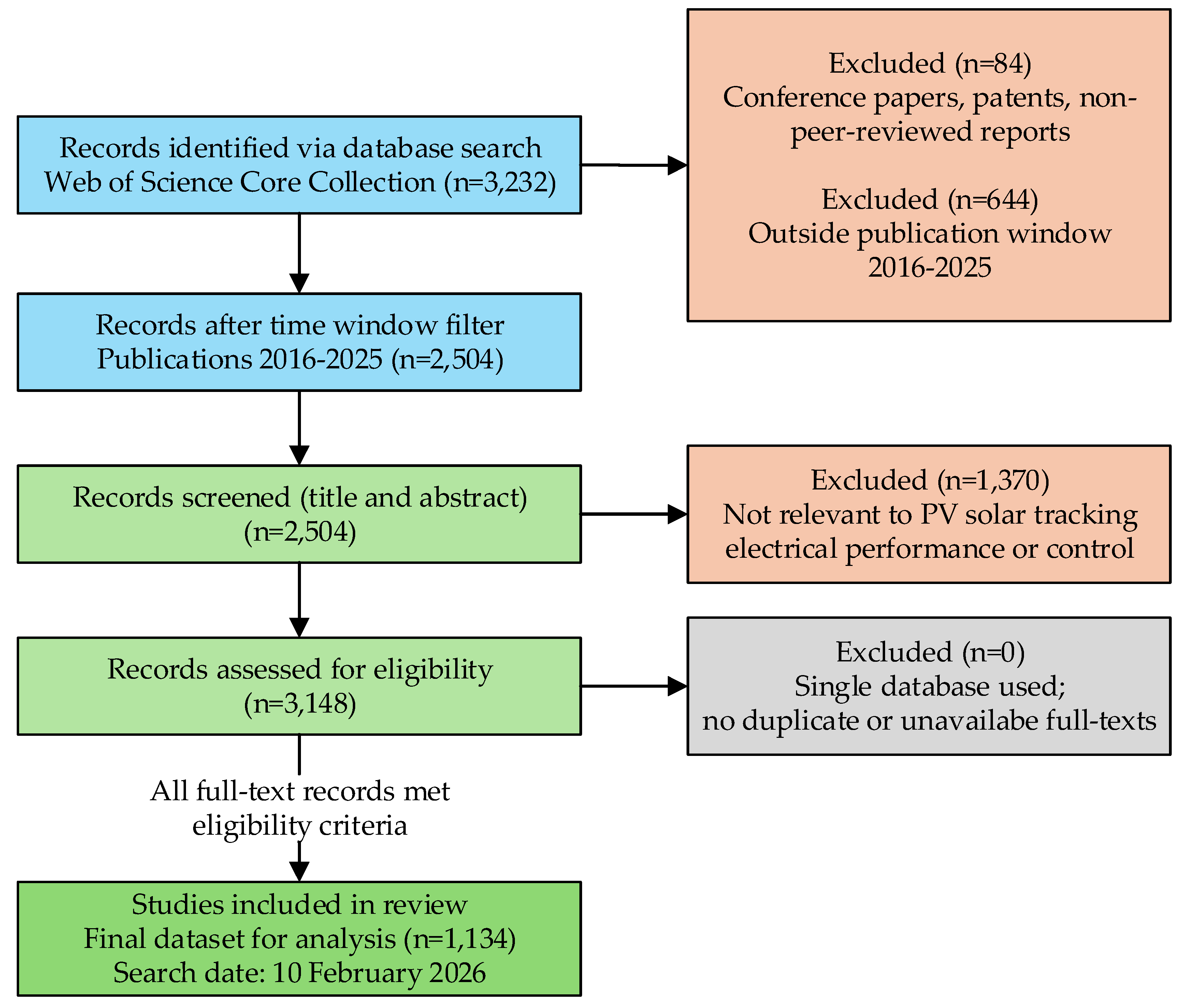
The identification stage began with a search of the Web of Science database, which yielded a total of 3232 records. Before screening, 728 records were removed by applying automated database filters: records not classified as peer-reviewed journal articles or review papers, records not written in English, and records published outside the defined time window (2016–2025). This resulted in 2504 records entering the screening stage.
The 2504 records entering the screening stage were assessed independently by the two authors based on titles and abstracts. Studies not aligned with the scope of photovoltaic solar tracking systems or lacking relevance to electrical performance and control aspects were excluded. Disagreements on inclusion or exclusion were resolved through discussion until consensus was reached. No formal inter-rater reliability metric was computed, as the screening criteria were designed to be unambiguous and consistently applicable.
The screening process resulted in 1134 reports eligible for full-text assessment. All 1134 reports were subsequently assessed for eligibility and retained, yielding the final set of studies included in the review.
The overall selection workflow, including the number of records retained at each stage, is illustrated in
Figure 3 in accordance with PRISMA guidelines.
2.6. Data Collection and Extraction
Bibliographic data were extracted from the selected records using standardized export formats provided by the database. The extracted information included authors and affiliations, publication year, journal source, keywords and abstracts, and citation metrics.
Data cleaning and preprocessing were performed to ensure consistency. Keyword normalization was applied to merge synonymous terms (e.g., “PV” and “photovoltaic”, “MPPT” and “maximum power point tracking”), following established bibliometric practices [
30,
31,
32,
33,
34].
2.7. Risk of Bias Assessment
A qualitative risk of bias assessment was performed by the authors based on predefined criteria. The analysis considered:
Publication bias: preference toward positive performance results;
Methodological bias: variations in experimental setups, simulation models, and performance metrics;
Reporting bias: inconsistent reporting of auxiliary energy consumption and net energy gain;
Technological bias: focus on specific tracking configurations or control strategies.
Given the engineering nature of the reviewed studies, a narrative approach was adopted instead of formal scoring tools, which are typically applied in clinical research [
29].
2.8. Data Synthesis and Analysis
The collected studies were analyzed using a combined qualitative and bibliometric approach in order to capture both the technical depth and the broader research trends associated with solar tracking systems in photovoltaic applications.
From a qualitative perspective, the reviewed articles were systematically grouped according to key technical dimensions relevant to the objectives of this study. These included the type of tracking configuration (fixed, single-axis, or dual-axis systems), the adopted control strategies (open-loop, closed-loop, hybrid, or intelligent methods), as well as the main electrical performance indicators and system integration aspects addressed in each work. This classification enabled a structured comparison of different approaches and facilitated the identification of recurring design principles and performance trade-offs.
In parallel, a bibliometric analysis was performed to provide a quantitative overview of the research landscape. The analysis focused on identifying publication trends over time, dominant research themes, and the evolution of scientific interest in solar tracking technologies. Particular attention was given to keyword co-occurrence patterns, which allowed the identification of major research clusters and emerging topics within the field.
The bibliometric analysis was carried out using the VOSviewer version 1.6.20 software tool, which enables the visualization of relationships between keywords and the mapping of thematic structures within large datasets [
35]. This approach supported the interpretation of research dynamics and highlighted connections between different areas of investigation.
By combining qualitative classification with quantitative scientometric analysis, the study provides a comprehensive understanding of the current state of research. This dual perspective enables the identification of dominant directions, technological gaps, and opportunities for future development, forming the basis for the technical discussions presented in the subsequent sections.
3. Bibliometric Analysis and Research Trends
Following the systematic selection process described in
Section 2, a bibliometric analysis was conducted to provide a quantitative and structural overview of the research landscape related to solar tracking systems (STSs) in photovoltaic (PV) applications. This analysis complements the qualitative review by identifying publication trends, dominant research domains, and thematic relationships within the scientific literature [
30].
3.1. Publication Trends over Time
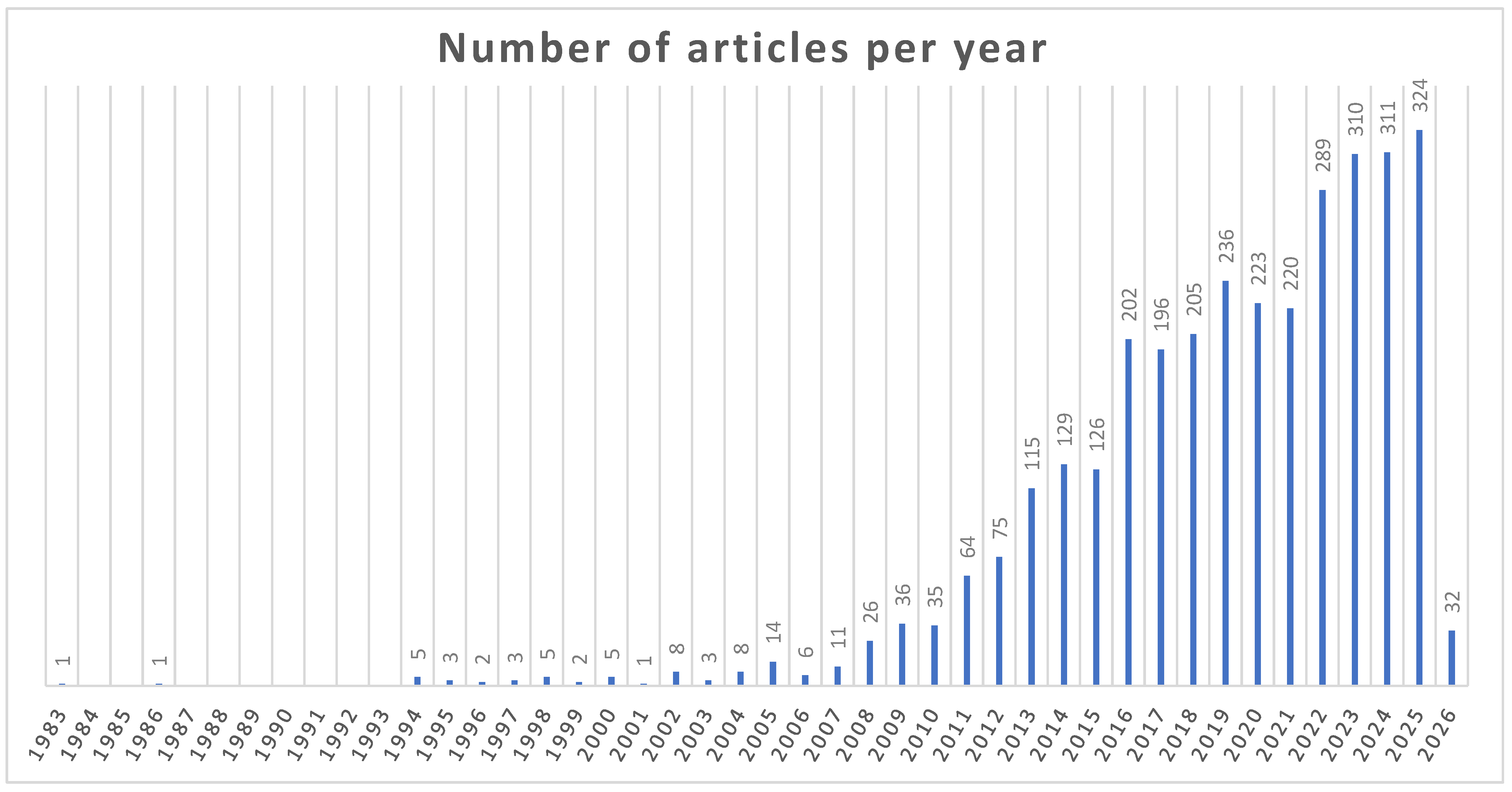
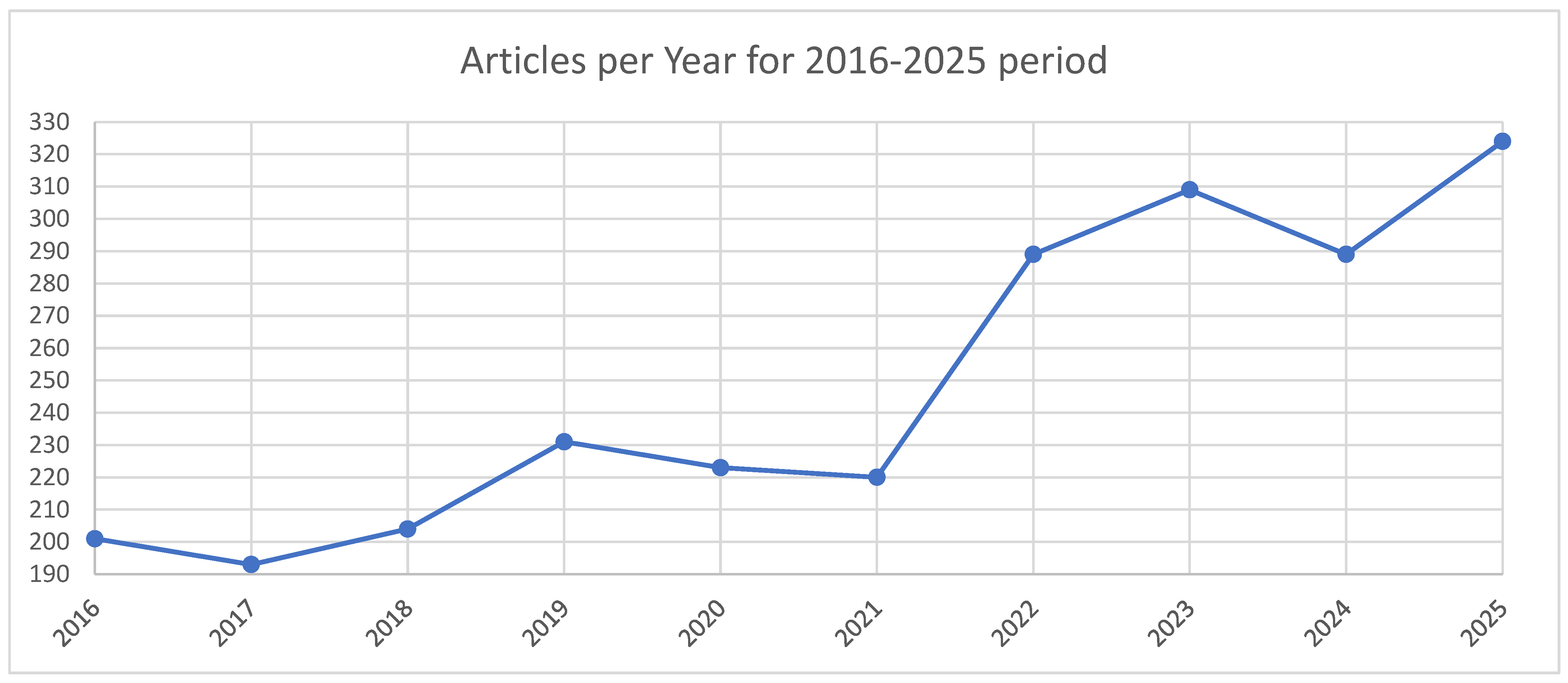
The temporal evolution of scientific publications in the field of solar tracking systems is presented in
Figure 4. The results indicate a clear upward trend in research activity over the analyzed period (2016–2025), reflecting the growing importance of tracking technologies in the context of increasing photovoltaic deployment and grid integration challenges.
The observed growth is consistent with global trends in renewable energy deployment and photovoltaic system expansion, as reported by international energy agencies [
2,
3,
4,
5]. The more pronounced increase in publications after 2021 can be associated with the rapid development of large-scale PV installations and the growing need for improved efficiency and system integration. In addition, the increasing interest in intelligent control methods and smart grid integration has contributed to the diversification of research topics within this field.
The observed publication dynamics confirm that solar tracking systems have evolved from a primarily mechanical optimization problem to a multidisciplinary research domain involving electrical engineering, control systems, and power system integration.
3.2. Distribution of Research Areas
The distribution of research areas associated with solar tracking systems is illustrated in
Figure 5, highlighting the interdisciplinary nature of this research domain. The majority of publications are concentrated in the fields of renewable energy, electrical engineering, and energy systems, with additional contributions from control engineering, automation, and materials science.
The dominance of energy and electrical engineering categories reflects the increasing focus on performance optimization, power electronics integration, and grid-related aspects of photovoltaic systems. At the same time, the presence of control and automation research indicates the growing importance of advanced control strategies, including sensor-based, hybrid, and intelligent approaches.
This distribution suggests a shift in research emphasis from purely structural and mechanical considerations toward electrically oriented system optimization. Such a transition aligns with the requirements of modern power systems, where photovoltaic installations are expected to operate as active components within the grid rather than passive energy sources [
12].
3.3. Keyword Co-Occurrence and Thematic Structure
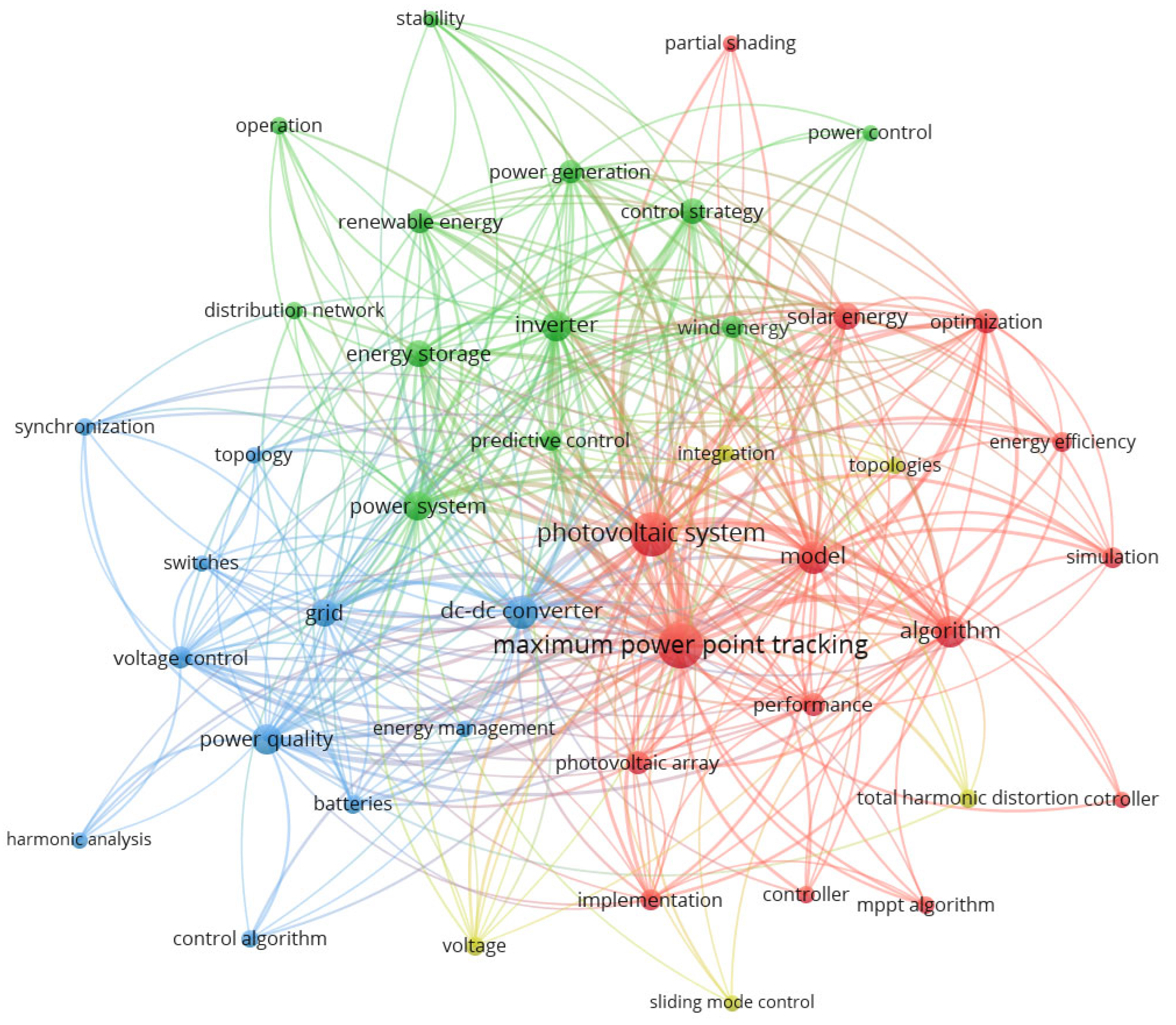
To further explore the conceptual structure of the research field, a keyword co-occurrence analysis was performed using the VOSviewer software tool [
30,
35], enabling the visualization of relationships between frequently used terms in the selected publications [
30,
32,
35]. The resulting network is presented in
Figure 6.
The analysis reveals several dominant thematic clusters. Core keywords such as “solar tracking”, “photovoltaic systems”, and “energy efficiency” form the central cluster, representing the fundamental focus of the field. Surrounding this core, additional clusters emerge, associated with control strategies (“MPPT”, “fuzzy logic”, “neural networks”), system optimization, and grid integration.
The presence of keywords related to advanced control techniques reflects the increasing interest in intelligent and adaptive solutions, which have been extensively studied in the context of photovoltaic systems [
26,
36,
37], while the emergence of terms related to grid interaction and power system stability highlights the growing importance of integrating PV systems into modern electrical networks [
23].
The structure of the keyword network highlights the transition of solar tracking research toward a more electrically and control-oriented perspective, where performance is evaluated not only in terms of energy gain but also in relation to system stability, efficiency, and grid compatibility.
3.4. Synthesis of Research Trends
The combined analysis of publication trends, research areas, and keyword co-occurrence provides a comprehensive picture of the evolution of solar tracking research. The results indicate a clear shift from early-stage studies focused on mechanical tracking mechanisms toward more advanced investigations addressing control strategies, electrical performance, and system integration.
In particular, the increasing emphasis on intelligent control methods, power-electronic interaction, and grid-aware operation reflects the transformation of photovoltaic systems into active and controllable elements within the electrical grid. This evolution is closely aligned with the broader transformation of power systems, where high penetration of renewable energy sources requires improved control, flexibility, and grid compatibility [
7,
10]. Consequently, solar tracking systems are increasingly studied not only as energy optimization tools but also as components of complex and interconnected electrical systems.
The bibliometric findings serve as a foundation for the technical analysis presented in the following sections, where solar tracking systems are examined from the perspective of classification, control strategies, electrical performance, and integration within modern power systems.
4. Overview of Solar Tracking Systems in Photovoltaic Applications
STSs represent an intermediate layer between PV energy conversion and power-system integration, linking mechanical motion with electrical performance and control. In tracking-based PV installations, orientation adjustment is not an isolated mechanical function but a process that directly affects irradiance capture, electrical operating points, and interaction with power-electronic conversion stages [
38].
Before addressing classification, control strategies, and electrical performance in detail, a clear overview of the functional principles and electrical architecture of STSs is required. Previous studies have shown that tracking behavior influences not only energy yield but also current–voltage characteristics, maximum power point dynamics, and inverter utilization, particularly in grid-connected configurations [
39].
This section introduces the fundamental operating concepts of STSs and outlines their main electrical components, including PV arrays, sensors, actuators, control units, and power-electronic interfaces. Establishing this common technical framework supports the comparative analyses presented in subsequent sections and clarifies the role of STSs as electrically active subsystems within modern PV installations [
40].
4.1. Definition and Functional Principles of Solar Tracking Systems
STSs are electromechanical subsystems designed to adjust the orientation of PV modules in order to align the active surface as closely as possible with the direction of incoming solar radiation throughout the day and year. In PV applications, the primary functional objective of a tracking system is to maximize the plane-of-array irradiance, thereby increasing the electrical power output and cumulative energy yield relative to fixed-tilt configurations [
41,
42].
From a functional standpoint, STSs operate by estimating or measuring the sun’s position and commanding actuators to reposition the PV structure accordingly. This process may rely on open-loop astronomical calculations, closed-loop sensor feedback, or hybrid approaches combining both sources of information [
43]. Regardless of the specific implementation, tracking systems introduce an additional control layer that directly influences the electrical operating conditions of the PV array.
The electrical relevance of solar tracking arises from the strong dependence of PV current generation on incident irradiance. Variations in module orientation alter the effective irradiance received by the cells, shifting the operating point on the I–V and P–V characteristics and modifying the instantaneous maximum power point [
44]. As a result, solar tracking must be analyzed not only as a geometric optimization problem but also as an electrically active mechanism that continuously interacts with power-electronic conversion and control processes.
In grid-connected PV installations, the effect of solar tracking extends beyond local energy capture. By reshaping the temporal distribution of generated power, tracking systems influence inverter loading, DC-link utilization, and power injection profiles at the point of common coupling. These effects reinforce the need to evaluate tracking systems using electrical performance metrics and system-level integration criteria rather than relying solely on geometric or mechanical considerations.
4.2. Electrical Architecture of a Solar Tracking PV System
The electrical architecture of a PV system equipped with solar tracking integrates sensing, control, actuation, and power conversion subsystems into a coordinated operational framework. Unlike fixed-tilt PV installations, tracking-based systems require continuous interaction between mechanical motion and electrical control to ensure efficient and stable operation.
4.2.1. Photovoltaic Modules and Array Configuration
PV modules in tracking systems are typically arranged in strings or sub-arrays mounted on movable support structures. From an electrical perspective, the array configuration must accommodate variable irradiance conditions caused by tracking motion, partial shading, and non-uniform illumination during transitional periods. These variations affect current sharing among parallel strings and influence mismatch losses at the array level [
45].
Tracking motion alters the effective irradiance distribution across the array, which may improve overall energy capture while introducing short-term electrical transients. Proper electrical design of string lengths, bypass diode placement, and array segmentation is therefore essential to maintain stable operation under dynamic orientation conditions [
46].
4.2.2. Sensors for Solar Position Detection
STSs employ various sensor technologies to determine the sun’s position or to estimate orientation errors. Common sensor-based approaches rely on light-dependent resistors (LDRs), photodiodes, or optical sensors arranged to detect differential irradiance [
47]. These sensors provide real-time feedback signals that are processed by the control unit to generate actuator commands.
From an electrical standpoint, sensor accuracy, noise sensitivity, and environmental robustness directly affect tracking precision and control stability. Sensor-based systems may exhibit degraded performance under diffuse irradiance or cloudy conditions, leading to oscillatory behavior and increased actuator activity. These effects can raise auxiliary power consumption and introduce unnecessary power fluctuations at the inverter input [
48].
4.2.3. Actuators and Drive Mechanisms
Actuation in STSs is commonly achieved using DC motors, stepper motors, or linear actuators driven by power-electronic interfaces. The selection of actuators has a direct impact on auxiliary power consumption, tracking resolution, and system reliability. From an electrical perspective, actuator duty cycles and peak power demands must be considered when evaluating the net energy benefit of tracking systems [
49].
Frequent repositioning or poorly tuned control strategies can increase energy consumption and mechanical wear, reducing the effective lifetime of the tracking system. Consequently, actuator selection and drive control should be optimized to balance tracking accuracy against electrical efficiency and long-term operational stability.
4.2.4. Power Electronics Interfaces
Power-electronic interfaces play a central role in tracking-based PV systems by linking the dynamically oriented PV array to the electrical grid. DC–DC converters and grid-connected inverters must accommodate continuous changes in input voltage and current caused by tracking-induced irradiance variation. These dynamics influence converter efficiency, MPPT convergence, and DC-link voltage stability [
50].
The interaction between tracking motion and power-electronic control becomes particularly relevant in systems with fast tracking adjustments or high DC-to-AC ratios. In such cases, coordinated operation between mechanical tracking and electrical control is required to avoid suboptimal power extraction and transient losses.
4.2.5. Control Units and Communication Layers
The control unit represents the central coordination element of a solar tracking system, processing sensor data or astronomical calculations and issuing commands to actuators and, in some cases, power-electronic controllers. Microcontrollers, programmable logic controllers (PLCs), and embedded industrial control platforms are commonly used, depending on system scale and complexity [
51].
Modern tracking systems increasingly incorporate communication interfaces for supervisory control, data acquisition, and remote monitoring. These capabilities enable adaptive control strategies, fault detection, and performance optimization at the plant level. From an electrical systems perspective, reliable communication and control integration support coordinated operation between tracking subsystems, inverters, and energy management systems, contributing to stable and efficient grid-connected performance.
5. Taxonomy of Solar Tracking Systems
5.1. Classification of Solar Tracking Systems
The number of degrees of freedom determines the ability of a tracking system to align the PV array with the sun’s apparent position. From an electrical perspective, this classification affects achievable irradiance gains, power variability, and the interaction with power-electronic converters.
5.1.1. Fixed-Tilt Photovoltaic Systems as Electrical Baseline
Fixed-tilt PV systems are commonly used as a reference baseline for evaluating the benefits of solar tracking. These systems operate with a constant tilt and azimuth, typically optimized for annual energy production at a given location. Their electrical behavior is characterized by minimal auxiliary power consumption and stable operating conditions, which simplify inverter control and grid integration [
52].
Despite these advantages, fixed-tilt systems exhibit reduced plane-of-array irradiance during morning and late-afternoon periods, leading to lower instantaneous power output and reduced annual energy yield. As discussed in
Section 1.2, this limitation motivates the comparison of fixed-tilt configurations with tracking-based solutions using electrically meaningful performance metrics.
5.1.2. Single-Axis Solar Tracking Systems
Single-axis STSs rotate the PV array around one axis, typically aligned horizontally or vertically, to follow the sun’s daily path. Common configurations include horizontal single-axis trackers (HSATs) and vertical single-axis trackers (VSATs). From an electrical standpoint, single-axis tracking increases plane-of-array irradiance primarily during early and late hours of the day, resulting in improved daily energy distribution and higher capacity factors compared with fixed-tilt systems [
42,
53].
The electrical benefits of single-axis tracking are accompanied by moderate increases in system complexity and auxiliary power consumption. Actuator motion is generally limited to discrete steps or slow continuous rotation, which reduces parasitic energy usage while maintaining substantial energy gains. These characteristics make single-axis trackers attractive for large-scale PV plants, where the balance between energy yield improvement and system reliability is critical [
54].
5.1.3. Dual-Axis Solar Tracking Systems
Dual-axis STSs provide two rotational degrees of freedom, enabling continuous alignment with both the solar azimuth and elevation angles. This configuration achieves the highest plane-of-array irradiance and, consequently, the maximum potential energy yield among tracking options [
42,
55].
From an electrical perspective, dual-axis tracking delivers smoother irradiance profiles and reduced angular mismatch losses throughout the year. These advantages translate into higher instantaneous power output and increased annual energy production. At the same time, dual-axis systems introduce higher auxiliary power consumption, increased control complexity, and greater mechanical and electrical stress on actuators and power-electronic interfaces. As a result, their application is more common in small- to medium-scale installations or in locations where land constraints and energy yield per unit area are dominant design factors [
56].
5.2. Classification Based on Driving and Actuation Systems
Beyond kinematic characteristics, STSs can be classified according to the nature of their driving and actuation mechanisms. This classification is particularly relevant for electrical performance evaluation, as it directly influences auxiliary energy consumption, control precision, and system reliability.
5.2.1. Active Solar Tracking Systems
Active tracking systems employ electrically driven actuators controlled by dedicated electronic units. These systems rely on motors, sensors, and control algorithms to achieve precise orientation adjustments. From an electrical standpoint, active trackers offer high positioning accuracy and adaptability to changing environmental conditions, supporting improved energy capture under variable irradiance [
57].
The primary limitation of active tracking systems is their auxiliary power requirement, which must be accounted for in net energy assessments. The electrical efficiency of motors, drive electronics, and control strategies plays a decisive role in determining whether the additional energy harvested through tracking offsets the energy consumed during operation.
5.2.2. Passive Solar Tracking Systems
Passive tracking systems utilize non-electrical mechanisms, such as thermal expansion or fluid displacement, to adjust orientation in response to solar heating. These systems typically operate without active electrical control, resulting in negligible auxiliary power consumption [
58].
From an electrical perspective, passive trackers offer simplicity and low parasitic losses, yet their tracking accuracy and responsiveness are limited. Reduced precision can lead to suboptimal irradiance alignment under rapidly changing conditions, constraining electrical performance gains compared with active solutions. Consequently, passive systems are less commonly adopted in grid-connected PV installations requiring predictable and controllable power output.
5.2.3. Semi-Passive and Hybrid Solar Tracking Systems
Semi-passive and hybrid tracking systems combine elements of active and passive approaches to balance tracking accuracy and auxiliary energy consumption. These systems may employ passive mechanisms for coarse alignment and active control for fine adjustments, reducing actuator duty cycles and electrical power usage [
59].
From an electrical and control-oriented viewpoint, hybrid systems offer a compromise between performance and efficiency. Their design aims to maximize net energy gain while maintaining acceptable control complexity and reliability. The evaluation of such systems requires careful assessment of control coordination, auxiliary consumption, and interaction with power-electronic conversion stages.
To provide a consolidated overview of the electrically relevant characteristics of STSs,
Table 1 summarizes the main tracking configurations according to degrees of freedom, actuation type, auxiliary power consumption, control complexity, and typical application domains. This comparative synthesis supports the subsequent analysis of control strategies and electrical performance presented in
Section 5 and
Section 6.
As indicated in
Table 1, the classification of STSs based on electrically relevant criteria reveals clear trade-offs between energy yield enhancement, auxiliary power consumption, and control complexity. Fixed-tilt systems offer predictable electrical behavior with negligible parasitic losses, serving as a useful reference for net energy comparisons. Single-axis tracking systems achieve substantial improvements in daily energy distribution with limited auxiliary consumption, explaining their widespread adoption in large-scale PV plants.
Dual-axis tracking systems provide the highest irradiance utilization and electrical output, yet their increased actuation demand and control complexity require careful net energy evaluation and reliability assessment. Passive tracking solutions minimize auxiliary consumption but exhibit limited controllability and accuracy, which constrains their application in grid-connected installations requiring predictable power injection. Hybrid and intelligent tracking systems aim to balance these competing factors by reducing unnecessary actuator motion while maintaining acceptable tracking precision, highlighting the growing importance of control-oriented optimization in modern PV systems.
6. Control Strategies for Solar Tracking Systems
Control strategies play a central role in the electrical effectiveness of STSs, as they determine tracking accuracy, actuator activity, auxiliary power consumption, and interaction with PV power conversion stages. From an electrical engineering perspective, the choice of control strategy directly influences net energy gain, system stability, and operational reliability, particularly in grid-connected PV installations.
Tracking control methods can be broadly classified into open-loop, closed-loop, hybrid, and intelligent approaches. Each category exhibits distinct characteristics in terms of sensing requirements, computational complexity, robustness to environmental variability, and electrical impact on the overall PV system.
6.1. Open-Loop Control Strategies
Open-loop control strategies determine the orientation of the PV array based on pre-calculated solar position models, without relying on real-time feedback from irradiance sensors. These approaches typically employ astronomical algorithms that compute the sun’s azimuth and elevation angles as functions of time, date, and geographical location [
65].
From an electrical standpoint, open-loop tracking offers stable and predictable behavior, as actuator movements follow predefined trajectories with limited sensitivity to short-term irradiance fluctuations. This characteristic reduces unnecessary actuator motion, contributing to low auxiliary power consumption and extended mechanical lifetime. In addition, the smooth orientation profile supports stable electrical operating conditions at the input of DC–DC converters and inverters [
62].
The main limitation of open-loop strategies arises from their dependence on accurate system calibration and alignment. Mechanical misalignment, structural deformation, or installation errors can lead to systematic tracking offsets, reducing plane-of-array irradiance and electrical output. These errors are not corrected in the absence of feedback, which may result in cumulative energy losses over time.
6.2. Closed-Loop Control Strategies
Closed-loop control strategies rely on real-time feedback from irradiance or optical sensors to adjust the orientation of the PV array. Common implementations use light-dependent resistors (LDRs), photodiodes, or camera-based sensors arranged to detect differential illumination across the tracking surface [
66].
From an electrical perspective, closed-loop control enables adaptive tracking that responds to changing environmental conditions, including seasonal variations and installation-specific deviations. This adaptability can improve tracking accuracy under clear-sky conditions and compensate for structural misalignments, leading to increased electrical output [
61].
At the same time, sensor-based control introduces sensitivity to diffuse irradiance and partial cloud coverage. Rapid fluctuations in sensor signals may trigger frequent actuator adjustments, increasing auxiliary power consumption and inducing power variations at the inverter input. These effects can interact with MPPT algorithms, potentially increasing convergence time and reducing overall energy extraction efficiency [
67]. Careful controller tuning and signal filtering are therefore required to balance tracking precision and electrical stability.
6.3. Hybrid Control Approaches
Hybrid control strategies combine open-loop astronomical models with closed-loop sensor feedback to exploit the advantages of both approaches. In such systems, astronomical calculations provide a reference orientation, while sensor feedback is used to correct residual errors and compensate for mechanical imperfections [
68].
From an electrical and control-oriented viewpoint, hybrid strategies reduce the dependence on continuous sensor-driven adjustments, limiting actuator activity and auxiliary power consumption. At the same time, the availability of feedback improves robustness against installation errors and long-term mechanical drift. This balance makes hybrid control particularly suitable for large-scale PV plants, where electrical efficiency, reliability, and maintenance costs are critical considerations [
60].
Hybrid approaches also support smoother power profiles by avoiding abrupt orientation changes driven solely by transient irradiance variations. As a result, the interaction between mechanical tracking and electrical MPPT processes is more predictable, facilitating coordinated operation between tracking controllers and power-electronic conversion stages.
6.4. Advanced and Intelligent Control Techniques
Advanced and intelligent control techniques have gained increasing attention in STSs as a means to improve tracking accuracy, reduce unnecessary actuator motion, and enhance net electrical energy gain under variable environmental conditions. These approaches extend beyond classical control by incorporating decision-making, prediction, or learning capabilities into the tracking process.
From an electrical engineering perspective, the primary motivation for intelligent tracking control lies in its potential to optimize the trade-off between irradiance maximization and auxiliary power consumption. Conventional closed-loop controllers may react aggressively to transient irradiance variations caused by clouds or diffuse radiation, leading to frequent actuator adjustments and increased parasitic losses. Intelligent control strategies aim to mitigate this effect by introducing adaptive behavior, pattern recognition, or predictive mechanisms [
63].
Fuzzy logic controllers (FLCs) represent one of the earliest intelligent approaches applied to solar tracking. By encoding heuristic rules based on tracking error and irradiance variation, FLCs enable smooth actuator motion without requiring an explicit mathematical model of the system. Experimental studies indicate that fuzzy-based tracking can reduce oscillatory behavior and actuator duty cycles while maintaining acceptable tracking precision, resulting in improved net energy performance compared with conventional sensor-based controllers [
64].
Artificial neural networks (ANNs) have also been employed to estimate optimal tracking angles based on historical irradiance data, time information, and environmental parameters. Once trained, ANN-based controllers can generate orientation commands without continuous sensor feedback, reducing sensitivity to noise and diffuse irradiance conditions. From an electrical standpoint, this behavior supports smoother power profiles and improved interaction with MPPT algorithms, particularly in systems subject to rapid irradiance fluctuations [
69].
More recent research explores machine learning and predictive control techniques to anticipate solar position and irradiance evolution, enabling proactive tracking decisions. Model predictive control (MPC), for instance, optimizes future actuator movements over a defined horizon while accounting for physical constraints and energy consumption. Such approaches offer the potential to minimize auxiliary power usage and reduce mechanical stress while preserving electrical performance [
70].
Despite their advantages, intelligent control techniques introduce increased computational complexity, data requirements, and implementation challenges [
71]. Their practical adoption in large-scale PV plants depends on controller robustness, ease of tuning, and compatibility with existing inverter and plant-level control architectures. As a result, intelligent tracking is often evaluated in conjunction with supervisory control and energy management systems rather than as an isolated subsystem.
A comparative overview of classical and intelligent tracking control strategies from an electrical perspective is provided in
Table 2. The table highlights the relationship between control approach, sensing requirements, auxiliary power consumption, and electrical impact, supporting the evaluation of control strategies presented in
Section 6.
As summarized in
Table 2, intelligent control strategies extend the capabilities of conventional tracking approaches by introducing adaptability and predictive features that directly influence electrical performance. Fuzzy logic and neural network-based controllers reduce unnecessary actuator motion, contributing to lower auxiliary consumption and smoother power injection. Predictive control strategies offer further optimization potential by explicitly incorporating energy consumption and system constraints into the control objective. These characteristics make intelligent control particularly attractive for grid-connected PV installations where electrical stability, efficiency, and coordinated operation with power-electronic converters are essential.
7. Electrical Performance Analysis of Solar Tracking Systems
The evaluation of STSs requires a comprehensive electrical performance analysis that accounts for power output, energy yield, auxiliary consumption, and interaction with PV operating characteristics. From an electrical engineering perspective, tracking effectiveness cannot be assessed solely through geometric or mechanical indicators; instead, it must be quantified using electrically meaningful metrics that reflect real operating conditions and system-level constraints.
7.1. Impact on Output Power and Annual Energy Yield
The primary electrical benefit of STSs lies in their ability to increase the plane-of-array irradiance incident on PV modules, resulting in higher output power and increased cumulative energy production. By maintaining a favorable orientation throughout daily and seasonal solar cycles, tracking systems enhance the effective irradiance received by the PV surface compared with fixed-tilt configurations, particularly during morning and late-afternoon periods [
72].
The instantaneous electrical power generated by a PV array can be approximated as:
where
and
denote the voltage and current at the maximum power point. Both quantities depend on the irradiance incident on the module plane and the operating temperature. Solar tracking primarily affects
through increased irradiance, leading to higher power output under otherwise identical operating conditions [
73].
Numerous experimental and simulation-based studies report significant energy yield improvements associated with tracking systems. Single-axis trackers typically provide annual energy gains ranging from 15% to 30% relative to fixed-tilt installations, while dual-axis trackers can achieve gains exceeding 35% under favorable climatic conditions [
74]. These improvements depend on site latitude, diffuse-to-direct irradiance ratio, and tracking configuration, underscoring the need for location-specific performance assessment.
From a system-level perspective, increased energy yield translates into higher capacity factors and improved utilization of grid-connection infrastructure. In utility-scale PV plants, the extended production window associated with tracking systems supports more uniform daily power injection profiles, reducing midday saturation and enhancing overall energy delivery efficiency [
75].
7.2. Influence on I–V and P–V Characteristics
Solar tracking affects not only the magnitude of PV output power but also the electrical characteristics of the PV array. Changes in module orientation modify the irradiance distribution across the array, influencing the shape and position of the current–voltage (I–V) and power–voltage (P–V) curves [
76].
Under increased irradiance conditions enabled by tracking, the short-circuit current rises approximately linearly with irradiance, while the open-circuit voltage exhibits a logarithmic dependence. As a result, the maximum power point shifts toward higher current levels and moderately higher voltage values, increasing the available electrical power [
77]. These shifts require continuous adaptation by the MPPT algorithm to ensure optimal energy extraction.
Tracking-induced irradiance variations may occur gradually, following the sun’s trajectory, or abruptly during repositioning steps. The latter can introduce transient changes in the operating point, challenging MPPT convergence and potentially increasing dynamic losses if coordination between mechanical tracking and electrical control is inadequate [
78].
In addition, non-uniform irradiance during tracking transitions or partial shading conditions may introduce mismatch losses within PV strings. These effects alter the I–V curve shape, potentially creating multiple local maxima in the P–V characteristic. Effective electrical design and control strategies are therefore essential to preserve tracking benefits under realistic operating conditions.
7.3. Electrical Losses and Auxiliary Power Consumption
While solar tracking increases energy capture, it also introduces additional electrical losses associated with actuator operation, control electronics, and sensing subsystems. These auxiliary loads consume energy that must be deducted from the gross energy gain to determine the net benefit of tracking [
79].
The auxiliary energy consumption can be expressed as
where
represents the power drawn by tracking actuators and
accounts for sensors, controllers, and communication equipment over the evaluation period T. Reported auxiliary consumption values typically range from 1% to 5% of the additional energy gained through tracking, depending on control strategy, actuator efficiency, and tracking resolution [
80].
Frequent actuator motion driven by aggressive control strategies or sensor noise can increase auxiliary consumption and mechanical wear. Electrically optimized tracking systems aim to minimize unnecessary repositioning while preserving adequate irradiance alignment, highlighting the importance of control design in net energy evaluation.
7.4. Net Energy Gain and Comparison with Fixed-Tilt Systems
The net electrical advantage of STSs is best assessed through a comparative energy balance that accounts for both gains and losses. The net annual energy gain relative to a fixed-tilt system can be defined as
where
and
represent the annual energy yields of tracked and fixed-tilt systems, respectively. Positive values of
indicate effective energy amplification through tracking.
Comparative analyses reported in the literature demonstrate that single-axis tracking often yields the most favorable balance between energy gain and auxiliary consumption in large-scale PV plants, while dual-axis tracking offers higher absolute gains at the expense of increased complexity and losses [
42,
81]. These findings reinforce the need for electrically informed selection criteria that consider net energy gain, system reliability, and integration constraints rather than gross energy improvement alone.
8. Integration of Solar Tracking Systems with Power Electronics
The integration of STSs with power-electronic conversion stages represents a critical aspect of their electrical performance and grid compatibility. Tracking-induced variations in irradiance and operating conditions directly affect DC–DC converters, MPPT algorithms, and grid-connected inverters. An electrically coordinated design is therefore required to ensure stable operation, efficient energy extraction, and compliance with grid requirements [
25].
8.1. Interaction with DC–DC Converters
In PV systems equipped with DC–DC conversion stages, solar tracking influences the input voltage and current profiles presented to the converter. By continuously adjusting module orientation, tracking systems alter the plane-of-array irradiance, resulting in corresponding shifts in the PV array operating point on the I–V characteristic. These irradiance-induced variations influence converter duty cycles, dynamic response, switching losses, and thermal loading of semiconductor devices [
82,
83].
From an electrical standpoint, gradual irradiance changes associated with smooth tracking trajectories are generally well managed by DC–DC converters operating under standard control schemes. Discrete or rapid tracking movements, by contrast, may introduce transient disturbances that challenge converter regulation and increase switching losses. Converter design and control bandwidth must therefore be selected to accommodate tracking-induced dynamics without compromising efficiency or stability [
84].
In systems with high DC-to-AC ratios, tracking-induced increases in DC power may also intensify clipping phenomena or approach converter saturation limits during high-irradiance periods. Consequently, coordinated design of tracking behavior, converter sizing, and control bandwidth is necessary to maintain stable and efficient operation.
8.2. Effects on Maximum Power Point Tracking Algorithms
MPPT algorithms play a central role in extracting electrical energy from PV arrays subject to tracking-induced irradiance variation.
As tracking modifies the orientation of the PV surface, the location of the maximum power point shifts continuously, requiring real-time adaptation by the MPPT controller [
79].
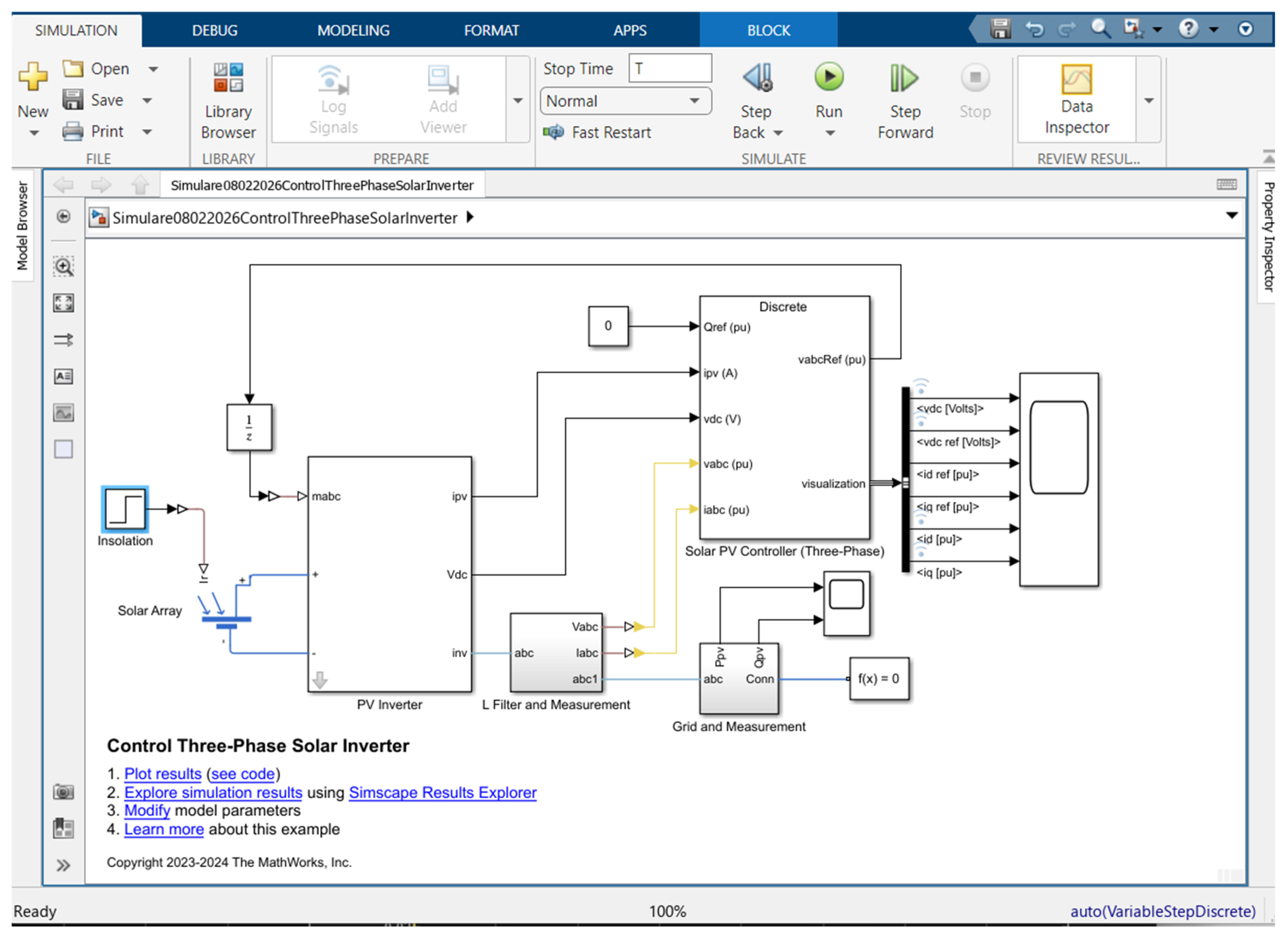
To illustrate the dynamic interaction between irradiance variation and MPPT response,
Figure 7 presents a representative simulation architecture commonly employed in the literature for analyzing PV-converter-inverter systems under variable irradiance conditions. The architecture is centered on a three-phase solar PV controller that interfaces the PV array with the grid through a power-electronic conversion stage.
The controller receives five input signals: the reactive power reference Qref (p.u.), the DC-side current (A), the DC-side voltage vdc (V), the AC-side per-unit voltage vabc (p.u.), and the AC-side per-unit current iabc (p.u.). It generates a per-unit reference voltage waveform vabc ref (p.u.) that drives the inverter switching stage.
For monitoring and analysis purposes, the controller also provides a measurement bus containing nine internal signals: the estimated phase angle θ of the input voltage vabc, the DC-side voltage vdc (V), the per-unit q-axis and d-axis current references iq ref and id ref, the DC-side reference voltage Vdc ref (V), the per-unit d-axis and q-axis voltages vd and vq, and the per-unit d-axis and q-axis currents id and iq. These signals allow detailed inspection of the controller’s dynamic behavior under varying irradiance conditions.
Main Parameters are: Open-circuit voltage, Short-circuit current, Voltage at maximum power point, Current at maximum power point. Such models are widely used to evaluate the dynamic behavior of MPPT algorithms when subjected to irradiance steps or gradual variations.
Tracking systems can introduce both slow and fast changes in irradiance. Slow variations follow the solar trajectory and are generally well handled by conventional MPPT algorithms such as perturb-and-observe or incremental conductance. Fast variations may occur during tracking repositioning steps or under partially cloudy conditions, increasing the likelihood of oscillations or delayed convergence [
85].
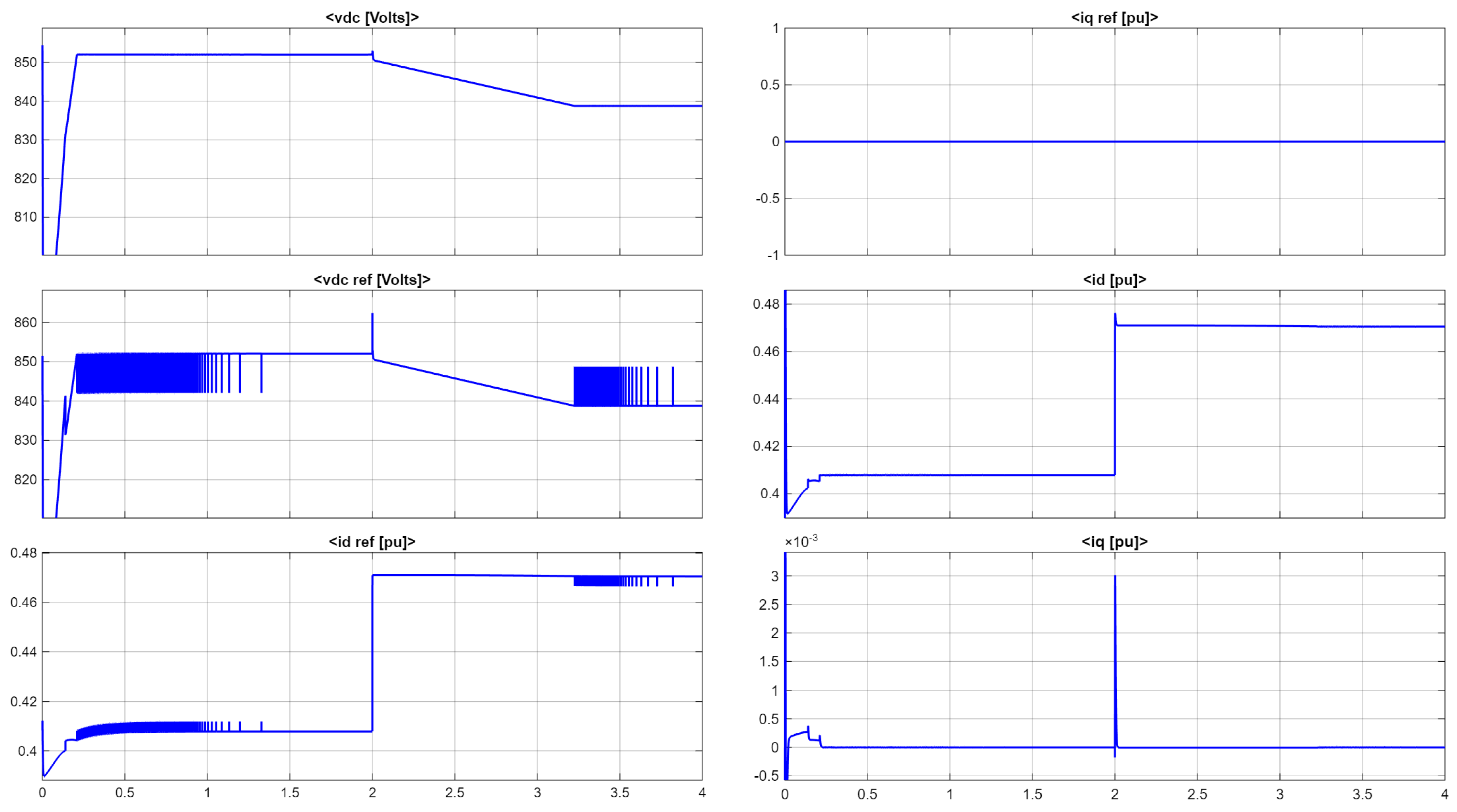
Figure 8 illustrates a typical dynamic MPPT response to an irradiance step variation, showing the transient behavior of key controller signals during the settling process.
From an electrical performance perspective, coordination between mechanical tracking motion and MPPT operation is essential. Excessively frequent or abrupt tracking adjustments can increase MPPT settling time and dynamic losses, reducing effective energy extraction. Electrically optimized tracking strategies aim to limit repositioning events while maintaining adequate irradiance alignment, supporting stable MPPT operation and improved net energy yield.
8.3. Coordination Between Mechanical Tracking and MPPT
The coordination between mechanical tracking and electrical MPPT represents a key integration challenge in tracking-based PV systems. Mechanical tracking modifies the irradiance profile, while MPPT algorithms seek to optimize electrical operating conditions based on instantaneous measurements. Without coordination, these two control layers may interact in ways that degrade performance [
86].
Coordinated strategies may involve synchronizing tracking movements with MPPT update intervals, introducing dwell times after repositioning, or incorporating tracking state information into MPPT logic. Such approaches reduce transient interactions and support smoother convergence to the global maximum power point, particularly in systems subject to partial shading or non-uniform irradiance [
87].
A critical aspect of this coordination concerns the temporal relationship between actuator repositioning and MPPT perturbation cycles. Typical MPPT algorithms operate with perturbation intervals ranging from 50 to 500 ms, depending on algorithm type and implementation. Mechanical actuators, by contrast, execute repositioning movements over time scales of seconds to tens of seconds for continuous tracking, or at discrete intervals of 1 to 15 min in step-based strategies [
78]. When MPPT dwell times and actuator time constants overlap, transient oscillations may arise: the MPPT algorithm interprets the changing irradiance during mechanical motion as a shift in the operating point and adjusts accordingly, while the tracker continues its motion, creating a feedback loop that may delay convergence or cause sustained power oscillations around the maximum power point [
87].
Reported studies indicate that transient energy losses during tracking-induced irradiance steps can range from 0.5% to 3% of instantaneous power, depending on the speed of the tracking movement and the responsiveness of the MPPT algorithm [
86]. Temporal decoupling strategies, in which the MPPT algorithm suspends perturbation during actuator motion or introduces a settling delay after repositioning, have been shown to mitigate these effects. Adaptive dwell-time approaches, where the pause duration is adjusted based on the magnitude of the irradiance change, offer a further improvement by balancing convergence speed against stability [
87].
From a system-level viewpoint, coordinated tracking–MPPT operation contributes to improved inverter utilization, reduced electrical stress, and enhanced reliability. These benefits become increasingly relevant in large-scale PV plants, where small efficiency improvements translate into significant energy gains.
8.4. Impact on Inverters and Grid-Connected Operation
Grid-connected inverters serve as the interface between tracking-based PV systems and the electrical grid. Tracking-induced variations in DC input power affect inverter loading, efficiency, and control behavior. Extended periods of elevated power output enabled by tracking can improve inverter utilization across a wider portion of the day, enhancing energy delivery efficiency [
88].
At the same time, rapid power fluctuations caused by aggressive tracking strategies may interact with inverter control loops and grid-support functions such as voltage regulation or reactive power control. These interactions can influence power quality metrics, including voltage fluctuations and ramp rates at the point of common coupling [
89].
Modern grid codes increasingly require PV inverters to provide ancillary services, including voltage support and fault ride-through capability. The integration of solar tracking must therefore be evaluated in conjunction with inverter control strategies and grid requirements, ensuring that tracking-induced power variations remain compatible with stable grid operation.
9. Reliability, Power Quality, and Grid Integration Issues
The deployment of STSs in grid-connected PV installations introduces additional electromechanical components and control layers that influence system reliability, power quality, and compliance with grid integration requirements. While tracking systems enhance energy capture, their impact on long-term operational performance and grid behavior must be carefully assessed using electrical reliability indicators and power-system metrics.
9.1. Reliability of Solar Tracking Systems from an Electrical Perspective
Reliability represents a critical factor in the evaluation of STSs, particularly in large-scale PV plants where downtime and maintenance costs directly affect energy yield and economic performance. From an electrical perspective, tracking systems introduce additional failure modes associated with actuators, sensors, power-electronic drivers, and control units [
90].
Actuator-related failures, including motor wear, gearbox degradation, and drive electronics malfunction, represent a significant source of reliability concerns. Electrical stress caused by frequent start–stop cycles and peak current demands during repositioning contributes to accelerated component aging. Control strategies that limit unnecessary motion and smooth actuator operation can mitigate these effects, improving mean time between failures and reducing maintenance interventions [
91].
Sensor reliability also plays a decisive role in tracking performance. Optical and irradiance sensors are exposed to harsh environmental conditions, including dust, humidity, and temperature extremes. Sensor degradation or misalignment can lead to tracking errors, increased actuator activity, and reduced electrical output. Sensorless or hybrid control approaches have been proposed to improve robustness by reducing dependence on continuous sensor feedback [
92].
From a system-level viewpoint, reliability assessment of tracking systems must consider the interaction between mechanical subsystems and electrical control. Fault detection and diagnostic techniques based on electrical signatures, such as abnormal current draw or power fluctuations, offer promising approaches for early identification of tracking-related faults and preventive maintenance planning.
9.2. Power Quality and Stability Considerations
The integration of tracking-based PV systems affects power quality and stability at both distribution and transmission levels. Tracking modifies the temporal profile of PV power injection, influencing voltage levels, ramp rates, and short-term variability at the point of common coupling [
93].
Extended power production enabled by tracking can improve voltage profiles during early morning and late afternoon periods, supporting better utilization of grid infrastructure. At the same time, rapid tracking movements or poorly coordinated control strategies may introduce short-term power fluctuations that interact with inverter control loops. These fluctuations can manifest as voltage variations or increased ramp rates, particularly in weak grids with high PV penetration [
94].
Power quality concerns associated with tracking systems are closely linked to inverter operation. Modern grid-connected inverters employ advanced control functions to regulate active and reactive power, mitigate voltage deviations, and comply with harmonic emission limits. Tracking-induced power variations must remain within the dynamic capabilities of these control systems to avoid adverse effects on voltage stability and power quality indices [
95].
As grid codes evolve toward higher penetration of inverter-based resources, coordinated operation between tracking systems and inverter control becomes increasingly important. Electrically informed tracking strategies that limit abrupt power changes support stable grid interaction and reduce the need for curtailment or additional grid-support measures.
9.3. Grid Integration Requirements and Compliance
Grid integration requirements for PV systems have become progressively more stringent, reflecting the growing share of PV generation in modern power systems. STSs must therefore be evaluated not only in terms of energy yield but also with respect to compliance with interconnection standards and grid-support obligations [
96].
Grid codes such as IEEE 1547 and corresponding international standards require PV inverters to provide voltage regulation, reactive power control, and fault ride-through capability [
96]. Tracking systems influence the operating envelope of inverters by modifying the available DC power and its temporal distribution. Proper coordination ensures that tracking-enhanced power production remains compatible with inverter ratings and grid-support functions [
97].
Beyond ramp-rate management, grid-aware tracking strategies can contribute more actively to power system stability. In networks with reduced synchronous inertia due to high inverter-based resource penetration, tracking systems can support frequency regulation by modulating active power injection in coordination with inverter control [
93]. For instance, controlled deceleration or temporary suspension of tracking motion during frequency transients can limit power excursions, while intentional orientation adjustment can shape the active power output to provide primary frequency support. Similarly, tracking-induced changes in the DC operating point influence the reactive power capability of the inverter, offering an additional degree of freedom for voltage regulation at the point of common coupling [
16]. These capabilities position grid-aware solar tracking as a complementary tool for ancillary service provision in modern power systems.
In utility-scale installations, plant-level control architectures increasingly integrate tracking systems into supervisory energy management frameworks. These architectures enable coordinated control of tracking, inverter operation, and grid interaction, supporting compliance with ramp-rate limits and curtailment commands issued by grid operators. Such integration is particularly relevant in regions with high PV penetration, where system-level flexibility and controllability are essential for secure grid operation [
98].
Overall, the reliability, power quality, and grid integration performance of tracking-based PV systems depend on electrically informed design choices that align mechanical tracking behavior with power-electronic capabilities and grid requirements. These considerations reinforce the need for holistic evaluation frameworks addressing both energy capture and power-system compatibility.
10. Emerging Applications and Trends
The evolution of solar tracking technologies reflects the broader transformation of PV systems toward larger scales, increased electrical complexity, and tighter integration with power systems. Emerging applications emphasize not only energy yield enhancement but also operational flexibility, grid compatibility, and resilience under diverse environmental conditions. This section reviews key application domains and technological trends shaping the future deployment of STSs.
10.1. Solar Tracking in Large-Scale Photovoltaic Power Plants
Large-scale PV power plants represent the primary application domain for STSs, particularly single-axis configurations. The widespread adoption of horizontal single-axis trackers in utility-scale installations is driven by their favorable balance between energy yield improvement, auxiliary power consumption, and operational reliability [
99].
From an electrical perspective, tracking systems in large-scale plants contribute to higher capacity factors and improved utilization of grid-connection assets. By extending power production into morning and late-afternoon periods, tracking reshapes daily generation profiles, reducing peak concentration around solar noon. This redistribution supports smoother power injection and enhances compatibility with transmission system constraints [
100].
Plant-level electrical design increasingly incorporates tracking behavior into inverter sizing, DC-to-AC ratio selection, and control architecture. Centralized and string inverter configurations must accommodate tracking-induced variations in DC input power while maintaining efficient operation across a wide operating range. Supervisory control systems coordinate tracking, inverter control, and grid interaction, enabling compliance with ramp-rate limits and curtailment commands issued by grid operators [
101].
Recent trends in large-scale plants include backtracking strategies to mitigate inter-row shading and bifacial module integration to exploit ground-reflected irradiance. These developments further strengthen the role of tracking systems as electrically integrated components of utility-scale PV generation.
10.2. Solar Tracking Systems in Floating Photovoltaic Installations
Floating photovoltaic (FPV) installations have emerged as a promising solution for deploying PV systems on water bodies such as reservoirs, lakes, and hydroelectric dams. The integration of solar tracking in FPV systems introduces additional opportunities and challenges related to electrical performance, mechanical stability, and environmental interaction [
102].
From an electrical standpoint, FPV systems benefit from reduced module operating temperatures due to evaporative cooling, leading to improved conversion efficiency. When combined with solar tracking, these effects can further enhance energy yield per installed kilowatt. Tracking-enabled FPV systems may exploit both improved irradiance alignment and favorable thermal conditions, resulting in higher specific energy production compared with land-based fixed installations [
103].
At the same time, tracking implementation in FPV environments must account for platform motion, wind loading, and anchoring constraints. Electrical reliability and insulation integrity are critical considerations due to increased humidity and exposure to water. Control strategies for FPV tracking systems often prioritize robustness and reduced actuator activity to maintain stable operation under dynamic environmental conditions [
104].
The growing interest in hybrid hydropower–FPV systems further highlights the relevance of tracking in integrated energy systems, where coordinated operation between generation technologies can support grid stability and efficient resource utilization.
10.3. Role of Solar Tracking in Smart Grids and Energy Management Systems
The transition toward smart grids and digitally controlled power systems is reshaping the functional role of PV installations. STSs are increasingly viewed as controllable assets that can support advanced energy management objectives rather than passive energy-harvesting mechanisms [
105].
In smart grid environments, tracking systems can be integrated with energy management systems (EMS) to support objectives such as peak-shaving, ramp-rate control, and coordination with energy storage. By adjusting tracking behavior in response to grid conditions, PV plants can modulate power output profiles without altering inverter control settings. This capability enhances operational flexibility and supports grid-support services [
106].
Advanced communication and control infrastructures enable real-time coordination between tracking systems, inverters, and grid operators. Data-driven control strategies, combined with forecasting and optimization tools, allow tracking systems to participate in system-level decision-making processes. These developments position solar tracking as an active contributor to grid-aware PV generation, aligned with the requirements of modern power systems characterized by high shares of inverter-based resources [
107].
11. Challenges and Future Research Directions
Despite the demonstrated benefits of STSs in PV applications, several technical and operational challenges continue to limit their widespread adoption and optimal integration in modern electrical power systems. Addressing these challenges requires coordinated advances in electrical design, control strategies, power-electronic integration, and system-level evaluation methodologies.
To position the present work relative to prior contributions,
Table 3 provides a comparative overview of existing review papers on solar tracking systems. While previous reviews have addressed tracker typologies, mechanical configurations, and control algorithms, the present review is, to the best of the authors’ knowledge, the first to systematically combine an electrical engineering perspective with a PRISMA-compliant methodology and bibliometric analysis. The electrical perspective covers MPPT interaction, power electronics integration, grid-aware tracking, and net energy gain.
A limitation of the present review is the use of a single database (Web of Science) for study identification. Although WoS provides comprehensive coverage of high-impact journals in the relevant fields, future reviews could benefit from incorporating additional databases such as Scopus and IEEE Xplore to further improve completeness.
11.1. Electrical and Control Challenges
One of the primary challenges associated with STSs is the coordination between mechanical tracking, electrical control, and power-electronic conversion. Tracking-induced irradiance variations continuously modify the operating point of the PV array, requiring robust and adaptive control strategies to maintain stable and efficient operation. Inadequate coordination between tracking motion and MPPT algorithms may lead to transient losses, oscillatory behavior, and increased electrical stress on converters and inverters [
108].
Auxiliary power consumption remains a critical concern, particularly in systems employing aggressive tracking strategies or frequent repositioning. Although tracking increases gross energy yield, the net benefit depends on limiting parasitic losses associated with actuators, sensors, and control units. Electrically optimized tracking controllers capable of reducing unnecessary motion while preserving adequate irradiance alignment represent an important research direction.
Environmental robustness also poses significant challenges. Tracking systems operate under varying temperature, wind, humidity, and soiling conditions, which affect sensor accuracy, actuator performance, and electrical reliability. Developing control strategies and hardware solutions resilient to environmental degradation is essential for ensuring long-term system availability and predictable electrical performance.
11.2. Cost–Performance Trade-Offs
The economic viability of STSs is strongly influenced by the trade-off between increased energy yield and additional capital and operational costs. From an electrical engineering perspective, this trade-off extends beyond initial investment to include maintenance requirements, component aging, and energy losses associated with auxiliary consumption [
101].
Single-axis tracking systems have emerged as a favorable compromise in many utility-scale applications due to their relatively low complexity and substantial energy gains. Dual-axis systems, while offering higher absolute energy yield, introduce greater mechanical and electrical complexity that may offset their benefits under certain climatic or regulatory conditions. Quantitative frameworks capable of evaluating cost–performance trade-offs using net energy gain, reliability metrics, and grid-integration constraints are needed to support informed decision-making.
Standardization of performance metrics represents another challenge. Variations in reporting practices related to auxiliary consumption, control behavior, and operating conditions complicate direct comparison across studies. Establishing unified electrically oriented performance indicators would enhance transparency and reproducibility in the evaluation of tracking technologies.
11.3. Future Trends in Intelligent and Grid-Aware Solar Tracking
Future developments in solar tracking are expected to align closely with the evolution of smart grids and digitally controlled power systems. Intelligent tracking strategies incorporating forecasting, machine learning, and optimization techniques offer opportunities to enhance net energy gain while supporting grid-level objectives such as ramp-rate control and congestion management [
106].
The integration of STSs into plant-level energy management systems represents a promising direction for grid-aware operation. By adapting tracking behavior in response to grid conditions, curtailment signals, or energy storage availability, PV plants can increase operational flexibility without compromising electrical efficiency.
An emerging research direction concerns the use of solar tracking for Fast Frequency Response (FFR) provision. By analogy with wind turbine deloading strategies, where turbines operate below maximum aerodynamic efficiency to maintain a deployable power reserve [
93], tracking systems could intentionally maintain a sub-optimal module orientation to create a controllable generation margin. Upon detection of a frequency deviation, rapid adjustment of the tracker toward the optimal angle would release the reserved power within seconds, contributing to system frequency recovery. This concept leverages the relatively fast response capability of modern actuators and could complement inverter-based synthetic inertia strategies [
16]. Although this approach has not yet been widely investigated in the PV tracking literature, it represents a promising avenue for integrating tracking systems into frequency-responsive grid operation.
Emerging concepts such as digital twins and cyber-physical control architectures also present opportunities for predictive maintenance, fault diagnosis, and performance optimization of tracking systems. These approaches rely on high-quality data acquisition and secure communication infrastructures, introducing new research challenges related to cybersecurity and data integrity in tracking-enabled PV systems [
109].
Overall, addressing the identified challenges and advancing the outlined research directions will support the development of electrically optimized, reliable, and grid-compatible STSs suitable for the next generation of PV power plants.
12. Conclusions
This paper presented a systematic and electrically oriented review of solar tracking systems applied to photovoltaic installations, with emphasis on electrical performance, control strategies, and system integration aspects relevant to modern power systems. By moving beyond purely mechanical classifications, the review highlighted the role of solar tracking as an active electromechanical subsystem that directly influences power generation, auxiliary consumption, power-electronic operation, and grid interaction.
The analysis indicated that solar tracking systems can significantly enhance output power and annual energy yield compared with fixed-tilt configurations, particularly through improved plane-of-array irradiance during non-peak solar hours. Based on the reviewed literature, single-axis tracking systems tend to represent a favorable compromise between energy gain, auxiliary power consumption, and operational reliability in large-scale photovoltaic plants, while dual-axis tracking systems generally offer higher absolute energy gains at the cost of increased electrical and control complexity.
A detailed examination of tracking control strategies demonstrated that control design plays a decisive role in determining net energy performance. Open-loop and hybrid control approaches tend to ensure stable operation while maintaining low auxiliary consumption, whereas closed-loop sensor-based methods offer adaptability at the expense of increased actuator activity. Intelligent control techniques, including fuzzy logic, neural networks, and predictive control, show promising potential, as reported in several studies, for reducing unnecessary motion, smoothing power profiles, and improving coordination with maximum power point tracking algorithms, particularly under variable irradiance conditions.
The review further emphasized the importance of coordinated integration between solar tracking systems, power-electronic converters, and grid-connected inverters. Tracking-induced variations in irradiance and operating points affect maximum power point tracking behavior, converter efficiency, inverter loading, and power quality metrics. Electrically informed tracking strategies that account for these interactions are essential to preserve tracking benefits while ensuring stable and compliant grid operation.
Emerging applications, including large-scale photovoltaic power plants, floating photovoltaic installations, and smart grid environments, reinforce the evolving role of solar tracking systems as controllable assets within integrated energy systems. In these contexts, tracking systems contribute not only to energy maximization but also to operational flexibility, grid-support functions, and enhanced utilization of electrical infrastructure.
Finally, the review identified key challenges related to auxiliary energy consumption, reliability, standardization of performance metrics, and grid-aware operation. Addressing these challenges requires future research focused on intelligent control, system-level optimization, and holistic evaluation frameworks that incorporate electrical performance, reliability, and grid compatibility. The findings presented in this review reflect tendencies observed across the reviewed literature rather than universally established conclusions and should be interpreted considering the diversity of climatic conditions, system scales, and methodological approaches reported in the included studies. By adopting this electrically oriented perspective, solar tracking systems can be more effectively designed and deployed to support the transition toward high-penetration photovoltaic power systems.
Author Contributions
Conceptualization, A.-A.P.-L., F.-M.P. and V.E.B.; methodology, A.-A.P.-L., F.-M.P. and V.E.B.; software, A.-A.P.-L. and F.-M.P.; validation, A.-A.P.-L., F.-M.P. and V.E.B.; formal analysis, A.-A.P.-L. and F.-M.P.; investigation, A.-A.P.-L. and F.-M.P.; resources, A.-A.P.-L. and F.-M.P.; data curation, A.-A.P.-L. and F.-M.P.; writing—original draft preparation, A.-A.P.-L. and F.-M.P.; writing—review and editing, A.-A.P.-L., F.-M.P. and V.E.B.; visualization, V.E.B.; supervision, V.E.B.; project administration, A.-A.P.-L.; funding acquisition, F.-M.P. All authors have read and agreed to the published version of the manuscript.
Funding
This research was funded by Aurel Vlaicu University of Arad, grant number 5578/03.06.2025, through the national scientific research project “Evaluation, Modelling, and Simulation of Advanced Soft Computing Methods in the Field of Electricity Generation Using Photovoltaic Panels”, coordinated by Flavius-Maxim Petcut as project director.
Data Availability Statement
No new data were created or analyzed in this study. This review is based on previously published studies identified through a systematic search. The PRISMA-based review protocol is publicly registered on the Open Science Framework (OSF) at
https://doi.org/10.17605/OSF.IO/8BJSR.
Acknowledgments
During the preparation of this manuscript, the authors used Anthropic’s Claude (large language model) for English language editing and rephrasing assistance. After using this tool, the authors reviewed and edited the content as needed and take full responsibility for the content of the publication.
Conflicts of Interest
The authors declare no conflicts of interest.
References
- International Renewable Energy Agency (IRENA). Renewable Power Generation Costs in 2023; IRENA: Abu Dhabi, United Arab Emirates, 2024. [Google Scholar]
- International Renewable Energy Agency (IRENA). Renewable Energy Statistics 2025; IRENA: Abu Dhabi, United Arab Emirates, 2025. [Google Scholar]
- International Energy Agency Photovoltaic Power Systems Programme (IEA PVPS). IEA PVPS Annual Report 2022; IEA PVPS: Paris, France, 2023. [Google Scholar]
- International Energy Agency Photovoltaic Power Systems Programme (IEA PVPS). IEA PVPS Annual Report 2023; IEA PVPS: Paris, France, 2024. [Google Scholar]
- International Energy Agency Photovoltaic Power Systems Programme (IEA PVPS). IEA PVPS Annual Report 2024; IEA PVPS: Paris, France, 2025. [Google Scholar]
- Petcut Lasc, A.A.; Balas, V.E.; Petcut, F.-M.; Barna, C. Modelling and Identification of Two Genetic Algorithms used for Solar Cell Parameter. In Proceedings of the 2025 IEEE 29th International Conference on Intelligent Engineering Systems (INES), Palermo, Italy, 11–13 June 2025; pp. 21–26. [Google Scholar] [CrossRef] [Scilit]
- Gu, Y.; Green, T.C. Power System Stability With a High Penetration of Inverter-Based Resources. Proc. IEEE 2023, 111, 832–853. [Google Scholar] [CrossRef] [Scilit]
- Lasc, A.A.P.; Balas, V.E.; Petcut, F.-M. Performance Trends and Efficiency Limits of Photovoltaic Modules: An Analysis Based on NREL Champion Data. In Proceedings of the 2025 IEEE 25th International Symposium on Computational Intelligence and Informatics (CINTI), Budapest, Hungary, 18–20 November 2025; pp. 773–778. [Google Scholar] [CrossRef] [Scilit]
- Montano, J.; Candelo-Becerra, J.E.; Hoyos, F.E. A Pareto Multiobjective Optimization Power Dispatch for Rural and Urban AC Microgrids with Photovoltaic Panels and Battery Energy Storage Systems. Electricity 2025, 6, 68. [Google Scholar] [CrossRef] [Scilit]
- Kenyon, R.W.; Bossart, M.; Marković, M.; Doubleday, K.; Matsuda-Dunn, R.; Mitova, S.; Julien, S.A.; Hale, E.T.; Hodge, B.-M. Stability and control of power systems with high penetrations of inverter-based resources: An accessible review of current knowledge and open questions. Sol. Energy 2020, 210, 149–168. [Google Scholar] [CrossRef] [Scilit]
- Okorieimoh, C.C.; Norton, B.; Conlon, M. Disaggregating Longer-Term Trends from Seasonal Variations in Measured PV System Performance. Electricity 2024, 5, 1–23. [Google Scholar] [CrossRef] [Scilit]
- Petcut Lasc, A.A.; Balas, V.E.; Petcut, F.-M. Optimizing Control of Electric Power Production via Photovoltaic Panels: A Survey on Fuzzy Technology, Neural Networks, and Hybrid Systems. In Proceedings of the 2025 11th International Conference on Electrical Energy Systems (ICEES), Chennai, India, 21–23 August 2025; pp. 385–390. [Google Scholar] [CrossRef] [Scilit]
- Petcut, F.-M. From Standard to Complex: Performance Analysis of Diode-Based PV Models Using MATLAB/Simulink. In Recent Trends in Communication and Intelligent Systems. ICRTCIS 2025; Pundir, A.K.S., Yadav, A., Domínguez, R.M., Das, S., Eds.; Algorithms for Intelligent Systems; Springer: Cham, Switzerland, 2026; pp. 85–104. [Google Scholar] [CrossRef] [Scilit]
- Lasc, A.A.P.; Balas, V.E.; Petcut, F.-M. Real-Time Performance Evaluation of a MATLAB/Simulink-Based Residential PV System. In Proceedings of the 2025 International Conference on Circuit, Systems and Communication (ICCSC), Fez, Morocco, 19–20 June 2025; pp. 1–5. [Google Scholar] [CrossRef] [Scilit]
- Narang, D.; Gupta, R.; Lam, A.; Veda, S.; Farzan, F. Highlights of IEEE Standard 1547-2018; NREL/TP-5D00-72535; National Renewable Energy Laboratory (NREL): Golden, CO, USA, 2019. Available online: https://docs.nrel.gov/docs/fy20osti/75436.pdf (accessed on 10 February 2026).
- IEEE Std 1547-2018; IEEE Standard for Interconnection and Interoperability of Distributed Energy Resources with Associated Electric Power Systems Interfaces. IEEE: New York, NY, USA, 2018. [CrossRef] [Scilit]
- Duffie, J.A.; Beckman, W.A. Solar Engineering of Thermal Processes, 4th ed.; Wiley: Hoboken, NJ, USA, 2013. [Google Scholar] [CrossRef] [Scilit]
- Skoplaki, E.; Palyvos, J.A. On the temperature dependence of photovoltaic module electrical performance: A review of efficiency/power correlations. Sol. Energy 2009, 83, 614–624. [Google Scholar] [CrossRef] [Scilit]
- King, D.L.; Boyson, W.E.; Kratochvil, J.A. Photovoltaic Array Performance Model; Report SAND2004-3535; Sandia National Laboratories: Albuquerque, NM, USA, 2004. [Google Scholar] [CrossRef] [Scilit]
- Tonkoski, R.; Lopes, L.A.C.; El-Fouly, T.H.M. Coordinated active power curtailment of grid connected PV inverters for overvoltage prevention. IEEE Trans. Sustain. Energy 2011, 2, 139–147. [Google Scholar] [CrossRef] [Scilit]
- Ebrahim, M.A.; Ward, S.A.; El-Gohary, M.F.; Mohamad, M.A.; Eid, M.M.; Alharbi, A.H.; Khafaga, D.S. AI-based voltage and power quality control of high-penetration grid-connected photovoltaic power plant. Front. Energy Res. 2023, 11, 1178521. [Google Scholar] [CrossRef] [Scilit]
- Marion, B.; Adelstein, J.; Boyle, K.; Hayden, H.; Hammond, B.; Fletcher, T.; Canada, B.; Narang, D.; Kimber, A.; Mitchell, L. Performance parameters for grid-connected PV systems. In Proceedings of the 31st IEEE Photovoltaic Specialists Conference (PVSC), Lake Buena Vista, FL, USA, 3–7 January 2005; pp. 1601–1606. [Google Scholar] [CrossRef] [Scilit]
- Kroposki, B.; Johnson, B.; Zhang, Y.; Gevorgian, V.; Denholm, P.; Hodge, B.-M.; Hannegan, B. Achieving a 100% renewable grid: Operating electric power systems with extremely high levels of variable renewable energy. IEEE Power Energy Mag. 2017, 15, 61–73. [Google Scholar] [CrossRef] [Scilit]
- Lorenzo, E. Solar Electricity: Engineering of Photovoltaic Systems; Progensa: Seville, Spain, 1994; ISBN 84-86505-55-0. [Google Scholar]
- Lorenzo, E.; Narvarte, L.; Muñoz, J. Tracking and back-tracking. Prog. Photovolt. Res. Appl. 2011, 19, 747–753. [Google Scholar] [CrossRef] [Scilit]
- Esram, T.; Chapman, P.L. Comparison of photovoltaic array maximum power point tracking techniques. IEEE Trans. Energy Convers. 2007, 22, 439–449. [Google Scholar] [CrossRef] [Scilit]
- Marion, B.; Dobos, A.; Anderberg, A.; Deline, C.; Janzou, S.; Blakely, E.; Deceglie, M. A practical irradiance model for bifacial PV modules. In Proceedings of the 2017 IEEE 44th Photovoltaic Specialists Conference (PVSC), Washington, DC, USA, 25–30 June 2017; pp. 1537–1542. [Google Scholar] [CrossRef] [Scilit]
- Petcut, F.M. Advanced Lookup Table for Enhanced Maximum Power Point Tracking Accuracy in Photovoltaic Systems. Control Eng. Appl. Inform. 2025, 27, 102–109. [Google Scholar] [CrossRef] [Scilit]
- Kitchenham, B.; Charters, S. Guidelines for Performing Systematic Literature Reviews in Software Engineering; EBSE Technical Report EBSE-2007-01; Keele University: Keele, UK, 2007. [Google Scholar]
- Donthu, N.; Kumar, S.; Mukherjee, D.; Pandey, N.; Lim, W.M. How to conduct a bibliometric analysis: An overview and guidelines. J. Bus. Res. 2021, 133, 285–296. [Google Scholar] [CrossRef] [Scilit]
- Aria, M.; Cuccurullo, C. bibliometrix: An R-tool for comprehensive science mapping analysis. J. Informetr. 2017, 11, 959–975. [Google Scholar] [CrossRef] [Scilit]
- Clarivate. Web of Science Core Collection: Content Coverage; Clarivate Analytics: Philadelphia, PA, USA, 2025; Available online: https://clarivate.com/webofsciencegroup/solutions/web-of-science-core-collection/ (accessed on 10 February 2026).
- Elsevier. Scopus Content Coverage Guide; Elsevier: Amsterdam, The Netherlands, 2024; Available online: https://www.elsevier.com/products/scopus/content (accessed on 10 February 2026).
- Petcut-Lasc, A.-A.; Balas, V.E.; Petcut, F.-M. A Survey of MPPT Techniques Under Partial Shading Conditions: Evaluating the Firefly Algorithm’s Performance. In Proceedings of the 2025 18th International Conference on Engineering of Modern Electric Systems (EMES), Oradea, Romania, 29–30 May 2025; pp. 1–6. [Google Scholar] [CrossRef] [Scilit]
- Petcut-Lasc, A.-A.; Petcut, F.-M. MPPT Strategies for PV Systems Under Partial Shading: A Survey with Emphasis on the Artificial Bee Colony Algorithm. In Proceedings of the 2025 25th International Conference on Control Systems and Computer Science (CSCS), Bucharest, Romania, 27–30 May 2025; pp. 99–106. [Google Scholar] [CrossRef] [Scilit]
- Cobo, M.J.; López-Herrera, A.G.; Herrera-Viedma, E.; Herrera, F. SciMAT: A new science mapping analysis software tool. J. Am. Soc. Inf. Sci. Technol. 2012, 63, 1609–1630. [Google Scholar] [CrossRef] [Scilit]
- Van Eck, N.J.; Waltman, L. VOSviewer Manual: Manual for VOSviewer Version 1.6.18; Universiteit Leiden: Leiden, The Netherlands, 2022; Available online: https://www.vosviewer.com/documentation/Manual_VOSviewer_1.6.18.pdf (accessed on 10 February 2026).
- Mousazadeh, H.; Keyhani, A.; Javadi, A.; Mobli, H.; Abrinia, K.; Sharifi, A. A review of principle and sun-tracking methods for maximizing solar systems output. Renew. Sustain. Energy Rev. 2009, 13, 1800–1818. [Google Scholar] [CrossRef] [Scilit]
- Villalva, M.G.; Gazoli, J.R.; Filho, E.R. Comprehensive approach to modeling and simulation of photovoltaic arrays. IEEE Trans. Power Electron. 2009, 24, 1198–1208. [Google Scholar] [CrossRef] [Scilit]
- Salas, V.; Olías, E.; Barrado, A.; Lázaro, A. Review of the maximum power point tracking algorithms for stand-alone photovoltaic systems. Sol. Energy Mater. Sol. Cells 2006, 90, 1555–1578. [Google Scholar] [CrossRef] [Scilit]
- Sadeghi, R.; Parenti, M.; Memme, S.; Fossa, M.; Morchio, S. A Review and Comparative Analysis of Solar Tracking Systems. Energies 2025, 18, 2553. [Google Scholar] [CrossRef] [Scilit]
- Rotar, R.; Petcuț-Lasc, A.A.; Petcut, F.M.; Oprițoiu, F.; Vlăduțiu, M. Failure Mode and Effects Analysis of a Microcontroller-Based Dual-Axis Solar Tracking System with Testing Capabilities. Appl. Syst. Innov. 2025, 8, 159. [Google Scholar] [CrossRef] [Scilit]
- Chong, K.K.; Wong, C.W. General formula for on-axis sun-tracking system and its application in improving tracking accuracy of solar collector. Sol. Energy 2009, 83, 298–305. [Google Scholar] [CrossRef] [Scilit]
- Martín-Chivelet, N.; Montero-Gómez, A.F.; Caamaño-Martín, E.; Olivieri, F. Assessment of PV Module Temperature Models for Building-Integrated Photovoltaics. Sustainability 2022, 14, 1500. [Google Scholar] [CrossRef] [Scilit]
- Lund, H. Renewable energy strategies for sustainable development. Energy 2007, 32, 912–919. [Google Scholar] [CrossRef] [Scilit]
- Olayiwola, T.N.; Hyun, S.-H.; Choi, S.-J. Photovoltaic Modeling: A Comprehensive Analysis of the I–V Characteristic Curve. Sustainability 2024, 16, 432. [Google Scholar] [CrossRef] [Scilit]
- Kalogirou, S.A. Design and construction of a one-axis sun-tracking system. Sol. Energy 1996, 57, 465–469. [Google Scholar] [CrossRef] [Scilit]
- Abdallah, S.; Nijmeh, S. Two axes sun tracking system with PLC control. Energy Convers. Manag. 2004, 45, 1931–1939. [Google Scholar] [CrossRef] [Scilit]
- Hafez, A.Z.; Yousef, A.M.; Harag, N.M. Solar tracking systems: Technologies and trackers drive types—A review. Renew. Sustain. Energy Rev. 2018, 91, 754–782. [Google Scholar] [CrossRef] [Scilit]
- Hohm, D.P.; Ropp, M.E. Comparative study of maximum power point tracking algorithms. Prog. Photovolt. Res. Appl. 2003, 11, 47–62. [Google Scholar] [CrossRef] [Scilit]
- Fathabadi, H. Novel high accurate sensorless dual-axis solar tracking system controlled by maximum power point tracking unit of photovoltaic systems. Appl. Energy 2016, 173, 448–459. [Google Scholar] [CrossRef] [Scilit]
- Duffie, J.A.; Beckman, W.A.; Blair, N. Solar Engineering of Thermal Processes, Photovoltaics and Wind, 5th ed.; Wiley: Hoboken, NJ, USA, 2020. [Google Scholar] [CrossRef] [Scilit]
- Fuentes-Morales, R.F.; Diaz-Ponce, A.; Peña-Cruz, M.I.; Rodrigo, P.M.; Valentín-Coronado, L.M.; Martell-Chavez, F.; Pineda-Arellano, C.A. Control algorithms applied to active solar tracking systems: A review. Sol. Energy 2020, 212, 203–219. [Google Scholar] [CrossRef] [Scilit]
- Blair, N.; Dobos, A.P.; Freeman, J.; Neises, T.; Wagner, M.; Gilman, P.; Janzou, S. System Advisor Model (SAM) General Description; Technical Report NREL/TP-6A20-61019; National Renewable Energy Laboratory (NREL): Golden, CO, USA, 2014. [Google Scholar] [CrossRef] [Scilit]
- Kalogirou, S.A. Solar Energy Engineering: Processes and Systems, 2nd ed.; Academic Press: London, UK, 2014; ISBN 978-0-12-374501-9. [Google Scholar]
- Singh, R.; Kumar, S.; Gehlot, A.; Pachauri, R. An imperative role of sun trackers in photovoltaic technology: A review. Renew. Sustain. Energy Rev. 2018, 82, 3263–3278. [Google Scholar] [CrossRef] [Scilit]
- Lee, C.Y.; Chou, P.C.; Chiang, C.M.; Lin, C.F. Sun Tracking Systems: A Review. Sensors 2009, 9, 3875–3890. [Google Scholar] [CrossRef] [Scilit]
- Clifford, M.J.; Eastwood, D. Design of a novel passive solar tracker. Sol. Energy 2004, 77, 269–280. [Google Scholar] [CrossRef] [Scilit]
- Alata, M.; Al-Nimr, M.A.; Qaroush, Y. Developing a multipurpose sun tracking system using fuzzy control. Energy Convers. Manag. 2005, 46, 1229–1245. [Google Scholar] [CrossRef] [Scilit]
- Nsengiyumva, W.; Chen, S.G.; Hu, L.; Chen, X. Recent advancements and challenges in Solar Tracking Systems (STS): A review. Renew. Sustain. Energy Rev. 2018, 81, 250–279. [Google Scholar] [CrossRef] [Scilit]
- Kazem, H.A.; Chaichan, M.T.; Al-Waeli, A.H.A.; Sopian, K. Dual axis solar photovoltaic trackers: An in-depth review. Energy Sources Part A Recovery Util. Environ. Eff. 2024, 46, 15331–15356. [Google Scholar] [CrossRef] [Scilit]
- Gbadamosi, T.A.; Olanibi, G.-G.A.; Ayodeji, S.P.; Kareem, B.; Lawal, A.; Olasanoye, O.S. Development of Hybrid Dual-Axis Solar Tracking System for Improved Photovoltaic Performance. Sci. J. Eng. Technol. (SJET) 2025, 2, 180–186. [Google Scholar] [CrossRef] [Scilit]
- Batayneh, W.; Owais, A.; Nairoukh, M. An intelligent fuzzy based tracking controller for a dual-axis solar PV system. Autom. Constr. 2013, 29, 100–106. [Google Scholar] [CrossRef] [Scilit]
- Bouchafaa, F.; Hamzaoui, I.; Hadjammar, A. Fuzzy logic control for the tracking of maximum power point of a PV system. Energy Procedia 2011, 6, 633–642. [Google Scholar] [CrossRef] [Scilit]
- Palomino-Resendiz, S.I.; Flores-Hernández, D.A.; Lozada-Castillo, N.; Luviano-Juárez, A. Adaptive Active Disturbance Rejection Control of Solar Tracking Systems with Partially Known Model. Mathematics 2021, 9, 2871. [Google Scholar] [CrossRef] [Scilit]
- Maatallah, T.; El Alimi, S.; Nassrallah, S.B. Performance modeling and investigation of fixed, single and dual-axis tracking photovoltaic panel in Monastir city, Tunisia. Renew. Sustain. Energy Rev. 2011, 15, 4053–4066. [Google Scholar] [CrossRef] [Scilit]
- Ishaque, K.; Salam, Z. A review of maximum power point tracking techniques of PV system for uniform insolation and partial shading condition. Renew. Sustain. Energy Rev. 2013, 19, 475–488. [Google Scholar] [CrossRef] [Scilit]
- Kacira, M.; Simsek, M.; Babur, Y.; Demirkol, S. Determining optimum tilt angles and orientations of photovoltaic panels in Sanliurfa, Turkey. Renew. Energy 2004, 29, 1265–1275. [Google Scholar] [CrossRef] [Scilit]
- Khatib, T.; Mohamed, A.; Sopian, K. A review of photovoltaic systems size optimization techniques. Renew. Sustain. Energy Rev. 2013, 22, 454–465. [Google Scholar] [CrossRef] [Scilit]
- Camacho, E.F.; Bordons, C. Model Predictive Control, 2nd ed.; Springer: London, UK, 2007. [Google Scholar]
- Izabela, R.; Dariusz, M.; Piotr, P.; Maciej, P. AI-Based modeling and optimization of AC/DC power systems. Energies 2025, 18, 5660. [Google Scholar] [CrossRef] [Scilit]
- Kalogirou, S.A. Solar thermal collectors and applications. Prog. Energy Combust. Sci. 2004, 30, 231–295. [Google Scholar] [CrossRef] [Scilit]
- Filho, E.A.S.; Fernandes, C.A.F.; Branco, P.J.C. A complete framework for the simulation of photovoltaic arrays under mismatch conditions. Sol. Energy 2021, 213, 13–26. [Google Scholar] [CrossRef] [Scilit]
- Ghribi, M.E.B.; Garcia-Gutierrez, L.; Ternifi, Z.E.T.; Zheng, Z.; Bachir, G.; Aillerie, M. Tracking the maximum power point of solar panels through direct estimation of optimum voltage with temperature. Clean Energy 2024, 8, 135–146. [Google Scholar] [CrossRef] [Scilit]
- Dobos, A.P. PVWatts Version 5 Manual; Technical Report NREL/TP-6A20-62472; National Renewable Energy Laboratory (NREL): Golden, CO, USA, 2014. [Google Scholar] [CrossRef] [Scilit]
- Deline, C.; Dobos, A.; Janzou, S.; Meydbray, J.; Donovan, M. A simplified model of uniform shading in large photovoltaic arrays. Sol. Energy 2013, 96, 274–282. [Google Scholar] [CrossRef] [Scilit]
- Faiman, D. Assessing the outdoor operating temperature of photovoltaic modules. Prog. Photovolt. Res. Appl. 2008, 16, 307–315. [Google Scholar] [CrossRef] [Scilit]
- Femia, N.; Petrone, G.; Spagnuolo, G.; Vitelli, M. Optimization of perturb and observe maximum power point tracking method. IEEE Trans. Power Electron. 2005, 20, 963–973. [Google Scholar] [CrossRef] [Scilit]
- Katche, M.L.; Makokha, A.B.; Zachary, S.O.; Adaramola, M.S. A Comprehensive Review of Maximum Power Point Tracking (MPPT) Techniques Used in Solar PV Systems. Energies 2023, 16, 2206. [Google Scholar] [CrossRef] [Scilit]
- Poulek, V.; Libra, M. A very simple solar tracker for space and terrestrial applications. Sol. Energy Mater. Sol. Cells 2000, 60, 99–103. [Google Scholar] [CrossRef] [Scilit]
- Deliu, A.D.; Cazacu, E.; Deliu, F.; Popa, C.; Popa, N.S.; Preda, M. Dynamic Average-Value Modeling and Stability of Shipboard PV–Battery Converters with Curve-Scanning Global MPPT. Electricity 2025, 6, 66. [Google Scholar] [CrossRef] [Scilit]
- Erickson, R.W.; Maksimović, D. Fundamentals of Power Electronics, 2nd ed.; Springer: New York, NY, USA, 2001. [Google Scholar]
- Pirayawaraporn, A.; Sappaniran, S.; Nooraksa, S.; Prommai, C.; Chindakham, N.; Jamroen, C. Innovative sensorless dual-axis solar tracking system using particle filter. Appl. Energy 2023, 338, 120946. [Google Scholar] [CrossRef] [Scilit]
- Hart, D.W. Power Electronics; McGraw-Hill: New York, NY, USA, 2011. [Google Scholar]
- Piegari, L.; Rizzo, R. Adaptive perturb and observe algorithm for photovoltaic maximum power point tracking. IET Renew. Power Gener. 2010, 4, 317–328. [Google Scholar] [CrossRef] [Scilit]
- Dolara, A.; Faranda, R.; Leva, S. Energy comparison of seven MPPT techniques for PV systems. J. Electromagn. Anal. Appl. 2009, 1, 152–162. [Google Scholar] [CrossRef]
- Li, X.; Wen, H.; Hu, Y.; Du, Y.; Yang, Y. A Comparative Study on Photovoltaic MPPT Algorithms Under EN50530 Dynamic Test Procedure. IEEE Trans. Power Electron. 2021, 36, 4153–4168. [Google Scholar] [CrossRef] [Scilit]
- Batzelis, E. Non-Iterative Methods for the Extraction of the Single-Diode Model Parameters of Photovoltaic Modules: A Review and Comparative Assessment. Energies 2019, 12, 358. [Google Scholar] [CrossRef] [Scilit]
- Hashemi, S.; Østergaard, J. Methods and strategies for overvoltage prevention in low voltage distribution systems with PV. IET Renew. Power Gener. 2017, 11, 205–214. [Google Scholar] [CrossRef] [Scilit]
- Carroll, J.; McDonald, A.; McMillan, D. Failure rate, repair time and unscheduled O&M cost analysis of offshore wind turbines. Wind Energy 2016, 19, 1107–1119. [Google Scholar] [CrossRef] [Scilit]
- Tavner, P. Offshore Wind Turbines: Reliability, Availability and Maintenance; IET: London, UK, 2012. [Google Scholar] [CrossRef] [Scilit]
- Rustemli, S.; Dincer, F.; Unal, E.; Karaaslan, M.; Sabah, C. The analysis on sun tracking and cooling systems for photovoltaic panels. Renew. Sustain. Energy Rev. 2013, 22, 598–603. [Google Scholar] [CrossRef] [Scilit]
- Fernández-Guillamón, A.; Gómez-Lázaro, E.; Muljadi, E.; Molina-García, Á. Power systems with high renewable energy sources: A review of inertia and frequency control strategies over time. Renew. Sustain. Energy Rev. 2019, 115, 109369. [Google Scholar] [CrossRef] [Scilit]
- Latif, A.; Gawlik, W.; Palensky, P. Quantification and Mitigation of Unfairness in Active Power Curtailment of Rooftop Solar Photovoltaic Systems Using Sensitivity Based Coordinated Control. Energies 2016, 9, 436. [Google Scholar] [CrossRef] [Scilit]
- Bollen, M.H.J.; Hassan, F. Integration of Distributed Generation in the Power System; Wiley-IEEE Press: Hoboken, NJ, USA, 2011; ISBN 9781118029039. [Google Scholar] [CrossRef] [Scilit]
- Ortiz-Guerrero, N.; González-López, R. Multilevel and Multiregional Analysis of the Electricity Metabolism of Mexico across Sectors. Electricity 2023, 4, 1–21. [Google Scholar] [CrossRef] [Scilit]
- UL 1741 SB; Inverters, Converters, Controllers and Interconnection System Equipment for Use with Distributed Energy Resources. UL: Northbrook, IL, USA, 2020.
- Denholm, P.; Nunemaker, J.; Gagnon, P.; Cole, W. The potential for battery energy storage to provide peaking capacity in the United States. Renew. Energy 2020, 151, 1269–1277. [Google Scholar] [CrossRef] [Scilit]
- Bolinger, M.; Seel, J.; Robson, D.; Warner, C. Utility-Scale Solar, 2022 Edition: Empirical Trends in Project Technology, Cost, Performance, and PPA Pricing in the United States. Available online: https://eta-publications.lbl.gov/sites/default/files/utility_scale_solar_2022_edition_slides.pdf (accessed on 10 February 2026).
- Denholm, P.; O’Connell, M.; Brinkman, G.; Jorgenson, J. Overgeneration from Solar Energy in California: A Field Guide to the Duck Chart; Technical Report NREL/TP-6A20-65023; National Renewable Energy Laboratory (NREL): Golden, CO, USA, 2015. [Google Scholar] [CrossRef] [Scilit]
- Hirth, L.; Ueckerdt, F.; Edenhofer, O. Integration costs revisited—An economic framework for wind and solar variability. Renew. Energy 2015, 74, 925–939. [Google Scholar] [CrossRef] [Scilit]
- Sahu, A.; Yadav, N.; Sudhakar, K. Floating photovoltaic power plant: A review. Renew. Sustain. Energy Rev. 2016, 66, 815–824. [Google Scholar] [CrossRef] [Scilit]
- Choi, Y.-K. A study on power generation analysis of floating PV system considering environmental impact. Int. J. Softw. Eng. Its Appl. 2014, 8, 75–84. [Google Scholar] [CrossRef] [Scilit]
- Trapani, K.; Millar, D.L. Proposing offshore photovoltaic (PV) technology to the energy mix of the Maltese islands. Energy Convers. Manag. 2013, 67, 18–26. [Google Scholar] [CrossRef] [Scilit]
- Fang, X.; Misra, S.; Xue, G.; Yang, D. Smart grid—The new and improved power grid: A survey. IEEE Commun. Surv. Tutor. 2012, 14, 944–980. [Google Scholar] [CrossRef] [Scilit]
- Lund, P.D.; Lindgren, J.; Mikkola, J.; Salpakari, J. Review of energy system flexibility measures to enable high levels of variable renewable electricity. Renew. Sustain. Energy Rev. 2015, 45, 785–807. [Google Scholar] [CrossRef] [Scilit]
- Marković, U.; Stanojev, O.; Aristidou, P.; Hug, G. Partial Grid Forming Concept for 100% Inverter-Based Transmission Systems. In Proceedings of the 2018 IEEE Power & Energy Society General Meeting (PESGM), Portland, OR, USA, 5–10 August 2018; IEEE: Piscataway, NJ, USA, 2018; pp. 1–5. [Google Scholar] [CrossRef] [Scilit]
- Worku, M.Y.; Hassan, M.A.; Maraaba, L.S.; Shafiullah, M.; Elkadeem, M.R.; Hossain, M.I.; Abido, M.A. A Comprehensive Review of Recent Maximum Power Point Tracking Techniques for Photovoltaic Systems under Partial Shading. Sustainability 2023, 15, 11132. [Google Scholar] [CrossRef] [Scilit]
- Tao, F.; Zhang, M.; Liu, Y.; Nee, A.Y.C. Digital twin driven smart manufacturing. CIRP Ann. 2019, 68, 1–24. [Google Scholar] [CrossRef] [Scilit]
| Disclaimer/Publisher’s Note: The statements, opinions and data contained in all publications are solely those of the individual author(s) and contributor(s) and not of MDPI and/or the editor(s). MDPI and/or the editor(s) disclaim responsibility for any injury to people or property resulting from any ideas, methods, instructions or products referred to in the content. |