


Abstract
This paper analyzes how nanoparticles can enhance cementitious matrices that incorporate recycled aggregates derived from construction and demolition waste. Recycled aggregates constitute a key pathway for lowering the demand for natural aggregates and advancing circular construction; however, their wider deployment is nevertheless constrained by residual adhered mortar, increased porosity, elevated water uptake, and a less robust interfacial transition zone. These attributes tend to reduce mechanical performance and increase vulnerability to durability-related degradation. Engineered nanoparticles, including nanosilica, nanoalumina, graphene-based derivatives, and other carbonaceous nanomaterials, can mitigate these drawbacks through several coupled mechanisms: pore filling, provision of heterogeneous nucleation sites, acceleration of hydration reactions, supplementary C-S-H generation, bulk matrix densification, refinement of the interfacial transition zone, and crack-bridging at multiple scales. The magnitude of these benefits is highly sensitive to dosage, dispersion quality, the associated change in water demand, physicochemical compatibility with the cementitious binder, and the intrinsic characteristics of the recycled aggregates. Inadequate dispersion promotes agglomeration, undermines workability, and introduces localized microstructural defects that can counteract the intended improvements. The surveyed literature indicates that, when incorporation parameters are carefully controlled, nano-modified recycled-aggregate concretes can deliver superior compressive and flexural strengths together with enhanced durability indicators. Yet important questions remain unresolved regarding long-term durability under field conditions, life-cycle environmental burdens, cost competitiveness, worker health and safety, and scalability at industrial throughput. The evidence collectively points to the need for optimized mixture designs, rigorously standardized dispersion and mixing protocols, and more explicit linkages between microstructural mechanisms, macroscopic mechanical response, durability metrics, and integrated sustainability assessment.
1. Introduction
The construction sector represents a significant user of natural resources and plays a crucial role in the generation of carbon dioxide emissions and construction and demolition waste (CDW). Ongoing advancements in building and infrastructure development drive the demand for natural aggregates and cement-based materials, simultaneously resulting in substantial waste production. Within this framework, repurposing materials salvaged from demolished edifices emerges as a vital approach to alleviate environmental strain, conserve natural resources, and foster more sustainable construction methodologies [1,2]. Recycled aggregates derived from construction and demolition waste present a viable alternative to a portion of the natural aggregates traditionally employed in cementitious materials for structures, roadways, and various infrastructure projects [2]. Nevertheless, their application is accompanied by certain constraints. In contrast to natural aggregates, recycled aggregates typically retain remnants of old mortar on their surfaces, leading to increased porosity and heightened water absorption, which can compromise the strength of the particles. These properties further influence the interfacial transition zone (ITZ), where the adhesion with the new cement paste tends to be less robust. Consequently, concrete and mortar that incorporate recycled aggregates may exhibit diminished mechanical performance and reduced longevity, particularly when subjected to harsh environments or prolonged service conditions [3]. The incorporation of nanoparticles has garnered increasing attention as a potential means to enhance the properties of cementitious composites containing recycled aggregates. Nanoparticles can improve recycled-aggregate cementitious composites mainly through pore filling, matrix densification, nucleation effects, and better bonding between recycled aggregates and the cement paste. For instance, Al-Kheetan et al. [4] demonstrated that nano-ZnO enhanced the performance of concrete containing 30 wt.% and 50 wt.% recycled concrete aggregates by decreasing water absorption and improving acid resistance. Recent investigations [5] have validated that nano-modified recycled-aggregate concrete can exhibit superior mechanical properties and durability. However, the existing body of literature remains disjointed, as numerous studies concentrate on a narrow range of nanoparticle types, specific levels of recycled aggregate substitution, or isolated indicators of durability. Consequently, the comprehensive effects of characteristics of recycled aggregates, nanoparticle dosage, dispersion techniques, curing parameters, and aggregate pretreatment are not yet fully understood. Similar observations were presented by Lepădatu et al. [6], who indicated that nanoparticles can mitigate the mechanical deficiencies linked to recycled aggregates by enhancing particle packing, minimizing internal voids, and fostering a denser cementitious matrix. These results highlight that the efficacy of nano-modified recycled-aggregate composites is heavily influenced by the optimization of the mixture and the interactions among the recycled aggregates, nanoparticles, and the cementitious matrix. This review intends to consolidate recent findings regarding the application of nanoparticles in cementitious materials that incorporate recycled aggregates, focusing on mechanical performance, durability, microstructural evolution, and sustainability considerations. Recent studies on advanced cementitious materials increasingly rely on nanoparticles to compensate for the weaker, more porous interfacial transition zone typical of recycled aggregate concrete. Many researchers [4,5,6,7] show that nanosilica and other nanomaterials can fill nanovoids, refine the microstructure, and accelerate pozzolanic reactions, leading to higher strength and improved durability; for example, one study reported that nanosilica increased compressive strength by up to and flexural strength by up to at recycled aggregate replacement [7]. The main mechanisms are filler action, nucleation, and ITZ refinement, which reduce micropores and create denser cement matrices. In some cases, nanoparticles also improve bonding between old recycled aggregate and new paste, while carbon-based nanomaterials such as MWCNTs can substantially increase impact resistance, although often at the cost of reduced workability [7]. These effects are mainly attributed to filler action, nucleation, and ITZ refinement, which together reduce porosity and densify the cementitious matrix. In recycled-aggregate concrete, nanosilica can also consume calcium hydroxide to form additional C-S-H, improving mechanical strength and lowering water absorption and overall permeability [8,9,10]. The multi-technique approach proposed in [10] aims to improve the properties of concrete incorporating recycled fine aggregates by acting simultaneously on the adhered cement paste content, porosity, and material microstructure. In this approach, the systematic screening of fractions smaller than mm helps remove the most porous and least rigid particles. At the same time, the partial replacement of cement with fly ash contributes to matrix densification and supports the development of mechanical performance at medium and long curing ages. This strategy addresses a well-known limitation of recycled fine aggregates, namely their more heterogeneous and absorptive nature, which still restricts the structural use of recycled concrete. By combining the reduction in adhered paste with microstructural modification through a supplementary cementitious material, the proposed approach provides a more durable and effective route than isolated treatments for improving compressive strength, elastic modulus, and, more broadly, the overall quality of concrete [10]. This paper presents a targeted narrative synthesis rather than a systematic review. Its aim is not exhaustive bibliometric coverage, but the curation and analysis of recent, representative studies that elucidate the function of nanoparticles in cementitious systems incorporating recycled aggregates. The discussion prioritizes the nano- and micro-scale interactions among nanoparticles, hydration products, recycled aggregate surfaces, and the surrounding cementitious matrix. Within this framework, dispersion is treated as a decisive parameter. The effectiveness of nanoparticle additions depends not only on their intrinsic chemistry, size, and morphology, but also on their ability to engage productively with the other constituents of the composite. When adequately dispersed, nanoparticles can act as heterogeneous nucleation sites, accelerate hydration kinetics, refine the pore network at micro- and nanometric scales, and densify the interfacial transition zone. Inadequate dispersion, by contrast, fosters agglomeration and diminishes the anticipated gains in mechanical properties and durability. The literature surveyed here was therefore selected for its direct relevance to cementitious composites with recycled aggregates, nanoparticle dispersion and stabilization, nano-scale interaction mechanisms, microstructural refinement, mechanical response, and durability performance. The selected contributions are used to support a critical appraisal of the principal mechanisms, constraints, and current research trajectories in this field. Accordingly, the contribution of this paper lies in consolidating representative evidence on recycled aggregates, nanoparticle mechanisms, dispersion-related limitations, mechanical response, durability performance, and practical sustainability constraints into a critical, mechanism-oriented discussion of nano-modified recycled-aggregate cementitious composites. The paper is conceived as a focused narrative synthesis rather than as a systematic review, and therefore does not aim to provide an exhaustive bibliometric or PRISMA-type assessment of the literature.
2. Recycled Aggregate in Concrete, Characteristics and Limitations
Recycled aggregates obtained from construction and demolition waste represent a credible alternative to natural aggregates in cementitious composites, while contributing to the reduction in virgin resource consumption and to the valorisation of construction and demolition waste [11,12]. Nevertheless, compared with natural aggregates, recycled aggregates commonly contain adhered old mortar, exhibit higher porosity and water absorption, and present a more heterogeneous particle morphology [12,13].
These characteristics directly affect the performance of concrete incorporating recycled aggregates. Residual mortar and pre-existing microcracks may compromise the integrity and load-bearing continuity of the aggregate skeleton, while increased porosity raises water demand and may reduce the packing efficiency and compactness of the newly formed cementitious matrix. Moreover, the interfacial transition zone formed between recycled aggregates and the fresh cement paste is usually more porous and less dense than that observed in conventional concrete, which can negatively affect mechanical strength and durability-related properties [5,13].
Accordingly, improving both the bulk cementitious matrix and the aggregate–paste interface is essential for enhancing the performance of recycled-aggregate composites. In this context, nanoparticles have attracted increasing interest because they can occupy nanoscale voids, accelerate hydration reactions, promote additional C–S–H formation, and refine the microstructure of the interfacial transition zone [5,14].
Apart from the characteristic rise in porosity and water uptake, the behavior of recycled aggregates is governed to a large extent by the provenance and quality of the parent concrete, the crushing and screening process, the residual adhered mortar content, and the ensuing granulometric distribution. This heterogeneity complicates proportioning compared with ordinary concrete, since recycled fractions often present reduced bulk density, elevated absorptivity, diminished mechanical integrity, and a less reliable physicochemical interaction with the fresh cementitious matrix. These constraints become particularly consequential at high substitution levels, where they tend to induce strength losses, increased permeability, and heightened vulnerability to durability-related degradation mechanisms [5,11,13,14].
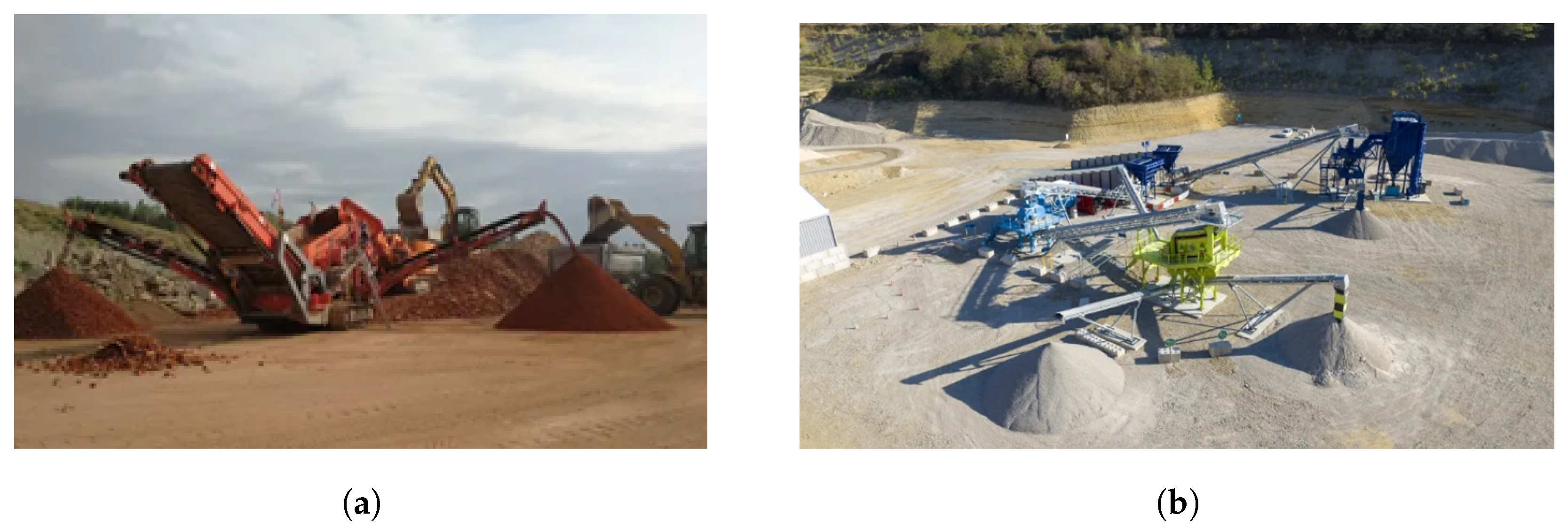
The practical production of recycled aggregates generally involves mobile or fixed crushing and screening installations, which influence the particle size distribution, particle shape, and amount of residual adhered mortar, as illustrated in Figure 1.
Figure 1.
Mobile and fixed crushing installations used for processing demolition concrete waste into recycled aggregates. (a) Mobile crushing and screening installation [15]. (b) Fixed C&D waste crushing and processing installation, Saint-Laurent-du-Mure, France [16].
3. Nanoparticles in Concrete: Types and Mechanisms
Intensive research in cement-based materials has turned to nanoparticles because they can modulate hydration kinetics, alter the architecture of the pore network, and increase the packing density of the binder matrix. At the nanoscale, their high specific surface area and small particle size enable dual functions as finely graded fillers and as heterogeneous nucleation centers for hydration phases, which, in combination, promote a more compact microstructure and enhanced mechanical properties. These outcomes have been reported across a spectrum of nano-modifiers, including silica and alumina nanoparticles, titanium dioxide, graphene-derived phases, and carbon nanotubes [17,18].
Among these additives, nanosilica is particularly prominent due to its strong pozzolanic reactivity and its capacity to stimulate additional C–S–H formation. By consuming calcium hydroxide and occupying nanometric voids, nanosilica diminishes porosity, increases matrix densification, and improves the quality of the interfacial transition zone. This effect is especially pertinent in concretes with recycled aggregates, where the aggregate phase typically introduces higher porosity and weaker paste–aggregate interfaces into the composite [13,18].
Carbon-based nanomaterials, especially single- and multi-walled carbon nanotubes, are likewise of interest because they can bridge microcracks, reinforce the microstructure, and thereby strengthen the mechanical response. Their performance, however, is highly contingent on dosage, dispersion state, and interfacial compatibility with the cementitious matrix. Inadequate dispersion facilitates agglomeration, which can suppress or even negate the expected benefits [19].
Recent findings also make clear that the response of nano-modified recycled-aggregate cementitious composites is governed by the interplay of multiple variables rather than by the nanoparticle alone. Using a Taguchi design, Lepadatu et al. studied mortars comprising demolished concrete waste aggregate, nanosilica powder, multi-walled carbon nanotubes, and polypropylene fibers. Their results underscored the decisive roles of nanoparticle content, cement dosage, water demand, fiber incorporation, and the degree of recycled aggregate substitution as interacting factors controlling mechanical performance [20].
While numerous other nanomaterials can be incorporated into cementitious matrices, the present analysis is restricted to those examined in this work, namely nanosilica, nanoalumina, graphene-derived materials, carbon nanotubes, and multi-walled carbon nanotubes [5,13,17]. Their effects are generally attributed to a set of complementary processes that include nanoscale void filling, provision of heterogeneous nucleation sites for hydration products, acceleration of cement hydration kinetics, pozzolanic consumption of calcium hydroxide, additional C–S–H formation, refinement of the pore network, and densification of the interfacial transition zone [7,13,17]. For carbon nanotubes and multi-walled carbon nanotubes, crack-bridging and microstructural reinforcement have further been identified as significant contributors to improved mechanical performance [19,21]. In concretes produced with recycled aggregates, these mechanisms assume particular relevance because they can partly offset the higher porosity, weaker adhered mortar, and less compact paste–aggregate interface that typically accompany recycled aggregates [13,20,21]. Nevertheless, the degree to which these benefits are realized depends critically on nanoparticle dosage, dispersion quality, interactions within hybrid nano-additive systems, and compatibility with the cementitious matrix [19,22,23].
4. Nanoparticle Dispersion and Agglomeration
Embedding nanoparticles in cement-based binders can densify the matrix and enhance strength and durability indices, provided that a stable and uniform dispersion is achieved throughout the paste. Owing to their nanoscale dimensions, very large specific surface area, and high surface energy, these particles readily coalesce into agglomerates through van der Waals attractions. Such clustering diminishes the accessible reactive surface, induces microstructural heterogeneity, and promotes weak loci with irregular hydration products in the hardened material [5,24].
Agglomeration also perturbs fresh-state rheology. Increasing nanoparticle dosage typically elevates water demand and compromises workability when dispersion is inadequate during pre-processing or mixing. Insufficient dispersion therefore affects not only slump and mix cohesiveness, but also hydration kinetics, pore-structure evolution, and the development of the interfacial transition zone. Rahman et al. [25] demonstrated that applying high-shear dispersion to nanoalumina decisively modifies the strength, durability, and microstructural attributes of concrete, underscoring that dispersion energy and the spatial distribution of particles are governing variables in nano-modified systems.
A range of protocols has been advanced to improve nanoparticle distribution, including direct mechanical mixing, aqueous pre-dispersion, preparation of colloidal suspensions, high-shear processing, ultrasonic agitation, and the use of dispersants or superplasticizers. Ultrasonication and other high-energy methods are commonly adopted to disrupt clusters and stabilize nano-suspensions, yet their efficacy depends on sonication duration, energy input, particle chemistry, solids loading, and compatibility with cement and admixtures. Without rigorous control of these factors, dispersion may remain partial or revert to re-agglomeration during mixing and early hydration.
In concretes with recycled aggregates, dispersion challenges are exacerbated by the aggregates’ elevated porosity, higher water absorption, and irregular surface morphology. A significant fraction of the mixing water can be sequestered within the recycled aggregate, reducing the free water available for nanoparticle dispersion and cement hydration. Consequently, the performance of nano-modified recycled-aggregate systems is a function not only of nanoparticle type and dosage, but also of water availability, aggregate absorption capacity, mixing sequence, and compatibility among nanoparticles, cement paste, recycled aggregates, and chemical admixtures [5,24].
Dispersion is especially critical for carbon-based nanomaterials. Carbon nanotubes and multi-walled carbon nanotubes can bridge microcracks, reinforce the microstructure, and improve mechanical response only when they are individually separated and homogeneously distributed. If they remain clustered, they behave as flaws rather than reinforcements. Analogous sensitivities to dispersion govern the structural and mechanical contributions of other nano-additives, such as aluminum oxide and nanodiamond systems [26].
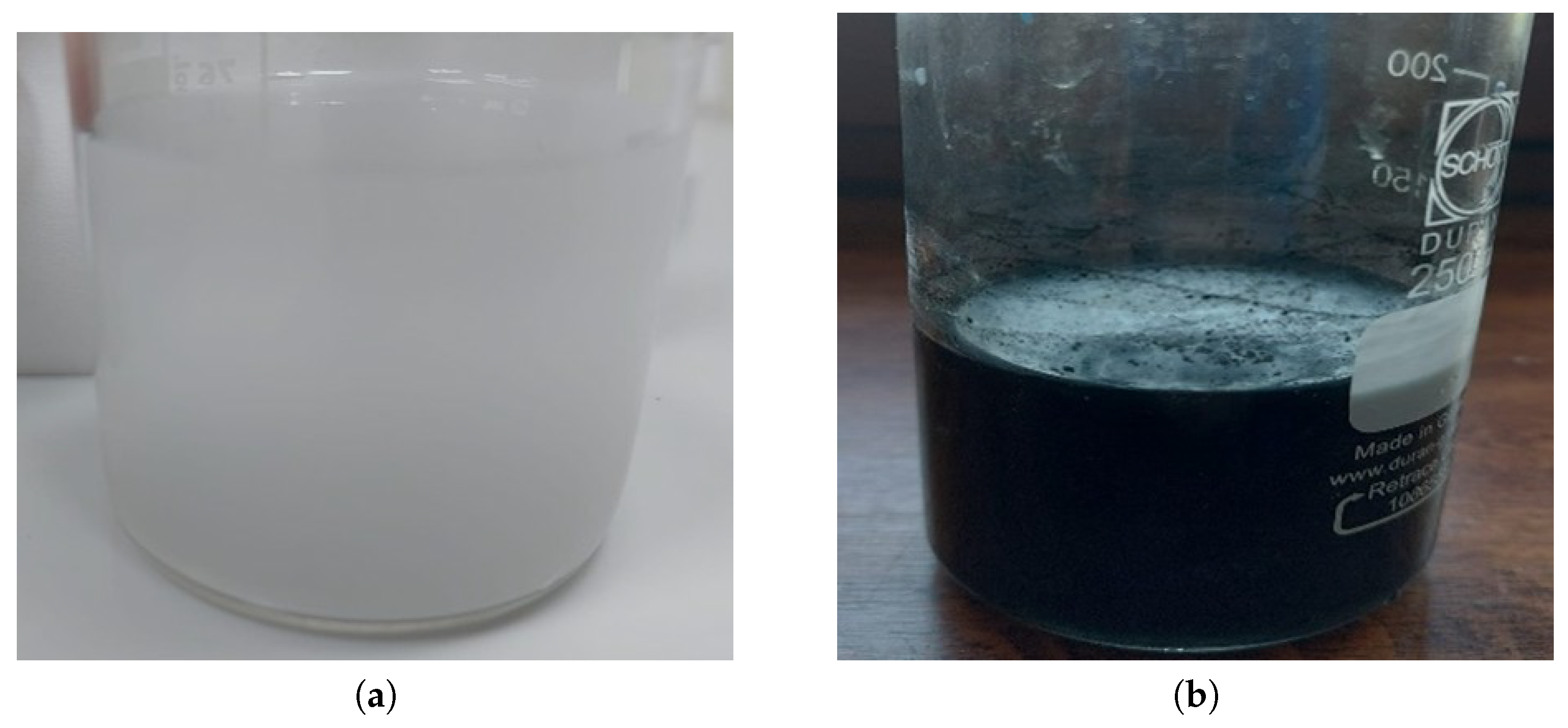
Recent studies on mortars incorporating demolished concrete waste aggregate, nanosilica powder, multi-walled carbon nanotubes, and polypropylene fibers reaffirm that the properties of nano-modified recycled-aggregate composites emerge from the convolution of several interdependent parameters. Lepadatu et al. [20] reported that nanoparticle dosage, cement content, water demand, fiber inclusion, recycled aggregate replacement ratio, and dispersion-related phenomena act synergistically to control mechanical behavior. This evidence argues against treating nanoparticles as standalone enhancers and instead frames them as constituents whose efficacy is conditioned by interactions within the entire cementitious system. Across the author’s experimental program [27], ultrasonication consistently enhanced the dispersion of nanosilica and carbonaceous nanomaterials in aqueous media, as illustrated in Figure 2. In practice, however, the protocol was not straightforward.
Figure 2.
Ultrasonic dispersion of nanomaterials used in cementitious composites: (a) homogeneous nanosilica suspension after sonication; (b) dispersion of graphene nanoplatelets in aqueous solution following ultrasonic treatment [27].
The images highlight the role of ultrasonic treatment in improving nanoparticle stability and reducing agglomeration in aqueous media. Such dispersion control is essential for obtaining a more homogeneous distribution of nano-additives within cementitious matrices and, consequently, for enhancing the uniformity of nano-modified concrete mixtures. In summary, achieving robust nanoparticle dispersion is a pivotal processing operation for nano-modified cementitious composites. Benefits such as pore-size refinement, matrix densification, accelerated hydration, and improved interfacial transition zones are realized only when agglomeration is mitigated and physicochemical compatibility with the cementitious milieu is secured. In recycled-aggregate concrete, this requirement becomes even more stringent, since the intrinsic porosity and absorptivity of recycled aggregates disturb the water balance, destabilize dispersion, and complicate matrix development. The continuous delivery of acoustic energy caused a gradual temperature rise in the suspension, which necessitated an auxiliary cooling step to limit overheating and maintain colloidal stability. These findings indicate that effective ultrasonic dispersion depends not only on the magnitude of the energy input, but also on the coordinated control of sonication duration, thermal evolution, suspension stability, and compatibility with the subsequent cementitious mixture.
5. Mechanical Performance Overview
5.1. Introduction
In nano-modified cementitious composites, the mechanical response arises from the concerted interplay of tighter particle packing, accelerated hydration kinetics, progressive refinement of the pore network, and densification of the interfacial transition zone. These processes are particularly significant in concretes incorporating recycled aggregates, where adhered residual mortar, elevated intrinsic porosity, and weaker aggregate-to-paste interfaces can hinder strength development and exacerbate variability in mechanical performance. When appropriately selected and dosed, nanoparticles can partially mitigate these shortcomings by producing a denser binder matrix and reinforcing the bond between the new paste and the recycled aggregate surface.
That said, improvements are not guaranteed. The final outcome is governed by nanoparticle chemistry and dosage, the effectiveness of dispersion, the concomitant water demand, the cement content, and the specific characteristics of the recycled aggregate. Excess additions can raise water demand and induce agglomeration, which degrades workability and introduces local defects into the hardened microstructure. Consequently, any enhancement in compressive, flexural, or tensile properties should be interpreted in parallel with dispersion efficiency and mixture compatibility [20,24,25].
5.2. Compressive Strength
Compressive strength remains a central metric for assessing how effectively nanoscale modifications improve cement-based materials. The observed gains generally stem from interdependent mechanisms: nanoparticles obstruct fine capillary porosity, act as prolific nucleation substrates that accelerate and sustain hydration, and foster the formation of a denser, more continuous binder microstructure. In accordance with this mechanistic rationale, Rahman et al. [25] reported 27-day strength increases of 8.96%, 20.99%, and 26.99% at nanoalumina dosages of 0.5%, 1.0%, and 1.5%, respectively, attributing these improvements to microvoid occlusion, matrix densification, and enhanced cohesion within the hydration assemblages.
The magnitude of the effect is intrinsically controlled by dosage. At low to moderate additions, nanoparticles improve particle packing and support the progression of hydration, which together elevate compressive strength. Beyond the dispersion capacity of the system, however, agglomeration becomes prevalent, the effective water demand increases, and microstructural uniformity deteriorates, outcomes that collectively diminish strength. These constraints are especially pronounced in recycled-aggregate concrete, where the high absorptivity of recycled aggregates perturbs the mixture’s water balance, thereby compromising nanoparticle dispersion as well as the hydration processes required to develop a homogeneous and compact matrix.
5.3. Flexural and Tensile Performance
Flexural and tensile behavior is highly sensitive to microstructural defects, the continuity of the pore network, and the condition of the aggregate–paste interfacial zone. In concretes incorporating recycled aggregates, these responses are typically degraded to a greater extent than compressive strength, because crack initiation and propagation are strongly influenced by residual adhered mortar, increased interfacial porosity, and pre-existing microcracks within the recycled aggregate particles.
Nanoparticles can enhance bending and tension-related performance by refining the pore structure, increasing matrix packing density, and fortifying the interfacial transition zone. Rahman et al. [25] showed that nanoalumina dispersed under high shear modifies strength, durability metrics, and microstructural characteristics, emphasizing that the functional efficacy of nano-additives is contingent on dispersion quality. Beskopylny et al. [26] similarly reported microstructural gains in high-strength concrete containing nanodiamonds and alumina nanoparticles.
Carbon-based nanomaterials, especially carbon nanotubes and multi-walled carbon nanotubes, can bridge defects and retard microcrack growth when they are uniformly dispersed within the cementitious matrix. The magnitude of the reinforcement depends on achieving homogeneous dispersion, establishing robust bonding with cement hydration products, and ensuring compatibility with the selected mix design.
In mortars produced with aggregates from demolished concrete and supplemented with nanosilica powder, multi-walled carbon nanotubes, and polypropylene fibers, Lepadatu et al. [20] demonstrated that mechanical performance arises from the coupled effects of nanoparticle dosage, the level of recycled aggregate substitution, water demand, cement content, and fiber addition. Accordingly, flexural and tensile outcomes should be interpreted not as a direct result of nanoparticle addition in isolation, but as the integrated consequence of matrix densification, crack-control mechanisms, dispersion effectiveness, and mixture compatibility.
5.4. Influence of Dispersion on Mechanical Response
In nanoparticle-modified concretes containing recycled aggregates, the dispersion quality of the nanophase is the principal determinant of mechanical response. When a homogeneous distribution is achieved, particle packing is intensified, the cementitious matrix is compacted, the capillary pore network is constricted, and the interfacial transition zone is consolidated. These microstructural refinements manifest as higher compressive, flexural, and tensile strengths, with disproportionately large benefits in mixtures where recycled aggregates introduce elevated porosity, remnants of adhered mortar, and weakened aggregate–paste interfaces. Consistent relationships among nanomaterial addition, microstructural densification, and mechanical improvement have also been documented by Verma et al. [24] and Shahpari et al. [23].
In contrast, inadequate dispersion promotes agglomeration, elevates water demand, impairs fresh-state workability and rheology, and seeds localized weak zones in the hardened composite. Under such conditions, nanoparticles cease to function as microstructural refiners and instead act as defects. Rahman et al. [25] showed that high-shear dispersion of nanoalumina critically influences strength, durability, and microstructural evolution, thereby establishing that dispersion protocols directly govern the efficiency of nano-modification.
This sensitivity is especially pronounced for carbon nanotubes and multi-walled carbon nanotubes, whose crack-bridging capacity and reinforcing efficiency depend on debundling, spatial homogeneity, and robust interfacial bonding with hydration products. Deng et al. [19] demonstrated that industrial-grade multi-walled carbon nanotubes affect both microstructure and overall mechanical behavior, while Kanagaraj et al. [22] examined their influence on flexural response alongside the associated microstructural attributes. Taken together, these studies indicate that the structural contribution of carbon-based nanomaterials is dictated as strongly by dispersion within the cementitious matrix as by intrinsic material properties.
In mortars incorporating demolished concrete waste aggregate, nanosilica powder, multi-walled carbon nanotubes, and polypropylene fibers, Lepadatu et al. [20] concluded that mechanical performance arises from the coupled effects of nanoparticle dosage, mixture water requirement, recycled-aggregate replacement level, cement content, fiber addition, and dispersion-driven mechanisms. Consequently, dispersion should be regarded as a primary performance variable rather than a routine preparatory step.
5.5. Durability, Practical Aspects and Research Gaps
The durability of recycled-aggregate concrete modified at the nanoscale is principally dictated by how effectively nano-additives reorganize the transport-governing microstructure. Through refinement of the capillary pore network, densification of the binder matrix, and reinforcement of the interfacial transition zone, nanoparticles can depress sorptivity, lower intrinsic permeability, slow chloride ingress, and enhance resistance to carbonation and other aggressive environments. These mechanisms are especially decisive in recycled-aggregate concrete, where adhered mortar and interfacial flaws elevate pore connectivity and facilitate the penetration of deleterious species. Studies employing nanosilica, graphene oxide, nanoalumina, and cognate nanomaterials consistently show that durability enhancements are attainable, yet the magnitude and reliability of these gains are highly contingent on dosage, dispersion state, and the chemical and physical compatibility among the nano-additive, the cementitious matrix, and the recycled aggregate fraction [5,13,21,24].
From an implementation perspective, nanoparticle adoption must be evaluated not only on achieved performance but also on technological practicality. The production, handling, dispersion, and incorporation of nanoparticles introduce added costs, elevated energy use, stricter safety requirements, and tighter quality-control protocols. High-shear mixing and ultrasonication can markedly improve particle distribution and colloidal stability; however, they demand careful control of energy input, temperature rise, processing duration, and interactions with chemical admixtures. Consequently, the sustainability of nano-modified recycled-aggregate concrete cannot be inferred solely from substituting natural aggregates. It requires a balanced appraisal that integrates resource conservation, potential extension of service life, process complexity, nanoparticle-specific impacts, and the feasibility of deployment at industrial scale [20,25].
Significant knowledge gaps still constrain the credible transfer of laboratory findings to field practice. Long-term durability datasets generated under realistic, coupled exposure conditions remain scarce, particularly for complex formulations that combine recycled aggregates with nanoparticles, fibers, and chemical admixtures. In addition, standardized methods for dispersion control, mix-design optimization, and rigorous quantification of nanoparticle spatial distribution are insufficiently mature. Future research should therefore forge stronger linkages among microstructural descriptors, mechanical response, durability indicators, and environmental assessment, while explicitly addressing reproducibility, pathways to scale-up, and cost-effectiveness. Such an integrated framework is essential to determine whether nanomodification provides a technically reliable and environmentally defensible strategy for recycled-aggregate cementitious systems.
More broadly, the advancement of nano-modified recycled-aggregate cementitious materials is poised to become increasingly salient for the construction sector. The continued rise in construction and demolition waste necessitates dependable pathways for recovery, recycling, and reintegration into high-performance matrices, while emergent technologies such as 3D concrete printing will intensify demand for finely engineered, property-controlled cementitious feedstocks. Within this forward-looking context, the author’s evolving notion of “Quantum Concrete” should be interpreted not as a fully delimited class of materials but as a research trajectory that progressively reduces the characteristic length scale of matrix constituents and interrogates how tailored nanoscale interactions can produce denser, more durable, and more resource-efficient composites. Although still conceptual, this perspective underscores the need to align recycled-resource valorization with nanoparticle engineering, digital fabrication, and advanced mix-design methodologies in the pursuit of next-generation cement-based materials.
6. Conclusions
This review indicates that nanoparticles can enhance the performance of cementitious composites incorporating recycled aggregates, yet their influence is contingent on the global mixture design and cannot be presumed a priori. The use of recycled aggregates typically entails elevated porosity, remnants of adhered mortar, increased water uptake, and a weakened interfacial transition zone, all of which can depress mechanical properties and exacerbate durability risks. Within this framework, nano-additives can partly counteract these shortcomings by refining the pore network, densifying the matrix, accelerating hydration kinetics, fostering additional C–S–H formation, and strengthening the aggregate–paste interface.
The literature attributes these improvements to several mechanisms, including filler action, provision of heterogeneous nucleation sites, pozzolanic reactions for reactive nanoparticles such as nanosilica, pore-size refinement, densification of the interfacial transition zone, and crack-bridging imparted by carbon-based nanomaterials. The efficacy of these pathways depends critically on particle type and morphology, dosage, dispersion quality, water demand, and compatibility with cement, chemical admixtures, fibers, and recycled aggregates. Overdosage or insufficient dispersion favors agglomeration, reduces workability, introduces localized microstructural defects, and can ultimately diminish rather than improve mechanical and durability outcomes.
The surveyed evidence further shows that mechanical strength alone is an inadequate metric for evaluating nano-modified concretes with recycled aggregates. Durability indicators such as water absorption and sorptivity, permeability, resistance to chloride ingress and carbonation, performance under sulfate and acid exposure, freeze–thaw resistance, shrinkage behavior, and long-term volumetric stability must be assessed in conjunction with microstructural characterization. In parallel, environmental relevance warrants careful scrutiny, since benefits ascribed to recycled aggregate use can be undermined by the cost, energy intensity, safety constraints, and technological complexity associated with nanoparticle manufacture and dispersion.
Taken together, nanoparticle-modified cementitious materials with recycled aggregates constitute a promising yet still emergent domain. Priority should be given to standardized dispersion protocols, mixture designs optimized for coupled fresh and hardened properties, evaluation of long-term durability under realistic exposure scenarios, demonstration of reproducibility at pilot and industrial scales, and the development of quantitative relationships linking microstructure, mechanical response, durability, and environmental performance. In this broader context, the notion of “Quantum Concrete” is best regarded as a forward-looking research trajectory aimed at progressive, multiscale engineering of the cementitious matrix, rather than a fully realized class of materials. Such directions are poised to gain importance as recovery of construction and demolition waste, valorization of recycled resources, and digitally enabled fabrication technologies such as 3D concrete printing continue to expand.
Author Contributions
Conceptualization, D.L. and I.C.; methodology, D.L.; validation, D.L., L.E.J., I.C. and I.S.E.; formal analysis, D.L. and I.S.E.; investigation and material characterization, L.E.J. and I.S.E.; resources, I.C.; writing—original draft preparation, I.C. and D.L.; writing—review and editing, D.L. and L.E.J.; supervision, D.L.; project administration, D.L. All authors have read and agreed to the published version of the manuscript.
Funding
This work is associated with the innovation project “Development and Optimization of Eco-Sustainable Cementitious Materials with Green Quantum Nanoparticles and Recycled Construction Waste”, selected for funding under the “Innovation Vouchers 2026–2027” programme of the National Agency for Research and Development (ANCD), Republic of Moldova.
Institutional Review Board Statement
Not applicable.
Informed Consent Statement
Not applicable.
Data Availability Statement
No new data were created or analyzed in this study.
Acknowledgments
The authors acknowledge CONS ART ENGINEERING SRL and the Technical University of Moldova for institutional support. This work is also connected to the PhD research of Igor Ceban, supervised by Daniel Lepadatu. During the preparation of this manuscript, the authors used ChatGPT (GPT-5.5 Instant) for the purposes of English translation, grammar correction, refinement of technical wording in selected parts of the manuscript, including the abstract and layout. The authors have reviewed and edited the output and take full responsibility for the content of this publication.
Conflicts of Interest
The authors declare no conflicts of interest.
Abbreviations
The following abbreviations are used in this manuscript:
| RA | Recycled Aggregates |
| ITZ | Interfacial Transition Zones |
| CDW | Construction and Demolition Waste |
| MWCNT | Multi-Walled Carbon Nanotubes |
| C-S-H | Calcium-Silicate-Hydrate |
| C-A-S-H | Calcium–Alumina–Silicate–Hydrate |
References
- Papamichael, I.; Voukkali, I.; Loizia, P.; Zorpas, A.A. Construction and demolition waste framework of circular economy: A mini review. Waste Manag Res. 2023, 41, 1728–1740. [Google Scholar] [CrossRef] [Scilit] [PubMed]
- Pourkhorshidi, S.; Sangiorgi, C.; Torreggiani, D.; Tassinari, P. Using Recycled Aggregates from Construction and Demolition Waste in Unbound Layers of Pavements. Sustainability 2020, 12, 9386. [Google Scholar] [CrossRef] [Scilit]
- Bergonzoni, M.; Melloni, R.; Botti, L. Analysis of sustainable concrete obtained from the by-products of an industrial process and recycled aggregates from construction and demolition waste. Procedia Comput. Sci. 2023, 217, 41–51. [Google Scholar] [CrossRef] [Scilit]
- Al-Kheetan, M.J.; Jweihan, Y.S.; Rabi, M.; Ghaffar, S.H. Durability enhancement of concrete with recycled concrete aggregate: The role of nano-ZnO. Buildings 2024, 14, 353. [Google Scholar] [CrossRef] [Scilit]
- Allujami, H.M.; Abdulkareem, M.; Jassam, T.M.; Al-Mansob, R.A.; Ng, J.L.; Ibrahim, A. Nanomaterials in recycled aggregates concrete applications: Mechanical properties and durability. A review. Cogent Eng. 2022, 9, 2122885. [Google Scholar] [CrossRef] [Scilit]
- Lepadatu, D.; Judele, L.; Bucur, D.R.; Ciubarca, P.; Proaspat, E. Performance investigation of ecoconcrete with recycled aggregates enhanced by nanoparticles. In Proceedings of the 25th International Multidisciplinary Scientific GeoConference Proceedings SGEM 2025, Nano, Bio, Green, and Space Technologies for a Sustainable Future, Albena, Bulgaria, 29 June–6 July 2025; Volume 25, pp. 69–71. [Google Scholar] [CrossRef] [Scilit]
- Haruehansapong, S.; Khamput, P.; Yoddumrong, P.; Kroehong, W.; Thuadao, V.; Abdulmatin, A.; Senawang, W.; Pulngern, T. Enhancement of recycled aggregate concrete properties through the incorporation of nanosilica and natural fibers. Heliyon 2024, 10, e39924. [Google Scholar] [CrossRef] [Scilit] [PubMed]
- Assis, D.A.S.; Bragança, M.D.O.G.P. Pozzolanic effect investigation of silica hydrosol (SH) nanoparticles with different granulometric distributions dispersed in cement paste. Rev. Matér. 2020, 25, e-12888. [Google Scholar] [CrossRef] [Scilit]
- Birgisson, B.; Mukhopadhyay, A.K.; Geary, G.; Khan, M.; Sobolev, K. Nanotechnology in Concrete Materials: A Synopsis; Transportation Research Circular E-C170; Transportation Research Board of the National Academies: Washington, DC, USA, 2012. [Google Scholar]
- Amadi, I.G.; Beushausen, H.; Alexander, M.G. Multi-technique approach to enhance the properties of fine recycled aggregate concrete. Front. Mater. 2022, 9, 893852. [Google Scholar] [CrossRef] [Scilit]
- Antunes, A.; Costa, H.; do Carmo, R.; Júlio, E. A comprehensive review of sustainable use of construction and demolition waste as recycled aggregates in the production of concrete—Properties, mix design and on-site applications. Constr. Build. Mater. 2025, 482, 141733. [Google Scholar] [CrossRef] [Scilit]
- Palii, O.; Sirico, A.; Belletti, B.; Bernardi, P. Building a sustainable future: Database of concrete with recycled aggregates from construction and demolition waste. Procedia Struct. Integr. 2024, 59, 167–174. [Google Scholar] [CrossRef] [Scilit]
- Zhan, P.; Xu, J.; Wang, J.; Zuo, J.; He, Z. A review of recycled aggregate concrete modified by nanosilica and graphene oxide: Materials, performances and mechanism. J. Clean. Prod. 2022, 375, 134116. [Google Scholar] [CrossRef] [Scilit]
- Lepadatu, D.; Judele, L.; Entuc, I.; Proaspat, E.; Sandulache, G. Nanoparticles and recyclable waste in construction materials. From practical necessity to advanced solutions. Int. Multidiscip. Sci. GeoConf. Surv. Geol. Min. Ecol. Manag. SGEM 2024, 24, 231–238. [Google Scholar] [CrossRef] [Scilit]
- Holcim. Ecocycle. Reproduced with Permission. Available online: https://www.holcim.com/building-materials-solutions/ecocycle (accessed on 17 November 2026).
- Holcim. Advanced Crushing Processing System in France. Available online: https://www.holcim.com/who-we-are/our-stories/advanced-crushing-processing-system-france (accessed on 17 November 2026).
- Goel, G.; Sachdeva, P.; Chaudhary, A.K.; Singh, Y. The use of nanomaterials in concrete: A review. Mater. Today Proc. 2022, 69, 365–371. [Google Scholar] [CrossRef] [Scilit]
- Tanimola, J.O.; Effe, S. Recent advances in nano-modified concrete: Enhancing durability, strength, and sustainability through nano silica (nS) and nano titanium (nT) incorporation. Appl. Eng. Sci. 2024, 19, 100189. [Google Scholar] [CrossRef] [Scilit]
- Deng, S.; Fan, J.; Yi, B.; Ye, J.; Li, G. Effect of industrial multi-walled carbon nanotubes on the mechanical properties and microstructure of ultra-high performance concrete. Cem. Concr. Compos. 2025, 156, 105850. [Google Scholar] [CrossRef] [Scilit]
- Lepadatu, D.; Judele, L.E.; Bucur, D.R.; Simon, I.M.; Entuc, I.S.; Proaspat, E.; Teodorescu, R.I.; Kobi, A.; Garcia-Granda, S. Synergistic influence of multi-walled carbon nanotubes and nanosilica powder on mechanical performance of mortar with demolished concrete waste aggregate and polypropylene fibers addition using Taguchi design of experiment. Materials 2025, 18, 5485. [Google Scholar] [CrossRef] [Scilit] [PubMed]
- Rezaei, F.; Memarzadeh, A.; Davoodi, M.-R.; Dashab, M.-A.; Nematzadeh, M. Mechanical features and durability of concrete incorporating recycled coarse aggregate and nano-silica: Experimental study, prediction, and optimization. J. Build. Eng. 2023, 73, 106715. [Google Scholar] [CrossRef] [Scilit]
- Kanagaraj, B.; Anand, N.; Lubloy, E.; Andrushia, D. Influence of multi-walled carbon nanotube (MWCNT) on flexural behavior and microstructure characteristics of geopolymer concrete beams. Case Stud. Constr. Mater. 2024, 20, e03317. [Google Scholar] [CrossRef] [Scilit]
- Shahpari, M.; Khaloo, A.; Rashidi, A.; Saberian, M.; Li, J. Synergetic effects of hybrid nano-blended cement on mechanical properties of conventional concrete: Experimental and analytical evaluation. Structures 2023, 48, 1519–1536. [Google Scholar] [CrossRef] [Scilit]
- Verma, S.K.; Daniyal, M.; Goldar, D. Comparative study on the mechanical and durability performance of concrete incorporating nanomaterials. Next Nanotechnol. 2026. [Google Scholar] [CrossRef] [Scilit]
- Rahman, I.; Dev, N.; Arif, M.; Paruthi, S.; Khan, A.H.; Yousif, F.N.K.; Alam, M.M. Effect of high shear-dispersed nano-alumina on concrete strength, durability, and microstructure. Sci. Rep. 2026, 16, 5346. [Google Scholar] [CrossRef] [Scilit] [PubMed]
- Beskopylny, A.N.; Özkılıç, Y.O.; Stel’makh, S.A.; Shcherban, E.M.; Elshaeva, D.; Chernik, A.; Madenci, E.; Aksoylu, C. The influence of nanodiamonds and aluminum oxide nanoparticles on the structure and properties of high-strength concrete. Civ. Eng. J. 2025, 11, 5049–5067. [Google Scholar] [CrossRef] [Scilit]
- Lepadatu, D.; Judele, L.; Rusu, I.; Proaspat, E.; Ciubarca, P. Nanomatériaux, méthodes de dispersion et la compatibilité avec la recette du béton. In Proceedings of the International Conference “Probleme Actuale În Urbanism Şi Arhitectură”, 12th Edition, Chişinău, Moldova, 15 November 2024. [Google Scholar]
Disclaimer/Publisher’s Note: The statements, opinions and data contained in all publications are solely those of the individual author(s) and contributor(s) and not of MDPI and/or the editor(s). MDPI and/or the editor(s) disclaim responsibility for any injury to people or property resulting from any ideas, methods, instructions or products referred to in the content. |
© 2026 by the authors. Licensee MDPI, Basel, Switzerland. This article is an open access article distributed under the terms and conditions of the Creative Commons Attribution (CC BY) license.