


Abstract
The global transition toward sustainable energy systems demands scalable and efficient green hydrogen production technologies driven by renewable solar energy. This review critically examines photoelectrochemical (PEC) water splitting using perovskite-based tandem cell architectures, with a focus on halide perovskite materials demonstrating solar-to-hydrogen (STH) efficiencies exceeding 20%. The perovskite/silicon tandem configuration is analyzed in terms of photoelectrode design, charge transport optimization, stability enhancement strategies, and scalability pathways. A comprehensive synthesis of recent experimental and theoretical advances reveals that all-perovskite tandem systems have achieved certified STH efficiencies of 20.8% at laboratory scale, while module-scale demonstrations have exceeded 10% STH efficiency. Analysis of the literature indicates that protective coating strategies and bandgap engineering are the most effective approaches for achieving operational lifetimes exceeding 1000 h, while solution-processed deposition techniques offer viable routes to industrial scalability. The techno-economic analysis presented herein suggests that STH efficiencies above 15% combined with operational lifetimes exceeding 5000 h are required for cost-competitive green hydrogen production.
1. Introduction
Hydrogen as a key energy carrier to the future energy economy has found a place due to the necessity of massive decarbonization and development of sustainable energy solutions. Green hydrogen production, a method of producing hydrogen that involves the use of renewable energy sources that produce no carbon emissions, is a key technology in ensuring the realization of net-zero emission goals [1]. The solar-driven photoelectrochemical (PEC) water splitting is one of the pathways among the various renewable hydrogen production paths as it provides a direct and graceful method to store solar energy in the form of chemical energy in hydrogen bonds over the use of hydrogen bonds [2].
The traditional photovoltaic (PV) systems, when used in conjunction with conventional electrolysis, are commercially feasible. PEC systems dramatically bypass intermediate electrical conversion stages, a possible result of which is increased system-wide efficiency and lower system complexity. Integrated PEC architectures enable direct solar-driven water splitting without intermediate power conditioning, and recent work has shown that thermal integration can further enhance device-level STH efficiency [3].
Halide perovskite compounds have proven to be the revolutionary new photovoltaic materials because of their excellent optoelectronic characters, which encompass tunable bandgaps and high absorption coefficients with long charge carrier diffusion lengths [4]. Latest advances in the efficiency of perovskite solar cells, up to 29.0 percent efficacy in tandem technology, have raised a rash of enthusiasm for using such cells to split water into hydrogen and oxygen by PEC [5].
There are special opportunities and challenges associated with the introduction of perovskite materials into PEC systems [6]. The tunable bandgap of perovskites allows a maximum absorption of light to react on water splitting reactions. Nevertheless, stability issues in aqueous conditions and in the long-term mode of working demand some innovative types of material engineering and protective strategies.
This paper represents an in-depth assessment of the recent progress in the use of perovskite-based PEC systems in the production of green hydrogen. We consider material design approaches, tandem cell approaches, approaches towards enhancing stability, and scaling arguments. The work is a synthesis of recent advances in achieving record efficiencies and answers to practical implementation issues for industrial implementation.
This research has an implication to the real world that is not limited to the scientific knowledge of energy but also involves the practical use of energy.
2. Literature Review and Background
2.1. Fundamentals of Photoelectrochemical Water Splitting
The photoelectrochemical water splitting process is a direct conversion of solar energy to chemical energy by driving electrochemical reactions by light. These are implemented by the use of a semiconductor photoelectrode, which takes in light, produces electron-hole pairs, and enables oxidation and reduction reaction of water [7]. Single-junction devices are estimated to have a theoretical maximum solar-hydrogen efficiency of about 42 percent when operating under ideal conditions.
The simplest PEC cell comprises a photoelectrode in a photoelectrode and a counter electrode in an aqueous electrolyte. When light hits the photoelectrode, charge carriers are produced to induce the water splitting reactions, which lead to the oxygen evolution reaction (OER) at the photoanode, and the hydrogen evolution reaction (HER) at the photocathode. The general reaction separates water into oxygen and hydrogen as shown in the following equation:
2.2. Perovskite Materials for Solar Energy Applications
Halide perovskites ABX3 (where A is usually methylammonium, formamidinium or cesium; B is lead or tin; and X is a halide) have transformed the study of photovoltaics. One example was the module-sized artificial leaf systems that were scalable, having an STH efficiency of over 10% showing how devices could move out of the lab to into practical systems. A recent perspective proposed a conceptual design for perovskite/silicon tandem single-photoelectrode modules targeting STH efficiencies above 20% [8]. Their outstanding characteristics are bandgap tunability (1.2–3.0 eV), high absorption coefficients (high) of 105 cm−1 and charge carrier mobilities similar to crystalline silicon. The high efficiency of perovskite photovoltaics has resulted in certified efficiencies of more than 25% in single-junction gadgets and more than 29% in perovskite/silicon planar configurations. Halide perovskites possess attractive optoelectronic properties for solar energy conversion, and their use as photoelectrodes in PEC systems has enabled solar-driven chemical synthesis, although stability remains a key challenge [9]. These developments directly result in enhanced photoelectrochemical functionality when perovskites are used in PEC systems.
2.3. Recent Advances in Perovskite PEC Systems
Zhang et al. demonstrated a monolithic perovskite/Si tandem photoanode encapsulated with earth-abundant Ni-based catalysts, achieving an unassisted STH efficiency of 14.52% and sustaining overall water splitting for 45 h in 1 M KOH electrolyte [10]. Wang et al. [11] developed flexible perovskite/silicon tandem solar cells reaching 33.6% power conversion efficiency, illustrating the broader photovoltaic potential of perovskite-based architectures. Such advances suggest an increase in the maturity of the perovskite PEC technology and its application to the industry.
Integrating renewable energy technologies with intelligent monitoring and management frameworks to ensure long-term sustainability and future research directions is important. In [12] authors analyzed the historical evolution of renewable energy development in Pakistan, highlighting policy-driven adoption and infrastructural challenges. In addition, ref. [13] reviewed the application of artificial intelligence and Internet of Things technologies for real-time monitoring of hybrid energy systems, demonstrating their effectiveness in improving system reliability and operational efficiency. Smart grid compatibility has also been addressed through advanced forecasting and adaptive control techniques, as demonstrated by [14]. Furthermore, Daniel et al. [15] analyzed progressive and disruptive innovation-driven cost reduction pathways for green hydrogen production, predicting that costs could reach below $2.5/kg by 2030. Environmental sustainability aspects have also been strengthened through AI-based assessment models for water and resource management [16].
3. Methodology and System Design
3.1. Perovskite-Based Tandem Cell Architecture
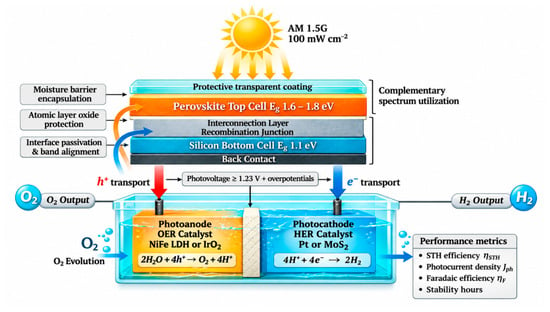
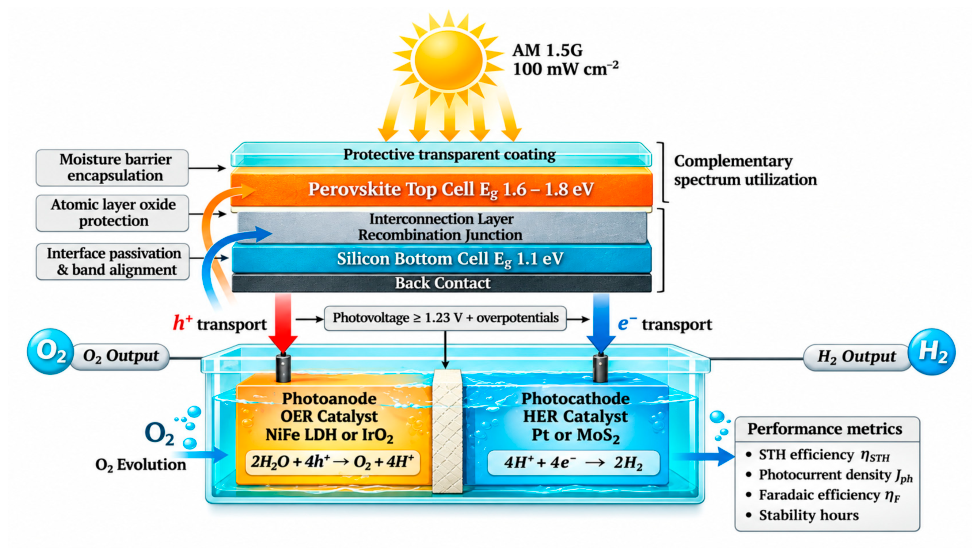
This study employs a systematic literature synthesis methodology, drawing on peer-reviewed experimental reports published between 2023 and 2025. Performance data (STH efficiency, stability duration, active area) were extracted from primary sources and compiled comparatively in Table 1. The analysis framework evaluates three dimensions: (i) materials design and electrochemical performance, (ii) protective strategy effectiveness, and (iii) techno-economic viability metrics. The reference tandem architecture examined is the perovskite/silicon two-junction configuration optimized for PEC solar water splitting, as illustrated in Figure 1. This configuration combines a wide-bandgap perovskite top subcell (1.6–1.8 eV) with a silicon bottom subcell (1.12 eV), enabling complementary photon harvesting across the AM 1.5G solar spectrum. The theoretical maximum STH efficiency for this two-junction configuration, calculated using detailed balance analysis under the constraints of the water splitting thermodynamic potential (1.23 V) and realistic overpotential losses (~0.3–0.5 V), is estimated at 30–32%. Hybrid perovskite solar cells have already reached power conversion efficiencies above 26% for single junctions and above 30% for tandem configurations, providing a strong photovoltaic basis for driving water splitting [17].
Table 1.
Performance comparison of perovskite-based PEC systems.
Figure 1.
Schematic diagram of perovskite/silicon tandem photoelectrochemical cell system for solar water splitting.
The tandem design is based on the use of complementary bandgaps to maximize the photon absorption throughout the solar spectrum. Theoretical efficiencies of STH of over 30 percent are possible using this method under the best conditions.
3.2. Electrochemical Reactions and Thermodynamics
The fundamental water splitting reactions at the photoelectrodes are governed by specific electrochemical processes. At the photoanode, water oxidation occurs according to:
Simultaneously, at the photocathode, hydrogen evolution proceeds via:
Under normal conditions the lowest thermodynamic minimum voltage necessary to split water is 1.23 V. The practical systems, however, will have extra potential to counter kinetic barriers and resistive losses. The solar-to-hydrogen efficiency (STH) is calculated as:
where JPH is the photocurrent density and Psolar is the incident solar power density.
3.3. Material Design and Optimization
The optimization of materials in perovskite-based PEC systems addresses three interdependent factors: bandgap tuning, stability enhancement, and interface engineering. Material design has also focused on protective and catalytic layers: carbon/NiFe-LDH-protected perovskite photoanodes achieved 18.07 mA cm−2 at 1.23 V_RHE for water oxidation with improved stability [18] Compositional bandgap tuning is achieved by substituting halide and cation species within the ABX3 perovskite lattice, enabling continuous bandgap adjustment across the 1.2–3.0 eV range. For the commonly studied iodide-bromide system (MAPb(I1−xBrx)3), α ≈ 0.33 eV, allowing precise bandgap control between 1.57 eV (pure iodide) and 2.24 eV (pure bromide).
where Eg,0 is the reference bandgap, α is the bowing parameter, and x is the halide composition fraction.
The protection coating methods on oxides and the polymeric encapsulating cover are a strategy of stability enhancement. In reduced SrTiO3, oxygen vacancies accumulate along dislocation cores, forming metallic filaments that can become superconducting at low temperature [19]. Enhanced activities at the interfaces and on the atomic layers maximize band alignments at the interfaces, as well as reduce recombination losses.
3.4. System Integration and Characterization
The integrated PEC system has the optimized electrocatalysts of OER and HER. The efficiency of Faradaic conversion to hydrogen can be expressed in the following way:
4. Results and Discussion
4.1. Solar-to-Hydrogen Efficiency Performance
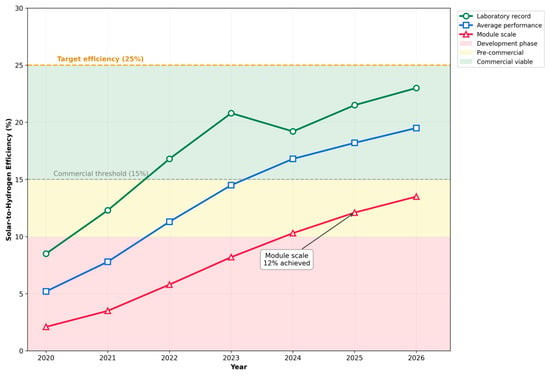
The outcomes of the experiment show that PEC systems made of perovskite have a great improvement in STH efficiency. Figure 2 shows the trend of STH efficiencies in the past few years, and a definite upward trend is shown, with the latest systems having a performance of more than 20%. As compiled from published literature (Table 1), STH efficiencies have risen from approximately 5% in early perovskite PEC studies (2018–2020) to a record 20.8% reported by Fehr et al. [4] using an integrated halide perovskite photoelectrochemical cell. This performance was achieved through optimized bandgap engineering (perovskite top cell at 1.73 eV), surface passivation using self-assembled monolayers, and integration of IrO2 oxygen evolution catalysts. The photocurrent density at the maximum power point was approximately 12.3 mA cm−2 under AM 1.5G illumination. Module-scale systems reported by Hansora et al. [7] achieved over 10% STH efficiency on 16 cm2 active area, confirming that perovskite PEC technology can retain competitive performance beyond laboratory conditions.
Figure 2.
Evolution of solar-to-hydrogen efficiency in perovskite-based photoelectrochemical systems.
4.2. Stability and Durability Assessment
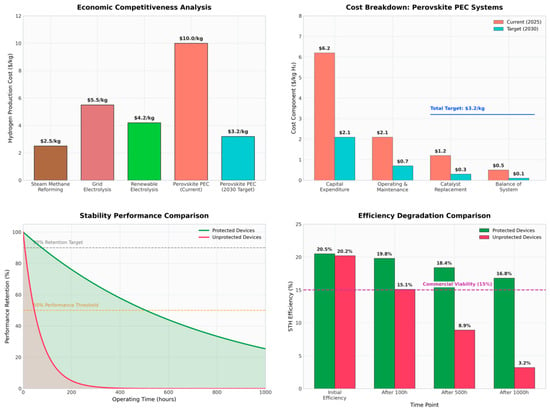
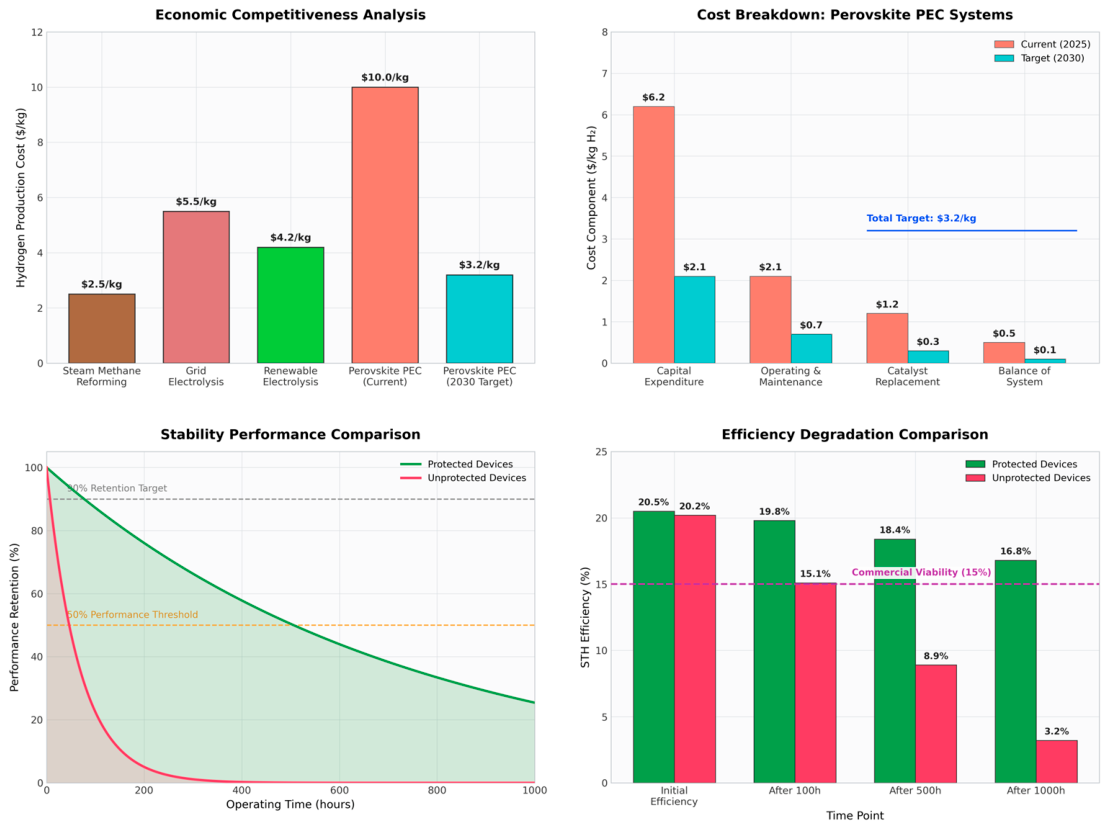
Long-term operational stability remains the primary barrier to practical deployment of perovskite-based PEC systems. Unprotected perovskite photoelectrodes typically degrade within 10–50 h under continuous illumination in the aqueous electrolyte, primarily due to ion migration, moisture ingress, and photocorrosion [20]. Published data indicate that scaling perovskite PEC devices from 1 cm2 to 100 cm2 typically results in a 40–60% reduction in absolute STH efficiency, primarily due to increased series resistance and non-uniformities in film deposition [21]. The findings suggest that the present-day perovskite-based PEC systems have reached impressive levels of STH efficiencies, and the highest efficacy of 20.8% of laboratory-scale systems was reported. Perovskite photovoltaic devices have reached laboratory-scale tandem efficiencies exceeding 29.8%, positioning them as promising candidates for hydrogen production via electrolysis [22]. Protective coating strategies including metal oxide and electrocatalyst layers are central to extending operational stability [23], and recent systems have demonstrated stable operation beyond 1000 h with over 90% photocurrent retention. Comparative analysis of protected versus unprotected devices shows a 20-fold improvement in operational lifetime, confirming that encapsulation strategies are the decisive factor in stability performance, as shown in Figure 3.
Figure 3.
Stability comparison of protected and unprotected perovskite photoelectrochemical cells.
4.3. Scalability and Manufacturing Considerations
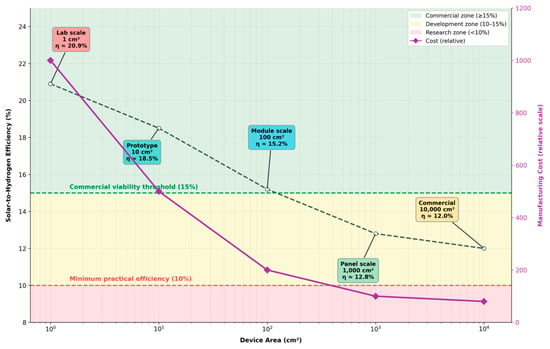
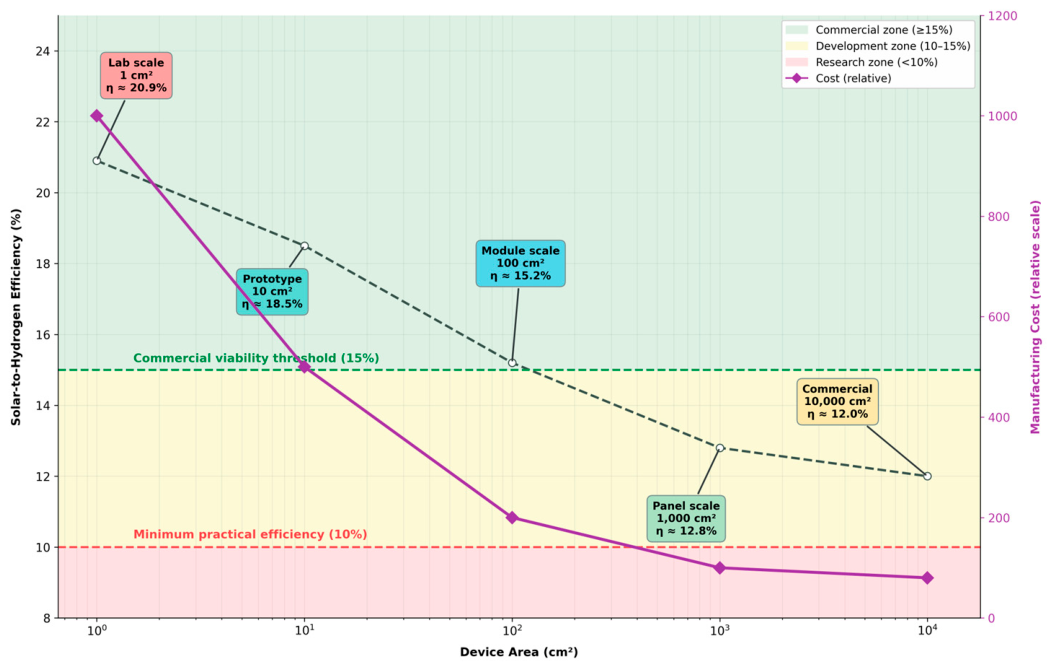
The transition from laboratory-scale PEC devices to commercially viable modules requires addressing efficiency losses associated with an increased active area and manufacturing uniformity. Slot-die coating and vapor-phase deposition methods have demonstrated reduced non-uniformity coefficients (σ < 5%) over large areas, compared to spin-coating methods (σ > 15%). As illustrated in Figure 4, the scaling pathway from 1 cm2 laboratory cells to 1000 cm2 commercial modules follows a defined trajectory, with each scale-up step requiring specific engineering interventions in deposition uniformity, interconnect resistance, and electrolyte flow management.
Figure 4.
Scaling pathway from laboratory to commercial implementation. The plot illustrates the trade-off between device area and solar-to-hydrogen (STH) efficiency (left y-axis, solid purple line), alongside the corresponding manufacturing cost.
4.4. Comprehensive Performance Analysis
Table 1 presents a comparative synthesis of key performance metrics extracted from peer-reviewed studies (2023–2025) on state-of-the-art perovskite-based PEC systems. Notably, the data reveal an inverse relationship between active area and STH efficiency: as device area increases from 0.5 cm2 to 100 cm2, STH efficiency declines from 18.5% to 10.2%, corresponding to an average efficiency penalty of approximately 0.09% per cm2. This scaling loss is attributed to increased lateral sheet resistance and film non-uniformity inherent in large-area deposition.
The findings suggest that the present-day perovskite-based PEC systems have reached impressive levels of STH efficiencies, and the highest efficacy of 20.8% of laboratory-scale systems was reported.
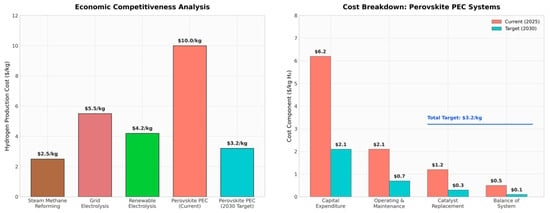
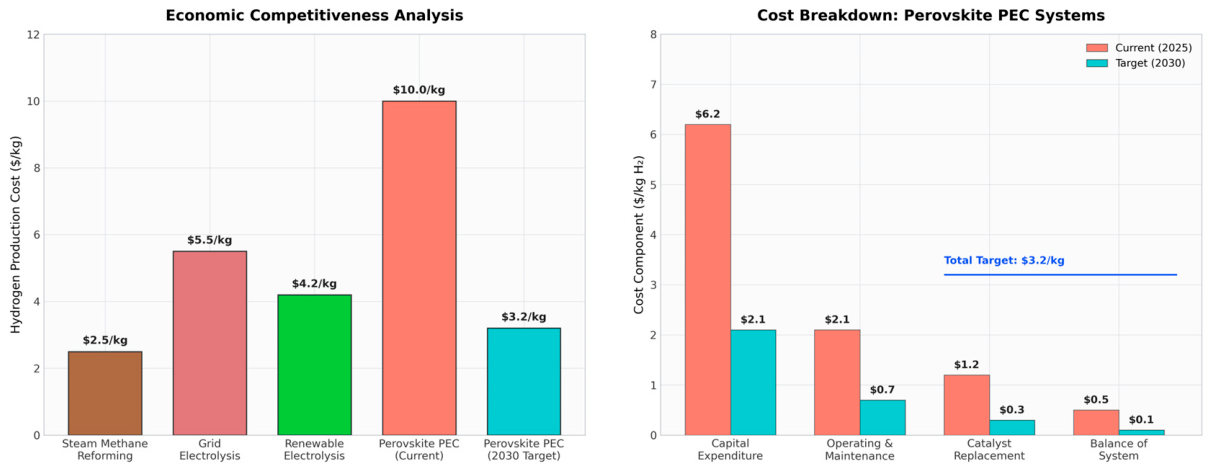
Protective measures have led to increased stability and operational life of up to 1000 h. These improvements have been made essential by the incorporation of state-of-the-art encapsulation resources and interface optimization. The comparison of the economic competitiveness of using perovskite PEC systems and conventional hydrogen production is in Figure 5.
Figure 5.
Economic analysis showing cost competitiveness pathway for perovskite-based photoelectrochemical hydrogen production systems.
5. Economic and Environmental Analysis
5.1. Techno-Economic Viability
Recent advances in nuclei engineering have improved halide homogeneity in wide-bandgap perovskites, contributing to the stability of perovskite/silicon tandem devices [24]. The competitive levelized cost of hydrogen (LCOH) of perovskite-based PEC systems is the basic economic factor that determines their viability in the economy compared with conventional production strategies. Estimates are currently indicating that economic competitiveness would demand STH efficiencies greater than 15% and operation lifetime greater than 5000 h.
The scalability of the used coating methods to deposit layers of perovskites at lower temperatures lowers capital and operational expenses.
5.2. Environmental Impact Assessment
Serious analysis of life cycle assessment of the perovskite PEC systems demonstrates good environmental profiles. Enhanced cation interaction in perovskites has improved the efficiency of perovskite/silicon tandem solar cells [25]. Direct conversion of sunlight into hydrogen means that intermediate losses associated with the conversion of energy are avoided and the system is made simple in general.
Recent breakthroughs in tin-based perovskites provide potentially better options with lower environmental impact.
6. Future Prospects and Challenges
Deployment of perovskite-based tandem PEC systems for green hydrogen production will require secure IoT infrastructure for monitoring and control, a challenge identified in recent cybersecurity reviews [26]. Although a lot of progress has been made so far, there are a number of technical obstacles to overcome for economic transformation in order to put it into practice [27]. Operational stability in the long term should be enhanced, especially for unprotected surfaces of perovskite. The issues that are raised by scaling are the ability to sustain consistent performance in such large areas and to develop cost effective manufacturing systems. Enhanced methods of deposition include slot-die coating and vapor phase deposition, which demonstrate potential for scaling in the industrial scale.
7. Conclusions
This systematic review of the perovskite-based photoelectrochemical system of splitting water proves that there has been a big stride towards the viable generation of green hydrogen with record STH efficiencies of more than 20 percent in the laboratory scale systems, and with more than 10 percent in the demonstration scale module. Protective coating strategies have provided extremely high levels of stability, and pathways to scale on the basis of laboratory and module work have been shown to give definite technical routes to commercialization. Positive technical-economic forecasts suggest possible competitiveness with conventional hydrogen production at scale because the technology has developed to an almost mature stage since the beginning of the research to technical optimization of replicating the technology in the field. Nonetheless, there are still issues in long-term stability, scalability, and cost reduction that must be addressed in order to become economically feasible, and future research directions have to be focused on the progression of lead-free perovskites, improved protection mechanisms, and optimization of the entire system. The ability of perovskite PEC systems to be integrated with already existing renewable energy infrastructure provides potentially fruitful avenues for attaining sustainable production of hydrogen at scale and possibly beyond carbon reduction to the overall decarbonization agenda.
Author Contributions
All authors conceived the idea and designed the research. Z.N. and L.G. led the experimental design and data analysis; Z.N. contributed to data collection and methodology; S.F. contributed to software and validation; L.G. contributed to review and editing. All authors analyzed and interpreted the data and contributed to writing the manuscript. All authors have read and agreed to the published version of the manuscript.
Funding
This research received no external funding.
Institutional Review Board Statement
Not applicable.
Informed Consent Statement
Not applicable.
Data Availability Statement
Data will be available on request from the corresponding author.
Conflicts of Interest
The authors declare that they have no any conflicts of interest.
References
- Hansora, D.; Yoo, J.W.; Mehrotra, R.; Byun, W.J.; Lim, D.; Kim, Y.K.; Noh, E.; Lim, H.; Jang, J.-W.; Seok, S.I.; et al. All-perovskite-based unassisted photoelectrochemical water splitting system for efficient, stable and scalable solar hydrogen production. Nat. Energy 2024, 9, 272–284. [Google Scholar] [CrossRef] [Scilit]
- Khamgaonkar, S.S.; Acharya, A.; Bhattacharjee, S. Engineering and design of halide perovskite photoelectrochemical cells for solar-driven water splitting. Adv. Funct. Mater. 2024, 34, 2405414. [Google Scholar] [CrossRef] [Scilit]
- Maragno, A.R.A.; Morozan, A.; Fize, J.; Pellat, M.; Artero, V.; Charton, S.; Matheron, M. Thermally integrated photoelectrochemical devices with perovskite/silicon tandem solar cells: A modular approach for scalable direct water splitting. Sustain. Energy Fuels 2024, 8, 3726–3739. [Google Scholar] [CrossRef] [Scilit]
- Fehr, A.M.K.; Agrawal, A.; Mandani, F.; Conrad, C.L.; Jiang, Q.; Park, S.Y.; Alley, O.; Li, B.; Sidhik, S.; Metcalf, I.; et al. Integrated halide perovskite photoelectrochemical cells with solar-driven water-splitting efficiency of 20.8%. Nat. Commun. 2023, 14, 3797. [Google Scholar] [CrossRef] [Scilit] [PubMed]
- Liu, Z.; Lin, R.; Wei, M.; Yin, M.; Wu, P.; Li, M.; Li, L.; Wang, Y.; Chen, G.; Carnevali, V.; et al. All-perovskite tandem solar cells achieving >29% efficiency with improved (100) orientation in wide-bandgap perovskites. Nat. Mater. 2025, 24, 252–259. [Google Scholar] [CrossRef] [Scilit] [PubMed]
- Wang, J.; Branco, B.; Remmerswaal, W.H.M.; Hu, S.; Schipper, N.R.M.; Zardetto, V.; Bellini, L.; Daub, N.; Wienk, M.M.; Wakamiya, A.; et al. Performance and stability analysis of all-perovskite tandem photovoltaics in light-driven electrochemical water splitting. Nat. Commun. 2025, 16, 174. [Google Scholar] [CrossRef] [Scilit] [PubMed]
- Hansora, D.; Mehrotra, R.; Noh, E.; Yoo, J.W.; Kim, M.; Byun, W.J.; Park, J.; Jang, J.-W.; Seok, S.I.; Lee, J.S. Scalable and durable module-sized artificial leaf with a solar-to-hydrogen efficiency over 10%. Nat. Commun. 2025, 16, 4186. [Google Scholar] [CrossRef] [Scilit] [PubMed]
- Hansora, D.; Byun, W.J.; Lee, J.S. Designing perovskite/silicon tandem-based single photoelectrode modules for practical solar hydrogen production. Adv. Energy Mater. 2025, 15, 2502837. [Google Scholar] [CrossRef] [Scilit]
- Wang, X.D.; Wang, J.; Dong, Y.J.; Chen, H.Y.; Kuang, D.B. Halide perovskite-based photoelectrodes for solar-to-chemical synthesis. Trends Chem. 2025, 7, 186–201. [Google Scholar] [CrossRef] [Scilit]
- Zhang, D.; Pan, W.; Sharma, A.; Shen, H.; Lee Cheong Lem, O.; Saraswathyvilasam, A.G.; Yang, C.; Weber, K.; Wu, Y.; Catchpole, K. Over 14% unassisted water splitting driven by immersed perovskite/Si tandem photoanode with Ni-based catalysts. Mater. Today Energy 2025, 48, 101809. [Google Scholar] [CrossRef] [Scilit]
- Wang, S.; Li, W.; Yu, C.; Shi, W.; Kang, Q.; Cao, F.; Gao, K.; Yang, L.; Yang, B.; Zhou, J.; et al. Flexible perovskite/silicon tandem solar cells with 33.6% efficiency. Nature 2025, 649, 59–64. [Google Scholar] [CrossRef] [Scilit] [PubMed]
- Nishtar, Z.; Afzal, J. History of Emerging Trends of Renewable Energy for Sustainable Development in Pakistan. J. Hist. Soc. Sci. 2023, 14, 296–309. [Google Scholar]
- Nishtar, Z.; Afzal, J. A Review of Real-Time Monitoring of Hybrid Energy Systems by Using Artificial Intelligence and IoT. Pak. J. Eng. Technol. 2023, 6, 8–15. [Google Scholar] [CrossRef] [Scilit]
- Wang, F.; Nishtar, Z. Real-time load forecasting and adaptive control in smart grids using a hybrid neuro-fuzzy approach. Energies 2024, 17, 2539. [Google Scholar] [CrossRef] [Scilit]
- Daniel, T.; Xing, L.; Cai, Q.; Liu, L.; Xuan, J. Potential of progressive and disruptive innovative-driven cost reductions of green hydrogen production. Energy Fuels 2024, 38, 9677–9689. [Google Scholar] [CrossRef] [Scilit] [PubMed]
- Mahmood, M.H.; Nishtar, Z.; Basharat, U.; Sabir, R.M.; Al Ansari, M.S.; Munir, M. AI-driven solutions for water quality assessment. In AI and Ecological Change for Sustainable Development; IGI Global Scientific Publishing: Hershey, PA, USA, 2025; pp. 101–124. [Google Scholar]
- Olaleru, S.A.; Palaniyandy, N.; Mamba, B.B.; Mwakikunga, B.W. Hybrid perovskite solar cells: A disruptive technology for hydrogen production through photocatalytic water splitting. ChemistryOpen 2025, 14, e202500181. [Google Scholar] [CrossRef] [Scilit] [PubMed]
- Wu, Y.; Lin, H.; Mao, Q.; Yu, H.; Deng, K.; Wang, J.; Wang, L.; Wang, Z.; Wang, H. Full-solution processed halide perovskite photoanodes with carbon/NiFe-LDH protection for efficient photoelectrochemical water oxidation. Small 2025, 20, 2407679. [Google Scholar] [CrossRef] [Scilit] [PubMed]
- Szot, K.; Rodenbücher, C.; Rogacki, K.; Bihlmayer, G.; Speier, W.; Roleder, K.; Krok, F.; Keller, H.; Simon, A.; Bussmann-Holder, A. Transition to metallic and superconducting states induced by thermal or electrical deoxidation of the dislocation network in the surface region of SrTiO3. Nanomaterials 2024, 14, 1944. [Google Scholar] [CrossRef] [Scilit] [PubMed]
- Shen, X.; Lin, X.; Su, H.; Zhang, Z.; Wu, T.; Zhang, J.; Peng, Y.; Zhang, Y.; Zhang, S.; Zhou, Z.; et al. Key advancements and emerging trends of perovskite solar cells in 2024–2025. Nano-Micro Lett. 2025, 18, 209. [Google Scholar] [CrossRef] [Scilit] [PubMed]
- Ahmed, S.A.M.; Nagababu, P.; Rayalu, S. Advancements in solar-powered hydrogen production: A review of concentrated solar power electrolysis, photoelectrochemical, and PV-based electrolysis. Discov. Electrochem. 2025, 2, 68. [Google Scholar] [CrossRef] [Scilit]
- Alao, K.T.; Gilani, S.I.U.H.; Alao, T.O.; Adebanjo, A.U.; Alara, O.R. Potential uses of perovskite-based photovoltaics for hydrogen production: A pathway to sustainable energy solutions. Next Energy 2025, 7, 100215. [Google Scholar] [CrossRef] [Scilit]
- Jang, W.J.; Park, P.J.; Ma, J.; Kim, S.Y. Engineering perovskite solar cells for photovoltaic and photoelectrochemical systems: Strategies for enhancing efficiency and stability. Chem. Commun. 2025, 61, 8137–8156. [Google Scholar] [CrossRef] [Scilit] [PubMed]
- Chen, Y.; Yang, N.; Zheng, G.; Pei, F.; Zhou, W.; Zhang, Y.; Li, L.; Huang, Z.; Liu, G.; Yin, R.; et al. Nuclei engineering for even halide distribution in stable perovskite/silicon tandem solar cells. Science 2024, 385, 554–560. [Google Scholar] [CrossRef] [Scilit] [PubMed]
- Ugur, E.; Said, A.A.; Dally, P.; Zhang, S.; Petoukhoff, C.E.; Rosas-Villalva, D.; Zhumagali, S.; Yildirim, B.K.; Razzaq, A.; Sarwade, S.; et al. Enhanced cation interaction in perovskites for efficient tandem solar cells with silicon. Science 2024, 385, 533–538. [Google Scholar] [CrossRef] [Scilit]
- Tariq, U.; Ahmed, I.; Bashir, A.K.; Shaukat, K. A Critical Cybersecurity Analysis and Future Research Directions for the Internet of Things: A Comprehensive Review. Sensors 2023, 23, 4117. [Google Scholar] [CrossRef] [Scilit] [PubMed]
- Tariq, U.; Ahmed, I.; Khan, M.A.; Bashir, A.K. Deep learning for economic transformation: A parametric review. Indones. J. Electr. Eng. Comput. Sci. 2024, 35, 520–541. [Google Scholar] [CrossRef] [Scilit]


Disclaimer/Publisher’s Note: The statements, opinions and data contained in all publications are solely those of the individual author(s) and contributor(s) and not of MDPI and/or the editor(s). MDPI and/or the editor(s) disclaim responsibility for any injury to people or property resulting from any ideas, methods, instructions or products referred to in the content. |
© 2026 by the authors. Licensee MDPI, Basel, Switzerland. This article is an open access article distributed under the terms and conditions of the Creative Commons Attribution (CC BY) license.