


Abstract
Industrial and indoor fire accidents pose serious threat to life and property. Traditional fire safety systems are based on manual reactions and frequently lack the ability to react in critical situations. In this paper, the design and implementation of an autonomous robotic system that detects, classifies, and contains fire in real time using the power of Artificial Intelligence is presented. The proposed system combines computer vision, environmental sensing, and robot control to detect fire and smoke, navigate to the fire source, and put out fires by employing a water-based fire extinguishing method. The camera module gives continuous visual input that is processed with the help of image-based fire detection algorithms, and further sensors are used for multi-modal fire detection. The system also features obstacle avoidance and IoT-enabled alerting functions, increasing the system’s operational efficiency and safety. The experimental tests show that the robot is able to identify fire in a controlled environment and take action in response to fire with only a slight delay. It demonstrates future opportunities to develop a smart fire safety system by the synergic use of Artificial Intelligence and robotics technology in the context of industrial applications.
1. Introduction
With the rise of fire incidents in industrial plants, warehouses, laboratories, commercial buildings, and residential homes, there is a critical need for intelligent and autonomous fire safety systems. By far the most common approach to traditional fire protection systems relies on smoke detectors, heat sensors, alarms, and manual firefighting operations. These systems are available to detect fire at a basic level, but typically lack adequate situational awareness, have more false alarms, and are highly reliant on human intervention in emergency situations [1]. The inability to quickly extinguish fires in hazardous areas may result in significant property damage, environmental impact, and loss of life.
The incorporation of Artificial Intelligence (AI), the Internet of Things (IoT), robotics, and computer vision technologies has been a main thrust of recent research for enhancing the efficiency and reliability of fire detection and suppression systems. Recent research has shown that the detection of fire and smoke in real-time video streams is highly accurate with the use of AI-based methods using deep learning algorithms like the YOLO algorithm and Convolutional Neural Networks (CNNs) [1,2]. On the other hand, the application of an IoT sensor network with flame sensors, gas sensors, thermal cameras, and environmental monitoring has further enhanced the early detection of fire and minimized false alarms. Additionally, autonomous firefighting robots with intelligent navigation, obstacles avoidance, and automatic suppression systems have attracted great interest, as they can reduce the risks to humans in firefighting missions [3,4].
While these advances have been made, some of the limitations of existing fire safety systems remain. The majority of the current solutions use only single-sensor detection techniques, which are susceptible to various environmental perturbations like lighting changes, smoke effects, and temperature changes. Further, most robotic-based firefighting systems are not equipped with efficient autonomous decision-making and real-time adaption capabilities in dynamic indoor environments. Some solutions are capable of high detection accuracy but require complex hardware setups, which are more appropriate for high-budget industries or smart buildings [5,6]. In addition, traditional fire suppression systems are typically reactive, and fail to offer an intelligent and coordinated response mechanism [7].
This paper aims to tackle these limitations by introducing an AI-Based Autonomous Fire Detection and Automatic Suppression Robotic system for smart industrial and indoor safety applications. The computer vision and multi-sensor fusion capabilities are integrated with autonomous robotic navigation and automatic fire suppression using water to form a single system that leverages AI. It is equipped with a Raspberry Pi-based processing unit, an ESP32-CAM for real-time video acquisition, flame and smoke detectors for environmental monitoring, an ultrasonic sensor for obstacle avoidance, and a motorized mobile robotic platform to enable autonomous motion. The fire detection mechanism consists of a mixture of computer vision methods and sensor-based validation to increase the reliability of fire detection and decrease false alarms.
When fire is detected, the robot is able to determine the fire location, move to the fire source with a set of obstacle avoidance algorithms, and ignite a mechanism to extinguish the fire without the assistance of human workers. AI and robotics combined make it possible to monitor, respond to, and fight fires intelligently in hazardous settings in real time. The proposed system is expected to minimize human exposure to unsafe fire environments and enhance response time, detection accuracy, and operational efficiency.
The rest of this paper is organized as follows: The literature review in Section 2 covers the existing works on fire detection systems using AI, autonomous firefighting robots, and intelligent suppression mechanisms. In Section 3, the proposed system architecture, hardware components, software implementation, and methodology are discussed. The experimental setup, results, and performance analysis of the proposed system are presented in Section 4. Finally, Section 5 ends the paper and discusses future improvement and research directions for intelligent fire safety systems.
2. Literature Review
On the smart fire safety system front, recent research has been directed towards the application of AI and the IoT to achieve more timely and precise fire detection. According to the papers reviewed, an automatic fire detection and suppression system with an automatic system based on the YOLO YOLO11n algorithm with high detection accuracy (with MAP: 0.94) is suggested. It is powered by an 8 MP camera, Raspberry Pi 4, servo motors, and Firebase for real-time monitoring and automatic fire extinguishing. The experimental tests showed that the spray mode has an advantage on fire extinguishing over the jet mode. The system successfully detects and extinguishes fires up to 5 m away, making it a scalable and effective system for smart homes and industrial safety applications [1].
A recent study of autonomous fire suppression systems is concerned with increasing human safety with the use of AI-based detection and location prediction of fires. In this study, fire is detected in real time using a self-stereo vision camera system and fire location prediction using YOLOv4. The CNN-based method is proved to be more accurate than traditional image processing methods, and it can detect fire events at 30 frames per second. It can estimate the positions of real fires in the world based on the coordinates of bounding boxes used to detect fire regions, allowing it to realize early fire detection and facilitate response efficiently. The study shows that the proposed system is cost-effective, accurate, and can be applied to smart surveillance systems and automatic fire safety systems [2].
Artificial Intelligence (AI) and machine learning (ML) are the latest technologies used in fire science to improve fire detection, modelling, and suppression. In early fire detection, computer vision, IoT sensors, and predictive analytics are employed by AI-based techniques to minimize false alarms. Intelligent models can also be applied in real-time fire and smoke prediction, and automatic firefighting systems improve the efficiency and safety of fire suppression. To wrap up, AI-driven fire science offers superior, improved solutions for fire management that are more effective, efficient, and accurate [8].
The key areas of recent research on fire safety are advanced fire detection, prevention, and suppression systems both indoors and outdoors. This study reviews the research and discusses image processing-based and machine learning-based methods for capturing the visual evidence of fire and sensing-based methods for detecting combustion products. It also reviews public access fire databases for training and testing fire detection systems. New systems for suppression, such as robotic- and drone-based firefighting systems, are discussed, especially in terms of lithium-ion battery fires and how they should be suppressed. In general, the study looks at the existing technologies, its pros and cons, and future research opportunities on smart fire safety systems [9].
The research in recent years on firefighting robots has concentrated on fire detection and suppression issues based on deep learning, sensors, and mobile robotic systems. In this review paper, an automatic firefighting robot that detects fire and moves towards fire via the image classification method using a Convolutional Neural Network (CNN) is introduced. It features a webcam, temperature reading sensor, communication via Bluetooth, and modules for controlling the robot’s movement. The robots mentioned in previous studies, which are discussed in this paper, are: flame-sensing robots, thermal infrared vision systems, voice-controlled robots, web-controlled robots, and deep learning-based fire detectors with transfer learning. Deep learning and transfer learning methods are used to enhance the accuracy of fire detection, speed, and system efficiency in autonomous firefighting applications, as highlighted in [3].
The research work on fire safety systems in recent years has involved the introduction of the IoT, AI, and automatic suppression systems for rapid response to emergencies in tall buildings. One reviewed study presents an innovative fire suppression and evacuation guidance system using an ESP32 microcontroller, fire sensors, smoke sensors, cameras, and servo-controlled sprinklers. The object detection method for fire detection is based on the YOLO algorithm, Opencv (version 4.14.0), and Python (version 3.14.5). Sprinklers automatically direct fire and then LED and audio evacuation directions are automatically triggered. According to the results of the experiments, the system can effectively achieve accurate fire extinguishing within 5 m, and prompt evacuation alarms in all fire cases was confirmed, which can effectively improve the safety and emergency response of a building [10].
The latest studies on smart firefighting systems focus on how to leverage the IoT, AI technologies, and robotics to improve fire detection and firefighting capabilities, and to reduce the risk to human firefighters. The sensor set of an autonomous fire-fighting robot includes three sensors (flame sensor, temperature sensor, and gas sensor), and an Arduino-based control system is used in one of the reviewed papers. The accuracy of flame detection is improved by a flame classification model based on AI, and the use of IoT technology enables the real-time remote monitoring and manual control of flames. The robot features an ultrasonic obstacle avoidance sensor and a water/CO2 extinguisher controlled by a servo motor to put out fires. The experimental results showed a high detection accuracy of 96.5% and only 25 s required for extinction, which suggests that the system has the efficiency and scalability needed for industrial, commercial, and residential fire safety applications [4].
In recent years, research on firefighting systems has focused on the application of multi-robot firefighting systems, and on incorporating Artificial Intelligence into these systems to improve firefighting efficiency and safety. One reviewed study proposes the application of high-performance sensors, AI algorithms, and SLAM with intelligent robots that can respond quickly in the event of a fire. The system is able to operate in real time and transmit information between robots in real time; the robots move quickly, and are designed to do dangerous tasks for firefighting with little or no human intervention. The system autonomously coordinates and adapts to actual environments so as to reduce response time, improve accuracy, and construct more safe and intelligent firefighting operations [5].
The recent works on the fire safety of oil refineries are focused on fire suppression systems based on advanced Artificial Intelligence and Internet of Things (IoT) technologies to manage hazardous hydrocarbon fires. The technologies discussed in the reviewed papers include sensor-fusion fire detection, predictive monitoring, water mist systems, eco-friendly foam agents, and firefighting robots and drones, which can provide a timely response in an emergency. Modern systems increase the effectiveness of fire control, save water, and minimize the environmental impact. The reviewed studies also highlight the need for autonomous firefighting robots and drone delivery systems to provide a reliable means of fire suppression in extreme refinery environments, and outline some challenges facing these systems in terms of cost, maintenance, and scaling [6].
AI-powered fire detection and suppression technologies for improved emergency response and false alarm reduction are topics of recent studies in smart building safety. One study highlighted that the use of AI tools, detection dashboards, real-time monitoring, predictive maintenance, and automation of suppression coordination are crucial for enhancing building safety. The study results showed that the capability of detecting both in real time and by AI contributes the most to safety improvements, and predictive maintenance contributed to the prevention of system faults and alarm latency. The study as a whole shows the ability to provide faster, more reliable, and coordinated responses to fire in commercial, industrial, and institutional buildings with the assistance of AI [7].
The research undertaken in the last few years is focused on the enhancement of fire safety in public areas by intelligent robots and the IoT. One paper discusses a firefighting robot that uses an ultrasonic sensor to avoid obstacles, real-time cloud communication and alerts using the esp8266 module, and a flame sensor to detect fire. The experimental results showed that the fire detection accuracy could reach 95% within a 2 m radius and that Class A fires could be extinguished in 15 s. The robot is low power, scalable, efficient for indoor firefighting, and reduces response time and human crew time during an indoor fire [11].
The latest research in this field is directed towards the development of a multi-sensor/auto-suppression system that can be used as an AI-based fire detection system to provide reliable fire monitoring. The tested system consists of the Arduino Nano 33 BLE Sense for smart fire detection, an AI camera, a thermal camera, a flame sensor, and a MQ-7 carbon monoxide sensor. Continuous monitoring is provided by the servo motors, and automatic response and suppression is provided by the water pump and alarm. The findings revealed that the system performed well in terms of improving detection accuracy, lowering the number of false alarms, and maintaining its reliability in industrial settings, demonstrating its application potential in the field of fire safety. The results indicated effective performance in detecting fire, minimizing false alarms, and ensuring reliability in industrial environments, highlighting the potential of AI- and sensor-based automation in fire safety applications [12].
New research on smart fire detection includes using AI and deep learning to enhance the speed and accuracy of fire detection. In one reviewed study, it is suggested to apply a real-time image-based fire detection system using YOLO and a Convolutional Neural Network (CNN) to detect fire and smoke in real time. It is trained with COCO datasets and is integrated with a camera and cloud communication, and it has an Android application developed in the Android Studio Django framework for remote monitoring and alerts. The proposed AI-based method requires less power than the traditional sensor-based method, has less maintenance requirements, and offers more accurate detection in the early stage of a fire than the traditional sensor-based method [13].
Recent research has focused on the development of camera-based AI systems to achieve more accurate and reliable fire monitoring with respect to the traditional sensor-based approach. Smoke, heat, or gas alarms have been known to give false alarms for the same reasons as other types of alarms: environmental causes, sunlight, and gases. A reviewed study showed that by using images and videos of fires and smoke, AI-based camera fire detection can detect fire and provide enhanced visual awareness and quicker response time. Traditional systems represent a much more expensive, power-intensive, and maintenance-intensive approach to detecting fires than AI-based systems, both indoors and outdoors, while also being less effective [14].
Studies related to existing firefighting systems are directed towards the development of autonomous robots based on Internet of Things (IoT) technology, which is capable of detecting fire in the early stages and extinguishing it quickly. One study showed that a robot for firefighting was designed and implemented to fight fires automatically by utilizing fire sensors, a microcontroller, a motor driver, and a water spraying mechanism. It also supports remote viewing and manual control through a web browser, and offers live camera streaming. The response time was reduced by 30%, confirming the experimental results, which allowed faster suppression of fires and decreased damage risk. The study points out the possibilities of IoT and automation technologies in smart and safe fire management systems [15].
3. Tools and Technology
Selection of Components.
3.1. ESP32-CAM Module
ESP32-CAM vs. Raspberry Pi Camera Module
The ESP32-CAM module is a very efficient and economical solution for real-time image acquisition in an embedded fire detection system. The ESP32-CAM is also compact, featuring an embedded camera interface and microcontroller, making it a single-chip design that bypasses the need for separate processing units like those found in traditional camera modules. This integration has a great reduction in system complexity, power consumption, and overall implementation cost.
The ESP32-CAM is capable of Wi-Fi and Bluetooth connectivity, which allows for live wireless data transmission of captured images and remote monitoring. It is equipped with an OV2640 camera sensor that is adequate for fire and smoke detection with low power consumption. The ESP32-CAM has the advantage of being compact and having low hardware usage, which allows it to be easily deployed in lightweight robotic systems compared to Raspberry Pi camera modules.
Moreover, the module can be integrated with OpenCV and AI-based object detection frameworks for autonomous fire detection and also supports image streaming. It is affordable, wireless, and can be easily integrated, making it highly suitable for smart firefighting robotic applications [1].
3.2. YDLIDAR X2 2D LiDAR Sensor
YDLIDAR X2 vs. Ultrasonic Sensors
The YDLIDAR X2 sensor has better environmental mapping and obstacle detection features than conventional ultrasonic sensors. YDLIDAR X2 is a laser scanner capable of 360-degree measurement, and it is not influenced by environmental noise interference, while ultrasonic sensors are only capable of measuring distances in one direction.
The LiDAR sensor is more accurate and responsive, and has a better detection range, which is suitable for the navigation of autonomous robots. It can be used to ensure Simultaneous Localization and Mapping (SLAM), which helps the robot detect obstacles and move efficiently in an unknown environment. Compared to this, ultrasonic sensors have a narrow sensing range and low precision in dynamic obstacle detection.
The other benefit of the YDLIDAR X2 is that it can operate successfully in different lighting conditions than camera-only systems. Due to its compact and efficient structure, low power consumption, and high-speed scanning capabilities, it is a reliable sensor used in intelligent firefighting robots in hazardous environments [2].
3.3. MQ-2 Smoke and Gas Sensor
MQ-2 vs. MQ-135 Sensor
The proposed system uses two different environmental sensing modules for fire-related monitoring: a flame sensor and an MQ-2 smoke and gas sensor. In this paper, the term flame sensor refers specifically to the infrared-based sensor module used to detect radiation emitted by a visible flame. The term MQ-2 smoke and gas sensor refers to the smoke- and combustible gas-sensing module used to detect smoke and gases associated with combustion. Therefore, wherever the term smoke sensor is used in this paper, it specifically refers to the MQ-2 smoke and gas sensor unless otherwise stated.
The MQ-2 sensor is the most popular sensor for fire and smoke detection. The MQ-2 sensor is mainly used for detecting LPG, methane, propane, hydrogen, and smoke produced by fire events, with a faster response time and improved detection performance than the MQ-135 sensor for the above applications.
The sensor is also equipped with both analogue and digital output, making it compatible with microcontrollers like ESP32 and Raspberry Pi. It is quick to respond, so that fires can be controlled before flames spread, thus increasing the efficiency of the fire-fighting system.
Moreover, the MQ-2 sensor is low in cost, highly reliable, and can be utilized in ongoing environmental monitoring for indoor and industrial security systems. With its compact size and simple interface, it is a very suitable component of self-contained fire detection robots [8].
3.4. Flame Sensor Module
Flame Sensor vs. Temperature-Based Detection
The flame sensor module is a more preferable flame detector for real-time fire detection than the temperature sensor module because it can directly detect the infrared radiation emitted by a flame. Temperature sensors also take a significant amount of heat to alert, which could be a factor fire detection delays.
The flame sensor has a high sensitivity and quick response to fire in the wavelength region of fire emission. It allows the robot to rapidly detect the direction and presence of fire so that it can navigate and suppress fires more accurately. Also, the sensor is efficient in low light conditions and is highly power efficient.
The flame sensor is compatible with embedded systems and inexpensive, making it a viable sensor in real-time autonomous firefighting applications [9].
3.5. L298N Motor Driver Module
L298N vs. L293D Motor Driver
A motor driver module such as L298N can be used instead of the L293D motor driver module for a robotic firefighting systems because it can handle more current and has better motor control performance. The L298N can effectively power larger-sized dc motors for use by autonomous robots with sensors, batteries, pumps, or firefighting mechanisms.
The module can be used for both forward and reverse motor control and PWM speed control, ensuring smooth movement and precise navigation of the robot. The L298N has better heat dissipation and operational stability than the L293D when operating under higher loads.
Moreover, multiple motors can be controlled simultaneously with the module, and it can also easily be connected to the ESP32 and Raspberry Pi platforms. It is considered to be a very robust, reliable system and is well suited to autonomous robotic systems that must move continuously and avoid obstacles [3].
3.6. Water Pump and Relay Module
Relay-Controlled Pump vs. Direct Pump Control
The relay-controlled water pump mechanism offers safer and more efficient fire suppression than a pump control mechanism that uses the direct microcontroller control method. The relay module is an electrically isolated switching element that protects the water pump’s control electronics because the water pump needs more current than a microcontroller can provide.
It is a relay that allows the automatic switching on and off of the water pump, according to the detection signals of a fire. This not only increases system reliability, but also enables high-power devices to be controlled with low-power embedded controllers. Also, relay control provides a steady pump operation during uninterrupted firefighting operations.
This water pump system efficiently extinguishes fire with minimal water wastage and is able to deliver water spraying in a targeted manner through the nozzle system. This allows for an autonomous indoor firefighting scenario to be used with the system [10].
3.7. Raspberry Pi 4
Raspberry Pi 4 vs. Arduino Uno
The Raspberry Pi 4 is a more powerful processing platform than the Arduino Uno for AI-based firefighting robots due to its higher level of computational power and the operating system it can run. The Raspberry Pi 4 can carry out image processing, Artificial Intelligence, and real-time video analytics, while the Arduino Uno can only perform simple control operations.
The Raspberry Pi 4 is capable of running efficient OpenCV, Python-based fire detection algorithms, and machine learning frameworks. Data from multiple sensors can be fused with navigation and fire detection in parallel because of its multi-core processor and increased RAM capacity.
Moreover, the Raspberry Pi offers Wi-Fi, Bluetooth, HDMI, and USB connectivity, making it versatile for robotics and IoT applications. It can be connected to AI libraries and is capable of being integrated into clouds; this makes it an ideal central controller for intelligent autonomous firefighting systems.
4. Methodology
The proposed AI-driven autonomous fire detection and suppression robotic system consists of five major stages: AI-based fire detection, environmental sensing, decision-making, autonomous navigation, and fire suppression.
AI-Based Fire Detection
The ESP32-CAM continuously captures real-time video frames from the surrounding environment. The captured frames are transmitted to the Raspberry Pi for processing. The Raspberry Pi executes the implemented AI-based fire detection model to analyse the visual input and identify the presence of fire. The AI model distinguishes fire regions from non-fire objects based on the visual features learned during the training process.
Once the AI model detects fire, the detection result is forwarded to the decision-making module for further action.
Environmental Sensing
The YDLIDAR X2 2D LiDAR sensor continuously scans the surrounding environment to detect nearby obstacles and estimate their distance from the robot. The sensor provides real-time environmental information required for safe robot movement.
Additional fire-related environmental information can be obtained using flame and MQ-2 smoke sensors. These sensor readings are used along with the AI-based visual detection result to improve the reliability of the fire detection process.
Decision-Making
The Raspberry Pi acts as the central processing and decision-making unit of the system. It receives the fire detection output from the AI model and environmental information from the sensors.
The system makes a decision based on the detected fire condition and sensor information. When a fire event is confirmed, the Raspberry Pi initiates the autonomous response sequence, including navigation towards the fire location and activation of the suppression mechanism.
Autonomous Navigation
After fire confirmation, the robot moves towards the detected fire source. The YDLIDAR X2 continuously monitors the surrounding environment and detects obstacles during movement.
If an obstacle is detected within the predefined safety distance, the robot changes its movement direction to avoid the obstacle. The navigation process continues until the robot reaches the required distance from the detected fire source.
Automatic Fire Suppression
Once the robot reaches the fire location at a suitable suppression distance, the Raspberry Pi sends a control signal to the relay module. The relay activates the water pump, which sprays water towards the detected fire.
The camera and sensors continue monitoring the environment during the suppression process. When the fire is no longer detected, the water pump is automatically switched off.
4.1. System Architecture Design
4.1.1. Sensing Layer
Multiple sensors collect environmental data that is fed into the system:
- Vision Input: The ESP32-CAM captures real-time video frames, which is used for AI-based fire detection.
- Flame Sensor: The flame sensor detects infrared radiation from fire and the MQ-2 sensor detects smoke and combustible gases.
- Distance Sensing: The YDLIDAR X2 2D LiDAR sensor detects obstacles and provides 360° navigation.
- Water Level Sensing: This module is responsible for sensing the water level in the tank.
4.1.2. Processing Layer
The Raspberry Pi acts as the central processing unit:
- Performs image processing using OpenCV
- Detects fire using:
- ○
- Colour segmentation (HSV thresholding)
- ○
- Contour detection
- Validates detection using sensor fusion
4.1.3. Decision Layer
The system determines:
- Fire presence
- Direction of fire
- Distance estimation
Decision logic includes:
- Multi-condition verification
- Threshold-based activation
- Priority handling for safety
4.1.4. Control and Navigation Layer
Robot movement is controlled using:
- Motor driver (L298N)
- DC motors for mobility
Navigation includes:
- Obstacle avoidance
- Directional movement toward fire
- Real-time path correction
4.1.5. Activation Layer
Fire suppression is performed using:
- Water pump controlled using a relay module
- Nozzle system for targeted spraying
4.2. Implementation Methodology
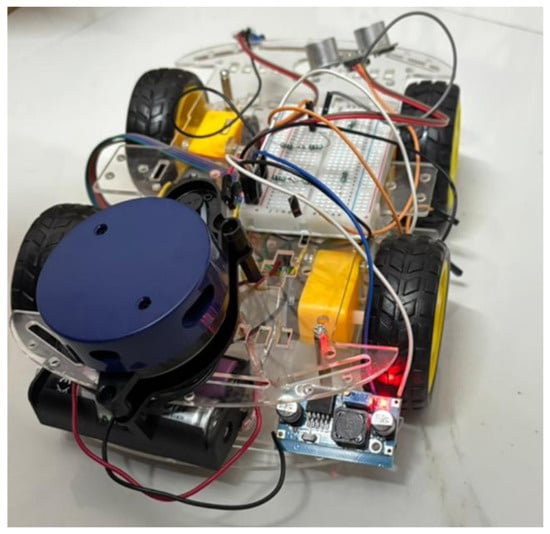
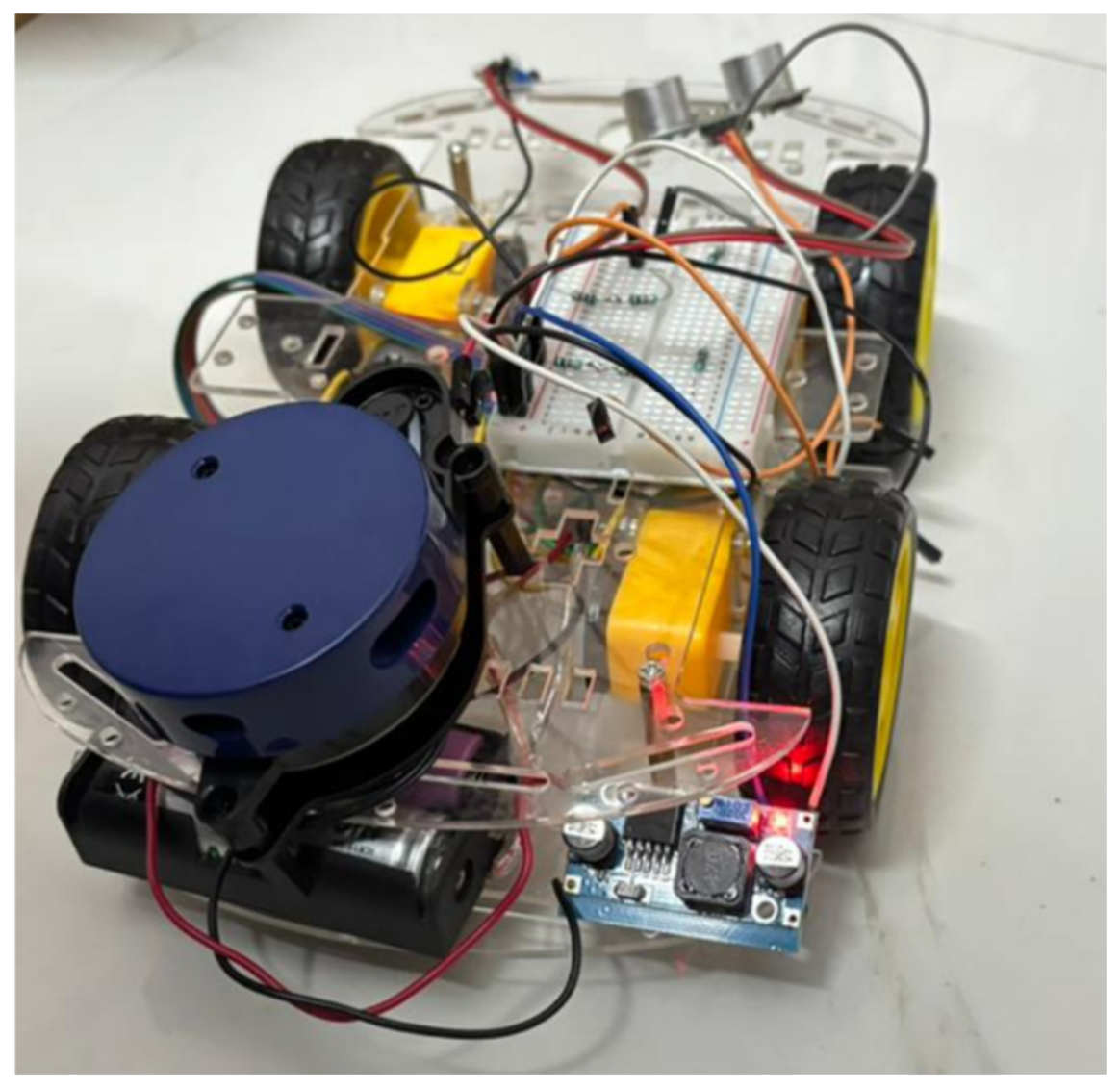
The proposed robotic system elements and their functions are summarized in Table 1. The prototype, now integrated with the sensing and processing unit, navigation and fire-suppression unit on a 4-wheel mobile platform, is displayed in Figure 1.
Table 1.
The system was implemented in phases.
Figure 1.
Shows the developed autonomous firefighting robot prototype.
4.3. Circuit Design and Component Integration
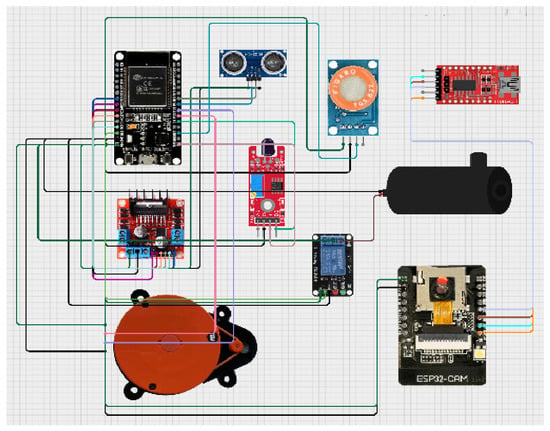
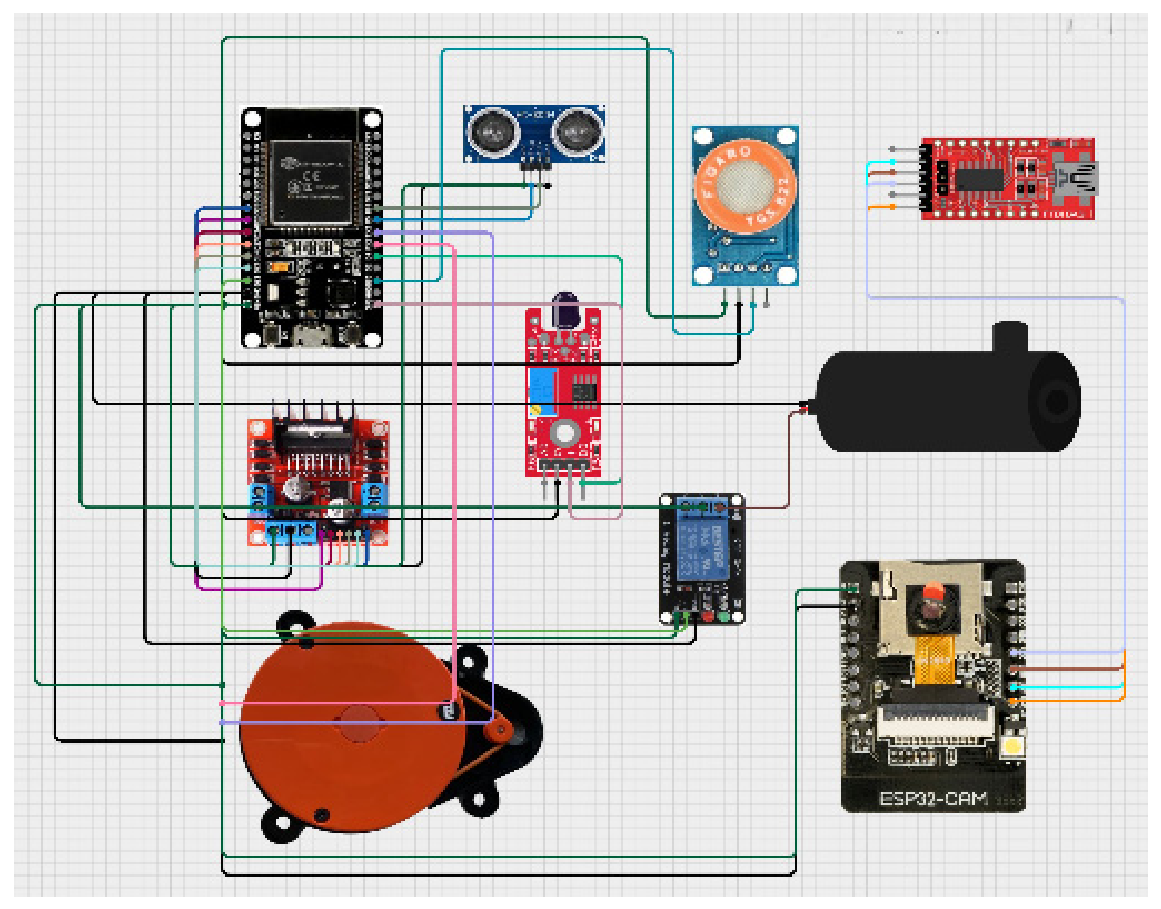
The circuit design is a combination of the sensing, processing, navigation and suppression modules in a single robotic system as depicted in Figure 2.
Figure 2.
Circuit diagram of the proposed fire detection and suppression system.
The ESP32 and the Raspberry Pi interface with the sensors and actuators via GPIO interfaces. The motor driver controls the movement of the wheels, and the relay module controls the mechanism that turns on the water pump. These sensors are consistently monitored to get real-time ‘environmental awareness’.
The ESP32-CAM sends video frames to the Raspberry Pi where they are processed for image analysis and fire detection using AI. The LiDAR sensor consistently measures the distance and provides obstacle detection and navigation.
4.4. Fire Detection Model
4.4.1. Feature Extraction
Fire detection is based on:
- Colour intensity (red, orange spectrum)
- Motion characteristics
- Shape irregularity
4.4.2. Detection Algorithm
Steps:
- Convert image to HSV colour space
- Apply fire colour threshold
- Detect contours
- Filter noise
- Confirm fire region
4.4.3. Sensor Fusion
The final decision is made using: vision detection + flame sensor + smoke sensor.
Four metrics were used to assess the performance of the proposed robotic system: detection accuracy, response time, false positives and suppression time as shown in Table 2.
Table 2.
Evaluation metrics.
5. Result and Analysis
5.1. Experimental Observation
The proposed autonomous fire detection and suppression robotic system was evaluated in a controlled indoor environment. The experiments were conducted to analyse the fire detection capability, response time, autonomous navigation performance, and suppression effectiveness of the developed prototype.
The testing area consisted of an indoor environment with a stable floor surface and a predefined fire location. The background primarily consisted of non-flammable indoor objects and walls to evaluate the ability of the system to distinguish the fire source from the surrounding environment.
Both the experiments were performed under controlled indoor lighting condition as indicated in the Table 3. The camera was mounted on the robot platform to take continuous images of the testing area. Fires were created using burning paper, to produce a small controlled flame. The fire was kept in a safe and smaller size appropriate to the prototype testing in the laboratory.
Table 3.
System performance.
The MQ-2 smoke and gas sensor was exposed to the smoke generated by the controlled flame, while the flame sensor monitored infrared radiation emitted by the flame. The AI-based visual fire detection module processed the video frames captured by the ESP32-CAM.
The robot was initially positioned at a predefined distance from the fire source. The YDLIDAR X2 sensor continuously monitored the surroundings for obstacle detection during navigation. The robot moved towards the detected fire location while maintaining obstacle avoidance.
Each experimental trial was performed under similar environmental conditions. The following parameters were recorded:
- Lighting condition
- Fire source and flame size
- Background condition
- Smoke level
- Initial testing distance
- Robot movement speed
- Detection time
- Response time
- Suppression time
The experiments were performed using small controlled flames only. Therefore, the reported results represent prototype-level performance under controlled indoor conditions and should not be directly generalized to large-scale industrial fire scenarios. The results are as follows:
- Successfully detected fire in controlled environments
- Robot navigated accurately toward fire source
- Water pump effectively extinguished small flames
A comparison of the advantages of the proposed robotic system with tradition fire alarm system and a basic firefighting robot from the perspectives of automation, response time and detection accuracy is shown in Table 4.
Table 4.
Comparative analysis.
The con-trolled fire scenario has been considered to test the practical performance of the proposed robotic system by burning paper. The following results are shown with the testing conditions in Table 5: Flame size, Detection distance, Detection time, Extinguishing time.
Table 5.
Practical scenario testing.
5.2. Observed Challenges
- Lighting conditions affect detection
- Sensor noise in dusty environments
- Limited water capacity
6. Conclusions
This paper presented the design and implementation of an AI-driven autonomous fire detection and suppression robotic system for industrial and indoor safety applications. The primary objective of the proposed system was to integrate AI-based visual fire detection, environmental sensing, autonomous navigation, obstacle avoidance, and automatic water-based fire suppression into a single robotic platform.
The experimental evaluation was conducted in a controlled indoor environment and demonstrated that the proposed prototype was able to detect small fire sources with a reported detection accuracy of 92–96%. The system achieved a response time of approximately 2–5 s and activated the water-based suppression mechanism within a suppression time of approximately 5–10 s. The YDLIDAR X2 sensor enabled the robot to detect nearby obstacles and support autonomous movement towards the detected fire source.
The results demonstrate that the proposed system successfully achieves the primary objectives of autonomous fire detection, navigation, and suppression under controlled testing conditions. The integration of AI-based visual detection with the flame sensor module and the MQ-2 smoke and gas sensor improves the reliability of fire-related environmental monitoring, while the Raspberry Pi provides centralized processing and decision-making.
However, the system has several limitations. The experiments were conducted using small controlled flames in indoor environments, and the performance may be affected by significant changes in lighting conditions, smoke density, background complexity, sensor noise, and limited water capacity. The current prototype has also not been evaluated in large-scale industrial fire scenarios.
Future work will focus on testing the system under diverse environmental conditions, improving the AI model using larger fire and smoke datasets, integrating thermal imaging, enhancing navigation using advanced SLAM and path-planning techniques, and increasing the suppression capacity for more realistic industrial applications.
7. Future Scope
The proposed AI-Based Autonomous Fire Detection and Automatic Suppression Robotic system has the potential for further advancements in its intelligence, scalability, and practicality in real-world scenarios. An important improvement is the integration of state-of-the-art deep learning techniques like YOLOv8, Faster R-CNN, and Convolutional Neural Networks (CNNs) to enhance fire and smoke detection capabilities in diverse environments, ensuring accurate and speedy results. They can enhance detection performance in smoky, low-light, and complex industrial environments and minimize false alarms using these AI models. Also, thermal imaging cameras can be used to help locate concealed heat generators and help detect fire outbreaks prior to any visible indication, thereby providing early intervention and prevention.
The system can be expanded to work with several independent robots that can collaborate within large scale industrial plants, smart buildings, and warehouses. By implementing swarm robotics and inter-robot communication, multiple robots in a fire scene can coordinate their movement, communicate with their surrounding environment, and implement distributed fire extinguishing more effectively to deal with large and spreading fire scenes. Mobility in unknown and dangerous environments could be further enhanced through the use of advanced autonomous navigation techniques, including SLAM (Simultaneous Localization and Mapping), AI-based path planning, and dynamic obstacle avoidance.
In addition, integration with IoT and cloud technologies can help achieve remote monitoring, alerts in real time, and centralised fire management via mobile or web applications. Aerial fire assessment in hard-to-reach and/or hazardous areas can also be implemented through the use of a drone-based surveillance system fitted with thermal cameras and AI-based monitoring. Other future features could also involve sustainable suppression options, machine learning-based predictive fire risk assessment, voice-activated emergency call systems, and augmented reality dashboards for instantaneous visualization and monitoring. These developments could mark the next step in making the proposed system fully intelligent and scalable, providing a next-generation autonomous firefighting solution for today’s industrial and smart city safety infrastructures.
Author Contributions
Conceptualization, K.G. and M.M.; methodology, S.K. and R.M.; software, R.M.; validation, J.J.; formal analysis, P.K.; investigation, K.G.; resources, J.J.; data curation, J.J.; writing—original draft preparation, M.M. and S.K.; writing—review and editing, P.K.; visualization, S.K.; supervision, K.G.; project administration, K.G.; funding acquisition, K.G., S.K., R.M., M.M., J.J. and P.K. All authors have read and agreed to the published version of the manuscript.
Funding
This research received no external funding. The research was funded through contributions from all authors.
Institutional Review Board Statement
Not applicable.
Informed Consent Statement
Not applicable.
Data Availability Statement
The original contributions presented in this study are included in the article. Further inquiries can be directed to the corresponding author.
Acknowledgments
During the preparation and revision of this manuscript, the authors used ChatGPT (OpenAI, GPT-5) for language refinement, grammatical corrections, and improvement of text clarity in certain sections. The authors reviewed, edited, and verified the output and take full responsibility for the content of this publication.
Conflicts of Interest
The authors declare no conflict of interest.
References
- Yuvaraj, R.; Bhalerao, S.A.; Murugesan, K.; Vellaiyan, S.; Van Minh, N. Real-Time Fire Detection and Suppression System Using YOLO11n and Raspberry Pi for Thermal Safety Applications. Case Stud. Therm. Eng. 2025, 75, 107159. [Google Scholar] [CrossRef] [Scilit]
- Latif, A.; Chung, H. Fire Detection and Spatial Localization Approach for Autonomous Suppression Systems Based on Artificial Intelligence. Fire Technol. 2023, 59, 2621–2644. [Google Scholar] [CrossRef] [Scilit]
- Saif, A.; Muneer, G.; Abdulrahman, Y.; Abdulbaqi, H.; Abdullah, A.; Ali, A.; Derhim, A. Developing a Prototype of Fire Detection and Automatic Extinguisher Mobile Robot Based on Convolutional Neural Network. Technol. Audit. Prod. Reserv. 2022, 6, 15–23. [Google Scholar] [CrossRef] [Scilit]
- Akila, P.; Ravindran, S.; Sundaram, S.S.; Karobari, F.M.; Kavitha, E.; Mahesh, K. IoT and AI-Enhanced Autonomous Fire-Fighting Robot with Real-Time Hazard Monitoring. In Proceedings of the 2025 9th International Conference on Computational System and Information Technology for Sustainable Solutions (CSITSS), Bangalore, India, 20–22 November 2025; pp. 1–5. [Google Scholar]
- Amal, M.R.; Joseph, A.; Aravind, A.S. AI-Based Multi-Robot Fire Suppression System. Int. J. Emerg. Res. Areas 2024, 4, 5. [Google Scholar]
- Ekunke, O.V.; Kehinde, T.O.; Owunna, I.B.; Ogunkanmi, S.A.; Oyetunde, J.O.; Dillum, M.N.; Adegoke, S.H. Innovations in Fire Detection and Suppression Systems for Oil Refinery Operations. Path Sci. 2024, 10, 4001–4015. [Google Scholar] [CrossRef] [Scilit]
- Mia, M.M. A Review on the Influence of AI-Enabled Fire Detection and Suppression Systems in Enhancing Building Safety. Rev. Appl. Sci. Technol. 2025, 4, 36–73. [Google Scholar] [CrossRef] [Scilit]
- Khan, K.; Islam, R.; Ali, R.; Bernard, H.F. Artificial Intelligence and Data Analytics in Fire Science: Detection, Modeling, and Suppression. Int. J. Appl. Nat. Sci. 2025, 3, 132–141. [Google Scholar] [CrossRef] [Scilit]
- Antunovic, A.; Arlovic, M.; Balen, J.; Seric, L. Advances in Fire Detection and Suppression: A Review of Contemporary Methods and Technologies. IEEE Access 2025, 13, 205110–205133. [Google Scholar] [CrossRef] [Scilit]
- Ramadhan, A.R.; Berliandhi, M.Y.; Diastyanto, A. Design and Implementation of Autonomous Fire Suppression System with AI-Guided Aiming Sprinklers and Evacuation Guidance for Smart Building Applications. In Proceedings of the 2025 5th International Conference on Electronic and Electrical Engineering and Intelligent System (ICE3IS), Yogyakarya, Indonesia, 6–7 August 2025; pp. 460–465. [Google Scholar]
- Vigram, K.M.; Ramji, M. Autonomous Firefighting Robot for Enhanced Fire Detection and Suppression. In Proceedings of the 2025 3rd International Conference on Intelligent Data Communication Technologies and Internet of Things (IDCIoT), Bengaluru, India, 5–7 February 2025; pp. 1070–1076. [Google Scholar]
- Kafumbe, S.; Danthakani, R.; Hasan, R.K.H.S.; Alameri, F.M.S.B.; Al Mansoori, M.N.H.S. AI-Based Fire Hazard Detection System for Industrial Safety. In Proceedings of the 2025 Advances in Science and Engineering Technology International Conferences (ASET), Dubai, United Arab Emirates, 15–18 September 2025; pp. 1–8. [Google Scholar]
- Iqbal, K.; Ali, S.S.; Ahad, A.; Khan, G.M.; Khan, A.H.; Qasim, S.Y. Artificial Intelligence-Based Real-Time Smoke and Fire Detection and Security Management Algorithms. VFAST Trans. Softw. Eng. 2025, 13, 99–110. [Google Scholar] [CrossRef] [Scilit]
- Sankaraiah, Y.R. Artificial Intelligence Approach for Fire Detection from Images: An Application of AI-Enabled Surveillance Camera. Int. J. Comput. Netw. Wirel. Commun. (IJCNWC) 2024, 13, 23–30. [Google Scholar]
- Ambafi, J.G.; Onuche, O.P.; Onuche, P.U.; Babatunde, E.T.; Abdullahi, A.O.; Osazuwa, P.; Ogunnaike, O.; Okonkwo, U.U. Development of a novel IoT-based smart firefighting robot for real-time fire detection and suppression. Curr. J. Appl. Sci. Technol. 2025, 44, 88–97. [Google Scholar] [CrossRef] [Scilit]

Disclaimer/Publisher’s Note: The statements, opinions and data contained in all publications are solely those of the individual author(s) and contributor(s) and not of MDPI and/or the editor(s). MDPI and/or the editor(s) disclaim responsibility for any injury to people or property resulting from any ideas, methods, instructions or products referred to in the content. |
© 2026 by the authors. Licensee MDPI, Basel, Switzerland. This article is an open access article distributed under the terms and conditions of the Creative Commons Attribution (CC BY) license.