


Abstract
Template conversion is an important strategy for preparing boron nitride (BN) materials with specific structures. However, the influence of intrinsic characteristics of carbon templates on the BN conversion process remains unclear. In this work, graphene aerogels (GAs) and carbon nanotubes (CNTs) with different crystal qualities were employed as carbon templates to investigate their conversion behaviors toward BN. The results demonstrate that carbon templates with low crystal quality can be completely converted into BN through a one-step reaction, whereas high-quality carbon templates exhibit significantly higher conversion difficulty and cannot be fully converted even under enhanced reaction conditions. Based on these observations, a template quality-dependent conversion mechanism is proposed. The defect sites within carbon templates are considered to facilitate BN nucleation and C atom substitution, while the conversion of high-quality carbon templates mainly proceeds gradually from the edges toward the interior due to the limited defect sites. This study reveals that template quality is positively correlated with the conversion difficulty of BN, providing a new regulation dimension for the template-assisted synthesis of BN materials.
1. Introduction
Hexagonal BN possesses excellent thermal stability, chemical stability, and electrical insulation properties, together with low density and outstanding high-temperature resistance, making it promising for applications in thermal management, adsorption, catalysis, and sensing [1,2,3,4]. With the increasing demand for low-dimensional and porous BN materials, achieving controllable synthesis of BN structures with tailored morphologies has become an important research direction. Compared with direct growth methods, template conversion strategies can utilize preconstructed template structures and obtain BN materials with specific morphologies through elemental substitution and chemical conversion, providing an effective approach for fabricating BN aerogels (BNAs), BN nanotubes (BNNTs), and other nanostructures.
Carbon materials with diverse structures and tunable morphologies are widely used as templates for the synthesis of BN materials. Carbon templates represented by graphene aerogels and carbon nanotubes can undergo high-temperature chemical conversion, where C atoms are replaced by BN species while preserving the original framework, enabling the formation of corresponding BN structures. However, during the practical conversion process, carbon templates cannot always be completely transformed into BN. Residual carbon and additional BN growth outside the template may affect the composition and structure of the final products. To address this issue, existing studies have mainly promoted the conversion of carbon templates to BN by modulating external reaction parameters, such as reaction temperature, reaction time, and reactant species [5,6,7,8,9]. However, in the synthesis of BN via the carbon-template method, the influence of the structural characteristics of the carbon template itself, particularly its crystal quality and associated defects, on the conversion behavior still lacks systematic investigation. The crystal quality of carbon templates is difficult to regulate independently and precisely, and preparing different types of carbon templates with comparable crystal quality also remains challenging. Elucidating the relationship between the crystal quality of carbon templates and the BN conversion behavior is expected to provide a new basis for understanding the conversion mechanism from carbon to BN and for achieving controllable synthesis of BN materials.
The crystal quality of carbon templates is closely associated with their defect density [10]. Carbon materials with low crystal quality generally contain abundant edges, vacancies, and surface defects, whereas high-quality carbon materials possess more intact crystal structures and fewer defects. These structural differences may further influence BN nucleation and C atom substitution processes. Does the crystal quality of carbon templates affect the difficulty of BN conversion, and what is the underlying mechanism? Addressing this issue is not only beneficial for understanding the carbon-to-BN conversion process in template strategies but also provides a new regulation dimension for the controllable synthesis of BN materials.
In this work, GAs with different crystal qualities were employed as carbon templates to systematically investigate their conversion behaviors toward BNA. Furthermore, CNTs with different crystal qualities were utilized to verify the universality of this phenomenon. The results reveal that low-quality carbon templates can be completely converted into BN through a one-step reaction, while high-quality carbon templates exhibit much higher conversion difficulty and remain partially unconverted even under intensified reaction conditions. Based on these experimental observations, a template quality-dependent BN conversion mechanism is proposed. The defect sites in carbon templates promote BN nucleation and C atom substitution, whereas the conversion of high-quality carbon templates mainly proceeds gradually from the edges toward the interior due to the limited defects, accompanied by additional BN growth. Therefore, template quality is proposed as an important tunable parameter in template-assisted BN synthesis, providing new insights into the understanding and regulation of carbon-to-BN conversion processes.
2. Methods
The preparation of GAs was conducted according to previously reported methods [11]. The GAs were placed in the high-temperature zone of a tube furnace (1300 °C), while boric acid powder (Aladdin Reagent Co., Ltd., Shanghai, China) was placed in the upstream low-temperature zone (700 °C). A mixed gas of ammonia and nitrogen was used as the carrier gas, and the reaction was conducted at high temperature for 1 h to achieve the conversion of carbon templates. Subsequently, the obtained boron nitride–graphene hybrid aerogel (BNGA) was annealed in air at 700 °C to remove residual carbon and obtain pure BNA. The conversion process of CNT was identical to that described above.
3. Characterization Instrument
The composition of the converted products was characterized using a Fourier-transform infrared spectrometer (Nicolet iS50R) (Thermo Fisher Scientific, Waltham, MA, USA). The morphology of CNT was characterized using a scanning electron microscope (JEOL 7401) (JEOL Ltd., Tokyo, Japan).
4. Results and Discussion
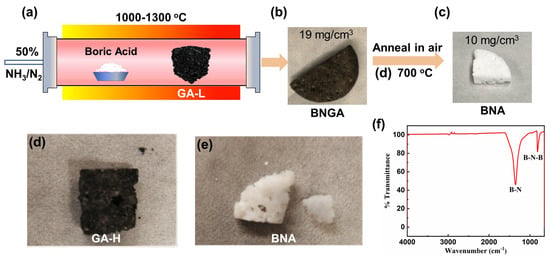
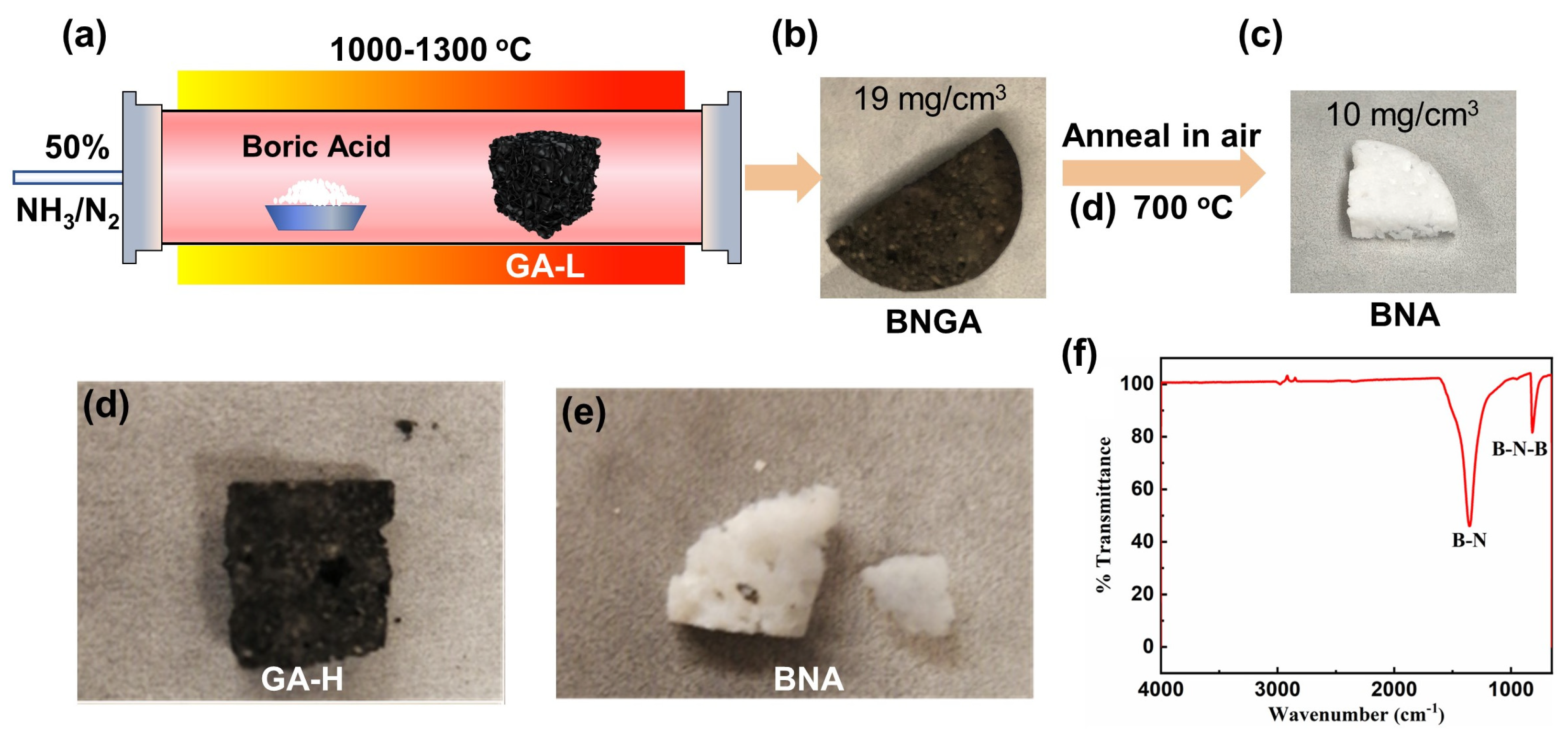
BNAs were synthesized through a template conversion strategy, and the synthesis process is illustrated in Figure 1. GAs were employed as carbon templates, which were prepared according to previously reported methods [11]. Carbon templates with different crystal qualities were obtained by annealing GAs at different temperatures. Specifically, GAs annealed at 2000 °C (GA-H) exhibited higher crystal quality with fewer defects, whereas GAs annealed at 1050 °C (GA-L) possessed lower crystal quality with abundant defects. The Raman spectra of the two samples show that GA-L exhibits a relatively strong D band with a broad peak shape, whereas GA-H exhibits sharper Raman peaks and a relatively weaker D band.
Figure 1.
(a) Schematic illustration of the template conversion process for BN synthesis. (b,c) Digital photographs of BNGA and BNA. (d,e) Digital photographs of GA-H and BNA. (f) FTIR spectrum of BNA.
First, GA-H was placed in the high-temperature zone of a dual-zone tube furnace for the conversion reaction. Boric acid powder was used as the B source and ammonia gas as the N source, with the boric acid powder placed in the low-temperature zone. After high-temperature reaction at 1300 °C for 1 h, GA-H was converted into BNGA, accompanied by a color change from black to brownish black. At this stage, graphene was not completely converted into BN, and the density of the aerogel increased from 17 mg/cm3 to 19 mg/cm3, indicating that, besides the in situ substitution of C atoms, additional BN growth also occurred during the conversion process. Subsequently, BNGA was annealed in air at 700 °C to completely remove carbon species, resulting in a pure white BNA. The density of BNA further decreased to 10 mg/cm3. Based on the density variation, approximately 8 mg/cm3 of C atoms were replaced by BN during the conversion of GA, while an additional 2 mg/cm3 of BN was grown.
The conversion behavior of GA-L was significantly different from that of GA-H. Under the same reaction conditions, GA-L could be directly converted into pure white BNA through a one-step reaction. FTIR analysis of the obtained BNA revealed only the characteristic peaks of B-N and B-N-B bonds, while no C-C bond peak was detected, demonstrating that GA-L could be completely converted into pure BNA through a single conversion process [12]. Even when the reaction temperature was lowered to 1100 °C, GA-L could still be completely converted.
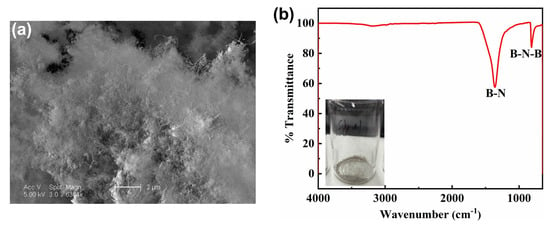
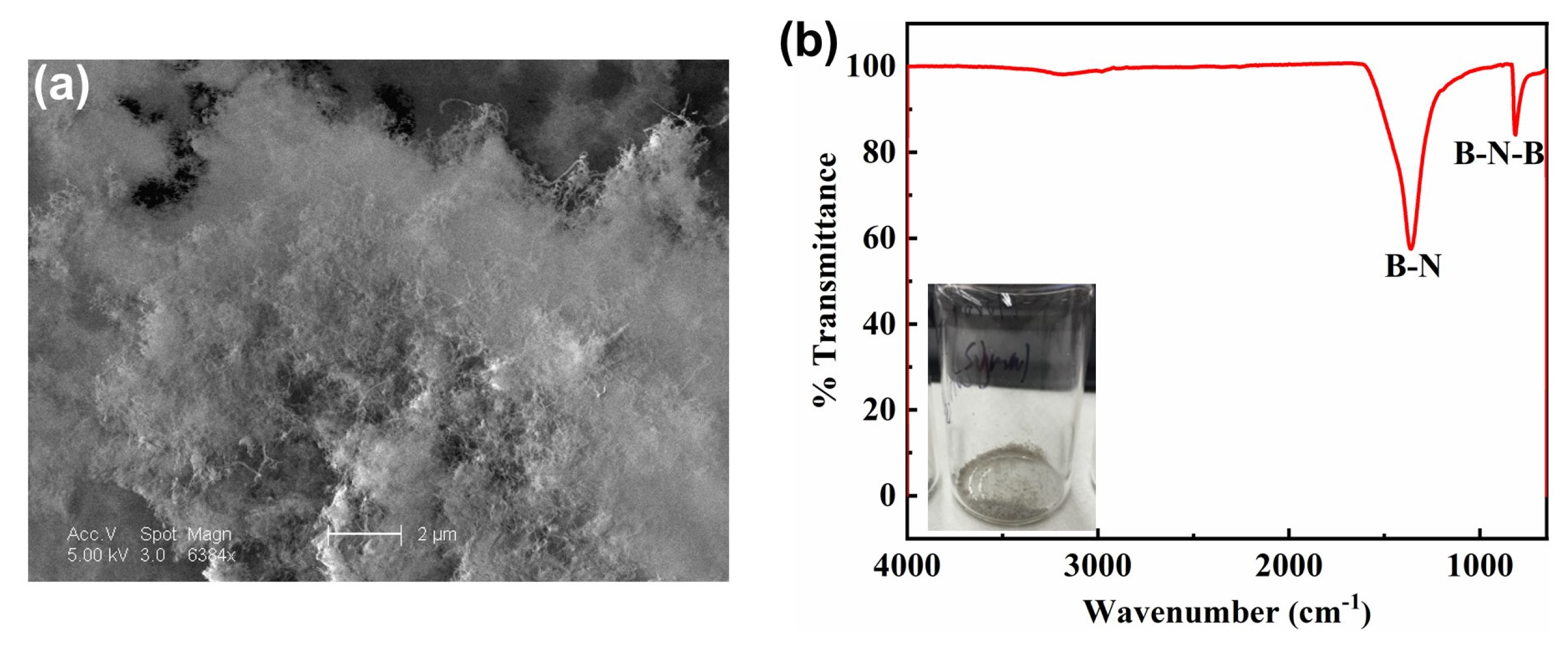
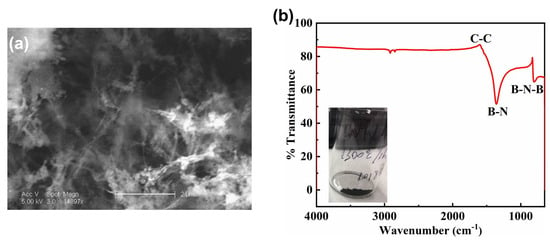
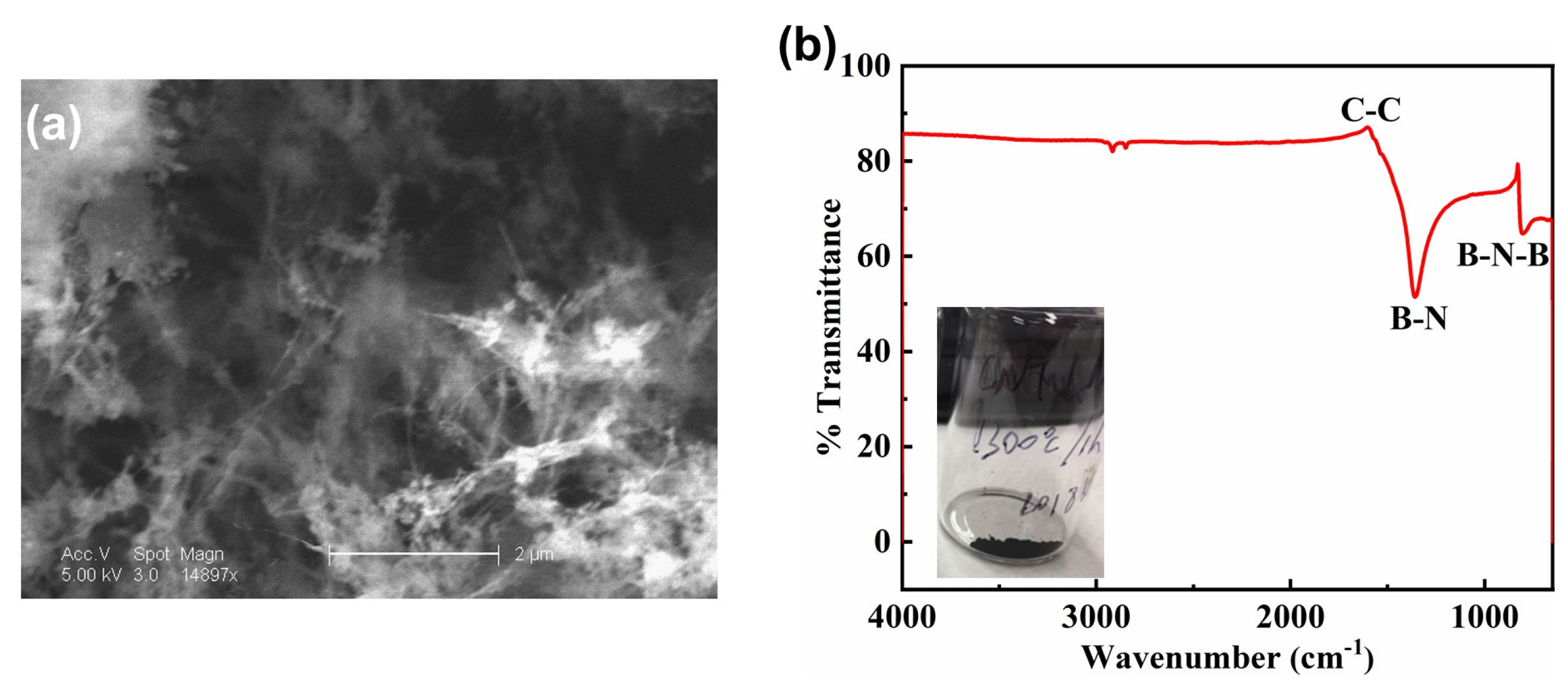
To verify whether this phenomenon was universal, CNTs with different crystal qualities were further employed as carbon templates for conversion reactions. As shown in the SEM image of low-quality carbon nanotubes (CNT-L) in Figure 2a, the nanotubes exhibited a curved morphology and significant aggregation, indicating relatively poor crystal quality. After the one-step conversion, FTIR analysis showed only the characteristic peaks of B-N and B-N-B bonds, and no obvious C-C characteristic peaks were observed, indicating that the residual carbon content was below the effective detection level of FTIR under these test conditions and confirming that CNT-L was essentially completely converted into BNNTs.
Figure 2.
(a) SEM image of low-quality CNT. (b) FTIR spectrum of converted BNNT.
In contrast, the SEM image of high-quality carbon nanotubes (CNT-H) in Figure 3a shows straight nanotube structures with longer lengths and negligible bending, indicating higher crystal quality. After one-step conversion under the same reaction conditions, the FTIR spectrum (Figure 3b) still exhibited a distinct C-C bond peak at 1617.1 cm−1, indicating that CNT-H was more difficult to convert than CNT-L. This result is consistent with the conversion behavior observed for GAs with different crystal qualities. Even when the reaction temperature was raised to 1500 °C, CNT-H could not be completely converted. Further experiments revealed that low-quality carbon templates could still be completely converted into BN even under reduced reaction conditions (shorter time and lower temperature), whereas high-quality carbon templates remained partially unconverted even after increasing the reaction conditions. These results demonstrate that, during the template synthesis of BN, carbon template quality is positively correlated with conversion difficulty.
Figure 3.
(a) SEM image of high-quality CNT. (b) FTIR spectrum of converted BNNT.
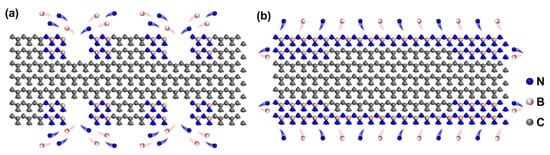
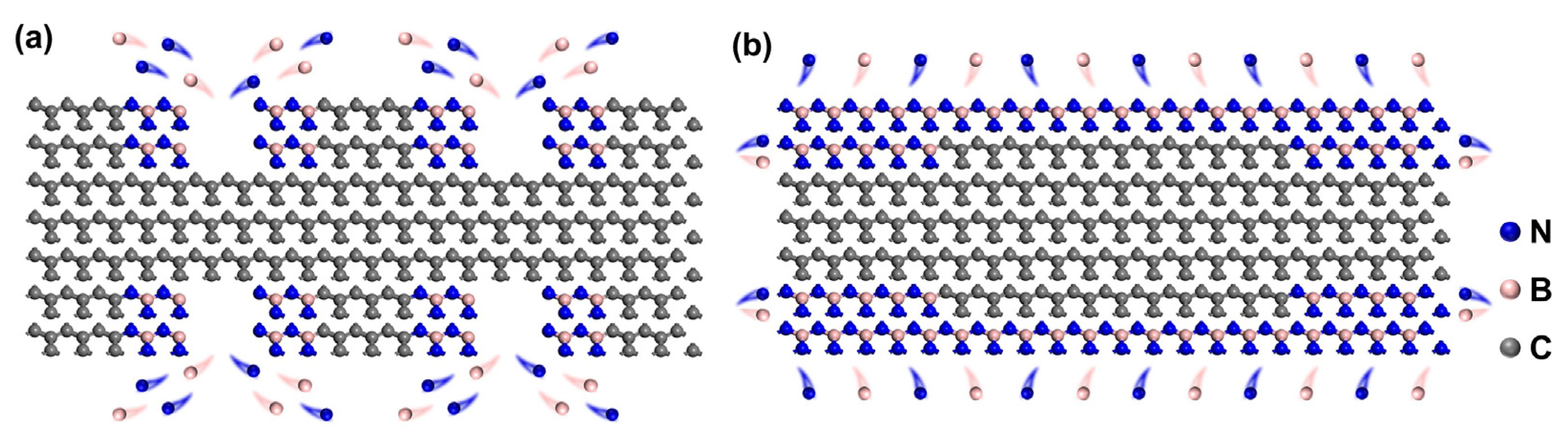
Based on the above experimental observations, a template quality-dependent BN conversion mechanism is proposed, as illustrated in Figure 4. Low-quality carbon templates contain abundant defects, including edges, vacancies, and oxygen-containing functional groups. BN substitution preferentially occurs at these defect sites and proceeds simultaneously from multiple locations until all C atoms are replaced, resulting in the formation of pure BN structures. In contrast, high-quality carbon templates contain fewer defects, and the conversion process mainly initiates from the edges of carbon templates and gradually extends toward the inner regions. Since the substitution of inner-layer C atoms is more difficult, additional BN layer growth occurs on the outer surface of the template, ultimately forming BN-coated carbon structures. Therefore, a new tunable parameter, namely template quality, is proposed for template-assisted BN synthesis. With increasing carbon template quality, the conversion reaction becomes more difficult, indicating a positive correlation between carbon template quality and BN conversion difficulty.
Figure 4.
(a,b) Schematic illustration of the conversion mechanisms of low-quality and high-quality carbon templates into BN.
5. Conclusions
In summary, this work investigated the influence of carbon template crystal quality on the conversion process toward BN. Through conversion experiments using GA and CNT with different crystal qualities, it was demonstrated that low-quality carbon templates can be completely converted into BN through a one-step reaction, whereas high-quality carbon templates exhibit higher conversion difficulty accompanied by additional BN growth. Based on these results, a template quality-dependent BN conversion mechanism was proposed, in which defect sites within carbon templates promote BN nucleation and C atom substitution, while high-quality templates with fewer defects undergo gradual conversion from the edges toward the interior. Therefore, template quality is identified as an important factor governing the carbon-to-BN conversion process and can serve as a new regulation dimension for the template-assisted synthesis of BN materials.
Author Contributions
Conceptualization, G.L. and H.L.; methodology, G.L.; validation, H.L.; formal analysis, H.L.; investigation, T.S.; resources, G.L.; data curation, T.S.; writing—original draft preparation, G.L.; writing—review and editing, T.S.; project administration, H.L.; funding acquisition, H.L. All authors have read and agreed to the published version of the manuscript.
Funding
National Natural Science Foundation of China (Grant No. 52375567 and 52475593), and Interdisciplinary Research Program of Huazhong University of Science and Technology (No. 2023JCYJ048).
Institutional Review Board Statement
Not applicable.
Informed Consent Statement
Not applicable.
Data Availability Statement
The raw data supporting the conclusions of this article will be made available by the authors on request.
Acknowledgments
The authors thank the Analytical and Testing Center of Huazhong University of Science and Technology (HUST).
Conflicts of Interest
The authors declare no conflict of interest.
References
- Wu, Y.; Xue, Y.; Qin, S.; Liu, D.; Wang, X.; Hu, X.; Li, J.; Wang, X.; Bando, Y.; Golberg, D.; et al. BN Nanosheet/Polymer Films with Highly Anisotropic Thermal Conductivity for Thermal Management Applications. ACS Appl. Mater. Interfaces 2017, 9, 43163–43170. [Google Scholar] [CrossRef] [Scilit]
- Song, Q.; Fang, Y.; Liu, Z.; Li, L.; Wang, Y.; Liang, J.; Huang, Y.; Lin, J.; Hu, L.; Zhang, J.; et al. The Performance of Porous Hexagonal BN in High Adsorption Capacity towards Antibiotics Pollutants from Aqueous Solution. Chem. Eng. J. 2017, 325, 71–79. [Google Scholar] [CrossRef] [Scilit]
- Chae, M.; Lee, D.; Kim, S.; Kim, H.-D. NO Sensing Properties of BN-Based Memristor Sensor Array for Real-Time NO Monitoring-Systems. Sens. Actuators B Chem. 2023, 394, 134373. [Google Scholar] [CrossRef] [Scilit]
- García-Miranda Ferrari, A.; Rowley-Neale, S.J.; Banks, C.E. Recent Advances in 2D Hexagonal Boron Nitride (2D-hBN) Applied as the Basis of Electrochemical Sensing Platforms. Anal. Bioanal. Chem. 2021, 413, 663–672. [Google Scholar] [CrossRef] [Scilit]
- Bi, J.-Q.; Wang, W.-L.; Qi, Y.-X.; Bai, Y.-J.; Pang, L.-L.; Zhu, H.-L.; Zhao, Y.; Wang, Y. Large-Scale Synthesis of BN Nanotubes Using Carbon Nanotubes as Template. Mater. Lett. 2009, 63, 1299–1302. [Google Scholar] [CrossRef] [Scilit]
- Han, W.; Wang, J.; Liu, S.; Ge, C.; Cao, S.; Song, B.; Wang, J.; Zhang, X. Spectral Properties of Spherical Boron Nitride Prepared Using Carbon Spheres as Template. Ceram. Int. 2017, 43, 3569–3575. [Google Scholar] [CrossRef] [Scilit]
- Song, Y.; Li, B.; Yang, S.; Ding, G.; Zhang, C.; Xie, X. Ultralight Boron Nitride Aerogels via Template-Assisted Chemical Vapor Deposition. Sci. Rep. 2015, 5, 10337. [Google Scholar] [CrossRef] [Scilit]
- Xu, X.; Zhang, Q.; Hao, M.; Hu, Y.; Lin, Z.; Peng, L.; Wang, T.; Ren, X.; Wang, C.; Zhao, Z.; et al. Double-negative-index ceramic aerogels for thermal superinsulation. Science 2019, 363, 723–727. [Google Scholar] [CrossRef] [Scilit]
- Kutty, R.G.; Sreejith, S.; Kong, X.; He, H.; Wang, H.; Lin, J.; Suenaga, K.; Lim, C.T.; Zhao, Y.; Ji, W.; et al. A topologically substituted boron nitride hybrid aerogel for highly selective CO2 uptake. Nano Res. 2018, 11, 6325–6335. [Google Scholar] [CrossRef] [Scilit]
- Liu, S.; Sun, D.; Zhang, X.; Tian, H.; Cheng, J.; Sang, L.; Liu, Z. Low-Temperature Preparation of High-Quality Low-Defect Few-Layer Graphene on Nickel-Coated Single-Crystal Silicon Substrates via Pulsed Laser Deposition. Diam. Relat. Mater. 2026, 167, 113800. [Google Scholar] [CrossRef] [Scilit]
- Worsley, M.A.; Pham, T.T.; Yan, A.; Shin, S.J.; Lee, J.R.I.; Bagge-Hansen, M.; Mickelson, W.; Zettl, A. Synthesis and Characterization of Highly Crystalline Graphene Aerogels. ACS Nano 2014, 8, 11013–11022. [Google Scholar] [CrossRef] [Scilit]
- Harrison, H.; Lamb, J.T.; Nowlin, K.S.; Guenthner, A.J.; Ghiassi, K.B.; Kelkar, A.D.; Alston, J.R. Quantification of Hexagonal Boron Nitride Impurities in Boron Nitride Nanotubes via FTIR Spectroscopy. Nanoscale Adv. 2019, 1, 1693–1701. [Google Scholar] [CrossRef] [Scilit]
Disclaimer/Publisher’s Note: The statements, opinions and data contained in all publications are solely those of the individual author(s) and contributor(s) and not of MDPI and/or the editor(s). MDPI and/or the editor(s) disclaim responsibility for any injury to people or property resulting from any ideas, methods, instructions or products referred to in the content. |
© 2026 by the authors. Licensee MDPI, Basel, Switzerland. This article is an open access article distributed under the terms and conditions of the Creative Commons Attribution (CC BY) license.