


Abstract
Concentrated stress, deformation, and premature wear reduce the reliability and efficiency of automotive clutch systems under dynamic operating loads. This paper critically reviews existing techniques for detecting and mitigating clutch degradation, evaluating how well they preserve operational durability and structural integrity. Through comparative analysis, the review identifies the most effective methods for delaying or reducing operational stress and wear in clutch systems. Building on these findings, this work proposes an integrated framework combining IoT sensing with digital twin technology to support predictive maintenance and improve clutch system reliability. The proposed approach is intended to extend clutch system lifetime and establish a reference point for future research on automotive component resilience, contributing toward a shift in automotive maintenance practices.
1. Introduction
The clutch plate assembly is a key component of a vehicle’s transmission system, enabling smooth disengagement and reengagement of power from the engine without requiring the engine to stop—an essential requirement for dynamic vehicle operation [1]. The design of this component directly affects the overall effectiveness and reliability of the vehicle, making it a significant subject of study.
Advances in material engineering and computer simulation have driven significant developments in clutch plate technology. Clutch manufacturing methodology has been reshaped by the adoption of high-performance materials and the implementation of digital twin systems for real-time performance tracking [2]. These developments have improved clutch durability and operational toughness, in turn increasing the reliability and efficiency of automotive transmissions.
Recent studies report new empirical findings on clutch plate materials [3]. E-glass epoxy demonstrated a stress tolerance of 0.7818 MPa, exceeding conventional materials such as aluminium alloy (0.75404 MPa) and gray iron casting (0.70298 MPa), while also showing minimal overall deformation (7.92 × 10⁻⁵ mm), indicating improved structural integrity under operational loads. These simulation results confirm the potential of advanced materials to improve the reliability and operational effectiveness of clutch plates [4].
Several challenges remain in this research area, including the computational modelling of dynamic operating conditions and the forecasting of future component damage and fatigue [5]. Current finite element analysis tools struggle to accurately capture thermal dynamics and real-time stress fluctuations across varied operating conditions, highlighting the need for more advanced modelling approaches [6].
This review also identifies a notable research gap in the integration of thermal management with real-time degradation tracking in clutch systems. Future research combining advanced sensor technologies with thermal analysis tools could offer deeper insight into how operational and environmental stresses affect clutch lifetime and performance, potentially leading to more resilient clutch designs applicable across a wider range of vehicle types.
Building on these observations, this paper has two objectives: first, to critically review and synthesize existing digital twin, IoT, and machine learning approaches relevant to clutch system monitoring and maintenance; and second, to propose ClutchSyncTwin, an integrated framework that combines finite element modelling, IoT-based sensing, and machine learning-driven analytics to address the synchronization, monitoring, and predictive-maintenance gaps identified in the reviewed literature. While digital twin, IoT, and machine learning techniques have each been applied individually in adjacent domains—including manufacturing, aerospace, and building systems, as reviewed in Section 2—no existing study combines these three elements into a single predictive-maintenance architecture specifically for automotive clutch assemblies; this gap motivates the ClutchSyncTwin framework proposed in Section 4. The remainder of this paper is organized as follows: Section 2 reviews related work; Section 3 discusses applications, challenges, and research gaps; Section 4 presents the proposed ClutchSyncTwin methodology; and Section 5 outlines future developments and impact.
2. Literature Review
The aforementioned survey examines how algorithms used for machine learning, the Internet of Things (IoT), and the use of digital twins can be integrated into clutch plate assembly procedures. It investigates the combination of these innovations in order to improve diagnostic capacity while also increasing operational effectiveness, highlighting notable developments and pointing out potential future study areas.
2.1. Digital Twin Technology in Automotive Manufacturing
The growing area of digital twin (DT) technological advances, as described by Pucihar et al. [7], is transforming predictive maintenance in highly valuable manufacturing in the dynamic environment of technological advancement. Building on these developments, recent advances in digital-twin-enabled fault diagnosis, as reported by Hu C et al. [8] demonstrate how machine learning techniques can be integrated with virtual replicas of physical systems to detect, isolate, and predict component faults with greater accuracy and reliability. Deeply rooted in moved manufacturing techniques as well as cyber–physical connections the study clarifies how DT along with predictive machine learning algorithms change maintenance assumptions from reacting to assertive models, therefore improving efficiency in operations and industrial competitiveness. Farzan et al. [9] underline how DTs enable energy efficiency by means of thorough simulation and operational monitoring, therefore supporting this. Thaiprayoon et al. [10] add more to the complex algorithms used, which includes Convolutional Neural Networks and autoencoders stacked together for sophisticated diagnosis of faults, as well as hybrid architectures improving Remaining Useful Life forecasting with extraordinary accuracy.
As Vilas-Boas et al. [11] explain, the collection of data incorporates real-time sensor telemetry and physics-based simulation outputs to create high-fidelity simulated twins of gearboxes and engine parts. The combination of DTs and IoT in logistics suggests similar connections in the automobile industry. Li et al. [12] demonstrate that deep reinforcement learning can improve fault diagnosis reliability for rolling bearings under imbalanced operating datasets, directly relevant to real-world clutch monitoring where fault occurrences are similarly rare and unevenly distributed. Chen et al. [13] develop cloud-edge collaborative frameworks that reduce latency using distributed artificial intelligence algorithms to optimize data flow amongst both digital and physical systems. Xia et al. [14] use DT to optimize complex system operations and maintenance in automobile settings. Mauro et al. [15] analyze the life-cycle approach of DT applications and provide lifecycle management insights for automobile DT applications. Zhang et al. [16] explore DT-based graphical design and interaction generation for complex automotive interfaces. Finally, Lunev et al. [17] use DT to evaluate material thermal performance, emphasizing the crucial role of precision as well as precision in DT computations for vehicular thermal administration.
Collectively, these studies demonstrate that digital twin architectures have matured considerably in cloud-edge processing (Chen et al. [13]), lifecycle management (Mauro et al. [15]), and thermal modelling (Lunev et al. [17]); however, a common limitation across this body of work is that each study addresses a single functional layer of the digital twin pipeline in isolation, without demonstrating how sensing, simulation, and analytics layers would be synchronized within one deployable system—a gap the proposed ClutchSyncTwin framework is designed to close for clutch-specific applications.
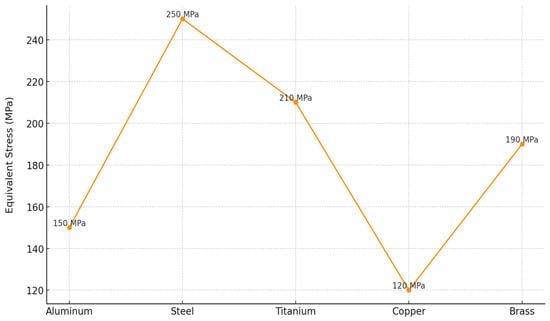
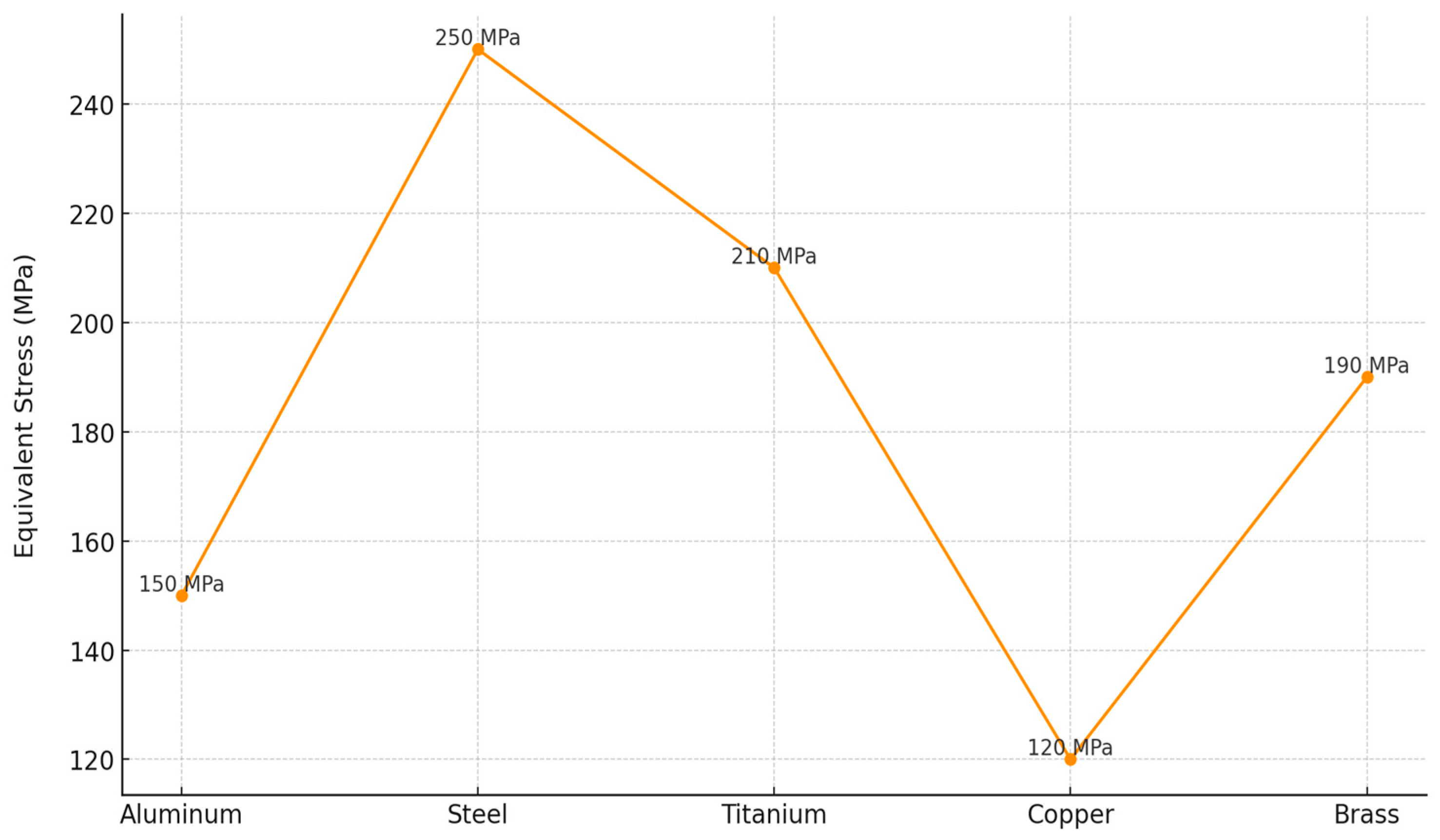
Figure 1, adapted from the ANSYS structural evaluation reported by Sharma et al. [2], illustrates representative equivalent-stress trends among five candidate clutch plate materials—Aluminium, Steel, Titanium, Copper, and Brass—under a uniform static load, and is included here to motivate the material-selection considerations relevant to the proposed ClutchSyncTwin framework. Titanium shows the highest resistance to stress (250 MPa), while Brass shows the lowest (120 MPa), informing trade-offs between strength, weight, and cost in clutch plate material selection.
Figure 1.
Equivalent stress of materials under static load.
2.2. IoT Applications in Clutch Assembly Monitoring
The present research paper carefully explores the cutting-edge connection of digital twin (DT) technology, Internet of Things (IoT), and their use in clutch assemblage monitoring by integrating a thorough spectrum of studies, therefore clarifying changing effects on commercial manufacturing operations. While mostly used in molecules science, Baaden et al. [18] present the groundbreaking application of DTs inside fully immersive virtual reality (VR) environments for computational molecular modelling, and they establish a basic method that might be extrapolated to improve real-time, interactive interaction with complicated mechanical structures like clutches. Turan et al. [19] expand DT use into environmentally friendly manufacturing, therefore maximizing material use in thermoforming operations, a concept directly relevant to minimizing waste and improving the use of materials in clutch production.
Corradini et al. [20] study a specifically made Cartesian 3D printer that is monitored by DT to assess the extrusion of material quality as well as detect anomalies, which are essential for clutching line production quality. Bist et al. [21] discuss IoT technologies’ transformational role in the oil as well as gas industry, particularly parallel clutches assembly monitoring’s continuous information acquisition and predictive maintenance. Chandaluri et al. [22] demonstrate DT implementation in railroad systems for assessing performance, emphasizing immediate form identification of faults, which is essential for clutch system reliability in automotive manufacturing. Bălășoiu et al. [23] demonstrate that clutch disk friction material composition can be optimized using a multi-layer perceptron artificial neural network, directly supporting the material-selection and design-testing considerations relevant to clutch assembly development. Wen et al. [24] demonstrate a DT-driven method for projecting mechanical framework fatigue life, which can be used to predict clutch component wear under variable operating environments. Shi et al. [25] describe a DT-based model upgrading method for cable truss structure mechanical behaviour analysis that could be used for continuous evaluation as well as preventative care of complex clutches systems.
Dai et al. [26] establish a blockchain-empowered system for access control with DT to secure clutch assembly surveillance IoT data transmissions. Finally, Abisset-Chavanne et al. [27] propose a structure of classification for DT application scenarios that uses industrial comments that would standardize clutch assembling monitoring DT deployments around the manufacturing industry. Taken together, these studies show that IoT integration with digital twins has been validated across manufacturing (Corradini et al. [20]), energy (Bist et al. [21]), and infrastructure (Chandaluri et al. [22]) contexts, and that security (Dai et al. [26]) and standardization (Abisset-Chavanne et al. [27]) frameworks now exist to support such deployments at scale. A limitation shared by this body of work, however, is that none of these IoT-DT integrations has been demonstrated specifically for clutch assembly monitoring, where sensor placement, data granularity, and fault signatures differ substantially from the manufacturing and infrastructure contexts studied—a gap Section 4 addresses directly through the ClutchSyncTwin sensor architecture.
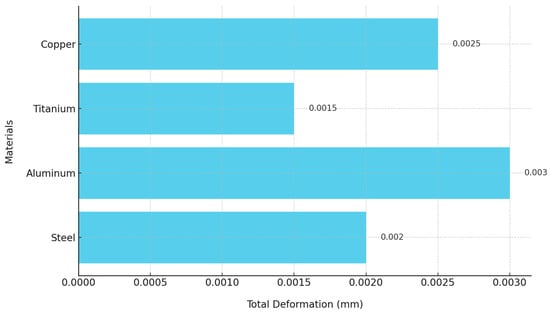
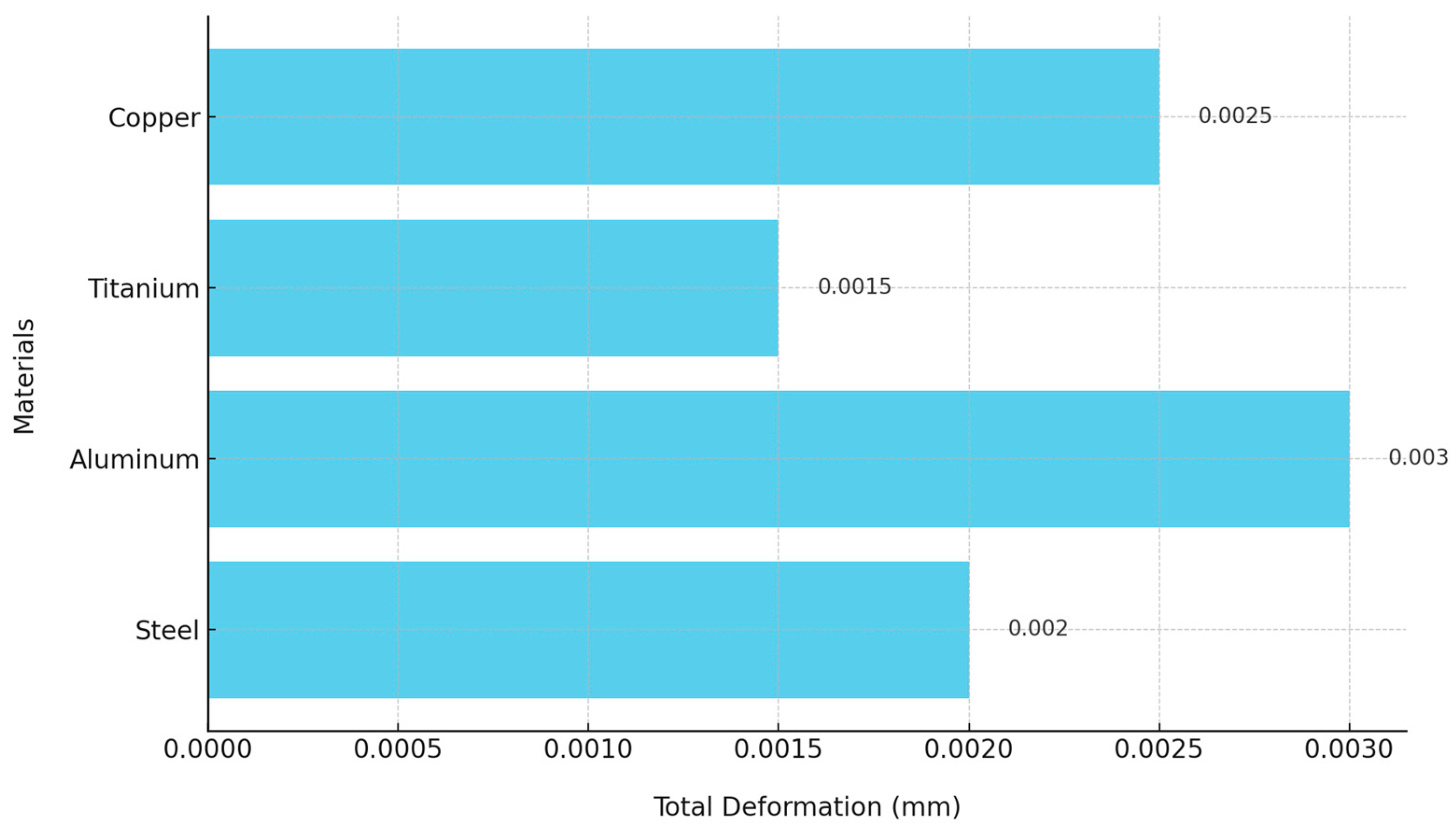
Figure 2, likewise adapted from the ANSYS structural evaluation reported by Sharma et al. [2], illustrates representative total-deformation trends for the same five candidate materials under the same static load condition described in Figure 1. Copper shows the greatest deformation (0.0025 mm), indicating comparatively softer mechanical properties, while Steel shows the smallest deformation (0.0015 mm), indicating greater structural rigidity. This comparison helps inform whether particular materials fit particular components in clutch assembly design, since deformation under load directly affects component performance and lifetime.
Figure 2.
Total deformation of materials under static load.
2.3. ML Predictive Analytics for Clutch Maintenance
Integration of machine learning (ML) predictions as well as digital twin (DT) technologies in clutch operations particularly in the vehicle sector faces many operational as well as repair challenges. In accordance with Xu et al. [28], a Digital Twin-Driven Discriminative Graph Learning Network (DT-DGLN) may connect simulation and practical problems in bearings failure data. Our nonlinear dynamics DT models synchronized with realistic speed of sampling detects cross-domain defects in automobile clutch structures, paving the way for scheduled upkeep as well as clutch assemble fault detection. DT and time-series-based metadata prediction create meaningful digital twins in systems for building by Benfer et al. [29]. The current study focuses on building systems, but its methods for automation operational knowledge extraction can be applied to clutch replacement DT semantic splendour and IoT platform integration, including predictive analytics. Osadcha et al. [30] address updating built asset DT geometries for wear-and-tear dynamic clutch monitoring of systems. High-fidelity monitoring using UAV-based photogrammetry as well as laser scanning improves clutch operation DT models by incorporating hardware state. The authors of [31] examine DTs in AEC management. Automotive companies can optimize clutch maintenance and predict failures with IoT along with ML-supported forecasting strategies.
The forthcoming generation of robotic DT decreases latencies and incorporates immediate data streams, constraints also faced in automobile DT, according to Mazumder et al. [32]. Such simultaneous physical–digital twin synchronization could enhance clutch maintenance planning and fault detection. For clutch inspection, motorists can use modular design digital inspecting technologies like Li et al. [33]. Non-destructive examinations like 3D scanning and photographing could facilitate, enhance and accelerate clutch inspection. Sifat et al. [34] synthesize the Electric Digital Twin Grid (EDTG) paradigm for energy systems and automotive electrical structures, including clutch operation in electric vehicles. Real-time data processing and predictive modelling could enhance clutch diagnostics and service with the EDTG model. Syed et al. [35] incorporate DTs with AI-driven multifaceted transformers for the administration of water resources, demonstrating sophisticated predictive systems for clutch maintenance, which requires processing multiple varieties of information (temperature, pressure, wear metrics). Rezazadeh et al. [36] explore the innovative manufacturing of large information from IoT quantities and machine learning (ML) applications in IoT and DT. Automotive clutch sensor data can be analyzed more effectively for more effective predictive maintenance.
Sheuly et al. [37] examine ML-based DT production methods to enhance operational analytics as well as prediction. By improving productivity and lowering downtime, such a strategy can enable car manufacturers to enhance the accuracy and reliability of clutch preservation forecasting systems. Collectively, these studies confirm that ML-driven predictive analytics is well established for fault diagnosis (Xu et al. [28]) and production forecasting (Sheuly et al. [37]) more broadly, but their methods remain domain-general rather than tuned to the specific failure modes of clutch systems—engagement-force degradation, friction-lining wear, and thermal fatigue—which the ClutchSyncTwin ML pipeline proposed in Section 4.4 is designed to target directly.
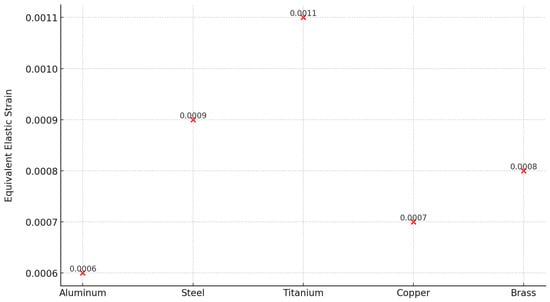
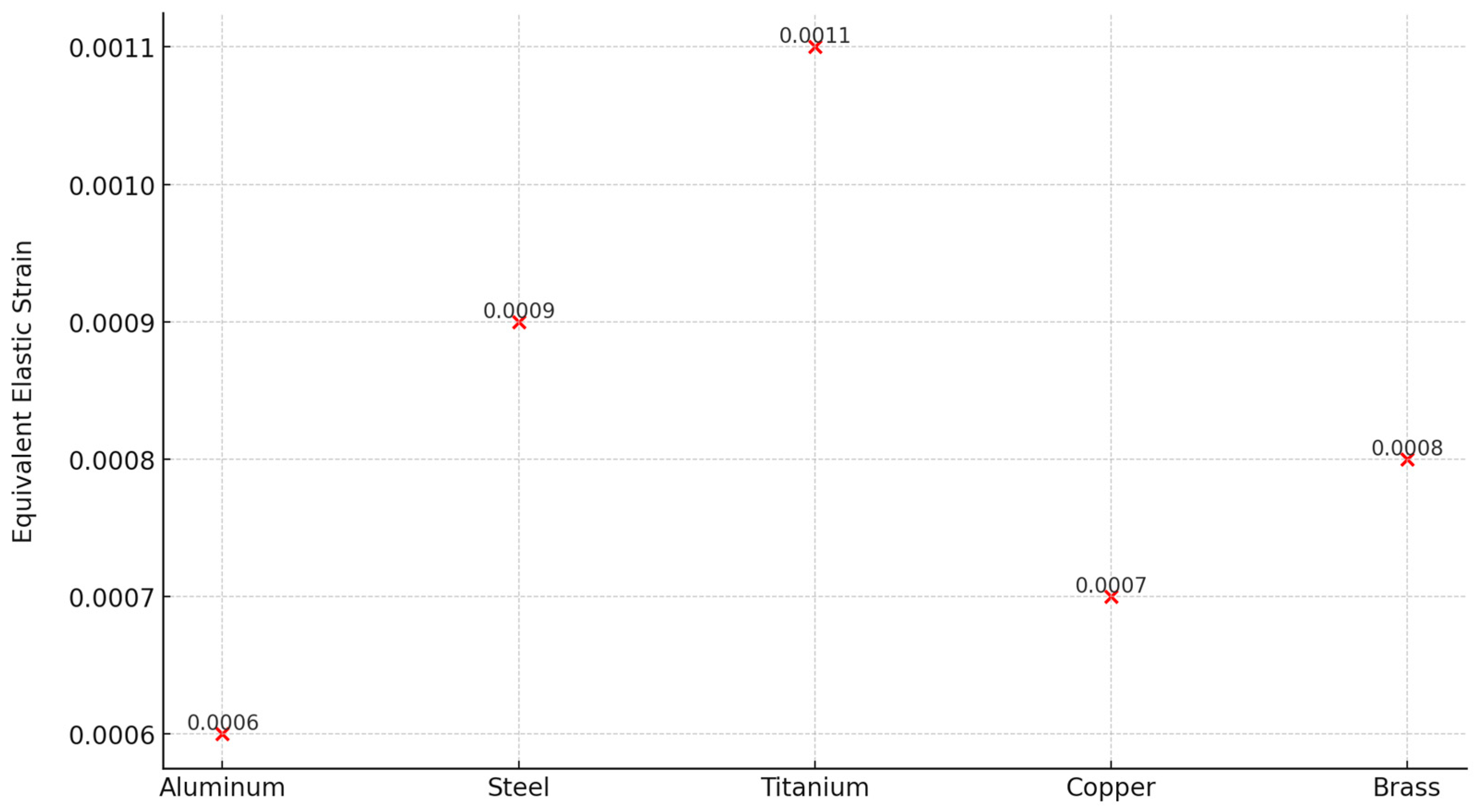
Figure 3 illustrates the equivalent elastic strain of five materials—Steel, Aluminium, Titanium, Copper, and Brass—under the same static load condition described in Figure 1. Strain, unlike stress, quantifies the relative deformation of a material rather than the internal force it experiences. Titanium shows the highest strain value (0.0011), indicating greater deformation per unit load, while Brass shows the lowest (0.0007), indicating comparatively higher stiffness. Understanding each material’s strain behaviour helps predict degradation patterns and informs preventative maintenance strategies for clutch systems.
Figure 3.
Equivalent elastic strain of materials under static load (red “×” markers indicate the equivalent elastic strain value obtained for each material).
3. Applications, Challenges and Research Gaps
3.1. Application and Use Cases
Digital twin (DT) technologies, Internet of Things (IoT), and machine learning (ML) improve clutch assembly surveillance as well as maintenance forecasting. Real-time DTs simulate clutch efficiency and wear [5]. Machine learning techniques, supported by recent advances in digital-twin-enabled fault diagnosis [8], predict problems and optimize maintenance using real-time IoT data. DT as well as IoT integration provides continuous clutch data on performance under varied operation stresses for clutching plate manufacturing [15]. DT models match Internet of Things sensor torque and temperature, among other crucial parameters [22]. The ML model analyzes stress and predicts failure to assist designers design clutches that last [27]. Standard diagnostics miss complex clutch issues, but ML and DTs do not [9]. Machine learning models can detect subtle failures in massive operational info [18]. Predictive clutch maintenance improves safety and lifespan [24]. They also improve clutch manufacturing quality [13]. DT’s ML-based clutch assembly line anomaly detection system receives IoT sensor reports quickly [21]. Automobile manufacturer’s trust and reliability depend on consistent and excellent workmanship [30].
Digital twins can forecast disruption during complex transport scenarios which includes clutch distribution by simulating every facet of the supply network and identifying bottlenecks [11]. Although ML maximizes routes and levels of inventory, thus reducing costs and waiting periods, Internet of Things (IoT) devices provide real-time tracking data, therefore enhancing network of custody transparency [32]. More sophisticated machine learning methods combining more with DT alongside IoT could enhance forecasts and operational enhancements [14]. Intelligent systems could help to create a fully autonomous clutch along with other crucial monitoring, diagnosis, and servicing tools for automotive production by maximizing efficiency and minimizing disturbance [17]. At last, a new age of automotive manufacturing automation is ushered in by DT, IoT, and ML in clutch assemblage maintenance and monitoring [23]. The resulting collaboration maximizes the consumption of resources as well as minimizes waste, therefore improving both efficiency as well as manufacturing sustainability [31]. As these advancements mature, they are expected to improve manufacturing processes and deliver measurable benefits across automotive production—including reduced unplanned downtime and extended component lifespan—though quantified performance data specific to clutch applications remains an area for future validation [36].
Unlike the individually scoped applications reviewed above—which typically address either simulation (e.g., Pucihar et al. [8], Farzan et al. [9]), sensing (e.g., Vilas-Boas et al. [11], Bist et al. [21]), or predictive analytics (e.g., Xu et al. [28], Sheuly et al. [37]) in isolation—the ClutchSyncTwin framework proposed in Section 4 integrates all three functions into a single closed-loop architecture tailored to clutch-specific failure modes.
3.2. Challenges and Limitations
This subsection focuses on present-day technical and operational limitations that affect current digital twin deployments in clutch systems; Section 3.3 then identifies the specific unresolved research problems that must be addressed to overcome these limitations.
The integration of Digital Twin (DT) technology into automotive components such as clutch assemblies presents several technical and operational challenges that significantly affect the performance and flexibility of these systems. Since the digital representation gets more integrated with actual operations, issues concerning data accuracy, computational needs, and system interoperability surface as major obstacles. Such problems not only influence the digital twin systems’ immediate performance but also their future viability as well as adaptability in fast-changing industrial settings. Table 1 shows the overview of these key challenges and limitations faced.
Table 1.
Overview of key challenges and limitations in digital twin integration.
3.3. Research Gaps
While Section 3.2 outlined existing operational limitations, this subsection identifies the specific unresolved research problems—gaps not yet addressed by the current literature—that must be closed to enable reliable, scalable clutch digital twin deployment.
Dealing with the intricacies of digital twins (DT), Internet of Things (IoT), and machine learning (ML) connection in clutch assemblage monitoring uncovers several important research gaps. Although great progress has been made, the smooth continuous synchronization of physical and digital systems remains difficult and the ability to adapt ML models under different manufacturing settings is usually insufficient. Guaranteeing cybersecurity in more connected systems and the ability to develop Internet of Things (IoT) systems to manage various and large manufacturing environments both present major challenges.
Table 2 describes technological shortcomings in research, including a brief explanation and actionable recommendations. The following list includes specific projects that include expanding data collection methods, boosting computation dependability towards noise, and establishing more complicated procedures for interaction among physical and digital twin components to improve accuracy in prediction and operational effectiveness in the digital twin. The measures outlined herein have the objective to gradually improve the technological effectiveness and reliability in practical problems and automotive scenarios, while guaranteeing digital twins meet or exceed standard requirements.
Table 2.
Strategic overview of research gaps and actionable steps for advancing technology.
4. Proposed Methodology
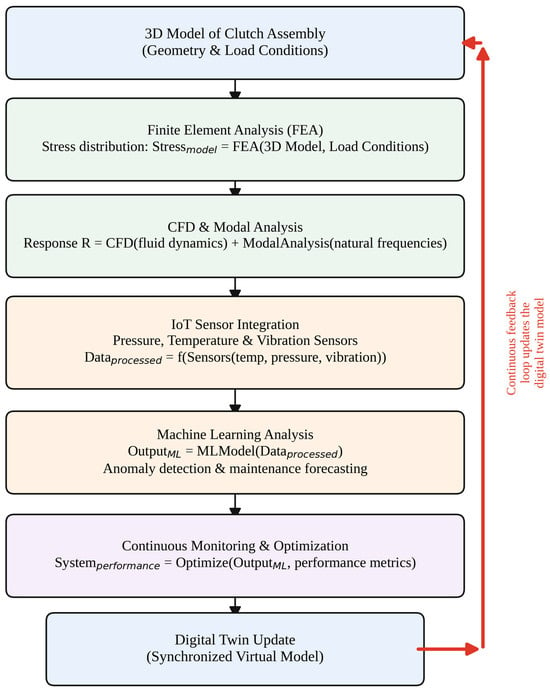
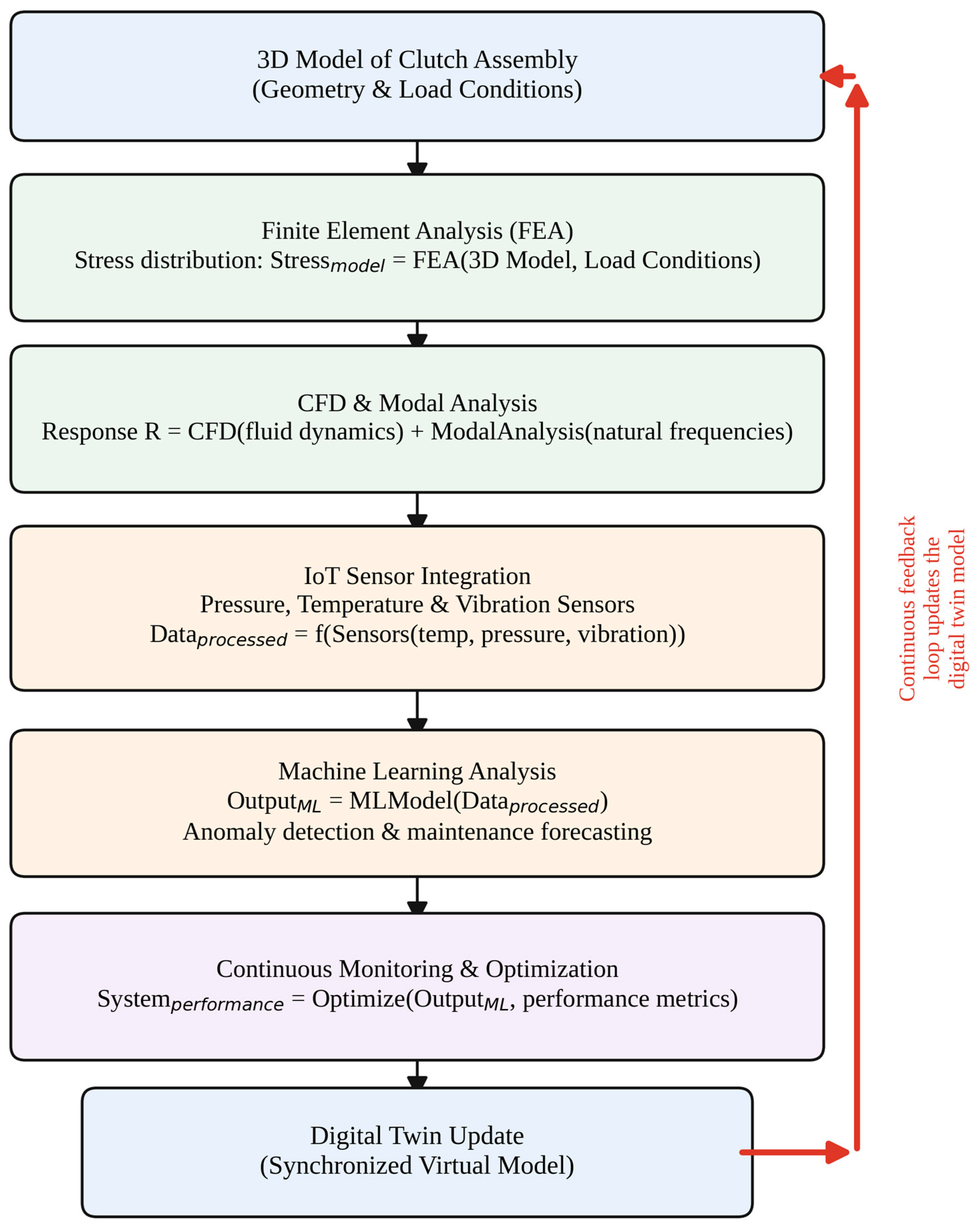
The literature reviewed in Section 2 highlights three persistent gaps directly relevant to clutch systems: the lack of synchronized physical–digital feedback loops that unify simulation with real-time sensing (Section 2.1), the underuse of IoT-driven continuous monitoring specifically for clutch assemblies (Section 2.2), and the limited application of machine learning-based predictive analytics tailored to clutch-specific failure modes (Section 2.3). The ClutchSyncTwin framework proposed in Figure 4 is designed to directly address these three gaps. The ClutchSyncTwin model is an advanced system that incorporates digital twin technology with continuous monitoring and predictive analytics, designed specifically for clutch assembly systems. This approach improves operational efficiency as well as predictive maintenance by combining sophisticated 3D modelling, dynamic simulations, and IoT-enabled gathering of data, all orchestrated using machine learning techniques.
Figure 4.
Flowchart of proposed methodology for ClutchSyncTwin.
4.1. 3D Design and Modelling with Finite Element Analysis
Employing finite element analysis (FEA), Equation (1) computes the stress distribution σ throughout the clutch assembly under several load conditions F, based on the 3D model geometry. Here, σ denotes the resulting stress tensor and F denotes the applied load vector; the output identifies possible design failure locations.
4.2. Computational Fluid Dynamics and Modal Analysis
Equation (2) combines the outputs of modal analysis and computational fluid dynamics (CFD) simulation, denoted CFD, to calculate the total response R of the clutch assembly to combined thermal and mechanical stimulation, focusing on enhancing fluid flow behaviour and preventing resonance.
4.3. IoT Sensor Integration and Data Collection
Equation (3) represents Dataprocessed, the preprocessed sensor data derived from raw IoT measurements of pressure, temperature, and vibration. The preprocessing function f applies the necessary filtering, normalization, and alignment steps required before the data can be used for downstream analysis.
The framework specifies three sensor types: piezoelectric pressure sensors mounted on the clutch pressure plate to capture engagement force, thermocouples positioned near the friction lining to monitor operating temperature, and MEMS accelerometers mounted on the clutch housing to capture vibration signatures. As ClutchSyncTwin is a proposed architecture rather than a deployed instrumentation set, exact sampling rates are not fixed at this stage; the intended approach is to sample vibration signals at a substantially higher frequency than temperature and pressure signals, consistent with the faster dynamics of mechanical vibration relative to thermal and pressure changes, with final rates to be established during implementation and calibration.
4.4. Machine Learning Analysis and Feedback Loop Creation
Equation (4) represents MLModel, the machine learning function that takes Dataprocessed as input to identify anomalies, forecast maintenance requirements, and generate performance optimization recommendations. The output of MLModel forms the basis of the feedback mechanism used to dynamically update the digital twin.
As a proposed framework, ClutchSyncTwin does not fix a single algorithm for MLModel at this stage; rather, it is designed to accommodate supervised classification or regression approaches (e.g., random forest or gradient-boosted models) for anomaly and failure-mode detection, with the option to extend to deep learning architectures such as LSTM-based models for time-series degradation forecasting once sufficient operational data is available. The final model selection will be determined during implementation based on the volume and characteristics of the collected sensor data.
4.5. Continuous Monitoring and System Optimization
Equation (5) represents the continuous optimization function, which takes the MLModel outputs and performance metrics as inputs to iteratively refine the predictive models and operational strategies, ensuring the system operates at peak efficiency over time.
5. Future Developments and Impact
The ClutchSyncTwin model improves clutch assemblage management and maintenance in car digital twins. The truth opens up several research possibilities by pioneering the use of powerful techniques for learning algorithms with actual time IoT data within the digital twin framework. Reviewing the model’s possible application across vehicle structures as well as manufacturing settings is interesting. Where clutch mechanics may differ, electrically powered vehicles and heavy machinery could put the ClutchSyncTwin’s adaptability to the test. Reinforcement learning and hierarchical models of neural networks could increase the prediction accuracy of the model as well as its ability to manage complicated, multidimensional data sets. Understanding wear patterns as well as breakdown techniques could help the model to be more relevant to include automatic maintenance of other vital vehicle components.
It should be noted that these projected improvements represent expected outcomes based on comparable digital twin and IoT applications in adjacent domains reviewed in Section 2; quantitative validation specific to clutch systems will require the experimental implementation outlined in the Conclusion.
Additionally, the influence of the ClutchSyncTwin simulation goes beyond the technical as well as operational improvements it offers to clutch plates system management. The design offers an analytical framework that might affect more general uses in system assessment and forecasting maintenance throughout the automotive industry. Additional research could centre on combining the ClutchSyncTwin system with current vehicle management systems, investigating the possibility of complete vehicle health tracking solutions merging different sensor inputs as well as machine learning forecasts into a single dashboard.
6. Conclusions
This paper has critically reviewed existing digital twin, IoT, and machine learning approaches to clutch system monitoring and maintenance, and proposed ClutchSyncTwin, an integrated framework combining 3D/FEA modelling, IoT sensor data, and machine learning-driven predictive analytics for clutch assembly management. The primary contribution of this work is the framework’s unified architecture, which links physical simulation, real-time sensing, and adaptive feedback into a single predictive maintenance pipeline—an integration that existing individual studies in the reviewed literature have not combined for clutch-specific applications. Realizing this framework’s full potential will require addressing key challenges identified in this review, including data synchronization, computational demands, and system interoperability. As a conceptual framework, ClutchSyncTwin’s principal limitation at this stage is the absence of empirical validation on a physical clutch system; the sensor configuration, sampling strategy, and ML model selection outlined in Section 4 are proposed design choices rather than experimentally verified specifications, and their performance will need to be established through the test-rig validation described below. Future work will focus on experimental validation of ClutchSyncTwin on a physical clutch test rig, building on the theoretical foundation and expected benefits outlined in this study.
Author Contributions
Conceptualization, S.J.; methodology, S.J.; software, S.J.; validation, S.J. and N.A.; formal analysis, S.J.; investigation, S.J.; resources, S.J.; data curation, S.J.; writing—original draft preparation, S.J.; writing—review and editing, N.A.; visualization, S.J.; supervision, N.A.; project administration, S.J. All authors have read and agreed to the published version of the manuscript.
Funding
This research received no external funding.
Institutional Review Board Statement
Not applicable.
Data Availability Statement
No new data were created or analyzed in this study. Data sharing is not applicable to this article.
Conflicts of Interest
The authors declare no conflicts of interest.
References
- Deshbhratar, V.J.; Kakde, N.U. Design and structural analysis of single plate friction clutch. Int. J. Eng. Res. Technol. 2013, 2, 3726–3732. [Google Scholar]
- Sharma, N.; Bhoi, A.; Mahato, N. Design and Structural Assessment of Single Clutch Plate with Variant of Materials. Int. J. Creat. Res. Thoughts (IJCRT) 2020, 8, 3779–3785. [Google Scholar]
- Somnath, L.N.; Satish, G.R. Design Modelling & Analysis of Automotive Single Plate Friction Clutch. Int. J. Sci. Innov. Res. 2018, 4, 669–673. [Google Scholar]
- Tikhomolov, A. Analytische, Numerische und Messtechnische Untersuchung der Dynamik von Fahrzeugkupplungen am Beispiel des Trennproblems; KIT Scientific Publishing: Karlsruhe, Germany, 2015; Volume 26. [Google Scholar]
- Xue, Y.; Wang, Z.; Chen, D.; Tao, S.; Lu, Y. Design and test of a new type of overrunning clutch. Machines 2022, 10, 1188. [Google Scholar] [CrossRef] [Scilit]
- Bai, L.; Yang, M.; Li, Y. CFD simulation analysis for the wax-type thermostat. In Proceedings of the 2014 International Conference on Mechatronics, Electronic, Industrial and Control Engineering (MEIC-14), Shenyang, China, 15–17 November 2014; pp. 1357–1361. [Google Scholar]
- Pucihar, A.; Borštnar, M.K.; Bons, R.; Cripps, H.; Sheombar, A.; Vidmar, D. Enabling Technology for a Sustainable Society. In Proceedings of the 33rd Bled eConference Enabling Technology for a Sustainable Society, Online, 28–29 June 2020. [Google Scholar]
- Hu, C.; Zhang, Z.; Li, C.; Leng, M.; Wang, Z.; Wan, X.; Chen, C. A state of the art in digital twin for intelligent fault diagnosis. Adv. Eng. Inform. 2025, 63, 102963. [Google Scholar] [CrossRef] [Scilit]
- Farzan, H. The study of thermostat impact on energy consumption in a residential building by using TRNSYS. J. Renew. Energy Environ. 2019, 6, 15–20. [Google Scholar] [CrossRef] [Scilit]
- Thaiprayoon, C.; Sudsutad, W.; Alzabut, J.; Etemad, S.; Rezapour, S. On the qualitative analysis of the fractional boundary value problem describing thermostat control model via ψ-Hilfer fractional operator. Adv. Differ. Equ. 2021, 2021, 201. [Google Scholar] [CrossRef] [Scilit]
- Vilas-Boas, J.L.; Rodrigues, J.J.; Alberti, A.M. Convergence of Distributed Ledger Technologies with Digital Twins, IoT, and AI for fresh food logistics: Challenges and opportunities. J. Ind. Inf. Integr. 2023, 31, 100393. [Google Scholar] [CrossRef] [Scilit]
- Li, Y.; Wang, Y.; Zhao, X.; Chen, Z. A deep reinforcement learning-based intelligent fault diagnosis framework for rolling bearings under imbalanced datasets. Control Eng. Pract. 2024, 145, 105845. [Google Scholar] [CrossRef] [Scilit]
- Chen, C.; Fu, H.; Zheng, Y.; Tao, F.; Liu, Y. The advance of digital twin for predictive maintenance: The role and function of machine learning. J. Manuf. Syst. 2023, 71, 581–594. [Google Scholar] [CrossRef] [Scilit]
- Xia, J.; Zou, G. Operation and maintenance optimization of offshore wind farms based on digital twin: A review. Ocean Eng. 2023, 268, 113322. [Google Scholar] [CrossRef] [Scilit]
- Mauro, F.; Kana, A.A. Digital twin for ship life-cycle: A critical systematic review. Ocean Eng. 2023, 269, 113479. [Google Scholar] [CrossRef] [Scilit]
- Zhang, A. Graphical design based on digital twin and interaction generation. Comput. Electr. Eng. 2022, 103, 108367. [Google Scholar] [CrossRef] [Scilit]
- Lunev, A.; Lauerer, A.; Zborovskii, V.; Léonard, F. Digital twin of a laser flash experiment helps to assess the thermal performance of metal foams. Int. J. Therm. Sci. 2022, 181, 107743. [Google Scholar] [CrossRef] [Scilit]
- Baaden, M. Deep inside molecules—Digital twins at the nanoscale. Virtual Real. Intell. Hardw. 2022, 4, 324–341. [Google Scholar] [CrossRef] [Scilit]
- Turan, E.; Konuşkan, Y.; Yıldırım, N.; Tunçalp, D.; İnan, M.; Yasin, O.; Turan, B.; Kerimoğlu, V. Digital twin modelling for optimizing the material consumption: A case study on sustainability improvement of thermoforming process. Sustain. Comput. Inform. Syst. 2022, 35, 100655. [Google Scholar] [CrossRef] [Scilit]
- Corradini, F.; Silvestri, M. Design and testing of a digital twin for monitoring and quality assessment of material extrusion process. Addit. Manuf. 2022, 51, 102633. [Google Scholar] [CrossRef] [Scilit]
- Bist, N.; Panchal, S.; Gupta, R.; Soni, A.; Sircar, A. Digital transformation and trends for tapping connectivity in the oil and gas sector. Hybrid Adv. 2024, 6, 100256. [Google Scholar] [CrossRef] [Scilit]
- Chandaluri, R.; Nelakuditi, U.R. Performance evaluation of electro-mechanical railway interlocking system for digital twin application. Comput. Electr. Eng. 2024, 116, 109225. [Google Scholar] [CrossRef] [Scilit]
- Bălășoiu, G.; Munteniță, C.; Amortila, V.T.; Titire, L. Optimisation of Clutch Disc Friction Material Using a Multi-Layer Perceptron Artificial Neural Network. Polymers 2024, 16, 3588. [Google Scholar] [CrossRef] [Scilit] [PubMed]
- Wen, C.-K.; Liu, Z.-Y.; Wu, G.-W.; Zhao, C.-J.; Chen, L.-P.; Yin, Y.-X.; Meng, Z.-J. Digital twin-driven fatigue life prediction framework of mechanical structures using a power density theory: Application to off-road vehicle front axle housing. Measurement 2023, 220, 113352. [Google Scholar] [CrossRef] [Scilit]
- Shi, G.; Liu, Z.; Lu, D.; Zhang, Q.; Wang, Z.; Zhao, Y. Digital twin-based model updating method for mechanical behaviors analysis of cable truss structure. J. Constr. Steel Res. 2024, 221, 108917. [Google Scholar] [CrossRef] [Scilit]
- Dai, Y.; Wu, J.; Mao, S.; Rao, X.; Gu, B.; Qu, Y.; Lu, Y. Blockchain empowered access control for digital twin system with attribute-based encryption. Future Gener. Comput. Syst. 2024, 160, 564–576. [Google Scholar] [CrossRef] [Scilit]
- Abisset-Chavanne, E.; Coupaye, T.; Golra, F.R.; Lamy, D.; Piel, A.; Scart, O.; Vicat-Blanc, P. A Digital Twin use cases classification and definition framework based on Industrial feedback. Comput. Ind. 2024, 161, 104113. [Google Scholar] [CrossRef] [Scilit]
- Xu, Y.; Jiang, Q.; Li, S.; Zhao, Z.; Sun, B.; Huang, G.Q. Digital twin-driven discriminative graph learning networks for cross-domain bearing fault recognition. Comput. Ind. Eng. 2024, 193, 110292. [Google Scholar] [CrossRef] [Scilit]
- Benfer, R.; Müller, J. Semantic digital twin creation of building systems through time series-based metadata inference–A review. Energy Build. 2024, 321, 114637. [Google Scholar] [CrossRef] [Scilit]
- Osadcha, I.; Jurelionis, A.; Fokaides, P. Geometric parameter updating in digital twin of built assets: A systematic literature review. J. Build. Eng. 2023, 73, 106704. [Google Scholar] [CrossRef] [Scilit]
- Zhang, A.; Yang, J.; Wang, F. Application and enabling digital twin technologies in the operation and maintenance stage of the AEC industry: A literature review. J. Build. Eng. 2023, 80, 107859. [Google Scholar] [CrossRef] [Scilit]
- Mazumder, A.; Sahed, M.F.; Tasneem, Z.; Das, P.; Badal, F.R.; Ali, M.F.; Ahamed, M.H.; Abhi, S.; Sarker, S.; Das, S.; et al. Towards next generation digital twin in robotics: Trends, scopes, challenges, and future. Heliyon 2023, 9, e13359. [Google Scholar] [CrossRef] [Scilit] [PubMed]
- Li, C.Z.; Li, S.; Ya, Y.; Tam, V.W.Y. Digital inspection techniques of modular integrated construction. Heliyon 2023, 9, e21399. [Google Scholar] [CrossRef] [Scilit] [PubMed]
- Sifat, M.M.H.; Choudhury, S.M.; Das, S.K.; Hafizhamed, M.; Muyeen, S.M.; Hasan, M.M.; Firojli, M.; Tasneem, Z.; Islam, M.M.; Islam, M.R.; et al. Towards electric digital twin grid: Technology and framework review. Energy AI 2023, 11, 100213. [Google Scholar] [CrossRef] [Scilit]
- Syed, T.A.; Khan, M.Y.; Jan, S.; Albouq, S.; Alqahtany, S.S.; Naqash, M.T. Integrating digital twins and artificial intelligence multi-modal transformers into water resource management: Overview and advanced predictive framework. AI 2024, 5, 1977–2017. [Google Scholar] [CrossRef] [Scilit]
- Rezazadeh, J.; Sianaki, O.A.; Farahbakhsh, R. Machine Learning for IoT Applications and Digital Twins. Sensors 2024, 24, 5062. [Google Scholar] [CrossRef] [Scilit] [PubMed]
- Sheuly; Sultana, S.; Uddin Ahmed, M.; Begum, S. Machine-learning-based digital twin in manufacturing: A bibliometric analysis and evolutionary overview. Appl. Sci. 2022, 12, 6512. [Google Scholar] [CrossRef] [Scilit]

Disclaimer/Publisher’s Note: The statements, opinions and data contained in all publications are solely those of the individual author(s) and contributor(s) and not of MDPI and/or the editor(s). MDPI and/or the editor(s) disclaim responsibility for any injury to people or property resulting from any ideas, methods, instructions or products referred to in the content. |
© 2026 by the authors. Licensee MDPI, Basel, Switzerland. This article is an open access article distributed under the terms and conditions of the Creative Commons Attribution (CC BY) license.