


Abstract
The physiological recordings used in this study were obtained from an existing dataset, collected using the NEXUS-10 MKII medical device during controlled baseline and stress-inducing tasks. The dataset includes annotations based on the established Valence–Arousal model, derived from participant self-reports, and has been used in affective computing and classification studies. However, these labels do not directly correspond to discrete stress levels, and the dataset was not originally designed for three-class stress prediction. To address this gap, we introduce a clinically aligned quantile-based labeling scheme that transforms continuous autonomic responses into three stress levels. To obtain subject-adaptive stress levels, we derive a quantile-based score reflecting the characteristic sympathetic activation pattern—higher electrodermal activity and heart rate combined with lower blood volume pulse amplitude and peripheral temperature. The proposed pipeline segments the signals into short windows (15 s, 5 s step), constructs eight physiologically meaningful temporal input channels, and trains a lightweight Temporal Convolutional Network (TCN) under a Leave-One-Subject-Out protocol. Despite its compact architecture, the TCN demonstrates strong cross-subject generalization. In the three-class setting, our model achieves macro-F1 scores above 0.80 and accuracy above 80%, showing that graded autonomic activation can be reliably captured from high-fidelity biosignals. When reduced to a post hoc binary stress decision, performance increases further, reaching a macro-F1 of approximately 0.90 and accuracy around 90%, confirming that the model effectively captures the underlying stress continuum. The z-score configuration yielded higher pooled Macro F1 than median/MAD scaling. Overall, our results demonstrate that stress is better modeled as a graded autonomic response, that quantile-based labeling provides a clinically aligned and subject-adaptive strategy for generating stress levels, and that lightweight TCNs effectively capture stress-related temporal dynamics in high-quality biosignal environments.
1. Introduction
Stress is expressed through coordinated autonomic changes associated with sympathetic activation, producing measurable effects across electrodermal, cardiovascular, and thermoregulatory pathways. Accurate stress-related classification from physiological signals is increasingly relevant to mental-health monitoring, adaptive human–computer interaction, and workload management [1]. Although several datasets are available, many rely on coarse binary labels or subjective self-reports, limiting the ability to model stress as a graded autonomic process.
Medical-grade devices such as the NEXUS 10 MKII provide high-fidelity physiological recordings that support fine-grained modeling of autonomic dynamics. However, converting continuous physiological responses into physiologically informed, subject-adaptive stress levels remains challenging. Valence–arousal annotations commonly used in affective computing do not directly correspond to stress intensity, and many datasets were not designed for multilevel stress prediction [2].
To address these limitations, we introduce a clinically aligned quantile-based labeling framework that transforms continuous autonomic responses into three subject-adaptive stress levels [3,4]. The labeling score integrates electrodermal activity, heart rate, blood-volume pulse amplitude, and peripheral temperature according to established directional patterns of autonomic arousal. We further evaluate a lightweight multi-stream Temporal Convolutional Network trained on short windows of high-fidelity physiological data, based on established TCN sequence-modeling principles [5]. The classifier is assessed using mutually exclusive training, validation, and test participants under a Leave-One-Subject-Out protocol, while normalization and target construction remain subject-adaptive.
The remainder of this paper is organized as follows. Section 2 reviews related work on biosignal-based stress detection. Section 3 describes the dataset and physiological modalities. Section 4 outlines the preprocessing pipeline and temporal input-channel construction. Section 5 introduces the quantile-based labeling framework. Section 6 presents the lightweight TCN architecture, while Section 7 details the training setup and evaluation protocol. Section 8 reports the experimental results and configuration analyses, followed by the discussion in Section 9 and conclusions in Section 10.
The main contributions of this study are:
- A clinically aligned quantile-based labeling scheme for deriving graded, subject-adaptive autonomic stress levels.
- A multi-signal preprocessing and temporal input-channel pipeline for 15 s physiological sequences.
- A lightweight multi-stream TCN architecture for three-class and binary subject-relative stress classification.
- An evaluation of alternative models, channel- and stream-level ablations, and a causal sensitivity protocol.
2. Related Work
Stress-related classification from non-invasive/wearable physiological signals has been widely investigated using electrodermal activity, blood-volume pulse, heart rate, cardiovascular variability, respiration, and peripheral temperature. Classical machine-learning approaches commonly rely on handcrafted temporal, statistical, and frequency-domain descriptors derived from these modalities. Although useful performance has been reported, cross-participant generalization remains sensitive to feature selection, participant variability, labeling strategy, sensor configuration, and evaluation protocol [1,6].
Physiological stress detection has also been examined in applied human–computer-interaction settings. Liapis et al. evaluated an automated approach based on physiological responses during user-experience assessment, illustrating the potential of biosignal-derived models for identifying stress-related interaction states [2]. More broadly, autonomic stress responses involve coordinated changes across multiple physiological systems rather than a single isolated signal. Concepts such as allostatic load further emphasize the multisystem and graded nature of stress-related physiological regulation [4].
Deep-learning methods extend conventional approaches by learning temporal representations directly from multivariate physiological sequences. Convolutional, recurrent, and temporal convolutional architectures have been used to capture local and longer-range dependencies. Temporal Convolutional Networks (TCNs) are particularly attractive because they support parallelizable convolutions, stable sequence modeling, and controllable receptive fields [5]. Diraco et al. showed that deep-learned physiological representations, including TCN-derived features, can support behavioral-change prediction and outperform handcrafted-feature pipelines in their evaluated setting [7]. TCN-based modeling has also been explored in multimodal real-time emotion-recognition systems using wearable physiological and neurophysiological sensing [8].
A persistent challenge concerns the definition of prediction targets. Many affective-computing datasets use subjective ratings, experimental-condition labels, or valence–arousal annotations. For example, DEAP provides continuous and categorical affective annotations, but valence and arousal do not directly correspond to stress intensity [3]. Similarly, task-level stress labels may overlook within-subject variation in the magnitude of autonomic responses [1,6]. Subject-adaptive quantile labeling offers a way to transform continuous physiological activation into relative lower-, intermediate-, and higher-response strata. However, its combination with high-fidelity medical-grade recordings and lightweight temporal architectures remains comparatively underexplored.
The present work builds on these developments by introducing a clinically aligned, subject-adaptive quantile-labeling framework and evaluating it with a compact multi-stream TCN trained on short windows of high-fidelity physiological recordings.
3. Dataset and Physiological Modalities
Recordings were obtained from the dataset introduced by Liapis et al. [2] and were collected using the NEXUS-10 MKII medical device. The dataset comprises 24 participants who completed baseline and stress-inducing tasks under controlled laboratory conditions.
The following physiological signals were recorded:
- Electrodermal activity (EDA).
- Blood volume pulse (BVP).
- BVP amplitude.
- Heart rate (HR).
- Peripheral temperature (Temp).
These signals capture complementary aspects of autonomic activation, including sympathetic electrodermal responses, pulse morphology, cardiac dynamics, and thermoregulatory variation.
Participant-reported valence–arousal annotations were also available. However, these annotations do not directly encode graded stress intensity and were not designed for multilevel autonomic-activation prediction. For this reason, we derived subject-adaptive, physiology-based autonomic stress labels using the quantile-based framework described in Section 5.
The source signals were exported at 32 Hz through the NeXus-10 MKII/BioTrace+ acquisition environment. BVP amplitude was supplied as a separate exported channel and was not calculated from the BVP waveform in the present study. According to the manufacturer, auxiliary-channel digitization resolution is approximately 0.238 µV and available acquisition bandwidth is related to the selected sampling rate (up to 0.4 times that rate); the recording-specific hardware acquisition settings cannot be established from these exported files. The spreadsheets contain aligned columns per experimental segment but no explicit sample timestamps, limiting independent verification of sample-level synchronization.
4. Preprocessing and Feature Extraction
4.1. Subject-Wise Normalization
Before signal conditioning and window construction, all available recordings from each participant were concatenated and normalized separately by modality. Two subject-wise normalization configurations were evaluated:
z-score normalization;
Median/MAD scaling.
For z-score normalization, each signal was centered by its participant-specific mean and scaled by its participant-specific standard deviation. Because normalization preceded both feature construction and autonomic-activation score computation, the comparison between the two strategies reflects a complete normalization-and-labeling configuration rather than an isolated input-scaling change. The z-score configuration achieved higher pooled Macro F1 in the evaluated pipeline and was retained for the final analysis.
For median/MAD scaling, each signal was centered by its participant-specific median and divided by 1.4826 times its participant-specific median absolute deviation.
4.2. Signal Conditioning
All physiological signals were downsampled to 8 Hz using FIR decimation. The following modality-specific processing was then applied:
- EDA: low-pass filtering at 0.18 Hz;
- BVP: band-pass filtering from 0.7 to 2.5 Hz;
- BVP amplitude: low-pass filtering at 0.2 Hz;
- HR and peripheral temperature: Savitzky–Golay smoothing with a window length of five samples and polynomial order 3.
Temporal gradients were computed as follows:
- First and second gradients of filtered EDA (dGSR, ddGSR);
- First gradient of smoothed heart rate (dHR).
All conditioning operations were applied after participant-wise normalization and downsampling, matching the implemented dataset builder.
The original offline processing used zero-phase filtering where applicable and did not apply a separate automated artifact-detection or window-rejection procedure. A separate causal sensitivity evaluation is described below.
4.3. Sliding Windows
The processed signals were divided into overlapping temporal windows using:
- A 15 s window duration;
- A 5 s step size;
- A total of 120 samples per window at 8 Hz.
This scheme provides overlapping temporal coverage while preserving the 15 s context used for both sequence construction and autonomic-activation labeling.
4.4. Temporal Features
These features capture tonic/phasic EDA dynamics, pulse morphology, cardiac acceleration, and thermoregulatory trends.
Each window was represented as a () multivariate sequence containing:
- Filtered EDA ();
- First EDA gradient ();
- Filtered BVP ();
- Filtered BVP amplitude;
- Smoothed heart rate ();
- Smoothed peripheral temperature ();
- Second EDA gradient ();
- First heart-rate gradient ().
These channels capture tonic electrodermal level, local electrodermal variation, pulse waveform and amplitude, heart-rate dynamics, and peripheral-temperature trends. They are supplied to the TCN as full temporal sequences rather than as window-level scalar features. The eight-channel construction matches the implemented dataset builder.
5. Quantile-Based Autonomic-Activation Labeling
To derive subject-relative autonomic-activation targets, EDA, HR, BVP amplitude, and peripheral temperature were standardized for each participant using z-score normalization. Standardization places the modalities on comparable dimensionless scales but does not imply equal physiological reliability or stress specificity [2,6]. The configuration comparison in Section 8.3 provides empirical support for retaining subject-wise z-score normalization in the overall labeling and classification pipeline, as this normalization strategy yielded higher pooled Macro F1 than the median/MAD alternative.
For each 15 s window, a tonic autonomic-activation score was computed as
The directional terms reflect an a priori autonomic-arousal hypothesis: sympathetic activation is generally associated with increased electrodermal and cardiac activity together with reduced peripheral pulse amplitude and skin temperature. Accordingly, the score is interpreted as a physiology-derived, subject-relative index of autonomic stress activation rather than as a clinically validated diagnostic measure.
Within each participant, activation scores were partitioned into tertiles, using the participant-specific 33rd and 66th percentiles (q1 = 0.33, q2 = 0.66), representing lower, intermediate, and higher relative autonomic activation. These subject-specific quantiles mitigate inter-subject variability and yield approximately balanced targets, but they do not define externally comparable or clinically validated stress thresholds.
For clarity and consistency with the classification figures, the lower-, intermediate-, and higher-activation tertiles are hereafter referred to as Low, Medium, and High Stress, respectively. These terms denote subject-relative, physiology-derived class labels rather than universal or clinically validated stress thresholds.
To reduce direct architectural circularity, neither the scalar activation score nor its window-level component means were provided explicitly to the Temporal Convolutional Network (TCN). Instead, the TCN operates on full time-series sequences ( containing conditioned time-series trajectories, localized derivatives such as and , and filtered pulse morphologies. The model is trained to predict subject-relative autonomic-activation strata from temporal physiological dynamics rather than from direct access to the predefined scalar score. Because the target and inputs remain physiologically related, the task constitutes weakly supervised classification of subject-relative autonomic stress states rather than validation against an independent psychological or clinical ground truth.
6. Lightweight TCN Architecture
The proposed model uses a lightweight multi-stream Temporal Convolutional Network to encode complementary physiological dynamics.
6.1. Residual TCN Blocks
Each physiological stream is processed by three residual temporal convolution blocks with:
- Output channels of 32 → 64 → 64;
- Dilation factors of 1, 2, and 4;
- Stride 2 in the first block and stride 1 thereafter;
- Group normalization;
- GELU activation;
- Dropout of 0.15;
- Learnable residual-scaling parameters γ.
These blocks provide multi-scale temporal receptive fields while maintaining a compact parameter budget.
6.2. Temporal Convolution
Following the residual stack, a depth-wise dilated temporal convolution with kernel size 3 and dilation 2 is applied. Its output is combined with the encoder representation through a learnable residual-scaling parameter, enhancing local temporal sensitivity without substantially increasing architectural complexity.
6.3. Attention-Based Statistical Pooling
Attention-based statistical pooling summarizes each encoded sequence using:
- Temporal mean;
- Temporal standard deviation;
- Attention-weighted mean.
For each stream, the 64-channel encoder output is reduced to a 192-dimensional representation, providing a compact summary of temporal dynamics.
6.4. Multi-Stream Fusion
The eight input channels are grouped into three physiological streams:
- Electrodermal stream: filtered GSR and its first- and second-order temporal derivatives;
- Pulse stream: filtered BVP and BVP amplitude;
- Cardiovascular–temperature stream: smoothed heart rate, smoothed peripheral temperature, and the heart-rate derivative.
Each stream is encoded independently, and the resulting 192-dimensional representations are concatenated into a 576-dimensional fused representation.
6.5. Classification Head
The fused representation is passed through a lightweight classification head consisting of:
- A 128-dimensional hidden layer;
- GELU activation;
- Dropout of 0.15;
- A three-class output layer.
The complete network contains approximately 152,000 trainable parameters, supporting computationally compact temporal modeling.
7. Experimental Setup
7.1. Evaluation Protocol
We adopted a Leave-One-Subject-Out (LOSO) cross-validation protocol. In each fold, one participant was held out for testing, one participant from the remaining pool was deterministically assigned for validation, and all other participants were used for training. The training, validation, and test sets therefore contained mutually exclusive participants.
Physiological signals were normalized separately within each participant before the construction of the LOSO folds. For z-score normalization, the mean and standard deviation were estimated from all available recordings of that participant and applied to their corresponding windows. The same participant-level recordings were also used to define the subject-specific activation-score tertiles. Consequently, the evaluation is subject-independent with respect to model fitting, but the preprocessing and target construction are subject-adaptive and use distributional information from the held-out participant. The protocol should therefore be interpreted as transductive subject-relative evaluation rather than fully inductive evaluation on an unseen participant.
7.2. Training
The Temporal Convolutional Network (TCN) was trained using the AdamW optimizer, a cosine-annealing learning-rate scheduler, and cross-entropy loss with balanced class weights and label smoothing of 0.03. Gradient clipping was applied during optimization. Early stopping and model selection were based on validation Macro F1, and the weights corresponding to the highest validation Macro F1 were restored before test evaluation. Training used a batch size of 32, up to 60 epochs, AdamW with a learning rate of and weight decay , cosine annealing (), early-stopping patience of 10, gradient clipping at 1.0, and random seed 42.
7.3. Evaluation Metrics
Performance was evaluated using multiclass Macro F1 as the primary metric, together with weighted F1 and accuracy. For binary evaluation, the highest autonomic-activation class (class 2) was treated as the positive class, and the lower and intermediate classes (classes 0 and 1) were grouped as the negative class. This binary metric therefore reflects higher autonomic activation versus lower/intermediate activation, rather than high stress versus rest.
Pooled window-level metrics are retained for descriptive comparison with the original evaluation. Additional analyses report subject-level performance and 95% confidence intervals across the 24 held-out participants, treating participants rather than overlapping windows as the units of evaluation.
7.4. Additional Evaluation Analyses
We evaluated eight channel-removal and three stream-removal TCN variants, as well as Logistic Regression using four window-level physiological means and a compact single-layer GRU using the eight temporal channels. All comparisons used the same derived labels and held-out participants, with a separately retrained full TCN as the common ablation reference. Performance uncertainty was computed across 24 held-out participants, not overlapping windows; pooled window-level results are descriptive. A complementary check compared activation classes across baseline and task segments, independently of label construction. We also assessed an initial-baseline-calibrated causal variant with 60 s of initialization and causal preprocessing, and measured model-only CPU inference time.
8. Results
8.1. Three-Class Stress Classification
The proposed TCN achieved a pooled window-level Macro F1 above 0.80 and an accuracy of 84% in the three-class setting. These metrics were computed after concatenating the held-out test-window predictions from all LOSO folds. The original TCN evaluation achieved a mean subject-level Macro F1 of 0.8387 (95% CI: 0.7934–0.8840) across the 24 held-out participants.
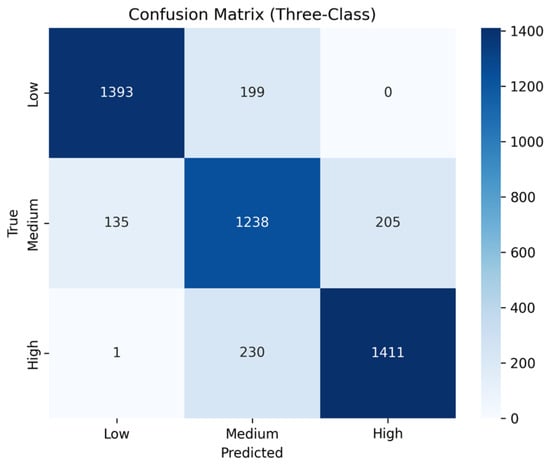
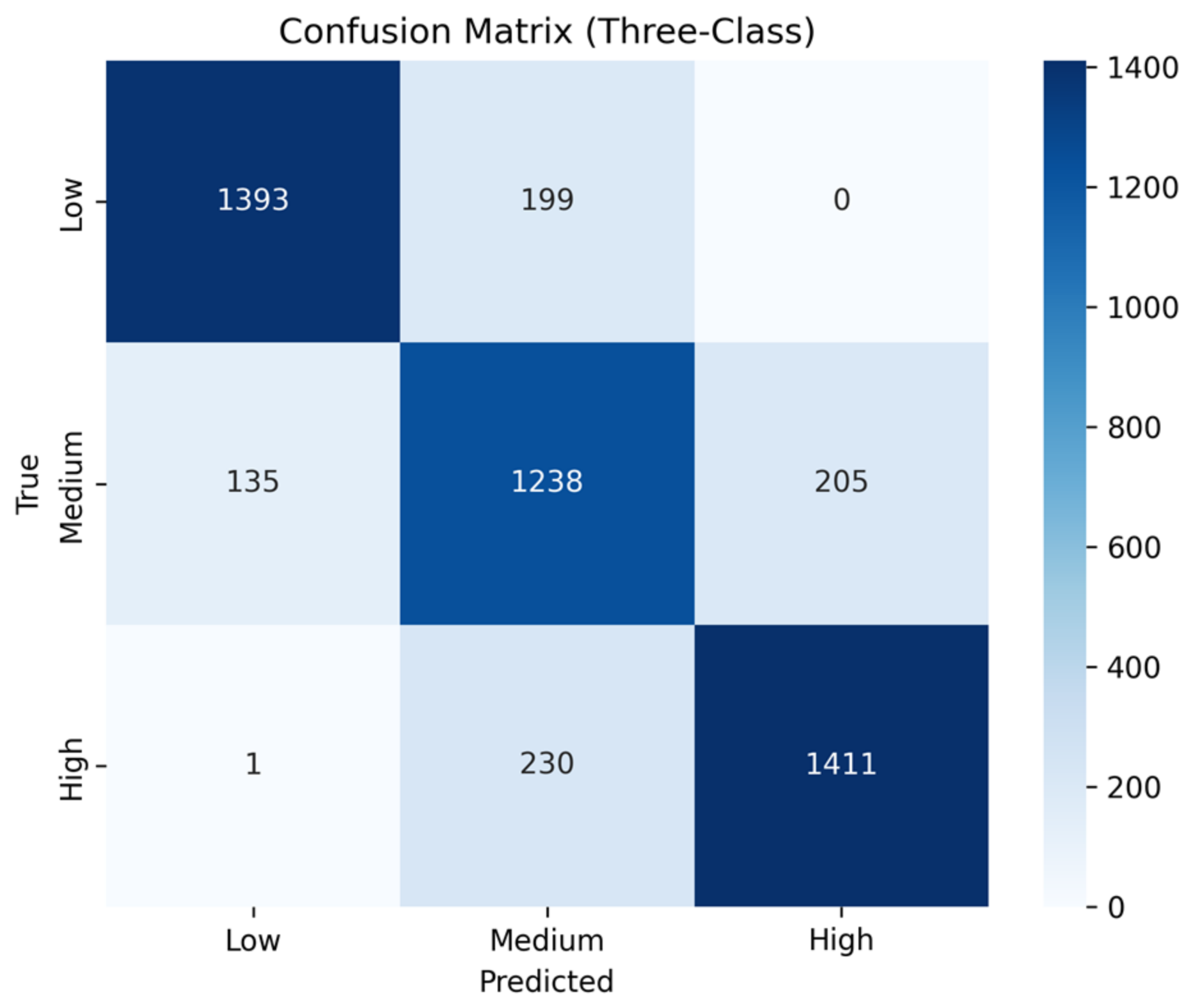
The confusion matrix in Figure 1 shows stronger discrimination for the Low- and High-Stress classes, whereas the Medium-Stress class exhibits greater overlap with the adjacent categories. These classes correspond to lower, intermediate, and higher subject-relative stress levels, as derived from the quantile-based labeling procedure.
Figure 1.
Confusion matrix for three-class subject-relative stress classification.
The model achieved comparatively high precision for the Low- and High-Stress classes. The Medium-Stress class was more frequently confused with neighboring classes, indicating that subject-relative mid-range stress patterns were less distinctly separated by the learned representation.
8.2. Binary High-Stress Classification
For the binary evaluation, the Low- and Medium-Stress classes were combined into a Lower/Medium category, while the High-Stress class was retained as the positive class. This binary comparison represents higher subject-relative autonomic activation versus lower/intermediate activation and should not be interpreted as stress versus a clinically verified resting state.
The resulting pooled window-level performance was approximately:
Macro F1: 0.90;
Accuracy: 0.91.
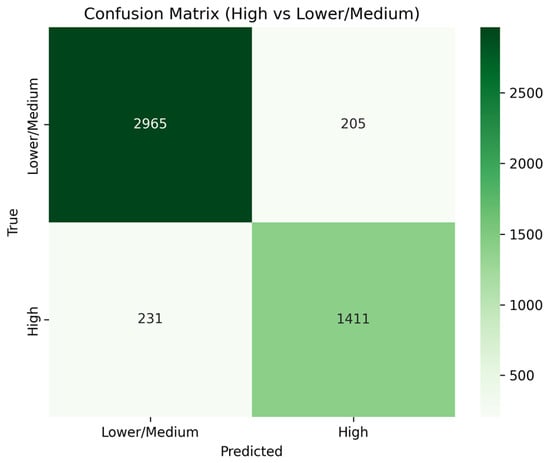
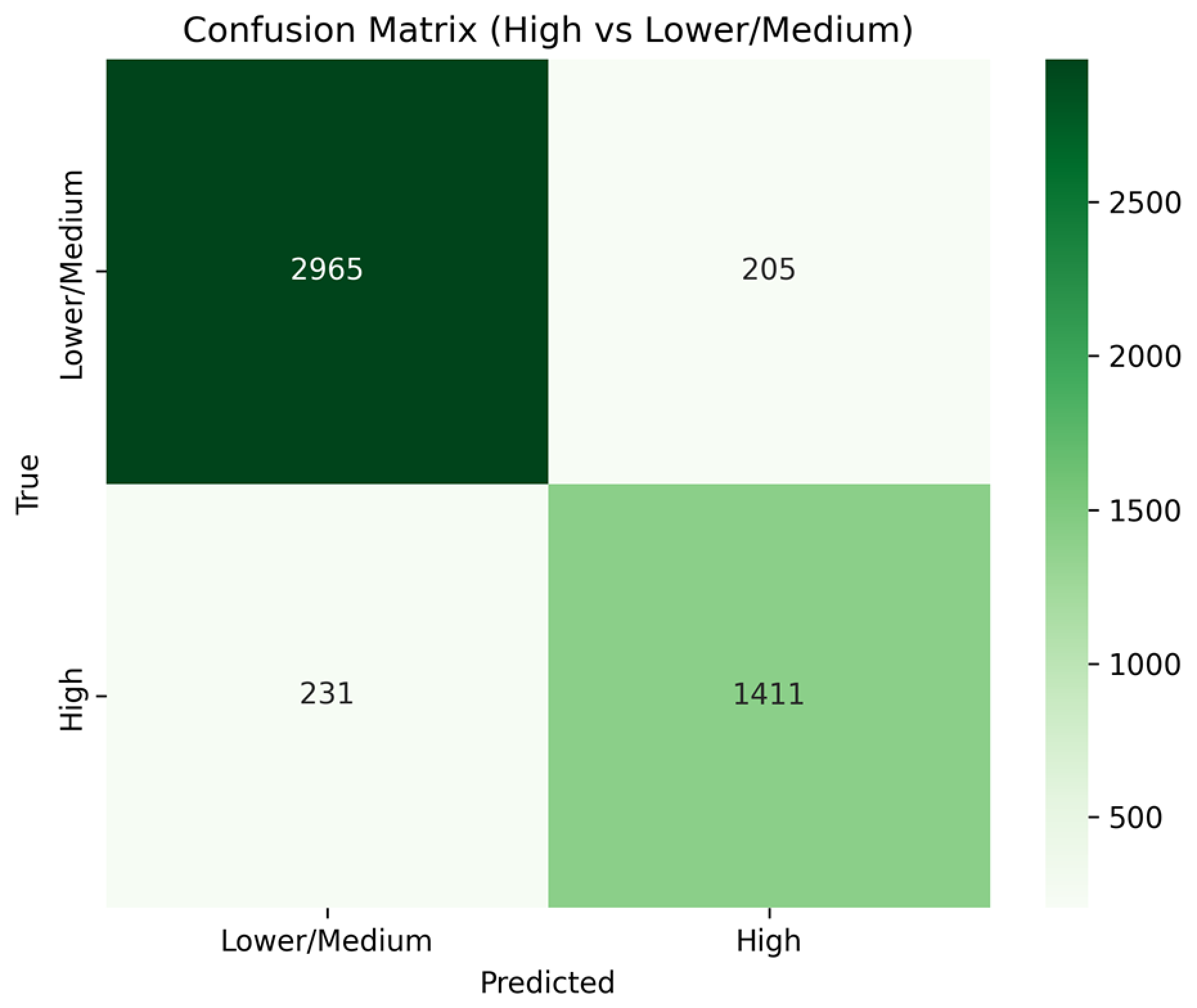
Figure 2 presents the corresponding confusion matrix.
Figure 2.
Confusion matrix for binary High-Stress versus combined Low-/Medium-Stress classification.
The binary formulation produced stronger aggregate performance than the three-class setting. Low- and Medium-Stress windows were correctly assigned to the combined category, while High-Stress windows retained strong recall. This result indicates that distinguishing the upper subject-relative stress tertile was easier than separating all three adjacent stress levels.
8.3. Configuration and Additional Evaluation Analyses
We compared subject-wise z-score and median/MAD normalization as complete preprocessing-and-labeling configurations, since each choice also alters the resulting physiological activation scores and quantile targets.
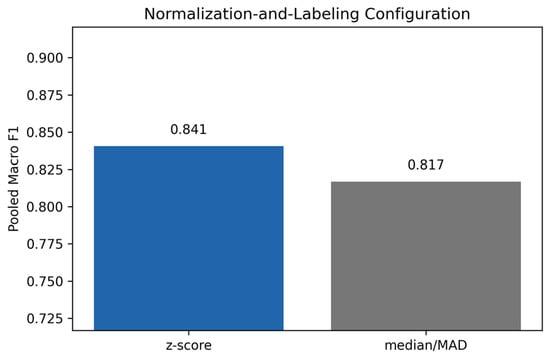
Figure 3 compares two subject-wise normalization configurations: z-score normalization and median/MAD scaling. Because normalization was applied before both feature construction and autonomic-activation score computation, the comparison reflects the complete normalization-and-labeling pipeline rather than an isolated transformation of otherwise identical model inputs.
Figure 3.
Configuration comparison between subject-wise z-score normalization and median/MAD scaling.
In the evaluated TCN pipeline, the z-score configuration achieved a pooled Macro F1 of 0.841, compared with 0.817 for the median/MAD configuration.
The result supports retaining z-score normalization in the final pipeline configuration. Standardizing each signal using its participant-specific mean and standard deviation may facilitate joint modeling across heterogeneous dynamic ranges. However, because the normalization method also affects the autonomic-activation scores and their subject-specific tertile boundaries, the observed performance difference cannot be attributed exclusively to input scaling and does not establish that robust scaling is generally inferior. It indicates only that the z-score-based normalization-and-labeling configuration performed better within the evaluated pipeline.
Across 24 LOSO folds, the controlled full TCN reference achieved a mean participant-level Macro F1 of 0.8292 (95% CI: 0.7865–0.8719). Removal of the EDA, BVP, or cardiovascular–temperature stream reduced this to 0.6611, 0.6821, and 0.6275, respectively. Channel-level removal reduced Macro F1 most strongly for GSR (0.6515), temperature (0.6515), BVP amplitude (0.7320), and HR (0.7851); removal of BVP waveform, dGSR, ddGSR, or dHR did not yield a material mean reduction. These ablations characterize contributions to the proposed labeling task, rather than physiological stress validity.
Using the same 24 test participants, Logistic Regression achieved mean subject-level Macro F1 of 0.8358 and a 4195-parameter GRU achieved 0.8381, versus 0.8292 for the controlled 151,890-parameter TCN. The paired TCN–GRU difference was −0.0089 (95% CI: −0.0247 to 0.0069), indicating no established performance advantage. The controlled TCN reference is reported separately from the original TCN evaluation (mean participant Macro F1 approximately 0.8387), because it comes from a new training series. Fold-level Macro F1 values for the controlled TCN (P01–P24) were: P01 0.659, P02 0.934, P03 0.902, P04 0.850, P05 0.893, P06 0.914, P07 0.874, P08 0.815, P09 0.824, P10 0.697, P11 0.944, P12 0.763, P13 0.911, P14 0.899, P15 0.671, P16 0.771, P17 0.861, P18 0.867, P19 0.853, P20 0.889, P21 0.920, P22 0.867, P23 0.783, and P24 0.541.
As a complementary experimental-condition check, the mean ordinal physiology-derived activation category was higher during stress-inducing tasks than during baseline segments in 19 of 24 participants (mean within-participant difference: +0.388; 95% CI: +0.070 to +0.706). Task/baseline conditions were not used to derive class labels. This association provides contextual concordance, not independent validation of the three categories.
In a separate causal LOSO sensitivity analysis, the first 60 s of the initial baseline provided subject-specific normalization and fixed tertile thresholds, followed by causal filtering and predictions from completed 15 s windows updated every 5 s (first prediction after 75 s). Over 4524 post-calibration windows, mean participant-level Macro F1 was 0.4472 (95% CI: 0.3829–0.5116) for the TCN versus 0.3946 (95% CI: 0.3385–0.4508) for Logistic Regression. Only 61 windows (1.35%) fell in the Medium category, which was absent in 13 participants; fixed short-baseline calibration therefore did not maintain stable three-class targets. These metrics are not directly comparable to those of the original offline task, because the preprocessing and target construction differ.
A CPU benchmark with synthetic 120 × 8 inputs (FP32, batch size one, two CPU threads) measured mean model-only inference latency of 7.33 ms for the TCN and 2.41 ms for the GRU. The TCN contained 151,890 parameters (approximately 0.605 MiB of weights). These measurements used initialized model weights and exclude sensing, preprocessing and data transfer; they do not validate an end-to-end embedded implementation.
9. Discussion
The results indicate that the proposed pipeline can discriminate among graded, subject-relative autonomic stress responses from multimodal physiological time series using a lightweight Temporal Convolutional Network. Strong aggregate three-class and binary performance was obtained under a Leave-One-Subject-Out evaluation protocol, supporting cross-participant generalization at the classifier level.
A central contribution of the study is the quantile-based labeling strategy, which operationalizes stress as a graded autonomic response rather than as a single binary state. The labeling score integrates electrodermal activity, heart rate, BVP amplitude, and peripheral temperature according to established directional patterns of autonomic arousal. The resulting lower-, intermediate-, and higher-activation levels are subject-adaptive and therefore account for differences in individual baselines and response ranges. These labels should be interpreted as relative autonomic-activation strata rather than as universal clinical thresholds.
The normalization-and-labeling comparison favored the z-score-based configuration over median/MAD scaling. Because normalization was applied before both feature construction and autonomic-activation score computation, the observed difference reflects the complete preprocessing-and-labeling configuration rather than input scaling alone. Within the evaluated pipeline, the z-score configuration provided the strongest predictive performance and was therefore retained for the final analysis.
The findings also support the use of compact temporal architectures in high-fidelity physiological sensing environments. The TCN achieved strong multiclass and binary performance from short multivariate sequences without requiring post-processing for the primary predictions. This indicates that lightweight models can capture stress-related temporal patterns under the controlled, high-fidelity acquisition conditions of the present dataset when the targets preserve graded, subject-relative autonomic information.
The multi-stream TCN was chosen for explicit temporal encoding and integration of electrodermal, pulse, and cardiovascular–temperature modalities. The stream ablations support the relevance of their combined use within this architecture, while Logistic Regression and GRU provide comparably accurate alternatives with different complexity. Multimodal signal integration is also illustrated in a different application by Bibbò et al. [9], whose EEG–EMG exoskeleton-control approach is methodologically relevant but not a stress-classification benchmark.
Sensor specifications and the signal-processing chain influence the reproducibility and interpretation of physiological estimates. Laganà et al. [10] discuss this measurement-chain perspective in the distinct context of air-coupled biomedical ultrasound. Here, the available exports do not document the original sensor-level acquisition settings or sample-level timing. The causal analysis further indicates that a short fixed initial baseline is insufficient for stable three-level classification in these recordings, despite low model-only CPU latency.
Several limitations should nevertheless be considered. Although the classifier was evaluated using mutually exclusive training, validation, and test participants, normalization and quantile construction were performed within each participant, thereby using subject-specific distributional information. The protocol is therefore strict with respect to model fitting and participant separation but subject-adaptive and transductive with respect to preprocessing and target definition. In addition, the stress levels were derived from physiological responses rather than from independent clinical diagnoses or contemporaneous self-reports. Future work should examine fully inductive normalization, independent psychological annotations, participant-level variability, and validation on external datasets and under less controlled acquisition conditions. Reliable initial and adaptive causal calibration remains an open requirement for prospective deployment.
10. Conclusions
This work presented a lightweight Temporal Convolutional Network pipeline for classifying graded, subject-relative autonomic stress responses from electrodermal activity, blood-volume pulse and pulse amplitude, heart rate, and peripheral temperature. The model achieved strong aggregate multiclass and binary performance under a Leave-One-Subject-Out evaluation protocol. The subject-adaptive quantile-labeling strategy enabled the continuous physiological response profile of each participant to be represented as lower-, intermediate-, and higher-activation strata.
The configuration analysis showed that the z-score-based normalization-and-labeling pipeline yielded a higher pooled Macro F1 than the corresponding median/MAD configuration (0.841 vs. 0.817). Additional 24-fold ablations supported the contribution of all three physiological streams, while Logistic Regression and GRU obtained comparable predictive performance. A separate causal analysis exposed the instability of three-level targets derived from a fixed 60 s baseline. Overall, the findings indicate that a compact temporal architecture can capture stress-related physiological dynamics under the high-fidelity acquisition conditions of the present dataset.
Beyond the present dataset, the proposed labeling strategy may provide a transferable first step toward graded stress estimation in physiological datasets with or without pre-existing stress annotations. In unlabeled datasets, it could be used to derive subject-relative, physiology-informed stress classes, whereas in labeled datasets it could serve as a complementary target for comparison with task-based, behavioral, or self-reported annotations. Although three tertile-based classes were examined here, the framework could be extended to a larger number of ordinal stress levels when sufficient data and appropriate external validation are available. Such extensions may help move stress modeling beyond binary on/off decisions toward more clinically oriented representations of graded physiological stress responses, without implying that the resulting classes are themselves clinically validated.
The conclusions remain specific to subject-relative, physiology-derived targets evaluated across held-out participants. Because normalization and tertile construction used participant-specific distributional information, the protocol should be interpreted as subject-adaptive and transductive rather than fully inductive. Future work should evaluate fully inductive normalization, independent psychological or behavioral stress annotations, participant-level variability, and external datasets collected under noisier and less controlled conditions. Such studies should also examine whether temporal smoothing, adaptive normalization, and calibration provide greater benefit when motion artifacts, environmental variation, and label uncertainty are more pronounced.
Author Contributions
G.V.T.: Conceptualization, Methodology, Writing—Original Draft, and Visualization. I.S.: Supervision and Writing—Review and Editing. D.A.F.: Supervision and Writing—Review and Editing. All authors have read and agreed to the published version of the manuscript.
Funding
This research received no external funding.
Institutional Review Board Statement
Not applicable.
Informed Consent Statement
Informed consent was obtained from all participants during the original data collection described by Liapis et al. (2021) [2].
Data Availability Statement
The physiological data analyzed in this study were obtained from Liapis et al. [2] and are not publicly available. As the dataset was originally collected and provided by third-party researchers, the authors of the present study are not authorized to distribute it independently. Requests for access should be directed to the corresponding author of the original study, and any subsequent data sharing is subject to permission from the original data providers.
Acknowledgments
The authors would like to thank the University of Western Macedonia and especially the Department of Informatics for their valuable technical and infrastructure support. OpenAI’s ChatGPT (GPT-6), Google Gemini (Gemini Pro), and Microsoft Copilot (GPT-5) were used as assistive tools for language refinement, grammar, clarity, and editorial review. All scientific content, analyses, interpretations, and conclusions were developed and verified by the authors, who take full responsibility for the final manuscript.
Conflicts of Interest
The authors declare no conflicts of interest.
References
- Taskasaplidis, G.; Fotiadis, D.A.; Bamidis, P.D. Review of Stress Detection Methods Using Wearable Sensors. IEEE Access 2024, 12, 38219–38246. [Google Scholar] [CrossRef] [Scilit]
- Liapis, A.; Katsanos, C.; Karousos, N.; Xenos, M.; Orphanoudakis, T. User Experience Evaluation: A Validation Study of a Tool-Based Approach for Automatic Stress Detection Using Physiological Signals. Int. J. Hum. Comput. Interact. 2021, 37, 470–483. [Google Scholar] [CrossRef] [Scilit]
- Koelstra, S.; Muhl, C.; Soleymani, M.; Lee, J.-S.; Yazdani, A.; Ebrahimi, T.; Pun, T.; Nijholt, A.; Patras, I. DEAP: A Database for Emotion Analysis; Using Physiological Signals. IEEE Trans. Affect. Comput. 2012, 3, 18–31. [Google Scholar] [CrossRef] [Scilit]
- Juster, R.-P.; McEwen, B.S.; Lupien, S.J. Allostatic Load Biomarkers of Chronic Stress and Impact on Health and Cognition. Neurosci. Biobehav. Rev. 2010, 35, 2–16. [Google Scholar] [CrossRef] [Scilit] [PubMed]
- Bai, S.; Kolter, J.Z.; Koltun, V. An Empirical Evaluation of Generic Convolutional and Recurrent Networks for Sequence Modeling. arXiv 2018, arXiv:1803.01271. [Google Scholar]
- Giannakakis, G.; Grigoriadis, D.; Giannakaki, K.; Simantiraki, O.; Roniotis, A.; Tsiknakis, M. Review on Psychological Stress Detection Using Biosignals. IEEE Trans. Affect. Comput. 2022, 13, 440–460. [Google Scholar] [CrossRef] [Scilit]
- Diraco, G.; Siciliano, P.; Leone, A. Behavioral Change Prediction from Physiological Signals Using Deep Learned Features. Sensors 2022, 22, 3468. [Google Scholar] [CrossRef] [Scilit] [PubMed]
- Chen, J.; Yu, K.; Wang, F.; Zhou, Z.; Bi, Y.; Zhuang, S.; Zhang, D. Temporal Convolutional Network-Enhanced Real-Time Implicit Emotion Recognition with an Innovative Wearable fNIRS-EEG Dual-Modal System. Electronics 2024, 13, 1310, Correction in Electronics 2024, 13, 1833. [Google Scholar] [CrossRef] [Scilit]
- Bibbò, L.; Laganà, F.; Pullano, S.A.; Angiulli, G. Multimodal EEG–EMG and FEM-Based Adaptive Control of Passive Upper-Limb Exoskeletons. Sensors 2026, 26, 3924. [Google Scholar] [CrossRef] [Scilit] [PubMed]
- Laganà, F.; Olivieri, R.; Stuppia, E.; Barile, G.; Ferri, G.; Pullano, S.A. Air-Coupled Ultrasound Systems for Biomedical Applications: Advances in Sensors, Electronic Interfaces and Signal Processing Strategies. Sensors 2026, 26, 1692. [Google Scholar] [CrossRef] [Scilit] [PubMed]
Disclaimer/Publisher’s Note: The statements, opinions and data contained in all publications are solely those of the individual author(s) and contributor(s) and not of MDPI and/or the editor(s). MDPI and/or the editor(s) disclaim responsibility for any injury to people or property resulting from any ideas, methods, instructions or products referred to in the content. |
© 2026 by the authors. Licensee MDPI, Basel, Switzerland. This article is an open access article distributed under the terms and conditions of the Creative Commons Attribution (CC BY) license.