


Abstract
Mining machines operate in harsh, variable and production-critical environments where dust, vibration, heat, uneven loading and continuous operation accelerate degradation. Recent mining maintenance research has advanced sensor-based monitoring, cyber-physical systems and predictive models, but the decision path from abnormal condition information to maintenance response is often less explicit. This paper develops a bio-inspired immune-system-centric framework for maintenance decision-making in mining machines. The phrase smart sensor fusion is used in a decision-framework sense: it means the integration of sensor-derived condition indicators, inspection evidence, operating context and OEM guidance and not the development of a new signal-level sensor-fusion algorithm. A design science research approach, supported by systems thinking and systems engineering, was used to translate immune-system functions into maintenance decision functions. The developed framework consists of five layers: context, condition-data input, sensor-informed assessment, immune-inspired diagnosis, and response and escalation, supported by a feedback memory loop. The framework was demonstrated through a hypothetical, anonymised mining maintenance scenario and compared with preventive maintenance, reliability-centred maintenance, condition-based maintenance, predictive maintenance and sensor-based monitoring. The result is a structured Industry 4.0 decision framework that extends fault detection into threat classification, response selection, escalation and organisational memory. The novelty lies in using immune-system logic as a systems engineering structure for sensor-informed maintenance response rather than as a general biomimetic analogy only.
1. Introduction
Mining operations depend on specialised equipment that must perform reliably in difficult operating environments. Equipment failure affects availability, safety, production continuity and maintenance cost. Mining machines also include interacting mechanical, hydraulic, electrical, electronic and digital subsystems. This makes maintenance a systems problem rather than a single technical activity.
Existing maintenance practices include reactive maintenance, preventive maintenance, reliability-centred maintenance (RCM), condition-based maintenance (CBM) and predictive maintenance (PdM). These approaches support maintenance planning and machine-health monitoring. However, mining environments are exposed to changing loads, dust, heat, vibration, water ingress and production pressure. These factors make it difficult to convert condition information into a timely and proportionate maintenance response.
Sensor-based condition monitoring is central to Industry 4.0 maintenance. Wireless accelerometer modules have been applied to mining mobile machinery [1], while cyber-physical systems have been developed for early failure detection in vibrating screens [2]. Gaussian process modelling has also been used for predictive maintenance of mining machinery [3], and recent reviews show growing interest in proactive and predictive maintenance in mining [4,5]. These studies demonstrate the value of sensing, monitoring and prediction. However, they also indicate that detection does not automatically become a maintenance decision. CBM policies must also account for dependencies between components [6], while digital-twin adoption in the minerals industry faces integration, cost and skills challenges [7].
Biomimicry offers one way to structure that decision pathway. Nature-inspired technologies are increasingly discussed in mining, including nature-inspired algorithms, swarm robotics and biomimicry-based technologies [8]. The biological immune system is especially relevant because it monitors normal state, detects abnormality, classifies threat, selects a response, escalates when required, supports repair and retains memory for future response. Recent smart maintenance research has already shown the relevance of immune-system-inspired logic in manufacturing environments [9].
The purpose of this paper is to develop and demonstrate a sensor-informed immune-system-inspired framework for maintenance decision-making in mining machines. This paper contributes a five-layer systems engineering framework that links condition information to threat classification, maintenance response, escalation and feedback memory. The novelty of this work is not sensor monitoring alone. It lies in using immune-system logic to structure the response side of mining maintenance decision-making. The use of the term smart sensor fusion is therefore limited to decision-level fusion of available evidence; it is not presented as a new physical sensor design or mathematical signal-fusion method.
2. Research Method
2.1. Research Design and Evidence Base
This paper followed design science research because the main output was an artefact in the form of a maintenance decision framework [10]. The artefact was developed through five steps: review of maintenance literature, systems representation of the mining maintenance problem, translation of immune response functions into maintenance decision functions, framework development and comparative evaluation.
The evidence base consisted of peer-reviewed literature on mining maintenance, sensor-based condition monitoring, biomimicry, immune-system-inspired maintenance and immune response processes. Publicly available mining and technical literature was used because detailed mining maintenance data are usually proprietary. This paper therefore does not claim live mine implementation. It develops and demonstrates a field-relevant framework that can be validated later with expert review and anonymised operational data.
For this paper, sensor fusion is used in a decision-framework sense. It refers to the structured combination of available condition indicators, inspection evidence, operational context and OEM guidance before a maintenance response is selected. It does not claim that a new physical sensor or mathematical sensor-fusion algorithm has been developed.
2.2. Systems Thinking and Systems Engineering Method
The systems engineering method did not treat maintenance as a single technical action. The maintenance problem was represented as a socio-technical system with asset and subsystem condition, environment, sensor or inspection inputs; OEM requirements; production pressure; maintenance resources; spares availability; decision authority; safety risk; and feedback learning. This aligns with systems engineering guidance that emphasises system life-cycle processes, stakeholder needs, interfaces and feedback across the whole system [11,12].
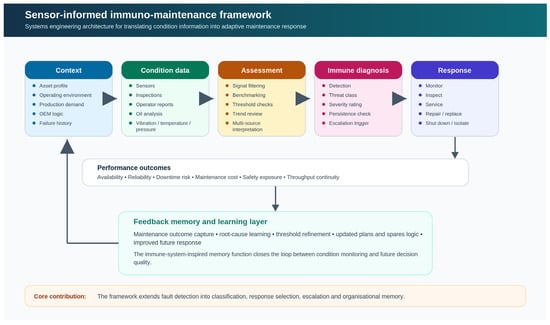
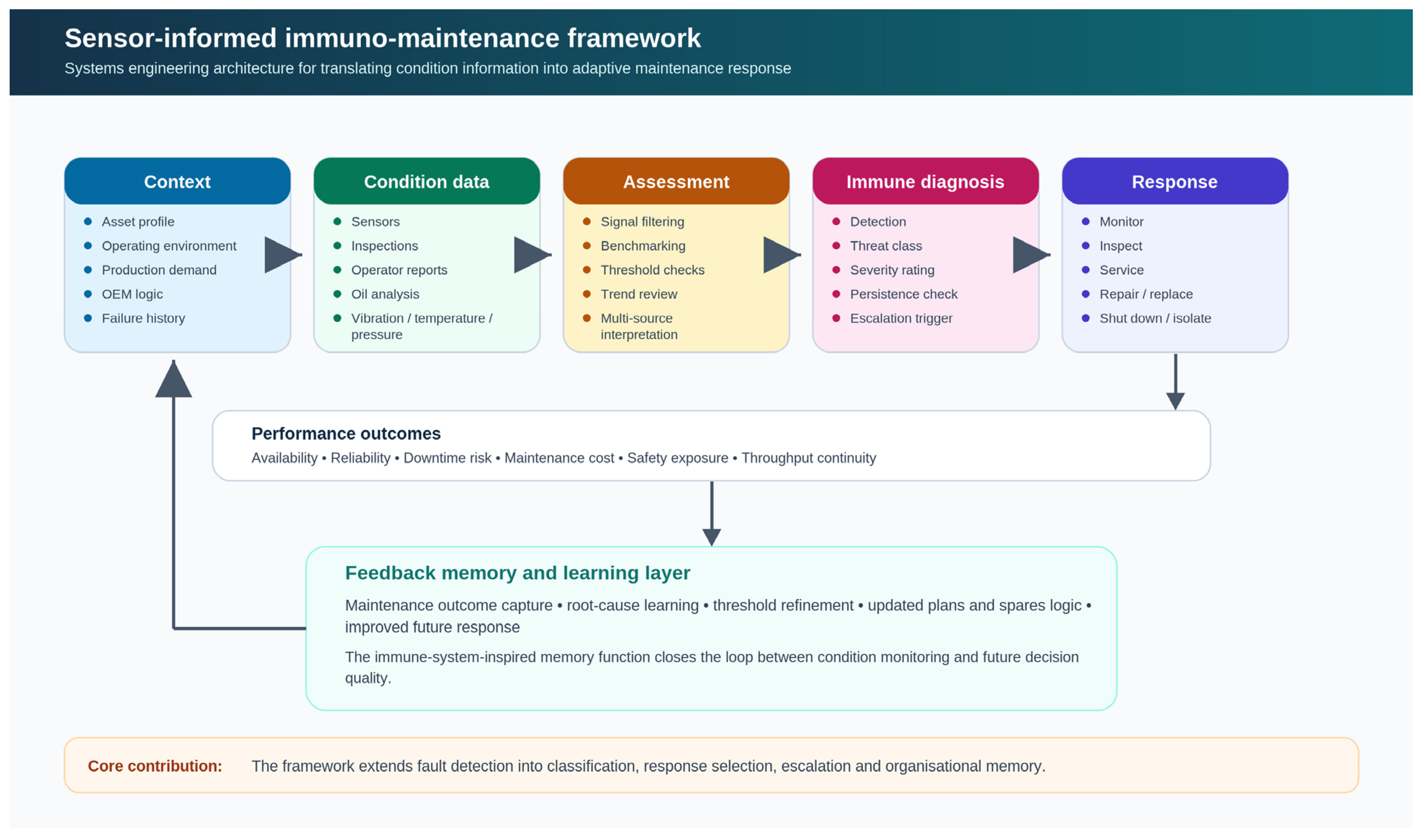
The systems thinking element was applied by asking how condition signals, asset history, OEM guidance, operating stressors, spares availability, maintenance windows and production pressure interact before a decision is made. This was used to define the five-layer architecture shown in Figure 1. Figure 1 has therefore been placed before the immune response translation section because it represents the overall research method and framework architecture.
Figure 1.
Sensor-informed immuno-maintenance framework for mining asset decision-making.
Figure 1 presents the proposed sensor-informed immuno-maintenance architecture. The framework begins with the asset context and condition-data inputs and then moves through assessment, immune-inspired diagnosis and maintenance response. The feedback memory layer closes the loop by returning learning from maintenance outcomes to future decision-making. This is important because the proposed contribution is not only to detect an abnormality but to structure what the maintenance system should do after an abnormality has been detected.
2.3. Translation and Evaluation Procedure
The immune process was mapped at a high level from normal state to return to an updated normal state. Pattern-recognition receptors, damage-associated molecular patterns, antigen presentation and inflammation resolution were used as biological reference points [13,14,15]. These immune processes were simplified into engineering functions that could be compared with maintenance and reliability logic.
The framework was evaluated qualitatively against preventive maintenance, RCM, CBM, predictive maintenance and sensor-based monitoring. The comparison criteria were adaptability, responsiveness, decision clarity, ability to escalate, ability to learn from previous events, and suitability for harsh mining environments. These criteria were applied in the comparative evaluation reported in Section 3.4. The purpose of the evaluation was not to prove operational performance from live data. It was to test whether the proposed framework added a clearer decision structure to the state of the art.
3. Results and Discussion
3.1. Immune Response Translation Result
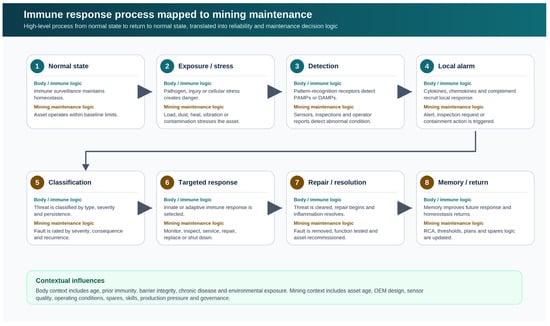
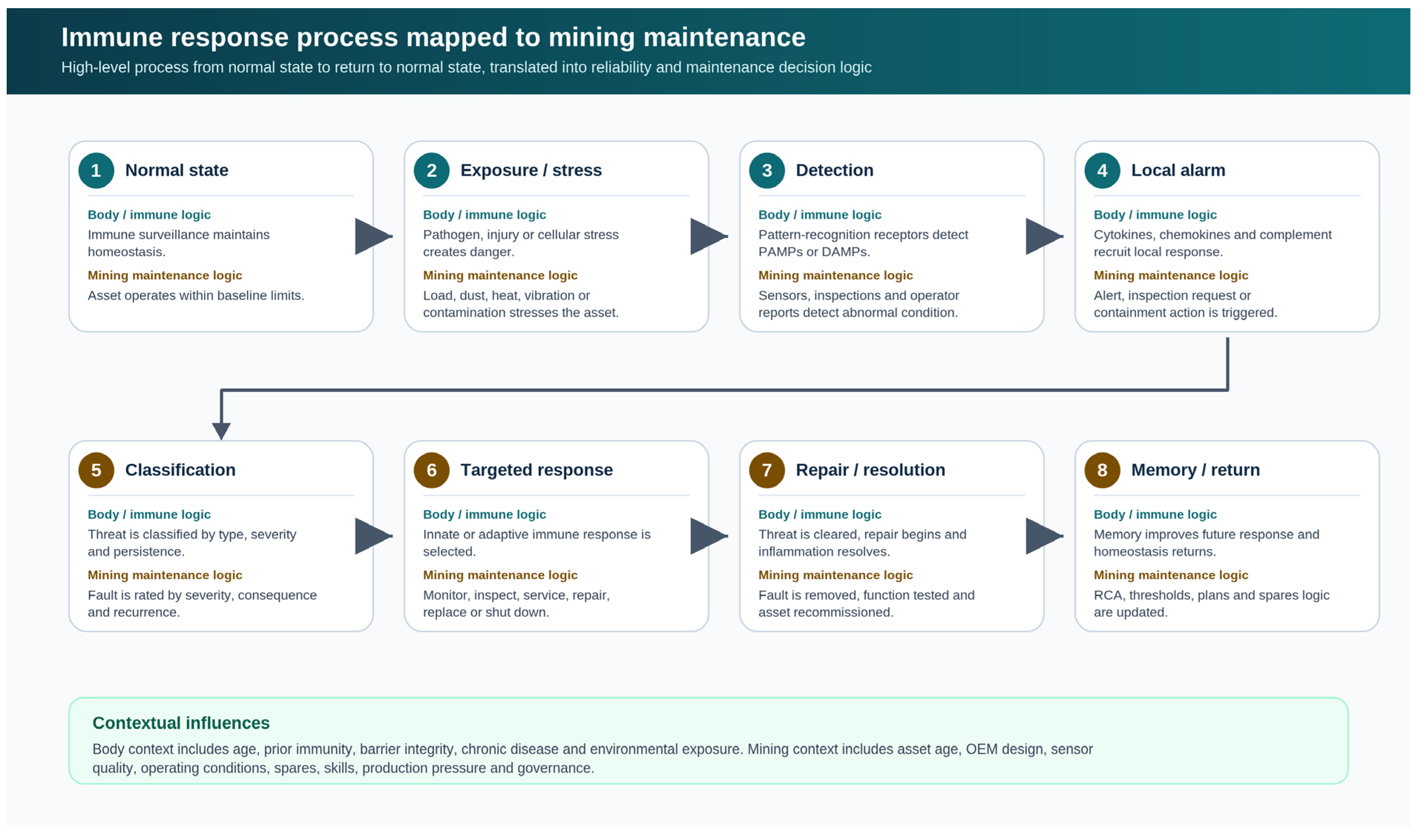
The first result is the immune response translation shown in Figure 2 and Table 1. The immune system was interpreted as a closed-loop response system that moves from normal state to stress, detection, local alarm, classification, response, repair, resolution and memory. This process was then translated into maintenance and reliability language for mining assets.
Figure 2.
Immune response process mapped to mining maintenance and reliability logic.
Table 1.
Immune response stages translated into mining maintenance logic.
Figure 2 visualises the immune response as a closed-loop maintenance process. The figure starts with a normal state; moves through exposure or stress, detection, local alarm, classification, response, repair and resolution; and ends with memory and return to an updated normal state. The mining comparison shows that an asset not only requires monitoring but also requires a decision cycle that can detect an abnormality, classify severity, choose an intervention, close the work order and update the maintenance memory before returning to normal operation. Figure 2 groups response selection with escalation, and repair with resolution; Table 1 lists these as separate stages.
Table 1 establishes the biological-to-engineering translation used in this paper. It follows the immune response from normal homeostasis to stress, detection, classification, response, repair, resolution and memory. The table is presented as a result because it is the output of the translation method. It is also used further in this paper to build the framework layers, define the anonymised scenario and explain the comparative evaluation of the proposed maintenance logic.
3.2. Anonymised Case Scenario Used to Demonstrate the Method
A generic anonymised scenario was created to demonstrate the method. Asset Class A represents a vibration-sensitive mining machine subsystem, such as a vibrating screen drive bearing or similar rotating asset. The scenario is hypothetical and does not contain data from an actual site or asset. The scenario was used only to demonstrate how the proposed framework would structure a maintenance decision.
In the scenario, the asset operated normally until condition information indicated increasing vibration and heat. The current maintenance system could detect the abnormality, but the decision path from detection to response was not always clear. The proposed framework was applied by moving the signal through detection, threat classification, response selection, escalation and memory update.
Table 2 applies the proposed logic to an anonymised mining maintenance scenario. The scenario shows how a change in condition information, such as increasing vibration and heat on a critical asset, can be moved through the framework until a maintenance response is selected. This demonstrates the practical value of the framework. It does not replace a sensor, OEM rule or predictive model. Instead, it shows how those inputs can be organised into a response pathway that is understandable to maintenance planners, engineers and production stakeholders.
Table 2.
Application of the framework to the anonymised mining maintenance scenario.
3.3. Decision Functions of the Framework
Table 3 defines the function and expected decision output of each framework layer shown in Figure 1. It separates the flow of information into condition-data input, benchmarking and contextualisation, immune-inspired diagnosis, response and escalation, and feedback memory. This separation is useful because it shows where sensors, human judgement, OEM guidance and organisational learning enter the maintenance decision process. It also clarifies that the proposed framework is a decision architecture rather than a standalone prediction algorithm.
Table 3.
Framework layers and expected decision outputs.
3.4. Qualitative Comparison of Maintenance Approaches
Table 4 applies the evaluation criteria to each approach rather than treating the comparison as a general narrative. The ratings are qualitative and use High, Medium or Low to show how each approach supports adaptability, responsiveness, decision clarity, escalation and learning, and suitability for harsh mining environments. The comparison shows that the proposed framework is not intended to replace preventive maintenance, RCM, CBM or predictive maintenance. Its value is that it sits downstream of sensing, CBM and PdM. It strengthens the response side of maintenance by making classification, escalation and organisational memory explicit.
Table 4.
Comparative evaluation against state-of-the-art maintenance approaches.
3.5. Discussion
The proposed framework is relevant to the Robotics, Sensors and Industry 4.0 session because it addresses the practical use of machine-health information after it has been generated. Current mining maintenance research has shown clear progress in sensing, monitoring, cyber-physical systems and predictive modelling [1,2,3,5]. These technologies improve the ability to identify abnormal equipment condition. However, Industry 4.0 value is not created by condition signals alone. Value is created when condition information is converted into a timely, risk-based and operationally realistic maintenance decision.
The first implication of the framework is that sensor information should not be treated as an isolated technical output. In mining, the same condition signal may lead to different decisions depending on asset criticality, operating context, safety consequence, spares availability, maintenance window and production pressure. A vibration trend may justify continued monitoring on a low-criticality asset, but it may require immediate escalation on a production-critical subsystem. The framework therefore places condition information inside a broader systems engineering context.
The immune-system analogy strengthens the framework by providing a structured logic for moving from abnormality to response. In the body, an immune response begins from homeostasis, detects danger or damage signals, classifies the threat, initiates a local or systemic response, clears the problem, resolves inflammation and retains memory for future exposure. The framework applies this same logic to mining maintenance. The maintenance system should know what normal means, detect an abnormality, classify severity, select a proportionate response, escalate when the risk increases and learn from previous events.
This provides a clearer novelty claim when compared with the state of the art. Preventive maintenance is useful for planning but can be rigid when operating conditions change. RCM links maintenance to function and failure consequence, but it can become static if failure modes and operating conditions are not regularly updated. CBM uses condition information, but practical implementation may still struggle when detection is not linked to decision authority and response rules. Predictive maintenance can forecast degradation, but prediction alone does not guarantee action. The proposed framework adds immune-style classification, escalation and memory to strengthen the decision pathway after sensing and prediction.
The anonymised scenario illustrates this contribution at a practical level. A vibration-sensitive mining subsystem may show increasing vibration and heat while still operating. A conventional condition-monitoring process may issue a warning, but the response may depend on individual judgement or production urgency. In the proposed framework, the signal is first compared with the operating baseline, then classified by severity and consequence, and then linked to a response category. If the condition worsens or repeats, the response escalates to engineering review, OEM support or shutdown planning. After repair, the outcome is captured as memory to update future decisions.
The framework also has value for gradual implementation. It does not require an immediate full digital twin or advanced artificial intelligence deployment. It can begin as a decision-support structure using existing sensor data, inspection reports and work-order history. Over time, it can be strengthened through more detailed sensor integration, reliability analysis, predictive models or expert validation. This makes it suitable for mines that are moving toward Industry 4.0 but still operate with fragmented data and mixed manual–digital maintenance processes.
The limitations of this work must also be recognised. The framework has been demonstrated through a literature-supported and anonymised scenario rather than live equipment data. This paper therefore does not claim that the framework has reduced downtime or maintenance cost in operation. The next research step is to apply the framework to a specific asset class using anonymised maintenance records, condition-monitoring information and practitioner review. A medical expert review may also strengthen the biological accuracy of the immune-system translation.
4. Conclusions
This paper developed and demonstrated a bio-inspired immune-system-centric framework for maintenance decision-making in mining machines. This work responded to a specific gap in smart maintenance: the need to move from condition detection to structured maintenance response. The proposed framework used systems engineering and design science research to translate immune-system functions into mining maintenance logic.
The main result is not a new sensor device or a deployed predictive model. The result is a systems engineering decision framework that can sit between machine-health information and maintenance action. The anonymised scenario demonstrated how condition signals can be moved through detection, classification, response selection, escalation, resolution and feedback memory. The four tables and two figures show the translation logic, the scenario application, the framework layers and the comparison with existing maintenance approaches.
The contribution of this paper is twofold. First, it adapts immune-system logic to the mining maintenance environment in a structured way. Second, it strengthens the response side of sensor-informed maintenance by making classification, escalation and learning explicit. This is relevant to Industry 4.0 because it connects sensor-based condition information to practical decision-making rather than treating monitoring as an end in itself.
Future work should apply the framework to a specific mining asset using anonymised field data and expert review. A first empirical validation should focus on one asset class, such as vibrating screen drive bearings, conveyor drives, pumps or mobile-machine rotating components. It should use at least 6 to 12 months of condition-monitoring records, inspection findings, work orders, downtime events and escalation records. The framework-guided decision pathway should then be compared with current maintenance practice over a defined baseline and trial period. Useful validation metrics would include time from abnormal signal to decision, consistency of escalation, repeat-failure occurrence, planned versus unplanned interventions, and practitioner assessment of decision clarity. Medical expert validation should also be used to confirm that the immune analogy is biologically reasonable. Further development may include a scoring model, a dashboard prototype or integration with existing CBM and predictive-maintenance platforms.
Author Contributions
The authors wrote, reviewed, and take full responsibility for all final content. Conceptualisation, S.S. and M.K.A.; methodology, S.S. and M.K.A.; writing—original draft preparation, S.S.; writing—review and editing, S.S. and M.K.A.; supervision, M.K.A. All authors have read and agreed to the published version of the manuscript.
Funding
This research received no external funding.
Institutional Review Board Statement
Not applicable to this paper because no identifiable human participant data, confidential operational data or patient data are reported. Future expert interviews or field validation should be submitted for appropriate ethics review where required.
Informed Consent Statement
Not applicable.
Data Availability Statement
No new empirical data were created or analysed in this study. The conceptual framework and illustrative scenario are contained within the article. Data sharing is not applicable to this article.
Acknowledgments
The authors acknowledge the Department of Industrial and Systems Engineering at the University of Pretoria for academic support. No confidential mining-house data are disclosed in this paper. During the preparation of this manuscript, the authors used ChatGPT (OpenAI; model versions were not recorded) for outlining and organisation, literature-search assistance, drafting and language revision, code-assisted preparation of conceptual figures, and document formatting. The authors have reviewed and edited the output and take full responsibility for the content of this publication.
Conflicts of Interest
The authors declare no conflicts of interest.
References
- Aqueveque, P.; Radrigan, L.; Pastene, F.; Morales, A.S.; Guerra, E. Data-driven condition monitoring of mining mobile machinery in non-stationary operations using wireless accelerometer sensor modules. IEEE Access 2021, 9, 17365–17381. [Google Scholar] [CrossRef] [Scilit]
- Aqueveque, P.; Radrigan, L.; Morales, A.S.; Willenbrinck, E. Development of a cyber-physical system to monitor early failures detection in vibrating screens. IEEE Access 2021, 9, 145866–145885. [Google Scholar] [CrossRef] [Scilit]
- Shao, Z.; Kumral, M. Implementing Gaussian process modelling in predictive maintenance of mining machineries. Min. Technol. 2024, 133, 348–368. [Google Scholar] [CrossRef] [Scilit] [PubMed]
- Dayo-Olupona, O.; Genc, B.; Celik, T.; Bada, S. Adoptable approaches to predictive maintenance in mining industry: An overview. Resour. Policy 2023, 86, 104291. [Google Scholar] [CrossRef] [Scilit]
- Werbinska-Wojciechowska, S.; Rogowski, R. Proactive maintenance of pump systems operating in the mining industry—A systematic review. Sensors 2025, 25, 2365. [Google Scholar] [CrossRef] [Scilit] [PubMed]
- Olde Keizer, M.C.A.; Flapper, S.D.P.; Teunter, R.H. Condition-based maintenance policies for systems with multiple dependent components: A review. Eur. J. Oper. Res. 2017, 261, 405–420. [Google Scholar] [CrossRef] [Scilit]
- Qu, J.; Kizil, M.S.; Yahyaei, M.; Knights, P. Digital twins in the minerals industry: A comprehensive review. Min. Technol. 2023, 132, 267–289. [Google Scholar] [CrossRef] [Scilit]
- Tan, J.; Melkoumian, N.; Harvey, D.; Akmeliawati, R. Nature-inspired solutions for sustainable mining: Applications of NIAs, swarm robotics, and other biomimicry-based technologies. Biomimetics 2025, 10, 181. [Google Scholar] [CrossRef] [Scilit] [PubMed]
- Pulikottil, T.; Martinez-Arellano, G.; Barata, J. Immune system inspired smart maintenance framework: Tool wear monitoring use case. Int. J. Adv. Manuf. Technol. 2024, 132, 4699–4721. [Google Scholar] [CrossRef] [Scilit]
- vom Brocke, J.; Hevner, A.; Maedche, A. Introduction to design science research. In Design Science Research. Cases; Springer: Cham, Switzerland, 2020; pp. 1–13. [Google Scholar] [CrossRef] [Scilit]
- ISO/IEC/IEEE 15288:2023; Systems and Software Engineering—System Life Cycle Processes. IEEE: Piscataway, NJ, USA, 2023. [Google Scholar] [CrossRef] [Scilit]
- INCOSE. Systems Engineering Handbook: A Guide for System Life Cycle Processes and Activities, 5th ed.; Wiley: Hoboken, NJ, USA, 2023. [Google Scholar]
- Moller, A.; Jauch-Speer, S.-L.; Gandhi, S.; Vogl, T.; Roth, J.; Fehler, O. The roles of Toll-like receptor 4, CD33, CD68, CD69, or CD147/EMMPRIN for monocyte activation by the DAMP S100A8/S100A9. Front. Immunol. 2023, 14, 1110185. [Google Scholar] [CrossRef] [Scilit] [PubMed]
- Hilligan, K.L.; Ronchese, F. Antigen presentation by dendritic cells and their instruction of CD4+ T helper cell responses. Cell. Mol. Immunol. 2020, 17, 587–599. [Google Scholar] [CrossRef] [Scilit] [PubMed]
- Dalli, J.; Serhan, C.N. Macrophage proresolving mediators—The when and where. Microbiol. Spectr. 2016, 4, MCHD-0001-2014. [Google Scholar] [CrossRef] [Scilit] [PubMed]

Disclaimer/Publisher’s Note: The statements, opinions and data contained in all publications are solely those of the individual author(s) and contributor(s) and not of MDPI and/or the editor(s). MDPI and/or the editor(s) disclaim responsibility for any injury to people or property resulting from any ideas, methods, instructions or products referred to in the content. |
© 2026 by the authors. Licensee MDPI, Basel, Switzerland. This article is an open access article distributed under the terms and conditions of the Creative Commons Attribution (CC BY) license.