


Abstract
The integration of ubiquitous computing architectures within veterinary clinical practice has intensified the demand for non-invasive, continuous diagnostic methodologies. In this study, an autonomous telemetric artifact designed for the simultaneous optimization of domestic animal kinesis and primary cardiovascular indexes is developed and clinically evaluated. The core systemic framework relies upon the sinuous coupling of an optical photoplethysmography sensor for pulse oximetry assessment and a high-sensitivity global positioning module governed by a central microcontroller. Through this configuration, real-time physiological telemetry is established, thereby mitigating the diagnostic latency associated with traditional, contact-dependent physical auscultation. Empirical validation was conducted through fifteen systematic testing scenarios, wherein the telemetry acquired by the designed prototype was rigorously contrasted against clinical-grade reference instrumentation and geodetic benchmarking systems. The experimental data indicate that a highly stable cardiovascular resolution was achieved, exhibiting a mean absolute percentage error restricted to 5.14% regarding heart rate fluctuations. Concurrently, the satellite positioning apparatus demonstrated an operational precision profile of 80% under standard geographical deployment conditions. The analytical evidence suggests that the non-linear errors observed during spatial tracking are primarily attributed to geoidal signal attenuation, which can be minimized in subsequent architectural iterations via the assimilation of dual-band real-time kinematic positioning. Ultimately, the high efficacy rate obtained confirms the viability of this localized IoT framework as a reliable infrastructure for preventive veterinary diagnostics, spatial security, and early clinical anomaly detection in small conscious animals.
1. Introduction
Pervasive telemetry frameworks increasingly require continuous, non-invasive biophysical assessment and reliable kinematic logging in veterinary and animal monitoring [1,2,3]. Traditional clinical approaches rely predominantly on direct contact-dependent methods, including adhesive cutaneous electrocardiograms, mechanical restraints, and physical auscultation [4,5]. Such procedures induce acute handling distress, elevate neuroendocrine stress responses, and compromise the baseline integrity of autonomic cardiovascular measurements [4,5]. Non-contact modalities, such as ultra-wideband (UWB) bio-radar [1], acoustic MEMS sensors [3], and automated optical video tracking [5], mitigate physical distress; nevertheless, their operational utility remains constrained by narrow field-of-view boundaries and line-of-sight occlusions in domestic environments.
Spatial tracking architectures provide indispensable empirical observations regarding movement ecology, territorial dynamics, and activity patterns across diverse taxa [6,7,8,9]. Light-level geolocation enables longitudinal tracking of reproductive and denning behaviors in remote fauna [6], while movement ecology frameworks drive conservation management strategies [7]. Technological advancements in tracking devices continue to reshape ecological theory and interdisciplinarity [8], particularly through big-data computational paradigms that model complex movement patterns across extensive ecosystems [9]. In parallel, the rapid evolution of the Internet of Things (IoT) enables the convergence of smart sensing arrays, pervasive communications, and distributed architectures for ubiquitous health and environmental tracking [10,11]. Embedded nodes and low-cost microcontrollers interface with cellular or satellite modules to provide remote location telemetry [12], while advanced multi-modal sensing arrays streamline classification and behavioral analysis [13]. Network routing topologies must optimize bandwidth and latency through software-defined and deterministic communication paths [14].
In domestic scenarios, continuous veterinary telemetry is intertwined with environmental toxicological surveillance [15] and the vital psycho-emotional role of companion animals within modern domestic structures and intergenerational environments [16,17,18]. Non-invasive monitoring of cardiovascular patterns and respiration has expanded across diverse species through radar transceivers [19] and near-field coherent sensing architectures [20]. Wearable activity monitors, such as collar-integrated accelerometers, provide objective metrics of locomotive vitality and clinical progression [21,22]. Remote sensing modalities—spanning satellite observation, manned aircraft, unmanned aerial systems (UAS), and embedded enclosures—broaden the scope of animal bio-imaging and physiological oversight [23,24]. Non-intrusive sensory approaches, including ground vibration tracking [25], barometric geolocation [26], and kinetic energy harvesting [27], address long-term operational autonomy. Aerial relays facilitate dynamic data retrieval from localized GPS tags [28], while advanced biotelemetry instruments establish comprehensive spatio-temporal tracking across aquatic and terrestrial habitats [29]. Finally, rigorous wireless propagation modeling and empirical coverage validation confirm the feasibility of deploying real-time telemetry overlays within localized cellular and IoT network coverages [30].
The integration of optical photoplethysmography (PPG) and satellite positioning within a localized IoT framework offers an effective alternative to invasive diagnostic procedures. This work presents the design, implementation, and empirical validation of an autonomous wearable artifact for simultaneous cardiovascular extraction and geospatial tracking in domestic animals, mitigating diagnostic latency while ensuring physiological stability.
2. Materials and Methods
2.1. Wearable Hardware Architecture and Subsystem Integration
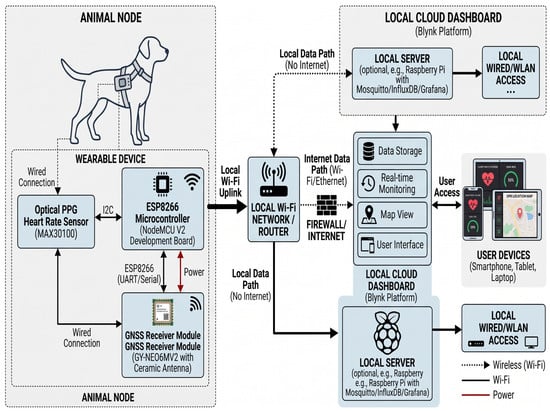
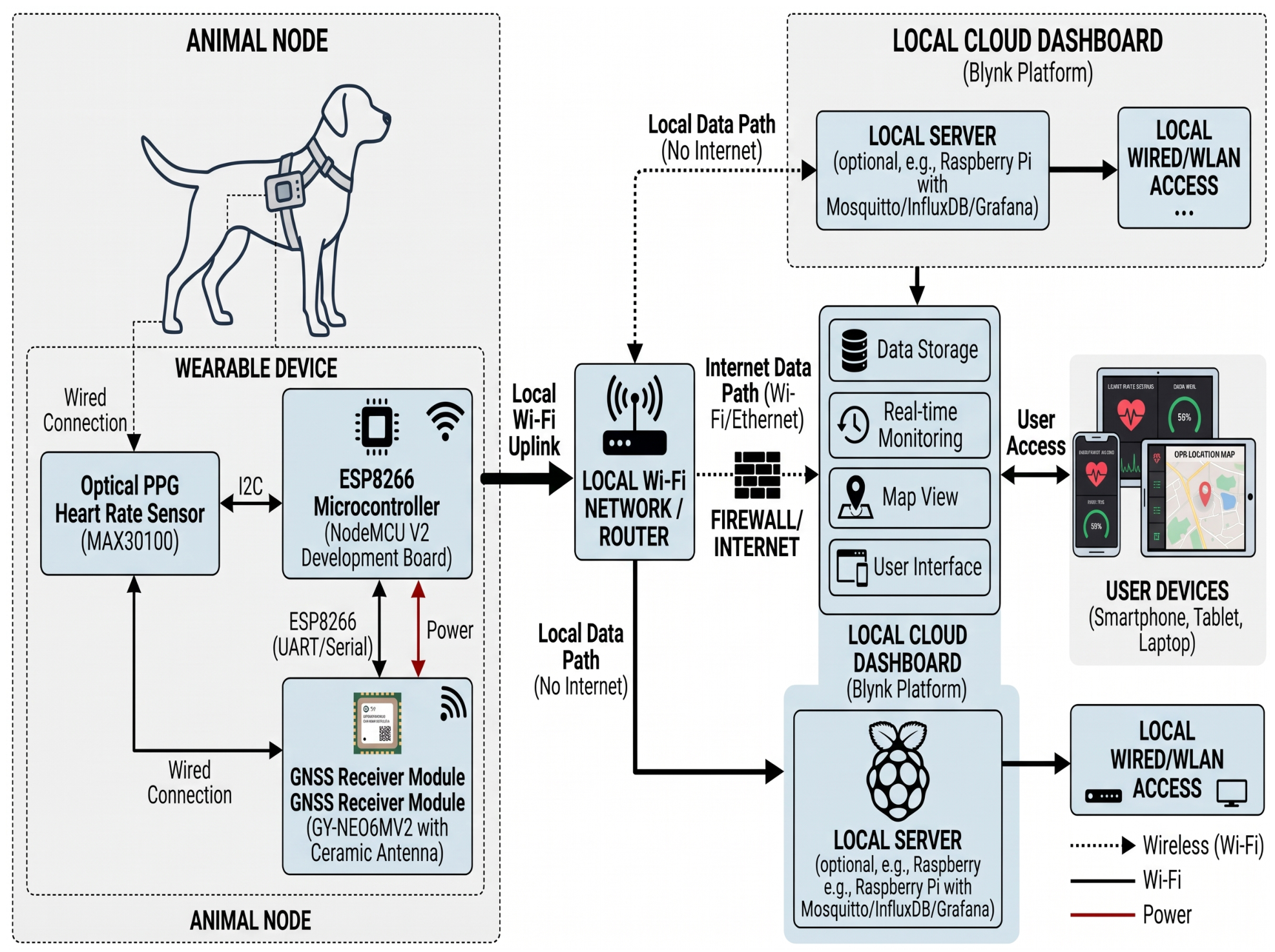
The telemetry prototype integrates three dedicated subsystem layers: biophysical photoplethysmographic acquisition, satellite positioning, and wireless edge routing. The central processing unit consists of a 32-bit NodeMCU V2 (ESP-12E module, AI-Thinker, Shenzhen, China) incorporating a Tensilica Xtensa LX106 microcontroller (Espressif Systems, Shanghai, China) running at a core frequency of 80 MHz with integrated IEEE 802.11 b/g/n Wi-Fi capabilities [2]. Figure 1 details the schematic layout.
Figure 1.
System topology diagram of the localized veterinary telemetry framework depicting the optical MAX30100 sensor, the GY-NEO6MV2 GNSS module, the NodeMCU V2 ESP8266 controller, and the local cloud dashboard.
Biophysical data acquisition is executed by an optical MAX30100 sensor module (Maxim Integrated, Analog Devices, Wilmington, MA, USA) combining two light-emitting diodes (red at and infrared at ) with an integrated photodetector and low-noise analog signal processing circuitry [13]. The sensor operates with dual supply rails of 1.8 V and 3.3 V, communicating with the ESP8266 via a standard interface through GPIO4 (SDA) and GPIO5 (SCL). Geospatial kinematics are captured using a GY-NEO6MV2 GNSS receiver (u-blox, Thalwil, Switzerland) equipped with a ceramic patch antenna, on-board EEPROM, and a backup battery for warm-start acquisition [12]. The module interfaces asynchronously with the controller via software serial communication configured at 9600 baud on GPIO4 (RX) and GPIO5 (TX) [12,14].
2.2. Cloud Interfacing and Firmware Pipeline
The firmware architecture was compiled in the Arduino IDE environment (version 2.3.2, Arduino S.r.l., Monza, Italy) utilizing the core libraries MAX30100_PulseOximeter.h (v1.0.1) and TinyGPS++.h (v1.0.3) [2,12]. Optical acquisition runs with an internal sampling period of 1000 ms, during which pulse variations and peripheral oxygen saturation () are extracted and formatted. Spatial coordinate strings, ground speed, and active satellite counts are parsed directly from raw NMEA sentences [12].
Telemetry streams are packaged into standardized virtual channel payloads and transmitted through local Wi-Fi uplinks to an IoT cloud dashboard (Blynk platform) configured via dedicated template identifiers [10,11]. Virtual channels V1 through V4 map instantaneous heart rate (BPM), percentage, ground speed (km/h), and satellite reception metrics for live supervisory tracking [2,11].
2.3. Mathematical Formulation and Evaluation Metrics
Continuous heart rate extraction from discrete optical pulsations is computed through temporal scaling:
where is expressed in beats per minute (BPM), represents the total count of systolic pulses detected within the measurement window, and corresponds to the elapsed time in minutes.
The spatial distance D between successive geodetic coordinate fixes and is calculated to evaluate positional deviation:
where X and Y represent projected latitude and longitude coordinate pairs [12].
Cardiovascular telemetry accuracy is evaluated against clinical reference instrumentation using the Mean Absolute Percentage Error (MAPE):
where V denotes the true clinical benchmark value and A corresponds to the real-time empirical reading registered by the telemetry prototype.
3. Results
3.1. Cardiovascular Telemetry and Error Analysis
Biophysical data validation was performed across 60 sequential experimental trials on conscious canine subjects under resting conditions. Real-time optical acquisitions from the MAX30100 sensor were directly benchmarked against a certified clinical pulse oximeter reference device. Heart rate values extracted via Equation (1) and the corresponding Mean Absolute Percentage Error (MAPE) computed using Equation (3) are reported in Table 1.
Table 1.
Cardiovascular telemetry validation and MAPE estimation against clinical reference monitor.
Across the aggregate validation dataset of 60 operational trials, the recorded heart rate spanned between 70.0 BPM and 100.0 BPM on the reference device, while prototype measurements registered between 76.0 BPM and 98.0 BPM. The calculated average MAPE across all validation sets converged to 5.14%, confirming high cardiovascular telemetry resolution under non-invasive attachment. Peripheral blood volume oxygen saturation () exhibited continuous baseline levels at 95.0% across the continuous logging intervals.
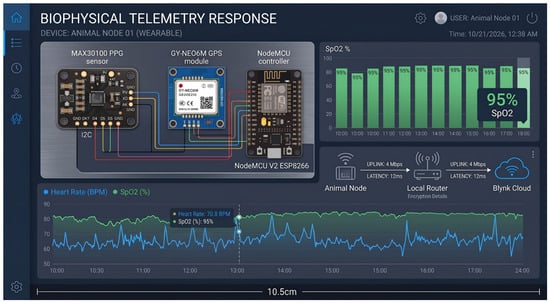
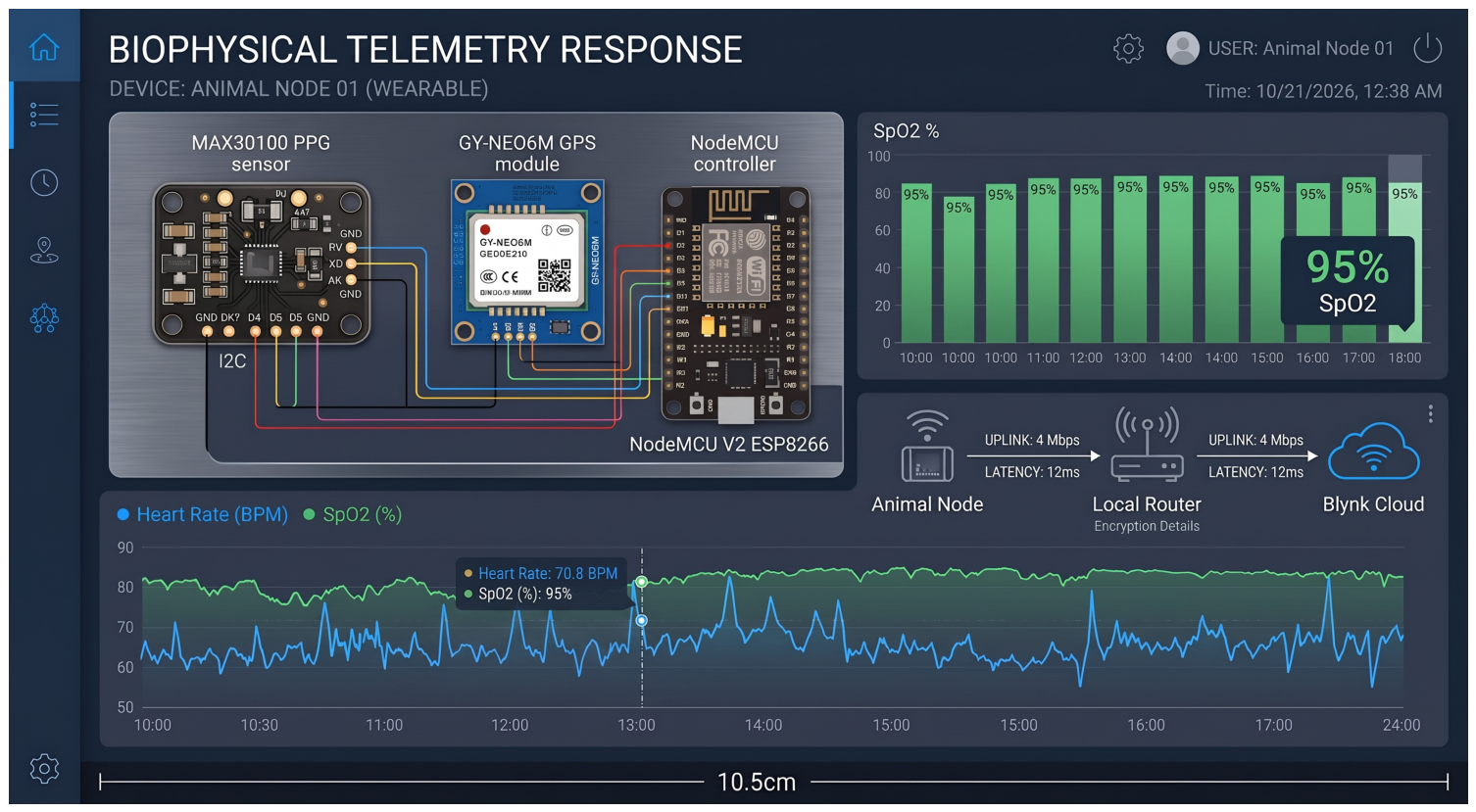
The empirical signal stream acquired during experimental testing is depicted in Figure 2.
Figure 2.
Real-time biophysical telemetry response registered in the IoT cloud interface illustrating continuous heart rate (70.81 BPM) and peripheral blood volume saturation (95% ).
3.2. Geodetic Trajectory and Positional Accuracy Evaluation
Geodetic tracking validation was conducted in the Samborondón region (Ecuador) across an active outdoor tracking route. A total of 60 kinematic fix points were acquired via the GY-NEO6MV2 module and compared against geodetic coordinates obtained from the standard geographical reference system. Positional tracking parameters and calculated deviations across representative route waypoints are summarized in Table 2.
Table 2.
Spatial coordinates and error margin evaluation across representative geodetic tracking waypoints.
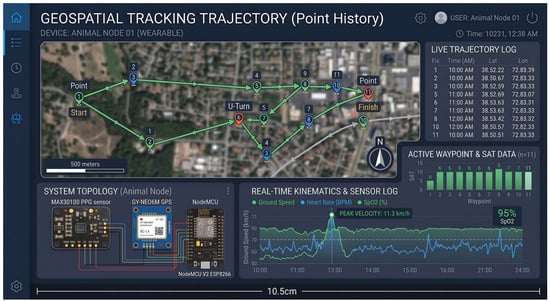
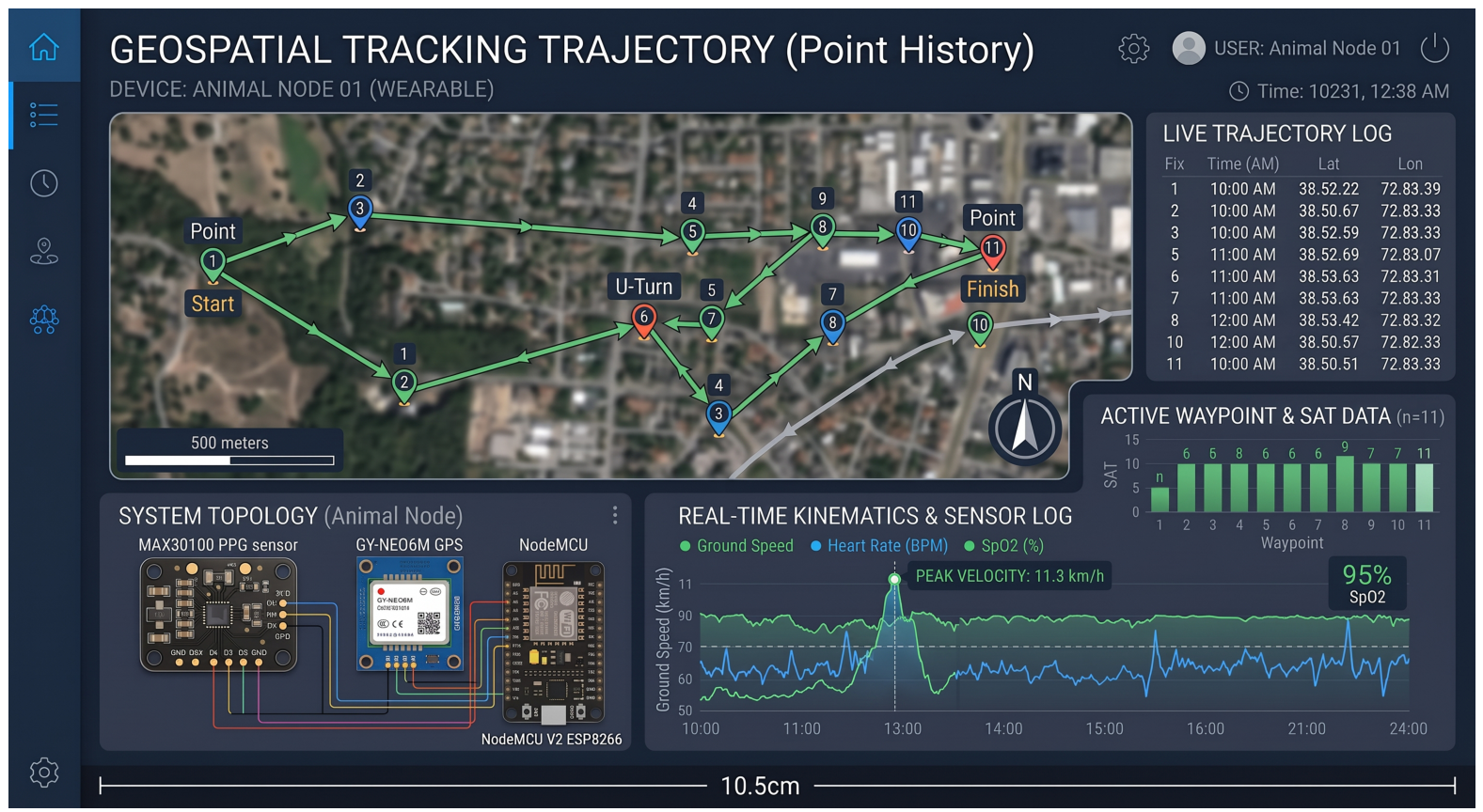
The Euclidean distance between representative points and yielded a spatial offset . The spatial tracking array maintained a consistent operational precision profile of 80% (with a spatial deviation bounded by 20.90%) under clear line-of-sight satellite reception, locking continuously between 8 and 11 active orbital satellites and tracking instantaneous velocities up to 11.3 km/h.
The geospatial trajectory reconstruction rendered through the localized map interface is illustrated in Figure 3.
Figure 3.
Geospatial tracking trajectory and real-time kinematic telemetry displaying active waypoint history, ground velocity (11.3 km/h), and orbital satellite acquisition ().
4. Discussion
The experimental findings demonstrate the feasibility of combining optical photoplethysmography and satellite tracking within a single low-power wearable node [2,4]. In contrast to traditional clinical procedures that depend on close physical auscultation or adhesive ECG leads, non-invasive optical telemetry eliminates dermal irritation and preserves autonomic homeostasis in conscious animals [4,20]. The recorded mean absolute percentage error () confirms that the embedded filtering and peak-detection algorithm yields stable heart rate estimation without requiring extensive high-frequency computational units [3,5].
Spatial tracking evaluations confirm that satellite acquisition remains reliable under open-sky conditions, maintaining locked reception with 8 to 11 orbital vehicles [12,28]. The 20.90% spatial margin observed between the raw prototype coordinates and reference map locations reflects typical atmospheric and geoidal attenuation inherent to single-frequency commercial GNSS receivers [23,26]. While higher-tier biologging deployments across wild or marine fauna often rely on barometric pressure profiling [26] or light-level geolocation [6], the integrated NEO-6M receiver provides direct, high-frequency spatial tracking suitable for peri-urban domestic environments [28,30]. Positional accuracy can be further refined in subsequent designs by incorporating dual-band real-time kinematic (RTK) positioning engines [9,13].
The localized IoT communication architecture establishes stable data routing toward the cloud interface with low latency [10,11]. By avoiding dense raw-signal transmission through edge processing on the ESP8266 microcontroller, the uplink bandwidth requirements are minimized, supporting scalable multi-node architectures [2,14]. Furthermore, continuous remote monitoring addresses early clinical anomaly detection and strengthens domestic animal welfare, aligning technical telemetry capabilities with the evolving demands of preventive veterinary care [16,18,21].
5. Conclusions
An autonomous localized IoT framework for non-invasive physiological telemetry and geodetic animal kinematics was designed, implemented, and experimentally validated. The wearable artifact integrates optical photoplethysmography via the MAX30100 sensor and satellite positioning through the GY-NEO6MV2 module, governed by a low-power NodeMCU V2 ESP8266 microcontroller communicating with a localized cloud dashboard.
Empirical testing demonstrated that the proposed telemetry architecture provides high cardiovascular resolution, yielding a mean absolute percentage error restricted to 5.14% for heart rate measurements when contrasted against clinical reference instrumentation. Concurrently, the geospatial tracking array achieved an operational precision profile of 80% under standard geographical deployment conditions, reliably tracking kinematic displacements with continuous satellite acquisition.
The experimental outcomes confirm that localized edge computing and non-invasive sensing eliminate the diagnostic latency and physical stress induced by conventional contact-dependent auscultation. The developed platform constitutes a reliable, cost-effective infrastructure for preventive veterinary diagnostics, active spatial security, and early clinical anomaly detection in conscious domestic animals.
Author Contributions
Conceptualization, D.H.C.V. and H.J.S.C.; methodology, D.H.C.V. and H.J.S.C.; software, J.G.J.R. and E.J.A.C.; validation, D.H.C.V., H.J.S.C., J.G.J.R. and E.J.A.C.; formal analysis, D.H.C.V. and H.J.S.C.; investigation, J.G.J.R. and E.J.A.C.; resources, D.H.C.V.; data curation, J.G.J.R. and E.J.A.C.; writing original draft preparation, D.H.C.V., J.G.J.R. and E.J.A.C.; writing review and editing, D.H.C.V. and H.J.S.C.; visualization, J.G.J.R. and E.J.A.C.; supervision, D.H.C.V. and H.J.S.C.; project administration, D.H.C.V. All authors have read and agreed to the published version of the manuscript.
Funding
This research received no external funding.
Institutional Review Board Statement
Not applicable due to non-invasive animal monitoring.
Informed Consent Statement
Not applicable.
Data Availability Statement
Data supporting reported results are available from the authors upon reasonable request.
Acknowledgments
The authors acknowledge the technical support from the Grupo de Investigación en Sistemas de Telecomunicaciones (GISTEL) at Universidad Politécnica Salesiana, Guayaquil, Ecuador.
Conflicts of Interest
The authors declare no conflicts of interest.
References
- Wang, P.; Che, Z.; Gao, X.; Zhao, X.; Song, Y.; Sun, J.; Zhang, X. Non-Contact Vital Signs Monitoring of Dog and Cat Using a UWB Radar. Animals 2020, 10, 205. [Google Scholar] [CrossRef] [Scilit] [PubMed]
- Torres Ventura, J.; Cruz, P.; Barba, M.; Morales, D. Performance for Interoperability Between Raspberry Pi and ESP8266 with a PLC in a Node-RED Server for IIoT. Ingenius 2023, 29, 90–97. [Google Scholar] [CrossRef] [Scilit]
- Taniguchi, M.; Kageyama, T.; Okamoto, Y.; Matsunaga, T.; Lee, S.S. A Vital Sign Monitoring System Using a MEMS Microphone for Dog. In Proceedings of the 18th International Conference on Nano/Micro Engineered and Molecular Systems (NEMS); IEEE: Jeju, Republic of Korea, 2023; pp. 70–73. [Google Scholar] [CrossRef] [Scilit]
- Oliveira, R.G.; Ferreira, B.; Santos, F.A.; Ribeiro, R.; Soares, F. Development of a New Integrated System for Vital Sign Monitoring in Small Animals. Sensors 2022, 22, 4264. [Google Scholar] [CrossRef] [Scilit] [PubMed]
- Kunczik, J.; Hönes, D.; Krogmann, A.; Ernst, H.; Thiele, C.; Tolba, R.; Bleich, A.; Zechner, D.; Vollmar, B. Remote Vitals Monitoring in Rodents Using Video Recordings. Biomed. Opt. Express 2019, 10, 4422–4436. [Google Scholar] [CrossRef] [Scilit] [PubMed]
- Merkel, B.; Aars, J.; Laidre, K.L.; Fox, J.W. Light-Level Geolocation as a Tool to Monitor Polar Bear (Ursus maritimus) Denning Ecology: A Case Study. Anim. Biotelemetry 2023, 11, 11. [Google Scholar] [CrossRef] [Scilit]
- Katzner, T.E.; Arlettaz, R. Evaluating Contributions of Recent Tracking-Based Animal Movement Ecology to Conservation Management. Front. Ecol. Evol. 2020, 7, 502429. [Google Scholar] [CrossRef] [Scilit]
- Trappes, R. How Tracking Technology Is Transforming Animal Ecology: Epistemic Values, Interdisciplinarity, and Technology-Driven Scientific Change. Synthese 2023, 201, 134. [Google Scholar] [CrossRef] [Scilit]
- Nathan, R.; Monk, C.T.; Arlinghaus, R.; Adam, T.; Alós, J.; Assaf, M.; Baktoft, H.; Beardsworth, C.E.; Bertram, M.G.; Bijleveld, A.I.; et al. Big-Data Approaches Lead to an Increased Understanding of the Ecology of Animal Movement. Science 2022, 375, eabg1780. [Google Scholar] [CrossRef] [Scilit] [PubMed]
- Nižetić, S.; Šolić, P.; López-de-Ipiña González-de-Artaza, D.; Patrono, L. Internet of Things (IoT): Opportunities, Issues and Challenges Towards a Smart and Sustainable Future. J. Clean. Prod. 2020, 274, 122877. [Google Scholar] [CrossRef] [Scilit] [PubMed]
- Lv, Z. Practical Application of Internet of Things in the Creation of Intelligent Services and Environments. Front. Internet Things 2022, 1, 912388. [Google Scholar] [CrossRef] [Scilit]
- Castro Correa, J.A.; Agudelo Flórez, J.D.; Ceballos Giraldo, A.; Cardona Arias, M. Sistema de Geolocalización de Vehículos a Través de la Red GSM/GPRS y Tecnología Arduino. Rev. EIA 2019, 16, 145–157. [Google Scholar] [CrossRef] [Scilit]
- Sundaram, N.; Meena, S.D. Integrated Animal Monitoring System with Animal Detection and Classification Capabilities: A Review on Image Modality, Techniques, Applications, and Challenges. Artif. Intell. Rev. 2023, 56, 12591–12641. [Google Scholar] [CrossRef] [Scilit]
- Matamoros, O.M.; Escobar, J.J.M.; Padilla, R.T.; Gutierrez, A.G.R.; Jimenez, P.F. Optimizing a Software-Defined Network by Means of the Peano Curve L-System. Comput. Sist. 2021, 25, 33–45. [Google Scholar] [CrossRef] [Scilit]
- Naranjo-Jiménez, C.; WingChing-Jones, R. Arsenic, Cadmium, Mercury, and Lead in Imported Pet Food in Costa Rica. Agron. Mesoam. 2023, 34, 48399. [Google Scholar] [CrossRef] [Scilit]
- Ceberio, M.R.; Videla, M.D. Las Mascotas en el Genograma Familiar. Cienc. Psicol. 2020, 14, e-2112. [Google Scholar] [CrossRef] [Scilit]
- Fuentes Cuiñas, A.A.; Longo, A.G.; Vailati, P.A. PANKs y PETS: Un Apego Casi Maternal. Rev. Psicol. 2022, 31, 1–10. [Google Scholar] [CrossRef] [Scilit]
- Zapata-Herrera, M.; Sanmartín-Laverde, C.M.; Hoyos-Duque, T.N. Comprensión del Vínculo Persona Mayor-Mascota Como Alternativa Para la Promoción de la Salud. MedUNAB 2021, 24, 193–202. [Google Scholar] [CrossRef] [Scilit]
- Shafkat, M.; O’Connor, M.; McSweeney, C.; O’Hagan, M.; Toop, M.; Scott, P. Non-Contact Vital Signs Monitoring in Broiler Chickens. J. Eng. 2023, 2023, e12320. [Google Scholar] [CrossRef] [Scilit]
- Hui, X.; Kan, E.C. No-Touch Measurements of Vital Signs in Small Conscious Animals. Sci. Adv. 2019, 5, eaau0169. [Google Scholar] [CrossRef] [Scilit] [PubMed]
- Belda, B.; Enomoto, M.; Case, B.C.; Lascelles, B.D.X. Initial Evaluation of PetPace Activity Monitor. Vet. J. 2018, 237, 63–68. [Google Scholar] [CrossRef] [Scilit] [PubMed]
- Siegford, J.M.; Berezowski, J.; Biswas, S.; Daigle, C.L.; Enander, R.; Fraley, G.S.; Jacobs, L.; Swanson, J.C. The Quest to Develop Automated Systems for Monitoring Animal Behavior. Appl. Anim. Behav. Sci. 2023, 265, 106000. [Google Scholar] [CrossRef] [Scilit]
- Wang, D.; Shao, Q.; Yue, H. Surveying Wild Animals from Satellites, Manned Aircraft and Unmanned Aerial Systems (UASs): A Review. Remote Sens. 2019, 11, 1308. [Google Scholar] [CrossRef] [Scilit]
- Magalhães, A.C.M.; Silva, A.F.; Morais, F.J.L.; Santos, F.A.; Soares, F.; Ferreira, B. New Enclosure for In Vivo Medical Imaging of Zebrafish with Vital Signs Monitoring. Front. Physiol. 2022, 13, 906110. [Google Scholar] [CrossRef] [Scilit] [PubMed]
- Dong, Y.; Jin, H.; Xiao, X.; Liu, X.; Zhang, L. PigV2: Monitoring Pig Vital Signs Through Ground Vibrations Induced by Heartbeat and Respiration. In Proceedings of the 20th ACM Conference on Embedded Networked Sensor Systems (SenSys ’22); ACM: Boston, MA, USA, 2022; pp. 1102–1108. [Google Scholar] [CrossRef] [Scilit]
- Nussbaumer, R.; Gravey, M.; Briedis, M.; Liechti, F. Global Positioning with Animal-Borne Pressure Sensors. Methods Ecol. Evol. 2023, 14, 1104–1117. [Google Scholar] [CrossRef] [Scilit]
- Gregersen, T.; Halvorsen, K.T.; Kregting, L.; Jentoft, S.; Kleiven, A.R.; Olsen, E.M. A Novel Kinetic Energy Harvesting System for Lifetime Deployments of Wildlife Trackers. PLoS ONE 2023, 18, e0285930. [Google Scholar] [CrossRef] [Scilit] [PubMed]
- Jin, T.; Si, X.; Liu, J.; Ding, P. An Integrated Animal Tracking Technology Combining a GPS Tracking System with a UAV. Methods Ecol. Evol. 2023, 14, 505–511. [Google Scholar] [CrossRef] [Scilit]
- Watanabe, Y.Y.; Papastamatiou, Y.P. Biologging and Biotelemetry: Tools for Understanding the Lives and Environments of Marine Animals. Annu. Rev. Anim. Biosci. 2023, 11, 247–267. [Google Scholar] [CrossRef] [Scilit] [PubMed]
- Toapanta Piguave, J.A.; Córdova Almeida, R.G.; Cárdenas Villacrés, D.H. Modeling 4G Coverage Using Matlab and Validation with Real-World Measurements Obtained via G-NetTrack (Modelado de la Cobertura 4G Mediante Matlab y Validación con Mediciones Reales Obtenidas a Través de G-NetTrack). Mem. Investig. Ing. 2026, 30, 211–228. (In Spanish) [Google Scholar]

Disclaimer/Publisher’s Note: The statements, opinions and data contained in all publications are solely those of the individual author(s) and contributor(s) and not of MDPI and/or the editor(s). MDPI and/or the editor(s) disclaim responsibility for any injury to people or property resulting from any ideas, methods, instructions or products referred to in the content. |
© 2026 by the authors. Licensee MDPI, Basel, Switzerland. This article is an open access article distributed under the terms and conditions of the Creative Commons Attribution (CC BY) license.