


Abstract
This paper investigates the potential of utilising recycled clay brick powder, recycled concrete powder and limestone filler as supplementary cementitious materials at replacement ratios of 10% and 20%. The experimental programme encompassed an analysis of rheological behaviour, compressive strength, open porosity and durability, with a focus on resistance to chloride penetration (NT Build 492). The results confirm the superiority of recycled clay brick powder, with the mixture containing a 20% proportion of this powder retaining 87% of the reference strength whilst improving chloride resistance by approximately 25%. In contrast, recycled concrete powder and limestone filler cause degradation of mechanical properties alongside a reduction in resistance to chloride penetration. In conclusion, recycled clay brick powder represents a sustainable alternative for structural concretes, whilst recycled concrete powder requires additional activation.
1. Introduction
The global demand for concrete, the second most used material on the planet after water, results in annual production reaching a remarkable 27 to 30 billion tonnes [1,2,3]. This scale of production generates unsustainable environmental pressure, primarily through intensive exploitation of natural resources and greenhouse gas emissions like CO2. Cement is therefore ranked among the most energy-demanding industrial products, after steel and aluminium [4,5]. Alongside the issue of emissions, the industry also faces a critical shortage of natural aggregates. The United Nations Environment Programme warns that the rate of exploitation of sand and gravel significantly exceeds their natural rates of renewal [5].
In this context, the transition from a linear model to the principles of the circular economy has become imperative [5,6,7,8]. Scientific research demonstrates that recycled powders are not merely inert fillers but can be used as active additions that contribute to the properties of the whole cementitious matrix. Replacing a portion of the cement and natural aggregates with recycled brick powder (RCBP), recycled concrete powder (RCP), and limestone filler not only offers a solution for reducing the CO2 footprint but also provides a means of preserving natural primary raw materials and closing the life cycle of building materials. The use of recycled powder as a mineral addition (SCM) enables the production of so-called “green concrete”, which according to some life cycle analyses, can reduce the global warming impact by up to 40% per unit of strength compared with some conventional mixtures [1,9]. Recycled clay brick powder demonstrates significant potential as an SCM owing to its pozzolanic activity, which comes from the thermal treatment of clay minerals at temperatures of 600 °C to 900 °C during the firing process [4,10,11]. The amorphous aluminosilicate phase in RCBP reacts with calcium hydroxide, a product of cement hydration, forming secondary calcium silicate hydrates and calcium aluminate hydrates, which contribute to the densification of the microstructure and long-term strength development [4]. On the other hand, recycled concrete powder contains a certain proportion of unhydrated cement particles, which could enable reactivity and contribute to the hydration process. Although higher replacement percentages of RCP can adversely affect early strength due to the presence of inert phases, it remains a key component for reducing concrete waste [1,12]. Alongside recycled materials, limestone powder represents one of the most commonly used mineral additions, acting not only as an inert filler but also as an active participant in early hydration [13].
The quality of recycled material, i.e., concrete, brick, and similar, also needs to be considered because such materials may contain various impurities and other substances that can worsen the properties of concrete or completely disrupt cement setting. Most authors use waste from strictly controlled laboratory conditions or from a single specific location [4,14,15,16,17]. Authors rarely address the problem of the high variability in the composition of C&D waste on real construction sites and how that variability affects the concrete mixture.
Although numerous studies exist in which silica fume, metakaolin, and fly ash are used as additions, these are often too costly and energy-demanding. Recycled materials utilise waste paths that do not require primary extraction, and their synergy enables the production of sustainable “green concrete” that satisfies mechanical and durability requirements. This paper is focused on investigating the mechanical and durability properties of concrete produced with recycled clay brick powder, recycled concrete powder and limestone powder serving as Portland cement replacements. It should be noted that limestone filler, unlike RCBP and RCP, does not originate from construction and demolition waste streams. It was included in this study primarily as a reference material. The aim of this paper is to determine how these materials affect individual properties when used as a cement replacement. A review of the available literature concluded that cement replacement is most effectively manifested at a replacement ratio of 10% and 20%, and this principle has been verified in the present study. Whilst each of these materials has been studied individually, their systematic comparison under controlled and identical mix proportions—with the simultaneous assessment of rheological, mechanical, and durability properties—has received limited attention.
2. Materials and Experimental Programme
2.1. Materials
Portland cement CEM II/A-LL 42.5R with a density of 3.15 kg/dm3, manufactured by Cemex Hrvatska d.d. (Kaštel Sućurac, Croatia), was used for the preparation of the laboratory mixtures. According to the product specification, the cement achieves an early compressive strength of 27 MPa after 2 days and a standard compressive strength of 52 MPa after 28 days.
The powdered materials used as cement replacements were collected from controlled industrial sources. The brick powder (RCBP) was obtained as a by-product of the manufacture of brick elements, whilst the concrete powder (RCP) was obtained by processing construction waste generated during the grinding of reinforced concrete elements. In order to achieve uniform granulation, both materials were additionally prepared in the laboratory.
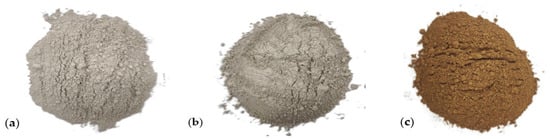
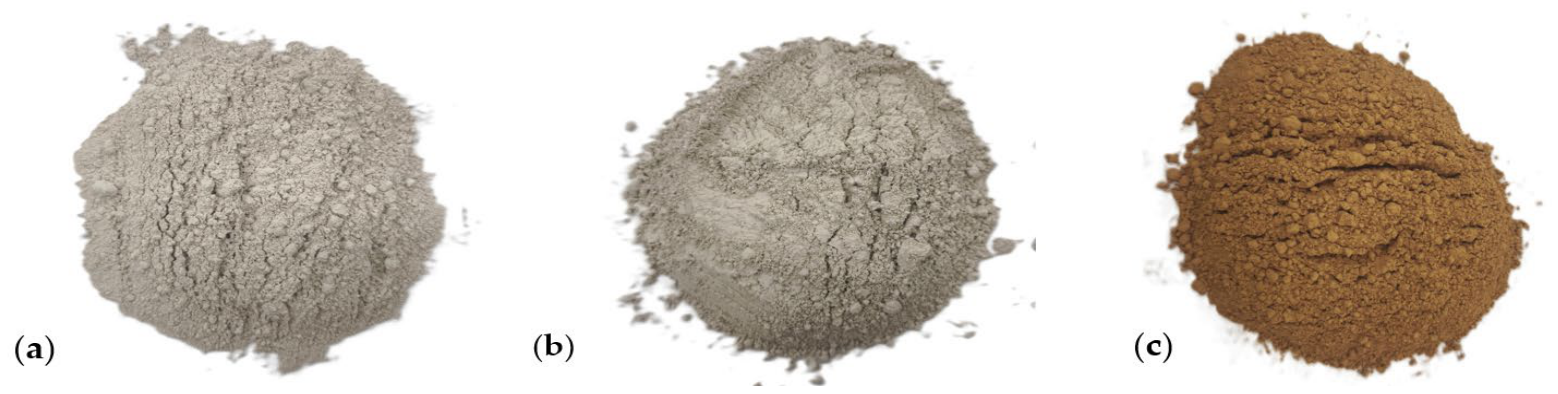
Prior to use, RCP was dried and ground in a laboratory ball mill for 2.5 h at a ratio of 1 kg of material to 3 kg of steel balls. Following grinding, the material was sieved through a 100-micron aperture sieve, where it was established that approximately 95% of the particles passed through the sieve, indicating a very small proportion of coarser particles. RCBP was only sieved through a 100-micron aperture sieve, and the portion of material that passed through the sieve was used in the mix designs. Limestone filler (LF) was obtained from a local quarrying and separation plant. The material was used in the fraction below 100 microns, consistent with the sieving criteria applied to RCBP and RCP. Figure 1 shows the powder form of the supplementary cementitious materials used in this study.
Figure 1.
Supplementary cementitious materials in powder form: (a) recycled concrete powder (RCP); (b) limestone powder (LF); (c) recycled clay brick powder (RCBP).
Fine and coarse aggregate were sourced from a local quarrying plant of limestone origin. Prior to the preparation of mixtures, the moisture content and water absorption of the aggregate were determined in accordance with standards EN 1097-5 [18] and EN 1097-6 [19]. Since the aggregate was not completely dry and absorbed a portion of the water during mixing, a correction of the effective water quantity was carried out in accordance with the measured moisture content and water absorption of the aggregate. The specific densities of the powdered materials RCBP, RCP and LF were tested in accordance with standard EN 1097-7 [20] and are as follows: 2.62 kg/dm3—RCBP, 2.57 kg/dm3—RCP, and 2.63 kg/dm3—LF. Ordinary tap water was used for the preparation of all mixtures. To achieve adequate workability, a polycarboxylate ether-based superplasticiser, MC-PowerFlow 5695 (MC-Bauchemie Müller GmbH & Co. KG, Bottrop, Germany), was applied at a dosage of 0.8% of the binder mass.
2.2. Mix Design and Specimen Preparation
In order to analyse the effects of RCBP, RCP and LF in detail, a total of seven mix designs were produced, presented in Table 1. The mixtures were designed with a total binder content of 350 kg/m3 to enable a better comparison of the influence of replacement materials on mechanical and durability properties relative to the reference mixture.
Table 1.
Concrete mix proportions (kg per 1 m3 of concrete).
The concrete preparation procedure was carried out by first homogenising the dry constituents: aggregate, cement and mineral additions. Once a homogeneous mixture had been achieved, two thirds of the total water quantity was added, after which the mixture was mixed for 4 min. The remaining water, previously combined with the superplasticiser, was then added and mixing was continued for a further 4 min. The water-to-binder ratio was maintained constant at 0.49 for all mixtures in order to enable a reliable comparison of the mechanical and fresh properties of the mixtures, irrespective of the water content.
2.3. Methods
The experimental programme covered tests carried out in two phases—on the fresh concrete mixture and on hardened concrete—with the aim of evaluating the fresh, mechanical and durability properties of the mix designs.
The workability of the fresh mixture was assessed by the slump method in accordance with EN 12350-2 [21], which provides an indirect evaluation of the suitability of the concrete for placement.
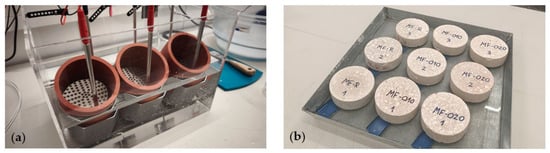
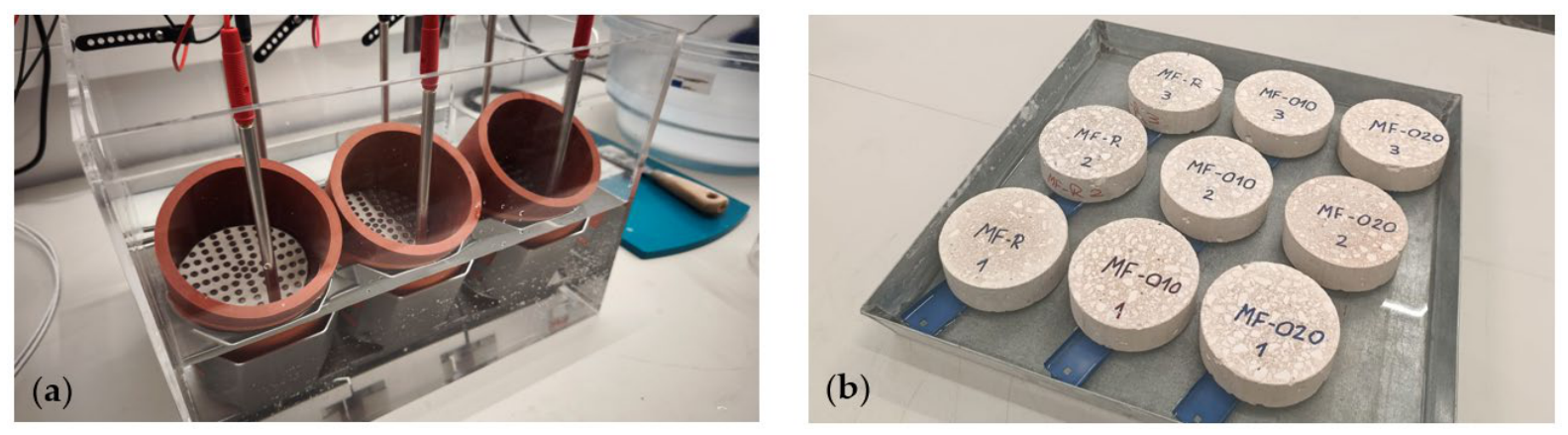
On hardened specimens, cured under water in a room at a relative humidity of RH 95% and a temperature of 20 °C for 28 days, mechanical and durability tests were carried out. Capillary water absorption was determined in accordance with EN 13057 [22] (Figure 2b) on cylindrical specimens with a diameter of 150 mm. Total open porosity was determined by the hydrostatic weighing method based on Archimedes’ principle, following the general principle of EN 12390-7 [23]. The compressive strength of concrete was determined on cube specimens with dimensions of 150 × 150 × 150 mm, in accordance with EN 12390-3 [24]. The resistance to chloride penetration was tested by the accelerated migration method in accordance with the Nordic standard NT Build 492 [25] (Figure 2a), which uses an applied external electrical potential to determine the chloride migration coefficient as the key durability indicator for concrete exposed to an aggressive chloride environment. As noted by Noushini et al. [26], NT Build 492 eliminates the influence of temperature (Joule heating effect) and the fact that all ions and not only chlorides pass through the specimen—a common issue with ASTM C1202 [27]. Furthermore, voltage adjustment is critical for preventing the overheating of highly conductive specimens.
Figure 2.
(a) Chloride penetration resistance test by the accelerated migration method according to NT Build 492. (b) Capillary water absorption per EN 13057.
3. Results and Discussion
3.1. Workability
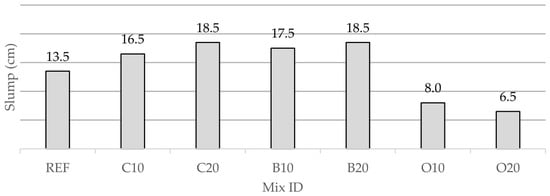
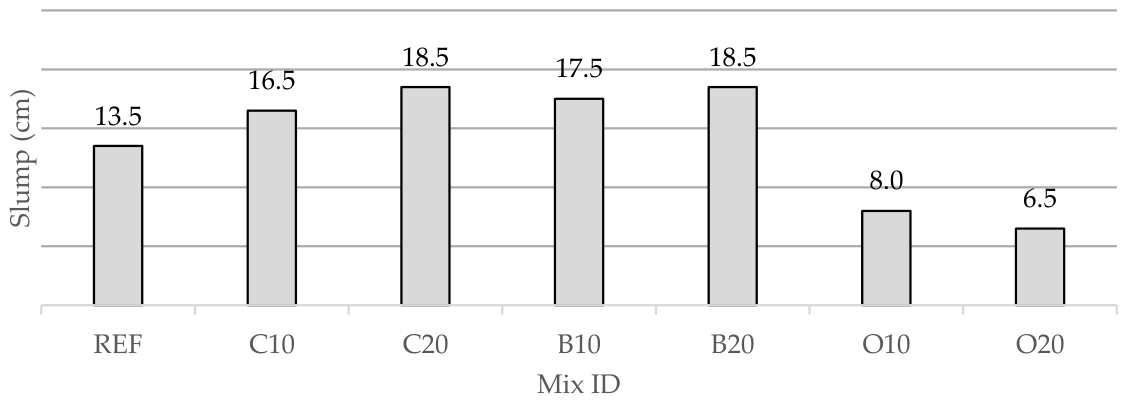
The results of the concrete slump test are presented in Figure 3. The results demonstrate a pronounced sensitivity of workability to the type and proportion of the supplementary cementitious material. The reference mixture achieved a slump of 13.5 cm, whilst mixtures with cement replacement using LF and RCP showed an increase in consistency with values of up to 18.5 cm, suggesting improved particle packing within the concrete itself and a possible reduction in internal friction in the fresh concrete at higher proportions.
Figure 3.
Consistency of concrete mixtures determined by slump test.
However, mixtures with the addition of RCBP exhibit a significant reduction in workability (O10 and O20, 8.0 cm and 6.5 cm, respectively), which can be attributed to the greater water demand and potential porosity and water absorption of fine particles. This non-linear relationship between replacement proportion and slump confirms that the mineral composition and physical properties of the replacement materials dominate the fresh properties of concrete.
3.2. Compressive Strength
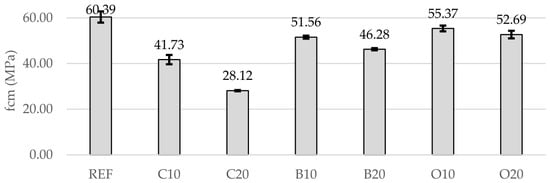
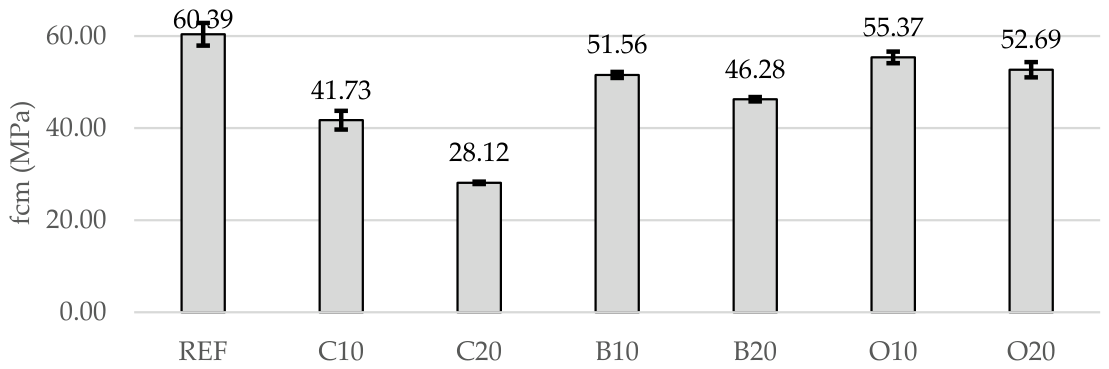
Figure 4 presents the compressive strength results after 28 days, showing significant differences depending on the replacement material used. The reference mixture achieved a compressive strength of 60.39 MPa (baseline). The strength decreased in all modified mixtures, to an extent depending on the addition type and replacement ratio. Mixtures with RCP show the most pronounced reduction in strength. At a 10% replacement ratio, the strength is 41.73 MPa, representing a reduction of approximately 31%, whilst at 20% replacement it falls to 28.12 MPa, equating to approximately 53% relative to the reference mixture. This trend indicates an unfavourable interaction of this addition with the cementitious matrix, particularly at higher proportions. RCP, as such, significantly compromises structural integrity, making it suitable for concretes of lower strength classes or requiring additional activation (finer grinding or thermal treatment).
Figure 4.
Compressive strength at 28 days. Note: Error bars represent standard deviation, n = 3.
Mixtures with LF (B10 and B20) show a more moderate reduction, corresponding to a decrease of approximately 15% and 23%, respectively.
The most favourable behaviour was recorded for RCBP, with values of 55.37 MPa (O10) and 52.69 MPa (O20)—a modest reduction of approximately 8% and 13%—indicating better compatibility with the cementitious matrix. Comparing the compressive strength and workability (slump) results, it is noted that the mixtures with the greatest slump (C20 and B20) have the lowest strength values, which is a classic indicator that high fluidity does not necessarily correlate with the quality of the microstructure. Other researchers report that the replacement of cement with RCBP of up to 20% is optimal for mechanical properties [10], which is in direct agreement with the present results where O20 retains a high 87% of the reference specimen’s strength.
3.3. Chloride Migration Test (NT Build 492)
The durability of reinforced concrete structures is directly conditioned by the ability of the concrete cover to prevent the ingress of aggressive substances. The penetration of chlorides through the porous matrix of concrete initiates corrosive processes on the reinforcement by disrupting the passive oxide layer that naturally forms on steel [28].
A particular research challenge is presented by the heterogeneous nature of concrete, which consists of cement paste and aggregate, but also a critical third region—the interfacial transition zone (ITZ). The ITZ is a zone of high porosity surrounding aggregate particles (20–30 μm in thickness) and often acts as a preferential pathway for the ingress of aggressive ions. The authors note that the application of pozzolanic SCMs, such as RCBP, can dramatically reduce the width and porosity of the ITZ, whilst inert fillers such as limestone or porous additions such as RCP may have the opposite effect, creating continuous pathways of high permeability [28]. Therefore, the aim of the present paper is not only to examine macroscopic properties (strength and slump), but to carry out an in-depth analysis of how three different materials modify ionic migration under non-steady-state conditions.
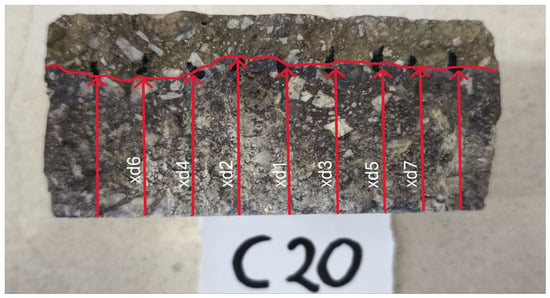
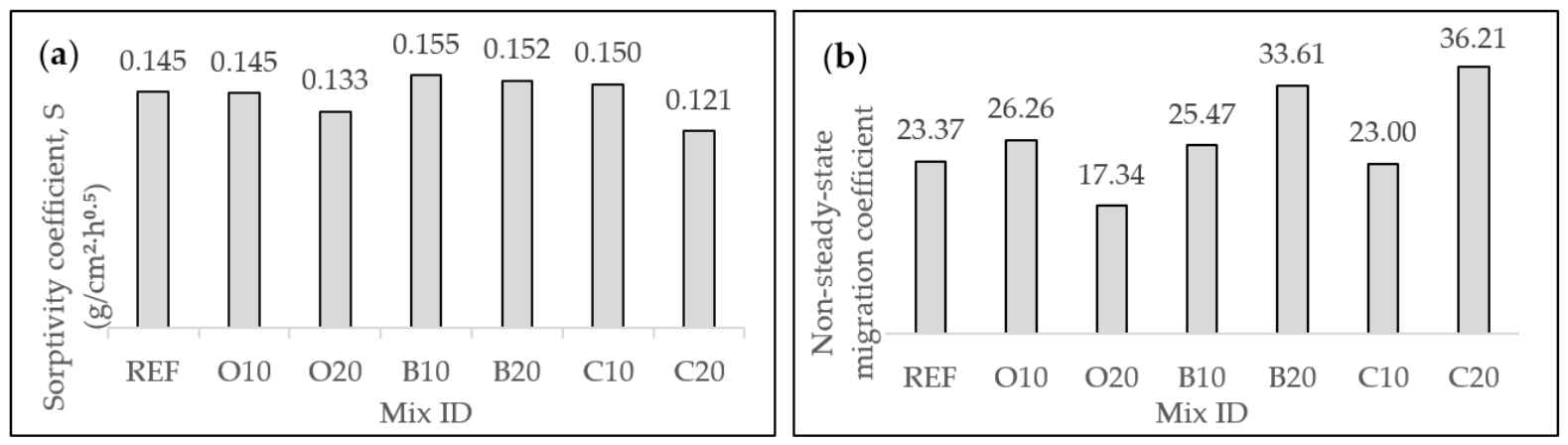
Based on the testing carried out, clear differences can be observed depending on which SCM material is used (Table 2, Figure 5 and Figure 6b). The most significant result was achieved by the O20 mixture, whose migration coefficient of 17.34 × 10⁻¹² m2/s represents a reduction of 25.8% relative to the reference mixture (REF, 23.37 × 10⁻¹² m2/s).
Table 2.
NT Build 492 chloride migration test results.
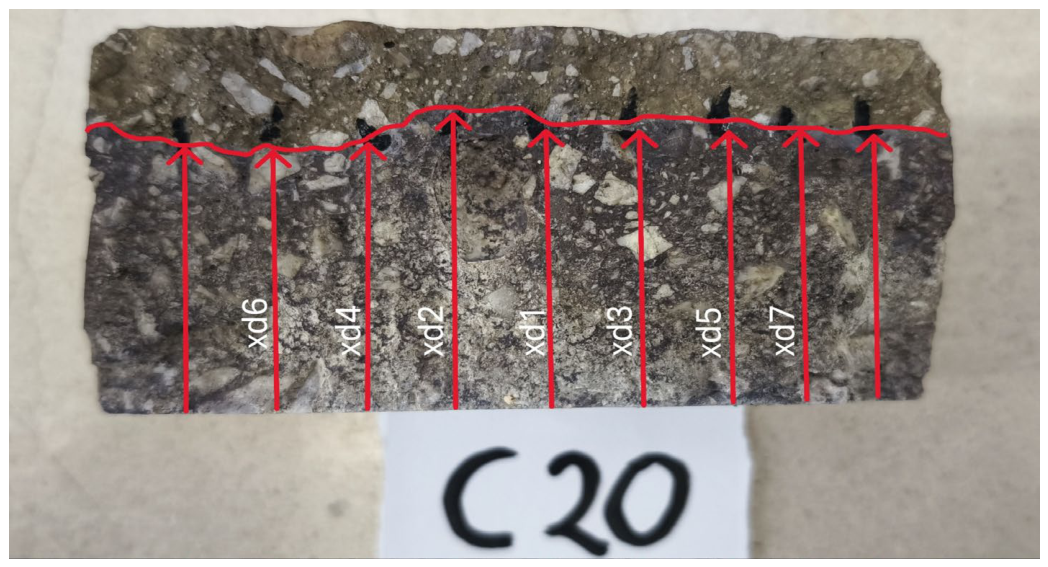
Figure 5.
Photograph of a sample highlighting the measurement profile for determining the chloride penetration depth; sample C20 shown.
Figure 6.
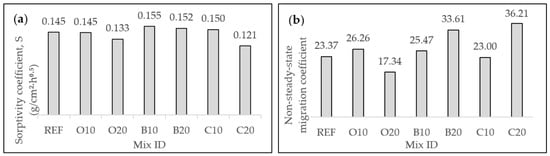
(a) Capillary sorptivity coefficient of tested mixtures. (b) Chloride migration test.
In contrast, mixtures with LF and RCP showed a drastic degradation in resistance, with migration coefficients exceeding 35 × 10−12 m2/s. In the B20 mixture, the increase in chloride migration is 44% greater than in the reference mixture, which can be attributed to the fact that limestone acts in an inert manner, i.e., more as a filler. The high values in RCP mixtures suggest highly porous ITZs within the mixture itself.
For context, chloride migration coefficients below 8 × 10⁻¹² m2/s are generally considered to indicate good resistance to chloride penetration, whilst values above 16 × 10−12 m2/s indicate low resistance. It should therefore be emphasised that all tested mixtures, including the best-performing O20, remain above both of these limits. The improvement achieved by RCBP is thus relative in nature, and the absolute level of chloride resistance of the tested mixtures remains limited for applications in severely aggressive chloride environments.
It is also important to note the rheological influence on the test results. Mixtures with the greatest slump (B20 and C20) show the poorest resistance to chlorides, whilst O20, with the smallest slump (6.5 cm), achieved the best durability. On the other hand, it can be observed that O20 was tested at a voltage of 25 V, and C20/B20 at only 15 V, which further explains the difference in matrix quality. The chloride penetration depth was measured on split specimens (Figure 5).
3.4. Open Porosity and Capillary Water Absorption
To provide additional macrostructural context for the workability, mechanical and durability trends discussed in the preceding sections, the total open porosity of each hardened mixture was determined as described in Section 2.3. The results are presented in Table 3.
Table 3.
Total open porosity of tested mixtures, determined by hydrostatic weighing.
The reference mixture (REF) exhibited an open porosity of 5.99%. Mixtures containing LF and RCP show a progressive increase in porosity with increasing replacement ratio, reaching 9.12% for B20 and 8.04% for C20, in agreement with the higher chloride migration coefficients and lower compressive strengths of these mixtures. RCBP mixtures exhibit the opposite trend: porosity decreases from 7.91% at 10% replacement (O10) to 5.34% at 20% replacement (O20)—the lowest value recorded among all the tested mixtures—coinciding with the lowest chloride migration coefficient obtained in this study (17.34 × 10⁻¹² m2/s).
The results of the capillary sorptivity test are presented in Figure 6a. The sorptivity coefficient of the reference mixture (REF) was 0.145 g/cm2·h0.5, used as the baseline. Mixtures containing limestone filler (B10 and B20) recorded coefficients of 0.155 and 0.152 g/cm2·h0.5, respectively—a slight increase relative to the reference sample. A similar trend was observed in mixtures with RCP (C10 and C20), with values of 0.150 and 0.121 g/cm2·h0.5, where the reduction at 20% replacement may be attributed to the pore-filling effect of fine RCP particles rather than pozzolanic activity. Mixtures incorporating RCBP (O10 and O20) showed sorptivity values of 0.145 and 0.133 g/cm2·h0.5, with O20 achieving the lowest value among the RCBP series. These findings are in general agreement with the chloride migration results, where RCBP mixtures also demonstrated superior resistance, further supporting the hypothesis that RCBP refines the pore structure of the cementitious matrix. The mixture C20 represents a small anomaly within the research data. Despite recording the lowest compressive strength among all the tested mixtures (28.12 MPa), it showed a relatively low sorptivity coefficient of 0.121 g/cm2·h0.5, which is the lowest value recorded across all mixtures.
This distinction is critical—it highlights that a low sorptivity value does not necessarily reflect a high-quality microstructure and that the transport and mechanical properties of concrete can be governed by different and at times opposing mechanisms as well. In contrast, the reduction in sorptivity observed in the O20 mixture is accompanied by a simultaneous improvement in compressive strength retention and chloride resistance.
4. Conclusions
This study conducted a comprehensive evaluation of three different powder materials—recycled clay brick powder, recycled concrete powder and limestone filler—as supplementary cementitious materials. Based on the results obtained for fresh properties, mechanical resistance and durability indicators, the following conclusions can be drawn:
- Recycled clay brick powder proved to be the most effective mineral addition in terms of mechanical performance and durability. Even at a 20% cement replacement ratio (O20), the mixture retained as much as 87% of the compressive strength of the reference specimen (52.69 MPa compared with 60.39 MPa), whilst reducing the chloride migration coefficient by approximately 25.8%, from 23.37 × 10⁻¹² m2/s to 17.34 × 10⁻¹² m2/s, and achieving the lowest open porosity of all the tested mixtures (5.34%).
- In contrast to studies reporting beneficial reactivity of unhydrated clinker in recycled concrete powder, the untreated material used here showed the poorest performance: at a 20% replacement ratio (C20), the compressive strength fell by 53% (to 28.12 MPa) and the chloride migration coefficient increased by approximately 55% (36.21 × 10⁻¹² m2/s). Limestone filler occupied an intermediate position, with moderate strength reductions (15% and 23%) but a substantial increase in chloride migration at 20% replacement (approximately 44%).
- Limestone filler and recycled concrete powder increased fluidity but produced lower strength and higher chloride migration, whereas recycled clay brick powder reduced slump (to 6.5 cm) yet produced the strongest, most chloride-resistant concrete, consistent with the open porosity results (Section 3.4), which increased for limestone filler and recycled concrete powder (up to 9.12%) and decreased for recycled clay brick powder (to 5.34% for O20). Neither slump nor capillary sorptivity alone reliably indicated microstructural quality: mixture C20 combined the lowest sorptivity coefficient in the study with the lowest compressive strength and highest chloride migration, whereas O20 combined low porosity with simultaneous gains in strength retention and chloride resistance.
- All the tested mixtures, including the best-performing O20, exhibited chloride migration coefficients above the commonly cited threshold of 8 × 10⁻¹² m2/s for good chloride resistance. Recycled clay brick powder can therefore be used in structural concretes in moderately aggressive environments—with a superplasticiser to compensate for workability—whilst severely aggressive chloride environments would require further mix optimisation (e.g., a lower water-to-binder ratio or higher binder content). Recycled concrete powder, in the form used, remains suitable for lower strength classes or requires thermal or mechanical activation to promote the reactivity of unhydrated clinker.
The results are based on a single source of each recycled material, and the variability inherent to real construction and demolition waste paths was not addressed. Furthermore, testing was limited to the 28-day curing period. Total open porosity provides only a global measure of the pore system; the pore-size distribution, the particle-size distribution of the powders and the particle packing density were not determined. Future research should focus on microstructural analysis to better understand these mechanisms. In conclusion, the integration of waste brick, concrete, and limestone in powder form offers a sustainable path towards a circular economy.
Author Contributions
Conceptualisation, M.F. and G.B.; methodology, M.F. and G.B.; investigation, M.F.; resources, M.F.; data curation, M.F.; formal analysis, M.F.; writing—original draft preparation, M.F.; writing—review and editing, M.F., G.B. and N.G.; visualisation, M.F.; supervision, N.G.; project administration, N.G. All authors have read and agreed to the published version of the manuscript.
Funding
This research was funded by the European Union (NextGenerationEU) under the Croatian Recovery and Resilience Plan 2021–2026 (NRRP), through the University of Split institutional project “Integrated Approach to the Sustainable Revitalization of the Urban Environment Using Natural Materials (URB-NAT); IA 1.1.2. URB-NAT”, grant number IP-UNIST-18, approved by the Ministry of Science, Education and Youth of the Republic of Croatia. The views and opinions expressed are however those of the authors only and do not necessarily reflect those of the European Union or the European Commission. Neither the European Union nor European Commission can be held responsible for them.
Institutional Review Board Statement
Not applicable.
Informed Consent Statement
Not applicable.
Data Availability Statement
Data will be made available on request.
Conflicts of Interest
The authors declare no conflicts of interest.
References
- Gao, Y.; Zou, F.; Wang, S.; Sui, H.; Yu, J.; Xu, B.; Chen, W.; Liu, Y. Redefining the Cement Substitution Potential of Recycled Concrete Powder Using Graphene Oxide Coating. Cem. Concr. Compos. 2025, 164, 106276. [Google Scholar] [CrossRef] [Scilit]
- Getachew, E.M.; Yifru, B.W.; Taffese, W.Z.; Yehualaw, M.D. Enhancing Mortar Properties through Thermoactivated Recycled Concrete Cement. Buildings 2023, 13, 2209. [Google Scholar] [CrossRef] [Scilit]
- Sharmin, S.; Sarker, P.K.; Biswas, W.K.; Abousnina, R.M.; Javed, U. Characterization of Waste Clay Brick Powder and Its Effect on the Mechanical Properties and Microstructure of Geopolymer Mortar. Constr. Build. Mater. 2024, 412, 134848. [Google Scholar] [CrossRef] [Scilit]
- Wu, J.-D.; Guo, L.-P.; Qin, Y.-Y. Preparation and Characterization of Ultra-High-Strength and Ultra-High-Ductility Cementitious Composites Incorporating Waste Clay Brick Powder. J. Clean. Prod. 2021, 312, 127813. [Google Scholar] [CrossRef] [Scilit]
- Martínez-García, R.; Rojas, M.I.S.D.; Pozo, J.M.M.; Fraile-Fernández, F.J.; Juan-Valdés, A. Evaluation of Mechanical Characteristics of Cement Mortar with Fine Recycled Concrete Aggregates (FRCA). Sustainability 2021, 13, 414. [Google Scholar] [CrossRef] [Scilit]
- Kesegiü, I.; Bjegoviü, D.; Netinger, I. Upotreba reciklirane opeke kao agregata za beton [Use of Recycled Brick as Aggregate in Concrete]. Građevinar 2009, 61, 15–22. [Google Scholar]
- Chen, X.-F.; Zhang, X.-C.; Peng, Y. Recycled Clay Brick Powder as a Dual-Function Additive: Mitigating the Alkali–Silica Reaction (ASR) and Enhancing Strength in Eco-Friendly Mortar with Hybrid Waste Glass and Clay Brick Aggregates. Materials 2025, 18, 2838. [Google Scholar] [CrossRef] [Scilit]
- Jesus, S.; Maia Pederneiras, C.; Brazão Farinha, C.; De Brito, J.; Veiga, R. Reduction of the Cement Content by Incorporation of Fine Recycled Aggregates from Construction and Demolition Waste in Rendering Mortars. Infrastructures 2021, 6, 11. [Google Scholar] [CrossRef] [Scilit]
- Zhao, Y.; Gao, J.; Liu, C.; Chen, X.; Xu, Z. The Particle-Size Effect of Waste Clay Brick Powder on Its Pozzolanic Activity and Properties of Blended Cement. J. Clean. Prod. 2020, 242, 118521. [Google Scholar] [CrossRef] [Scilit]
- Sallı Bideci, Ö.; Bideci, A.; Ashour, A. Utilization of Recycled Brick Powder as Supplementary Cementitious Materials—A Comprehensive Review. Materials 2024, 17, 637. [Google Scholar] [CrossRef] [Scilit]
- Pachta, V.; Konopisi, S.; Stefanidou, M. The Influence of Brick Dust and Crushed Brick on the Properties of Lime-Based Mortars Exposed at Elevated Temperatures. Constr. Build. Mater. 2021, 296, 123743. [Google Scholar] [CrossRef] [Scilit]
- Chen, X.; Li, Y.; Bai, H.; Ma, L. Utilization of Recycled Concrete Powder in Cement Composite: Strength, Microstructure and Hydration Characteristics. J. Renew. Mater. 2021, 9, 2189–2208. [Google Scholar] [CrossRef] [Scilit]
- Gudissa, W.; Dinku, A. The use of limestone powder as an alternative cement replacement material: An experimental study. J. EEA 2010, 27, 34–43. [Google Scholar]
- Kalinowska-Wichrowska, K.; Pawluczuk, E.; Bołtryk, M.; Jimenez, J.R.; Fernandez-Rodriguez, J.M.; Suescum Morales, D. The Performance of Concrete Made with Secondary Products—Recycled Coarse Aggregates, Recycled Cement Mortar, and Fly Ash–Slag Mix. Materials 2022, 15, 1438. [Google Scholar] [CrossRef] [Scilit]
- Huang, Q.; Zhu, X.; Xiong, G.; Wang, C.; Liu, D.; Zhao, L. Recycling of Crushed Waste Clay Brick as Aggregates in Cement Mortars: An Approach from Macro- and Micro-Scale Investigation. Constr. Build. Mater. 2021, 274, 122068. [Google Scholar] [CrossRef] [Scilit]
- Debieb, F.; Kenai, S. The Use of Coarse and Fine Crushed Bricks as Aggregate in Concrete. Constr. Build. Mater. 2008, 22, 886–893. [Google Scholar] [CrossRef] [Scilit]
- Sun, C.; Chen, Q.; Xiao, J.; Liu, W. Utilization of Waste Concrete Recycling Materials in Self-Compacting Concrete. Resour. Conserv. Recycl. 2020, 161, 104930. [Google Scholar] [CrossRef] [Scilit]
- EN 1097-5:2008; Tests for Mechanical and Physical Properties of Aggregates—Part 5: Determination of the Water Content by Drying in a Ventilated Oven. CEN: Brussels, Belgium, 2008.
- EN 1097-6:2022; Tests for Mechanical and Physical Properties of Aggregates—Part 6: Determination of Particle Density and Water Absorption. CEN: Brussels, Belgium, 2022.
- EN 1097-7:2022; Tests for Mechanical and Physical Properties of Aggregates—Part 7: Determination of the Particle Density of Filler—Pyknometer Method. CEN: Brussels, Belgium, 2022.
- EN 12350-2:2019; Testing Fresh Concrete—Part 2: Slump Test. CEN: Brussels, Belgium, 2019.
- EN 13057:2002; Products and Systems for the Protection and Repair of Concrete Structures—Test Methods—Determination of Resistance of Capillary Absorption. CEN: Brussels, Belgium, 2002.
- EN 12390-7:2019; Testing Hardened Concrete—Part 7: Density of Hardened Concrete. CEN: Brussels, Belgium, 2019.
- EN 12390-3:2019; Testing Hardened Concrete—Part 3: Compressive Strength of Test Specimens. CEN: Brussels, Belgium, 2019.
- NT Build 492; Concrete, Mortar and Cement-Based Repair Materials: Chloride Migration Coefficient from Non-Steady-State Migration Experiments. Nordtest: Espoo, Finland, 1999.
- Noushini, A.; Nguyen, Q.D.; Castel, A. Assessing Alkali-Activated Concrete Performance in Chloride Environments Using NT Build 492. Mater. Struct. 2021, 54, 57. [Google Scholar] [CrossRef] [Scilit]
- ASTM C1202-12; Standard Test Method for Electrical Indication of Concrete’s Ability to Resist Chloride Ion Penetration. ASTM International: West Conshohocken, PA, USA, 2012.
- De Jesus, W.S.; Da Silva, S.F.M.; De Almeida, T.M.S.; Souza, M.T.; Leal, E.S.; Souza, R.S.; Sacramento, L.A.; Allaman, I.B.; Pessôa, J.R.D.C. Comparative Study of ASTM C1202 and IBRACON/NT Build 492 Testing Methods for Assessing Chloride Ion Penetration in Concretes Using Different Types of Cement. Buildings 2025, 15, 302. [Google Scholar] [CrossRef] [Scilit]

Disclaimer/Publisher’s Note: The statements, opinions and data contained in all publications are solely those of the individual author(s) and contributor(s) and not of MDPI and/or the editor(s). MDPI and/or the editor(s) disclaim responsibility for any injury to people or property resulting from any ideas, methods, instructions or products referred to in the content. |
© 2026 by the authors. Licensee MDPI, Basel, Switzerland. This article is an open access article distributed under the terms and conditions of the Creative Commons Attribution (CC BY) license.