


Abstract
The introduction of composite dowels (CD) into bridge construction resulted in development of new forms of steel-concrete cross-sections and new bridge designs. In particular, it has become possible to connect steel T-beams with concrete T-beams. In the cross-section thus created, the shear connection can be located anywhere in the steel-concrete web: the freedom to shape the cross-section required a new design concept. Therefore, a new concept have been developed and implemented in the EU design standards under the name of hybrid composite member (HCM). The paper presents the history of the development of the HCM concept through the prism of built bridges and then presents the latest bridge systems used in Poland that use it.
1. Introduction
Research on composite steel–concrete structures has evolved over several decades. The most significant progress has been achieved over the last two decades, driven by intensive research on innovative composite systems, new shear connection concepts, and their implementation in modern bridge engineering.
So far, the connection of steel and concrete in beam elements has been achieved mainly in two ways: by concreting flexible steel elements in the cross-section (reinforced concrete) or by adding a concrete slab to a rigid steel element (composite structures), which was achieved by means of (mainly) additional welded elements in the form of welded studs. In the resulting steel-concrete cross-sections, one part (concrete or steel) always dominated and the vertical shear force was assigned to this part in the design. The introduction of composite dowels (CD) into bridge construction disrupted this order, leading to the development of new forms of steel-concrete cross-sections and new bridge designs [1,2]. Actually, it can be said that we are dealing with a third (in addition to the two mentioned) important method of joining steel and concrete. The direction of development was as follows: first, composite dowels were developed, then new forms of bridges were created, determined by new types of cross-sections in which steel and concrete could be shaped freely. In particular, it has become possible to connect steel T-beams with concrete T-beams, and new CD varieties enable the use of very thin concrete webs. In the cross-section thus created, the shear connection can be located anywhere in the steel-concrete web: the freedom to shape the cross-section required a new design concept. Therefore, a new concept was developed and implemented in the EU design standards under the name of hybrid composite member (HCM) [3]. HCM is a new formal definition of a steel-concrete structural element, introduced in the new edition of Eurocodes. From the point of view of its components, it is a type of steel-concrete composite element. From the design point of view, this concept is a generalization [3] of the approaches currently used separately (as extreme cases) in Eurocode 4 and Eurocode 2: it is composite member with cross-section that includes a concrete web or concrete member of size such that the design may take account of its contribution to the resistance to vertical shear of the composite section. This concept emerged in response to the possibilities of constructing a steel-concrete cross-section using a composite dowel shear connection. The paper presents the history of the development of the HCM concept through the prism of built bridges and then presents the latest bridge systems used in Poland that use it. Current research work and further development directions were also highlighted. The developed technologies are currently being developed outside the EU in the following regions: Japan, China and Australia (whereas hybrid bridges are industrially built outside the EU only in Australia for now).
2. The History of the Development of the HCM Concept
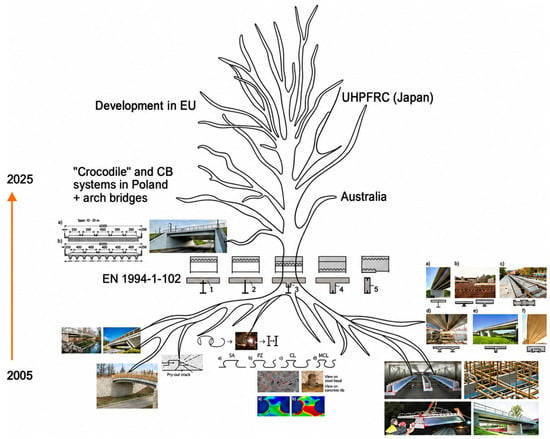
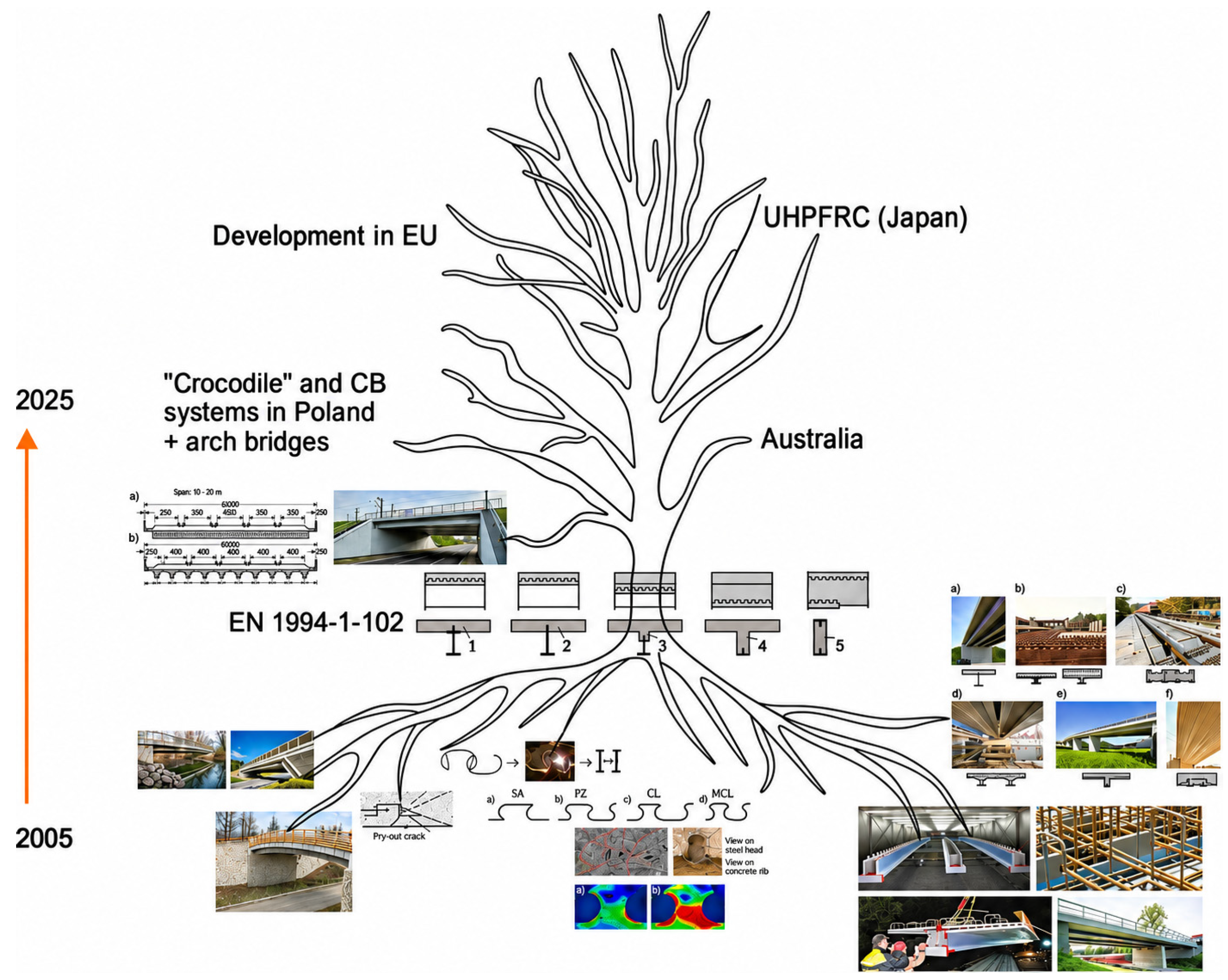
The development of composite dowels and the HCM concept can be traced through designed and constructed bridges [1,3]. Below we focus on activities beyond 2020. From the perspective of 2026, these activities (resulting in a wide variety of forms) can be viewed as the “roots of the tree” (Figure 1) illustrating the development of CD/HCM in bridges. Both the HCM concept and the only dowel shape currently used in bridges, known as MCL shape (Modified Clothoidal Shape) in the EN 1994-1-102 standard [4], were developed for the bridge known as Wierna Rzeka built in 2009 in Poland; this is described in [3]. This solution, later slightly modified, is still used today in railway bridges in Poland. The development of the EN 1994-1-102 standard was a summary of the theoretical concepts and a significant milestone; In Figure 1 this moment is marked as the trunk. Taking the analogy of a “tree”, we are currently at the level of growth of the main branches and further development (in various directions that are still being defined).
Figure 1.
Development of composite bridge structures: (upper left) bridge deck cross-sections: (a) solid slab bridge deck, (b) multi-girder bridge deck; (upper centre) composite and hybrid girder cross-sections: (1) conventional composite T-girder with composite dowels, (2) composite T-girder with composite dowels only, (3) hybrid girder with a shallow concrete web, (4) hybrid girder with a concrete web and external lower reinforcement, (5) hybrid girder with a double external reinforcement; (lower centre)composite dowel geometries: (a) fin-shaped (SA), (b) puzzle-shaped (PZ), (c) clothoidal (CL), (d) modified clothoidal (MCL); (right) composite bridge superstructure systems: (a) conventional steel–concrete composite girder with composite dowels, (b) girders with external reinforcement, (c) shallow composite deck with external steel reinforcement (d) twin-girder hybrid composite deck, (e) hybrid composite girder with a reinforced concrete web, (f) hybrid composite deck slab with embedded steel sections. (pictures of bridges by SSF Ingenieure).
The fundamentals of steel dowel design and manufacturing are key to steel fatigue but this is well recognized topic now [1,5]. The new form of strongly reinforced composite dowels (SRCD) made it possible to reduce the web thickness in bridges to 20 cm which, combined with new solutions of the so-called transition zones, allowed the creation of a new system of prefabricated beams, the so-called CB [6] (transition zones were also expanded for the needs of arch bridges). The CB system, first used to build a number of bridges for the construction of one of the new motorways in Poland and is essentially one of the two typical systems for beam bridges. In parallel, alongside the CB system, a completely different system called “crocodile” is being developed for spans between 50 and 70 m [7]. These two systems constitute the “base” of hybrid bridges in Poland and are the basis for further development activities within the EU (marked on the left side of the “tree” in Figure 1). In parallel to them, hybrid elements are being implemented in arch bridges shown in Figure 2.
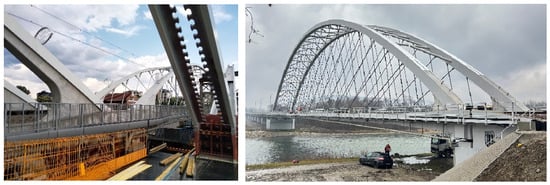
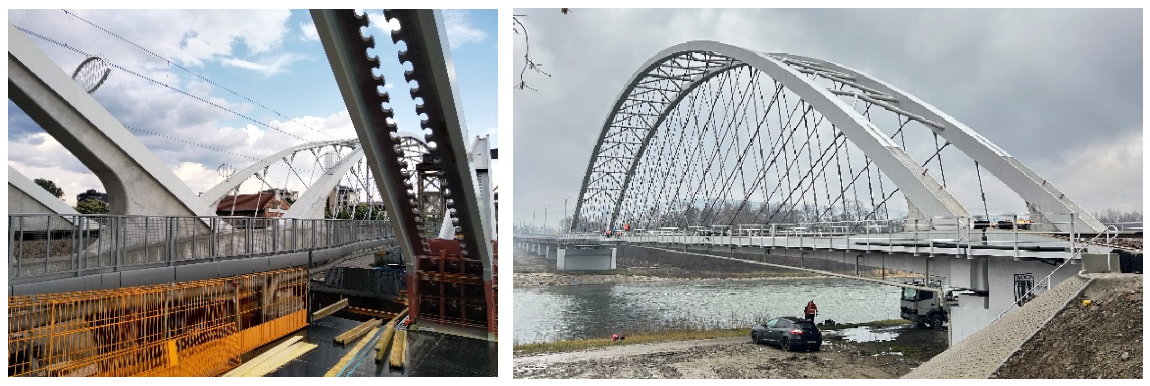
Figure 2.
HCMs in Polish arch bridges: using rolled sections (from the left) and welded sections (from the right).
Collaboration since 2015 between Wrocław University of Science and Technology and the Osaka Institute of Technology led to intensive activities in Japan and the R&D works in Japan [8]. Subsequently, activities there began regarding CD in buildings [9]. Independently, engineers in Australia have adopted technologies developed in the EU, and they construct hybrid bridges [10]. It’s worth noting the slightly different solutions dictated by the specifics of the region. This is an important aspect, demonstrating how technology adapts and adapts to changing conditions. The economic aspect is also emphasized: both in Poland and Australia, solutions are used because they are simply economical. After 2020, the adoption of technology in China can be seen; the publication [11] shows that the scientists and engineers there tried to cope (in their own way) with the distribution of the shear force between steel and concrete in the case of using an extended concrete zone. They considered the solution using standard welded studs and they claimed, that the shear resistance is composed of two parts: steel webs and concrete webs [11] which was in contradiction with the approach taken in EN 1994-1-102. This is addressed in [3]. This shows how important the problem of distributing the shear force between steel and concrete was in order to create new steel-concrete forms and it is clear that its solution [3] now enables significant progress: previously, engineers did not have formal tools for designing such cross-sections. Recently, both the CD and HCM concepts have been adopted in China [12], and this is also done in UHPRFC concrete (which was previously developed by the Germans for applications in buildings [13]). Currently, there are publications showing that the CD connection is being investigated in China [14], including the MCL [4,15], but there are no publications about built bridge structures. Independent investigations of shear connectors and their anchorage provide additional background for design development [1,2,5].
3. New Systems Developed in Poland
The continuous development of composite dowel technology has resulted in several innovative bridge systems that have already been implemented in practice. Their successful application in recently completed bridge projects has confirmed both the structural efficiency and the versatility of the proposed solutions. The most representative bridge systems developed in Poland are presented in the following sections.
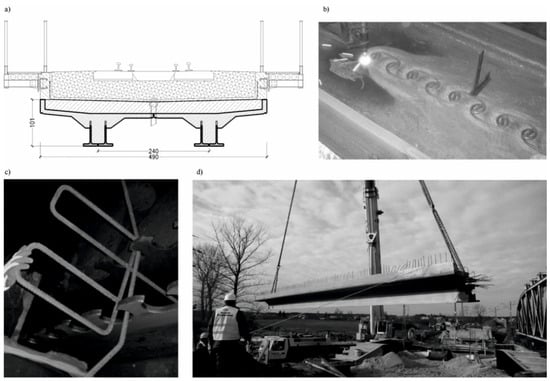
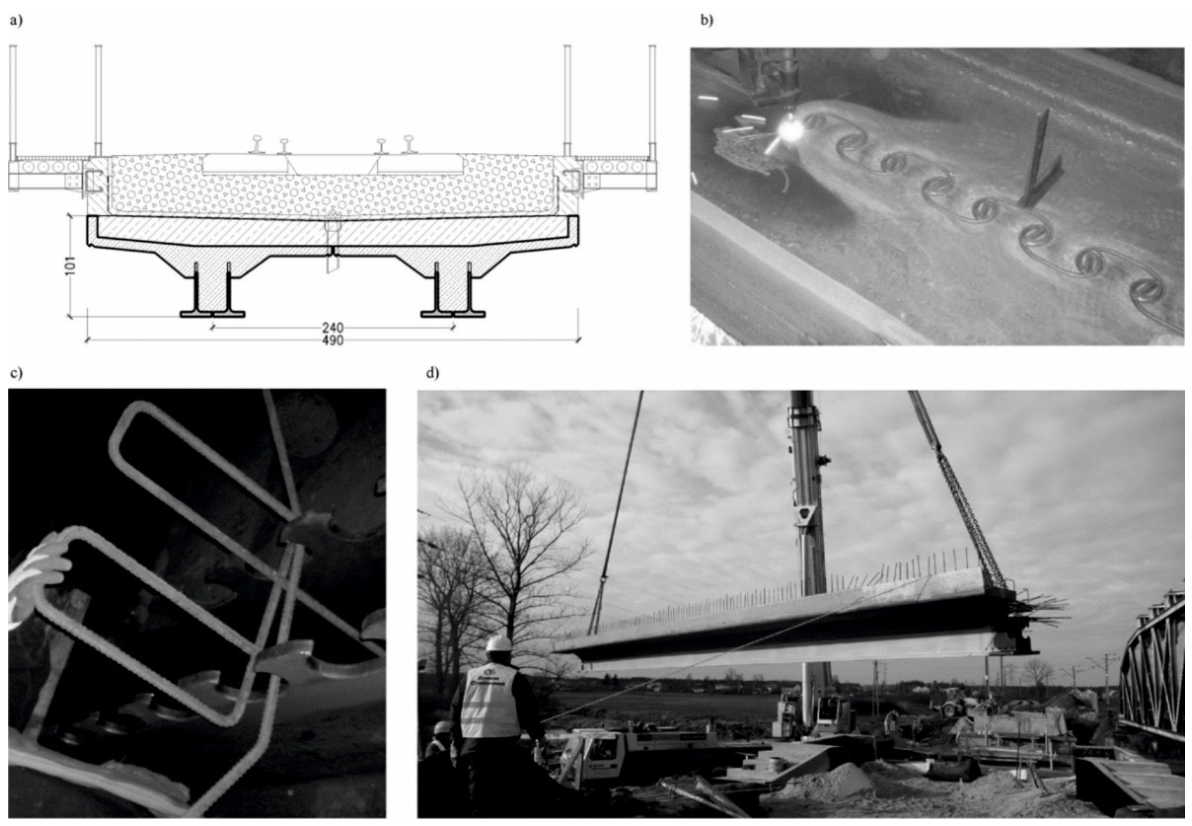
In the Wierna Rzeka bridge (Figure 3), a new type of shear connection was introduced in the form of an MCL shape as well as a cross-section design method in which both the steel T-section and the concrete part located above it participate in the transfer of the transverse force [3]. This was rather thick-walled composite section dedicated to railway bridge.
Figure 3.
Wierna Rzeka bridge from 2009 built in Poland: (a) cross section, (b) MCL shape cutting line, (c) MCL steel dowels and shear reinforcement, (d) prefabricated element of the bridge.
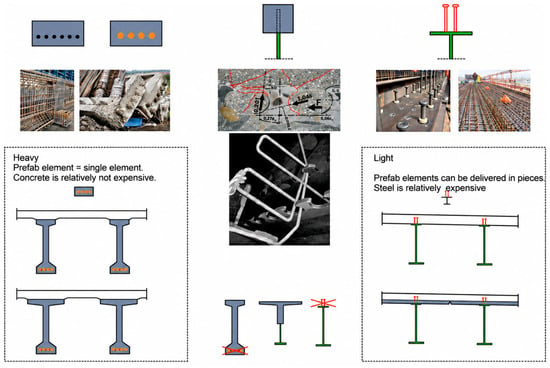
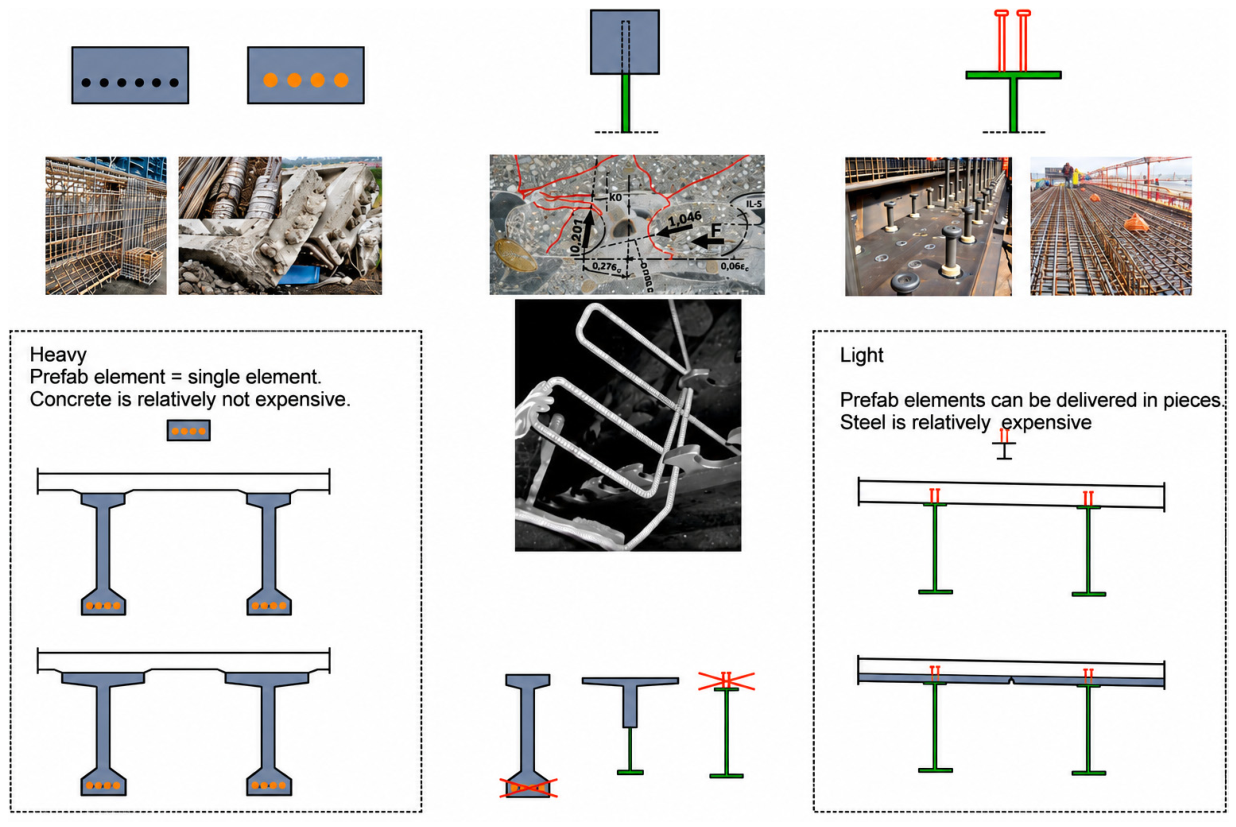
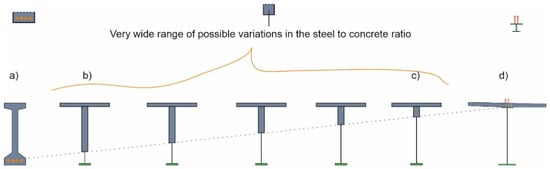
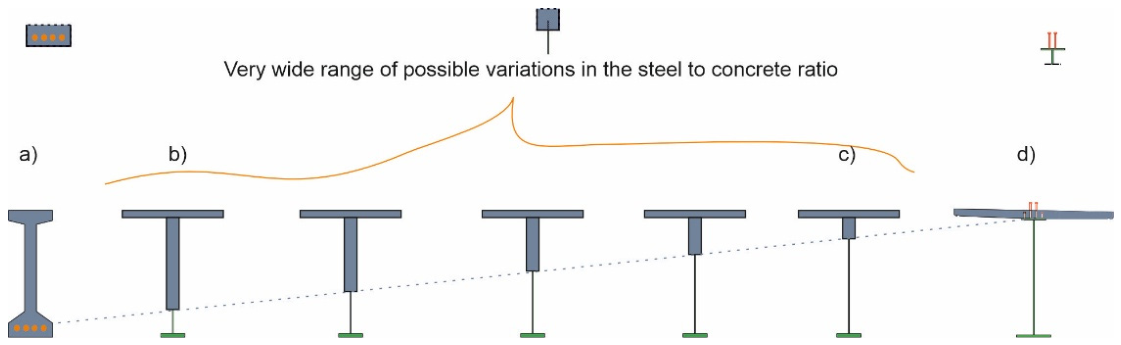
Currently, prefabricated road bridges use the thinnest possible concrete webs and the essence of the solution is well illustrated in Figure 4. Figure 5 shows variety of possible solutions; this feature of hybrid structures is clearly visible in CB beams.
Figure 4.
Evolution of hybrid solution for prefabricated road bridges.
Figure 5.
Variations in steel–concrete composite girder cross-sections with different steel-to-concrete ratios: (a) prestressed concrete beam, (b) hybrid cross-section with a predominantly concrete web, (c) hybrid cross-section with a predominantly steel web, (d) conventional steel–concrete composite cross-section.
3.1. Connection of Thin Walled Concrete Web with Welded T-Section: CB Beams
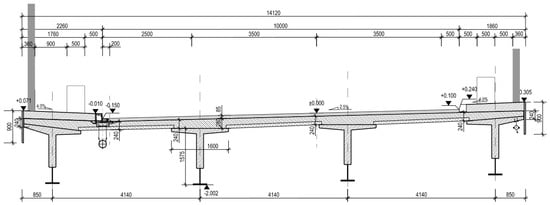
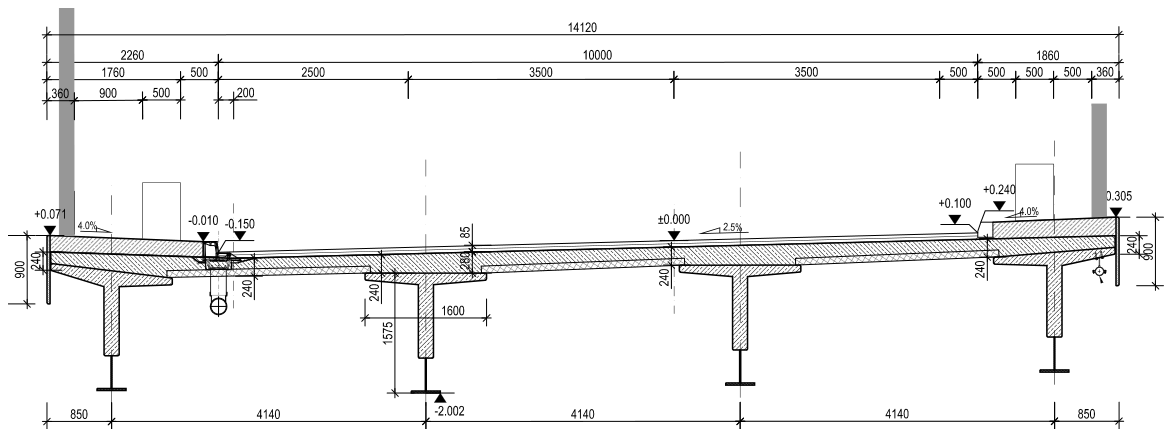
The publication [6] presents a new CB system used for the construction of bridges along the new motorway and viaducts above it. Figure 6 and Figure 7 shows the main bridge M7 [6]; The bridges of the new lane highway consist of 4 girders, similarly to the old structure (Figure 7), which allows us to assess the lightness of the new solution.
Figure 6.
Cross-section of the M7 bridge at S3 highway (Dargobądz–Troszyn section).
Figure 7.
New M7 bridge using hybrid beams and the old one using prestressed concrete (at the left) and steel structure of hybrid member (at the right).
3.2. Connection of Thick Concrete Web with Rolled T-Section: Crocodile
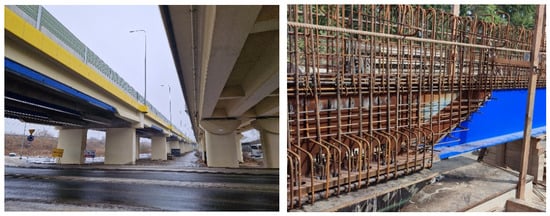
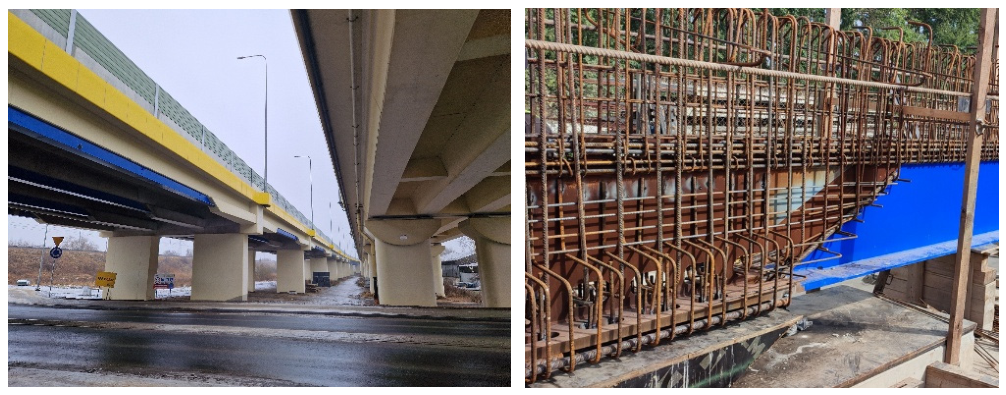
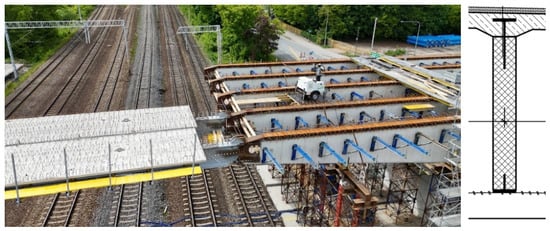
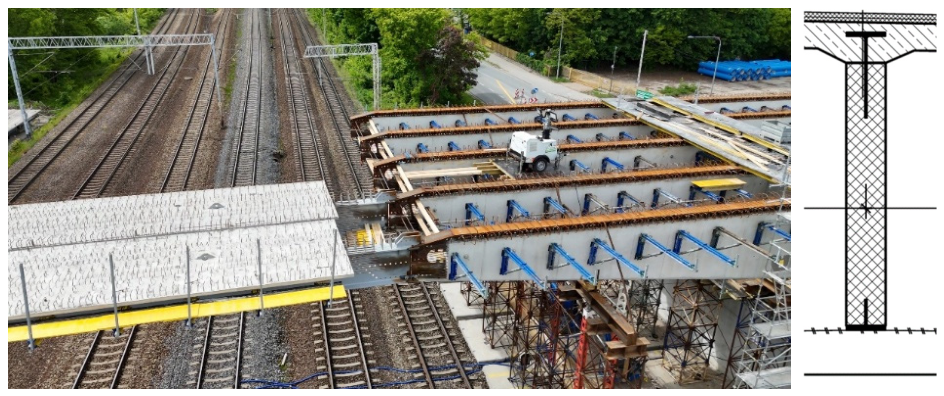
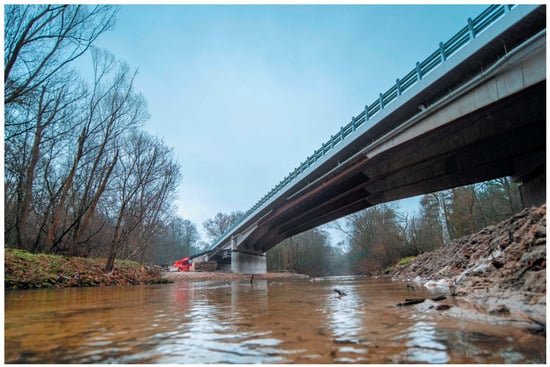
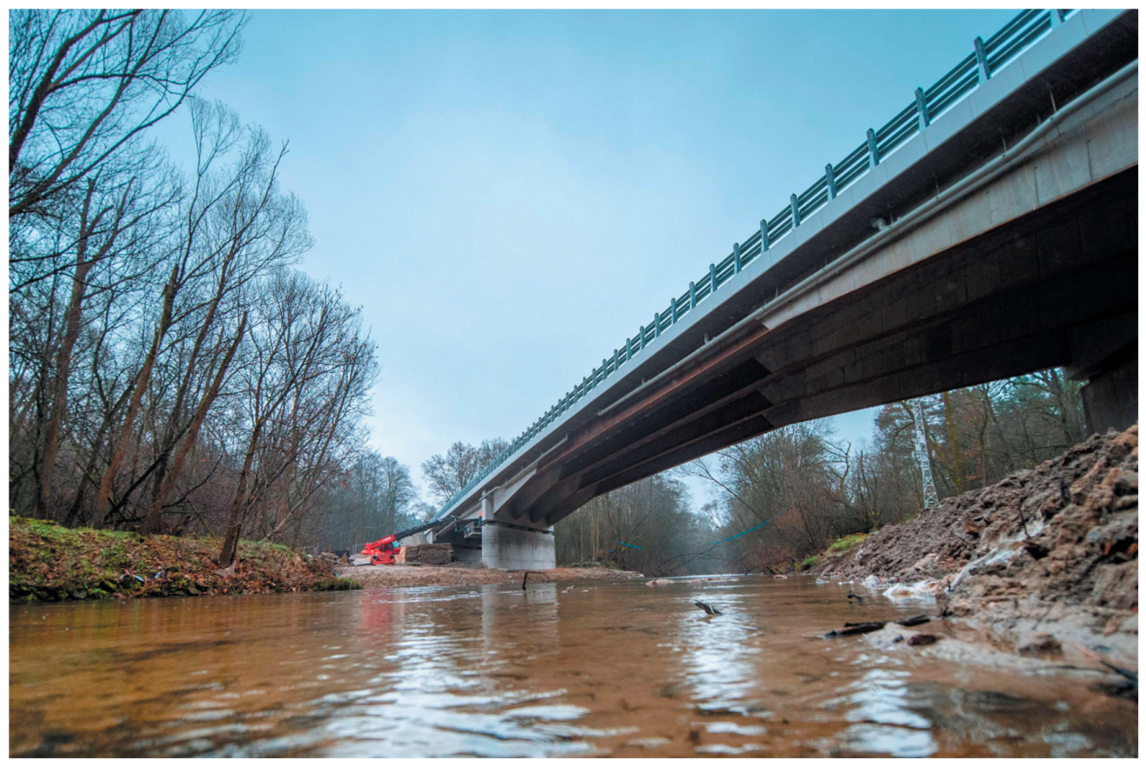
This solution is used for span lengths about 50-60m. The system and the first bridge is described in [7]. Figure 8 presents prefabricated hybrid member (and standard VFT prefabricated composite members) during construction of the second bridge of this type and hybrid section next to the concrete crossbeam is presented. The first crocodile bridge built in Poland is shown in Figure 9.
Figure 8.
Construction of the second “crocodile” bridge (with span length 60 m) in Warsaw, Poland (2025) using prefabrication of composite and hybrid elements.
Figure 9.
An example of a “crocodile” bridge built in 2024 over the Kwisa River near Żagań.
3.3. Arch Bridges
There are two bridges constructed using HCM; the rolled sections and plated sections are used (Figure 2). One of the bridges was shortlisted for an IABSE award. There are many photos and videos of the construction of this bridge on the Internet, just enter the phrase “e30 railway bridge in Cracow, Poland” in the search engine.
3.4. UHPFRC
Work to date [12,13,16] with UHPFRC has involved thin steel webs for small concrete elements. The latest developments include the introduction of ultra-high performance fiber reinforced concrete to the SRCD connection [8]. This results in very high load-bearing capacity and ductility, so that the 30mm steel webs become the weaker element.
4. Conclusions
The paper presents a brief summary of the applications of a new type of element in bridge engineering, i.e., a hybrid element. This technology is still developing.
Author Contributions
Conceptualization, W.L. and M.K.; methodology, W.L. and M.K.; investigation, W.L., M.K., M.T. and J.B.; resources, W.L., M.K., M.T. and J.B.; writing—original draft preparation, W.L., M.K. and M.T.; writing—review and editing, W.L., M.K., and M.T.; visualization, W.L., supervision, J.B. All authors have read and agreed to the published version of the manuscript.
Funding
This research received no external funding.
Institutional Review Board Statement
Not applicable.
Informed Consent Statement
Not applicable.
Data Availability Statement
No new data were created or analyzed in this study. Data sharing is not applicable to this article.
Conflicts of Interest
The authors declare no conflicts of interest.
Abbreviations
The following abbreviations are used in this manuscript:
| CD | Composite Dowels |
| HCM | Hybrid composite member |
| MCL | Modified Clothoidal Shape |
References
- Kong, F.; Huang, P.; Han, B.; Wang, X.; Liu, C. Experimental study on behavior of corrugated steel-concrete composite bridge decks with MCL shape composite dowels. Eng. Struct. 2021, 227, 111399. [Google Scholar] [CrossRef] [Scilit]
- Classen, M.; Hegger, J. Anchorage of composite dowels. Steel Constr. 2016, 9, 138–150. [Google Scholar] [CrossRef] [Scilit]
- Lorenc, W.; Kurz, W.; Seidl, G. Hybrid steel–concrete sections for bridges: Definition and basis for design. Eng. Struct. 2022, 270, 114902. [Google Scholar] [CrossRef] [Scilit]
- Feldmann, M.; Kopp, M.; Pak, D. Composite dowels as shear connectors for composite beams—Background to the German technical approval. Steel Constr. 2016, 9, 80–88. [Google Scholar] [CrossRef] [Scilit]
- Christou, G.; Schmidt, C.; Hegger, J.; Classen, M. The effect of concrete fatigue on the cyclic behaviour of composite dowels—Derivation of a design approach based on experimental findings. Eng. Struct. 2022, 253, 113743. [Google Scholar] [CrossRef] [Scilit]
- Kołakowski, T.; Kosecki, W.; Windorpskib, H.; Stempniewicz, A.; Bartoszek, B.; Lorenc, W.; Kożuch, M.; Kozioł, P. Modern solutions for middle span steel-concrete composite bridges in Poland: Hybrid girders and rolled sections using high strength steel and weathering steel. In Proceedings of the Nordic Steel Construction Conference 2024 (NSCC 2024), Luleå, Sweden, 26–28 June 2024. [Google Scholar]
- Kożuch, M.; Lorenc, W.; Windorpski, H.; Dubiło, A.; Ryng, Ł.; Ślęzak, A. The Crocodile Steel and Concrete Hybrid Bridge: Experiences from Design and Construction; Advances in Steel and Steel–Concrete Composite Structures; Lorenc, W., Czepiżak, D., Kozioł, P., Giżejowski, M.A., Marcinowski, J., Hotała, E., Eds.; Routledge: London, UK, 2025. [Google Scholar] [CrossRef] [Scilit]
- Imagawa, Y.; Kozioł, P.; Ohyama, O. PBL shear connection in bridges, Wyzwania Współczesnego Mostownictwa. In Proceedings of the Seminarium Naukowo-Techniczne Wrocławskie Dni Mostowe, Wrocław, Poland, 19–22 July 2022; pp. 185–202. [Google Scholar]
- Che, R.; Kimura, Y.; Suzuki, A. Cyclic Behavior of Composite Beams with Puzzle-Shaped Shear Connectors Under Asymmetric Bending; Routledge: London, UK, 2025. [Google Scholar]
- Schwarz, W.; Jayasekera, N. Introducing composite dowels for bridge beams in Australia—Case study of three constructed bridges. In Proceedings of the 11th International Conference on Short and Medium Span Bridges, Toronto, ON, Canada, 19–22 July 2022. [Google Scholar]
- Shao, X.; Zhao, X.; Liu, Q.; Deng, S.; Wang, Y. Design and experimental study of hot rolled shape steel-ultrahigh performance concrete composite beamEng. Struct. 2022, 252, 113612. [Google Scholar] [CrossRef] [Scilit]
- Shen, X.; Shao, X. A new steel-UHPFRC composite beam with composite dowels as connector and its shear behavior. Wyzwania Współczesnego Mostownictwa. In Proceedings of the Seminarium Naukowo-Techniczne Wrocławskie Dni Mostowe, Wrocław, Poland, 23–25 November 2022; pp. 179–184. [Google Scholar]
- Lechner, T.; Gehrlein, S.F.; Fischer, O. Structural behaviour of composite dowels in thin UHPC elements. Steel Constr. 2016, 9, 32–137. [Google Scholar] [CrossRef] [Scilit]
- Shen, X.; He, Y.; Hung, C.-C.; Yang, J.; Chen, H. Shear behavior in Steel-UHPFRC compo-site beams with different failure modes. Compos. Struct. 2025, 362, 119105. [Google Scholar] [CrossRef] [Scilit]
- Matanmi, F.O.; Su, Q.; Gu, M.; Xu, S.; Liu, F.; Huang, L.; Shi, Z. Full-scale study on flex-ural behavior of high-strength steel—UHPC composite beam with modified clothoid-shaped dowels as shear connector. Eng. Struct. 2026, 48, 121708. [Google Scholar] [CrossRef] [Scilit]
- Benedetty, C.A.; dos Santos, V.B.; Krahl, P.A.; Rossi, A.; Silva, F.A.; Cardoso, D.C.T.; Martins, C.H. Flexural and shear behavior of steel-UHPC composite beams: A review. Eng. Struct. 2023, 293, 116649. [Google Scholar] [CrossRef] [Scilit]
Disclaimer/Publisher’s Note: The statements, opinions and data contained in all publications are solely those of the individual author(s) and contributor(s) and not of MDPI and/or the editor(s). MDPI and/or the editor(s) disclaim responsibility for any injury to people or property resulting from any ideas, methods, instructions or products referred to in the content. |
© 2026 by the authors. Licensee MDPI, Basel, Switzerland. This article is an open access article distributed under the terms and conditions of the Creative Commons Attribution (CC BY) license.