


Abstract
Climate change poses a significant threat to the durability of concrete infrastructure, especially in aggressive environments such as those exposed to de-icing salts. The effect of climate change on the service life of a structure is illustrated through a case study: the Highway Viaduct Golubinjak in the mountainous region of Croatia, which is affected by chloride-induced corrosion. Measured chloride content after 22 years was used to calibrate numerical models. Two climate scenarios, “Representative Concentration Pathway 4.5” and “Representative Concentration Pathway 8.5” (RCP4.5 and RCP8.5) were analyzed to assess their influence on chloride ingress in concrete and the service life of the structure. Considering the assumptions from the calibration and depending on the concrete cover thickness, the results indicate a reduction in reinforcement depassivation time of 10% and a decrease in corrosion initiation time of up to 15 years, highlighting the need to adapt maintenance strategies.
1. Introduction
Concrete with embedded steel (reinforcement bars or prestressing cables) is the most widely used construction material in the construction sector, especially for infrastructural assets. However, most field problems relate to durability and maintenance [1,2], with the primary cause of the premature degradation, serviceability loss, and structural failure of reinforced concrete structures being corrosion of embedded steel. Corrosion of reinforcement steel is enabled by a reduction in the concrete’s pH value, which is mainly induced by either carbonation or chloride contamination [3]. The consequences include reduced load-bearing capacity and deformability, as well as reduction in energy dissipation capacity and changes in the dynamic properties of the structure, ductility, and collapse mechanisms [3,4,5,6]. Additionally, climate change factors such as carbon dioxide concentration, temperature, and relative humidity affect corrosion processes, impacting both existing and future buildings. In fact, the Republic of Croatia is one of the three most vulnerable countries in the European Union, with the largest estimated share of damage from climate change relative to gross national product [7]. Bridges, as a particularly important part of strategic infrastructure, require longer service lives while being especially vulnerable to climatic and environmental influences and degradation processes, such as corrosion of steel in concrete, carbonation, chloride penetration, freezing–thawing cycles, and thermal stresses. Recent studies consistently demonstrate that service-life predictions are highly dependent on local climatic conditions, highlighting the need for region-specific assessments for Croatian bridge infrastructure. Even within Europe, significant climatic variability exists between coastal, continental, and mountainous regions [8,9,10,11,12]. Croatia is characterized by two highly aggressive exposure environments: marine coastal regions affected by seawater chlorides and continental and mountainous regions where de-icing salts are extensively used.
This study presents a case study of the Viaduct Golubinjak, a significant infrastructure asset on the challenging mountain section of Croatia’s A6 highway. Numerical models in the software Life-365 v2.2.3 are calibrated with field-measured chloride concentration profiles. Then, future temperature predictions are incorporated into the models to analyze climate change impact on service life. This addresses the lack of region-specific service-life predictions for Croatian bridge infrastructure under future climate conditions. In addition, calibrated Life-365 models with field measurements reduce the uncertainties associated with generic durability models and providing results relevant to other Mediterranean and mountainous European regions.
2. Service-Life Predictions
Chloride transport from the environment into concrete is a complex process. It occurs through mechanisms of diffusion, convection, migration, capillary absorption, hydrostatic pressure, thermodiffusion and chloride binding [4,13,14]. Therefore, there have been many service-life prediction models developed in last few decades.
Life-365 is a numerical model of chloride ingress assessing the time to corrosion initiation with the addition of calculating maintenance costs of reinforced concrete structures. The dominant transport process of chloride ingress is diffusion. Diffusion basics are described by the 1st and 2nd Fick’s Laws. Fick’s second law dictates that the change in chloride diffusion flow must be proportional to the change in the total amount of chloride in the concrete and reads:
where t is the time [s], is the change in the amount of chloride in the concrete over time, and is the change in the flow of chloride diffusion along the depth of the concrete. Life-365 enables a relatively simple yet sufficiently reliable durability assessment of reinforced concrete structures exposed to chlorides. The chloride diffusion coefficient (D) is a function of time and temperature in comparison with some much simpler models with constant parameters. Concrete admixtures analysis is also enabled, helping optimize concrete mix design for improved durability. The main limitations of this model are the assumptions that concrete pores are completely saturated and that the concrete is uncracked. This is not the case in the actual reinforced concrete structures in real environmental conditions [15,16]. It also disregards other important transport processes such as convection, migration, capillary absorption, and chloride binding. However, the shortcomings of this model were partly overcome by calibrating numerical models based on measured chloride profiles at 35 locations on the bridge after 22 years of use.
3. Case Study
The Golubinjak Viaduct, located in a mountain region on the A6 motorway in Croatia, consists of two parallel structures. The western structure was built in 1996 and the eastern structure in 2008. Due to its significantly poorer condition identified during visual inspection, the western structure was selected for investigative work and model calibration in this study. The western structure consists of 19 spans, each approximately 29.9 m long, with a total viaduct length of 577 m and an overall width of 12.2 m. The superstructure cross section consists of four simply supported precast prestressed concrete girders and the precast concrete slab [17]. The precast girders are supported on elastomeric bearings placed on concrete pedestals, while the substructure consists of monolithic abutments and hollow piers with cap beams [17]. Expansion joints are located at the abutments and at piers P4, P8, P11, and P15 [17].
The inspection provided in 2018 confirmed significant damage to the reinforced concrete elements, primarily caused by long-term exposure to aggressive environmental conditions, moisture, and chloride penetration. Expansion joints were out of function, deck waterproofing was damaged, and due to degraded drainage, traces of moisture were visible along the viaduct’s substructure. Along with some poor construction practice and/or workmanship, such as insufficient concrete cover, it all resulted in serious corrosion damage. The most pronounced deterioration was observed in the form of concrete cracking, spalling of the concrete cover, local delamination, and exposed reinforcement. Damage was especially visible in the deck slab edges, piers, abutments, bearing zones, New Jersey fence and drainage areas, especially considering the amount of de-icing salts on the deck which were dissolved in the drainage water [17].
Field investigations included concrete core extraction for laboratory testing, rebound hammer testing for concrete quality assessment, reinforcement detection, reinforcement corrosion assessment by half-cell potential, chloride sampling, and non-destructive ultrasonic testing to determine crack depth. Results of measuring ultrasound velocity showed that the crack depths ranged from 2.5 cm to 11.4 cm [17,18]. Reinforcement corrosion assessment was performed according to ASTM C876 [19] using Cu/CuSO4 reference electrodes. Measurements were carried out at sixteen locations on the structure. The results indicated a high probability of reinforcement corrosion (>90%) at the abutments, girders, and cap beams. On the piers, visually sound areas showed a low corrosion risk (<10%), while visually deteriorated areas indicated medium to high corrosion risk (>50%) [12,13].
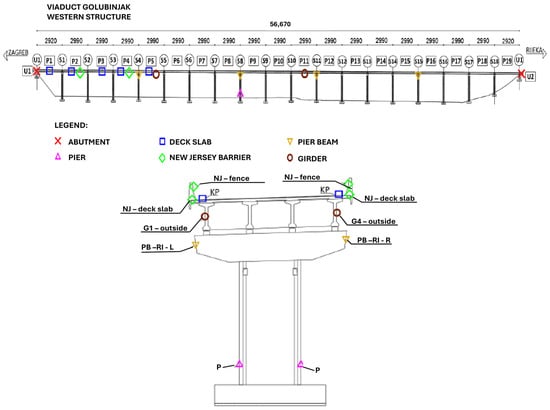
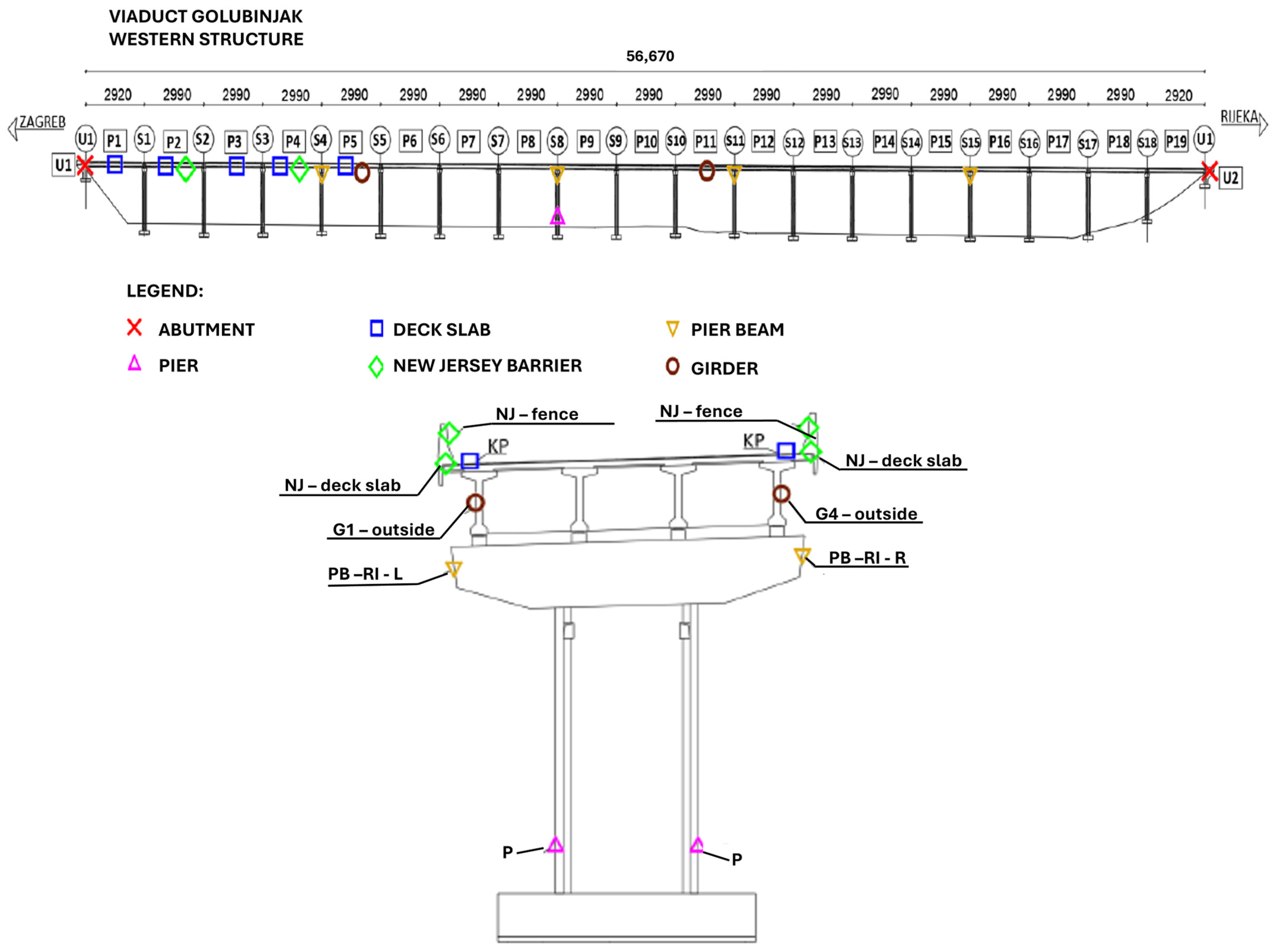
Laboratory testing included determination of concrete compressive strength, modulus of elasticity, density, carbonation depth, and total chloride content in concrete. The chloride content in concrete is measured in 35 samples taken from all structural elements (Figure 1) using the rapid chloride test (RCT) [12]. Chloride content testing revealed critical chloride concentrations of 0.05% of mass of concrete according to HRN EN 206-1 [20] in several structural elements, particularly in cap beams, abutments, parts of the deck slab, and external girders, indicating a significant risk of reinforcement corrosion.
Figure 1.
Longitudinal view (up) and cross section (below) of Golubinjak Viaduct with indicated location of chloride content measurements (adapted from [18]).
Based on the obtained results, it was concluded that the viaduct required rehabilitation measures to restore durability, improve protection against chloride penetration, and ensure the extension of its service life. These findings served as the basis for the rehabilitation works carried out in 2022.
4. Calibration of the Model
The objective was to obtain numerical models that would best match the measured chloride content values in the concrete obtained through investigative works conducted on the viaduct. During these investigations, chloride concentration values were measured at concrete depths of 0–20 mm, 20–40 mm, and 40–60 mm. For simplification and easier comparison, depths of 10 mm, 30 mm, and 50 mm were adopted. This way, diagrams present chloride content profile determined by three points. These measured values served as reference data for comparison with the results obtained from the model.
Life-365 requires defining two key initial values: the initial surface chloride concentration (as a percentage of concrete mass) and the chloride diffusion coefficient through concrete (m2/s). Since these values were not directly known, they were determined through the model calibration procedure, i.e., by adjusting the input parameters.
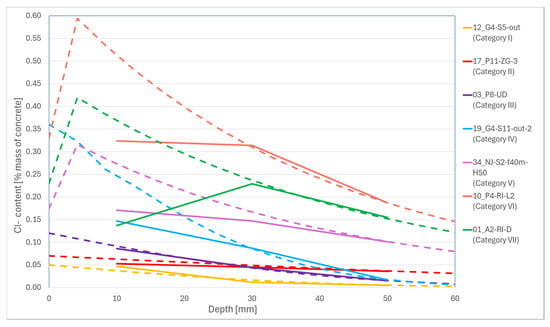
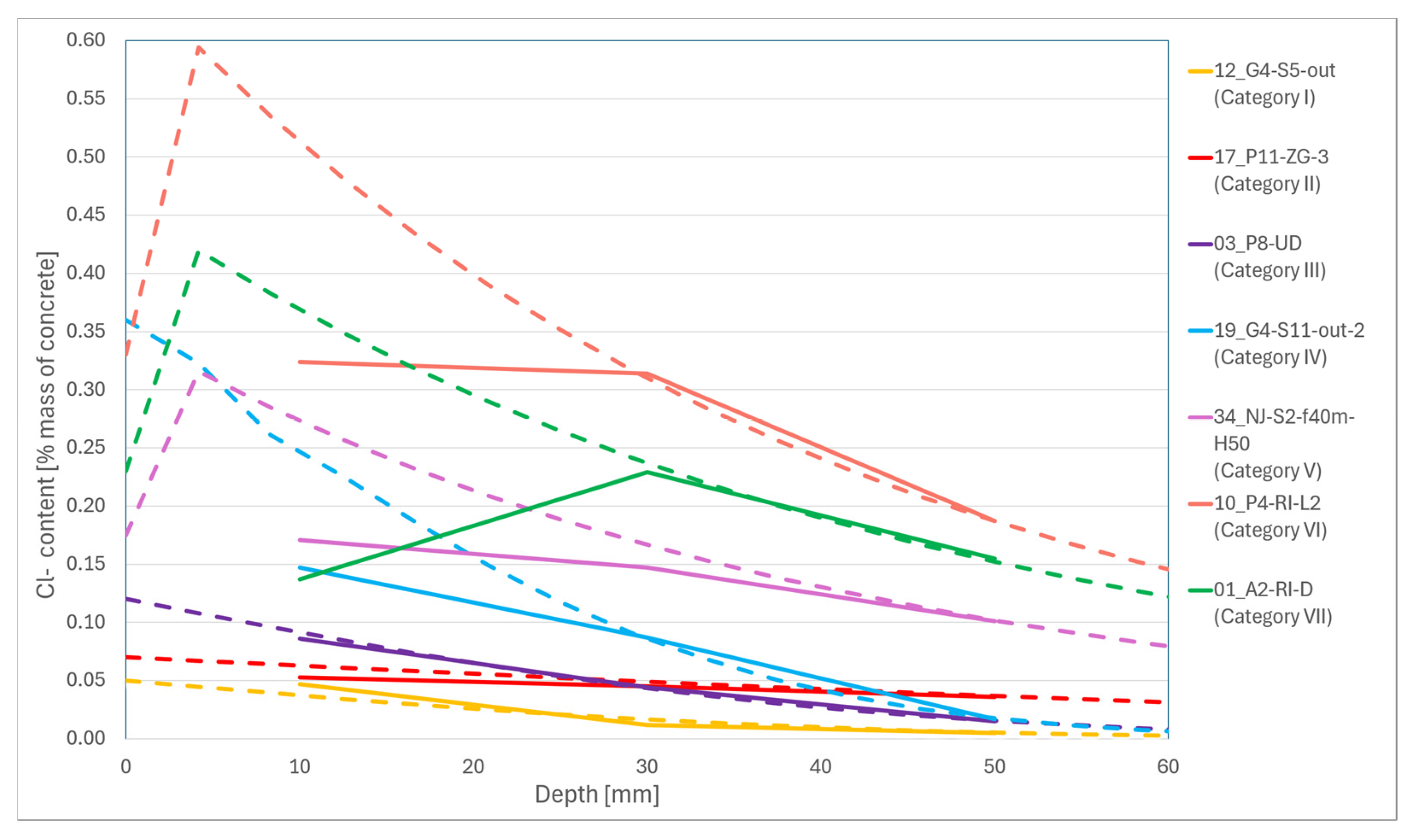
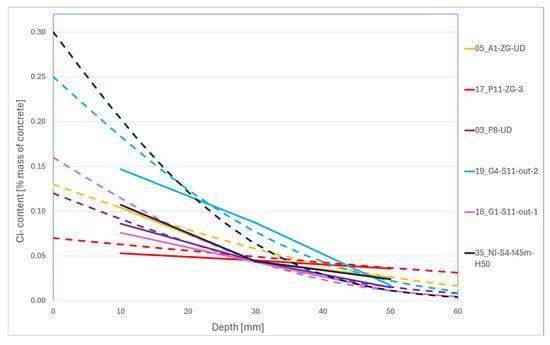
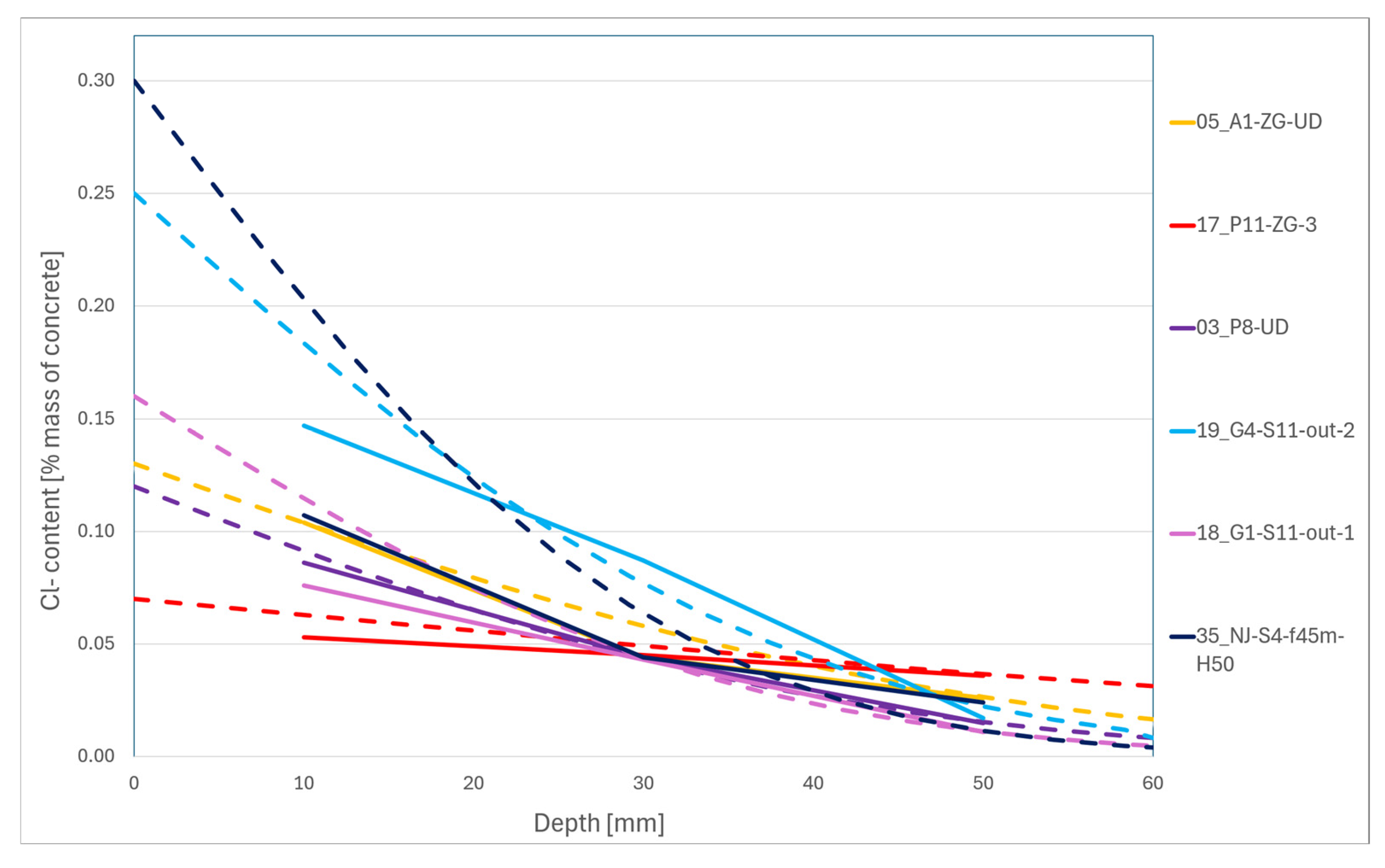
The numerical model was adjusted until the obtained numerical results matched the measured chloride concentration values at different depths. In this way, a numerical model was obtained that accurately describes the actual behavior of concrete under the investigated conditions and enables the assessment of future chloride concentration development over time, the determination of the time to reinforcement corrosion initiation, and the comparison of the durability of different parts of the structure. Since the Life-365 model uses simplified input data, there were cases in which it was not possible to achieve full agreement between the numerical and measured chloride profile. In such cases, priority was given to the chloride profile at the concrete cover thickness, since this zone has a significant influence on the durability of the structure. The example of calibration of measured and numerical chloride profiles is shown in Figure 2 and Figure 3, where measured values are shown with a solid line, while values from numerical models are shown with dashed line.
Figure 2.
Numerical chloride profiles corresponding to seven different chloride exposure and diffusion coefficient categories, calibrated by measured chloride profiles after 22 years of exposure.
Figure 3.
Numerical chloride profiles for six selected cases with corrosion initiation times occurring during the bridge service life (excluding cases with initiation in the first year or after 100 years), calibrated by measured chloride profiles after 22 years of exposure.
For some chloride profiles with a high concentration of chloride in the deeper layers of concrete, it was difficult to obtain a numerical profile based on diffusion, as the influence of chloride convection is also a significant transport process in such cases.
Based on a comprehensive calibration process, results for the input parameters vary significantly due to different environmental exposure, concrete quality and the presence of cracks and concrete permeability: surface chloride concentrations vary from 0.015 to 0.630% of concrete mass, while calibrated chloride diffusion is in a range from 2.45 to 9.90 m2/s. It should be noted that for some cases, the high calibrated diffusion coefficients (up to 9.9 × 10⁻⁷ m2/s) arise because the simplified Life-365 model artificially absorbs other chloride transport and deterioration mechanisms into a single diffusion parameter. These extreme fitted diffusion coefficients should not be interpreted as physically realistic material properties or as the true diffusion through an intact cement matrix. Rather, they represent effective values that compensate for deterioration mechanisms not explicitly included in the simplified Life-365 model, such as open cracks, spalling of the concrete cover, increased transport through damaged concrete, convective chloride transport, and localized preferential pathways for accelerated chloride ingress.
5. Prediction of Depassivation Time with and Without Impact of Climate Change
After successful model calibration, the influence of climate change on durability and corrosion initiation time was evaluated using average monthly temperature data provided by the Croatian Meteorological and Hydrological Service. Numerical models of chloride profiles with reference climate data for 1981–2010 were compared with those of future projections for 2041–2070 under the optimistic (RCP 4.5) and pessimistic (RCP 8.5) climate scenarios [21].
First, all 35 chloride profiles obtained by calibration for each testing point were grouped into seven categories according to the similarity of the chloride profile. For each category, representative lines were selected that best describe the chloride behavior within that category (Figure 2).
The chloride concentration values and diffusion coefficients of these representative lines were used as input data for the models with future temperatures under the RCP 4.5.and RCP 8.5 scenarios. The chloride ingress analysis was performed for a service life of 30 years, corresponding to both the reference period and the period for which the climate projection was developed. Results for the initiation time for each category of chloride profile and two concrete cover thicknesses, average executed (cc = 30 mm) and designed (cc = 50 mm), are presented in Table 1, where initiation time is defined by the moment when the critical chloride concentration at the reinforcement depth reaches the critical chloride concentration.
Table 1.
Initiation time of chloride profiles corresponding to seven different chloride exposure and diffusion coefficient categories with and without climate change inclusion.
Results for the optimistic scenario (RCP 4.5) show an increase in chloride ingress at a depth of 30 mm from 1% to more than 9%, depending on the category. Changes are more notable in the pessimistic (RCP 8.5) scenario, with an increase of up to 17%. Meanwhile, results at a depth of 50 mm show an increase of up to 23% and 38% for the optimistic and pessimistic scenarios, respectively.
For the first two categories, the surface chloride content is small (often lower than the critical value) as well as the diffusion coefficient, so the initiation time is longer than 100 and 500 years, respectively. Categories IV to VII are characterized by a high surface chloride concentration and concrete diffusion coefficient, which results in an initiation time in two months of exposure. For both very short and very long initiation times, climate change logically does not have a significant impact on the service life (Table 1).
However, for category III, where the initiation time is between 1 and 100 years, i.e., sometime during the service life of the bridge, climate change has a more significant impact. Therefore, more similar chloride profiles where climate change has relevant impact are presented in Table 2 and Figure 3. This group of chloride profiles represents elements with good quality concrete, with chloride diffusivity ranging from 2 × 10⁻¹² to 2 × 10⁻¹¹ m2/s, and moderate exposure to salts, with surface chloride concentration one to five times higher than the critical chloride content (0.07–0.30% of concrete mass).
Table 2.
Initiation time of chloride profiles for six selected cases with corrosion initiation times occurring during the bridge service life (excluding cases with initiation in the first year or after 100 years) with and without climate change inclusion.
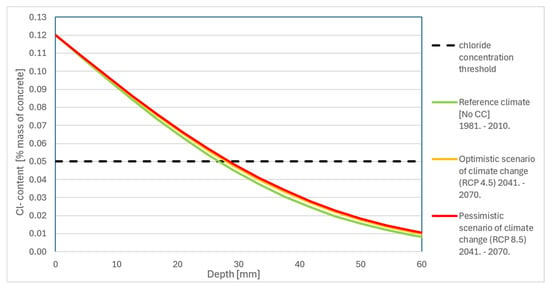
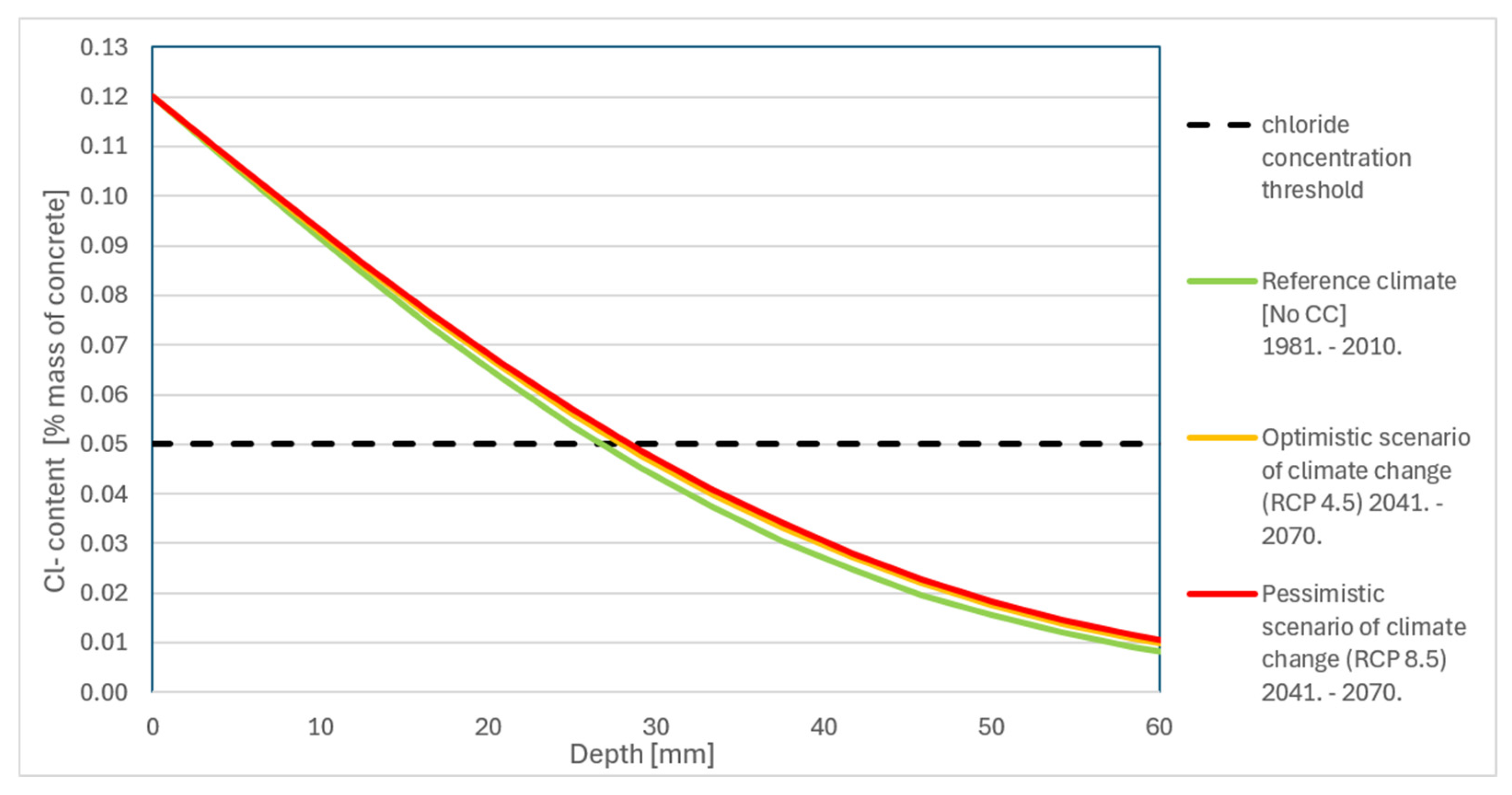
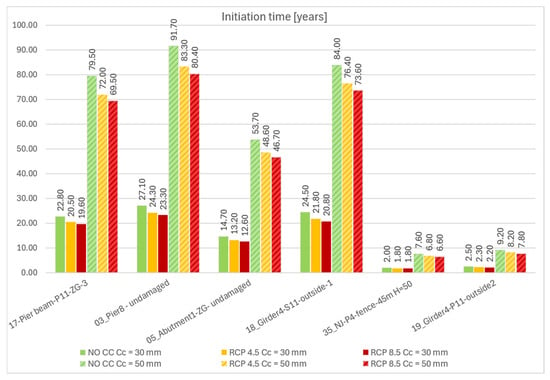
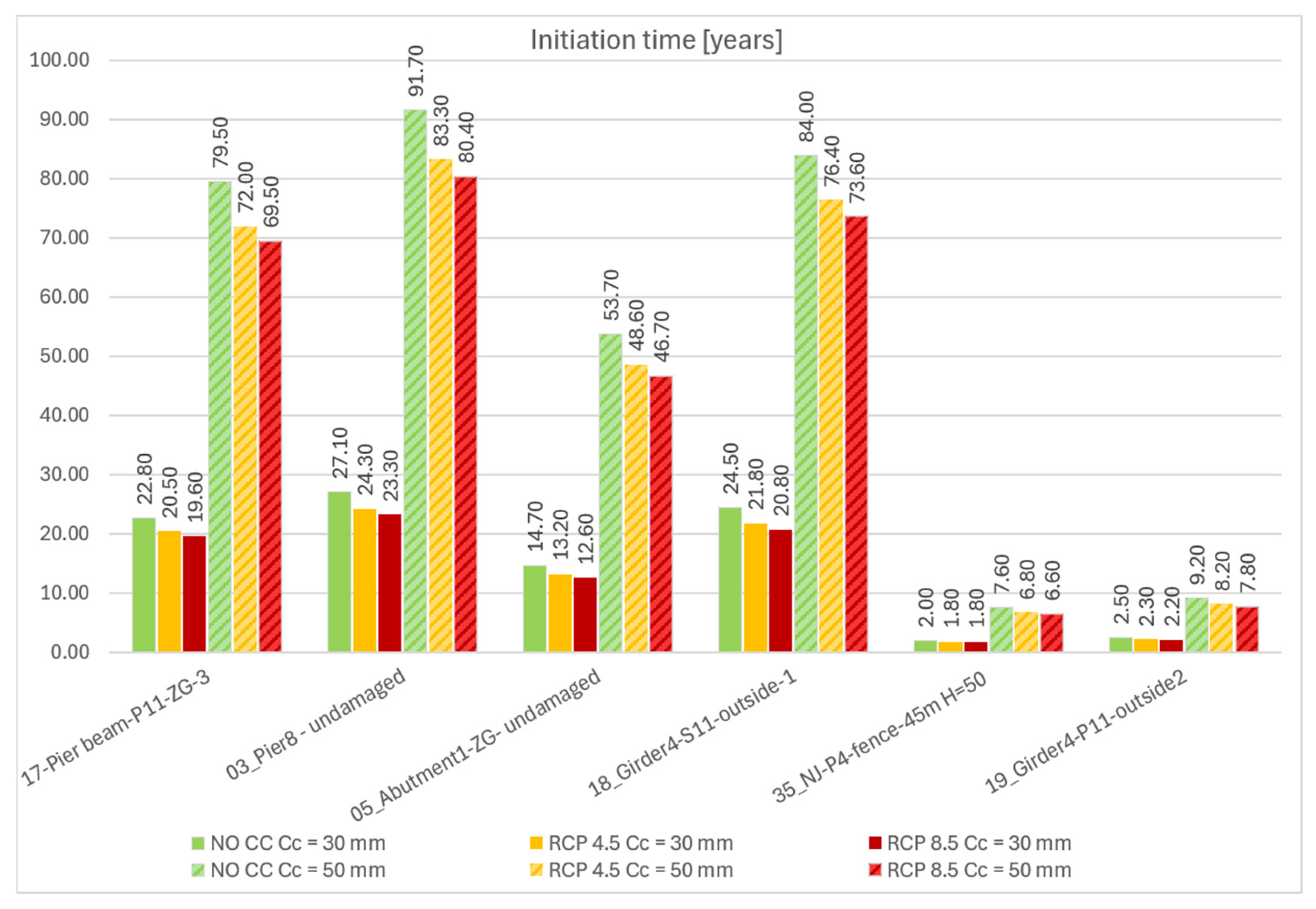
Although the chloride profiles after 30 years of exposure (Figure 4) do not show significant deviations between the reference climate, the optimistic scenario, and the pessimistic scenario, the differences are much greater when considering the chloride content and, in practice, the most significant factor: the reduction in service life (Table 2, Figure 5). Based on the analyses carried out on the numerical chloride profiles, calibrated according to the measurements on the structure, the reduction in the initiation time amounts to an average of 10% for the optimistic and 15% for the pessimistic climate change scenario. In the specific example of the pessimistic scenario and a concrete cover thickness of 5 cm, the time to depassivation was shortened by as much as 15 years.
Figure 4.
Chloride profile after 30 years of exposure for reference climate and two scenarios of climate change prediction based on calibrated chloride profile for the undamaged part of the pier S8.
Figure 5.
Corrosion initiation time for reference climate (no climate change) and two scenarios of climate change prediction based on calibrated chloride profiles for concrete cover of 30 mm and 50 mm.
6. Conclusions
Climate change is increasingly affecting the durability and long-term performance of reinforced concrete infrastructure, particularly structures exposed to aggressive environmental conditions such as de-icing salts. This study investigated the impact of rising temperatures on the service life of the Golubinjak Viaduct, a reinforced concrete highway bridge located in the mountainous region of Croatia.
Numerical chloride ingress models developed in Life-365 were calibrated using measured chloride profiles obtained from extensive field and laboratory investigations after 22 years of service. The results confirmed significant chloride-induced deterioration in several structural elements due to long-term exposure to moisture, de-icing salts, damaged waterproofing, inadequate drainage, and local deficiencies in concrete cover.
Climate projections for the period 2041–2070 under the optimistic (RCP 4.5) and pessimistic (RCP 8.5) scenarios showed an increase in chloride ingress, with more pronounced effects under the pessimistic scenario and at greater concrete depths. While some structural elements already exceeded the critical chloride threshold under the current climate, the analyses demonstrated that climate change may also shift previously non-critical areas into a higher durability risk category. Locations that are currently considered safe may reach critical chloride concentrations during the projected service life, particularly under the RCP 8.5 scenario.
Although the impact of climate change is greater with a thicker concrete cover, increasing the thickness of the concrete cover is a key measure for adapting bridges to climate change. Increasing the concrete cover thickness from 30 mm to 50 mm extends the service life of the bridge by approximately three to four times.
For structural elements with moderate chloride exposure and relatively good-quality concrete, the calibrated models predicted a reduction in reinforcement depassivation time of approximately 10–15%, corresponding to a decrease in service life of up to 15 years. The influence of climate change was less significant for elements with either very low chloride exposure or already severely deteriorated conditions.
The obtained results correlate well with previous international research. Studies on bridges in China showed that rising temperatures may increase chloride concentrations at reinforcement depth by 6–15% by the year 2100 compared to scenarios without climate change [4]. Bastidas-Arteaga et al. [22] reported a reduction in failure time of up to 31% for maritime environments and up to 19.9% for tropical environments under climate change conditions. These findings further confirm that future climate conditions may significantly accelerate deterioration processes in reinforced concrete structures.
Overall, this study highlights that relying solely on historical climate data may underestimate future deterioration risks and maintenance demands. Therefore, climate-adaptive durability design, service-life prediction, and maintenance planning should become essential parts of modern bridge engineering practice.
Although the presented analysis was based on a relatively simplified diffusion-based chloride ingress model, the methodology demonstrates the importance of calibrating numerical models using measured data on existing structures and the use of accurate meteorological data and climate change projections for the bridge location. More advanced models that additionally consider cracking, wetting–drying cycles, convection, and other transport mechanisms may indicate even greater vulnerability of reinforced concrete structures under future climate conditions.
Author Contributions
Conceptualization, M.K.M. and P.M.; methodology, M.K.M. and P.M.; software, P.M.; validation, M.K.M.; formal analysis, P.M.; investigation, M.K.M.; resources, M.K.M.; data curation, P.M. and J.R.; writing—original draft preparation, P.M.; writing—review and editing, M.K.M.; visualization, P.M. and J.R.; supervision, M.K.M.; project administration, M.K.M. and P.M.; funding acquisition, not applicable. All authors have read and agreed to the published version of the manuscript.
Funding
This research received no external funding.
Institutional Review Board Statement
Not applicable.
Informed Consent Statement
Not applicable.
Data Availability Statement
The data supporting the findings of this study are not publicly available.
Acknowledgments
This study was conducted within the framework of the University of Zagreb Faculty of Civil Engineering Institutional project for enhancing scientific excellence—DURABRIDGE Durability and Reliability Assessment of Bridges under Integrated Load and Degradation Effects (Agreement No.: 100-037/26) which was co-financed by funds from the National Recovery and Resilience Plan 2021–2026. Funded by the European Union—NextGenerationEU. The views and opinions expressed are solely those of the authors and do not necessarily reflect the official positions of the European Union or the European Commission.
Conflicts of Interest
Author Petra Milić was employed by the company Toding d.o.o. Author Josipa Rendulić was employed by the company Lotus Architecti, LAD 1 Studio; The remaining authors declare that the research was conducted in the absence of any commercial or financial rela-tionships that could be construed as a potential conflict of interest.
References
- Milić, P.; Kušter Marić, M.K. Climate change effect on durability of bridges and other infrastructure. Građevinar 2023, 75, 893–906. [Google Scholar] [CrossRef] [Scilit]
- Milić, I.; Ivanković, A.M.; Syrkov, A.; Skokandić, D. Bridge failures, forensic structural engineering and recommendations for design of robust structures. Građevinar 2021, 73, 717–736. [Google Scholar] [CrossRef] [Scilit]
- Francišković, J. Corrosion protection in reinforced-concrete structures. Građevinar 2004, 56, 12. [Google Scholar]
- Böhni, H. Corrosion in Reinforced Concrete Structures; Woodhead Publishing Limited: Cambridge, UK, 2005. [Google Scholar]
- Yoon, I.; Copurouglu, O.; Park, K. Effect of global climatic change on carbonation progress of concrete. Atmos. Environ. 2007, 41, 7274–7285. [Google Scholar] [CrossRef] [Scilit]
- Sousa, M.L.; Dimova, S.; Athanasopoulou, A.; Rianna, G.; Mercogliano, P.; Villani, V.; Nogal, M.; Gervasio, H.; Neves, L.; Bastidas-Arteaga, E.; et al. Expected Implications of Climate Change on the Corrosion of Structures; EUR 30303 EN; JRC121312; Publications Office of the European Union: Luxembourg, 2020. [Google Scholar] [CrossRef]
- DOOR—Društvo za Oblikovanje Održivog Razvoja. Available online: https://door.hr/ (accessed on 29 August 2021).
- Wang, X.; Stewart, M.G.; Nguyen, M.N. Impact of climate change on corrosion and damage to concrete infrastructure in Australia. Clim. Change 2012, 110, 941–957. [Google Scholar] [CrossRef] [Scilit]
- Fan, Y.; Yu, H.; Tan, Y.; Ma, H.; Xu, M.; Yue, C. Service Life Design for Concrete Engineering in Marine Environment. Engineering 2022, 17, 123–135. [Google Scholar] [CrossRef] [Scilit]
- Nasr, A.; Honfi, D.; Ivanov, O. Probabilistic analysis of climate change impact on chloride-induced deterioration of reinforced concrete considering Nordic climate. J. Infrastruct. Preserv. Resil. 2022, 3, 8. [Google Scholar] [CrossRef] [Scilit]
- Ramani, V.; Zhang, L. Impacts of climate change on long-term reliability of reinforced concrete structures due to chloride ingress. Constr. Build. Mater. 2022, 354, 129091. [Google Scholar] [CrossRef] [Scilit]
- Nasr, A.; Björnsson, I.; Honfi, D.; Ivanov, O.L.; Johansson, J.; Kjellström, E. A review of the potential impacts of climate change on the safety and performance of bridges. Sustain. Resilient Infrastruct. 2021, 6, 192–212. [Google Scholar] [CrossRef] [Scilit]
- Khatami, D.; Shafei, B. Impact of climate conditions on deteriorating reinforced concrete bridges in the US Midwest region. J. Perform. Constr. Facil. 2021, 35, 04020129. [Google Scholar] [CrossRef] [Scilit]
- Samarakoon, S.; Ratnayake, R.M. Residual Service Life Prediction of Offshore Concrete Structures with ChlorideInduced Damage: The State of the Art. In Proceedings of the International Conference on Offshore Mechanics and Arctic Engineering—OMAE, Nantes, France, 9–14 June 2013; 3. [Google Scholar] [CrossRef] [Scilit]
- Koenders, E.; Imamoto, K.; Soive, A. Benchmarking Chloride Ingress Models on Real-life Case Studies—Marine Submerged and Road Sprayed Concrete Structures: State-of-the-Art Report of the RILEM TC 270-CIM; Springer International Publishing: Berlin/Heidelberg, Germany, 2022. [Google Scholar]
- Radić, J. (Ed.) Proračun uporabnog vijeka konstrukcija (poglavlje). In Betonske konstrukcije 4. Sanacije; Hrvatska Sveučilišna naklada: Zagreb, Croatia, 2010; pp. 165–226. [Google Scholar]
- Vuković, S.D.; Prpić, G. Inspection and Investigation Works Report: Golubinjak North Viaduct on the A6 Motorway [Report]; Work Order: 62515337, record no: 720120-IZV-107/2018; Institut IGH d.d., Design Department: Zagreb, Croatia, 2018. (In Croatian) [Google Scholar]
- Rendulić, J. Impact of Climate Change on Service Life of the Golubinjak Viaduct. Master’s Thesis, University of Zagreb, Zagreb, Croatia, 2025. [Google Scholar]
- ASTM C876-15; Standard Test Method for Corrosion Potentials of Uncoated Reinforcing Steel in Concrete. ASTM International: West Conshohocken, PA, USA, 2016.
- HRN EN 206:2016; Concrete—Specification, Performance, Production and Conformity (EN 206:2013+A1:2016). Croatian Standards Institute: Zagreb, Croatia, 2016.
- Ministry of Environment and Energy of the Republic of Croatia. Draft Climate Change Adaptation Strategy in the Republic of Croatia for the Period up to 2040 with a View to 2070; White Paper; Capacity Building for Climate Change Adaptation and Preparation of the Draft Climate Change Adaptation Strategy; Trumbić, I., Ed.; Ministry of Environment and Energy: Zagreb, Croatia, 2017.
- Bastidas-Arteaga, E.; Schoefs, F.; Stewart, M.G.; Wang, X. Influence of global warming on durability of corroding RC structures: A probabilistic approach. Eng. Struct. 2014, 51, 259–266. [Google Scholar] [CrossRef] [Scilit]

Disclaimer/Publisher’s Note: The statements, opinions and data contained in all publications are solely those of the individual author(s) and contributor(s) and not of MDPI and/or the editor(s). MDPI and/or the editor(s) disclaim responsibility for any injury to people or property resulting from any ideas, methods, instructions or products referred to in the content. |
© 2026 by the authors. Licensee MDPI, Basel, Switzerland. This article is an open access article distributed under the terms and conditions of the Creative Commons Attribution (CC BY) license.