


Abstract
Building Information Modelling (BIM) is the main tool of the ongoing digital transformation in the engineering and construction industry. At the same time sustainability requirements are enhanced in modern regulations and codes. A literature review was carried out to research how BIM may facilitate sustainability assessment of bridges. First, the issues related to the application of BIM for bridges and bridge sustainability are discussed separately, and then the integration of the two. Generally, two approaches can be distinguished: the extraction of the relevant data from a BIM bridge model for further analysis or input of the most important, generally environmentally related data on top of technical performance in BIM software. Although highly complex, both can serve as an efficient method to attain sustainable bridges.
1. Introduction
The introduction of Building Information Modelling (BIM) by the European Public Sector was set forth in [1] in 2017 as “strategic action for construction sector performance, driving value, innovation and growth” and positioned it at “the centre of a digital transformation of the construction sector and the built environment”. BIM was then identified as “a strategic tool to deliver:
- Cost savings;
- Productivity and operations efficiencies;
- Improved infrastructure quality and
- Better environmental performance”.
Last year’s position paper [2] confirmed it has now indeed “become a cornerstone of innovation and efficiency in the construction sector”.
At the same time sustainability requirements came to the forefront in the most recent regulations and codes, including updating the list of the basic requirements for construction works in the new EU Construction Products Regulation [3] by introducing emissions into the outdoor environment of construction works as well as the addition of a sustainability requirement in the general rules of the new generation Eurocodes for both new [4] and assessment and interventions on existing structures [5].
This paper provides the summary and conclusions of a review [6] carried out in 2025 which focused on the instances, opportunities and challenges that BIM implementation may offer in relation to carrying out a bridge sustainability assessment. The importance and topical nature of the subject are now specifically highlighted in the most recent publication [7] which argues that the green transition and the digital transition “are not parallel tracks but a single Twin Transition, and that success in one increasingly depends on success in the other”.
2. BIM for Bridges
BIM is the main tool of the ongoing digital transformation in the engineering and construction industry [8]. Its adoption and implementation are on the rise in general [9].
While its widespread application to buildings has a longer history [10], it has now, despite many barriers [11], also come to more common use for bridges especially as
- Dedicated BIM software or add-ons addressing the complex geometry of bridges (and other infrastructure) and other specificities become readily available;
- Improvements are made towards the seamless integration of BIM software with bridge/structural analysis requirements;
- ISO 19650 [12] standards are adopted worldwide as the standardized framework to manage information using BIM;
- Open standards, such as extensions of the IFC schema to bridges, are available and enhance information exchange/interoperability [13];
- Appropriate workflows and libraries are investigated and established.
Bridges (and other infrastructure) are for the most part public works, thus a major incentive for BIM implementation in the sector came in the form of a non-obligatory rule of the EU public procurement directive [14] already in 2014 that use of BIM may be required in contracts and design contests. Over the past years, BIM has become mandated in many countries [15,16], but in a substantial number of cases its obligatory use has been restricted to publicly funded projects exceeding a certain financial threshold. Bridges would certainly be falling into that category at least in some cases.
The United Kingdom and Scandinavian countries are often cited as the leaders in BIM adoption [17,18]. The UK BIM mandate was set already in 2011 and enforced in 2016 (a requirement of fully collaborative BIM for central government projects [19]). It has subsequently evolved into the Information Management Mandate, delivered through the UK BIM Framework [20] requiring adherence to ISO 19650, and specifically highlighting project delivery [21], asset operation [22] and information exchange [23]. In contrast, in Croatia, design delivery in a BIM environment has been mandated only recently, with the new Building Act, which entered into force on 1 January 2026 [24], but the actual obligation has been postponed by 5 years for the works that require permits issued by the Ministry, i.e., works of national and regional importance, and 9 years for the other works (with exemption for works falling into the category of “less complex” that do not require permit issuance and that are not subject to the BIM mandate). Although there are substantial differences among the European countries in the current state of BIM adoption, there are nowadays many public tenders for bridge (and other infrastructure) design specifying BIM. This means not only must design engineers be prepared to work in BIM, but also the contracting authority has the information requirements and execution plans established [25], open standards adopted and a system for information management, including the common data environment set up.
3. Bridge Sustainability Assessment
With the adoption of the UN Agenda 2030s [26] 17 sustainable development goals adopted in 2015 and their subsequent implementation in EU policies—most notably the European Green Deal [27], issues related to sustainability became major trends in many industrial ecosystems. In the construction ecosystem this green transition may be summarized as “the need to reduce the environmental impact of the construction industry by both improving energy and material efficiency and recyclability” [28].
When considering bridges, the declared sustainability goals mean “planning, designing, constructing and managing bridges that maintain a balance between the three pillars of sustainability: social, economic, and environmental considerations” [29]. As bridges generally represent high investments and vital transportation links for the functioning of a society and are often intended for a very long service life (and the related effects that depend on the extent of maintenance and/or repair during the lifetime that may be required), their impact—whether negative or positive—is significant, and not only to the immediate surroundings, but often to the larger area as well [29,30,31].
Ideally, the sustainability assessment would consider all three pillars of assessment—environmental, economic and social—and the impacts need to be evaluated across the entire life cycle of an asset [32]. Life cycle sustainability assessment (LCSA) methodologies are used for this purpose—Life Cycle Assessment (LCA) for environmental, Life Cycle Cost (LCC) for economic and Social-Life Cycle Assessment (S-LCA) for social aspects. Considering all three pillars inevitably requires trade-offs.
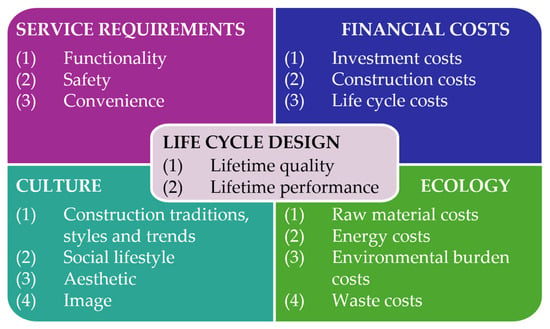
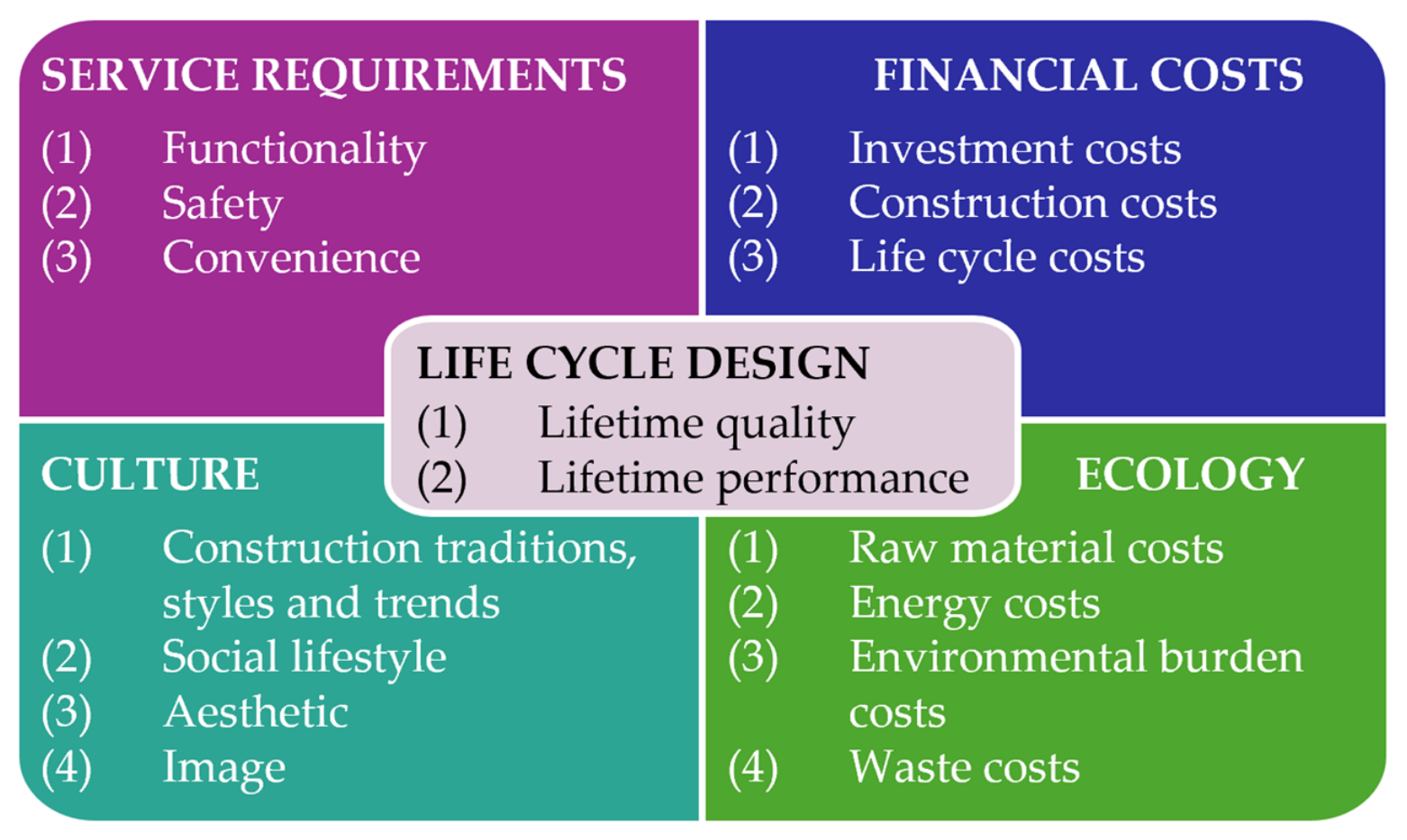
The life cycle approach means encompassing the entire process from the pre-construction, production and construction stages, through the use stage, to the end-of-life stage. These life cycle stages for civil engineering works and the information required for the assessment are now standardized [33,34]. The major challenge when comparing variants remains defining the boundaries of the system for the analysis and deciding on the functional unit that reflects appropriate functional equivalence [35]. Additionally, over the long service life for which a bridge is designed, there might be a substantial effect to consider due to structural deterioration and the resulting maintenance and repair scenarios as well as climate change [30,32]. Major considerations for life cycle design from all three pillars of sustainability as well as service requirements are indicated in Figure 1 [30].
Figure 1.
Bridge life cycle design, adapted from [30].
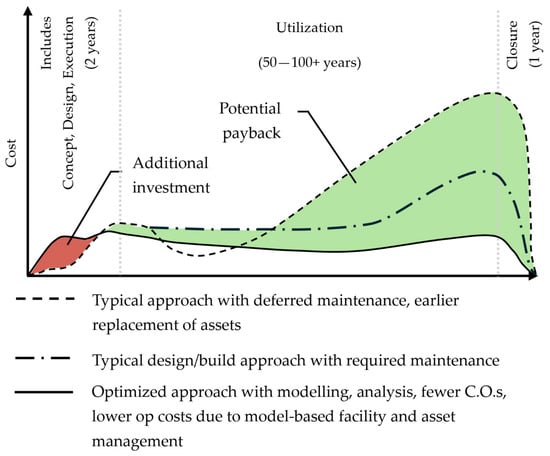
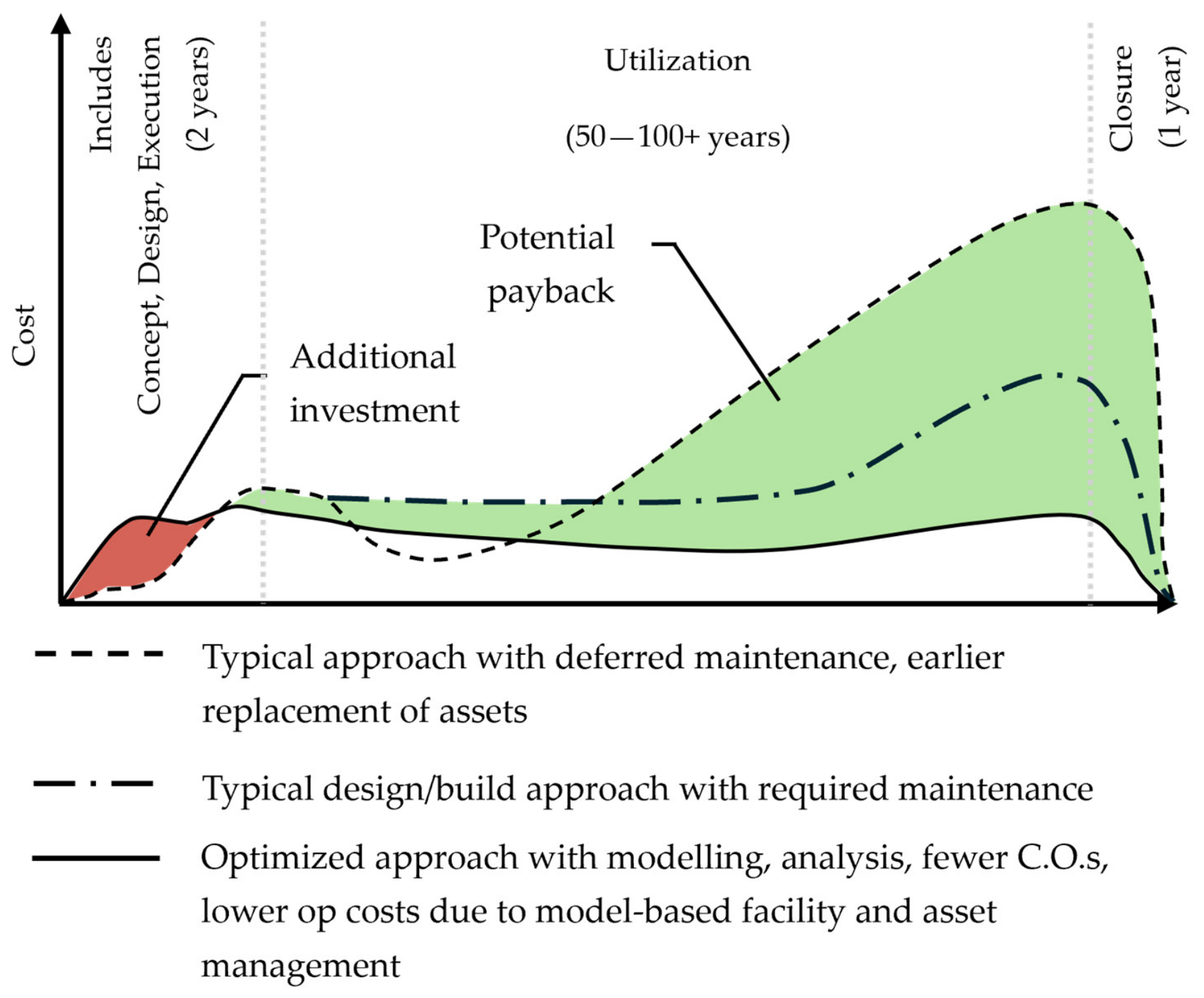
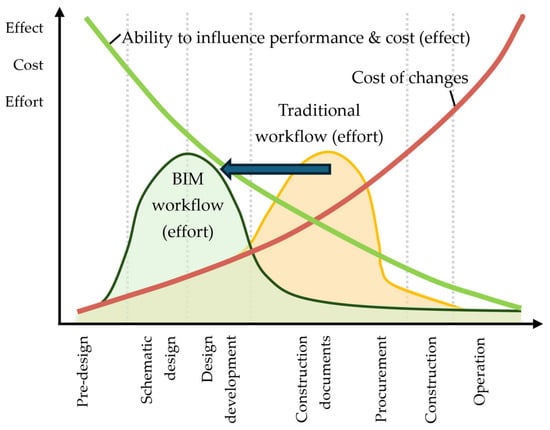
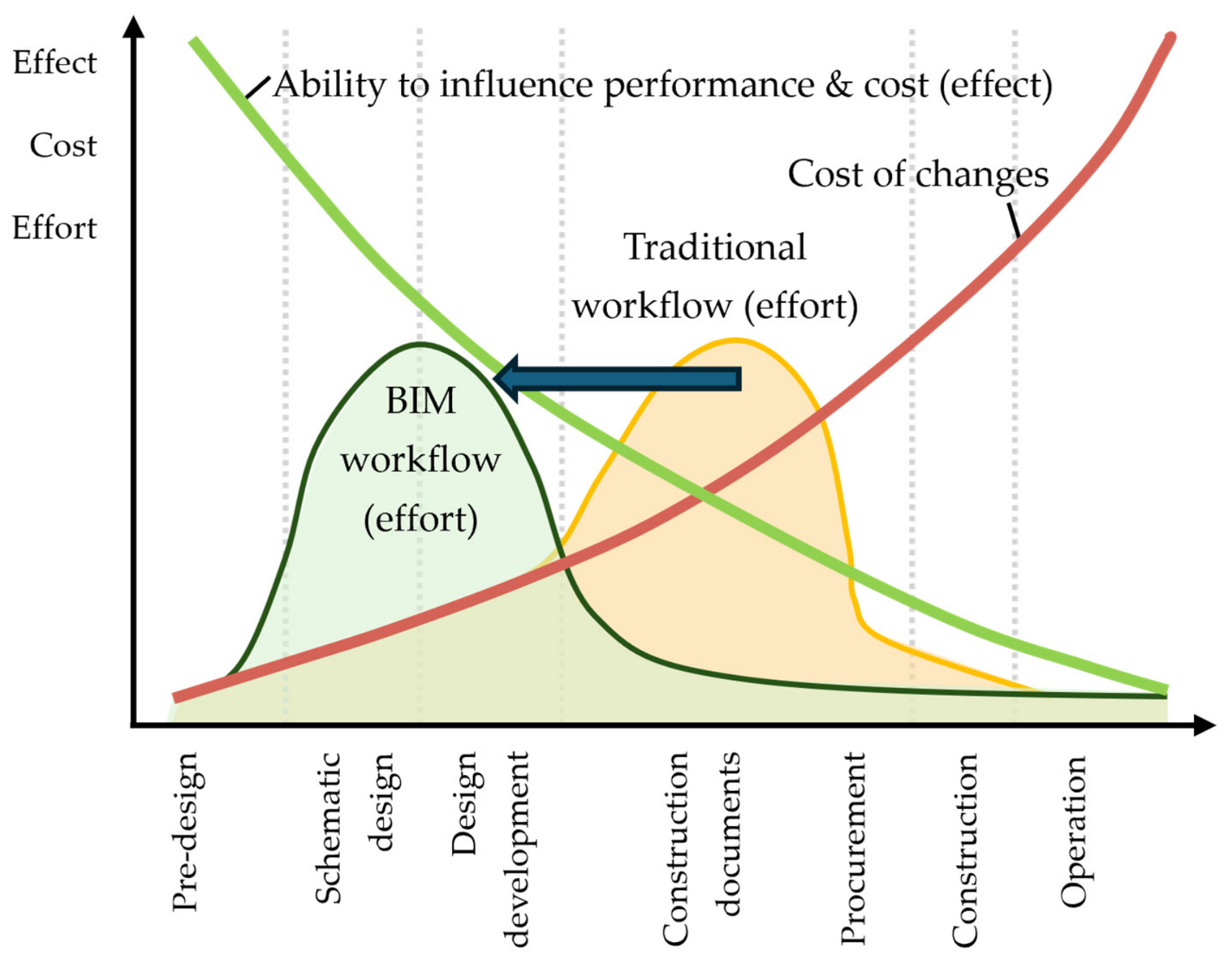
It is generally recognized that to achieve a truly sustainable bridge, appropriate considerations must be given to that criterion from the earliest design stages. This requires additional effort and investment at the beginning of the project, but provides gains over the long lifetime of a bridge, as illustrated in Figure 2 [36] for maintenance costs. This initial additional work will include evaluating the appropriate sustainability indicators, and a substantial amount of data is required for that purpose. These two aspects are precisely where BIM excels and can thus provide an important tool for carrying out bridge sustainability assessments. BIM workflows are pushed forward in the life cycle of a structure (Figure 3) [36,37], and the rich BIM data models enable analysis and simulations, thus enabling better future predictions and reducing risks further down the timeline.
Figure 2.
Chart of Life Cycle Costs, adapted from [36].
Figure 3.
Cost of decisions mapped along the timeline of a typical construction project (the MacLeamy Curve), adapted from [36,37].
4. BIM for Bridge Sustainability Assessment
The key to BIM is information contained in the digital bridge model, which is often referred to as
- Geometric information—a visual representation of shape and size;
- Semantic information—descriptions of the properties of the structure and its components (material, manufacturer, user-related, etc.).
A model rich with information—but always considered in conjunction with the confirmed reliability of data contained in the model—serves to carry out further simulations and analysis. As was briefly discussed in the previous section, assessing bridge sustainability requires various methods. Generally, geometric information providing the volume of bridge structural and non-structural elements and semantic information assigning the material to those quantities is essential, but other information is used, depending on the selected methodology, scope and extent of analysis. Most of the published research deals with LCA only.
According to [38] the sustainability assessment methods can sometimes be qualitative and subjective, which complicates the automation of calculations, but as far as the quantitative methods are concerned, these should in most cases be possible to semi-automate if not automate fully, enabling the implementation of sustainability assessment as a standard practice in day-to-day infrastructure planning. However, there are nuances to be considered when the assessment is used to conclude on or compare life cycle performance. The authors give an example of material-based LCA analysis as typically easy to implement. In that case, the bill of quantities from BIM models is tied to Environmental Product Declarations that provide environmental impact datasets. This can be done in several manners, and the result will be obtained in the impact categories that were included in the analysis. However, the authors point out several potential inaccuracies:
- The effect of different service lives of different bridge elements might not be considered (a shorter lifetime will require repair/replacement of the element over the design service life of the bridge, so the material quantities should be adjusted considering the fact);
- Although the greatest leverage is possible if sustainability assessment is carried out at the earliest stages of design, as discussed in the previous section, the results of the analysis must be interpreted considering that at that time the BIM model is also most probably at a quite low level. Details that might affect the result will probably be missing. It should also be added that those models, even if detailed, will inevitably also be less reliable in terms of quantities of major structural elements;
- The boundaries of the analyzed system might be of extreme importance in some cases, for instance where the material of the product is negligible, but there are other factors—the requirement for auxiliary elements to apply the product on a bridge, as well as an adverse effect on bridge function while applying the product on a bridge.
It is therefore suggested to transfer to element-based assessments instead of material-based ones.
In [39] LCA is, as one of the generally accepted methods for assessing the carbon footprint of a product, material, or activity over its entire lifespan, applied to a bridge case study. The authors indicate that bridge construction materials account for the structure’s primary environmental impact over its entire life cycle, whereas for a residential building, the operational phase represents the largest share. Within the analysis, it was estimated that the cost of bridge infrastructure during operation can be neglected, as there is no significant cost involved at the operation stage. For periodic maintenance, the cost was estimated based on the types of activities. As far as the technique of integrating the sustainability assessment and BIM is concerned, the authors expanded the 3D BIM model into 4D (time—estimated construction schedule; operation and maintenance phase, but shorter life span is assumed), 5D (cost—the raw materials cost and other costs, mainly the cost of the machinery; regular maintenance assumed every 5 years and repair/repainting every 15 years) and eventually 6D (carbon emissions throughout the life cycle). As far as the BIM-LCA integration approach is concerned, the authors summarized earlier research into two directions—the first involves extracting information from the BIM model created to calculate the LCA performance, and the second requires inputting the environmental properties of the materials into the BIM. The first approach is more accurate but more complex, whereas the second approach can only have an effect in the early stages of a building’s life cycle.
A research review of potential integration of BIM and LCA/LCC tools for infrastructure projects [40] highlighted that data formats differ significantly between BIM and LCA, creating a need to map data from the BIM model for transfer to an LCA tool, and listed six methods:
- Exporting the bill of quantities to Excel (Microsoft Corporation, Redmond, WA, USA);
- Exporting the bill of quantities to dedicated LCA tools;
- Using an LCA plug-in with BIM tools;
- Using visual programming languages for environmental impact assessment;
- Using the IFC format to transfer data exported from the BIM model to an LCA tool;
- Incorporating LCA data into the BIM model, usually through materials.
Study [30] also describes one of those directions in investigating the implementation of BIM in LCA analysis, aiming to maximize the automation of the LCA process and minimize manual data collection. The model was exported as an IFC file, and the IFC file analyzer presented it as a text document, with the data subsequently used in Microsoft Excel spreadsheets. The data from Excel were collected, converted, and entered into the appropriate LCA tool spreadsheet, thereby enabling the authors to achieve the study’s objective. It was concluded that the research was successful; specifically, the data collection process was effectively automated using simple BIM tools (Autodesk Revit and Microsoft Excel) [41].
According to [40], the three main methods for integrating LCA and LCC with BIM are as follows:
- Use of existing BIM tools: examples include Autodesk Revit, Autodesk Infraworks, Autodesk Civil 3D CAD (Autodesk, Inc., San Francisco, CA, USA), CSiBridge (Computers and Structures, Inc., Walnut Creek, CA, USA), and Tekla Structures (Trimble Inc., Westminster, CO, USA); these are used to export information—such as material quantities and energy consumption—from the BIM model to Microsoft Excel for further calculations;
- Exporting data from BIM tools to an external tool: exporting data from the BIM model to an external tool to perform calculations on a different platform;
- Incorporating data and information into the BIM environment: direct application within BIM.
The authors highlight that integrating LCA and LCC with BIM enables the generation of rapid, reliable results for LCC and LCA analysis and assessment during the early stages. Interestingly, although the implementation of BIM is useful and helps to automate LCA analyses, in [42] a study was reported where the respondents were divided into five groups:
- Application of LCA with BIM;
- Application of LCA and BIM, but without BIM-integrated LCA;
- Application of LCA without BIM;
- Application of BIM without LCA;
- Without applying BIM or LCA.
According to that research, the fewest respondents belonged to the first two groups, which can be explained by the incompleteness of the data, lack of standards and low external demand.
The integration of and interoperability between BIM and multicriteria decision-making (MCDM) are highlighted in [43], as such methods are usually the basis for the sustainability analysis with conflicting economic, environmental, and social criteria. This study proposed to couple the MCDM method Integrated Value Model for Sustainability Assessment (MIVES) with BIM to assess the sustainability of bridge projects and demonstrated the method on a case-study. Four steps are required to integrate MIVES and BIM to calculate the Sustainability Index (SI):
- Problem analysis—the data describing the bridge project to be modelled using BIM is reviewed together with the problem definition;
- Defining MIVES information—the following information is provided: MIVES decision-making tree (considered requirements, criteria and sustainability indicators) and indicator information;
- Defining the BIM model—the virtual model of the subject bridge project is generated using the BIM methodology;
- Calculation of SI in BIM software (Revit)—SI is calculated using the software with tables of quantities which include the MIVES information entered into the BIM model in step 3 and the values of the studied indicators listed in the BIM database together with the numerical operators from the equations to calculate value function (preference for a certain alternative).
5. Conclusions
BIM is increasingly attaining the status of the essential tool to be applied in bridge projects worldwide, as the appropriate standardization is in place, and the engineering community and contracting authorities are gaining experience. At the same time, it is becoming necessary to carry out bridge sustainability assessments to evaluate compliance with new criteria related to how the structure impacts the environment, economy and community.
This review contains a limited selection of published research related to using BIM to facilitate sustainability assessment of bridges. Most of the studies relate to LCA, but an example of coupling BIM and MCDM is shown as well.
Bridge sustainability assessment requires a large amount of data from various sources. Generally, there is a consensus that BIM enables relevant and interconnected data to be consolidated in one place—specifically, within the BIM model, thereby reducing the likelihood of errors. Still, research clearly demonstrates that results depend on the reliability of the model and the overall assumptions and boundaries of the analysis, which leads to the conclusion that much care must be given by the user in how the entire process is set up and evaluated. While the model reliability issue is subject to the specific project, the latter may be attributed at least in part to the ongoing research into the appropriate overall methodology. The major benefit of using BIM in bridge sustainability assessment is that much of the manual work can be automated, which enables simulations and the analysis of different scenarios, but some research still shows hesitance among potential users regarding its application.
Author Contributions
Conceptualization J.B.; methodology J.B. and V.L.; investigation V.L.; resources J.B. and V.L., writing—original draft preparation J.B. and V.L.; writing—review and editing J.B.; supervision J.B. All authors have read and agreed to the published version of the manuscript.
Funding
This research received no external funding. It was carried out as a part of a bachelor’s final exam at the University of Zagreb, Faculty of Civil Engineering.
Institutional Review Board Statement
Not applicable.
Informed Consent Statement
Not applicable.
Data Availability Statement
No new data created.
Conflicts of Interest
The authors declare no conflicts of interest.
Abbreviations
The following abbreviations are used in this manuscript:
| BIM | Building Information Modelling |
| IFC | Industry Foundation Classes |
| LCA | Life Cycle Assessment |
| LCC | Life Cycle Cost |
| MCDM | Multicriteria-Decision Making |
| MIVES | Integrated Value Model for Sustainability Assessment |
| SI | Sustainability Index |
References
- EU BIM Taskgroup. Handbook for the Introduction of Building Information Modelling by the European Public Sector Strategic Action for Construction Sector Performance: Driving Value, Innovation and Growth. Available online: https://eubim.eu/handbook-selection/ (accessed on 8 May 2026).
- EU BIM Taskgroup. Position Paper of the EU BIM Task Group (November 2025). Available online: https://eubim.eu/wp-content/uploads/2025/12/Position_Paper_of_the_EU-BIM-Task-Group-on-BIM-for-Public-Procurement.pdf (accessed on 8 May 2026).
- Official Journal of the European Union. Regulation (EU) 2024/3110 of the European Parliament and of the Council of 27 November 2024 Laying Down Harmonised Rules for the Marketing of Construction Products and Repealing Regulation (EU) No 305/2011. Available online: https://eur-lex.europa.eu/eli/reg/2024/3110/oj/eng (accessed on 11 August 2026).
- HRN EN 1990-1:2026; Eurocode—Basis of Structural and Geotechnical Design—Part 1: New Structures. Hrvatski zavod za norme/Croatian Standards Institute: Zagreb, Croatia, 2026.
- HRN EN 1990-2:2026; Eurocode—Basis of Structural and Geotechnical Design—Part 2: Assessment of Existing Structures. Hrvatski zavod za norme/Croatian Standards Institute: Zagreb, Croatia, 2026.
- Leventić, V. BIM u Ocjeni Održivosti Mostova/BIM for Bridge Sustainability Assessment. Bachelor’s Thesis, University of Zagreb, Faculty of Civil Engineering, Zagreb, Croatia, 2025. [Google Scholar]
- Aguiar Costa, A.; Ferreira, M.T.; Palma, J. BIM and Twin Transition: Challenges and Opportunities for EU Public Construction Clients, Handbook 2.1 for Implementing Building Information Modelling by the European Public Construction Sector; EU BIM Taskgroup in collaboration with CERIS, Instituto Superior Technico, Universidade de Lisboa; EU BIM Task Group: Brussels, Belgium, 2026; Available online: https://eubim.eu/handbook-selection/handbook/ (accessed on 11 August 2026).
- European Construction Sector Observatory (ECSO). Building Information Modelling in the EU Construction Sector. 2019. Available online: https://ec.europa.eu/docsroom/documents/34518 (accessed on 8 May 2026).
- European Construction Sector Observatory. Digitalisation in the Construction Sector, Analytical Report. April 2021. Available online: https://ec.europa.eu/docsroom/documents/45547/attachments/1/translations/en/renditions/pdf (accessed on 8 May 2026).
- Bleiziffer, J.; Miloš, M. Bridge Modelling and Structural Analysis in BIM. In Advances in Science and Technology; Trans Tech Publications Ltd.: Baech, Switzerland, 2025; Volume 164, pp. 47–55. [Google Scholar] [CrossRef] [Scilit]
- Forcael, E.; Castro, A.; Bedwell, F.; Casanova, E.; Orozco, F.; Moreno, F. Barriers to BIM implementation in bridge construction: A case study. In Proceedings of the 31st Annual Conference of the International Group for Lean Construction (IGLC31), Lille, France, 26 June–2 July 2023; pp. 128–139. [Google Scholar] [CrossRef] [Scilit] [PubMed]
- HRN EN ISO 19650-1:2019; Organization and Digitization of Information About Buildings and Civil Engineering Works, Including Building Information Modelling (BIM)—Information Management Using Building Information Modelling Part 1: Concepts and Principles. Hrvatski zavod za norme/Croatians Standards Institute: Zagreb, Croatia, 2019.
- HRN EN ISO 16739-1:2024; Industry Foundation Classes (IFC) for Data Sharing in the Construction and Facility Management Industries—Part 1: Data Schema. Hrvatski zavod za norme: Zagreb, Croatia, 2024.
- Official Journal of the European Union. Directive 2014/24/EU of the European Parliament and of the Council of 26 February 2014 on Public Procurement and Repealing Directive 2004/18/EC. Available online: https://eur-lex.europa.eu/eli/dir/2014/24/oj/eng (accessed on 8 May 2026).
- Mitera-Kiełbasa, E.; Zima, K. BIM Policy Trends in Europe: Insights from a Multi-Stage Analysis. Appl. Sci. 2024, 14, 4363. [Google Scholar] [CrossRef] [Scilit]
- European Commission. An analysis for the Adoption of Building Information Modelling (BIM) Across the EU27 for Public Sector. 2024. Available online: https://build-up.ec.europa.eu/en/resources-and-tools/publications/analysis-adoption-bim-across-eu (accessed on 11 August 2026).
- Charef, R.; Emmitt, S.; Alaka, H.; Fouchal, F. Building Information Modelling adoption in the European Union: An overview. J. Build. Eng. 2019, 25, 100777. [Google Scholar] [CrossRef] [Scilit]
- Burgess, M.; Wilson, C.; Fan, Y.V. Adoption drivers and barriers of Building Information Modelling (BIM) in Europe. Energy Build. 2026, 355, 116953. [Google Scholar] [CrossRef] [Scilit]
- Government UK Cabinet Office. Government Construction Strategy. 2011. Available online: https://www.gov.uk/government/publications/government-construction-strategy (accessed on 11 August 2026).
- Government UK. Policy Paper Transforming Infrastructure Performance: Roadmap to 2030. 2021. Available online: https://www.gov.uk/government/publications/transforming-infrastructure-performance-roadmap-to-2030/transforming-infrastructure-performance-roadmap-to-2030 (accessed on 11 August 2026).
- HRN EN ISO 19650-2:2019; Organization and Digitization of Information About Buildings and Civil Engineering Works, Including Building Information Modelling (BIM)—Information Management Using Building Information Modelling—Part 2: Delivery Phase of the Assets. Hrvatski zavod za norme/Croatians Standards Institute: Zagreb, Croatia, 2019.
- HRN EN ISO 19650-3:2020; Organization and Digitization of Information About Buildings and Civil Engineering Works, Including Building Information Modelling (BIM)—Information Management Using Building Information Modelling—Part 3: Operational Phase of the Assets. Hrvatski zavod za norme/Croatians Standards Institute: Zagreb, Croatia, 2020.
- HRN EN ISO 19650-4:2022; Organization and Digitization of Information About Buildings and Civil Engineering Works, Including Building Information Modelling (BIM)—Information Management Using Building Information Modelling—Part 4: Information Exchange. Hrvatski zavod za norme/Croatians Standards Institute: Zagreb, Croatia, 2022.
- Ministarstvo Prostornog Uređenja, Graditeljstva i Državne Imovine/Ministry of Physical Planning, Construction and State Assets. Zakon o Gradnji/Building Act. Official Gazette 155/25. (In Croatian). Available online: https://mpgi.gov.hr/pristup-informacijama-16/zakoni-i-ostali-propisi/podrucje-gradnje-3228/3228 (accessed on 8 May 2026).
- Dolaček-Alduk, Z.; Šimenić, Z.; Galić, D.; Pavlović Cerinski, M.; Andabaka, F.; Šolman, H.; Ecimović, A.; Grošić, M.; Džajić, I.; Stober, D.; et al. Guidelines for BIM approach in infrastructure projects. In Proceedings of the 7th International Conference on Road and Rail Infrastructure CETRA2022, Pula, Croatia, 11–13 May 2022; pp. 731–737. [Google Scholar] [CrossRef] [Scilit]
- United Nations. Transforming Our World: The 2030 Agenda for Sustainable Development. A/RES/70/1 Resolution Adopted by the General Assembly on 25 September 2015. Available online: https://docs.un.org/en/A/RES/70/1 (accessed on 8 May 2026).
- Koundouri, P.; Alamanos, A.; Plataniotis, A.; Stavridis, C.; Perifanos, K.; Devves, S. Assessing the sustainability of the European Green Deal and its interlinkages with the SDGs. npj Clim. Action 2024, 3, 23. [Google Scholar] [CrossRef] [Scilit]
- Kretz, D.; Van de Velde, E.; Lecluyse, L.; Moreno, C.; Borbon, Y.; Markianidou, P. Monitoring the Twin Transition of Industrial Ecosystems CONSTRUCTION Analytical Report. Available online: https://monitor-industrial-ecosystems.ec.europa.eu/industrial-ecosystems/construction (accessed on 11 August 2026).
- Transportation Association of Canada. Primer on The Sustainability Considerations for Bridges. 2015. Available online: https://www.tac-atc.ca/en/knowledge-centre/technical-resources-search/publications/prm-scbg-e/ (accessed on 11 August 2026).
- Kogut, A. Building Information Modeling-Based Bridge Sustainability Analysis. Bachelor’s Thesis, Metropolia University of Applied Sciences, Helsinki, Finland, 2019. Available online: https://www.theseus.fi/bitstream/handle/10024/172438/BIM-based%20bridge%20sustainability%20analysis_Anna%20Kogut.pdf?sequence=2 (accessed on 20 June 2025).
- Long, A.E.; Basheer, P.A.M.; Taylor, S.E.; Rankin, B.G.I.; Kirkpatrick, J. Sustainable bridge construction through innovative advances. Proc. Inst. Civ. Eng. Bridge Eng. 2008, 161, 183–188. [Google Scholar] [CrossRef] [Scilit]
- Milić, I.; Bleiziffer, J. Life cycle assessment of the sustainability of bridges: Methodology, literature review and knowledge gaps. Front. Built Environ. 2024, 10, 1410798. [Google Scholar] [CrossRef] [Scilit]
- HRN EN 17472:2022; Sustainability of Construction Works—Sustainability Assessment of Civil Engineering Works—Calculation Methods. Hrvatski zavod za norme/Croatian Standards Institute: Zagreb, Croatia, 2022.
- HRN ISO 21928-2:2023; Sustainability in Buildings and Civil Engineering Works—Sustainability Indicators—Part 2: Framework for the Development of Indicators for Civil Engineering Works. Hrvatski zavod za norme/Croatian Standards Institute: Zagreb, Croatia, 2023.
- Milić, I.; Bleiziffer, J. Life Cycle Sustainability Assessment of Reinforced Concrete Bridges. In Road and Rail Infrastructure VIII, Proceedings of the Conference CETRA 2024; Lakušić, S., Ed.; University of Zagreb Faculty of Civil Engineering: Zagreb, Croatia, 2024; pp. 1221–1227. [Google Scholar] [CrossRef] [Scilit]
- Anderson, R. An Introduction to the IPD Workflow for Vectorworks BIM Users. Nemetschek Vectorworks. Available online: https://download2.nemetschek.net/www_misc/2010/IPD_workflow_for_BIM.pdf (accessed on 15 July 2024).
- Muñoz La Rivera, F.; Vielma, J.; Herrera, R.F.; Carvallo, J. Methodology for Building Information Modeling (BIM) Implementation in Structural Engineering Companies (SECs). Adv. Civ. Eng. 2019, 13, 1–16. [Google Scholar] [CrossRef] [Scilit]
- Müller, M.; Zinke, T.; Ummenhofer, T. Element approach for BIM-based life-cycle modeling of bridges. In Life-Cycle of Structures and Infrastructure Systems; Biondini, F., Frangopol, D.M., Eds.; CRC Press: Boca Raton, FL, USA, 2023; pp. 2337–2344. [Google Scholar] [CrossRef] [Scilit]
- Kaewunruen, S.; Sresakoolchai, J.; Zhou, Z. Sustainability-Based Lifecycle Management for Bridge Infrastructure Using 6D BIM. Sustainability 2020, 12, 2436. [Google Scholar] [CrossRef] [Scilit]
- Jrade, A.; Jalaei, F.; Zhang, J.J.; Eirdmousa, S.J.; Jalaei, F. Potential Integration of Bridge Information Modeling and Life Cycle Assessment/Life Cycle Costing Tools for Infrastructure Projects within Construction 4.0: A Review. Sustainability 2023, 15, 15049. [Google Scholar] [CrossRef] [Scilit]
- Jrade, A.; Abdulla, R. Integrating building information modeling and life cycle assessment tools to design sustainable buildings. In Proceedings of the 29th CIB W78 Conference “Applications of IT in the AEC Industry”, Beirut, Lebanon, 17–19 October 2012; pp. 173–182. [Google Scholar]
- Jäkel, J.I.; Kaus, M.; Klemt-Albert, K. Sustainability assessment of bridge structures in the operation phase based on a digital twin. ce/papers 2023, 6, 667–674. [Google Scholar] [CrossRef] [Scilit]
- Lozano, F.; Jurado, J.C.; Lozano-Galant, J.A.; de la Fuente, A.; Turmo, J. Integration of BIM and Value Model for Sustainability Assessment for application in bridge projects. Autom. Constr. 2023, 152, 104935. [Google Scholar] [CrossRef] [Scilit]
Disclaimer/Publisher’s Note: The statements, opinions and data contained in all publications are solely those of the individual author(s) and contributor(s) and not of MDPI and/or the editor(s). MDPI and/or the editor(s) disclaim responsibility for any injury to people or property resulting from any ideas, methods, instructions or products referred to in the content. |
© 2026 by the authors. Licensee MDPI, Basel, Switzerland. This article is an open access article distributed under the terms and conditions of the Creative Commons Attribution (CC BY) license.