


Abstract
Using surrogates of uranium-silicide dispersion fuel (U3Si2-Al), the chemical behavior of aluminum, silicon, and uranium in alkaline media was investigated. Dissolution of the aluminum matrix in 2.2 M NaOH containing 1.76 M NaNO3 at 70 °C proceeded quantitatively (>99.9%) within 60 min. In the absence of H2O2, uranium dissolution did not exceed 0.01%, whereas under simulated radiolytic conditions (stepwise addition of 0.01 M H2O2), soluble uranyl peroxo-hydroxide complexes formed, as indicated by absorption bands at 340 and 356 nm, resulting in uranium losses of 15–30%. The apparent activation energy was estimated to be 33.8–47 kJ/mol. Thermal hydrolysis and addition of 0.1 M NaI were proposed to suppress uranium dissolution. Carbonation of aluminate liquors removed 99.0–99.7% of Al and more than 99.5% of Si. Alkali regeneration by causticization closed the alkali recycle loop.
1. Introduction
Advanced dispersion fuels for research reactors, particularly U3Si2 in an Al matrix, require efficient reprocessing [1]. The PUREX process applied to silicide fuels suffers from silicon release, which forms gels and colloids that complicate extraction [2]. Alkaline methods offer an alternative: Al selectively dissolves as aluminate, while U remains in the solid residue [3,4]. However, water radiolysis in irradiated fuel produces H2O2, which can oxidize U and form soluble peroxo-hydroxo complexes, increasing U losses [5]. Previous studies on U-Al alloys showed that such losses can be suppressed by adding NaI or by thermal decomposition of peroxides [3], yet systematic kinetic data for U3Si2-Al dispersion fuel (different surface chemistry, stronger radiolytic effects) are lacking. Moreover, treatment of aluminate liquors—including recovery of Al and Si and alkali regeneration—remains insufficiently addressed. This work examines the kinetics of alkaline dissolution of U3Si2-Al SNF components, conditions for quantitative recovery of Al and Si by carbonation, and removal of mobile U species. Based on the results, an integrated alkaline-carbonate flowsheet with high decontamination and reagent recycling is proposed.
2. Experimental Section
Model compositions simulating voloxidized U3Si2 spent nuclear fuel were prepared from granular aluminum, U3O8 obtained by oxidation of UO2.25 at 600 °C, and Na2SiO3·9H2O. Sodium hydroxide, sodium nitrate, sodium nitrite, sodium iodide, and 30 wt.% hydrogen peroxide were used without additional purification. Dissolution experiments were carried out in a thermostatically controlled 500 cm3 reactor at 70 ± 1 °C under atmospheric pressure using solutions containing 2.2 M NaOH and 1.76 M NaNO3. Selected experiments additionally contained 0.6 M NaNO2. Simulated radiolysis was reproduced by stepwise addition of 0.01 M H2O2 every 10 min. Carbonation of aluminate liquors was performed by CO2 sparging at 20–25 °C for 60 min. Regeneration of NaOH from carbonate solutions employed Ca(OH)2 at 85 ± 5 °C. Uranium concentrations were determined spectrophotometrically with Arsenazo III and titrimetrically by the ferrous phosphate-vanadate method. Silicon was analyzed photometrically through formation of molybdosilicic heteropoly acid. Solid phases were characterized by XRD (D2 PHASER, Bruker, Ettlingen, Germany) and SEM-EDS (VEGA3 scanning (raster) electron microscope, Tescan, Brno, Czech Republic).
3. Results and Discussion
To establish the process parameters for alkaline dissolution of the aluminum matrix in U3Si2-Al dispersion fuel, the kinetics of metallic aluminum dissolution in aqueous NaOH, NaOH-NaNO3, and NaOH-NaNO3-NaNO2 solutions were investigated in the presence and absence of U3O8 particles simulating oxidized uranium-silicide fuel. Particular attention was paid to the effect of hydrogen peroxide introduced to simulate water radiolysis products.
3.1. Dissolution of the Aluminum Matrix
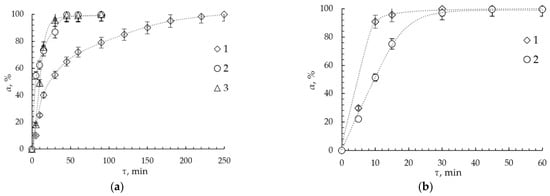
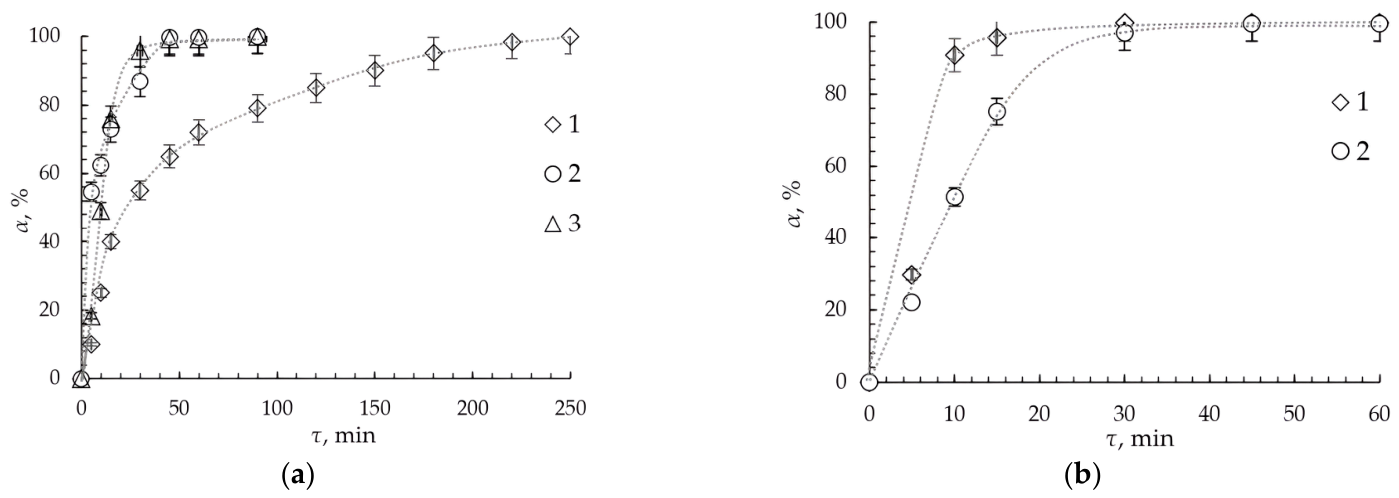
Figure 1a shows the dissolution kinetics of aluminum granules in 2.2 M NaOH at 70 °C under different conditions. In pure alkaline solution, the process was accompanied by vigorous hydrogen evolution and reached completion after approximately 250 min. Addition of 1.76 M NaNO3 markedly accelerated dissolution, and complete conversion of aluminum was achieved within 60 min. This behavior is attributed to oxidative dissolution of aluminum by nitrate ions with concurrent ammonia formation. Further addition of 0.6 M NaNO2 slightly reduced the dissolution rate during the first 15 min, most likely because of competitive adsorption of nitrite ions at active surface sites. As shown in Figure 1b, under otherwise identical conditions, the dissolution rate of aluminum was somewhat higher in the presence of U3O8 particles. This effect may be associated with mechanical interaction between abrasive U3O8 particles and the aluminum surface, leading to local disruption of the passive oxide film and, consequently, enhanced dissolution kinetics. Thus, the matrix dissolution processes are described by the equations:
Al + NaOH + H2O → NaAlO2 + 1.5H2
Al + 0.5NaOH + 0.5NaNO2 + 0.5H2O → NaAlO2 + 0.5NH3
Al + 0.625NaOH + 0.375NaNO3 + 0.25H2O → NaAlO2 + 0.375NH3
Al + NaOH + 1.5NaNO3 → NaAlO2 + 1.5NaNO2 + 0.5H2O
Figure 1.
Dependence of aluminum dissolution degree on time: (a) 1–2.2 M NaOH; 2–2.2 M NaOH + 1.76 M NaNO3; 3–2.2 M NaOH + 1.76 M NaNO3 + 0.6 M NaNO2, t = 70 °C, (b) 1–2.2 M NaOH + 1.76 M NaNO3; 2–2.2 M NaOH + 1.76 M NaNO3 + 0.6 M NaNO2, t = 70 °C in the presence of U3O8.
3.2. Uranium Dissolution During Simulated Radyolysis
In the absence of H2O2, corresponding to conditions relevant to unirradiated fuel processing, the uranium concentration in solution after completion of aluminum dissolution did not exceed 0.001 g/L, which corresponds to less than 0.01% of the initial uranium content. This behavior is consistent with the low solubility of both U(IV), present as hydrated UO2, and U(VI), present as sodium polyuranates, in concentrated alkaline media lacking strong complexing ligands.
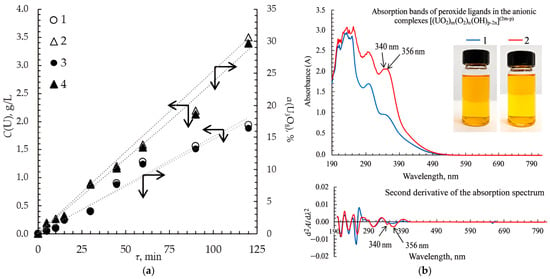
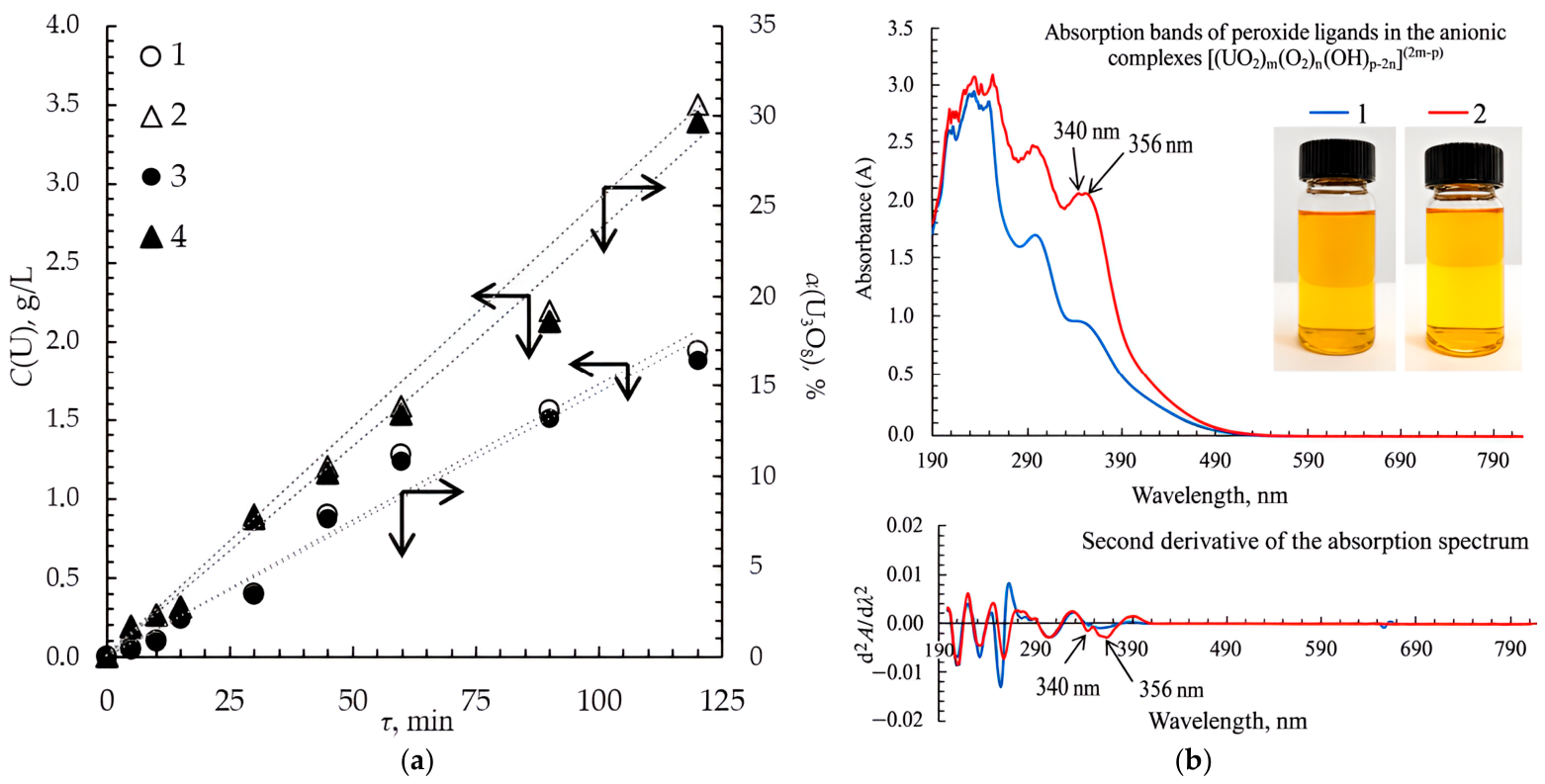
When 0.01 M H2O2 was added periodically every 10 min to simulate radiolytic peroxide formation during treatment of irradiated fuel, pronounced uranium accumulation in the liquid phase was observed. As shown in Figure 2a, the U(VI) concentration reached 2.0–3.5 g/L after 60 min, corresponding to dissolution of 15–30% of the initial uranium inventory. At the same time, the solution color changed from colorless to orange-red, characteristic of uranyl peroxo-hydroxide complexes. The shape of the kinetic curves indicates rapid oxidation of surface layers of U3O8 followed by formation of soluble anionic complexes. Electronic absorption spectra presented in Figure 2b contained bands at 340 and 356 nm assigned to uranyl peroxo-hydroxide complexes. Formation of these species indicates that hydrogen peroxide acts both as an oxidizing agent and as a ligand stabilizing uranium in solution. Mathematical treatment of the experimental data using heterogeneous kinetic models showed that the dissolution process under all studied conditions was adequately described by the Yander equation. Quantitative analysis of the alkaline oxidative dissolution rate of the model particles was therefore performed using equation [1 − (1 − α)1/3]2 = kτ, where α is the conversion degree, k is the apparent rate constant, and τ is agitation time. The calculated apparent activation energy ranged from 33.8 to 47 kJ/mol, indicating that the process proceeds predominantly in the external kinetic regime rather than under diffusion control.
Figure 2.
(a) Uranium extraction into solution as a function of mixing time for Al + U3O8 suspensions in: 1.3–2.2 M NaOH + 1.76 M; 2.4–2.2 M NaOH + 1.76 M NaNO3 + 0.6 M NaNO2, t = 70 °C with periodic addition of 0.01 M H2O2; (b) electronic absorption spectra and second-derivative spectra: 1—solution obtained after dissolution of Al + U3O8 in NaOH-NaNO3-H2O2 (U concentration 2 g/L); 2—the same system with NaNO2 addition (U concentration 3.5 g/L). Bands at 340 and 356 nm correspond to uranyl peroxo-complexes.
3.3. Suppression of Uranium Transfer to Solution
Thermal decomposition of peroxide species was examined by boiling the suspension at 105 °C for 30 min. Under these conditions, more than 99.9% of dissolved uranium precipitated from solution. The resulting solid phase corresponded predominantly to sodium polyuranate. Addition of 0.1 M NaI also reduced uranium transfer into solution. The effect is associated with catalytic decomposition of hydrogen peroxide:
3H2O2 + NaI → NaIO3 + 3H2O
Suppression of peroxide accumulation prevented formation of soluble uranyl peroxide species and lowered uranium losses to trace levels.
3.4. Recovery of Aluminum and Silicon from Aluminate Solutions by Carbonation and Alkali Regeneration
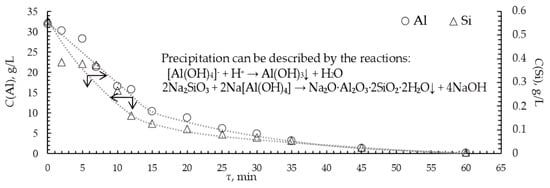
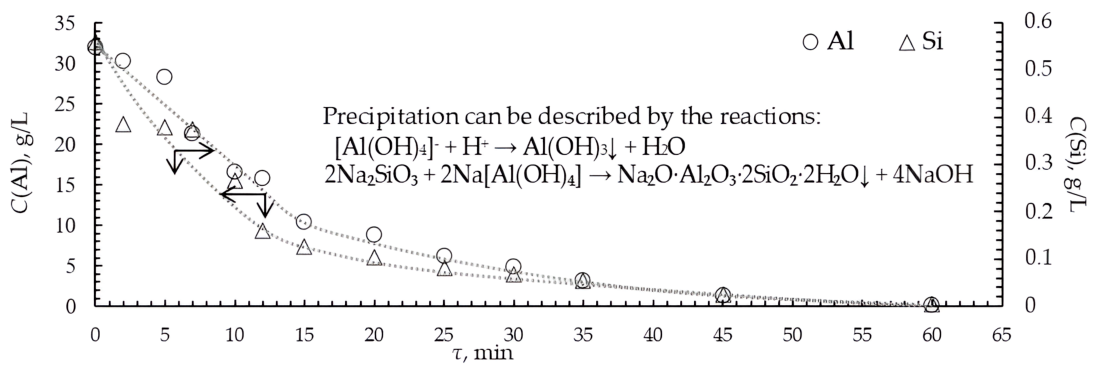
As shown in Figure 3, carbonation of aluminate liquors by CO2 sparging caused precipitation of aluminum hydroxide and hydroaluminosilicate phases. Aluminum removal reached 99.0–99.7%, while silicon removal exceeded 99.5%. The sharp decrease in Al and Si concentrations during the initial stage of carbonation indicates rapid formation of hydrolysis products. SEM-EDS analysis showed that the precipitates consisted mainly of Al(OH)3 with minor sodium and silicon impurities. The elemental composition of the carbonation products is summarized in Table 1. After carbonation and separation of the hydrolytic precipitate, the remaining liquid phase consisted mainly of sodium carbonate and sodium bicarbonate together with sodium nitrate introduced during aluminum dissolution. Since the concentration of free alkali in this solution was low, regeneration of NaOH was carried out by causticization with slaked lime, Ca(OH)2. Under the selected conditions, alkali regeneration was essentially quantitative, and the NaOH concentration reached 2.2 M, corresponding to the initial concentration used for aluminum dissolution. Sodium nitrate remained in solution because it does not participate in the causticization reactions and therefore gradually accumulates in the recycle loop. To prevent excessive buildup, periodic bleed-off or crystallization of NaNO3 is required. Repulping with 1 M Na2CO3 reduced uranium contamination in the solid phase to 0.29 wt.% and returned dissolved uranium to the process liquor.
Figure 3.
Variation in aluminum and silicon concentrations in solution during carbonation (CO2 flow rate 0.2 L/min, 20 °C). Initial solution composition: 32 g/L Al and 0.54 g/L Si.
Table 1.
Elemental composition of washed hydrolytic precipitates after carbonation determined by SEM-EDS analysis.
4. Process Scheme
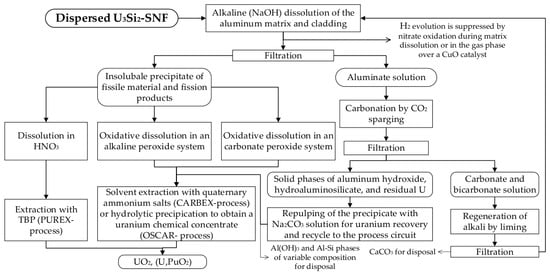
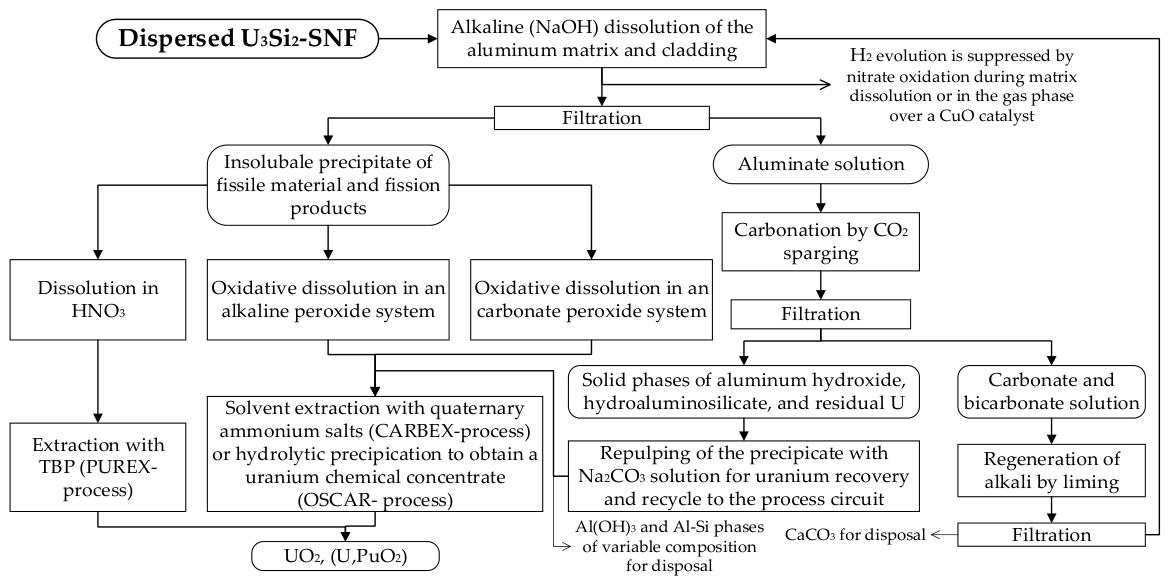
Based on the experimental results, a conceptual process scheme for hydrometallurgical alkaline treatment of spent uranium-silicide dispersion fuel with an aluminum matrix is proposed. The scheme (Figure 4) includes alkaline dissolution of the matrix, separation of the uranium-bearing residue, carbonation of aluminate liquors, causticization for alkali regeneration, and optional downstream purification stages prior to solvent extraction or precipitation-based uranium recovery (PUREX, CARBEX [6], or OSCAR-type [6] processes).
Figure 4.
Flowsheet of the proposed hydrometallurgical alkaline process for treatment of spent U3Si2 dispersion nuclear fuel in an aluminum matrix.
5. Conclusions
Dissolution of the aluminum matrix in alkaline nitrate media at 70 °C proceeded quantitatively within 60 min. In peroxide-free systems, uranium dissolution remained below 0.01%. Simulated radiolysis caused formation of soluble uranyl peroxo-hydroxide complexes and increased uranium losses to 15–30%. Boiling at 105 °C and addition of NaI suppressed uranium transfer into solution through decomposition of peroxide species. Carbonation removed 99.0–99.7% of Al and >99.5% of Si from aluminate liquors, while subsequent causticization regenerated NaOH for recycling. The alkaline-carbonate scheme combines selective dissolution of the aluminum matrix with internal alkali recycling and reduced generation of secondary liquid waste.
Author Contributions
Conceptualization, D.R.S. and A.V.B.; methodology, D.R.S., A.G.K. and S.V.A.; validation, A.V.B.; formal analysis, A.V.B.; investigation, D.R.S., A.G.K. and S.V.A.; resources, L.N.P.; data curation, A.V.B.; writing—original draft preparation, D.R.S.; writing—review and editing, D.R.S. and A.V.B.; supervision, S.I.S.; project administration, L.N.P.; funding acquisition, A.Y.S. All authors have read and agreed to the published version of the manuscript.
Funding
The work was carried out within the framework of the Unified Sectoral Thematic R&D Plan of the Rosatom State Atomic Energy Corporation (project EOTP-TCPM 404).
Institutional Review Board Statement
Not applicable.
Informed Consent Statement
Not applicable.
Data Availability Statement
The raw data supporting the conclusions of this article will be made available by the authors on request.
Conflicts of Interest
The authors declare there are no conflicts of interest.
Abbreviations
| SNF | Spent nuclear fuel |
| PUREX | Plutonium uranium recovery by extraction |
| CARBEX | Carbonate extraction |
| OSCAR | Carbonate precipitation |
| XRD | X-ray diffraction |
| SEM-EDS | Scanning electron microscopy with energy-dispersive X-ray spectroscopy |
References
- Wiencek, T.C.; Domagala, R.F.; Thresh, H.R. Thermal compatibility studies of unirradiated uranium silicide dispersed in aluminum. Nucl. Technol. 1985, 71, 608–616. [Google Scholar] [CrossRef] [Scilit]
- Touron, E.; Cheroux, L. Silicon Behaviour During Reprocessing of Uranium Silicide Fuel by the PUREX Process; CEA Report; European Nuclear Society: Aachen, Germany, 2001. [Google Scholar]
- Wymer, R.G.; Helton, D.M.; Kibbey, A.H.; Land, J.L. Caustic Dissolution: Preliminary Studies; ORNL 1782; Oak Ridge National Laboratory: Oak Ridge, TN, USA, 1954. [Google Scholar]
- Buymov, S.A.; Vasilkov, I.V.; Goncharov, Y.V.; Sergey, S.; Khlytin, A.L. Method for Regeneration of Nuclear Fuel Powders from Fuel Elements and Dispersion Compositions Based on Aluminium and Aluminium Alloys. Russian Patent No. 2562809, 10 September 2015. [Google Scholar]
- Maier, A.C.; Benarosch, A.; El Jamal, G.; Jonsson, M. Radiation induced dissolution of U3Si2–A potential accident tolerant fuel. J. Nucl. Mater. 2019, 517, 263–267. [Google Scholar] [CrossRef] [Scilit]
- Boyarintsev, A.V.; Kostikova, G.V.; Frankiv, S.O.; Stepanov, S.I. Extraction separation and purification of uranium and plutonium in the CARBEX process. Uspekhi Khimii Khimicheskoi Tekhnologii 2022, 36, 38–41. (In Russian) [Google Scholar]

Disclaimer/Publisher’s Note: The statements, opinions and data contained in all publications are solely those of the individual author(s) and contributor(s) and not of MDPI and/or the editor(s). MDPI and/or the editor(s) disclaim responsibility for any injury to people or property resulting from any ideas, methods, instructions or products referred to in the content. |
© 2026 by the authors. Licensee MDPI, Basel, Switzerland. This article is an open access article distributed under the terms and conditions of the Creative Commons Attribution (CC BY) license.