


Abstract
Accurate wind speed forecasting plays an important role in the technical and economic evaluation of wind energy systems. In this study, an artificial neural network (ANN)-based model was applied to predict hourly wind speed for 2024 in the İzmir (Urla–Gülbahçe) region using historical meteorological data obtained from NASA POWER. Two training scenarios were evaluated: Scenario A using only 2023 data and Scenario B using combined 2022–2023 data. The predicted wind speeds were converted into electrical power using a 1 MW wind turbine power curve, and annual energy production was evaluated. The results showed that expanding the training dataset improved forecasting performance. The RMSE decreased from 1.31 m/s in Scenario A to 0.84 m/s in Scenario B, while the coefficient of determination (R2) increased from 0.83 to 0.91. Scenario B estimated a 1872.11 MWh energy production value with a deviation of 4.73 MWh from the actual value.
1. Introduction
Wind energy has become one of the most important renewable energy sources due to its sustainability and decreasing installation costs. However, the stochastic nature of wind creates challenges for reliable energy production estimation and economic planning. Accurate wind speed forecasting is therefore essential for evaluating the performance and financial feasibility of wind energy systems.
Traditional forecasting approaches such as persistence models and linear regression often fail to capture the nonlinear behaviour of atmospheric variables. Artificial neural networks (ANNs) have shown strong capability in modelling nonlinear relationships between meteorological variables and wind speed.
Some previous studies in wind forecasting can be summarized as follows: Hong et al. [1] applied a neural network model to develop hour-ahead wind power and speed estimation using meteorological inputs. Liu et al. [2] trained recurrent neural network (RNN) and long short-term memory (LSTM) models using multi-year hourly wind speed data. The models were designed for short-term and medium-term forecasting, ranging from hours to a few days ahead. Deep learning models showed better performance than classical ANN models. Similarly, Li et al. [3] employed an advanced neural network architecture combining LSTM networks to improve the precision of short-term wind power prediction. Most previous studies mainly focused on short-term forecasting or model accuracy. However, studies combining sequential hourly wind speed forecasting over a full year with annual energy and economic evaluation in Türkiye remain limited. This study integrates annual wind speed forecasting with annual energy, economic and environmental assessment.
In this study, an ANN-based forecasting model, training a feedforward neural network via the Levenberg–Marquardt algorithm, was implemented using historical meteorological data obtained from the NASA POWER database. Various atmospheric features, such as temperature, pressure, and relative humidity, were used to forecast hourly wind speeds for the year 2024 in İzmir (Urla–Gülbahçe), Türkiye. The predicted wind speeds are converted into electrical power using a wind turbine power curve. Annual energy production, revenue, and payback period are calculated to evaluate the economic feasibility of the system.
2. Methodology
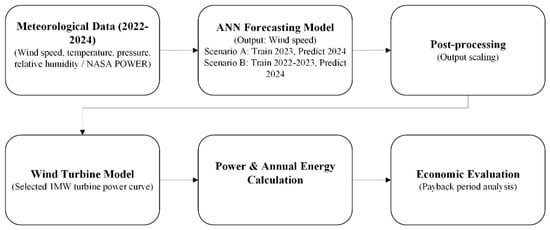
The methodology of this study consists of four main stages: data acquisition from the NASA Power website, wind speed forecasting, power and energy calculation, and economic evaluation. Figure 1 summarizes the methodology used in the study.
Figure 1.
A block diagram of the steps of the study.
Hourly meteorological data, including wind speed at 50 m height, air temperature, relative humidity, and surface pressure, were obtained from the NASA POWER database [4]. Hourly datasets for 2022–2024 were organized and checked for continuity.
A feedforward ANN model was implemented in MATLAB R2025a to forecast wind speed using a 24 h sliding window based on historical meteorological data. The hidden layers used tangent-sigmoid (tansig) transfer functions, while the output layer used a linear (purelin) transfer function. Input and output data were normalized using MATLAB’s mapminmax preprocessing function. Two forecasting scenarios were evaluated: Scenario A was trained using only 2023 data, while Scenario B used combined 2022–2023 data.
Scenario A was implemented with two hidden layers containing 8 and 4 neurons and trained for 1000 epochs. Scenario B used 20 and 10 neurons and was trained for 300 epochs. A 24 h sliding window was used to create sequential hourly input vectors, and the model predicted the next-hour wind speed at each step. The network was trained using the complete training dataset (dividetrain) without an internal validation/test split, and the 2024 dataset was used for out-of-sample evaluation. Different ANN structures were applied because the training datasets had different sizes, and the parameters were selected based on prediction performance for each scenario.
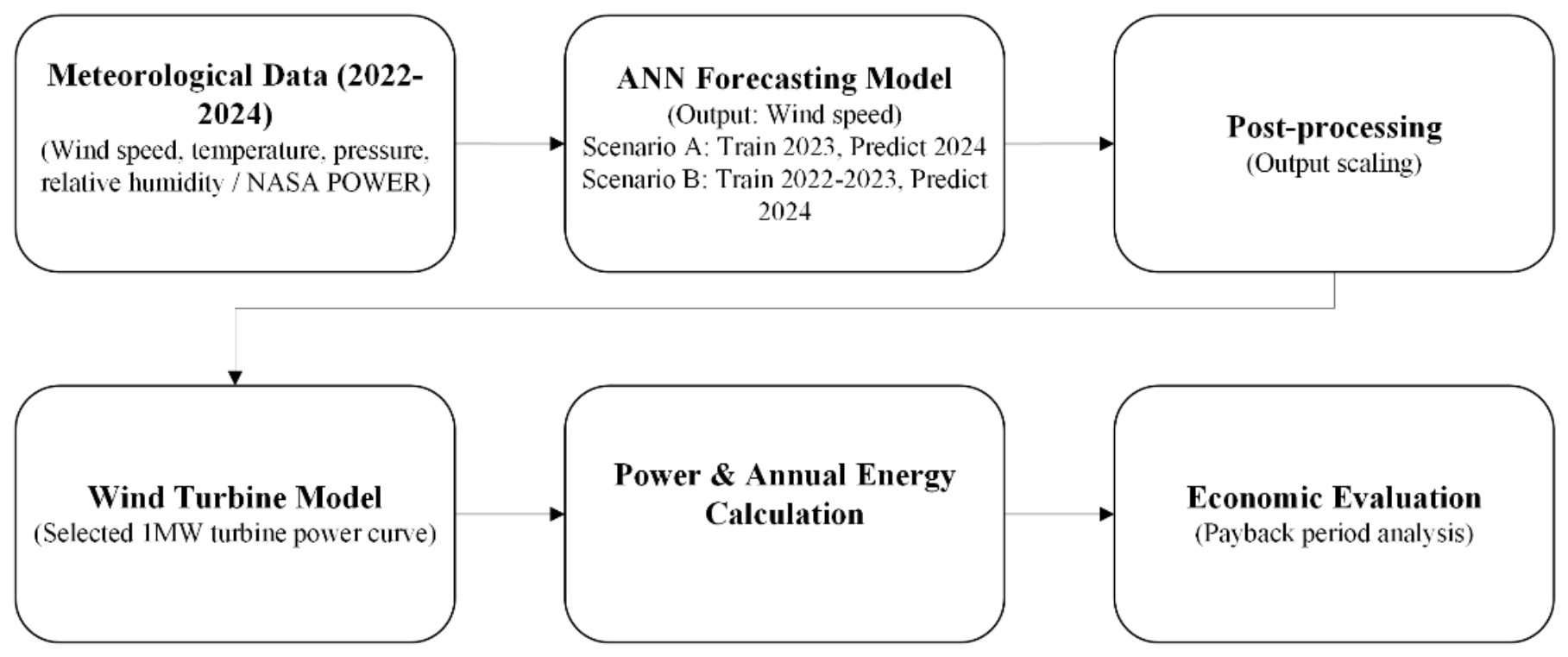
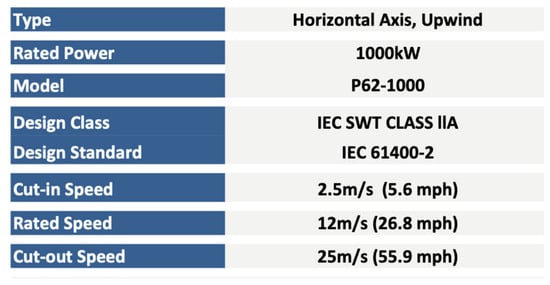
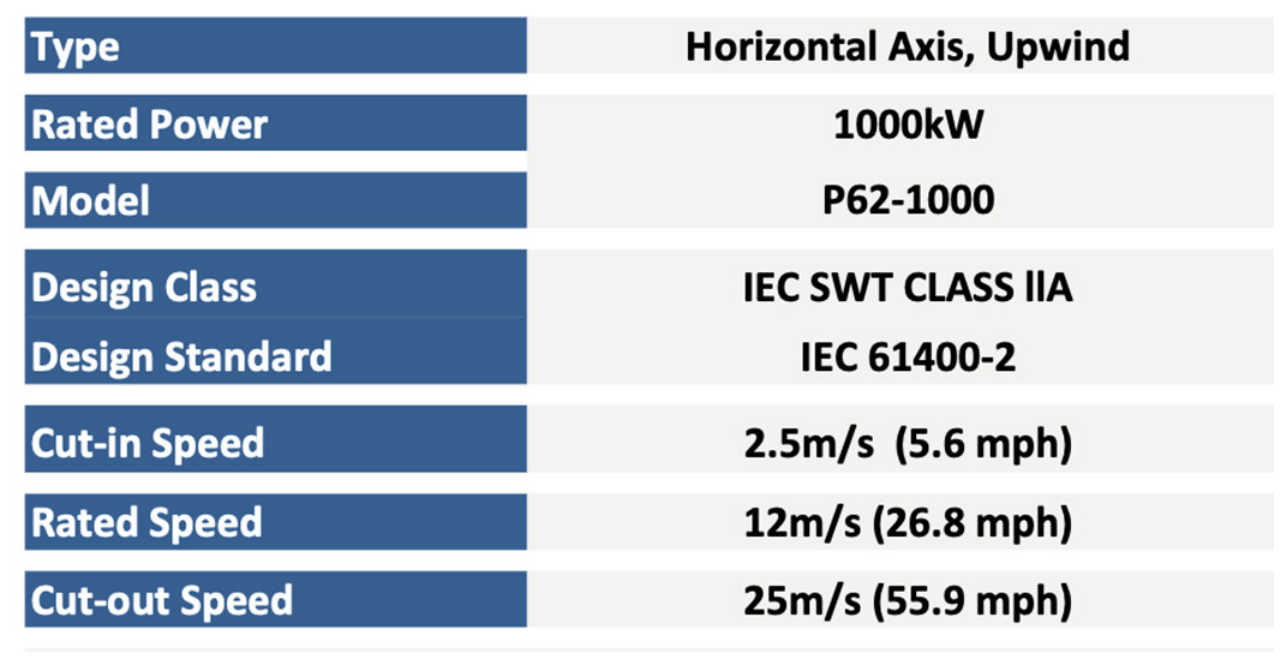
The trained ANN models were used to predict hourly wind speeds for 2024. These predicted wind speeds were then converted into electrical power output using the power curve of a 1 MW Polaris P62-1000 wind turbine, with the characteristics given in Figure 2.
Figure 2.
Polaris model P 62-1000 wind turbine characteristics [5].
3. Energy and Economic Evaluation
The predicted wind speed values were converted into electrical power using the operational limits of the selected wind turbine. Hourly energy production was calculated from the power output of the turbine and aggregated to obtain the annual energy yield. Revenue was estimated by multiplying hourly energy generation with hourly electricity market prices obtained from the Energy Exchange Istanbul (EPİAŞ) [6].
The economic feasibility of the system was evaluated using the payback period method. The capital cost of the wind turbine was taken from IRENA benchmarks for onshore wind installations [7].
4. Results and Discussion
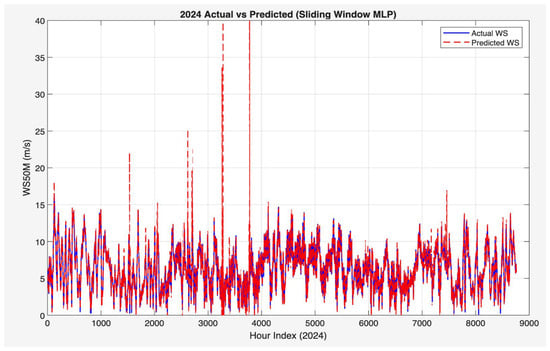
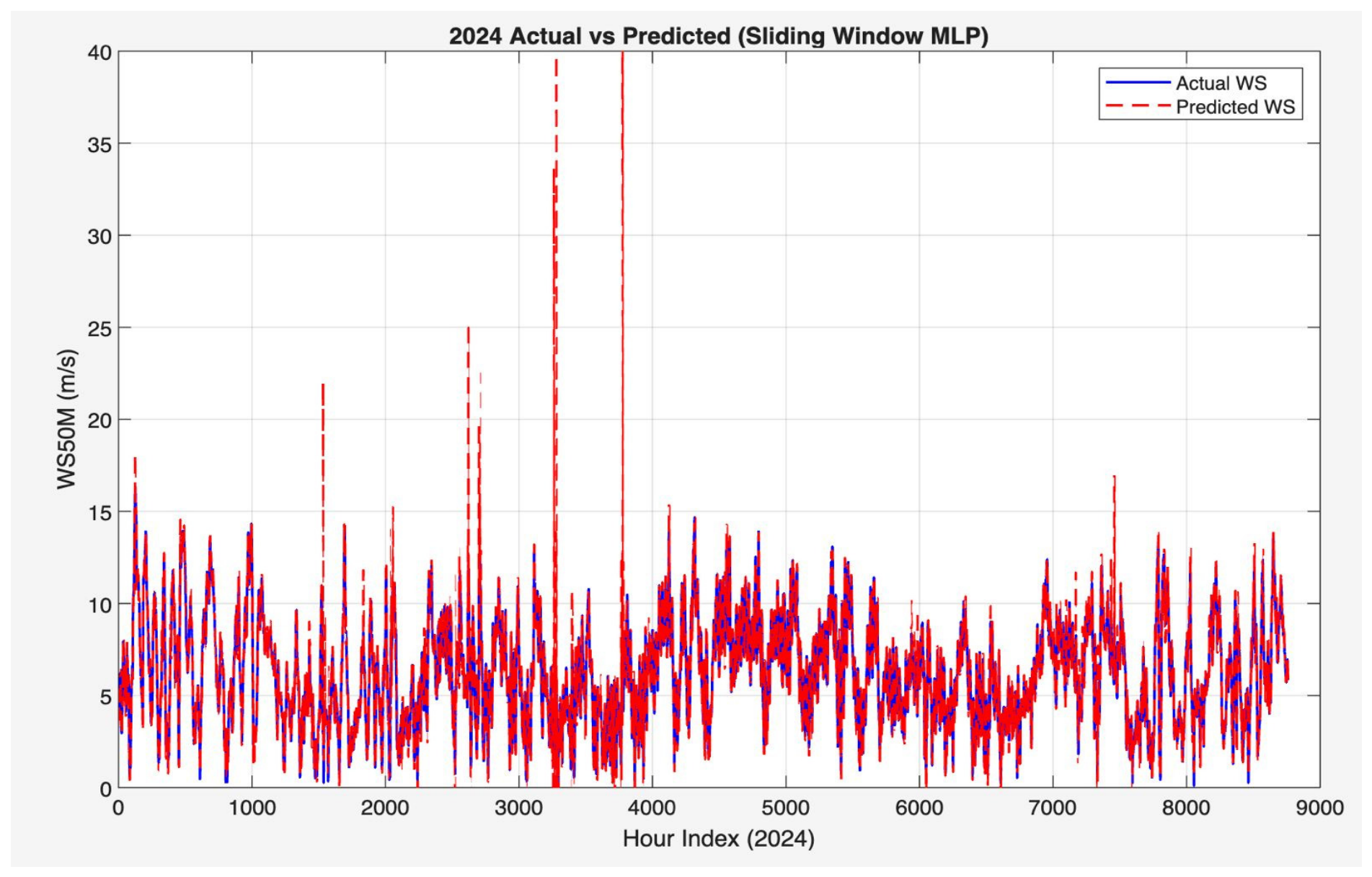
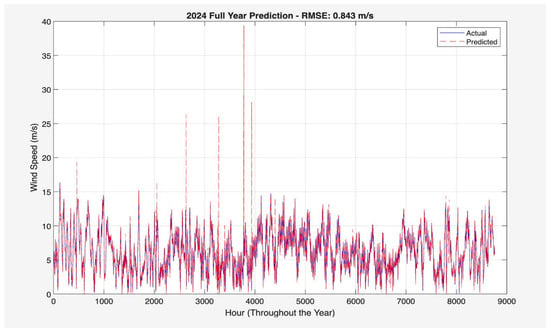
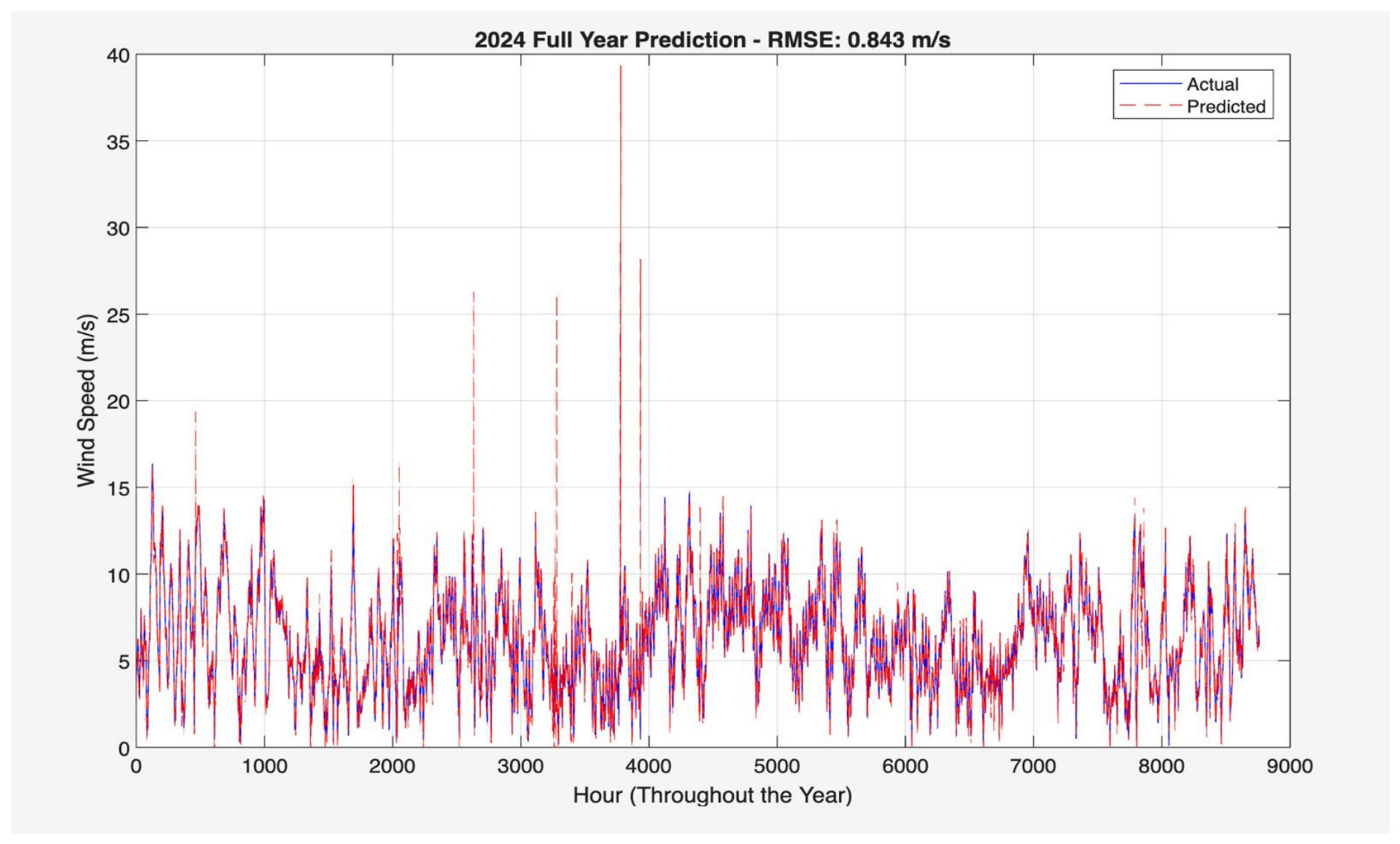
The wind speed prediction values for Scenario A and Scenario B are compared with the measured wind speed values in Figure 3 and Figure 4. It can be seen that for both cases, there is a good agreement between predicted and measured values.
Figure 3.
Actual and predicted wind speed comparison for Scenario A.
Figure 4.
Actual and predicted wind speed comparison for Scenario B.
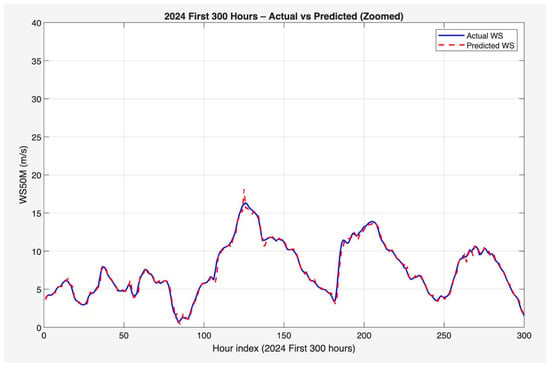
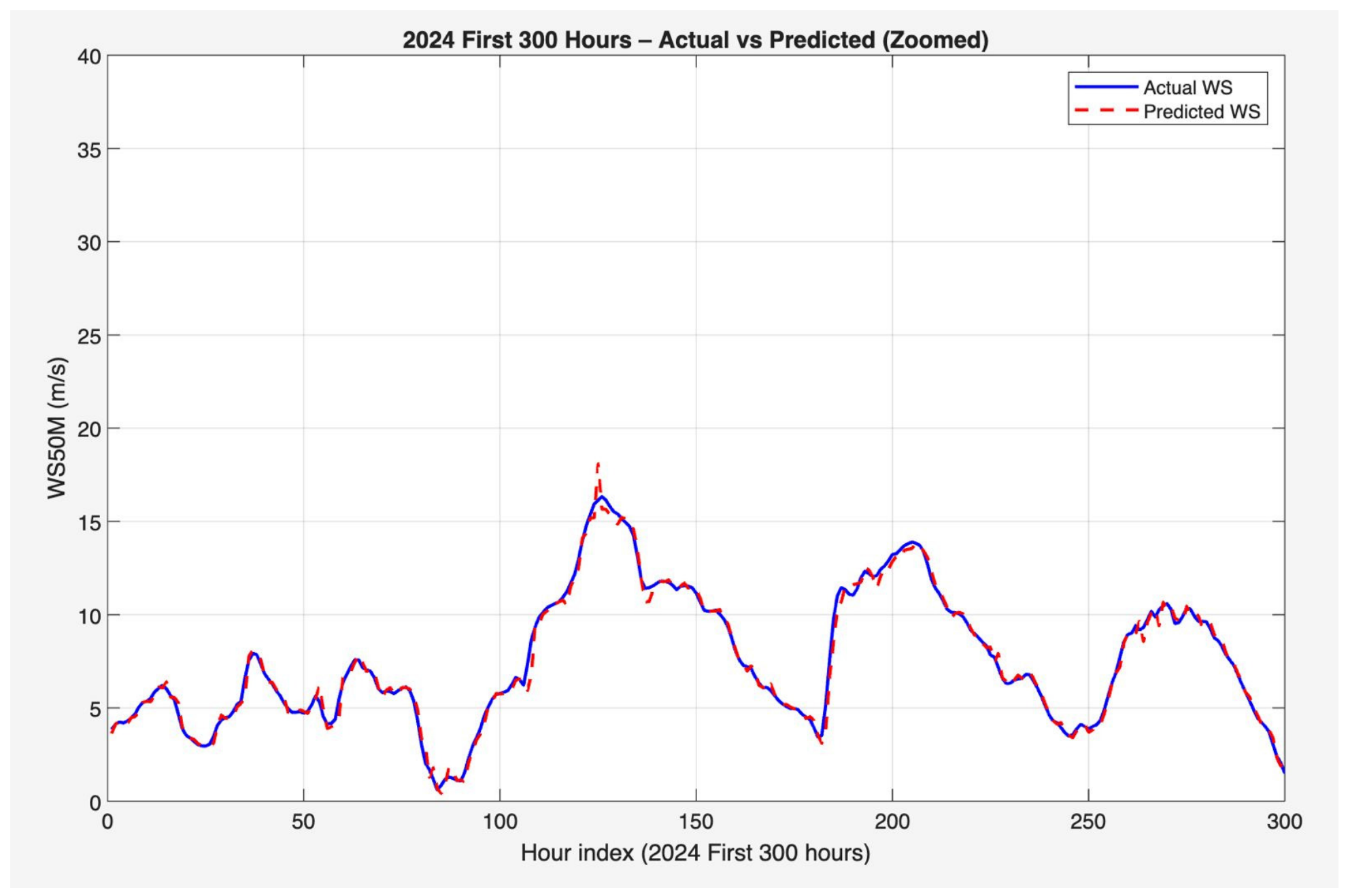
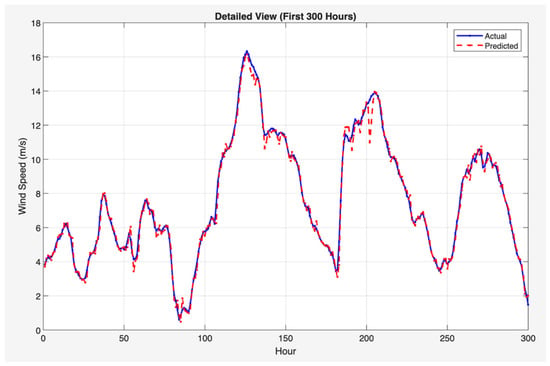
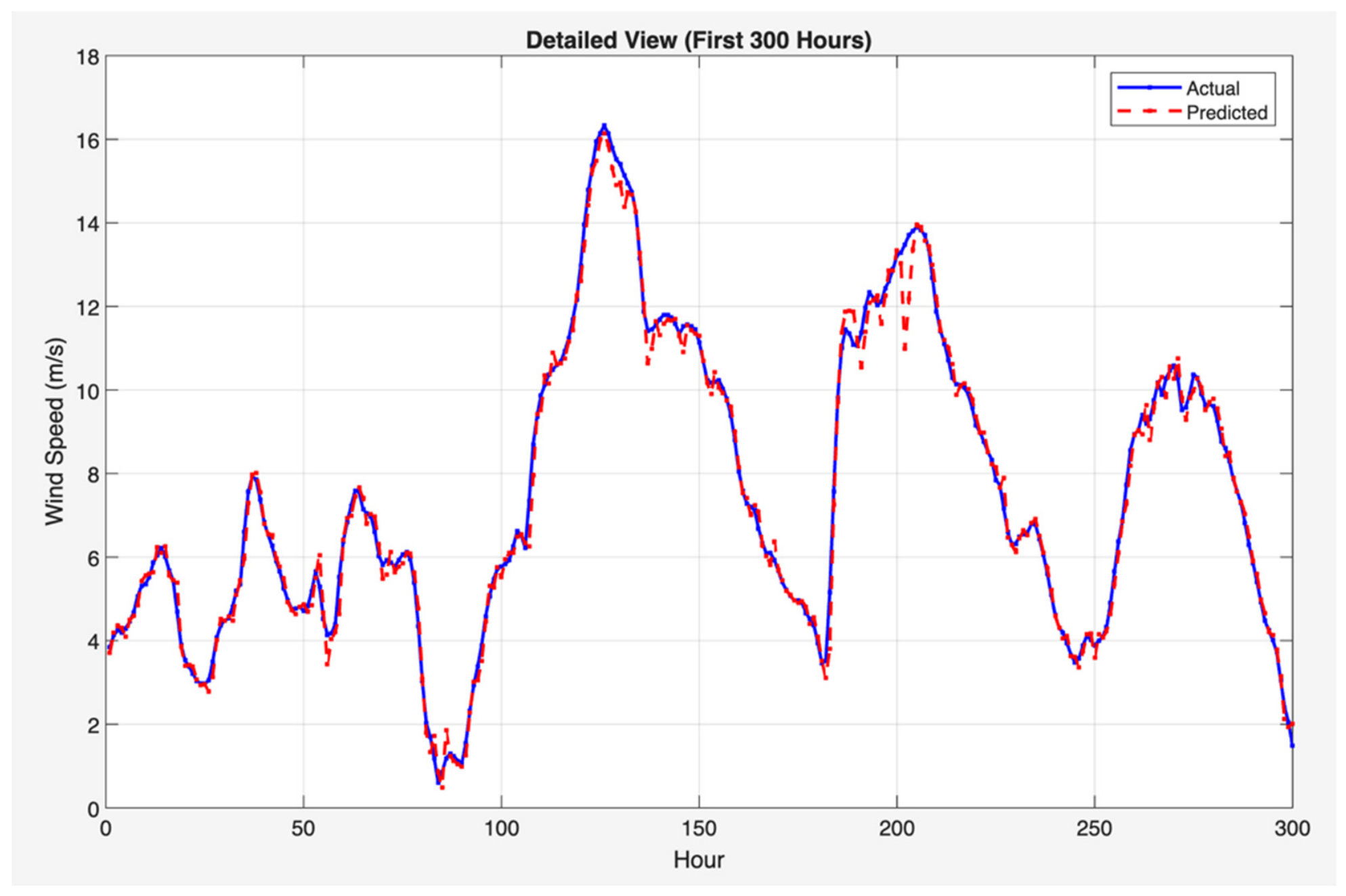
For improved readability and detailed inspection, a zoomed subset of the comparison for the first 300 h is also presented in Figure 5 and Figure 6. The coefficient of determination (R2) values were calculated as 0.83 for Scenario A and 0.91 for Scenario B, while the RMSE values were 1.31 m/s and 0.84 m/s, respectively. These results indicate that both models produced reliable predictions; however, Scenario B showed better agreement with the measured wind speed. The improved performance can be related to the larger training dataset, which allowed the ANN model to represent seasonal and hourly wind variations more effectively.
Figure 5.
Detailed view for Scenario A.
Figure 6.
Detailed view for Scenario B.
The predicted wind speed values were used to estimate annual energy production and economic indicators. The actual annual energy yield of the turbine was calculated as 1867.38 MWh based on measured wind speed data. For Scenario B, the estimated annual energy yield was 1872.11 MWh, with a deviation of 4.73 MWh. In comparison, Scenario A showed a higher deviation of 7.02 MWh, indicating greater energy overestimation. As presented in Table 1, the corresponding payback periods were similar for both scenarios, with 9.094 years for Scenario A and 9.059 years for Scenario B. The avoidedCO2 emissions were calculated as 918.46 tons for Scenario A and 917.33 tons for Scenario B.
Table 1.
Energy, economic and environmental comparison of Scenario A and Scenario B.
5. Conclusions
This study employed an ANN-based wind speed forecasting model to evaluate a wind energy system under two training scenarios. The results showed that increasing the amount of training data improved prediction accuracy and reduced energy estimation errors. Although the base-case payback periods remained similar, improved forecasting performance provided more reliable annual energy and economic results. The study was limited to two ANN training scenarios and fixed wind turbine operating conditions. In addition, forecasting performance may be affected by extreme wind conditions and the limited historical training period. Future studies may further evaluate the applied ANN model by comparing its performance with alternative forecasting methods, such as LSTM and persistence-based models.
Author Contributions
Conceptualization, İ.E.C., B.Ş. and L.B.; methodology, İ.E.C., B.Ş. and L.B.; software, İ.E.C. and B.Ş.; validation, İ.E.C. and B.Ş.; formal analysis, İ.E.C. and B.Ş.; investigation İ.E.C. and B.Ş.; resources, İ.E.C., B.Ş. and L.B.; data curation, İ.E.C. and B.Ş.; writing—original draft preparation, İ.E.C., B.Ş.; writing—review and editing, L.B.; visualization, İ.E.C., B.Ş.; supervision, L.B.; project administration, L.B.; All authors have read and agreed to the published version of the manuscript.
Funding
This research received no external funding.
Institutional Review Board Statement
Not applicable for studies not involving humans or animals.
Informed Consent Statement
Not applicable for studies not involving humans.
Data Availability Statement
The raw data supporting the conclusions of this article will be made available by the authors on request.
Conflicts of Interest
The authors declare no conflicts of interest.
Abbreviations
The following abbreviations are used in this manuscript:
| ANN | Artificial neural network |
| RMSE | Root mean square error |
| RNN | Recurrent neural network |
| LSTM | Long short-term memory |
References
- Hong, Y.Y.; Chang, H.L.; Chiu, C.S. Hour-ahead wind power and speed forecasting using simultaneous perturbation stochastic approximation (SPSA) algorithm and neural network with fuzzy inputs. Energy 2010, 35, 3870–3876. [Google Scholar] [CrossRef] [Scilit]
- Liu, H.; Mi, X.; Li, Y. Smart multi-step deep learning model for wind speed forecasting based on variational mode decomposition, singular spectrum analysis, LSTM network and ELM. Energy Convers. Manag. 2018, 159, 54–64. [Google Scholar] [CrossRef] [Scilit]
- Li, X.; Zhang, Y.; Wang, Z.; Song, Z. Short-Term Wind Power Prediction Based on Optimized VMD and LSTM. Energy Eng. 2025, 122, 4603–4619. [Google Scholar] [CrossRef] [Scilit]
- NASA Power. Available online: https://power.larc.nasa.gov/ (accessed on 1 October 2025).
- Polaris Model P 62-1000 Wind Turbine: Technical Sales Specifications. Available online: https://www.hasmak.com.tr/ruzgar_turbinleri/1mw_ruzgar_turbinleri.pdf (accessed on 27 October 2025).
- EPİAŞ. Electricity Market Data and Prices. Energy Exchange Istanbul. Available online: https://www.epias.com.tr/en/spot-electricity-market/ (accessed on 28 October 2025).
- IRENA. Renewable Power Generation Costs. 2024. Available online: https://www.irena.org/Publications/2025/Jun/Renewable-Power-Generation-Costs-in-2024 (accessed on 28 October 2025).

Disclaimer/Publisher’s Note: The statements, opinions and data contained in all publications are solely those of the individual author(s) and contributor(s) and not of MDPI and/or the editor(s). MDPI and/or the editor(s) disclaim responsibility for any injury to people or property resulting from any ideas, methods, instructions or products referred to in the content. |
© 2026 by the authors. Licensee MDPI, Basel, Switzerland. This article is an open access article distributed under the terms and conditions of the Creative Commons Attribution (CC BY) license.