


Abstract
This article explores an intelligent control system for a dual-loop solar installation with thermosiphon circulation, designed to improve the efficiency of hot water supply and heating. The proposed system integrates a flat-plate solar collector, a heat exchange loop, a heat pump, a storage tank, circulation pumps, and an AI forecasting module. The main idea of the work is to transition from traditional threshold control to adaptive control based on forecasting the temperature of the collector, the heat transfer fluid, the storage tank, the heat load, and energy consumption. To evaluate the effectiveness of the proposed approach, calculation data were generated for solar radiation, ambient temperature, system temperature conditions, pump operation, thermal efficiency, and energy consumption. The results show that AI control enables the required storage tank temperature of 50 °C to be reached more quickly, reduces the average temperature deviation from 4.2 to 2.6 °C, and increases the average system efficiency from 54.3% to 60.1%. Daily energy consumption decreases from 12.0 to 9.93 kW·h, corresponding to a 17.3% savings, while useful heat output increases from 40.2 to 44.5 kW·h/day. In addition, the number of pump switching cycles decreases from 28 to 17, which reduces the load on the equipment and improves operational reliability. The accuracy of the AI model is confirmed by the MAE, RMSE, MAPE, and R2 metrics. The highest accuracy was achieved for predicting the storage tank temperature, where MAE was 0.96 °C, RMSE was 1.27 °C, MAPE was 2.4%, and R2 reached 0.97. The results confirm that the use of artificial intelligence improves energy efficiency, temperature stability, and operational reliability of a dual-loop solar system with thermosiphon circulation.
1. Introduction
Improving the efficiency of hot water and heating systems based on renewable energy sources is a key focus of modern thermal power engineering. Solar thermal systems play a particularly important role among these solutions, as they allow for the use of solar radiation to heat the heat transfer fluid and reduce the consumption of traditional energy resources. However, the operation of such systems depends significantly on changing external conditions: solar radiation intensity, ambient temperature, thermal load, heat transfer fluid circulation mode, and the state of the storage tank. Therefore, traditional control schemes based on fixed temperature thresholds do not always ensure rational operation of the system. In recent years, methods of artificial intelligence, machine learning, and predictive control have been actively developed in the field of solar energy. Work [1] notes that AI approaches can be applied to predict thermal parameters, optimize operating modes, improve the efficiency of solar water heating systems, and diagnose their condition. Experimental studies of adaptive control of solar hot water systems [2] also show that intelligent control allows for a more flexible response to changes in weather conditions and consumer heat demand. Combined solar systems operating in conjunction with heat pumps are of significant interest. Such systems allow for the use of not only direct solar radiation but also low-grade ambient heat. A study [3] examines methods for predicting the performance of solar-assisted heat pumps using various artificial intelligence models. This is particularly important for dual-loop systems, where it is necessary to coordinate the control of the solar collector, heat exchanger, heat pump, compressor, circulation pumps, and storage tank. A separate area of research involves predicting the thermal efficiency of solar collectors using machine learning. The works [4,5,6] demonstrate that ANFIS, SVM, ANN models, and other data-driven methods can be applied to evaluate the thermal performance of solar water heaters, vacuum tube collectors, and systems with complex heat exchange structures. Studies [7,8,9] also confirm the effectiveness of neural network and physics-based models for predicting the temperature, thermal power, and overall efficiency of solar collectors. Current research also focuses on hybrid and advanced solar systems. Studies [10,11,12] examine collectors with phase-change materials, nanofluids, and PV/T systems. These studies show that intelligent methods allow for the consideration of a large number of interrelated factors: solar radiation, heat transfer fluid temperature, flow rate, thermal power, collector design parameters, and system operating mode. This is particularly relevant for installations with nonlinear thermal processes and variable operating conditions. Alongside machine learning, model predictive control methods are finding increasingly widespread application. The works [13,14,15] examine stochastic, nonlinear, and learning-based predictive controllers for solar thermal collector fields. The advantage of such methods is that the control action is determined not only based on the current state of the system but also by taking into account the predicted changes in solar radiation, ambient temperature, and thermal load. This makes predictive control a promising tool for improving the stability and energy efficiency of solar thermal systems. For combined heating systems incorporating solar sources and heat pumps, intelligent control also demonstrates significant potential. In [16], a strategy for optimal control of a system combining a solar source and an air-source heat pump is proposed. Study [17] examines daily regulation of solar heating systems based on model predictive control. The results confirm that predictive algorithms can reduce energy consumption, stabilize temperature, and improve the coordination of individual components within the heating system. Intelligent control of hot water supply systems and heat pumps is also actively developing in the residential sector. In [18], a data-driven approach to heat pump control is proposed using machine learning and anomaly detection. Studies [19,20] show that model predictive control can be effectively used to control heat pump water heaters and electric water heaters integrated with photovoltaic systems. This confirms the practical significance of AI and MPC approaches for improving the efficiency of hot water supply systems. Applying the second law of thermodynamics (the exergetic approach) allows for the consideration of various types of losses in the collector and provides a more accurate assessment of the solar HWS system as a whole [21]. This study [22] theoretically and numerically investigates heat losses in a flat-plate solar collector for solar water heating under Kazakhstan’s climatic conditions. A mathematical model based on ordinary differential equations was used to evaluate the influence of heat-loss coefficient, Nusselt, Rayleigh, and Prandtl numbers on collector efficiency. Simulation results showed that the water temperature can reach about 70 °C during the daytime. For the Almaty region, efficient system operation can be maintained from April to October, demonstrating the potential of solar water heating to reduce building energy consumption.
This work examines a dual-loop solar system with thermosiphon circulation, comprising a flat-plate solar collector, a heat pump, a heat exchanger, a storage tank, and automatic circulation pumps. This design allows solar energy to be used to heat the heat transfer fluid, while also utilizing a heat pump to raise the temperature in the hot water and heating systems. The presence of two loops and thermosiphon circulation enhances the system’s functionality but at the same time complicates the task of selecting the optimal control mode. Despite a large number of studies devoted to AI modeling of solar collectors, heat pumps, and hot water supply systems, the task of intelligent control of a dual-loop solar system with thermosiphon circulation remains insufficiently studied. Such a system requires not only predicting the temperature of the collector, the heat transfer fluid, and the storage tank, but also determining the optimal operating mode for the pumps, heat pump, and compressor, taking into account changing climatic and operating conditions.
In this regard, the objective of this work is to develop an intelligent AI control system for a dual-loop solar system with thermosiphon circulation to improve the efficiency of hot water supply and heating. The proposed approach is based on the use of sensor data, a predictive AI model, and adaptive control of actuators. Unlike traditional threshold control, the system under development is focused on predicting the future thermal state of the system and selecting a more energy-efficient operating mode.
2. Materials and Methods
The subject of this study is a dual-loop solar system with thermosiphon circulation. Structurally, it consists of a flat-plate solar collector, a tubular heat exchange loop, a heat pump, a condenser, an evaporator, a compressor, a storage tank, and automatic circulation pumps. The source material indicates that the flat-plate collector contains transparent double glazing with reduced pressure, a wooden frame, a foil-backed thermal insulation film, and a flexible, thin-walled, corrugated stainless steel tube arranged in a coil configuration.
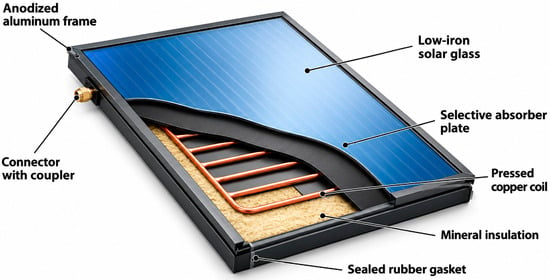
Figure 1 illustrates the design of a flat-plate solar collector used to convert solar energy into thermal energy. The main components are the solar glass, a selective heating absorber, a copper coil, mineral insulation, and sealing elements. Solar radiation passes through the glass and is absorbed by the absorber, after which heat is transferred to the heat transfer fluid circulating through the copper loop. The presence of thermal insulation and a sealed housing reduces heat loss and increases the collector’s efficiency.
Figure 1.
Design of a flat-plate solar collector used to convert solar energy into thermal energy.
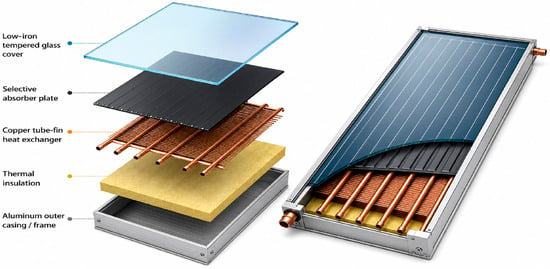
Figure 2 depicts the design of a flat-plate solar collector in both disassembled and assembled states. The main components of the collector are transparent, low-iron tempered glass, a selective absorber plate, a copper tube-fin heat exchanger, a layer of thermal insulation, and an aluminum frame. This configuration ensures efficient absorption of solar radiation, heat transfer to the heat transfer fluid, and reduced heat loss to the environment. The transparent glass cover serves a protective and optical function: it transmits short-wave solar radiation to the absorber while simultaneously reducing convective heat loss. The selective absorber plate converts solar energy into heat, and the copper heat exchanger transfers the generated heat to the circulating heat transfer fluid. The use of copper increases the system’s thermal conductivity and contributes to a more even distribution of heat flow across the collector’s surface. The bottom layer of thermal insulation limits heat loss through the back of the collector, which is particularly important at low ambient temperatures and under wind loads. The aluminum frame provides mechanical strength, airtightness, and protection of internal components from external influences. When assembled, the collector forms a compact thermotechnical module suitable for integration into a solar hot water supply system with a heat pump (Midea Group Co., Ltd., Foshan, China) and intelligent control.
Figure 2.
Design of a flat-plate solar collector in a disassembled and assembled state.
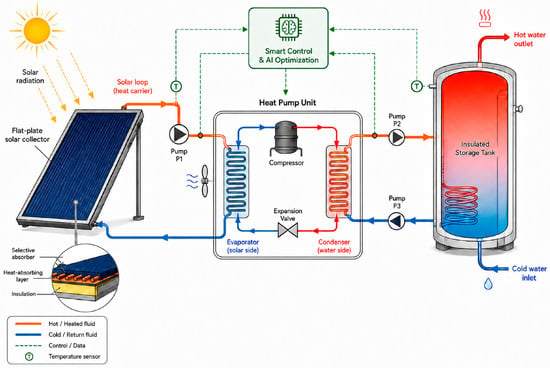
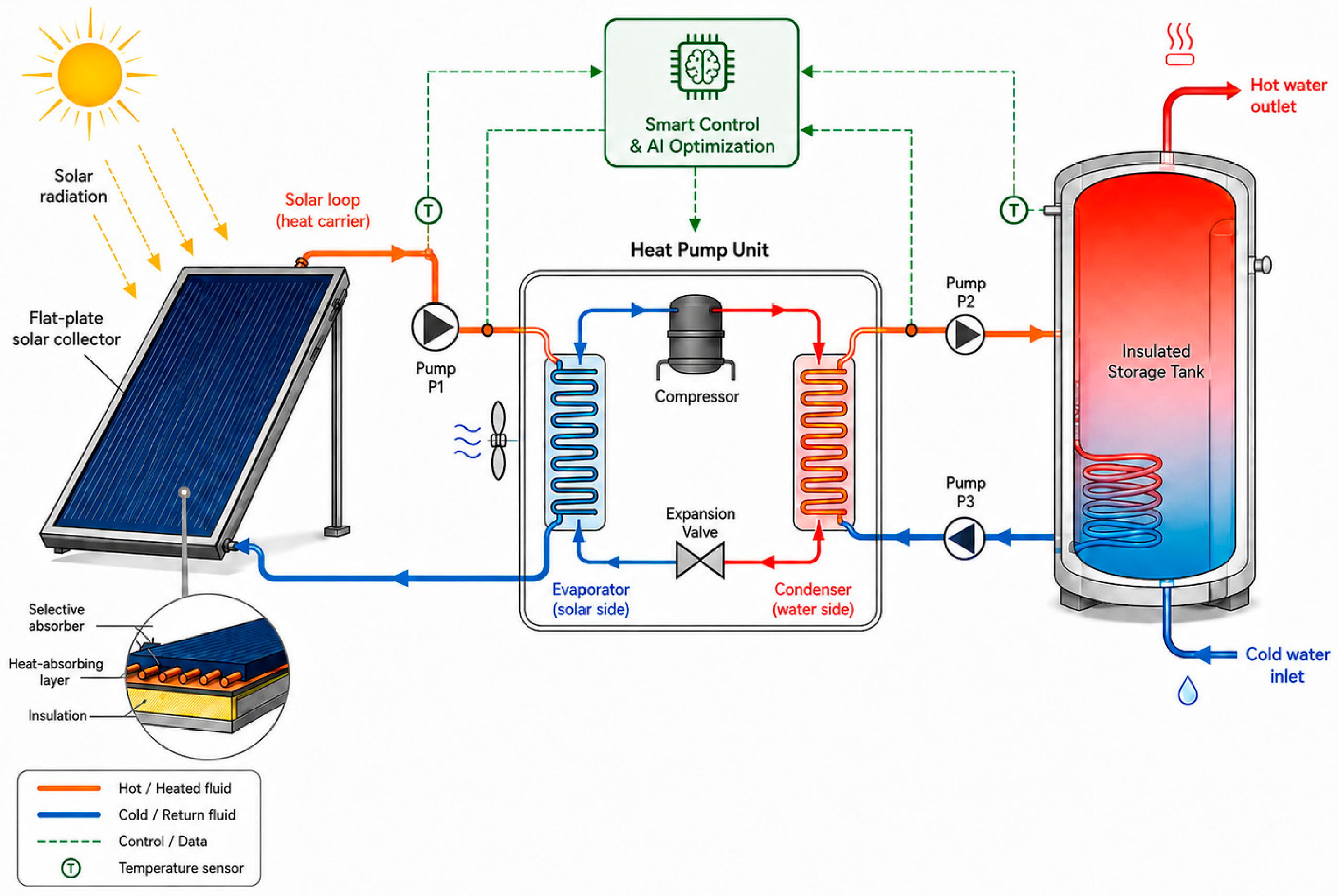
Figure 3 shows a schematic diagram of a dual-loop solar hot water supply system and its intelligent control unit. The solar collector absorbs solar radiation and transfers the resulting thermal energy to the heat transfer fluid, which circulates through the primary loop. The heated heat transfer fluid then flows into the heat exchanger of the heat pump, where the system’s temperature potential is further increased.
Figure 3.
Schematic diagram of a dual-loop solar hot water supply system.
The heat pump serves as a backup heat source and activates when the solar collector does not provide enough energy to maintain the desired hot water temperature. The main components of the refrigeration cycle are shown inside the heat pump: the evaporator, compressor, condenser, and expansion valve. Through the condenser, thermal energy is transferred to the water loop connected to the storage tank. The storage tank ensures the accumulation of thermal energy and the stabilization of the hot water temperature. Cold water enters the lower part of the tank, where the cooler zone is located, while hot water is drawn from the upper part, where a zone of higher temperature is formed. This temperature stratification increases the efficiency of heat storage and allows for more stable maintenance of the required water supply conditions. The Smart Control & AI Optimization unit receives data from temperature sensors and controls the operation of the pumps, heat pump, and circulation loops. Based on current system parameters and external conditions, the AI module can predict temperature changes, select the optimal circulation mode, and reduce excess energy consumption. Thus, the proposed system represents an energy-efficient solution in which solar energy serves as the primary heat source, while the heat pump and intelligent control ensure reliability, stability, and adaptability to changing weather conditions.
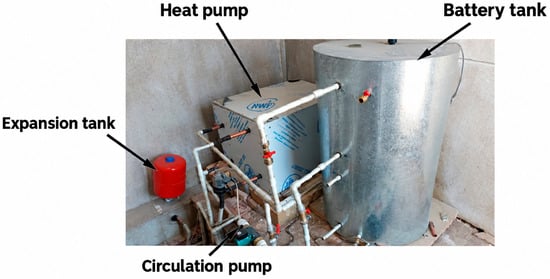
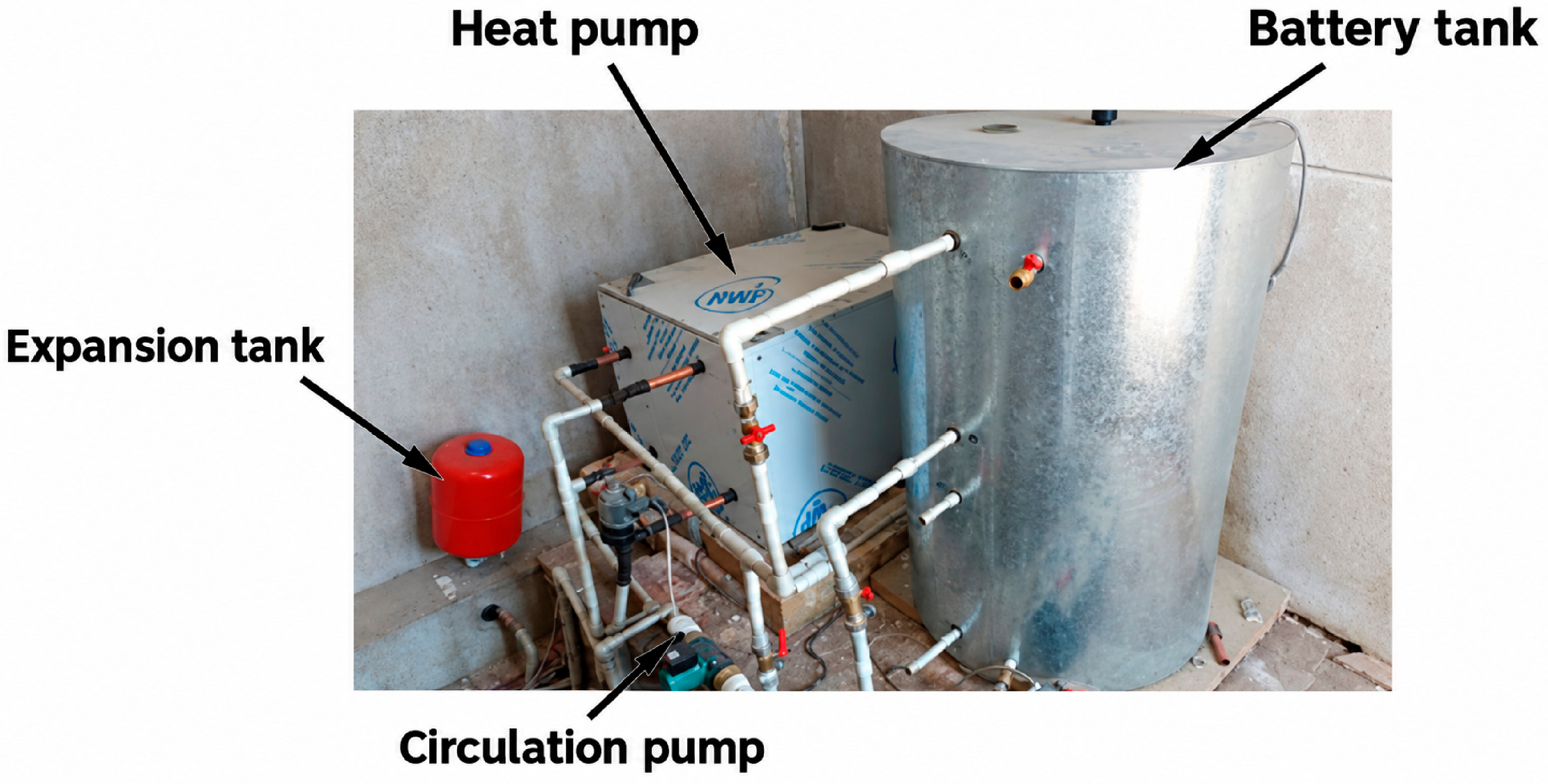
Figure 4 shows an experimental test stand for a solar thermal system with heat transfer fluid storage and circulation. The main components of the system are a heat pump, a storage tank, an expansion tank, and a circulation pump, which together provide heating, transport, and storage of thermal energy. The heat pump is used to increase the heat transfer fluid’s temperature potential and maintain the required hot water supply, especially when solar radiation is insufficient. The storage tank acts as a thermal accumulator, in which heated water is stored for later use. The expansion tank compensates for changes in the heat transfer fluid’s volume during heating and prevents excess pressure in the system, thereby enhancing the safety of the installation. The circulation pump ensures forced circulation of the heat transfer fluid between the elements of the loop, maintaining stable heat exchange and uniform distribution of thermal energy. This experimental installation allows for the investigation of temperature regimes, heat transfer efficiency, the operation of the pump loop, and the system’s stability under changing external conditions. It can also be used to verify mathematical models, assess energy efficiency, and develop algorithms for automatic or intelligent control of a solar hot water supply system.
Figure 4.
Experimental stand of a solar thermal system with heat transfer fluid storage and circulation.
To build an AI model, the following input parameters are recommended:
Table 1 lists the key input parameters required for the operation of an intelligent control system for a dual-loop solar system with thermosiphon circulation. It includes climatic indicators, temperature parameters for the collector, the heat transfer fluid, and the storage tank, as well as the operating states of the pump and the heat pump. This data is used by the AI module to predict the thermal state of the system and select the optimal circulation mode. This parameter structure allows for a transition from simple threshold control to adaptive intelligent regulation of the solar system’s operation.
Table 1.
Input Parameters for the Intelligent Control System of a Solar Thermal Installation.
The general scheme of intelligent control can be described as follows:
where —vector of system input parameters, —predicted status of the installation, and —intelligent prediction model.
3. AI-Based System Control Model
The AI module in this system provides intelligent control of thermal processes. It analyzes the current parameters of the solar collector, the temperature of the heat transfer fluid, the status of the storage tank, and external weather conditions, and then predicts future temperature changes in the system. Based on this forecast, the module selects the optimal operating mode for the circulation pumps, which improves heat exchange efficiency and reduces unnecessary energy consumption.
If there is not enough solar energy to maintain the desired hot water temperature, the AI module decides to activate the heat pump. This approach ensures more stable system operation, reduces temperature fluctuations in the tank, and improves the reliability of the hot water supply under changing weather conditions.
The control function can be set as follows:
In the traditional system, the values of and are fixed. In an intelligent system, these thresholds can be adjusted:
This allows the system to take into account not only the current temperature difference, but also expected changes in solar radiation, heat load, and ambient temperature.
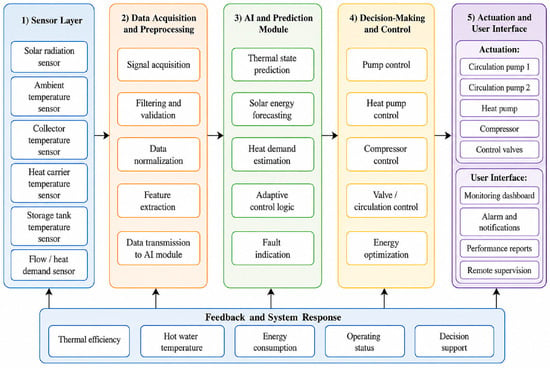
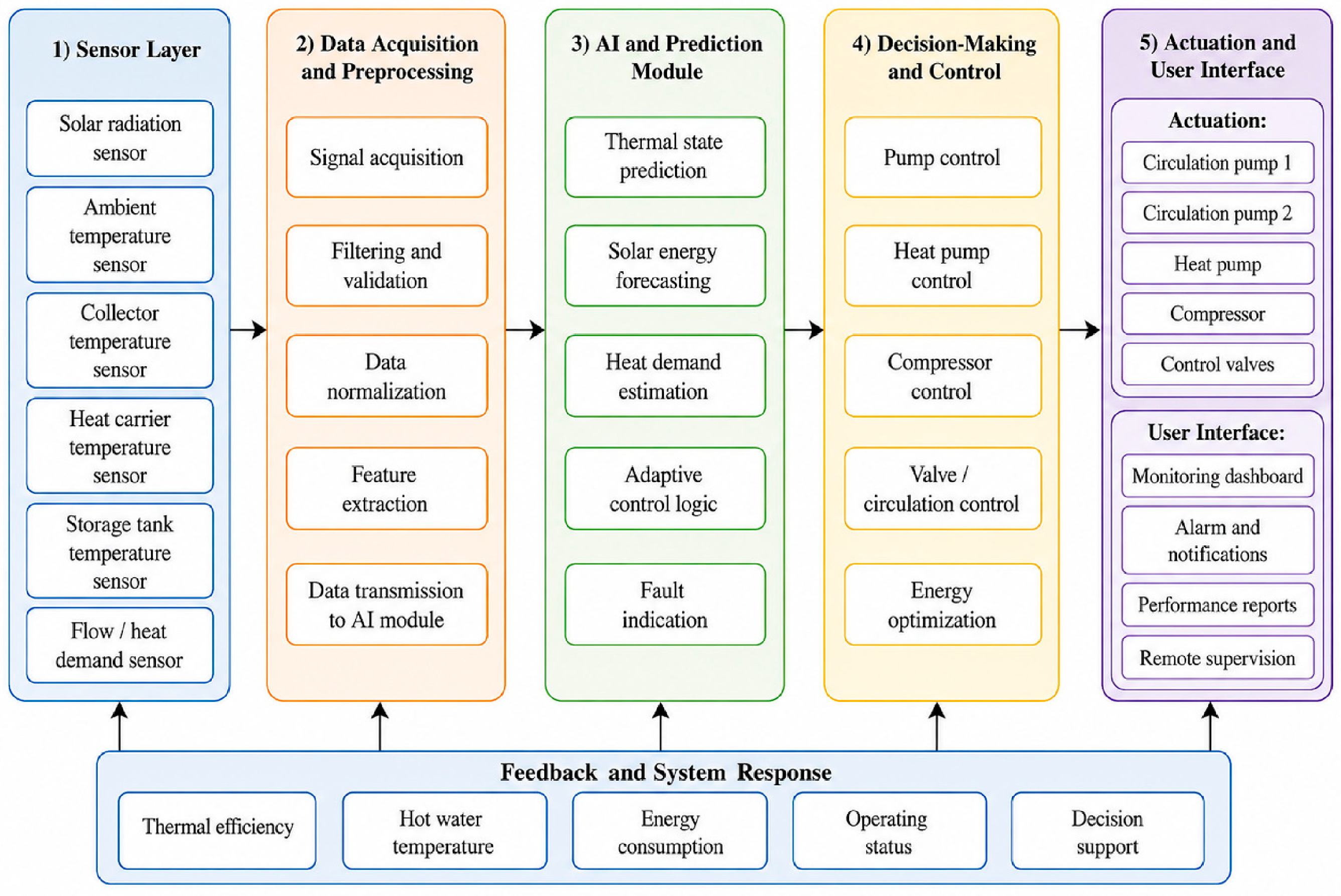
Figure 5 (image 5 was generated by AI) shows the architecture of an intelligent control system for a dual-loop solar installation with thermosiphon circulation. The system consists of five layers: the sensor layer, the data acquisition and preprocessing module, the AI prediction module, the decision-making and control unit, and the actuator and user interface layers. Data on solar radiation, ambient temperature, and the temperatures of the collector, heat transfer fluid, and storage tank are fed into the AI module, where the thermal state is predicted and the optimal operating mode is selected. Based on the analysis results, the system controls the circulation pumps, heat pump, compressor, and valves, ensuring improved energy efficiency and stability of the hot water supply.
Figure 5.
Architecture of an intelligent control system for a dual-loop solar system with thermosiphon circulation.
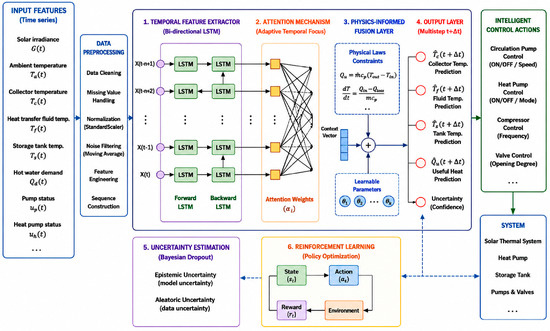
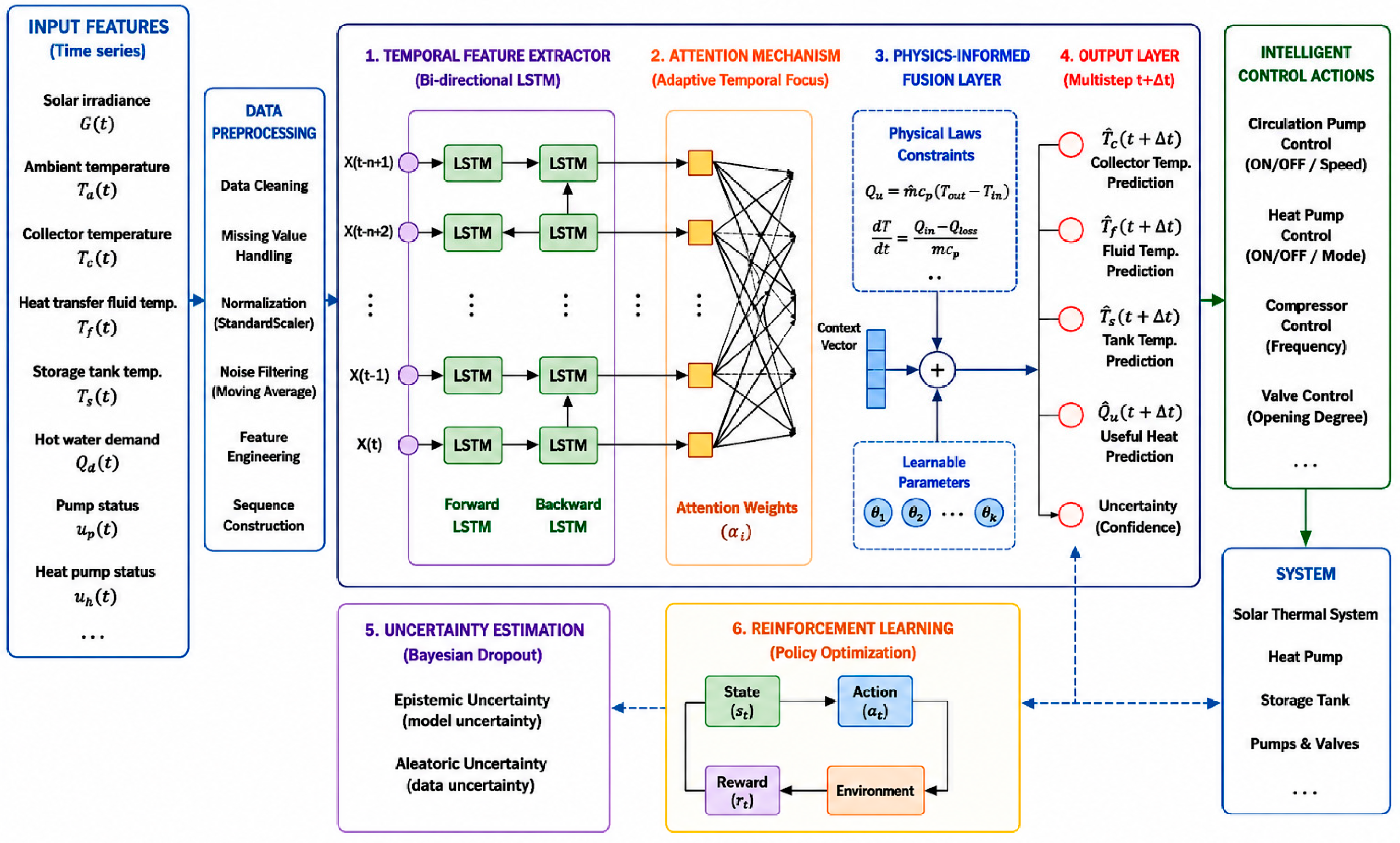
Figure 6 (image 6 was generated by AI) shows a neural network for the intelligent control of a dual-loop solar installation. The model’s inputs include time series for solar radiation, ambient temperature, collector temperature, heat transfer fluid temperature, storage tank temperature, heat load, and equipment status. After preprocessing, the data is fed into a bi-directional LSTM block, which extracts temporal dependencies, while the attention mechanism highlights the most significant moments and parameters. Next, the physics-informed layer accounts for the system’s thermal constraints, after which the output layer predicts the temperatures of the collector, heat transfer fluid, and storage tank, as well as the useful thermal power and the level of uncertainty. The resulting forecasts are used for intelligent control of pumps, the heat pump, the compressor, and valves.
Figure 6.
Neural network for intelligent control of a dual-loop solar installation.
4. Results
To quantitatively assess the effectiveness of the proposed AI system, calculation tables were created that reflect climatic conditions, system temperature parameters, actuator operating modes, thermal efficiency, energy consumption, and prediction accuracy. The tabular data were used to construct graphs allowing for a comparison between traditional threshold control and intelligent control based on an AI module. This presentation of the results demonstrates the impact of artificial intelligence on hot water temperature stability, reduced energy consumption, and improved overall efficiency of the dual-loop solar system.
Table 2 presents the input data used by the AI module to forecast and control the solar hot water supply system. Throughout the day, solar radiation increases from 180 W/m2 at 8:00 to a maximum of 780 W/m2 at 12:00, after which it gradually decreases to 120 W/m2 by 17:00. At the same time, the ambient temperature rises from 2.1 °C to 7.6 °C and then begins to decrease. The heat load is inversely proportional to solar activity: it is higher in the morning and evening—4.8–5.0 kW—and decreases to 3.5–3.6 kW during the period of maximum solar radiation. This data allows the AI module to determine when there is sufficient energy from the solar collector and when it is necessary to activate the pumps or heat pump to maintain the required hot water temperature.
Table 2.
Initial climatic data for modeling.
Table 3 presents the calculated temperature parameters of the solar hot water system throughout the day. The collector temperature rises from 24.5 °C at 8:00 to a maximum of 62.4 °C at 12:00, which corresponds to the period of peak solar radiation. The heat transfer fluid temperature also rises from 21.8 °C to 52.5 °C, indicating efficient heat transfer from the collector to the circulation system. The storage tank temperature gradually increases from 38.2 °C in the morning to 55.1 °C at 14:00, after which it begins to slowly decrease. This demonstrates the thermal inertia of the tank: even after solar radiation decreases, the system retains the stored heat. The condenser temperature reaches a maximum of 59.8 °C at 13:00, indicating the possible connection or support of a heat pump to stabilize the hot water temperature.
Table 3.
Temperature parameters of the solar installation.
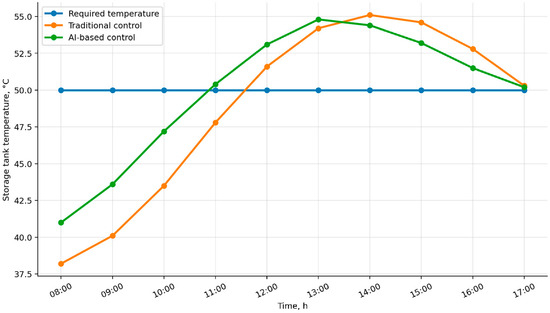
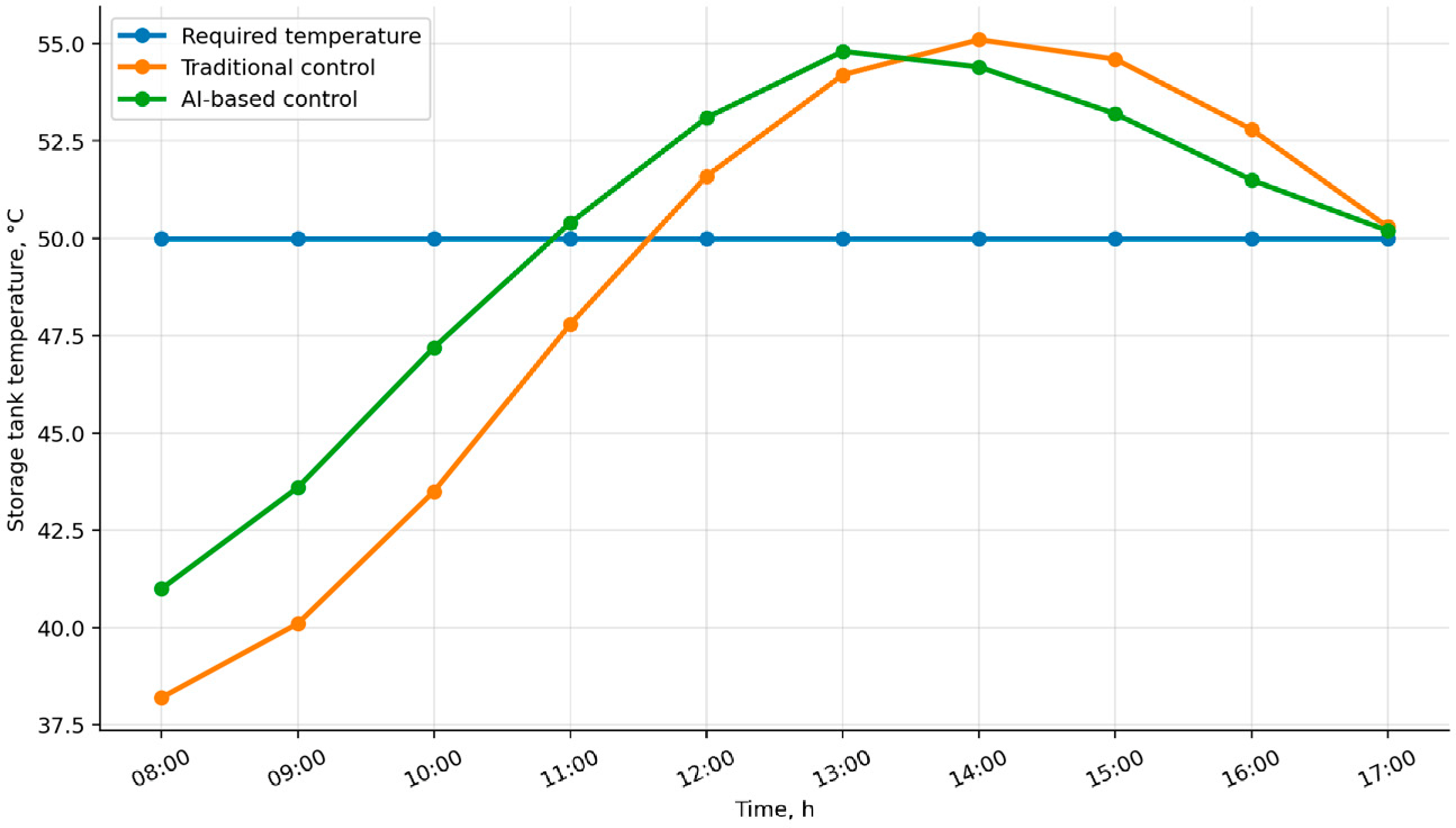
Table 4 compares traditional control and AI control of the storage tank temperature relative to the target value of 50 °C. In the morning hours, the traditional system falls significantly short of the set temperature: at 8:00, the tank temperature is only 38.2 °C, whereas AI control raises it to 41.0 °C. As solar radiation increases, the temperature under AI control approaches the target level more quickly and reaches 50.4 °C as early as 11:00. The most precise control is observed at 11:00 and 17:00, when the AI error is only 0.4 °C and 0.2 °C, respectively. During the daytime, the AI system maintains the temperature above the required level, which allows for the creation of a thermal reserve in the storage tank. Overall, the table shows that AI control ensures faster attainment of the required temperature and more stable maintenance of the hot water supply compared to traditional control.
Table 4.
Comparison of traditional and AI control by storage tank temperature.
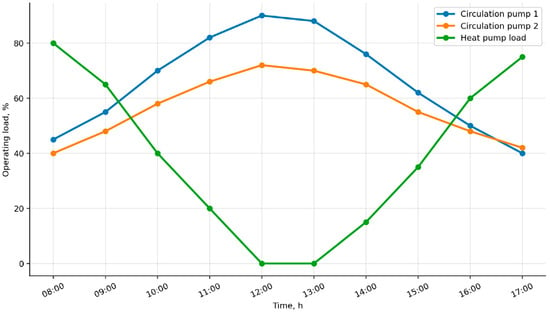
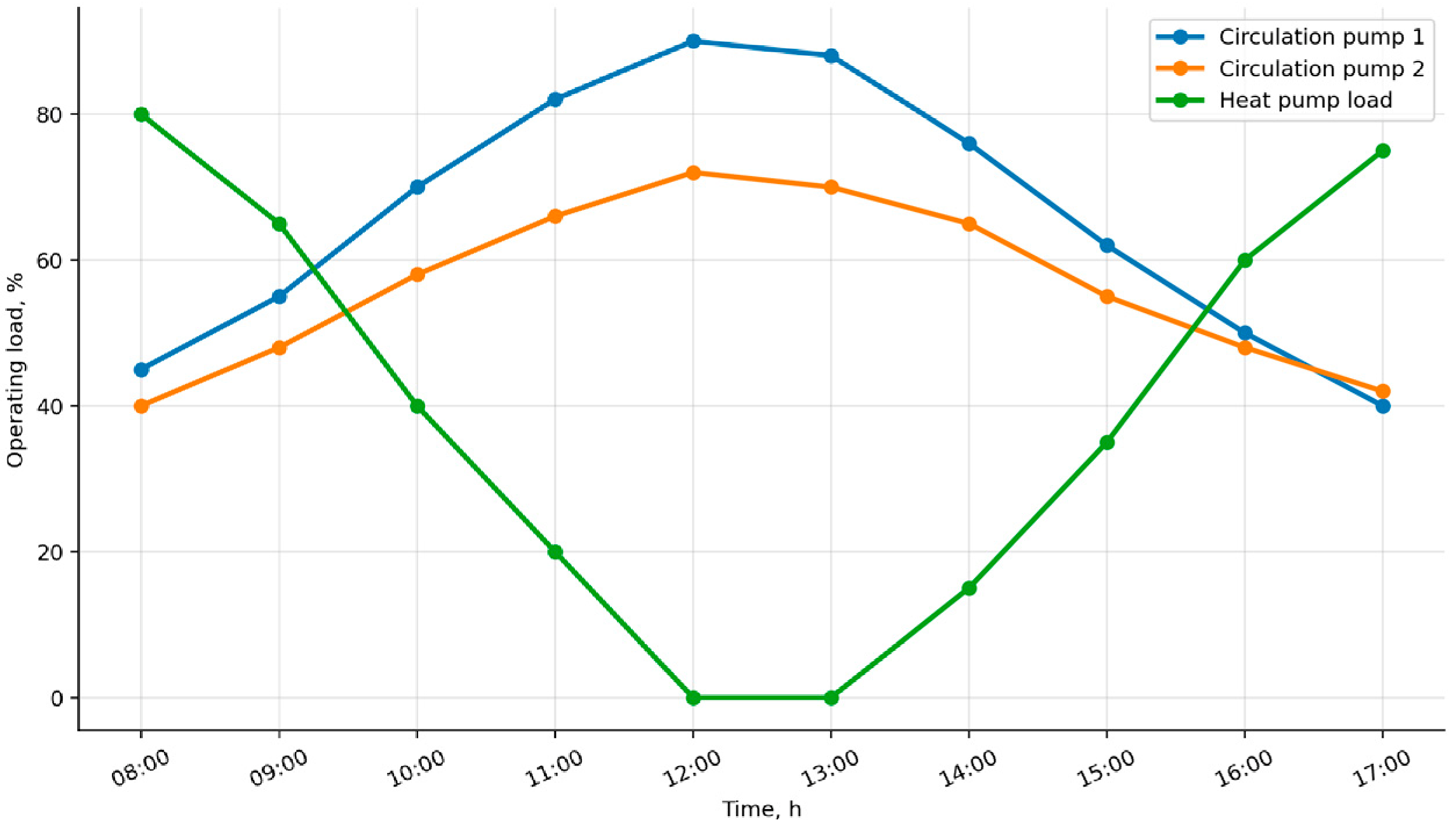
Table 5 shows the operating mode of the pumps and the heat pump throughout the day, depending on solar radiation and the heat load. In the morning, when there is insufficient solar energy, the heat pump operates at high capacity: at 8:00, the load is 80%, and the compressor is running. As solar radiation increases, the load on the heat pump decreases, and the circulation pumps operate more actively, ensuring heat transfer from the solar collector to the storage tank. During the period of maximum solar activity, from 12:00 to 13:00, the heat pump shuts off, as there is sufficient solar energy to heat the water. After 14:00, solar radiation decreases, so the heat pump is turned back on, and its load gradually increases to 75% by 17:00. This control logic demonstrates that the AI module allows for the rational distribution of work between the solar loop and the heat pump, reducing electricity consumption during hours of high solar activity.
Table 5.
Operating modes of pumps and heat pump.
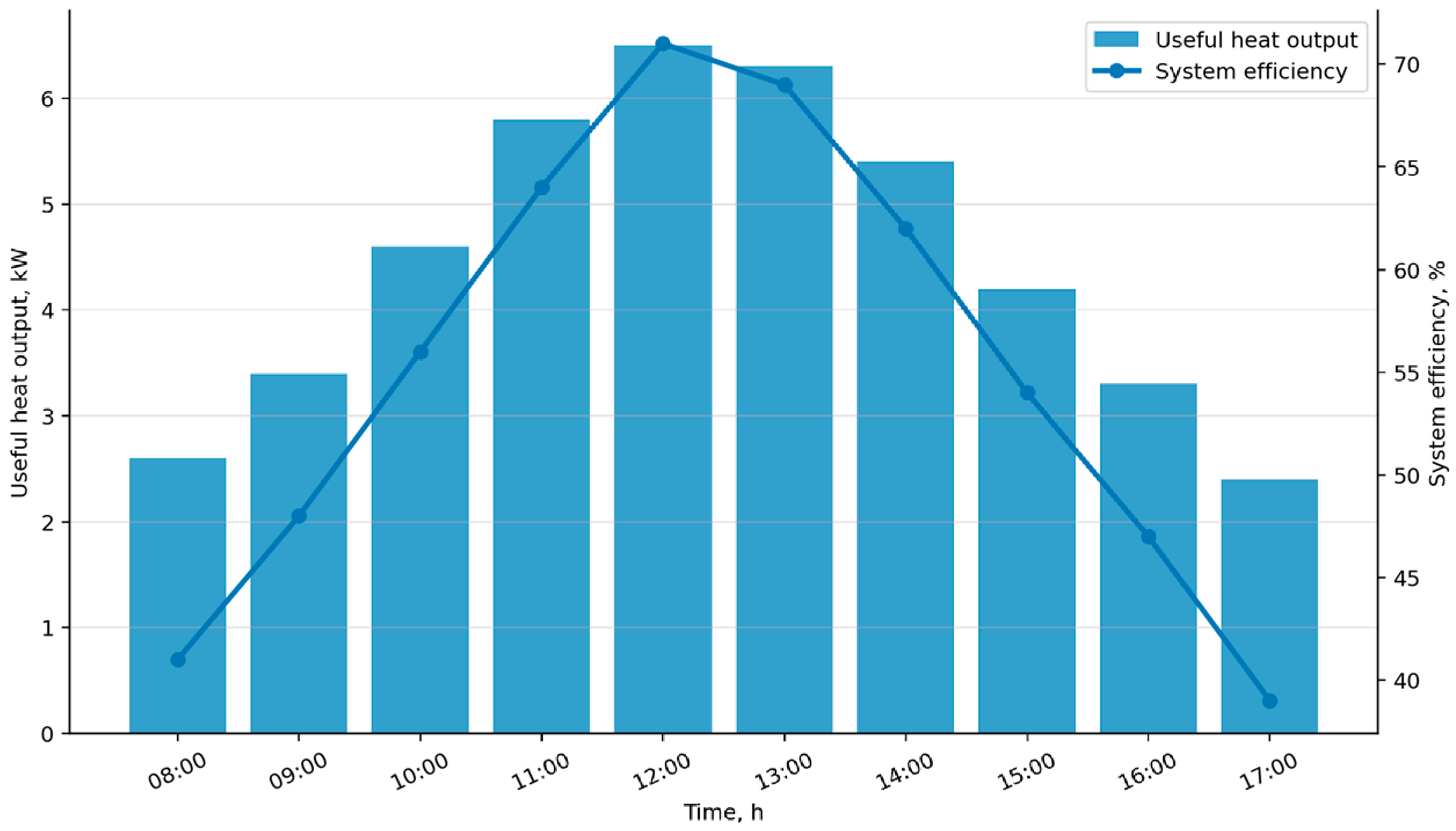
Table 6 presents the energy performance metrics of a solar hot water system supplemented by a heat pump. The useful thermal output increases from 2.6 kW at 8:00 to a maximum of 6.5 kW at 12:00, which is due to increased solar radiation and a greater contribution from the solar loop. During this period, the solar contribution reaches 6.1 kW, while the heat pump’s contribution drops to 0.4 kW, demonstrating the efficient use of solar energy. After 14:00, solar radiation decreases, so the useful thermal power drops from 5.4 to 2.4 kW, and the heat pump’s contribution rises again to 1.8 kW. The system’s maximum efficiency is observed at 12:00 and is 71%, whereas in the morning and evening it is lower—41% and 39%, respectively. This confirms that AI control allows for the rational distribution of the load between the solar loop and the heat pump, increasing the system’s efficiency during hours of high solar activity.
Table 6.
Thermal efficiency of the system.
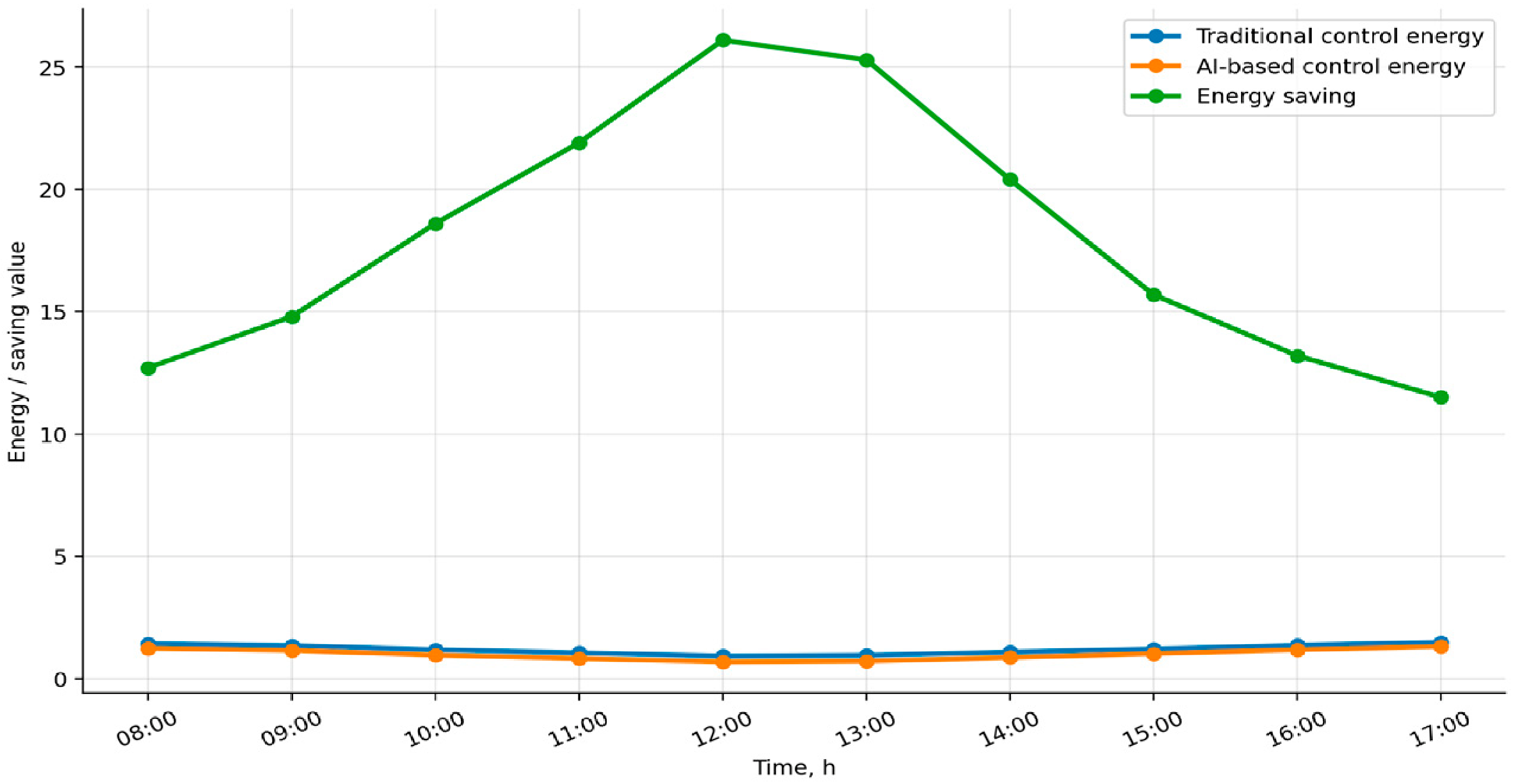
Table 7 compares the system’s energy consumption under traditional control versus AI control. This shows that the AI model reduces energy consumption at all times: for example, at 8:00, consumption decreases from 1.42 to 1.24 kWh, and at 12:00, from 0.92 to 0.68 kWh. The maximum savings are observed during periods of high solar activity: at 12:00, they amount to 26.1%, and at 13:00—25.3%. In the morning and evening hours, the savings are lower but still significant: 12.7% at 8:00 and 11.5% at 17:00. This is because there is less solar energy during these periods, so the system requires heat pump support more frequently. Overall, the data shows that AI control allows for more efficient use of solar energy, optimizes pump operation, and reduces the overall energy consumption of the hot water supply system.
Table 7.
Energy consumption under traditional and AI control.
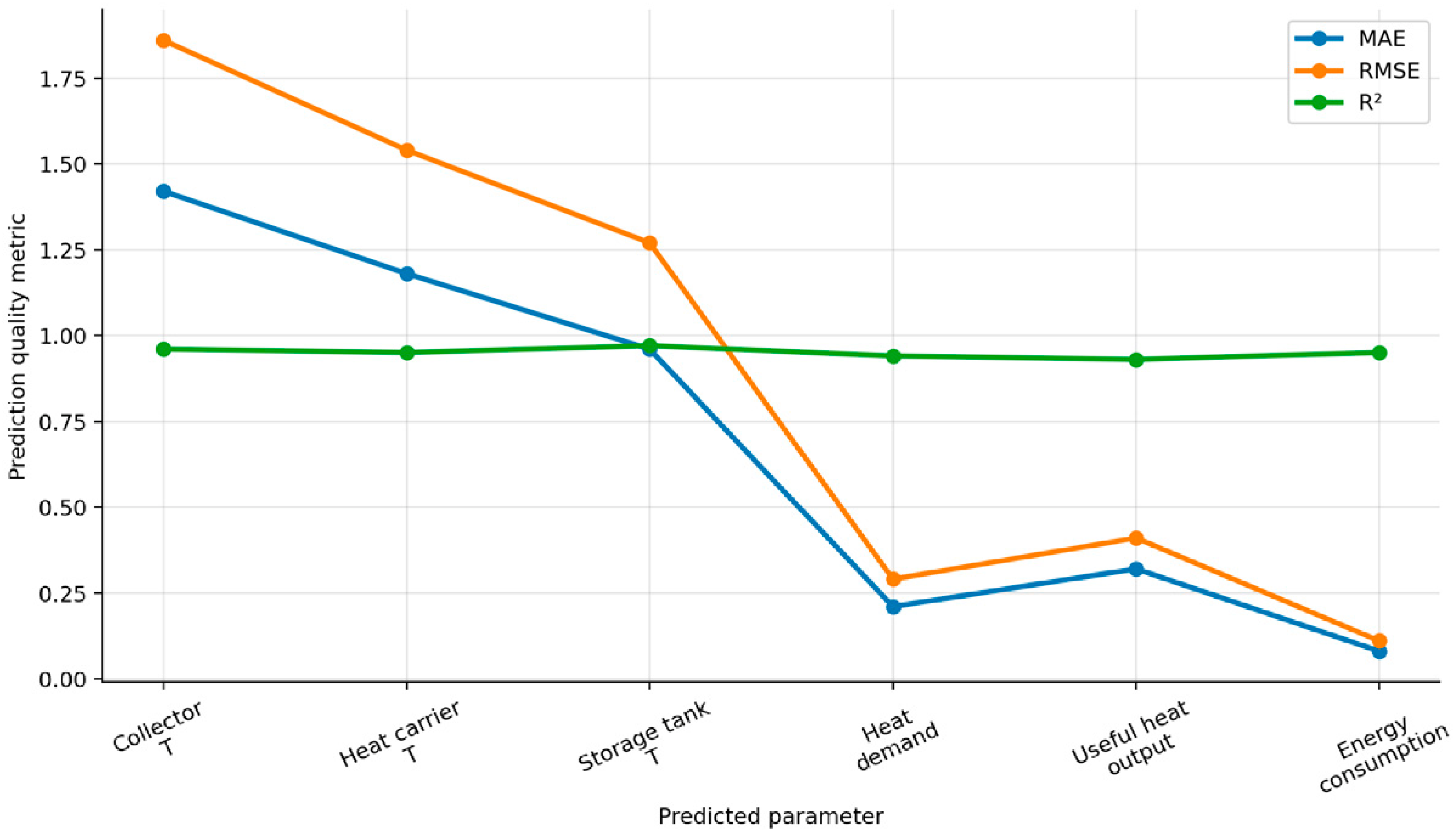
Table 8 presents the prediction accuracy metrics of the AI module for the key parameters of the solar hot water supply system. The highest accuracy was achieved for the storage tank temperature: MAE is 0.96 °C, RMSE is 1.27 °C, MAPE is 2.4%, and the coefficient of determination R2 reaches 0.97. This indicates that the model accurately predicts the thermal state of the tank, which is a key parameter for system control. High R2 values were also obtained for the collector and heat transfer fluid temperatures—0.96 and 0.95, respectively—with MAE errors of 1.42 °C and 1.18 °C. The thermal load forecast has an MAE of 0.21 kW and R2 = 0.94, confirming the model’s suitability for estimating heat demand. For useful thermal power and energy consumption, the R2 values are 0.93 and 0.95, indicating good agreement between the predicted and calculated values. Overall, the results show that the AI module provides sufficiently accurate predictions of the system’s temperature, energy, and load parameters. The low values of MAE, RMSE, and MAPE confirm the model’s suitability for optimal control of pumps, the heat pump, and the heat storage mode.
Table 8.
Forecasting quality of the AI model.
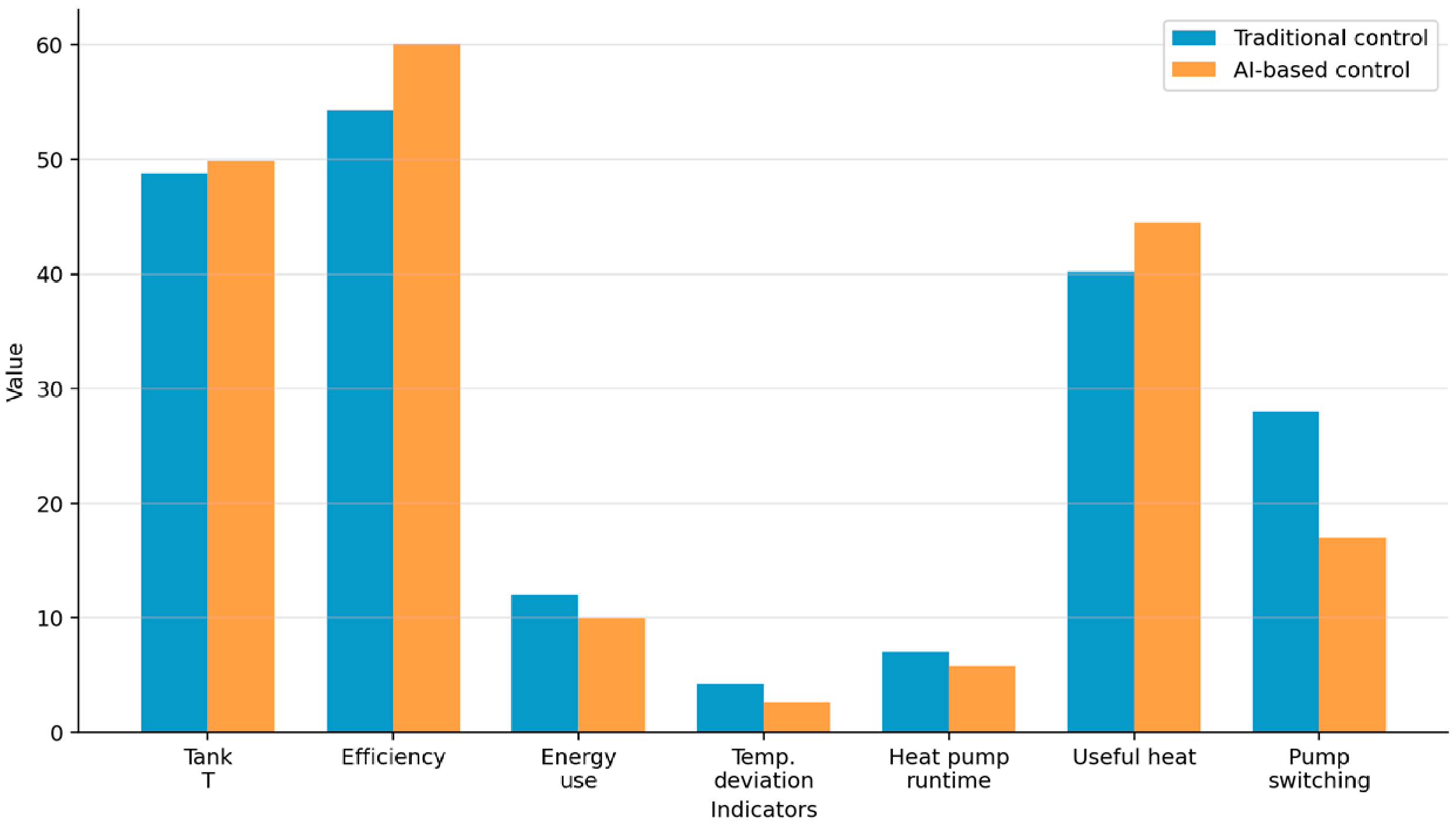
Table 9 provides a final comparison of traditional control and AI-based control in terms of the system’s key performance indicators. AI-based control increases the average storage tank temperature from 48.8 to 49.9 °C, i.e., by 1.1 °C, while the average system efficiency rises from 54.3% to 60.1%, representing a 5.8% improvement. Daily energy consumption decreases from 12.0 to 9.93 kW·h, meaning a saving of 17.3%. AI control also reduces the average temperature deviation from 4.2 to 2.6 °C, which means more stable maintenance of the required operating conditions. Heat pump operating time is reduced from 7.0 to 5.8 h per day, while useful heat output increases from 40.2 to 44.5 kWh per day. Additionally, the number of pump cycles is reduced from 28 to 17, which reduces the load on the equipment and improves system reliability.
Table 9.
Final comparison of traditional and AI-based control.
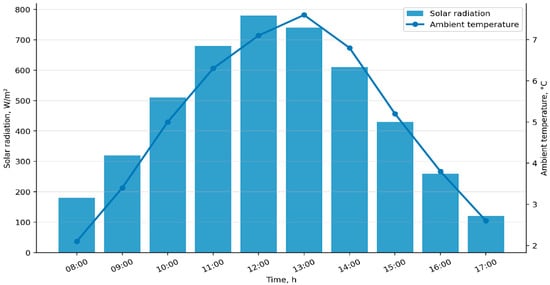
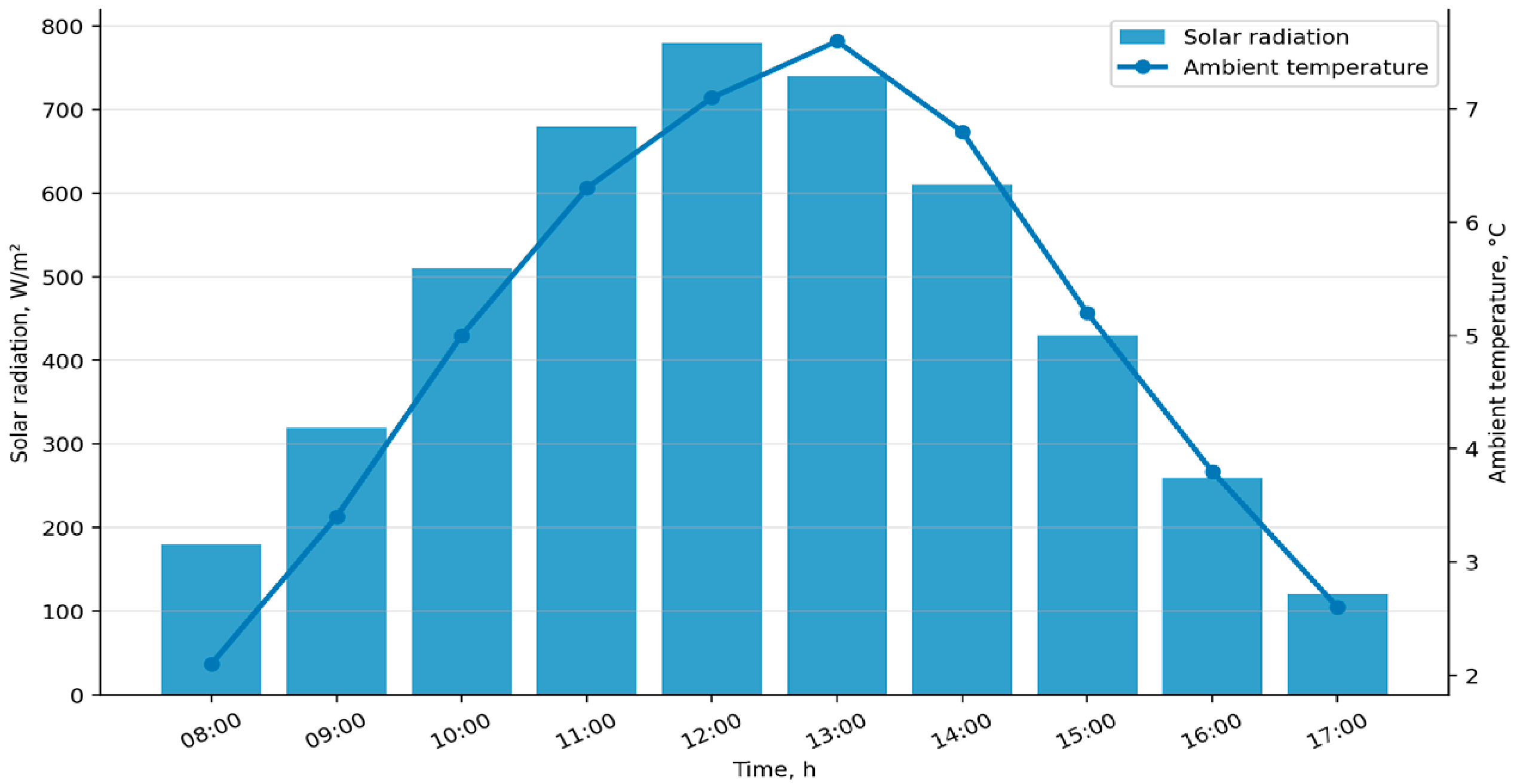
Figure 7 shows the changes in solar radiation and ambient temperature throughout the day. Solar radiation gradually increases from 180 W/m2 at 8:00 to a maximum of 780 W/m2 at 12:00, after which it decreases to 120 W/m2 by 17:00. The ambient temperature follows a similar pattern: in the morning it is 2.1 °C, reaches a maximum of 7.6 °C at 13:00, and then drops to 2.6 °C in the evening. This pattern shows that the greatest potential for the solar collector’s operation occurs between 11:00 and 14:00, when solar radiation exceeds 600 W/m2. In the morning and evening hours, solar energy is insufficient, so the system may require support from a heat pump or an additional heat source to ensure a stable hot water supply.
Figure 7.
Changes in solar radiation and ambient temperature throughout the day.
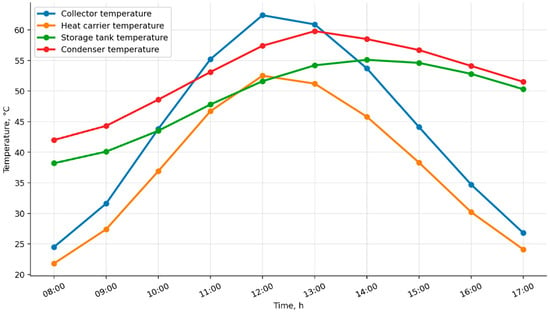
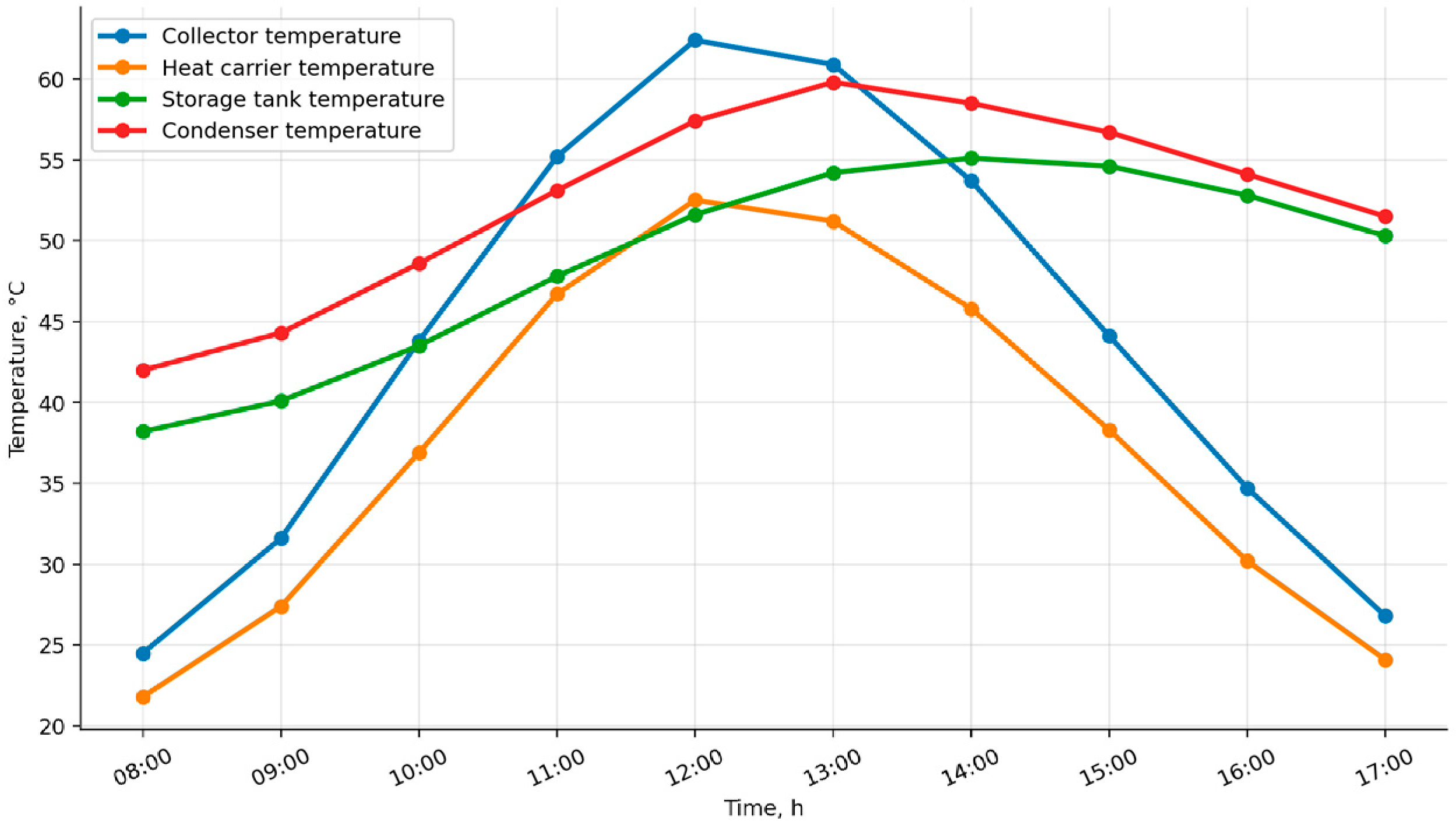
Figure 8 illustrates the daily temperature dynamics in the main components of the solar hot water supply system. The collector temperature rises from 24.5 °C at 8:00 to a maximum of 62.4 °C at 12:00, after which it drops rapidly to 26.8 °C by 17:00. The heat transfer fluid temperature follows a similar pattern: it rises from 21.8 to 52.5 °C and then drops to 24.1 °C. The temperature of the storage tank changes more gradually: from 38.2 °C in the morning, it rises to 55.1 °C at 14:00 and remains at a relatively high level even after solar activity decreases. This is due to the thermal inertia of the tank and the accumulation of energy during the day. The condenser temperature reaches a maximum of 59.8 °C at 13:00, indicating that the required temperature regime is being maintained and that the solar loop can interact effectively with the heat pump.
Figure 8.
Daily temperature dynamics in the main components of the solar hot water supply system.
Figure 9 shows a comparison of traditional control and AI-based control of the storage tank temperature relative to the target temperature of 50 °C. In the morning hours, neither system reaches the set temperature, but AI control approaches the target value more quickly: at 8:00 a.m., the temperature is 41.0 °C versus 38.2 °C with traditional control, and at 10:00 a.m., it is 47.2 °C versus 43.5 °C. After 11:00, the AI system reaches the target temperature and maintains the tank temperature within the range of 50.2–54.8 °C. Traditional control also reaches the desired level, but with a longer delay and a more significant temperature overshoot during the daytime. Overall, the graph shows that AI control ensures faster attainment of the set temperature, reduces temperature deviation, and improves the stability of the hot water supply system.
Figure 9.
Comparison of traditional control and AI-based control of the storage tank temperature relative to the target temperature of 50 °C.
Figure 10 shows the operation of the circulation pumps and the heat pump throughout the day. In the morning, when solar radiation is low, the heat pump’s load is high, reaching 80% at 8:00, which is necessary to compensate for the lack of solar heat. As solar activity increases, the heat pump’s load gradually decreases and reaches 0% between 12:00 and 13:00, meaning the system temporarily operates primarily using the solar collector. At the same time, the load on the circulation pumps increases: Pump 1 increases its operation from 45% to 90%, and Pump 2 from 40% to 72%. This indicates an increase in coolant circulation during the period of maximum solar energy input. After 14:00, solar radiation decreases, so the load on the pumps drops, and the heat pump is reconnected, reaching 75% by 17:00. This mode demonstrates adaptive control, in which the AI module redistributes the load between the solar loop and the heat pump to maintain a stable hot water temperature.
Figure 10.
Operation of the circulation pumps and heat pump throughout the day.
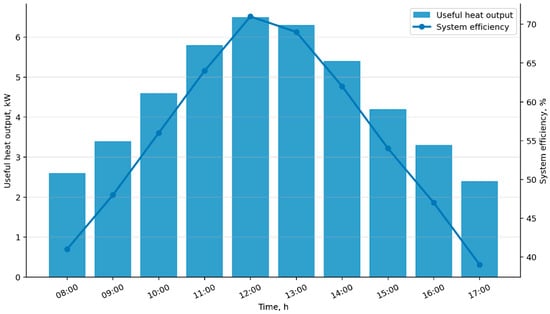
Figure 11 demonstrates the dependence of the system’s useful thermal power and efficiency on the time of day. The useful thermal power increases from 2.6 kW at 8:00 to a maximum of 6.5 kW at 12:00, which corresponds to the period of peak solar radiation. At the same time, system efficiency reaches a maximum of 71%, indicating the most efficient use of solar energy. After 13:00, the useful thermal power gradually decreases: from 6.3 kW to 2.4 kW by 17:00. System efficiency also decreases from 69% to 39% as solar radiation decreases and the need for additional heat pump support increases. Overall, the graph shows that the system’s best energy performance is observed between 11:00 and 13:00.
Figure 11.
Dependence of the useful thermal power and efficiency of the system on the time of day.
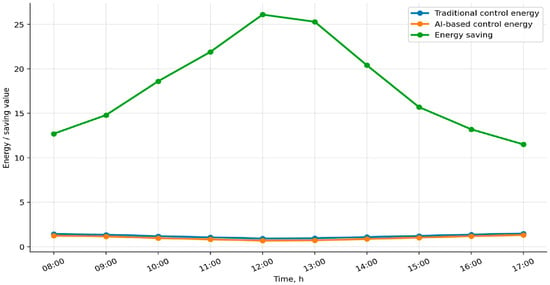
Figure 12 illustrates a comparison of energy consumption between traditional control and AI-based control, as well as the percentage of energy savings throughout the day. The graph shows that AI-based control provides lower energy consumption at all times compared to traditional control. For example, at 8:00, consumption drops from 1.42 to 1.24 kWh, and at 12:00, from 0.92 to 0.68 kWh. The greatest energy savings are observed during peak solar activity: at 12:00, they reach 26.1%, and at 13:00, they amount to 25.3%. In the morning and evening, the savings are lower but still significant: 12.7% at 8:00 and 11.5% at 17:00. This shows that the AI module most effectively reduces energy consumption during the hours when solar energy can most effectively replace the heat pump’s operation and reduce the load on the equipment.
Figure 12.
Comparison of energy consumption between traditional control and AI control, as well as the percentage of energy savings throughout the day.
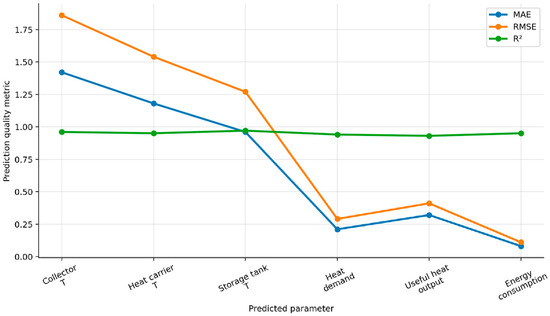
Figure 13 shows the prediction accuracy metrics of the AI module for various system parameters. The largest errors are observed in the prediction of collector temperature: the MAE is 1.42 and the RMSE is 1.86, which is due to the collector’s high sensitivity to changes in solar radiation, wind, and ambient temperature. For the heat transfer fluid temperature, the errors are lower: MAE = 1.18 and RMSE = 1.54. The most accurate forecast is obtained for the storage tank temperature, where MAE is 0.96, RMSE is 1.27, and R2 reaches 0.97. This indicates that the model accurately describes the thermal inertia of the tank. For the heat load, useful heat output, and energy consumption, the errors also remain low: MAE ranges from 0.08 to 0.32, and R2 is 0.93–0.95. Overall, the graph confirms that the AI model provides sufficiently high prediction accuracy and can be used for optimal control of the pumps, heat pump, and heat storage mode.
Figure 13.
Prediction accuracy metrics of the AI module for various system parameters.
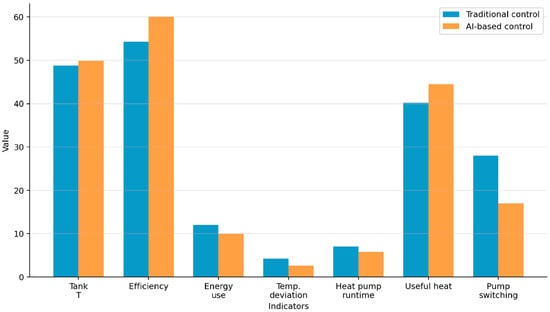
Figure 14 presents a final comparison of traditional control and AI-based control based on key system performance indicators. It shows that AI control increases the average storage tank temperature and system efficiency: efficiency rises from approximately 54.3% to 60.1%. At the same time, energy consumption decreases, temperature deviation is reduced, and heat pump operating time is shortened. The advantage of AI control is particularly noticeable in the number of pump switching cycles: this number decreases from 28 to 17, which reduces the load on the equipment and improves system reliability. In addition, useful heat output increases from 40.2 to 44.5 kWh/day. Overall, the graph shows that the use of the AI module ensures more stable temperature control, energy savings, and increased efficiency of the solar hot water supply system.
Figure 14.
Final comparison of traditional control and AI-based control based on key system performance indicators.
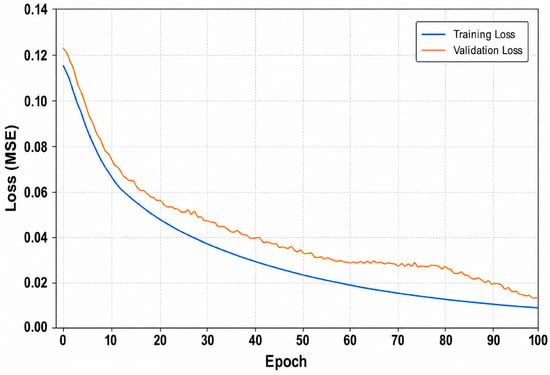
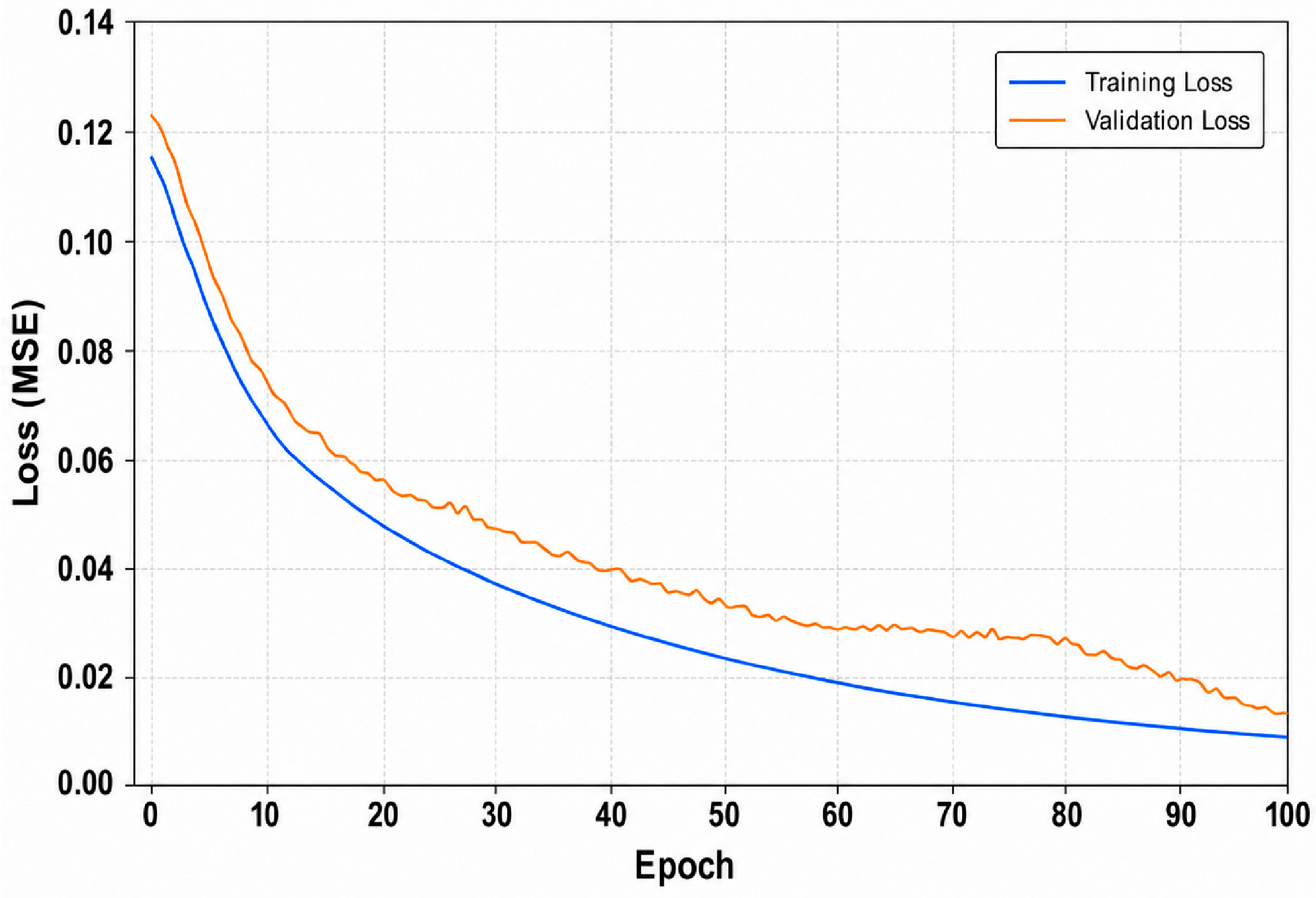
Figure 15 shows the dynamics of the model’s loss function during training. The error on the training set gradually decreases from approximately 0.115 to 0.009 MSE, indicating that the model is training stably and improving its ability to approximate the data. The error on the validation set also decreases from 0.123 to approximately 0.013 MSE, confirming the model’s good generalization ability. The difference between training loss and validation loss remains small, so no significant overfitting is observed. Minor fluctuations in validation loss during individual epochs are normal and are associated with testing the model on independent data. Overall, the graph shows that the AI model converges steadily and can be used to predict the system’s temperature and energy parameters.
Figure 15.
Dynamics of the model’s loss function during training.
5. Conclusions
The conducted study showed that the use of AI control improves the efficiency of a dual-loop solar system with thermosiphon circulation. The intelligent module takes into account solar radiation, ambient temperature, heat load, and the state of the storage tank, which allows for more efficient control of the pumps and heat pump. Compared to traditional control, the AI system brings the tank temperature closer to the required value of 50 °C more quickly, reduces temperature deviations, and lowers energy consumption. It also reduces the operating time of the heat pump and the number of pump cycles, thereby increasing equipment reliability. The results confirm the potential of using artificial intelligence to control solar hot water supply systems. In the future, it is necessary to conduct experimental testing of the system on a real installation and expand the model to account for seasonal variations, variable water consumption, and weather uncertainty.
Author Contributions
Conceptualization, Z.Z. and G.M.; methodology, M.K.; software, E.N.; validation, D.Z. and A.Y.; formal analysis, S.T.; investigation, A.T., B.S. and A.S. All authors have read and agreed to the published version of the manuscript.
Funding
This study has not received external funding.
Institutional Review Board Statement
Not applicable.
Informed Consent Statement
Not applicable.
Data Availability Statement
The computational data supporting the findings of this study are presented in the article. Additional data and calculation files are available from the corresponding authors upon reasonable request.
Acknowledgments
During manuscript preparation, the authors used ChatGPT (OpenAI, GPT-6 model) to generate draft text and prepare schematic illustrations. For Figure 5, the tool was instructed to depict the architecture of an intelligent control system for a dual-loop solar installation, including sensors, data acquisition and processing, forecasting, decision-making, and actuators. For Figure 6, the task was to visualize a neural network architecture comprising input parameters, a BiLSTM block, an attention mechanism, a physics-informed layer, and prediction outputs. These descriptions summarize the tasks and are not verbatim quotations of the prompts. The authors reviewed and edited the generated text and figures and take full responsibility for the content of the manuscript.
Conflicts of Interest
The authors declare no conflicts of interest.
References
- Odoi Yorke, F. Artificial Intelligence for Solar Water Heating Systems: A Review of Global Research Trends, Advances, and Future Perspectives. Energy Convers. Manag. X 2025, 28, 101378. [Google Scholar] [CrossRef] [Scilit]
- Znaczko, P.; Chamier-Gliszczynski, N.; Kaminski, K. Experimental Study of Solar Hot Water Heating System with Adaptive Control Strategy. Energies 2025, 18, 3904. [Google Scholar] [CrossRef] [Scilit]
- Ma, M.; Pektezel, O.; Ballerini, V.; Valdiserri, P.; Rossi di Schio, E. Performance Predictions of Solar-Assisted Heat Pumps: Methodological Approach and Comparison Between Various Artificial Intelligence Methods. Energies 2024, 17, 5607. [Google Scholar] [CrossRef] [Scilit]
- Saravanan, A.; Sree, S.R.; Reddy, M.S.; PV, E.; Karthik, K.; Cheeli, A.K.; Hasan, N. Thermal Performance Prediction of a V-Trough Solar Water Heater with a Modified Twisted Tape Using ANFIS, GLR, RT and SVM Models of Machine Learning. Sci. Rep. 2024, 14, 27206. [Google Scholar] [CrossRef] [Scilit] [PubMed]
- Hu, X.; Guo, L.; Wang, J.; Liu, Y. Computational Fluid Dynamics and Machine Learning Integration for Evaluating Solar Thermal Collector Efficiency-Based Parameter Analysis. Sci. Rep. 2025, 15, 24528. [Google Scholar] [CrossRef] [Scilit] [PubMed]
- Farhadi, S.; Atrian Seresht, H.; Aghakhani, H.; Baghapour, B. Performance Prediction of Heat Pipe Evacuated Tube Solar Collectors: Analytical Modeling and Data-Driven Machine Learning/ANN Approach with Developing Web Application. Energy 2025, 321, 135512. [Google Scholar] [CrossRef] [Scilit]
- Ozgen, F.; Duranay, Z.B.; Dayan, A.; Güldemir, H. ANN-Based Performance Modeling of a Solar Air Collector with Varying Absorber Surfaces. Machines 2025, 13, 812. [Google Scholar] [CrossRef] [Scilit]
- Cáceres, M.; Avila, C.; Rivera, E. Thermodynamics-Informed Neural Networks for the Design of Solar Collectors: An Application on Water Heating in the Highland Areas of the Andes. Energies 2024, 17, 4978. [Google Scholar] [CrossRef] [Scilit]
- Sánchez Martínez, D.A.; Talavera López, A.; Murrieta-Luna, E.; Alvarado Perea, L.; Canizalez Dávalos, L. Predicting the Thermal Performance of a Flat Plate Solar Collector Network by Programming a Neural Network. Chem. Eng. Trans. 2025, 120, 421–426. [Google Scholar]
- Uniyal, A.; Bose, S.; Dutt, N.; Kumar, A.; Ranakoti, L.; Painuly, A. Experimental Investigation and Machine Learning Modeling for Thermal Performance Prediction of U-Tube PCM Solar Collectors. J. Energy Storage 2025, 129, 117306. [Google Scholar] [CrossRef] [Scilit]
- Khudhur, K.A.; Razavi, S.E.; Bonab, M.B.E. Machine Learning Insights and Performance Assessments into Nanofluid-Enhanced PV-T Solar Collector. Int. J. Thermofluids 2025, 29, 101337. [Google Scholar] [CrossRef] [Scilit]
- Gharaee, H.; Erfanimatin, M.; Bahman, A.M. Machine Learning Development to Predict the Electrical Efficiency of Photovoltaic-Thermal Collector Systems. Energy Convers. Manag. 2024, 315, 118808. [Google Scholar] [CrossRef] [Scilit]
- Zhang, X.; Wang, D.; Chen, C.; Song, X.; Zhao, S. Research on Stochastic Dual Model Predictive Control and Application to Solar Thermal Collector Field. Electronics 2025, 14, 2048. [Google Scholar] [CrossRef] [Scilit]
- Kalanithi, K.; Samuel, G.G.; Malathi, M.; Venkatesan, R. Development and Implementation of a Model Predictive Control System for a Solar Parabolic Trough Plant Influenced by an Advanced Meteorological Disturbance Model. Sci. Rep. 2025, 15, 36650. [Google Scholar] [CrossRef] [Scilit] [PubMed]
- Pataro, I.M.; Gil, J.D.; Álvarez, J.D.; Guzmán, J.L.; Lemos, J.M.; Berenguel, M. Learning-Based Practical Nonlinear Predictive Controller for Solar Thermal Collector Fields. IEEE Trans. Control. Syst. Technol. 2025, 33, 2108–2120. [Google Scholar] [CrossRef] [Scilit]
- Zhao, J.; Li, Y.; Qin, Y.; Liu, D.; Wu, X.; Zhang, X.; Cheng, X.; Wu, Y. A Model Predictive Control Strategy of Global Optimal Dispatch for a Combined Solar and Air Source Heat Pump Heating System. Appl. Therm. Eng. 2025, 258, 124778. [Google Scholar] [CrossRef] [Scilit]
- Xin, X.; Liu, Y.; Zhang, Z.; Zheng, H.; Zhou, Y. A Day-Ahead Operational Regulation Method for Solar District Heating Systems Based on Model Predictive Control. Appl. Energy 2025, 377, 124619. [Google Scholar] [CrossRef] [Scilit]
- Rahal, M.; Ahmed, B.S.; Renstrom, R.; Stener, R.; Wurtz, A. Data-Driven Heat Pump Management: Combining Machine Learning with Anomaly Detection for Residential Hot Water Systems. Neural Comput. Appl. 2025, 37, 16203–16229. [Google Scholar] [CrossRef] [Scilit]
- Premer, L.D.R.; Pergantis, E.N.; Semmelmann, L.; Ziviani, D.; Kircher, K.J. Model Predictive Control Lowers Barriers to Adoption of Heat-Pump Water Heaters: A Field Study. Energy Convers. Manag. 2026, 348, 120723. [Google Scholar] [CrossRef] [Scilit]
- Laguili, O.; Eynard, J.; Podesta, M.; Grieu, S. Model Predictive Control of Electric Water Heaters in Individual Dwellings Equipped with Grid-Connected Photovoltaic Systems. Solar 2025, 5, 15. [Google Scholar] [CrossRef] [Scilit]
- Yedilkhan, A.; Murat, K.; Beibut, A.; Aliya, K.; Ainur, K.; Tumur, M.; Azhibek, D. Mathematical justification of thermosyphon effect main parameters for solar heating system. Cogent Eng. 2020, 7, 1851629. [Google Scholar] [CrossRef] [Scilit]
- Merembayev, T.; Amirgaliyev, Y.; Kunelbayev, M.; Yedilkhan, D. Thermal Loss Analysis of a Flat Plate Solar Collector Using Numerical Simulation. Comput. Mater. Contin. 2022, 73, 4627–4640. [Google Scholar] [CrossRef] [Scilit]

Disclaimer/Publisher’s Note: The statements, opinions and data contained in all publications are solely those of the individual author(s) and contributor(s) and not of MDPI and/or the editor(s). MDPI and/or the editor(s) disclaim responsibility for any injury to people or property resulting from any ideas, methods, instructions or products referred to in the content. |
© 2026 by the authors. Licensee MDPI, Basel, Switzerland. This article is an open access article distributed under the terms and conditions of the Creative Commons Attribution (CC BY) license.