


Abstract
The rising demand for sustainable energy has also raised the demand for green hydrogen as a low-carbon energy carrier. However, the intermittent nature of renewable energy sources such as solar and wind energy often results in unstable electrolyzer operation and inefficient hydrogen production. This paper proposes an artificial intelligence-based optimization system for green hydrogen production in solar-wind hybrid electrolysis systems. The proposed system combines renewable energy production, IoT-based monitoring, machine learning prediction, and hydrogen production in an intelligent energy management system. Environmental factors such as solar irradiance, wind speed, temperature, and hydrogen production rate are measured using IoT sensors and renewable energy data from NASA POWER and the Global Wind Atlas. Machine learning algorithms such as long short-term memory (LSTM), support vector regression (SVR), and gradient boosting regression are employed for renewable energy prediction. Experimental results show that the proposed system has a prediction accuracy of 94% using LSTM and enhances the efficiency of hydrogen production by about 20%.
1. Introduction
The increasing demand for sustainable energy solutions across the globe has also led to interest in other energy sources that can help reduce greenhouse gas emissions. Among the other energy sources, hydrogen energy has been recognized as a promising energy carrier due to its high energy density and environmentally friendly nature. Green hydrogen, which is produced by water electrolysis using renewable energy resources like solar and wind energy, has received considerable attention from the research community in recent years [1,2]. The hydrogen energy chain has vast potential for the decarbonization of industrial chains, transportation infrastructure, and energy storage systems [3].
However, despite its many benefits, the use of renewable energy sources in hydrogen production systems faces some operational difficulties. Solar and wind energy sources are intermittent and affected by environmental factors, which in turn affect the stability of the electricity provided to electrolyzers. This can result in inefficient energy use and lower efficiency of hydrogen production. Traditional hydrogen production management systems use deterministic control methods that are developed for stable power supplies. As a result, these traditional methods have difficulty coping with the dynamic behavior of renewable energy sources [4].
However, recent developments in Artificial Intelligence and Machine Learning have shown promising results in overcoming these issues. Machine learning algorithms can effectively learn complex nonlinear relationships between environmental variables and renewable energy production, thus providing accurate predictions and better energy management [5]. Long Short-Term Memory, Support Vector Regression, and Gradient Boosting models have shown excellent performance in renewable energy prediction problems [6,7]. Machine learning-based optimization has also been investigated for improving the operational performance of hydrogen production systems [8]. Moreover, Internet of Things (IoT)-based monitoring systems allow real-time measurement of environmental and process variables such as solar irradiance, wind speed, temperature, voltage, and hydrogen flow rates. These variables are employed for predictive analysis and intelligent decision-making in hydrogen production systems [9]. The complementary nature of solar and wind energy generation patterns can mitigate variability and offer a stable power supply for hydrogen production through electrolysis [10].
Accurate datasets are essential for the development of predictive models for renewable hydrogen production systems [11]. Satellite-based resources such as the NASA Prediction of Worldwide Energy Resources (POWER) dataset offer accurate solar radiation and meteorological information, and the Global Wind Atlas offers precise wind speed information [12,13]. In this context, the current research work proposes an Artificial Intelligence-based optimization model for green hydrogen production in hybrid solar-wind electrolysis systems. The proposed model integrates solar and wind energy production, IoT-based data acquisition, machine learning-based prediction, and hydrogen production in an intelligent energy management system. Simulation results demonstrate improved use of renewable energy and enhanced hydrogen production efficiency compared to the conventional rule-based energy management system. The key contributions of the current research study are summarized as follows:
- An Artificial Intelligence framework is proposed for optimizing green hydrogen production in hybrid solar and wind electrolysis systems.
- IoT-based monitoring and publicly available renewable energy data are combined to facilitate real-time acquisition and analysis of environmental data.
- Machine learning algorithms such as LSTM, SVR, and Gradient Boosting are compared for renewable energy forecasting and hydrogen production optimization.
- Simulation-based evaluation shows improved renewable-energy utilization and hydrogen-production efficiency compared with the conventional rule-based system.
2. Materials and Methods
The proposed framework integrates hybrid renewable energy sources, data acquisition using IoT technology, machine learning predictions, and hydrogen production. Solar photovoltaic cells and wind energy convert electricity to power proton exchange membrane (PEM) electrolyzers for water electrolysis. The produced hydrogen is compressed and stored for future use. The electrolyzer separates water molecules into hydrogen gas through a process called water electrolysis.
The rate of hydrogen production can be calculated as
where H2 is the quantity of hydrogen produced, P is the electrical power supplied to the electrolyzer, t is the operating time, Eelec is the energy required for electrolysis, and η is the overall system efficiency.
Renewable energy data sources include the NASA Prediction Of Worldwide Energy Resources (POWER) database and the Global Wind Atlas, which offer accurate information on solar irradiance, wind speed, temperature, and humidity. IoT-based sensors measure system parameters such as solar radiation, wind speed, voltage, current, and hydrogen flow rate. The acquired data undergoes preprocessing techniques such as normalization, missing data treatment, and feature selection to prepare the data for machine learning model development.
Three machine learning models are employed for renewable energy prediction: Long Short-Term Memory, Support Vector Regression, and Gradient Boosting. LSTM is ideal for time-series energy data modeling because of its capability to learn temporal dependencies. SVR is employed to predict the nonlinear relationship between environmental variables and hydrogen production [6]. Gradient Boosting is employed to enhance prediction accuracy by aggregating multiple weak learning models. The predicted renewable energy availability is employed to control the power supply to the PEM electrolyzer to optimize hydrogen production and reduce energy losses [7].
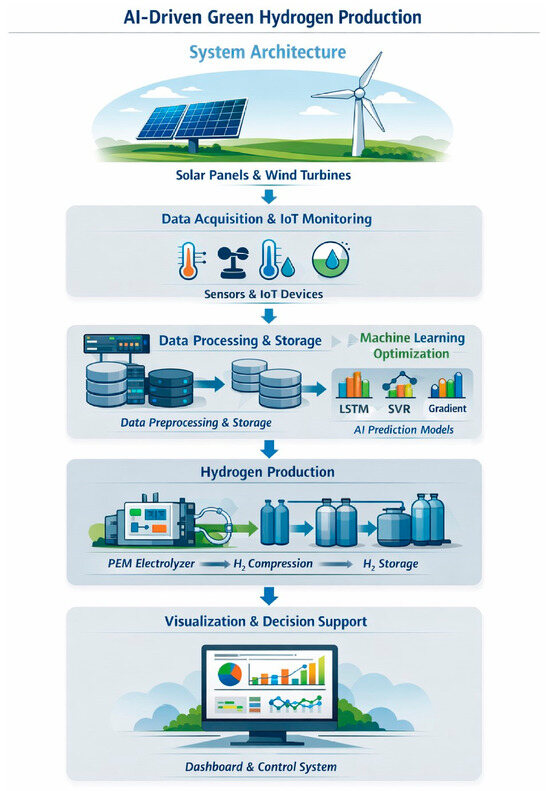
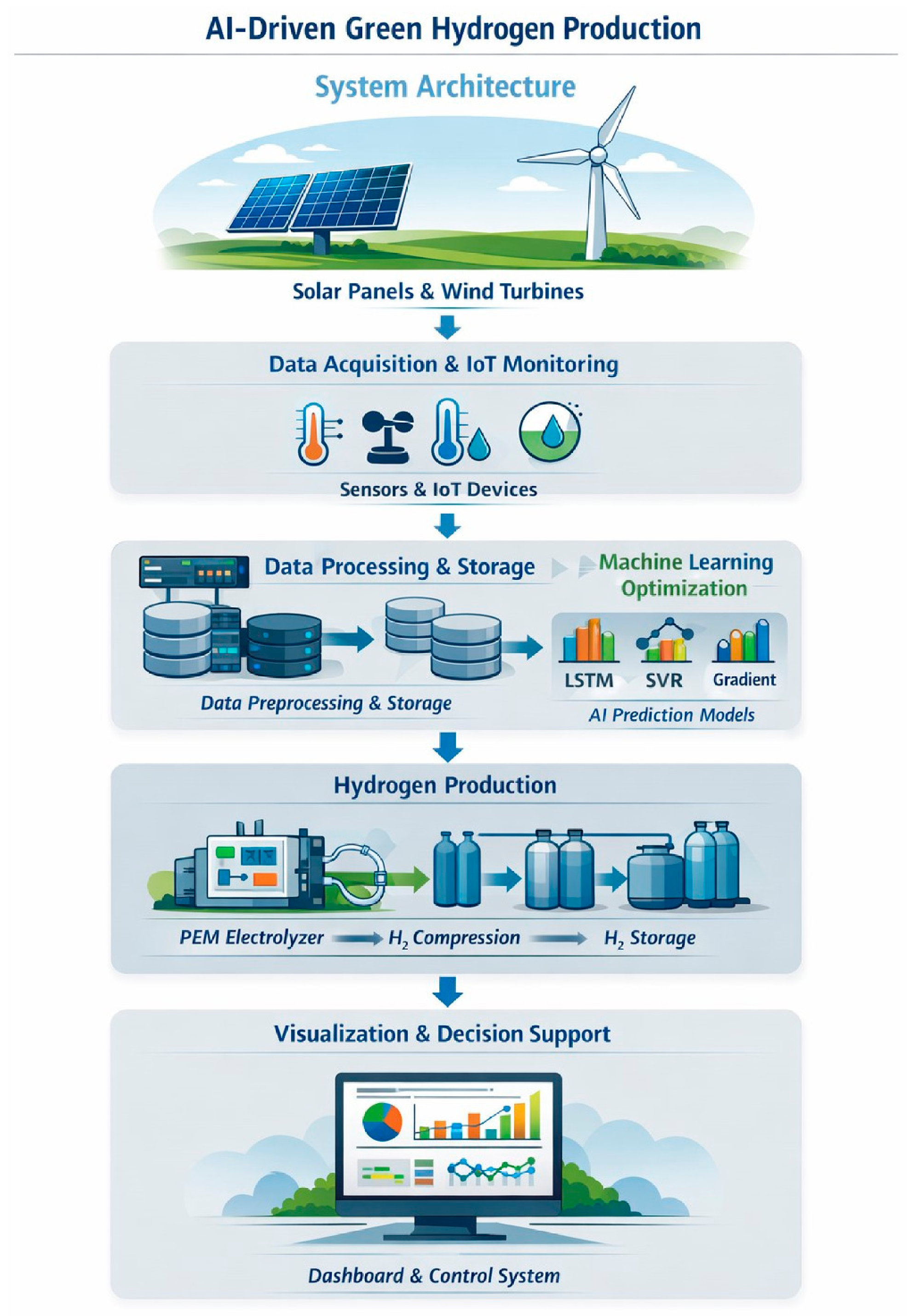
The proposed system architecture for the production of green hydrogen using Artificial Intelligence will incorporate the renewable energy generation module, IoT-based data acquisition, data processing, machine learning-based optimization, and hydrogen production in a unified intelligent energy management framework, as shown in Figure 1.
Figure 1.
Proposed AI-driven architecture for hybrid solar-wind-based green hydrogen production integrating renewable energy generation, IoT monitoring, machine learning prediction, and PEM electrolyzer modules.
3. Results
Table 1 shows the performance comparison of the machine learning models implemented for forecasting in the renewable energy industry. The machine learning models employed in the evaluation include Long Short-Term Memory (LSTM), Support Vector Regression (SVR), and Gradient Boosting. The performance of the machine learning models was assessed based on regression analysis, including Root Mean Square Error (RMSE), Mean Absolute Error (MAE), and prediction accuracy. Among the evaluated machine learning models, the best prediction performance in terms of the lowest values in both RMSE (0.10) and MAE (0.08) and the highest prediction accuracy (94%) was achieved by the LSTM model. The Gradient Boosting model also performed well in the evaluation, achieving an RMSE of 0.12 and prediction accuracy of 92%. The performance of the SVR model was slightly lower, achieving an RMSE of 0.14 and prediction accuracy of 90%. The performance evaluation indicates that the proposed model, particularly the LSTM model, is effective in forecasting in the renewable energy sector.
Table 1.
Performance comparison of machine learning models for renewable energy forecasting.
Table 2 shows the comparison of hydrogen production performance between the conventional rule-based control system and the proposed machine learning-based optimization system. The table shows that the proposed intelligent system optimization approach enhances system performance. The proposed system improved the utilization of renewable energy by 18%, increasing it from 72% in the conventional system to 90%. The proposed system also improved the efficiency of hydrogen production by 19%, increasing it from 70% in the conventional system to 89%. The proposed system also improved the stability of the electrolyzer and reduced losses in comparison to the conventional system.
Table 2.
Hydrogen production efficiency comparison between conventional and proposed machine learning-based systems.
Table 3 shows the parameters of the input dataset used in the proposed system for forecasting renewable energy and hydrogen production. The dataset contains parameters related to the environment and system operation, such as solar irradiance, wind speed, ambient temperature, relative humidity, renewable power, and hydrogen production rate. The parameters are obtained from the NASA POWER dataset, where solar irradiance and meteorological parameters are available. The wind speed parameters are available in the Global Wind Atlas repository. The dataset contains comprehensive information on the environment and system operation, enabling accurate prediction and optimization of system performance. The dataset parameters are used as input features in the proposed system, where machine learning models are used to optimize system performance.
Table 3.
Input dataset parameters used for renewable energy forecasting and hydrogen production modeling.
The results show that the use of machine learning prediction models in hybrid renewable energy systems enhances the performance of the system and improves the efficiency of hydrogen production.
4. Discussion
The experimental results show that the integration of machine learning techniques with hybrid renewable energy systems can greatly enhance the efficiency of hydrogen production. Traditional rule-based control systems are not capable of handling these variabilities effectively, leading to inefficient system operation. In comparison with traditional rule-based control systems for hydrogen production previously reported in the literature, the proposed AI system offers the advantages of superior renewable energy forecasting and more efficient electrolyzer operation.
Among the models tested, the LSTM model performed the best due to its capability to handle the temporal variability of renewable energy resources. The effectiveness of LSTM models has also been demonstrated in previous studies for solar and wind energy forecasting. The SVR and Gradient Boosting models also yielded strong prediction results, proving their ability to capture nonlinear relationships between environmental factors and energy production.
The developed system improved the utilization of renewable energy resources by approximately 18% and the efficiency of hydrogen production by nearly 19%. These improvements demonstrate the effectiveness of artificial intelligence techniques in optimizing renewable hydrogen production systems. The use of hybrid solar and wind energy resources further improves system reliability by reducing the variability of power generation. The complementary nature of solar and wind resources ensures a stable power supply for the electrolysis reaction. Although the results are encouraging, the present study is restricted to simulation experiments using publicly available datasets. Future studies should validate the developed system on physical hydrogen production platforms and account for operational factors such as equipment degradation and system limitations.
5. Conclusions
This paper has presented an optimization approach for green hydrogen production using hybrid solar-wind renewable energy systems based on artificial intelligence. The developed system integrates renewable energy production, IoT-based monitoring, machine learning prediction models, and PEM electrolyzer-based hydrogen production. The simulation results have confirmed that machine learning models can be employed to predict renewable energy availability with good accuracy and optimize hydrogen production processes. Among the models tested, the LSTM model showed the highest prediction accuracy of 94%. The proposed system showed an improvement of about 18% in renewable energy utilization and a 19% improvement in hydrogen production efficiency over traditional rule-based control systems. The results of this paper have shown the potential of artificial intelligence and machine learning models for the development of intelligent and efficient hydrogen energy systems. Future research will concentrate on practical implementation of the proposed system and its integration with energy storage systems and smart grid infrastructure.
Author Contributions
Conceptualization, J.R. and V.V.; methodology, J.R.; software, J.R.; validation, J.R., V.V. and S.R.; formal analysis, J.R.; investigation, J.R.; resources, V.V.; data curation, J.R.; writing—original draft preparation, J.R.; writing—review and editing, V.V. and S.R.; visualization, J.R.; supervision, V.V.; project administration, V.V. All authors have read and agreed to the published version of the manuscript.
Funding
This research received no external funding.
Institutional Review Board Statement
Not applicable.
Informed Consent Statement
Not applicable.
Data Availability Statement
The datasets used in this study are publicly available. Solar irradiance and meteorological parameters were obtained from the NASA Prediction of Worldwide Energy Resources (POWER) dataset repository (https://power.larc.nasa.gov). Wind speed datasets were obtained from the Global Wind Atlas repository (https://globalwindatlas.info). The processed data supporting the findings of this study are available from the corresponding author upon reasonable request.
Acknowledgments
The authors would like to thank Alliance University, Bengaluru, for providing the research environment and computational resources required to conduct this study. The authors also acknowledge the NASA Prediction Of Worldwide Energy Resources (POWER) and Global Wind Atlas repositories for providing publicly accessible renewable energy datasets used in this research. No generative AI or AI-assisted tools were used in the preparation of this manuscript.
Conflicts of Interest
The authors declare no conflicts of interest.
Abbreviations
The following abbreviations are used in this manuscript:
| AI | Artificial Intelligence |
| IoT | Internet of Things |
| PEM | Proton Exchange Membrane |
| PV | Photovoltaic |
| LSTM | Long Short-Term Memory |
| SVR | Support Vector Regression |
| RMSE | Root Mean Square Error |
| MAE | Mean Absolute Error |
References
- Glenk, G.; Reichelstein, S. Economics of converting renewable power to hydrogen. Nat. Energy 2019, 4, 216–222. [Google Scholar]
- Bhandari, R.; Trudewind, C.; Zapp, P. Life cycle assessment of hydrogen production via electrolysis. Int. J. Hydrogen Energy 2014, 85, 151–163. [Google Scholar]
- Momirlan, M.; Veziroglu, T. Hydrogen Energy System; Springer: Berlin, Germany, 2023; pp. 110–158. [Google Scholar]
- Wang, J.; Zhang, Y.; Liu, H. Hybrid renewable energy systems for hydrogen production: A review. Renew. Sustain. Energy Rev. 2024, 182, 113475. [Google Scholar]
- Urhan, B.B.; Keles, D.; Tsiropoulos, I. Machine learning-based forecasting of renewable hydrogen production. Energy Convers. Manag. 2025, 315, 118902. [Google Scholar]
- Khan, M.; Alqahtani, A.; Lee, J. Forecasting solar energy generation using LSTM networks. Renew. Energy 2024, 214, 891–903. [Google Scholar]
- Chen, H.; Sun, W.; Zhao, L. Gradient boosting approaches for renewable energy prediction. Energy Rep. 2023, 9, 5584–5596. [Google Scholar]
- Patel, S.; Kumar, R.; Singh, A. Machine learning optimization for hydrogen production systems. In Proceedings of the IEEE International Conference on Smart Energy Systems, Singapore, 15–18 July 2025; pp. 120–126. [Google Scholar]
- Dincer, I.; Acar, C. Hydrogen energy systems and sustainability. In Comprehensive Energy Systems; Sayigh, A., Ed.; Elsevier: London, UK, 2024; pp. 215–240. [Google Scholar]
- Li, Q.; Yang, X.; Zhao, Y. Artificial intelligence optimization of electrolyzer operation in renewable hydrogen systems. Appl. Energy 2025, 342, 121168. [Google Scholar]
- Anderson, P. Renewable Energy Forecasting for Hydrogen Production Systems. Ph.D. Thesis, University of Cambridge, Cambridge, UK, 2024. [Google Scholar]
- NASA Prediction of Worldwide Energy Resources (POWER). Available online: https://power.larc.nasa.gov (accessed on 10 March 2026).
- Global Wind Atlas. Available online: https://globalwindatlas.info (accessed on 10 March 2026).

Disclaimer/Publisher’s Note: The statements, opinions and data contained in all publications are solely those of the individual author(s) and contributor(s) and not of MDPI and/or the editor(s). MDPI and/or the editor(s) disclaim responsibility for any injury to people or property resulting from any ideas, methods, instructions or products referred to in the content. |
© 2026 by the authors. Licensee MDPI, Basel, Switzerland. This article is an open access article distributed under the terms and conditions of the Creative Commons Attribution (CC BY) license.