


Abstract
Based on the TeleManagement Forum Introductory Guide 1310A Digital Twin for Decision Intelligence reference architecture, we developed a software system architecture for digital-twin-enabled real-time network traffic monitoring and analysis. The system addresses challenges in traffic visualization and congestion mitigation under dynamic conditions in large-scale network topologies, such as Fat-Tree. We validated the system, and the results showed that integrating digital twin technology with closed-loop autonomic management enables traffic engineering optimization and automated decision-making for network operations.
1. Introduction
The rapid expansion of cloud computing and hyperscale data centers has complicated network topologies, such as the Fat-Tree architecture. In dynamic network environments, traditional telecommunications operations support systems (OSSs) rely on manual, reactive diagnostic processes to resolve network congestion; however, they often struggle to cope with massive volumes of real-time packet traffic. Consequently, developing an intelligent network management system that supports automated decision-making has become a critical challenge in modern network engineering.
Digital twin technology enables the construction of a high-fidelity digital mirror of a physical system within a software-based virtual environment, offering a new paradigm for network management. When integrated with decision intelligence, a digital twin can leverage what-if simulation capabilities [1] to evaluate the effectiveness of alternative traffic scheduling strategies without disrupting the operational network. This facilitates the identification of the next best action and, in turn, enables precise traffic engineering optimization. Guided by the TeleManagement Forum Introductory Guide 1310A Digital Twin for Decision Intelligence reference architecture (TM Forum IG1310A DT4DI) [2], a software system architecture was developed for digital-twin-based network traffic monitoring and analysis.
By collecting data from the physical network [software-defined networking (SDN)] and the emulation environment (Mininet), the system constructs real-time virtual state snapshots and automatically generates the corresponding network topology graph. The developed system visualizes the actual transmission paths of packets through the network, enabling operators to perform intuitive problem diagnosis. The system also introduces an observe–decide–act optimization loop and monitors congestion conditions, determines mitigation strategies, and then reconfigures packet routes to achieve congestion alleviation.
The remainder of this article is organized as follows. Section 2 provides a comprehensive literature review, exploring existing research on Digital Twin technology and its application in network management. Section 3 presents the system architecture and design in detail, describing the workflow of the proposed Digital-Twin-enabled network monitoring and traffic analysis system, including data collection and sensing, physical–virtual mirroring instantiation, implementation of the decision intelligence layer, and the closed-loop autonomous management mechanism. Section 4 demonstrates the system implementation, highlights graphic user interface features, and provides application case studies. Finally, Section 5 concludes the paper and discusses future research directions.
2. Literature Review
The development of network management systems has evolved with the integration of virtualization and standardized frameworks. The TM Forum IG1310A DT4DI reference architecture provides a standardized framework for implementing decision intelligence within digital twins [2]. It emphasizes the use of data-driven models to support complex decision-making processes in telecommunications. Furthermore, the TM Forum GB1022 Autonomous Networks Practitioner’s Guide outlines the functional architecture required to achieve higher levels of network autonomy, transitioning from manual operations to self-managing systems [3]. SDN, particularly through the OpenFlow protocol, has revolutionized network control by decoupling the control plane from the forwarding plane [4]. This separation enables programmable network management and dynamic path reconfiguration. Previous studies have successfully demonstrated the design of digital twin topology systems for telecom networks, providing a basis for real-time physical-to-virtual mapping.
In network environments, identifying silent failures or subtle performance degradations is critical. Research on systems such as Network Sentinel has shown how proactive monitoring can detect anomalies that traditional OSS might miss [5]. The integration of AI within network digital twins enhances the ability to predict traffic patterns and simulate what-if scenarios, ensuring high-fidelity mirroring and robust congestion management. The TM Forum IG1310A DT4DI and TM Forum GB1022 are adopted to ensure both technical rigor and industry alignment. While IG1310A DT4DI provides the specialized reference architecture for Decision Intelligence within a digital twin, enabling the systematic evaluation of alternative strategies, GB1022 offers the necessary autonomous networks practitioner’s guide to bridge the gap between high-level intelligence and functional execution. By synergizing these two standards, the developed system mirrors physical reality and ensures the closed-loop autonomy required to manage high-throughput packet telemetry and complex congestion scenarios in modern network engineering.
3. System Architecture
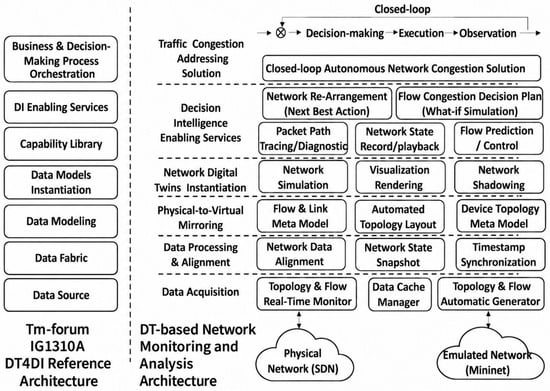
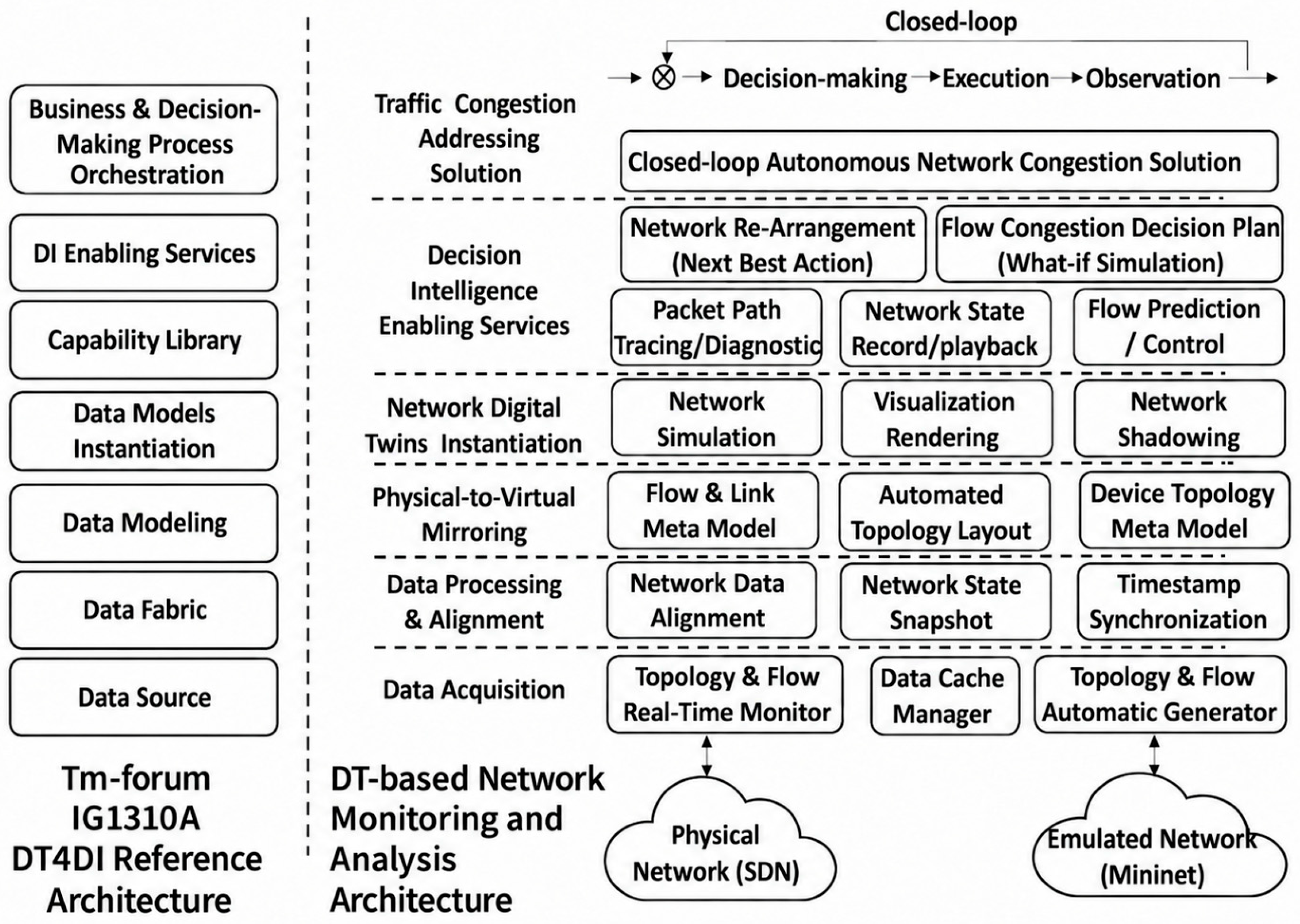
The developed system is designed as a highly efficient, scalable data channel between the physical entity and the virtual mirror, aligning with international standards (Figure 1). Through the closed-Loop concept, observation, decision-making, and execution are interconnected to ensure continuous feedback and the achievement of congestion mitigation goals. The developed system has the following workflow from raw data acquisition to traffic management.
Figure 1.
DT-based network monitoring and analysis architecture. The arrows at the top indicate the decision-making, execution, and observation sequence and its feedback loop. The bidirectional arrows at the bottom indicate information exchange between the physical or emulated network and the corresponding data acquisition components.
- Data acquisition: Responsible for obtaining raw data from diverse environments. This study implements data collection from SDN controllers and Mininet, employing a data caching mechanism to efficiently process high-throughput packet telemetry data.
- Data processing and alignment: This layer transforms heterogeneous data into standardized formats and performs time-series synchronization to ensure consistency between physical and virtual spaces.
- Physical-to-virtual mirroring: Establishes the digital model of the physical network, defining dynamic attributes for Links and Flows, as well as the connection logic for core, aggregation, and edge switches.
- Network digital twins instantiation: Automatically generates the digital mirror in the software environment and provides visualization for interaction and observation;
- Decision intelligence enabling services: Analyze current states and simulate future scenarios. It provides decision recommendations for congestion relief by simulating various scheduling schemes without interfering with active operations;
- Traffic congestion addressing solution: Orchestrates the functional modules to manage the sequence of operations and data delivery, achieving the goal of traffic engineering optimization.
4. System Implementation and Evaluation
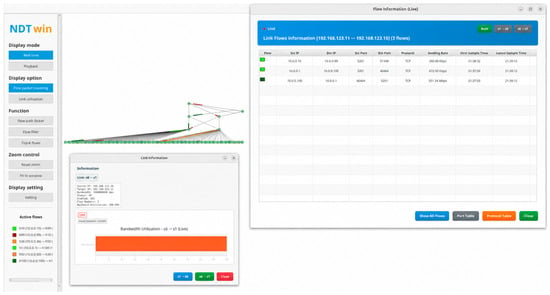
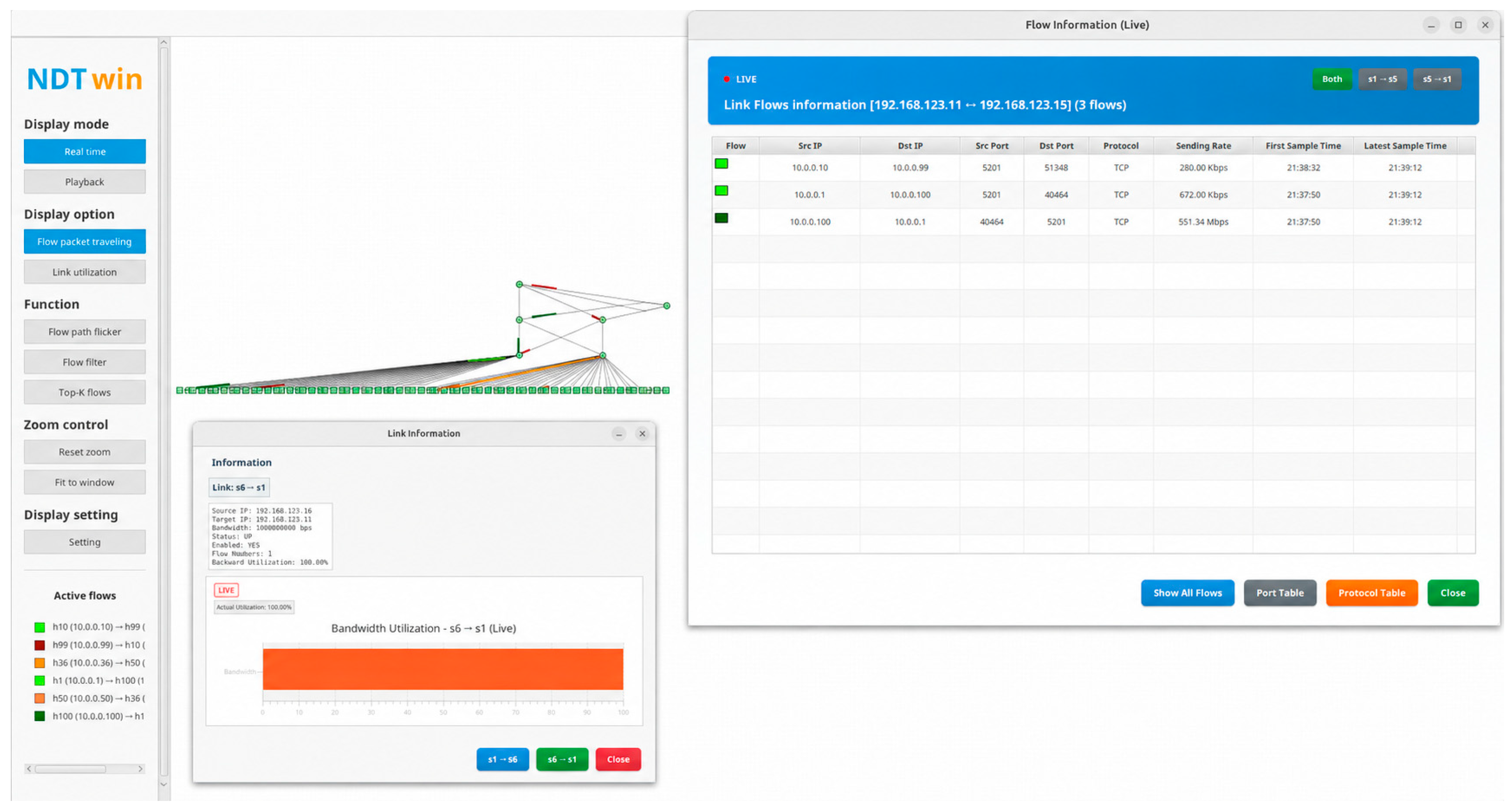
When the system detects congestion, it utilizes network state record/playback to perform rehearsals in the virtual environment. The Network Re-Arrangement module then executes path changes, followed by monitoring to verify the effectiveness of the automated closed-loop management. The network state snapshot function captures link connections and flow traffic between physical switches. This state is presented in the virtual environment via an automated topology layout module developed in this work [6] (Figure 2).
Figure 2.
Automated topology layout and network traffic monitoring. The screenshot illustrates the simultaneous display of the network topology, link information, and flow information. The overlapping windows and truncated sidebar entries reflect the interface state at the time of capture; individual entries and numerical values are not intended to be read from this overview. Different colors distinguish individual traffic flows, with corresponding colors used in the topology view, active-flow list, and flow-information table.
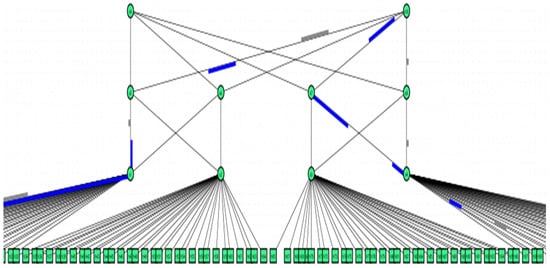
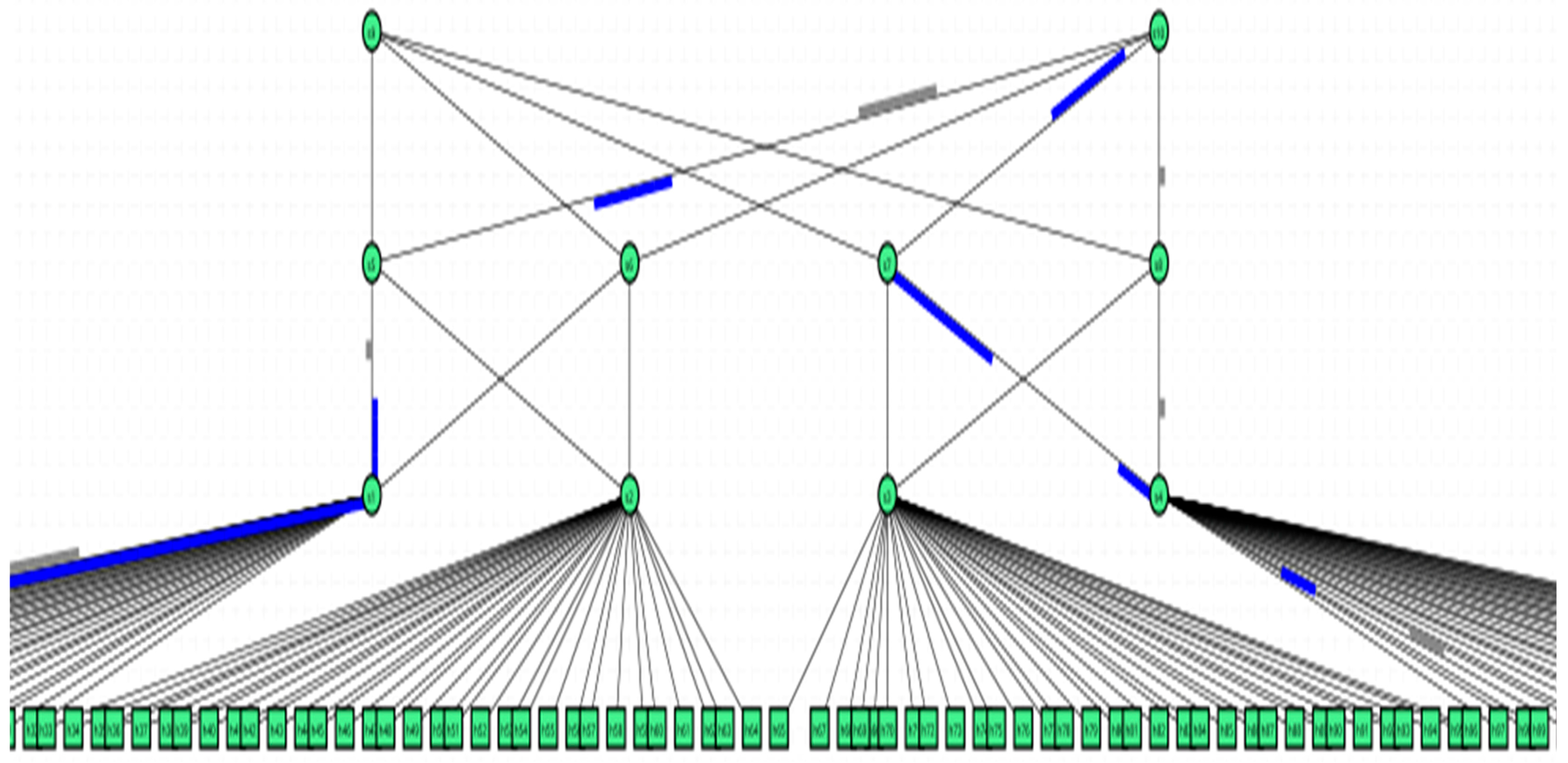
For network re-arrangement, an SDN controller is used to modify flow tables, dynamically guiding congested traffic to idle paths [4]. The packet path tracing function is then used to track and confirm the accuracy of the new routes (Figure 3).
Figure 3.
Network topology and traffic-flow visualization. Green symbols represent network devices, including switches and hosts, while gray and black lines represent network links. Blue segments indicate the positions of animated traffic-flow markers along their routes at the time of capture. The figure provides an overview of the topology and traffic visualization; densely packed host labels and connections extending beyond the displayed area are not intended for individual inspection.
The proposed system has been deployed in Taiwan’s largest telecommunication operators. The results showed significant performance improvements across key operational indicators, as shown in Table 1. Notably, the time required for network re-arrangement during each dynamic congestion event has been drastically reduced from 8 to 1 h, representing an 87.5% optimization in operational efficiency. The frequency of user complaints regarding network speed degradation dropped from 412 cases per month to 121 cases, achieving a 70.6% reduction. The outcomes indicate a substantial enhancement in both network stability and customer satisfaction.
Table 1.
Performance improvement in operational efficiency and customer satisfaction.
5. Conclusions
We developed a digital twin network monitoring and analysis system based on the TM Forum IG1310A DT4DI reference architecture. By implementing real-time mirroring, visualization, and record/playback functions, traffic scheduling and rehearsals were effectively conducted without interfering with current network operations. Advanced AI traffic prediction models and business process management must be adopted in the developed system for automated network mitigation and enhanced decision intelligence.
Author Contributions
Conceptualization, T.-E.C. and C.-W.C.; methodology, T.-E.C.; software, T.-E.C.; validation, T.-E.C. and C.-W.C.; formal analysis, T.-E.C.; investigation, C.-W.C.; writing—original draft preparation, T.-E.C.; writing—review and editing, C.-W.C. All authors have read and agreed to the published version of the manuscript.
Funding
This research received no external funding.
Institutional Review Board Statement
Not applicable.
Informed Consent Statement
Not applicable.
Data Availability Statement
The original contributions presented in this study are included in the article. Further inquiries can be directed to the corresponding author.
Acknowledgments
The authors used the web-based version of Gemini (Google, Mountain View, CA, USA; specific model version not recorded) during manuscript preparation to assist with minor language editing and translation. All AI-assisted text was thoroughly reviewed and revised by the authors, who take full responsibility for the accuracy and integrity of the final work.
Conflicts of Interest
Author Chih-Wei Chang is employed by Chunghwa Telecom Co., Ltd. The company provided no funding for this study and had no role in the study design, data collection, analysis, manuscript preparation, or decision to publish. The authors declare no other conflicts of interest.
References
- Huang, C.L.; Chen, J.Y.; Huang, Y.C. Using a digital twin for verification of automatic fulfillment procedures in telecom services. In Proceedings of the NOMS 2024—IEEE Network Operations and Management Symposium, Seoul, Republic of Korea, 6–10 May 2024; pp. 1–3. [Google Scholar]
- TM Forum. Available online: https://www.tmforum.org/resources/introductory-guide/ig1310a-digital-twin-for-decision-intelligence-dt4di-reference-architecture-v2-2-0/ (accessed on 3 February 2026).
- TM Forum. Available online: https://www.tmforum.org/resources/introductory-guide/gb1022-oda-functional-architecture-guidebook-v1-1-0/ (accessed on 3 February 2026).
- McKeown, N.; Anderson, T.; Balakrishnan, H.; Parulkar, G.; Peterson, L.; Rexford, J.; Shenker, S.; Turner, J. OpenFlow: Enabling innovation in campus networks. ACM SIGCOMM Comput. Commun. Rev. 2008, 38, 69–74. [Google Scholar]
- Chang, C.W.; Jung, P.; Hung, C.C.; Chang, Y.C. Detect silent failures with network sentinel. In Proceedings of the 2024 IEEE Network Operations and Management Symposium (NOMS), Seoul, Republic of Korea, 6–10 May 2024; pp. 1–6. [Google Scholar]
- Network Digital Twins with Artificial Intelligence. Available online: https://www.ndtwin.org (accessed on 3 February 2026).

Disclaimer/Publisher’s Note: The statements, opinions and data contained in all publications are solely those of the individual author(s) and contributor(s) and not of MDPI and/or the editor(s). MDPI and/or the editor(s) disclaim responsibility for any injury to people or property resulting from any ideas, methods, instructions or products referred to in the content. |
© 2026 by the authors. Licensee MDPI, Basel, Switzerland. This article is an open access article distributed under the terms and conditions of the Creative Commons Attribution (CC BY) license.