


Abstract
Using recycled aerospace prepreg, Kevlar fiber, and carbon nanotube-modified epoxy resin, composite personal protective equipment is fabricated. The fiber and resin ratios of the aerospace prepreg are precisely controlled to ensure the stability and reliability of the final structural components. Aerospace-grade carbon fiber possesses ultra-high strength and high modulus. However, it must be stored in extremely low temperatures (approximately −18 °C), and even then, the prepreg has a defined shelf life, after which it must be discarded. This limits the flexibility of production planning and increases the risk of material waste, and the material itself is expensive. Kevlar fiber also exhibits high toughness, high abrasion resistance, and excellent impact resistance, making it an ideal material for protective clothing. To overcome the constraints, we introduce a vacuum-assisted resin transfer molding process to appropriately stack the aforementioned raw materials, inject carbon nanotube-modified epoxy resin, and cure at room temperature to prepare composite personal protective equipment with a sandwich structure. The mechanical properties of this composite material were evaluated for impact testing and flexural strength to verify the practicality and application potential of combining recycled aerospace materials with carbon nanotube resin for personal protection. The fabricated equipment serves as a feasible solution for the sustainable development of high-performance composite materials.
1. Introduction
The rapid advancement of composite materials has led to a substantial increase in the use of carbon fiber-reinforced plastics in commercial aviation. For instance, more than 50% of the structural weight of the Boeing 787 and Airbus A350 contains composite materials, driving demand for aerospace-grade carbon fiber prepregs [1]. However, these prepregs exhibit limited shelf lives and require strict storage conditions, including cryogenic freezing. In practice, large quantities are discarded once the resin exceeds its designated shelf life, despite the carbon fibers retaining their mechanical integrity. This issue contributes to elevated material costs, significant waste, and environmental burdens [2,3].
Current recycling methods for waste composites primarily involve pyrolysis, chemical dissolution, or mechanical separation [4]. These methods, however, are constrained by high energy requirements, the release of hazardous byproducts, and substantial degradation of fiber properties [5]. Consequently, they fail to preserve the high-strength characteristics essential for aerospace-grade applications. To address these challenges, this study aims to develop a sustainable and efficient reprocessing strategy that bypasses the limitations of traditional destructive recycling [6]. The primary objective is to fabricate high-performance, impact-resistant hybrid composites by combining expired aerospace-grade prepregs with Kevlar fibers [5,6,7] and carbon nanotube (CNT)-modified epoxy resin [1,2,3,4] using a vacuum-assisted resin transfer molding (VARTM) process [8,9,10,11]. By evaluating the synergistic effects of these materials under different sandwich configurations, this research seeks to solve the economic and environmental issues associated with prepreg disposal [12,13]. Ultimately, this approach provides a viable pathway to upcycle aviation waste into valuable personal protective equipment, preserving the inherent mechanical integrity of the fibers while promoting sustainability in composite manufacturing.
2. Materials and Methods
Composite laminates were fabricated using vacuum-assisted resin transfer molding (VARTM). The matrix consisted of a carbon nanotube (CNT)-modified epoxy resin, prepared by dispersing CNTs into the epoxy system. Reinforcements included expired aerospace-grade prepreg, Kevlar fibers, and an elastic cushioning polymer pad. To examine the effects of different sandwich configurations on mechanical performance, four specimen designs were prepared.
- A: CNT-Epoxy/recycled prepreg;
- B: CNT-Epoxy/recycled prepreg/Kevlar;
- C: CNT-Epoxy/recycled prepreg/polymer pad;
- D: CNT-Epoxy/recycled prepreg/Kevlar/polymer pad.
The VARTM process began with mold cleaning using acetone, followed by application of release wax and sealing strips. The resin was prepared at a weight ratio of 100:70 (epoxy to hardener), with a total mass of approximately 850 g. After stacking the designated materials, the assembly was sealed and evacuated to ensure the complete fiber impregnation of resin infiltration under negative pressure. The material was cured at ambient temperature. The laminates were subsequently cut using a diamond saw (Sawmaster R1048, Sawmaster, Riverside, CA, USA, 3240 rpm) at a feed rate of 0.2–0.5 cm/s. Specimens were prepared for mechanical testing with dimensions of 1.5 × 5 cm for impact tests and 2 × 7 cm for three-point bending tests.
According to the American Society for Testing and Materials D790 standard [14], the bending properties of the test specimens were measured using a universal testing machine (Instron 3369, Instron, Norwood, MA, USA, maximum load 50 kN) equipped with Bluehill 3 software (Instron, Norwood, MA, USA). Test conditions were set with a span of 65 mm and a clamp descent rate of 0.3 mm/min. The bending strength (S) and strain value (r) were calculated using the following formulas:
where P is the load, L is the span, b and d are the width and thickness of the specimen, and D is the center deformation.
The impact test was performed using an Izod cantilever beam impact testing machine (TMI No. 43-01, Testing Machines, Inc., New Castle, DE, USA) according to the ASTM D256 standard [15]. Two pendulum calibrations were performed before testing to obtain the average error. A 5-pound pendulum was used for the groups without padding (A and B), and a 30 lb pendulum was used for the groups with padding (C and D). The impact energy value (F, in lb-ft/in) was calculated using the following formula:
where P is the impact indication value, a and b are the pendulum correction values, and A is the specimen thickness.
To investigate the failure mechanisms of composite materials under mechanical loads, this study utilized a high-resolution charged-coupled device imaging system (WAT-502A, Watec Co., Ltd., Yamagata, Japan, Black & White 1/3) to capture the cross-sectional morphology of specimens after impact and three-point bending tests. This system, equipped with a zoom lens (ZOOM LENS 18-108mm/2.5f, CBC Co., Ltd., Tokyo, Japan) with 6× optical zoom, effectively captured subtle features of the damaged areas of the specimens.
Interfacial bonding was evaluated by examining the wettability and bonding strength between the CNT-modified epoxy resin and the reinforcing components, including aerospace-grade prepreg, Kevlar fibers, and the elastic cushioning material. Failure modes were analyzed through imaging to identify characteristic behaviors such as delamination, fiber pull-out, and matrix cracking. Particular attention was given to the cracking process and the deformation of the cushioning layer to clarify how different stacking designs influence crack propagation. The energy absorption mechanism was investigated by correlating impact energy data with the roughness and failure area of fracture surfaces, elucidating the dissipation pathways of composite materials under dynamic loading.
3. Results and Discussion
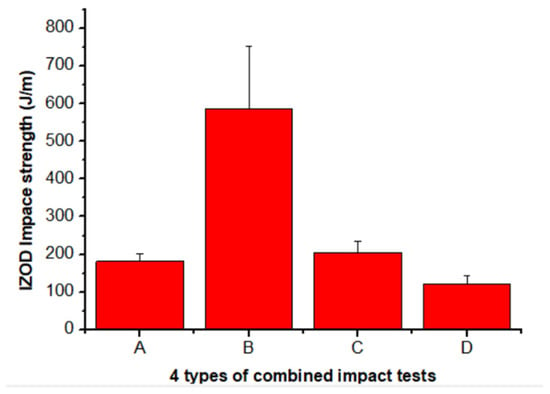
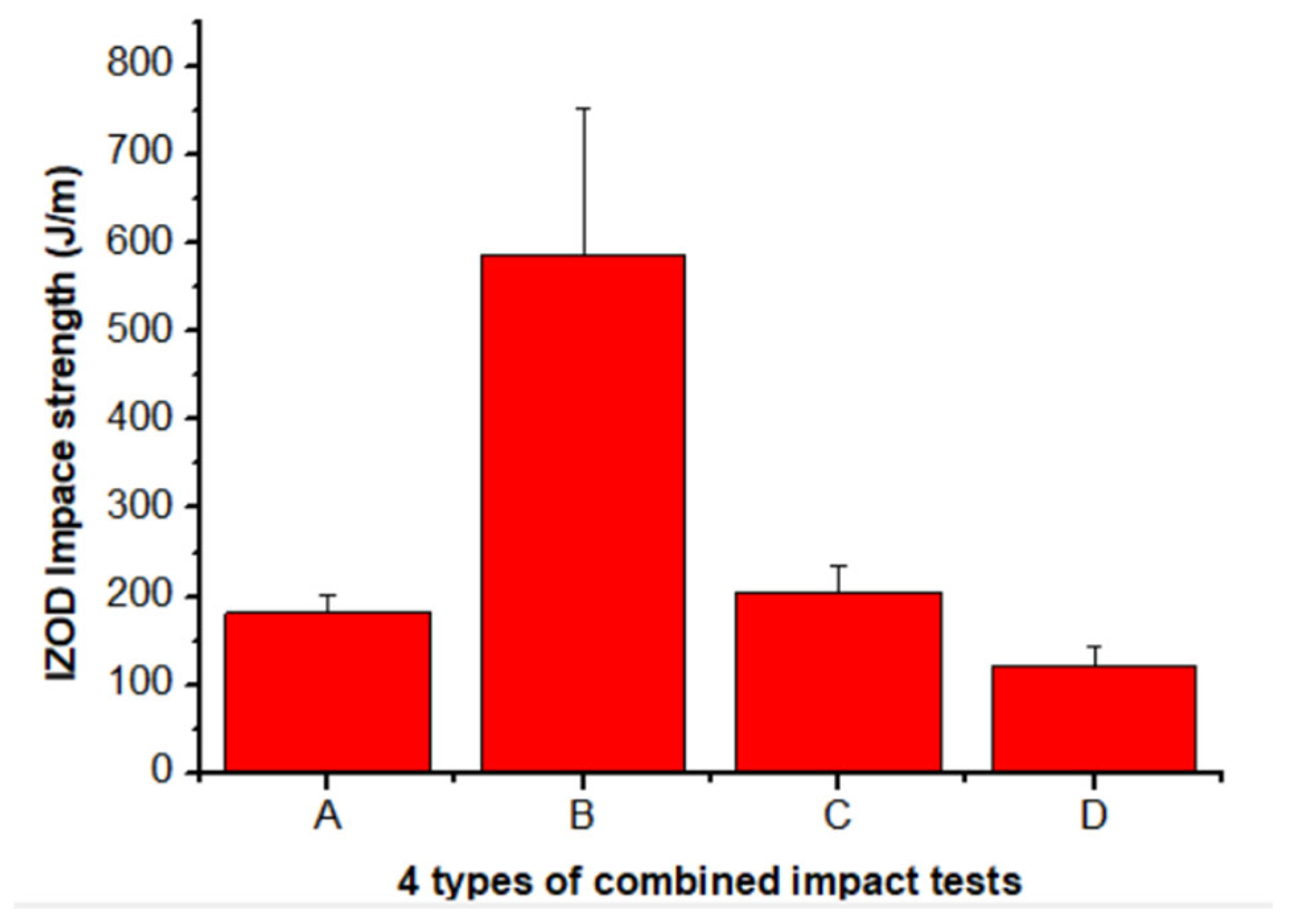
Izod impact tests were conducted on specimens with four different formulations, as shown in Figure 1. The data indicate that interfacial bonding quality and the mechanical synergy between layers are decisive factors in determining impact energy absorption.
Figure 1.
Impact test of composites.
When only recycled prepreg was incorporated (Combination D), the impact strength was 121.6 J/m, the lowest among all groups. This reduction is attributed to residual resin on the surface of the recycled aerospace prepreg, which hindered effective bonding with the CNT-modified epoxy. The insufficient wetting produced a weak interface, limiting overall impact resistance.
The addition of reinforcement and padding materials significantly improved performance. Incorporating an elastic cushioning polymer pad (Combination A) increased strength to 181.3 J/m, showing that the pad redistributed stress and compensated for poor interfacial bonding. Introducing Kevlar fibers (Combination C) further raised the average strength to 204.8 J/m. The high strength and low elongation of Kevlar promoted strong adhesion with the CNT resin, enabling efficient stress transfer and enhanced energy dissipation.
The most effective configuration was the hybrid laminate containing recycled prepreg, Kevlar fibers, and elastic padding (Combination B), which achieved an average strength of 584.6 J/m. This improvement resulted from the synergistic soft–hard layering: the elastic pad absorbed vibration energy and delayed stress wave transmission during impact, while Kevlar fibers and the CNT resin system carried the remaining load. This mechanism transformed brittle fracture into a resilient energy absorption process. In summary, although recycled prepreg interfaces are limited by residual resin, optimized reinforcement with Kevlar and elastic padding significantly enhances impact resistance.
Flexural testing revealed contrasting trends. Groups without elastic padding (Combinations A and B) exhibited the highest flexural strength. The pure recycled prepreg laminate (Combination A) reached 76.7 MPa, confirming that the carbon fiber layer maintained structural rigidity with CNT resin support. Introducing Kevlar fibers (Combination B) slightly reduced the strength to 73.8 MPa, likely due to interfacial slippage caused by residual resin, which weakened bonding under bending loads.
In contrast, laminates containing elastic padding (Combinations C and D) showed drastic reductions in flexural strength. The pure padding group (Combination C) decreased to 11.5 MPa, whereas the addition of Kevlar fibers (Combination D) improved strength to 19.1 MPa. The low shear modulus of the elastic pad prevented effective stress transfer, shifting the neutral axis and causing excessive local deformation. The improvement in Combination D, approximately 66% higher than Combination C, demonstrates that Kevlar fibers provided partial structural reinforcement in a weakly rigid environment.
The recycled prepreg and CNT-epoxy formed the rigid backbone of the laminate, sustaining flexural strength above 70 MPa. Kevlar fibers and elastic padding contributed primarily to dynamic energy absorption, with impact resistance reaching 584.6 J/m (Figure 1). Although elastic padding reduced static bending stiffness by 75–85%, its role in dynamic protection highlights a promising design pathway. Hybrid laminates combining recycled prepreg, Kevlar fibers, and elastic padding offer a viable strategy for repurposing aerospace waste composites into high-performance protective plates and impact-buffer components.
4. Conclusions
We developed a composite material composed of recycled carbon fiber, Kevlar fiber, a carbon nanotube-modified epoxy resin, and elastic cushioning polymer padding and evaluated its feasibility for self-defense protective applications. The results show that Kevlar fiber significantly enhances impact resistance compared with a pure recycled carbon fiber structure. In particular, the four-phase hybrid laminate (Combination B) achieved an average strength of 584.6 J/m, confirming its strong dynamic energy absorption capacity and potential as a protective material.
Flexural testing results showed that laminates without elastic padding exhibited substantially higher stiffness, with an average strength difference of approximately 60 MPa compared with padded groups. This reduction is attributed to the separation of fiber layers caused by the elastic pad, which forces the upper fiber layer to bear the initial load. Once the upper layer fails, stress is absorbed by the ductile pad, leading to premature termination of loading. This mechanism accounts for the poor static bending performance of specimens containing cushioning material.
The results highlight the potential of hybrid laminates incorporating recycled prepreg, Kevlar fibers, and elastic padding for applications requiring high impact resistance. Beyond personal protective equipment, such as helmet liners and impact gear, these materials are extended to aerospace structures and vehicle crumple zones. Demonstrating that recycled carbon fiber can retain mechanical strength comparable to virgin material would advance sustainable practices in the composites industry, reducing waste and promoting environmental protection.
In further studies, it is required to determine the maximum load-bearing capacity without permanent deformation and to improve the reliability of the VARTM process by addressing defects such as bubble entrapment and incomplete resin impregnation.
Author Contributions
Conceptualization, W.-J.C.; methodology, W.-J.C.; validation, M.-H.H.; formal analysis, C.-C.C., Y.-H.S., C.-Z.Y., M.-H.K. and C.-A.H.; investigation, C.-C.C., Y.-H.S., C.-Z.Y., M.-H.K. and C.-A.H.; data curation, C.-C.C., Y.-H.S., C.-Z.Y., M.-H.K. and C.-A.H.; writing—original draft preparation, W.-J.C.; writing—review and editing, M.-H.H.; supervision, M.-H.H. All authors have read and agreed to the published version of the manuscript.
Funding
This research received no external funding.
Institutional Review Board Statement
Not applicable.
Informed Consent Statement
Not applicable.
Data Availability Statement
The data presented in this study are available in the article.
Conflicts of Interest
The authors declare no conflict of interest.
References
- Lin, D.-S. Mechanical and Dynamic Properties of MWNTs/Epoxy Composites. Master’s Thesis, National Tsing Hua University, Hsinchu, Taiwan, 2024. [Google Scholar]
- Shen, M. Study on the Synergistic Effect of Different Dimensional Carbon Nanomaterials on the Reinforcement Behavior, Thermoelectric Properties and Morphology of Epoxy/Carbon Fiber Composites; Final Project Report MOST 101-2221-E-035-037-MY2; Ministry of Science and Technology: Taipei, Taiwan, 2014.
- Yang, K.-T. Effect of Different CNT Addition on the Mechanical Behavior of Carbon Fiber Fabric/Phenolic Resin Composites. Master’s Thesis, Tatung University, Taipei, Taiwan, 2010. [Google Scholar]
- Gojny, F.H.; Wichmann, M.H.G.; Fiedler, B.; Bauhofer, W.; Schulte, K. Influence of nano-modification on the mechanical and electrical properties of conventional fibre-reinforced composites. Compos. Part A Appl. Sci. Manuf. 2005, 36, 1525–1535. [Google Scholar] [CrossRef] [Scilit]
- Ursache, Ș.; Cerbu, C.; Hadăr, A. Characteristics of Carbon and Kevlar Fibres, Their Composites and Structural Applications in Civil Engineering—A Review. Polymers 2024, 16, 127. [Google Scholar] [CrossRef] [Scilit] [PubMed]
- Wang, F.-X. Research on Impact Properties of Carbon Fiber Composites Reinforced with Nano-Reinforcing Materials. Master’s Thesis, National Kaohsiung University of Applied Sciences, Kaohsiung, Taiwan, 2016. [Google Scholar]
- Wang, B.; He, B.; Wang, Z.; Qi, S.; Zhang, D.; Tian, G.; Wu, D. Enhanced Impact Properties of Hybrid Composites Reinforced by Carbon Fiber and Polyimide Fiber. Polymers 2021, 13, 2599. [Google Scholar] [CrossRef] [Scilit] [PubMed]
- Patel, K.; Potluri, P.; Yousaf, Z.A. Multiscale reinforcement of epoxy composites—Use of carbon fibre fabrics coated with an epoxy binder containing MWCNTs for improved interlaminar fracture resistance. Compos. Part B Eng. 2019, 165, 109–119. [Google Scholar] [CrossRef] [Scilit]
- Hashim, N.; Majid, D.L.; Uda, N.; Zahari, R.; Yidris, N. Vacuum infusion method for woven carbon/Kevlar reinforced hybrid composite. IOP Conf. Ser. Mater. Sci. Eng. 2017, 270, 012021. [Google Scholar] [CrossRef] [Scilit]
- Marom, G.; Drukker, E.; Weinberg, A.; Banbaji, J. Impact behaviour of carbon/Kevlar hybrid composites. Composites 1986, 17, 150–153. [Google Scholar] [CrossRef] [Scilit]
- Akbolat, M.Ç.; Wang, S.; Katnam, K.B.; Potluri, P.; Soutis, C. Low-velocity impact response of carbon/epoxy laminates with interlaminar hybrid toughening via core–shell-rubber particles and non-woven thermoplastic fibre veils. Compos. Part A Appl. Sci. Manuf. 2025, 195, 108944. [Google Scholar] [CrossRef] [Scilit]
- Chen, L.; Wu, L.-W.; Jiang, Q.; Tian, D.; Zhong, Z.; Wang, Y.; Fu, H.-J. Improving Interlaminar Fracture Toughness and Impact Performance of Carbon Fiber/Epoxy Laminated Composite by Using Thermoplastic Fibers. Molecules 2019, 24, 3367. [Google Scholar] [CrossRef] [Scilit] [PubMed]
- Matykiewicz, D.; Barczewski, M.; Mousa, M.S.; Sanjay, M.R.; Siengchin, S. Impact Strength of Hybrid Epoxy–Basalt Composites Modified with Mineral and Natural Fillers. ChemEngineering 2021, 5, 56. [Google Scholar] [CrossRef] [Scilit]
- ASTM D790-17; Standard Test Methods for Flexural Properties of Unreinforced and Reinforced Plastics and Electrical Insulating Materials. ASTM International: West Conshohocken, PA, USA, 2017.
- ASTM D256-10 (2018); Standard Test Methods for Determining the Izod Pendulum Impact Resistance of Plastics. ASTM International: West Conshohocken, PA, USA, 2018.
Disclaimer/Publisher’s Note: The statements, opinions and data contained in all publications are solely those of the individual author(s) and contributor(s) and not of MDPI and/or the editor(s). MDPI and/or the editor(s) disclaim responsibility for any injury to people or property resulting from any ideas, methods, instructions or products referred to in the content. |
© 2026 by the authors. Licensee MDPI, Basel, Switzerland. This article is an open access article distributed under the terms and conditions of the Creative Commons Attribution (CC BY) license.