


Abstract
In the present study, the sensitivity of poly(lactic acid) (PLA) to thermomechanical degradation was investigated using a Brabender internal mixer (50EHT) equipped with roller-type blades. The effect of residence time was examined by varying it from 2.5 to 25 min. Molecular degradation was analyzed by torque rheometry and correlated with melt flow rate measurements. Changes in mechanical properties were evaluated through tensile tests. The results indicate that increasing residence time considerably reduces melt viscosity, as evidenced by a substantial increase in melt flow rate. However, reductions in tensile strength and modulus were minimal, suggesting that the molar mass did not decrease below a critical threshold at which mechanical properties would deteriorate markedly. These findings show that, within the investigated processing window, PLA undergoes measurable molecular degradation without a corresponding loss in mechanical integrity, which is relevant for processing optimization and industrial processing conditions.
1. Introduction
As global awareness regarding the End-of-Life (EoL) management of plastics and their predominantly non-renewable origin continues to grow, the large-scale production and consumption of polymeric materials have become considerable sustainability challenges. Numerous strategies and plans have been implemented, including national legislation and international directives, to address the issues related to plastic waste accumulation and to promote a circular economy [1]. Therefore, more and more research efforts are devoted to lowering the environmental impact of plastics through improved recycling technologies and the development of natural resource-derived and biodegradable alternatives to the currently available selection [1,2].
Among biopolymers, poly(lactic acid) (PLA) is currently the most widely used owing to its favorable processability and mechanical properties. PLA is a linear aliphatic thermoplastic polyester derived from lactic acid, which is achieved through the fermentation of carbohydrate-rich feedstocks [3]. Its properties are comparable to those of conventional commodity plastics such as polystyrene (PS) and poly(ethylene terephthalate) (PET), making it a promising biodegradable alternative for applications in packaging, biomedical devices, additive manufacturing, and consumer products [4]. PLA is commonly processed by extrusion, injection molding, and fused filament fabrication, techniques operating above the melting point of PLA. During melt processing, PLA is exposed to various degradation mechanisms, including hydrolysis, thermo-oxidative degradation, and shear-induced degradation, which collectively facilitate macromolecular chain scission [5,6].
Because the physical, mechanical, thermal, and rheological properties of PLA are strongly dependent on its molar mass and molar mass distribution, understanding degradation during melt processing is important for maintaining consistent rheological and mechanical performance [7]. Accordingly, a large body of work has been devoted to investigating processing-induced degradation and its effect on the properties of PLA [8]. However, most studies primarily rely on offline characterization methods, such as gel permeation chromatography, melt flow measurements, and conventional rheological analyses. On the other hand, little attention has been paid to the possibility of monitoring degradation directly during processing using torque rheometry.
Torque rheometers, such as Thermo Fischer’s Haake PolyLab and Anton Paar’s Brabender Metastation, equipped with internal mixing chambers, are an appropriate tool for monitoring the thermomechanical degradation of polymers through the continuous measurement of mixing torque under controlled temperature and shear conditions. As a result, they provide an effective means to simulate the processing conditions within industrial melt processing machines, such as extruders, while simultaneously enabling the investigation of degradation mechanisms [9,10].
Unlike melt flow measurements, capillary rheometry, or molar mass characterization techniques, which provide only end-point information, torque rheometers allow continuous monitoring of the evolution of melt resistance throughout the processing cycle [11]. While torque rheometry cannot provide very precise values of the absolute viscosity, it offers a major advantage for studying degradation kinetics in real-time during processing [12]. Furthermore, once correlations between torque and material properties have been established, molar mass, melt flow behavior, and viscosity may be estimated from a single torque-rheometry experiment without the need for repeated measurements [13].
Accordingly, the aim of the present study is to investigate the thermomechanical degradation of PLA during melt processing in an internal mixer operated at constant temperature and rotational speed while varying the mixing time. Molecular degradation was monitored through melt flow rate measurements performed after predetermined processing intervals. The obtained melt flow data were subsequently used to estimate the molar mass of the processed PLA and to establish a quantitative correlation between mixing torque and molar mass. In addition, the influence of degradation on the mechanical performance of PLA was evaluated by tensile testing.
2. Materials and Methods
2.1. Material
Poly(lactic acid), grade Ingeo™ Biopolymer 2003D, was supplied by NatureWorks (Minnetonka, MN, USA). The polymer has a D-lactide content of ~4.3% and a density of 1.24 g/cm3. Its weight-average molar mass (Mw) is typically reported in the range of 180,000 to 232,000 g/mol in the literature [14,15].
2.2. Processing
Prior to melt mixing, the PLA pellets were dried in a Faithful WGLL-125BE air-circulating drying oven (Huanghua, Cangzhou, China) at 80 °C for 4 h to prevent hydrolytic degradation during processing.
Thermomechanical treatment was carried out using an Anton Paar Brabender Metastation 8 (Duisburg, Germany) equipped with a 50EHT type internal mixer chamber fitted with roller-type rotors. The chamber temperature was 180 °C, while the rotor speed was fixed at 60 rpm throughout the experiments, with both parameters selected based on literature data [16]. For each measurement, 50 g of PLA was introduced into the preheated mixing chamber, corresponding to a fill factor of ~80%.
Processing under industrial circumstances (e.g., extrusion) commonly involves residence times of 2.5–5 min, whereas internally recycled material may undergo multiple processing cycles and thus substantially longer exposure. Therefore, in the current experiment, PLA was processed for predetermined times of 2.5, 5, 10, 15, and 25 min to induce different levels of thermomechanical degradation. To ensure that the reported processing time corresponded to the thermomechanical treatment of the molten polymer, torque recording and mixing time evaluation were initiated 0.5 min after material introduction. This interval allowed the completion of material feeding, pellet compaction, and chamber filling, thereby eliminating torque fluctuations associated with the loading stage. With increasing mixing time, PLA became slightly yellower, indicating gradual degradation.
Following the thermomechanical treatment, the processed PLA samples were compression molded into sheets of 2 mm thickness using a Labtech LP-20B hydraulic hot press (Samut Prakarn, Thailand). Compression molding was carried out at 180 °C for 2 min under a pressure of 100 bar. The compression-molded sheets were cooled to 40 °C inside the mold for 5 min whilst maintaining pressure.
2.3. Characterization
Melt flow rate (MFR) measurements were performed using a Ceast 7026.000 Modular Melt Flow Tester (Pianezza, Italy) in accordance with ISO 1133 [17]. The measurements were carried out at a temperature of 180 °C under a load of 2.16 kg.
Tensile properties were determined using an Instron 5582 universal testing machine (Norwood, MA, USA) equipped with a 10 kN load cell and an Instron video extensometer. Rectangular specimens with a cross-section of 10 × 2 mm2 were cut from the compression-molded sheets. The gauge length was set to 58 mm. Tensile tests were performed at a crosshead speed of 5 mm/min; however, Young’s modulus was determined at a crosshead speed of 1 mm/min using strain data obtained from the video extensometer. Note that due to the rectangular geometry of the specimens, some fractured within the gripping section and were therefore excluded from the evaluation.
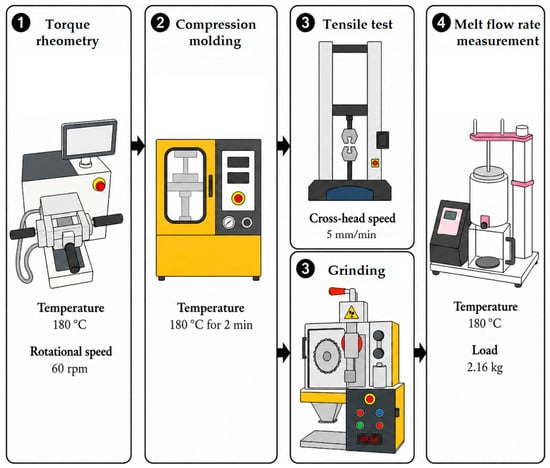
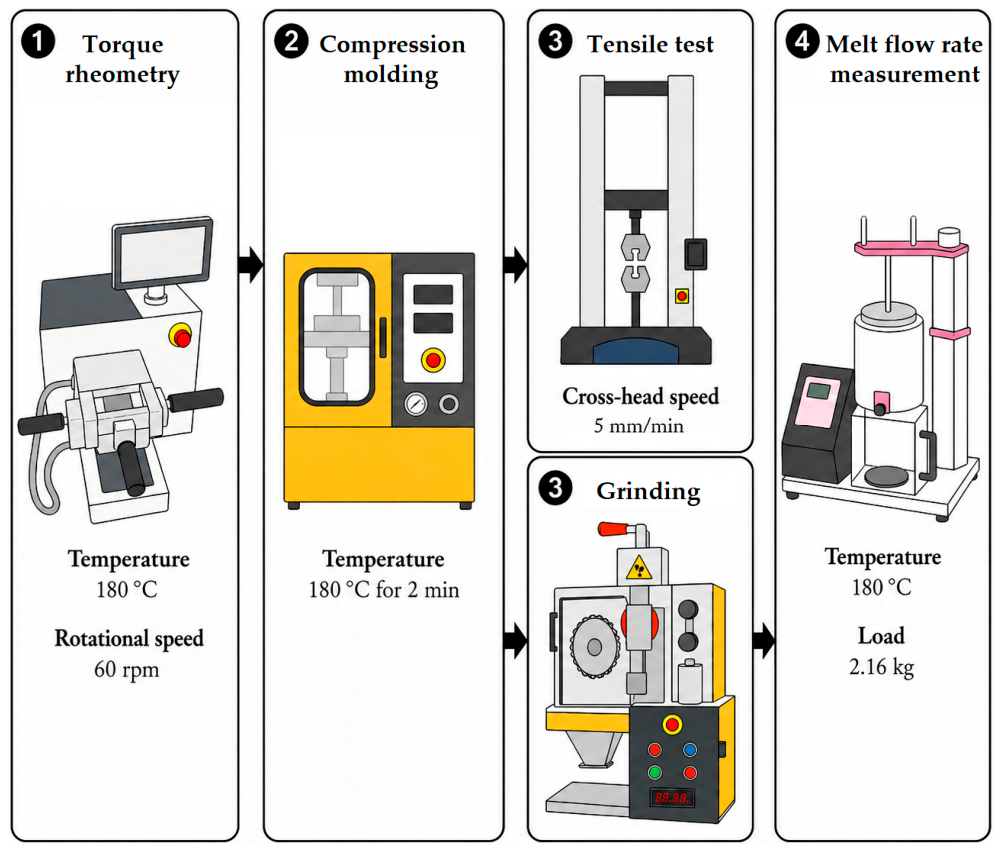
A schematic illustration of the processing and characterization steps performed is shown in Figure 1.
Figure 1.
Schematics of the performed processing and characterization steps.
3. Results and Discussion
3.1. Torque Rheometry
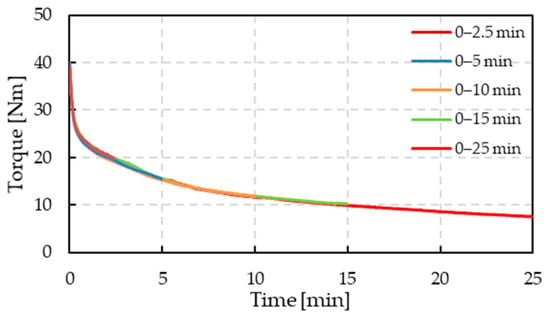
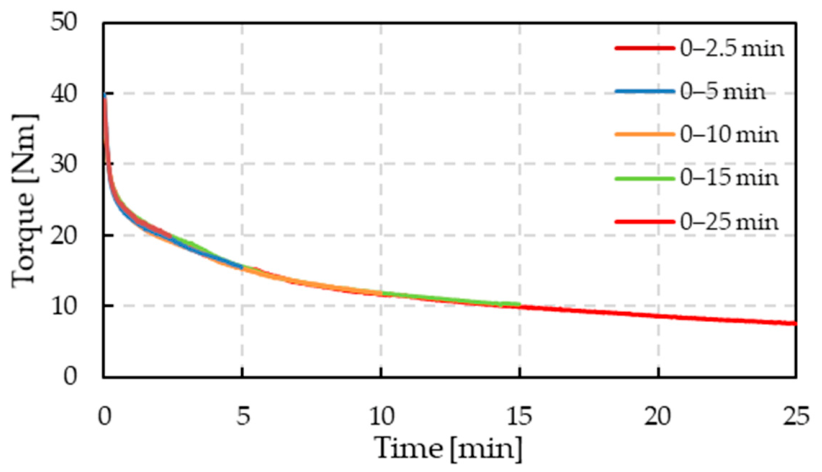
The torque–time curves recorded for the PLA samples subjected to different mixing durations are presented in Figure 2. Based on the results, the curves exhibit nearly complete overlapping throughout their common interval, indicating that the evolution of melt viscosity follows a reproducible degradation pathway during the melt processing. Accordingly, the measured torque is considered to be a reliable indicator of degradation after a given mixing time, as also reported in the literature [18]. As expected, the final torque values gradually decreased with increasing mixing time, from 17.5 Nm at 2.5 min to 7.7 Nm at 25 min, with values of 14.4, 11.8, and 10.3 Nm obtained after 5, 10, and 15 min, respectively.
Figure 2.
Torque–time curves for PLA samples processed over different times.
3.2. Melt Flow Behavior
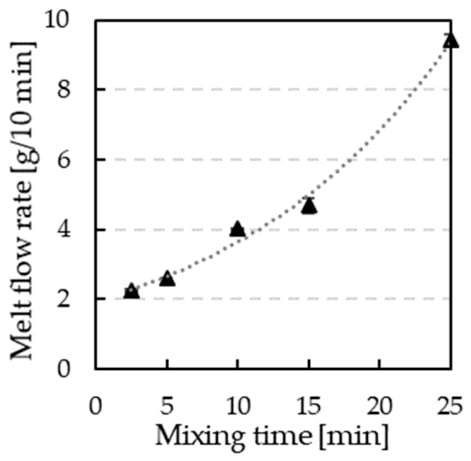
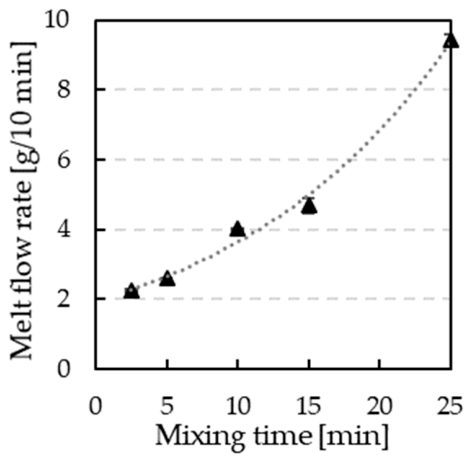
The evolution of PLA’s melt flow rate (MFR) was analyzed as a function of mixing time, as shown in Figure 3. The results reveal an increase in MFR with increasing mixing time following an exponential trend. The MFR increased from 2.2 g/10 min after 2.5 min of processing to 9.4 g/10 min after 25 min, corresponding to an overall growth of a factor of more than four. The progressive increase in MFR (decrease in melt viscosity) with increasing processing time is consistent with molar mass reduction caused by chain scission during the melt processing. These findings are in good agreement with the literature. Velghe et al. [8] reported that the processing-induced degradation of PLA is primarily governed by four factors: (i) moisture content, (ii) processing temperature, (iii) shear intensity, and (iv) residence time. Since the first three factors were kept constant throughout the present study, the increased MFR can be attributed to the increasing residence time in the mixer.
Figure 3.
The melt flow rate of PLA samples as a function of mixing time.
Although MFR cannot be directly converted into molar mass, Bremner and Rudin [19] proposed an empirical model based on an inverse relationship between MFR and Mw, as described in Equation (1). While the formula was originally proposed for the estimation of polyolefins’ molar mass, it has been found to accurately predict the Mw of PLA based on MFR measurements as well [20].
where x [-] is a fitting parameter assumed to be in the range of 3.0–4.6, and G is a material-dependent constant between 10−19 and 10−24 (10 min·g−1−x·molx) for most linear thermoplastics [19,21].
Based on preliminary experiments, the parameters x = 3.44 and G = 2.34 × 10⁻¹⁹ were found to accurately describe the relationship between MFR and molar mass for the PLA grade used in the present work (Ingeo™ 2003D). Using these parameters, the Mw values of the samples processed for different mixing times were calculated from the measured MFR values and summarized in Table 1.
Table 1.
The melt flow rate and the weight-average molar mass of PLA at different mixing times.
As expected, the weight-average molar mass decreased gradually with mixing time. Accordingly, the highest value of 208,000 g/mol was obtained for the sample processed for 2.5 min, monotonously decreasing to 137,000 after 25 min, corresponding to an overall reduction of ~35%. This progressive decrease in molar mass confirms the occurrence of thermomechanical degradation during melt processing, resulting from the combined effects of elevated temperature and shear-induced chain scission. Similar trends have been widely reported in the literature. Le Marec et al. [5] demonstrated that the weight-average molar mass of PLA is markedly affected by increasing processing temperature and residence time. Likewise, Pillin et al. [22] reported a decrease in the weight-average molar mass with increasing mixing time, which was ascribed to macromolecular chain scission occurring as a consequence of thermomechanical degradation.
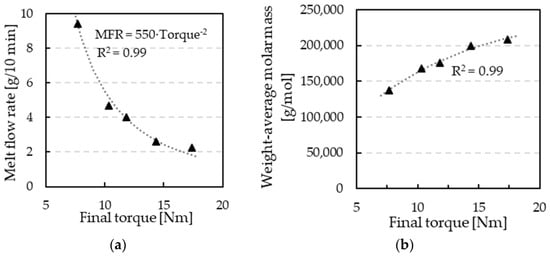
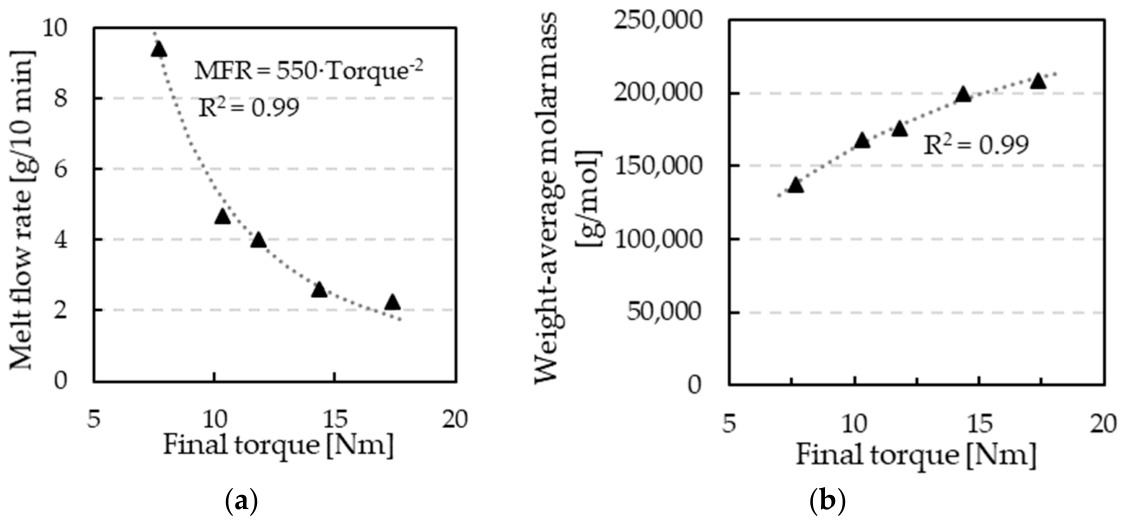
The measured MFR values were thereafter analyzed as a function of the final torque recorded during each mixing experiment. As shown in Figure 4a, a strong correlation was observed between the melt flow rate and the torque value, indicating that the torque measured during mixing may serve as a useful indicator of the rheological state of the material. Since MFR was successfully used to estimate the molar mass of the processed PLA, this observation further suggests that torque measurements may also be used to predict molar mass directly. To investigate this possibility, the weight-average molar mass values calculated from the MFR data (Table 1) were correlated with the corresponding equilibrium torque values, as presented in Figure 4b.
Figure 4.
The melt flow rate (a) and weight-average molar mass (b) of PLA samples as a function of final torque during melt mixing.
The results revealed a strong correlation between the torque and weight-average molar mass (Figure 4b). In order to quantitatively describe this relationship, an empirical equation was established based on regression analysis of the experimental data. An exponential function, given by Equation (2), was selected, providing the best agreement (R2 = 0.99) with the experimental data over the investigated degradation range. The proposed relationship enables the estimation of molar mass directly from in situ torque measurements acquired during processing, thereby offering a practical tool for rapid assessment of molecular degradation.
where A and B are fitting constants of 252,000 [-] and 6, 7 [-], respectively, while T [Nm] denotes the torque measured during the melt mixing.
3.3. Tensile Mechanical Properties
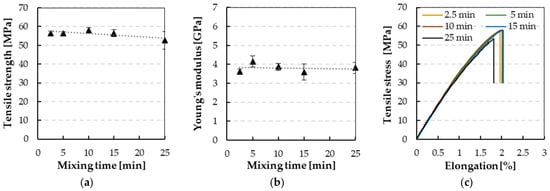
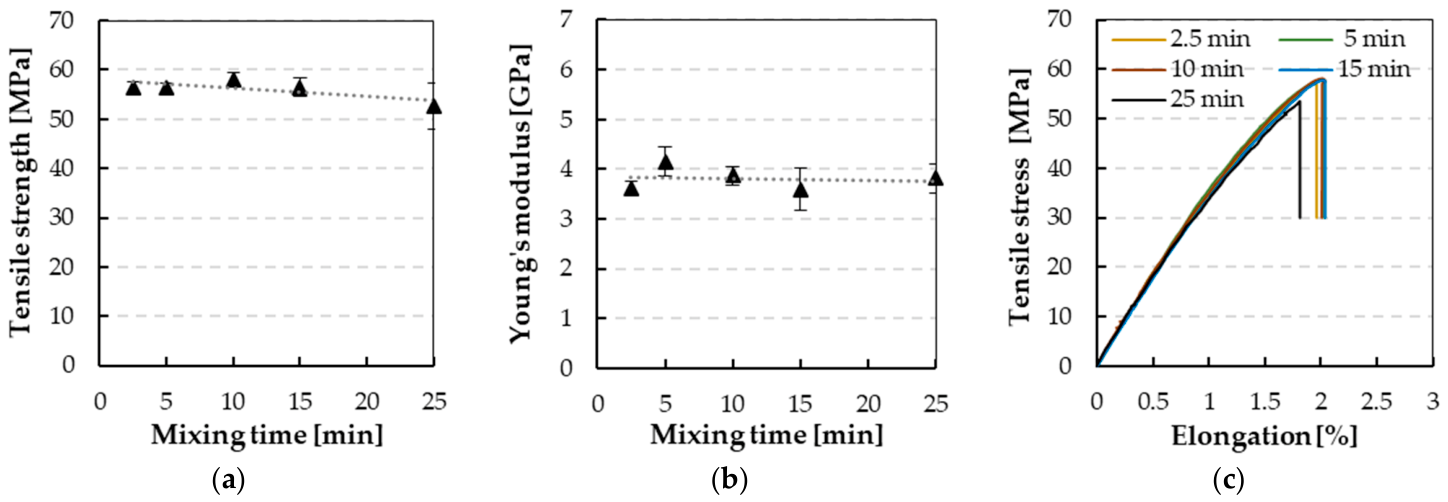
Figure 5a depicts the tensile strength, which shows a slight overall decrease as a function of mixing time. After the shortest mixing time of 2.5 min, PLA exhibited a tensile strength of 56.5 MPa, a value that is in good accord with those reported in the literature [23,24]. With further processing, the tensile strength remained rather constant up to 15 min, fluctuating within a narrow range of 56.3–57.9 MPa. After 25 min of mixing, the strength decreased by ~7% to 52.5 MPa, indicating molecular chain scission ascribed to the mixing process. This is assumed to lead to a reduction in entanglement density, which ultimately deteriorates the mechanical strength of the material. Such changes in tensile strength as a function of thermomechanical exposure are in good agreement with the melt flow results.
Figure 5.
Tensile mechanical performance of the PLA samples at different mixing times: (a) tensile strength, (b) Young’s modulus, and (c) representative tensile stress–strain curves.
Figure 5b shows the evolution of Young’s modulus as a function of mixing time. According to the experimental results, the modulus remained relatively constant throughout the 25 min of mixing, as the scatter in the measured values partially overlapped in all cases. The average values of modulus ranged from 3.6 to 4.1 GPa, and, unlike tensile strength, no significant loss was observed even after 25 min of melt mixing. This indicates that Young’s modulus is less sensitive to thermomechanical exposure compared to strength. Similar findings, i.e., the lower sensitivity of modulus to thermal and shear loading, have been reported in the literature [20,25] and are typically ascribed to the fact that modulus is governed primarily by bond stiffness rather than molecular entanglements. Figure 5c shows typical stress–strain curves, also highlighting that the elongation of the samples was barely affected by mixing time.
Overall, it can be concluded that all samples maintained a molar mass above a critical threshold below which tensile mechanical properties start to deteriorate drastically. This is consistent with previous findings [20], which show that tensile properties are markedly affected when molar mass decreases below an Mw of ~100,000 g/mol.
4. Conclusions
In this study, the thermomechanical degradation of poly(lactic acid) was investigated using torque rheometry under controlled melt-processing conditions. The influence of residence time was evaluated by processing the material for 2.5, 5, 10, 15, and 25 min in an internal mixer. Melt flow measurements showed gradually increasing MFR with increasing processing time, indicating progressive molecular degradation of the PLA. Based on the results, an empirical relationship was established between mixing torque and weight-average molar mass of PLA, enabling molar mass estimation directly from in situ processing data. Changes in mechanical properties were evaluated through tensile testing. The results showed a slight decrease in tensile strength and Young’s modulus with increasing degradation. The proposed approach demonstrates the potential of torque rheometry as a rapid and efficient tool for monitoring molecular degradation in PLA during melt processing.
Author Contributions
Conceptualization, L.L.; methodology, V.L.K.-B., S.K.J. and L.L.; validation, L.L.; formal analysis, V.L.K.-B. and S.K.J.; investigation, V.L.K.-B., S.K.J. and L.L.; resources, L.L.; data curation, S.K.J. and L.L.; writing—original draft preparation, V.L.K.-B., S.K.J. and L.L.; writing—review and editing, L.L.; visualization, V.L.K.-B. and L.L.; supervision, L.L.; project administration, L.L.; funding acquisition, L.L. All authors have read and agreed to the published version of the manuscript.
Funding
The work reported here was supported by the National Research, Development and Innovation Office (Hungary) through the project STARTING 150339.
Institutional Review Board Statement
Not applicable.
Informed Consent Statement
Not applicable.
Data Availability Statement
The raw data supporting the conclusions of this article will be made available by the authors on request.
Conflicts of Interest
The authors declare no conflicts of interest.
References
- Vlasopoulos, A.; Malinauskaite, J.; Żabnieńska-Góra, A.; Jouhara, H. Life cycle assessment of plastic waste and energy recovery. Energy 2023, 277, 127576. [Google Scholar] [CrossRef] [Scilit]
- Ronkay, F. Effect of Recycling on the Rheological, Mechanical and Optical Properties of Polycarbonate. Acta Polytech. Hung. 2013, 10, 209–220. [Google Scholar]
- Ramezani Dana, H.; Ebrahimi, F. Synthesis, properties, and applications of polylactic acid-based polymers. Polym. Eng. Sci. 2023, 63, 22–43. [Google Scholar] [CrossRef] [Scilit]
- Khouri, N.G.; Bahú, J.O.; Blanco-Llamero, C.; Severino, P.; Concha, V.O.C.; Souto, E.B. Polylactic acid (PLA): Properties, synthesis, and biomedical applications—A review of the literature. J. Mol. Struct. 2024, 1309, 138243. [Google Scholar] [CrossRef] [Scilit]
- Le Marec, P.E.; Ferry, L.; Quantin, J.-C.; Bénézet, J.-C.; Bonfils, F.; Guilbert, S.; Bergeret, A. Influence of melt processing conditions on poly(lactic acid) degradation: Molar mass distribution and crystallization. Polym. Degrad. Stab. 2014, 110, 353–363. [Google Scholar] [CrossRef] [Scilit]
- Wang, Y.; Steinhoff, B.; Brinkmann, C.; Alig, I. In-line monitoring of the thermal degradation of poly(l-lactic acid) during melt extrusion by UV–vis spectroscopy. Polymer 2008, 49, 1257–1265. [Google Scholar] [CrossRef] [Scilit]
- Aldhafeeri, T.; Alotaibi, M.; Barry, C.F. Impact of Melt Processing Conditions on the Degradation of Polylactic Acid. Polymers 2022, 14, 2790. [Google Scholar] [CrossRef] [Scilit] [PubMed]
- Velghe, I.; Buffel, B.; Vandeginste, V.; Thielemans, W.; Desplentere, F. Review on the Degradation of Poly(lactic acid) during Melt Processing. Polymers 2023, 15, 2047. [Google Scholar] [CrossRef] [Scilit] [PubMed]
- Goodrich, J.E.; Porter, R.S. A rheological interpretation of torque-rheometer data. Polym. Eng. Sci. 1967, 7, 45–51. [Google Scholar] [CrossRef] [Scilit]
- Cheng, B.; Zhou, C.; Yu, W.; Sun, X. Evaluation of rheological parameters of polymer melts in torque rheometers. Polym. Test. 2001, 20, 811–818. [Google Scholar] [CrossRef] [Scilit]
- Allen, E.O., II; Williams, R.F., Jr. Prediction of polymer processing characteristics using the C. W. Brabender plasti-corder torque rheometer. Polym. Eng. Sci. 1972, 12, 353–357. [Google Scholar] [CrossRef] [Scilit]
- Almeida, T.G.; Emídio, S.J.; Neto, S.; Costa, A.R.M.; da Silva, A.S.; Carvalho, L.H.; Canedo, E.L. Degradation during processing in poly(butylene adipate-co-terephthalate)/vegetable fiber compounds estimated by torque rheometry. Polym. Test. 2016, 55, 204–211. [Google Scholar] [CrossRef] [Scilit]
- Melik, D.H.; Schechtman, L.A. Biopolyester melt behavior by torque rheometry. Polym. Eng. Sci. 1995, 35, 1795–1806. [Google Scholar] [CrossRef] [Scilit]
- Orellana Barrasa, J.; Ferrández-Montero, A.; Ferrari, B.; Pastor, J.Y. Characterisation and Modelling of PLA Filaments and Evolution with Time. Polymers 2021, 13, 2899. [Google Scholar] [CrossRef] [Scilit] [PubMed]
- Standau, T.; Long, H.; Murillo Castellón, S.; Brütting, C.; Bonten, C.; Altstädt, V. Evaluation of the Zero Shear Viscosity, the D-Content and Processing Conditions as Foam Relevant Parameters for Autoclave Foaming of Standard Polylactide (PLA). Materials 2020, 13, 1371. [Google Scholar] [CrossRef] [Scilit] [PubMed]
- Moldovan, A.; Sarosi, I.; Popescu, V.; Cuc, S.; Sarosi, C.; Zagrean-Tuza, C.; Silaghi-Dumitrescu, R.; Nemes, O.; Tiuc, A.-E. Correction: Aging and degradation behaviour of poly(lactic acid) composites in alcoholic and acidic food simulants. RSC Adv. 2026, 16, 26141–26142. [Google Scholar] [CrossRef] [Scilit] [PubMed]
- ISO 1133-1; Plastics—Determination of the Melt Mass-Flow Rate (MFR) and Melt Volume-Flow Rate (MVR) of Thermoplastics. ISO: Geneva, Switzerland, 2022.
- Backes, E.H.; Pires, L.d.N.; Costa, L.C.; Passador, F.R.; Pessan, L.A. Analysis of the Degradation During Melt Processing of PLA/Biosilicate® Composites. J. Compos. Sci. 2019, 3, 52. [Google Scholar] [CrossRef] [Scilit]
- Bremner, T.; Rudin, A.; Cook, D.G. Melt flow index values and molecular weight distributions of commercial thermoplastics. J. Appl. Polym. Sci. 1990, 41, 1617–1627. [Google Scholar] [CrossRef] [Scilit]
- Lendvai, L.; Bódi, V.L.; Danko, M.; Varbanov, P.S.; Jakab, S.K. Successive Mechanical Recycling of Poly(lactic Acid) by Injection Molding: Evolution of Molecular, Thermal, and Mechanical Properties. Macromol. Mater. Eng. 2026, 311, e00349. [Google Scholar] [CrossRef] [Scilit]
- Seavey, K.C.; Liu, Y.A.; Khare, N.P.; Bremner, T.; Chen, C.-C. Quantifying Relationships among the Molecular Weight Distribution, Non-Newtonian Shear Viscosity, and Melt Index for Linear Polymers. Ind. Eng. Chem. Res. 2003, 42, 5354–5362. [Google Scholar] [CrossRef] [Scilit]
- Pillin, I.; Montrelay, N.; Bourmaud, A.; Grohens, Y. Effect of thermo-mechanical cycles on the physico-chemical properties of poly(lactic acid). Polym. Degrad. Stab. 2008, 93, 321–328. [Google Scholar] [CrossRef] [Scilit]
- Cheong, K.L.; Pang, M.M.; Low, J.H.; Tshai, K.Y.; Koay, S.C.; Wong, W.Y.; Ch’ng, S.Y.; Buys, Y.F. Graphene Nanoplatelets/Polylactic Acid Conductive Polymer Composites: Tensile, Thermal and Electrical Properties. Chem. Eng. Technol. 2024, 47, e202300592. [Google Scholar] [CrossRef] [Scilit]
- Jakab, S.K.; Nagy, A.L.; Lendvai, L. Understanding the Role of PBAT Content and Raster Orientation on the Mechanical Performance of Material Extrusion 3D-Printed PLA/PBAT Objects. Polymers 2026, 18, 339. [Google Scholar] [CrossRef] [Scilit] [PubMed]
- Virág, Á.D.; Müller, K.; Ramos-Masana, A.; Tóth, C. Mechanical Recycling of Biochar-Filled Poly(lactic acid): A Study of Mechanical and Thermal Properties Supported by Meta-Analysis. Macromol. Mater. Eng. 2026, 311, e70234. [Google Scholar] [CrossRef] [Scilit]

Disclaimer/Publisher’s Note: The statements, opinions and data contained in all publications are solely those of the individual author(s) and contributor(s) and not of MDPI and/or the editor(s). MDPI and/or the editor(s) disclaim responsibility for any injury to people or property resulting from any ideas, methods, instructions or products referred to in the content. |
© 2026 by the authors. Licensee MDPI, Basel, Switzerland. This article is an open access article distributed under the terms and conditions of the Creative Commons Attribution (CC BY) license.