Proceeding Paper

Impact of the Primary Zone Excess Air Ratio in Gas Turbine Engine Combustors on Pollutant Emissions †
1
Department of Thermal Power Plants, G.Daukeev Almaty University of Energy and Communications, Almaty 050013, Kazakhstan
2
Department of Heat, Hydraulics and Environmental Engineering, University of Ruse “Angel Kanchev”, 7004 Ruse, Bulgaria
3
Agricultural Machinery Department, University of Ruse “Angel Kanchev”, 7004 Ruse, Bulgaria
4
Department of Transport, University of Ruse “Angel Kanchev”, 7004 Ruse, Bulgaria
*
Author to whom correspondence should be addressed.
Presented at the International Conference on Electronics, Engineering Physics and Earth Science (EEPES2026), Bandirma, Turkey, 24–27 June 2026.
Eng. Proc. 2026, 154(1), 53; https://doi.org/10.3390/engproc2026154053
Published: 7 September 2026

Abstract

The transition to a low-carbon energy paradigm requires reducing nitrogen oxide NOx and carbon monoxide CO emissions to 5–9 ppm. This study investigates the impact of the primary zone excess air ratio α and mixing quality on pollutant yields, addressing the “seesaw” trade-off mechanism between NOx and products of incomplete combustion. Analysis of Lean Premixed and Micromix technologies demonstrates that achieving NOx levels below 5 ppm requires local α fluctuations to remain within a root-mean-square deviation of 3–4%. An original burner design with an intelligent emission control system is presented, enabling dynamic adjustment of local αin to maintain combustion within a narrow stability window. Experimental results confirm that minimum toxicity, with NOx concentrations below 20 ppm, is achieved at αin = 1.7–1.8. The implementation of this technology ensures stable operation across transient and part-load regimes while mitigating thermal NOx formation and thermoacoustic instabilities.

1. Introduction

The current stage of global energy development is characterized by a transition toward a stringent low-carbon paradigm, presenting complex technological challenges for the designers of power generation equipment, including GTEs (gas turbine engines). The traditional priority of increasing thermodynamic efficiency and specific power now directly conflicts with the necessity for a radical reduction in anthropogenic emissions. The primary driver of the current environmental agenda is the systemic tightening of international standards regulating the maximum concentrations of NOx (nitrogen oxides) and CO (carbon monoxide). By the beginning of 2026, these limits in several leading industrial regions have been reduced to critical levels of 5–9 ppm, effectively precluding the operation of GTEs without the implementation of sophisticated emission abatement systems.
Meeting new environmental standards requires a profound transformation of physicochemical processes within the combustion chamber. As demonstrated in studies [1] regarding the impact of stringent regulatory standards on GTE design, contemporary NOx limits inevitably lead to a degradation of engine performance at part-load conditions. This is due to the fact that maintaining ultra-lean mixtures—which are critical for minimizing local flame temperatures and the thermal formation of nitrogen oxides—requires precision control of the air–fuel ratio. Such technological complexity results in a narrowing of the stable operating range and increases the sophistication of automated control systems.

1.1. The NOx—CO Emissions Trade-Off Mechanism

The central problem in the design of modern low-emission GTE combustors is a fundamental thermodynamic contradiction, known in engineering practice as the “seesaw” mechanism (or emissions trade-off) between the formation of nitrogen oxides NOx and PICs (products of incomplete combustion), primarily CO and UHCs (unburned hydrocarbons). This relationship imposes stringent constraints on the unit’s operating range, as the factors conducive to minimizing one component inevitably led to an increase in the other.
The physics of the process is governed by the thermal regime within the combustion zone. The formation of thermal NOx exhibits an exponential dependence on the local flame temperature; active accumulation of nitrogen oxides begins once a threshold of 1800–1900 K is exceeded. To suppress this process, modern DLE (dry low-emission) systems employ ultra-lean premixed combustion technology. However, as noted by the authors of [2] in their study of combustion kinetics at low temperatures, excessive leaning of the mixture and reduction in the mass-average temperature in the combustor below 1400–1500 K leads to a sharp deceleration of CO to CO2 oxidation reactions. Consequently, an exponential increase in carbon monoxide concentration is observed in the combustion products, which not only lowers the unit’s environmental rating but also indicates a decline in combustion efficiency.

1.2. Primary Zone of the Combustion Chamber

The implementation of modern low-emission combustion concepts is inextricably linked to the refinement of the front-end assembly architecture. This assembly serves as a critical node that dictates the flow structure and the ignition conditions of the air–fuel mixture. In this study, the object of detailed analysis is the dome plate in conjunction with the burner modules operating on the principle of premixed combustion. It is the design parameters of the front-end assembly that establish the initial flow turbulization and fuel concentration distribution, which directly influence the temperature field within the primary zone of the combustor.
The primary zone of the combustor is the region where the main oxidation reactions occur and the recirculation zone—essential for flame stabilization—is formed. In modern GTEs equipped with DLE technology, the primary zone geometry is designed to ensure maximum mixture homogenization before it enters the combustion zone. As noted in [3], a study dedicated to the aerodynamics of burner devices, even a slight mixture non-uniformity in the front-end assembly (less than 5%) can lead to local temperature peaks that trigger intensive thermal NOx formation. Consequently, the front-end assembly must not only efficiently mix the components but also ensure the aerodynamic stability of the flame under conditions of deep leaning.

2. Why Operation on Rich Mixtures in Micro-Zones Inevitably Leads to Increased Emissions

Operation on fuel-rich mixtures within diffusion combustion micro-zones inevitably leads to increased NOx emissions due to localized high temperatures and fuel excess, which promote the intensive formation of radicals participating in nitrogen oxidation reactions. Under such conditions, the residence time of combustion products in the high-temperature zone increases, thereby enhancing the formation of thermal NOx and other nitrogen oxides [4]. Furthermore, fuel-rich zones are characterized by an insufficient oxygen supply, leading to incomplete combustion and elevated emissions of CO and other carbon-containing compounds. Modeling and experimental data indicate that rich-mixture diffusion combustion is accompanied by non-uniform distribution of temperature and chemical species, which exacerbates the pollution problem [5]. To mitigate emissions, it is crucial to optimize the combustor geometry and fuel injection to minimize radical lifetime and ensure more uniform mixing; however, completely preventing NOx growth during rich combustion remains a significant challenge. Thus, rich micro-zones create conditions for enhanced pollutant formation due to high temperatures and limited oxygen, making their impact on emissions a critical factor in the design of combustion systems.

2.1. Premixed Combustion: Advantages of Fuel–Air Pre-Mixing

Lean-premixed combustion is the most effective method to minimize nitrogen oxide emissions in gas turbine units. The principal advantage of this technology lies in the ability to control the temperature profile within the reaction zone by eliminating the diffusion combustion mechanism. In contrast to traditional diffusion flames—where a stoichiometric zone with maximum temperatures (T > 2200 K) is inevitable at the phase interface—premixed combustion allows for the maintenance of an excess air ratio (α ≥ 1) throughout the entire volume of the combustion zone.
A key advantage of pre-mixing is the achievement of a high degree of temperature field uniformity. Reducing local temperature peaks makes it possible to avoid the thermal NOx formation mechanism, which, according to the Arrhenius law, is characterized by an exponential dependence on temperature. As indicated in [6], a study on flame stability in modern DLE systems, mixture homogenization at the molecular level prior to entering the combustion zone allows the unit to operate near the lean blow-out limit. This ensures NOx emission levels within the range of 3–5 ppm while maintaining high combustion efficiency.

2.2. Influence of Mixing Quality on Local α Values

The transition to a kinetic combustion regime in modern GTEs requires ensuring an extremely high degree of fuel–air mixture homogenization. Under premixed conditions, the key parameter determining the environmental and operational characteristics of the combustor is not the global (bulk) excess air ratio (α), but rather its local distribution within the primary zone. Local deviations of α from the design value lead to the formation of “rich” micro-zones, which act as hotspots for NOx generation, and “lean” zones, which provoke incomplete combustion and CO production.
The mixing degree directly correlates with the intensity of turbulent transport and the residence time of the components within the premixing duct. According to studies in [7], even with an identical total mass flow of components, a 10–15% change in swirl intensity leads to a significant transformation of the local α field. The authors emphasize that fluctuations in mixture composition (Δα) are the primary source of thermal inhomogeneity at the flame front. In regions where the local α approaches unity, the combustion product temperature reaches peak values; this renders the kinetic combustion regime unstable and negates the environmental advantages of premixed technology.

3. Micromix Combustion: Flame Front Distribution for Temperature Field Leveling

One of the most promising avenues in the development of low-emission combustion chambers is the transition from traditional large-scale burner devices to Micromix combustion technology. This method is based on the principle of spatial distribution of the flame front into a multitude of discrete combustion micro-sites. Instead of forming a single powerful flame, typical of conventional GTEs, fuel is injected through a system of small-diameter nozzles directly into a crossflow of air. This approach allows for a radical transformation of the heat release structure within the primary zone. A key advantage of Micromix combustion is the achievement of unprecedented temperature field uniformity. The small scale of each individual combustion zone promotes intensive heat and mass transfer, which prevents the formation of local “hot spots”—the primary sources of thermal NOx. As noted in [8], reducing the characteristic flame size leads to a proportional decrease in the residence time of combustion products in high-temperature regions. This effectively suppresses nitrogen oxide formation even when burning highly reactive fuels, such as pure hydrogen, where conventional premixing methods encounter the challenge of flame flashback. Micromix technology also ensures high resistance to thermoacoustic oscillations. Due to the distributed nature of the energy supply, the phase shifts between pressure fluctuations and heat release in individual flamelets are averaged out, which prevents the excitation of resonant frequencies within the combustion chamber.

Numerical and Theoretical Analysis of the Excess Air Ratio Influence on NOx Emissions

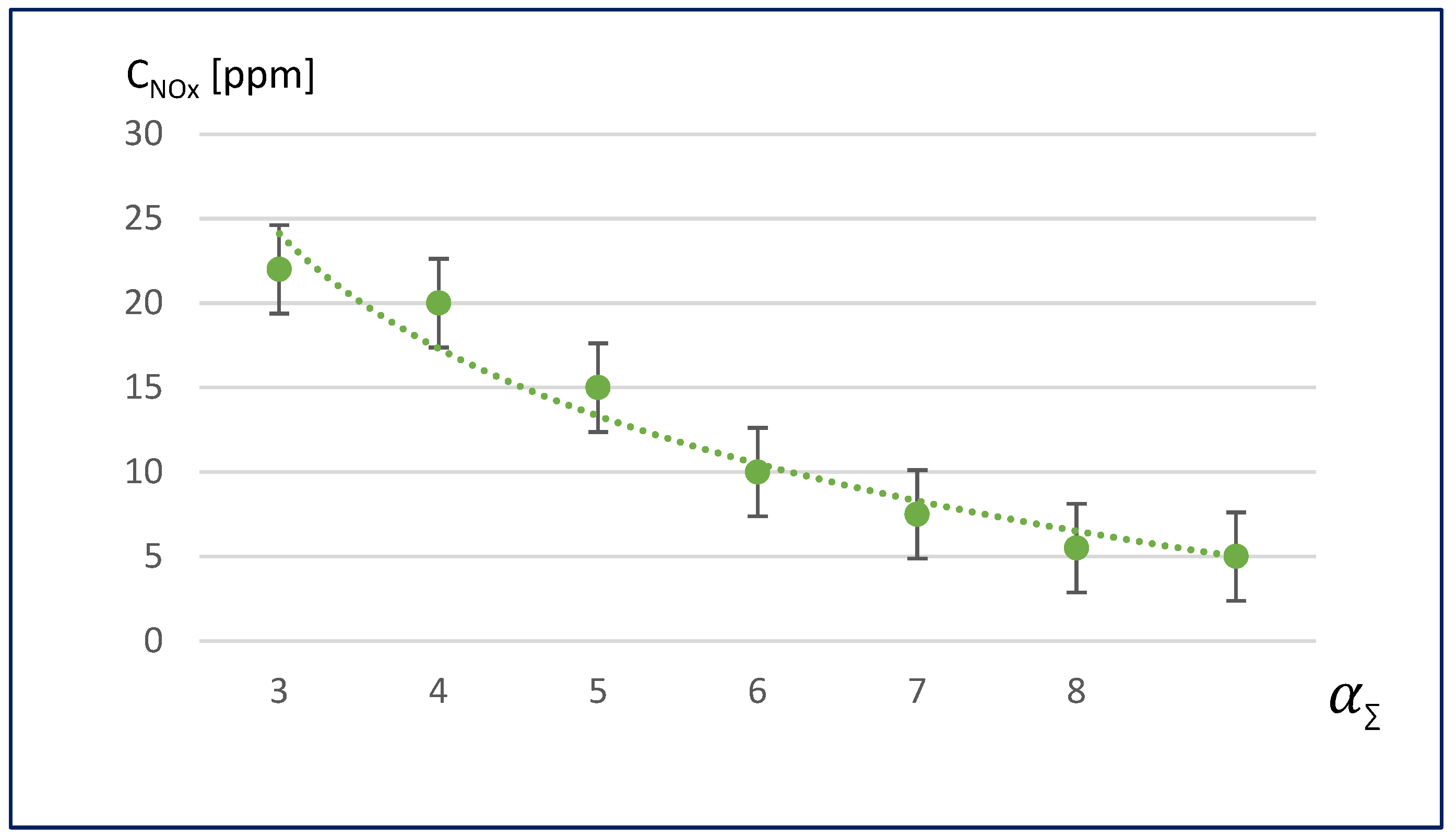
Existing systems for calculating NOx emission levels in gas turbine combustors vary significantly in terms of complexity, applicability, and computational cost. The use of simplified semi-empirical equations is limited to specific types of GTE combustors; applying these equations to different engine configurations requires the introduction of substantial correction factors [9]. Most of these equations fail to account for the fundamental physical processes occurring within the combustion chamber, as their input parameters reflect neither the combustor architecture, nor its geometry, nor the specific combustion mode employed. The use of simplified equations allows for the description of NOx yields in conventional combustors with a margin of error of up to 30% [10]; achieving greater accuracy is hardly possible without incorporating a significantly more rigorous treatment of the working processes occurring within the combustion chamber. Furthermore, empirical correlations do not allow for tracing how emissions change in response to modifications in the front-end assembly design or the architecture of the combustor itself. Advanced models incorporate a chemical kinetic mechanism based on reaction pathways in the primary zone. This mechanism is coupled with a flow model to integrate NOx kinetics with gas-dynamic and thermal processes. In [11], it is demonstrated that the application of detailed kinetic schemes for the analysis of combustion in real-world chambers is feasible when employing two well-known combustion models: the flamelet model and the reactor model. In the case of diffusion combustors, using these detailed kinetic schemes results in a variance of NOx values ranging from approximately 50% to 100%. Conversely, simulations of premixed (homogeneous) combustors show significantly lower discrepancies between different kinetic schemes. In actual combustion chambers, the presence of unsteady recirculation zones and cross-jets can cause turbulence models to underestimate turbulence levels and turbulent diffusion by several orders of magnitude. The most comprehensive approach to determining NOx through effective parameters is proposed in [12,13,14,15]. This method utilizes a kinetic equation for the conditional process of NOx formation, derived from research on low-emission gas turbine combustor designs. The authors account for air staging along the length of the flame tube and employ temperature averaging based on the residence time in each part of the combustion zone. Furthermore, the model incorporates the fact that nitrogen oxides are formed primarily within the combustion zone and are subsequently subjected to dilution. However, a significant drawback of this method is that it fails to account for temperature non-uniformity across the combustor cross-section. In light of the identified limitations of existing premixing systems, an original technical solution has been proposed. A patent application for the developed burner design—incorporating an intelligent emission control system—has been filed with the Patent Office of the Republic of Kazakhstan (Registration No. 2025/1016.1). As demonstrated by experimental studies of this burner device equipped with an air nozzle, the dependence of nitric oxide (CNOx) formation on the overall excess air ratio (α) at different inlet excess air ratio (αin) can be expressed. Figure 1 shows that the highest NOx emissions were obtained during operation with a fuel–air mixture at αin = 1–1.12 and α∑ = 3.
The minimum toxicity of the combustion products was achieved at αin = 1.7–1.8; in these cases, the concentration of nitrogen oxides in the combustion products during fuel combustion did not exceed 20 ppm. Further increase in the excess air ratio leads to a reduction in the total amount of nitrogen oxides formed. One of the objectives set during the development of the experiment was to design a burner device capable of producing a controlled and adjustable temperature field at the outlet of the combustion chamber, while maintaining a low degree of temperature field non-uniformity. The results of the conducted experimental studies confirm that precise control of the excess air ratio in the primary zone of the air atomizer serves as an effective tool for the deterministic regulation of the temperature field structure. It has been established that optimization of the local value of αin directly within the flame front assembly enables the minimization of thermal nitrogen oxide formation, thereby ensuring stable maintenance of low-emission characteristics of the gas turbine engine over a wide range of operating conditions. The transition to operating combustion chambers on ultra-lean mixtures to achieve target NOx emission levels inevitably raises the issue of maintaining dynamic flame stability. Flame blowout and thermoacoustic instabilities become critical for the reliability of maneuverable GTEs, especially during ‘idle’ and rapid acceleration regimes characterized by significant mixture fluctuations. The proposed burner device design makes it possible to mitigate the risks associated with deep mixture leaning. The system promptly adjusts the local value of the excess air ratio directly within the flame front assembly, maintaining the process within a narrow range between the zone of intensive NOx formation and the flame blowout limit.

4. Conclusions

In conclusion, it must be noted that under real-world operating conditions—particularly for transport and maneuverable GTEs—the unit almost never operates solely at a single nominal rating. Transient processes, such as idle, start-up, acceleration, or part-load operation, are characterized by abrupt changes in fuel flow while the airflow maintains high inertia.
The excess air ratio in the front section acts as the primary control parameter. Rapid airflow redistribution enables the combustion process to stay within a narrow operating window, ensuring compliance with emission standards regardless of the overall load on the GTE.
The proposed burner design, featuring intelligent control, enables the dynamic adjustment of local αin values, thereby ensuring that NOx emissions remain within permissible levels across all operating modes.
Despite the results achieved, this field remains highly specialized and necessitates further in-depth investigation. Future interdisciplinary research into these processes will facilitate the transition from static models to the development of Digital Twins for combustion chambers. Such systems will be capable of real-time optimization of the working processes in next-generation gas turbine engines.

Author Contributions

A.D., Y.B., M.K., and N.T. worked on all the tasks, Y.B., M.K., N.T., and H.B. worked on the literature review, I.I., I.B., and H.B. performed the supervision, and all authors analyzed the results. All authors have read and agreed to the published version of the manuscript.

Funding

This study was financed by the European Union-NextGenerationEU through the National Recovery and Resilience Plan of the Republic of Bulgaria (project No.: BG-RRP-2.013-0001-C01).

Institutional Review Board Statement

Not applicable.

Informed Consent Statement

Not applicable.

Data Availability Statement

All data can be used on request.

Conflicts of Interest

The authors declare no conflicts of interest.

References

  1. Di Nardo, A.; Giacomazzi, E.; Cimini, M.; Troiani, G.; Scaccia, S.; Calchetti, G.; Cecere, D. Development of a Low-NOx Fuel-Flexible and Scalable Burner for Gas Turbines. Energies 2025, 18, 1768. [Google Scholar] [CrossRef] [Scilit]
  2. Zeinali, S.; Neshat, E.; Mollayousefi, S. Numerical investigation on different effects of recirculated species on UHC and CO formation during lean homogeneous combustion. Sci. Rep. 2025, 15, 10859. [Google Scholar] [CrossRef] [Scilit] [PubMed]
  3. Li, L.; Zhou, Y.; Yang, C.; Peng, A.; Huang, G. Experimental investigation on the NO formation of pulverized coal combustion under high-temperature and low-oxygen environments simulating MILD oxy-fuel combustion conditions. Carbon Resour. Convers. 2023, 7, 1002024. [Google Scholar] [CrossRef] [Scilit]
  4. Jiménez, C.; Cole, R.; Noble, D.; Steele, R.; Wu, D.; Emerson, B.; Lieuwen, T. Towards the Development of an NH3-RRQL System Part 2: Effects of The Primary Combustion Zone Length and Secondary Stage Number of Holes on Stability and Emissions. J. Eng. Gas Turbines Power 2025, 148, 4069538. [Google Scholar] [CrossRef] [Scilit]
  5. Adam, A.; Elbaz, A.; Kai, R.; Watanabe, H. A Numerical Investigation of the Flame Characteristics of a CH4/NH3 Blend Under Different Swirl Intensity and Diffusion Models. Energies 2025, 18, 3921. [Google Scholar] [CrossRef] [Scilit]
  6. Füzesi, D.; Malý, M.; Jedelský, J.; Józsa, V. Numerical modeling of distributed combustion without air dilution in a novel ultra-low emission turbulent swirl burner. Phys. Fluids 2021, 34, 043311. [Google Scholar] [CrossRef] [Scilit]
  7. Berger, L.; Attili, A.; Pitsch, H. Intrinsic instabilities in premixed hydrogen flames: Parametric variation of pressure, equivalence ratio, and temperature. Part 1—Dispersion relations in the linear regime. Combust. Flame 2022, 240, 111935. [Google Scholar] [CrossRef] [Scilit]
  8. Lee, I.; Woo, I.; Lee, M. Effects of nitrogen dilution on the NOx and CO emission of H2/CO/CH4 syngases in a partially-premixed gas turbine model combustor. Int. J. Hydrog. Energy 2016, 41, 15841–15851. [Google Scholar] [CrossRef] [Scilit]
  9. Sinha, A.; Swain, B.; Behera, A.; Mallick, P.; Samal, S.; Vishwanatha, H.M.; Behera, A. A Review on the Processing of Aero-Turbine Blade Using 3D Print Techniques. J. Manuf. Mater. Process. 2022, 6, 16. [Google Scholar] [CrossRef] [Scilit]
  10. ST GU153-39-020-2005; Gas Turbine Installations. Methodology for Measuring Thermal and Gas-Dynamic Parameters of Gas Turbine Installations. Ministry of Energy of the Republic of Kazakhstan: Astana, Kazakhstan, 2005.
  11. Lebedev, B.P. On the Influence of Fuel–Air Mixing on the Fuel Combustion Process in the Primary Zone of a Gas Turbine Engine Combustion Chamber; Trudy TsIAM: Moscow, Russia, 1982. [Google Scholar]
  12. Naushiev, T.E.; Dostiyarov, A.M. Analytical model of nitrogen oxide formation in the combustion chamber of GTU. Sci. Educ. South. Kazakhstan/Ser. Ecol. 2006, 5, 71–74. [Google Scholar]
  13. Lyubchik, G.N. Indicators of toxicity and energy characteristics in the diagram of operating modes of fuel-burning devices. In Thermocatalytic Purification and Reduction of Toxic Emissions into the Atmosphere: Collection of Scientific Papers; Institute of Gas of the Academy of Sciences of the Ukrainian SSR, Ed.; Naukova Dumka: Kyiv, Ukraine, 1989; pp. 33–39. [Google Scholar]
  14. Ongar, B.; Iliev, I.; Nikolić, V.; Milašinović, A. The study and the mechanism of nitrogen oxides’ formation in combustion of fossil fuels. Facta Univ. Ser. Mech. Eng. 2018, 16, 273–283. [Google Scholar] [CrossRef] [Scilit]
  15. Ongar, B.; Iliev, I.K.; Smagulova, G.K.; Nurova, A.I. Numerical simulation of the formation of nitrogen oxides in pulverized furnaces. J. Eng. Sci. Technol. Rev. 2020, 2, 171–175. [Google Scholar]
Figure 1. Dependence of nitric oxide formation on operating parameters.
Engproc 154 00053 g001
Disclaimer/Publisher’s Note: The statements, opinions and data contained in all publications are solely those of the individual author(s) and contributor(s) and not of MDPI and/or the editor(s). MDPI and/or the editor(s) disclaim responsibility for any injury to people or property resulting from any ideas, methods, instructions or products referred to in the content.